


“In this fort there were Egyptians and Moriscoes that were banished as myself.”Footnote 1 Made around 1600, this is the earliest known observation of a Romani presence in the Central African region.Footnote 2 The fort in question is the Portuguese fortress of Massangano (Forte de Nossa Senhora da Vitória de Massangano), a key post at a major river crossing important for Portuguese control and trade security, located in the north of what is today the Republic of Angola. The observation was made by the English seaman Andrew Battel. Not much is known about Battel. He seems to have left England on a privateer around 1597, was captured by the Portuguese in Brazil, and sent to Angola. Once there, he was first made to serve as a sailor and soldier, rose to the rank of sergeant, and later became a trading agent for the Portuguese governors. He stayed in Angola until the spring of 1607, when he fled northward to the Kingdom of Loango, and returned to England around 1612. His report, “The Strange Adventures of Andrew Battel of Leigh, in Angola and the Adjoining Region,” as it was first written up in Samuel Purchas’ Purchas His Pilgrimage (1613) and later variously edited and amended, has become “a priceless source for the otherwise poorly documented history of Angola between ca. 1590–1606.”Footnote 3
Six years into his banishment to Massangano, Battel attempted to escape with other soldiers also impressed into service in this fort, including several Romani men:
To one of these Egyptians I brake my mind, and told him that it were better for us to venture our lives for our liberty than to live in that miserable place. This Egyptian was as willing as myself, and told me he would procure ten of his consorts to go with us. So we got three Egyptians and seven Portugals. That night we got the best canoe that we could find, and went down the river Cuanza … .Footnote 4
He then goes on to describe how the group tried to reach the Kingdom of Loango, but was recaptured:
The seventh day, in the morning, we saw the captain of the city come after us with horsemen and great store of negroes. Hereupon our company being dismayed, seven of our faint-hearted Portugals hid themselves in the thickets. I, and the four Egyptians, thought to have escaped, but they followed us so fast that we were fain to go into a little wood. As soon as the captain had overtaken us he discharged a volley of shot into the wood, which made us lose one another.
Thus being all alone, I bethought myself that if the negroes did take me in the woods they would kill me … Whereupon I yielded up my musket and myself.
Then the captain commanded all the soldiers and negroes to search the woods, and to bring them out alive or dead, which was presently done. Then they carried us to the city of San Paulo [Luanda], where I and the three Egyptians lay in prison three months with collars of iron, and great bolts upon our legs, and hardly escaped.Footnote 5
After this episode, Romani people do not appear again in “The Strange Adventures of Andrew Battel.” This brief mention of the attempt to flee their forced exile in the interior of Angola, however, suggests how the social position of Romanies within the early modern Portuguese world was connected to colonial processes of expropriation and exploitation. As a combination of penal servitude and exile, the Portuguese system of transport served as a mechanism of conquest, colonization and settlement.Footnote 6 Ciganos – as Romani people have become known in the Lusophone world – were folded into this system through legislation and policies that were specifically aimed at them and that continued to single them out. Focusing on one colony, Angola, this chapter shows that Ciganos emerged as a specific surplus population that was deportable and extinguishable, how their transportation and coerced labor supported an empire and how Romani individuals and families navigated this colonial South Atlantic world.
The Fort of Massangano was one of several military outposts built across Angola to solidify Portuguese occupation and protect commercial flows, including the trade of the enslaved to the Americans. Like other colonial outposts in Africa, Asia and South America, it required soldiers and colonists. While some colonies, such as the Azores in the sixteenth century or BrazilFootnote 7 after the seventeenth century, were eventually able to attract free colonizers, most Portuguese outposts depended on a constant supply of penal exiles, so-called degredados. Battel and other soldiers in “The Strange Adventures” – Romani, Portuguese and Moorish – were all sent to Angola by the courts or Inquisition for varying lengths of time through criminal exile, or degredo.
The Portuguese army, especially overseas where the hold of central authorities was strategic yet tenuous, was manned by such soldiers. Angola, São Tomé and Maranhão, in particular, were centers of degredos. These were the least desirable destinations, generally reserved for those accused of unpardonable crimes, such as heresy or counterfeiting.Footnote 8 The mortality rate was high, even before the soldiers reached the forts, and so was the turnover of the corps. The rate of desertion was also high – Battel attempted to escape three times. Degredados, feeling that they would never return to Portugal (or wherever they desired to live), tried to change their fate; they pushed to be relocated, left the assigned locales or deserted. Others evaded military service through marriage, tried to make a living as traders in the interior, joined the natives, looked for ways to return clandestinely to Portugal or attempted escape to more desirable colonies, like Brazil. When they failed, they were punished with a prolonged sentence, sent to other colonies such as São Tomé, or both.
Romani people were thus co-constitutive of early modern Portuguese Angola, yet their position was singular. Throughout the eighteenth century, for instance, as I will show below, Romani individuals were transported to Angola without committing any apparent crime – only for being Ciganos – and banished for perpetuity. No other group was criminalized in Portugal in this way. While Ciganos’ fate intertwined with that of others, as in Battel’s account of escape, the same processes that brought these people together also set Romani individuals apart, limited their sphere of action and determined the characteristics ascribed to them. They were in a different position than the native Africans, particularly the enslaved – the core distinction structuring Angolan society in the eighteenth century was that between the enslaved and the enslavers.
Once in the colony, degredados were free to move within an assigned locality, allowed to work and paid for their labor. If they were in the army, a common sentence for many, they would be referred to and treated as soldiers and from historical documents it becomes impossible to determine which soldiers were volunteers and which were degredadosFootnote 9 – in other words, those considered undesirable, antisocial and even dangerous to the social order at home would be treated as useful to the imperial project abroad.Footnote 10 Like others who had been shut out from opportunities in Portugal, such as the New Christians, historical documents suggest that some Romani individuals succeeded in making a living through trade – sometimes even transatlantically – of the enslaved, ivory and other products on the margins of this Atlantic system.Footnote 11
In the context of overseas expansion and state-building, and depending on specific needs, Ciganos became a category of people who could be pressed into galleys or the army or be sent to populate colonies and man garrisons. They were not like other forced colonizers, however. Rather, documents show that they continued to be singled out in ways that dynamically improvised the characteristics and terms of Romani difference, distinguishing them not only from other Portuguese subjects in the metropole, but also from other people in the colonies, including other degredados, when required. In the early modern era, then, Romani difference became elaborated against this colonial setting. Ultimately, this chapter suggests, early modern ideas about “Gypsies” are contingent upon contemporary circumstances and not solely of European provenance.
From Galleys to Perpetual Banishment
Dating from January 29, 1752, a carta de guia – a letter of guidance or instruction – accompanied the transport of Luis José, a 32-year-old Cigano man from Lisbon, on a ship from Bahia, Brazil.Footnote 12 It was handed over to the magistrate in Luanda by the ship captain and was, with all probability, written up by a jailer of exiles in Limoeiro, Lisbon, where Luis had arrived as part of the leva, a chain gang of convicts, from Beja in the interior of southern Portugal.Footnote 13 Luis was deported along with his wife, whose name is not stated, and five children: João (10), Maria (9), Manuel (8), Mariana (5), and Joana, probably still an infant, as her age is not given.
It is unclear how long the family had waited in Bahia for a ship to take them to Luis’ destination of degredo, but it seems that Luis had a brother who also had ended up in Angola.Footnote 14 Four years before him, another Cigano man, Vitorino José, with the same surname and same father (João Rebelo), had arrived accompanied by a wife and daughter. Twenty-year-old Vitorino, whose hometown was Alcácer do Sal, was brought by a ship from Bahia on July 13, 1748, as part of the leva from Aldeia Galega de Riba-Rio.
Leva, a coffle or a convict convoy, was a common early modern system in many European countries through which convicts were collected and transported. In Portugal, judicial district magistrates would be responsible for organizing the transportation of a group of at least six soon-to-be-exiled convicts to the next district, where more would be added until they reached Lisbon.Footnote 15 There, they would wait to be taken to the galleys or to board ships heading to colonies. The whole process might have lasted several months, and the sea journey itself sometimes passed through several ports. While Vitorino arrived in July 1748 as the only Cigano out of five convicts aboard the ship, other Cigano men in the same draft of convicts from Aldeia Galega de Riba-Rio had arrived a few months earlier, also via Bahia, on May 4 and 7, 1748, respectively. The first ship brought three penal exiles – all Cigano men – while the second brought three convicts, of which two were Ciganos. Like Vitorino, the Romani men were young, aged between eighteen and twenty-six, and unlike him, all were single; they were clearly expected to serve as soldiers. The fact that they were from the same leva might suggest that the authorities had organized a sweep through a Romani community in the region, collecting suitable men to serve as soldiers in Angola and maybe other colonial outposts.
In theory, cartas de guia were standardized documents. Each contained information about the convict, such as their name, parents’ names and hometown, and sometimes provided other distinguishing features, such as profession, physical description or race. It also described their crime and specified the length of exile. In practice, sometimes cartas were incomplete or even missing. Nevertheless, 1,328 cartas de guia for the period between 1714 and 1757 have been preserved by the Luanda municipal council,Footnote 16 and the comparison within this register is instructive.
First, Luis José’s race is explicitly stated as “Cigano”; in total, sixty-seven individuals (5 percent) are marked as Cigano men or women within the Luanda register. Second, unlike the cartas of the non-Romani degredados aboard on the same ship, Luis’ does not specify any crime for which he was being exiled. Third, like his brother Vitorino a few years earlier, Luis was accompanied by his family. Although authorities near the end of the century would encourage the transport of Romani couples and families to colonies to serve as settlers,Footnote 17 this practice was uncommon at the time of Luis’ voyage. These three facts relate to the fourth difference between his and other cartas from the period: Luis’ length of banishment is not specified, as by the mid-eighteenth century it had become expected that exiled Ciganos would never return to Portugal. This becomes clear from the cartas de guia of Vitorino and other young men from the same leva: their race is specified as “Cigano,” which is also their only crime, they are sentenced to “perpetual banishment” (extermínio perpétuo) and, were they to return to Portugal, they would be sent to the galleys.
While Romani people constituted only a very small portion of convicts, the historical documents index their differential treatment and position within the transport system. First, from the Luanda register of 1,328 degredados, only thirty-five arrived accompanied by another family member.Footnote 18 Of these, ten were Romani, including, surprisingly, three women, as women were rarely transported to Angola. For instance, Joaquina de Morais, sentenced on April 19, 1753, for being a Cigana, arrived in Angola with her husband and two children.Footnote 19 Second, for half of Romani degredados, the only “crime” indicated on their cartas de guia is that of being a Cigano. Third, in most Cigano cases (almost 80 percent), the length of punishment was a lifetime. Although a sentence of “perpetual degredo” (degredo perpétuo) appears in 15 percent of all cases found in the Luanda register and in 19 percent of Romani cases, sentences of “banishment” (extermínio) or “perpetual banishment” (extermínio perpétuo), which foreground expulsion and elimination from Portugal, are specific only to Ciganos and appear in 38 percent of cases. Moreover, almost a quarter of Romani cartas de guia do not specify the length of exile, which might suggest that non-return was assumed by all involved. Taken together, these differences are striking. They make it clear that, in addition to obtaining labor for the Angolan colony degredo was used to rid the metropole of Romani inhabitants.
While it is not clear how representative the Luanda register is of the penal transport system as a whole, criminal exile undoubtedly influenced how Romani individuals in Portugal and its colonies were viewed and treated, as well as what possibilities and characteristics were ascribed to them. In other words, the Romani people were set apart by a specific mode through which, at various levels, Portuguese antigypsy policies fed into the convict labor system and the needs of the colonial empire. And while the targeting of Romani people through specific legislation preceded the Portuguese colonial settlement (excluding the first North African outposts), it was reshaped by expansion into places such as Angola.
There is no space to discuss this dynamic in detail, but it should be noted that the Portuguese system of degredo and Portuguese antigypsy legislation developed together as part of the same dynamic process. Portuguese monarchs repeatedly – in, for instance, 1526, 1538, 1557, 1579, 1592, 1603, 1606, 1647, 1650, 1686, 1718, and 1745 – issued laws and edicts against Ciganos or those leading Cigano-like lives.Footnote 20 Punishments varied (expulsion, corporal punishment and even the death penalty), but galleys, forced labour and deportation to colonies (or between them, if the law concerned a colony) appeared consistently. As the historian Timothy Coates observes, “as early as 1573 (and probably well before that), Gypsy men had been singled out as a likely labor source,”Footnote 21 but Romani people alone could not solve the ongoing manpower shortages in galleys and, increasingly, in new colonies.Footnote 22 The entanglement of antigypsy policies with the convict labor system, coupled with the needs of the colonial empire, became a mechanism for their categorization, marginalization and control of Romani people within the early modern Lusophone world. The proliferation of antigypsy statutes from the end of the sixteenth century until the first half of the eighteenth century created a configuration aimed at eliminating the Romani presence through criminalizing Romani modes of dwelling in the world, such as community life, kinship, language and economic activities. Characteristics attributed to Ciganos became the basis for their deportability, and by the mid-1700s, Portuguese magistrates could gather Romani individuals into chain gangs and transport them to colonies, without specifying the length of their punishment, simply for being Ciganos. The frequent requests (or demands) to send entire Romani families to Angola, such as those discussed in the next section, show that Romani people were constituted as a special category of potential forced settlers because of their criminalization as Ciganos.
This configuration was constantly changing, with its aspects more or less influenced and made possible by particular historical conditions. For instance, the punishment of the Romani men and women who arrived in Angola in 1741 was “extermínio conforme as ordens do Rei” – “the removal on the king’s orders.”Footnote 23 They were all accused of the same crime (cattle stealing) and were a part of the leva of Campo Maior. There is no record of recent royal orders, so the justification for their permanent deportation (itself disproportionate given their alleged crime) must have lain in the antigypsy policies already in place, which were mobilized to meet some specific needs in Portugal or overseas; indeed, four years later, in 1745, the king passed a decree which explicitly ordered the implementation of the existing laws related to the expulsion of Ciganos.Footnote 24 Similarly, when half a century later the superintendent general of the police argued for the need to transport Romani couples and families to the colonies, he not only pointed to the complaints from Portuguese authorities regarding Romani individuals and to the colonies’ need for more European settlers, but stressed that there was already related legislation in place. In a letter to the secretary of state for the internal affairs of the kingdom, he systematically listed nine laws and decrees from the period between 1606 and 1745 that he found necessary to implement.Footnote 25 In sum, within the context of colonial expansion, the assemblage of laws, institutions and infrastructures led to the naturalization of hierarchies within Europe and enabled the appropriation of Romani labor necessary for galleys, military occupation, colonial settlement and wealth expropriation, including the enslavement of Africans. The meaning of Romani difference was not static, however, but became transformed with colonization.
Moving between South Atlantic Locales
During the seventeenth and eighteenth centuries, forced colonization was the only way to secure the functioning of colonies such as Angola. The lack of effective control, manpower shortages, the unruliness of colonists and the uncontrollable trade of the enslaved were all matters of frequent correspondence between colonial authorities and the metropole. For instance, in a letter to the king from June 22, 1754, the new governor António Álvares da Cunha (1753–58) argued that the shortages made it impossible to defend the kingdom of Angola. Among other things, he asked for craftsmen from the Azores and for Ciganos, who he believed “are the most suitable soldiers for this climate because they are the most resistant to it.”Footnote 26 Cunha’s other letters throughout 1754 and 1755 testify to his attempts to bring the colony under control and to expand it. On December 2, 1754, he provided an overview of the workforce available to him, complaining that the whites in Angola, predominantly those deported from Portugal, were all thieves and rebellious even under the threat of punishment, while mulattoes and Blacks were too soft and weak to be given any responsibility. He listed the specific categories of men he needed: Portuguese army officers, men from the Azores and, for the cavalry, he thought most useful that “many Ciganos and their wives are brought here, because they are also the most resilient in this climate, and they have not proven to be evil in their deeds.”Footnote 27 Three months later, at the end of a letter to the secretary of state in which da Cunha outlined his vision for various army regiments, he requested men from the Azores for the infantry and Ciganos for the cavalry, “who could come with their wives.”Footnote 28
The Overseas Council was not unresponsive to these needs, although they brought different assumptions to the plan. Foregrounding the annihilation of Romanies throughout Portuguese realms rather than colonial settlement, in October 1754, the Crown’s treasurer noted:
Since the Governor says that the Ciganos serve well in Angola, it seems to me that it would be useful for him and for that Kingdom to send one hundred of the men he asks for, ordering the Duke Regedor and the Porto Court of Appeals to arrest and prosecute them, that they are young men between 18 and 20 years old and unmarried, because by separating them in this way, and by being able to send the young women to another colony, this caste without public utility can be wiped out, and these one hundred men can be distributed among the ships going to [Angola], so that they are transported without great costs.Footnote 29
Though such numbers were never achieved, a year later on September 11, 1755, the secretary of state in Lisbon wrote a letter to the governor and Crown’s officials in Bahia that they were sending “eleven Cigano couples” who should be taken care of at the treasury’s expense and then sent on the first available ships to Angola where the men were to serve as soldiers.Footnote 30 This is probably the best-documented case of Romani transport and the only one for which there are documents from various Atlantic locales. The register written up in Salvador on November 19, 1755, lists ten Cigano couples (three with children) and one single Cigano man. The men were aged between twenty-five and fifty-two and several were born in Spain.Footnote 31 In May 1756, the governor of Bahia confirmed that he had transported all but one of the Ciganos, who would follow on the next occasion;Footnote 32 four of these men are listed as arriving in Luanda in February 1756.Footnote 33
Curiously, while the governor of Bahia continued speaking of “eleven Cigano couples,” the scribe of the General Criminal Inspectorate in his note to the same letter wrote that only three of the Ciganos who arrived in Angola did so with their wives.Footnote 34 We do not know what happened to the other women; maybe they decided to stay in Brazil and wait for their husbands’ return (through escape or discharge), or they were sent later on other ships. As the policies and their implementation were inconsistent, forced family separation is also a possibility. Whatever the case, along with the fact that these degredados were part of one leva from Évora and that degredo often led to separation of couples and families, this fact points to the deportation system’s destructive impact on Romani communities in Portugal and the need to reconstitute communities and family lives overseas.
It is impossible to say how the policy of supplying Cigano soldiers for cavalry in Angola would have developed. On November 1, 1755, while Nossa Senhora da Natividade with the “eleven Cigano couples” was on the high seas approaching Salvador, the Great Lisbon Earthquake destroyed nearly the whole city and killed thousands. The earthquake and subsequent fires also destroyed the prison of Limoeiro, which held the cartas da guia jailers had written up over two centuries. Additionally, the tragedy led to a change in priorities, and degredados, including Ciganos, were now employed in public works in Portugal rather than sent overseas.Footnote 35 The next governor of Angola, António de Vasconcelos (1758–64), was also less keen on Ciganos as a solution to critical manpower shortages and ineffective governance within the colony. Quite the contrary. In communications to the state secretary in 1759, he complains variously of “the degredados of Limoeiro, Ciganos, and New Christians” or of “the convicts of the Holy Office, the thieves of Limoeiro, and Ciganos” who roam freely through the interior of Angola, become rich and corrupt others; he urges that instead of banishment to Angola, they be put to the galleys or placed in houses of correction.Footnote 36 In the jurisdictions of Benguela and Caconda, he noted, Ciganos even left to live with the natives (gentio bravo) to the great detriment of commerce.
The system of degredo forged an expendable labor force for the central government that could be deployed depending on current needs and priorities. Consequently, while waiting in Limoeiro for ships to take them to their assigned locales, prisoners frequently saw their sentences commuted elsewhere. The length and locale of service could be revised, and even pardons were not uncommon. Flexibility was “the rule rather than the exception” of the Portuguese system of penal exile.Footnote 37 For instance, a ship from Lisbon that arrived in Luanda in May 1751 brought six degredados – all Cigano men.Footnote 38 Like many before and after them, the men were meant to serve as soldiers: they were aged between seventeen and forty, and all but the oldest were single. Their only crime was that of being Ciganos; they were banished “on the king’s orders,” and the duration of their punishment was unspecified. Originally, however, they had been sentenced to be transported to Cape Verde or São Tomé.
Throughout the eighteenth century, degredados, including Ciganos, arrived in Angola not only from Portugal, but also from other colonies, particularly Brazil. This intensified at the beginning of the century when Brazil was attractive enough to European settlers that it did not require forced colonists; meanwhile, the Crown was stepping up its measures to eliminate Romani people from the metropole by transporting whole families and communities.Footnote 39 Brazilian authorities resorted to deporting Ciganos to Angola, revealing a close and interdependent – but unequal – relationship between the two locales within the Lusophone South Atlantic space. In response to the royal order from October 1719 to send horses to Angola, for instance, the governor of Rio de Janeiro explained in July 1720 that he had not yet sent any; instead, he had prioritized shipping a significant number of Ciganos who had been imprisoned in the city for causing trouble.Footnote 40 In 1723, the governor of Minas Gerais ordered the arrest of “every Cigano man and woman together with anyone in their company” because they were “highly prejudicial to the community as they do not live except by stealing,” demanding they be deported to Angola.Footnote 41 In 1725, when the city magistrates of Olinda complained about the disturbances and thefts committed by the Ciganos, the king ordered the governor of Pernambuco to “send them to the Captaincy of Ceará, where they will be able to do some service in the conquest of the Indigenous people [gentio brabo].” Those Ciganos who refused to lead “orderly lives” (vida civil) and earn money through regular trade were to be expelled and deported to Angola immediately.Footnote 42
The Luanda municipal council protested against it becoming a dumping ground for degredados from elsewhere. In 1720, it complained of such Romani retransports, pointing out that “all Ciganos who have been sent to Rio de Janeiro, Bahia, and Pernambuco invariably end up in the kingdom of Angola.”Footnote 43 While Angola was a place for convicts from other localities, São Tomé, probably the least desirable location that throughout its duration as a Portuguese colony was primarily and by design inhabited by degredados and the enslaved, was a place for convicts from Angola. In 1735, a Cigano, João da Costa Rocha, was deported from Angola to São Tomé due to theft, violence and being disruptive to the trade in enslaved Africans.Footnote 44
The core places of degredo shifted over time. During the seventeenth century, the main destination for penal convicts was Brazil, but by the mid-eighteenth century it had become Angola. The relative standing of each colony at a particular moment – its character, economic position, links and relationships with Portugal and other colonies – played a role. In the process, soldiers, colonial officials, sailors, merchants, commoners and exiles, including Romani people, circulated between Angola, Brazil, Portugal and other locales, forming commercial networks and connecting various Atlantic shores.
Convict Traders
Across the early modern Lusophone world, Romani people were particularly vulnerable to being targeted by the authorities. Their lives were overshadowed by laws forbidding “living like a Cigano,” and by eviction, restrictions of mobility, forced labor or dislocation. Even assimilated Romani individuals were prosecutable as “Ciganos.”Footnote 45 Depending on local circumstances, momentary demands, and intra-locale calculus, one’s belonging was always at stake; a threat of being taken to the galleys, conscripted into the army, separated from one’s family, exiled to a colony or transported to another and a general inability to move to or live how one desired loomed on the horizon.
These were the concerns of Luis Fernandes de Abreu, his brother Manoel Rodrigues, “also a Cigano,” and their families, who in 1736 were living in Rio de Janeiro.Footnote 46 The documents do not say why they had come there, but they wanted to return to Angola, where they had previously lived. Luis Abreu feared, however, that upon his return he would be forced into the army, which he sought to remedy by seeking royal assurances.
According to the transcription of the marriage record, which a parish priest from Our Lady of Remedies in Luanda sent to Lisbon in April 1734 to support Luis’ petition, Luis was the son of Sebastião Fernandez and Engracia de Abreu, both Ciganos, and natural citizens of Estremoz, Portugal. He had come “to the Kingdom of Angola without crime or banishment” and had served as a soldier from February 21, 1720, until December 1, 1733. In Luanda, on December 13, 1722, he married Rosa Maria, daughter of the Ciganos Lourenço Martins and Catharinas Marias, and natural citizen of Masranilha, in the Bishopric of Seville, Spain. According to the supportive statement by the governor, “this Cigano (supposed to be such) always lived here behaving properly, both in the time of my government and in that of my predecessors, is married, has children and is poor.”Footnote 47
Luis Abreu’s case shows how tenuous was the border between freedom and unfreedom for Romani people and in ways specific to them. Across the Lusophone world, authorities variously and contradictorily insisted on assimilation, of giving up living together or speaking the language, on the one hand, and on distinguishing Ciganos from other Portuguese, on the other.Footnote 48 For instance, in 1720, when the number of Ciganos brought to Angola both from Portugal and Brazil was increasing rapidly, the municipal council of Luanda forbade “Ciganos to walk in this kingdom wearing [black] cloaks [mantos], but only their garments [manilhas] in the way they moved around in Portugal and Brazil so that they would be recognizable as such.”Footnote 49 A decade later, in the early 1730s, letters between the Overseas Council, the governor of Angola, and the chief Crown inspector of Angola discussed the fact that Ciganos sent to Angola after serving as soldiers were asking for discharge while concealing the fact that they were Ciganos. This not only caused manpower shortages and increased Romani involvement in trade activities in Angola, but there was fear that they would seek to return to Portugal, which was expressly prohibited by the Overseas Council.Footnote 50
In the early modern Portuguese world, then, being labeled as a Cigano had consequences for one’s life. A telling example, from 1767, comes from the other side of the Atlantic, in Bahia. In a petition to the king, Catharina Loba and her daughters, “native citizens [naturais] of the City of Bahia de Todos dos Santos [Salvador],” asked for a permit to trade to earn their living. They argued that while it is true that they “used to sell on the public streets of the said City under the title of Cigano women,” they were in fact “daughters of that City.” Catharina and her daughters insisted that they only had distant relatives who called themselves Ciganos and were marked in documents as such because they had arrived from Alentejo, but who were not, in fact, Ciganos by origin (Ciganos da nação).Footnote 51 No matter the true story of Catharina’s family, since her ancestors were marked as Ciganos and she herself was known as a Cigana, Bahian authorities imposed restrictions that limited the sphere of her actions.Footnote 52
Catharina Loba, Luis Abreu and others navigated an antigypsy environment where the specificities of discriminatory measures differed by locales, and they strove to carve out meaningful lives that they found worth living. Some passed for non-Ciganos, deserted the army, escaped the sites of their penal servitude, attempted to build alternative lives, or traveled to another colony. For instance, in the 1660s, degredados, including reformed prostitutes and Ciganos, surreptitiously boarded ships in Luanda and escaped to Brazil.Footnote 53 Others petitioned the authorities, asserting, like Catharina Loba, their belonging to a locality or, like Luis Abreu, their service to the Crown. The archival documents testify to people’s agency and efforts to expand their space for maneuverability. They also speak of Ciganos’ foresight, social contacts and networks of sociability. A vicar transcribed marriage documents only four months after Luis had been discharged from his duties, which suggests that Luis had already started arranging the documents in Angola. Two captains had been the witnesses at his wedding with Rosa Maria, while the governor testified to his good behavior in a letter to the Overseas Council and even questioned if Luis should be considered a Cigano when he qualified the label with the phrase “supposed to be such.”
At the same time, the Portuguese colonial world and the character of the Angolan colony created opportunities for gain and social ascent. Merchants arrived in eighteenth-century Luanda hoping to earn fortunes or recoup the wealth they had lost in America or Portugal.Footnote 54 Most traders died within months, however, with Luanda in particular, Angola’s main fort and port, coming to be known as the “white man’s grave.”Footnote 55 Some traders managed to retire to Brazil, but many of those who succeeded had originally come to Angola as degredados. Indeed, the convict exiles had little choice but to get involved in trade, since degredo was “a merciful but cruel punishment, to be feared” that isolated individuals and cut them off from their social and economic networks.Footnote 56 Moreover, soldiers’ salaries were inadequate and late, if they came at all. Soldiers were expected to generate additional funds – through trade, for instance – and forge for themselves a more independent base – through marriage, for instance.Footnote 57 These are also things that Luis Abreu and his brother seem to have done.
It is conceivable that Luis had come to Angola of his own free will, as his petition claims. Angola provided new possibilities for men who were desperate or regularly harassed and marginalized in Portugal, including Ciganos. In the early eighteenth century, “debtors, criminals, gypsies [sic], and political exiles” expanded the Luso-African trading frontier by exchanging transatlantic commodities for local goods, including primarily the enslaved.Footnote 58
Ciganos appear in several documents related to the internal Angolan trade. In February 1731, the chief Crown inspector noted that there were at least two Romani communities along the route from the interior of Angola to Luanda, which forced pombeirosFootnote 59 to enter negotiations on their terms. As a consequence of this control of trade in slaves, ivory and honey, Brazilian merchants ventured into the interior on their own in search of slaves, which too was disruptive.Footnote 60 Two years later, the inspector complained again of the disorderly trade caused by the overall greed and avarice of traders, including the Brazilians.Footnote 61 He singled out Ciganos, whom he accused of stealing, killing and price dumping. They could afford to do so, he said, because they obtained their trading goods by forcing pombeiros to sell the enslaved and beeswax at low prices. This situation had allegedly led to general impoverishment in Luanda, especially among soldiers. However, despite frequent complaints, not much could be done because these Ciganos were apparently protected by other influential and powerful people involved in the trade. Similarly, in a letter dated October 15, 1735, the Angolan governor noted that it had been difficult to imprison the Cigano João da Costa Rocha (a trader in the interior mentioned above) “not only because of his remote location, but also because he had people in this city [Luanda] who protected him.”Footnote 62 Thanks to “the capture of that beast and others like him who infest the hinterland, the roads were cleared and the pombeiros can freely reach [the city] with their cabeças [the enslaved; literally ‘heads’].”
Romani people co-created a trading network that connected the Angolan interior with Portuguese-controlled ports or illicit markets on overseas coasts, particularly in Brazil. Various actors were involved in this commercial and logistical network, often with conflicting interests and goals. The documents speak of local authorities of various kinds, market masters, captain majors, soldiers, pombeiros, “naturais da terra” (Luso-Africans), “brancos forasteiros” (foreign whites) and Ciganos, among others. Before going to the interior, traders generally took tradeable American and European goods on credit from Portuguese and Brazilian merchants in the ports. A Cigano man named Manoel Faria Marinho had such an aviante (creditor) in Luanda from whom he obtained “sortimentos” (products) and “carregação” (loads) to trade in the interior, primarily gerebita (sugarcane rum), gunpowder and money. He liquidated this debt by bringing his creditors slaves, ivory, beeswax and other “fazendas” (trade goods). In 1798, he was made to “leave this kingdom [Angola] and not to enter its interior [sertões] anymore” after getting into conflict with the authorities. The report prepared on this occasion by the General Inspectorate of the Kingdom of Angola provides insights into the functioning of the local economy, as well as into ways many Ciganos and others carved out their existence in the Angola of the eighteenth century.Footnote 63
According to this report, Manoel Faria Marinho had been authorized by the Board of Trade to conduct business at a market in Cassange, hundreds of kilometers inland. From there, he would lead caravans to the coast carrying the enslaved and other goods. It was a perilous and arduous journey – often deadly, especially for the captives. He would stop off at Golungo and Ambaca, located between Cassange and Luanda; his own assets (including slaves), which he had accumulated over the years in Angola, were guarded within the jurisdiction of the fort of Ambaca. Other locations, such as Benguela and Haco, are also mentioned as places that Manoel had traveled through at one point or another. The report also gives a sense of his network of contacts, which included market traders, local authorities and other Ciganos who operated in the Angolan hinterland.
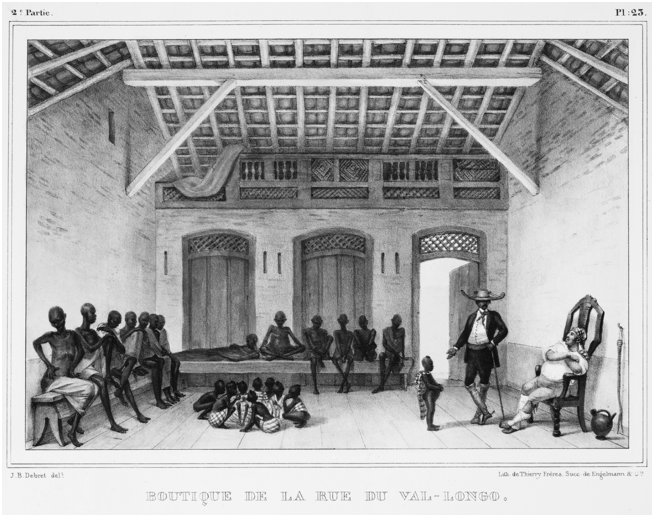
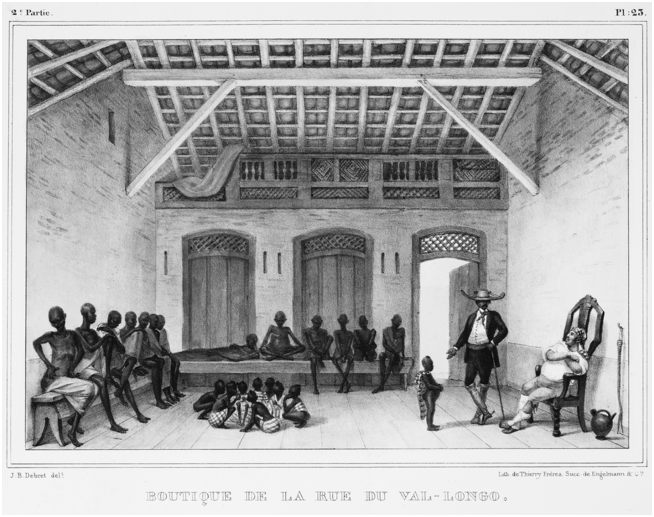
Manoel was “a native of Pernambuco [Brazil], from where he voluntarily came to trade in this Kingdom [of Angola].” His story, like that of Luis Abreu, shows that even for some Romani individuals, movement between Atlantic locales was not only caused by redeportation, escape or commutation of sentences. Credit links extended from Brazil or Portugal to the interior of Angola, and the activities of merchants were not necessarily constrained to their places of residence. Consider the following commentary, suggestive of such transatlantic circulation, that French painter Jean-Baptiste Debret provided for his painting “Boutique de la rue du Val-Longo” (Figure 2.1), which depicts a sale in a Rio de Janeiro shop belonging to a Cigano secondhand seller of enslaved Africans: “[H]e [the Cigano merchant] also suffers, judging by the discolored complexion and a swollen belly, from a [intestinal] congestion that he brought from the African coast, which is so disease-filled that the troops can hardly be stationed there for more than three years without needing to be replaced by fresher ones.”Footnote 64
The accompanying commentary included on pages 78–79 explains: “I have recreated a sales scene. From the layout of the shop and the simplicity of the furniture, we can see that this Cigano, a second-hand seller of negroes (brocanteur de nègres), is of mediocre fortune.”
Given all this, it is conceivable that having survived almost fourteen years in Angola, Luis Abreu hoped to resettle in Brazil. Maybe his family had left Angola while waiting for the royal right of safe return, because of economic considerations, or both. Or maybe he wanted to retire to Brazil due to his failing health – documents suggest that Luis had been ill for some time. Indeed, it is surprising that he lasted in Angola so long. Be that as it may, it seems as though he had been impeded in his plans: his petition notes that he had amassed some wealth in Angola that should have been sent to him in Rio de Janeiro, but had not been; because he was now feeling better, his family would like to return, at their own expense, to Africa.
For Luis Abreu and others, the world of unequally positioned locales created through Portuguese (and European) maritime expansion was also the space of action and maneuverability. While the transatlantic zone, with its affordances and limits, opened some possibilities, it was also striated by restrictions on Cigano mobility and activities. Luis’ parents, at least, were born in Portugal, his wife’s parents in Spain, and his own trajectory had led him from Angola to Brazil, and back to Angola; there might even have been other stops along the way for this family. In November 1737, in recognition of his services and because he had no criminal record, he was granted a royal permit to return from Rio de Janeiro to Angola along “with his family,” “so they can earn their living.” They were allowed to move to or settle in Brazil and Angola without the impediments of courts or authorities, although Portugal seems to have been out of the question.
Conclusions
Romani people played an important role in establishing and maintaining the Portuguese overseas presence, especially in Africa and Brazil – generally involuntarily, but sometimes also voluntarily. Even though they never constituted the majority of convicts sent to galleys, the army or colonies, penal transportation became central to their legal, political and social identity as Romani Portuguese. It set them apart from the rest of the population, attributing characteristics specific to them, and limiting their sphere of action. The threat of degredo was on the horizon for all Romani people and penal banishment and its management should be seen as the defining feature structuring the Romani social position in the early modern Lusophone world. It was not just an epiphenomenon of interethnic relationships, but shaped all aspects of Romani family and community life.
In places like Brazil and Angola in the seventeenth and eighteenth centuries, it gave rise to Romani communities, as many – if not most – of the Ciganos who arrived were convicts banished from Portugal or other locales of the empire. Degredo influenced the lives of these men and women – where they could live, what they could do, how long they were expected to stay and where they could go next. It also played a key role in the lives of those Ciganos who arrived in the colonies on their own accord. In historical sources, this becomes visible in their interactions with authorities, when such individuals never fail to stress that they arrived by their own will or that they were natives to a locality – avoiding any ambiguity in their status was of utmost significance.
Penal transport also played a role in shaping Romani lives and communities in Portugal. In early modern Portugal, since the sixteenth century, the galleys just as degredo – as legal restrictions on movement and residence and, above all, as forms of penal exile – were a common feature of all antigypsy legislation. The legislation singled out Romani people as a potential labor force at the oars or for the colonies, and simultaneously problematized and criminalized Cigano kinship, culture and life. The Cigano way of life was deemed scandalous, something that should disappear from the kingdom and the colonies; deportation was frequently accompanied by a prohibition of Cigano cohabitation, modes of dressing, language and so on. Penal exile constantly threatened Romani social reproduction in Portugal through imprisonment, separation of families or community sweeps through which ships to colonies were to be filled with new forced colonizers.
The history of Romani presence in Angola, North Africa, São Tomé, Cape Verde or Brazil, as well in Portugal, cannot be thought of without taking into consideration the relationships between various South Atlantic – and other – locales. The names of the vast majority of degredados, including Ciganos, are unknown, as they would not normally make it into official correspondence between authorities. Whenever such names appear, they are only preserved in petitions, royal pardons or documents related to their transport. Their story also urges historians not to treat Romani experiences and histories in isolation. In Battel’s account, the Romani, Moorish, Portuguese and other soldiers tried to escape together. This fact is not to be taken lightly; rather, it is an invitation to further explore how navigating the Atlantic world, carving out a meaningful existence or resisting was only possible for Ciganos by relating to others. This is true, even if, through resisting assimilation and community rupture, they also confirmed their cultural autonomy and way of being in the world as Ciganos.

 Open access