





1 Introduction
Throughout this text, q will denote a power of the prime p and n a positive integer. Further,
$\mathbb F_q$
 will stand for the finite field of order q and
$\mathbb F_{q^n}$
will stand for the finite field of order q and
$\mathbb F_{q^n}$
 for its extension of degree n, while for any
$d\mid n$
for its extension of degree n, while for any
$d\mid n$
 ,
$\mathbb F_{q^d}$
,
$\mathbb F_{q^d}$
 will stand for the corresponding intermediate extension of degree d.
Some
$a\in \mathbb F_{q^n}$
 is called primitive if it generates the multiplicative group
$\mathbb F_{q^n}^*$
is called primitive if it generates the multiplicative group
$\mathbb F_{q^n}^*$
 . It is well-known that every finite field contains primitive elements (see [Reference Lidl and Niederreiter24, Theorem 2.8]), while primitive elements of finite fields are important for both theoretical and practical reasons, with their most notable applications found in areas, such as cryptography and coding theory.
On the other hand, some
$a\in \mathbb F_{q^n}$
 is called
$q^n/q$
is called
$q^n/q$
 -normal (or normal over
$\mathbb F_q$
-normal (or normal over
$\mathbb F_q$
 or just normal) if its
$\mathbb F_q$
or just normal) if its
$\mathbb F_q$
 -conjugates, that is, the set

forms an
$\mathbb F_q$
 -basis of
$\mathbb F_{q^n}$
-basis of
$\mathbb F_{q^n}$
 when the latter is viewed as an
$\mathbb F_q$
when the latter is viewed as an
$\mathbb F_q$
 -vector space. A basis of this form is called a
$q^n/q$
-vector space. A basis of this form is called a
$q^n/q$
 -normal basis. The existence of these elements is known.
Theorem 1.1 (Normal basis theorem)
There exists some
$a\in \mathbb F_{q^n}$
 that is
$q^n/q$
that is
$q^n/q$
 -normal.
For a proof of the above, we refer the reader to [Reference Lidl and Niederreiter24, Theorem 2.35]. Although primitive elements are more commonly employed for practical purposes than normal elements, the latter category is important for both theoretical and practical reasons on its own right, with their most notable applications found in areas where efficient finite field arithmetic is important, such as coding theory or radar technology.
A natural question is whether there exist elements of
$\mathbb F_{q^n}$
 that combine both of the above properties. The answer to that question was given by the following celebrated result.
Theorem 1.2 (Primitive normal basis theorem)
There exists some
$a\in \mathbb F_{q^n}$
 that is simultaneously primitive and
$q^n/q$
that is simultaneously primitive and
$q^n/q$
 -normal.
The above was initially established in 1987 by Lenstra, Jr. and Schoof [Reference Lenstra and Schoof23], but Cohen and Huczynska [Reference Cohen and Huczynska9] gave a computer-free proof in 2003. Both of these works employ the character sum method, which we will also employ in this work. Roughly speaking, this method is used in existence questions. In its typical application, the number of elements of interest is expressed as a sum that involves characters. Then, the sum is split in two terms: the main term and the error term. The main term corresponds to all the characters being trivial, and the error term is the remaining sum. The existence assertion follows, should the difference of the two terms be nonzero.
A natural question that arises from Theorem 1.1 is whether some
$a\in \mathbb F_{q^n}$
 can be normal over the intermediate extensions of
$\mathbb F_{q^n}/\mathbb F_q$
can be normal over the intermediate extensions of
$\mathbb F_{q^n}/\mathbb F_q$
 . In particular,
$a\in \mathbb F_{q^n}$
. In particular,
$a\in \mathbb F_{q^n}$
 is called
$q^n/q$
is called
$q^n/q$
 -completely normal (or just completely normal) if it is
$q^n/q^d$
-completely normal (or just completely normal) if it is
$q^n/q^d$
 -normal for all
$d\mid n$
-normal for all
$d\mid n$
 , and the existence of such elements has also been established.
Theorem 1.3 (Completely normal basis theorem)
There exists some
$a\in \mathbb F_{q^n}$
 that is
$q^n/q$
that is
$q^n/q$
 -completely normal.
The above was initially established in 1986 by Blessenohl and Johnsen [Reference Blessenohl and Johnsen6], but with general Galois extensions in mind. Later on, in 1994, Hachenberger [Reference Hachenberger14] gave a simplified proof that is specific to finite field extensions.
A simple glimpse to Theorems 1.1–1.3 immediately leads to wondering about the existence of elements of
$\mathbb F_{q^n}$
 that are, at the same time, primitive and completely normal. Thus, we say that the extension
$\mathbb F_{q^n}/\mathbb F_q$
that are, at the same time, primitive and completely normal. Thus, we say that the extension
$\mathbb F_{q^n}/\mathbb F_q$
 possesses the MM property if it contains an element
$a\in \mathbb F_{q^n}$
possesses the MM property if it contains an element
$a\in \mathbb F_{q^n}$
 that is primitive and completely normal. In fact, in 1996, Morgan and Mullen [Reference Morgan and Mullen27] stated the following.
Conjecture 1.4 (Morgan–Mullen)
Every finite field extension possesses the MM property.
The above, as we will see in some detail in Section 2, has been partially established. In particular, we know that certain families possess the MM property and the conjecture has been directly verified by computational means, for numerous small finite field extensions, while no counterexample has been found. This evidence strongly suggests the validity of this conjecture, which is, however, not yet fully resolved.
The aim of this work is to make an additional step toward the proof of Conjecture 1.4, by establishing that new families of finite field possess the MM property. This is done by providing new algebraic constructions of completely normal elements that can be used to attack Conjecture 1.4.
Toward this end, we introduce the family of partially completely basic finite fields extensions and establish that, under conditions, these extensions possess the MM property.
This article is organized as follows. In Section 2, we present conditions under which Conjecture 1.4 is known to hold. In Section 3, we present some background material that we will use along the way. In Section 4, we establish a novel construction of sets of completely normal elements (see Proposition 4.7 and Theorem 4.10). In Section 5, we introduce the family of
$(n_1,n_2)$
 -partially completely basic extensions of finite fields and prove novel conditions that ensures the existence of elements that are primitive and
$q^n/q$
-partially completely basic extensions of finite fields and prove novel conditions that ensures the existence of elements that are primitive and
$q^n/q$
 -completely normal for such extensions (see Theorems 5.2 and 5.3). In Section 6, we establish an asymptotic result for
$(n_1,n_2)$
-completely normal for such extensions (see Theorems 5.2 and 5.3). In Section 6, we establish an asymptotic result for
$(n_1,n_2)$
 -partially completely basic extensions to possess the MM property (see Theorem 6.4). In Section 7, we explore the computational aspects of our work. In particular, we describe an algorithm that takes advantage of our theoretical arguments to establish the MM property for
$(n_1,n_2)$
-partially completely basic extensions to possess the MM property (see Theorem 6.4). In Section 7, we explore the computational aspects of our work. In particular, we describe an algorithm that takes advantage of our theoretical arguments to establish the MM property for
$(n_1,n_2)$
 -partially completely basic extensions, for fixed
$n_1$
-partially completely basic extensions, for fixed
$n_1$
 , see Section 7.1. Then, in Section 7.2, we use the algorithm to settle the
$n_1=2$
, see Section 7.1. Then, in Section 7.2, we use the algorithm to settle the
$n_1=2$
 and
$n_1=3$
and
$n_1=3$
 cases, see Theorem 7.2, and comment on the
$n_1=4$
cases, see Theorem 7.2, and comment on the
$n_1=4$
 case. We conclude this work with a small discussion about future additions or improvements to this line of research in Section 8.
2 Toward the primitive completely normal basis theorem
We will split our exhibition of previous results depending on the means that workers that attacked Conjecture 1.4 have adopted in the past, rather than a strictly chronological order. The first and most obvious method is direct verification with the help of computers. This is in fact the method that Morgan and Mullen [Reference Morgan and Mullen27] used in order to support Conjecture 1.4.
Theorem 2.1 (Morgan–Mullen)
Suppose that
$q\leq 97$
 and
$q^n<10^{50}$
and
$q^n<10^{50}$
 . Then
$\mathbb F_{q^n}/\mathbb F_q$
. Then
$\mathbb F_{q^n}/\mathbb F_q$
 possesses the MM property.
Later still, with the help of more modern equipment, advanced computational methods, and theoretical arguments, Hachenberger and Hackenberg [Reference Hachenberger and Hackenberg21] extended the original Morgan–Mullen verifications as follows.
Theorem 2.2 (Hachenberger–Hackenberg)
Suppose that
-
(1) $n\leq 202$
 or
or -
(2) $q< 10^4$
and
$q^n < 10^{80}$
.


Then,
$\mathbb F_{q^n}/\mathbb F_q$
 possesses the MM property.
However, most of the advances toward establishing Conjecture 1.4 have been achieved with theoretical means. A first observation is that all completely normal elements are, by definition, normal, but the inverse is true only for certain finite field extensions. So, the following definition is essential.
Definition 2.1 Let
$\mathbb F_{q^n}/\mathbb F_q$
 be such that every
$q^n/q$
be such that every
$q^n/q$
 -normal element is
$q^n/q$
-normal element is
$q^n/q$
 -completely normal. Then the extension
$\mathbb F_{q^n}/\mathbb F_q$
-completely normal. Then the extension
$\mathbb F_{q^n}/\mathbb F_q$
 is called completely basic.
For the case of completely basic extensions, Conjecture 1.4 is directly implied by Theorem 1.2, thus, if
$\mathbb F_{q^n}/\mathbb F_q$
 is completely basic, it possesses the MM property. Clearly, if r is prime,
$\mathbb F_{q^r}/\mathbb F_q$
is completely basic, it possesses the MM property. Clearly, if r is prime,
$\mathbb F_{q^r}/\mathbb F_q$
 is completely basic, but this is not the only family of completely basic extensions. In fact, we have the following complete characterization of this family by Blessenohl and Johnsen [Reference Blessenohl and Johnsen7].
Theorem 2.3 (Blessenohl–Johnsen)
The finite field extension
$\mathbb F_{q^n}/\mathbb F_q$
 is completely basic if and only if for every prime divisor r of n,
$r\nmid d$
is completely basic if and only if for every prime divisor r of n,
$r\nmid d$
 , where d stands for the order of q modulo the relatively prime to q part of
$n/r$
, where d stands for the order of q modulo the relatively prime to q part of
$n/r$
 .
.
In particular, see [Reference Hachenberger, Mullen and Panario18, Example 5.4.19], this family includes cases, such as
$n=r^2$
 (where r is a prime number),
$n\mid q-1$
(where r is a prime number),
$n\mid q-1$
 or
$n=p^k$
or
$n=p^k$
 , where k is arbitrary and
$p=\operatorname {\mathrm {char}}{\mathbb F_q}$
, where k is arbitrary and
$p=\operatorname {\mathrm {char}}{\mathbb F_q}$
 .
.
Another family that is of interest for us is the following.
Definition 2.2 If d is the order of q modulo the product of the prime divisors of n that do not divide q, and
$\gcd (n,d)=1$
 , then
$\mathbb F_{q^n}/\mathbb F_q$
, then
$\mathbb F_{q^n}/\mathbb F_q$
 is called a regular extension.
Completely basic extensions are clearly regular extensions. But, see [Reference Hachenberger, Mullen and Panario18, Example 5.4.47], this family also include extensions
$\mathbb F_{q^n}/\mathbb F_q$
 , where the set
$D = \{ r\mid n : r\text { prime} \}$
, where the set
$D = \{ r\mid n : r\text { prime} \}$
 satisfies
-
(1) $|D|=1$
, or, -
(2) for every $r\in D,$
we have that
$r\mid q-1$
or
$r\mid q$
, or, -
(3) $D\subseteq \{7, 11, 13, 17, 19, 31, 41, 47, 49, 61, 73, 97, 101, 107, 109, 139, 151, 163, 167, 173, 179, 181, 193\}$
.


Also,
$\mathbb F_{q^n}/\mathbb F_q$
 is regular if n is a power of a Carmichael number. It has been established that regular extensions possess the MM property.
Theorem 2.4 (Hachenberger)
Regular extensions possess the MM property.
The above was initially partially established by Hachenberger [Reference Hachenberger16, Reference Hachenberger17] and, subsequently, fully established by the same author [Reference Hachenberger20]. Furthermore, we note that the establishment of Theorem 2.4 required deep understanding of the underlying module structure of finite fields and combines algebraic and character sum methods.
Last but not least, some efforts have been made with the adoption of combinatorial and character sum methods. Namely, in 2016, Hachenberger [Reference Hachenberger19] used elementary combinatorial arguments in order to obtain the following.
Theorem 2.5 (Hachenberger)
Suppose that
-
(1) $q\geq n^{7/2}$
and
$n\geq 7$
, or, -
(2) $q\geq n^3$
and
$n\geq 37$
,


then
$\mathbb F_{q^n}/\mathbb F_q$
 possesses the MM property.
It is worth mentioning that the results of [Reference Hachenberger19] depend on an estimate of the number of
$q^n/q$
 -completely normal elements that derives from combinatorial arguments and does not depend on the prime decomposition of n and its relation with q.
Inspired by this work, the authors adjusted the character sum method accordingly for this setting. More precisely, in [Reference Garefalakis and Kapetanakis12, Reference Garefalakis and Kapetanakis13], the main term of the authors’ application of the method was manipulated in a way that it equaled the number of
$q^n/q$
 -completely normal elements. This lead to the following improvement of Theorem 2.5 in [Reference Garefalakis and Kapetanakis13].
Theorem 2.6 (Garefalakis–Kapetanakis)
If the part of n that is relatively prime to q is smaller than q, then
$\mathbb F_{q^n}/\mathbb F_q$
 possesses the MM property. In particular, all extensions
$\mathbb F_{q^n}/\mathbb F_q$
possesses the MM property. In particular, all extensions
$\mathbb F_{q^n}/\mathbb F_q$
 with
$n\leq q$
with
$n\leq q$
 possess the MM property.
Soon after, with more attention given to technical details, the above was further improved in [Reference Garefalakis and Kapetanakis12] by the same authors.
Theorem 2.7 (Garefalakis–Kapetanakis)
If either
-
(1) n is odd and $n<q^{4/3}$
, or, -
(2) n is even, $q-1\nmid n$
and
$n<q^{5/4}$
,


then
$\mathbb F_{q^n}/\mathbb F_q$
 possesses the MM property.
Here, we remark that, in this section, emphasis was given to the end results regarding the existence of primitive and
$q^n/q$
 -completely normal elements, which is also the object of this work. However, in addition to this question, there are many interesting related questions, such as the distribution of these elements. We refer the interested reader to the references of this work and in particular to related textbooks [Reference Hachenberger15, Reference Hachenberger, Mullen and Panario18, Reference Hachenberger and Jungnickel22] and the references therein.
3 Preliminaries
As we mentioned in Section 1, in this work, we will take advantage of the character sum method. In this method, characters and their sums play a crucial role in characterizing elements of finite fields with the desired properties and in estimating the number of elements that combine all the desired properties.
Definition 3.1 Let
$\mathfrak {G}$
 be a finite abelian group. A character of
$\mathfrak {G}$
be a finite abelian group. A character of
$\mathfrak {G}$
 is a group homomorphism
$\mathfrak {G} \to \mathbb {C}^*$
is a group homomorphism
$\mathfrak {G} \to \mathbb {C}^*$
 . The characters of
$\mathfrak {G}$
. The characters of
$\mathfrak {G}$
 form a group under multiplication, which is isomorphic to
$\mathfrak {G}$
form a group under multiplication, which is isomorphic to
$\mathfrak {G}$
 . This group is called the dual of
$\mathfrak {G}$
. This group is called the dual of
$\mathfrak {G}$
 and denoted by
$\widehat {\mathfrak {G}}$
and denoted by
$\widehat {\mathfrak {G}}$
 . Furthermore, the character
$\chi _0 : \mathfrak {G} \to \mathbb {C}^*$
. Furthermore, the character
$\chi _0 : \mathfrak {G} \to \mathbb {C}^*$
 , where
$\chi _0(g) = 1$
, where
$\chi _0(g) = 1$
 for all
$g\in \mathfrak {G}$
for all
$g\in \mathfrak {G}$
 , is called the trivial character of
$\mathfrak {G}$
, is called the trivial character of
$\mathfrak {G}$
 . Finally, by
$\bar \chi $
. Finally, by
$\bar \chi $
 we denote the inverse of
$\chi $
we denote the inverse of
$\chi $
 and observe that, for every
$g\in \mathfrak G$
and observe that, for every
$g\in \mathfrak G$
 and
$\chi \in \widehat {\mathfrak G}$
and
$\chi \in \widehat {\mathfrak G}$
 ,
$|\chi (g)|=1$
,
$|\chi (g)|=1$
 .
.
The finite field
$\mathbb F_{q^n}$
 is associated with its multiplicative and its additive group. From now on, we will call the characters of
$\mathbb F_{q^n}^*$
is associated with its multiplicative and its additive group. From now on, we will call the characters of
$\mathbb F_{q^n}^*$
 multiplicative characters and the characters of
$\mathbb F_{q^n}$
multiplicative characters and the characters of
$\mathbb F_{q^n}$
 additive characters. Furthermore, we will denote by
$\chi _0$
additive characters. Furthermore, we will denote by
$\chi _0$
 and
$\psi _0$
and
$\psi _0$
 the trivial multiplicative and additive character, respectively, and we will extend the multiplicative characters to zero with the rule

A character sum is a sum that involves characters. In this work, we will use the following incomplete character sum estimate.
Theorem 3.1 Let
$\mathbb F_{q^n}/\mathbb F_q$
 be a finite field extension and take
$\chi $
be a finite field extension and take
$\chi $
 a multiplicative character of
$\mathbb F_{q^n}$
a multiplicative character of
$\mathbb F_{q^n}$
 and
$\psi $
and
$\psi $
 an additive character of
$\mathbb F_q$
an additive character of
$\mathbb F_q$
 , such that not both of them are trivial. Further, let
$a\in \mathbb F_{q^n}$
, such that not both of them are trivial. Further, let
$a\in \mathbb F_{q^n}$
 be such that
$\mathbb F_q(a)=\mathbb F_{q^n}$
be such that
$\mathbb F_q(a)=\mathbb F_{q^n}$
 . Then

The above follows from the main result of [Reference Fu and Wan11]. However, an alternative simplified proof was established recently (see [Reference Mazumder, Kapetanakis, Kala and Basnet26]).
The additive and the multiplicative groups of
$\mathbb F_{q^n}$
 can also be seen as modules. In particular,
$\mathbb F_{q^n}^*$
can also be seen as modules. In particular,
$\mathbb F_{q^n}^*$
 (the multiplicative group) can be seen as a
$\mathbb Z$
(the multiplicative group) can be seen as a
$\mathbb Z$
 -module under the rule
$r\circ a = a^r$
-module under the rule
$r\circ a = a^r$
 , where
$r\in \mathbb Z$
, where
$r\in \mathbb Z$
 and
$a\in \mathbb F_{q^n}$
and
$a\in \mathbb F_{q^n}$
 . The fact that
$\mathbb F_{q^n}$
. The fact that
$\mathbb F_{q^n}$
 contains primitive elements implies that this module is cyclic.
By using Vinogradov’s formula for generators of cyclic modules over Euclidean domains, it follows that the characteristic function for
$a\in \mathbb F_{q^n}^*$
 being primitive is

where
$q'=q^n-1$
 ,
$\theta (r)=\phi (r)/r$
,
$\theta (r)=\phi (r)/r$
 ,
$\mu $
,
$\mu $
 is the Möbius function,
$\phi $
is the Möbius function,
$\phi $
 is the Euler function, and the order of a multiplicative character is defined as its multiplicative order in
$\widehat {\mathbb F_{q^n}^*}$
is the Euler function, and the order of a multiplicative character is defined as its multiplicative order in
$\widehat {\mathbb F_{q^n}^*}$
 . Also, we stress that
$\mathbb F_{q^n}^*$
. Also, we stress that
$\mathbb F_{q^n}^*$
 contains
$\phi (q')$
contains
$\phi (q')$
 primitive elements.
Regarding the additive group, for any
$d\mid n$
 ,
$\mathbb F_{q^{d}}$
,
$\mathbb F_{q^{d}}$
 can be seen as an
$\mathbb F_{q}[x]$
can be seen as an
$\mathbb F_{q}[x]$
 -module under the rule
$f\circ a = \mathfrak f(a)$
-module under the rule
$f\circ a = \mathfrak f(a)$
 , where
$\mathfrak f$
, where
$\mathfrak f$
 stands for the q-associate of
$f\in \mathbb F_{q}[x]$
stands for the q-associate of
$f\in \mathbb F_{q}[x]$
 , that is, for
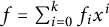
$f=\sum _{i=0}^k f_ix^i$
, that is, for
$f=\sum _{i=0}^k f_ix^i$
 , then
$\mathfrak f = \sum _{i=0}^k f_ix^{q^{i}}$
, then
$\mathfrak f = \sum _{i=0}^k f_ix^{q^{i}}$
 .
.
Theorem 1.1 implies that for all
$d\mid n$
 , the corresponding module is cyclic. Similarly, the characteristic function for
$a\in \mathbb F_{q^{d}}$
, the corresponding module is cyclic. Similarly, the characteristic function for
$a\in \mathbb F_{q^{d}}$
 being
${q^{d}}/{q}$
being
${q^{d}}/{q}$
 -normal is

where
$F_{d}'=x^{d}-1\in \mathbb F_{q}[x]$
 ,
$\theta _{q}(f):= \phi _{q}(f)/q^{\deg (f)}$
,
$\theta _{q}(f):= \phi _{q}(f)/q^{\deg (f)}$
 , and
$\mu _{q}$
, and
$\mu _{q}$
 and
$\phi _{q}$
and
$\phi _{q}$
 are the Möbius and Euler functions in
$\mathbb F_{q}[x]$
are the Möbius and Euler functions in
$\mathbb F_{q}[x]$
 , respectively, the first sum extends over the monic divisors of
$F_d'$
, respectively, the first sum extends over the monic divisors of
$F_d'$
 in
$\mathbb F_{q}[x]$
in
$\mathbb F_{q}[x]$
 and the second sum runs through the additive characters of
$\mathbb F_{q}$
and the second sum runs through the additive characters of
$\mathbb F_{q}$
 of q-order f. The q-order of some
$\psi \in \widehat {\mathbb F_{q^{d}}}$
of q-order f. The q-order of some
$\psi \in \widehat {\mathbb F_{q^{d}}}$
 , denoted by
$\operatorname {\mathrm {ord}}(\psi )$
, denoted by
$\operatorname {\mathrm {ord}}(\psi )$
 , is defined as the lowest degree monic polynomial
$g\in \mathbb F_{q}[x]$
, is defined as the lowest degree monic polynomial
$g\in \mathbb F_{q}[x]$
 such that
$\psi ( g\circ a ) = 1$
such that
$\psi ( g\circ a ) = 1$
 for all
$a\in \mathbb F_{q^{d}}$
for all
$a\in \mathbb F_{q^{d}}$
 . We note that the q-order of an additive character of
$\mathbb F_{q^{d}}$
. We note that the q-order of an additive character of
$\mathbb F_{q^{d}}$
 divides
$F_d'$
divides
$F_d'$
 and that
$\mathbb F_{q^d}$
and that
$\mathbb F_{q^d}$
 contains
$\phi _q(F_d')$
contains
$\phi _q(F_d')$
 elements that are
$q^d/q$
elements that are
$q^d/q$
 -normal.
Last but not least, it follows immediately from the orthogonality relations that the characteristic function for some
$a\in \mathbb F_q$
 to be nonzero is

4 A construction of completely normal elements
Before we proceed, we start with the following definition.
Definition 4.1 Take some finite field extension
$\mathbb F_{q^n}/\mathbb F_q$
 and some
$a\in \mathbb F_{q^n}$
and some
$a\in \mathbb F_{q^n}$
 . The set of translates of a is defined as

In this section, we will modify the following proposition, which plays an important role in the original proof of Theorem 1.3.
Proposition 4.1 [Reference Hachenberger14, Claim (3.1.4)]
Assume that
$n=n_1n_2$
 , where
$n_1, n_2$
, where
$n_1, n_2$
 are relatively prime. If
$a_i\in \mathbb F_{q^{n_i}}$
are relatively prime. If
$a_i\in \mathbb F_{q^{n_i}}$
 is
$q^{n_i}/q$
is
$q^{n_i}/q$
 -completely normal for
$i=1,2$
-completely normal for
$i=1,2$
 , then
$a_1a_2$
, then
$a_1a_2$
 is
$q^n/q$
is
$q^n/q$
 -completely normal.
Toward this end, we will need the following auxiliary lemmas and the notion of the trace function. The
$q^n/q$
 -trace is the function

Lemma 4.2 [Reference Hachenberger14, Claim (3.1.2)]
Let
$n_1,n_2$
 be relatively prime and assume that some
$a\in \mathbb F_{q^{n_1}}$
be relatively prime and assume that some
$a\in \mathbb F_{q^{n_1}}$
 is
$q^{n_1}/q$
is
$q^{n_1}/q$
 -normal. Then a is
$q^{n_1n_2}/q^{n_2}$
-normal. Then a is
$q^{n_1n_2}/q^{n_2}$
 -normal (as an element of
$\mathbb F_{q^{n_1n_2}}$
-normal (as an element of
$\mathbb F_{q^{n_1n_2}}$
 ).
).
Lemma 4.3 [Reference Hachenberger14, Claim (3.1.3)]
Assume that
$n=n_1n_2$
 , where
$n_1, n_2$
, where
$n_1, n_2$
 are relatively prime. If
$a_i\in \mathbb F_{q^{n_i}}$
are relatively prime. If
$a_i\in \mathbb F_{q^{n_i}}$
 is
$\mathbb F_{q^{n_i}}/\mathbb F_q$
is
$\mathbb F_{q^{n_i}}/\mathbb F_q$
 -normal for
$i=1,2$
-normal for
$i=1,2$
 , then
$a_1a_2$
, then
$a_1a_2$
 is
$q^n/q$
is
$q^n/q$
 -normal.
Lemma 4.4 [Reference Mazumder, Kapetanakis and Basnet25, Lemma 3.1]
Suppose
$a\in \mathbb F_{q^n}$
 is
$q^n/q$
is
$q^n/q$
 -normal and
$d\mid n$
-normal and
$d\mid n$
 . Then
$\operatorname {\mathrm {Tr}}_{q^n/q^d}(a)$
. Then
$\operatorname {\mathrm {Tr}}_{q^n/q^d}(a)$
 is
$q^d/q$
is
$q^d/q$
 -normal. In particular,
$\operatorname {\mathrm {Tr}}_{q^n/q^d}(a)\neq 0$
-normal. In particular,
$\operatorname {\mathrm {Tr}}_{q^n/q^d}(a)\neq 0$
 .
.
Lemma 4.5 Suppose
$a\in \mathbb F_{q^n}$
 is
$q^n/q$
is
$q^n/q$
 -normal. Choose some
$\lambda _i\in \mathbb F_q$
-normal. Choose some
$\lambda _i\in \mathbb F_q$
 for
$i=0,\ldots , n-1$
for
$i=0,\ldots , n-1$
 . Then
$\sum _{i=0}^{n-1} \lambda _i a^{q^i} \in \mathbb F_q$
. Then
$\sum _{i=0}^{n-1} \lambda _i a^{q^i} \in \mathbb F_q$
 if and only if all of the
$\lambda _i$
if and only if all of the
$\lambda _i$
 ’s are equal.
Proof Since a is
$q^n/q$
 -normal, the map

is a bijection. The statement of the lemma amounts to

Indeed, if
$\lambda _i=\lambda \in \mathbb F_q$
 for all
$i=0,\ldots ,n-1$
for all
$i=0,\ldots ,n-1$
 , then

Therefore,
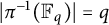
$\{(\lambda ,\ldots , \lambda ) : \lambda \in \mathbb F_q\} \subseteq \pi ^{-1}(\mathbb F_q)$
 . Since
$|\pi ^{-1}(\mathbb F_q)| = q$
. Since
$|\pi ^{-1}(\mathbb F_q)| = q$
 , the claim follows.
We prove the following lemma.
Lemma 4.6 Suppose
$a\in \mathbb F_{q^n}$
 is
$q^n/q$
is
$q^n/q$
 -normal and take some
$c\in \mathbb F_q$
-normal and take some
$c\in \mathbb F_q$
 . If
$p\mid n$
. If
$p\mid n$
 , then
$a+c$
, then
$a+c$
 is
$q^n/q$
is
$q^n/q$
 -normal. If
$p\nmid n$
-normal. If
$p\nmid n$
 , then the following are equivalent:
-
(1) $a+c$
is
$q^n/q$
-normal. -
(2) $\operatorname {\mathrm {Tr}}_{q^n/q}(a+c)\neq 0$
. -
(3) $c \neq -\operatorname {\mathrm {Tr}}_{q^n/q}(a)\cdot n^{-1}$
, where n is seen as an element of
$\mathbb F_q$
.


Proof Take

for some
$\lambda _i\in \mathbb F_q$
 , for
$i=0,\ldots ,n-1$
, for
$i=0,\ldots ,n-1$
 . Recall that
$a+c$
. Recall that
$a+c$
 is
$q^n/q$
is
$q^n/q$
 -normal if and only if the above holds only for
$\lambda _i=0$
-normal if and only if the above holds only for
$\lambda _i=0$
 for all
$i=0,\ldots ,n-1$
for all
$i=0,\ldots ,n-1$
 . Now, the latter is equivalent to

Further, Lemma 4.5 entails that
$\lambda _i=\lambda $
 for every
$i=0,\ldots ,n-1$
for every
$i=0,\ldots ,n-1$
 , for some
$\lambda \in \mathbb F_q$
, for some
$\lambda \in \mathbb F_q$
 . Finally, the last equation becomes

which implies the desired result, with Lemma 4.4 in mind.
Proposition 4.7 Assume that
$n=n_1n_2$
 , where
$n_1$
, where
$n_1$
 and
$n_2$
and
$n_2$
 are relatively prime. If
$a_i\in \mathbb F_{q^{n_i}}$
are relatively prime. If
$a_i\in \mathbb F_{q^{n_i}}$
 is
$q^{n_i}/q$
is
$q^{n_i}/q$
 -completely normal for
$i=1,2$
-completely normal for
$i=1,2$
 . If
$p\mid n$
. If
$p\mid n$
 , then
$a_1a_2+c$
, then
$a_1a_2+c$
 is
$q^n/q$
is
$q^n/q$
 -completely normal for every
$c\in \mathbb F_q$
-completely normal for every
$c\in \mathbb F_q$
 . If
$p\nmid n$
. If
$p\nmid n$
 , then, for every
$c\in \mathbb F_q$
, then, for every
$c\in \mathbb F_q$
 , the following are equivalent:
-
(1) $a_1a_2+c$
is
$q^n/q$
-completely normal. -
(2) $\operatorname {\mathrm {Tr}}_{q^n/q}(a_1a_2+c)\neq 0$
. -
(3) $c \neq -\operatorname {\mathrm {Tr}}_{q^n/q}(a_1a_2)\cdot n^{-1}$
, where n is seen as an element of
$\mathbb F_q$
.


Proof Recall that
$a_1a_2$
 is
$q^n/q$
is
$q^n/q$
 -completely normal by Proposition 4.1. Next, fix some
$c\in \mathbb F_q$
-completely normal by Proposition 4.1. Next, fix some
$c\in \mathbb F_q$
 . Clearly, if
$c=-n\operatorname {\mathrm {Tr}}_{q^n/q}(a_1a_2)$
. Clearly, if
$c=-n\operatorname {\mathrm {Tr}}_{q^n/q}(a_1a_2)$
 (in the case
$p\nmid n$
(in the case
$p\nmid n$
 ), then, by Lemma 4.6,
$a_1a_2+c$
), then, by Lemma 4.6,
$a_1a_2+c$
 cannot be
$q^n/q$
cannot be
$q^n/q$
 -completely normal. So, from now on, we assume that either
$p\mid n$
-completely normal. So, from now on, we assume that either
$p\mid n$
 , or
$\operatorname {\mathrm {Tr}}_{q^n/q}(a_1a_2+c)\neq 0$
, or
$\operatorname {\mathrm {Tr}}_{q^n/q}(a_1a_2+c)\neq 0$
 if
$p\nmid n$
if
$p\nmid n$
 .
.
Now, take some
$d\mid n$
 . If
$p\mid (n/d)$
. If
$p\mid (n/d)$
 , Lemma 4.6 yields that
$a_1a_2+c$
, Lemma 4.6 yields that
$a_1a_2+c$
 is
$q^n/q^d$
is
$q^n/q^d$
 -normal. So, we may focus on the case
$p\nmid (n/d)$
-normal. So, we may focus on the case
$p\nmid (n/d)$
 .
.
In this case, Lemma 4.6 implies that
$a_1a_2+c$
 is
$q^n/q^d$
is
$q^n/q^d$
 -normal if
$\operatorname {\mathrm {Tr}}_{q^n/q^d}(a_1a_2+c)\neq 0$
-normal if
$\operatorname {\mathrm {Tr}}_{q^n/q^d}(a_1a_2+c)\neq 0$
 . However, if this is not the case, then

a contradiction.
Remark 4.8 The proof of Proposition 4.7 uses essentially the same arguments with that of Proposition 4.1, only with Lemma 4.6 in mind, instead of Lemma 4.3.
Remark 4.9 For the purposes of this work, we are interested in finding
$q^n/q$
 -completely normal elements that have multiplicative order
$q^n-1$
-completely normal elements that have multiplicative order
$q^n-1$
 . However, the element
$a_1a_2$
. However, the element
$a_1a_2$
 that is obtained from Lemma 4.3 has order at most
$(q^{n_1}-1)(q^{n_2}-1)/ (q-1)$
that is obtained from Lemma 4.3 has order at most
$(q^{n_1}-1)(q^{n_2}-1)/ (q-1)$
 . In other words, the construction of completely normal elements in the original proof of Theorem 1.3 never yields primitive elements. In our opinion, this is a key factor for the persistence of Conjecture 1.4.
As a corollary of Proposition 4.7, we obtain the main result of this section.
Theorem 4.10 Let
$\mathbb F_{q^n}/\mathbb F_q$
 be a finite field extension and let
$n=p_1^{n_1}\ldots p_k^{n_k}$
be a finite field extension and let
$n=p_1^{n_1}\ldots p_k^{n_k}$
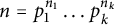 be the prime decomposition of n, with
$k\geq 2$
be the prime decomposition of n, with
$k\geq 2$
 . Further, take some
$q^{p_i^{n_i}}/q$
. Further, take some
$q^{p_i^{n_i}}/q$
 -completely normal
$a_i$
-completely normal
$a_i$
 , for every
$i=1,\ldots ,k$
, for every
$i=1,\ldots ,k$
 and set
$a = a_1\ldots a_k$
and set
$a = a_1\ldots a_k$
 .
.
-
(1) If $p\mid n$
, the set of translates
$\mathcal T_a$
is comprised of
$q^n/q$
-completely normal elements. -
(2) If $p\nmid n$
, then the set
$\mathcal T_a\setminus \{ a -Tr_{q^n/q}(a)\cdot n^{-1}\}$
(where n is seen as an element of
$\mathbb F_q$
) is comprised of
$q^n/q$
-completely normal elements.





Proof Proposition 4.1, used inductively, ensures that
$a_1\ldots a_{k-1}$
 is
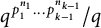
$q^{p_1^{n_1}\ldots p_{k-1}^{n_{k-1}}}/q$
is
$q^{p_1^{n_1}\ldots p_{k-1}^{n_{k-1}}}/q$
 -completely normal. Now, apply Proposition 4.7.
Remark 4.11 Another way to attack Conjecture 1.4 emerges from Theorem 4.10. Namely, Theorem 4.10 links the MM property with the translate property (and its strong version). The corresponding definitions and the details of this interesting connection are explained briefly in Appendix A. However, as explained in more detail in Appendix A, this connection is of small practical interest for the purposes of this work.
5 Main condition
Before we proceed further, we introduce the following family of finite field extensions that will be of interest for us.
Definition 5.1 Let
$\mathbb F_{q^n}/\mathbb F_q$
 be an extension of finite fields, such that
-
(1) $n=n_1n_2$
, where
$n_1,n_2>1$
with
$\gcd (n_1,n_2)=1,$
and -
(2) $\mathbb F_{q^{n_2}}/\mathbb F_q$
is completely basic.


Then we call the extension
$(n_1,n_2)$
 -partially completely basic.
Remark 5.1 With the discussion on completely basic extensions in mind, see Section 2, we observe that the family of partially completely basic extensions is rather large. In particular, if
$n=r_1^{n_1}\ldots r_k^{n_k}$
 is the prime factorization of n, if the extension
$\mathbb F_{q^n}/\mathbb F_q$
is the prime factorization of n, if the extension
$\mathbb F_{q^n}/\mathbb F_q$
 is not completely basic, it is partially completely basic if
$n_i=1$
is not completely basic, it is partially completely basic if
$n_i=1$
 or
$2$
or
$2$
 for some i, if
$r_i=p$
for some i, if
$r_i=p$
 for some i, or, if
$r_i^{n_i}\mid q^n-1$
for some i, or, if
$r_i^{n_i}\mid q^n-1$
 for some i, while it is clear that a fixed extension may be
$(n_1,n_2)$
for some i, while it is clear that a fixed extension may be
$(n_1,n_2)$
 -partially completely basic for multiple parameters
$n_1$
-partially completely basic for multiple parameters
$n_1$
 and
$n_2$
and
$n_2$
 .
.
We will also need the following technical definition.
Definition 5.2 Let X be a positive integer or a polynomial in
$\mathbb F_q[x]$
 . Then
$W(X)$
. Then
$W(X)$
 denotes the number of squarefree divisors or the number of squarefree monic divisors of X, respectively.
We are now in position to prove the main results of this section.
Theorem 5.2 Let
$\mathbb F_{q^n}/\mathbb F_q$
 be an
$(n_1,n_2)$
be an
$(n_1,n_2)$
 -partially completely basic extension, such that
$p\nmid n$
-partially completely basic extension, such that
$p\nmid n$
 and
and

Then
$\mathbb F_{q^n}/\mathbb F_q$
 possesses the MM property.
Proof Theorem 1.3 ensures the existence of some
$a\in \mathbb F_{q^{n_1}}$
 that is
$q^{n_1}/q$
that is
$q^{n_1}/q$
 -completely normal. The fact that
$\mathbb F_{q^{n_2}}/\mathbb F_q$
-completely normal. The fact that
$\mathbb F_{q^{n_2}}/\mathbb F_q$
 is completely basic and Proposition 4.7 implies that if we identify some
$b\in \mathbb F_{q^{n_2}}$
is completely basic and Proposition 4.7 implies that if we identify some
$b\in \mathbb F_{q^{n_2}}$
 and
$c\in \mathbb F_q^*$
and
$c\in \mathbb F_q^*$
 such that
-
(1) b is $q^{n_2}/q$
-normal, -
(2) $ab+c$
is primitive, and -
(3) $\operatorname {\mathrm {Tr}}_{q^n/q}(ab+c)\neq 0$
,



then
$ab+c$
 is primitive and
$q^n/q$
is primitive and
$q^n/q$
 -completely normal. In particular,
$\mathbb F_{q^n}/\mathbb F_q$
-completely normal. In particular,
$\mathbb F_{q^n}/\mathbb F_q$
 possesses the MM property.
From the characteristic functions of the corresponding properties, as presented in Section 3, it follows that the number of
$b\in \mathbb F_{q^{n_2}}$
 that combine the desired properties as above is

where we note that, given the restrictions on a, b, and c, we have that
$ab+c\neq 0$
 . So, for our purposes, it suffices to show that
$\mathcal N\neq 0$
. So, for our purposes, it suffices to show that
$\mathcal N\neq 0$
 . We replace
$\omega $
. We replace
$\omega $
 and
$\varOmega _{n_2}$
and
$\varOmega _{n_2}$
 with their expressions from Section 3 and obtain

where
$S_1$
 is the part that corresponds to
$d=1$
is the part that corresponds to
$d=1$
 and
$S_2$
and
$S_2$
 the one that corresponds to
$d\neq 1$
the one that corresponds to
$d\neq 1$
 .
.
First, we focus on
$S_1$
 . We have that

Then, we turn our attention to
$S_2$
 . We have that

where

It follows that

where
$\rho (b) = \psi (b)\eta (\operatorname {\mathrm {Tr}}_{q^n/n}(ab))$
 is an additive character of
$\mathbb F_{q^{n_2}}$
is an additive character of
$\mathbb F_{q^{n_2}}$
 . Further, observe that, since a is
$q^{n_1}/q$
. Further, observe that, since a is
$q^{n_1}/q$
 -normal, Lemma 4.2 entails that it is also
$q^n/q^{n_2}$
-normal, Lemma 4.2 entails that it is also
$q^n/q^{n_2}$
 -normal, thus
$\mathbb F_{q^{n_2}}(a) = \mathbb F_{q^n}$
-normal, thus
$\mathbb F_{q^{n_2}}(a) = \mathbb F_{q^n}$
 , that is,
$\mathbb F_{q^{n_2}}(a^{-1}c) = \mathbb F_{q^n}$
, that is,
$\mathbb F_{q^{n_2}}(a^{-1}c) = \mathbb F_{q^n}$
 . It follows from Theorem 3.1 (applied on the extension
$\mathbb F_{q^n}/\mathbb F_{q^{n_2}}$
. It follows from Theorem 3.1 (applied on the extension
$\mathbb F_{q^n}/\mathbb F_{q^{n_2}}$
 ) that, since
$\chi $
) that, since
$\chi $
 is not trivial,
$|\mathcal {C}(\chi ,\psi ,\eta ,c)|\leq 2 n_1 q^{n_2/2}$
is not trivial,
$|\mathcal {C}(\chi ,\psi ,\eta ,c)|\leq 2 n_1 q^{n_2/2}$
 . Furthermore, recall that there are exactly
$\phi (d)$
. Furthermore, recall that there are exactly
$\phi (d)$
 (resp.
$\phi _q(f)$
(resp.
$\phi _q(f)$
 ) multiplicative (resp. additive) characters of order d (resp. q-order f). It follows that

We combine Equations (5.1)–(5.3) and obtain that
$\mathcal N\neq 0$
 if
if

from where the result follows.
For the case
$p\mid n$
 , we have the following improved version of Theorem 5.2.
Theorem 5.3 Let
$\mathbb F_{q^n}/\mathbb F_q$
 be an
$(n_1,n_2)$
be an
$(n_1,n_2)$
 -partially completely basic extension, such that
$p\mid n$
-partially completely basic extension, such that
$p\mid n$
 . Then, if

$\mathbb F_{q^n}/\mathbb F_q$
 possesses the MM property.
Proof If
$p\mid n$
 , the requirement
$\operatorname {\mathrm {Tr}}_{q^n/q}(ab+c)\neq 0$
, the requirement
$\operatorname {\mathrm {Tr}}_{q^n/q}(ab+c)\neq 0$
 is satisfied for all
$c\in \mathbb F_q^*$
is satisfied for all
$c\in \mathbb F_q^*$
 . This means that the term
$q-2$
. This means that the term
$q-2$
 that appears in Equation (5.2) can be replaced by
$q-1$
that appears in Equation (5.2) can be replaced by
$q-1$
 and that the function z can be skipped altogether. All the other arguments remain identical as the ones in the proof of Theorem 5.2
Remark 5.4 Note that Theorem 5.2 is ineffective in the case
$q=2$
 as its condition can never hold. In fact, our method fails in the case
$q=2$
as its condition can never hold. In fact, our method fails in the case
$q=2$
 and n odd. The underlying reason is that, under the assumptions of Theorem 4.10, the set where we are looking for primitive completely normal elements is the singleton
$\{ ab\}$
and n odd. The underlying reason is that, under the assumptions of Theorem 4.10, the set where we are looking for primitive completely normal elements is the singleton
$\{ ab\}$
 , but
$ab$
, but
$ab$
 , as already mentioned in Remark 4.9, is never primitive. The case
$q=2$
, as already mentioned in Remark 4.9, is never primitive. The case
$q=2$
 and n even can be, however, treated by Theorem 5.3.
Remark 5.5 In the literature, one can find several powerful strategies to weaken the conditions of Theorems 5.2 and 5.3, such as the prime sieve [Reference Cohen and Huczynska9], the modified prime sieve [Reference Bailey, Cohen, Sutherland and Trudgian5], or the hybrid bound [Reference Bagger4]. However, in this work, we choose to not use any of these in an attempt to keep the text as simple as possible focus on the novel aspects of this work.
6 An asymptotic result
In this section, we will use Theorems 5.2 and 5.3, in order to obtain an asymptotic condition for an
$(n_1,n_2)$
 -partially completely basic extension to possess the MM property. We will need the following classic result.
Lemma 6.1 [Reference Apostol2, p. 296]
For every
$\delta> 0$
 ,
$W(n) = o(n^\delta )$
,
$W(n) = o(n^\delta )$
 , where o signifies the little-o notation.
We will also need the following lemmas.
Lemma 6.2 [Reference Lenstra and Schoof23, Lemma 2.9]
Let q be a prime power and n be a positive integer. Then, we have
$W(F_n') \leq 2^{\frac 12 (n+\gcd (n,q-1))}$
 . In particular,
$W (F_n') \leq 2^n$
. In particular,
$W (F_n') \leq 2^n$
 , while the equality holds if and only if
$n \mid q - 1$
, while the equality holds if and only if
$n \mid q - 1$
 . Furthermore, if
$n \nmid q - 1$
. Furthermore, if
$n \nmid q - 1$
 ,
$W (F_n') \leq 2^{3n/4}$
,
$W (F_n') \leq 2^{3n/4}$
 .
.
For small values of q, we will use the following.
Lemma 6.3 [Reference Aguirre and Neumann1, Lemma 3.7]
Let q be a prime power and n be a positive integer. Then,
$W(F_n') \leq 2^{\frac {n+a}{b}}$
 for some
$a,b\in \mathbb Z$
for some
$a,b\in \mathbb Z$
 . In particular, for
$q\geq 29$
. In particular, for
$q\geq 29$
 , we have
$(a,b)=(0,1)$
, we have
$(a,b)=(0,1)$
 ; for
$7\leq q\leq 27$
; for
$7\leq q\leq 27$
 , we have
$(a,b)=(q-1,2)$
, we have
$(a,b)=(q-1,2)$
 and for
$q\leq 5,$
and for
$q\leq 5,$
 we have the following values for
$a,b$
we have the following values for
$a,b$
 :
:
We are now in position to prove the main result of this section.
Theorem 6.4 Let
$\mathbb F_{q^n}/\mathbb F_q$
 be an
$(n_1,n_2)$
be an
$(n_1,n_2)$
 -partially completely basic extension, where
$n_2$
-partially completely basic extension, where
$n_2$
 is large compared to
$n_1$
is large compared to
$n_1$
 , then
$\mathbb F_{q^n}/\mathbb F_q$
, then
$\mathbb F_{q^n}/\mathbb F_q$
 possesses the MM property, unless n is odd and
$q=2$
possesses the MM property, unless n is odd and
$q=2$
 .
.
Proof First, we assume
$q>2$
 . Fix some
$n_1\geq 2$
. Fix some
$n_1\geq 2$
 . Theorem 5.2, along with Lemmas 6.1 and 6.2, implies that an
$(n_1,n_2)$
. Theorem 5.2, along with Lemmas 6.1 and 6.2, implies that an
$(n_1,n_2)$
 -partially completely basic extension possesses the MM property, given that

This implies the result for
$q>16$
 .
.
For
$4 \leq q \leq 16$
 , Lemma 6.3 yields
$W(F_{n_2}') \leq 2^{\frac {n_2+q-1}{2}}$
, Lemma 6.3 yields
$W(F_{n_2}') \leq 2^{\frac {n_2+q-1}{2}}$
 and a sufficient condition implied by Theorem 5.2 is

which is satisfied for
$n_2$
 large enough.
For
$q=3$
 , Lemma 6.3 yields
$W(F_{n_2}') \leq 2^{\frac {n_2+20}{3}}$
, Lemma 6.3 yields
$W(F_{n_2}') \leq 2^{\frac {n_2+20}{3}}$
 and the above condition is replaced by

which settles the case
$q=3$
 .
.
Finally, for
$q=2$
 , we are confined to n even, thus we may use Theorem 5.3 instead. Now, Lemma 6.3 entails
$W(F_{n_2}') \leq 2^{\frac {n_2+14}{5}}$
, we are confined to n even, thus we may use Theorem 5.3 instead. Now, Lemma 6.3 entails
$W(F_{n_2}') \leq 2^{\frac {n_2+14}{5}}$
 and the above condition is replaced by

which completes our proof.
7 Computational aspects
In this section, we explore the computational aspects of Theorem 5.2. First, with the condition of Theorem 5.2 in mind, we see that a concrete expression of Lemma 6.1 is needed.
Lemma 7.1 [Reference Cohen and Huczynska9, Lemma 3.7]
For any
$\alpha \in \mathbb {N}$
 and a positive real number
$\nu $
and a positive real number
$\nu $
 ,
$W(\alpha ) \leq \mathcal C_\nu ^{(\alpha )}\cdot \alpha ^{1/\nu }$
,
$W(\alpha ) \leq \mathcal C_\nu ^{(\alpha )}\cdot \alpha ^{1/\nu }$
 , where
$\mathcal C_\nu ^{(\alpha )} = \prod _{i=1}^{t} 2/(p_i^{1/\nu })$
, where
$\mathcal C_\nu ^{(\alpha )} = \prod _{i=1}^{t} 2/(p_i^{1/\nu })$
 and
$p_1, p_2, \dots , p_t$
and
$p_1, p_2, \dots , p_t$
 are the primes less than or equal to
$2^\nu $
are the primes less than or equal to
$2^\nu $
 that divide
$\alpha $
that divide
$\alpha $
 .
.
Let
$p_1,\ldots ,p_s$
 be all the primes less or equal to
$2^\nu $
be all the primes less or equal to
$2^\nu $
 . We note that, in this section, in addition to the number
$\mathcal C_\nu ^{(\alpha )}$
. We note that, in this section, in addition to the number
$\mathcal C_\nu ^{(\alpha )}$
 defined above, we will use the following two numbers:
-
(1) $\mathcal C_\nu := \prod _{i=1}^{s} 2/(p_i^{1/\nu })$
. Clearly,
$\mathcal C_\nu ^{(\alpha )} \leq \mathcal C_\nu $
for all
$\alpha \in \mathbb Z$
. -
(2) For any $1\leq j\leq s$
,
$\mathcal C_\nu ^{[p_j]} := \mathcal C_{\nu } p_j^{1/\nu }/2$
. Clearly,
$\mathcal C_\nu ^{(\alpha )} \leq \mathcal C_\nu ^{[p_j]}$
for all
$\alpha \in \mathbb Z$
with
$p_j\nmid \alpha $
.


Furthermore, the number
$\mathcal C_\nu ^{(\alpha )}$
 in the statement of Lemma 7.1 can be freely replaced by either
$\mathcal C_\nu $
in the statement of Lemma 7.1 can be freely replaced by either
$\mathcal C_\nu $
 , or, if the prime
$r\leq 2^\nu $
, or, if the prime
$r\leq 2^\nu $
 does not divide
$\alpha $
does not divide
$\alpha $
 , by
$\mathcal C_\nu ^{[r]}$
, by
$\mathcal C_\nu ^{[r]}$
 .
.
7.1 An algorithm for the MM property
Now, we present an algorithm, that takes
$n_1$
 as its input and aims to establish that all
$(n_1,n_2)$
as its input and aims to establish that all
$(n_1,n_2)$
 -partially completely basic extensions possess the MM property is given. The algorithm is comprised by the following steps:
-
Step 1 Set $n_{\min }$
as the minimum value of
$n_2$
that is not covered by Theorem 2.2 for the given
$n_1$
. -
Step 2 For $n_2=n_{\min }$
, find
$q_{\max }$
, the minimum prime power q that satisfies the condition of Theorem 5.2, where the numbers
$W(F_{n_2}')$
and
$W(q')$
are estimated by Lemmas 6.2 and 7.1, respectively. We note that, with the notation of Lemma 7.1, we take
$\nu =4n_1$
and we bound the constant
$\mathcal C_{4n_1}^{(q^{n_1n_2}-1)}$
by the generic bound
$\mathcal C_{4n_1}$
. At this point, we are left with a finite number of prime powers q that are not covered. -
Step 3 For each prime power $3\leq q< q_{\max }$
, find the maximum value of
$n_2$
,
$n_{\max }^{(q)}$
, not satisfying the condition of the previous step. Note that in this step, every q is treated as fixed, the sharper estimate
$\mathcal C_{4n_1}^{[p]}$
(where p stands for the unique prime divisor of q) is employed over the generic
$\mathcal {C}_{4n_1}$
and
$n_2$
is treated as a variable. Upon completion, for each prime power
$3\leq q< q_{\max }$
, we are left with a range
$n_{\min }\leq n_2\leq n_{\max }^{(q)}$
of yet unsettled cases.Footnote
1
-
Step 4 For each prime power $3\leq q\leq q_{\max }$
and integers
$n_{\min }\leq n_2\leq n_{\max }^{(q)}$
, we explicitly identify which values of
$n_2$
are such that-
• $\mathbb F_{q^{n_2}}/\mathbb F_q$
is completely basic, -
• $\gcd (n_1,n_2)=1$
, and -
• $q^{n_1n_2}>10^{80}$
.
The first two conditions ensure that the extension $\mathbb F_{q^{n_1n_2}}\mathbb F_q$
is
$(n_1,n_2)$
-partially completely basic and the third one that the extension is not already covered by Theorem 2.2. At this point, we are left with a finite list of pairs
$(q,n_2)$
that correspond to the
$(n_1,n_2)$
-partially completely basic extensions not already covered. -
-
Step 5 For each of these pairs, we check the condition of Theorem 5.2, where $W(F_{n_2}')$
is explicitly computed, and
$W(q')$
is estimated by Lemma 7.1, where, under the notation of Lemma 7.1,
$\nu =4n_1$
, and the constant
$\mathcal C_{4n_1}^{(q^{n_1n_2}-1)}$
is explicitly computed. Remove from the list of possible exceptions the pairs that pass this test. -
Step 6 For the remaining pairs, we check the condition of Theorem 5.2, where $W(F_{n_2}')$
and
$W(q')$
are both explicitly computed. Remove from the list of possible exceptions the pairs that pass this test. -
Step 7 If the list of possible exceptions remain nonempty at this point, return FAIL.
-
Step 8 Now, we move on to the case $q=2$
. We repeat Steps 3–6 with the difference that Theorem 5.3 is used over Theorem 5.2 and that, in Step 4, we additionally demand
$n_2$
to be even. -
Step 9 If the list of possible exceptions remain nonempty at this point, return FAIL. Otherwise, return SUCCESS.





The rest of this section is dedicated into applying this algorithm in an attempt to establish the MM property for
$(n_1,n_2)$
 -partially completely basic extensions for small values of
$n_1$
-partially completely basic extensions for small values of
$n_1$
 .
.
7.2 Concrete results
We successfully applied the algorithm of Section 7.1 for
$n_1=2$
 and
$n_1=3$
and
$n_1=3$
 , while we obtained partial results for
$n_1=4$
, while we obtained partial results for
$n_1=4$
 . Namely, we establish the following theorem.
Theorem 7.2 Let
$\mathbb F_{q^n}/\mathbb F_q$
 be an
$(n_1,n_2)$
be an
$(n_1,n_2)$
 -partially completely basic extension. Then
$\mathbb F_{q^n}/\mathbb F_q$
-partially completely basic extension. Then
$\mathbb F_{q^n}/\mathbb F_q$
 possesses the MM property in the following cases:
-
(1) $n_1=2$
or
$3$
. -
(2) $n_1=4$
and either-
• $q\geq 199211272511189639\,(\approx 2\cdot 10^{17})$
, -
• $n_2\geq n_1^{n_1} = 256$
and
$q\geq 22271$
, or, -
• $n_2\geq n_1^6 = 4096$
.
-


For our calculations, we used the SageMath system, running on a modern laptop and the source files are available online.Footnote 2 In the following sections, we present the most important details of our calculations.
7.2.1 The cases
$n_1=2$
and
$n_1=3$


The most essential information of our implementation for the cases
$n_1=2$
 and
$n_1=3$
and
$n_1=3$
 is summarized in Table 1.
Summary of the implementation of the algorithm of Section 7.1 for
$n_1=2$
 and
$n_1=3$
and
$n_1=3$
 .
.

Table 1 Long description
The table consists of 11 columns. The headers are n sub 1, n sub min, C sub 4 n sub 1, q sub max, followed by ‘No. of pairs after step’ which spans columns for steps 4, 5, 6, 8.4, 8.5, and 8.6, and a final column for Time.
* Row 1 (n sub 1 equals 2): n sub min is 102; C sub 4 n sub 1 is 4,514.6265; q sub max is 11. The number of pairs after step 4 is 15. For steps 5, 6, 8.4, 8.5, and 8.6, the count is 0. Time is approximately 1 second.
* Row 2 (n sub 1 equals 3): n sub min is 67; C sub 4 n sub 1 is 1.057 dot 10 super 24; q sub max is 487. The number of pairs after step 4 is 3,011. For steps 5 and 6, the count is 0. For step 8.4, the count is 111. For steps 8.5 and 8.6, the count is 0. Time is approximately 30 seconds.
We note that the zeros appearing in the columns under Steps 6 and 8.6 show that the application was successful. The zeros in the columns under Steps 5 and 8.5 show that we never had to resort to computing
$W(q')$
 , which is an expensive computation, as the computer should first factor
$q^{n_1n_2}-1$
, which is an expensive computation, as the computer should first factor
$q^{n_1n_2}-1$
 into primes. Furthermore, the zero in the entry that corresponds to
$n_1=2$
into primes. Furthermore, the zero in the entry that corresponds to
$n_1=2$
 , and Step 8.4 is the result of the fact that, in this case, we expect
$n_2$
, and Step 8.4 is the result of the fact that, in this case, we expect
$n_2$
 to be both odd (as it has to be relatively prime to
$n_1=2$
to be both odd (as it has to be relatively prime to
$n_1=2$
 ) and even (as it has to be divided by
$p=2$
) and even (as it has to be divided by
$p=2$
 ).
).
Next, in Table 2, we present the numbers appearing in Step 3 for
$n_1=2$
 and, in Tables 3–5, we present the numbers appearing in Step 3 for
$n_1=3$
and, in Tables 3–5, we present the numbers appearing in Step 3 for
$n_1=3$
 . We note that in Table 2, the case
$q=2$
. We note that in Table 2, the case
$q=2$
 is missing, as, we already explained, this case is irrelevant and, in Table 3, the entries that correspond to
$q=2$
is missing, as, we already explained, this case is irrelevant and, in Table 3, the entries that correspond to
$q=2$
 derive from Step 8.3.
Prime powers
$3 \leq q<q_{\max }$
 , the corresponding
$n_{\max }^{(q)}$
, the corresponding
$n_{\max }^{(q)}$
 , and the corresponding value of
$\mathcal C_{4n_1}^{[p]}$
, and the corresponding value of
$\mathcal C_{4n_1}^{[p]}$
 for
$n_1=2$
for
$n_1=2$
 .
.

Table 2 Long description
The table is organized into three repeating sets of three columns: q, n sub max to the q power, and C sub 4 n sub 1 to the p power.
Row 1:
- First set: q is 3, n sub max to the q power is 133, C is 2,589.5959.
- Second set: q is 4, n sub max to the q power is 108, C is 2,461.6176.
- Third set: q is 5, n sub max to the q power is 81, C is 2,760.3433.
Row 2:
- First set: q is 7, n sub max to the q power is 84, C is 2,878.9167.
- Second set: q is 8, n sub max to the q power is 68, C is 2,461.6176.
- Third set: q is 9, n sub max to the q power is 60, C is 2,589.5959.
Prime powers
$2 \leq q\leq 128$
 , the corresponding
$n_{\max }^{(q)}$
, the corresponding
$n_{\max }^{(q)}$
 , and the corresponding value of
$\mathcal C_{4n_1}^{[p]}$
, and the corresponding value of
$\mathcal C_{4n_1}^{[p]}$
 for
$n_1=3$
for
$n_1=3$
 .
.

Table 3 Long description
The table is organized into two identical sets of three columns. The columns are q, n sub max super q, and C sub 4 n sub 1 super p.
Selected data points from the first set:
* q equals 2, n sub max super q equals 1,666, C sub 4 n sub 1 super p equals 5.6008 dot 10 super 23.
* q equals 4, n sub max super q equals 517, C sub 4 n sub 1 super p equals 5.6008 dot 10 super 23.
* q equals 7, n sub max super q equals 421, C sub 4 n sub 1 super p equals 6.2172 dot 10 super 23.
* q equals 13, n sub max super q equals 207, C sub 4 n sub 1 super p equals 6.5463 dot 10 super 23.
* q equals 31, n sub max super q equals 344, C sub 4 n sub 1 super p equals 7.0380 dot 10 super 23.
* q equals 64, n sub max super q equals 163, C sub 4 n sub 1 super p equals 5.6008 dot 10 super 23.
* q equals 127, n sub max super q equals 110, C sub 4 n sub 1 super p equals 7.9156 dot 10 super 23.
Selected data points from the second set:
* q equals 3, n sub max super q equals 599, C sub 4 n sub 1 super p equals 5.7933 dot 10 super 23.
* q equals 8, n sub max super q equals 341, C sub 4 n sub 1 super p equals 5.6008 dot 10 super 23.
* q equals 19, n sub max super q equals 162, C sub 4 n sub 1 super p equals 6.7566 dot 10 super 23.
* q equals 32, n sub max super q equals 327, C sub 4 n sub 1 super p equals 5.6008 dot 10 super 23.
* q equals 81, n sub max super q equals 140, C sub 4 n sub 1 super p equals 5.7933 dot 10 super 23.
* q equals 128, n sub max super q equals 109, C sub 4 n sub 1 super p equals 5.6008 dot 10 super 23.
Prime powers
$131 \leq q\leq 289$
 , the corresponding
$n_{\max }^{(q)}$
, the corresponding
$n_{\max }^{(q)}$
 , and the corresponding value of
$\mathcal C_{4n_1}^{[p]}$
, and the corresponding value of
$\mathcal C_{4n_1}^{[p]}$
 for
$n_1=3$
for
$n_1=3$
 .
.

Table 4 Long description
The table contains 15 rows of data across two parallel sections. Each section has three columns: q, n sub max super open parenthesis q close parenthesis, and C sub 4 n sub 1 super open parenthesis p close parenthesis.
* Row 1: q = 131, n sub max = 109, C = 7.9361 dot 10 super 23 | q = 137, n sub max = 106, C = 7.9658 dot 10 super 23.
* Row 2: q = 139, n sub max = 106, C = 7.9754 dot 10 super 23 | q = 149, n sub max = 102, C = 8.0217 dot 10 super 23.
* Row 3: q = 151, n sub max = 102, C = 8.0306 dot 10 super 23 | q = 157, n sub max = 100, C = 8.0568 dot 10 super 23.
* Row 4: q = 163, n sub max = 98, C = 8.0820 dot 10 super 23 | q = 167, n sub max = 97, C = 8.0983 dot 10 super 23.
* Row 5: q = 169, n sub max = 97, C = 6.5463 dot 10 super 23 | q = 173, n sub max = 96, C = 8.1222 dot 10 super 23.
* Row 6: q = 179, n sub max = 95, C = 8.1453 dot 10 super 23 | q = 181, n sub max = 94, C = 8.1528 dot 10 super 23.
* Row 7: q = 191, n sub max = 92, C = 8.1894 dot 10 super 23 | q = 193, n sub max = 92, C = 8.1966 dot 10 super 23.
* Row 8: q = 197, n sub max = 91, C = 8.2106 dot 10 super 23 | q = 199, n sub max = 91, C = 8.2175 dot 10 super 23.
* Row 9: q = 211, n sub max = 89, C = 8.2577 dot 10 super 23 | q = 223, n sub max = 87, C = 8.2958 dot 10 super 23.
* Row 10: q = 227, n sub max = 86, C = 8.3081 dot 10 super 23 | q = 229, n sub max = 86, C = 8.3142 dot 10 super 23.
* Row 11: q = 233, n sub max = 85, C = 8.3262 dot 10 super 23 | q = 239, n sub max = 85, C = 8.3439 dot 10 super 23.
* Row 12: q = 241, n sub max = 84, C = 8.3497 dot 10 super 23 | q = 243, n sub max = 84, C = 5.7933 dot 10 super 23.
* Row 13: q = 251, n sub max = 83, C = 8.3780 dot 10 super 23 | q = 256, n sub max = 82, C = 5.6008 dot 10 super 23.
* Row 14: q = 257, n sub max = 82, C = 8.3945 dot 10 super 23 | q = 263, n sub max = 82, C = 8.4107 dot 10 super 23.
* Row 15: q = 269, n sub max = 81, C = 8.4265 dot 10 super 23 | q = 271, n sub max = 81, C = 8.4317 dot 10 super 23.
* Row 16: q = 277, n sub max = 80, C = 8.4471 dot 10 super 23 | q = 281, n sub max = 80, C = 8.4572 dot 10 super 23.
* Row 17: q = 283, n sub max = 80, C = 8.4622 dot 10 super 23 | q = 289, n sub max = 79, C = 6.6943 dot 10 super 23.
Prime powers
$293 \leq q<q_{\max }$
 , the corresponding
$n_{\max }^{(q)}$
, the corresponding
$n_{\max }^{(q)}$
 , and the corresponding value of
$\mathcal C_{4n_1}^{[p]}$
, and the corresponding value of
$\mathcal C_{4n_1}^{[p]}$
 for
$n_1=3$
for
$n_1=3$
 .
.

Table 5 Long description
The table contains data for n sub 1 equals 3 across two parallel sections of three columns each.
* Row 1: q equals 293, n sub max equals 79, mathcal C equals 8.4867 dot 10 super 23 | q equals 307, n sub max equals 78, mathcal C equals 8.5198 dot 10 super 23.
* Row 2: q equals 311, n sub max equals 77, mathcal C equals 8.5290 dot 10 super 23 | q equals 313, n sub max equals 77, mathcal C equals 8.5336 dot 10 super 23.
* Row 3: q equals 317, n sub max equals 77, mathcal C equals 8.5426 dot 10 super 23 | q equals 331, n sub max equals 76, mathcal C equals 8.5734 dot 10 super 23.
* Row 4: q equals 337, n sub max equals 75, mathcal C equals 8.5863 dot 10 super 23 | q equals 343, n sub max equals 74, mathcal C equals 6.2172 dot 10 super 23.
* Row 5: q equals 347, n sub max equals 74, mathcal C equals 8.6072 dot 10 super 23 | q equals 349, n sub max equals 74, mathcal C equals 8.6113 dot 10 super 23.
* Row 6: q equals 353, n sub max equals 74, mathcal C equals 8.6195 dot 10 super 23 | q equals 359, n sub max equals 74, mathcal C equals 8.6316 dot 10 super 23.
* Row 7: q equals 361, n sub max equals 73, mathcal C equals 6.7566 dot 10 super 23 | q equals 367, n sub max equals 73, mathcal C equals 8.6475 dot 10 super 23.
* Row 8: q equals 373, n sub max equals 73, mathcal C equals 8.6592 dot 10 super 23 | q equals 379, n sub max equals 72, mathcal C equals 8.6707 dot 10 super 23.
* Row 9: q equals 383, n sub max equals 72, mathcal C equals 8.6783 dot 10 super 23 | q equals 389, n sub max equals 72, mathcal C equals 8.6896 dot 10 super 23.
* Row 10: q equals 397, n sub max equals 71, mathcal C equals 8.7043 dot 10 super 23 | q equals 401, n sub max equals 71, mathcal C equals 8.7116 dot 10 super 23.
* Row 11: q equals 409, n sub max equals 71, mathcal C equals 8.7259 dot 10 super 23 | q equals 419, n sub max equals 70, mathcal C equals 8.7435 dot 10 super 23.
* Row 12: q equals 421, n sub max equals 70, mathcal C equals 8.7470 dot 10 super 23 | q equals 431, n sub max equals 70, mathcal C equals 8.7641 dot 10 super 23.
* Row 13: q equals 433, n sub max equals 70, mathcal C equals 8.7675 dot 10 super 23 | q equals 439, n sub max equals 69, mathcal C equals 8.7776 dot 10 super 23.
* Row 14: q equals 443, n sub max equals 69, mathcal C equals 8.7842 dot 10 super 23 | q equals 449, n sub max equals 69, mathcal C equals 8.7941 dot 10 super 23.
* Row 15: q equals 457, n sub max equals 68, mathcal C equals 8.8070 dot 10 super 23 | q equals 461, n sub max equals 68, mathcal C equals 8.8134 dot 10 super 23.
* Row 16: q equals 463, n sub max equals 68, mathcal C equals 8.8166 dot 10 super 23 | q equals 467, n sub max equals 68, mathcal C equals 8.8229 dot 10 super 23.
* Row 17: q equals 479, n sub max equals 67, mathcal C equals 8.8416 dot 10 super 23.
7.2.2 The case
$n_1=4$

Finally, we comment on our attempt in implementing the algorithm of Section 7.1 on the
$n_1=4$
 case. The main information of our attempt on the
$n_1=4$
case. The main information of our attempt on the
$n_1=4$
 case is summarized in Table 6.
Summary of the implementation of the algorithm of Section 7.1 for
$n_1=4$
 , with various choices of
$n_{\min }$
, with various choices of
$n_{\min }$
 .
.

Table 6 Long description
The table consists of 9 columns. The first two columns are n sub min and q sub max. The next six columns are grouped under the heading No. of pairs after step, with sub-headings for steps 4, 5, 6, 8.4, 8.5, and 8.6. The final column is Time.
* Row 1: n sub min is 50. q sub max is approximately 2 times 10 super 17. All other columns contain dashes.
* Row 2: n sub min is 256. q sub max is 22,271. Step 4 is 82,148. All other columns contain dashes.
* Row 3: n sub min is 1,024. q sub max is 27. Step 4 is 5,936. All other columns contain dashes.
* Row 4: n sub min is 4,096. q sub max is 4. Step 4 is 188. Step 5 is 0. Step 6 is 0. Step 8.4 is 3,317. Step 8.5 is 0. Step 8.6 is 0. Time is approximately 8 minutes.
First, we attempted to run the algorithm of Section 7.1 as it is. So, we computed
$n_{\min } = 50$
 ,
$\mathcal C_{4n_1} = 1.9356\cdot 10^{200}$
,
$\mathcal C_{4n_1} = 1.9356\cdot 10^{200}$
 , and
$q_{\max } = 199211272511189639 \approx 2\cdot 10^{17}$
, and
$q_{\max } = 199211272511189639 \approx 2\cdot 10^{17}$
 . However, the vast size of
$q_{\max }$
. However, the vast size of
$q_{\max }$
 makes it clear that even storing the numbers
$n_{\max }^{(q)}$
makes it clear that even storing the numbers
$n_{\max }^{(q)}$
 for each
$3\leq q\leq q_{\max }$
for each
$3\leq q\leq q_{\max }$
 is not straightforward and, in fact, our computer crashed during the computation of these numbers.
Then, we confined ourselves (arbitrarily) to
$n_{\min } = n_1^{n_1} = 256$
 . In this case, we computed
$q_{\max } = 22,271$
. In this case, we computed
$q_{\max } = 22,271$
 . This made the completion of Step 3 feasible with a total number of 82,148 possible exceptional pairs. However, due to the large size of these numbers, our computer failed to complete Step 4 after having examined about 2,200 pairs, with no exceptional pair found until this point.
Our attempt on the
$n_{\min } = n_1^5 = 1,024$
 case faced similar difficulties, although, in this case, we got a significantly smaller
$q_{\max } = 27$
case faced similar difficulties, although, in this case, we got a significantly smaller
$q_{\max } = 27$
 and after Step 3 we had 5,936 possible exceptional pairs. This time, only around 1,650 of them were in fact checked during Step 4, before our computer’s crash, without any exceptions up to this point.
Finally, we successfully run the algorithm with the twist that we chose
$n_{\min }=n_1^6 = 4,096$
 , where we obtained
$q_{\max } = 4$
, where we obtained
$q_{\max } = 4$
 . Also, we note that in this case, we got
$n_{\max }^{(2)} = 13,385$
. Also, we note that in this case, we got
$n_{\max }^{(2)} = 13,385$
 ,
$\mathcal C_{4n_1}^{(2)} = 1.0106\cdot 10^{200}$
,
$\mathcal C_{4n_1}^{(2)} = 1.0106\cdot 10^{200}$
 ,
$n_{\max }^{(3)} = 4,605$
,
$n_{\max }^{(3)} = 4,605$
 , and
$\mathcal C_{4n_1}^{(3)} = 1.0366\cdot 10^{200}$
, and
$\mathcal C_{4n_1}^{(3)} = 1.0366\cdot 10^{200}$
 , respectively. This completes the proof of Theorem 7.2.
8 Discussion
We conclude this work with a short discussion about possible future research directions regarding Conjecture 1.4.
The first one is hinted in Remark 5.5. In particular, we believe that, with considerably additional computational efforts and resources, Theorem 7.2 can potentially be extended to
$n_1=4$
 . However, increasing
$n_1$
. However, increasing
$n_1$
 further should be feasible only after implementing the methods described in Remark 5.5. Our impression is that these methods should be able to increase
$n_1$
further should be feasible only after implementing the methods described in Remark 5.5. Our impression is that these methods should be able to increase
$n_1$
 even to two-digit numbers.
Also, we stress that in the literature, for example, see [Reference Aravena3], one can find additional constructions of completely normal elements. Possibly, these constructions can be exploited into establishing the MM property for additional finite fields extensions, or even into completely resolving Conjecture 1.4.
A The translate properties and their connection with the MM property
In this appendix, we dive deeper in the perspective raised in Remark 4.11. We start with defining the properties that are of interest for us.
Definition A.1 Let
$\mathbb F_{q^n}/\mathbb F_q$
 be a finite field extension such that, for every
$a\in \mathbb F_{q^n}$
be a finite field extension such that, for every
$a\in \mathbb F_{q^n}$
 such that
$\mathbb F_q(a) = \mathbb F_{q^n}$
such that
$\mathbb F_q(a) = \mathbb F_{q^n}$
 , some primitive element lies within the set of translates
$\mathcal T_a$
, some primitive element lies within the set of translates
$\mathcal T_a$
 . Then the extension possesses the translate property. If, every such set of translates
$\mathcal T_a$
. Then the extension possesses the translate property. If, every such set of translates
$\mathcal T_a$
 contains two distinct primitive elements, then the extension possesses the strong translate property.
Furthermore, it is known that, for fixed n, if q is large enough, then the extension
$\mathbb F_{q^n}/\mathbb F_q$
 possesses the translate property.
Theorem A.1 (The translate property)
Let n be a positive integer. There exists some
$\mathrm {TP}(n)$
 such that for every prime power
$q>\mathrm {TP}(n)$
such that for every prime power
$q>\mathrm {TP}(n)$
 , the extension
$\mathbb F_{q^n}/\mathbb F_q$
, the extension
$\mathbb F_{q^n}/\mathbb F_q$
 possesses the translate property.
The above was initially established by Davenport [Reference Davenport10] for prime q and extended to its stated form by Carlitz [Reference Carlitz8]. In a similar fashion, in this work, we prove the strong version as follows.
Theorem A.2 (The strong translate property)
Let n be a positive integer. There exists some
$\mathrm {STP}(n) \geq \mathrm {TP}(n)$
 such that for every prime power
$q>\mathrm {STP}(n)$
such that for every prime power
$q>\mathrm {STP}(n)$
 , the extension
$\mathbb F_{q^n}/\mathbb F_q$
, the extension
$\mathbb F_{q^n}/\mathbb F_q$
 possesses the strong translate property.
Proof We assume that
$q>\mathrm {TP}(n)$
 and fix some
$b\in \mathbb F_{q^n}$
and fix some
$b\in \mathbb F_{q^n}$
 , such that
$\mathbb F_q(b) = \mathbb F_{q^n}$
, such that
$\mathbb F_q(b) = \mathbb F_{q^n}$
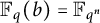 . We will show that, if q is large enough,
$\mathcal T_b$
. We will show that, if q is large enough,
$\mathcal T_b$
 contains two primitive elements. Theorem A.1 implies that, for some
$c\in \mathbb F_q$
contains two primitive elements. Theorem A.1 implies that, for some
$c\in \mathbb F_q$
 , the element
$a=b+c$
, the element
$a=b+c$
 is primitive, while clearly
$\mathcal T_b = \mathcal T_a$
is primitive, while clearly
$\mathcal T_b = \mathcal T_a$
 , that is, if the set
$\mathcal T_a\setminus \{ a\}$
, that is, if the set
$\mathcal T_a\setminus \{ a\}$
 contains a primitive element, our proof is complete.
Observe that the elements of
$\mathcal T_a$
 are nonzero, thus the number of primitive elements within the set
$\mathcal T_a \setminus \{ a\}$
are nonzero, thus the number of primitive elements within the set
$\mathcal T_a \setminus \{ a\}$
 is
is

where
$q'=q^n-1$
 ,
$S_1$
,
$S_1$
 is the part of the sum that corresponds to
$d=1,$
is the part of the sum that corresponds to
$d=1,$
 and
$S_2$
and
$S_2$
 is the remaining sum.
Clearly,
$S_1=q-1$
 . Further, the fact that, for
$d\mid q'$
. Further, the fact that, for
$d\mid q'$
 , there are
$\phi (d)$
, there are
$\phi (d)$
 multiplicative characters of order d and Theorem 3.1 yields
$|S_2|\leq W(q')(nq^{1/2}+1)$
multiplicative characters of order d and Theorem 3.1 yields
$|S_2|\leq W(q')(nq^{1/2}+1)$
 , hence,
$|S_2|<2nW(q')\sqrt {q}$
, hence,
$|S_2|<2nW(q')\sqrt {q}$
 .
.
Now, Lemma 6.1 yields that, for q large enough,
$S_1 = q-1> |S_2|$
 , which, combined with Equation (A.1) implies
$\mathcal N_{\mathrm {STP}}\neq 0$
, which, combined with Equation (A.1) implies
$\mathcal N_{\mathrm {STP}}\neq 0$
 . The result follows.
Now, observe that Theorem 4.10 yields that, if
$p\mid n$
 , the translate property implies the MM property, while, in any case, the strong translate property implies the MM property. In other words, we have the following.
Theorem A.3 Let
$\mathbb F_{q^n}/\mathbb F_q$
 be a finite field extension, such that, either
-
(1) $p\mid n$
and
$q>\mathrm {TP}(n)$
, or, -
(2) $q>\mathrm {STP}(n)$
,


then this extension possesses the MM property.
Remark A.4 Despite the fact that Theorem A.3 might appear like a meaningful way to attack Conjecture 1.4, this is, unfortunately, not the case. This is due to the fact that, although little is known about the numbers
$\mathrm {TP}(n)$
 and only a handful of them are known, these numbers suggest that, in principle, they tend to be significantly larger than n. In particular, see [Reference Bailey, Cohen, Sutherland and Trudgian5] and the references therein, we know that
$\mathrm {TP}(2)=1$
and only a handful of them are known, these numbers suggest that, in principle, they tend to be significantly larger than n. In particular, see [Reference Bailey, Cohen, Sutherland and Trudgian5] and the references therein, we know that
$\mathrm {TP}(2)=1$
 ,
$\mathrm {TP}(3)=37$
,
$\mathrm {TP}(3)=37$
 , and
$43\leq \mathrm {TP}(4)\leq 102,829$
, and
$43\leq \mathrm {TP}(4)\leq 102,829$
 . In other words, Theorems 2.5–2.7 probably already cover the extensions that are known to possess the (strong) translate property.
Acknowledgements
We are grateful to D. Hachenberger for pointing out a serious mistake in our original manuscript and his useful comments. Also, we are grateful to the anonymous reviewer for carefully reading our original manuscript and their helpful feedback.








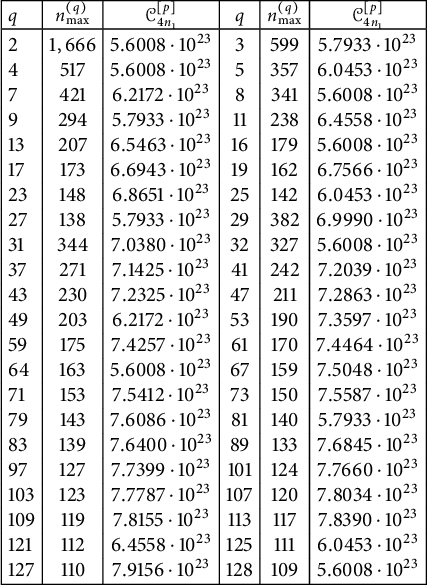


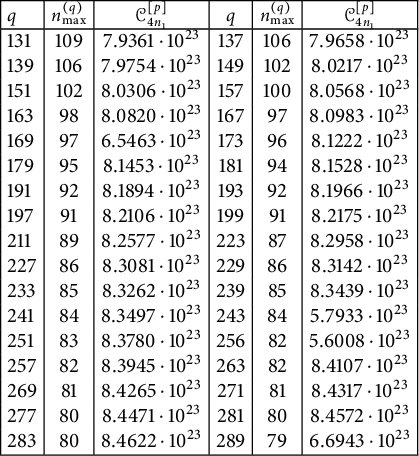


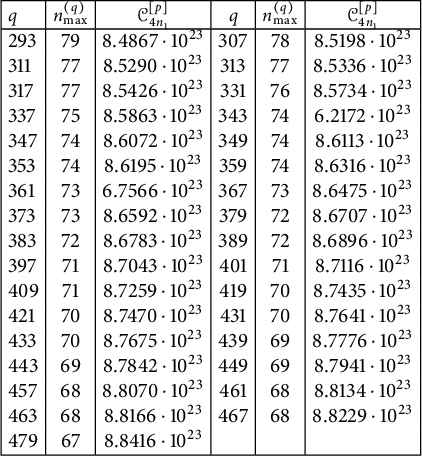


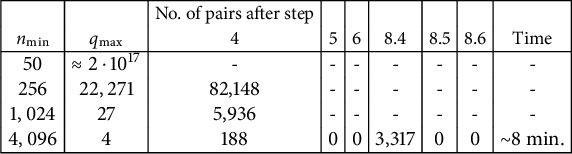


 Open access

