

Introduction
The preservation of fish by salting or fermenting to protect the animal protein against degradation was well known in antiquity in the Mediterranean region (Curtis, Reference Curtis and Scarborough1991; Grainger, Reference Grainger2013, Reference Grainger2018, Reference Grainger2021; Marzano, Reference Marzano2013; Trentacoste et al., Reference Trentacoste, Nicholson and Mylona2018; Weingarten, Reference Weingarten2018). It probably originated in the Black Sea and eastern Mediterranean. Production can be attributed to the ancient Greeks, according to texts from the third and second centuries bc (Grainger, Reference Grainger2013: 15). The technique was possibly disseminated around the Mediterranean basin by the Phoenicians (Curtis, Reference Curtis and Scarborough1991: 46, 113–16). The economic value of this practice in the Roman Empire cannot be overstated, as attested by the large-scale industrial fish-salting installations (cetaria, i.e. fish processing sites with industrial structures including complexes of vats) on the western Mediterranean and Atlantic coastlines of Iberia, North and North-western Africa, and the archaeological evidence for maritime shipments of salted-fish cargoes (Curtis, Reference Curtis and Scarborough1991: 50–57, 149–52; Grainger, Reference Grainger2013: 16, 18, table 2). Salted-fish processing in antiquity required three ingredients: an abundant supply of fish, salt, and freshwater (Curtis Reference Curtis and Scarborough1991: 50–57, 149–52). Smaller-scale salting operations may be less visible to archaeologists because fermentation vessels of variable size leave a far lighter footprint in the archaeological record than industrial cetaria (Curtis, Reference Curtis and Scarborough1991: 11–13, 123).
This Roman staple was also consumed in the Levant. Evidence for the import of exotic fish sauce from Iberia was found at first-century bc Masada, a fortress in the Judean desert near the Dead Sea (Cotton et al., Reference Cotton, Lernau and Goren1996). A salted-fish ‘kiosk’ was identified at Caesarea-Maritima in a context dating to the first century ad, which was interpreted as a small-scale food service for circus patrons (Lernau, Reference Lernau and Porath2015). A few centuries later at Caesarea, fish remains stored within pottery vessels and most likely to have been salted were discovered in a late Byzantine (seventh century ad) warehouse, thought to be intended for local consumption or export (Fradkin & Lernau, Reference Fradkin, Lernau, Holum, Stabler and Reinhardt2008). These examples indicate that the salting of fish was indeed practised in the southern Levant in antiquity, but evidence for large-scale salting operations akin to the western Mediterranean cetaria is thus far missing from the Levantine coastline (Galili & Sharvit, Reference Galili, Sharvit, Stewart and Vita-Finzi1988; Lernau, Reference Lernau and Porath2015).
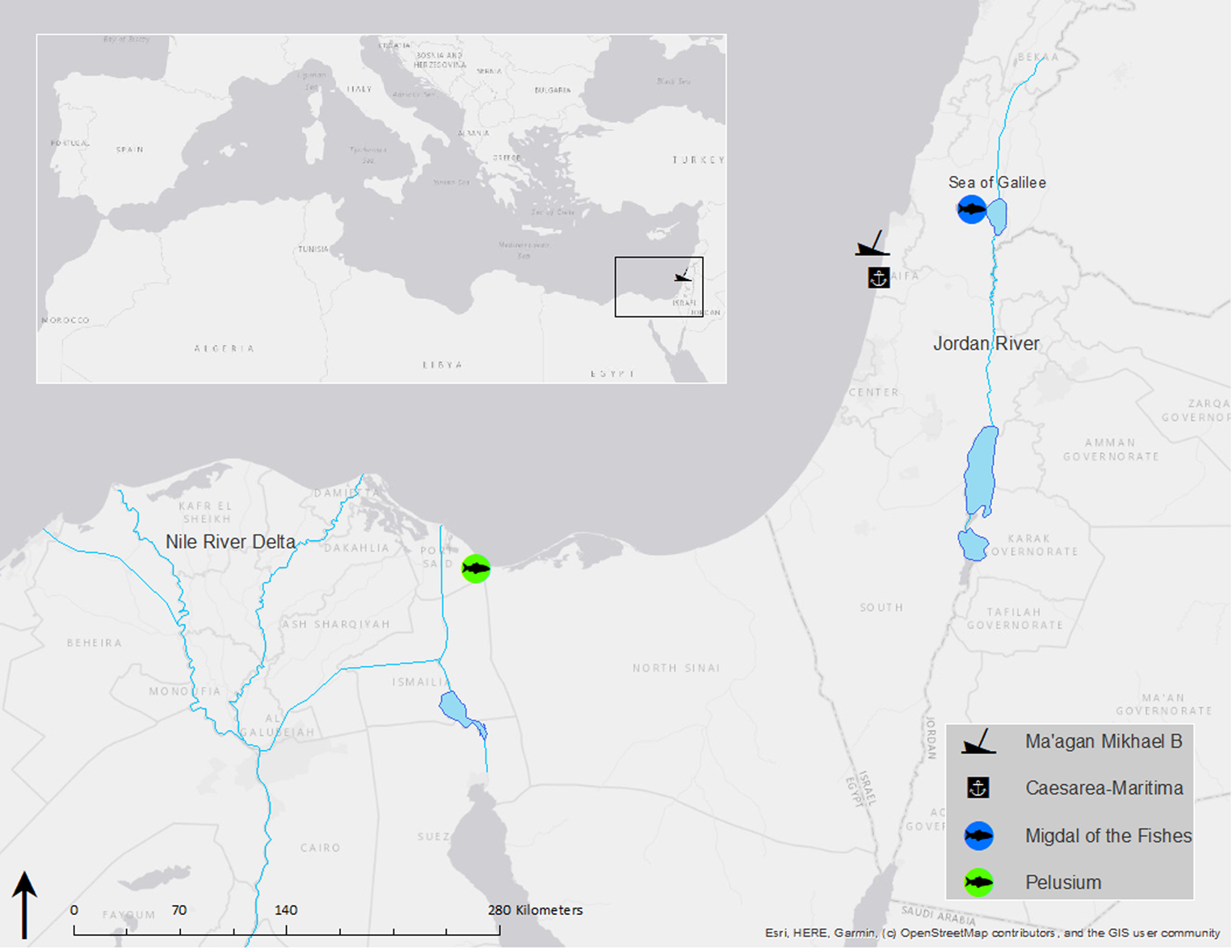
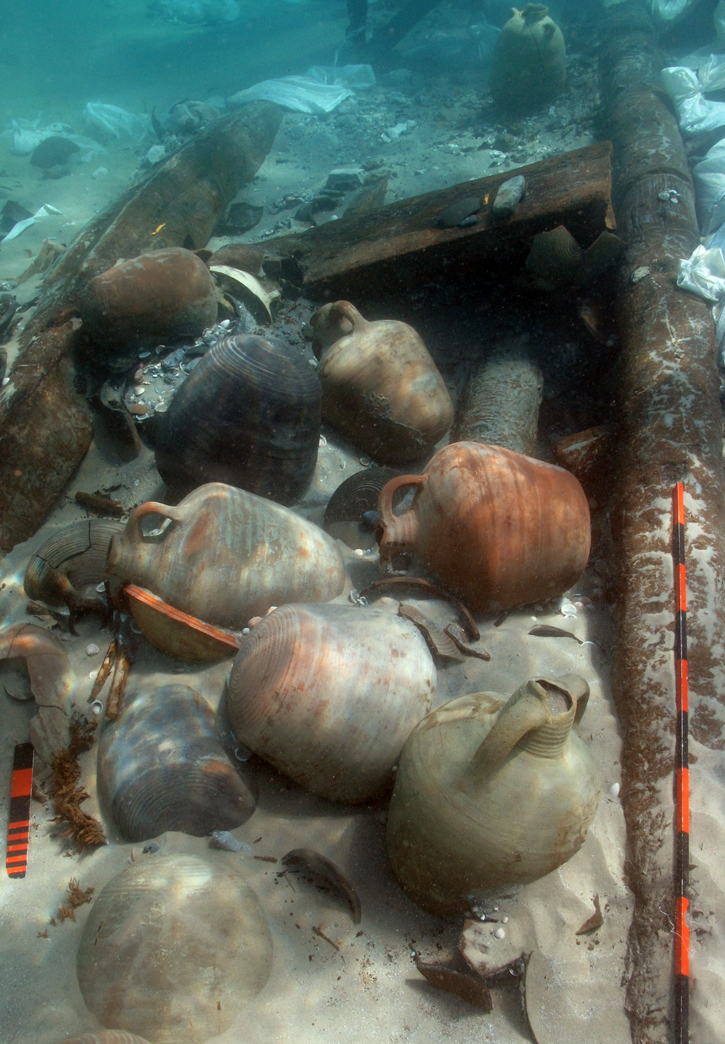
Shipwreck sites in the Mediterranean Sea (Parker, Reference Parker1992; Grainger, Reference Grainger2013) provide another source of archaeological evidence for the trade and consumption of salted fish in antiquity. Among them, the Ma‘agan Mikhael B shipwreck, found on the Mediterranean Carmel coast of modern Israel (Figure 1), is a merchantman dated to the early Islamic period (seventh–eighth century ad) (Cohen & Cvikel, Reference Cohen and Cvikel2019). The ship was transporting a large cargo of amphorae which contained a variety of foodstuffs (Figure 2) (Creisher et al., Reference Creisher, Goren, Artzy and Cvikel2019: 114). The amphorae primarily comprised Late Roman 5 (LR5) variants; three groups of LR5 amphorae were identified onboard the Ma‘agan Mikhael B (Creisher et al., Reference Creisher, Goren, Artzy and Cvikel2019: 110, following Dixneuf's typology). Three vessels belonging to Group 1 were found in the bow and contained the skeletal remains of small fish (amphorae MMB 3159.1–3, MMB 3199, and MMB 3319).
Location of the Ma‘agan Mikhael B shipwreck and other sites referred to in the text. The Jordan Valley and Nile rivers are shown in relation to the distribution of identified fish species. The fish symbols for Migdal and Pelusium indicate their status as proposed production centres.
The Ma‘agan Mikhael B shipwreck was heavily laden with a cargo of amphorae carrying a variety of foodstuffs. The image shows a selection of amphorae and other vessels before excavation. Photograph by permission A. Yurman.
The LR5 amphorae of Group 1 had small oval bodies (0.35 m maximum height) with a dark reddish-brown colour (Creisher et al., Reference Creisher, Goren, Artzy and Cvikel2019: 110, fig. 2:4). Petrographic analysis indicated an Egyptian origin. This variant of the LR5 is known to have been produced in the Nile region from the mid-seventh to the early ninth century ad, with distribution centres both there and along the Levantine coast (Creisher et al., Reference Creisher, Goren, Artzy and Cvikel2019: 110, with references). The Group 1 LR5 amphorae from the Ma'agan Mikhael B were lined with a resinous coating and had one small hole with a mean diameter of 3.5 mm drilled into the shoulder area. The holes are thought to have been made deliberately to allow air to flow during fermentation, while being too small to allow spillage. The resinous inner coating suggests an intended liquid content (Creisher et al., Reference Creisher, Goren, Artzy and Cvikel2019), such as wine or liquid garum, a sauce made from fermented fish. These features suggest that the fermentation of fish sauce may have been possible while in transit (Grainger, Reference Grainger2013: 24).
This article focuses on the identification and interpretation of the fish remains recovered from LR5 amphorae aboard the Ma‘agan Mikhael B, as part of an ongoing study of this shipwreck. Our results shed light on the possibility of a so far unidentified small-scale fish processing industry near the Sea of Galilee during the early Islamic period; they also attest to the regional trade and consumption of this preserved protein source. In addition, this study comments on a possible port-of-call along the ship's sailing route and considers whether these salted-fish products were a tradeable commodity or part of the sailors' rations.
Methods
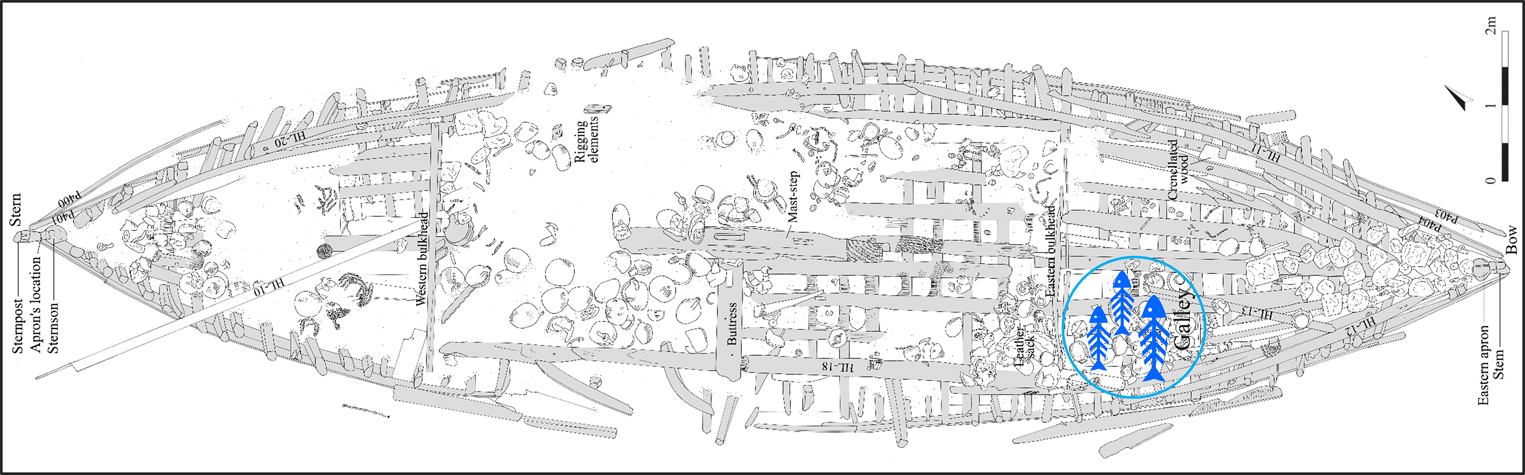
The LR5 amphorae containing fish bones onboard the Ma‘agan Mikhael B shipwreck were found where the galley is thought to have been located (Figure 3). The amphorae were broken in situ and, thanks to the thick layer (c. 1.5 m) of sand deposited over the shipwreck over time, their contents remained in place until they were excavated. The vessels and their contents were collected during excavation and placed in separate plastic bags with seawater until they reached the Yaacov Yak Kahanov Laboratory for Ancient Ship Research at the University of Haifa. The sherds from two amphorae (MMB 3199 and MMB 3159.1–3) were removed, and the ichthyological remains from each vessel were separately placed in a 1 mm mesh sieve to be rinsed gently with fresh water. After having been air-dried at ambient temperature on paper towels, the total quantity of fish bones from each amphora was weighed (MMB 3199: 22.9 g; MMB 3159.1–3: 66.9 g) and placed in sealed, labelled containers. The third amphora (MMB 3319) contained a concretion at the base of the vessel, which consisted of a mixture of marine sediment and organic remains. The contents of this concretion were separated by wet-sieving. After drying, the organic remains were inspected under a magnifying glass. This yielded a very small quantity of fish bones and scales, as well as unidentified botanical and entomological remains. The ichthyological specimens were separated and placed in a sealed plastic bag. Samples taken from each amphora were then taken to Jerusalem where the first analysis took place (MMB 3199 sample: 11.2 g [35 per cent of the total]; MMB 3159.1–3 sample: 23.6 g [49 per cent of the total]; MMB 3319 [100 per cent of the total]).
Plan of the Ma‘agan Mikhael B shipwreck in 2019 with the proposed galley area in blue. The fish icons denote the location of the amphorae containing fish bones. Basis of illustration by permission of P. Sibella.
Taxonomic identification was conducted using the reference collection of O. Lernau, and some additional identifications were checked against the collection of the Royal Belgian Institute of Natural Sciences in Brussels. Size estimations were made by direct comparison with specimens of known length from these reference collections. Given the very high density of skeletal elements in the samples from MMB 3199 and MMB 3159.1–3, a subsample of 3 g from each of these amphorae's samples was searched for species-indicative elements. This resulted in the number of identified specimens (NISP). The minimum number of individuals (MNI) for each taxon was counted within each 3 g subsample and then extrapolated to estimate the MNI for the whole content of each amphora. Since it was very small, the entire sample from MMB 3319 was examined. MNI was only determined to the family level for all samples. A Leica™ S9i binocular microscope combined with LasEZ (Leica Application Suite, version 3.40) image capturing software was used to photograph the fish bones and scales from the amphorae.
Results
Unless specific sources are indicated, the information about the distribution and ecology of fish species was taken from FishBase (Froese & Pauly, Reference Froese and Pauly2021). The contents of amphorae MMB 3199 and 3159.1–3 will be treated as one assemblage (Assemblage A) because their species compositions were very similar. The remains from amphora MMB 3319 were different and are discussed separately (Assemblage B).
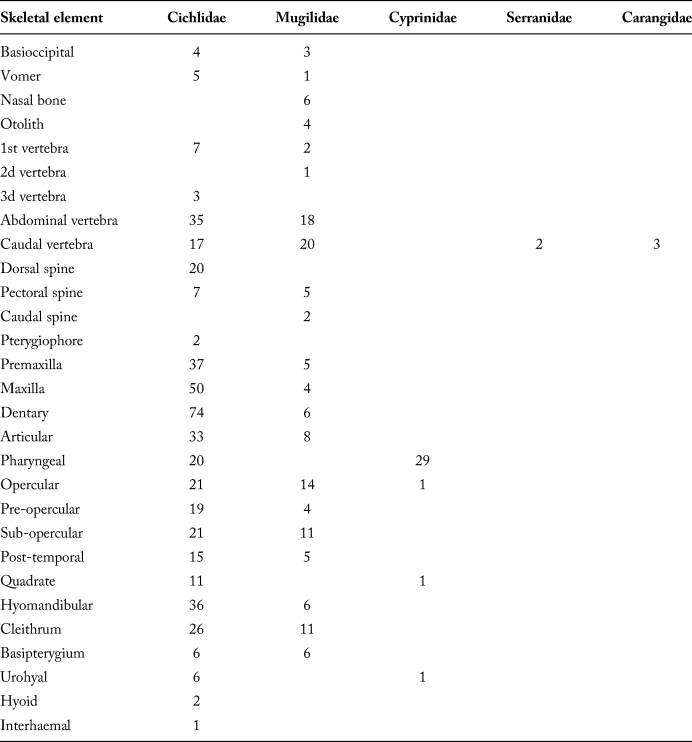
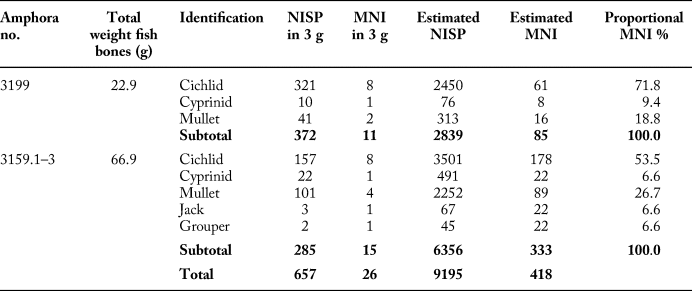
The fish taxa identified within Assemblage A belonged to five families: cichlids (Cichlidae), cyprinids (Cyprinidae), mullets (Mugilidae), groupers (Serranidae), and jacks (Carangidae). The number of identified skeletal elements per fish family are presented in Table 1, and NISP and MNI per amphora are listed in Table 2. Based on the estimated MNI, cichlids are the most abundant family represented in Assemblage A, accounting for 71.8 per cent of the content of MMB 3199 and 53.5 per cent of the content of MMB 3159.1–3. The second most abundant family in Assemblage A is mullet, but its proportional contribution is minimal. Fewer remains were identified for cyprinids, groupers, and jacks in Assemblage A.
Diagnostic skeletal elements in Assemblage A attributed to identified taxonomic families.
NISP and MNI of the identified skeletal elements attributed to taxonomic family per 3 g sample. The figures were extrapolated by the total dry weight of fish bones per amphora to obtain the estimated NISP and MNI in Assemblage A and the compositional proportions per family within each vessel.
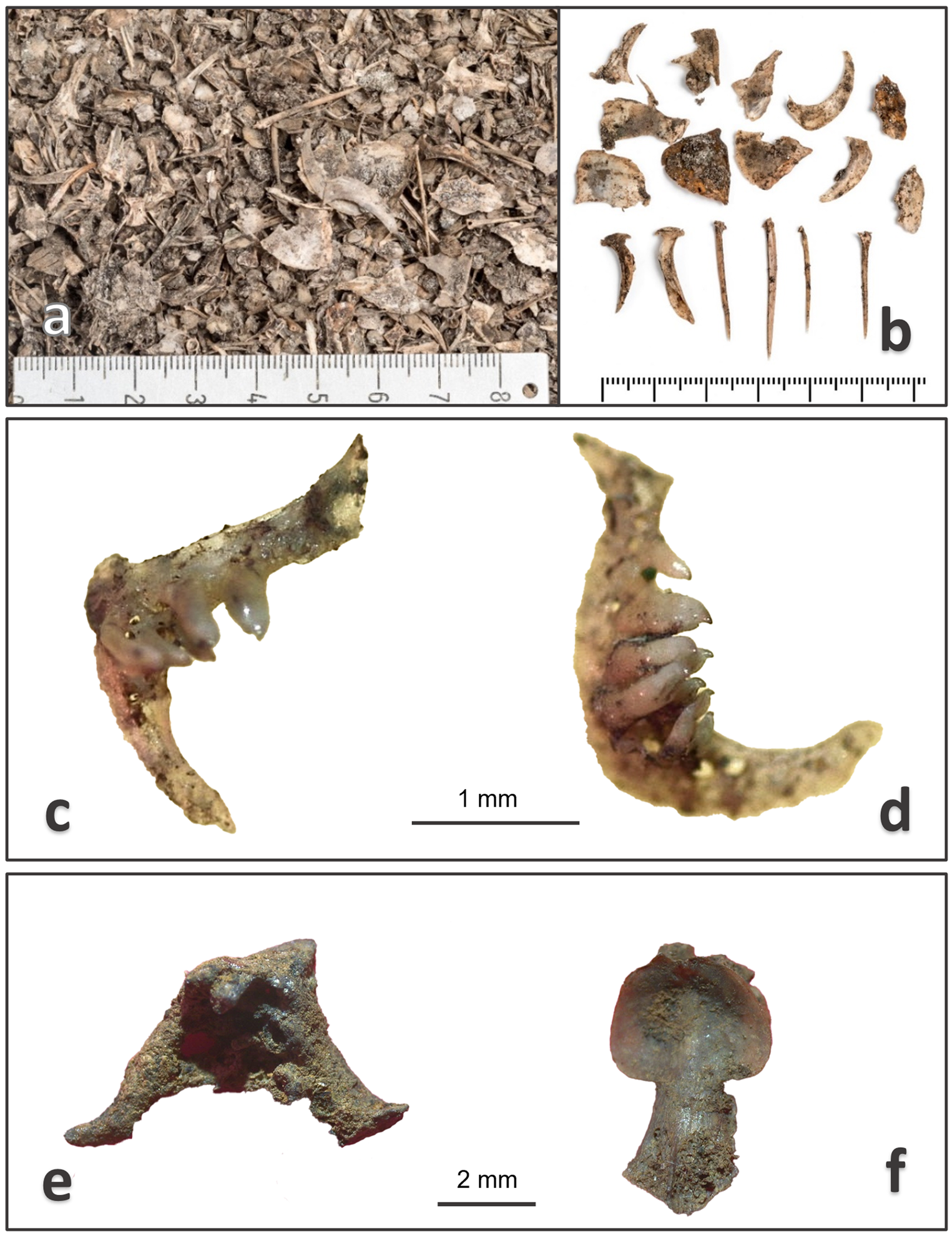
The thousands of individual ichthyological remains within Assemblage A were very small (1–3 mm greatest length) with some of them well preserved (Figure 4a & b). Identification to genus and species was difficult due to the miniscule size of the skeletal elements, but some could be identified (Table 3). The species recorded among the cichlids are: blue tilapia (Oreochromis cf. aureus; n=10); mango tilapia (Sarotherodon galilaeus; n=7); and redbelly tilapia (Coptodon zillii; n=19). Cichlids mainly inhabit fresh waterways but can also adapt to shallow, brackish marine waters (Golani, Reference Golani1996: 26). These species are abundant in the Jordan Valley and coastal river systems in Israel, as well as in freshwater systems in Egypt and other parts of Africa (Goren, Reference Goren1974: 104; Goren & Ortal, Reference Goren and Ortal1999: 4–5, table 1; Barkai et al., Reference Barkai, Lernau and Kahanov2013: 167).
a) Assemblage A comprised thousands of tiny ichthyological remains, 1–3 mm in size. The samples were examined under a microscope to locate identifiable skeletal elements; b) recorded skeletal elements included cranial and post-cranial bones, fin spines, and scales, suggesting that whole, small fish were deposited in the amphorae; c) view of a Jordan himri (Carasobarbus canis) infrapharyngeal plate from Assemblage A; d) a Jordan himri infrapharyngeal specimen from Assemblage A with the dentition in greater detail; e) pharyngeal plate from Labeo sp. in Assemblage B; f) lamina of a basioccipital bone from Labeo sp. in Assemblage B. Photographs a and b by permission of A. Efremov; photographs c–f by permission of O. Lernau.
Habitat of the taxonomic families identified in Assemblage A.
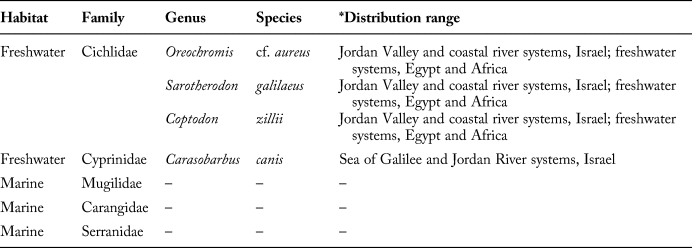
*Biogeographical distribution ranges are provided for the specimens identified to species.
Cyprinids are abundant in the Sea of Galilee and dominate the Jordan Valley river systems, and other freshwater systems in Arabia and Africa (Goren & Ortal, Reference Goren and Ortal1999: 1, 3; Borkenhagen & Krupp, Reference Borkenhagen and Krupp2013). Though they are primarily freshwater fish found in streams, lakes, and ponds, they are remarkably tolerant of waters with low oxygen and high salinity; some genera even adapt to brackish marine areas (Balon, Reference Balon1974: 18). Cyprinid remains are very difficult to identify to species (Lepiksaar & Heinrich, Reference Lepiksaar and Heinrich1977). In the 3 g subsample of amphora MMB 3199 (Assemblage A), a few pharyngeal plates were found. Since these small bones are the most suitable for cyprinid species identification, all the samples from both amphorae in Assemblage A were revisited for this particular element. The identified infrapharyngeals (n=29) recovered from Assemblage A certainly belonged to a barbel-like genus, which excludes the species Acanthobrama telavivensis or Capoeta damascina. The barbel cyprinids that inhabit the southern Levant are the Jordan himri (Carasobarbus canis) and the Jordan barbel (Luciobarbus longiceps) (Goren, Reference Goren1974: 91; Krupp & Schneider, Reference Krupp and Schneider1989: 360–63; Goren & Ortal, Reference Goren and Ortal1999: 4, table 1; Borkenhagen & Krupp, Reference Borkenhagen and Krupp2013: 11–13; Freyhof et al., Reference Freyhof, Ekmekçi, Ali, Khamees, Özulu and Hamidan2014). Similar barbel species are present in the Nile river system in Egypt: the Niger barb (Labeobarbus bynni) and perince (Enteromius perince). The Levantine and Egyptian barbel species differ in the dentition pattern for the first two teeth of the pharyngeals, making it possible to identify on this basis. We could positively assign the infrapharyngeal specimens to the Jordan himri (Figure 4c & d). The other three cyprinid bones in Assemblage A (quadrate, opercular, and urohyal) also strongly resembled this species, which seems to indicate that all the cyprinid bones in Assemblage A belong to the Jordan himri. Although FishBase reports that the Jordan himri inhabits the southern Levant's inland freshwater systems, as well as coastal rivers draining directly into the Mediterranean, we suggest that the latter claim is dubious, given the few unsubstantiated observations noted (Krupp & Schneider, Reference Krupp and Schneider1989: 360; Borkenhagen & Krupp, Reference Borkenhagen and Krupp2013: 11–13). Neither Goren (Reference Goren1974) nor Goren & Ortal (Reference Goren and Ortal1999) report the Jordan himri in the coastal rivers of Israel. Unlike some other local cyprinid species, it has not been observed in marine waters in the Levant. There is, however, abundant evidence for the Jordan himri in the Jordan River system, including spawning grounds and fisheries in the Sea of Galilee (Goren, Reference Goren1974: 91; Krupp & Schneider, Reference Krupp and Schneider1989: 360–63; Goren & Ortal, Reference Goren and Ortal1999: 3; Borkenhagen & Krupp, Reference Borkenhagen and Krupp2013: 11–13; Freyhof, Reference Freyhof2014).
Mullets, jacks, and groupers are marine fishes. Mullets are commonly found in shallow, coastal, eastern Mediterranean waters, including brackish lagoons and estuaries (Goren & Ortal, Reference Goren and Ortal1999: 3; Kaschner et al., Reference Kaschner, Kesner-Reyes, Garilao, Segschneider, Rius-Barile and Rees2019). Mullets are natural inhabitants of the coastlines of Israel and Egypt (Golani, Reference Golani1996: 40). The Carangid family includes jacks, scads, and the commercially important jack mackerel (Trachurus spp.). These are pelagic, migratory, schooling fish whose habitat includes the eastern Mediterranean (Golani, Reference Golani1996: 38–39; Kaschner et al., Reference Kaschner, Kesner-Reyes, Garilao, Segschneider, Rius-Barile and Rees2019). Several species of groupers are found in rocky reef habitats along the coasts, lagoons, and estuaries of the southern Levant (Heemstra & Randall, Reference Heemstra and Randall1993; Golani, Reference Golani1996: 37–38; Kaschner et al., Reference Kaschner, Kesner-Reyes, Garilao, Segschneider, Rius-Barile and Rees2019). Species identifications for the mullets, jacks, and groupers were not attempted due to non-diagnostic skeletal elements.
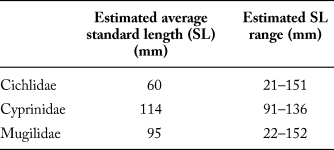
The average body size and minimum to maximum size ranges of the cichlids, cyprinids, and mullets within the two vessels MMB 3199 and MMB 3159.1–3 were estimated (Table 4). All fishes were below the 160 mm standard length (SL: greatest length from the tip of the snout to the posterior end of the last vertebra, excluding the caudal fin). Due to preservation issues, precise size estimations were not possible for the groupers and jacks, but they were on par with the size of the other fish. The skeletal elements found in Assemblage A included scales, cranial/facial and post-cranial bones, indicating that these small fishes were complete and not descaled prior to deposition in the amphorae.
Estimated average body size (SL) and minimum–maximum size ranges for Assemblage A based on individual skeletal elements identified.
Among the few fish remains in Assemblage B, four pharyngeal bones were identified as belonging to the cyprinid genus Labeo sp. (NISP=4, MNI=2) (Figure 4e & f). Based on the size of the pharyngeals, these fishes have an estimated SL of 150–180 mm. The genus Labeo is not known to inhabit the inland river systems of the southern Levant. Four species are known from the Nile River and other freshwater systems in Egypt and north-eastern Africa. Sandon (Reference Sandon1950) mentions the African carp (L. coubie), Nile carp (L. niloticus), Labeo forskalii, and the Assuan labeo (Labeo horie). There were no other identifiable fish remains in Assemblage B.
For both Assemblages A and B, the majority of fish species identified originate in freshwater habitats, which excludes the possibility of an accidental accumulation of fish bones in the marine environment. It appears that the amphorae of Assemblage A held a preserved fish product consisting of both freshwater and marine taxa which retained many bones, while the content of the Assemblage B amphora is more obscure. A possibility is that it held a liquid which dissipated after the wrecking event. The few entomological and botanical remains present in the Assemblage B concretion are currently under study and their identification may shed light on the issue.
Discussion
Historical context
Fish salting and fish fermentation are two distinct processes (Grainger, Reference Grainger2013: 15; Marzano, Reference Marzano2013: 90). Salsamenta is the Latin word used by the Romans to designate any meat, but particularly fish, preserved by salting (Curtis, Reference Curtis and Scarborough1991: 6). This process involves packing layers of chopped animal flesh alternating with layers of salt within jars (Curtis, Reference Curtis and Scarborough1991: 10). Here, we use the term salsamenta to refer to salted fish. Fermented fish products, such as garum, liquamen, and muria, were produced by the fermentation of salted fish packed in water-tight vessels like dolia (Curtis, Reference Curtis and Scarborough1991: 12–14; Van Neer et al., Reference Van Neer, Lernau, Friedman, Mumford, Poblome and Waelkens2004: 102; Grainger, Reference Grainger2013: 15–16; Marzano, Reference Marzano2013: 92). All parts of the fish were used to make fermented fish sauces, including viscera. These sauces were often seasoned with herbs and spices, and the containers were placed in a sunny location to ferment for nearly a month. This produced a liquid fish sauce which varied by recipe. Allec was a residue fish paste which retained the bones after the liquid garum had been strained off (Grainger, Reference Grainger2013: 15–16; Marzano, Reference Marzano2013: 91–92). In Roman contexts, salsamenta and allec are the most archaeologically recognizable because of the remains of fish bones left behind, while garum, liquamen, and muria, being mainly liquid, generally do not survive in the archaeological record (Curtis, Reference Curtis and Scarborough1991: 14; Cotton et al., Reference Cotton, Lernau and Goren1996: 231). Nevertheless, liquid fish sauces can sometimes be indicated by certain types of commonly used storage amphorae, or by inscriptions (tituli picti) describing their contents, as was the case of the garum jar found in Herodian Masada (Cotton et al., Reference Cotton, Lernau and Goren1996: 226).
Fermented fish products were usually stored in ceramic amphorae for later use or distribution (Curtis, Reference Curtis and Scarborough1991: 10, 123–24; Grainger, Reference Grainger2013: 16). In antique Levantine contexts, ichthyological remains found in such containers have usually been interpreted as allec (Cotton et al., Reference Cotton, Lernau and Goren1996: 230–31; Van Neer & Depraetere, Reference Van Neer and Depraetere2005: 159; Fradkin & Lernau, Reference Fradkin, Lernau, Holum, Stabler and Reinhardt2008: 192; Barkai et al., Reference Barkai, Lernau and Kahanov2013: 195, 198). Fish remains with known biogeographical ranges outside the context in which they were found can suggest provenance, and therefore long-distance trade (Van Neer et al., Reference Van Neer, Lernau, Friedman, Mumford, Poblome and Waelkens2004: 102).
The preservation of fish by drying, smoking, salting (read salsamenta), and fermenting or pickling also has a long tradition in Egypt, dating back to at least the Middle Kingdom (second millennium bc) (Curtis, Reference Curtis and Scarborough1991: 131–40; Van Neer et al., Reference Van Neer, Lernau, Friedman, Mumford, Poblome and Waelkens2004: 102, 108, table 1; Van Neer & Depraetere, Reference Van Neer and Depraetere2005: 159). In the literature, the term ‘pickled’ is used to describe Egyptian fermented fish, although the fish became pickled by fermentation as opposed to adding an acidic liquid like vinegar (Curtis, Reference Curtis and Scarborough1991: 17). Here, we use the terms pickled and fermented interchangeably. Cyprinid bones found in jars in a Napatan residential building at the urban centre of ancient Kerma along the Sudanese Nile (700–500 bc) were interpreted to have been salted fish (Van Neer & Depraetere, Reference Van Neer and Depraetere2005: 159 with references). Pickled Nilotic fish remains were found at Mons Claudianus, a second century ad quarry site in the East Desert of Egypt (Van Neer & Depraetere, Reference Van Neer and Depraetere2005: 159 with references). Salted Nilotic freshwater fish remains were identified at a Coptic Byzantine site at Shanhûr on the east bank of the Nile in upper Egypt north of Luxor (Van Neer & Depraetere, Reference Van Neer and Depraetere2005: 159–68). Textual evidence derived from ostraca reports that freshwater fish from the Nile was pickled and consumed by the Coptic monastic community at Bawit during the early Islamic period (Van Neer & Depraetere, Reference Van Neer and Depraetere2005: 168, with references). This tradition is still alive today in preparations such as the pickled faseekh, which is consumed during the spring festival of Sham an-Naseem (Van Neer & Depraetere, 2006: 168–69).
Preserved fish was also exported from Egypt to neighbouring Palestine during the Hellenistic, Roman, and Byzantine periods, both by land and by sea (Sperber, Reference Sperber1976: 119–23; Van Neer et al., Reference Van Neer, Lernau, Friedman, Mumford, Poblome and Waelkens2004: 128–30, table 3). A third-century bc papyrus records that two camel loads of salted fish were delivered overland from Pelusium (الفرما) on the Mediterranean coast of Sinai to Gaza (Weingarten, Reference Weingarten2018: 238, with references). The Babylonian Talmud discusses garum-type products that were imported to Caesarea from Pelusium in the third century ad (Babylonian Talmud Avodah Zarah 39a; Sperber, Reference Sperber1976: 122; Weingarten, Reference Weingarten2018: 238). Archaeological evidence for the distribution of Egyptian fish into historical Palestine indicates that this trade seems to have continued into the Islamic and later periods, though the record shows that this was mainly in the form of dried Nilotic perch (Lates niloticus) (Van Neer et al., Reference Van Neer, Lernau, Friedman, Mumford, Poblome and Waelkens2004: table 3).
Amphorae containing fish bones, interpreted as the remains of salsamenta or allec (Parker, Reference Parker1992; Barkai et al., Reference Barkai, Lernau and Kahanov2013; Grainger, Reference Grainger2013), are recorded from twelve premodern (i.e. before 1500 ad) shipwrecks in the Mediterranean Sea (Figure 5; details in Table 5). Ten of these are situated on the Mediterranean coast of Europe, and have been dated between the Imperial and Late Roman periods (first century bc–fifth century ad).
Locations of twelve premodern Mediterranean shipwrecks with amphorae containing fishbones. Dating: turquoise: Roman Empire (first century bc–fourth century ad); blue: Late Roman (fourth–fifth century ad); green: early Islamic period (seventh–ninth century ad).

Summary of premodern Mediterranean shipwrecks with published identification of fish remains within amphorae.
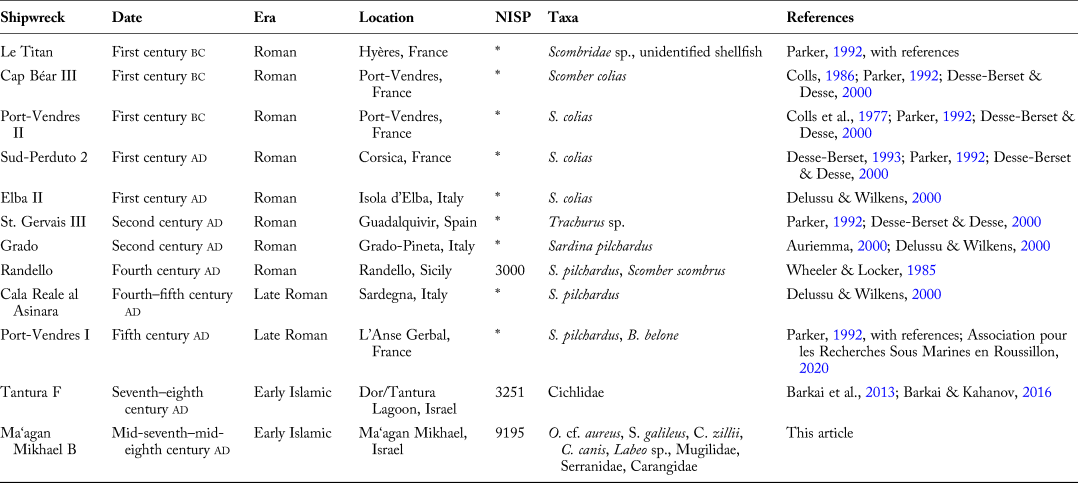
* Denotes the absence of an exact NISP; estimated NISP from the original publication is included when available.
The amphorae from the western Mediterranean shipwrecks mainly contained European pilchard sardines (Sardina pilchardus) or mackerel (Scomber spp. and Trachurus spp.). One ship's cargo (Port-Vendres I) also included some garfish (Belone belone) along with the sardines. These fishes are all pelagic, schooling, marine genera native to the Mediterranean (Whitehead, Reference Whitehead1984). The presence of amphorae containing such fish on Roman-era shipwrecks has been interpreted as evidence of trade in salted-fish products (Curtis, Reference Curtis and Scarborough1991: 6, 12–14; Van Neer et al., Reference Van Neer, Lernau, Friedman, Mumford, Poblome and Waelkens2004: 102; Grainger, Reference Grainger2013: 15–16; Marzano, Reference Marzano2013: 92). The typology of the amphorae containing ichthyological remains has often linked regions famous for cetaria (Iberia, northern, and north-western Africa) with nodes of commerce in the larger Imperial Roman maritime trade network (Colls et al., Reference Colls, Étienne, Lequément, Liou and Mayet1977: 42; Curtis, Reference Curtis and Scarborough1991: 149–52; Parker, Reference Parker1992: 97, 330, 331; Desse-Berset & Desse, Reference Desse-Berset and Desse2000: 81; Grainger, Reference Grainger2013: 16–18).
In the eastern Mediterranean, the shipwreck evidence for maritime trade in preserved fish is much slighter. Until the underwater excavations of the Ma‘agan Mikhael B, the Tantura F shipwreck, found some thirty kilometres south of Haifa and dated to the seventh–eighth century ad in the early Islamic period, provided the sole direct evidence of preserved fish being transported by ship on the southern Levantine coastline (Barkai & Kahanov, Reference Barkai and Kahanov2016: 196). The fish found within eight ovoid LR5 amphorae onboard were identified as cichlids and their skeletal elements indicated the use of whole fish (Barkai et al., Reference Barkai, Lernau and Kahanov2013: 195), i.e. small fish ranging between 17 and 40 mm in total length. The amphorae contents were thus interpreted as the remains of allec.
The Sea of Galilee is famous for its fisheries—both biblically and historically—and a fish processing industry is known to have existed at ‘Migdal of the Fishes’ (or Migdal Taricheae/Nunayya), just north of Tiberias (Tabariyya), from the Hellenistic to the Roman periods (Pines et al., Reference Pines, Avshalom-Gorni, Shalev and Marom2020: 1, with references). The scale of this industry is believed to have been large, because the nomenclature of the city refers to fish (taricheae [Greek] or nunayya [Aramaic]). Historical support is found in a few references to a fish-salting industry there given by Strabo (Geography, 16.2.45) and Flavius Josephus (The Jewish War, 3.445–466). Excavations at Migdal revealed an industrial complex with many vats where fish salting on a large scale could have taken place. Microfaunal remains were, however, not specifically screened and hence archaeozoological evidence for a cetaria-like operation has yet to be identified (see discussion in Pines et al., Reference Pines, Avshalom-Gorni, Shalev and Marom2020). Salt could have been procured from salinae, i.e. salt works usually constructed in coastal lagoon areas that made salt from evaporated seawater. Some were complex, with channels and sluice gates, others were shallow rectangular basins cut directly into coastal rock and were often located near fish-salting facilities (Marzano, Reference Marzano2013: 124, 130). Such works existed on the Mediterranean Carmel coast (e.g. the salt pans at the Nahal Me'arot (Caves River) outlet; Galili & Sharvit, Reference Galili, Sharvit, Stewart and Vita-Finzi1988). We therefore believe that the three requirements for fish-salting as defined by Curtis (Reference Curtis and Scarborough1991)—abundant fish, locally imported salt, and freshwater—were met at the Sea of Galilee in antiquity, as suggested by the historical documentation.
The famous fishing town of Migdal was destroyed by the Romans during the revolt of the Jews against Rome in the 70s ad, and was abandoned by the third century ad (Avshalom-Gorni, Reference Avshalom-Gorni2009: 3), hundreds of years before the sinking of the Ma‘agan Mikhael B. Recent surveys and excavations have revealed that the settlement moved slightly to the north of Migdal on the western shoreline of the Sea of Galilee in the Byzantine and early Islamic periods (Avshalom-Gorni, Reference Avshalom-Gorni2009: 3; Dark, Reference Dark2013: 187, 196). At Kursi Beach on the eastern shoreline, a five-metre diameter stone-built piscina, that is, a tank or pool constructed to hold and raise fish known in both marine and freshwater contexts (Marzano, Reference Marzano2013: 211, 226), was identified near the mouth of Nahal Samak (Fish River) (Artzy et al., Reference Artzy, Cohen, Meir and Misgav2019). This fishpond was dated to the late Byzantine to early Islamic transition period and was associated with a monastery and pilgrims' hostel.
This archaeological evidence suggests a continuation in commercial fishing activity at the Sea of Galilee in late antiquity. Considering that the conditions for fish-salting would still have been met despite the disruptions that the geopolitical manoeuvres in the region caused, it is conceivable that a fish preservation industry continued into later periods around the lake, albeit with a lighter archaeological footprint.
The Ma‘agan Mikhael B fish remains
The Jordan himri remains identified within Assemblage A are prevalent in the inland Jordan river system, including the Sea of Galilee. Given the historical and archaeological evidence for a commercial fishing industry which probably extended into the late Byzantine to early Islamic period at the Sea of Galilee, we suggest that this would have been the most likely location for the catch and processing of the freshwater fishes identified in Assemblage A. The marine fish found within this assemblage could only have been caught in the Mediterranean Sea. Even if netted on the Carmel coast, the saltwater fish could not have been salted together with fish from the Sea of Galilee as the distance of more than fifty kilometres is too great to transport fresh fish in one day (Van Neer et al., Reference Van Neer, Lernau, Friedman, Mumford, Poblome and Waelkens2004: 106). The most parsimonious explanation for the co-occurrence of fresh- and saltwater taxa within the amphorae is that these vessels were reused and contained two distinct salted-fish products—marine fish from the Mediterranean (mullet, grouper, and jack) and freshwater fish (cichlids and cyprinids) from the Sea of Galilee.
How and why these sauces would be combined is ambiguous. One possibility is that the freshwater fish was salted at the Sea of Galilee, transported to a depot or trade centre on the Mediterranean coast in larger vats or amphorae, and then transferred to smaller LR5 amphorae which still contained the remnants of marine fish sauce. After the garum had been strained off, the dregs of the sauce may not have been emptied completely before reuse, or the remnants may have been used intentionally to promote fermentation in transit (Curtis, Reference Curtis and Scarborough1991: 123; Grainger, Reference Grainger2013: 16, 23). This ‘second-use’ hypothesis could also explain the predominance of freshwater fish within Assemblage A (62.7 per cent combined proportional MNI), and the heterogenous mixture of marine and freshwater taxa. The amphora containing Assemblage B may have also been reused. The very few remains identified make this difficult to establish, but the few fish bones within the concretion suggest that its last content was a liquid fermented fish sauce like garum or liquamen. If so, then the botanical remains may have come from the seasoning of the recipe (Curtis, Reference Curtis and Scarborough1991: 12). A wheat weevil (Sitophilus granaries) was identified in one of the amphorae containing fish bones on the Tantura F shipwreck, indicating that it had previously held grain and hence the amphora was in secondary use (Barkai et al., Reference Barkai, Lernau and Kahanov2013: 193). The future identification of the insects recorded in the amphora containing Assemblage B may elucidate the use history of this vessel. Since it would be uneconomic to ship empty amphorae, the Egyptian origin of the clay used to make these LR5 vessels also suggests a secondary use. The use of LR5 amphorae as generalized storage vessels filled with various foodstuffs (e.g. olives, fruits, and nuts) onboard the Ma‘agan Mikhael B (Cohen & Cvikel, Reference Cohen and Cvikel2019) gives the impression that they were refilled according to cargo storage needs.
The closest archaeological parallels for the preserved fish found on the Ma‘agan Mikhael B are the remains of allec from the Tantura F shipwreck. The same type of LR5 amphorae containing fish bones was found on both ships (Creisher, pers. comm. 2020). Both were petrographically sourced to the Nile region and interpreted as having been in secondary use (Barkai et al., Reference Barkai, Lernau and Kahanov2013: 193; Barkai & Kahanov, Reference Barkai and Kahanov2016: 20). Unlike the Ma‘agan Mikhael B amphorae, those from the Tantura F contained only cichlids, interpreted by the authors as a higher-quality sauce meant for trade rather than representing the sailors' rations. The most likely locations for the production or procurement of the Tantura F salted fish were posited to be Caesarea or the Nile region (Barkai et al., Reference Barkai, Lernau and Kahanov2013: 195; Barkai & Kahanov, Reference Barkai and Kahanov2016: 22). The Caesarea hypothesis suggests that a fish-salting industry not previously identified, archaeologically existed on the southern Levantine coast in the late Byzantine/early Islamic period. Further evidence for this comes from the ichthyological remains found in storage jars in a seventh-century ad Byzantine warehouse at Caesarea, as well as fish bones found in occupation contexts within the city during and after the transition to Islamic rule (Fradkin & Lernau, Reference Fradkin, Lernau, Holum, Stabler and Reinhardt2008: 192; Van Neer et al., Reference Van Neer, Lernau, Friedman, Mumford, Poblome and Waelkens2004: 111, table 3). The remains from our Assemblage A seem to bolster this hypothesis. Caesarea remained an active harbour town in the Umayyad and Abbasid periods, and would have been a geographically convenient nexus for the processing, fermentation, and distribution of fish from both coastal marine and inland freshwater sources
As to whether the preserved fish on the Ma‘agan Mikhael B was a tradeable commodity or was part of the of crew's rations is difficult to establish. The mixture of fish and high bone content within Assemblage A is interpreted as allec or salsamenta, a preparation generally considered to be of low quality (Lepiksaar, Reference Lepiksaar1986; Desse-Berset & Desse, Reference Desse-Berset and Desse2000; Grainger, Reference Grainger2013). There is an assumption that salted-fish products traded over great distances designates them as elite and luxury-grade commodities due to the time and effort taken to transport them (Van Neer & Ervynck, Reference Van Neer, Ervynck, O'Day, Van Neer and Ervynck2002). Grainger (Reference Grainger2013), however, contends that the majority of preserved fish products recovered from amphorae on shipwrecks in the Mediterranean should be identified as allec, and thus suggests that sub-elite and low status salted-fish preparations were heavily traded in antiquity. Moreover, she posits that the fish bones found in the Tantura F shipwreck were more likely to have been a common, low-quality liquamen (Grainger, Reference Grainger2021). The allec from the Ma‘agan Mikhael B could therefore have been a traded commodity. On the other hand, salted-fish sauce is known to feature among the rations of Roman soldiers and enslaved people (Cotton et al., Reference Cotton, Lernau and Goren1996: 231, 234–35; Grainger, Reference Grainger2013: 14), so a plebeian-grade allec would be a logical and feasible ingredient in a mariner's diet as a source of protein, vitamins, and minerals (Curtis, Reference Curtis and Scarborough1991: 22). This would have been consistent with a sailor's social class and may have been included in rations.
In terms of long-distance exchange, the Ma‘agan Mikhael B salted-fish products point to two distinct sources: the southern Levant and the Nile region of Egypt. We suggest that the Jordan himri in Assemblage A was most likely to have been caught and salted at the Sea of Galilee. This implies that a fish preservation industry operated after the destruction of Migdal of the Fishes, and indicates that trade between the Sea of Galilee and the Carmel coast was active in the early Islamic period. The cyprinids (Labeo sp.) identified in Assemblage B do not occur in the southern Levant. Geographically, the closest species in this genus are found in the Nile river system (Sandon, Reference Sandon1950). The Assemblage B cyprinids may indicate a late antique fermented fish production centre in the Nile region of Egypt, whose products were imported into the southern Levant in the early Islamic period. Pelusium on the Mediterranean coast of Egypt may have been such a centre, given the historical evidence for a fish-salting industry there with exports to Palestine in the Roman and later periods (Sperber, Reference Sperber1976: 121–22; Curtis, Reference Curtis and Scarborough1991: 145–46).
Conclusions
The fish bones identified within the LR5 amphorae on the Ma‘agan Mikhael B shipwreck represent the remains of salted- fish products. The five families of fish taxonomically identified within the vessels share habitat ranges in Egypt and the southern Levant, though some amphorae contain genera and species endemic to one or the other. The mullets, groupers, and jacks, which inhabit the Mediterranean coastline of both Egypt and the southern Levant, do not indicate a specific origin for the saltwater fish product. The cichlids in Assemblage A occur in both southern Levantine and Egyptian freshwater systems and also cannot be used to suggest provenance. But the cyprinids identified to genus or species are endemic to discrete freshwater systems: those from Assemblage A come from the southern Levant, and those from Assemblage B from Egypt. Assemblage A consisted of two amphorae that held similar contents, a heterogenous combination of fresh and saltwater fish, while Assemblage B only contained a residue which included a few freshwater fish remains. Assemblage A appears to have consisted of two distinct preserved fish products: salted Galilean freshwater fish and the dregs of a previous marine fish allec or salsamenta. The composition of Assemblage B is less clear, but it may have derived from a liquid fish sauce that had dissolved after the Ma‘agan Mikhael B sank. The provenance of the Assemblage A LR5 amphorae, made of Egyptian clay, and their contents, a mix of marine and freshwater fish, suggest that these vessels were in secondary use.
This study brings to light the probable existence of a fish-salting industry on the shores of the Sea of Galilee in the early Islamic period. The evidence also suggests that another production centre existed contemporaneously in the Nile region. We tentatively posit that this was Pelusium, given the historical and archaeological evidence available. The allec from Assemblage A corroborates the hypothesis of a late Byzantine/early Islamic-period salted-fish product distribution or trade centre at Caesarea-Maritima, only 3.2 nautical miles from the Ma‘agan Mikhael B shipwreck site. This harbour town continued to operate in the early Islamic period, and fish remains in pottery vessels were recovered from a seventh-century ad warehouse there. Caesarea may have been the Ma‘agan Mikhael B's last port-of-call before foundering on the Carmel coast.
Our investigation into the provenance of the fish remains onboard the Ma‘agan Mikhael B shipwreck demonstrates the value of applying archaeozoological methods in maritime archaeology and adds to the story of the ill-fated vessel. It also reveals that an ancient Mediterranean and Egyptian culinary tradition—the salting and fermenting of fish—continued well into late antiquity. Though the practice may have lost its commercial importance after the fall of the Roman Empire and its maritime trade networks, the culinary custom persisted in the southern Levant and Egypt, regardless of geopolitical events in the eastern Mediterranean during the transition from Byzantine to Islamic rule in the region.
Acknowledgments
This work was supported by the Israel Science Foundation (grant no. 1891/16 and grant no. 252/19). The underwater excavations (IAA permits G-41/2016, G-40/2017, G-26/2018, and G-34/2019) and research of the Ma‘agan Mikhael B shipwreck are supported by the Israel Science Foundation (grant no. 1891/16), the Honor Frost Foundation, the Research Authority of the University of Haifa, the Sir Maurice and Lady Irene Hatter Research Grant, Kibbutz Ma‘agan Mikhael, and anonymous donors. Analysis of the LR5 amphorae was undertaken by Michelle Creisher from the Department of Maritime Civilizations, University of Haifa. We wish to thank Andrey Shirak from the Institute of Animal Science, Agricultural Research Organization in Rishon LeTsiyon, Israel, for attempting an aDNA analysis of the cyprinid specimens, and Wim Van Neer from the Royal Belgian Institute of Natural Sciences in Brussels for cooperation with his laboratory. We thank the three anonymous reviewers for their advice and directions.


 Open access

