


Introduction
The Lesser White-fronted Goose Anser erythropus is globally threatened, designated as ‘Vulnerable’ (BirdLife International 2010). The world population has declined greatly since the 1940s (Lorentsen et al. Reference Lorentsen, Øien, Aarvak, Markkola, von Essen, Faragó, Morozov, Syroechkovsky, Tolvanen, Madsen, Cracknell and Fox1999) to an estimated 25,000–28,000 individuals currently (BirdLife International 2010). The Russian population was thought to have decreased from 30,000–50,000 individuals to 8,000-10,000, but 22,000 were counted in autumn 2008 (www.piskulka.net/Recent%20news.htm). The Fennoscandian population has declined from more than 10,000 birds in the early 20th century to a few pairs (Lorentsen et al. Reference Lorentsen, Øien, Aarvak, Markkola, von Essen, Faragó, Morozov, Syroechkovsky, Tolvanen, Madsen, Cracknell and Fox1999). In east Asia, the Lesser White-fronted Goose was stated to be the most numerous species in the Yangtze River floodplain over 100 years ago (Styan Reference Styan1891), although other historical data indicate that the species occurred in the lower Yangtze, but was uncommon in south-eastern China (La Touche 1931-Reference La Touche1934), and was uncommon in the middle and lower reaches of the Yangtze River (Cheng Reference Cheng1987); thus, there is considerable confusion about the historical status of the species in eastern China. The species was reportedly regularly sighted in Hunan, Hubei, Anhui and Jiangsu Provinces from the 1920s to 1980s (BirdLife International 2001), indicating a wide distribution in eastern China. However, at present only c.21,000 individuals occur, mostly confined to East Dongting Lake National Nature Reserve (190,000 ha) (Cao et al. Reference Cao, Barter and Lei2008b, Reference Cao, Zhang, Barter and Lei2010), part of the second largest freshwater lake in China, smaller only than Poyang Lake.
Despite national nature reserve status, East Dongting Lake faces many threats that could potentially affect Lesser White-fronted Geese, including massive changes in the hydrological cycle (average reduction of five weeks [20%] in the flood pulse duration and an average c.3 m lower peak height; L. Cao unpubl. data) and downstream sediment loads due to commissioning of the Three Gorges Dam (TGD) in mid-2003 (Xu et al. Reference Xu, Milliman, Yang and Wang2006,Yang et al. Reference Yang, Wang, Saito, Milliman, Xu, Qiao and Shi2006, Yang et al. Reference Yang, Zhang and Xu2007, Zhang et al. 2011), and illegal hunting (Chen et al. Reference Chen, Li, Jiang and Liu2001). Increasing pollution (Wang Reference Wang2006, Yan and Zhang Reference Yan and Zhang2003) can also be expected to impact on wetland quality and vegetation structure, and consequently on waterbirds (Cheng et al. Reference Cheng, Cao, Barter, Xu, Zhang and Zhao2009, Fox et al. Reference Fox, Cao, Zhang, Barter, Zhao, Meng and Wang2010, Zhang et al. Reference Zhang, Cao, Barter, Fox, Zhao, Meng, Jiang and Zhu2011).
Given these serious threats to wetland habitats in the Yangtze River floodplain, the main wintering area of the Lesser White-fronted Goose in east Asia, we here present the first collation of published and unpublished data on the distribution and abundance of the species in eastern China in recent decades, and recommend further surveys and future research to improve our knowledge of the distribution and ecological needs of this threatened species.
Methods
Study area
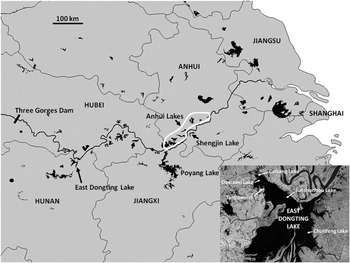
China east of 110°E has traditionally been frequented by the species, especially the Yangtze River floodplain and coastal Jiangsu Province (Figure 1; Cao et al. Reference Cao, Wang, Wang and Barter2008a). The Yellow River wetlands are less important, as they are invariably frozen throughout the winter (Liu Reference Liu1997). Coastal areas, from the Vietnam border in the south to the Bo Sea in the north, provide extensive intertidal and sub-coastal habitat suitable for geese but are less used (Cao et al. Reference Cao, Barter and Lei2008b). Few waterbirds occur west of 110°E during the non-breeding season, as this part of China is mostly at higher elevations, particularly in the south-west, and much of it lies well to the north of the average January 0°C isotherm (Liu Reference Liu1997).
Location of important wetlands for Lesser White-fronted Geese within the Yangtze River floodplain: East Dongting Lake, Poyang Lake, the Anhui Lakes (Anhui Anqing Yangtze Riverine Provincial Nature Reserve) and Shengjin Lake; boundaries of the floodplain provinces and the site of the Three Gorges Dam are also shown. Lower right inset shows the most important sites within East Dongting Lake.
Data sources
Few systematic survey data for waterbirds in East China exist before the 2000s, although occasional and incomplete accounts have been published. The first synchronous surveys were conducted throughout the Yangtze River floodplain in February 2004 and 2005 covering Hunan, Hubei, Jiangxi, Anhui and Jiangsu Provinces, and Shanghai Municipality (Barter et al. Reference Barter, Chen, Cao and Lei2004, Reference Barter, Lei and Cao2006); the first survey also covered coastal southern Jiangsu province.
Since then, non-synchronous counts have been conducted in the following Provinces: Hunan (2005/06–2008/2009); Hubei (2008/2009); Jiangxi 2005/06–2009/2010); and Anhui (13–20 December 2009; 5–10 February 2010). Opportunistic counts at different periods during the wintering season complicate data interpretation but contribute to our knowledge of the consistency with which sites held important numbers of Lesser White-fronted Geese.
Because of its great importance for Lesser White-fronted Goose, key areas at East Dongting Lake (Hunan Province) were counted monthly in the 2008/2009 and 2009/2010 winters (P. Cong unpubl. data). Shengjin Lake (Anhui Province), another key waterbird wetland, has also been counted regularly during the 2008/2009 (nine times) and 2009/2010 (13 times) winters (Cheng et al. Reference Cheng, Cao, Barter, Xu, Zhang and Zhao2009, Meng Reference Meng2010).
Other data sources (e.g. China Bird Report, China Birdwatch, the internet, etc.) were searched to determine the extent to which the range of the species extends outside the Yangtze River floodplain.
To assess trends in abundance and distribution, maximum annual provincial count data were divided into three periods: 1987/1988–1992/1993, 1993/1994–1998/1999 and 2004/2005–2009/2010. For each period we used the sum of the maximum counts for sites within each province.
Results
Lesser White-fronted Goose numbers have declined greatly in Anhui, Jiangxi and Jiangsu Provinces between the late-1980s/early-1990s and recent years: numbers in Hunan Province have remained relatively stable; the species’ range has now mainly contracted to Hunan (Table 1). As we have no information on how Lesser White-fronted Geese move around during the winter, the period totals may not accurately reflect the east China wintering population size; however, it seems likely that there was a large population decline between the late-1980s/early-1990s and the mid- to late 1990s, as also occurred generally in Anatidae wintering in eastern China (Cao et al. Reference Cao, Barter and Lei2008b).
Lesser White-fronted Goose numbers in the Yangtze River floodplain provinces from 1987/1988–2009/2010 (maximum counts during each period).

1: Waterbird Specialist Group of Chinese Ornithological Association (1994); 2: David Lee (pers. comm.); 3: Lei and Yang (Reference Lei and Yang1999); 4: Ge et al. (Reference Ge, Cai, Hu, Liu, Cao and Liu2005). 5, 6: Cao unpubl. data; 7: unpubl. data from Poyang Lake Nature Reserve; 8: Count data from four key sites at East Dongting Lake (L. Cao unpubl. data), which held over 90% of Lesser White-fronted Geese at Dongting Lake in the 2004 and 2005 winters; 9: WWF survey (Barter et al. Reference Barter, Chen, Cao and Lei2004, Reference Barter, Lei and Cao2006).
Since 2002/2003, the great majority of Lesser White-fronted Geese have occurred in Hunan and Jiangxi, mostly at East Dongting Lake with occasionally large numbers present at Poyang Lake. Total numbers have been relatively stable, despite probable variations in annual breeding success, incompleteness of counts and difficulties in separating the species from Greater White-fronted Geese Anser albifrons (Table 2).
Lesser White-fronted Goose numbers in the Yangtze River floodplain provinces from 2002/2003 to 2009/10.

Notes: 2003/2004 and 2004/2005 counts conducted in early February (Barter et al. Reference Barter, Chen, Cao and Lei2004, Reference Barter, Lei and Cao2006); italics identify incomplete counts which did not cover the complete province, but probably few birds occurred outside counted areas; ‘-‘ indicates no data available. 1 and 4: 25–26 February 2008; 2: 5 February 2009; 3: 6 February 2010; 4:10 February 2010; all L Cao unpubl. data; 5–10: unpubl. data from Poyang Lake National Nature Reserve, 5 and 8 are January counts, 6 and 7 are December counts, 9 and 10 are February counts; 11: January count (Barter and Lei Reference Barter and Lei2003); 11–13: 1, 5 and 0 birds, respectively, outside East Dongting Lake; 14, 15 and 17: unpubl. data from East Dongting Lake (February counts); 16 and 18: data from four key sites at East Dongting Lake (L. Cao unpubl. data), which held over 90% of Lesser White-fronted Geese in Dongting Lake in 2004 and 2005 winter; 19: January count (Barter and Lei Reference Barter and Lei2003).
Lesser White-fronted Geese concentrate at three sites (all February counts) within East Dongting Lake: Chunfeng, Daxiaoxi and Caisang Lakes (Figure 1 inset), with numbers declining at Daxiaoxi Lake in recent years and a smaller increase at Caisang Lake (Table 3).
Numbers of Lesser White-fronted Goose at the key sites in East Dongting Lake during simultaneous February counts in 2002/2003–2009/2010 winters.

Notes: Counts conducted in 2002/2003 from Barter and Lei (Reference Barter and Lei2003); counts in 2003/2004 and 2004/2005 from Barter et al. (Reference Barter, Chen, Cao and Lei2004, Reference Barter, Lei and Cao2006); remaining counts all L. Cao (unpubl. data); ‘-‘ indicates no data available.
Discussion
Little quantitative information is available on wintering numbers before the early 2000s, with the only reasonably comprehensive surveys being conducted in the 1988–1992 period, although there may be some doubt about the accuracy of these counts given the difficulty of separating Lesser from Greater White-fronted Geese and the lack of good optical equipment in China at that time. However, historical data indicate that there has been a large decline in abundance and range within eastern China for many Anatidae species (BirdLife International 2001), including Lesser White-fronted Geese (Sowerby et al. Reference Sowerby1943, Cao et al. Reference Cao, Wang, Wang and Barter2008a). Syroechkovskiy (Reference Syroechkovskiy, Boere, Galbraith and Stroud2006) provides further evidence for the decline in abundance suggesting that the Eastern Russia–China breeding population has decreased from 220,000 in the mid-1980s to c.40,000 in 2002/2003, although he believes that it is possible that some of these birds are wintering west of China – a suggestion which explains why only c.50% of the estimated 2002/2003 population winter in East Asia (Cao et al. Reference Cao, Barter and Lei2008b). In summary, despite patchy and possibly inaccurate historical data it seems that there has been a large decline in Lesser White-fronted Goose numbers in recent decades.
Lesser White-fronted Geese were probably more widespread in the 1980s and 1990s than is currently the case, with greater numbers in Anhui, Jiangxi and Jiangsu Provinces than in recent years. Although formerly more widespread in the Yangtze River floodplain and coastal Jiangsu, the Lesser White-fronted Goose is now mainly confined to East Dongting Lake. Numbers seem to be stable since 2002/2003, at around 20,000 individuals in mid-winter. Further analysis and discussion of possible causes of changes in status is limited by lack of knowledge on the wintering ecology of the species, e.g. arrival and departure dates, movements within eastern China, age ratios and food preferences.
Reasons for the possible range contraction and reduction in numbers during the 1990s are likely a combination of factors including habitat loss and degradation in the Yangtze River floodplain (Lu Reference Lu1996, NWCAPC 2000, He and Zhang Reference He and Zhang2001), hunting (Lu Reference Lu, Moser and Prentice1993), and the specialised feeding ecology of the species. At East Dongting Lake, the species aggregates in dense monocultures of short graminoid plants, exposed by falling water levels that are not exploited by other geese (P. H. Cong unpubl. data). Hence the species, as elsewhere in its range, may be adapted to exploiting highly specific winter habitats that make it more susceptible to habitat change than other goose species. However we have little information concerning the habitat preferences elsewhere within the historical wintering range and, hence, whether a decline in short graminoids may have led to range contraction.
East Dongting Lake is relatively well protected and the current timing and pattern of water level recession has enabled Lesser White-fronted Geese (as well as Bean Geese Anser fabalis and Greater White-fronted Geese) to utilise the new growth of various graminoid species in succession (P. H. Cong unpubl. data, L. Cao unpubl. data). However, the Three Gorges Dam could affect water level drawdown patterns, especially by exposing Carex sedge beds at East Dongting Lake earlier, affecting the height and hence attractiveness of the sward.
Poyang Lake and East Dongting Lake National Nature Reserves support most of the wintering Lesser White-fronted Goose population; Shengjin Lake National Nature Reserve supports the majority of the small remaining numbers found in the floodplain. Human disturbance is much reduced in nature reserves, especially national nature reserves, because there is less agriculture, fishing, poaching and reclamation than in unprotected wetlands. The relatively stable numbers at East Dongting Lake suggest that the population is not currently threatened, but the extreme concentration at one lake makes the species vulnerable, especially to external factors such as hydrological change. Lesser White-fronted Geese rely on very specific meadow vegetation exposed after water recession, so changes in water levels or recession timing may affect biomass, palatability and plant species composition of the meadows. Within East Dongting Lake, Lesser White-fronted Geese are highly concentrated at just three relatively restricted sites, with the distribution between these changing in recent years.
It is critically important to understand the wintering ecology and habitat needs of this threatened species throughout the current wintering range, and to determine the best means of providing and protecting its grazing habitat, potentially by regulating water levels in a scientifically defensible way. This is particularly important at East Dongting Lake which supports the great majority of Lesser White-fronted Geese wintering in the eastern China. It is also essential to conduct further synchronous surveys in the Yangtze River floodplain to assess the current status, distribution and habitat use of Lesser White-fronted Geese throughout the region.
Acknowledgements
The study was supported by Chinese Academy of Sciences Innovation Project (Grant No. KZCX2-YW-QN503), the National Natural Science Foundation of China (Grant No.31071941) and the University of Science and Technology of China Graduate School Educational Innovation Base. We wish to thank two anonymous reviewers for their helpful comments which helped greatly in improving the paper.



