

Introduction
Encouraging fathers to take parental leave is a key policy issue in relation to gender equality (Gornick and Meyers, Reference Gornick and Meyers2008). Fathers’ uptake of parental leave facilitates mothers’ being able to combine work and family life, and increases fathers’ involvement in childcare and housework (Schober, Reference Schober2014). Meanwhile, it may strengthen fathers’ bond with their children and promote the children’s well-being (Flouri and Buchanan, Reference Flouri and Buchanan2003). Nonetheless, a gap in fathers’ leave use has been documented in a variety of contexts (O’Brien, Reference O’Brien2013). Among other things, financial reasons and career penalties are barriers to fathers’ uptake (Twamley and Schober, Reference Twamley and Schober2019).
Most studies on parental leave have been conducted in the Nordic countries, which stand out in terms of their many initiatives to promote gender equality. Sweden tends to be ranked among the most gender-equal countries in the world. In demographic research, Sweden and the other Nordic countries have often been considered forerunners in family change (Ohlsson-Wijk et al., Reference Ohlsson-Wijk, Turunen and Andersson2017). This holds particularly for factors related to gender. It also holds for developments related to the so-called Second Demographic Transition of family change (Lesthaeghe, Reference Lesthaeghe2010), as well as developments depicted by a more recent stream of literature explicitly focusing on changing gender dynamics in relation to family-demographic change (see Goldscheider et al., Reference Goldscheider, Bernhardt and Lappegård2015; Esping-Andersen and Billari, Reference Esping-Andersen and Billari2015).
In Sweden, efforts have been made since the 1970s to encourage men to become more involved fathers. This has been done by promoting fathers’ parental leave and supporting mothers’ positions in the labour market (Ruxton and van der Gaag, Reference Ruxton and van der Gaag2013). Sweden was the first country in the world to introduce a gender-neutral parental leave scheme whereby both mother and father can use the leave, and over time this goal has been stressed with increasing intensity. Goldscheider and colleagues (Reference Goldscheider, Bernhardt and Lappegård2015) refer to Swedish fathers’ increasing involvement in parental leave and childrearing as the second step in an ongoing gender revolution: the first step involves women’s entry into the labour market, and the second men’s entry as full actors in matters related to family life. Together these steps produce an entirely new setting for family life, which the authors ascribe to a number of desired outcomes, such as higher family stability and less unmet demand for childbearing.
Fathers’ uptake of parental leave is one of several indicators of gender equality. As such, it has relevance for gender relations in the home as well as in the labour market. Fathers’ use of parental leave decreases inequalities in unpaid care work (Evertsson et al., Reference Evertsson, Boye and Erman2018); it also strengthens mothers’ opportunities in the labour market (Ferrarini and Duvander, Reference Ferrarini and Duvander2010). Nonetheless, the developments towards decreasing gender inequalities in care work may not progress equally fast among all actors in society (Verloo, Reference Verloo2006). Instead, new socio-economic inequalities in behaviour may emerge (Esping-Andersen and Billari, Reference Esping-Andersen and Billari2015).
Earlier studies on parental leave in Sweden show a close association between fathers’ individual characteristics and their parental leave use. A positive role of fathers’ high education and earnings in their parental leave use has been reported (Duvander and Johansson, Reference Duvander, Johansson, Rostgard and Eydal2014). However, foreign-born fathers do not take parental leave to the same extent as Swedish-born fathers do (Mussino et al., Reference Mussino, Duvander and Ma2018). So far, we have little knowledge about how the associations between individual characteristics and fathers’ leave use have changed over time.
The present study focuses on fathers’ uptake of parental leave during 1993–2010, in which a first and second reserved month for fathers were introduced in the Swedish parental-leave legislation. Given that the parental leave benefit is individual and earnings-based, we explore the development of leave use across fathers’ socio-economic and demographic characteristics, including age, educational attainment, income, place of residence, and country of origin, with the purpose of detecting any forerunners and laggards in recent family-demographic change. Specifically, we study how the development of parental leave use has evolved in different sub-groups. Our study contributes to the literature in several ways. First, it enriches our understanding of how parental leave use varies in different sub-groups of fathers and how such variation has developed in tandem with recent family-policy reforms. Second, it highlights factors that may enhance or restrain fathers’ parental leave use. Finally, our study provides insight into recent social change in terms of new socio-economic inequalities (or equalities) in the aspects of family behaviour we are studying.
The Swedish parental leave programme
Swedish family policies aim to facilitate the combination of paid work and family life for both women and men. Job-protected parental-leave benefits are based on the principle of replacing lost individual earnings in connection with a parent’s leave. The system makes it beneficial to commence childbearing after reaching a stable position in the labour market, a pattern that most women and men in Sweden tend to follow (Andersson, Reference Andersson2000; Andersson and Scott, Reference Andersson and Scott2005; Andersson, Reference Andersson2008; Ferrarini and Duvander, Reference Ferrarini and Duvander2010).
When the parental leave programme was introduced in 1974, it gave parents the right to six months of paid leave from work after the birth of a child. Parents could share the leave as they saw fit, and employed mothers and fathers were granted an income replacement of 90% of their previous earnings up to a relatively high ceilingFootnote 1. All parents permanently residing in Sweden are entitled to benefits, and practically all mothers use the leave. The parental leave benefit is individual and earnings-based (Försäkringskassan, 2018). For parents with no income to base the benefit on, a low flat rate is paid. The leave can be used in various ways: full-time or down to 1/8 of a day until the child turns eight. For children born in 2014 and later, the paid leave can be used until the child turns 12 years old, though only 96 days can be used after the child turns four. Benefits are paid out of the general tax and social insurance system, with no direct cost to employers. The entitlement period was stepwise prolonged during the 1970s and 1980s. In 1989 it was extended to 15 months, and in 2002 to 16 months (Duvander and Johansson, Reference Duvander and Johansson2012).
To encourage fathers to use parental leave, in 1995 one month was specifically reserved for each parent, and this month cannot be transferred to the other. With fathers being the major beneficiaries of the reform, the month has popularly been labelled the “daddy month.” At the same time, half of the benefit days were formally assigned to the mother and the other half to the father. The leave was thus individualized, meaning that one parent needs the consent of the other to use more than his or her share of the entitlements. In 2002 a second month was reserved for each parent (at the same time as the leave was extended to 16 months). In 2016, a third month was reserved for each parent.
During the 1990s the income-replacement level was reduced as public finances were strained. Since the 1990s, it has remained at about 80%. As parents often claim that economic restrictions determine the division of parental leave, the income ceiling may matter in decisions on the sharing of the leave between parents (Eriksson, Reference Eriksson2011). To dampen economic restrictions on a more gender-equal leave use, a gender equality bonus for parents sharing the leave more equally was introduced in 2008 (Duvander and Johansson, Reference Duvander and Johansson2012). However, this bonus system was later abolished.
The parental leave system in Sweden has developed in tandem with other expansions of family policy. Most importantly, the number of places available in publicly financed preschools began increasing from the 1970s onwards. Nevertheless, in the 1990s, there was still considerable variation in childcare cost and availability (Andersson et al., Reference Andersson, Duvander and Hank2004). At the turn of the century, a low standard fee was introduced. To enable equal access to preschool, a place guarantee for all children above the age of one year was introduced. The proportion of children in preschool has increased to almost 50% of one-year-olds and 90% of two-year-olds from the beginning of the 2000s (Viklund and Duvander, Reference Viklund, Duvander, Blossfeld, Kulic, Skopek and Triventi2017). Preschool today plays a crucial role in children’s lives from age one and onwards.
Fathers’ involvement in parental leave and the Swedish family model
Overall, fathers’ share of leave use in Sweden has gradually increased from around 1% in the 1970s to 23% in 2010 (Appendix 1). By that time, more than eight of every ten fathers used some leave before their child’s fourth birthday (Försäkringskassan, 2011). Duvander and Johansson (Reference Duvander and Johansson2012) found that the introduction of the first reserved month in 1995 had a strong positive effect on fathers’ parental leave use, whereas the effect of the second reserved month was more modest. With the first month, fathers who had not previously used the leave started doing so, and a norm of one month leave was established. By the time the second month was introduced, highly educated and high-income fathers had already increased their leave use to two months or more. However, fathers with a low education and income did not change their leave use behaviour. Hence, the gap in leave use between different groups of fathers seems to have increased.
In general, the welfare policies to which the parental-leave system belongs support a dual-earner family model, whereby women and men are encouraged to share paid work as well as unpaid care work (Esping-Andersen, Reference Esping-Andersen2002; Ferrarini and Duvander, Reference Ferrarini and Duvander2010; Korpi, Reference Korpi2000). Norms that value non-gender-specific parenting and intimate fathering may also promote fathers’ involvement into family life (Evertsson, Reference Evertsson2014, Reference Evertsson2016; Sanchez and Thomson, Reference Sanchez and Thomson1997). Men of higher educational attainment and with more liberal attitudes tend to be more egalitarian in relation to gender roles and share domestic and care work more equally with women (Evertsson, Reference Evertsson2014). Meanwhile, they also use the longest parental leave (Duvander, Reference Duvander2014).
It deserves note that fathers’ uptake of parental leave is not necessarily driven by a desire for gender equality, even if this may be a consequence of such behaviour (Duvander et al., Reference Duvander, Lappegård and Andersson2010). Fathers who take parental leave, especially those who take extensive leave, might just be more child- and family-oriented than others (Björnberg, Reference Björnberg, Drew, Emerek and Mahon1998). It has also been shown that many fathers face restrictions to taking leave, including those related to the characteristics of their workplace (Haas et al., Reference Haas, Allard and Hwang2002). Bygren and Duvander (Reference Bygren and Duvander2006) show that fathers’ parental leave is more restricted when they work in the private rather than the public sector.
Further, many social processes bear witness of increased geographical polarization. Labour market characteristics vary across regions. Family and work behaviour of men in urban areas may thus differ from that of men in sparsely populated areas (Försäkringskassan, 2014).
Data and methods
Earlier studies have focused on fathers’ leave use and factors such as educational attainment, earnings, and other socio-demographic characteristics. However, these have mainly been based on cross-sectional data and have not aimed at examining how patterns of association have changed over time. Our study addresses this issue by focusing on differences in relative changes in fathers’ leave use over the period 1993–2010.
The data for our analyses come from a collection of register data available to researchers at the Stockholm University Demography Unit. Originally, the data on parental leave stem from the Social Insurance Agency of Sweden, while other data are merged from administrative registers at Statistics Sweden. The data contain essential individual-level and longitudinal information on socio-economic and demographic features of all residents of Sweden. The most recent data at our disposal are from 2012.
Data on individual use of parental leave are available annually from 1993 onwards. The available data record the total sum of leave days within a year in two ways: total net and total gross days. Our estimations are based on the total gross daysFootnote 2.
In our study, we observe fathers’ parental leave use within the first two years after first birth for two reasons. First, our data on parental leave are accumulated annually, and we cannot identify the child for whom the leave is taken if the parents have more than one child. Given that parental leave use after the first child turns two years is often driven by the birth of a second or even a third child, we select only parents who had their first common child in January and measure fathers’ leave use during the two subsequent years. In this way, we do not confuse our measures with the leave use for any other siblings. Second, most parents take the main part of their parental leave for a child within the first two years after its birth (Duvander and Andersson, Reference Duvander and Andersson2006). The leave taken during the first two years is often more coherent and noticeable to employers than leave taken later, when most two-year-olds have started daycare.
During 1993–2010, 1.98 million children were born in Sweden. Around 861,000 of them were first-borns, amounting to 43% of all births. Among these, around 72,000 were born in January. Parents who had twins are excluded because the leave policies for these parents differ. Parents who separated are also excluded. Ultimately, 51,287 couples enter our observation, all with their first child born in January 1993–2010Footnote 3.
Dependent variable
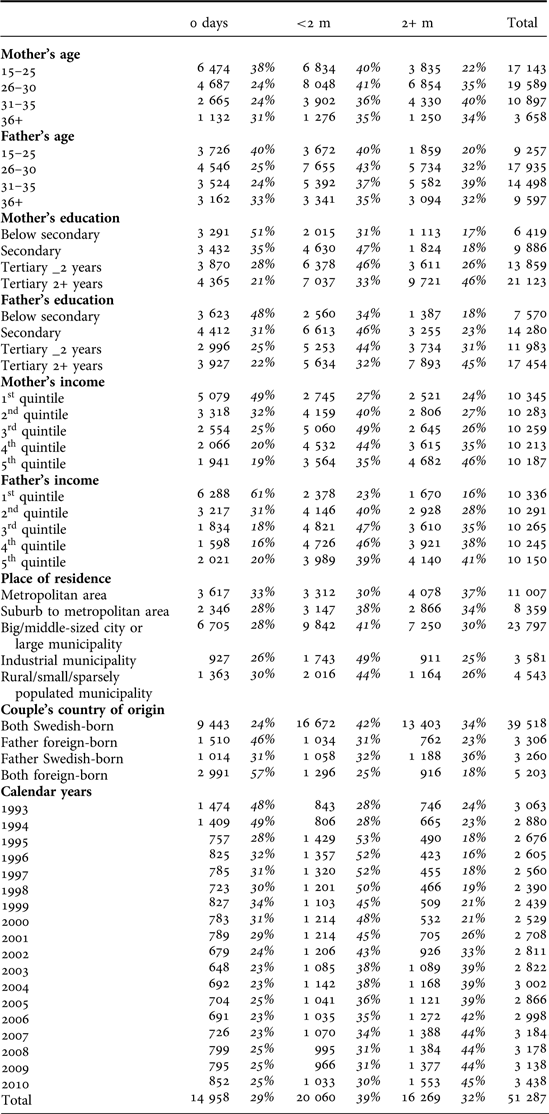
Our dependent variable is the length of parental leave in gross days used by fathers during the first two years after childbirth. On average during 1993–2010, fathers took 54 leave days during these two years. Before the policy reform of 2002, the average was 40 gross days; after the reform, it increased to 66 days. Based on the parental leave reforms and the data distribution, we categorize the length of fathers’ leave use during the first two years after the first birth into “0 days”, “less than two months” (i.e. 60 days or fewer), and “more than two months” (i.e. extensive leave of more than 60 days) (see Table 1).
Uptake of parental leave by variables used in multivariate analysis
Source: Authors’ calculations based on Swedish register data
In our empirical analyses we run multinomial logistic regressions with calendar year as our key independent variable, in order to estimate trends over time in fathers’ uptake and the factors that may push them to take extensive leave (more than two months) or no leave at all (0 days). An uptake of less than two months is defined as the baseline category for our comparisons.
Key explanatory variables
Table 1 presents descriptive statistics for the set of variables used in our analysis. Fathers’ age, educational attainment, annual disposal income, residence at first birth, couple’s country of origin, and calendar year serve as the main explanatory variables. Fathers’ age is evenly distributed into the ages 15–25, 26–30, 31–35, and above 36. Descriptive statistics show that 80% of fathers aged 25 or younger took either a leave of less than two months or no leave at all.
Fathers’ educational attainment is grouped into below secondary, secondary, tertiary of up to two years, and tertiary of more than two years. Of fathers with the lowest education, 48% took no parental leave at all during the two years after childbirth. In contrast, 45% of fathers with a long tertiary education took a leave of more than two months. From 1993 to 2010, the proportion of fathers with a tertiary education of more than two years increased from 26% to 40% (see Appendix 2). This compositional change among fathers may be reflected in their likelihood of taking parental leave.
Our income measure covers an individual’s annual gross earnings, including work-related transfers such as sick leave, in the year prior to the birth of the child. We categorize the variable into five quintiles, with each income category containing an equal number of fathers within a specific year. Our data show that, on average, 29% of fathers had an income higher than the ceiling of income replacement during our observation period. In 1993, only 10% of fathers’ income reached the ceiling. The proportion rapidly increased in the 1990s and 2000s. In 2010, approximately 42% of fathers had an income higher than the ceiling. That is, in 1993, fathers whose income exceeded the ceiling belonged to the fifth quintile of our income variable. With the rise of income over our observation period, they can fall into the fourth quintile in our last years of observation.
To address parental leave use across residential contexts, we include the father’s place of residence at the time of first birth in the analysis. Sweden’s nearly 300 municipalities are divided into five categories (see Sveriges Kommuner och Landsting, 2010): metropolitan areas (Stockholm, Gothenburg, and Malmö); suburbs to metropolitan areas; big/middle-sized cities or other large municipalities; industrial municipalities; and rural/small/sparsely populated municipalities.
Parents’ country of origin is classified into both Swedish-born, father foreign-born (with mother Swedish-born), father Swedish-born (with mother foreign-born), and both foreign-born. Over our study period, the proportion of couples in which both were Swedish-born gradually decreased from 82% to 73%, whereas the proportion of couples in which both were foreign-born increased from 7% to 14% (see Appendix 3). The descriptive statistics in Table 1 show that 57% of foreign-born fathers with a foreign-born partner took no leave during the first two years after childbirth.
Calendar year is a variable of prime interest in our study. Our observation ranges from 1993 to 2010, covering periods from before to after the parental leave reforms of 1995 and 2002, respectively. The interaction terms of calendar year and the other explanatory variables of interest help us discern changes in patterns of parental leave use by different sub-groups of fathers.
Control variables
Mothers’ demographic and socio-economic factors are controlled for. These include the mother’s age at childbirth, educational attainment, and annual disposable income prior to childbirth. These variables are grouped into categories in the same way as those of the fathers. In the early 1990s, only 0.8% of mothers’ income reached the ceiling of income replacement. The proportion slightly increased to 3.7% in 2010. Given that women’s earnings are lower than those of men, the income in the fifth maternal quintile is lower than that in the fifth paternal quintile.
Descriptive results
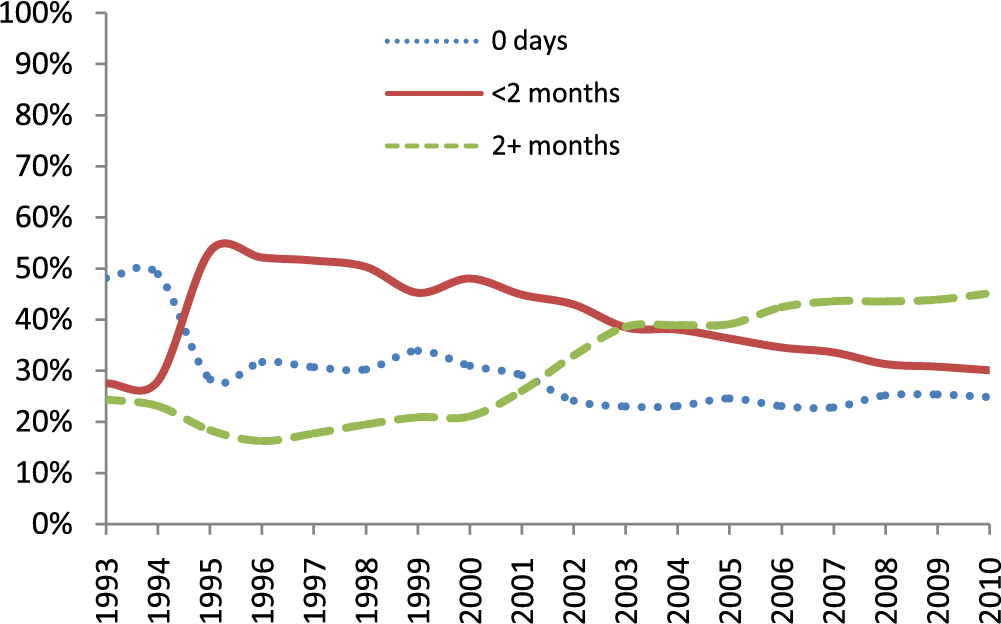
Figure 1 presents the distribution of fathers’ use of parental leave within two years after the child’s birth during each calendar-year period from 1993 to 2010. The figure shows two clear changes. The first emerged in 1995, when taking a leave up to two months suddenly came to dominate, whereas a corresponding drop occurred for the tendency to take no leave at all. Simultaneously, the percentage of fathers taking a leave of more than two months dropped slightly. These changes indicate a new pattern among fathers of taking a one-month leave.
Distribution of fathers’ uptake of parental leave by calendar year and leave length (in per cent), Sweden 1993–2010 Source: Authors’ calculations based on Swedish register data

The second change entered the picture in 2002, when the prevalence of taking a leave shorter than two months shrank, whereas the tendency to take a leave longer than two months increased. By the end of our observation period, 45% of fathers used more than two months of leave, 30% used less than two months’ leave, and the remaining 25% did not use any leave at all during the first two years after becoming a father; some of them might have used the leave later, after their child turned two.
Results: Correlates of fathers’ uptake of no and long parental leave
Table 2 presents the estimated odds ratios (in the form of relative risks) for father’s uptake of no parental leave (0 days) and long parental leave (more than two months) from the multinomial logistic regression model. The base outcome is father’s uptake of less than two months’ parental leave after childbirth.
Odds ratios for father’s uptake of parental leave in Sweden, 1993–2010 (base outcome: <2 months)

Source: Authors’ calculations based on Swedish register data
Note: Statistical significance: ***p<.01; ** .01<p<.05; and * .05<p<.10.
Estimates are presented for the role of the father’s age, educational attainment, annual income, place of residence, country of origin, and calendar year. It seems that very young fathers are the least likely to take long leave, controlling for the age of the mother and other variables included in the model. The oldest fathers are the most likely to take no leave at all.
Table 2 also shows that fathers with the lowest educational attainment (below secondary education) have a 28% higher risk of taking no leave at all than fathers with a secondary education, while the highest educated fathers (with more than two years of tertiary education) have 67% higher odds of taking a leave of more than two months, as compared to those with a secondary education. The link between mother’s education and father’s uptake is similar to that of father’s education. Higher education may be related to attitudes in favour of gender equality and father involvement, but also to fewer labour market constraints for fathers in taking a long leave and stronger bargaining positions in relation to employers.
As the parental leave benefit is related to previous earnings (with a ceiling), the uptake of parental leave is quite different for fathers with high and low incomes. Low-income fathers have substantially higher odds of taking no leave than middle-income fathers. Additionally, the relationship between fathers’ income and taking a leave longer than two months shows an inverted U shape. Middle-income earners are at the forefront of taking long leave, whereas fathers with the lowest and highest earnings are less likely to take a long leave. Low-income earners might be restricted by their unstable labour market situation, while high-income earners might be affected by the income replacement ceiling.
The relationship between mother’s income and father’s leave use is also noteworthy. A mother’s low earnings are related to high odds that the father will take no leave at all. Additionally, both depressed and very high earnings of mothers are associated with fathers taking a long leave. Low income-replacement levels for the mother might stimulate fathers to take a long leave instead, in situations in which only he is entitled to generous benefits from the leave programme. Mothers with very high earnings may have an occupation that makes them prone to return to work and share the leave more equally with the father.
Our results show that fathers in metropolitan areas are more likely both to take no leave and to take longer leaves. It appears that Stockholm, Gothenburg and Malmö allow for greater diversity in lifestyles than those that are dominant in Sweden on average.
Our estimates for parents’ country of origin manifest differences in parental leave use between Swedish- and foreign-born fathers. Compared to a Swedish-born father with a Swedish-born partner, a foreign-born father, irrespective of his partner’s origin, has a higher likelihood of taking no leave and a lower likelihood of taking long leave. To some extent, these findings may reflect the impact of higher labour market uncertainties for foreign-born men (Lundström and Andersson Reference Lundström and Andersson2012). They may also reflect differential access to information on the Swedish parental leave system.
Our calendar year estimates confirm earlier findings that the parental leave reforms triggered behavioural changes in fathers’ uptake of parental leave (see also Figure 2). In 1995, when the first reserved month was introduced, the tendency to take no leave or a leave of more than two months declined. In 2002, when the second reserved month was introduced, there was an increase in fathers taking a leave of more than two months. Thereafter, this trend continued upwards until the end of our study period. We need to remind ourselves that as the leave can be used until the child is eight years old, and as we measure the uptake only during the first two years, it is likely that many more fathers will end up with a leave that is longer in total. The trend of taking no leave at all remained relatively stable until the end of our observation time.
Odds ratios of fathers’ uptake of parental leave by calendar year, Sweden 1993–2010 (Base outcome: <2 months; reference year: 1995) Source: Authors’ calculations based on Swedish register data

Results: Forerunners and laggards in fathers’ uptake of long parental leave
In order to demonstrate changes over time in fathers’ uptake of parental leave across socio-demographic sub-groups, we estimate interactive terms of each of our main explanatory variables and the calendar year variable, while other variables are controlled for. Figure 3 presents the over-time changes in fathers’ extended parental leave by the fathers’ age groups. It shows that the relative trends for different age groups were almost identical during the early period of 1993–2002. However, after this, clear differences emerged. In particular, the youngest fathers seem to have lagged behind in the development towards an increasing use of extended parental leave.
Interactive effect of father’s age and calendar year, Sweden 1993–2010 (Base outcome: <2 months; reference category: 1993, age 15–25) Source: Authors’ calculations based on Swedish register data

This diagram also displays the changes over time in the odds of taking no leave at all (see soft grey lines at the bottom of the diagram). When compared to the odds differences between categories of fathers taking extended leave, the differences in the odds of taking no leave appear minor. This concerns differences in odds between calendar years as well as differences between various age groups of fathers.
Figure 4 presents the interaction between father’s educational attainment and calendar year. It shows that at the beginning of the study period the differences in leave use across the fathers’ educational attainment were relatively small. Over time these differences have increased substantially as the highly educated fathers have become much more likely than others to take extended leave. Evidently, they can be seen as forerunners in the recent family-demographic change. The odds of taking no leave for various educational groups did not change during the study period.
Interactive effect of father’s education and calendar year, Sweden 1993–2010 (Base outcome: <2 months; reference category: 1993, below secondary) Source: Authors’ calculations based on Swedish register data

The interaction term of father’s income and calendar year is shown in Figure 5. Before 2002, differences by income categories were small. Then, after 2003, the first (lowest) income quintile of fathers started to lag behind in the generally increasing probabilities of taking long leave. In addition, the probability of this group of fathers taking no leave at all was much higher than for any other group. Being laggards in recent trends, this group had a distinctively different pattern than the other income categories, indicating that economic considerations may matter for parents’ uptake of parental leave.
Interactive effect of father’s annual income and calendar year, Sweden 1993–2010 (Base outcome: <2 months; reference category: 1993, 1st quintile) Source: Authors’ calculations based on Swedish register data

Figure 6 captures the interaction between the place of residence at childbirth and calendar year. Like in the previous graphs, we find relatively small differences in behaviour between sub-groups during the first ten years of observation. Again, a clear divergence in trends occurred during the new century. Fathers living in metropolitan areas and the surrounding suburbs substantially increased their propensity to take long parental leave. In comparison, the practice of taking a parental leave of more than two months by fathers in rural, small or sparsely populated areas increased at a much slower pace. However, fathers in metropolitan areas also had a slightly higher probability of using no leave, indicating a polarized pattern for this category.
Interactive effect of father’s place of residence at childbirth and calendar year, Sweden 1993–2010 (Base outcome: <2 months; reference category: 1993, metropolitan area) Source: Authors’ calculations based on Swedish register data

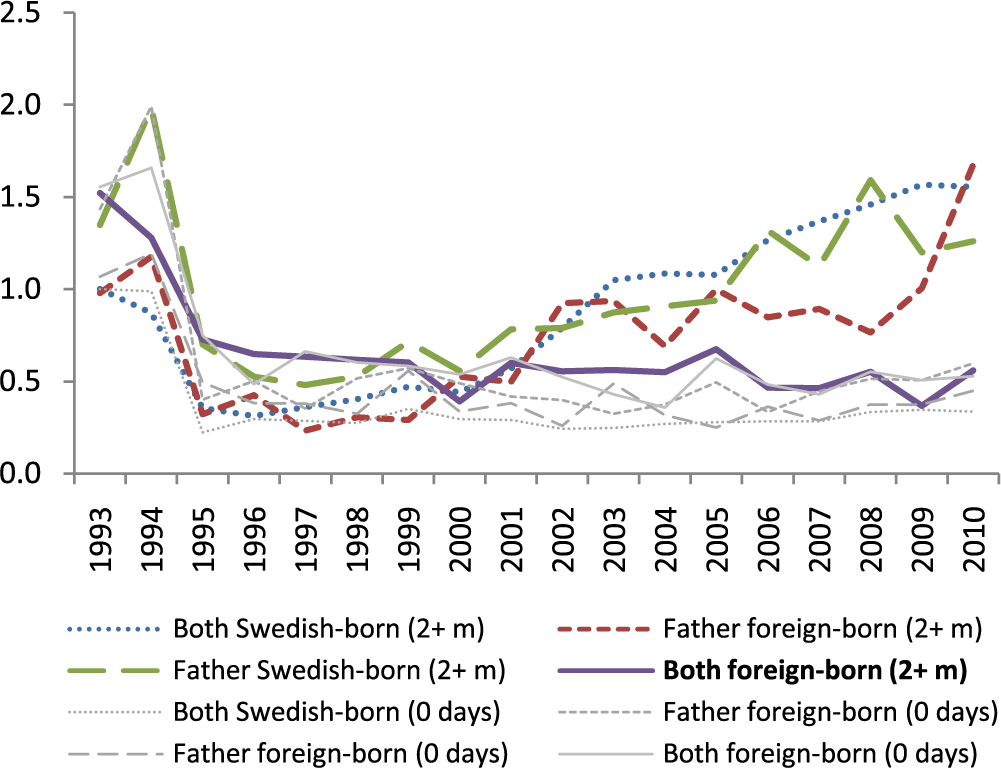
Finally, Figure 7 shows the interaction of the couple’s country of origin and calendar year. In line with our findings from the main effects model, it is clear that couples in which both are foreign-born stand out by having the lowest odds of the father taking an extended leave. What is more, this difference opened up at the beginning of the new century when the odds of fathers taking a long leave increased for all family types except those with two foreign-born parents, whose trend of taking a long leave slightly declined.
Interactive effect of couple’s country of origin and calendar year, Sweden 1993–2010 (Base outcome: <2 months; reference category: 1993, both Swedish-born) Source: Authors’ calculations based on Swedish register data

Discussion and conclusion
This study examined how fathers’ uptake of parental leave has changed over time in Sweden in the decades before and after the turn of the century. In particular, we studied changes in behaviour across different socio-economic and demographic groups of fathers. With our study design, we aimed to identify possible forerunners and laggards in new patterns of leave use over time and in relation to the reforms in 1995 and 2002 that provided additional time earmarked for fathers’ (and mothers’) parental leave.
Our descriptive results show that the reservation of the first “daddy month” in 1995 was followed by a substantial decrease in fathers taking no leave, and a notable increase in fathers taking some leave but less than two months. The introduction of the second reserved month in 2002 was accompanied by a decrease in taking some leave of less than two months, and an increase in taking extended longer leave. These developments indicate that Swedish fathers adjusted the length of their leave use in concert with the gender-equality-oriented parental leave reforms. These changes make Sweden a successful forerunner in active fathering practices. However, although two months came to be specifically reserved for fathers, many fathers still remained inactive in this movement.
To study how the uptake of parental leave has varied over time for different sub-groups of fathers, we ran interaction models between calendar year and each of the fathers’ different socio-economic and demographic characteristics, while controlling for other variables. The results from our multivariate analyses show that the increase in leave use from 2002 onwards is shared by most categories of fathers in Sweden, but we also found distinct patterns in terms of forerunners and laggards in the new trend of increasing uptake of extended parental leave.
To start with the forerunners, we note that highly educated fathers increasingly took an extended leave and that the difference between them and fathers in other educational categories increased over time. Another forerunner group was fathers in metropolitan areas, but they also showed a polarized pattern whereby some were more likely to take no leave at all.
At the other end of the spectrum, there are a few groups that have been falling behind as laggards in the general trend towards an increased leave use among fathers. The youngest fathers had a depressed probability of taking a leave of more than two months. In addition, differences increased between fathers with the lowest incomes and other income categories. Those with the lowest incomes had much higher odds of using no leave at all, and also lagged behind in the general trend of an increasing use of a leave of two months or more.
The last laggard category was foreign-born fathers with a foreign-born partner. Along with the gradual increase in the foreign-born population, the country background of immigrants has changed as well. More recent immigrants have faced obstacles entering the Swedish labour market (le Grand and Szulkin, Reference Le Grand and Szulkin2002; Statistics Sweden, 2018). This situation may have restricted their likelihood of taking parental leave. Furthermore, many new residents of Sweden may lack knowledge of the details of the parental leave system, partly because they have fewer channels of information and relevant social networks (Tervola et al., Reference Tervola, Duvander and Mussino2017).
This study has some limitations. We only cover fathers’ uptake of parental leave in connection with the birth of a first child. Fathers may take less leave for their second or higher order children (Sundström and Duvander, Reference Sundström and Duvander2002). Accordingly, the leave use patterns and trends for fathers of two or more children might be somewhat different. Nonetheless, the emergence of multiple inequalities in parental leave use among first-child fathers in Sweden is a cause for concern. A pattern has emerged whereby better-educated Swedish-born fathers, and residents of metropolitan areas, are the forerunners in family change based on a more gender-equal division of parental leave. Other groups are lagging behind: those who use less leave – i.e. young fathers, low-income earners, and foreign-born fathers – perhaps do so because they face more restrictions economically or are restricted by other factors in the labour market. The findings highlight the intersectionality of our approach. Future research needs to study whether previous patterns of relatively homogenous social change in Sweden have disintegrated into new inequalities in social welfare. Finally, a third reserved month for fathers (and mothers) was introduced in 2016, and in 2017 a government commission suggested five months reserved for each parent. This makes it crucial to continue following whether recent policy changes may fuel or dampen the trend of increasing inequalities that we have found.
Acknowledgements
We acknowledge financial support from the Swedish Research Council (Vetenskapsrådet) via the Linnaeus Center for Social Policy and Family Dynamics in Europe (SPaDE), grant 349-2007-8701 and the Swedish Initiative for Research on Microdata in the Social and Medical Sciences (SIMSAM), grant 340-2013-5164.
Supplementary material
To view supplementary material for this article, please visit https://doi.org/10.1017/S0047279419000230





 Open access

