Why do we want to transition all of our energy to clean, renewable energy? Why don’t we just continue burning fossil fuels until they run out, which may be in 50 to 150 years? For three major reasons. Namely, fossil fuels today cause massive air-pollution health damage, climate damage, and risks to the world’s energy security. These three problems, which have the same root cause, require immediate and drastic solutions. The longer we wait to solve these problems, the more the damage accumulates. This chapter examines each problem, in turn.
1.1 The Air-Pollution Tragedy
Today, air pollution is the second-leading cause of human death and illness worldwide. It also kills and injures animals; impedes visibility; and harms plants, trees, crops, structures, tires, and art. Because air pollution causes such enormous loss and cost, controlling it is one of the greatest challenges of our time.
What is air pollution? Air pollution occurs when gases or aerosol particles in the air build up in concentration sufficiently high to cause direct or indirect damage to humans, plants, animals, other life forms, ecosystems, structures, or works of art.
What are gases and aerosol particles? A gas is a group of atoms or molecules that are not bonded to each other. Whereas a liquid occupies a fixed volume and a solid has a fixed shape, a gas is unconfined and freely expands with no fixed volume or shape.
An aerosol particle consists of 15 or more gas atoms or molecules, suspended in the air, that have bonded together and changed phase to become a liquid or solid. An aerosol particle can contain one chemical or a mixture of many different chemicals. An aerosol is an ensemble of aerosol particles.Reference Green and Lane1 Aerosol particles are distinguished from cloud drops, drizzle drops, raindrops, ice crystals, snowflakes, and hailstones in that the latter all start as an aerosol particle but accumulate far more water in them than the former.
Gases and aerosol particles may be emitted into the air naturally or by humans (anthropogenically). They may also be produced chemically in the air from other gases or aerosol particles. Natural air-pollution problems on the Earth are as old as the planet itself. Volcanoes, natural fires, lightning, desert dust, sea spray, plant debris, pollen, spores, viruses, bacteria, and bacterial and animal metabolism have all contributed to natural air pollution.
Humans first emitted air pollutants when we burned wood for heating and cooking. Today, anthropogenic air pollution arises primarily from the burning of fossil fuels and bioenergy fuels used for energy, and from the burning of open biomass for land clearing or ritual, or due to arson or carelessness. Air pollutants also arise from the release of gases and/or particles to the air, such as from industrial processes or leaks, brake-pad wear, tire wear, and evaporation of solvents and pesticides, for example.
The main fossil fuels burned today are coal, fossil gas, and crude oil byproducts. Crude oil is refined into multiple products, including gasoline, diesel, kerosene, heating oil, naphtha, liquefied petroleum gas, jet fuel, and bunker fuel. Bioenergy fuels burned are either solid fuels, such as wood, vegetation, or dung (biomass); liquid fuels, such as methanol, ethanol, or biodiesel (biofuels); or gaseous fuels, such as landfill gas (biogas), produced by bacteria breaking down dead plant and animal material in the absence of oxygen. Open biomass includes forests, woodland, grassland, savannah, and agricultural residues. Anthropogenic emissions have contributed not only to indoor and outdoor air pollution, but also to acid rain, the Antarctic ozone hole, global stratospheric ozone loss, and global warming.
About 61 million people die each year from all causes worldwide. Air pollution causes about 7.4 million (12.1 percent) of the deaths, making it the second-leading cause of death after heart disease.2, 3 Air pollution also cause billions of illnesses each year. Of the annual air-pollution deaths, about 4.2 million are due to outdoor air pollution3 and about 3.2 million are due to indoor air pollution.2 Indoor air pollution arises because 2.6 billion people burn solid fuels (wood, dung, crop waste, coal) and kerosene indoors for cooking and heating.
The deaths and illnesses arise when air-pollution particles (mostly) and gases trigger or exacerbate heart disease, stroke, chronic obstruction pulmonary disease (chronic bronchitis and emphysema), lower respiratory tract infection (flu, bronchitis, and pneumonia), lung cancer, and asthma.
Almost half of all pneumonia deaths worldwide among children aged five and younger are due to air pollution.2 Many children who die live in homes in which solid fuels or kerosene is burned for home heating and cooking. Their little lungs absorb a high concentration of aerosol particles in the air that result from fuel burning. They die of pneumonia because their immune systems weaken due to the assault of air pollutants on their respiratory systems. Most of the casualties are in developing countries, where indoor burning often still occurs on a large scale. These deaths and illnesses not only devastate families but also incur tremendous cost. The worldwide cost of all air-pollution death and illness may exceed $30 trillion per year today.Reference Jacobson, von Krauland and Coughlin4
Transition highlight
Of the 7.4 million deaths from air pollution worldwide each year, China and India absorb the brunt, with a combined total of 3.6 million deaths per year (49 percent of the total). Nigeria, Pakistan, Indonesia, Bangladesh, the Philippines, and Russia each suffer more than 100,000 air-pollution deaths per year. The highest per capita air-pollution death rates are in North Korea, Georgia, Chad, Nigeria, Bosnia and Herzegovina, and Somalia, respectively.
Of all air-pollution deaths, about 90 percent are due to air-pollution particles; the rest are due to air-pollution gases, primarily ozone. Around half the mass of particles in the air worldwide is in natural particles. However, natural particles are mostly large and thus don’t penetrate deep into people’s lungs or cause many air-pollution deaths. Conversely, combustion particles, which are almost all anthropogenic, are usually small and penetrate deep into people’s lungs. Most combustion particles are also emitted in densely populated areas, so people breathe in these particles. As a result, about 90 percent of air-pollution deaths are due to energy, including all indoor air-pollution deaths.Reference Jacobson, Fu, Sambor and Mühlbauer5 Most of the remaining 10 percent of deaths are due to anthropogenic open biomass burning to clear land,Reference Jacobson6 road dust, construction dust, natural wildfires, soil dust, sea spray, volcanic gases and particles, pollen, spores, bacteria, and viruses.Reference Jacobson, Fu, Sambor and Mühlbauer5
Because combustion during energy production is the world’s major source of air pollution, changing the world’s energy infrastructure to eliminate combustion will largely eliminate air-pollution death and illness worldwide. This goal can be accomplished by transitioning to 100 percent clean, renewable energy and storage for everything.
1.2 Global Warming
1.2.1 The Natural Greenhouse Effect
Global warming is the human-caused increase in the average temperature of the Earth’s lower atmosphere since the Industrial Revolution above and beyond the average temperature caused by the natural greenhouse effect. The natural greenhouse effect is the Earth’s average temperature with a pre–Industrial-Revolution atmosphere containing natural greenhouse gases, minus its temperature with no atmosphere. The natural greenhouse effect arose due to the buildup of natural greenhouse gases in the atmosphere since the formation of the Earth. Greenhouse gases are gases that are mostly transparent to sunlight but that absorb some of the heat emitted by the surface of the Earth. All objects in the universe, including the Earth, emit heat.
The Earth has three main sources of heat. The first and, by far, the most important, is sunlight, also called solar radiation. The Earth absorbs sunlight and converts it to heat, also called infrared radiation. About 99.97 percent of the heat emitted by the surface of the Earth originates from sunlight. The remaining 0.03 percent of heat originates from the interior of the Earth, from two sources, each in relatively equal proportions. One is heat left over from the formation of the Earth, called primordial heat. Due to gravitational compression of the Earth’s interior during its formation, and despite heat loss over time, the temperature at the center of the Earth is still about 4,300 degrees Celsius. This heat transfers slowly to the surface of the Earth by conduction, which is the process by which molecules transfer energy to each other when they collide. Primordial heat also gets to the surface by volcanic activity. The other source of interior heat is heat released during the decay of radioactive elements in the Earth’s interior. The main elements that decay include uranium, thorium, and a small fraction of potassium. The decay products of these elements decay further as well. The resulting heat transfers slowly to the surface, also by conduction.
Greenhouse gases in the Earth’s atmosphere are transparent to sunlight, allowing the sunlight to penetrate to the Earth’s surface. However, the same gases trap a portion of the Earth’s outgoing heat, warming the ground and air near the ground. The more greenhouse gases present, the greater the trapping of heat and warming of the near-surface air. When the greenhouse gases are natural, the resulting warming is called the natural greenhouse effect.
The primary natural greenhouse gases in the Earth’s atmosphere are water vapor, carbon dioxide (CO2), ozone, nitrous oxide, methane, and oxygen gas. Oxygen gas is a weak greenhouse gas, but it is so abundant in the air (20.95 percent of all air molecules) that it has a nontrivial natural warming impact. Nitrogen gas, which comprises 78.08 percent of the molecules in the Earth’s atmosphere, is not a greenhouse gas.
If the Earth had no atmosphere, thus no natural greenhouse effect, its average surface temperature would be about minus 18 degrees Celsius (zero degrees Celsius is the freezing temperature of water). At minus 18 degrees Celsius, little life would evolve on Earth’s surface.
During Earth’s 4.6-billion-year history, several processes released to the air all of the Earth’s natural greenhouse gases, except for ozone. These processes included emissions (through volcanoes, fumaroles, and geysers) of greenhouse gases (water vapor, carbon dioxide, and methane) from the Earth’s interior, bacterial metabolism (producing methane, carbon dioxide, nitrous oxide, and water vapor), bacterial photosynthesis (producing oxygen), and green-plant photosynthesis (producing oxygen). Ultraviolet sunlight cooked some oxygen to produce ozone, most of which formed high above the ground, in what is now called the stratospheric ozone layer. The formation of the ozone layer was critical for protecting the surface of the Earth from harmful ultraviolet sunlight, permitting life to move from underwater and underground to above the ground.
Natural greenhouse gases raised the temperature of the Earth substantially compared with the Earth without an atmosphere, permitting life to flourish on the Earth. Just before the start of the Industrial Revolution, around 1760, Earth’s average temperature was about 15 degrees Celsius. That is 33 degrees Celsius higher than Earth’s temperature without greenhouse gases (minus 18 degrees Celsius). This warming was due to the natural greenhouse effect. Of this temperature rise, about 66 percent was due to water vapor, about 25 percent was due to background carbon dioxide, and about 6.2 percent was due to background ozone, most of which is in the upper atmosphere.Reference Jacobson6
1.2.2 Global Warming
Global warming is the rise in the Earth’s globally averaged ground and near-surface air temperature above and beyond that due to the natural greenhouse effect, owing to human activity. The Earth’s average global warming in the period 2011–2020 compared with the period 1850–1900 was about 1.09 degrees Celsius.Reference Canadell, Monteiro, Costa, Masson-Delmotte, Zhai and Pirani7 In 2023, globally averaged temperature rose to 1.36 or 1.48 degrees Celsius above the 1850–1900 mean, depending on the data set used.8, 9 Temperatures in 2024 were even higher, closer to 1.5 degrees Celsius above the 1850–1900 mean. Since these values are averages, some places have warmed more, whereas others have warmed less or cooled. For example, the Arctic has warmed by over 5 degrees Celsius. Many other high-latitude locations (parts of Canada, Northern Europe, and Russia) have warmed by 2–5 degrees Celsius. The North Atlantic Ocean has cooled slightly.
1.2.3 Causes of Global Warming
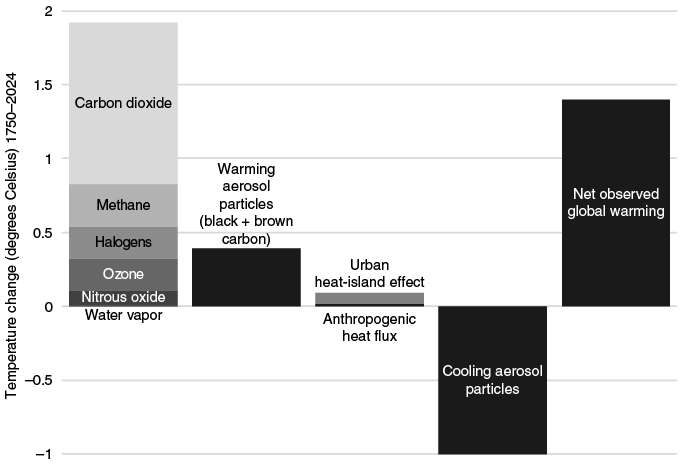
Figure 1.1 reflects an approximate global warming of 1.4 degrees Celsius since 1750. Global warming is the net effect of four major warming processes partially offset by one major cooling process (Figure 1.1). The four major warming processes are anthropogenic greenhouse gas emissions, anthropogenic warming particle emissions, anthropogenic heat emissions, and the urban heat-island effect. The cooling process is anthropogenic cooling particle emissions.
Estimated primary contributors to net observed global warming from 1750 to 2024.
Net observed warming is the sum of gross warming minus cooling. Gross warming is the warming due to greenhouse gases (left column), warming aerosol particles (second column), and the urban heat-island effect plus anthropogenic heat (third column). Cooling is due to cooling aerosol particles. Warming aerosol particles include black and brown carbon from fossil-fuel burning, biofuel burning, and open biomass burning. Cooling aerosol particle components include sulfate, nitrate, chloride, ammonium, sodium, potassium, calcium, magnesium, nonbrown organic carbon, and water. Of the gross warming (warming before cooling is subtracted out), about 45.7 percent is due to carbon dioxide, 16.3 percent is due to black plus brown carbon, 12 percent is due to methane, 9 percent is due to halogens, 8.8 percent is due to ozone, 4.3 percent is due to nitrous oxide, 3 percent is due to the urban heat-island effect, 0.7 percent is due to anthropogenic heat flux, and 0.23 percent is due to anthropogenic water vapor (updated from original source).Reference Jacobson10
1.2.3.1 Anthropogenic Greenhouse Gas Emissions
The primary anthropogenic greenhouse gases contributing to global warming are carbon dioxide, methane, halogens, ozone, nitrous oxide, and anthropogenic water vapor.
The primary anthropogenic sources of carbon dioxide today are fossil-fuel combustion, bioenergy combustion, open biomass burning to clear land, and chemical reaction during, for example, cement manufacturing, steel production, and silicon extraction. Owing to all of these sources, carbon dioxide in the air has increased from about 275 parts per million (ppm) to 429 ppm, or by 56 percent, between 1750 and 2025. One part per million of carbon dioxide means that for every one million molecules of total air, one molecule is carbon dioxide. Carbon dioxide has been increasing in the air, not only due to its emissions from human activity, but also because it stays in the air for a long time. The major removal mechanisms of carbon dioxide from the air are its dissolution into the oceans and other water bodies, and green-plant photosynthesis (the conversion of carbon dioxide and water vapor into oxygen and cell material by plants, trees, algae, and photosynthetic bacteria). However, these sinks remove the vast amounts of carbon dioxide in the air very slowly, over many decades.
The primary anthropogenic sources of methane are combustion of fossil gas, coal, oil, and bioenergy; combustion of open biomass; leakage to the air during fossil-gas, coal, and oil mining; and leakage of methane produced by bacteria to the air from landfills, rice paddies, livestock, and manure. Methane is removed from the air primarily by chemical reaction in the air itself and by bacterial metabolism at the surface of the Earth.
Halogens are a set of synthetic chemicals whose main uses are as refrigerants, solvents, degreasing agents, blowing agents, fire extinguishants, and fumigants. The first halogen was invented in 1928. Halogens enter the air when appliances or tubes sealing them in liquid form leak or are drained, and the liquid evaporates. Most halogens are halocarbons, which are chemicals that contain carbon and possibly hydrogen, but also either chlorine, bromine, fluorine, or iodine. The main types of halocarbons are the following: Chlorofluorocarbons (CFCs) are halocarbons containing carbon, chlorine, and fluorine. Halons are halocarbons containing carbon and bromine. Perfluorocarbons are halocarbons containing carbon and fluorine. Hydrofluorocarbons are halocarbons containing carbon, fluorine, and hydrogen. Some halogens, such as sulfur hexafluoride, have no carbon, so are not halocarbons. Because chlorofluorocarbons and halons contain stratospheric ozone-destroying chlorine and bromine, most countries outlawed them through international agreement starting with the 1987 Montreal Protocol. Hydrofluorocarbons and perfluorocarbons were developed as ozone-layer-friendly replacements. However, because many of them are greenhouse gases with long lifetimes in the air, such chemicals, while not directly damaging to the ozone layer, have the unintended consequence of enhancing global warming.
Ozone is the only greenhouse gas with no emission source. It forms chemically in the air. About 90 percent of ozone resides in the upper atmosphere (stratosphere), and the rest, in the lower atmosphere (troposphere). The troposphere is the layer of air between the ground and 8 kilometers above sea level at the north and south poles, and between the ground and 18 kilometers above sea level at the equator. The stratosphere is the layer of air just above the troposphere and extends to about 48 kilometers above sea level. Because of the substantial abundance of ozone in the stratosphere, the stratosphere is also called the ozone layer.
In the stratosphere, ozone (which has three oxygen atoms) forms from oxygen gas and ultraviolet light. Oxygen gas is the gas we breathe (when it is near the Earth’s surface) and that our life depends on. It is made of two oxygen atoms bonded together. Ozone in the stratosphere forms chemically following the breakdown of oxygen gas by ultraviolet sunlight into two separate oxygen atoms. One atomic oxygen atom then combines with oxygen gas to form ozone. In the troposphere, ozone is produced following the breakdown, by ultraviolet sunlight, of nitrogen dioxide into atomic oxygen and atomic nitrogen. The atomic oxygen then combines with the oxygen gas to form ozone. The nitrogen dioxide is either emitted or comes from a chemical reaction between nitric oxide and certain reactive organic gases. Most emissions of nitric oxide, nitrogen dioxide, and reactive organic gases result from the burning of fossil fuels and bioenergy fuels by humans. Some comes from natural forest burning and bacterial metabolism. Some nitric oxide comes from lightning.
Ozone has a relatively short lifetime in the air. Most of its loss is due to chemical reaction. Since the Industrial Revolution, the mass of tropospheric ozone has increased by about 43 percent due to the worldwide increase in air pollution (the anthropogenic emissions of nitric oxide, nitrogen dioxide, and reactive organic gases). Since the late 1970s, stratospheric ozone has declined by about 5 percent due to the increased abundance of chlorofluorocarbons and halons in the stratosphere. Just as its abundance has grown rapidly in the troposphere due to increased air pollution, ozone’s abundance and warming impact in the troposphere can decrease rapidly if air-pollution levels decrease. This is one reason that a strategy to eliminate air pollution can help to decrease global warming as well.
Nitrous oxide (laughing gas) is a colorless gas emitted naturally by bacteria in soils and in the oceans. Because it is long-lived, nitrous oxide can stay in the air for hundreds of years once emitted. It is a powerful greenhouse gas, so it causes substantial warming per molecule during this period. Humans have increased the abundance of nitrous oxide in the air through fertilizer use, burning agricultural waste, creating sewage, planting legumes (plants in the pea family), burning bioenergy fuels, burning forests, jet-fuel burning, nylon manufacturing, and manufacturing aerosol spray cans. Agriculture (fertilizer use, agricultural waste burning, and legume cultivation) is the largest source of human-emitted nitrous oxide today.
Anthropogenic water vapor comes from two main sources. The first is evaporation of water that is used to cool power plants and industrial facilities that run on coal, fossil gas, oil, biomass, or uranium. The second is emission of water vapor during the burning of fuels for energy. Water vapor emitted annually from these sources is only about one eight-thousand-eight-hundredth of the 500 million metric tonnes of water vapor emitted per year from natural sources. Nevertheless, this relatively small anthropogenic emission rate of water vapor contributes a modest 0.23 percent of global warming.Reference Jacobson6
1.2.3.2 Anthropogenic Warming Particle Emissions
Dark aerosol particles may contribute more to today’s global warming than any chemical aside from carbon dioxide (see Figure 1.1).Reference Jacobson11–Reference Bond, Doherty and Fahey14 Dark particles, also called warming particles, contain primarily black and brown carbon. Black carbon is an agglomerate of pure carbon solid spherules attached to each other in an amorphous shape. The source of black carbon is incomplete combustion of diesel, gasoline, jet fuel, bunker fuel, kerosene, fossil gas, coal, crude oil, biogas, solid biomass, and liquid biofuels. Black carbon is often visible to the eye and appears black because it absorbs all wavelengths of sunlight, transmitting none to the eye. Black carbon particles convert the absorbed light to heat, raising the temperature of the particles. The heat is then reradiated to the surrounding air.
Black carbon and greenhouse gases warm the air in different ways from each other. Greenhouse gases are mostly transparent to sunlight. They warm the air by absorbing heat emitted by the surface of the Earth. They then reemit half of that heat upward and half downward, raising the ground and near-surface air temperatures. Black carbon particles, on the other hand, heat the air primarily by absorbing sunlight, converting the sunlight to heat, then reemitting the heat upward and downward. Like greenhouse gases, black carbon particles also absorb and reemit heat itself, but that process is important only at night and when their concentrations are high. For example, citrus farmers in the past burned crude oil in large iron “smudge” pots at night to create a black carbon haze that would trap heat emitted by the surface of the Earth to keep the citrus trees from freezing.
When other aerosol material, such as sulfuric acid, nitric acid, ammonium, brown carbon, and/or water coats the outside of a black carbon particle, the black carbon heats the air two to three times faster than without a coating because more light hits the larger particle, thus more light bends (refracts) into the particle. Inside the particle, this light bounces around until it hits the black carbon core and is absorbed by it.
Black carbon not only warms the air, but it also evaporates clouds and melts snow. When black carbon enters a cloud, it absorbs sunlight that is bouncing around in the cloud, converts the sunlight to heat, then emits the heat to the cloud, warming and evaporating the cloud. When black carbon falls on snow or sea ice, the black carbon similarly absorbs sunlight, converts the sunlight to heat, then emits the heat to the ice or snow, melting it.
Thus, for four reasons (its strong absorption when pure, its stronger absorption when coated, its ability to evaporate clouds, and its ability to melt snow and sea ice), black carbon is the second-leading cause of global warming after carbon dioxide. In fact, per unit mass in the air, black carbon causes over one million times more warming than does carbon dioxide.Reference Jacobson11 However, because black carbon particles last only days to weeks in the air, their concentrations are much lower than are those of carbon dioxide, which stays in the air for decades. Nevertheless, because black carbon is continuously emitted, it always causes a strong warming.
Brown carbon is also a particle component that increases global warming and causes health problems. Whereas brown carbon is generally more abundant than black carbon, brown carbon is much less effective per unit mass at warming than is black carbon. As such, black carbon causes more overall warming than brown carbon does.
Whereas black carbon contains pure carbon, brown carbon contains carbon, hydrogen, and possibly oxygen, nitrogen, and/or other atoms. In other words, brown carbon is a type of organic carbon (which is a chemical containing carbon, hydrogen, and other atoms). Not all organic carbon is brown carbon. Brown carbon is the subset of organic carbon that absorbs short (blue) and some medium (green) wavelengths of visible light. The remaining long wavelengths (red) and some of the green wavelengths are mostly transmitted to the viewer’s eye, making the particle haze appear brown. The more green light that is transmitted (the less that is absorbed), the more yellow the particles appear. Other organic carbon particles are often white or gray because they don’t absorb much or any visible light.
The sources of brown carbon – the combustion of fossil fuels, bioenergy fuels, and open biomass burning – are also the sources of black carbon. However, the relative amount of brown or black carbon from a combustion source depends largely on the temperature of the flame. Hotter flames favor black carbon, whereas cooler flames favor brown carbon. For example, in smoldering biomass (a low-temperature flame), the ratio of brown to black carbon is about eight to one. In diesel combustion (a high-temperature flame), the ratio is about one to one.
Because black and brown carbon particles together cause such a large warming per molecule and have such short lifetimes in the air, reducing their emissions is the fastest way of slowing global warming.Reference Jacobson13 Because such particles both cause substantial human death and illness, reducing their emissions not only slows global warming but also immediately improves human health. Thus, two major reasons exist to eliminate black and brown carbon particle emissions: to slow global warming rapidly and to improve human health rapidly.
1.2.3.3 Anthropogenic Heat Emissions
Anthropogenic heat emissions are emissions of heat from the use of electricity, friction created by vehicle tires on the road, the combustion of fossil fuels and bioenergy fuels, nuclear reaction, and open biomass burning to clear land. Such heat emissions warm the air directly. Much of the hot air eventually rises, converting the heat energy into gravitational potential energy, which is energy embodied in air lifted to a certain height against gravity. Differences in gravitational potential energy between one location and another create winds, which carry with them kinetic energy. Thus, some anthropogenic heat emissions are converted to energy in the wind. The increases in both temperature and wind speed due to heat emissions cause liquid water in the oceans and at the ground surface to evaporate. Since water vapor is a greenhouse gas, the production of water vapor accelerates the impact of the original heat emissions.
In sum, most anthropogenic heat is converted to other forms of energy that persist in the air, oceans, and land. Overall, the impact of anthropogenic heat emissions is much less than that of greenhouse gases, which persist for tens to thousands of years and cause greater overall warming than anthropogenic heat. Anthropogenic heat may contribute to about 0.7 percent of gross global warming to date (see Figure 1.1).Reference Jacobson6 As such, eliminating fossil-fuel and bioenergy combustion and nuclear reaction, which WWS does, reduces anthropogenic heat emissions.
1.2.3.4 The Urban Heat-Island Effect
The urban heat-island effect is the temperature increase in urban areas due to the covering of soil and replacing of vegetation with impervious surfaces, such as concrete and asphalt. Covering surfaces reduces evaporation of water from soil and plants. Because evaporation is a cooling process, eliminating evaporation warms the surface. Built-up areas also have sufficiently different properties of construction materials that they enhance urban warming relative to surrounding vegetated areas. Worldwide, the urban heat-island effect may be responsible for about 3 percent of gross global warming (warming before cooling is subtracted out) (Figure 1.1).
1.2.3.5 Cooling Particle Emissions
Cooling particles are light-colored aerosol particles that cool the Earth’s surface by reflecting sunlight to space and by thickening low clouds, which are largely reflective. Cooling particles contain primarily sulfate, nitrate, chloride, ammonium, sodium, potassium, calcium, magnesium, nonbrown organic carbon, and water. Because cooling particles tend to be more soluble in water than are warming particles, cooling particles allow water vapor to condense readily on them, enhancing cloudiness, thereby cooling the climate. Warming particles, on the other hand, tend to heat clouds, helping to burn them off. As with warming particles, cooling particles last only days to weeks in the air and cause major air-pollution health damage. As with warming particles, eliminating cooling particle emissions will improve human health dramatically. However, eliminating cooling particles will also raise global temperatures. This is why a strategy of eliminating all greenhouse gases, warming particles, and cooling particles simultaneously through a transition to WWS is necessary to solve both air-pollution and global-warming problems together.
1.2.4 Impacts of Global Warming
Global warming has already caused the world significant financial loss, and the cost is expected to grow to over $30 trillion per year by 2050.Reference Jacobson, von Krauland and Coughlin4 Losses arise due to coastline erosion and flooding (from sea-level rise), fishery and coral reef damage, species extinction, illness and death due to heat stress and heat stroke, more malaria and dengue fever, agricultural loss, more famine and drought, more wildfires and air pollution, increased climate migration, and more severe weather and storminess (e.g., more intense hurricanes, tornadoes, and hot spells).
Higher temperatures increase air pollution in cities where the pollution is already severe.Reference Jacobson15, Reference Jacobson16 Higher temperatures and the resulting drier wood and longer dry season also increase the risk, length, and intensity of wildfires, which themselves cause air pollution, loss of life, and structural damage. For example, during November 2018, three major wildfires in California, enhanced by drought and unusually high November temperatures, killed dozens of people, displaced hundreds of thousands more, rendered several thousand people homeless, and produced dangerous levels of air pollution throughout the state for over two weeks.
Similarly, global warming has already caused a lot of damage by increasing hurricane duration, size, wind speed, and storm surge. Global warming has further caused crops to fail in many parts of the world, triggering mass migrations. Such migrations are already occurring from the Middle East and North Africa to Europe, and from Central America to the United States, for example.
1.2.5 Strategies for Reducing Air Pollution and Global Warming Together
Because all aerosol particles together are the leading cause of air-pollution mortality, reducing both cooling and warming particles is necessary from a public health perspective. However, Figure 1.1 indicates that cooling particles cause more cooling than warming particles cause warming globally. As such, if emissions of all warming and cooling particles are eliminated together without eliminating the remaining sources of heat, global warming will worsen. Similarly, since cooling particles mask about 40 percent of gross global warming, eliminating only cooling particles will increase net warming by about 70 percent (Figure 1.1).
One strategy to address global warming and human health simultaneously is to eliminate only warming particles. The downside of this strategy is that it permits most global warming and air pollution to continue. Instead, Figure 1.1 suggests that the best strategy for addressing human health and climate simultaneously is to eliminate greenhouse gases, cooling particles, and warming particles simultaneously. This will also reduce most anthropogenic heat and water vapor emissions.
This book is about how best to implement that strategy – eliminating all anthropogenic emissions of greenhouse gases, warming particles, and cooling particles at the same time. The solution is to transition the world’s energy to 100 percent wind, water, and solar plus storage for all energy and to eliminate all nonenergy emissions.
1.3 Energy Insecurity
Energy insecurity is a third major problem that needs to be addressed on a global scale. Several types of energy insecurity are of concern.
1.3.1 Energy Insecurity due to Diminishing Availability of Fossil Fuels and Uranium
One type of energy insecurity is the economic, social, and political instability that results from the long-term depletion of nonrenewable energy supplies. Fossil fuels and uranium are limited resources and will run out at some point. As fossil-fuel supplies dwindle, their prices will rise. Such price increases will first hit people who can least afford them – those with little or no income. Such people will suffer, since they cannot pay to warm their homes sufficiently during the winter, to cool their homes sufficiently during the summer, or for enough vehicle fuel.
Higher energy prices will also increase the cost of food and ultimately lead to economic, social, and political instability. The end result may be chaos and civil war.
A solution to this problem is to transition to an energy system that is sustainable – one in which energy is at less risk of being in long-term short supply. Such a system is one that consists of clean, renewable energy, which is energy that is replenished by the wind, the water, and the sun. Solutions that do not solve this problem are fossil-fuel power plants, with or without carbon capture, and almost all nuclear power plants, because they rely on fuels that will disappear over time.
1.3.2 Energy Insecurity due to Reliance on Centralized Power Plants and Oil Refineries
A second type of energy insecurity is the risk of electricity or fuel loss due to the reliance on large, centralized electric-power plants, oil refineries, and fossil-gas storage facilities. If a city or an island relies on centralized power plants, and if one or more plants or the transmission grid goes down, electricity to a large portion of the city or island may be unavailable for an indefinite period. Such an event can arise from severe weather, a power-plant failure, or terrorism. An accidental fire or act of terrorism at an oil refinery or fossil-gas storage facility can similarly disrupt local and regional oil and gas supplies.
For example, on September 14, 2019, a terrorist attack on two Saudi Arabian oil-processing facilities knocked out the production of five million barrels of oil per day, or 5 percent of the world’s – and half of Saudi Arabia’s – daily oil production. Oil and gas refineries and storage facilities worldwide are continuously at risk of being attacked, and many become targets during conflict. Whereas decentralized power generation and storage facilities provided by WWS do not decrease the risk of attack to zero, they decrease the risk significantly due to the difficulty in damaging hundreds to thousands of smaller individual units rather than one or two larger ones.
Transition highlight
On September 18, 2017, Hurricane Maria hit Puerto Rico and knocked out power to its 1.5 million people for almost 11 months. The hurricane toppled 80 percent of the island’s utility poles and transmission lines. With ten oil-fired power plants, two fossil-gas power plants, and one coal plant, the island’s energy supply was all but wiped out by the loss of transmission. The long delay restoring power to homes and businesses occurred because of the need to rebuild most of the transmission system. A more distributed energy system with rooftop solar photovoltaics, distributed onshore and offshore wind turbines, and local battery storage would have allowed hospitals, fire stations, and homes to maintain at least partial power during the entire blackout period and would have reduced the time required to restore power to most customers. In fact, in early 2019, the main utility in Puerto Rico proposed to divide the island into eight interconnected microgrids dominated by solar and batteries. If one microgrid goes down, the other seven will still function. On April 11, 2019, Puerto Rico went further by passing a law to go to 100 percent renewable electricity by 2050.
Another problem with large, centralized power plants is that they don’t serve the 760 million people worldwide without access to electricity,Reference Ritchie and Roser17 and they poorly serve another 2.1 billion people who have access to only dirty solid fuels (dung, wood, crop residues, charcoal, and coal) for home cooking and heating.3 Burning solid fuels fills homes with smoke that causes short- and long-term illness to hundreds of millions of people and death to 3.2 million people worldwide each year.3 Similarly, centralized power plants cannot provide electricity to remote military bases. Those bases obtain their electricity from diesel transported long distance and used in diesel generators. For example, in 2009, seven liters of diesel fuel were burned during the transport of each liter of diesel used to produce electricity in US military bases in Afghanistan.Reference Vavrin18 Many soldiers died during the transport of the fuel.
Because WWS technologies are mostly distributed (decentralized) technologies, they can be used in microgrids to provide electricity when it is otherwise unavailable. A microgrid is an isolated grid that provides electricity to an individual building, hospital complex, community, military base, or data center, for example. A microgrid may be either far from a larger grid or wired to a larger grid but disconnected from it. A WWS microgrid may consist of any combination of solar PV panels, wind turbines, geothermal electricity generators, batteries, electrolyzers for producing hydrogen, hydrogen storage, hydrogen fuel cells for producing electricity and heat, battery-electric-vehicle chargers, electric heat pumps, and energy-efficient appliances. Electricity in a microgrid may also be used to purify wastewater, desalinate salty water, and/or grow food in a container farm or a greenhouse.Reference Sambor, Wilber, Whitney and Jacobson19 When used in a microgrid, WWS can bring electricity to people without it or to a disaster zone. Microgrids can also provide electricity to computer clusters or data centers not connected to the grid.
In sum, a transition to WWS facilitates the creation of microgrids and more distributed energy sources. Both factors reduce the chance that severe weather, power-plant failure, or terrorism will deny people energy. Fossil-fuel power plants, with or without carbon capture, and nuclear power plants do not solve this insecurity problem because these plants are mostly large and centralized. In addition, fossil fuels almost always require fuel to be imported to a region. With a clean, renewable energy microgrid, this problem is eliminated since all energy is produced locally from natural sources, namely, wind, water, and sunlight.
1.3.3 Energy Insecurity due to Reliance on Fuel Supplies Subject to Human Intervention
A third type of energy insecurity is the risk associated with fuel supplies that can be manipulated or that fluctuate substantially in price. Such risks often arise when one country relies on another country to supply its energy. For example, many countries, particularly island countries, must import coal, oil, and/or fossil gas to run their energy system. Similarly, prior to the 2022 war in Ukraine, over 35 percent of the European Union’s fossil gas was imported from Russia. During the war, bans placed on Russian fuel decreased the flow substantially such that, by January 1, 2025, Russia provided only about 2.5 percent of European Union fossil gas. Japan imports over 75 percent of its oil, primarily from the Middle East. Israel imports over 90 percent of its oil, primarily from Azerbaijan, Brazil, and Kazakhstan. Importing fuel not only results in higher fuel prices, but it also creates reliance of one country on another. This reliance may be tested in times of international conflict. In some cases, a country that controls the energy may withhold it through a ban, an embargo, or price manipulation, or just may not be able to supply it anymore. Similarly, fossil-fuel and uranium supplies, even within a country, can be held up due to a labor dispute or civil war.Reference Krane and Idel20
Fossil-fuel and nuclear power plants are particularly prone to this problem because they rely on fuels that must be supplied continuously, either from across international borders or domestically. In many cases, especially for island countries, the fuels must be transported long distance.
A clean, renewable WWS energy system built within a country avoids this type of energy insecurity. This is mainly because WWS requires no mined fuels (oil, fossil gas, coal, or uranium) to run. Instead, WWS relies only on natural energy sources. Eliminating mined fuels eliminates the energy insecurity associated with them.
Transition highlight
On Friday, October 18, 2024, the island country of Cuba (population 11 million) was plunged into darkness as the main power source on the island, a 330-megawatt oil-powered centralized power plant, shut down due to a combination of low fuel supply, increased electricity demand during a heat wave, and aging infrastructure. The low fuel supply was due largely to decreased shipments of oil from Venezuela, Cuba’s main oil supplier, as well as from Russia and Mexico. Venezuela had been struggling to produce enough fuel to export, and Russia was embroiled in a war with Ukraine. In addition, Hurricane Milton the week before had prevented the transfer of oil from ships offshore to the island. The blackout caused an almost complete shutdown of commerce, services, and internet. This blackout illustrates the confluence of two energy-security problems associated with fossil fuels: the use of centralized power plants and the reliance on imported fuels. WWS addresses both limitations by relying on mostly decentralized energy produced within a country.
Although a country that supplies 100 percent of its own energy with WWS minimizes the risk of energy insecurity due to international conflict and price manipulation, a benefit arises when adjacent countries trade WWS electricity between each other. Such trading, in the absence of conflict, reduces the overall cost of energy and improves the reliability of the overall energy system.
1.3.4 Energy Insecurity due to Fuels That Have Mining, Pollution, or Catastrophic Risk
A fourth type of energy insecurity is the risk associated with byproducts of energy use. For example, facilities and vehicles that burn fossil fuels and bioenergy fuels produce air pollution that kills millions of people worldwide each year. The perpetual mining of fossil fuels and uranium also causes health damage to miners and damage to land, vegetation, and animals. Underground coal mining, for instance, leads to black-lung disease in many miners. Underground uranium mining increases lung-cancer rates in miners, who breathe in polonium, a carcinogenic radioactive decay product of radon. Radon is a gaseous radioactive decay product of uranium itself. Nuclear reactors also produce radioactive waste that must be stored for hundreds of thousands of years. In addition, nuclear reactors run the risk of a reactor core meltdown. Finally, the historic spread of nuclear energy to dozens of countries has contributed to the proliferation of nuclear weapons in several of these countries.
A transition to clean, renewable energy avoids these risks to health, the environment, and public safety. The continued use of fossil fuels and bioenergy fuels, with or without carbon capture, and of nuclear power, prolongs these energy-security problems.