


Introduction
How can actors contribute to the stabilisation of contested norms and normative orders? Current analyses of global governance institutions and processes indicate that contestation affects the authority, legitimacy and effectiveness of normative orders at various levels (Wiener Reference Wiener2018; Zürn Reference Zürn2018). This includes international norms as collective standards for appropriate behaviour in specific contexts (Finnemore and Sikkink Reference Finnemore and Sikkink1998; Björkdahl Reference Björkdahl2002), such as the ban on torture and the responsibility to protect (Zimmermann et al. Reference Zimmermann, Deitelhoff, Lesch, Arcudi and Peez2023). In addition, normative orders – sets of norms that enable orientation while also constraining behaviour in international affairs (Lantis and Wunderlich Reference Lantis and Wunderlich2022) – have been increasingly contested globally, for example, Western conceptions of a liberal international order (Bettiza and Lewis Reference Bettiza and Lewis2020; Börzel and Zürn Reference Börzel and Zürn2021). This contestation of the liberal international order involves liberal and illiberal actors and is driven by endogenous and exogenous factors (Goddard et al. Reference Goddard, Krebs, Kreuder-Sonnen and Rittberger2024). Yet, the erosion of normative orders is accompanied by stagnation in international institutionalisation (Kreuder-Sonnen and Zangl Reference Kreuder-Sonnen and Zangl2025) or even the regression of many international organisations and treaties (Eilstrup-Sangiovanni Reference Eilstrup-Sangiovanni2020; Dijkstra and Debre Reference Dijkstra and Debre2022; Kruck et al. Reference Kruck, Heinkelmann-Wild, Daßler and Hobbach2022). In general, contestation encompasses all activities that critically engage with norms (Wiener Reference Wiener2018). Yet, some studies suggest that norms may lose their strength due to contestation, as this initiates an erosion process that leads to norm decay or norm death (Rosert and Schirmbeck Reference Rosert and Schirmbeck2007; Panke and Petersohn Reference Panke and Petersohn2012). At the same time, contestation can also stabilise norms by making them more legitimate or robust (Wiener Reference Wiener2018; Deitelhoff and Zimmermann Reference Deitelhoff and Zimmermann2019). Thus, contestation does not have a predetermined impact on norms but depends on the specific actors involved in contesting activities (Orchard and Wiener Reference Orchard, Wiener, Orchard and Wiener2024, p. 4). By focusing on international city networks (ICNs) and their activities, we introduce often-overlooked actors that increasingly engage in global governance and thus affect global norm dynamics. Based on assumptions in contestation research, this article examines how ICNs contribute to stabilising norms through their activities.
As networks of predominantly cities, ICNs use their members’ legal competencies at the local level to enact global policies, but like other networks of state and non-state actors, ICNs exchange knowledge, coordinate themselves and develop joint strategies for local implementation and global advocacy (Acuto et al. Reference Acuto, Pejic, Mokhles, Leffel, Gordon, Martinez, Cortes and Oke2024; Gordon and Ljungkvist Reference Gordon and Ljungkvist2022; Jakobi et al. Reference Jakobi2025). There are numerous examples of ICNs’ activities and accompanying support for global norms. Global environmental networks, such as C40 and ICLEI, encourage their members to lead climate mitigation and adaptation efforts (Gordon Reference Gordon2020; Hickmann Reference Hickmann2016). Human rights networks like ‘Cities for CEDAW’ sustain international human rights treaties when national governments fail to ratify them (Och Reference Och2018; Runyan and Sanders Reference Runyan and Sanders2021) or advocate for liberal norms on minorities when these norms are contested at the national or international level, like in the ‘Pact of Free Cities’ (Szpak et al. Reference Szpak, Gawłowski, Modrzyńska and Modrzyński2023). Moreover, existing studies on ICNs at the intersection of urban studies, international law and International Relations (IR) have documented how ICNs implement, criticise, or even generate specific norms and policies (Acuto and Rayner Reference Acuto and Rayner2016; Swiney Reference Swiney2020; Acuto and Leffel Reference Acuto and Leffel2021; Durmus and Oomen Reference Durmus and Oomen2021; Gordon and Ljungkvist Reference Gordon and Ljungkvist2022). Despite their successful inclusion in global climate governance (Cortes et al. Reference Cortes, van der Heijden, Boas and Bush2022; Leffel et al. Reference Leffel, Ben Derudder and van der Heijden2023; Gordon and Johnson Reference Gordon and Johnson2017; Bansard et al. Reference Bansard, Pattberg and Widerberg2017), there is still a need for more systematic analyses of how ICNs contribute to norm dynamics in other issues of global politics (see also Jakobi et al. Reference Jakobi2025). Therefore, we assess ICNs that engage in global issues where norm contestation is widespread at the global level, such as nuclear disarmament, human rights on sexual orientation and gender identity and HIV/AIDS policies.
To systematically analyse how ICNs contribute to stabilising norms through their activities, we build upon existing approaches from norm research that focus on the conditions and effects of contestation on norm robustness, resiliency and legitimacy (Deitelhoff and Zimmermann Reference Deitelhoff and Zimmermann2020, Reference Deitelhoff and Zimmermann2019; Lantis and Wunderlich Reference Lantis and Wunderlich2018; Wiener Reference Wiener2014, Reference Wiener2018). Despite different emphases and starting points, all three approaches examine contestation and make assumptions on how norms can be stabilised to become more robust, resilient and legitimate. We trace these arguments and use them as complementary perspectives for the empirical analysis of ICNs’ stabilising activities, but do not aim to integrate them conceptually in a new approach of our own. Instead, the article makes three specific contributions to the debate on actors, activities and contestation in global norm dynamics: First, we empirically demonstrate that ICNs are relevant actors across various levels of norm dynamics, although they have so far received little attention in norm research. Their relevance is evident in their contributions to global norm dynamics, particularly in stabilising normative orders. Second, we focus on the stabilising activities of actors in norm dynamics, complementing recent assessments of the liberal international order and its contestation with a more productive perspective that highlights opportunities for constructive engagement amidst normative crises. Third, we demonstrate that the three approaches can be combined to determine whether and how ICNs stabilise norms. We assume that norms must be as robust, resilient and legitimate as possible to maintain their functions in facilitating individual orientation and collective order. Therefore, activities to stabilise norms are essential contributions to prevent norm decay.
The article proceeds as follows: First, we introduce our understanding of normative orders, norm contestation and stabilising activities as our conceptual background and establish an analytical framework. In the second step, we analyse three ICNs and their activities, based on different data sources and a structuring content analysis: Mayors for Peace (concerned with the issue area of nuclear disarmament), Rainbow Cities Network (human rights regarding lesbian, gay, bisexual, transgender and intersex people) and the Fast-Track Cities Initiative (HIV/AIDS policies). Our results show that all three ICNs stabilise norms through their activities and effectively contribute to preventing norm decay. Therefore, ICNs utilise unique organisational, social and legal capacities that affect the durability and scope of their activities in stabilising contested norms. In the conclusion, we reflect on how our findings contribute to broader debates on norms and their effects on ICNs as networks within processes of global governance, as well as on the contestation of international orders.
Normative orders, norm contestation and stabilising activities: conceptual background and analytical framework
Norms produce order by enabling and constraining the activities of actors in global politics. They facilitate coordination among actors to solve problems through their regulatory function, while also shaping individual and collective identities and providing meaning to situations through their constitutive effects (Rosert Reference Rosert2019, p. 118). Although norms and normative orders enable orientation and order, they remain ‘works-in-progress’ (Krook and True Reference Krook and True2012, p. 104): Political processes at different levels constantly affect how norms enable and constrain international ordering, resulting in various forms of normative change over time. Actors and their activities can strengthen norms through rhetorical support or implementation. Still, they can also undermine global norms through outright opposition or transform normative orders through critical reshaping.
Over the last decades, the contestation of norms has sparked a debate in norm research about the dynamics in normative orders between norm strength and decay. Research has analysed the effects of contestation on the robustness, resiliency and legitimacy of international norms. In general, contestation refers to ‘a social practice of objecting to or critically engaging with norms’ (Wiener Reference Wiener2018, p. 2). It can be observed regarding specific norms like the responsibility to protect, the prohibition of torture, or the anti-whaling norm (Schmidt and Sikkink Reference Schmidt and Sikkink2019; Welsh Reference Welsh2019; Peez and Zimmermann Reference Peez and Zimmermann2022; Zimmermann et al. Reference Zimmermann, Deitelhoff, Lesch, Arcudi and Peez2023) but also regarding the liberal international order as a whole (Bettiza and Lewis Reference Bettiza and Lewis2020; Börzel and Zürn Reference Börzel and Zürn2021). At the same time, existing research offers different perspectives on whether contestation is problematic for norms or not (Deitelhoff and Zimmermann Reference Deitelhoff and Zimmermann2020, pp. 54–56). On the one hand, norms as stable phenomena of specific components (Winston Reference Winston2018) require regular affirmation and compliance, while contestation in discourse and practice has negative consequences for the strength of norms and normative orders (Ben-Josef Hirsch and Dixon Reference Ben-Josef Hirsch and Dixon2021). When norms lack rhetorical and practical support, studies indicate norm destabilisation, potentially initiating processes of erosion that lead to norm decay or death (Panke and Petersohn Reference Panke and Petersohn2012; Rosert and Schirmbeck Reference Rosert and Schirmbeck2007). Actors aiming to destabilise norms engage in contestation through various activities, such as norm antipreneurship, sabotage, or decoupling (Bloomfield Reference Bloomfield2016; Schneiker Reference Schneiker2020; Mende Reference Mende2024). On the other hand, a relational perspective on contestation emphasises that norms are constantly in flux and open to critique and change (Krook and True Reference Krook and True2012; Sandholtz Reference Sandholtz2008). Due to their political origin and interpretative character, norms have a principal ambiguity (Linsenmaier et al. Reference Linsenmaier, Schmidt and Spandler2021). While they may gain validation over time, their meaning is always a meaning-in-use, making norms contested by default (Wiener Reference Wiener2007). Therefore, contestation represents a regular – and not per se problematic – feature in global politics (Wiener Reference Wiener2014, Reference Wiener2018). To systematically analyse how ICNs contribute to stabilising global norms through their activities, we understand contestation as a potentially neutral process with varying effects and outcomes. Since ‘it is actors’ choices that determine whether a particular contestation affects a norm in a positive or negative way’ (Orchard and Wiener Reference Orchard, Wiener, Orchard and Wiener2024, p. 4), we argue that a focus on activities is central for answering how ICNs contribute to stabilising norms. To assess ICNs and their activities, we introduce three recent approaches to contestation in norm research, focusing on norm robustness, resiliency and legitimacy. In the following, we contrast their assumptions about stabilising and destabilising activities related to norms, and establish a framework for analysing the activities of ICNs. We also highlight the analytical potential of this combined framework for assessing ICNs’ contributions to norm dynamics, despite the ontological and epistemological differences among the three approaches.
Activities to stabilise norms through their robustness, resiliency and legitimacy
As a first approach, research on norm robustness acknowledges that contestation is a regular feature in global politics and aims to explain how norms persist in generating orientation and a willingness among addressees to follow normative expectations (Deitelhoff and Zimmermann Reference Deitelhoff and Zimmermann2019, Reference Deitelhoff and Zimmermann2020; Zimmermann et al. Reference Zimmermann, Deitelhoff, Lesch, Arcudi and Peez2023). The degree of robustness is essential for the effects of norms under contestation. Norm robustness ‘is said to be “high” when its claims are widely accepted by norm addressees (validity) and generally guide the actions of these addressees (facticity)’ (Deitelhoff and Zimmermann Reference Deitelhoff and Zimmermann2019, p. 3). Coming from this definition, robustness research analyses the conditions under which contestation strengthens or weakens norms (Deitelhoff and Zimmermann Reference Deitelhoff and Zimmermann2019, p. 6). Therefore, it uses a distinction between two contestation types – applicatory and validity contestation – as different activities that actors may engage in. Activities of applicatory contestation do not contest the norm itself, but the specific case or situation of a norm’s application. Since the core of the respective norm is not contested, applicatory contestation will not per se weaken the norm’s robustness. Instead, by specifying the scope of a norm, this form of contestation may even strengthen norm robustness (Deitelhoff and Zimmermann Reference Deitelhoff and Zimmermann2020, pp. 57–58). In turn, validity contestation is a more radical form of contestation as it questions a norm’s appropriateness and thus its core, which means its most fundamental assumptions and therefore its robustness (Deitelhoff and Zimmermann Reference Deitelhoff and Zimmermann2020, p. 59). Regarding stabilising and destabilising activities, research on norm robustness argues that occasional applicatory contestation does not harm the norm, while validity contestation or sustained applicatory contestation weakens a norm because it may result in norm erosion, particularly when institutional procedures for dealing with applicatory contestation are missing (Deitelhoff and Zimmermann Reference Deitelhoff and Zimmermann2020, p. 71). To measure norm robustness, research has established four indicators that combine discourse-based and practice-based dimensions (Deitelhoff and Zimmermann Reference Deitelhoff and Zimmermann2019, pp. 5–6): As a first discourse-based dimension, ‘concordance’ refers to the acceptance of a norm by different actors in varying forums and can be categorised between no acceptance and high acceptance. As a second discursive dimension, the reactions of so-called third parties to norm violations are assessed; that is, it must be analysed how uninvolved actors respond to specific violations, with the spectrum of responses ranging from rhetorically supporting violations to comprehensively sanctioning violators. To complement the discursive aspects of norm robustness, two practice-based dimensions are established. On the one hand, norm compliance can be examined from universal to non-existent compliance. On the other hand, norm implementation, as a second practice-based dimension, determines the extent to which a norm is incorporated into political practice, ranging from high to no implementation (Deitelhoff and Zimmermann Reference Deitelhoff and Zimmermann2019, pp. 8–9). In sum, these four dimensions create a heuristic that can be empirically and analytically used to determine ICNs’ contributions to norm robustness through their stabilising activities.
A second approach, scholarship on norm resiliency, considers contestation a common feature of norm dynamics, distinguishing between its effects on individual norms and on norm sets within normative orders. By engaging with an interconnected bundle of norms, this perspective shifts the analytical focus from the robustness of isolated norms to the resiliency of norm clusters, the latter being defined as ‘collections of aligned, but distinct, norms or principles that relate to a common, overarching issue area’ (Lantis and Wunderlich Reference Lantis and Wunderlich2018, p. 571). This perspective is embedded in a recent strand of research on norm connections that analyses the ‘harmonious or conflictual, hierarchical or horizontal, clustered or separated’ relations between norms (Fehl and Rosert Reference Fehl and Rosert2020, p. 1). As a specific form of norm relations, norm clusters are intentionally produced by connecting norms through activities of norm linkage (Fehl Reference Fehl2023). In general, ‘resiliency’ defines ‘the ability of systems to recover from or adjust to (external) challenges while retaining essential functions’ (Lantis and Wunderlich Reference Lantis and Wunderlich2018, p. 576). Following research on norm resiliency, contestation affects norm clusters differently than individual norms. Due to their embedded nature, norms in clusters can maintain their validity under contestation, making the robustness of individual norms dependent on whether norms are part of a cohesive, legalised and institutionalised norm cluster (Lantis and Wunderlich Reference Lantis and Wunderlich2018, pp. 571, 576). Therefore, research on norm clusters concludes that ‘cohesive norm linkages can absorb discontent’ (Lantis and Wunderlich Reference Lantis and Wunderlich2018, p. 592) and thus stabilise normative orders. At the same time, research indicates that other, destabilising activities of norm linkage can contribute to collisions between norms (Holzscheiter et al. Reference Holzscheiter, Gholiagha and Liese2022). When ‘actors claim that two or more norms provide conflicting or incompatible expectations about appropriate behaviour in a specific situation’, dormant norm collisions are activated (Gholiagha et al. Reference Gholiagha, Holzscheiter and Liese2020, p. 295). Such collisions demonstrate the consequences of destabilising activities, as not every norm linkage necessarily increases the resiliency of normative orders. Therefore, with regard to stabilising and destabilising activities, research on norm resiliency emphasises that connecting norms within a cohesive, institutionalised cluster prevents norm decay, whereas linkages through norm collisions support instability by focusing on conflictive relations. To empirically assess the establishment of norm clusters, ‘norm linkage’ as a practice of ‘discursive re-arrangement’ (Fehl Reference Fehl2023, p. 755) must be analysed. Specifically, two conditions are significant for making normative orders more resilient and furthering the ‘nested nature of norm clusters’ (Lantis and Wunderlich Reference Lantis and Wunderlich2018, p. 592): linkages between norms must support cohesiveness and synergies, and they should also be institutionalised and legalised (Lantis and Wunderlich Reference Lantis and Wunderlich2018, p. 578). In sum, to stabilise norms by making them more resilient, ICNs must further synergies between norms through linkage and aim to institutionalise such norm clusters.
A third approach, research on norm legitimacy, takes a more critical stance toward contestation, holding that global norms provoke contestation because they are fundamentally political, and analyses how norms become validated through contestation practices (Wiener Reference Wiener2014, Reference Wiener2018). From this perspective, norm contestation is a common activity in global politics due to the social nature of norms and their contextualised ‘meaning-in-use’. Research on norm legitimacy distinguishes between two different practices of contestation (Wiener Reference Wiener2018, pp. 35–38): Reactive contestation addresses an already established norm by questioning its validity or fit. As such, it demonstrates a lack of access for affected stakeholders to norm emergence and thus indicates a potential gap in the norm’s legitimacy. In turn, proactive contestation represents a more comprehensive engagement with norms. As a productive critique, proactive contestation is central to increasing the legitimacy of international norms, as it refers to the quod omnes tangit principle, which holds that a norm must be validated by those affected by it (Wiener Reference Wiener2018, pp. 31–33). Yet, the diversity of the global realm makes it difficult to validate norms through proactive contestation. Since the international community is plural and diverse, it evokes a ‘tension between the expected global moral reach of a norm on the one hand and the contested local implementation of a norm on the other’ (Wiener Reference Wiener2018, p. 5). Regarding stabilising and destabilising activities, norm research on legitimacy holds that reactive contestation or the exclusion of affected stakeholders de-legitimises norms. To increase the legitimacy of global norms, affected stakeholders ‘who are morally entitled to contest the norms that govern them’ (Wiener Reference Wiener2018, p. 9) must be included in a global multilogue (Wiener Reference Wiener2014, p. 40, Reference Wiener2018, pp. 7–8). Stabilising activities recognise cultural diversity at the global level, include marginalised perspectives, give excluded communities a voice and, particularly, represent the global South (Wiener Reference Wiener2014, pp. 42–44, Reference Wiener2018, pp. 66–69). Therefore, ICNs’ stabilising activities foster an inclusive dialogue, expanding opportunities for proactive contestation and the representation of marginalised stakeholders in global norm dynamics.
Introducing our analytical framework, methods and materials
To empirically assess how ICNs contribute to stabilising norms, we focus on the combined potential of the three approaches for analysing ICNs’ activities. However, we are aware that the approaches differ in many ways. While research on norm robustness and resiliency ontologically assume that norms have a stable core (Lantis and Wunderlich Reference Lantis and Wunderlich2018), represent shared normative understandings, and are based on deliberation and possible consensus (Deitelhoff and Zimmermann Reference Deitelhoff and Zimmermann2019), research on norm legitimacy argues that norms are always ambiguous and dynamic, signify contextual meaning-in-use and are deeply rooted in political conflicts and agonistic normativities (Wiener Reference Wiener2018; Linsenmaier et al. Reference Linsenmaier, Schmidt and Spandler2021). The three approaches also aim at different epistemological goals. Research on norm robustness and resiliency seeks to establish typologies of contestation or conditions under which it occurs. In contrast, research on the legitimacy of norms reconstructs normativity and inclusion in relation to norm contestation from a more critical and normatively explicit standpoint. Therefore, the three approaches represent different forms of constructivism and engage in varying directions, ranging from conventional to consistent or critical constructivism (Adler Reference Adler1997). We will revisit these crucial differences in the conclusion. Yet, we see value in a combination of these approaches that share an understanding of contestation as a normal and generally neutral practice. Their focus on different activities enables us to assess what ICNs specifically do in norm dynamics and how they contribute to stabilising normative orders by supporting norm robustness, norm resiliency and norm legitimacy. Our analytical framework, based on these approaches, is used to empirically demonstrate that ICNs are relevant actors in norm dynamics at various levels, how their multiple activities stabilise norms within the liberal international order, and whether norms become more robust, resilient, or legitimate through these activities.Footnote 1
Table 1 summarises the different approaches to norm dynamics, their perspective on contestation, the destabilising and stabilising activities they address, and their operationalisation. Through our analytical framework, we apply these concepts to examine ICNs as actors in global norm dynamics. Existing research on such networks – often implicitly – assumes that ICNs support norms (Swiney Reference Swiney2020; Durmus and Oomen Reference Durmus and Oomen2021; Gordon and Ljungkvist Reference Gordon and Ljungkvist2022), but their activities have rarely been examined more closely and with a theoretical consideration of norm research. Regarding activities that stabilise norm robustness, we assess whether ICNs support norms in discourse and practice through a rhetoric of concordance, criticism of violations and active norm compliance and implementation. With regard to activities for stabilising norm resiliency, we analyse whether ICNs establish norm clusters by increasing the synergies between them and attempt to institutionalise and legalise productive norm linkages. Regarding activities for stabilising norm legitimacy, we assess whether ICNs include affected communities, give marginalised people a voice, and create opportunities for proactive contestation. The basic assumption of our analysis is that norms are most likely to maintain their functions for individual orientation and collective order when they are as robust, resilient, and legitimate as possible. Thus, to stabilise norms, respective activities are crucial.
Contestation, destabilising and stabilising activities in three approaches to norm dynamics and their operationalisation
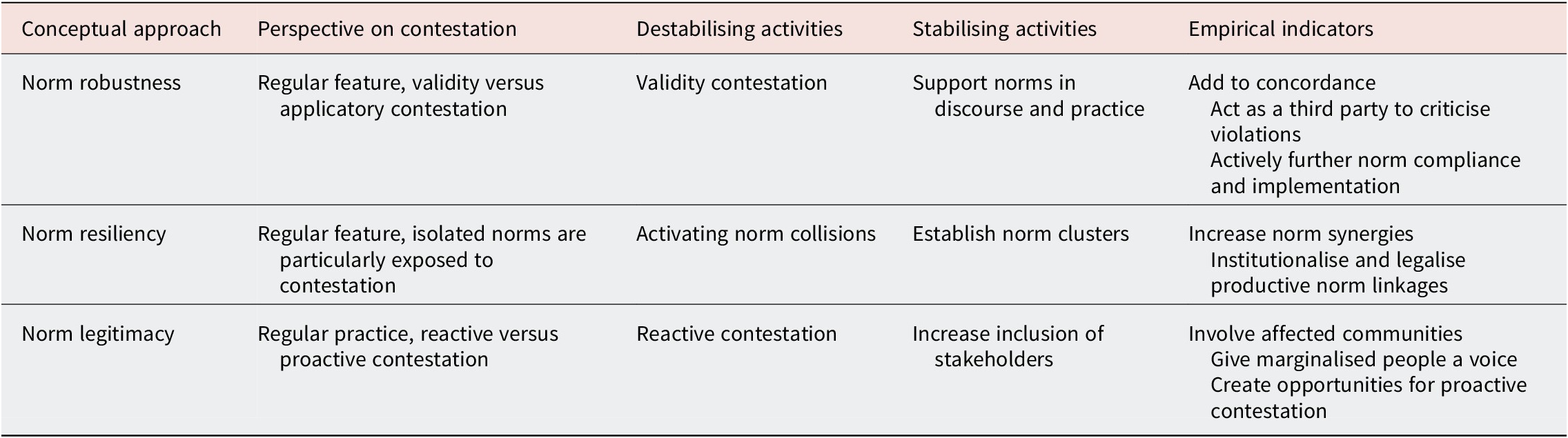
Table 1. Long description
The table consists of five columns and three rows of data.
Column headers from left to right are: Conceptual approach, Perspective on contestation, Destabilising activities, Stabilising activities, and Empirical indicators.
Row 1: Norm robustness. Perspective: Regular feature, validity versus applicatory contestation. Destabilising activities: Validity contestation. Stabilising activities: Support norms in discourse and practice. Empirical indicators: Add to concordance; Act as a third party to criticise violations; Actively further norm compliance and implementation.
Row 2: Norm resiliency. Perspective: Regular feature, isolated norms are particularly exposed to contestation. Destabilising activities: Activating norm collisions. Stabilising activities: Establish norm clusters. Empirical indicators: Increase norm synergies; Institutionalise and legalise productive norm linkages.
Row 3: Norm legitimacy. Perspective: Regular practice, reactive versus proactive contestation. Destabilising activities: Reactive contestation. Stabilising activities: Increase inclusion of stakeholders. Empirical indicators: Involve affected communities; Give marginalised people a voice; Create opportunities for proactive contestation.
(Source: own account).
The study is primarily based on data from the ICNs that we gathered online, including strategy documents and annual reports, which communicate the network’s aspirations and activities, as well as those of its member cities. We also conducted interviews with representatives from all three ICNs and attended specific conferences. We then carried out a structured content analysis to systematically condense the data (Mayring Reference Mayring, Flick, von Kardorf and Steinke2004, p. 269) by using categories from the three approaches as structuring dimensions (Kuckartz and Rädiker Reference Kuckartz and Rädiker2023, p. 83), while remaining open to inductively built categories emerging from the material (Schreier Reference Schreier and Flick2014, p. 170). Such an analytical method understands texts as crucial sources of knowledge about social phenomena (Bergström and Boréus Reference Bergström, Boréus, Boréus and Bergström2017) and is thus compatible with more qualitative methodological approaches. At the same time, it enables the comparison of conceptual approaches and cases against a common analytical framework.
Analysing ICNs and their activities to stabilise normative orders
As networks of subnational governmental actors, ICNs have received limited attention in norm research and IR, particularly outside of global environmental or migration governance. ICNs are defined as networks of cities in at least three countries, but they are often closely linked to international organisations and private actors, some of which are also members (Jakobi et al. Reference Jakobi2025). The ICNs analysed in this article (Mayors for Peace, Rainbow Cities Network and Fast-Track Cities Initiative) consist solely of city members but differ in issue area, size and age.
While networks are not new to IR, the hybrid characteristics of ICNs are at odds with IR’s network research. Most networks linked to norm dynamics have either transgovernmental or transnational members (Keck and Sikkink Reference Keck and Sikkink1998; Eilstrup-Sangiovanni Reference Eilstrup-Sangiovanni and Kahler2009) and engage in specific activities: Transgovernmental networks often focus on problem-solving and implementation, while transnational networks mainly engage in agenda-setting and advocacy (Carpenter Reference Carpenter2007; Slaughter and Hale Reference Slaughter, Hale and Bevir2010). In contrast, ICNs do not represent national governments or transnational, non-state actors. Still, comparative studies on the missions of ICNs highlight that they combine the profiles, activities and characteristics of the mentioned network types: As Jakobi et al. (Reference Jakobi2025) show, ICNs engage in translocal networking to exchange knowledge and best practices for norm implementation, but they also develop joint strategies for activism at different levels. Like other political networks, ICNs can thus enable and sustain collective activities that stabilise or destabilise norms.
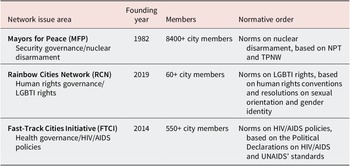
To assess ICNs’ activities in norm dynamics, our analysis focuses on three networks engaged in security, human rights and health governance. Specifically, they address contested norms on nuclear disarmament, LGBTI rights, and HIV/AIDS responses. From a norm research perspective, these issue areas exhibit different normative features, ranging from strong normative orders in the case of nuclear non-proliferation and disarmament to weaker norms or those in decay, such as LGBTI policies (Ben-Josef Hirsch and Dixon Reference Ben-Josef Hirsch and Dixon2021). Although all three ICNs engage in norm dynamics, which encompass contestation from different actors, levels and directions, no issue under study is contested along established cleavages between the global North and South, or along specific cultural or religious lines. Instead, we selected cases in which ICNs can align with various positions on contestation. Yet within these dynamics, the type of contestation varies: while some issues are targets of reactive or validity contestation, others are widely accepted, with only sporadic instances of applicatory contestation. Also, some issue areas show a cohesive normative order grounded in a specific norm, while others are institutionalised within norm clusters. The norm dynamics in these issue areas also vary with regard to the access to contestation of different stakeholders. Table 2 gives an overview of the networks and their embeddedness in normative orders.
Information on the ICNs and their embeddedness in normative orders
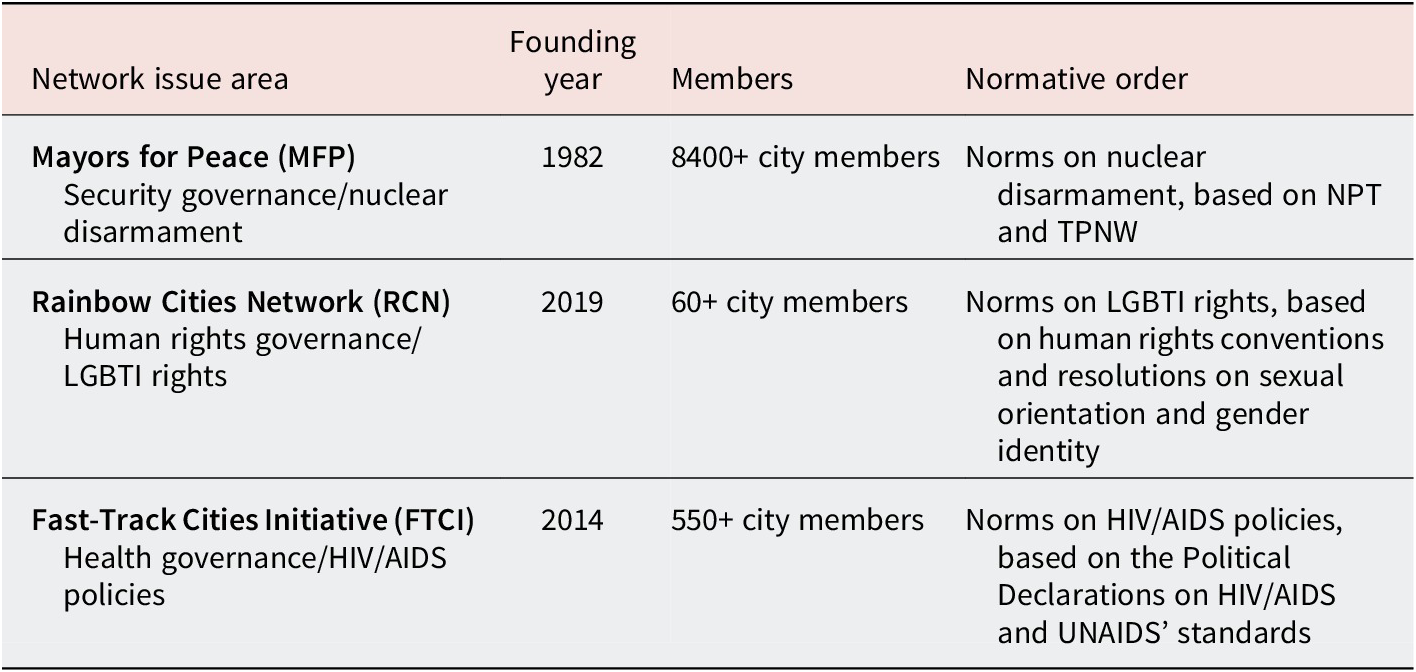
Table 2. Long description
The table consists of four columns: Network issue area, Founding year, Members, and Normative order.
Row 1: Mayors for Peace M F P. Issue area is Security governance or nuclear disarmament. Founded in 1982. Members include 8400 plus city members. Normative order is norms on nuclear disarmament, based on N P T and T P N W.
Row 2: Rainbow Cities Network R C N. Issue area is Human rights governance or L G B T I rights. Founded in 2019. Members include 60 plus city members. Normative order is norms on L G B T I rights, based on human rights conventions and resolutions on sexual orientation and gender identity.
Row 3: Fast-Track Cities Initiative F T C I. Issue area is Health governance or H I V or A I D S policies. Founded in 2014. Members include 550 plus city members. Normative order is norms on H I V or A I D S policies, based on the Political Declarations on H I V or A I D S and U N A I D S standards.
(Source: own account).
In the following, each ICN is presented in three analytical steps: starting with the normative background of the respective issue area, followed by the characteristics of the ICNs’ missions and instruments, and finally turning to the stabilising activities regarding norm robustness, resiliency and legitimacy. In a comparative section, we then summarise these activities and discuss how ICNs stabilise norms.
Mayors for Peace and nuclear disarmament
Mayors for Peace (MFP) is linked to norms on arms and security against a background of peaceful conflict resolution. The two mayors of Hiroshima and Nagasaki initially founded MFP in 1976 as a bilateral exchange, with support from the UN as part of its disarmament efforts. Based on the experienced use of nuclear weapons, the network emphasises the need to abolish nuclear weapons and supports the Non-Proliferation Treaty (NPT) and its idea of nuclear disarmament. Moreover, linked to human rights concerns of civilians in war, the network pushes for the prohibition of nuclear weapons, as codified in the Treaty on the Prohibition of Nuclear Weapons (TPNW). The NPT and its norm cluster on sharing the peaceful benefits of nuclear energy while preventing the proliferation of nuclear weapons by states and non-state actors has been widely accepted among states. Yet, the disarmament efforts of the NPT have not been successful, creating imbalances between states possessing nuclear weapons and those not possessing them. Neither the new development of nuclear arms nor disarmament by nuclear powers has been prevented by the existing normative framework in the NPT, yet the non-use of existing nuclear weapons is widely shared (Tannenwald Reference Tannenwald1999). This normative order was further questioned with the explicit prohibition of nuclear weapons in the TPNW in 2017 (Tannenwald Reference Tannenwald2024). The ban on nuclear weapons is highly contested and polarised between activists and policymakers who want to institutionalise the nuclear taboo and diverse other groups that refer to the importance of nuclear weapons for military means and peace (Sagan and Waltz Reference Sagan and Waltz2002). Although the two treaties thus represent different normative orders, MFP supports both the NPT and the TPNW, stabilising the respective normative implications of not using and limiting nuclear weapons in each of these treaties (Jakobi Reference Jakobi2025).
The importance of prohibiting the use of nuclear weapons is also based on the extent of suffering that Japanese victims of nuclear weapons experienced. The network builds upon remembrance politics of Hiroshima and Nagasaki as a warning that the use of nuclear weapons is a threat to citizens worldwide. The name ‘Mayors for Peace’ was established in 2002, shortening the original name ‘World Conference of Mayors for Peace through Inter-City Solidarity’ (Klockmann Reference Klockmann2018, pp. 523–528). Linked to human rights norms, the network’s aim has been to ban nuclear weapons, and it has also joined international campaigns to that end. As cities have been particularly affected by nuclear weapons as prime targets of these weapons, the network has closely linked this security issue to cities’ local politics. While in its first years, the network’s activities mainly consisted of mayors’ inputs at UN conferences on disarmament and arms control, it later became accredited as an NGO by the UN ECOSOC. Hence, MFP established a permanent representative at the UN and aligned its efforts with UN initiatives, including its public campaigns that also criticised the lack of efforts to reduce or ban nuclear weapons (MFP 1991, pp. 1–2; Jakobi Reference Jakobi2025). At the same time, the network embeds its policies in a broader approach to peace and city-level and citizen-level exchange: Originally centred around the promotion of a ‘culture of peace’, the network evolved in the early 1990s to include also peace-related topics like human rights, the situation of refugees and environmental degradation (MFP 1991, p. 2). In more recent years, the importance of refugees and their integration in cities has also become an important aspect for many members (MFP Interview 2023). With more than 8.400 member cities of different sizes and from around 160 countries (as of June 2025), the network is a particularly large and global ICN. MFP thus represents a large set of cities worldwide and contributes to the robustness, resiliency and legitimacy of norms for peace and against the use of nuclear weapons.
The network’s activities stabilise norms in several ways: With regard to robustness, MFP supports norms on nuclear disarmament in discourse and practice. On the local level, MFP facilitates concordance through exchanges among cities and creates opportunities to learn about peace and the issues surrounding nuclear weapons. For instance, books, talks and exhibitions provide citizens with background knowledge on nuclear weapons, while an annual Flag Day in front of mayors’ offices marks a commitment to peace and the pursuit of a ban on nuclear weapons. The network also supports campaigns against nuclear weapons, works with NGOs and other partners, addresses national governments and participates in diplomatic meetings (MFP Interview 2023). The compliance and implementation of respective norms are also stabilised by letters and statements to further nuclear disarmament. For instance, national chapters contacted their foreign ministries to gather support for the TPNW, particularly in those countries reluctant to adopt it (MFP Interview 2023). At the same time, its close connections with the UN help to support policies. By implementing these norms more directly, MFP also engaged with institutions of international law. For example, the two mayors of Hiroshima and Nagasaki also served as witnesses at the International Court of Justice (ICJ) from 1994 to 1995, when it was called upon to render a verdict on the legality of the threat or use of nuclear weapons (Klockmann Reference Klockmann2018, pp. 533–535). Simultaneously, this engagement also facilitated the establishment of norm clusters by directly linking questions of disarmament to humanitarian norms, human rights and the UN charter, and thus marking nuclear weapons as an unacceptable tool of warfare for humanitarian reasons. The annual Flag Day commemorates the day of the judgment that led to the restriction of these weapons in accordance with humanitarian and human rights norms (MFP Interview 2023). It may thus be seen as a symbolic institutionalisation of the respective norm cluster. More recently, MFP has also broadened its understanding of peace by linking sustainability and other aspects to nuclear disarmament and thus forming a cluster of several mutually supportive norms on international peace (MFP 2021, p. 4). Finally, to stabilise norm legitimacy, MFP also included affected communities and increased the visibility of perspectives that have not been involved in norm dynamics before. Specifically, the remembrance politics of the network enabled marginalised communities – the dead and injured victims of Hiroshima and Nagasaki – to be included in the discourse, with the aim that their fate should not be repeated in any city worldwide (Klockmann Reference Klockmann2018). Thereby, MFP not only represents affected communities like the survivors of the bombing at the end of World War II, but also all citizens of cities as possible victims of nuclear warfare (MFP 2021).
Rainbow Cities Network and LGBTI rights
From a formal perspective, LGBTI rights lack concordance in discourse and institutionalisation in international law (Ben-Josef Hirsch and Dixon Reference Ben-Josef Hirsch and Dixon2021, pp. 528–529). This informal status results from highly conflicting global norm dynamics, making sexuality rights one ‘among the most contentious topics in contemporary human rights debates’ (Thoreson Reference Thoreson2014, p. 4). At the international level, the adoption of several resolutions on LGBTI rights in the UN General Assembly or the UN Human Rights Council (Langlois Reference Langlois, Bosia, McEvoy and Rahman2019, p. 76) was met with harsh critique from a broad alliance of states (Symons and Altman Reference Symons and Altman2015, pp. 78–82). This was supported by transnational coalitions that orchestrate campaigns and fuel a backlash against national and international LGBTI policies (Velasco Reference Velasco2023; Ayoub and Stoeckl Reference Ayoub and Stoeckl2024a) despite the UN’s global campaigns for LGBTIQ+ equality (UN 2025). Contesting actors usually utilise different norms to justify their critique, for example, religion, culture and traditional beliefs, and argue that LGBTI issues should be dealt with at the national level (Symons and Altman Reference Symons and Altman2015, p. 65). At the national level, conservative, populist, or religious actors increasingly target LGBTI rights, as various examples from Hungary, Poland, the US, Russia, Uganda, or Kenya illustrate (Ayoub and Stoeckl Reference Ayoub and Stoeckl2024b). Some contesting governments even use their legislative powers to engage in norm immunisation, which means ‘the creation of legal barriers aimed at fending off a transnationally diffusing norm by blocking local advocacy’ (Nuñez-Mietz and García Iommi Reference Nuñez-Mietz and Iommi2017, p. 196). In sum, the contestation of LGBTI rights results in an international situation of norm polarisation, where ‘two groups of states have adopted conflicting norms, and have clashed repeatedly over them’ (Symons and Altman Reference Symons and Altman2015, p. 65).
Within the global dynamics of norm contestation, RCN was formed as a formal network of city members in 2019, although its origins date back to 2012, when Amsterdam, Barcelona, Cologne and Turin informally established it. As of 2025, RCN has over 60 member cities from various regions worldwide, primarily from European countries (RCN 2025a). It only accepts cities as members, not other public or private actors. Specifically, membership requires an official from the city administration with expertise in LGBTI issues as a formal representative to ensure that LGBTI persons are ‘to be included in every level in our societies’ (RCN 2025b). To safeguard political commitment from the cities and city administrations, RCN requires a membership fee and expects all members to participate in the annual meetings (RCN 2020a). At these conferences, members also share so-called one-pagers that communicate the three best practices from each city, summarise the progress of their policies, and facilitate the exchange between the member cities (RCN 2022a). In addition, with financial support from the EU’s ‘Europe for Citizens’ programme, RCN developed guidelines for urban LGBTI policies, published in 2023 under the title ‘Rainbow Cities in Action: Policy Guidelines for Municipalities’ (RCN 2023a). Overall, RCN’s mission is to further exchange between like-minded cities on how to support LGBTI rights locally. Since ‘discrimination of LGBTI people often takes place in their direct surroundings’ (RCN 2025a), RCN understands its mission to fight against such discrimination at the local level in all aspects.
Through its activities, RCN contributes to the robustness, resiliency and legitimacy of the normative order on LGBTI rights to differing degrees. Regarding norm robustness, RCN generally supports LGBTI rights in discourse and practice. Specifically, it increases concordance by highlighting the norm’s validity: ‘We believe that LGBTI rights are human rights and that we are all free to be who we are’ (RCN 2025b). RCN even exceeds mere support by acknowledging its leadership role in LGBTI policies in order ‘to champion the cause of the LGBTIQ+ community’ (RCN 2023a) and ‘to become the benchmark for the implementation of LGBTI public policies around the world’ (RCN 2025b). Although RCN only indirectly acts as a third party by criticising local norm violations, it nonetheless provides standards for LGBTI policies that indicate when and where cities fail to comply with their commitments. For example, the aforementioned guidelines establish thresholds aimed at further improving urban responsibility and accountability, awareness and education, access and participation, as well as visibility and representation in various issues, ranging from ‘health’ to ‘safety’ and ‘infrastructure and public spaces’ (RCN 2023b). At the same time, RCNs’ more practice-oriented activities also contribute to norm robustness through local compliance and implementation. By introducing urban programs, RCN conceives itself ‘as a means to strengthen local LGBTQI+ policies’ (RCN 2020b). Notably, the one-pagers focus on implementation and include, for example, the establishment of municipal bodies for diversity, gender-sensitive infrastructure, counselling on LGBTI topics and sensitisation programs for members of the administration (RCN 2021, 2020b, 2023c). Since cities are often large employers, they can also directly implement specific work- and workspace-related policies or use their legal powers as local governments to adopt ordinances and set incentives to implement LGBTI policies and comply with respective norms (RCN Interview 2024b).
By establishing norm clusters, ICNs may increase the resiliency of normative orders through synergies and institutionalisation. In general, RCN links norms on sexual orientation and gender identity to the norm of non-discrimination, a cornerstone of many international human rights treaties. Thus, it re-arranges the contested topic of LGBTI rights as an integral part of established human rights norms by expanding, and thereby stabilising, the validity of non-discrimination norms discursively (RCN 2025b). To a lesser degree, RCN also connects urban LGBTI issues with the UN’s Sustainable Development Goals (RCN 2023b): At the urban level, LGBTI policies support transformations that reduce inequalities (goal 10) by making cities inclusive, safe and resilient (goal 11), while promoting peaceful and just institutions (goal 16) and develop global partnerships (goal 17) like RCN as an ICN. In addition to norm linkages through argumentative cohesiveness, RCN also aims at institutionalisation and legalisation, which are specifically observable at the local level and are supplemented internationally through intensified exchange with SOGI experts at the UN and the EU (RCN 2020b, p. 8; RCN Interview 2024a).
Due to its activities, RCN makes normative orders more legitimate by including affected communities and creating opportunities for contestation. In particular, RCN aims to give the LGBTI community a voice by ‘promoting the inclusion of LGBTQI+ people and to increase the visibility of LGBTQI+ issues’ (RCN 2020a) and considers itself explicitly community-driven, underlining the importance of ownership of LGBTI policies by their respective communities (RCN Interview 2024a, 2024b). The one-pagers document that member cities establish forums for exchange, create safe spaces, and conduct surveys to identify community needs (RCN 2021, 2022b, 2023c). At the same time, many experts on LGBTI issues within the member cities’ administrations have an activist background and are associated with the communities in various ways (RCN Interview 2024a, 2024c). RCN utilises these contacts to create opportunities for proactive contestation at multiple levels. Locally, it provides affected communities with a means to be included in the policy processes of the member cities. But at times, RCN also aims to bring these interests to the international realm by reaching out to international and regional organisations. For example, the guidelines created a channel for input from affected communities at the European level, since they translate these experiences into best practices for policy formulation in other cities. However, research on norm contestation and legitimacy highlights the need for global representation in norm validation. Since RCN is predominantly a European network, this can be an obstacle to increasing diversity and inclusion. Yet, RCN’s members are aware of this problem and aim to make the network more globally inclusive (RCN Interview 2024a, 2024b, 2024c).
Fast-Track Cities Initiative and HIV/AIDS policies
While the medical aspects of HIV/AIDS policies appear technical and therefore rather uncontested, their human rights implications ignite international contestation. According to models from UNAIDS, the transmission of the virus could be stopped by 2030 if two intertwined principles were realised, namely ‘95-95-95’ and ‘Zero stigma’ (IAPAC 2024). 95-95-95 is a catchphrase that means that 95% of all people living with HIV must know their status, of which 95% must receive antiretroviral therapy, and 95% of these people in treatment must have viral suppression so they cannot pass the virus. ‘Zero stigma’ is essential for success because all individuals with the virus must be provided with appropriate health services. This implies that discrimination and stigma against so-called ‘key populations’ with high exposure to infection – men who have sex with men, sex workers, transgender persons and people who inject drugs – must be overcome to make medical treatment available for them (IAPAC 2024). Therefore, effective responses to HIV/AIDS can only be realised by addressing stigmatised minorities. While these goals were adopted in ‘Declarations on HIV/AIDS’ by the UN General Assembly in 2011, 2016 and 2021, contestation is observable regarding the human rights implications: Similar to the RCN case, some actors perpetuate their prejudices against key populations and therapeutic tools associated with a promiscuous lifestyle. Although international treaties acknowledge the human right to ‘the highest attainable standard of physical and mental health’ (ICESCR 1966), including access to prevention and therapy, recent controversies surrounding PrEPFootnote 2 as a preventive tool illustrate the political and social implications of access to treatment (Schubert Reference Schubert, Gerhards and Braun2019). Against UNAIDS recommendations, some national health authorities categorised PrEP as ‘not essential’ and referred to alternatives (Blouin-Genest and Erb Reference Blouin-Genest, Erb, Blouin-Genest, Doran and Paquerot2019, pp. 237–239). All in all, contestation in global norm dynamics to end AIDS target human rights aspects, namely the right to health and minority rights on non-discrimination.
Founded in 2014 by the International Association of Providers of AIDS Care (IAPAC), UNAIDS, UN-Habitat and the City of Paris, the Fast-Track City Initiative (FTCI) is a network dedicated to ending the HIV/AIDS epidemic by 2030. Although it only accepts cities as members, it collaborates closely with international bodies, such as UNAIDS, and with business partners in the health sector (FTCI 2024a; IAPAC 2024). FTCI is a global partnership of cities and municipalities. As of 2024, FTCI has 550 members from all over the world. In its founding document, the Paris Declaration, several commitments are outlined to achieve the initiative’s objective to end AIDS. Specifically, the declaration indicates central goals for the FTCI as a city network in HIV/AIDS policies: It aims to terminate AIDS as a public health threat in cities by 2030 by putting people first and explicitly addressing the causes of risk, vulnerability and transmission. At the same time, municipal responses to HIV/AIDS should not only be timely and appropriate but also form a basis for broader social transformation by integrating public health and development. To attain these goals, the members aim to unite as leaders (FTCI 2021). In 2022, FTCI incorporated the Sevilla Declaration into its mission and self-understanding, highlighting the importance of affected communities and stakeholders for the initiative’s success (FTCI 2022). In sum, FTCI’s most crucial function is to facilitate exchange and learning through various instruments, including the network’s global conferences and reports by IAPAC and UNAIDS. Additionally, FTCI has established a best-practice repository and public dashboards that member cities use to document progress in implementation and to share their experiences on HIV responses with other network members (FTCI 2024b, 2024c).
Through its activities, FTCI stabilises the normative order on HIV/AIDS policies by enhancing its robustness, resiliency and legitimacy. Regarding norm robustness, FTCI supports norms in discourse and practice, particularly the 95-95-95 standard and the goal of ‘Zero stigma’. It aims to accelerate the HIV response at the urban level to ‘contribute significantly to reaching the ambitious targets that have been set in the UN Political Declaration, and the global goal of ending AIDS by 2030’ (IAPAC/UNAIDS 2022). The Paris and Sevilla Declarations emphasise that FTCI aims to promote global norms for universal access to healthcare and a comprehensive approach to HIV/AIDS that respects and protects human rights (FTCI 2021, 2022). Although FTCI does not explicitly act as a third party in criticising violations of these norms, it installed a mechanism to facilitate norm-compliant behaviour: The dashboards, which track progress in the cities through comparable indicators and numbers, also function as a tool for competition and potential shaming when cities lag in their outcomes. At the same time, FTCI also stabilises norms by actively furthering compliance and implementation. Member cities aim to implement better ‘sexual, reproductive and mental health services’ that are central to the HIV response but also ‘critical to achieving universal access to health care’ (FTCI 2022). FTCI members also actively engage in non-discrimination and non-stigma policies ‘to remove local ordinances and laws that discriminate against or criminalize the behaviours of vulnerable populations most affected by HIV’ (FTCI 2022). Thus, compliance with both aspects of 95-95-95 and ‘Zero stigma’ is strengthened at the local level, sometimes even surpassing the HIV/AIDS policies of national governments in ambition and in concrete numbers (Jakobi and Loges Reference Jakobi and Loges2022; FTCI Interview 2024).
By connecting norms and increasing the resiliency of norm clusters, ICNs can stabilise normative orders. By highlighting the relationship between 95–95-95 and ‘Zero stigma’, FTCI discursively rearranges the relations between norms. Linking norms of effectiveness and efficiency (regarding medical solutions) to human rights issues underlines the synergies of a clustered approach. In terms of cohesion, FCTI connects the right to health to non-discrimination norms regarding gender, sexual orientation, or race, grounded in human rights but with differing institutionalisation. Thereby, FTCI emphasises the relevance of the Universal Declaration of Human Rights and its importance for the network’s daily work in a rights-based approach to HIV/AIDS (FTCI Interview 2024). To a lesser degree, FTCI also refers to UN-Habitat’s New Urban Agenda and its urban human rights perspective (FTCI 2022). However, compared with norm linkage regarding UN declarations, covenants, or conventions on human rights, the institutionalisation of the New Urban Agenda appears weaker.
By including affected communities and creating opportunities for proactive contestation, FTCI’s activities also stabilise normative orders by making them more legitimate. In particular, FTCI is concerned with the inclusion of key populations in HIV responses. These involve groups that are specifically exposed to HIV/AIDS: People who use drugs intravenously, men who have sex with men, transgender persons and – in some regions of the world – heterosexual girls and women. As the declarations state, FTCI will ensure the participation of affected key populations in policy-making (FTCI 2021) and give these marginalised communities a voice ‘by creating an enabling environment that supports more equal, equitable and inclusive cities and municipalities for our citizens, including the most vulnerable’ (FTCI 2022).
Comparing ICNs and their activities for stabilising norms
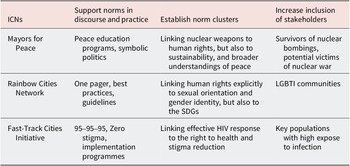
All ICNs in our analysis contribute to norms through stabilising activities, even if these vary. They all explicitly support norms in their discourse, but their activities also encompass symbolic practices, knowledge provision for collective diffusion and benchmarks for implementation. Additionally, the three networks reinforce their respective norms by linking them to other established global norms. While some connections bridge different normative orders, others tie different norms in the same field, for example, within human rights. Finally, all three ICNs also included affected stakeholders who had not been systematically involved previously, ranging from broader urban populations to more specific stakeholders within the cities. These communities range from survivors of nuclear attacks to LGBTI persons and people who live with HIV/AIDS or are exposed to infection. Overall, our findings indicate that ICNs engage in various stabilising activities that enhance the robustness, resiliency and legitimacy of normative orders (see Table 3).
Stabilising activities of ICNs
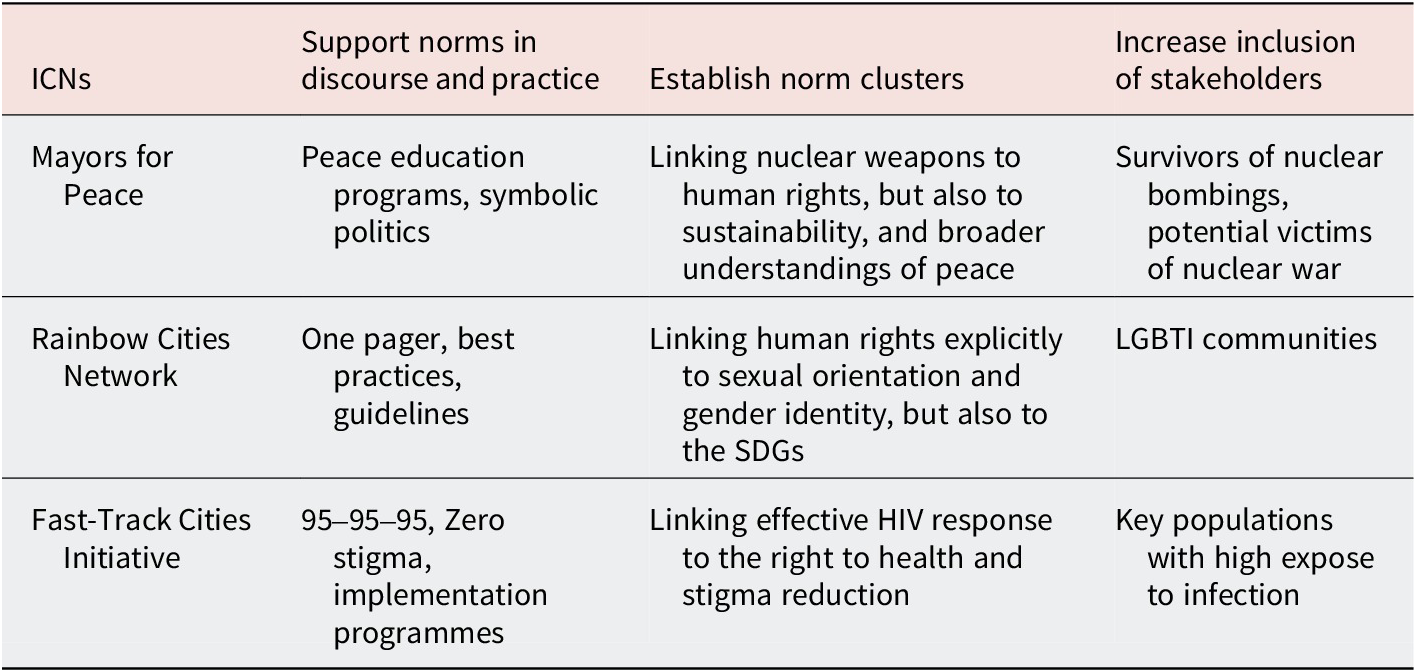
Table 3. Long description
The table consists of four columns and four rows including the header.
Column headers from left to right are: I C N s, Support norms in discourse and practice, Establish norm clusters, and Increase inclusion of stakeholders.
Row 1: Mayors for Peace. Support norms include peace education programs and symbolic politics. Norm clusters link nuclear weapons to human rights, sustainability, and broader understandings of peace. Stakeholders include survivors of nuclear bombings and potential victims of nuclear war.
Row 2: Rainbow Cities Network. Support norms include one pager, best practices, and guidelines. Norm clusters link human rights explicitly to sexual orientation and gender identity, and to the S D G s. Stakeholders include L G B T I communities.
Row 3: Fast-Track Cities Initiative. Support norms include 95-95-95, Zero stigma, and implementation programmes. Norm clusters link effective H I V response to the right to health and stigma reduction. Stakeholders include key populations with high exposure to infection.
(Source: own account).
Based on different strands of norm research, our basic assumption was that norms are most likely to maintain their functions for individual orientation and collective order when they are robust, resilient and legitimate, and that contestation can impact these dimensions differently. Our framework enabled us to determine whether ICNs respond accordingly to this variation, allowing for a more fine-grained analysis of stabilising norms. The findings suggest that ICNs not only further all three aspects of norms through their activities but also meet the specific demands of the respective normative order and its contestation. While the order on nuclear disarmament is grounded in an already established norm cluster, MFP reminds states to uphold their legal commitments and further institutionalise disarmament efforts. At the same time, it emphasises the inclusion of survivors of nuclear bombings and other urban populations to underline the moral basis of its stance regarding nuclear weapons. In contrast, RCN supports the validity of LGBTI rights in rhetoric and practice, thus contributing to norm robustness in a situation of polarisation. It also furthers norm clusters through strategic linkages, arguing that LGBTI rights are an integral part of the established human rights agenda and its mainly legalised norms. At the same time, its inclusion of LGBTI persons increases the visibility of rights-bearers and validates the norm’s legitimacy. Finally, while HIV/AIDS policies have always been comparatively inclusive due to the relevance of key populations as patients, the robustness and resiliency of respective norms required stabilisation. FTCI not only reaffirmed the inclusion of affected communities but also supported these norms in discourse and practice and emphasised the synergies between medical effectiveness and human rights norms.
Yet, ICNs’ stabilising activities are not just local, temporary initiatives. Instead, ICNs function as ‘organisational platforms’ in norm dynamics (Finnemore and Sikkink Reference Finnemore and Sikkink1998, pp. 899–900) to organise and coordinate activities. All three ICNs have network capacities that affect the durability and scope of their activities in norm stabilisation. Although ICNs share similarities with non-state actors, as they advocate for norms and causes through their networks, they also represent subnational governmental actors which can principally resort to collective decision-making and binding implementation. Therefore, they possess unique organisational, social and legal capacities that set them apart from other actors in norm dynamics. Regarding their organisational capacities, ICNs offer an infrastructure for members to facilitate exchange and communication, as well as to prolong political momentum in global norm dynamics. These capacities thereby sustain stabilising activities through institutionalisation. At the same time, their social capacities help ICNs to shape a collective identity and enable internal socialisation processes that maintain the diffusion of activities through mechanisms such as learning and competition. Finally, ICNs can also leverage their members’ legal capacities for norm implementation, which may contribute to a gradual convergence of member cities’ policies to counter norm decay. By providing these capacities, ICNs can sustain their activities over time. Moreover, because of their networked structures, ICNs’ stabilising activities are not confined to the local level but have effects across the networks’ broader membership. Thus, ICNs change the normative landscape by stabilising norms across a multiplicity of local settings, producing translocal effects through networked activities. In sum, ICNs stabilise existing norms and normative orders over time and across various localities, making these networks even more relevant for norm research and IR in general.
Conclusions: ICNs as agents of norm stabilisation
Although contestation has frequently been assessed, norm research has rarely examined actors and activities that stabilise normative orders. This article analysed three ICNs and their contributions to norm dynamics, particularly their stabilising activities regarding norms and normative orders under global contestation. Against a background of growing norm contestation, ICNs engage in norm dynamics across a range of issue areas, on various levels, through specific activities and with sustaining capacities. While ICNs could potentially contribute to norm decay if they seriously challenge norms, our findings show that ICNs actively support norms. When subnational entities like cities seek recognition and acknowledgement as international actors, supporting existing norms that enjoy widespread acceptance is strategically advantageous, as it can grant legitimacy to ICNs that promote them. However, their observable activities cannot be explained solely in strategic terms. While our results support findings from more quantitative studies on ICNs’ norm contributions (Jakobi et al. Reference Jakobi2025), we were surprised to find that the stabilising activities of all ICNs go beyond rhetorical support and involve norm linkage within clusters and active inclusion of stakeholders. Although the three ICNs vary in their emphasis on specific activities to stabilise norms, they nonetheless aim to engage as normative actors with their contributions to preventing norm decay.
So far, ICNs have remained underexamined in norm research. By comparing Mayors for Peace, Rainbow Cities Network and Fast-Track Cities Initiative, we demonstrated how they support norms in discourse and practice, establish norm clusters and increase the inclusion of affected stakeholders. In sum, the activities of ICNs stabilise norms by making them more robust, resilient and legitimate. By using a combined framework based on the three approaches, we have shown that ICNs are relevant actors in norm dynamics through their stabilising activities. Yet, further research could focus on the specific approaches to robustness, resiliency and legitimacy to comprehensively trace the mechanisms at work or the practices in use, and thus document in more detail how ICNs contribute to preventing norm decay from the specific perspective. At the same time, organisational, social and legal capacities are particularly relevant for sustaining the effects of ICNs’ stabilising activities on normative orders. While we have presented the relevance of ICNs’ capacities, our analysis did not systematically examine ICNs as organisational platforms in global norm dynamics. Further research could elucidate in more detail how their capacities contribute to these activities and if they have varying effects on stabilising activities.
Even though all three ICNs empirically engage in stabilising activities to counter norm decay, there are still open questions for further research on norms and ICNs: Our results cannot be used to claim that all ICNs support norms, and we did not evaluate the effects of these activities. Not all ICNs evolve and grow over time to develop sustainable network structures that could contribute to norm stabilisation (Jakobi et al.Reference Jakobi2025). We focused on ICNs that emerged several years ago and are central to their respective issue areas. Additionally, our cases included only networks of cities, which may have affected their relationship to norms. ICNs that include regional, civil society, or private actors might not only undertake different activities, but their relationship to existing norms can also differ – a topic that further research would need to assess. Moreover, the context in which ICNs operate warrants closer consideration, as do the effects they can have. Existing studies highlighted that cities might use networks as ‘local boomerangs’ against national governments, although their potential to initiate normative change beyond the local level is limited (Runyan and Sanders Reference Runyan and Sanders2021). In a critical examination, further research could address why and how ICNs select specific norm dynamics to engage in and what the effects of stabilising activities are in the longer term. Although some cities may join ICNs for purely symbolic reasons, membership will often be linked to some form of activism. It will thus incur monetary and political costs that cities must be willing to bear. Our analysis has shown that members of the three ICNs have accepted these costs, though to varying degrees. This finding is also consistent with research on relatively informal urban networking between so-called sanctuary cities, which shows how cities position themselves in opposition to their national governments, incurring considerable political and financial costs (Arnold Reference Arnold2022; Humphris Reference Humphris2023). At the same time, variance between ICNs’ activities, costs and their effect on norms is likely, and future research could aim to explain these differences.
All in all, norm research, particularly the analysis of stabilising contested norms, could profit from taking ICNs into account as a new category of actors that links different, well-researched levels and types of actors in global norm dynamics. While our analyses contributed to questions of how actors and their activities stabilise norms and normative orders, there are still many questions to be answered on how ICNs relate to the effectiveness and legitimacy of global governance, what kind of authority they represent, if any, or whether they constitute a new form of informal governance. At the same time, the study of ICNs can enrich norm research by offering a novel, expanded perspective on local actors, their networks within global norm dynamics, and the effects of their activities on contested normative orders. As we have demonstrated, ICNs enable activities through their unique capacities, thereby shaping normative dynamics. As agents of norm stabilisation in global security, human rights and health, they contributed to preventing norm decay. Thus, they represent highly relevant but still largely overlooked actors for comprehensive analyses of contestation practices in norm research and beyond.
Acknowledgements
We presented an earlier version of the article at the DVPW Congress 2024 in Göttingen. We would like to thank the participants of the panel on ‘Norm Research,’ especially Carmen Wunderlich, for their valuable comments, as well as Johanna Speyer and Dirk Peters from PRIF for feedback on an earlier version of this text. We also appreciate the detailed and very helpful comments by the two anonymous reviewers.
Funding statement
The research is part of a project on international city networks and global norms (URBANORMS), funded by the German Research Foundation (DFG – funding number 468859403).
The manuscript presents original work and has not been submitted elsewhere.
Competing interests
There is no competing interests involved.

 Open access

