


Introduction
Rockhopper Penguins Eudyptes chrysocome and E. moseleyi are among the most abundant and widespread avian predators of the Southern Ocean (Woehler Reference Woehler1993). Their global breeding population has been estimated at 3.7 million pairs (BirdLife International 2004) distributed on almost all the cool temperate and sub-Antarctic islands of the Southern Ocean between the Subtropical and Antarctic Polar Fronts. However, numbers have fluctuated and fallen markedly at most monitored breeding sites, with declines of 88% recorded at the Falkland Islands over 60 years, 94% at Campbell Island (New Zealand) since the 1940s, 60% in 7 years on Marion Island (South Africa) after 1994, and nearly 50% at Ile Amsterdam (France) from 1972 to 1994 (Cunningham and Moors Reference Cunningham and Moors1994, Crawford et al. Reference Crawford, Cooper, Dyer, Greyling, Klages, Ryan, Petersen, Underhill, Upfold, Wilkinson, de Villiers, du Plessis, Du Toit, Leshoro, Makhado, Mason, Merkle, Tshingana, Ward and Whittington2003a,Reference Crawford, Cooper, Dyer, Greyling, Klages, Nel, Nel, Petersen and Wolfaardtb, Pütz et al. Reference Pütz, Clausen, Huin and Croxall2003). The species sensu lato (see below) is classified as globally ‘Vulnerable’ (BirdLife International 2007a).
Taxonomic issues complicate the conservation status of Rockhopper Penguins, as it has generally been described as a single species, with three subspecies: E. c. moseleyi breeding on Amsterdam and St. Paul Islands in the southern Indian Ocean and on the Tristan da Cunha islands and Gough Island in the South Atlantic Ocean, and E. c. chrysocome and E. c. filholi breeding south of the Sub-tropical Convergence. Recent work shows that the northern form should be recognised as a full species, the Northern Rockhopper Penguin E. moseleyi (Jouventin et al. Reference Jouventin, Cuthbert and Ottvall2006). Published evidence indicates that declines have been most widespread in the southern species, with less evidence of a decrease in recent years for E. moseleyi, with apparently stable populations on Gough and Inaccessible Island (Tristan da Cunha) (Ryan and Moloney Reference Ryan and Moloney2000, Cuthbert and Sommer Reference Cuthbert and Sommer2004a), an increasing population at St Paul Island (Woehler et al. Reference Woehler, Cooper, Croxall, Fraser, Kooyman, Miller, Nel, Patterson, Peter, Ribic, Salwicka, Trivelpiece and Weimerskirch2001), and a decreasing population at Amsterdam Island (Guinard et al. Reference Guinard, Weimerskirch and Jouventin1998, Woehler et al. Reference Woehler, Cooper, Croxall, Fraser, Kooyman, Miller, Nel, Patterson, Peter, Ribic, Salwicka, Trivelpiece and Weimerskirch2001). However, with the acceptance of the recent split of the Southern and Northern Rockhopper Penguin (BirdLife International 2007b), the conservation status of both species needs to be reassessed. In this paper we review the population size and trends of Northern Rockhopper Penguins breeding at Tristan da Cunha and Gough Island using recently gathered and historical population estimates, and assess the conservation status of this newly recognised species.
Methods
The UK Overseas Territory of Tristan da Cunha (which includes Gough Island) is located in the central South Atlantic Ocean. The Tristan da Cunha group (hereafter referred to as ‘Tristan da Cunha’) consists of five principal islands (Figure 1): the main island of Tristan (hereafter referred to as ‘Tristan’), Inaccessible, Nightingale and Nightingale's two small satellite islands of Middle (Alex) and Stoltenhoff. Northern Rockhopper Penguins are present on Tristan da Cunha and Gough for around 8 months a year. At Tristan da Cunha, adults return in late July-August, eggs are laid in September, hatching occurs from mid-October to early November and chicks fledge from the end of December to January (Ryan Reference Ryan2007). Breeding adults then depart the colonies on a pre-moult fattening trip, before returning to moult from February to March. Young birds and failed breeders return earlier to moult. Breeding phenology on Gough is 3–4 weeks later than at Tristan da Cunha, but otherwise similar. Rockhopper Penguins (and other Eudyptes penguins) lay two eggs, with the first laid ‘a-egg’ smaller than the ‘b-egg’. Almost invariably, only the b-egg produces a fledged chick. It is very unlikely that pairs are able to relay in the same breeding season following the loss of a clutch.
Map of the Tristan da Cunha group (consisting of the main island of Tristan, and satellites Inaccessible, Nightingale, Stoltenhoff and Middle islands) and Gough Island. Place names refer to localities mentioned in the text. For Tristan, numerals 1 to 8 indicate the position of the extant penguin colonies at West Jew's Point (1), Big Gulch (2), Phoenix Beach (3), East End (4), Trypot Bay (5), Goat Road Gulch (6), Stony Beach (7), and Stony Hill (8). Asterisks indicate the position of colonies that are known to have become extinct. Arrows and kilometres on the Tristan da Cunha map mark the direction and distance between Tristan, Inaccessible and Nightingale Islands. Gough Island is 350 km to the south-east of Tristan.

All available records of penguin numbers on Gough Island and Tristan da Cunha were collated. Count data include published information, early historical records, anecdotal observations, and unpublished counts. Difficulty of access and differences in nesting habitat of the species on the various islands meant that various methodologies were utilised in recent surveys. On Tristan, penguin colonies occur on rocky slopes and gulches, and incubating penguins were counted on foot in the eight extant colonies. At Nightingale, Inaccessible and Middle Islands, colonies are located under tall (> 2 m), dense stands of tussock grass Spartina arundinacea, making counts extremely difficult. Estimates of numbers for Nightingale and Middle Islands in 1973 are based on the density of birds and area of breeding colonies (Richardson Reference Richardson1984). Density estimates were repeated on Nightingale in September and October 2007 by two independent survey teams, and the boundaries of colonies were mapped by GPS on the second visit. A small area of colony on the south of Nightingale was also scan-counted in 2007. No counts have been made at Middle Island since the estimate from 1973. Rockhopper Penguins have not been recorded breeding at Stoltenhoff Island, which is more exposed and probably unsuitable for breeding. Even in areas where colonies are concealed under dense tussock grass, their presence is given away by penguins loafing adjacent to landing sites (Ryan and Moloney Reference Ryan and Moloney2000). No such aggregations of birds have been observed on Stoltenhoff.
At Inaccessible, population trends were estimated from boat- or shore-based counts of penguins in beach parties, which are presumed to reflect the total number of pairs present (Ryan Reference Ryan2006). Beach parties were counted at eight different colonies in 1989, 1999 and 2004 (Ryan and Moloney Reference Ryan and Moloney2000; Ryan Reference Ryan2006). At Gough Island, most breeding colonies are located on rocky boulder slopes below coastal cliffs and most data are based on shore-based or boat-based scan counts. The counts made at Gough in 2004 and 2006 repeated the survey methods that were previously used in 1982 (Watkins Reference Watkins1987) with one observer (PGR) involved in all counts. Breeding colonies in The Glen and Sophora Glen on Gough Island are not visible from the sea and were surveyed on foot. Counts at Rockhopper Point on Gough include scan counts from boats (Watkins Reference Watkins1987), as well as scan counts from high cliffs directly overlooking this area (Swales Reference Swales1965; RJC pers. obs.).
Although considerable differences exist between the methods (e.g. scan-count totals tend to be lower than those from ground counts; Cuthbert and Sommer Reference Cuthbert and Sommer2004b) and different observers were involved, if the large-scale (order of magnitude) changes in Rockhopper Penguin populations at other islands have occurred at Tristan da Cunha and Gough Island, they should be detectable, despite the likely imprecision and inaccuracy of some of the estimates involved. Most recent counts (since 1979) on Tristan and Gough Island have been made in October and November when only one member of a breeding pair is in attendance incubating eggs or guarding a small chick. Counts of penguins during this period are assumed to reflect the number of breeding pairs, although the number will decrease as the season progresses (Williams and Stone Reference Williams and Stone1981). Counts on Gough in 2006 were undertaken early in the breeding season (29 September–4 October), when egg laying was commencing and when both members of the pair are present in the colony. Counts made on foot at six areas (containing 40–600 nesting pairs) during this time revealed an average ratio of 2.1 adults to nests: consequently scan counts were divided by 2.1 to provide a more reliable estimate of breeding pairs. In 2004, all counts were boat-based, and The Glen and Sophora Glen were not counted. Accordingly we added the 2006 count of 3,250 pairs at The Glen and Sophora Glen to the 2004 total to provide a whole-island estimate. In 2006, only the eastern, southern and southwest coastlines were counted (from Deep Glen to North Point; Figure 1). This area of coast supported 58.2%, 63.0% and 49.8% of the total island population in 1979, 1984 and 2004, respectively. Consequently, we used the average of these proportions to provide an estimate for the total population in 2006.
Whole-island population estimates for Gough Island are available from 1956, 1979, 1984, 2004 and 2006. Because of the very high inter-annual variation in population estimates made a few years apart (coefficient of variation of 41% and 52% for 1979–84 and 2004–6, respectively) we have treated these counts as three discrete events: 1956, 1979–84 and 2004–06, each separated by 20–25 years, and have used the average value of each pair of counts as the approximate best estimate of the population size for these periods.
Results
There have been substantial decreases in the population estimates of Northern Rockhopper Penguins at Gough and Tristan da Cunha over the period for which counts are available (Table 1). If the 1956 estimate of two million pairs for Gough Island and minimum population size of 200,000 pairs at Tristan in 1873 are roughly accurate, then total declines are greater than 90% for both islands, and have occurred over at least 45 and 130 years. For Gough Island, a population decrease of > 90% occurred over a 26-year period from 1956 to 1979/84, at a mean decline rate of 11% per year, assuming a constant decrease. With limited counts and high inter-annual variation there is considerable uncertainty in the rate of decrease from 1979–84 and 2004–06, however our best estimate for this 23-year period is a decrease of 50–60% at a rate of 3–4% per year. Counts on Tristan indicate that a population decline had already occurred by the 1950s, with the population likely to have decreased by > 90% between 1873 and 1955. Supporting this, eight of 16 colonies on Tristan went extinct over 2–3 decades from the end of the 19th century (Richardson Reference Richardson1984). Despite protection for Tristan colonies since 1984, there is some evidence for continued modest declines: the five counts conducted from 1992–2005 average 3,660 pairs, and are lower than the two counts from 1955 and 1973 (Table 1). There has been no change in the remnant population on Tristan between 1984 and 2005, with numbers varying from 3,200 to 4,500 pairs.
Population estimates for Gough, Tristan, Inaccessible, Nightingale and Middle Islands, indicating the year of survey, comments on survey methodology or information recorded, and the source of data. All estimates are of pairs, other than 19th century counts where units were not specified. The latter two estimates for Inaccessible Island are based on the mid-point of the range of estimates given. Tristan ANRD stands for the Tristan da Cunha Agriculture and Natural Resources Department.
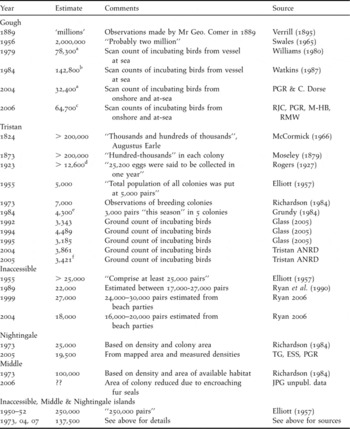
a The Glen and Sophora Glen (1.5% of the total in 1984) were not counted in 1979 or 2004.
b Penguin Island (Figure 1) with an estimated 1,500 pairs, is excluded from this total (Watkins 1986) and has not been counted in other years.
c Correction made for count early in the breeding season (see methods).
d This total is a minimum and assumes both eggs of each clutch were collected.
e Estimated from counts of 5/8 colonies that on average comprise 70% of Tristan total.
f Estimated from counts of 6/8 colonies that on average comprise 77% of Tristan total.
There are fewer data available to examine population trends at Tristan da Cunha's outer islands, with only one estimate for Middle Island of 100,000 pairs in 1973. For Nightingale, independent estimates give densities of 1.59 and 1.32 nests m−2 in 2007, which with a mapped breeding area of 1.43 ha gives a population of around 19,500 pairs (including an additional 500 pairs scan counted on the south of the island): a c. 20% decrease from 25,000 pairs in 1973. Population estimates for Inaccessible from 1979 to 2004, vary from 18,000 to 27,000 pairs (average 22,300). If Richardson's 1950–52 estimate of > 25,000 pairs is accurate, then numbers on Inaccessible appear relatively stable. However, the most recent best estimates for Inaccessible (18,000 in 2004), Nightingale (19,500 in 2007) and the 1973 estimate for Middle (100,000) islands, are barely half the total population of 250,000 pairs estimated for these three islands in 1950–52 (Table 1).
Discussion
Historical population trends and exploitation
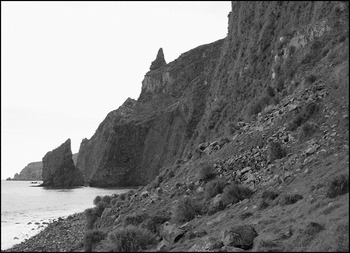
Early accounts from Gough Island and Tristan da Cunha suggest there were much larger numbers of Northern Rockhopper Penguins in the 19th century, with Comer recording “millions” on Gough Island in 1889 and Augustus Earle noting “thousands and hundreds of thousands” at Tristan in 1824 (Comer, cited by Verrill Reference Verril1895; Earle cited by McCormick Reference McCormick1966). In the 1950s, Rockhopper Penguins were still estimated to number two millions pairs on Gough (Swales Reference Swales1965). Although these estimates have been questioned (Williams Reference Williams1980), it seems unlikely that three observers (Earle, Comer and Swales) would all over-estimate numbers by as much as an order of magnitude. Support for there being two million pairs on Gough in 1956 comes from counts made at Rockhopper Point where Swales (Reference Swales1965) reported, “the largest single rookery, of about 200,000 pairs, occupied almost the whole of Rookery Point” and gives a detailed account of this observation. This area was recounted in 2004 and 2006 from the same cliff-top observation point. Only a small proportion of the area is now occupied by penguins, with counts of 1,180 and 4,030 pairs, respectively: a decline of > 98% and in agreement with the estimated whole-island decline of > 90%, suggesting the 1956 estimate of two million pairs is plausible. Williams (Reference Williams1980) doubted whether there were sufficient areas of suitable nesting habitat on Gough to support two million pairs, but the island's east coast now consists of small fragmented penguin colonies amongst large areas of apparently previously occupied habitat (characterised by weedy vegetation typical of previously bare areas; Figure 2), suggesting that the island could have supported far larger numbers.
Isolated penguin colony within large areas of apparently suitable habitat on the east coast of Gough Island, characterised by short, weedy plants typical of recently vegetated areas. (Photo R. Cuthbert)
Declines on Tristan were first recognised during 1937–1938 when Hagen (Reference Hagen1952) reported, “since the end of the 19th century the stock of Rockhopper Penguins has most evidently decreased considerably”. These early decreases are likely to be partly, or largely, due to human exploitation. Vast numbers of birds were exploited on Tristan since at least 1824 (McCormick Reference McCormick1966). Anne Rogers wrote that “penguin eggs are hunted for and used in immense quantities”, with more than 25,200 eggs collected in one year (Rogers Reference Rogers1927). Penguin eggs were also collected for export: 20,000 were shipped to Cape Town in 1949 (Munch Reference Munch1971). The last published information for Tristan is of 1,470 and 3,000 eggs collected in 1973 and 1974 (Richardson Reference Richardson1984). The species was fully protected on Tristan in 1984, but a traditional take of eggs for human consumption and for making curios still occurs on Nightingale. The number of eggs taken is now greatly reduced in comparison to the 12,000 estimated from the 1930s and 1950s, and 23,400 and 41,100 from 1973 and 1974 (Hagen Reference Hagen1952, Elliott Reference Elliott1957, Richardson Reference Richardson1984). In addition to egg collecting, exploitation of adult birds also occurred: “thousands used to be slaughtered” to extract oil from moulting birds or for their head-plumes for use in making ornamental table ‘tossel’ mats (Munch Reference Munch1971). These practices had largely ceased by 1955 (Elliot 1957). Moulting birds were also herded into pens to have their feathers plucked for pillows and mattresses, before being released alive (Hagen Reference Hagen1952). The extant penguin colonies on Tristan are now all found on the east coast of the island, away from the area of settlement (Figure 1).
Other factors may also have played a role in the decline in penguin numbers at Tristan, particularly predation by feral pigs Sus scrofa that were introduced before 1811, and apparently extinct by 1873 (Moseley Reference Moseley1879, Wace and Holdgate Reference Wace and Holdgate1976). Pigs also became established on Inaccessible following the wreck of the Blenden Hall in 1821 and were common on the island in 1871, where they were reported to prey on penguins and Tristan Albatrosses Diomedea dabbenena (Moseley Reference Moseley1879, Stoltenhoff Reference Stoltenhoff and Spry1876, Rosenthal Reference Rosenthal1952). By 1873, Moseley (Reference Moseley1879) reported that wild hogs had “nearly exterminated a penguin rookery on the south side of (Inaccessible) island”. Domestic dogs Canis familiaris, some semi-wild, have at times also killed large numbers of penguins on Inaccessible (Moseley Reference Moseley1879, Stoltenhoff Reference Stoltenhoff and Spry1876) and reportedly on Tristan when the island was evacuated in the 1960s (Falk-Rønne Reference Falk-Rønne1967).
Recent population trends
Evidence from Gough Island indicates that around two million pairs were still present in the mid 1950s and that the population has since crashed by more than 90%. Although human exploitation and introduced predators may be the main factors responsible for the historical decreases at Tristan, these factors cannot explain the decreases on Gough. Exploitation of penguins by sealers certainly occurred on Gough Island during the 18th and 19th centuries (3,000 eggs were collected in 1889; Hänel et al. Reference Hänel, Chown and Gaston2005). However, the small numbers of sealers based ashore are unlikely to have had the same impact as at Tristan with its larger, permanent human population and historical importance for supplying visiting ships. More significantly, the population on Gough has decreased in a period when human exploitation was limited.
Factors that are known to have impacted penguins at Tristan da Cunha and Gough Island in recent years include landslips (Richardson Reference Richardson1984, Ryan Reference Ryan1993), oil pollution (RJC & RMW pers. obs.), use as bait for the Tristan Rock Lobster Jasus tristani fishery (Wace and Holdgate Reference Wace and Holdgate1976, Richardson 1974, Roscoe Reference Roscoe1979), incidental bycatch by fishing vessels (Ryan and Cooper Reference Ryan and Cooper1991), entanglement in marine debris (RJC & PGR pers. obs.), and the capture of birds for zoological collections (Cooper and Ryan Reference Cooper and Ryan1994, JC & JPG pers. obs.). However, the spatial scale and/or temporal infrequency of these events make it unlikely that they could be responsible for the observed > 90% decrease from two million pairs in the 1950s (e.g. landslips onto colonies are a natural but infrequent occurrence and large areas of apparently suitable breeding habitat remain; Figure 2).
The population crash of penguins at Gough Island, in the absence of any identified causal factor, mirrors the decreases observed in Southern Rockhopper Penguins at colonies in the Falklands, Campbell and Marion islands (Cunningham and Moors Reference Cunningham and Moors1994, Crawford et al. Reference Crawford, Cooper, Dyer, Greyling, Klages, Ryan, Petersen, Underhill, Upfold, Wilkinson, de Villiers, du Plessis, Du Toit, Leshoro, Makhado, Mason, Merkle, Tshingana, Ward and Whittington2003a,b, Pütz et al. Reference Pütz, Clausen, Huin and Croxall2003). When and why these decreases occurred is unknown. Proposed hypotheses for these declines range from the impact of commercial fishing to the warming of the marine environment (Cunningham and Moors Reference Cunningham and Moors1994; Pütz et al. Reference Pütz, Clausen, Huin and Croxall2003). An extensive longitudinal study investigating stable isotope signatures from Rockhopper Penguins sensu lato (including Gough and Tristan da Cunha) suggests there have been inter-site changes in marine productivity, but no consistent pattern indicating a common cause in the global declines of Rockhopper Penguins (Hilton et al. Reference Hilton, Thompson, Sagar, Cuthbert, Cherel and Bury2006).
Two other hypotheses to explain the decline on Gough Island are inter-specific competition for prey with Subantarctic Fur Seals Arctocephalus tropicalis, as proposed for Antarctic Fur Seals A. gazella and Macaroni Penguins Eudyptes chrysolophus at South Georgia (Barlow et al. Reference Barlow, Boyd, Croxall, Reid, Stanland and Brierly2002), or predation by Subantarctic Fur Seals as observed for Northern Rockhopper Penguins at Amsterdam Island (Guinard et al. Reference Guinard, Weimerskirch and Jouventin1998). Fur seals were nearly extirpated from Tristan da Cunha, and numbers significantly reduced on Gough Island through uncontrolled sealing during the late 19th and early 20th centuries. Their numbers have since recovered, increasing exponentially through the 1970s and continuing to increase from 1988/89 to 2005/06 (Bester Reference Bester1990; Bester et al. Reference Bester, Wilson, Burke and Hofmeyr2006). The total population on Gough is currently estimated to be 300,000 animals, with around 60,000 pups produced each year (Ryan Reference Ryan2007). Over the same period, populations of penguins have collapsed by > 90%. Such massive changes in numbers of two top marine predators may have caused substantial changes in the availability and biomass of prey, and a potential for inter-specific competition. Similarly, even if fur-seal predation of penguins is rare, the large fur seal population of 300,000 animals could have a marked impact on a (now) substantially smaller penguin population. Further investigation of the potential role of inter-specific competition and fur seal predation is required.
Conservation status and protection
For Gough, Tristan, Inaccessible and Nightingale islands the current population size and best estimate of recent (30 year) population trends are 48,500 pairs on Gough (average of the two most recent counts) declining at a rate of 3–4% a year from the estimated 110,000 pairs in the early 1980s, 3,700 pairs on Tristan (average of five counts from 1992–05) declining from 7,000 pairs in 1973 at 2% a year, a stable population of 22,300 pairs on Inaccessible (three counts from 1989–04) and a population of 19,500 pairs on Nightingale with an estimated decline rate of < 1% per annum since the 1973 estimate of > 25,000 pairs. Extrapolating backwards with the current population estimates, over three generations (30 years for Eudyptes penguins; BirdLife International 2007a) the total population is likely to have declined by 52% from 1975–2005. No population trends can be determined for Middle Island, as only one estimate has been made to date. Middle Island (then) held nearly two thirds of the Tristan da Cunha population and clearly a new population estimate is an urgent priority, especially given observations that Subantarctic Fur Seals have colonised the island, displacing at least some penguins (JPG pers. obs.). Recent records off Nightingale Island of predation upon adult penguins by Northern Giant Petrels Macronectes halli also give cause for concern (Ryan et al. Reference Ryan, Sommer and Breytenbach2008). Populations of Northern Rockhopper Penguins at Amsterdam and St Paul Islands have undergone contrasting trends, with numbers decreasing from 58,000 to 25,000 pairs at Amsterdam from 1971–93, and increasing from 4,000 to 9,000 pairs over the same period on St Paul (Guinard et al. Reference Guinard, Weimerskirch and Jouventin1998). For both islands combined, the population has declined at a rate of around 2.2% a year from 1971–93, a three-generation decrease of 49% if this decline rate has remained constant. As the Tristan da Cunha group and Gough hold > 80% of the global population (c. 200,000 pairs if numbers at Middle Island have remained constant, and using 1993 estimates for Amsterdam and St Paul), the overall decline rate for the species is likely to exceed 50% in three generations: placing this species as globally ‘Endangered’ under criterion A2 (IUCN 2001).
Continued protection and limiting disturbance to the remaining colonies are a priority for Tristan da Cunha and Gough Island. On Tristan they were first protected at the West Jew's Point colony in 1979 (Cooper et al. Reference Cooper, Ryan, Andrew and Dingwall1995), fully protected against human exploitation in 1984 (Ryan & Glass Reference Ryan and Glass2001, Appendix 2), and their breeding colonies were declared nature reserves in 2006 (St Helena Government 2006). Penguins were protected on Gough Island in 1976 with the island's declaration as a wildlife reserve and subsequent recognition as a World Heritage Site including protection in its 12-nautical mile territorial waters (Cooper and Ryan Reference Cooper, Ryan and Dingwall1995). Inaccessible was declared a nature reserve in 1997, and was granted enhanced conservation status as part of an expanded Gough and Inaccessible Islands World Heritage Site in 2004, with management plans that control inter alia disturbance to wildlife, including penguins (Cooper and Ryan Reference Cooper and Ryan1994, Ryan and Glass Reference Ryan and Glass2001). Nightingale, Stoltenhoff and Middle Islands remain legally unprotected, but exploitation of penguins at these islands is now restricted to their eggs and guano by islanders only (St. Helena Government 2006). Given the decreasing populations of the Northern Rockhopper Penguin and its globally ‘Endangered’ status it is important that any collecting of eggs should be conducted in a sustainable manner, such as being limited to a-eggs only.
Monitoring trends in breeding populations should also commence or continue at all islands within the territory, including assessing the current population size at Middle Island. Monitoring should follow established protocols and be undertaken annually on Tristan and every 3–5 years for Gough and other islands (Cuthbert and Sommer Reference Cuthbert and Sommer2004b, Tristan da Cunha Government 2006, Ryan Reference Ryan2006). Whereas protection on land and monitoring are important, practical steps to halt the decrease in penguin numbers at any breeding island remain elusive until the causal factor, or factors, behind the population declines are identified. It is most likely that the main threats facing penguins are not occurring on land, but at sea. Research at Tristan da Cunha and Gough Island and other breeding sites of Northern and Southern Rockhopper Penguins is urgently required to identify the factors behind the wide-scale declines.
Acknowledgements
We thank the South African Department of Environmental Affairs and Tourism, the Tristan da Cunha Agriculture and Natural Resources Department and Ovenstones Agencies Pty Ltd for logistical support, the University of Cape Town for assistance with field equipment and support during writing, Andrea Angel for assistance with fieldwork in 2003, and Marthan Bester for information on fur seal populations. Our thanks go the people of Tristan da Cunha who approved the research and provided logistical support. This study was made possible by a grant from the United Kingdom Foreign and Commonwealth Office, in cooperation with the Royal Society for the Protection of Birds and the Percy FitzPatrick Institute of African Ornithology.



