




1. Introduction
Logic programming (LP) and formal argumentation are two primary disciplines involving knowledge representation and non-monotonic reasoning. Assumption-based argumentation (ABA, for short) (Bondarenko et al. Reference Bondarenko, Dung, Kowalski and Toni1997; Cyras et al. Reference Čyras, iFan, Schulz, Toni, Baroni, Gabbay, Giacomin and van der Torre2018) is a well-established branch in argumentation theory, aimed at providing coherent sets of formulas that admit other sets of formulas as their contraries, based on assumptions, contrariness operators, and rules in corresponding deductive systems. ABA was inspired by Dung’s semantics for abstract argumentation frameworks (Dung Reference Dung1995) and LP with its dialectical interpretation of the acceptability of negation-as-failure assumptions based on the "failure to prove the converse" (Przymusinski Reference Przymusinski1990). Thus, ABA can be viewed as an argumentative interpretation of LP semantics.
The similar ground of LP and ABA calls upon translation methods for revealing the exact relations between them, and for importing reasoning methods from one formalism to the other. For example, argumentative characterizations of LP have been proven useful for explanation (Schulz et al. Reference Schulz, Satoh and Toni2015; Schulz and Toni Reference Schulz and Toni2016), visualization of inferences in LP (Schulz Reference Schulz2015), and debugging of logic programs (Thevapalan et al. Reference Thevapalan, Heyninck and Kern-Isberner2021). Among the works that relate LP and ABA we recall the one of Bondarenko et al. (Reference Bondarenko, Dung, Kowalski and Toni1997), who were the first to show a correspondence between stable models (respectively, the well-founded model) of a normal logic program and stable extensions (respectively, the grounded extension) of the associated ABA framework (see Theorem 3.13, respectively Theorem 6.3 by Bondarenko et al. (Reference Bondarenko, Dung, Kowalski and Toni1997), and the work of Caminada and Schulz 2017, Reference Caminada and Schulz2018) that provides a one-to-one correspondence between the 3-valued stable models (Przymusinski Reference Przymusinski1990) (respectively, the regular models (You and Yuan Reference You and Yuan1994)) for normal logic programs, and complete labellings (respectively, preferred labellings) for ABA frameworks. A recent work (Wakaki, Reference Wakaki2020) shows that answer sets of a (non-disjunctive) extended logic programs can be captured by stable extensions of the translated ABA frameworks. These works were restricted to logic programs, where only atoms or their (classical) negations are allowed in the head of the rules. Yet, a faithful modeling of real-world problems often requires to cope with incomplete information, which is not possible in the scope of such logic programs. This is a primary motivation in the introduction of disjunctive logic programs, where (classical) disjunctions are allowed in the heads of the rules and negations (sometimes called “negation-as failure” (Przymusinski Reference Przymusinski1990; Gelfond and Lifschitz Reference Gelfond and Lifschitz1991)) may occur in the rules’ bodies. Reasoning with uncertainty is also a principle motivation behind extended disjunctive logic programs, where a classical negation is also permitted, both in the rules bodies and their heads. Indeed, disjunctive logic programs have been efficiently implemented and widely applied, and so become a key technology in knowledge representation (see, e.g., Su Reference Su2015), although under the usual complexity assumptions, they were shown to be strictly more expressive than normal logic programs (Gottlob Reference Gottlob1994; Eiter et al. Reference Eiter, Gottlob and Mannila1997).
Despite the equivalence between ABA semantics and the semantics of normal logic programs that has already been obtained in a number of works (Caminada and Schulz Reference Caminada and Schulz2017, Reference Caminada and Schulz2018), it is not obvious that such a correspondence carries on to disjunctive logic programs. In fact, there are some a-priori indications to the contrary, at least in some fundamental cases. For instance, the correspondence shown in Caminada and Schulz (Reference Caminada and Schulz2017) between 3-valued stable models of normal logic programs and complete extensions of ABA, breaks down when disjunctions may appear in the rules’ heads. This is simply due to the fact that there are disjunctive logic programs without 3-valued stable models (Przymusinski Reference Przymusinski1991), while (flat) ABA frameworks always have complete extensions (Cyras et al. Reference Čyras, iFan, Schulz, Toni, Baroni, Gabbay, Giacomin and van der Torre2018). Therefore, in this paper we set out to generalize the argumentative characterization of LP for disjunctive logic programs and their extended variations. Naturally, this raises the primary research question of this paper, namely: “Can existing translations from normal logic programming into assumption-based argumentation be extended, in some ‘natural way’, to disjunctive logic programs?”
This question is answered affirmatively by showing that, at least as far as two-valued stable models are involved, disjunctive logic programs (and even extended disjunctive logic programs, allowing also strong negation in the rules) can be faithfully represented in terms of assumption-based argumentation frameworks. For this, we incorporate the ideas in Arieli and Heyninck Reference Arieli and Heyninck2021, Reference Arieli and Heyninck2025) and Heyninck et al. (Reference Heyninck, Arieli and Bogaerts2024), generalizing standard ABA frameworks to propositional formulas (as the defeasible or strict assumption at hand), expressed and evaluated in propositional (Tarskian) logics. This allows to augment the underlying core logic of the ABA framework (based only on Modus Ponens, MP) with the inference rules Resolution (Res) and Reasoning by Cases (RBC), for handling disjunctive assertions, and so associate the stable extensions of such frameworks with the (2-valued) stable models of the corresponding disjunctive logic programs. On the other hand, we show that even when 3-valued stable models do exist, they might not correspond to complete models in the translated argumentation theory.
The structure of the paper. In the next section we review some basic notions behind assumption-based argumentation and disjunctive LP. In Section 3, which is the main part of the paper, we show how (the stable models of) the latter can be represented by (the stable extensions of) the former. The converse is discussed in Section 4. In Section 5, we provide some negative results, showing that this correspondence does not carry on to models and extensions that are not necessarily two-valued and stable. On the other hand, as shown in Section 6, our results are easily generalized to extended disjunctive logic programs, where a classical negation is also allowed, in addition to the negation-as-failure connective. In Section 7 (referring also to the supplementary material), we discuss some related work and conclude.
Relations with previous work. This paper is an updated and extended version of the paper in Heyninck and Arieli (Reference Heyninck and Arieli2019), where we first revealed the relations between ABA and disjunctive LP. In particular, we give here full proofs for the main results of the paper (in Section 3.2), including proofs that were omitted in the conference paper, and revisions of other proofs in Heyninck and Arieli (Reference Heyninck and Arieli2019), add further illustrations to the main concepts, consider also 3-valued semantics (and corresponding models) for LP, discuss extended logic programs, and refer to related work in more detail. Our work in Heyninck and Arieli (Reference Heyninck and Arieli2019), which is extended here, closes a gap in the investigations of the connections between LP and formal argumentation, mainly in the presence of uncertain information. For this purpose, we extend the logical setting of the work in Bondarenko et al. (Reference Bondarenko, Dung, Kowalski and Toni1997) and Caminada and Schulz (Reference Caminada and Schulz2017, Reference Caminada and Schulz2018), consisting of Modus Ponens (MP) as the sole inference rule, by two additional inference rules, (Res) and (RBC) mentioned previously, which also allow to handle disjunctive information. This extended logical setting (with some adjustments) serves as a basis for a number of other recent follow-up papers, for example the ones by Wakaki (Reference Wakaki2022, Reference Wakaki2024), discussing disjunctive information in ABA frameworks in relation to the way it is evaluated by semantics for extended disjunctive logic programs. The work in Wakaki (Reference Wakaki2024) shows, furthermore, that (a variationFootnote 1 of) our logical setting is also useful for linking ABA frameworks and a number of other formalisms for non-monotonic reasoning, including disjunctive default logic (Gelfond et al. Reference Gelfond, Przymusinska, Lifschitz and Truszczynski1991; Etherington and Crawford Reference Etherington, Crawford, Clancey and Weld1996), prioritized circumscription (Lifschitz 1987), and possible model semantics for extended disjunctive logic programs (Sakama and Inoue Reference Sakama and Inoue2000). The motivation behind our work is therefore twofold: in the theoretical level it extends, by means of a simple translation, the known links between ABA and LP, and on the more practical side it vindicates the usefulness of argumentative and LP-based frameworks in handling not only inconsistent information, but also incomplete one.Footnote 2
2. Preliminaries
We start with a brief review of the main concepts that are related to assumption-based argumentation (Section 2.1) and disjunctive logic programs (Section 2.2).
2.1. Assumption-based argumentation
We denote by $\mathcal L$
a propositional language. We shall assume that
$\mathcal L$
a propositional language. We shall assume that $\mathcal L$
contains a conjunction (denoted as usual in LP by a comma), disjunction
$\mathcal L$
contains a conjunction (denoted as usual in LP by a comma), disjunction $\vee$
, implication
$\vee$
, implication $\rightarrow$
, a negation operator
$\rightarrow$
, a negation operator $\sim$
, and propositional constants F, T for falsity and truth. Atomic formulas in
$\sim$
, and propositional constants F, T for falsity and truth. Atomic formulas in $\mathcal L$
are denoted by
$\mathcal L$
are denoted by $p,q,r$
(possibly indexed), literals (i.e., atomic formulas or their negation) are denoted by
$p,q,r$
(possibly indexed), literals (i.e., atomic formulas or their negation) are denoted by $l$
(possibly indexed), compound formulas are denoted by
$l$
(possibly indexed), compound formulas are denoted by $\psi ,\phi ,\sigma$
, and sets of formulas in
$\psi ,\phi ,\sigma$
, and sets of formulas in $\mathcal L$
are denoted by
$\mathcal L$
are denoted by $\Gamma ,\Delta ,\Theta ,\Lambda$
. When considering extended disjunctive logic programs, we shall assume that the language also contains another kind of negation, denoted
$\Gamma ,\Delta ,\Theta ,\Lambda$
. When considering extended disjunctive logic programs, we shall assume that the language also contains another kind of negation, denoted $\neg$
(the exact meaning of each connective will be defined in the sequel). In what follows, we denote by
$\neg$
(the exact meaning of each connective will be defined in the sequel). In what follows, we denote by $\sim \!\Gamma$
the set
$\sim \!\Gamma$
the set $\{\sim \!\gamma \mid \gamma \in \Gamma \}$
. The powerset of
$\{\sim \!\gamma \mid \gamma \in \Gamma \}$
. The powerset of $\Gamma$
is denoted
$\Gamma$
is denoted ${\wp }(\Gamma )$
.
${\wp }(\Gamma )$
.
Definition 1.
A (propositional) logic for a language $\mathcal L$
is a pair
$\mathcal L$
is a pair ${\mathfrak L} = {\langle {\mathcal L},\vdash \rangle }$
, where
${\mathfrak L} = {\langle {\mathcal L},\vdash \rangle }$
, where $\vdash$
is a (Tarskian) consequence relation for
$\vdash$
is a (Tarskian) consequence relation for $\mathcal L$
, that is, a binary relation between sets of formulas and formulas in
$\mathcal L$
, that is, a binary relation between sets of formulas and formulas in $\mathcal L$
, satisfying the following properties:
$\mathcal L$
, satisfying the following properties:
-
• Reflexivity: if $\psi \in \Gamma$
then
$\Gamma \vdash \psi$
.
$\psi \in \Gamma$
then
$\Gamma \vdash \psi$
. -
• Monotonicity: if
$\Gamma \vdash \psi$
and
$\Gamma \subseteq \Gamma ^\prime$
, then
$\Gamma ^\prime \vdash \psi$
. -
• Transitivity: if
$\Gamma \vdash \psi$
and
$\Gamma ^\prime ,\psi \vdash \phi$
, then
$\Gamma ,\Gamma ^\prime \vdash \phi$
.


The next definition, adapted from Heyninck and Arieli (Reference Heyninck and Arieli2020), generalizes the definition in Bondarenko et al. (1997) of assumption-based argumentation frameworks.
Definition 2.
An assumption-based framework (ABF, for short) is a tuple $\textsf {ABF} = {\langle \mathfrak{L}, \Gamma , \Lambda , - \rangle }$
, where:
$\textsf {ABF} = {\langle \mathfrak{L}, \Gamma , \Lambda , - \rangle }$
, where:
-
•
${\mathfrak L} = {\langle {\mathcal L},\vdash \rangle }$
is a propositional logic.
-
•
$\Gamma$
(the strict assumptions) and
$\Lambda$
(the candidate or defeasible assumptions) are distinct countable sets of
$\mathcal{L}$
-formulas, where the former is assumed to be
$\vdash$
-consistent (i,.e,
$\Gamma \not \vdash \textsf {F}$
) and the latter is assumed to be nonempty.
-
•
$- : \Lambda \rightarrow {\wp }(\mathcal{L})$
is a contrariness operator, assigning a finite set of
$\mathcal L$
-formulas to every defeasible assumption in
$\Lambda$
.


Note 1.
Unlike the setting of Bondarenko et al. (Reference Bondarenko, Dung, Kowalski and Toni1997), an ABF may be based on any propositional logic $\mathfrak{L}$
. Also, the strict as well as the candidate assumptions are formulas that may not be just atomic. Concerning the contrariness operator, note that it is not a connective of
$\mathfrak{L}$
. Also, the strict as well as the candidate assumptions are formulas that may not be just atomic. Concerning the contrariness operator, note that it is not a connective of $\mathcal L$
, as it is restricted only to the defeasible assumptions.
$\mathcal L$
, as it is restricted only to the defeasible assumptions.
Defeasible assertions in an ABF may be attacked by counterarguments.
Definition 3.
Let $\textsf {ABF}={\langle \mathfrak{L}, \Gamma , \Lambda ,- \rangle }$
be an assumption-based framework,
$\textsf {ABF}={\langle \mathfrak{L}, \Gamma , \Lambda ,- \rangle }$
be an assumption-based framework, $\Delta ,\Theta \subseteq \Lambda$
, and
$\Delta ,\Theta \subseteq \Lambda$
, and $\psi \in \Lambda$
. We say that
$\psi \in \Lambda$
. We say that $\Delta$
attacks
$\Delta$
attacks $\psi$
if
$\psi$
if $\Gamma ,\Delta \vdash \phi$
for some
$\Gamma ,\Delta \vdash \phi$
for some $\phi \in -\psi$
. Accordingly,
$\phi \in -\psi$
. Accordingly, $\Delta$
attacks
$\Delta$
attacks $\Theta$
if
$\Theta$
if $\Delta$
attacks some
$\Delta$
attacks some $\psi \in \Theta$
.
$\psi \in \Theta$
.
Example 1.
Let $\textsf {ABF}={\langle \mathfrak{L}_{\textsf {MP}}, \{{\sim \!q} \rightarrow p\}, \{{\sim \!p}, \: {\sim \!q}\},- \rangle }$
, where
$\textsf {ABF}={\langle \mathfrak{L}_{\textsf {MP}}, \{{\sim \!q} \rightarrow p\}, \{{\sim \!p}, \: {\sim \!q}\},- \rangle }$
, where $-{\sim \!p} = \{p\}$
and
$-{\sim \!p} = \{p\}$
and $-{\sim \!q} = \{q\}$
, and where
$-{\sim \!q} = \{q\}$
, and where $\mathfrak{L}_{\textsf {MP}}$
consists of the sole inference rule Modus Ponens:
$\mathfrak{L}_{\textsf {MP}}$
consists of the sole inference rule Modus Ponens:

This gives rise to the followingFootnote visual representation of $\textsf {ABF}$
in terms of an attack diagram:
$\textsf {ABF}$
in terms of an attack diagram:

This diagram may be viewed as a directed graph whose nodes are sets of defeasible assumptions and where a directed arrow represents an attack of the set at the origin of the arrow on the set at the arrow’s end. Note that, by MP, it hold that $\sim \! q,\: {\sim \!q} \rightarrow p \vdash p$
, and so in our case every set that contains
$\sim \! q,\: {\sim \!q} \rightarrow p \vdash p$
, and so in our case every set that contains $\sim \!q$
attacks any set that contains
$\sim \!q$
attacks any set that contains $\sim \!p$
.
$\sim \!p$
.
The last definition gives rise to the following adaptation to ABFs of the usual semantics for abstract argumentation frameworks (Dung Reference Dung1995).
Definition 4.
(Bondarenko et al. Reference Bondarenko, Dung, Kowalski and Toni1997) Let $\textsf {ABF}={\langle \mathfrak{L}, \Gamma , \Lambda ,- \rangle }$
be an assumption-based framework, and let
$\textsf {ABF}={\langle \mathfrak{L}, \Gamma , \Lambda ,- \rangle }$
be an assumption-based framework, and let $\Delta \subseteq \Lambda$
. Then
$\Delta \subseteq \Lambda$
. Then $\Delta$
is conflict-free if there is no
$\Delta$
is conflict-free if there is no $\Delta '\subseteq \Delta$
that attacks some
$\Delta '\subseteq \Delta$
that attacks some $\psi \in \Delta$
. We say that
$\psi \in \Delta$
. We say that $\Delta$
is a stable extension of
$\Delta$
is a stable extension of $\textsf {ABF}$
if it is conflict-free, and attacks every
$\textsf {ABF}$
if it is conflict-free, and attacks every $\psi \in \Lambda \setminus \Delta$
. The set of stable extensions of
$\psi \in \Lambda \setminus \Delta$
. The set of stable extensions of $\textsf {ABF}$
is denoted by
$\textsf {ABF}$
is denoted by $\textsf {Stb}(\textsf {ABF})$
.Footnote
4
$\textsf {Stb}(\textsf {ABF})$
.Footnote
4
Example 2.
Consider again the assumption-based argumentation framework in Example 1. The sole stable extension of this framework is $\{{\sim \!q}\}$
.
$\{{\sim \!q}\}$
.
2.2. Disjunctive logic programs
Definition 5.
(Przymusinski Reference Przymusinski1991) A disjunctive logic program (DLP) $\pi$
is a finite set of rules of the form
$\pi$
is a finite set of rules of the form
 \begin{equation*} (\star ) q_1, \ldots , q_m, {\sim \!r_1}, \ldots , {\sim \!r_k} \rightarrow p_1 \lor \ldots \lor p_n \end{equation*}
where $m,k \geq 0$
and
$m,k \geq 0$
and $n\geq 1$
.Footnote
5
We say that
$n\geq 1$
.Footnote
5
We say that $p_1 \lor \ldots \lor p_n$
the head (conclusion) of the rule, and that
$p_1 \lor \ldots \lor p_n$
the head (conclusion) of the rule, and that $q_1, \ldots , q_m, \sim \!r_1, \ldots , \sim \!r_k$
is the body (assumptions) of the rule.
$q_1, \ldots , q_m, \sim \!r_1, \ldots , \sim \!r_k$
is the body (assumptions) of the rule.
-
• A logic program
$\pi$
is positive, if
$k=0$
for every rule in
$\pi$
(i.e., the negation-as-failure operator
$\sim$
does not appear in
$\pi$
).
-
• When each head of a rule in
$\pi$
is either empty or consists of an atomic formula (i.e.,
$n \leq 1$
), we say that
$\pi$
is a normal logic program.


We denote by $\mathcal{A}(\pi )$
the set of atomic formulas that appear in
$\mathcal{A}(\pi )$
the set of atomic formulas that appear in $\pi$
.
$\pi$
.
Intuitively, the rule in $(\star )$
indicates that if
$(\star )$
indicates that if $q_i$
holds for every
$q_i$
holds for every $1 \leq i \leq m$
and
$1 \leq i \leq m$
and $r_i$
is not provable for every
$r_i$
is not provable for every $1 \leq i \leq k$
, then either of the
$1 \leq i \leq k$
, then either of the $p_i$
’s, for
$p_i$
’s, for $1 \leq i \leq n$
, should hold. In what follows, unless otherwise stated, when referring to a logic program we shall mean that it is disjunctive. The semantics of a logic program
$1 \leq i \leq n$
, should hold. In what follows, unless otherwise stated, when referring to a logic program we shall mean that it is disjunctive. The semantics of a logic program $\pi$
is defined as follows:
$\pi$
is defined as follows:
Definition 6.
Let $M$
be set of atomic formulas,
$M$
be set of atomic formulas, $p,p_i,q_j$
atomic formulas, and
$p,p_i,q_j$
atomic formulas, and $l_j$
literals. We denote:
$l_j$
literals. We denote:
-
•
$M \models p$
if
$p \in M$
, -
•
$M \models \:\sim \!p$
if
$p \not \in M$
, -
•
$M \models p_1 \vee \ldots \vee p_n$
if
$M \models p_i$
for some
$1 \leq i \leq n$
, -
•
$M \models l_1, \ldots , l_m$
if
$M \models l_j$
for every
$1 \leq j \leq m$
, -
•
$M \models l_1, \ldots , l_m \rightarrow p_1 \vee \ldots \vee p_n$
if either
$M \models p_1 \vee \ldots \vee p_n$
or
$M \not \models l_1, \ldots , l_m$
(the latter means that it is not the case that
$M \models l_1, \ldots , l_m$
).





Note that $M$
may be viewed as an interpretation into
$M$
may be viewed as an interpretation into $\{t,f\}$
, where
$\{t,f\}$
, where $M(p) = t$
if
$M(p) = t$
if $p \in M$
(if
$p \in M$
(if $M \models p$
). When
$M \models p$
). When $M \models \psi$
, we say that
$M \models \psi$
, we say that $M$
satisfies
$M$
satisfies $\psi$
. Given a logic program
$\psi$
. Given a logic program $\pi$
, we denote by
$\pi$
, we denote by $M \models \pi$
that
$M \models \pi$
that $M$
satisfies every
$M$
satisfies every $\psi \in \pi$
. In that case, we say that
$\psi \in \pi$
. In that case, we say that $M$
is a model of
$M$
is a model of $\pi$
.
$\pi$
.
Thus, a model of a rule either falsifies at least one of the conjuncts in the rule’s body, or validates at least one of the disjuncts in the rule’s head. A particular family of models for disjunctive logic programs called stable (see Przymusinski Reference Przymusinski1991) is defined next.
Definition 7.
Let $\pi$
be a disjunctive logic program and let
$\pi$
be a disjunctive logic program and let $M \subseteq \mathcal{A}(\pi )$
.
$M \subseteq \mathcal{A}(\pi )$
.
-
• The Gelfond-Lifschitz reduct (Gelfond and Lifschitz Reference Gelfond and Lifschitz1988) of
$\pi$
with respect to
$M$
is the (positive) disjunctive logic program
$\pi ^M$
, where
$q_1, \ldots , q_m\rightarrow p_1 \lor \ldots \lor p_n \in \pi ^M$
if there is a rule
$q_1, \ldots , q_m, \sim \!r_1, \ldots , \sim \!r_k\rightarrow p_1 \lor \ldots \lor p_n \in \pi$
and
$r_i \not \in M$
for every
$1\leqslant i\leqslant k$
. -
•
$M$
is a stable model of
$\pi$
if it is a
$\subseteq$
-minimal model of
$\pi ^M$
.


Example 3.
Consider the disjunctive logic program: $\pi _1=\{{\sim \!p} \rightarrow q \lor r \}$
. Below are the different combinations of atoms in this case and their reducts. The two stable models of
$\pi _1=\{{\sim \!p} \rightarrow q \lor r \}$
. Below are the different combinations of atoms in this case and their reducts. The two stable models of $\pi _1$
are marked by a gray background.
$\pi _1$
are marked by a gray background.
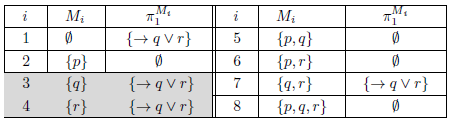
Thus, $\{q\}$
and
$\{q\}$
and $\{r\}$
are the (only) stable models of
$\{r\}$
are the (only) stable models of $\pi _1$
.
$\pi _1$
.
3. Representation of DLP by ABA
Given a disjunctive logic program $\pi$
, we show a one-to-one correspondence between the stable models of
$\pi$
, we show a one-to-one correspondence between the stable models of $\pi$
onto the stable extensions of an ABA framework that is induced from
$\pi$
onto the stable extensions of an ABA framework that is induced from $\pi$
. First, we describe the translation and then prove its correctness.
$\pi$
. First, we describe the translation and then prove its correctness.
3.1. The translation
All the ABA frameworks that are induced from disjunctive logic programs will be based on the same core logic, which is constructed by the three inference rules Modus Ponens ( $\textsf {MP}$
), Resolution (
$\textsf {MP}$
), Resolution ( $\textsf {Res}$
) and Reasoning by Cases (
$\textsf {Res}$
) and Reasoning by Cases ( $\textsf {RBC}$
):
$\textsf {RBC}$
):
 \begin{equation*} \left . \begin{array}{lll} {[\textsf {MP}]} \quad & \displaystyle \frac { \phi _1,\ldots ,\phi _n \rightarrow \psi \quad \phi _1 \quad \phi _2 \quad \cdots \quad \phi _n} {\psi } \\[12pt] {[\textsf {Res}]} \quad & \displaystyle \frac {\psi '_1 \vee \ldots \vee \psi '_m \vee \phi _1 \vee \ldots \vee \phi _n \vee \psi ''_1 \vee \ldots \vee \psi ''_k \quad \sim \!\phi _1 \quad \cdots \quad \sim \!\phi _n} {\psi '_1 \vee \ldots \vee \psi '_m \vee \ldots \vee \psi ''_1 \vee \ldots \vee \psi ''_k} \\[12pt]{[\textsf {RBC}]} \quad & \displaystyle \frac {\begin{array}{c} \phi _1 \\ \vdots \\ \psi \end{array} \quad \begin{array}{c} \phi _2 \\ \vdots \\ \psi \end{array} \quad \begin{array}{c} \ \\ \ \\ \cdots \end{array} \quad \begin{array}{c} \phi _n \\ \vdots \\ \psi \end{array} \quad \begin{array}{c} \ \\ \ \\ \phi _1 \vee \ldots \vee \phi _n \end{array}}{\psi } \end{array} \right . \end{equation*}
In what follows we denote by ${\mathfrak L} = {\langle {\mathcal L},\vdash \rangle }$
the logic based on the language
${\mathfrak L} = {\langle {\mathcal L},\vdash \rangle }$
the logic based on the language $\mathcal L$
which consists of disjunctions of atoms (
$\mathcal L$
which consists of disjunctions of atoms ( $p_1\lor \ldots \lor p_n$
for
$p_1\lor \ldots \lor p_n$
for $n \geq 1$
), negated atoms (
$n \geq 1$
), negated atoms ( $\sim \!p$
), or formulas of the forms of the program rules in Definition5. Accordingly, we shall use only fragments of the inference rules above, in which in [Res] and [RBC] the formulas
$\sim \!p$
), or formulas of the forms of the program rules in Definition5. Accordingly, we shall use only fragments of the inference rules above, in which in [Res] and [RBC] the formulas $\psi ,\psi _i$
are disjunctions of atomic formulas and
$\psi ,\psi _i$
are disjunctions of atomic formulas and $\phi _i$
are atomic formulas. In [MP],
$\phi _i$
are atomic formulas. In [MP], $\psi$
is a disjunction of atomic formulas and
$\psi$
is a disjunction of atomic formulas and $\phi _i \in \{p_i, {\sim \!p_i}\}$
are literals. Now, we denote
$\phi _i \in \{p_i, {\sim \!p_i}\}$
are literals. Now, we denote $\Delta \vdash \phi$
if
$\Delta \vdash \phi$
if $\phi$
is either in
$\phi$
is either in $\Delta$
or is derivable from
$\Delta$
or is derivable from $\Delta$
using the inference rules above. In other words,
$\Delta$
using the inference rules above. In other words, $\Delta \vdash \phi$
if
$\Delta \vdash \phi$
if $\phi \in \textsf {Cn}_{\mathfrak L}(\Delta )$
, where
$\phi \in \textsf {Cn}_{\mathfrak L}(\Delta )$
, where $\textsf {Cn}_{\mathfrak L}(\Delta )$
is the
$\textsf {Cn}_{\mathfrak L}(\Delta )$
is the $\mathfrak L$
-based transitive closure of
$\mathfrak L$
-based transitive closure of $\Delta$
(namely, the
$\Delta$
(namely, the $\subseteq$
-smallest set that contains
$\subseteq$
-smallest set that contains $\Delta$
and is closed under [MP], [Res] and [RBC]).
$\Delta$
and is closed under [MP], [Res] and [RBC]).
Note 2.
For any $\phi \in \textsf {Cn}_{\mathfrak L}(\Delta )$
, if
$\phi \in \textsf {Cn}_{\mathfrak L}(\Delta )$
, if $\phi$
is not of the form
$\phi$
is not of the form $p_1\lor \ldots \lor p_n$
then
$p_1\lor \ldots \lor p_n$
then $\phi \in \Delta$
.
$\phi \in \Delta$
.
Note 3.
Since the rule $\rightarrow \psi$
is identified with
$\rightarrow \psi$
is identified with $\textsf {T}\rightarrow \psi$
, [MP] implicitly implies Reflexivity [Ref]:
$\textsf {T}\rightarrow \psi$
, [MP] implicitly implies Reflexivity [Ref]: $\displaystyle \frac {\rightarrow \psi }{\psi }$
.
$\displaystyle \frac {\rightarrow \psi }{\psi }$
.
Definition 8.
The assumption-based argumentation framework that is induced by a disjunctive logic program $\pi$
is defined by:
$\pi$
is defined by: $\textsf {ABF}(\pi ) = {\langle {\mathfrak L},\pi ,\sim \!\mathcal{A}(\pi ),- \rangle }$
, where
$\textsf {ABF}(\pi ) = {\langle {\mathfrak L},\pi ,\sim \!\mathcal{A}(\pi ),- \rangle }$
, where $-\!\sim \!p = \{p\}$
for every
$-\!\sim \!p = \{p\}$
for every $p \in \mathcal{A}(\pi )$
.
$p \in \mathcal{A}(\pi )$
.
Example 4.
Let $\pi _2= \{{\rightarrow \! p \lor q}, \ {p \rightarrow q}, \ {q \rightarrow p}\}$
. The attack diagram of the induced assumption-based argumentation framework
$\pi _2= \{{\rightarrow \! p \lor q}, \ {p \rightarrow q}, \ {q \rightarrow p}\}$
. The attack diagram of the induced assumption-based argumentation framework $\textsf {ABF}(\pi _2)$
is shown in Figure 1
a.
$\textsf {ABF}(\pi _2)$
is shown in Figure 1
a.

In the notations of Definition 2, we have: $\Gamma = \pi _2$
and
$\Gamma = \pi _2$
and $\Lambda = \{{\sim \!p},{\sim \!q}\}$
. To see, for example, that the set
$\Lambda = \{{\sim \!p},{\sim \!q}\}$
. To see, for example, that the set $\{\sim \!p\}$
attacks itself, note that by [MP] on
$\{\sim \!p\}$
attacks itself, note that by [MP] on $\rightarrow p \vee q$
we conclude
$\rightarrow p \vee q$
we conclude $\Gamma \vdash p \vee q$
, and by [Res] it holds that
$\Gamma \vdash p \vee q$
, and by [Res] it holds that $\Gamma ,{\sim \!p} \vdash q$
. Thus, since
$\Gamma ,{\sim \!p} \vdash q$
. Thus, since $q\rightarrow p \in \Gamma$
, by [MP] we get
$q\rightarrow p \in \Gamma$
, by [MP] we get $\Gamma ,{\sim \!p} \vdash p$
, namely:
$\Gamma ,{\sim \!p} \vdash p$
, namely: $\Gamma ,{\sim \!p} \vdash {-\!\sim \!p}$
. From similar reasons
$\Gamma ,{\sim \!p} \vdash {-\!\sim \!p}$
. From similar reasons $\{{\sim \!q}\}$
attacks itself. For the attacks of
$\{{\sim \!q}\}$
attacks itself. For the attacks of $\emptyset$
on
$\emptyset$
on $\{{\sim \!p}\}$
and
$\{{\sim \!p}\}$
and $\{{\sim \!q}\}$
we also need [RBC].
$\{{\sim \!q}\}$
we also need [RBC].
Note that in this case $\{p,q\}$
is the stable model of
$\{p,q\}$
is the stable model of $\pi _2$
(Definition 7) and
$\pi _2$
(Definition 7) and $\emptyset$
is the stable extension of
$\emptyset$
is the stable extension of $\textsf {ABF}(\pi _2)$
(Definition 4
).
$\textsf {ABF}(\pi _2)$
(Definition 4
).
Example 5. Logic programs and their induced ABFs from earlier examples are the following:
-
a) The assumption-based argumentation framework considered in Example 1 is induced from the logic program
$\{{\sim \!q} \rightarrow p\}$
.Footnote
6
-
b) Figure 2 depicts (a fragment of) the graph of the assumption-based argumentation framework that is induced by the logic program
$\pi _1 = \{{\sim \!p} \rightarrow q \lor r \}$
from Example 3. This framework has two stable extensions:
$\mathcal{E}_1 = \{\sim \!p,\sim \!q,\}$
and
$\mathcal{E}_2 = \{\sim \!p,\sim \!r,\}$
.


Note 4.
The translation in Definition 8 always gives rise to a so-called flat ABF, that is, an ABF for which there is no $\Delta \subseteq \Lambda$
and
$\Delta \subseteq \Lambda$
and $\psi \in \Lambda \setminus \Delta$
such that
$\psi \in \Lambda \setminus \Delta$
such that $\Gamma ,\Delta \vdash \psi$
. This is shown in the following proposition:
$\Gamma ,\Delta \vdash \psi$
. This is shown in the following proposition:
Proposition 1.
For every disjunctive logic program $\pi$
and the induced assumption-based argumentation framework
$\pi$
and the induced assumption-based argumentation framework $\textsf {ABF}(\pi ) = {\langle \mathfrak{L}, \Gamma , \Lambda , - \rangle } = {\langle {\mathfrak L},\pi ,\sim \!\mathcal{A}(\pi ),- \rangle }$
, if
$\textsf {ABF}(\pi ) = {\langle \mathfrak{L}, \Gamma , \Lambda , - \rangle } = {\langle {\mathfrak L},\pi ,\sim \!\mathcal{A}(\pi ),- \rangle }$
, if $\Delta \subseteq \Lambda$
and
$\Delta \subseteq \Lambda$
and $\Gamma ,\Delta \vdash \psi$
, then
$\Gamma ,\Delta \vdash \psi$
, then $\psi \not \in \Lambda \setminus \Delta$
.
$\psi \not \in \Lambda \setminus \Delta$
.
Proof.
Since $\Lambda$
consists only of formulas of the form
$\Lambda$
consists only of formulas of the form $\sim \!p$
, we can restrict our attention to such formulas. Suppose that
$\sim \!p$
, we can restrict our attention to such formulas. Suppose that $\Gamma ,\Delta \vdash \psi$
for some
$\Gamma ,\Delta \vdash \psi$
for some $\Delta \subseteq \Lambda$
. Since
$\Delta \subseteq \Lambda$
. Since $\Lambda$
contains only formulas of the form
$\Lambda$
contains only formulas of the form $\sim \!p$
, and since
$\sim \!p$
, and since $\Gamma = \pi$
, then by Note 2, if
$\Gamma = \pi$
, then by Note 2, if $\Gamma ,\Delta \vdash \:\sim \!p$
, necessarily
$\Gamma ,\Delta \vdash \:\sim \!p$
, necessarily $\sim \!p\in \Delta$
.
$\sim \!p\in \Delta$
.
To relate the semantics of logic programs and their induced ABFs, we need the following notations:
Definition 9.
Let $\pi$
be a disjunctive logic program and let
$\pi$
be a disjunctive logic program and let $\Theta \subseteq \mathcal{A}(\pi )$
. We denote:
$\Theta \subseteq \mathcal{A}(\pi )$
. We denote:
-
•
${\lfloor \sim \!\Theta \rfloor } = \Theta$
(Thus
$\lfloor \cdot \rfloor$
eliminates the leading
$\sim$
from the formulas in the set) -
• If
$\Delta \subseteq \:\sim \!\mathcal{A}(\pi )$
then
$\underline {\Delta } = \mathcal{A}(\pi ) \setminus {\lfloor \Delta \rfloor }$
-
• If
$\Delta \subseteq \mathcal{A}(\pi )$
then
$\overline {\Delta } = \:\sim \!(\mathcal{A}(\pi ) \setminus \Delta$
)





In other words, $\underline {\Delta }$
(respectively,
$\underline {\Delta }$
(respectively, $\overline {\Delta }$
) takes the complementary set of
$\overline {\Delta }$
) takes the complementary set of $\Delta$
and removes (respectively, adds) the negation-as-failure operator from (respectively, to) the prefix of its formulas.
$\Delta$
and removes (respectively, adds) the negation-as-failure operator from (respectively, to) the prefix of its formulas.
Example 6.
Consider again the program $\pi _2$
of Example 4, and let
$\pi _2$
of Example 4, and let $\Delta = {\sim \!\mathcal{A}}(\pi _2) = \{{\sim \!p},{\sim \!q\}}$
. Then
$\Delta = {\sim \!\mathcal{A}}(\pi _2) = \{{\sim \!p},{\sim \!q\}}$
. Then $\underline {\Delta } = \emptyset$
and
$\underline {\Delta } = \emptyset$
and $\overline {\emptyset } = \Delta$
.
$\overline {\emptyset } = \Delta$
.
The semantic correspondence between a logic program and the induced ABF is obtained by the following results:
-
1. If
$\Delta$
is a stable extension of
$\textsf {ABF}(\pi )$
, then
$\underline {\Delta }$
is a stable model of
$\pi$
, and -
2. If
$\Delta$
is a stable model of
$\pi$
, then
$\overline {\Delta }$
is a stable extension of
$\textsf {ABF}(\pi )$
.


Before showing these results, we first provide some examples and notes concerning related results.
Example 7. Let’s revisit our previous examples and see that the correspondence between the stable models of the logic programs and the stable extensions of the induced ABFs, indicated above, indeed holds in these examples:
-
a) The stable models
$M_3$
and
$M_4$
of the logic program
$\pi _1$
in Example 3 correspond to the stable extensions
$\mathcal{E}_1$
and
$\mathcal{E}_2$
of the assumption-based framework
$\textsf {ABF}(\pi _1)$
that is induced from
$\pi _1$
according to Definition 8, which is considered in Example 5
(b) and Figure 2. Indeed,
$M_3 = \underline {\mathcal{E}_2}$
and
$M_4 = \underline {\mathcal{E}_1}$
(Alternatively,
$\mathcal{E}_1 = \overline {M_4}$
and
$\mathcal{E}_2 = \overline {M_3}$
).
-
b) As shown in Example 4, the correspondence between the stable model of
$\pi _2$
and the stable extension of the framework
$\textsf { ABF}(\pi _2)$
that is induced from
$\pi _2$
(see Figure 1
a), is preserved.


As indicated before this example, and as we show in Section 3.2 (Propositions 2 and 3 ), the two items above are not a coincidence.
Example 8.
As noted in the introduction, Caminada and Schulz (Reference Caminada and Schulz2017, Reference Caminada and Schulz2018) consider the correspondence between ABA frameworks and normal logic programs. In our notations, the ABF that they associate with a normal logic program $\pi$
is
$\pi$
is $\textsf {ABF}_{\textsf {Norm}}(\pi ) = {\langle {\mathfrak L}_{\textsf {MP}},\pi ,{\sim \!\mathcal{A}(\pi )},- \rangle }$
constructed as in Definition 8, except that
$\textsf {ABF}_{\textsf {Norm}}(\pi ) = {\langle {\mathfrak L}_{\textsf {MP}},\pi ,{\sim \!\mathcal{A}(\pi )},- \rangle }$
constructed as in Definition 8, except that ${\mathfrak L}_{\textsf {MP}}$
is defined by Modus Ponens only.
${\mathfrak L}_{\textsf {MP}}$
is defined by Modus Ponens only.
-
a) To see that
$\textsf {ABF}_{\textsf {Norm}}$
is not adequate for disjunctive logic programs, consider the program
$\pi _3=\{{\rightarrow p \lor q}\}$
. This program has two stable models:
$\{p\}$
and
$\{q\}$
. However, the only stable extension of
$\textsf { ABF}_{\textsf {Norm}}(\pi _3)$
is
$\{\sim \!p, \sim \!q\}$
. We can enforce
$\{\sim \!p\}$
and
$\{\sim \!q\}$
being stable models by requiring that
$\pi _3\cup \{\sim \!p\}\vdash q$
and
$\pi _3\cup \{\sim \!q\}\vdash p$
. For this, we need the resolution rule
$\textsf {[Res]}$
. -
b) Adding only
$\textsf {[Res]}$
to
${\mathfrak L}_{\textsf {MP}}$
(i.e, without
$\textsf {[RBC]}$
) as the inference rules for the logic is yet not sufficient. To see this, consider again the program
$\pi _2$
from Example 4. Recall that
$\{p,q\}$
is the sole stable model of
$\pi _2$
. The attack diagram of the ABF based on [MP] and [Res] is shown in Figure 1
b, thus there is no stable extension in this case (However, if
$\textsf {[RBC]}$
is also available, we get the ABF depicted in Figure 1
a, which, as indicated in Example 7
b, is a faithful translation of
$\pi _2$
).


3.2. Proof of correctness
The correctness of the translation follows from Propositions2 and 3 below. First, we need some definitions and lemmas. In what follows $\mathfrak L$
denotes the logic defined in Section 3.1, and
$\mathfrak L$
denotes the logic defined in Section 3.1, and $\pi$
is an arbitrary disjunctive logic program.
$\pi$
is an arbitrary disjunctive logic program.
We start with the following soundness and completeness result.
Lemma 1.
Let $\Delta$
be a set of
$\Delta$
be a set of $\mathcal L$
-formulas of the form
$\mathcal L$
-formulas of the form $\sim \!p$
or
$\sim \!p$
or $q_1,\ldots ,q_m,{\sim \!r_1},\ldots ,{\sim \!r_k} \rightarrow p_1\lor \ldots \lor p_n$
. Then:
$q_1,\ldots ,q_m,{\sim \!r_1},\ldots ,{\sim \!r_k} \rightarrow p_1\lor \ldots \lor p_n$
. Then:
-
a) If
$\psi \in \textsf {Cn}_{\mathfrak L}(\Delta )$
then
$M\models \psi$
for every
$M$
such that
$M \models \Delta$
. -
b) If
$\psi =r_1\lor \ldots \lor r_m$
and
$M\models \psi$
for every
$M$
such that
$M \models \Delta$
, then
$\psi \in \textsf {Cn}_{\mathfrak L}(\Delta )$
.


Note 5.
Part (b) of Lemma 1 does not hold for any formula $\psi$
, but only for a disjunction of atoms. To see this, let
$\psi$
, but only for a disjunction of atoms. To see this, let $\Delta =\{{\sim \!s}, \:{p\rightarrow s}\}$
. The only
$\Delta =\{{\sim \!s}, \:{p\rightarrow s}\}$
. The only $M \subseteq \{p,s\}$
such that
$M \subseteq \{p,s\}$
such that $M \models \Delta$
is
$M \models \Delta$
is $M=\emptyset$
. Thus, for every
$M=\emptyset$
. Thus, for every $M$
such that
$M$
such that $M \models \Delta$
it holds that
$M \models \Delta$
it holds that $M \models \:\sim \!p$
. However,
$M \models \:\sim \!p$
. However, $\sim \!p$
cannot be derived from
$\sim \!p$
cannot be derived from $\Delta$
using
$\Delta$
using $\textsf {[MP]}$
,
$\textsf {[MP]}$
, $\textsf {[Res]}$
and
$\textsf {[Res]}$
and $\textsf {[RBC]}$
.
$\textsf {[RBC]}$
.
Proof.
We prove Part (a) of the lemma by induction on the number of applications of the inference rules in the derivation of $\psi \in \textsf {Cn}_{\mathfrak L}(\Delta )$
.
$\psi \in \textsf {Cn}_{\mathfrak L}(\Delta )$
.
For the base step, no inference rule is applied in the derivation of $\psi$
, thus
$\psi$
, thus $\psi \in \Delta$
. Since
$\psi \in \Delta$
. Since $M \models \Delta$
, we have that
$M \models \Delta$
, we have that $M \models \psi$
.
$M \models \psi$
.
For the induction step, we consider three cases, each one corresponds to an application of a different inference rule in the last step of the derivation of $\psi$
:
$\psi$
:
-
1. Suppose that the last step in the derivation of
$\psi$
is an application of Resolution. Then
$\psi = p'_1 \vee \ldots \vee p'_m \vee \ldots \vee p''_1 \vee \ldots \vee p''_k$
is obtained by [Res] from
$p'_1 \vee \ldots \vee p'_m \vee q_1 \vee \ldots \vee q_n \vee p''_1 \vee \ldots \vee p''_k$
and
$\sim \!q_i$
$(i=1,\ldots ,n)$
. Suppose that
$M \models \Delta$
. Since
${\sim \!q_i} \in \textsf {Cn}_{\mathfrak L}(\Delta )$
iff
${\sim \!q_i} \in \Delta$
and since
$M\models \Delta$
, we have
$M \models {\sim \!q_i}$
$(i=1,\ldots ,n)$
, thus
$M \not \models q_i$
$(i=1,\ldots ,n)$
. By the induction hypothesis,
$M \models p'_1 \vee \ldots \vee p'_m \vee q_1 \vee \ldots \vee q_n \vee p''_1 \vee \ldots \vee p''_k$
. By Definition6, then,
$M \models p'_i$
for some
$1 \leq i \leq m$
, or
$M \models p''_j$
for some
$1 \leq j \leq k$
. By Definition6 again,
$M \models \psi$
. -
2. Suppose that the last step in the derivation of
$\psi$
is an application of Reasoning by Cases, and let
$M \models \Delta$
. By induction hypothesis,
$M \models p_1 \vee \ldots \vee p_n$
, and
$M \models \psi$
in case that
$M \models p_j$
for some
$1 \leq j \leq n$
. But by Definition6 the former assumption means that there is some
$1 \leq j \leq n$
for which
$M \models p_j$
, therefore
$M \models \psi$
. -
3. Suppose that the last step in the derivation of
$\psi$
is an application of Modus Ponens, and let
$M \models \Delta$
. By induction hypothesis
$M \models l_i$
, where
$l_i \in \{p_i,{\sim \!p_i}\}$
for
$i =1,\ldots ,n$
. Thus, by Definition6,
$M \models l_1, \ldots , l_n$
. On the other hand, by induction hypothesis again,
$M \models l_1, \ldots , l_n \rightarrow \psi$
. By Definition6,
$M \models \psi$
.





We now turn to Part (b) of the lemma. Suppose that $M\models \psi$
for every
$M\models \psi$
for every $M$
such that
$M$
such that $M \models \Delta$
, yet
$M \models \Delta$
, yet $\psi \not \in \textsf {Cn}_{\mathfrak L}(\Delta )$
(where
$\psi \not \in \textsf {Cn}_{\mathfrak L}(\Delta )$
(where $\psi =r_1\lor \ldots \lor r_m$
for some
$\psi =r_1\lor \ldots \lor r_m$
for some $m\geqslant 1$
). We show that this leads to a contradiction by constructing an
$m\geqslant 1$
). We show that this leads to a contradiction by constructing an $M'$
for which
$M'$
for which $M' \models \Delta$
but
$M' \models \Delta$
but $M' \not \models \psi$
. For this, we consider the following set of the minimal disjunctions of a set of formulas
$M' \not \models \psi$
. For this, we consider the following set of the minimal disjunctions of a set of formulas $\mathcal{S}$
:
$\mathcal{S}$
:
 \begin{equation*} \textsf {MD}(\mathcal{S})=\{ q_1\lor \ldots \lor q_n \in \mathcal{S} \mid \not \exists \{i_1,\ldots ,i_m\}\subsetneq \{1,\ldots ,n\} \text{ s.t. } q_{i_1}\lor \ldots \lor q_{i_m} \in \mathcal{S} \}. \end{equation*}
We first show that if $q_1\lor \ldots \lor q_n \in \textsf {MD}(\textsf {Cn}_{\mathfrak L}(\Delta ))$
then there is an
$q_1\lor \ldots \lor q_n \in \textsf {MD}(\textsf {Cn}_{\mathfrak L}(\Delta ))$
then there is an $1\leqslant i\leqslant n$
such that
$1\leqslant i\leqslant n$
such that $q_i \not \in \{r_1,\ldots ,r_m\}$
and
$q_i \not \in \{r_1,\ldots ,r_m\}$
and ${\sim \!q_i} \not \in \Delta$
. Indeed, suppose first for a contradiction that
${\sim \!q_i} \not \in \Delta$
. Indeed, suppose first for a contradiction that $q_1\lor \ldots \lor q_n \in \textsf {MD}(\textsf {Cn}_{\mathfrak L}(\Delta ))$
, yet for every
$q_1\lor \ldots \lor q_n \in \textsf {MD}(\textsf {Cn}_{\mathfrak L}(\Delta ))$
, yet for every $1\lt i\leqslant n$
either
$1\lt i\leqslant n$
either $q_i\in \{r_1,\ldots ,r_m\}$
or
$q_i\in \{r_1,\ldots ,r_m\}$
or ${\sim \!q_i} \in \Delta$
. In that case, by
${\sim \!q_i} \in \Delta$
. In that case, by $\textsf {[Res]}$
,
$\textsf {[Res]}$
, $r_1\lor \ldots \lor r_m \in \textsf {Cn}_{\mathfrak L}(\Delta )$
, contradicting the original supposition that
$r_1\lor \ldots \lor r_m \in \textsf {Cn}_{\mathfrak L}(\Delta )$
, contradicting the original supposition that $r_1\lor \ldots \lor r_m \not \in \textsf {Cn}_{\mathfrak L}(\Delta )$
. Suppose now, again towards a contradiction, that
$r_1\lor \ldots \lor r_m \not \in \textsf {Cn}_{\mathfrak L}(\Delta )$
. Suppose now, again towards a contradiction, that $q_1\lor \ldots \lor q_n \in \textsf {MD}(\textsf {Cn}_{\mathfrak L}(\Delta ))$
, yet for every
$q_1\lor \ldots \lor q_n \in \textsf {MD}(\textsf {Cn}_{\mathfrak L}(\Delta ))$
, yet for every $1\leqslant i\leqslant n$
,
$1\leqslant i\leqslant n$
, ${\sim \!q_i} \in \Delta$
. In that case, by
${\sim \!q_i} \in \Delta$
. In that case, by $\textsf {[Res]}$
again,
$\textsf {[Res]}$
again, $q_i\in \textsf {Cn}_{\mathfrak L}(\Delta )$
(for every
$q_i\in \textsf {Cn}_{\mathfrak L}(\Delta )$
(for every $i$
), but this, together with the assumption the
$i$
), but this, together with the assumption the $\sim \!q_i \in \Delta$
(for every
$\sim \!q_i \in \Delta$
(for every $i$
), contradicts the assumption that there is an
$i$
), contradicts the assumption that there is an $M$
such that
$M$
such that $M \models \Delta$
.
$M \models \Delta$
.
We thus showed that in any case, if $q_1\lor \ldots \lor q_n \in \textsf {MD}(\textsf {Cn}_{\mathfrak L}(\Delta ))$
, then there is an
$q_1\lor \ldots \lor q_n \in \textsf {MD}(\textsf {Cn}_{\mathfrak L}(\Delta ))$
, then there is an $1\leqslant i\leqslant n$
such that
$1\leqslant i\leqslant n$
such that $q_i \not \in \{r_1,\ldots ,r_m\}$
and
$q_i \not \in \{r_1,\ldots ,r_m\}$
and $\sim \!q_i \not \in \Delta$
.
$\sim \!q_i \not \in \Delta$
.
We now construct the model $M'$
such that
$M'$
such that $M'\models \Delta$
and
$M'\models \Delta$
and $M'\not \models r_1\lor \ldots \lor r_m$
: Let
$M'\not \models r_1\lor \ldots \lor r_m$
: Let $M'$
contain exactly one
$M'$
contain exactly one $q_i$
with
$q_i$
with $1\leqslant i\leqslant n$
and
$1\leqslant i\leqslant n$
and $q_i\not \in \{r_1,\ldots ,r_m\}$
and
$q_i\not \in \{r_1,\ldots ,r_m\}$
and ${\sim \!q_i} \not \in \Delta$
for every
${\sim \!q_i} \not \in \Delta$
for every $q_1\lor \ldots \lor q_n \in \textsf {MD}(\textsf {Cn}_{\mathfrak{L}}(\Delta ))$
. (If there is more than one such
$q_1\lor \ldots \lor q_n \in \textsf {MD}(\textsf {Cn}_{\mathfrak{L}}(\Delta ))$
. (If there is more than one such $i$
, take
$i$
, take $i$
which is minimal among
$i$
which is minimal among $1\leqslant i\leqslant n$
.) As shown above, there is at least one such
$1\leqslant i\leqslant n$
.) As shown above, there is at least one such $i$
for every formula
$i$
for every formula $q_1\lor \ldots \lor q_n\in \textsf {MD}(\textsf {Cn}_{\mathfrak{L}}(\Delta ))$
.
$q_1\lor \ldots \lor q_n\in \textsf {MD}(\textsf {Cn}_{\mathfrak{L}}(\Delta ))$
.
We now show that (1) $M'\models \Delta$
and (2)
$M'\models \Delta$
and (2) $M'\not \models r_1\lor \ldots \lor r_m$
.
$M'\not \models r_1\lor \ldots \lor r_m$
.
Item (1): Suppose that $\phi \in \textsf {Cn}_{\mathfrak{L}}(\Delta )$
. We have to consider two possibilities:
$\phi \in \textsf {Cn}_{\mathfrak{L}}(\Delta )$
. We have to consider two possibilities: $\phi = {\sim \! s}$
or
$\phi = {\sim \! s}$
or $\phi =q_1\lor \ldots \lor q_n$
. In the first case, by construction,
$\phi =q_1\lor \ldots \lor q_n$
. In the first case, by construction, $s\not \in M'$
and thus
$s\not \in M'$
and thus $M'\models \:\sim \!s$
. In the second case, there is a
$M'\models \:\sim \!s$
. In the second case, there is a $q_{i_1}\lor \ldots \lor q_{i_m}\in \textsf {MD}(\textsf {Cn}_{\mathfrak L}(\Delta ))$
such that
$q_{i_1}\lor \ldots \lor q_{i_m}\in \textsf {MD}(\textsf {Cn}_{\mathfrak L}(\Delta ))$
such that $\{i_1,\ldots ,i_m\}\subseteq \{1,\ldots ,n\}$
. By construction, there is a
$\{i_1,\ldots ,i_m\}\subseteq \{1,\ldots ,n\}$
. By construction, there is a $1\leqslant j\leqslant m$
such that
$1\leqslant j\leqslant m$
such that $q_{i_j}\in M'$
. Thus,
$q_{i_j}\in M'$
. Thus, $M' \models q_1\lor \ldots \lor q_n$
.
$M' \models q_1\lor \ldots \lor q_n$
.
Item (2): By construction $r_i\not \in M'$ $(i = 1,\ldots ,m)$
, thus
$(i = 1,\ldots ,m)$
, thus $M'\not \models r_1\lor \ldots \lor r_m$
.
$M'\not \models r_1\lor \ldots \lor r_m$
.
Lemma 2.
Let $\pi$
be a logic program. For every
$\pi$
be a logic program. For every $M,N \subseteq \mathcal{A}(\pi )$
, if
$M,N \subseteq \mathcal{A}(\pi )$
, if $N\setminus M \neq \emptyset$
then
$N\setminus M \neq \emptyset$
then $N\not \models \textsf {Cn}_{\mathfrak L}(\overline {M}\cup \pi )$
.
$N\not \models \textsf {Cn}_{\mathfrak L}(\overline {M}\cup \pi )$
.
Proof.
Suppose that $N\setminus M\neq \emptyset$
and let
$N\setminus M\neq \emptyset$
and let $p \in N\setminus M$
, Then
$p \in N\setminus M$
, Then ${\sim \!p} \in \overline {M}$
and thus
${\sim \!p} \in \overline {M}$
and thus ${\sim \!p} \in \textsf {Cn}_{\mathfrak L}(\overline {M}\cup \pi )$
. Since
${\sim \!p} \in \textsf {Cn}_{\mathfrak L}(\overline {M}\cup \pi )$
. Since $N \models p$
,
$N \models p$
, $N \not \models {\sim \!p}$
, and so
$N \not \models {\sim \!p}$
, and so $N\not \models \textsf {Cn}_{\mathfrak L}(\overline {M}\cup \pi )$
.
$N\not \models \textsf {Cn}_{\mathfrak L}(\overline {M}\cup \pi )$
.
Lemma 3.
Given a logic program $\pi$
, if
$\pi$
, if $M$
is a minimal model of a logic program
$M$
is a minimal model of a logic program $\pi '\subseteq \pi ^M$
, then for every
$\pi '\subseteq \pi ^M$
, then for every $N \subsetneq M$
,
$N \subsetneq M$
, $N\not \models \textsf {Cn}_{\mathfrak L}(\overline {M}\cup \pi )$
.
$N\not \models \textsf {Cn}_{\mathfrak L}(\overline {M}\cup \pi )$
.
Proof.
Suppose that $M$
is a minimal model of a logic program
$M$
is a minimal model of a logic program $\pi '\subseteq \pi ^M$
, and suppose towards a contradiction that there is some
$\pi '\subseteq \pi ^M$
, and suppose towards a contradiction that there is some $N \subsetneq M$
such that
$N \subsetneq M$
such that $N \models \textsf {Cn}_{\mathfrak L}(\overline {M}\cup \pi )$
. We show that
$N \models \textsf {Cn}_{\mathfrak L}(\overline {M}\cup \pi )$
. We show that $N$
is a model of
$N$
is a model of $\pi '$
by showing that
$\pi '$
by showing that $N$
is a model of
$N$
is a model of $\pi ^{M}$
. Indeed, let
$\pi ^{M}$
. Indeed, let $p_1,\ldots ,p_n,{\sim \!q_1},\ldots ,{\sim \!q_m} \rightarrow r_1 \vee \ldots \vee r_k\in \pi$
such that
$p_1,\ldots ,p_n,{\sim \!q_1},\ldots ,{\sim \!q_m} \rightarrow r_1 \vee \ldots \vee r_k\in \pi$
such that $q_1,\ldots ,q_m \not \in M$
. Then
$q_1,\ldots ,q_m \not \in M$
. Then ${\sim \!q_i} \in \overline {M}$
for every
${\sim \!q_i} \in \overline {M}$
for every $i=1,\ldots ,m$
. Suppose furthermore that
$i=1,\ldots ,m$
. Suppose furthermore that $ p_1,\ldots ,p_n \in N$
. Then (since
$ p_1,\ldots ,p_n \in N$
. Then (since $N\subset M$
), also
$N\subset M$
), also $p_1,\ldots ,p_n \in M$
and thus
$p_1,\ldots ,p_n \in M$
and thus $M \vdash r_1\lor \ldots \lor r_k$
, which implies that
$M \vdash r_1\lor \ldots \lor r_k$
, which implies that $r_1\lor \ldots \lor r_k \in \textsf {Cn}_{\mathfrak L}(\overline {M}\cup \pi )$
. It follows that
$r_1\lor \ldots \lor r_k \in \textsf {Cn}_{\mathfrak L}(\overline {M}\cup \pi )$
. It follows that $r_i \in N$
for some
$r_i \in N$
for some $i=1\ldots ,k$
(as we assumed that
$i=1\ldots ,k$
(as we assumed that $N \models \textsf {Cn}_{\mathfrak L}(\overline {M}\cup \pi )$
), and so
$N \models \textsf {Cn}_{\mathfrak L}(\overline {M}\cup \pi )$
), and so $N$
is a model of the rule
$N$
is a model of the rule $p_1,\ldots ,p_n \rightarrow r_1 \vee \ldots \vee r_k \in \pi ^M$
. This means that
$p_1,\ldots ,p_n \rightarrow r_1 \vee \ldots \vee r_k \in \pi ^M$
. This means that $N$
is a model of
$N$
is a model of $\pi '$
, which contradicts the minimality of
$\pi '$
, which contradicts the minimality of $M$
.
$M$
.
Lemma 4.
Let $M$
be a stable model of
$M$
be a stable model of $\pi$
. Then
$\pi$
. Then $M = \min _\subseteq \{ N \subseteq \mathcal{A}(\pi ) \mid N \models \textsf {Cn}_{\mathfrak L}(\pi \cup \overline {M}) \}$
.
$M = \min _\subseteq \{ N \subseteq \mathcal{A}(\pi ) \mid N \models \textsf {Cn}_{\mathfrak L}(\pi \cup \overline {M}) \}$
.
Proof.
Let $M$
be a stable model of
$M$
be a stable model of $\pi$
. We first show that
$\pi$
. We first show that $M\models \textsf {Cn}_{\mathfrak L}(\overline {M}\cup \pi )$
. Let
$M\models \textsf {Cn}_{\mathfrak L}(\overline {M}\cup \pi )$
. Let $\psi \in \textsf {Cn}_{\mathfrak L}(\overline {M}\cup \pi )$
. Then it has an
$\psi \in \textsf {Cn}_{\mathfrak L}(\overline {M}\cup \pi )$
. Then it has an $\mathfrak L$
-derivation
$\mathfrak L$
-derivation $\textsf {D}_{\mathfrak L}(\psi )$
.Footnote
7
We show by induction on the size of
$\textsf {D}_{\mathfrak L}(\psi )$
.Footnote
7
We show by induction on the size of $\textsf {D}_{\mathfrak L}(\psi )$
that
$\textsf {D}_{\mathfrak L}(\psi )$
that $M \models \psi$
.
$M \models \psi$
.
For the base step, no inference rule is applied in $\textsf {D}_{\mathfrak L}(\psi )$
, thus
$\textsf {D}_{\mathfrak L}(\psi )$
, thus $\psi = {\sim \!\phi } \in \overline {M}$
. Since this means that
$\psi = {\sim \!\phi } \in \overline {M}$
. Since this means that $\phi \not \in M$
, we have that
$\phi \not \in M$
, we have that $M \models \psi$
.
$M \models \psi$
.
For the induction step, we consider three cases, each one corresponds to an application of a different inference rule in the last step of $\textsf {D}_{\mathfrak L}(\psi )$
:
$\textsf {D}_{\mathfrak L}(\psi )$
:
-
1. Suppose that the last step in
$\textsf {D}_{\mathfrak L}(\psi )$
is an application of Resolution. Then
$\psi = p'_1 \vee \ldots \vee p'_m \vee \ldots \vee p''_1 \vee \ldots \vee p''_k$
is obtained by [Res] from
$p'_1 \vee \ldots \vee p'_m \vee q_1 \vee \ldots \vee q_n \vee p''_1 \vee \ldots \vee p''_k$
and
$\sim \!q_i$
$(i=1,\ldots ,n)$
. Since
${\sim \!q_i} \in \textsf {Cn}_{\mathfrak L}(\overline {M}\cup \pi )$
means that
${\sim \!q_i} \in \overline {M}$
, we have
$q_i\not \in M$
for every
$i= 1,\ldots ,n$
. By the induction hypothesis,
$M \models p'_1 \vee \ldots \vee p'_m \vee q_1 \vee \ldots \vee q_n \vee p''_1 \vee \ldots \vee p''_k$
. Thus, by Definition6,
$M \models p'_i$
for some
$1 \leq i \leq m$
, or
$M \models p''_j$
for some
$1 \leq j \leq k$
. By Definition6 again,
$M \models \psi$
. -
2. Suppose that the last step in
$\textsf {D}_{\mathfrak L}(\psi )$
is an application of Reasoning by Cases. By induction hypothesis we know that
$M \models p_1 \vee \ldots \vee p_n$
, and that
$M \models \psi$
in case that
$M \models p_j$
for some
$1 \leq j \leq n$
. But by Definition6 the former assumption means that there is some
$1 \leq j \leq n$
for which
$M \models p_j$
, therefore
$M \models \psi$
. -
3. Suppose that the last step in
$\textsf {D}_{\mathfrak L}(\psi )$
is an application of Modus Ponens on
$p_1,\ldots ,p_n,{\sim \!q_1},\ldots ,{\sim \!q_m} \rightarrow r_1\lor \ldots \lor r_k \in \pi$
. By induction hypothesis
$M \models p_i$
, for every
$1\leqslant i\leqslant n$
. Also, for every
$1\leqslant i\leqslant m$
,
${\sim \!q_i} \in \textsf {Cn}_{\mathfrak L}(\overline {M}\cup \pi )$
implies
$q_i\not \in M$
. Thus,
$p_1,\ldots ,p_n\rightarrow r_1\lor \ldots \lor r_{k} \in \pi ^M$
. Since
$M$
is a model of
$\pi ^M$
,
$M\models r_i$
for some
$1\leqslant i\leqslant k$
. Thus,
$M\models r_1\lor \ldots \lor r_k$
.








We have shown that $M\models \textsf {Cn}_{\mathfrak L}(\overline {M}\cup \pi )$
. By Lemma2, for no
$M\models \textsf {Cn}_{\mathfrak L}(\overline {M}\cup \pi )$
. By Lemma2, for no $N\subseteq \mathcal{A}(\pi )$
such that
$N\subseteq \mathcal{A}(\pi )$
such that $N\setminus M\neq \emptyset$
it holds that
$N\setminus M\neq \emptyset$
it holds that $N\models \textsf {Cn}_{\mathfrak L}(\overline {M}\cup \pi )$
. Thus, if there is some
$N\models \textsf {Cn}_{\mathfrak L}(\overline {M}\cup \pi )$
. Thus, if there is some $N\subseteq \mathcal{A}(\pi )$
such that
$N\subseteq \mathcal{A}(\pi )$
such that $N\models Cn_{\mathfrak{L}}(\overline {M}\cup \pi )$
, then
$N\models Cn_{\mathfrak{L}}(\overline {M}\cup \pi )$
, then $N\subseteq M$
. But if
$N\subseteq M$
. But if $N\subset M$
, by Lemma3 we have that
$N\subset M$
, by Lemma3 we have that $N\not \models \textsf {Cn}_{\mathfrak L}(\overline {M}\cup \pi )$
. Thus,
$N\not \models \textsf {Cn}_{\mathfrak L}(\overline {M}\cup \pi )$
. Thus, $M$
is the unique subset of
$M$
is the unique subset of $\mathcal{A}(\pi )$
which is a model of
$\mathcal{A}(\pi )$
which is a model of $ \textsf {Cn}_{\mathfrak L}(\overline {M}\cup \pi )$
.
$ \textsf {Cn}_{\mathfrak L}(\overline {M}\cup \pi )$
.
Corollary 1.
Let $M$
be a stable model of
$M$
be a stable model of $\pi$
. Then
$\pi$
. Then $p \in M$
iff
$p \in M$
iff $p \in \textsf {Cn}_{\mathfrak L}(\overline {M}\cup \pi )$
.
$p \in \textsf {Cn}_{\mathfrak L}(\overline {M}\cup \pi )$
.
Proof.
Suppose first that $p\in M$
. Thus
$p\in M$
. Thus $M\models p$
. Since by Lemma4
$M\models p$
. Since by Lemma4 $M$
is the unique model of
$M$
is the unique model of $\textsf {Cn}_{\mathfrak L}(\overline {M}\cup \pi )$
, by Lemma1 it holds that
$\textsf {Cn}_{\mathfrak L}(\overline {M}\cup \pi )$
, by Lemma1 it holds that $M\models p$
implies that
$M\models p$
implies that $p \in \textsf {Cn}_{\mathfrak L}(\overline {M}\cup \pi )$
. For the converse, suppose that
$p \in \textsf {Cn}_{\mathfrak L}(\overline {M}\cup \pi )$
. For the converse, suppose that $p \in \textsf {Cn}_{\mathfrak L}(\overline {M}\cup \pi )$
. By Lemma4,
$p \in \textsf {Cn}_{\mathfrak L}(\overline {M}\cup \pi )$
. By Lemma4, $M\models \textsf {Cn}_{\mathfrak L}(\overline {M}\cup \pi )$
, and so
$M\models \textsf {Cn}_{\mathfrak L}(\overline {M}\cup \pi )$
, and so $M\models p$
.
$M\models p$
.
Example 9.
Corollary 1 actually says that any atom $p$
that is verified by a 2-valued sable model
$p$
that is verified by a 2-valued sable model $M$
of
$M$
of $\pi$
, can be derived by assuming that all the assumptions not in
$\pi$
, can be derived by assuming that all the assumptions not in $M$
are false (and using the derivation rules together with the rules of the program). To illustrate this, take for example the program
$M$
are false (and using the derivation rules together with the rules of the program). To illustrate this, take for example the program $\{{\sim \!q}\rightarrow p_1\lor p_2\}$
. This program has two stable models:
$\{{\sim \!q}\rightarrow p_1\lor p_2\}$
. This program has two stable models: $\{p_1\}$
and
$\{p_1\}$
and $\{p_2\}$
. The result above then says that
$\{p_2\}$
. The result above then says that $p_1$
belongs to
$p_1$
belongs to $\textsf {Cn}_{\mathfrak L}(\overline {\{p_1\}}\cup \pi )=\textsf {Cn}_{\mathfrak L}(\{{\sim \!p_2},{\sim \!q}\}\cup \pi )$
. Indeed, it holds that
$\textsf {Cn}_{\mathfrak L}(\overline {\{p_1\}}\cup \pi )=\textsf {Cn}_{\mathfrak L}(\{{\sim \!p_2},{\sim \!q}\}\cup \pi )$
. Indeed, it holds that $p_1$
is derivable from
$p_1$
is derivable from $\{{\sim \!p_2},{\sim \!q}\}\cup \pi$
using the rules
$\{{\sim \!p_2},{\sim \!q}\}\cup \pi$
using the rules $\{{\sim \!q}\}\cup \{{\sim \!q}\rightarrow p_1\lor p_2\} \vdash p_1\lor p_2$
and
$\{{\sim \!q}\}\cup \{{\sim \!q}\rightarrow p_1\lor p_2\} \vdash p_1\lor p_2$
and $\{p_1\lor p_2,{\sim \!p_2}\}\vdash p_1$
.
$\{p_1\lor p_2,{\sim \!p_2}\}\vdash p_1$
.
Lemma 5.
Let $\pi$
be a disjunctive logic program,
$\pi$
be a disjunctive logic program, $\Delta \subseteq {\sim \!\mathcal{A}}(\pi )$
, and
$\Delta \subseteq {\sim \!\mathcal{A}}(\pi )$
, and $r_1\lor \ldots \lor r_k \in \textsf { Cn}_{\mathfrak L}(\pi \cup \Delta )$
. If
$r_1\lor \ldots \lor r_k \in \textsf { Cn}_{\mathfrak L}(\pi \cup \Delta )$
. If $M$
is a model of
$M$
is a model of $\pi ^{{\lfloor \Delta \rfloor }}$
and
$\pi ^{{\lfloor \Delta \rfloor }}$
and $M \subseteq {\lfloor \Delta \rfloor }$
, then
$M \subseteq {\lfloor \Delta \rfloor }$
, then $r_i\in M$
for some
$r_i\in M$
for some $1\leqslant i\leqslant k$
.
$1\leqslant i\leqslant k$
.
Proof.
We show by induction on the number of steps used in deriving $r_1\lor \ldots \lor r_k$
from
$r_1\lor \ldots \lor r_k$
from $\pi \cup \Delta$
, that
$\pi \cup \Delta$
, that $r_1\lor \ldots \lor r_k \in \textsf {Cn}_{\mathfrak L}(\pi \cup \Delta )$
implies that
$r_1\lor \ldots \lor r_k \in \textsf {Cn}_{\mathfrak L}(\pi \cup \Delta )$
implies that $ M \models r_1\lor \ldots \lor r_k$
. This means that
$ M \models r_1\lor \ldots \lor r_k$
. This means that $M \models r_i$
for some
$M \models r_i$
for some $1\leqslant i\leqslant k$
, and so
$1\leqslant i\leqslant k$
, and so $r_i\in M$
for that
$r_i\in M$
for that $i$
.
$i$
.
For the base step, since every element of $\Delta$
is of the form
$\Delta$
is of the form $\sim \!p$
, we have that
$\sim \!p$
, we have that $r_1\lor \ldots \lor r_k \not \in \Delta$
. Thus,
$r_1\lor \ldots \lor r_k \not \in \Delta$
. Thus, $r_1\lor \ldots \lor r_k$
is obtained from some rule
$r_1\lor \ldots \lor r_k$
is obtained from some rule ${\sim \!q_1},\ldots ,{\sim \!q_m} \rightarrow r_1\lor \ldots \lor r_k \in \pi$
, where
${\sim \!q_1},\ldots ,{\sim \!q_m} \rightarrow r_1\lor \ldots \lor r_k \in \pi$
, where ${\sim \!q_1},\ldots ,{\sim \!q_m} \in \Delta$
. In that case, since (1)
${\sim \!q_1},\ldots ,{\sim \!q_m} \in \Delta$
. In that case, since (1) $M \subseteq \underline {\Delta }$
; (2)
$M \subseteq \underline {\Delta }$
; (2) $M$
is a model of
$M$
is a model of $\pi ^{{\lfloor \Delta \rfloor }}$
; and (3)
$\pi ^{{\lfloor \Delta \rfloor }}$
; and (3) $\rightarrow r_1\lor \ldots \lor r_k \in \pi ^{{\lfloor \Delta \rfloor }}$
, by Definition7 there is a
$\rightarrow r_1\lor \ldots \lor r_k \in \pi ^{{\lfloor \Delta \rfloor }}$
, by Definition7 there is a $1\leqslant i\leqslant k$
such that
$1\leqslant i\leqslant k$
such that $r_i\in M$
.
$r_i\in M$
.
For the induction step, suppose that the claim holds for every $r_1\lor \ldots \lor r_k$
that is derived from
$r_1\lor \ldots \lor r_k$
that is derived from $\Delta$
using
$\Delta$
using $n$
or less derivation steps. We consider three cases:
$n$
or less derivation steps. We consider three cases:
-
•
$r_1\lor \ldots \lor r_k$
is obtained by applying [MP] to the rule
$p_1,\ldots ,p_n,{\sim \!q_1},\ldots ,{\sim \!q_m} \rightarrow r_1\lor \ldots \lor r_k$
. In this case,
${\sim \!q_1},\ldots ,{\sim \!q_m}\in \Delta$
and so
$q_i \not \in \underline {\Delta }$
for any
$1\leqslant i\leqslant m$
. It follows that
$p_1,\ldots ,p_n\rightarrow r_1\lor \ldots \lor r_k \in \pi ^{{\lfloor \Delta \rfloor }}$
. Let now
$M$
be a model of
$\pi ^{{\lfloor \Delta \rfloor }}$
such that
$M \subseteq {\lfloor \Delta \rfloor }$
. By the induction hypothesis,
$p_i \in \textsf {Cn}_{\mathfrak L}(\pi \cup \Delta )$
implies that
$p_i \in M$
(for every
$1\leqslant i\leqslant n$
). Thus, since
$M$
is a model of
$\pi ^{{\lfloor \Delta \rfloor }}$
,
$r_i \in M$
for some
$1 \leqslant i \leqslant k$
. -
•
$r_1\lor \ldots \lor r_k$
is obtained by applying [Res] from
$r_1\lor \ldots \lor r_k\lor r_{k+1}\lor \ldots r_{n}$
and
${\sim \!r}_{k+1},\ldots ,{\sim \!r}_n$
. Suppose furthermore that
$M \subseteq {\lfloor \Delta \rfloor }$
is a model of
$\pi ^{{\lfloor \Delta \rfloor }}$
. By the induction hypothesis and since
$r_1\lor \ldots \lor r_k\lor r_{k+1}\lor \ldots r_{n} \in \textsf {Cn}_{\mathfrak L}(\pi \cup \Delta )$
, we have that
$r_i\in M$
for some
$1\leqslant i\leqslant n$
. Since
$\sim \!r_i\in \Delta$
for
$k+1\leqslant i\leqslant n$
and
$M\subseteq {\lfloor \Delta \rfloor }$
,
$r_i\not \in M$
for every
$k+1\leqslant i \leqslant n$
. This means that
$r_i\in M$
for some
$1\leqslant i\leqslant k$
. -
•
$r_1\lor \ldots \lor r_k$
is obtained by applying [RBC], since
$s_1\lor \ldots \lor s_n \in \textsf { Cn}_{\mathfrak L}(\pi \cup \Delta )$
and since
$r_1\lor \ldots \lor r_k \in \textsf {Cn}_{\mathfrak L}(\pi \cup {\{\rightarrow s_i\}} \cup \Delta )$
for every
$1\leqslant i\leqslant n$
. By the induction hypothesis, (
$\dagger$
): for every
$1\leqslant i\leqslant n$
and every model
$M'$
of
$(\pi \cup {\{\rightarrow s_i\}})^{{\lfloor \Delta \rfloor }}$
such that
$M' \subseteq \underline {\Delta }$
, we have that
$r_1\lor \ldots \lor r_k \in \textsf {Cn}_{\mathfrak L}(\pi \cup {\{\rightarrow s_i\}} \cup \Delta )$
implies
$r_i\in M'$
for some
$1\leqslant i\leqslant k$
. Now, since
$s_1\lor \ldots \lor s_n \in \textsf {Cn}_{\mathfrak L}(\pi \cup \Delta )$
, by the induction hypothesis this means that
$s_j\in M$
for some
$1\leqslant j\leqslant n$
for every model
$M$
of
$\pi ^{{\lfloor \Delta \rfloor }}$
. In other words,
$M$
is a model of
$\pi ^{{\lfloor \Delta \rfloor }}$
iff it is a model of
$(\pi \cup \{\rightarrow s_j\})^{{\lfloor \Delta \rfloor }}=\pi ^{{\lfloor \Delta \rfloor }}\cup \{\rightarrow s_j\}$
for some
$1\leqslant j\leqslant n$
. By
$(\dagger )$
, then,
$r_i\in M$
for some
$1\leqslant i\leqslant k$
.




By the last lemma, in case that $k=1$
, we therefore have:
$k=1$
, we therefore have:
Corollary 2.
Let $\pi$
be a disjunctive logic program,
$\pi$
be a disjunctive logic program, $\Delta \subseteq {\sim \!\mathcal{A}}(\pi )$
and
$\Delta \subseteq {\sim \!\mathcal{A}}(\pi )$
and $r \in \textsf {Cn}_{\mathfrak L}(\pi \cup \Delta )$
. If
$r \in \textsf {Cn}_{\mathfrak L}(\pi \cup \Delta )$
. If $M$
is a model of
$M$
is a model of $\pi ^{{\lfloor \Delta \rfloor }}$
and
$\pi ^{{\lfloor \Delta \rfloor }}$
and $M \subseteq {\lfloor \Delta \rfloor }$
, then
$M \subseteq {\lfloor \Delta \rfloor }$
, then $r \in M$
.
$r \in M$
.
Now we can show the main results of this section.
Proposition 2.
If $M$
is a stable model of
$M$
is a stable model of $\pi$
, then
$\pi$
, then $\overline {M}$
is a stable extension of
$\overline {M}$
is a stable extension of $\textsf {ABF}(\pi )$
.
$\textsf {ABF}(\pi )$
.
Proof.
Suppose that $M$
is a stable model of
$M$
is a stable model of $\pi$
. We show first that
$\pi$
. We show first that $\overline {M}$
is conflict-free in
$\overline {M}$
is conflict-free in $\textsf {ABF}(\pi )$
. Otherwise, there is some
$\textsf {ABF}(\pi )$
. Otherwise, there is some $\sim \!p \in \overline {M}$
such that
$\sim \!p \in \overline {M}$
such that $\pi ,\overline {M} \vdash p$
. The former implies that
$\pi ,\overline {M} \vdash p$
. The former implies that $p \not \in M$
. But since
$p \not \in M$
. But since $M$
is a model of
$M$
is a model of $\pi ^M$
, by Corollary2,
$\pi ^M$
, by Corollary2, $p \in \textsf {Cn}_{\mathfrak L}(\pi \cup \overline {M})$
implies that
$p \in \textsf {Cn}_{\mathfrak L}(\pi \cup \overline {M})$
implies that $p \in M$
, a contradiction to
$p \in M$
, a contradiction to $p \not \in M$
We now show that $\overline {M}$
attacks every
$\overline {M}$
attacks every ${\sim \!p} \in \:\sim \!\mathcal{A}(\pi ) \setminus \overline {M}$
. This means that we have to show that
${\sim \!p} \in \:\sim \!\mathcal{A}(\pi ) \setminus \overline {M}$
. This means that we have to show that $\pi ,\overline {M} \vdash p$
for every
$\pi ,\overline {M} \vdash p$
for every $p \in M$
. This follows from Corollary1.
$p \in M$
. This follows from Corollary1.
Proposition 3.
If $\mathcal{E}$
is a stable extension of
$\mathcal{E}$
is a stable extension of $\textsf {ABF}(\pi )$
, then
$\textsf {ABF}(\pi )$
, then $\underline {\mathcal{E}}$
is a stable model of
$\underline {\mathcal{E}}$
is a stable model of $\pi$
.
$\pi$
.
Proof.
We first show that $\underline {\mathcal{E}}$
is a model of
$\underline {\mathcal{E}}$
is a model of $\pi ^{\underline {\mathcal{E}}}$
. Indeed, let
$\pi ^{\underline {\mathcal{E}}}$
. Indeed, let $p_1,\ldots ,p_n,\sim \!q_1,\ldots , \sim \!q_m\rightarrow r_1\lor \ldots \lor r_k\in \pi$
. If
$p_1,\ldots ,p_n,\sim \!q_1,\ldots , \sim \!q_m\rightarrow r_1\lor \ldots \lor r_k\in \pi$
. If $q_j \in \underline {\mathcal{E}}$
for some
$q_j \in \underline {\mathcal{E}}$
for some $1 \leq j \leq m$
we are done: the rule is satisfied by
$1 \leq j \leq m$
we are done: the rule is satisfied by $\underline {\mathcal{E}}$
. Otherwise,
$\underline {\mathcal{E}}$
. Otherwise, $q_1,\ldots ,q_m \not \in \underline {\mathcal{E}}$
, and so
$q_1,\ldots ,q_m \not \in \underline {\mathcal{E}}$
, and so $p_1,\ldots ,p_n\rightarrow r_1\lor \ldots \lor r_k\in \pi ^{\underline {\mathcal{E}}}$
. Again, if
$p_1,\ldots ,p_n\rightarrow r_1\lor \ldots \lor r_k\in \pi ^{\underline {\mathcal{E}}}$
. Again, if $p_j \not \in \underline {\mathcal{E}}$
for some
$p_j \not \in \underline {\mathcal{E}}$
for some $1 \leq j \leq n$
we are done, as the rule is satisfied by
$1 \leq j \leq n$
we are done, as the rule is satisfied by $\underline {\mathcal{E}}$
. Thus,
$\underline {\mathcal{E}}$
. Thus, $p_1,\ldots ,p_n \in \underline {\mathcal{E}}$
. In other words,
$p_1,\ldots ,p_n \in \underline {\mathcal{E}}$
. In other words, ${\sim \!p_1},\ldots ,{\sim \!p_n}\not \in \mathcal{E}$
and
${\sim \!p_1},\ldots ,{\sim \!p_n}\not \in \mathcal{E}$
and ${\sim \!q_1},\ldots ,{\sim \!q_m}\in \mathcal{E}$
. Since
${\sim \!q_1},\ldots ,{\sim \!q_m}\in \mathcal{E}$
. Since $\mathcal{E}$
is a stable extension of
$\mathcal{E}$
is a stable extension of $\textsf {ABF}(\pi )$
, this means that
$\textsf {ABF}(\pi )$
, this means that $\pi , \mathcal{E} \vdash r_1\lor \ldots \lor r_k$
. Suppose now for a contradiction that
$\pi , \mathcal{E} \vdash r_1\lor \ldots \lor r_k$
. Suppose now for a contradiction that ${\sim \!r_i}\in \mathcal{E}$
for every
${\sim \!r_i}\in \mathcal{E}$
for every $1\leqslant i\leqslant k$
. Then by [Res],
$1\leqslant i\leqslant k$
. Then by [Res], $\pi , \mathcal{E} \vdash r_i$
for every
$\pi , \mathcal{E} \vdash r_i$
for every $1\leqslant i\leqslant k$
and thus
$1\leqslant i\leqslant k$
and thus $\mathcal{E}$
attack itself, which contradicts the fact that
$\mathcal{E}$
attack itself, which contradicts the fact that $\mathcal{E}$
is conflict-free. Consequently, there is at least one
$\mathcal{E}$
is conflict-free. Consequently, there is at least one $1\leqslant i\leqslant k$
such that
$1\leqslant i\leqslant k$
such that ${\sim \!r_i}\not \in \mathcal{E}$
, thus
${\sim \!r_i}\not \in \mathcal{E}$
, thus $r_i\in \underline {\mathcal{E}}$
, which means that
$r_i\in \underline {\mathcal{E}}$
, which means that $\underline {\mathcal{E}}$
satisfies
$\underline {\mathcal{E}}$
satisfies $p_1,\ldots ,p_n \sim \!q_1,\ldots , \sim \!q_m \rightarrow r_1\lor \ldots \lor r_k$
.
$p_1,\ldots ,p_n \sim \!q_1,\ldots , \sim \!q_m \rightarrow r_1\lor \ldots \lor r_k$
.
To show the minimality of $\underline {\mathcal{E}}$
, suppose that there is an
$\underline {\mathcal{E}}$
, suppose that there is an $M \subsetneq \underline {\mathcal{E}}$
that is a model of
$M \subsetneq \underline {\mathcal{E}}$
that is a model of $\pi ^{ \underline {\mathcal{E}}}$
. Let
$\pi ^{ \underline {\mathcal{E}}}$
. Let $p \in \underline {\mathcal{E}}\setminus M$
. Since
$p \in \underline {\mathcal{E}}\setminus M$
. Since $p\in \underline {\mathcal{E}}$
,
$p\in \underline {\mathcal{E}}$
, ${\sim \!p}\not \in \mathcal{E}$
. Since
${\sim \!p}\not \in \mathcal{E}$
. Since $\mathcal{E}$
is stable, this means that
$\mathcal{E}$
is stable, this means that $\pi , \mathcal{E} \vdash p$
. By Corollary2, any model of
$\pi , \mathcal{E} \vdash p$
. By Corollary2, any model of $\pi ^{\underline {\mathcal{E}}}$
satisfies
$\pi ^{\underline {\mathcal{E}}}$
satisfies $p$
, a contradiction to
$p$
, a contradiction to $p \not \in M$
.
$p \not \in M$
.
4. Representation of ABA by DLP
The main body of literature on ABA frameworks is concentrated on languages that consist solely of formulas of the form $p_1,\ldots ,p_n\rightarrow p$
(where
$p_1,\ldots ,p_n\rightarrow p$
(where $p,p_1,\ldots ,p_n$
are atomic formulas). As noted previously, for such assumption-based frameworks (or at least when the frameworks are flat) it has been shown that there is a straightforward translation into normal logic programs that preserve equivalence for all the commonly studied argumentation semantics (see Caminada and Schulz Reference Caminada and Schulz2017, Reference Caminada and Schulz2018). To the best of our knowledge, the more complicated classes of ABA frameworks that are considered in this paper for characterizing disjunctive LP (and which are based on a logic allowing to reason with disjunctive rules of the form
$p,p_1,\ldots ,p_n$
are atomic formulas). As noted previously, for such assumption-based frameworks (or at least when the frameworks are flat) it has been shown that there is a straightforward translation into normal logic programs that preserve equivalence for all the commonly studied argumentation semantics (see Caminada and Schulz Reference Caminada and Schulz2017, Reference Caminada and Schulz2018). To the best of our knowledge, the more complicated classes of ABA frameworks that are considered in this paper for characterizing disjunctive LP (and which are based on a logic allowing to reason with disjunctive rules of the form $p_1,\ldots ,p_n,{\sim \!q}_1,\ldots ,{\sim \!q}_m\rightarrow r_1\lor \ldots \lor r_k$
) have not been investigated for other purposes other than the translation of DLPs. We thus do not see any motivation for investigating the reverse translation from these assumption-based frameworks into disjunctive logic programs. We do believe, however, that it is interesting to see if the more general class of assumption-based frameworks based on an arbitrary propositional logic (as defined and studied in Arieli and Heyninck Reference Arieli and Heyninck2021, Reference Arieli and Heyninck2025) and Heyninck and Arieli (Reference Heyninck and Arieli2020)) can be translated in a class of logic programs, probably more general than disjunctive ones. This is a subject for a future work.
$p_1,\ldots ,p_n,{\sim \!q}_1,\ldots ,{\sim \!q}_m\rightarrow r_1\lor \ldots \lor r_k$
) have not been investigated for other purposes other than the translation of DLPs. We thus do not see any motivation for investigating the reverse translation from these assumption-based frameworks into disjunctive logic programs. We do believe, however, that it is interesting to see if the more general class of assumption-based frameworks based on an arbitrary propositional logic (as defined and studied in Arieli and Heyninck Reference Arieli and Heyninck2021, Reference Arieli and Heyninck2025) and Heyninck and Arieli (Reference Heyninck and Arieli2020)) can be translated in a class of logic programs, probably more general than disjunctive ones. This is a subject for a future work.
5. Beyond two-valued stable semantics
So far we have discussed two-valued stable models for (disjunctive) logic programs and their correspondence to the stable extensions of the induced ABA frameworks. In this section we check whether similar correspondence may be established between other semantics of logic programs, such as three-valued stable semantics, and other types of argumentative extensions.
For switching to a three-valued semantics we add to the two propositional constants $\textsf {T}$
and
$\textsf {T}$
and $\textsf {F}$
, representing in the language
$\textsf {F}$
, representing in the language $\mathcal{L}$
the Boolean values, a third elements, denoted
$\mathcal{L}$
the Boolean values, a third elements, denoted $\textsf {U}$
, which intuitively represents uncertainty. These constants correspond, respectively, to the three truth values of the underlying semantics,
$\textsf {U}$
, which intuitively represents uncertainty. These constants correspond, respectively, to the three truth values of the underlying semantics, $\textsf {t}$
,
$\textsf {t}$
, $\textsf {f}$
,
$\textsf {f}$
, $\textsf {u}$
, representing truth, falsity and uncertainty. As in Kleene’s semantics (Kleene Reference Kleene1950), these values may be arranged in two orders:
$\textsf {u}$
, representing truth, falsity and uncertainty. As in Kleene’s semantics (Kleene Reference Kleene1950), these values may be arranged in two orders:
-
• a total order
$\leq _t$
, representing difference in the amount of truth that each value represent, in which
$\textsf {f} \lt _t \textsf {u} \lt _t \textsf {t}$
, and -
• a partial order
$\leq _i$
, representing difference in the amount of information that each value depicts, in which
$\textsf {u} \lt _i \textsf {f}$
and
$\textsf {u} \lt _i \textsf {t}$
.


In what follows, we denote by $-$
the
$-$
the $\leq _t$
-involution, namely
$\leq _t$
-involution, namely $-\textsf {f} = \textsf {t}$
,
$-\textsf {f} = \textsf {t}$
, $-\textsf {t} = \textsf {f}$
, and
$-\textsf {t} = \textsf {f}$
, and $-\textsf { u} = \textsf {u}$
.
$-\textsf { u} = \textsf {u}$
.
Accordingly, we extend the notion of interpretations of a logic program $\pi$
from subsets of
$\pi$
from subsets of $\mathcal{A}(\pi )$
(as in Definition6) to pairs of subsets of
$\mathcal{A}(\pi )$
(as in Definition6) to pairs of subsets of $\mathcal{A}(\pi )$
:
$\mathcal{A}(\pi )$
:
Definition 10.
A three-valued interpretation of a program $\pi$
is a pair
$\pi$
is a pair $M = (x,y)$
, where
$M = (x,y)$
, where $x \subseteq \mathcal{A}(\pi )$
is the set of the atoms that are assigned the value
$x \subseteq \mathcal{A}(\pi )$
is the set of the atoms that are assigned the value $\textsf {t}$
and
$\textsf {t}$
and $y \subseteq \mathcal{A}(\pi )$
is the set of atoms assigned a value in
$y \subseteq \mathcal{A}(\pi )$
is the set of atoms assigned a value in $\{\textsf {t},\textsf { u}\}$
.
$\{\textsf {t},\textsf { u}\}$
.
Clearly, in every three-valued interpretation it holds that $x\subseteq y$
, and the two-valued interpretations (onto
$x\subseteq y$
, and the two-valued interpretations (onto $\{\textsf {t},\textsf {f}\}$
) of the previous sections may be viewed as three-valued interpretations in which
$\{\textsf {t},\textsf {f}\}$
) of the previous sections may be viewed as three-valued interpretations in which $x = y$
.
$x = y$
.
Interpretations may be compared by two order relations, generalized from the order relations among the truth values:
-
1. the truth order
$\leq _t$
, where
$(x_1,y_1) \leq _t (x_2,y_2)$
iff
$x_1 \subseteq x_2$
and
$y_1 \subseteq y_2$
, and -
2. the information order
$\leq _i$
, where
$(x_1,y_1) \leq _i (x_2,y_2)$
iff
$x_1 \subseteq x_2$
and
$y_2 \subseteq y_1$
.




The information order represents differences in the “precisions” of the interpretations. Thus, the components of higher values according to this order represent tighter evaluations. The truth order represents increased "positive" evaluations. Truth assignments to complex formulas are then recursively defined as in the next definition (see also Przymusinski Reference Gelfond and Lifschitz1991):
Definition 11.
The truth assignments of a 3-valued interpretation $(x,y)$
are defined as follows:
$(x,y)$
are defined as follows:
-
•
$(x,y)(p)= \begin{cases} \textsf {t} & \text{ if } {p} \in x \text{ and } {p} \in y, \\ \textsf {u} & \text{ if } {p} \not \in x \text{ and }{p} \in y, \\ \textsf {f} & \text{ if } {p} \not \in x \text{ and } {p} \not \in y, \\ \end{cases}$
-
•
$(x,y)(\sim \!\phi )=- (x,y)(\phi )$
, -
•
$(x,y)(\psi \land \phi )=lub_{\leq _t}\{(x,y)(\phi ),(x,y)(\psi )\}$
, -
•
$(x,y)(\psi \lor \phi )= glb_{\leq _t}\{(x,y)(\phi ),(x,y)(\psi )\}$
.


The next definition is the three-valued counterpart of Definitions6 and 7.
Definition 12.
Let $\pi$
be a logic program and let
$\pi$
be a logic program and let $(x,y)$
be a 3-valued interpretation of
$(x,y)$
be a 3-valued interpretation of $\pi$
.
$\pi$
.
-
•
$(x,y)$
is a (3–valued) model of
$\pi$
, if for every
$\phi \rightarrow \psi \in \pi$
,
$(x,y)(\phi ) \leq _t (x,y)(\psi )$
. -
• The Gelfond-Lifschitz transformation (Gelfond and Lifschitz Reference Gelfond and Lifschitz1991) of a disjunctively normal program
$\pi$
with respect to a 3-valued interpretation
$(x,y)$
, denoted
$\pi ^{(x,y)}$
, is the positive program obtained by replacing in every rule in
$\pi$
of the form
$q_1, \ldots , q_m, {\sim \!r_1}, \ldots , {\sim \!r_k} \rightarrow p_1 \lor \ldots \lor p_n$
, any negated literal
$\sim \!r_i$
(
$1\leq i\leq k$
) by:
$\textsf {F}$
if
$(x,y)(r_i)=\textsf {t}$
,
$\textsf {T}$
if
$(x,y)(r_i)=\textsf {f}$
, and
$\textsf {U}$
if
$(x,y)(r_i)=\textsf { u}$
. That is, replacing
$\sim \!r_i$
by the propositional constant that corresponds to
$(x,y)(\sim \!r_i)$
. -
• An interpretation
$(x,y)$
is a 3-valued stable model of
$\pi$
(Przymusinski Reference Przymusinski1991), if it is a
$\leq _t$
-minimal model of
$\pi ^{(x,y)}$
.


There is a host of other semantics for both normal and disjunctive logic programs, including several semantics that refine the three-valued stable models by, for example, selecting only the $\leq _i$
-minimal three-valued stable models (as is done for normal logic programs in the so-called 3-valued well-founded models), or taking the
$\leq _i$
-minimal three-valued stable models (as is done for normal logic programs in the so-called 3-valued well-founded models), or taking the $\leq _i$
-maximal three-valued stable models. The latter, called M-stable models (or L-stable models), were introduced for DLPs by Sacca and Zaniolo Sacca and Zaniolo (Reference Sacca and Zaniolo1990, Reference Sacca and Zaniolo1991, Reference Sacca and Zaniolo1997). For normal logic programs, M-stable models coincide with regular models, as defined by You and Yuan (Reference You and Yuan1994, Definition8). However, for disjunctive logic programs, M-stable models do not coincide with regular models, since the latter are guaranteed to exist (see [You and Yuan, Reference You and Yuan1994, Proposition 5.1]) whereas the former are not (as three-valued stable models in general might not exist for DLPs, see Przymusinski Reference Przymusinski1991). A detailed overview of the relations between the above-mentioned semantics, as well as other semantics for DLPs, is given by Eiter, Leone and Saccá (Reference Eiter, Gottlob and Mannila1997).
$\leq _i$
-maximal three-valued stable models. The latter, called M-stable models (or L-stable models), were introduced for DLPs by Sacca and Zaniolo Sacca and Zaniolo (Reference Sacca and Zaniolo1990, Reference Sacca and Zaniolo1991, Reference Sacca and Zaniolo1997). For normal logic programs, M-stable models coincide with regular models, as defined by You and Yuan (Reference You and Yuan1994, Definition8). However, for disjunctive logic programs, M-stable models do not coincide with regular models, since the latter are guaranteed to exist (see [You and Yuan, Reference You and Yuan1994, Proposition 5.1]) whereas the former are not (as three-valued stable models in general might not exist for DLPs, see Przymusinski Reference Przymusinski1991). A detailed overview of the relations between the above-mentioned semantics, as well as other semantics for DLPs, is given by Eiter, Leone and Saccá (Reference Eiter, Gottlob and Mannila1997).
Likewise, there are many proposals in the literature for extending the well-founded semantics from normal logic programs to disjunctive logic programs. We refer, for example, to Brass and Dix (Reference Brass and Dix1995), Seipel (Reference Seipel1998), Alcantara et al. (Reference Alcântara, Damásio and Pereira2005), Wang and Zhou (Reference Wang and Zhou2005), and Knorr and Hitzler (Reference Knorr and Hitzler2007), for some examples. However, there is no consensus about which are the most suitable ones, or even what should be the criteria for comparing them (see Alcantara et al. Reference Alcântara, Damásio and Pereira2005; Wang and Zhou Reference Wang and Zhou2005), including existence and uniqueness. In what follows, for considering the correspondence with ABA frameworks, we restrict our attention to the 3-valued stable models, leaving the investigations of other semantics such as the ones discussed above to future work.
Note 6.
As shown in Caminada and Schulz (Reference Caminada and Schulz2017, Reference Caminada and Schulz2018), when $\pi$
is a normal logic program, its 3-valued models that are defined above have some counterparts in terms of the induced assumption-based argumentation framework
$\pi$
is a normal logic program, its 3-valued models that are defined above have some counterparts in terms of the induced assumption-based argumentation framework $\textsf {ABF}_{\textsf {Norm}}(\pi )$
, described in Example
8
. To recall these results, we first need to extend the notions in Definition
4
with the following argumentative concepts:
$\textsf {ABF}_{\textsf {Norm}}(\pi )$
, described in Example
8
. To recall these results, we first need to extend the notions in Definition
4
with the following argumentative concepts:
Definition 13.
Let $\textsf {ABF}={\langle \mathfrak{L}, \Gamma , \Lambda ,- \rangle }$
be an assumption-based framework and let
$\textsf {ABF}={\langle \mathfrak{L}, \Gamma , \Lambda ,- \rangle }$
be an assumption-based framework and let $\Delta \subseteq \Lambda$
. The set of all the formulas in
$\Delta \subseteq \Lambda$
. The set of all the formulas in $\Lambda$
that are attacked by
$\Lambda$
that are attacked by $\Delta$
is denoted by
$\Delta$
is denoted by $\Delta ^+$
, and the set of all the formulas in
$\Delta ^+$
, and the set of all the formulas in $\Lambda$
that are defended by
$\Lambda$
that are defended by $\Delta$
(namely, the formulas whose attackers are in
$\Delta$
(namely, the formulas whose attackers are in $\Delta ^+$
) is denoted
$\Delta ^+$
) is denoted $\textsf {Def}(\Delta )$
. We say that
$\textsf {Def}(\Delta )$
. We say that $\Delta$
is a complete extension of
$\Delta$
is a complete extension of $\textsf {ABF}$
, if it is conflict-free (Definition
4
) and
$\textsf {ABF}$
, if it is conflict-free (Definition
4
) and $\textsf { Def}(\Delta ) = \Delta$
(namely,
$\textsf { Def}(\Delta ) = \Delta$
(namely, $\Delta$
defends exactly its own elements). A
$\Delta$
defends exactly its own elements). A $\subseteq$
-maximally complete extension of
$\subseteq$
-maximally complete extension of $\textsf {ABF}$
is called preferred extension of
$\textsf {ABF}$
is called preferred extension of $\textsf {ABF}$
, and a
$\textsf {ABF}$
, and a $\subseteq$
-minimally complete extension of
$\subseteq$
-minimally complete extension of $\textsf {ABF}$
is called grounded extension of
$\textsf {ABF}$
is called grounded extension of $\textsf {ABF}$
.Footnote
8
$\textsf {ABF}$
.Footnote
8
In Caminada and Schulz (Reference Caminada and Schulz2017, Reference Caminada and Schulz2018), it was shown that the 3-valued stable models of a normal logic program $\pi$
correspond to the complete extensions of
$\pi$
correspond to the complete extensions of $\textsf {ABF}_{\textsf {Norm}}(\pi )$
, the M-stable models of
$\textsf {ABF}_{\textsf {Norm}}(\pi )$
, the M-stable models of $\pi$
correspond to preferred extensions of
$\pi$
correspond to preferred extensions of $\textsf {ABF}_{\textsf {Norm}}(\pi )$
, and the well-founded model of
$\textsf {ABF}_{\textsf {Norm}}(\pi )$
, and the well-founded model of $\pi$
corresponds to the grounded extension of
$\pi$
corresponds to the grounded extension of $\textsf {ABF}_{\textsf {Norm}}(\pi )$
. Using the notations in Definition
9
, these results can be expressed as follows:
$\textsf {ABF}_{\textsf {Norm}}(\pi )$
. Using the notations in Definition
9
, these results can be expressed as follows:
-
• If
$(x,y)$
is a 3-valued stable model of a normal logic program
$\pi$
, then
$\overline {y}$
is a complete extension of
$\textsf {ABF}_{\textsf {Norm}}(\pi )$
. -
• If
$\mathcal{E}$
is a complete extension of
$\textsf {ABF}_{\textsf {Norm}}(\pi )$
, where
$\pi$
is a normal logic program, then
$({\lfloor \mathcal{E}^+ \rfloor },\underline {\mathcal{E}})$
is a 3-valued stable model of
$\pi$
.


We note that Caminada and Schulz (Reference Caminada and Schulz2017, Reference Caminada and Schulz2018) also establish a connection between the well-founded models [respectively, the M-stable models] for normal logic programs and the grounded extensions [respectively, the preferred extensions] of assumption-based argumentation frameworks.
Footnote
9
In other words, true atoms $p \in x$
on the LP-side correspond to attacked negations of these atoms
$p \in x$
on the LP-side correspond to attacked negations of these atoms ${\sim \!p} \in \overline {y}^+$
on the ABA-side, whereas false atoms
${\sim \!p} \in \overline {y}^+$
on the ABA-side, whereas false atoms $p \in \mathcal{A}(\pi ) \setminus y$
correspond to accepted negations of these atoms
$p \in \mathcal{A}(\pi ) \setminus y$
correspond to accepted negations of these atoms ${\sim \!p} \in \overline {y}$
on the ABA-side. We illustrate this with an example:
${\sim \!p} \in \overline {y}$
on the ABA-side. We illustrate this with an example:
Example 10.
Consider the normal logic program $\pi _4=\{{\sim \!q} \rightarrow q, \ {\sim \!r} \rightarrow s\}$
. This program has a single 3-valued stable model
$\pi _4=\{{\sim \!q} \rightarrow q, \ {\sim \!r} \rightarrow s\}$
. This program has a single 3-valued stable model $(\{s\},\{s,q\})$
, in which
$(\{s\},\{s,q\})$
, in which $s$
is true,
$s$
is true, $q$
is undecided and
$q$
is undecided and $r$
is false. The induced assumption-based framework is
$r$
is false. The induced assumption-based framework is $\textsf {ABF}_{\textsf {Norm}}(\pi _4)={\langle \mathfrak{L}_{\textsf {MP}},\pi _4, \{{\sim \!q}, {\sim \!r}, {\sim \!s}\},- \rangle }$
. (A fragment of) its attack diagram is the following:
$\textsf {ABF}_{\textsf {Norm}}(\pi _4)={\langle \mathfrak{L}_{\textsf {MP}},\pi _4, \{{\sim \!q}, {\sim \!r}, {\sim \!s}\},- \rangle }$
. (A fragment of) its attack diagram is the following:
 $\textsf {ABF}_{\textsf {Norm}}(\pi _4)$
has a single preferred extension:
$\textsf {ABF}_{\textsf {Norm}}(\pi _4)$
has a single preferred extension: $\{{\sim \!r}\}$
, which attacks
$\{{\sim \!r}\}$
, which attacks $\{\sim \!s\}$
. Intuitively (also according to the 3-valued labeling semantics for this case, see Baroni et al. Reference Baroni, Caminada, Giacomin, Baroni, Gabbay, Giacomin and van der Torre2018), this makes
$\{\sim \!s\}$
. Intuitively (also according to the 3-valued labeling semantics for this case, see Baroni et al. Reference Baroni, Caminada, Giacomin, Baroni, Gabbay, Giacomin and van der Torre2018), this makes $\sim \!r$
true (i.e.,
$\sim \!r$
true (i.e., $r$
is false),
$r$
is false), $\sim \!s$
false (and so
$\sim \!s$
false (and so $s$
is true), and
$s$
is true), and $\sim \!q$
undecided (since it is neither accepted nor attacked by
$\sim \!q$
undecided (since it is neither accepted nor attacked by $\sim \!r$
).Footnote
10
This corresponds to the 3-valued stable model of
$\sim \!r$
).Footnote
10
This corresponds to the 3-valued stable model of $\pi _4$
, which is in-line with the results stated above.
$\pi _4$
, which is in-line with the results stated above.
The correspondence described above, between 3-valued stable models of logic programs and extensions of the induced argumentation frameworks, does not carry on to disjunctive logic programs. This immediately follows from the fact that, while a 3-valued stable model (respectively: a $\leq _i$
-minimal 3-valued stable model, a
$\leq _i$
-minimal 3-valued stable model, a $\leq _i$
-maximal 3-valued stable model) of a DLP are not guaranteed to exist (Reiter Reference Reiter, Gallaire and Minker1978),Footnote
11
complete (respectively: grounded, preferred) extensions of the induced ABF always exist. Clearly, this consideration is independent of the used translation. However, the next example shows that, moreover, even when 3-valued stable models of a DLP do exist, the correspondence to the related ABF extensions ceases to hold under our translation.
$\leq _i$
-maximal 3-valued stable model) of a DLP are not guaranteed to exist (Reiter Reference Reiter, Gallaire and Minker1978),Footnote
11
complete (respectively: grounded, preferred) extensions of the induced ABF always exist. Clearly, this consideration is independent of the used translation. However, the next example shows that, moreover, even when 3-valued stable models of a DLP do exist, the correspondence to the related ABF extensions ceases to hold under our translation.
Example 11.
Consider the disjunctive logic program $\pi _5 =\{{\sim \!q} \rightarrow q, \ q \rightarrow r \lor s\}$
. The 3-valued stable models of
$\pi _5 =\{{\sim \!q} \rightarrow q, \ q \rightarrow r \lor s\}$
. The 3-valued stable models of $\pi _5$
are
$\pi _5$
are $(\emptyset , \{q,r\})$
and
$(\emptyset , \{q,r\})$
and $(\emptyset , \{q,s\})$
.
$(\emptyset , \{q,s\})$
.
The assumption-based argumentation that is induced by $\pi _5$
is
$\pi _5$
is $\textsf {ABF}(\pi _5)= {\langle \mathfrak{L},\pi _5, \{{\sim \!q},{\sim \!r},{\sim \!s}\},- \rangle }$
. This results in the following (fragment of the) attack diagram:
$\textsf {ABF}(\pi _5)= {\langle \mathfrak{L},\pi _5, \{{\sim \!q},{\sim \!r},{\sim \!s}\},- \rangle }$
. This results in the following (fragment of the) attack diagram:

The unique complete set of assumptions in this case is $\emptyset$
. This set does not attack any assumption, thus corresponding to
$\emptyset$
. This set does not attack any assumption, thus corresponding to $(\emptyset ,\{q,r,s\})$
. We thus see here that there is a discrepancy between the three-valued stable models of
$(\emptyset ,\{q,r,s\})$
. We thus see here that there is a discrepancy between the three-valued stable models of $\pi _5$
and complete extensions of
$\pi _5$
and complete extensions of $\textsf {ABF}(\pi _5)$
.
$\textsf {ABF}(\pi _5)$
.
Note 7.
A closer inspection of the last example may reveal some of the reasons for the inadequacy of our translation under 3-valued semantics: In the 3-valued setting, the interpretations $(\emptyset ,\{q,r\})$
,
$(\emptyset ,\{q,r\})$
, $(\emptyset ,\{q,s\})$
, and
$(\emptyset ,\{q,s\})$
, and $(\emptyset ,\{q,r,s\})$
, are all models of
$(\emptyset ,\{q,r,s\})$
, are all models of $\pi _5$
, whereas only the first two are stable. This means that in this setting,
$\pi _5$
, whereas only the first two are stable. This means that in this setting, $\textsf {f}$
-assignments are not minimized (indeed, in either of the first two models, the set of the atoms that are assigned
$\textsf {f}$
-assignments are not minimized (indeed, in either of the first two models, the set of the atoms that are assigned $\textsf {f}$
properly contains the corresponding set of the other model). To reflect such a minimization in the induced argumentation framework, additional rules are required. For instance, in the last example, if
$\textsf {f}$
properly contains the corresponding set of the other model). To reflect such a minimization in the induced argumentation framework, additional rules are required. For instance, in the last example, if $r\lor s$
is undecided (since
$r\lor s$
is undecided (since $\sim \!q$
is undecided), one needs a rule that would bring about mutual attacks between
$\sim \!q$
is undecided), one needs a rule that would bring about mutual attacks between $\sim \!r$
and
$\sim \!r$
and $\sim \!s$
.
$\sim \!s$
.
We conclude this section by noting that some other semantics for disjunctive logic programs have been suggested in the literature, for example stationary semantics (Przymusinski Reference Przymusinski1991), (weakly) supported semantics (Brass and Dix Reference Brass and Dix1995; Heyninck et al. Reference Heyninck, Arieli and Bogaerts2024), determining inference semantics (Shen and Eiter Reference Shen and Eiter2019), semi-equilibrium semantics (Amendola et al. Reference Amendola, Eiter, Fink, Leone and Moura2016; Heyninck and Bogaerts Reference Heyninck and Bogaerts2023), and several variants of the well-founded semantics (Amendola et al. Reference Amendola, Eiter, Fink, Leone and Moura2016; Heyninck and Bogaerts Reference Heyninck and Bogaerts2023). Whether these semantics can be characterized by argumentation frameworks is a subject for future work.
6. Extended disjunctive logic programs
Intuitively, the connective $\sim$
may be understood as representing "negation as failure" (to prove the converse) (Clark Reference Clark and Ginsberg1978). This kind of negation is also known as "weak negation." Extended (disjunctive) logic programs are obtained by introducing another negation connective,
$\sim$
may be understood as representing "negation as failure" (to prove the converse) (Clark Reference Clark and Ginsberg1978). This kind of negation is also known as "weak negation." Extended (disjunctive) logic programs are obtained by introducing another negation connective, $\neg$
, which acts as an explicit (strong, classical) negation, and allowing
$\neg$
, which acts as an explicit (strong, classical) negation, and allowing $\neg$
-literals (namely, atomic formulas or their explicit negation) instead of the atoms in the rules
$\neg$
-literals (namely, atomic formulas or their explicit negation) instead of the atoms in the rules $(\star )$
of Definition5. Formally:
$(\star )$
of Definition5. Formally:
Definition 14.
An extended disjunctive logic program $\pi$
(Przymusinski Reference Przymusinski1991) is a finite set of rules of the form
$\pi$
(Przymusinski Reference Przymusinski1991) is a finite set of rules of the form
 \begin{equation*} (\star \star ) \quad l_1, \ldots , l_m, {\sim \!l_{m+1}}, \ldots , {\sim \!l_{m+k}}\rightarrow l_{m+k+1} \lor \ldots \lor l_{m+k+n} \end{equation*}
where $m,k \geq 0$
,
$m,k \geq 0$
, $n \geq 1$
, and each
$n \geq 1$
, and each $l_i$
$l_i$ $(1 \leq i \leq m+k+n)$
is a
$(1 \leq i \leq m+k+n)$
is a $\neg$
-literal, that is:
$\neg$
-literal, that is: $l_i \in \{p_i,\neg p_i\}$
for some
$l_i \in \{p_i,\neg p_i\}$
for some $p_i \in \mathcal{A}(\pi )$
.
$p_i \in \mathcal{A}(\pi )$
.
The semantics of extended disjunctive logic programs is defined by reduction to disjunctive logic programs, using a standard method in LP that views a literal of the form $\neg p$
as a strangely written atomic formula. Under this view, rules of the form
$\neg p$
as a strangely written atomic formula. Under this view, rules of the form $(\star \star )$
may be treated just as if they are of the form
$(\star \star )$
may be treated just as if they are of the form $(\star )$
. Relations between atomic formulas that correspond to positive and negative occurrences of the same atomic assertion (namely, without or with a leading explicit negation, respectively) are made on the semantic level. Indeed, while the semantics of disjunctive logic programs is two-valued (where an atom
$(\star )$
. Relations between atomic formulas that correspond to positive and negative occurrences of the same atomic assertion (namely, without or with a leading explicit negation, respectively) are made on the semantic level. Indeed, while the semantics of disjunctive logic programs is two-valued (where an atom $p$
is verified in a model
$p$
is verified in a model $M$
if
$M$
if $p \in M$
and is falsified otherwise), the semantics of extended disjunctive programs is four-valued. To see this, given a rule
$p \in M$
and is falsified otherwise), the semantics of extended disjunctive programs is four-valued. To see this, given a rule $r$
of the form
$r$
of the form $(\star \star )$
, replace every occurrence of
$(\star \star )$
, replace every occurrence of $p$
by
$p$
by $p^+$
and every occurrence of
$p^+$
and every occurrence of $\neg p$
by
$\neg p$
by $p^-$
. Denote by
$p^-$
. Denote by $r^{\pm }$
by the resulting rule (and by
$r^{\pm }$
by the resulting rule (and by $\pi ^{\pm }$
the corresponding program). Suppose that
$\pi ^{\pm }$
the corresponding program). Suppose that $M$
is a model of
$M$
is a model of $r^{\pm }$
. Then:
$r^{\pm }$
. Then:
-
•
$p$
is true in
$M$
, if
$p^+ \in M$
and
$p^- \not \in M$
, -
•
$p$
is false in
$M$
, if
$p^+ \not \in M$
and
$p^- \in M$
, -
•
$p$
is contradictory in
$M$
, if
$p^+ \in M$
and
$p^- \in M$
, -
•
$p$
is undecided in
$M$
, if
$p^+ \not \in M$
and
$p^- \not \in M$
.


The next example illustrates this distinction between the semantics of disjunctive logic programs and extended disjunctive logic programs, and shows how this is reflected by the stable extensions of the corresponding ABFs.
Example 12.
-
1. Let
$\pi _6 = \{ {\sim \!p} \rightarrow \neg p \}$
. This program depicts a ‘"closed world assumption" (Reiter Reference Reiter, Gallaire and Minker1978) regarding
$p$
: Any statement that is true is also known to be true, therefore, if
$p$
is not known to be true, it must be false. The conversion of
$\pi _6$
to a normal logic program is
$\pi _6^{\pm } = \{ {\sim \!p^+} \rightarrow p^- \}$
, the stable model is
$\{p^-\}$
, which in turn is associated with the the two-valued stable model of
$\pi _6$
, in which
$p$
is false (see above). In the corresponding assumption-based framework
$\textsf {ABF}(\pi _6) = {\langle {\mathfrak L},\pi _6^{\pm },\{{\sim \!p}^+,{\sim \!p}^-\},- \rangle }$
we have that
$\{{\sim \!p}^+\}$
attacks
$\{{\sim \!p}^-\}$
, and so
$\{{\sim \!p}^+\}$
is the unique stable model in this case (as indeed indicated in Proposition
2
).
Note that if
$\pi _6$
is extended with
$\{p\}$
, the situation is reversed: the sole stable extension of
$(\pi _6 \cup \{p\})^{\pm }$
is
$\{p^+\}$
, and in the corresponding ABF we have that
$\{{\sim \!p}^+\}$
is attacked by
$\{{\sim \!p}^-\}$
. Thus, the latter is the unique stable extension in this case, as expected.
-
2. Consider the following extended disjunctive logic program:
We obtain the following translated disjunctive logic program:
\begin{equation*}\pi _7=\{\rightarrow \lnot p\lor \lnot q, \ {\sim \!\!\lnot p}\rightarrow p, \ {\sim \!\!\lnot q}\rightarrow q, \ p\rightarrow s, \ q\rightarrow s\}.\end{equation*}
The corresponding assumption-based framework is:
\begin{equation*}\pi _7^{\pm }=\{ \rightarrow p^-\lor q^-, \ {\sim \!p}^-\rightarrow p^+, \ {\sim \!q}^-\rightarrow q^+, \ p^+\rightarrow s^+, \ q^+\rightarrow s^+\}.\end{equation*}
A fragment of the resulting attack diagram is given below:
\begin{equation*}\textsf {ABF}(\pi _7^{\pm }) = {\langle {\mathfrak L},\pi _7^{\pm },\{{\sim \!p}^+,{\sim \!p}^-,{\sim \!q}^+,{\sim \!q}^-,{\sim \!s}^+,{\sim \!s}^-\},- \rangle }.\end{equation*}
There are two stable sets of assumptions,
$\{\sim \!q^-, \sim \!p^+,\sim \!s^-\}$
and
$\{\sim \!p^-, \sim \!q^+,\sim \!s^-\}$
, corresponding (respectively) to the stable models of
$\pi _7^{\pm }$
$\{p^-,q^+,s^+\}$
and
$\{q^-,p^+,s^+\}$
, which in turn correspond (respectively) to the two stable models of
$\pi _7$
$\{\lnot p, q, s\}$
and
$\{\lnot q, p,s\}$
. -
3. Let
$\pi _8=\{\rightarrow p, \ \rightarrow q, \ \rightarrow r, \ \rightarrow \neg p \vee \neg q\}$
. This logic program reflects an inconsistent information regarding
$\{p,q\}$
. The translated program is
$\pi _8^{\pm }=\{\rightarrow p^+, \ \rightarrow q^+, \ \rightarrow r^+, \ \rightarrow p^- \vee q^-\}$
, and the induce induced ABFs is
$\textsf {ABF}(\pi _8^{\pm }) = {\langle {\mathfrak L},\pi _8^{\pm },\{{\sim \!p}^+,{\sim \!p}^-,{\sim \!q}^+,{\sim \!q}^-,{\sim \!r}^+\},- \rangle }$
. Part of the attack diagram in this case is the following:
The stable extensions of
$\textsf {ABF}(\pi _8^{\pm })$
are therefore
$\{{\sim \!q}^-\}$
and
$\{{\sim \!p}^-\}$
, corresponding to the stable models
$\{p^+,p^-,q^+,r^+\}$
and
$\{q^+,q^-,p^+,r^+\}$
of
$\pi _8^{\pm }$
. In both models, inconsistency is ‘"localized":
$p$
is the only contradictory atoms in the former model, and
$q$
is the only contradictory atom in the latter.


We observe that in Item 3 of the last example the two stable models of the logic program $\pi _8^{\pm }$
coincide with the paraconsistent stable models of
$\pi _8^{\pm }$
coincide with the paraconsistent stable models of $\pi _8$
according to Sakama and Inoue (Reference Sakama and Inoue1995). Next, we show that this is not a coincidence. First, we recall the definition of the paraconsistent stable semantics in Sakama and Inoue (Reference Sakama and Inoue1995):
$\pi _8$
according to Sakama and Inoue (Reference Sakama and Inoue1995). Next, we show that this is not a coincidence. First, we recall the definition of the paraconsistent stable semantics in Sakama and Inoue (Reference Sakama and Inoue1995):
Definition 15.
Let $M$
be a set of
$M$
be a set of $\lnot$
-literals.
$\lnot$
-literals.
-
• The satisfiability relation
$\models$
is defined as follows (cf. Definition
6
, where
$M$
is a set of atoms):
-
–
$M \models l$
iff
$l\in M$
(for any
$\lnot$
-literal
$l$
) -
–
$M \models l_1\lor \ldots \lor l_n$
iff
$M\models l_i$
for some
$1 \leq i \leq n$
(for any set of
$\lnot$
-literals
$\{l_1,\ldots ,l_n\}$
),
-
–
$M \models l_1, \ldots , l_m, {\sim \!l_{m+1}}, \ldots , {\sim \!l_{m+k}}\rightarrow l_{m+k+1} \lor \ldots \lor l_{m+k+n}$
iff whenever
$M \models l_i$
for every
$1 \leq i \leq m$
and
$M \not \models l_{m+i}$
for every
$1 \leq i \leq k$
, then
$M \models l_{m+k+1} \lor \ldots \lor l_{m+k+n}$
.
We say that
$M$
is a model of an extended disjunctive logic program
$\pi$
iff
$M\models r$
for every
$r\in \pi$
. -
-
• The (2-valued) reducts of extended DLPs can be constructed just as in the case without strong negation (cf. Definition 7 ), that is:
$\pi ^M$
consists of all the rules
$ l_1, \ldots , l_m, \rightarrow l_{m+k+1} \lor \ldots \lor l_{m+k+n}$
such that
$ l_1, \ldots , l_m, {\sim \!l_{m+1}}, \ldots , {\sim \!l_{m+k}}\rightarrow l_{m+k+1} \lor \ldots \lor l_{m+k+n} \in \pi$
and
$l_{m+i}\not \in M$
for every
$1 \leq i \leq k$
. -
• A set of literals
$M$
is a paraconsistent stable model of
$\pi$
, iff
$M$
is a
$\subseteq$
-minimal model of
$\pi ^M$
.Footnote
12





We now define a translation $\delta$
from
$\delta$
from $\pm$
-atomic formulas to
$\pm$
-atomic formulas to $\lnot$
-literals by:
$\lnot$
-literals by: $\delta (p^{-})=\lnot p$
,
$\delta (p^{-})=\lnot p$
, $\delta (p^{+})= p$
, and denote
$\delta (p^{+})= p$
, and denote $\delta (\Theta )=\{\delta (p^\pm ) \mid p^\pm \in \Theta \}$
. Likewise, we define:
$\delta (\Theta )=\{\delta (p^\pm ) \mid p^\pm \in \Theta \}$
. Likewise, we define: $\delta ^{-1}(\lnot p)=p^-$
,
$\delta ^{-1}(\lnot p)=p^-$
, $\delta ^{-1}( p)=p^+$
, and denote
$\delta ^{-1}( p)=p^+$
, and denote $\delta ^{-1}(\Theta )=\{\delta ^{-1}(l)\mid l\in \Theta \}$
.
$\delta ^{-1}(\Theta )=\{\delta ^{-1}(l)\mid l\in \Theta \}$
.
The following correspondence result is now easily obtained:
Proposition 4.
let $\pi$
be an extended disjunctive logic program. Then:
$\pi$
be an extended disjunctive logic program. Then:
-
a) If
$\mathcal{E}$
is a stable extension of
$\textsf {ABF}(\pi ^{\pm })$
, then
$\delta (\underline {\mathcal{E}})$
is a paraconsistent stable model of
$\pi$
. -
b) If
$M$
is a paraconsistent stable model of
$\pi$
, then
$\overline {\delta ^{-1}(M)}$
is a stable extension of
$\textsf {ABF}(\pi ^{\pm })$
.


Proof. The proof immediately follows from the following two observations:
-
• A set
$M$
of
$\neg$
-literals is a paraconsistent stable model of
$\pi$
iff
$\delta (M)$
is a stable model of
$\pi ^\pm$
. (This is straightforward from the definition of a paraconsistent stable model. In particular, there are no rules governing interactions between
$\lnot p$
and
$p$
for any atom
$p$
, thus
$p$
and
$\lnot p$
behave as unrelated literals in this semantics.) -
• If
$\mathcal{E}$
is a stable extension of
$\textsf {ABF}(\pi ^{\pm })$
, then
$\underline {\mathcal{E}}$
is a stable model of
$\pi ^{\pm }$
, and vice-versa: if
$M$
is a stable model of
$\pi ^{\pm }$
then
$\overline {M}$
is a stable extension of
$\textsf {ABF}(\pi ^{\pm })$
. (This follows from Propositions2 and 3.)


By the last proposition it follows that our approach allows to capture the paraconsistent stable semantics for extended disjunctive LP introduced in Sakama and Inoue (Reference Sakama and Inoue1995) by a rather simple revision of the language. We refer also to Wakaki (Reference Wakaki2022, Reference Wakaki2024), where a further study of argumentative representations of extended disjunctive LP has been undertaken. The latter requires to extend the set of rules in the translation. Thus, depending on the application at hand, each approach has its benefits and downsides.
7. Related work and conclusion
This work generalizes translations from LP into assumption-based argumentation to cover also (extended) disjunctive logic programs. Our framework was introduced in Heyninck and Arieli (Reference Heyninck and Arieli2019) and then generalized in Wakaki (Reference Wakaki2022), where Wakaki shows a semantic correspondence between generalized assumption-based argumentation (Definition 2), based on the logic in Section 3.1, and extended disjunctive LP. In Wakaki (Reference Wakaki2024), this correspondence is carried on to further formalisms for non-monotonic reasoning, including disjunctive default theory, parallel circumscription, and prioritized circumscription. Even though a different symbol for disjunction (denoted by $\mid \,$
) is used in Wakaki Reference Wakaki2022, Reference Wakaki2024), the semantics of this connective is the same as the one we consider here, when programs are restricted to
$\mid \,$
) is used in Wakaki Reference Wakaki2022, Reference Wakaki2024), the semantics of this connective is the same as the one we consider here, when programs are restricted to $\neg$
-free disjunctive logic programs (i.e., programs without strong negation, see also the supplementary material). When looking at more general classes of logic programs, different semantics have been proposed, for example Gelfond’s answer set semantics for extended disjunctive logic programs (which are represented argumentatively in Wakaki Reference Wakaki2022, Reference Wakaki2024)). Thus, the family of extended logic programs considered here is somewhat different than the extended logic programs considered in Wakaki Reference Wakaki2022, Reference Wakaki2024). In that respect, some difficulties that arise when representing disjunctive information in Reiter’s default theory (Reiter Reference Reiter1980) are indicated and resolved in Wakaki (Reference Wakaki2024). Rationality postulates and connections to related non-monotonic formalisms, such as answer set semantics and disjunctive default theories, are also discussed in Wakaki Reference Wakaki2022, Reference Wakaki2024).
$\neg$
-free disjunctive logic programs (i.e., programs without strong negation, see also the supplementary material). When looking at more general classes of logic programs, different semantics have been proposed, for example Gelfond’s answer set semantics for extended disjunctive logic programs (which are represented argumentatively in Wakaki Reference Wakaki2022, Reference Wakaki2024)). Thus, the family of extended logic programs considered here is somewhat different than the extended logic programs considered in Wakaki Reference Wakaki2022, Reference Wakaki2024). In that respect, some difficulties that arise when representing disjunctive information in Reiter’s default theory (Reiter Reference Reiter1980) are indicated and resolved in Wakaki (Reference Wakaki2024). Rationality postulates and connections to related non-monotonic formalisms, such as answer set semantics and disjunctive default theories, are also discussed in Wakaki Reference Wakaki2022, Reference Wakaki2024).
A work with a similar motivation is presented in Wang (Reference Wang2000), where a representation of DLPs by structured argumentation frameworks is proposed. In this framework, the assumptions are disjunctions of negated atoms ${\sim \!p}_1\lor \ldots \lor {\sim \!p}_n$
, instead of just negated atoms as in our translation. Furthermore, unlike Wang (Reference Wang2000), we define our translation in assumption-based argumentation, which means that meta-theoretical insights (e.g., complexity results (Dimopoulos Reference Dimopoulos, Nebel and Toni2002) or results on properties of the non-monotonic consequence relations (Čyras and Toni Reference Čyras and Toni2015; Heyninck and Arieli Reference Heyninck and Arieli2020; Arieli and Heyninck Reference Arieli and Heyninck2025), dialectical proof theories (Dung et al. Reference Dung, Kowalski and Toni2006a, Reference Dung, Mancarella and Toni2006b), and different implementations (Craven et al. Reference Craven, Toni and Williams2013; Toni Reference Toni2013), can be directly used.
${\sim \!p}_1\lor \ldots \lor {\sim \!p}_n$
, instead of just negated atoms as in our translation. Furthermore, unlike Wang (Reference Wang2000), we define our translation in assumption-based argumentation, which means that meta-theoretical insights (e.g., complexity results (Dimopoulos Reference Dimopoulos, Nebel and Toni2002) or results on properties of the non-monotonic consequence relations (Čyras and Toni Reference Čyras and Toni2015; Heyninck and Arieli Reference Heyninck and Arieli2020; Arieli and Heyninck Reference Arieli and Heyninck2025), dialectical proof theories (Dung et al. Reference Dung, Kowalski and Toni2006a, Reference Dung, Mancarella and Toni2006b), and different implementations (Craven et al. Reference Craven, Toni and Williams2013; Toni Reference Toni2013), can be directly used.
A representation of disjunctive LP by abstract argumentation is studied in Bochman (Reference Bochman2003). In that translation, nodes in the argumentation framework correspond to single assumptions $\sim \!p$
, as opposed to sets of such assumptions as in our translation. Because of this, the translation in Bochman (Reference Bochman2003) has to allow for attacks on sets of nodes, instead of just nodes, necessitating a generalization of Dung’s abstract argumentation frameworks (Dung Reference Dung1995). Since we work in assumption-based argumentation, where nodes in the argumentation framework correspond to sets of assumptions, the argumentation frameworks generated by our translation are normal abstract argumentation frameworks. This is important since in that way results and implementations for abstract argumentation frameworks can be straightforwardly used and applied. Yet, the characterizations in Bochman (Reference Bochman2003) of 3-valued semantics of disjunctive logic programs by generalized abstract argumentation frameworks could provide valuable insights into the conditions (if any) under which a similar correspondence may be established with assumption-based argumentation.
$\sim \!p$
, as opposed to sets of such assumptions as in our translation. Because of this, the translation in Bochman (Reference Bochman2003) has to allow for attacks on sets of nodes, instead of just nodes, necessitating a generalization of Dung’s abstract argumentation frameworks (Dung Reference Dung1995). Since we work in assumption-based argumentation, where nodes in the argumentation framework correspond to sets of assumptions, the argumentation frameworks generated by our translation are normal abstract argumentation frameworks. This is important since in that way results and implementations for abstract argumentation frameworks can be straightforwardly used and applied. Yet, the characterizations in Bochman (Reference Bochman2003) of 3-valued semantics of disjunctive logic programs by generalized abstract argumentation frameworks could provide valuable insights into the conditions (if any) under which a similar correspondence may be established with assumption-based argumentation.
Another related, but more distant line of work, is concerned with the integration of disjunctive reasoning in structured argumentation with defeasible rules (see Beirlaen et al. Reference Beirlaen, Heyninck and Straßer2017, Reference Beirlaen, Heyninck and Straßer2018). We differ from this work both in the goal and the form of the knowledge bases.
In future work, we plan to generalize our results to other semantics for disjunctive LP, such as the disjunctive well-founded (Brass and Dix Reference Brass and Dix1998), extended well-founded (Ross Reference Ross1992), and stationary semantics (Przymusinski Reference Przymusinski1990). Some of these semantics are based on ideas that are very similar to the ideas underlying several well-known argumentation semantics. Likewise, for example, both the stationary semantics for disjunctive LP and the preferred semantics from abstract argumentation (Dung Reference Dung1995) can be characterized using three instead of two “truth values”. Indeed, as noted in Section 5, for normal logic programs the correspondence between the 3-valued stable models for normal logic programs (Przymusinski Reference Przymusinski1990) and complete labelings for ABA framework has been proven by Caminada and Schulz Reference Caminada and Schulz2017, Reference Caminada and Schulz2018). On what conditions, if any, the correspondence holds also for disjunctive logic programs, is still an open question. Finally, we hope to extend our results to more expressive languages, such as epistemic (Gelfond Reference Gelfond1994) and parametrized LP (Goncalves and Alferes Reference Gonçalves and Alferes2010).
Acknowledgments
We would like to thank the reviewers of this paper for their detailed and insightful comments. The work on this paper was partially supported by the Israel Science Foundation (Grant No. 550/19).
Supplementary material
To view supplementary material for this article, please visit https://doi.org/10.1017/S1471068425100070.






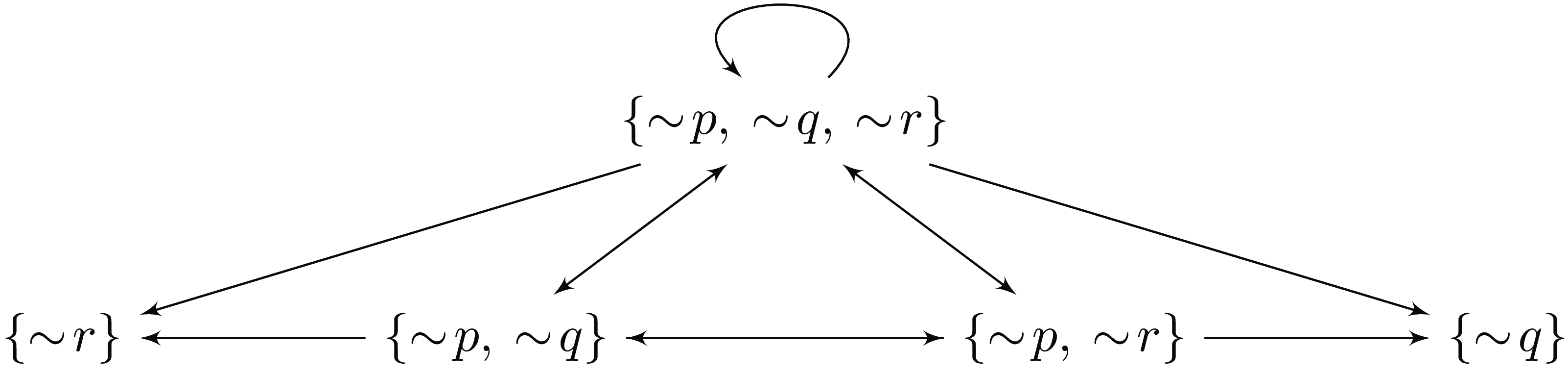


 Open access

