


The Chinese National Twin Registry (CNTR), established in 2001, is the first national twin registry in China, and it has now become the largest twin registry in China. Recently, the CNTR obtained a large amount of funding for a project entitled ‘Cohort study on environmental epidemiology in China’, which was supported by Specific Research Project of Health Pro Bono Sectors, Ministry of Health, China (Project ID 201002007). This project aimed to establish a twin cohort. The CNTR is led by the School of Public Health, Peking University, and collaborates with nine other research centers: the Qingdao Center for Disease Control and Prevention (CDC), Zhejiang CDC, Jiangsu CDC, Sichuan CDC, Beijing CDC, Shanghai CDC, Tianjin CDC, Qinghai CDC, and Harbin Medical University. Professor Liming Li from Peking University is the principle investigator. The cohort study on environmental epidemiology in China project started in July 2010 and will continue until June 2013.
The CNTR's History
At the very beginning of the CNTR, according to the data from Gan's study (Figure 1; Gan & Zheng, Reference Gan and Zheng2002), Shandong Province has the largest number of twins in China and that is why Qingdao was selected as one of the first four cities/regions from which twins were recruited. Apart from Qingdao, the CNTR also selected Beijing, Shanghai, and Lishui as the other first three cities to recruit twins. Twins from these cities are located in northern urban, southern urban, and southern rural areas of China, whereas twins from Qingdao are located in a northern rural area. The CNTR is a voluntary registry, although different areas use different methods to collect twins. The twins are mainly recruited through local CDCs, which collaborate with the residence registry in local public security bureaus and communities, and through public media. By the end of 2005, 7,423 twin pairs were enrolled and twin registration was in progress in Shanghai at that time (Figure 1; Li et al., Reference Li, Gao, Lv, Cao, Zhan, Yang and Hu2006). For those twin pairs who were only registered, a questionnaire was given to the members and used for zygosity assessment (Gao et al., Reference Gao, Li, Cao, Zhan, Lv, Qin, Pang, Wang, Chen, Chen and Hu2006). For twins where both members consented to a detailed assessment (1,613 pairs), gender, ABO blood type, and DNA comparison were used step by step to determine zygosity. Based on the CNTR, a series of scientific research projects have been conducted, such as the evaluation of methods of zygosity determination, secular trends, and associated factors of twinning in Qingdao, studies on the intermediate phenotypes of cardiovascular and cerebrovascular diseases in adult twins, psychological studies of adult twins, and studies on growth and development in adolescent twins. In 2009, the epidemiological study in adult twins was awarded the second Science and Technology prize by the Chinese Preventive Medicine Association Science and Technology.
The distribution of the CNTR. Note: The legend indicates the number of new twin pairs in 1989, China (Gan & Zheng, Reference Gan and Zheng2002).

Aims of the Twin Cohort
The twin cohort aims to collect 35,000 twin pairs, based at the CNTR, with the goal of collecting data on health and lifestyle, behavior, physical characteristics, and fasting blood sample. Longitudinal follow-ups and a surveillance of major chronic diseases are also planned. In addition, health-related environmental information, such as accessibility to unhealthy food, smoking, and twins’ subjective feelings on environment will be collected. The cohort will look for the disease-discordant twins and exposure-discordant twins to determine the causal relationship between environmental risk factors and chronic diseases.
The study protocol for the Cohort Study on Environmental Epidemiology in China — Twin Cohort was reviewed and approved by the Ethics Committee for Human Subject Studies of the Peking University Health Science Center in 2011 (ID: IRB00001052-11029).
Advances of the Twin Cohort
The cohort study on environmental epidemiology in China started in 2011. In addition to the first four cities in the CNTR, another five cities or provinces — Tianjin City, Jiangsu Province, Sichuan Province, Qinghai Province, and Heilongjiang Province — have joined the twin cohort (Figure 1). The nine cities/provinces together covered the areas that have a large (Qingdao, Jiangsu, and Sichuan), moderate (Heilongjiang and Qinghai), and low (Zhejiang, Shanghai, Beijing, and Tianjin) number of twins. Also, these nine cities/provinces geographically covered western (Qinghai and Sichuan), eastern (Qingdao, Jiangsu, Shanghai, and Zhejiang), northern (Heilongjiang), and southern areas (Shanghai and Zhejiang) in China.
Twins were asked to complete one of the three questionnaires. The first questionnaire was developed for twins aged below 18 years. In the first questionnaire, twins were asked to provide their demographic information, parents’ names, contact details, birth weight, current weight, current height, medical history (obesity, hypertension, diabetes, asthma, and genetic disease history), and zygosity. Adult twins who were aged 18 years and over were asked to select one of the two questionnaires: the second and the third questionnaires. The second questionnaire included questions on demographic information, contact details and zygosity questions, waist circumference, and medical history (e.g., hypertension, hyperlipidemia, diabetes, coronary heart disease, stroke, chronic bronchitis/emphysema, and cancer); 6,176 twins who were aged 18 and over completed this questionnaire (Table 1). The third questionnaire was developed later and is more complex. Twins who accepted the third questionnaire needed to provide information on an alternate person who could help update future contact details. In addition, the third questionnaire included questions on demographic information, socioeconomic status (SES), birth weight, birth defects, birth place, whether reared apart, current height, weight, waist circumference, zygosity, smoking, drinking, fruit and vegetable consumption, physical activity, medical history (hypertension, hyperlipidemia, diabetes, coronary heart disease, stroke, chronic bronchitis/emphysema, and cancer), allergic history, family medical history (hypertension, hyperlipidemia, diabetes, coronary heart disease, stroke, chronic bronchitis/emphysema, and cancer); 12,611 twins who were aged 25 and over completed the third questionnaire (Table 1). Twins are currently tracked and updated on their contact information, height, weight, waist, and the onset of new chronic diseases, when possible. The age and gender distribution of the twins recruited so far is presented in Table 1.

*M/M: twin pairs who are both male; F/F: twin pairs who are both female; M/F: twin pairs with opposite sex.
From the recruited twins, disease-discordant twin pairs have been found and are shown in Tables 2–4. As our zygosity assessment was not completed, concordance/discordance status in Tables 2–4 is based on combined samples of monozygotic and dizygotic twins. In the third questionnaire, behaviors such as smoking, alcohol drinking, fruit and vegetable consumption, and physical activity have been investigated. This questionnaire enabled us to determine exposure-discordant twin pairs (Table 5).
Disease-Discordant Twin Pairs Found From the First Questionnaire (Age < 18 years)
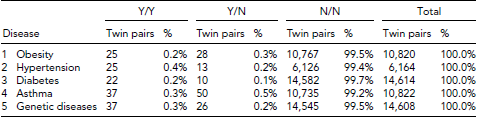
Y = disease present, N = disease absent.
Disease-Discordant Twin Pairs Found From the Second Questionnaire (Age ≥ 18 years)

Y = disease present, N = disease absent.
Diseases-Discordant Twin Pairs Found From the Third Questionnaire (Age ≥ 25 years)
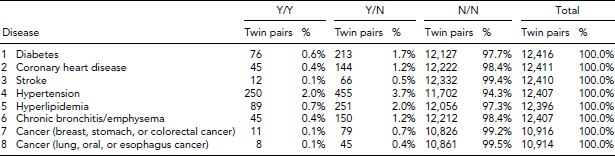
Y = disease present, N = disease absent.
Exposure-Discordant Twin Pairs Found in the Third Questionnaire (Age ≥ 25 years)

1Y = current smoker/drinker or ex-smoker/drinker; N = never smoker/drinker. A current smoker is defined as anyone who, self-reportedly, smokes one or more cigarettes (or cigars, pipes, or any other smoked tobacco products) daily in the past year. The definition of a current drinker is anyone who self-reportedly consumes >50 g of liquor with 52% alcohol by volume daily in the past year.
2Y = those who eat at least three servings of vegetables and two servings of fruit per day.
3Y = those who do moderate or vigorous physical activity for at least 30 minutes at a time on at least 5 days/week. Moderate activities refer to activities that take moderate physical effort and make breathing somewhat harder than normal. Vigorous physical activities refer to activities that take hard physical effort and make breathing much harder than normal.
Environmental Scan
The cohort study on environmental epidemiology has conducted an ‘environmental scan’ in 12 cities of China, and aims to objectively describe the environment related to four main risk behaviors: physical inactivity, an unhealthy diet, and tobacco and alcohol use. Street blocks were systematically sampled from all communities of chosen districts in these cities. The tools were developed following a review of existing auditing tools and modified according to the results of a prior similar study in Hangzhou, which also investigated the relationship between these four behaviors and built environment (Du et al., Reference Du, Su, Liu, Ren, Li and Lv2012; Gong et al., Reference Gong, Lv, Liu, Ren, Li and Kawachi2011; Lv et al., Reference Lv, Liu, Ren, Gong, Wang and Li2011; Wong et al., Reference Wong, Stevens, O'Connor-Duffany, Siegel and Gao2011). The survey assessed five kinds of public places of interest: streets, stores and restaurants, recreational facilities, schools, and hospitals. Through the survey, we hope to obtain a description of the distribution of these places of interest, as well as their health behaviors, such as safety, accessibility to unhealthy food, and non-smoking information.
From an extensive and comprehensive collection of urban built environments and comparisons between cities, our study attempts to establish the relationship between health behaviors and environment. The survey also takes a further step in providing evidence for macro-level chronic diseases prevention strategies due to the causal relationship between unhealthy behaviors and chronic disease, which has been recommended in WHO reports (WHO, 2004, 2011). However, there is still a lack of proof in China. Furthermore, the survey can also be the foundation for future studies in which we can add to the population data.
The New Face of the CNTR
The new logo of the CNTR was designed and used for this project (Figure 2). The inspiration for this logo came from the Chinese character of the ‘double (双)’, which was designed with the shape of two dancing people. The green color implies healthy and cheerful twins in China. It is strongly recognizable. The CNTR now has its own website at http://cntr.bjmu.edu.cn. Twins can register themselves, and research assistants can input the twin information on the Internet. The Internet also helps data managers to manage twin data in a timely fashion, although face-to-face interview questionnaires printed on paper are currently still preferred by most research assistants.
Logo of the CNTR.

Future Plans
In the next step, fasting blood samples will be collected in the disease/exposure-discordant twins, who will undergo a detailed physical examination. Matched case control and cohort studies focusing on one kind of disease or one kind of exposure will be conducted in these twins. The epigenetic mark of DNA methylation will be analyzed in cardiovascular disease-discordant MZ twins.
Acknowledgments
This research is supported by Specific Research Project of Health Pro Bono Sectors, Ministry of Health, China (Project ID 201002007). The authors gratefully acknowledge the cooperation of Centers for Disease Control and Prevention in Qingdao, Zhejiang, Beijing, Shanghai, Tianjin, Jiangsu, Sichuan, Qinghai, and School of Public Health, Harbin Medical University.



