

Introduction
Platform work is gaining increased attention as a new form of employment enabled by digital technologies. In terms of the future development of labour markets, platform work is important not only because the number of platform workers is growing in almost all countries around the world (Groen et al., Reference De Groen, Kilhoffer, Westhoff, Postica and Shamsfakhr2021), but also because platform work is considered to be a main driver of a further de-standardisation of work and employment challenging the established labour market and welfare state institutions. The emerging platform labour markets are insofar disruptive as they ‘transform labour markets from markets for jobs to markets for tasks’ (Drahokoupil and Vandaele, Reference Drahokoupil, Vandaele, Drahokoupil and Vandaele2021: 1). Stability based on employment contracts is being replaced by flexible sequences of temporary gigs and a loose, short-term relationship to a client.
As the majority of platform work is based on solo self-employment and is decoupled from physical companies, the established institutions regulating labour markets and offering social protection do not have any or only limited power. Most platform enterprises refuse employer status and view themselves as intermediaries, claiming to only match supply and demand (Drahokoupil and Vandaele, Reference Drahokoupil, Vandaele, Drahokoupil and Vandaele2021). Hence, most platform workers perform as independent service providers and do not have an employment contract with the platform enterprises, leading to an individualisation of social protection (Beckmann and Hoose, Reference Beckmann and Hoose2022).
Despite the general consideration of this issue in the literature (Garcia Calvo et al., Reference Garcia Calvo, Kenney and Zysman2023), there is little empirical insight into the social protection of platform workers. Previous studies indicate a lack of social protection amongst platform workers globally (ILO, 2021) and in the European Union (Joyce et al. Reference Joyce, Stuart, Forde and Valizade2019) as well as in Germany (Baethge et al., Reference Baethge, Boberach, Hoffmann and Wintermann2019). However, little emphasis is put on the embeddedness of platform work in hybrid employment patterns (Jerg et al., Reference Jerg, O’Reilly and Schulze Buschoff2021) and how these employment patterns correspond to social protection, although previous research has highlighted the importance of platform work as a part of multiple jobholding (Ilsøe et al., Reference Ilsøe, Larsen and Bach2021).
This article takes this as a starting point for an empirical exploration of the social protection of platform workers in Germany. As a Bismarckian conservative welfare regime, it offers only poor protection for the majority of self-employed (Nullmeier, Reference Nullmeier, Busemeyer, Kemmerling, Marx and van Kersbergen2022). Platform work especially puts such regimes as the German one to test due to the low accessibility to institutionalised social protection for the self-employed (Sieker, Reference Sieker2022). In our contribution, we are interested in two questions: (1) In which individual employment patterns is platform work embedded and how do these patterns correspond to institutionalised social protection? and (2) Which protection types amongst platform workers can be identified and how do these clusters differ regarding working conditions, employment situations and social policy preferences?
Taking into account previous research suggesting that the majority of platform workers hold another (often dependent) employment relationship as their main source of income (Piasna et al., Reference Piasna, Zwysen and Drahokoupil2022), as well as the institutional architecture of the social insurance scheme in the German welfare regime, we expect platform workers holding regular full-time employment as their main job to have the highest coverage of institutionalised protection against old age. At the same time, we expect lower levels of coverage amongst self-employed and people holding a minijob, as both forms of employment are not covered by statutory pension insurance. Moreover, coverage is expected to be lower amongst platform workers without any additional sources of income from employment. With respect to health insurance, we expect wide coverage due to its obligatory character in the German welfare regime, but diverging shares in public and private health insurances.
In contrast to the investigation of social insurance coverage, the analysis of protection types amongst platform workers is explorative in nature, with previous research neither having dealt with a differentiation of protection demands nor social policy preferences of platform workers. Hence, we view our analysis as a first empirical step in investigating these important questions. Our study adds to the literature by empirically investigating the mutual relationship between employment participation in ‘old’ and ‘new’ fields of employment and its implications for institutionalised social protection. Moreover, our study sheds empirical light on the social policy preferences of platform workers, which have surprisingly remained a black box to date.
In section 2, we start by examining the prevalence and characteristics of platform work and its disruptive nature for employment. Section 3 outlines the institutionalised social protection in the German welfare regime and discusses why platform work challenges these institutions and what is empirically known about the social protection of platform workers. In section 4, we describe the sample and the methods, before we present the empirical findings in section 5. Here, we first take a look at individual employment patterns of platform workers and show how each of these patterns corresponds to the protection against sickness and old age. After this, we conduct a cluster analysis to explore different protection types amongst platform workers in Germany and analyse how these clusters differ with respect to working conditions, employment situations and social policy preferences. In section 6, we summarise our main findings and discuss the socio-political implications for the future governance of platform work.
Platform work: prevalence and characteristics
In the course of the platformisation of economic activities, labour platforms as infrastructures for the matching of paid work tasks have also developed. Although most investigations of platform work focus on work organised via these digital labour platforms, social media platforms also gain in importance for the monetisation of activities – for example, in the case of live-streaming (e.g. via Twitch) or influencing (e.g. via Instagram) (Rosenbohm and Hoose, Reference Rosenbohm, Hoose and Ness2022). Consequently, Garcia Calvo and colleagues (Reference Garcia Calvo, Kenney and Zysman2023) differentiate between narrow and broad perspectives on platform work, criticising that many studies focus only on digital labour platforms and especially local gig work (see also Schor et al., Reference Schor, Attwood-Charles, Cansoy, Ladegaard and Wengronowitz2020).
Estimations of the size of the platform labour market in Germany and Europe vary notably since official data from labour market statistics are missing and existing surveys differ regarding definitions, operationalisation and survey modes. The latest estimations based on the JRC COLLEEM II-survey (Urzì Brancati et al., Reference Urzì Brancati, Pesole and Férnández-Macías2020) assume that 5.7 per cent of the workforce in Germany perform platform work on a regular basis – this accounts for approximately 2.5 million people. Earlier surveys come to similar estimations for Germany, with Serfling (Reference Serfling2018) estimating 4.8 per cent and Pesole et al. (Reference Pesole, Urzí Brancati, Fernández-Macías, Biagi and González Vázquez2018) 6.6 per cent of the workforce. At the same time, the European Union estimates that in 2021 there were 28 million platform workers in Europe, with the number presumably rising to 43 million in 2025 (European Commission, 2021).
Although platform work is an umbrella term for very different forms of work, there are typical features most forms of platform work have in common. In an organisational dimension, there is the common feature that platform work tends to be carried out as solo self-employment. According to Groen et al. (Reference De Groen, Kilhoffer, Westhoff, Postica and Shamsfakhr2021), nine out of ten gigs in the European Union are carried out on the basis of an independent service provision, and temporary transactions thus replace long-term commitment based on an employment contract (Drahokoupil and Vandaele, Reference Drahokoupil, Vandaele, Drahokoupil and Vandaele2021). Since platform enterprises often influence the work organisation and solve various coordination problems in the labour process (e.g. ensuring performance and know-how), it nevertheless remains controversial to which extent self-employed platform workers depend on the platforms’ infrastructure (Cutolo and Kenney, Reference Cutolo and Kenney2021).
In addition, the majority of tasks are carried out online and do not in any way require a physical point of reference, and there tend to be no companies as a physical organisational basis. This ‘de-companyisation’ (Nullmeier, Reference Nullmeier, Busemeyer, Kemmerling, Marx and van Kersbergen2022: 295) has implications for questions concerning labour and social law because there are only a few segments within the platform economy where there are firm-like structures and existing social and labour law is applicable (Haipeter and Hoose, Reference Haipeter and Hoose2019). Last but not least, previous research underlines that platform work serves as a means for earning additional money for the majority of platform workers (Piasna et al., Reference Piasna, Zwysen and Drahokoupil2022; Urzì Brancati et al., Reference Urzì Brancati, Pesole and Férnández-Macías2020). Hence, only a small minority considers platform work their main source of income (ibid.). At the same time, the individual labour market status of platform workers varies remarkably, ranging from ‘regular’ employment to self-employment, but also including students, pupils and the unemployed (Piasna et al., Reference Piasna, Zwysen and Drahokoupil2022: 37). As platform work is mainly used as a means for generating additional income, it fosters multiple jobholding and the trend towards hybrid employment patterns, that is, the combination of dependent and self-employment. In Germany, the number of moonlighters has tripled between 2003 and 2018 (Klinger and Weber, Reference Klinger and Weber2019), with platform labour markets offering even more opportunities for volatile forms of multiple jobholding.
Challenges for social security in the platform economy
By substituting dependent employment relationships with temporal interactions based on solo self-employment, platform enterprises undermine the institutions of social security in the German welfare regime and externalise the responsibility for social protection to the platform workers – be it private precaution, protection through other regular jobs or other sources of familial or welfare state protection (Beckmann and Hoose, Reference Beckmann and Hoose2022). As Au Yeung and colleagues (Reference Au Yeung, King-Chi Chan, Ming and Tsui2024) show for food delivery platform work in Hong Kong, occupational welfare is also strategically undermined by platform enterprises, resulting in huge policy challenges due to the state’s weak regulatory power and the unwillingness for reform in this field of employment, for example, with respect to the access of occupational welfare entitlements.
Although self-employed platform workers face similar challenges regarding labour and social law as ‘conventional’ self-employed, various special challenges for platform workers are highlighted in the literature (Schoukens, Reference Schoukens2020). One major concern is the emergence of platform enterprises as new labour market players. While they view themselves as intermediaries but not employers, many studies highlight their market and control power. For self-employed platform workers, the emergence of platforms as new intermediaries goes hand in hand with specific challenges for income generation. Algorithmic management leads to new forms of labour process control in some segments in the platform labour market. Many platform workers are confronted with non-transparent platform structures (e.g. regarding matching of supply and demand, modes of pricing, ratings and rankings) (Rahman Reference Rahman2021: 981). Moreover, platforms tend to be closed ecosystems with individual profiles being non-transferable and thus increasing the dependence of platform workers on certain platforms (Cutolo and Kenney, Reference Cutolo and Kenney2021). Against this backdrop, questions of bogus self-employment in platform work, misclassifications of employment statuses and the potential need for a third employment status are prominent in recent academic and policy debates (Aloisi, Reference Aloisi2022; European Commission, 2021).
The high volatility of self-employed platform work is another important challenge for the established institutions of labour and social law. As discussed above, platform work is often part of multiple jobholding patterns (Piasna et al., Reference Piasna, Zwysen and Drahokoupil2022). These emerging hybrid employment patterns are a huge challenge for many social security schemes since there tends to be only little complementarity of different protection schemes (Jerg et al., Reference Jerg, O’Reilly and Schulze Buschoff2021). Platform work often serves as a means for rather low additional income (Piasna et al. Reference Piasna, Zwysen and Drahokoupil2022), giving rise to renewed debates on what is to be considered ‘work’. As Schoukens (Reference Schoukens2020) shows, normally two criteria are applied: the regularity of the activity and the intention to earn one’s living from these activities. In platform work, however, activities may be performed sporadically, tasks may be marginal, or the generated income may only be indirectly related to the platform activity (e.g. advertising revenues in influencing) (ibid.: 440).
Consequently, previous research suggests that platform workers are less protected than employees in standard employment relationships. On the basis of a survey of 1232 respondents on four clickwork platforms, Joyce et al. (Reference Joyce, Stuart, Forde and Valizade2019: 172) show that between 68 per cent and 82 per cent of those platform workers who depend on the income from platform work are not protected against the main social risks – with the exception of healthcare. This general trend has also been confirmed in international studies investigating many countries in the Global North and South (ILO, 2021). For Germany, previous studies have also shown a low level of social protection, especially regarding unemployment/loss of income and old age (Leimeister et al., Reference Leimeister, Durward and Zogaj2016). In a survey of 553 platform workers conducted by Baethge et al. (Reference Baethge, Boberach, Hoffmann and Wintermann2019), only 23 per cent of platform workers reported to be socially protected within their platform work.
This has to do with the general characteristics of the Bismarckian welfare regime in Germany, in which institutionalised social security is organised via social insurance contributions. The social insurance scheme in Germany comprises five single insurances: health insurance, occupational accident insurance, pension insurance, unemployment insurance and nursing care insurance. All social insurances are financed equally by contributions from employers and employees. Since almost all insurances are linked to formal employment relationships, the German model of social security is considered highly labour centredFootnote 1 . Especially unemployment and pension insurance, which provide cash benefits, require participation in a permanent, continuous and decently paid standard employment relationship (SER) over the life course. However, there is consensus that important social policy reforms, especially the ‘Hartz-reforms’ in 2003, have remarkably weakened traditional paradigms of status protection in the German welfare regime and led to a greater risk exposure of formerly well-protected middle-class employees (Bothfeld/Rosenthal, Reference Bothfeld and Rosenthal2018).
A ‘dogmatic dualism’ (Schlegel, Reference Schlegel, Bührmann, Fachinger and Welskop-Deffaa2018: 294; author translation) in German social law leads to a strict separation between workers in dependent employment and those in self-employment. While the former are – with few exceptions, such as minijobsFootnote 2 – obligatory members of the social insurances, most of the latter are not. The legislator argues that the self-employed can assure their social security individually and do not require collective protection – although empirical studies indicate that in particular, many of the solo self-employed are hardly able to assure their social security privately due to low income (Schulze Buschoff, Reference Schulze Buschoff2016). Estimations suggest that approximately one-quarter of the self-employed in Germany are protected by obligatory special systemsFootnote 3 (ibid.). In addition to these special systems, anyone self-employed can make contributions to the compulsory social insurance scheme voluntarily. However, legal requirements are often as high as the costs. Since employers’ contributions are missing, self-employed need to pay both the employers’ and employees’ contributions.
Despite the general consideration of this issue in the literature (Garcia Calvo et al., Reference Garcia Calvo, Kenney and Zysman2023), there is still a lot that is not yet known regarding the social protection of platform workers. Previous studies hardly ever discuss the types of social protection and do not consider differences between different employment patterns. Moreover, there are no studies to date dealing with social policy and regulative preferences of platform workers, leaving the perspective of platform workers themselves overlooked. Hence it remains unknown whether platform workers want collective, institutionalised protection and whether they would be willing to pay for better social protection. Below, we will analyse these aspects on an empirical basis.
Data and methods
Our research is based on an online survey which was conducted in December 2022 amongst platform workers resident in Germany. For the survey, an online access panel through which respondents were acquired was used. Thus, we were able to inquire in detail about the status of social security for self-employed platform work. However, this approach is also associated with some limitations (Evans and Mathur, Reference Evans and Mathur2018). As of now, we cannot make any statements about the representativeness of our data, because there are a lack of reliable data on the population of self-employed platform workers in Germany (Rosenbohm and Hoose, Reference Rosenbohm, Hoose and Ness2022). It is therefore also unknown to what extent the online access panel is able to represent this population or whether there are systematic statistical biases at hand. However, using an online access panel also enables reaching an internet-oriented population, which is important for investigating such new forms of employment on the internet. Moreover, our methodical approach is able to cover a huge variety of platform work segments and hence is not limited to specific tasks on very few platforms, such as in many empirical platform work studies.
To identify our target group, the survey started with a screening based on two questions. First, respondents were asked whether they had used the internet or an app to earn money in the past 12 months by (1) renting a home, (2) selling self-made, second hand or new products (excluding own belongings), (3) taking paid tasks mediated through an online platform and/or (4) creating their own content on social media platforms. Moreover, it was required that respondents reported performing this work as self-employed, that is, they must not have an employment contract with the platform enterprise. The sample contains 719 platform workers.
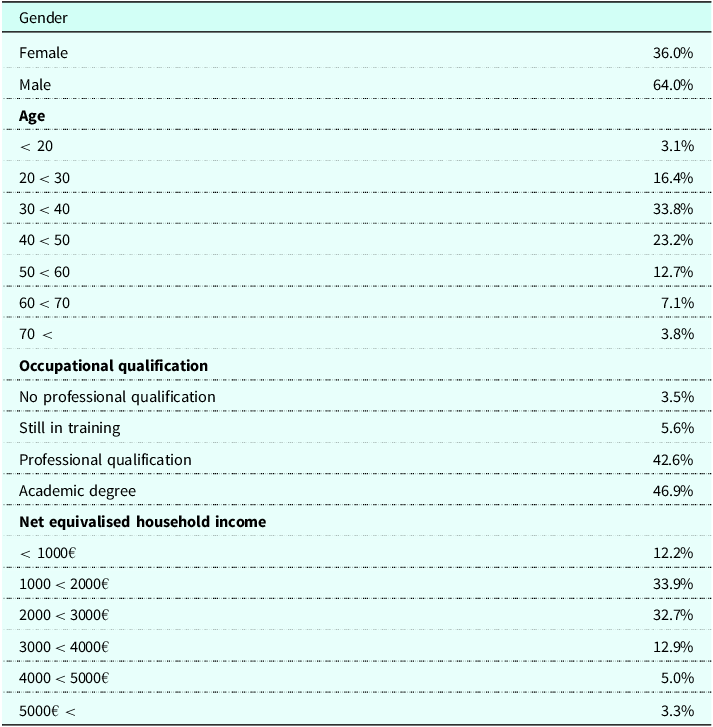
In total, 64 per cent of the sample are male and a majority of respondents are 30–50 years old (see Table 1). One in five platform workers in the sample is younger than 30. Compared with the German population, neither the share in pupils nor students is above average. The vocational qualification degree of the platform workers in the sample is above average, with 47 percent reporting an academic degree. Most respondents have a monthly net equivalent household income between 1000 and 3000 euros. The mean net equivalised household income in the sample is 2000 euros, that is, above the average in Germany (Destatis et al., 2021: 235). Hence, the platform workers in the sample – just as in previous surveys (Urzì Brancati et al., Reference Urzì Brancati, Pesole and Férnández-Macías2020; Piasna et al., Reference Piasna, Zwysen and Drahokoupil2022) – tend to be male, rather young, well-educated and have a rather high income.
Socio-demographic characteristics of platform workers in the sample

Note: Author calculation and visualisation; n = 719.
The survey covered three main areas of interest: (1) information on respondents’ platform work and the working conditions, (2) the objective dimension of social protection, that is, membership in compulsory insurances and other forms of income and savings and (3) the subjective dimension of social protection, that is, perceived needs, willingness to pay and regulatory preferences. Regarding our cluster analysis, we build the following factors: For measuring the subjective evaluation of social protection, we build a factor of the evaluations regarding the main five risks covered by German social insurances (sickness, nursing care, unemployment, accident and old age)Footnote 4 . We use a subjective indicator because membership in social insurances alone does not give information on the quality of potential claims nor the extent to which the claims cover individual demands. Corresponding to this approach, we build a factor which covers the importance of platform work for ensuring sufficient social protection against the five major risks mentioned aboveFootnote 5 . Regarding financial resources, we use the household net equivalised incomeFootnote 6 and a ‘prospect index’. This index combines evaluations regarding the question of how long a household could cope with savingsFootnote 7 and a subjective evaluation of household incomeFootnote 8 . This operationalisation enables us not only to cover income from employment, but also to include other assets and savingsFootnote 9 .
As we do not have any presumptions regarding the number of clusters, we use a agglomerative hierarchical cluster analysis. For the fusion we use Ward’s method. To represent the three dimensions, we explore factors on the basis of a principal component analysis (PCA). The resulting clusters are then analysed along four dimensions: (1) socio-demographic characteristics, (2) working conditions in platform work, (3) individual employment situation and (4) social policy and regulatory preferences.
Empirical findings
Employment patterns and social protection
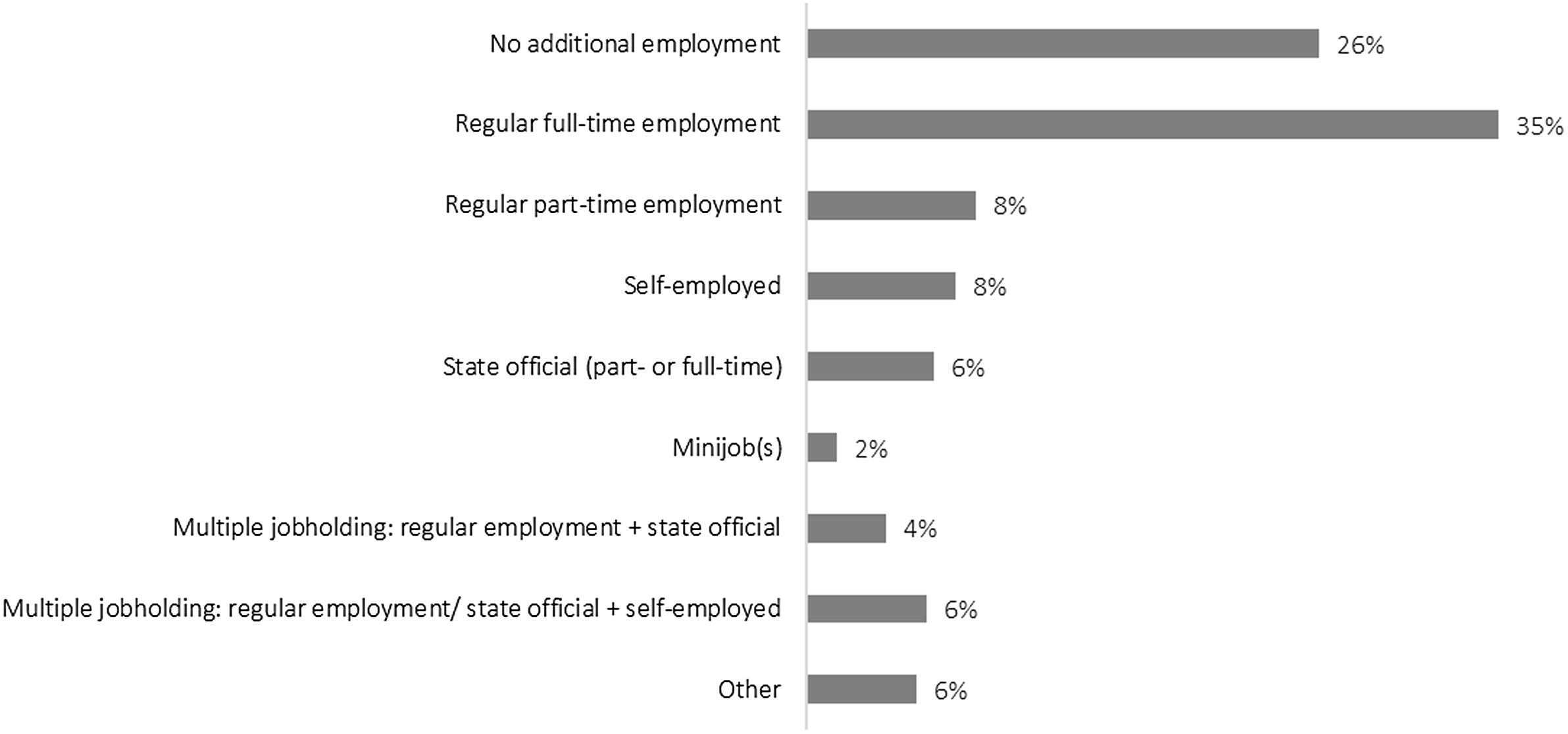
The employment situation of platform workers is characterised by the embeddedness of platform work in multiple jobholding patterns. In our sample, a huge variety of employment patterns can be observed (see Figure 1): 35 per cent perform platform work in addition to regular full-time employment, whereas 11 per cent also have regular part-time employment, and 6 per cent are public officials. Further, 8 per cent are (full-time) self-employed in their main job and 2 per cent work in a minijob. In addition, there is a huge variety of different employment patterns and different mixtures of employment forms: 16 per cent of the sample report to have more than two jobs and 65 per cent of respondents hold an additional dependent employment which is subject to social insurance contributions.
Employment patterns of platform workers in the sample; n = 719.
Note: Author calculation and visualisation; n = 719.

On the contrary, 26 per cent do not hold any additional employment. Of these platform workers, 30 per cent are pensioners, 14 per cent students, 9 per cent pupils, 8 per cent are housewives/husbands and 5 per cent are registered unemployed. Here, at least basic social protection can be assumed, mainly through various welfare benefits. However, one-quarter of the platform workers without any additional employment report not having any extra source of income. For this group, platform work is likely to be the only regular source of income and access to social insurances is missing.
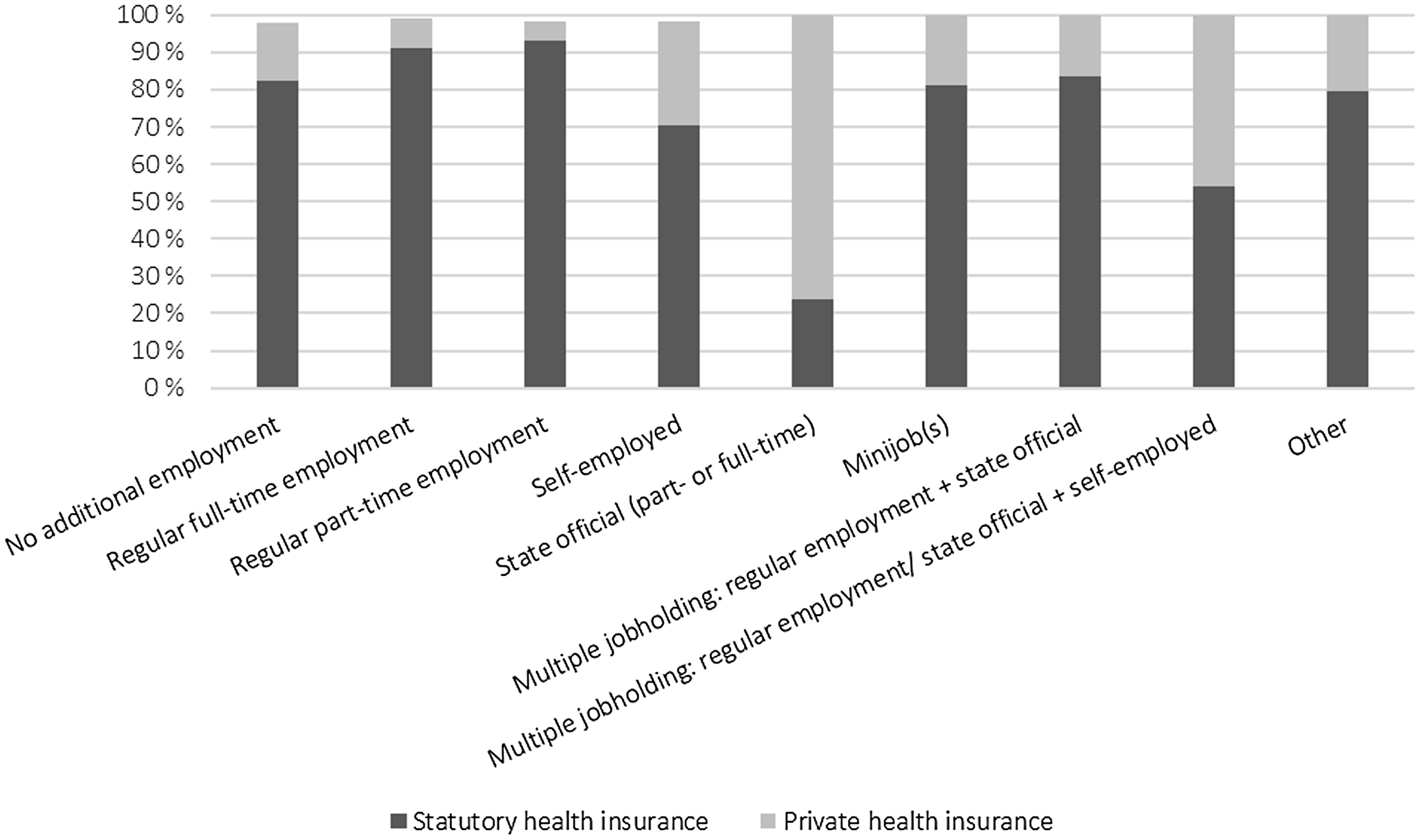
Looking at the correlation between these employment patterns and institutionalised protection against sickness (see Figure 2), the findings reveal a high level of protection independent of the specific employment pattern. There is almost no person in the sample reporting not being covered by health insurance. This confirms our assumptions, because institutionalised protection against sickness is obligatory in Germany. However, as expected, the findings also reveal diverging distributions regarding private and statutory insurance. The highest rates of private insurances can be observed for public officials (80 per cent) and the self-employed (30 per cent), while the other groups dominated by the integration into dependent employment relationships have high rates of statutory insurance coverage. Although the findings indicate that institutionalised protection against sickness is not a critical issue amongst platform workers in Germany, other studies point to the fact that especially for the self-employed with low income, private health insurances can be challenging in terms of their high insurance contributions.
Institutionalised protection against sickness along different employment patterns of platform workers; n = 719.
Note: Author calculation and visualisation; n = 719.

The findings regarding institutionalised protection against old age (see Figure 3) show a different and more heterogenous picture. In general, both statutory and private insurance coverage is relatively widespread, but there are remarkable differences between different employment patterns. In those employment patterns with at least one dependent employment relationship which is subject to social insurance contributions, the share in platform workers who are members of statutory pension insurance is above 90 per cent. In addition, state officials have widespread institutionalised, but tax-financed, protection coverageFootnote 10 . Amongst self-employed, minijobbers and respondents who do not perform any additional employment, approximately 70 per cent report having either a private or statutory pension insurance. At 20 per cent, the rate of people without any pension insurance is highest amongst the self-employed. Amongst minijobbers, we find the highest share of ‘don’t know’ answers. This may be due to the special regulation of this form of employment, which is dependent but not subject to social insurance contributions (Beckmann, Reference Beckmann2020). In summary, we can observe a huge variety of protection patterns and sources across all employment patterns investigated. Although these data do not allow for the estimation of the quality of protection, it is possible to empirically identify rather well-protected groups (i.e. platform workers with additional full-time employment, state officials and people performing more than one employment subject to social insurance contributions) and groups with higher risks of precariousness (self-employed without any pension insurance, minijobbers). The findings confirm our assumptions and empirically underline the diverging risk exposure amongst platform workers as well as the importance of the employment participation outside the platform labour market.
Protection types amongst platform workers
As we are interested in the structure of different protection types amongst platform workers in the sample, we conducted a cluster analysis along three dimensions: (1) subjective evaluation of one’s social protection, (2) importance of platform work for ensuring sufficient social protection and (3) financial resources (for detailed description of methods, see section 4). The cluster analysis revealed four clusters which can be grouped along the three dimensions as visualised in Figure 4.
Institutionalised protection against old age along different employment patterns of platform workers; n = 719.
Note: Author calculation and visualisation; n = 719.

Protection types of platform workers.
Note: Author calculation and visualisation; n = 719.

For the platform-orientated, platform work has a relevant importance for social protection. For 90 per cent of this cluster, the income from platform work is important for the protection against main social risks. At the same time, workers in this cluster report a high level of subjective social security, while financial resources are average compared with the other clusters. Monthly household income is pretty much the same as the household income of the insecure cluster and the undemanding cluster. However, people in the platform-orientated cluster are more satisfied with their household income, while evaluating the temporal usability of their savings more negatively.
The privileged are characterised by high financial resources, and report the highest income of all clusters and the greatest trust in their private savings. Across the main social risks investigated, 50–60 per cent of this cluster state that platform work is an important means for ensuring social protection. The subjective evaluation of individual social security is mainly positive; however, one-third of this cluster reports ambivalent evaluations.
The insecure feel least secured of all clusters. Despite protection against sickness, half of this cluster considers their individual social protection (rather or very) bad. Nevertheless, for two-thirds of this cluster platform work does not play a significant role for ensuring social protection. Although the monthly household income is not significantly lower than those of the platform-orientated and the undemanding, 45 per cent of this cluster report being able to make ends meet only with great difficulty.
Finally, the undemanding cluster differs from the other clusters in the fact that for them, income from platform work is not at all important for questions concerning individual social protection. In addition, this cluster is characterised by average evaluations of individual social security and reports an average household income.
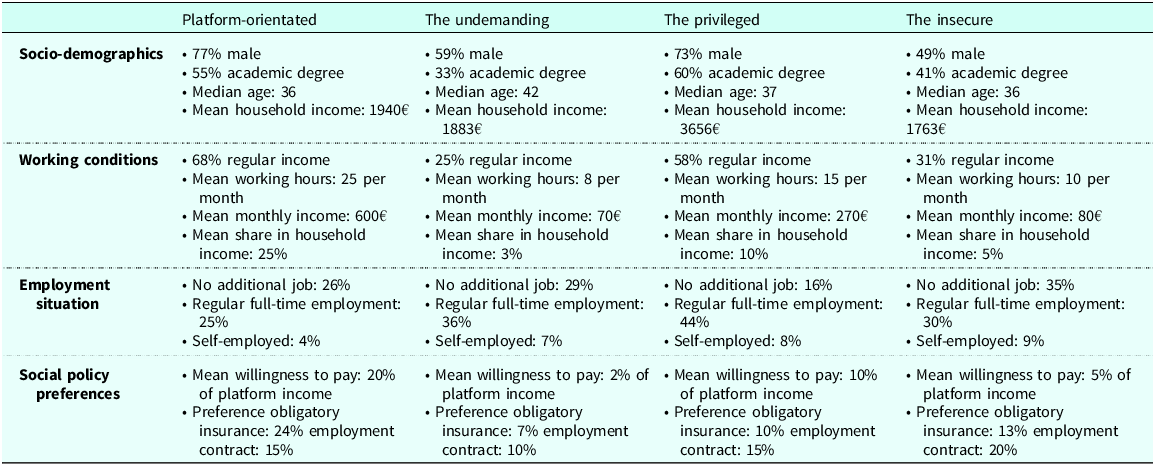
On the basis of this typology, we take a closer look at the four clusters and analyse their sociodemographic structure, their working conditions in platform work, their individual employment situation and preferences regarding social protection and regulation (see Table 2).
Cluster characteristics regarding socio-demographics, working conditions, employment situation and social policy preferences

Note: Author calculation and visualisation; n = 719; age in years; household income equivalised according to Hagenaars et al. (Reference Hagenaars, Vos and Zaidi1994) and OECD (2013: 174); euros, hours and all percentages rounded.
Regarding socio-demographics, the platform-orientated and the privileged have the highest shares in men, the highest occupational qualifications, and a similar mean age. However, the mean monthly household income of the privileged is almost double as high as that of the platform-orientated. These two clusters pretty much correspond to the image of the ‘classic’ platform worker discussed in the literature (Urzì Brancati et al., Reference Urzì Brancati, Pesole and Férnández-Macías2020; Piasna et al., Reference Piasna, Zwysen and Drahokoupil2022). In contrast, the undemanding cluster has the highest mean age and the lowest share in academics, whereas the insecure cluster is the only cluster with a majority of women. Both clusters have a similar mean household income.
With respect to the working conditions in platform work, the four clusters vary remarkably. For a majority of almost 70 per cent of the platform-orientated, platform work serves as main or secondary employment on a regular basis. Platform workers in this cluster also have the highest mean monthly working hours (25 hours) and the highest mean monthly income (600 euros) of all clusters. Moreover, the income from platform work accounts for 25 per cent of the total household income on average. This may also explain why it is this cluster for whom platform work has the greatest importance for individual social protection. For the privileged cluster, platform work also is a regular source of income for the majority. People in this cluster have a mean working time in platform work of 15 hours per month and earn 270 euros/month on average. The income from platform work accounts for 10 per cent of the household income in this cluster on average. In contrast to these two clusters, the undemanding and the insecure tend to perform platform work more sporadically and report remarkably lower monthly working hours (8 hours versus 10 hours, respectively) and mean monthly platform work income of 70 euros versus 80 euros, respectively. Hence, income from platform work accounts only for 5 per cent or less of the total household income in these clusters.
When we look at the embeddedness of platform work in individual employment situations, the privileged cluster is the one with the highest share in people working in regular full-time employment and the lowest share in platform workers without any additional job. Combining this information with the financial resources of this cluster, it is plausible that many of this cluster work in well paid jobs and hence also have a solid basis for social insurance claims and other savings. In contrast to this cluster, the other three clusters do not differ remarkably from one another and have similar shares in full-time employment platform workers and those only performing platform work. Interestingly, the privileged and the insecure have the highest shares in self-employed. Considering both their varying financial resources and their subjective perception of security, these clusters are prototypical for the socio-economic heterogeneity of self-employment.
Finally, we are interested in whether there are differences between the clusters regarding social policy and regulatory preferences. Here, we focus on three indicators: (1) willingness to pay for social security, (2) preference for obligatory social insurance contributions for income from platform work and (3) favouring an employment contract with the platform enterprise over performing platform work as self-employed. The lowest demand for social protection and respective regulations can be observed in the undemanding cluster. Here, only 7 per cent vote for an integration of platform work into the obligatory insurance scheme and only 10 per cent would favour an employment contract over self-employment. Consequently, people in this cluster are willing to only pay 2 per cent of their platform work income for social protection on average. In contrast, the platform-orientated report the highest willingness to pay: in this cluster, people would be willing to spend 20 per cent of their income from platform work for social protection on average. Nevertheless, one-quarter of this cluster votes for an integration of platform work into the compulsory insurance scheme and 15 per cent would favour an employment contract over self-employment. The privileged and the insecure are in between those clusters: while the former report a higher willingness to pay for social protection, the latter prefer compulsory insurances and employment contracts more often. Despite the differences across the four clusters, the findings reveal high shares in rather individualistic orientations, with only a minority voting for platform work being subject to compulsory insurance and desiring employment contracts with the platform enterprises.
Discussion and conclusion
Established welfare state institutions do not or only marginally offer protection and regulation for the majority of platform workers. While this is being problematised both in academic and policy discourses, there is little in-depth knowledge about the social protection of platform workers. Against this background, this article presented explorative empirical findings on employment patterns and social protection coverage as well as social policy and regulatory preferences amongst 719 platform workers in Germany.
The empirical investigation revealed two major findings: First, platform work is embedded in a huge variety of hybrid employment patterns and is used as an additional income for the majority of the respondents. Our analysis shows that these employment patterns correspond to different patterns of institutionalised social protection. There is widespread protection against sickness since health insurance is compulsory in Germany. However, the relationship between private and statutory insurances varies notably across different employment patterns. The same is true for pension insurance. Overall, the level of protection against old age amongst platform workers is lower than against sickness. The analysis underlined the importance of the individual employment situation: while platform workers holding a dependent employment relationship report the highest shares in institutionalised protection against old age, it is especially workers with minijobs and the self-employed reporting missing access to the pension insurance. This finding mirrors the social security institutions in the German welfare regime and underlines the mutual relationship between the platform labour market and the traditional labour market.
The second major finding is based on our explorative analysis of social protection types. While clusters with low mean working hours and earnings report little demand for social protection, those clusters with a higher volume of platform work tend to seek platform work as an important puzzle piece for their individual social protection. Hence, social protection issues may gain in importance in the case that the economic relevance of platform work increases in the future. However, across all clusters the investigation also revealed that the majority of platform workers do not demand social protection within platform work and that the willingness to pay is rather low. Overall, compulsory contributions for social insurance in platform work are disapproved by 88 per cent of the platform workers in the sample, and only 14 per cent favour an employment contract with a platform enterprise over self-employed platform work.
The low prevalence of preferences for improved collective protection of platform workers illustrates that the absence of regulation is a driving force for performing platform work. Previous research has rightfully pointed to the strategies of platform enterprises to undermine established labour market and welfare state institutions (Schor and Vallas, Reference Schor, Vallas and Heydari2023; Beckmann and Hoose, Reference Beckmann and Hoose2022). However, our findings suggest that it is also the platform workers themselves who actively promote a free riding of social protection. In platform labour markets the demand for temporary gigs coincides with a supply side which relies on protection derived from other sources. From the view of platform workers, this may be insofar rational as income and working hours, and consequently, potential social insurance claims in platform work, are low. Platform workers with additional ‘regular’ jobs make use of the missing regulation of platform work and combine well-regulated jobs in the ‘conventional’ labour market with flexible income opportunities in the platform labour market. Therefore, a well-known pattern of multiple jobholding in the German welfare regime continues: the increase in minijobs in the German labour market. Although a form of dependent employment, minijobs are not subject to social insurance contributions and are attractive as side jobs for employees with regular main jobs. It is not surprising that the number of minijobs performed as a side job have risen from one million in the year 2000 to almost three million in 2019 (Beckmann, Reference Beckmann2020). Diverging institutional arrangements for different forms of employment provide incentives for specific forms of multiple jobholding patterns. Hence, we understand the free riding of platform workers as a reaction to the structural features of platform labour markets and the missing regulatory approaches of the legislator (for similar findings, see Au Yeung et al., Reference Au Yeung, King-Chi Chan, Ming and Tsui2024). While this employment strategy may work for some on the individual level, it may bear risks for others, for example, when future protection demands are underestimated or constant income opportunities erode. Every bit as important, a growing platform labour market may cannibalise the social insurances as well as employees and employers in the traditional labour market in the long run.
Individualistic preferences also have implications for current initiatives and proposals for the regulation of platform work. These approaches – be it in politics on the European Union level or in the sphere of industrial relations on a national level – focus on fighting misclassifications and bogus self-employment and seek to enable access to institutionalised protection via employee status (Aloisi, Reference Aloisi2022). Regardless of legal aspects in this matter, our findings indicate that employee status is preferred only by a small minority of platform workers. Nota bene, these findings do not indicate that (collective) regulation is not necessary. However, future regulatory approaches need to take heterogeneous interests, differing platform labour market segments and the embeddedness of platform work in diverse employment patterns into account and consider that potential reforms may be rejected not only by many platform enterprises, but also by platform workers.
Despite social policy reforms on the state level, there is growing interest in questions concerning collective labour regulation in the platform economy. According to an empirical investigation by Martindale et al. (Reference Martindale, Wood and Burchell2024), a majority of platform workers in the UK are interested in collective ways of improving wages and joining or even setting up a union. In contrast, Vandaele et al. (Reference Vandaele, Piasna and Zwysen2024) study platform workers in 14 European countries and find strong pro-union attitudes amongst them, but a low willingness to unionise. In any case, there is growing protest against poor working conditions and missing social protection in the platform economy, although mainly in local gig work to date (Umney et al., Reference Umney, Stuart, Bessa, Joyce, Neumann and Trappmann2024), while online platform work offers much lower chances for formulating collective interests (Schou and Bucher, Reference Schou and Bucher2023). Nevertheless, initiatives for fair working conditions have emerged here as well. In Germany, eight platform enterprises from the crowd work sector signed a code of conduct for transparent platform structures and fair payment for crowd workers. This initiative is supported by the largest German trade union, IG Metall, and contains an Ombuds Office where platform workers from the platforms involved can make complaints and have their issues negotiated by the Ombuds Office (Heiland, Reference Heiland2022). Although the scope of the code of conduct is limited and decisions are not legally binding, it is a step towards collective labour regulation and an example for collective regulation beyond state policies.
This study adds to the growing literature on platform work and its precarious features, as well as challenges resulting for labour market and welfare state institutions. It underlines the importance of primary data collection not only to evaluate working conditions and the embeddedness of platform work in different employment patterns (Ilsøe et al., Reference Ilsøe, Larsen and Bach2021), but also to survey the social protection of platform workers and their subjective demands and preferences for protection and regulation. Future research in this field is important, as we need a better understanding of individual labour market behaviour of platform workers and the underlying subjective logics. This includes both conceptual studies and further primary data collection. Our survey is limited to platform workers in Germany, and since there is a lack of reliable information on the population, more empirical research on social policy issues of platform work is needed for external validation. This also comprises further analytical considerations regarding the interaction between platform work and ‘traditional’ employment – be it with respect to time use, hybrid income mixes or free riding on collective welfare state institutions.
As discussed, a limit of our study is the geographical focus on Germany as a prototypical conservative welfare regime. Hence, we need further surveys in other countries not only for external validation of our results, but also to check whether platform workers in different political economies report different protection and regulation preferences. Such differences between different welfare regimes have been shown for the prevalence of platform work (Funke and Picot, Reference Funke and Picot2021), and it seems plausible that different welfare state institutions may affect not only platform workers’ perceptions and evaluations regarding social protection, but also individual labour market strategies. As our findings indicate, there are strong interdependencies between participating in platform work and ‘traditional’ employment, with platform enterprises, as well as platform workers themselves, making strategic use of free riding opportunities (Schor et al., Reference Schor, Attwood-Charles, Cansoy, Ladegaard and Wengronowitz2020). Hence, further investigation of mutual labour market and welfare state dynamics seems promising.
Acknowledgements
We gratefully acknowledge financial support from the Network on Interdisciplinary Social Policy Research (FIS) by the German Federal Ministry of Labour and Social Affairs (BMAS) (award FIS.03.00014.21). Moreover, we thank the two anonymous reviewers for their valuable feedback.
Competing interests
The authors declare none.



 Open access

