

Introduction
The United States experienced an unprecedented shift in electoral administration ahead of the 2020 general election. To reduce the airborne spread of the COVID-19 virus, some state governments adopted broad expansions of mail voting—loosening absentee balloting laws to allow any voter to request and cast a mail ballot, or adopting a universal vote-by-mail (UVBM) policy under which all registered voters were automatically provided with a mail ballot. However, some states did not make such changes, either choosing to adhere to a policy of in-person voting except under narrow circumstances or making no changes because they already allowed mail balloting for all voters.
These changes took place against a backdrop of highly racialized access to voting in the United States. Different racial groups received the right to vote at different points in U.S. constitutional development (e.g., Keyssar Reference Keyssar2009; Springer Reference Springer2012), and electoral policy and administration have often been designed and implemented to disenfranchise or disproportionately burden some racial groups (Eubank and Fresh Reference Eubank and Fresh2022; Ray et al. Reference Ray, Herd and Moynihan2023). As a result of this long and damaging history, changes to electoral administration may be viewed skeptically by particular racial groups. For example, Black Americans have previously demonstrated a distrust of new forms of voting, instead preferring more proven methods like in-person voting (Crabtree and Fraga Reference Crabtree and Fraga2021; Tate Reference Tate1998).
We explore the consequences of the widespread expansion of vote-by-mail for voting behavior and trust in government in 2020 among voters of color. We examine how electoral policy changes in 2020 were related to general election turnout and method of voting for Asian, Black, and Latino Americans relative to white Americans and investigate whether adopting these policies changed voters’ trust in the government differently across racial groups.
To do so, we use data from the 2020 cross-sectional wave of the Collaborative Multiracial Post-Election Survey (CMPS), which provides large oversamples of U.S. racial minorities. We also use data from the 2020 Cooperative Election Study (CES) and 2020 cross-sectional wave of the American National Election Studies (ANES), which provide validated turnout data and additional measures of trust in government, respectively. To analyze the potential effects of two different mail voting policy changes—specifically, the adoption of no-excuse absentee voting (NEAV) or UVBM—we employ coarsened exact matching (CEM) to compare voters within and across racial groups in newly adopting versus non-adopting states.
We find that adopting NEAV and UVBM in 2020 is associated with an increase in the use of mail-in voting among white, Black, Latino, and Asian Americans, despite historically rooted mistrust in new forms of voting, particularly among Black Americans. We also find that expanding mail voting was associated with increases in government trust for Latino and Asian voters.
Previous work has found that a shift toward vote-by-mail leads to modest increases in turnout that do not disproportionally benefit a particular political party (Barber and Holbein Reference Barber and Holbein2020; Bonica et al. Reference Bonica, Grumbach, Hill and Jefferson2021; McGhee et al. Reference McGhee, Paluch and Romero2022; Thompson et al. Reference Thompson, Wu, Yoder and Hall2020; Trexler et al. Reference Trexler, Martinez and SoRelle2025). Our contribution provides further context by showing how these policy changes interact with racialized historical legacies around voting, with heterogeneous effects on communities of color. We also provide evidence that vote-by-mail is associated with increased government trust among Latino and Asian voters, highlighting an important dynamic not captured by focusing on short-term turnout. This increased trust in government could, in turn, increase turnout in future elections, thereby helping to shrink the racial turnout gap.
Political Context, Policy Feedback, and the Consequences of Electoral Reforms
The 2020 general election in the United States was unusual in many ways. The onset of a global pandemic raised public health concerns that challenged state governments to consider drastic changes to voting procedures on a very short timeline. Because in-person voting involved higher risks of contagion among both voters and election staff, many states elected to create new options for mail-in (“absentee”) voting and reduced the scope of in-person voting infrastructure. Fifteen states allowed NEAV for the first time, a system in which any voter can cast a mail ballot either without needing an approved reason or by allowing any voter to use the pandemic as their excuse (effectively implementing NEAV for just the 2020 election). Six states and the District of Columbia took the more drastic step of adopting UVBM, sending a mail ballot to every registered voter. However, all states employing NEAV or UVBM for the first time in 2020 also provided access to in-person voting in a limited capacity. While some of these states had already planned to adopt new voting procedures for the 2020 election,Footnote 1 most made these changes in response to the public health challenge presented by the pandemic.
Because these changes in voting procedures were explicitly aimed at facilitating electoral participation amid a global health crisis, we consider (as a first-order effect) whether states that adopted NEAV or UVBM in 2020 saw increased overall turnout. Given extant evidence that mail voting modestly increases turnout, we expect:
Hypothesis 1a: The adoption of NEAV or UVBM increases voter turnout across all examined racial groups compared to voters of the same race in non-adopting states.
Additionally, due to the threat to public health posed by COVID-19, we might expect that voters would have preferred to avoid in-person participation and would instead choose to vote by mail, if permitted to do so. That said, voters might instead be skeptical of new forms of voting and rely heavily on preexisting habits of in-person voting, producing little change in voting method after an expansion of mail voting. That is, voters may need time and positive experiences to accumulate familiarity and trust with new forms of voting before changing their voting method en masse—which might be particularly difficult in 2020 because of the short timeline for reform adoption in many states. A rapid transition to mail voting could instead indicate that these reforms can reduce the costs of voting, potentially providing more immediate and widespread benefits such as more equitable (Bonica et al. Reference Bonica, Grumbach, Hill and Jefferson2021) and effective (Wolak and Stapleton Reference Wolak and Stapleton2025) representation. We therefore test whether:
Hypothesis 1b: The adoption of NEAV or UVBM increases vote-by-mail across all examined racial groups compared to voters of the same race in non-adopting states.
The expansion of mail voting did not occur in a political vacuum. The incumbent President, Donald Trump, and his party sought to minimize uptake of these voting reforms among Democratic-leaning constituencies and to undermine trust in the electoral system broadly by falsely attacking mail voting as fraudulent (Goel et al. Reference Goel2020). Departing from long-standing traditions in U.S. politics, Trump expressly refused to accept the results of the 2020 election, both before and after the votes were cast and counted, falsely alleging massive fraud while failing to produce any evidence of significant irregularities. The rhetoric from Trump and other Republican Party leaders inflamed partisan attitudes toward both the pandemic and electoral policy reforms like NEAV and UVBM (Lockhart et al. Reference Lockhart, Hill, Merolla, Romero and Kousser2020) and led to stark partisan differences in the use of a variety of preventive measures intended to limit the spread of COVID-19 more broadly (Camobreco and He Reference Camobreco and He2022). Despite the rhetoric, existing evidence suggests that mail voting reforms typically increase participation in elections (turnout) without producing unequal partisan benefits for either Democrats or Republicans (Barber and Holbein Reference Barber and Holbein2020; Bonica et al. Reference Bonica, Grumbach, Hill and Jefferson2021; McGhee et al. Reference McGhee, Paluch and Romero2022; Thompson et al. Reference Thompson, Wu, Yoder and Hall2020; Trexler et al. Reference Trexler, Martinez and SoRelle2025).
There are, however, reasons to believe that the unique context of the 2020 election might lead to differences in mail voting by racial groups. Both the pandemic and the partisan response to it in the U.S. occurred within a deeply racialized context, with the potential to generate racialized patterns in vote-by-mail uptake. First, the pandemic affected communities unevenly across the United States, with much of its early and most severe consequences falling disproportionately on Black, Latino, and Native American populations, who experienced higher rates of hospitalization and mortality than white Americans (Mude et al. Reference Mude, Oguoma, Nyanhanda, Mwanri and Njue2021). The disproportionate costs that the pandemic imposed on Black, Latino, and Native American communities derived in part from the country’s long struggles with structural racism that have produced persistent disparities in the social determinants of health such as employment, wealth, housing, and access to quality health care (Tai et al. Reference Tai, Shah, Doubeni, Sia and Wieland2021; Tai et al. Reference Tai, Sia, Doubeni and Wieland2022).
Second, these historically rooted forms of structural racism extend well beyond the realm of health. Access to the ballot is similarly uneven across the United States, with minority populations often facing disproportionate institutional, social, and administrative hurdles to participate in the democratic process (Eubank and Fresh Reference Eubank and Fresh2022; Greenberger and Smith Reference Greenberger and Smith2025; Ray et al. Reference Ray, Herd and Moynihan2023). Jim Crow-era poll taxes and literacy tests disproportionately limited Black voters’ access to the ballot (Anderson Reference Anderson2018; Greenberger and Smith Reference Greenberger and Smith2025; Key Reference Key1949). Even after the Voting Rights Act (VRA) of 1965, Eubank and Fresh (Reference Eubank and Fresh2022) find that incarceration rates of Black Americans increased in jurisdictions required to preclear their electoral administration changes with the Justice Department under Section 5 of the VRA—suggesting that racially targeted incarceration was used as a way to remove Black voters from the electoral process when racially targeted voting restrictions were no longer legally permissible. Since 2010, voter identification laws have been increasingly adopted (New Voting Restrictions in America 2019) with especially deleterious effects on turnout for voters of color (Hajnal et al. Reference Hajnal, Lajevardi and Nielson2017). These voter ID laws were also found to increase wait times at polling places, which disproportionately harms turnout for Black voters (Barreto et al. Reference Barreto, Nuno and Sanchez2009; Stein et al. Reference Stein, Mann, Stewart, Birenbaum and Fung2020). The upshot of these racialized realities is that the adoption of NEAV or UVBM could potentially improve access to the franchise, particularly for racial minoritiesFootnote 2, while also helping to minimize threats of harm from the pandemic more broadly.
State governments’ decisions to adopt NEAV or UVBM for the 2020 election thus had to contend with both sharply partisan and deeply racialized perceptions of who a particular policy change was for, what it was intended to do, and who would ultimately benefit from it. Similarly, the reaction to each policy change—that is, who actually took advantage of increased access to mail voting—may have differed across states not only as a result of arrangements of partisan power in state governments but also as a result of partisan and racialized perceptions of policy targeting that varied across states.
While we expect adoption of NEAV and UVBM to increase vote-by-mail across racial groups, we do not expect the magnitude of the increase in vote-by-mail to be uniform. We know that long-standing racialized differences in trust manifest in the context of electoral administration, with potential consequences for the uptake of vote-by-mail. Black Americans have faced a unique history of political disenfranchisement in the United States (Parker and Towler Reference Parker and Towler2019). In response to repeated attempts at disenfranchisement waged by white political elites, Black Americans have traditionally focused their political efforts on in-person voting (Tate Reference Tate1998). This unique historical experience may lead Black Americans not only to disproportionately eschew alternatives like mail voting in favor of more trusted in-person voting but also to distrust government efforts to implement new alternatives, even if those alternatives might otherwise be expected to particularly help racial minorities. Descriptively, we expect:
Hypothesis 2: Across all states, Black voters will have voted by mail at proportionally lower rates than Asian, Latino, and white voters in the 2020 general election.
According to initial evidence from Georgia, Black Democrats were more likely to vote in person compared to white Democrats in the 2020 election (Crabtree and Fraga Reference Crabtree and Fraga2021). Media coverage in the lead-up to the 2020 election frequently recounted Black voters’ reported distrust in mail voting, noting that many Black voters preferred in-person options where they could “see” their vote being recorded. For example, ProPublica reported that, in 2018, 40% of returned ballots in North Carolina belonged to voters of color, and the rejection rate for Black voters’ ballots was twice that of white voters’ ballots (Chou and Dukes Reference Chou and Dukes2020). In April 2020, the New York Times reported that Asian and white voters were more likely to favor vote-by-mail than Black and Latino voters, and they also reported that the NAACP was “concerned about a shift to only vote-by-mail” (Epstein and Saul Reference Epstein and Saul2020). Therefore, we expect:
Hypothesis 3: In states that adopted NEAV and UVBM in 2020, we expect Black voters will choose to vote in person (rather than by mail) at higher rates than Asian, Latino, and white voters—that is, Black take-up of the NEAV and UVBM mail voting options will be lower than for voters from other racial groups.
How people cast their ballots is only one potential consequence of the 2020 patchwork expansion of mail voting. Electoral administration changes may also affect trust in government. Scholars of policy feedback—the idea that public policies can subsequently reshape politics—suggest that people’s experience with policy benefits and implementation can influence feelings of trust in governing institutions in positive (e.g., Campbell Reference Campbell2002; Mettler Reference Mettler2005), negative (e.g., Weaver and Lerman Reference Weaver and Lerman2010), and mixed (e.g., Michener and SoRelle Reference Michener and SoRelle2026; Soss Reference Soss1999) directions. Political trust refers to the degree to which an individual believes the government fulfills their expectations in a given domain (Craig Reference Craig1979; Craig et al. Reference Craig, Niemi and Silver1990). Perhaps nowhere is the link between policy implementation and political trust more straightforward than in election administration, where the policy regime is tasked with directly translating voter preferences into representative governing arrangements. Thus, we also consider whether the state-level adoption of NEAV or UVBM (respectively) affected political trust in government across racial groups during the 2020 election.
The legacy of racial segregation and its consequences for voting are, in many ways, distinct for Black voters relative to other racial minority groups in the United States. That is not to say that other voters do not experience structural and institutional barriers to ballot access based on their race—far from it (e.g., Hua and Junn Reference Hua and Junn2021; White et al. Reference White, Nathan and Faller2015). Nevertheless, the constitutional and legislative expansion of voting rights for Black Americans following their emancipation from enslavement, and the century-long (indeed, ongoing) contestation of that expansion through efforts like Jim Crow, is distinctive.
While preexisting differences in trust of certain modes of voting may structure racialized patterns in the uptake of mail voting, policy feedback suggests that exposure to new forms of voting may also reshape evaluations of trust. For example, if people use mail voting and find it easy to navigate and believe their votes were counted appropriately, this could increase trust in election administration and government more broadly (And, of course, the reverse is also possible when the experience is negative.). We anticipate that NEAV and UVBM adoption in 2020 in particular will be seen as government attempts to protect the public from COVID-19 while facilitating broad access to the ballot, thus increasing trust in government among voters.Footnote 3
But the relationship between mail voting and evaluations of government trust could manifest in different ways for different cohorts of voters. Scholars have shown that feedback effects can produce differentially racialized effects (e.g., Michener Reference Michener2019; Michener and SoRelle Reference Michener and SoRelle2026; Rosenthal Reference Rosenthal2021) as well as differences across partisan identity (e.g., Chen Reference Chen2013; Mettler et al. Reference Mettler, Jacobs and Zhu2023; SoRelle and Shanks Reference SoRelle and Shanks2024; but see Trexler et al. Reference Trexler, Martinez and SoRelle2025). The latter is critical in this context because of the increased convergence of racialized and partisan identity in the United States (e.g., Mason Reference Mason2016; Mason and Wronski Reference Mason and Wronski2018; White and Laird Reference White and Laird2020). As in the case of voting method, we anticipate that Black voters’ historical preference for in-person voting will also condition how the adoption of mail voting might influence their trust in government.
In examining the possibilities of racialized feedbacks on trust, we distinguish between states that adopt UVBM and those that adopt NEAV. In NEAV states, voters maintain the opportunity to vote in person, but they may see expanded mail voting options as a way to help keep the public safe from COVID-19. In UVBM states, however, all registered voters are provided a mail ballot and in-person voting options are substantially reduced—a much stronger institutional push toward mail voting and away from in-person participation. While voters may see this change as the government’s way of protecting voters, the minimization of known and trusted voting options may negate any increased trust.
We anticipate that Black voters’ trust in government may be contingent on the decision to preserve what we expect to be their preferred option: voting in person. As a result, Black voters may evaluate government trust differently when mail voting is offered as a complement to in-person options (in the case of NEAV) compared with reforms that largely replace in-person voting with mail voting (UVBM). We expect, therefore, that:
Hypothesis 4a: Relative to Asian and Latino voters in non-expanding states, Asian and Latino voters will experience increased trust in government in both NEAV and UVBM states.
Hypothesis 4b: Relative to Black voters in non-expanding states, Black voters will experience increased trust in government in NEAV states, but not in UVBM states.
Data and Methods
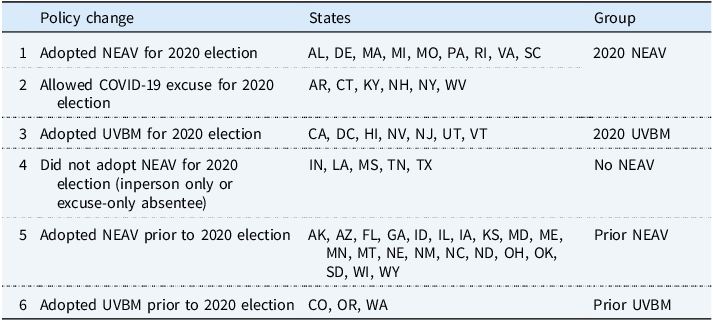
In this study, we focus on voters in several groups of states, categorized based on their vote-by-mail policies in the 2020 U.S. general election. The first group of states includes those that expanded vote-by-mail options by offering NEAV for the first time in 2020 (shown in row 1 of Table 1) or allowed COVID-19 to be a valid excuse for absentee voting in 2020 (NEAV in effect, shown in row 2 of Table 1). To assess the potential impact of adopting NEAV, we compare this combined treated group of states that adopted NEAV in 2020 against states that did not have NEAV prior to 2020 and did not adopt either mail voting measure for the 2020 election (shown in row 4 of Table 1).
Electoral administration groups

Next, we examine the states that already had NEAV but took the more drastic step of adopting UVBM (shown in row 3 of Table 1). We compare these treated states against those that also had NEAV prior to 2020 but did not adopt UVBM for that election (shown in row 5 of Table 1). A final group of states (shown in row 6) already had UVBM prior to the 2020 election; these states are not included in our analyses.
To examine the relationship between NEAV or UVBM adoption and turnout, method of voting, and trust in government, we rely on three datasets: the 2020 CES, the 2020 CMPS, and the 2020 ANES.Footnote 4
We use the 2020 CES to examine turnout. The CES is a national, non-probability, stratified sample survey of 61,000 respondents, administered by YouGov. We use the 2020 CES dataset to measure turnout because respondents are matched to the Catalist database of registered voter data, so the turnout variable reflects actual voter records rather than self-reports.
We use the 2020 CMPS to examine method of voting and trust in government. The CMPS survey was administered after the 2020 election to large oversamples of racial and ethnic groups in the United States in a variety of languages, such as English, Spanish, Chinese, Arabic, and Farsi. The survey used a mixed stratified probability-based and non-probability sampling design to obtain 14,988 completed responses from white, Black, Latino, and Asian Americans. These oversamples of nonwhite respondents allow us to more precisely estimate the relationships between electoral administration, method of voting, and trust in government.
The CMPS measures voting method with a single question that asks, “Did you vote by mail or absentee ballot, vote early in person, or vote in person on Election Day at your precinct or voting center?” We use this question to obtain a binary variable to indicate voting by mail. Anyone who reported voting absentee via U.S. mail or ballot drop box is coded as having voted by mail. Anyone who reported voting in person, whether early or on Election Day, is coded as having voted in person.
We operationalize trust in government in two ways: general trust in government and the distinct perception that government helps Black and Hispanic people.Footnote 5 General trust in government is a composite of three CMPS items measured on 4-point scales: how much of the time do you think you can trust the government in Washington DC to do what is right (Always = 1, Never = 4; reverse coded); how much you agree or disagree with the statement that the political system helps people with their genuine needs (Strongly Agree = 1; Strongly Disagree = 4; reverse coded); and how much of the time do you think you can trust your local government to do what is right (Always = 1; Never = 4; reverse coded). We code responses so that they are increasing in positive perceptions of government. We sum these three responses to create one composite measure and then rescale the index to vary from 0 to 1 (α = .79).
The perception that government helps Black and Hispanic people is a composite of two CMPS items: how much of the time do you think you can trust the government to do what is best for Black people (Always = 1; Never = 4; reverse coded), and how much of the time do you think you can trust the government to do what is best for Hispanic people (Always = 1; Never = 4; reverse coded). We code responses so that they are increasing in trust in government. We sum these two items to create one composite measure and rescale it to vary from 0 to 1 (α = .809).
Finally, we use the 2020 ANES to examine trust in election officials specifically. The 2020 cross-section of the ANES is a national probability-based survey of 8,280 respondents, interviewed in a two-wave panel survey (one wave fielded before and the other after the 2020 election). In the pre-election survey, respondents were asked how much they trusted election officials in their area. Because this question was fielded prior to the election (between August and November 2020), we can use the item to assess the impact of changes in electoral administration on trust in the officials implementing that change, without this perception being distorted by the actual election outcome. For example, if a respondent’s favored candidate won, then their trust in election officials may increase. Meanwhile, if their favored candidate lost, then their trust in election officials may decrease. By only looking at pre-election responses, we can at least rule out the actual election outcome as a confounding variable. On the ANES, respondents are asked, “How much do you trust officials who oversee elections where you live?” Respondents answered on a scale of 1 (Not at all) to 5 (A great deal), increasing in trust. We rescaled the survey responses to range from 0 to 1, with higher values indicating greater trust.
Because the adoption of new voting procedures—and voters’ behavior in response—is nonrandom but rather is endogenous with key individual-level characteristics like education, gender, age, etc., simple regression techniques may distort true relationships of interest. We employ CEM to create comparison groups among those who are “treated” by experiencing a particular type of electoral reform and those who are not (King et al. Reference King, Nielsen, Coberley, Pope and Wells2011). By matching along five key demographic characteristics—education, residential urbanicity, age, partisan identification, and gender—CEM reduces imbalance along these covariates, instead pruning the sample to exclude observations without a valid match in the treatment and control.
These demographic characteristics are powerfully and consistently related to both voting participation behavior and vote choice (e.g., Campbell et al. Reference Campbell, Converse, Miller and Stokes1960; Cramer Reference Cramer2016; Key Reference Key1949; McKee Reference McKee2008; Verba et al. Reference Verba, Schlozman and Brady1995; Wolfinger and Rosenstone Reference Wolfinger and Rosenstone1980). Thus, matching on these observables—particularly under conditions of strong and broad nationalization of U.S. politics (Hopkins Reference Hopkins2018)—lends confidence that the differences we find are a function of the classes of changes in election administration across states, rather than idiosyncrasies of individual states’ political environments. That said, we acknowledge that matching is an imperfect causal identification strategy, and we face several substantive threats to inference in this setting (e.g., from differences in other relevant state policies, different sets of candidates running across states, different economic or geographic conditions across states, etc.). We therefore limit ourselves to describing relationships in lieu of making causal claims, and we use matching to refine our analyses by absorbing sociodemographic distortions on the main relationships of interest. Our findings may thus be interpreted as being consistent with a potential causal story rather than proof positive.
For the treatment of NEAV adoption, our treatment group is voters in 2020 NEAV states, and our control group is voters in no NEAV states. One way to interpret this comparison is the effect of the first election after adoption of NEAV on our outcomes of interest. Similarly, for the treatment of UVBM adoption, our treatment group is voters in 2020 UVBM states, and the control group is voters in prior NEAV states. Again, this comparison could be interpreted as the effect on the first election after adoption of UVBM. Every state that currently has UVBM had NEAV before moving to a UVBM voting system. The resulting samples of voters for each treated and untreated group are alike on all selected covariates, as each treated unit is paired with untreated units of the same coarsened covariate values to approximate as-if random assignment (Iacus et al. Reference Iacus, King and Porro2012).Footnote 6 After creating matched samples, we look at the relationship between treatment and outcomes of interest using either a logit or ordinary least squares model, with controls for our matching variables, weights according to each data source, and standard errors clustered at the state level.
Mail Voting Adoption, Turnout, and Method of Voting Across Racial Groups
First, we are interested in whether the adoption of NEAV or UVBM is related to voter turnout. For this analysis, we use validated voter data from the CES to measure turnout. Our hypothesis is that the first adoption of NEAV or UVBM will correspond to increased turnout for all voters (Hypothesis 1a).
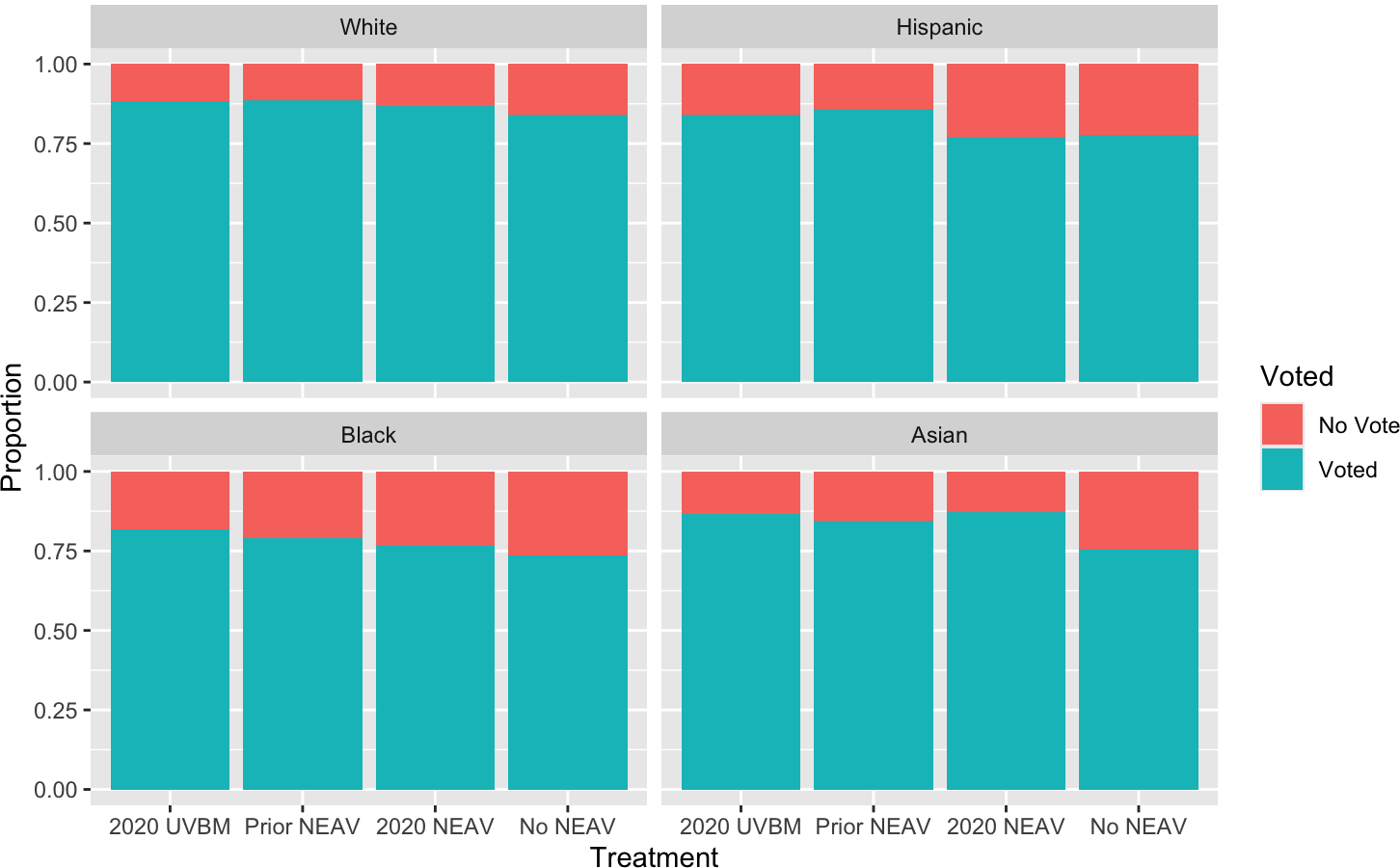
Figure 1 shows turnout by treatment across racial groups among CES respondents. We note that validated turnout in the CES sample is very high across the board—and considerably higher than the actual national turnout rate of the voting eligible population in the 2020 election, about 67% (AEI and MIT Election Data+Science Lab 2021).Footnote 7 This could be due to the opt-in nature of the YouGov sample and nonresponse bias; individuals willing to answer political surveys are also potentially more likely to vote (Sciarini and Goldberg Reference Sciarini and Goldberg2016). Our findings from this analysis are thus likely to apply primarily to more engaged voters and may not apply broadly across the general population.
Turnout by treatment group across race.

Descriptively, Figure 1 shows partial support for our expectation that mail voting reforms increase turnout. White voters turn out at higher rates compared to other racial groups on average, but within most racial groups, turnout is lowest in “No NEAV” states, where voters have very limited vote-by-mail options and must rely on in-person voting. We observe small positive differences between the 2020 UVBM states and the Prior NEAV states, as well as between the 2020 NEAV states and the No NEAV states.
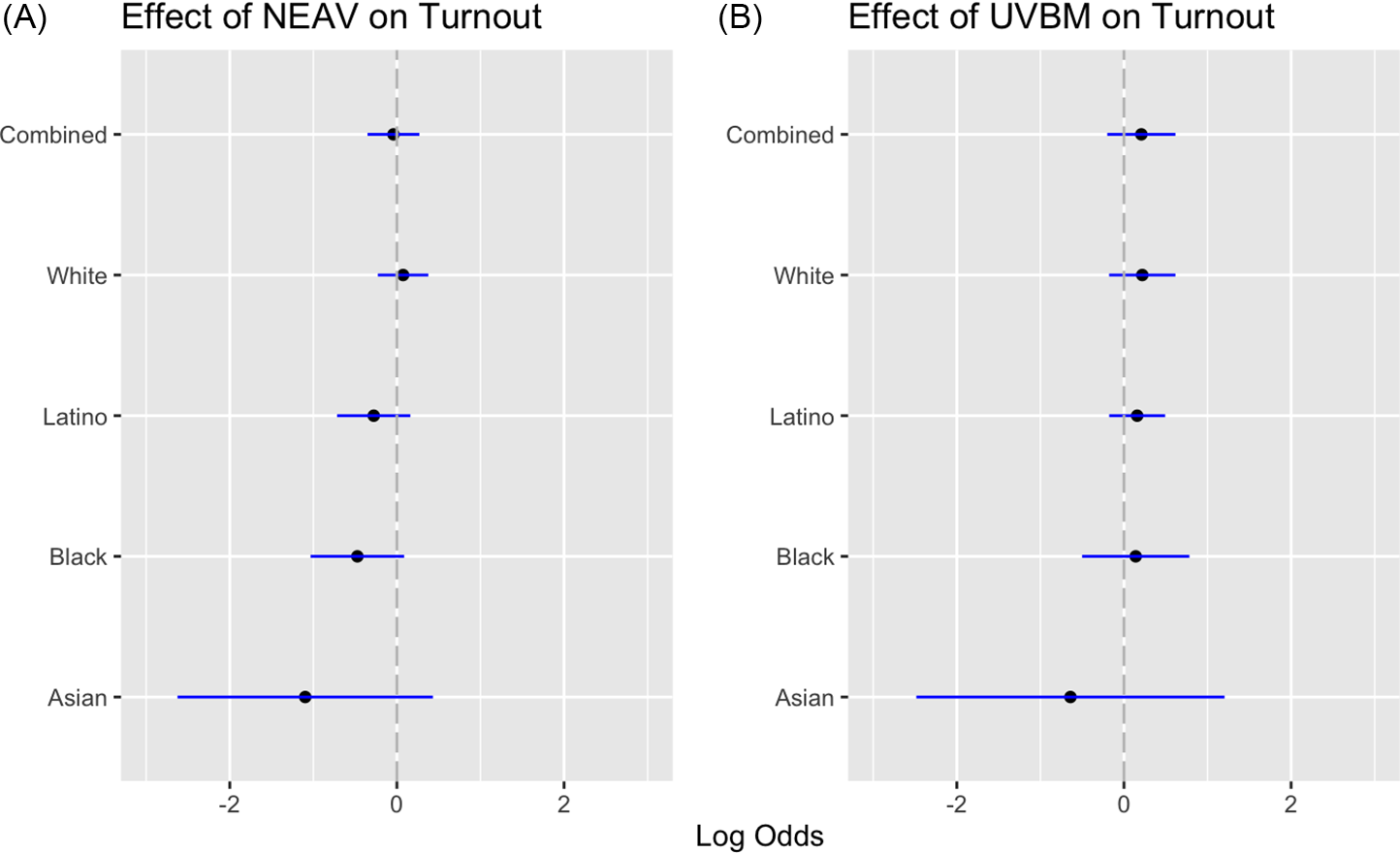
Figure 2 shows the estimated average treatment effect on turnout of adopting NEAV and UVBM in 2020 with our CEM analysis.Footnote 8 Overall, our analysis suggests that adopting NEAV did not correspond to improved turnout for most racial groups during the 2020 election (Figure 2A). For Black voters, those in NEAV states might be slightly less likely to vote in the 2020 general election compared to similar Black voters in no NEAV states. The magnitude of this change is quite large, where the odds of a Black voter in a NEAV state turning out to vote are about 38% lower compared to a similar Black voter in a no NEAV state. However, this point estimate is not statistically distinguishable from zero. Meanwhile, adopting UVBM corresponds to improved turnout across all racial groups by a factor of about 1.23 (Figure 2B), consistent with previous findings (e.g., Bonica et al. Reference Bonica, Grumbach, Hill and Jefferson2021).
Electoral administration and turnout.

There are a few possible reasons why we observe a weak relationship between electoral administration and turnout, particularly for NEAV (as a less drastic reform). First, as noted above, the CES sample is biased toward politically engaged respondents (Sciarini and Goldberg Reference Sciarini and Goldberg2016). This may induce a ceiling effect in our observed data: those who are more likely to vote regardless of policy are more likely to appear in our data, so there is little room for the policy to generate an improvement. In addition, voter turnout overall was abnormally high during the 2020 election (Hartig, Keeter, and Green Reference Hartig, Keeter and Van Green2023), potentially producing a more general ceiling effect. Second, we examine only the effect of the first adoption of NEAV and UVBM. It may take repeated exposure and opportunities to vote for these policies to affect turnout more substantially. Third, because the unique conditions of the pandemic generated broad public demand for state governments to adapt election procedures to protect public health—such as through expansions of mail voting—the failure of no NEAV states to implement such policies may have generated a backlash and countermobilization that also increased turnout in those states (as in response to, e.g., voter ID laws; Citrin et al. Reference Citrin, Green and Levy2014; Valentino and Neuner Reference Valentino and Neuner2016).
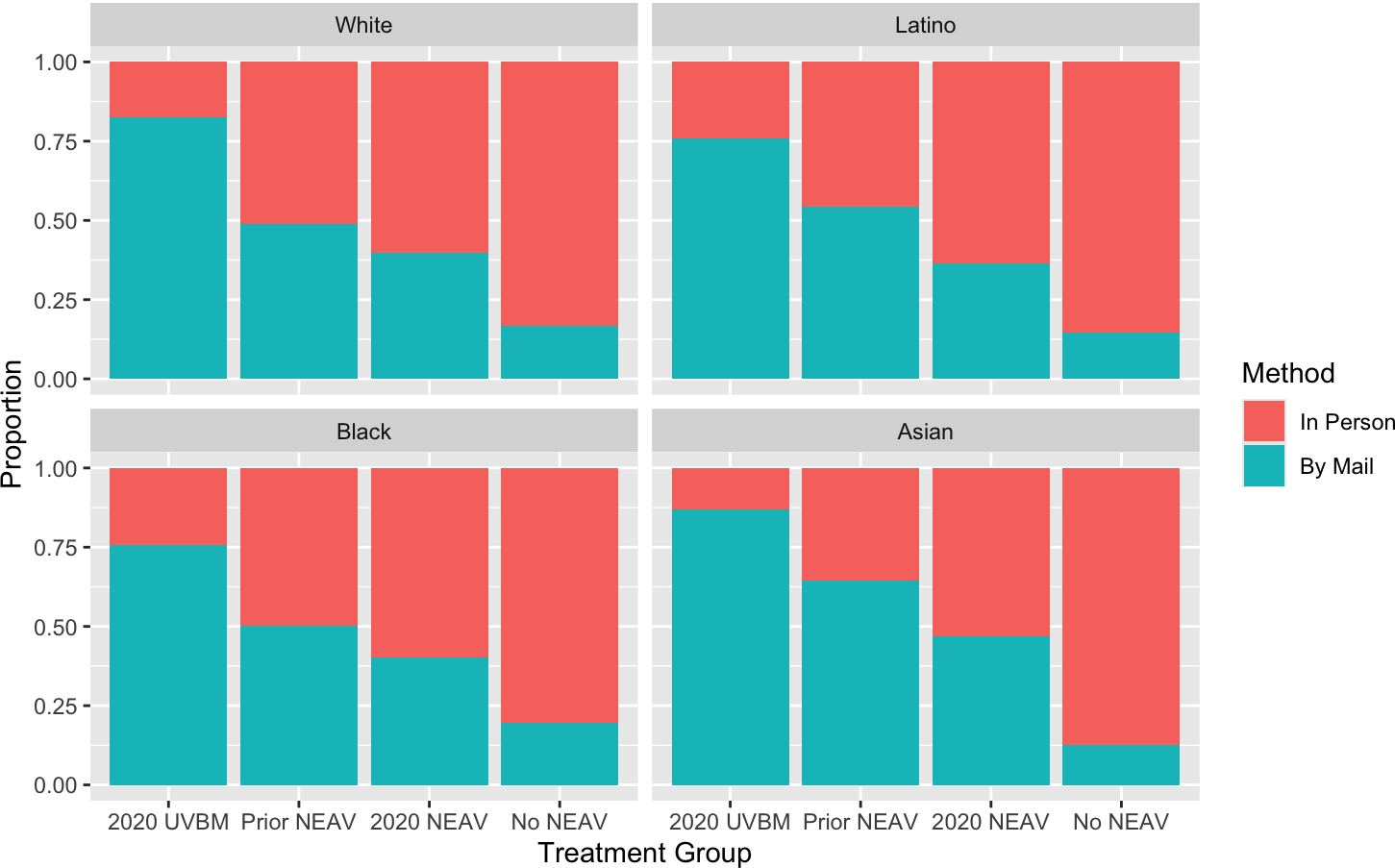
Next, we address how expanding mail voting might be related to how people choose to vote. For this analysis, we use survey data from the CMPS to measure method of voting. We expect the adoption of NEAV or UVBM to increase voting-by-mail across all racial groups (Hypothesis 1B). Our analysis supports this hypothesis. Figure 3 shows the proportion of voters who voted via mail-in ballots by race and treatment. Voters used absentee ballots most in states that moved to UVBM,Footnote 9 followed by states with prior NEAV experience, and then states that moved to NEAV in 2020. As expected, there was relatively little vote-by-mail happening in no NEAV states (where voters could only cast mail ballots for specific allowed reasons, such as overseas deployment).
Method of voting by treatment and racial group (clustered by racial group).

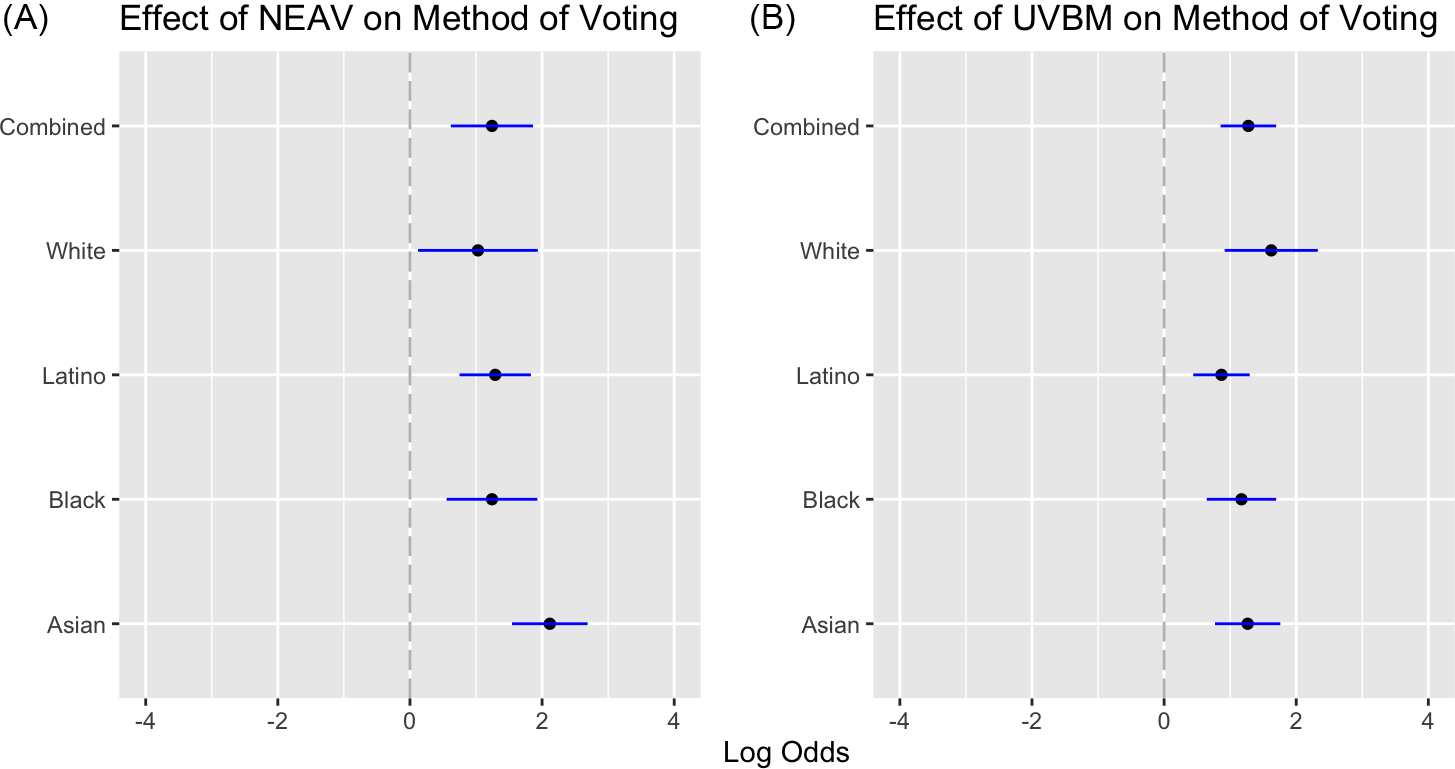
Figure 4 shows the average treatment effect of adopting NEAV and UVBM in 2020 in the CEM analysis on method of voting.Footnote 10 Across all racial groups, NEAV and UVBM are correlated with an increased probability of voting by mail. Looking at NEAV adoption (Figure 4A), Asian, Black, Latino, and white voters were much more likely to vote by mail in newly adopting NEAV states compared with votes in no-NEAV states. Asian voters in NEAV states are eight times more likely to vote by mail compared to Asian voters in states with no NEAV. Meanwhile, Black, Latino, and white voters were about three to four times more likely to vote by mail compared to similar voters in no NEAV states.
Electoral administration and method of voting.

Figure 4B shows the average treatment effect of adopting UVBM in 2020 on method of voting. Compared to voters in states that had no change in electoral administration but had NEAV before 2020, Black, Latino, Asian, and white voters in states that enacted UVBM were two to five times more likely to vote via absentee ballot.
Moderate increases in the probability of voting by mail in UVBM states may be explained by previous experience with vote-by-mail. Every state that transitioned to UVBM in 2020 had NEAV prior to 2020, so voters in 2020 UVBM states may have more experience with vote-by-mail and are therefore more trusting of that system and more willing to use it. Indeed, many voters in 2020 UVBM states may have already been voting by mail (via NEAV) prior to 2020. The combination of these factors could explain moderate increases in the probability of voting by mail. These findings are in line with our expectation that adoption of NEAV or UVBM would increase the probability that voters of all racial groups choose to vote by mail.
For turnout and method of voting, there is another type of variation we might be interested in: timing of the decision to implement changes. Some states that expanded to NEAV or UVBM passed legislation to institute these electoral changes prior to the COVID-19 pandemic. Instead of updating their election administration in response to the pandemic, they had already planned for these changes. The first general election in which the laws were in place just happened to be the 2020 general election. Michigan, Pennsylvania, Rhode Island, and Virginia all voted to enact NEAV prior to 2020, but the first general election with these rules in place was the 2020 election. Meanwhile, Utah and Hawaii had enacted UVBM prior to 2020, but their first general election with these rules in place was also 2020.
This variation allows us to consider any difference in first adoption due to COVID and first adoption in the absence of COVID. By disentangling these two types of policy adoption, we can begin to circumvent concerns about bundled treatment—states that opted to adopt NEAV and UVBM in response to the pandemic probably enacted other COVID-response policies that could alter turnout, method of voting, and trust in government. We found that states that choose to adopt NEAV or UVBM prior to 2020 had stronger positive treatment effects compared to states that adopted these measures in response to COVID-19. This difference could indicate that states that adopted NEAV or UVBM early had voters who were more in favor of or prepared for voting by mail.Footnote 11
Mail Voting Adoption and Racial Differences in Vote-By-Mail
In terms of mail voting adoption, we expect differences by race. First, descriptively, we expect Black voters to vote by mail at proportionally lower rates than Asian, Latino, and white voters in the 2020 general election (Hypothesis 2).
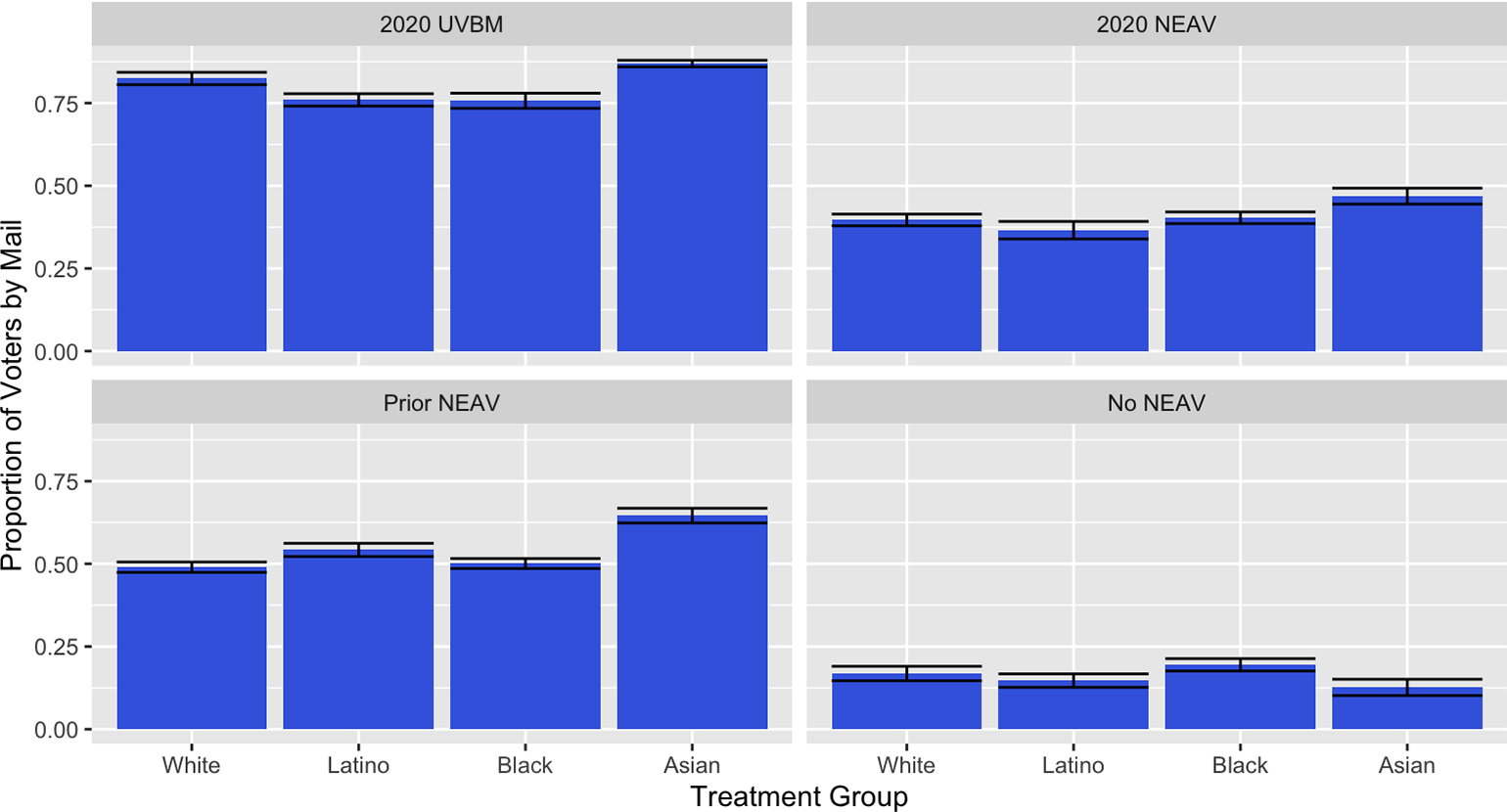
Figure 5, similar to Figure 3, shows the proportion of voters who cast their ballots via mail by race and treatment group, but bars are grouped by treatment to compare rates of voting by mail across race but within different mail voting regimes. In partial support of our expectations, Black voters cast their ballots by mail at lower rates compared to white and Asian voters in the 2020 UVBM states, relative to Asian voters in the 2020 NEAV states, and relative to Latino and Asian voters in the Prior NEAV states. However, Black voters appear to vote by mail at higher rates than other racial groups in no NEAV states.
Method of voting by treatment and racial group (clustered by treatment).

We also expect Black voters to respond differently to expansions of mail voting compared to white, Latino, and Asian voters (Hypothesis 3). Specifically, in states that adopted NEAV and UVBM in 2020, we expect Black voters will choose to vote in person (rather than by mail) at higher rates than Asian, Latino, and white voters. In other words, we expect Black take-up of the NEAV and UVBM mail voting options will be lower than for voters from other racial groups.
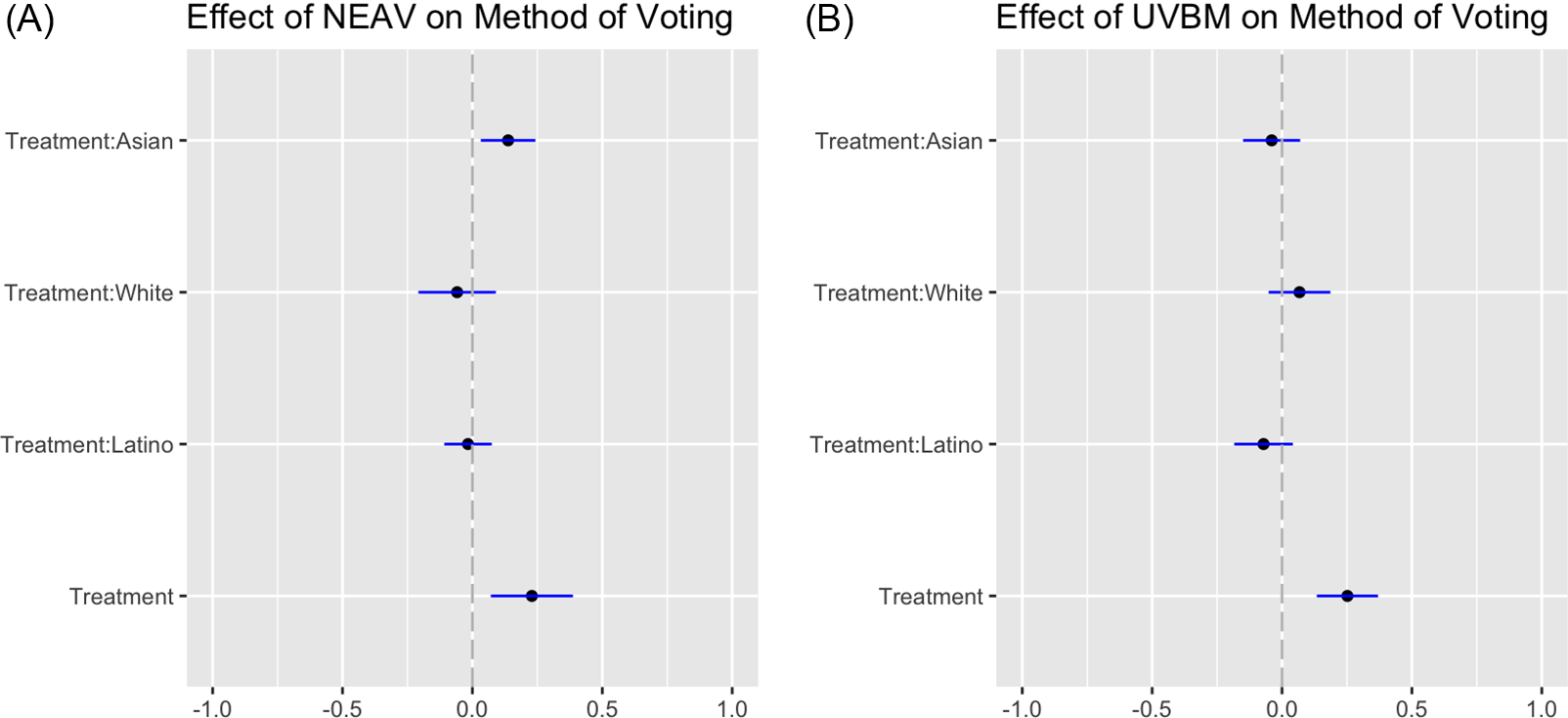
To test this hypothesis, we combined each racial group into a single model that includes an interaction between race and treatment. Figure 6 shows the relationship between the treatment and race interaction (NEAV adoption on Panel A and UVBM adoption on Panel B) and method of voting. The baseline racial group is Black voters. First, both NEAV and UVBM are associated with increased vote-by-mail for Black voters by a factor of about 1.2, and the relationship for Black voters is not statistically distinguishable from the relationship for white voters under either treatment.
Electoral administration and method of voting with treatment and race interaction.

We predicted that the uptake for Black voters would be less than uptake for Asian and Latino voters. The relationship between treatment and vote-by-mail for Black voters is distinct from the relationship for Asian voters in NEAV states. In NEAV states, Asian voters chose to vote by mail more often than Black voters, but we find no significant differences between Black and Latino (or white) voters in terms of mail voting uptake. The magnitude of the difference between Asian and Black voters in NEAV states is also not large. In NEAV states, Black voters are 1.2 times more likely to vote by mail compared to 1.4 times more likely to vote by mail among Asian voters.
We make three additional observations here. First, all groups of voters in the NEAV-treated states embraced the new method of voting to a meaningful degree, despite the often sudden and novel implementation of this voting regime in the 2020 election. This is consistent with our broader hypothesis about an increase in mail voting among adopting states (Hypothesis 1B).
Second, with respect to Hypothesis 2—that Black voters will have chosen in-person voting at higher rates than other groups—we see mixed evidence. While Black voters do appear to have opted for in-person voting at higher rates than Asian voters across Prior NEAV, 2020 NEAV, and 2020 UVBM states, they do not appear notably different from white and Latino voters. With respect to Hypothesis 3—that Black take-up of mail voting in the treated NEAV and UVBM states, we have null findings, with Black voters rarely eschewing mail voting options relative to other racial groups. One possibility for this outcome may be that the global pandemic put pressure on voters—and particularly Black and Latino voters who experienced disproportionate harms from the virus—to vote by mail instead of in person to protect their health.
Third, Asian voters appear to be an outlier with respect to their uptake of mail voting in NEAV states. They saw the greatest increase in mail voting of any group in new NEAV states. One possible explanation is that the combination of pandemic health threats and Asian hate crimes may have made it more attractive to vote by mail. The U.S. Department of Justice (2023) found a 77% increase in hate crimes against Asian Americans between 2019 and 2020.
Mail Voting Adoption and Racial Differences in Trust in Government
Electoral administration changes, particularly during a presidential election year in the midst of a global pandemic, can telegraph to voters the government’s role in society. By taking steps to protect public health and reducing barriers to electoral participation, states may have signaled a responsive and protective role, particularly among those who have historically been underserved and excluded from the electoral process. Conversely, such efforts could be perceived as paternalistic or even subversive among voters who viewed the medical establishment skeptically or heeded Republicans’ false claims that mail voting facilitates fraud.
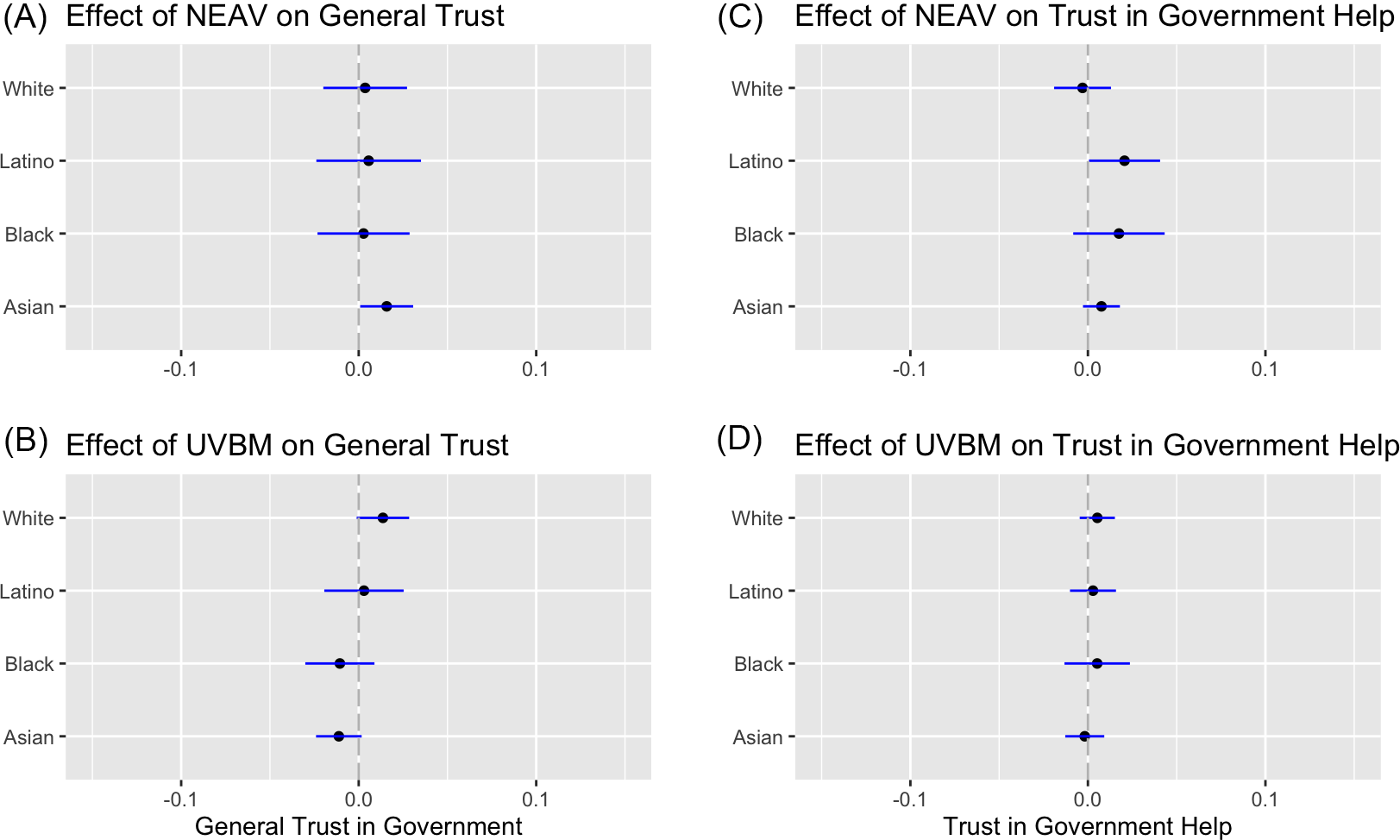
Figure 7 shows the average treatment effect of adopting NEAV and UVBM on general trust in government and trust that the government helps Black and Hispanic people.Footnote 12 Panels A and B look at the relationship between NEAV and UVBM, respectively, on general trust in government. Panels C and D look at the relationship between NEAV and UVBM, respectively, on trust that the government helps Black and Hispanic people.
Electoral administration and trust.

In general, we do not find consistent patterns in the relationship between experiencing first-time adoption of NEAV or UVBM and either measure of trust. We find some mixed support for Hypothesis 4A (Relative to Asian and Latino voters in non-expanding states, Asian and Latino voters will experience increased trust in government in both NEAV and UVBM states). First, Asian voters in NEAV states experienced an increase in general trust in government and Latino voters in NEAV states experienced an increase in trust that government helps Black and Hispanic people. However, these increases were substantively very small—a one to two percentage point increase. Also, contrary to our expectations, Asian voters in UVBM states experienced a one percentage point decrease in general trust in government. Notably, however, the magnitude of these estimates is small in each case, and the confidence intervals give us pause in drawing strong conclusions from these results. We find no support for Hypothesis 4B (Relative to Black voters in non-expanding states, Black voters will experience increased trust in government in NEAV states, but not in UVBM states). Black voters did not experience a change in general trust in government or trust that the government helps Black and Hispanic people in either the NEAV or the UVBM conditions.
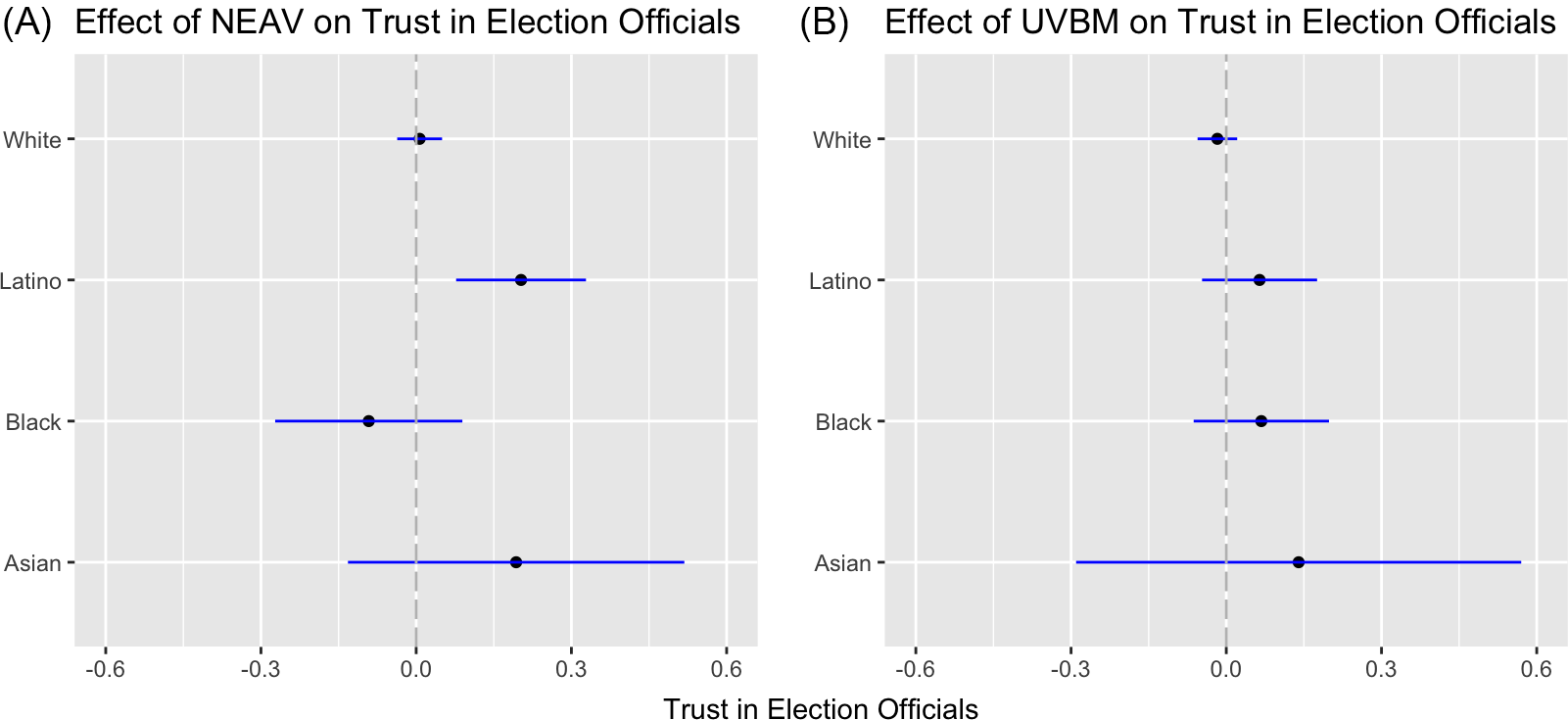
It is possible that a more appropriate measure would explore trust specific to elections rather than general trust in government. For example, electoral administration changes could have a more significant effect on trust in election officials. While the CMPS does not have a question on trust in election officials, the 2020 ANES cross-sectional survey does. Figure 8 reports the results on adoption of UVBM and NEAV on people’s reported trust in election officials.Footnote 13
Electoral administration and trust in election officials.

Overall, it does not appear that either NEAV or UVBM adoption is related to trust in election officials for any racial group, except for Latino voters in NEAV states. In NEAV states, Latino voters experienced a 20-percentage point increase in trust in election officials compared to similar voters in non-NEAV states. The other point estimates are not statistically distinguishable from zero. We note, however, that ethnoracial group analysis with the ANES dataset is difficult because of the small sample sizes among racial subsamples; without over-sampling by race, it is difficult to get precise estimates for Black, Latino, and Asian respondents. The confidence intervals are very large, particularly for Asian respondents. Nevertheless, for white respondents—a sufficiently large sample to provide precise estimates—NEAV and UVBM adoption still do not appear to correspond to trust in election officials; the point estimates are substantively zero.
These findings suggest that fluctuation in trust during 2020 may be attributable to other factors, such as how state governments chose to handle COVID-19 lockdowns, rather than their election administration choices. Policies that expanded mail voting may have been seen as public health measures more than election integrity and equity measures. If voters saw electoral administration changes as health policies rather than election policies, it makes sense that we would see some movement across general trust and trust in government help for Black and Hispanic people but not trust in election officials. Additionally, when respondents were asked about their trust in election officials, they had not yet seen the outcome of an election. They may not yet have enough information to update their priors on trust in election officials.
We also looked at how variation in when NEAV or UVBM was adopted affected general trust in government, trust that government helps Black and Hispanic people, and trust in election officials. We found no significant differences between states that choose to change their election administration prior to 2020 or in response to the COVID-19 pandemic.Footnote 14
Conclusion
The 2020 election was unique for many reasons, but one notable change was the relatively rapid shift in electoral administration for millions of Americans. Nearly half of the states changed their electoral administration procedures in order to protect public health and preserve election security. Given that different racial groups have different histories with voting in the United States, we expect these policies to have differential effects across racial groups, particularly with Black voters less likely to take up mail voting even when made newly available.
We investigated how NEAV and UVBM adoption were related to turnout and method of voting across all racial groups. We also looked at whether electoral administration changes had differential effects across race on method of voting and trust in government. Overall, we found that NEAV and UVBM were not related to changes in turnout. While we found support for our prediction that NEAV and UVBM adopting states saw an increase in mail voting, those differences were not racially disparate in the manner we anticipated. Instead, only Asian voters in NEAV stood out for opting to vote by mail at higher rates. Additionally, contrary to our expectations, electoral administration changes were not reliably related to changes in trust in government broadly or election officials more specifically for any racial group. While adoption of NEAV may correspond to increased trust in government among Latino voters, we are hesitant to give too much weight to these results.
There were many factors that made the 2020 election unique. The electoral administration changes were motivated, in part, by a global pandemic. A major political party and a candidate for president were calling into question the legitimacy of elections and mail voting in particular. Additionally, a national debate surrounding race and equality was happening in the United States. States that chose to change their electoral administration policies also likely made changes to other policies, and voters in these states likely also had different attitudes toward the pandemic. These changes and attitudes may also influence the political behavior of American voters.
With that in mind, there are still two significant takeaways from this work. First, voters of color are not a monolith, and they do not respond to policy change in the same way. Work like the CMPS that oversamples racial minorities in the United States is critical to understanding the different ways people of color experience and engage with American democracy. With this article, we contribute to the growing literature on race, political behavior, and policy feedback, which takes seriously the idea that race conditions interactions with government and feedback effects of public policies.
Second, electoral administration has the capacity to alter how citizens experience government. This analysis shows that voters are willing to engage in mail-in voting and that doing so may have very limited consequences for government trust for some groups. Though we did not see increases in turnout or consistent increases in trust in the first election after policy adoption, it is possible that cumulative experience with these voting changes may beget increased political participation and trust in the future. Notably, our findings also suggest that, despite a historically greater appetite for in-person voting, Black voters are not considerably less likely to engage in novel forms of ballot casting like mail voting.
There is much room for future work. This study focuses on the 2020 election. As we note, there were many things about that contest that were unique: the global pandemic, the political context, and the partisan and racialized rhetoric tied to both. We do not yet know how NEAV or UVBM adoption functions under other circumstances, nor do we have a robust understanding of how NEAV or UVBM might have racialized effects on voters over time (though see Bonica et al. Reference Bonica, Grumbach, Hill and Jefferson2021; Trexler et al. Reference Trexler, Martinez and SoRelle2025), in part because of limited availability of data for longitudinal analysis of racial subgroups in this domain. Does previous vote-by-mail experience increase future vote-by-mail and trust in government? Does longer exposure to vote-by-mail options, without using vote-by-mail, increase future propensity to vote by mail and trust in government? Are any of these patterns racialized?
Understanding how electoral administration shapes the behavior of voters of color is a critical task. Different ethnoracial groups have different experiences and historical legacies with voting in the United States. Given unique historical backgrounds, it makes sense that electoral administration changes would have differential effects across groups. Yet, this study suggests there may be limits to the effects of those historical differences when it comes to the impact of electoral reforms. If scholars and policymakers are interested in designing electoral institutions that increase voting equity, special attention should be paid to how electoral administration changes affect turnout, method of voting, and trust in government for Americans of color.
Supplementary material
The supplementary material for this article can be found at https://doi.org/10.1017/rep.2026.10069.
Funding statement
This research was not funded by any specific grant.
Competing interests
None.


 Open access

