


During the production process an error was introduced into the “Labels, characteristics and percentages of the six trajectory groups” section of table 2. The correct version of table 2 is shown on page 2.
Labels, characteristics, and percentages of the six trajectory groups
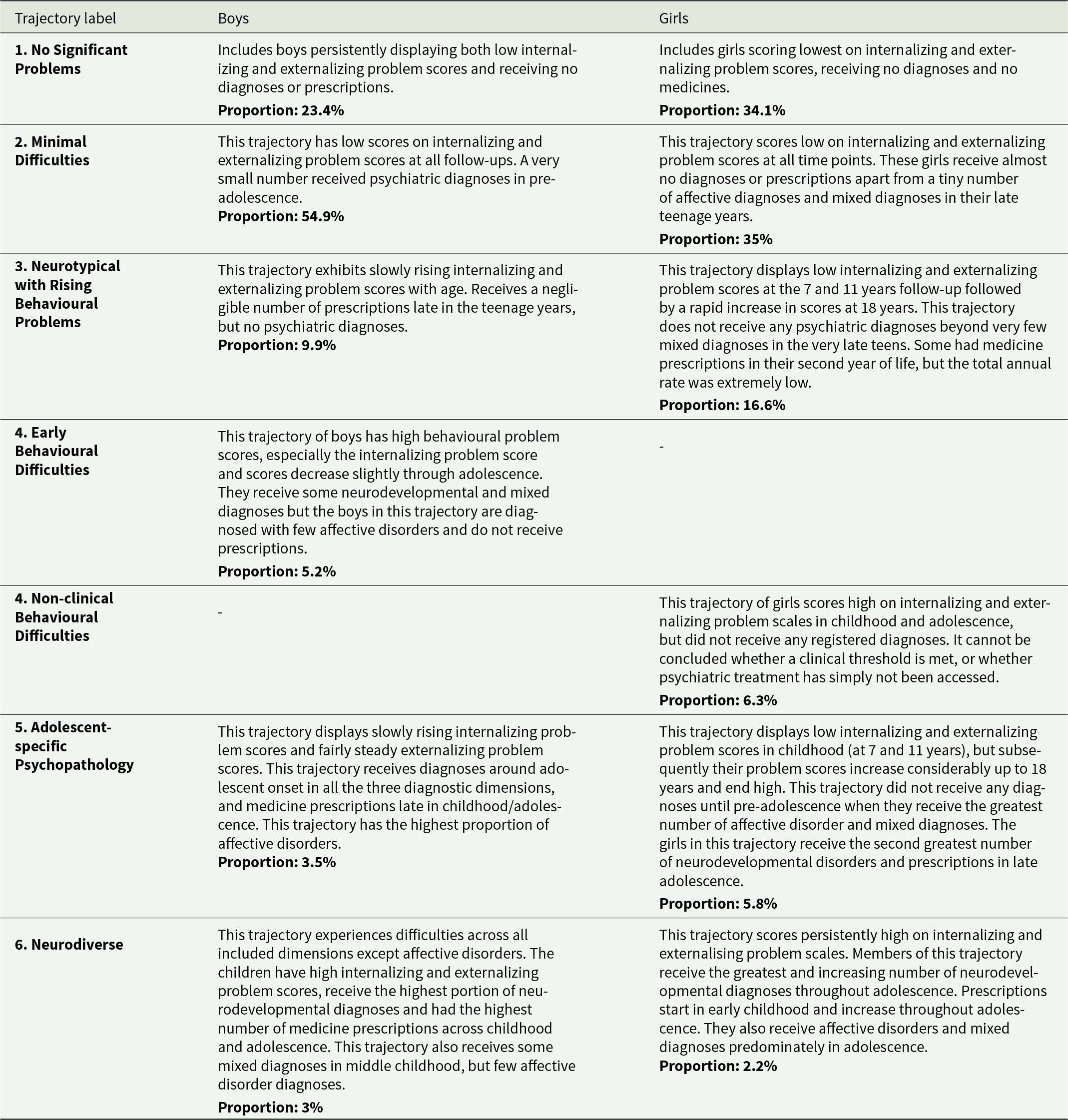
Table 2 Long description
The table summarises six distinct mental health trajectory groups, describing emotional-behavioural difficulties, psychiatric diagnoses and psychotropic medication use for boys and girls, plus each group’s proportion. For boys, Minimal Difficulties is the largest group at 54.9%, followed by No Significant Problems at 23.4%; the remaining groups are smaller, including Neurotypical with Rising Behavioural Problems at 9.9%, Early Behavioural Difficulties at 5.2%, Adolescent-specific Psychopathology at 3.5%, and Neurodiverse at 3%. For girls, the two largest groups are Minimal Difficulties at 35% and No Significant Problems at 34.1%, followed by Neurotypical with Rising Behavioural Problems at 16.6%, Non-clinical Behavioural Difficulties at 6.3%, Adolescent-specific Psychopathology at 5.8%, and Neurodiverse at 2.2%. A sex-specific difference appears in group four: boys have Early Behavioural Difficulties with high early behavioural scores and some neurodevelopmental or mixed diagnoses, while girls have Non-clinical Behavioural Difficulties with high scores but no registered diagnoses. Neurodiverse is the smallest group for both sexes and is marked by persistently high problem scores and the highest neurodevelopmental diagnoses and medication use, with girls also showing affective and mixed diagnoses mainly in adolescence. Interpretive caveat: the “Non-clinical Behavioural Difficulties” label for girls notes that lack of recorded diagnoses might reflect unmet clinical need or limited access to care.
The Publisher apologises for the error.


 Open access

