




In the winter of 1894, Fanny Bullock Workman and her husband, William Hunter, paused their bicycle tour to rest under an olive grove just outside the city of Tlemcen in northern Algeria.Footnote 1 There, they watched “the passing Arabs, some on foot, some on horseback, with their veiled women sitting behind,” and recalled that it was “like a scene from the ‘Arabian Nights.’” Rather than pleasure, however, this Orientalized fantasy created a temporal and spatial uneasiness in the Workmans. The modern technologies of railroad, steamship, and bicycle had brought the Workmans to North Africa, and in the Algerian sun, they struggled to “recall the fact that, one week before, we were living under the leaden winter skies of Germany.” Modern mobility disrupted their sense of time, space, and importantly, place. These industrial technologies brought the Workmans not to the future but to an imagined and fantasized past.Footnote 2
It should not be surprising that new technologies produced feelings of temporal and spatial disquiet in the imperial setting. Empire was, after all, a temporal regime. The logic of imperial rule was often justified by claiming that people and spaces were behind European and American civilization and had to be brought, often coercively and violently, into the future. In many ways, the entire technological apparatus of the nineteenth-century “West” was given profound meaning when labeled as “progress.” Here, however, I am less interested in following the many ways imperial regimes used technology to temporally displace their colonial subjects in order to rule them.Footnote 3 What I am more interested in is the ways a technology of personal mobility, in this case the bicycle, facilitated a temporal way of experiencing and knowing European empire for American interlopers.
In this article, I follow Fanny Bullock and William Hunter Workman on a series of global bicycle journeys between 1894 and 1899 to reveal how a novel technology of personal mobility shaped their understanding of the world at the very moment the United States transitioned from a continental settler empire to an overseas and imperial one. Despite a reliance on thickening networks of transimperial power, the bicycle allowed the Workmans to leave colonial railroads and tourist steamships in ways that gave their mobility an intense sense of meaning and that intersected with their race, class, and gendered subjectivities. On a bicycle, the Workmans believed passionately that what they saw was authentic in a world shaped by the rapid expansion of European empires. In doing so, they crafted a fantasy of independent travel that fed a belief in their own superiority as transimperial actors.Footnote 4
In the first decade of the twentieth century, Fanny Bullock Workman was one of the most famous American women in the world, internationally renowned for her mountaineering exploits. Born in Worcester, Massachusetts, in 1859 to Alexander Hamilton Bullock, a former state governor, and Eliza Bullock, a wealthy socialite, Fanny Bullock married William Hunter Workman, a physician roughly a decade her senior, in 1881.Footnote 5 In 1906, she became the first woman to reach the 23,000-foot barrier. Prior to her mountaineering career, however, Workman was a keen cyclist who pedaled through most of western Europe, North Africa, and portions of the Levant with her husband (Figure 1). In 1897, the Workmans set out to cycle the length of Asia, ending their tour in 1899 in Srinagar where, captivated by the Himalayas, Fanny Bullock turned her focus to mountaineering. During this time and after, the Workmans co-authored a series of travelogues detailing their cycling and mountaineering adventures across global empires. Although always traveling in the company of her husband, Fanny Bullock was very much the public face of the duo, and all but one of their published travelogues list her as the lead author. The Workmans, compared to other cycling adventurers of the period, also left an extensive archive.Footnote 6 As one of the most well-known adventurers in the United States and Europe at the turn of the century, Fanny Bullock presented herself as a “New Woman.”Footnote 7 In riding her bicycle across global empires and climbing some of the world’s highest peaks, Workman pushed the perceived limits of feminine ability well beyond their breaking point. Given her historical significance, I have chosen to focus primarily, although not exclusively, on the gendered experience of Fanny Bullock as the Workmans cycled through the imperial world to help bridge a gap between new work on mobility and more recent work on the entangled histories of U.S. empire to show that how people move matters.Footnote 8
Fanny Bullock Workman utilized the “safety” bicycle to self-fashion herself as a modern New Woman. Source: “Workman in front of bike,” correspondence, journals, accounts, photographs, maps and miscellaneous papers of Fanny Bullock Workman, 1867–1939, Acc. 9893/48, National Library of Scotland, Edinburgh, UK, reproduced with permission of the MacRobert Trust.

From the very beginning of the bicycle revolution, Americans were keenly aware that they were one spoke in a global culture of cycling. The modern “safety” bicycle—wheels of equal size, diamond frame, chain drive—was first produced in Coventry, England, in 1885, and by 1887, it could be found across the United States and around the world. In its initial years, the safety bicycle was viewed as a technology of elite white civilization before it was quickly embraced by a larger class of people who resisted and challenged this narrative of white exclusivity.Footnote 9 In the United States, the bicycle was first socialized as a fashionable way for middle-class men to confirm their class status, masculinity, and ease with modernity. Likewise, middle-class women embraced the safety bicycle’s radical potential for spatial liberation and sparked a transnational debate on the suitability of cycling for women. For numerous commentators in the late nineteenth century, feminine emancipation was synonymous with the bicycle.Footnote 10 Given this social impact, many Americans believed that the bicycle would lead to a radical transformation of their nation.Footnote 11
Although modern and mechanical, in the 1890s, bicycle technology was thought of as a more “natural” experience compared to other technologies of industrial mobility such as the railroad. As the cultural historian Ellen Gruber Garvey puts it, the safety bicycle was “imagined not as another machine in the garden but as a part of the garden.”Footnote 12 What urban historian Even Friss labels the bicycle’s “spatial flexibility” gave many an opportunity to get off the beaten path and find what they believed were “authentic” spaces, objects, and peoples.Footnote 13 Likewise, literary scholar Dave Buchanan has gone so far as to argue that the first wave of middle-class cycling was as much an “aesthetic as an athletic activity [that] looked backward more than forward.”Footnote 14 These dynamics—time, nature, and technology—were all at the forefront of the Workmans’ experience of imperial space.Footnote 15
In believing in the radical independence the bicycle facilitated, the Workmans thought they had entered into a new realm of imperial mobility that gave their movement a powerful sense of purpose. Fanny Workman’s elite status allowed her to move through and between empires with ease. Her mobility on a bicycle was an act of imperial privilege that (re)produced the discourses and subjectivities of racial supremacy. For Fanny Workman, the fact that she accomplished this travel on a cutting-edge human-powered technology only further underscored her belief in the global rise of white women. And, unlike Nellie Bly, who famously traveled on steamship and railroad for a seventy-two-day dash around the world in 1889, Fanny Bullock’s journeys tested the physical capabilities of white womanhood in intimate imperial spaces.Footnote 16 As Tracy Jean Boisseau has argued, white feminism at the turn of the century was rooted in “colonialist imagery and frontier ideology.”Footnote 17 Workman’s own career as a global cycling adventurer, mountain climber, anthropologist, and geographer, makes clear how expansive this archetype was.
When looking at American travel abroad at the end of the nineteenth century, scholarship has focused on U.S. business interests in and tourism to Europe, while to a lesser degree historians have looked at missionary and business activity in Africa and Asia.Footnote 18 But what of the travelers who left Europe behind and were not interested in Christian mission or capital accumulation? How did they give meaning to the practice of movement through space at the height of imperial modernity? By taking seriously how and in what ways people moved through multiple and overlapping imperial modalities, I argue, we can better access the American experience of the world at a granular level. For Fanny Bullock and William Hunter Workman, their journeys illuminate the ways temporal fantasies, facilitated by a new technology of mobility, mediated their comprehension of and self-positioning within the infrastructure and networks of European empires.
In what follows, I take a thematic approach to make clear the ways the Workmans’ experiences and perceptions of the world overlapped in multiple locations. The essay begins with an overview of their journeys through Algeria, Tunisia, Ceylon (Sri Lanka), and India before exploring their experiences of bicycle travel to make three interrelated claims. In the first instance, the Workmans’ mobility was deeply dependent on the infrastructure and labor of European empires that reveals the embeddedness of American travel within the imperial world. At the same time, the bicycle’s “spatial flexibility” gave the Workmans an intense belief that what they experienced was authentic in ways that influenced how they saw that world. Lastly, Fanny Bullock Workman utilized her Kodak and the language of anthropology to perform as a new imperial actor that assessed and accessed overlapping Indigenous and European imperial space. In all three instances, Fanny Bullock Workman mobilized the bicycle to craft an independent New Womanhood rooted in the global imperial world of the late nineteenth century.
The World Awheel
In 1894, the Workmans toured Algeria and Tunisia by bicycle and published their experiences as Algerian Memories: A Bicycle Tour over the Atlas to the Sahara in 1895. Their review of the French colony was an assessment not only of native Algerians but of the ability of the French to run their empire efficiently and effectively.Footnote 19 Guided by the 1888 edition of Algérie et Tunisie by Louis Piesse, the Workmans focused their attention on traveling to religious sites and places of archeological interest. After a forty-hour journey by small-boat across the Mediterranean, the Workmans arrived in Oran. From there they travelled west to Tlemcen before returning to Oran and heading east across the Atlas Mountains to Constantine, turning south to the Roman ruins of Timgad and the desert oases around Biskara. From Biskara they journeyed to Tebessa, taking the train to Tunis and Carthage. Back in Algeria they cycled through the “Gorge of Death” to Béjaïa and then proceeded to hike and bike through the “North African Alps,” spending time with the Kabyle people of the Atlas range, before retracing their steps to Algiers and ending their journey. Throughout their time in Algeria, they frequently moved between bicycle, mule, and train due to poor roads, wild dogs, impassable terrain, or simply running out of daylight. Their many transitions from steam to animal to human-power gave them a deep and pervasive sense that, when they were on a bicycle, they were moving well beyond the tourist’s trail.Footnote 20
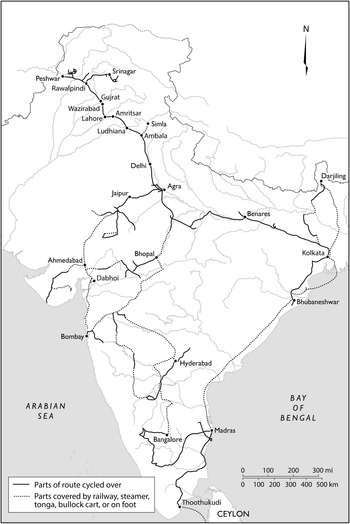
Two years after the publication of Algerian Memories, and having spent the intervening years cycling and traveling through Italy, Germany, the Netherlands, France, Turkey, Egypt, and Palestine, the Workmans turned their attention to southeast Asia, where their longing for the lived experience of imperial worlds was even more pronounced.Footnote 21 In India, they relied heavily on the 1870s work of Scottish architectural historian, James Fergusson, and their published travelogue—Through Town and Jungle: Fourteen thousand miles a-wheel among the temples and peoples of the Indian Plain (1904)—reads as a detailed study of ancient Indian architecture facilitated by the modern mobility of the bicycle.Footnote 22 Their journey began in November 1897 in Ceylon, and it involved cycling 1,100 miles in six weeks before crossing the Palk Strait from Colombo to Thoothukudi on January 3, 1898. Over the course of the next two years, they cycled 14,000 miles and spent several thousand more traveling by “rail, steamboat, tonga, tum-tum, bullock-cart, palki, and on foot.”Footnote 23 Unlike in Algeria, where their route was relatively circular, in India the Workmans meandered. From Thoothukudi they moved in a northerly direction to Delhi. They then cycled the two-millennia-old Grand Trunk Road to Ambala, Ludhiana, Amritsar, Lahore, Wazirabad, Gujrat, and Rawalpindi.Footnote 24 Leaving Rawalpindi, they cycled four and half days to Srinagar covering 200 miles. They then moved east, cycling and hiking along the Himalayas to Darjeeling before making a “pioneer cycle run” to Calcutta (Kolkata) moving on to Odisha, spending time around the temples and Brahmins of Bhubaneswar.Footnote 25 After returning to Calcutta, they got back on the Grand Trunk Road and cycled westward over the peninsula transferring to Dabhoi. From Dabhoi, the travelogue abruptly shifts back to Kashmir in the second half of 1899. That spring, however, the Workmans spent March through June cycling across the independent kingdom of Siam (Thailand), French Indochina, and Dutch Java before returning via steamship to Calcutta on June 5, 1899 (Figure 2).Footnote 26
A map showing the Workmans’ route and means of travel through British India between 1897 and 1899. Source: Courtesy of William Nelson.

In their writing, the Workmans presented themselves as surveyors, moving through the forgotten and left behind spaces of European empires. For their trip through Algeria, they noted that guidebooks were “few and imperfect, the descriptive literature scanty, emanating mostly from French and German sources, much of it antiquated.” As a result, most tourists stuck to the two “fashionable” cities of Algiers and Biskara, while the Workmans’ means of travel meant that they could access the “neglected … with a reasonable degree of safety, yet offering now and then a suggestion of the venturesome and dangerous.”Footnote 27 At the same time, and despite moments of real danger, they also embraced the luxuries and established formalities of the British, French, and Dutch empires. They often switched between a chauvinistic American identity and an embrace of and nostalgia for earlier forms of European imperialism. In many ways, they personified the snobbery of the nineteenth-century traveler who created a false dichotomy between themselves and “the tourist.”Footnote 28 The sheer difficulty of traveling by bicycle, however, meant that more often than not there was nothing leisurely about their journey. The roads of northern India were filled with thorns that frequently punctured their tires. It was “no uncommon thing for us to have thirty-five to forty punctures to repair at a sitting, and one occasion the number repaired was seventy,” they complained.Footnote 29 Such hardships, notes Nathaniel Wood, meant that cycling adventurers’ vision differed from a leisure-oriented “tourist gaze.”Footnote 30 Having each inherited sizable fortunes, the Workmans’ travel was not centered on escaping work for a holiday; adventure was their work.Footnote 31 The embodied act of cycling through imperial space was what separated their journey from the typical tourist and made it worthy of public consumption. For Fanny Bullock Workman, her subjectivity centered on a belief in her independent white womanhood as she crossed multiple empires and a desire for the hardships of frontier travel made more significant because she did it awheel.
The Infrastructure and Labor of Imperial Travel
In the first instance, empire made global bicycle travel possible. Equipped with passports, British visas, Turkish letters of introduction, tariff receipts, and Daotai papers, cyclists pedaled through empires’ bureaucratic apparatuses, moving from consul houses to missionary outposts; from one transimperial enclave to another.Footnote 32 As much as cyclists were achieving a new feat, they often followed telegraph poles, colonial roads, canals, and rail lines. The Workmans, likewise, were reliant on a vast network of imperial infrastructure—steamships, railroads, roads, paths, bungalows, and hotels—as well as the labor that made it work. Far from self-sufficient cyclo-adventures, they were dependent on colonial labor as a purview of their imperial power and, carrying loaded pistols, backed by the threat of violence if necessary. In making use of imperial infrastructure, whether it be French, British, or Dutch, the Workmans not only became a part of these networks, but facilitated, in the words of Alan Lester, “the production, reproduction and circulation of notions of ‘race’ that played a significant role in the material dispossession, exploitation and partial eradication of indigenous peoples.”Footnote 33 Examining the Workmans’ practical use of such infrastructure, even as they celebrated their independence, can ground the historian in ways that bind the larger entanglements of the imperial world together and can reveal the not-so-hidden power dynamics at play when Americans traveled abroad.Footnote 34
In Algeria, the Workmans mostly stayed in French hotels in towns and villages, and on one occasion, lodged with a French settler family.Footnote 35 While for the most part their bicycles got them to their destinations, encountering the mountains and deserts of Algeria, the Workmans’ machines often failed the topography. Attempting to cycle the northern Sahara, their frequent encounters with camels led the Workmans to “realize” that “together with the bad condition of the road … we had reached a land where the Arab and his camel could probably travel with greater ease than the American with his wheel.”Footnote 36 In these instances, when modernity failed them, the Workmans employed colonial labor to carry their bicycles and sometimes even themselves across rivers and up mountains (Figure 3).Footnote 37 At Timgad they paid a native Algerian to carry them and their bicycles across the river. After the man deposited Fanny on the other side, Hunter demanded the man take the bicycles across next, fearful they would be stolen if left alone. Seeing his advantage, the man doubled his price. After negotiations failed, William Hunter took the bicycles across the river himself. The man, however, still demanded to be paid the full amount and grabbed one of their bicycles, revealing a knife in his belt. “The muzzle of a revolver, within six feet of his face, accompanied by some forcible expressions, convinced him we were not so helpless as we had appeared,” boasted the Workmans.Footnote 38 On more than one occasion in their travels, the Workmans drew their weapons and threatened violence if local workers or residents did not meet their demands.Footnote 39
This photograph, taken from a later mountaineering expedition, shows Fanny Bullock Workman carried “hog back” over a mountain stream near the Rose glacier, Karakoram, Kasmir. The Workmans, presenting themselves as independent travelers, were in fact highly dependent on the intimate and physical work of colonial labor compelled by imperial power. Source: “Crossing river near centre of Rose glacier” (Between 1911 and 1912; published 1917). Library of Congress, Washington, DC.

In India, they went to an even greater extent to mobilize the infrastructure of empire. A “cycle tour” of India, according to the Workmans, was a “different thing from what it is in the countries of Europe, in Algeria, or even Ceylon and Java.” In these places they could find supplies and suitable lodgings. India, on the other hand, was “a land where, outside a comparatively small number of centres … The cyclist can expect little mechanical or surgical aid in case of accident.”Footnote 40 Based on this belief, the Workmans employed a servant who was sent a day ahead on bullock cart or rail to transport their luggage and to prepare their meals when they arrived.Footnote 41 In fact, one of their biggest complaints, after road quality, was their servants’ inability or unwillingness to source and cook European food. “The French cuisine, which passes everywhere among people of cultivated gastronomic taste, is unknown,” complained the Workmans, while they sat in a jungle bungalow outside of Mysore.Footnote 42 The other was the lack of water, which they often failed to pack in sufficient quantities; they looked forward to indulging “in the luxury of soda and lemonade” when they came across a train station with a refreshment room.Footnote 43 The Workmans were so dependent on colonial labor that, when they went without it, they suffered terribly searching for food and water. While awheel, the Workmans vacillated between the hardships of adventurers and a desire for the comforts of imperial rule.
Another shock came with the state of the bungalow system. Having chosen to forsake the railway, they discovered that the Raj’s highway-side bungalows had gone into disrepair with rail now the main source of imperial travel.Footnote 44 Part of the Workmans’ problem was their use of Fergusson’s almost-thirty-year-old guidebook, which took them to highway stops long since out of use or left in a “primitive” condition.Footnote 45 In late February 1898, after a brutal forty-seven miles during which they cycled “atrocious” roads, suffered from thirst and “hot winds,” and waded the Tungabhadra river on the way to Adoni in Andhra Pradesh, Fanny discovered that her bungalow for the night was “a nasty place and most disagreeable.”Footnote 46 These bungalows—no matter their state—were often sites of encounter between the American interlopers, British colonists, and Indian subjects. In a bungalow in Dehri, Bihar, they encountered a European who had been in India for over thirty years and explained that there was little worth seeing in India other than Delhi, the Taj, and Kanchenjunga (the third highest mountain in the world). For the Workmans, the man “was a good specimen of a certain class, who though old in service are not experienced in travel.”Footnote 47 Although the occasional European and British official may have irritated them, the presence of an Indian guest at a dâk-bungalow near Ajmer in the northwest state of Rajasthan in January 1899 was the “more trying to the Anglo-Saxon in India.”Footnote 48
Fanny’s hired Indian servants, whom she dehumanized by numbering rather than naming, frequently undermined her authority. Her diary is filled with frustration and complaints as the servants resisted the Workmans’ demands.Footnote 49 After forgetting their water bottles on the roadside outside of Jeypore and having to cycle eight miles back to get them, the Workmans arrived in the dark at their bungalow after a seventy-five-mile journey, Fanny Bullock’s longest in India, only to discover that their servant had not purchased any food, claiming that the Workmans had not advanced money for it.Footnote 50 In October 1898, after complaining of the slow progress they had made in Sikkim, Fanny Bullock questioned why her time in the Himalayas was so slow compared to the time of Sir Joseph Dalton Hooker, the botanist who made an expedition to Everest in 1847–51. “Perhaps this shows the effect of British rule,” she wrote to herself. His servants had “followed him over snow and ice half clad and uncomplaining. In 1898 after I have clothed and [fed] them they will not go or if they do accomplish nothing.”Footnote 51 Not considering that Hooker exaggerated the pliability of his servants, Fanny blamed the supposed leniency of the British Raj, which had taken control of the subcontinent in 1858, compared to the hard rule of the East Indian Company. Far from an imperialist nostalgia concealed as “genuinely innocent, tender recollections,” Fanny Workman longed for the intensity of mid-century imperial power.Footnote 52 When servants resisted the Workmans’ requests, Fanny Bullock interpreted this as both the supposed incapacity of Indians and the failure of the modern British empire.
Even as disruptive servants revealed the Workmans’ dependency on the infrastructure of empire and colonial labor, the daily act of cycling through “town and jungle” meant that the Workmans believed deeply in the fantasy of independence—a view reinforced by mostly ignoring the adoption of the bicycle in India.Footnote 53 In Calcutta, the editor of The Asian, W.W. Burke, suggested they cycle the old post road to the Ganges. The journey took eight days, and they spent six nights away from the railways without the “the assistance of our servant and baggage.”Footnote 54 Likewise, the lack of railway between Deoli and Bundi in Rajasthan meant that they left with well-loaded bicycles and suffered considerably.Footnote 55 In leaving the colonial railroads behind, bicycle travel convinced the Workmans that they had a unique access to the people, places, and nations they visited. As a novel form of mobility, cycling gave the Workmans’ imperial knowledge a form of authority even if that mobility was the result of a web of imperial infrastructure and labor rooted in a fantasy of independent travel.
Mobility, Temporality, and Authenticity in Imperial Space
The bicycle shaped what the Workmans saw and how they saw it. It helped them view the world’s empires and colonized spaces through a prism of the past that opened these spaces to intrusion in the present and future. Atop their bicycles, the Workmans searched for a time before European occupations, taking possession via their writing and photography of the authentic landscapes, peoples, and histories of the imperial world. When shopping their first book to publishers, William emphasized that cycling allowed them to see “more of the people and the country than travelling in the ordinary manner.”Footnote 56 In doing so, the Workmans framed their travel in the language of the frontier: “The sensation of being a pioneer,” noted the Workmans, “in these days when every corner of the world is sought out by the tourist is certainly exhilarating.”Footnote 57 In India, the Workmans’ object was to study the subcontinent’s “ancient civilizations through extensive travel of a primitive kind and the endurance of much hardship.”Footnote 58 The bicycle was their best choice as they could leave the railroad’s mainline modernity and travel deep into the “interior.”Footnote 59 The bicycle’s mobility granted the Workmans access to spaces deemed to be new frontiers in their imagination of the world. Such adventuring, as historian Jimmy Bryan has argued, was part of a process in which foreign places were conceptualized and naturalized as frontiers and future American space.Footnote 60
In Algeria, the Workmans’ journey was constructed out of Orientalized dreams of Arab life and culture. Their first impression was disappointment. Warned by their French captain that Oran was just another French city, they were nevertheless disillusioned by the city’s lack of “Oriental” character and its cosmopolitan citizens.Footnote 61 Fortunately for them, their bicycles offered the “most independent and satisfactory” way to access “the most interesting and original districts” of the French colony.Footnote 62 At a health resort in the town of Biskara on the edge of the Sahara, they longed for an imperial rule when the process of French assimilation was still in its infancy. “The days when the romantic German tourist sat alone in the Moorish dining room of the Hotel de Sahara, served by silent-footed, sad-eyed Biskris in national costume, are unhappily at an end,” reported the Workmans. “At the present time, the crowded restaurant, the French menu and the clatter of the table-d’hôte are found, and although it is the Biskiri who serves, in native trousers and fez, he wears a French sack, and is very French in manner.”Footnote 63 Likewise, in her journal, Fanny lamented the fact that “[t]he houses like the Arab costume is disappearing from Algiers.”Footnote 64 For the Workmans, the French settler project had gone too far, erasing their opportunity to experience a colonial world when the processes of cultural and social displacement were in their infancies. Fanny Bullock and William Hunter were late to the imperial game.
The Workmans, while at times dismissive, did feel an affinity for their French settler counterparts. They praised the construction of good-quality colonial roads alongside the efforts by the French to teach the “habits of order and obedience to authority” through compulsory military service, which created, in the Workmans’ minds, “better subjects … reconciled to French dominion.”Footnote 65 However, leaving Oran for Tlemcen, they were relieved to find that the “French have made little impression either on the architecture or the people” of the city.Footnote 66 In the fortified cities of central Algeria, it was easy to be “transported backward a few centuries in time.”Footnote 67 Likewise, after making the journey through the Sahara to Timgad, they were “carried back to the time of Trajan and Constantine …We live again with the people who labored here and lavished their time …”Footnote 68 There were lessons for contemporary empires too: the similarity of “the Roman remains in different lands [made clear] the thoroughness with which they stamped their own civilization on all conquered peoples,” the Workmans noted approvingly.Footnote 69 By traveling to the ancient world, the Workmans found inspiration for their present: a world that was imprinted by empire and gave an atavistic access to its people and cultures.
This time travel meant that Fanny Bullock could assess Algeria’s Kabyle women from the perspective of her own subjectivity as a modern white feminist. Having cycled to the French fort-town of Michelet, the Workmans abandoned their bicycles and took mules accompanied by two Kabyle guides to Ait ‘Hassen, the largest town of the Beni Yenni. They were surprised, however, when they met “Monsieur Salem.” To their astonishment, Salem “permitted himself a certain amount of civilization, not to say luxury.” He frequently visited Algiers and had just returned from Chicago. After touring the village, the Workmans went back to Salem’s for a lunch of couscous and boiled mutton. Over lunch, Salem revealed that he had traveled to the United States the previous year for the World’s Columbian Exposition where he was in charge of twenty Kabyles as part of the Government of Algiers’ exhibit. Salem was enthralled, like many Americans, by the Ferris Wheel and the amusements of the Midway Plaisance. To prove he had been to Chicago, he produced a matchbox and other souvenirs from the World’s Fair. He complimented American cooking—especially grilled steak—but said American coffee could not compare with Algerian café maure.Footnote 70
Although the Workmans believed that Salem “had good judgement, was an astute observer, and would do credit to the land that adopted him,” the gender relations among the Kabyle hindered their advancement compared to the modern partnership of Fanny and William. For Fanny Bullock, her feminism intersected with her racialized and imperial worldview. After dinner, Salem led the Workmans to a rear courtyard where the women of his household—dressed in finery for Eid—stood to meet them. Compared to Salem’s “pleasant room,” the house of the women and children was “desolate … with its floor of cold earth.” After leaving Salem’s home, the Workmans hoped that “if our Kabyle friend ever again should go to America, he would study the woman question as well as the culinary excellences of the United States.”Footnote 71 As a modern New Woman, equipped with her bicycle, revolver, and Kodak, Fanny Workman believed that “the advance of a nation in modern ideas may be judged by the position occupied by its woman.”Footnote 72 According to her, Kabyle women were stuck in a different time of about “a hundred years ago” and would remain there for “perhaps a hundred years hence.”Footnote 73 Monsieur Salem, having made roughly the same journey between United States and Algeria, upset the Workmans’ claims to spatial and temporal modernity. Nevertheless, Salem’s family and society were rendered as existing a hundred years earlier and in need of reform. In doing so, the Workmans viewed the world through a lens of “settler time” in which Indigenous peoples were either placed in the past or inserted into a present on terms that normalized non-Indigenous histories and geographies.Footnote 74
As technology gave them access to temporal frontiers, the Workmans also encountered ambiguous spaces that shifted their sense of place as well as time. From Souk Ahras near the Tunisian border, they cycled three days west to Setif to ride the less-traveled road through the gorge of Chabet-el-Akhra to Béjaïa on the coast. “The distance, one hundred and thirteen kilometers, can be traversed in a day on a bicycle,” reported the Workmans, “but requires two days in a carriage. The traveler, therefore, who is loath to leave the railroad seldom journeys over this route.”Footnote 75 After leaving the gorge, they realized they would not make it to Béjaïa before nightfall. A local man suggested that they head three kilometers back to the “Rendez vous de Chasse” where they would be cared for. As dusk fell, they found a private villa surrounded by orange groves and a small garden house with chairs and tables out front.
Brought to the Rendez vous de Chasse by bicycle, and very much off the beaten path, the Workmans entered a liminal space. They were approached by someone who was “[e]vidently a woman, not attired in the costume worn by her sex, but in a complete man’s suit of tightly-fitting white jean trousers, high gaiters and short sack coat. She asked what she could do for us, smoking the while a cigarette.” The patron of the villa who displayed signifiers of late-nineteenth-century masculinity—trousers, cigarettes, “short hair,” and “an excellent shot”—showed the Workmans the villa’s “orange and lemon orchard” while their beds were made. They dined on six courses served by what “might have been a sister of the hostess, dressed in women’s garb, with a garland of fresh flowers twined in her hair.” As they left through the restaurant, the patron was serving soup to a dozen or so servants of the house. “Having to make an early start in the morning,” the Workmans, “… bade her good-night, and accompanied by the pretty maid with her chaplet of flowers, carrying lights and sirop de grenadine, returned to the villa. We were soon asleep, dreaming of orange-gardens presided over by cordial amazons in trousers.”Footnote 76
With its dreamy re-telling and Orientalist eroticism, the scene on the outskirts of Béjaïa replicated fantasies of frontier space as sexually ambiguous. Bicycle mobility made this experience possible. The Workmans were in Béjaïa only because they were touring Algeria awheel. Cycling granted the Workmans access to places and spaces where people—such as a gender nonconforming woman and her “sister”—may have exercised a “passionate mobility” to live away from the tourist or colonial official.Footnote 77 At the same time, the orange gardens and “cordial amazons” in Fanny and William’s dreams tapped into the longstanding Orientalist trope of colonial space as erotically alluring and places of sexual access for imperial travelers and was matter-of-factly presented in both the private and public accounts of the Workmans.Footnote 78
The bicycle’s “spatial flexibility” meant that the Workmans’ experiences went beyond curated tourist travel. In each instance, the Workmans’ found people living outside their perceived notions of what space and time should be in the imperial world—a Kabyle villager who had been to Chicago and back, and a couple who transgressed gendered conformity. Such experiences were essential to the Workmans’ self-construction as mobile adventurers who sought new and authentic ways of seeing the people and places of European empires. Three years later in Ceylon, the Workmans stressed their maneuverability over other imperial travelers. When exploring the fortress of Sigiriya, Fanny Bullock noted that the “cycler has the advantage over other travelers” as riding a bicycle cut the time in half compared to the tourist bullock carts that departed at Dambulla.Footnote 79 In India, the Workmans believed they had escaped the British empire’s tourist–industrial complex and had “discovered” two villages that were “untinctured by any trace of English influence. For this reason, both the people and the buildings are interesting. In the bazaar curious beads and other trinkets not ‘made in Birmingham’ were for sale, and sadhus and devotees with distorted limbs were in evidence.”Footnote 80 For the Workmans, such experiences aligned with their preconceptions of what South Asia should be (including famine and human suffering) compared to the modernity found on its trains and in its cities. In the summer capital of British India, the Hotel Metropole in Shimla was tolerable, but it was also “pretty and fashionable [and] dull for much travelled people” like Fanny, she noted to herself.Footnote 81
The Workmans believed firmly that cycling enhanced their gaze within the imperial milieu, leading them to fantasize that they could move past the artifice of imperial projects and into the hidden corners and realities of empire. It was an opportunity to assess the world’s peoples and the empires that sought to rule them. The bicycle’s human-powered mobility combined an atavistic form of travel with a modern desire for new scientific and anthropological knowledge. In the introduction to Town and Jungle, the Workmans noted that on the bicycle, man’s “impressions are more vivid, he notices much that familiarity and habit cause them to overlook … he can see the true bearing of events.”Footnote 82 For the Workmans, this “true bearing of events” was best captured with their Kodak cameras.
Kodaking the World Awheel
Historians have pointed to the centrality of photography and the personal camera to the imperial project of the nineteenth century, suggesting the ways performances of visual imagery shaped political and cultural views of empire as well as the negotiated labor of colonial encounter and exchange.Footnote 83 Most of this work has focused on the visual output rather than getting to the location of the photograph itself. The personal camera, however, developed in tandem with the modern bicycle, and the two technologies were deeply connected. Georgine Clarsen, in her study of cycling in Australia, has gone so far as to argue that the bicycle and camera worked together to help constitute the antipodean settler state. The mobility of the bicycle meant that cyclists were given new perspectives to “Kodak” their environments at home and abroad in ways that created new “grammars” of colonial power.Footnote 84 The cycling press frequently published individuals’ photographs, and cycling travelogues were accompanied with photographic illustrations that could number in the hundreds. The camera and the bicycle generated new renderings of the landscape that were inaccessible from a train car’s window and shifted the sense of belonging to foreign terrain.Footnote 85
Where and when she could, Fanny Workman attempted to capture the people she encountered on film, preserving them and locking them in time. Attempts to “kodak” the inhabitants of Algeria, however, often ended “in vain.”Footnote 86 In her travelogues, journals, and unpublished papers, Fanny Workman’s gaze moved seamlessly from flora and fauna to ancient temples to the people she encountered, often within the same thought.Footnote 87 With well-illustrated travelogues and hundreds of photographs in the archive from her trips across the globe, Fanny Workman performed the part of a new sort of imperial agent that collected and collated foreign people and places on film.Footnote 88 The Workmans’ journey created a photographic archive of race through which they understood the people they encountered and themselves as imperial actors. This archive, however, was more expansive than a description of ethnicities and tribal groups. In the transimperial world of the nineteenth century, ethnographic racial knowledge was produced relationally through a prism of Blackness that included Indigenous peoples, Africans, and Black Americans. In this way, the Workmans’ gaze was shaped by the mutually constitutive logics of empire and anti-Black racism that served to naturalize European rule over the world’s populations.Footnote 89
In Ceylon, Fanny Bullock filled her personal journals and unpublished travelogue with descriptions of the photographs she took of the island’s inhabitants in which she played the role of an anthropologist comparing, contrasting, and cataloguing the people she encountered. Sinhalese women were viewed as having more in common with the women of Myanmar than India, while their “drapery and fineness of feature” was that of “certain natives” of central and northern India.Footnote 90 In her diary, Workman’s racialized vision crossed empires as she layered her imperial experiences. She noted that boys photographed in Ceylon were “not so handsome as some in Algeria.”Footnote 91 In India, the Workmans assessed the region’s Adivasis or tribal groups whom they claimed adhered “to the aboriginal ways and ideas of their ancestors.”Footnote 92 People around the temple complex of Korvangla were compared to “Africans” and “the negro.”Footnote 93 The Workmans believed that their cyclo-mobility gave them an ability to move between imperial and Indigenous space, past and present. It created transimperial racial geographies in their minds that were best captured through the lens of a Kodak.
For Fanny Bullock, the highlight of her cycling journey in Ceylon was the Vedda people. “[N]o one should leave Ceylon without seeing the Veddahs,” she wrote. Here, her gaze rendered the Vedda as primitive objects within a colonial–tourist entertainment complex. The Workmans met and photographed the Vedda—an Indigenous group residing in central Sri Lanka—at Bibile through an arrangement with a local government agent. After a difficult and rainy bicycle ride, they reached the rest house in Bibile where they dined on “tough fowl and musty rice.”Footnote 94 The next morning a group of local Veddas arrived to perform a “show” for the Workmans that included dancing and a bow and arrow display before cooking and sharing rice, curry, and pickled banana leaves.Footnote 95 After the performance and meal, the Workmans offered a “present of money as a sign they might leave having accomplished their duty.” The Vedda workers, however, deemed this to be an insufficient exchange for their labor and demanded that the Workmans purchase cloth from the local bazaar to further compensate them for what had been a daylong walk to see and perform for the Americans.Footnote 96 Clearly agents in their own colonial encounter, the Vedda workers understood the value of their performance and made sure they were sufficiently compensated.Footnote 97
In Fanny Bullock’s unpublished travelogue, the day is presented as a moment of amusement in which Indigenous performance and labor combined in an exchange that contributed to the production of imperial modernity—a modernity that was rooted in popular conceptions of social Darwinism and frontier space that denied Indigenous people a coevality and rendered them fit to be ruled.Footnote 98 Workman followed the genre of travel writing in this period that became the basis for many anthropologists’ and scientists’ understandings of foreign peoples, which in turn shaped later travel writers’ understanding of the people they encountered abroad, what Matthew Frye Jacobson has called “an endless and self-sustaining loop of observation and theory.”Footnote 99 Fanny Bullock embodied this role of anthropologist–adventurer moving through a fantasy of frontier space, even when what she saw was curated for imperial tourists, as was the case of the Vedda. For the Workmans, the actual British imperial project was secondary to their desire to produce, sell, “Kodak,” and consume what they believed authentic in an atavistic present.
Yet for all their talk of photographing the past in the present, the Workmans encountered local people familiar with the cutting-edge technology of the bicycle. In many ways, their journey through the imperial world was at the height of the first global bicycle age. Europeans’ use of the bicycle was in decline, while colonial subjects were beginning to fashion and adapt their own bicycle modernities.Footnote 100 At Dindigul, Fanny Bullock noted in her journal that the people were “quiet and orderly although surprised at seeing whites on cycles.”Footnote 101 They were frequently asked if they were in India to sell bicycles as the locals “could not understand otherwise, why we should take the trouble to travel on cycles.”Footnote 102
The Workmans’ transimperial romp around the globe combined an older mode of eighteenth-century colonial tourism centered on the past—landscapes, temples, forts, and mosques—with the late nineteenth century’s obsession with tropicality, technology, and science: the bike, the camera, the gun.Footnote 103 It was a grand tour of the world’s foremost empires. In her personal diary, Fanny described herself as representative of what could be accomplished by white womanhood in imperial spaces. She dismissed the other travelers she encountered as Rudyard Kipling’s “globe-trotters,” who followed “lists” of what to see and do.Footnote 104 At the fashionable mountainside resort hotel in Gulmarg in Kashmiri, she criticized the British imperial elite for spending two to three months a year playing “golf, cricket, and polo,” while the ladies “never are seen walking.”Footnote 105 In her own mind, Workman was not a tourist but an adventurer on par with the British explorers of the mid-nineteenth century. She self-consciously crafted a sense of New Womanhood that was at once fiercely independent, pushing the boundaries of codified gendered norms, and simultaneously performing a conservative patrician and imperial class. As Fanny Workman compared herself to other, less mobile white women in imperial spaces, her bicycle journey was not only to view the exotic and experience the authentic; it was also an essential means to prove her feminine capability.
Conclusion
In the late autumn of 1904, the New York Times reported on the publication of an “Important Book on India” by the “daughter of the former Gov. Bullock.” It offered views of Indian architecture and “much of interest in the manners and customs of the people and in the country itself.” Another reviewer, ignoring Indians themselves, highlighted that travel awheel meant that the Workmans were able to find “the astonishing monuments of ancient Indian architecture … scattered, almost unknown, over the entire Indian peninsula, for the most part in long-deserted cities and often nearly recovered by the jungle.” National Geographic concluded that the best element of Through Town and Jungle was the hundreds of photographs of the “wonderful architecture of the past, created by peoples now gone or degenerate.”Footnote 106 Reviewed in major journals, the bicycle travels of the Workmans opened the door for readers to find a world beyond curated travelogues centered on rail travel, that opened the spaces of European empires for American consumption—a world in which the national, race, and gendered identities of Fanny Bullock and her husband reinforced a rising tide of global imperialism, while a novel technology of personal mobility reinforced temporal fantasies of their own supposed superiority over both colonized and colonizer.
The bicycle provides one way through which we can understand the Workmans’ relationship to the imperial world as the twentieth century dawned. Movement was made meaningful as a white woman self-fashioned her femininity in the spaces of multiple European empires. The bicycle was an extraordinary way to access the ordinary, to move beyond the curated modernity of the steamship and train but not completely pass into the realm of independent adventurer. Technologies of mobility produce different ways of seeing and knowing. Viewing and understanding the world from a bullock cart, mule, bicycle, train, automobile, or airplane offer vastly different experiences and different sensations. Historians of the United States in the world embracing the mobility turn can come to better grips with the granular and local ways American movement was embedded in infrastructures of power, whether that was in the travel of imperial actors as shown here, or of colonial subjects caught up in forced and induced movement or rendered immobile by imperial apparatuses of control. As Genevieve Carpio has convincingly argued, mobility makes race.Footnote 107
Fanny Bullock Workman did not fictively consume empire from the armchair of a parlor; she went out and produced it for herself. Armed with pencil and paper and the latest technology of representation, the Kodak camera, she produced images of the world that created troubling frameworks for understanding its peoples at home and abroad. As “adventurers,” the Workmans operated as a different kind of imperial actor compared to missionaries and entrepreneurs, but one that tapped into these same networks of culture and influence that fed back to the United States and shaped knowledge of the imperial world at home.Footnote 108 As trans-imperial travelers, imperial modernity was not always what the Workmans were looking for. Their desire to escape the present created inconsistencies in their thinking: at one moment celebrating the colonial regime, at the other moment complaining it had gone too far. The Workmans’ fantasies meant that Fanny’s interpretation of what she saw was remarkably similar across thousands of miles and often quite literally on the other side of the planet. Her experience of empire was temporally and spatially layered. It was transimperial. Not content to view foreign empires as they were, the Workmans sought to live both the frontierism of the American West and the opulent Orientalism of the heyday of European imperialism: a vague time period before the mass and, in their view, crass modernity of the fin-de-siècle. They did not necessarily look to their contemporaries for inspiration but rather longed for an earlier and imagined period of European rule, a longing seemingly made more contradictory as they did so on one of the quintessential technologies of industrial modernity.



 Open access

