


1. Introduction
Design thinking unfolds through dynamic cognitive and metacognitive processes that shape how designers frame problems, generate ideas, evaluate alternatives, and implement solutions. Research shows that design activities evoke diverse cognitive and affective states (Reference Nolte, Huff and McCombNolte et al., 2022; Reference Ashari, Amraee and AdabiAshari et al., 2025) and that negative emotions such as anxiety and fear can undermine creativity and cognitive performance (Reference Nguyen and ZengNguyen & Zeng, 2012, Reference Nguyen and Zeng2014, Reference Nguyen and Zeng2016; Reference Håkansson and TörlindHåkansson & Törlind, 2014; Reference SandiSandi, 2013; Reference Ashari, Amraee, Schmidt and CasciniAshari et al., 2024; Reference Nolte, Soria Zurita, Starkey and McCombNolte et al., 2023). Emotions fluctuate throughout ideation, evaluation, and decision-making (Reference TribertiTriberti et al., 2017; Reference Biagioli, Grimaldi and AliBiagioli et al., 2018; Reference HoHo, 2024), while metacognition enhances designers’ awareness, creativity, and decision quality (Reference Von Thienen, Weinstein and Meinelvon Thienen et al., 2023; Reference YazıcıYazıcı, 2024). Although cognitive aspects of design have been widely examined (Reference Ashari and AmraeeAshari & Amraee, 2025; Reference Jung and VartanianJung & Vartanian, 2018; Reference Koszut, Nallaperuma-Herzberg and LioKoszut et al., 2025), recent work highlights the regulatory mechanisms that coordinate intuitive, analytical, and metacognitive processing during complex tasks (Reference Vieira, Kannengiesser and BenedekVieira et al., 2022). Neurocognitive studies further show that metacognitive activity in open design tasks corresponds to distinct EEG patterns (Reference Vieira, Kannengiesser and GeroVieira et al., 2023), underscoring the central role of monitoring and self-regulation in design cognition (Reference Ashari, Amraee and AdabiAshari et al., 2025). Time pressure is a key contextual factor influencing this cognitive–metacognitive interplay. Prior findings are mixed: moderate time constraints may enhance focus and idea generation (Reference Liikkanen, Björklund, Hämäläinen and KoskinenLiikkanen et al., 2009), yet time pressure can be perceived as either a challenge or a hindrance (Reference Zhou, Zhang, Zheng and FuZhou et al., 2024). Meta-analytic evidence suggests a nonlinear relationship between time pressure and innovation performance (Reference Song, Gao and ZhangSong et al., 2022). However, much of the existing literature relies on retrospective assessments and focuses on performance outcomes rather than capturing designers’ moment-to-moment emotional and metacognitive experiences (Reference Hutchinson and TraceyHutchinson & Tracey, 2017; Reference HoHo, 2024). To address this gap, the present study uses MetaCogno (Reference Ashari, Amraee and AdabiAshari et al., 2025) to record designers’ real-time cognitive and emotional states across four structured steps of the design thinking process. The study examines which experiences dominate at each step and how they differ between designers working with and without time constraints, contributing to a deeper understanding of how temporal pressure shapes the regulatory dynamics of design cognition.
2. Research methodology
This study aimed to investigate designers’ cognitive and affective experiences throughout the design thinking process, comparing Time-Limited (n = 41) and No-Time-Limit (n = 42) conditions. The sample comprised 83 industrial designers with varying experience levels (novice, semi-professional, and professional) and formal academic training, recruited from students and graduates of Tabriz Islamic Art University to ensure diversity in skills and experience. In the No-Time-Limit group, there were 21 female and 21 male participants, while in the Time-Limited group, there were 19 female and 22 male participants. All participants were right-handed, physically and mentally healthy, free from medication, and screened through structured clinical interviews (SCID-5, DSM-5). They were instructed to avoid stimulants, alcohol, caffeine, and tobacco before participation. To enhance ecological validity, a design competition, “Neuro Idea,” was organized, providing a motivating and realistic setting. Participants were tasked with designing a smart waste disposal system for motorcycles, scooters, and bicycles, considering criteria such as minimal production cost, usability, waste segregation, functional integration, aesthetics, innovation, and portability. Sessions lasted 30–50 minutes, in line with standard empirical design research procedures (Reference LawsonLawson, 2005; Reference Kruger and CrossKruger & Cross, 2006). This approach allowed the collection of rich cognitive and emotional data while simulating authentic design experiences.
2.1. Design thinking process experiment
The design thinking experiment was conducted using MetaCogno software, which captures participants’ moment-to-moment cognitive and emotional experiences. The experiment consisted of four structured steps: Problem Analysis, Ideation, Evaluation and Selection, and Implementation (Sketching). In the No-Time-Limit condition, participants advanced to the next step at their own pace by pressing a keyboard key upon completion of the current phase. In the Time-Limited condition, fixed durations were assigned: two minutes each for Problem Analysis, Ideation, and Evaluation, and five minutes for Sketching. The total duration of each session (including an introductory briefing, four minutes of calming instrumental music, a five-minute pre-test resting period with eyes closed, and the design thinking task) was determined following seven pilot studies to ensure procedural consistency. Immediately after each step, MetaCogno presented a screen displaying 12 affective descriptors, encompassing positive, negative, and neutral emotions. Participants indicated which emotions they genuinely experienced during that step. Multiple emotions could be selected simultaneously, allowing for the recording of complex affective states. In addition to data collection, MetaCogno supports participants’ learning by prompting self-reflection on their own cognitive and emotional patterns, thereby enhancing their understanding of personal design processes and decision-making strategies. This procedure was repeated across all four steps, enabling step-specific measurement of both cognitive and affective experiences. By operationalizing designers’ experiences in this manner, the study ensured construct validity and minimized item overlap. Each affective descriptor functioned as a distinct, validated item, and previous research confirmed convergent and discriminant validity of the emotional constructs. This approach provides a detailed, moment-to-moment account of how designers perceive, regulate, and learn from their cognitive and emotional states throughout the design process.
3. Results
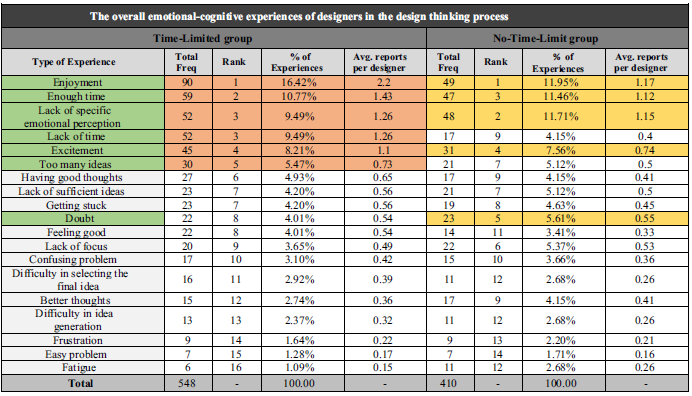
To examine the impact of the design thinking process on designers’ cognitive and emotional experiences, categorized as positive, negative, or neutral, both within-group and between-group analyses were conducted. Within-group comparisons assessed variations across the four main steps of the design thinking process (problem analysis, ideation, evaluation, and implementation) to identify which step most strongly influenced cognitive and emotional responses. Between-group analyses evaluated differences between designers working under Time-Limited and No-Time-Limit conditions. Data were analyzed using Excel and SPSS version 26. All 19 identified experiences were ranked based on the frequency of self-reports, and two indices were computed for each: (i) the Percentage of Total Experiences, reflecting the proportion of each experience relative to all reported experiences, and (ii) the Average Number of Reports per Designer, indicating how many times, on average, each experience was reported across the four steps. For example, in the Time-Limited group, “enjoyment” had an average of 2.14 reports per designer, indicating it was experienced slightly more than twice per participant. These metrics capture both the intensity and recurrence of each experience, providing insights into which cognitive and emotional states were most prominent. By combining frequency-based rankings with average reports, the analysis highlights the dominant affective and cognitive profiles of designers throughout the design thinking process, offering a nuanced understanding of how time constraints influence their experiences (Table 1).
Designers’ cognitive and emotional experiences across the entire design thinking process

Table 1 Long description
The table presents the overall emotional-cognitive experiences of designers in the design thinking process, comparing Time-Limited and No-Time-Limit groups. It includes data on the frequency, percentage, and average reports per designer for various types of experiences. The table has 19 rows and 10 columns. Column headers are: Type of Experience, Total Freq, Rank, % of Experiences, Avg. reports per designer for both Time-Limited and No-Time-Limit groups, and Total Freq, Rank, % of Experiences, Avg. reports per designer for No-Time-Limit group. Row labels include types of experiences such as Enjoyment, Enough time, Lack of specific emotional perception, Lack of time, Excitement, Too many ideas, Having good thoughts, Lack of sufficient ideas, Getting stuck, Doubt, Feeling good, Lack of focus, Confusing problem, Difficulty in selecting the final idea, Better thoughts, Difficulty in idea generation, Frustration, Easy problem, and Fatigue. Each row lists the total frequency, rank, percentage of experiences, and average reports per designer for each group. Notable trends include higher frequencies of enjoyment and lack of specific emotional perception in the Time-Limited group compared to the No-Time-Limit group.
3.1. Time-limited group
In the Time-Limited group, the emotional experience of enjoyment was the most frequently reported, with a frequency of 90, representing 16.42% of all experiences. This highlights the central and recurring role of enjoyment throughout the design process under time pressure. Moreover, the Average number of reports per designer for enjoyment (M = 2.2) indicates that, on average, each designer experienced this state slightly more than twice across the different steps of the design process. This finding reflects the persistent and stable occurrence of enjoyment among designers, suggesting that despite time constraints, they were able to maintain a positive engagement with the design tasks and derive satisfaction from the problem-solving process. The experience of having enough time was ranked second (frequency = 59; 10.77%), while the experience of time scarcity was observed with the same frequency, suggesting that designers perceived time as adequate in some steps yet experienced pressure in others. The experience of no specific feeling was ranked third (frequency = 52), reflecting moments in which designers did not report a dominant emotional state, likely due to high focus on task execution under temporal constraints. Excitement and having many ideas were ranked fourth and fifth (frequencies = 45 and 30, respectively), indicating sustained motivation, engagement, and creativity within the Time-Limited group.
3.2. No-time-limit group
In the No-Time-Limit group, enjoyment was the most frequently reported emotion (frequency = 49; 11.95%), with an average of 1.17 reports per designer, indicating generally positive experiences across the design steps, though less intense and recurrent than in the Time-Limited group. “No specific feeling” (frequency = 48) and “having enough time” (frequency = 47) were the next most common, reflecting designers’ strong focus on task execution with limited awareness of their own emotions. Excitement ranked fourth (frequency = 31; 7.56%), demonstrating sustained energy and engagement throughout the process. Doubt appeared fifth (frequency = 23; 5.61%), highlighting the cognitive challenges of selecting the best idea among multiple options. The absence of time constraints allowed greater reflection but also increased indecision during final decision-making. Overall, designers in the No-Time-Limit group experienced predominantly positive emotions, maintained focused engagement, and faced moderate cognitive challenges, while the intensity and recurrence of experiences were lower than in the Time-Limited group, suggesting that time pressure may enhance both emotional and cognitive involvement during the design process (Figure 1 & Table 1).
Designers’ cognitive and emotional experiences during the design thinking process

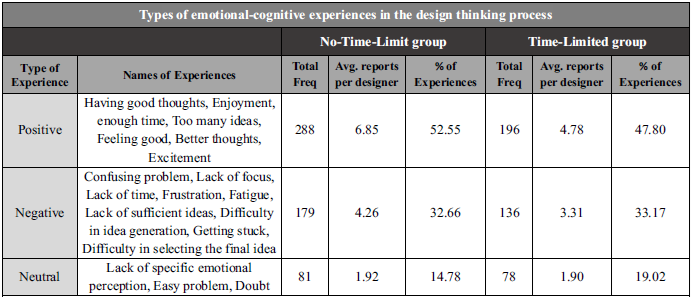
As noted, designers’ experiences throughout the design thinking process were classified as positive, negative, or neutral (Table 2). Positive experiences, including having good thoughts, enjoyment, enough time, many ideas, excitement, feeling good, and better thoughts, reflect a pleasurable and engaging design experience. Negative experiences, such as confusing problems, lack of focus, insufficient time, frustration, fatigue, insufficient ideas, getting stuck, difficulty in ideation, and selecting the final idea, highlight the challenges and cognitive difficulties encountered by designers. Neutral experiences, including Lack of specific emotional perception, ease of problem, and hesitation, indicate varied subjective experiences and momentary unawareness of internal states. This may result from intense cognitive focus on complex problem analysis, prioritization due to time pressure, or suppression of emotional awareness during the design process. Such momentary unawareness reflects how designers often concentrate on in-depth understanding and analysis of design problems, sometimes at the expense of recognizing internal emotional states.
Types of designers’ cognitive and emotional experiences in the design thinking process

3.3. Comparative analysis
3.3.1. Problem analysis step
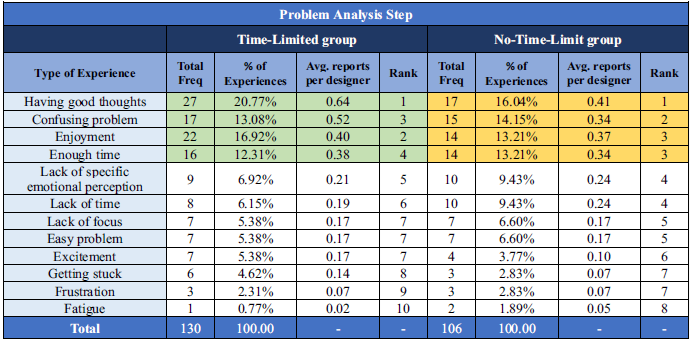
This section presents a stepwise analysis of designers’ cognitive and emotional experiences during the design thinking process. During the first step, Problem Analysis, comparisons between Time-Limited and No-Time-Limit groups revealed only minor differences in experience type and intensity. Both groups predominantly reported positive emotions, indicating broadly similar affective profiles. Notably, designers under time constraints exhibited a higher frequency of positive emotions and fewer negative ones, suggesting that limited time may enhance engagement and focus. In contrast, the No-Time-Limit group reported more instances of fatigue and perceived lack of time, reflecting a more relaxed but less goal-directed cognitive state. These findings highlight how time pressure subtly modulates emotional and cognitive engagement during the initial step of design thinking (Table 3).
Designers’ emotional-cognitive experiences in the first step of the design thinking process

Table 3 Long description
The table presents a comparison of designers' cognitive and emotional experiences during the Problem Analysis step of the design thinking process between Time-Limited and No-Time-Limit groups. It has 11 rows and 9 columns. The columns are Type of Experience, Total Freq, % of Experiences, Avg. reports per designer, Rank for the Time-Limited group, Total Freq, % of Experiences, Avg. reports per designer, and Rank for the No-Time-Limit group. The rows are Having good thoughts, Confusing problem, Enjoyment, Enough time, Lack of specific emotional perception, Lack of time, Lack of focus, Easy problem, Excitement, Getting stuck, Frustration, Fatigue, and Total. Row 1: Having good thoughts, 27, 20.77 percent, 0.64, 1, 17, 16.04 percent, 0.41, 1. Row 2: Confusing problem, 17, 13.08 percent, 0.52, 3, 15, 14.15 percent, 0.34, 2. Row 3: Enjoyment, 22, 16.92 percent, 0.40, 2, 14, 13.21 percent, 0.37, 3. Row 4: Enough time, 16, 12.31 percent, 0.38, 4, 10, 9.43 percent, 0.24, 4. Row 5: Lack of specific emotional perception, 9, 6.92 percent, 0.21, 5, 10, 9.43 percent, 0.24, 4. Row 6: Lack of time, 8, 6.15 percent, 0.19, 6, 7, 6.60 percent, 0.17, 5. Row 7: Lack of focus, 7, 5.38 percent, 0.17, 7, 7, 6.60 percent, 0.17, 5. Row 8: Easy problem, 7, 5.38 percent, 0.17, 7, 7, 6.60 percent, 0.17, 5. Row 9: Excitement, 7, 5.38 percent, 0.17, 7, 4, 3.77 percent, 0.10, 6. Row 10: Getting stuck, 6, 4.62 percent, 0.14, 8, 3, 2.83 percent, 0.07, 7. Row 11: Frustration, 3, 2.31 percent, 0.07, 9, 3, 2.83 percent, 0.07, 7. Row 12: Fatigue, 1, 0.77 percent, 0.02, 10, 2, 1.89 percent, 0.05, 8. Row 13: Total, 130, 100.00 percent, , , 106, 100.00 percent, , .
3.3.2. Ideation step
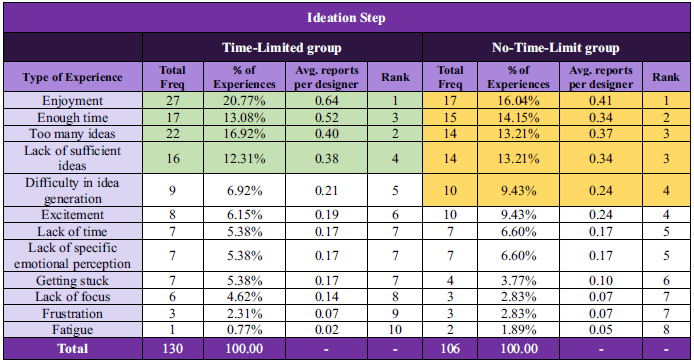
In the second step of the design thinking process, ideation, the experience of enjoyment ranked highest in both groups. Additionally, experiences related to having sufficient time and generating numerous ideas were notably prominent in both the Time-Limited and No-Time-Limit groups. Interestingly, experiences of insufficient ideas and difficulty in ideation were the most frequently reported negative experiences, indicating that designers in both groups encountered a mix of positive and negative affective and cognitive experiences during ideation. However, positive experiences slightly outweighed negative ones. Similar to the previous step, the Time-Limited group reported a higher number of experiences overall (Table 4).
Designers’ emotional-cognitive experiences in the second step of the design thinking process

3.3.3. Evaluation and final idea selection step
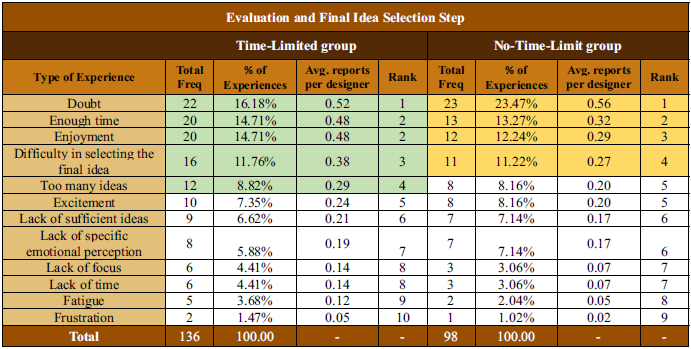
In the third step, Evaluation and Final Idea Selection, “experiencing doubt” emerged as the dominant experience in both groups, exhibiting the highest frequency percentage, which reflects the cognitive challenges faced by designers at this step. Following this, the experiences of “having sufficient time” and “enjoyment” ranked second in both groups, while “difficulty in selecting the final idea” and “many ideas” were reported as the third and fourth most frequent experiences, respectively. This pattern indicates that the abundance of ideas contributes to uncertainty in choosing the best option, making the decision-making process more challenging for designers. Furthermore, similar to the previous steps, the Time-Limited group reported a greater number of positive, negative, and neutral experiences, highlighting the influence of diverse emotions on decision-making quality during this step (Table 5).
Designers’ emotional-cognitive experiences in the third step of the design thinking process

3.3.4. Final implementation and sketching
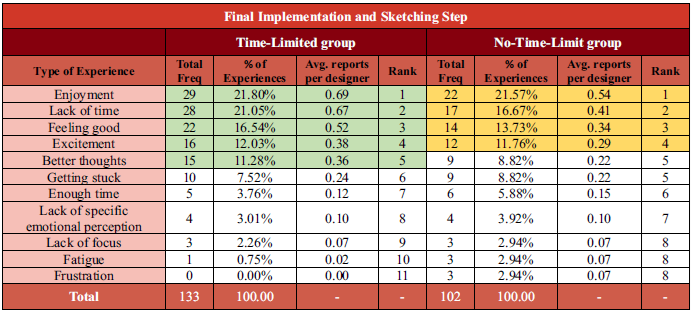
In the fourth step, encompassing the final implementation and sketching of ideas, positive experiences such as enjoyment, having good thoughts, excitement, and better thoughts predominated in both groups of designers, exhibiting the highest frequencies. This indicates a generally positive and motivational experience throughout this step. The experience of time shortage ranked second in both groups, suggesting a potential negative impact on designers’ performance (Table 6). Overall, designers reported more positive experiences in this step, which may be attributed to the practical execution of ideas through sketching and a relative reduction in cognitive stress. However, designers in the Time-Limited group experienced a higher intensity of positive emotions, whereas those in the No-Time-Limit group reported greater fatigue and frustration. This pattern reflects the effect of extended sketching durations and the potentially draining nature of the design thinking process when temporal pressures are absent.
Designers’ emotional-cognitive experiences in the fourth step of the design thinking process

Table 6 Long description
The table compares emotional-cognitive experiences of designers in the final implementation and sketching step across two groups: Time-Limited and No-Time-Limit. It has 11 rows and 8 columns. The columns are Type of Experience, Total Freq, % of Experiences, Avg. reports per designer, Rank for the Time-Limited group, and Total Freq, % of Experiences, Avg. reports per designer, Rank for the No-Time-Limit group. The rows are Enjoyment, Lack of time, Feeling good, Excitement, Better thoughts, Getting stuck, Enough time, Lack of specific emotional perception, Lack of focus, Fatigue, Frustration, and Total. Row 1: Enjoyment, 29, 21.80, 0.69, 1, 22, 21.57, 0.54, 1. Row 2: Lack of time, 28, 21.05, 0.67, 2, 17, 16.67, 0.41, 2. Row 3: Feeling good, 22, 16.54, 0.52, 3, 14, 13.73, 0.34, 3. Row 4: Excitement, 16, 12.03, 0.38, 4, 12, 11.76, 0.29, 4. Row 5: Better thoughts, 15, 11.28, 0.36, 5, 9, 8.82, 0.22, 5. Row 6: Getting stuck, 10, 7.52, 0.24, 6, 9, 8.82, 0.22, 6. Row 7: Enough time, 5, 3.76, 0.12, 7, 6, 5.88, 0.15, 7. Row 8: Lack of specific emotional perception, 4, 3.01, 0.10, 8, 4, 3.92, 0.10, 8. Row 9: Lack of focus, 3, 2.26, 0.07, 9, 3, 2.94, 0.07, 9. Row 10: Fatigue, 1, 0.75, 0.02, 10, 3, 2.94, 0.07, 10. Row 11: Frustration, 0, 0.00, 0.00, 11, 3, 2.94, 0.07, 11. Row 12: Total, 133, 100.00, -, -, 102, 100.00, -, -.
4. Discussion
The present study showed that the design thinking process involves a wide range of affective–cognitive experiences whose intensity varies depending on contextual factors such as time constraints. These findings reinforce the view that design is not solely a rational problem-solving activity but a process shaped by intertwined cognitive and emotional dynamics (Reference Biagioli, Grimaldi and AliBiagioli et al., 2018; Reference TribertiTriberti et al., 2017). Across both groups, positive experiences (including enjoyment, good thoughts, and excitement) were the most frequently reported. This aligns with Reference Biagioli, Grimaldi and AliBiagioli et al. (2018), who argue that positive emotions act as motivational drivers that enhance focus, creativity, and idea quality. Designers in this study reported enjoyment even under Time-Limited conditions, suggesting a form of “constructive arousal,” where moderate stress increases engagement and cognitive focus, while excessive pressure may be detrimental (Reference Nguyen and ZengNguyen & Zeng, 2014; Reference SandiSandi, 2013).
In the first step, problem analysis, time constraints had minimal influence on designers’ affective–cognitive states. Both groups reported focused attention, constructive thoughts, and enjoyment in exploring the problem. This indicates that early-stage design activity is dominated by cognitive engagement rather than emotional fluctuation, consistent with Reference Dorst and CrossDorst and Cross (2001) and Reference Nguyen and ZengNguyen and Zeng (2016), who describe this step as cognitively demanding but emotionally stable. Designers primarily work to understand and structure the problem, which may buffer them from external pressures.
In the second step, ideation, designers experienced a mixture of positive emotions (such as enjoyment and excitement) and negative ones, including insufficient ideas and difficulty generating ideas. This pattern supports Reference HoHo (2024) and Reference Ashari, Amraee, Schmidt and CasciniAshari et al. (2024), who describe ideation as a cyclical process characterized by oscillations between creativity, doubt, and emotional variability. The coexistence of excitement and difficulty reflects the inherent tension of generating novel ideas under varying cognitive loads. In the third step, evaluation and selection, “doubt” emerged as the most frequent experience in both groups. This finding aligns with Reference Von Thienen, Weinstein and Meinelvon Thienen, Weinstein, and Meinel (2023), who identify this step as a peak of metacognitive activity, where designers must compare alternatives and commit to a final choice. Such decision points activate cognitive networks associated with conflict and complex reasoning (Reference Jung and VartanianJung & Vartanian, 2018). In this study, the abundance of ideas increased the difficulty of selection, heightening doubt and cognitive pressure, consistent with Reference Nguyen and ZengNguyen and Zeng’s (2012) mental tension model. In the fourth step, final implementation and sketching, affective–cognitive patterns diverged more clearly between the two groups. Positive experiences (such as enjoyment, better thoughts, excitement, and constructive thinking) were dominant in both groups, suggesting that the tangible realization of ideas fosters motivation and a sense of progress (Reference Bilda and GeroBilda & Gero, 2007; Reference CrossCross, 2011). However, “time shortage” ranked second in both groups, indicating that this step also introduces cognitive stress related to execution and refinement. These findings align with Reference LawsonLawson (2005), who notes that environmental and temporal factors influence designers’ decision-making quality.
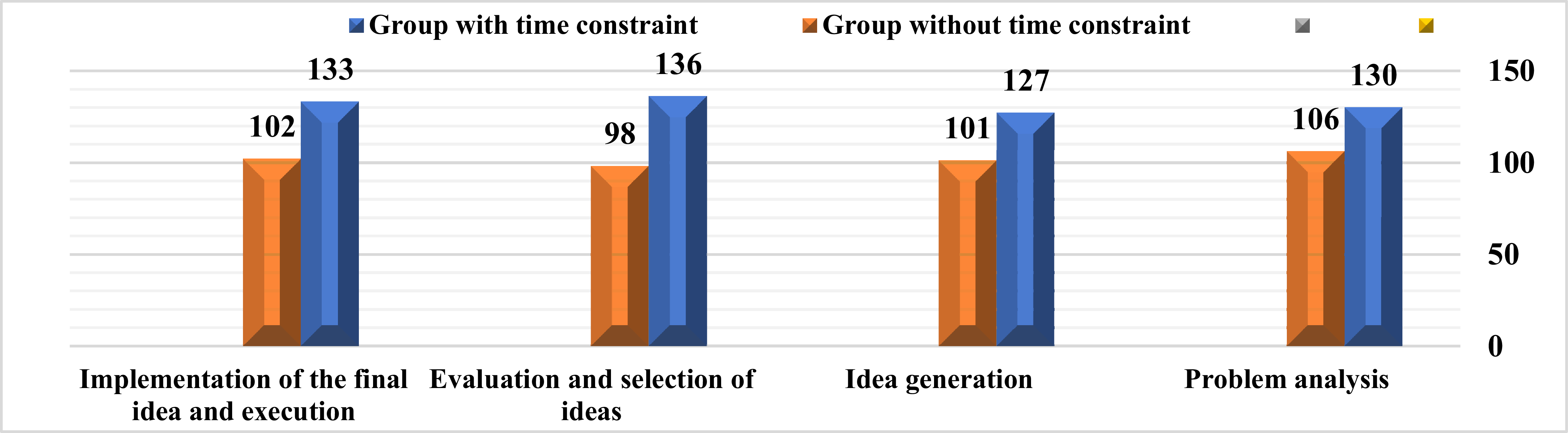
Overall, designers reported more positive experiences in the final step than in earlier ones, suggesting cognitive relief after completing analytical and evaluative tasks. Interestingly, the Time-Limited group reported more positive emotions than the No-Time-Limit group. This suggests that a defined temporal structure may enhance focus and motivation, whereas excessive time can lead to mental fatigue and reduced cognitive energy (Reference Cardoso and Badke-SchaubCardoso & Badke-Schaub, 2011). Conversely, the No-Time-Limit group showed higher fatigue and mental strain, likely due to prolonged sketching and diminishing excitement over time. This pattern aligns with emotional cycle theories in design, which propose that designers’ emotions fluctuate depending on task demands and temporal conditions (Reference DesmetDesmet, 2012; Reference Purcell and GeroPurcell & Gero, 1998). Taken together, the findings indicate that time constraints did not negatively affect designers’ experiences; instead, they appeared to enhance focus, excitement, and motivation during implementation. These insights have practical implications for structuring design thinking activities, suggesting that appropriate time boundaries can function as motivational tools that support engagement and decision-making quality. Figure 2 illustrates the distribution of affective–cognitive experiences across the four steps for both groups. By capturing these dynamics in a step-locked, in-situ manner, MetaCogno addresses limitations of retrospective self-report, think-aloud protocols, and purely physiological approaches. The ability to align experience reports with specific phases of design (and, when relevant, with EEG markers) provides a more fine-grained and ecologically valid understanding of how cognition and emotion co-evolve throughout the design process. This integrated perspective is essential for refining theoretical models of design cognition and for informing educational practices that intentionally shape designers’ affective–cognitive trajectories over time.
Types of affective cognitive experiences across the four steps of the design thinking process

5. Conclusion
The present study used the MetaCogno tool to examine designers’ cognitive and affective experiences throughout the real-time execution of a four-step design thinking process under Time-Limited and No-Time-Limit conditions. By recording experiences immediately after each step, the study showed that design thinking is a dynamic, intersubjective process shaped by continuous interaction between cognition and affect rather than a purely rational problem-solving activity. Across the entire process, positive experiences were predominant in both groups, and enjoyment was the highest-ranked experience overall, indicating that designers generally perceived the task as engaging and rewarding even when working under time constraints. Step-specific analyses revealed distinct emotional–cognitive signatures. In Problem Analysis, both groups showed relatively similar and positive profiles, and time constraints had little impact on initial problem understanding. In Ideation, enjoyment and excitement coexisted with difficulty in generating ideas and perceived lack of sufficient ideas, reflecting the inherent tension of creative exploration. In Evaluation and Final Idea Selection, doubt was the dominant experience, highlighting the cognitive load associated with comparing alternatives and committing to a final solution. In the Final Implementation and Sketching step, positive experiences such as excitement, feeling good, and better thoughts were again prominent, while lack of time emerged as the most persistent negative state in both groups. Designers working under time constraints reported more positive experiences overall, whereas those without time limits reported more fatigue and mental exhaustion, suggesting that appropriately structured temporal boundaries can support motivation and focus rather than simply increasing stress. Methodologically, the study demonstrates that MetaCogno offers an effective framework for real-time evaluation of cognitive affective processes in design. By capturing a mix of positive, negative, and neutral experiences at each step, the tool provides clear answers to the research questions: designers experience a complex blend of states throughout the design thinking process; the dominant experiences in each step correspond to the nature of the activities performed; and time constraints can, when properly calibrated, enhance focus and reinforce positive experiences rather than undermining them. From an applied perspective, these insights suggest that thoughtful time management is a key lever for optimizing both the quality of designers’ experiences and their decision-making capabilities, offering practical guidance for structuring educational and professional design processes.
6. Limitations
This study was carefully conducted under conditions closely resembling real-world design settings to capture authentic cognitive and emotional experiences of designers with high validity and reliability. While the sample mainly included students, limiting generalizability to professional designers, the relatively large participant pool and multi-step design, measuring both cognitive and affective responses in nearly one hundred individuals, enhance the study’s robustness. A further limitation is the focus on individual design tasks, excluding collaborative processes that may elicit different experiences. Nevertheless, this research extends the study of design cognition and emotion beyond engineering into industrial design, providing valuable insights into designers’ experiences and contributing to a broader understanding of cognitive and emotional dynamics in design practice.
7. Future research
To address the limitations of this study and deepen understanding of the design process, future research should examine designers’ cognitive and affective experiences in more diverse and authentic contexts. Expanding samples to include professional designers across multiple domains, conducting studies in real-world or closely simulated settings, and extending research beyond industrial design to areas such as UX, service, and graphic design would enhance generalizability and enable comparative analyses. Future work should integrate multi-modal methods (e.g., EEG, ECG, fNIRS) and consider individual differences, including expertise, age, gender, handedness, and personality. Developing cognitive-affective models of design and conducting cross-cultural studies could further clarify the interplay of cognitive and emotional factors and reveal broader variations in design experiences.
Acknowledgement
This article is based upon research funded by the Iran National Science Foundation (INSF) under project No.4014968. The Mohammad Reza Shabanloo Jewelry Design Studio also provided additional financial support. Ethical considerations, including avoidance of plagiarism and dual publication, were fully observed. This study was approved by the Ethics Committee (Code: IR.TABRIZU.REC.1403.071).


 Open access

