

Introduction
Lived experience of mental illness, treatment and recovery as a valid source of knowledge is only beginning to be recognised (Sunkel & Sartor, Reference Sunkel and Sartor2022, Norton, Reference Norton2023, Norton, Reference Norton2024). Mutual peer support remains a largely untapped resource, often ignored and distanced from mainstream services. An indication that change is imminent can be seen in the recent employment of peer support workers by the Health Service Executive (HSE) and the establishment of recovery colleges where people are seen as productive co-students rather than passive recipients of help. In this perspective article I reflect on my own experiences as a service user, spouse, close relative and friend, member and employee of a peer support organisation and member of an international community of people who openly share their own experience. I then consider the findings of my doctoral research (Watts & Higgins, Reference Watts and Higgins2017) which explored the experiences of a cohort of leaders of Grow Mental Health, an Irish based peer support organisation. Finally I try to imagine what a recovery oriented mental health system might look like and what changes this might entail. Throughout this article, I am using the term mental illness rather than mental distress or personal crisis. Even though I believe the latter might be more accurate words to describe this human phenomenon, it is still mainly understood as an illness or pathology. I use the term mutual peer support rather than peer support which is represented by individual peer support workers employed by the HSE because of their lived experience but about peers reciprocally empowering one another within a community setting.
Personal experiences
As a young man I was prey to a range of psychotic symptoms: a menacing voice, misinterpretation of sounds and strange ideas which often unnervingly arrived as ready-made poems about death. I believe that these experiences represented the culmination of years of acute loneliness, unresolved issues, personal choices, a fervent imagination and were linked to the onset of puberty and the ‘promise’ of the swinging sixties. I systematically became isolated and emotionally bankrupt, surrounded by fearfulness and a deep sense of mockery. I could find no positive identity(s) or social role(s). Psychosis, in my case, was very much nurtured by an abusive level of alcohol, tobacco and cannabis consumption.
Finding it increasingly difficult to just keep going I reluctantly sought psychiatric help. Encouraged by a warm welcome I was led into a lecture room full of medical students and asked if I minded if they sat in on my assessment. I was diagnosed with ‘Pathological Shyness’ and prescribed Librium. I took the Librium once and never went back. At home in my medical family there were mutterings of schizophrenia.
A turning point was meeting my life-partner Fran. Fast forward four years and Fran experiences post-puerperal psychosis. I was advised she needed to be admitted to Our Lady’s Hospital, a foreboding building on the outskirts of Ennis. I refused but that night realised we could not cope with the terror gripping Fran who was banging her head against the walls, pulling out her hair and screaming a scream that seemed to contain all the pain ever experienced in the world.
It was a huge relief to be met in the hospital by friendly nurses who spoke with kindness and the message that everything would be alright. Over the next three years Fran received a series of diagnoses: schizophrenia, schizoaffective disorder and bipolar disorder. She was prescribed an ever-growing cocktail of drugs (18 tablets a day) and several series of electroconvulsive therapy (ECT). Her treatment sometimes included solitary confinement in one of the long-term locked wards. There was never any talk of recovery or questions about trauma or indeed what Fran might find helpful. Life became more and more difficult. We now had three small children as well as running a working farm. I had stopped smoking cannabis and using alcohol but was still extremely socially incompetent and a chain smoker. Ironically, I felt I was seen as ‘well’ by mental health professionals. We were both very aware that one of Fran’s sisters had been diagnosed with schizophrenia and had been homeless for years. This sister died at 51 in a Salvation Army hostel in Amsterdam.
The next turning point was discovering Grow. Grow was a place of hope, empowerment and inspiration. I felt instantly at home and somehow ‘knew’ we could both recover with the support of this community. My own recovery began with gradually learning to manage my shyness and paranoia through involvements with neighbours, creative arts, a return to study (BA, MPsychSc, PhD), physical activities and Toast Masters (a public speaking organisation). Progress was slow and there were many setbacks. Particularly helpful were a course in metaphysics which answered some of my questions about why I had been born and why pain exists and a period working in a factory where the camaraderie was palpable.
After 15 years, Fran was able to wean herself completely off medication with the support of her psychiatrist and officially left the mental health system. Her recovery included, time spent in church, third level study, Community Employment Schemes, back to work courses and work within the third order of the Franciscans.
In 1983 I began work for Grow and later became National Programme Coordinator. Over 30 years, I attended thousands of groups witnessing the recovery of a multitude of people many of whom successfully left medication behind even though their diagnoses were supposedly for life. I was also one of two people with lived experience to serve on Ireland’s first Mental Health Commission.
Our world was shattered in 2021 when a very close relative, aged 45, was hospitalised and diagnosed with schizophrenia. He was extremely heavily medicated and given a disability pension. As far as we know, he was not encouraged to avail of any of the many psychosocial supports that can help in recovery (Hearing Voices Network, recovery college etc.). Nothing appeared to have changed. As close relatives we found it extremely difficult to obtain any information. This person’s experience show’s how, despite many very positive developments such as the employment of peer support workers, the creation of recovery colleges and the publication of documents such as Sharing the Vision it is still very possible to fall through the cracks and miss out on recovery oriented help.
The mutual peer support of Grow
Grow began in Australia in 1957, coming to Ireland in 1969. It evolved through the reflective lived experience of its members. Key to its success was Con Keogh a priest and epistemologist who had spent 11 years studying in Europe. Con later experienced a spectacular breakdown, was hospitalised and diagnosed with paranoid schizophrenia. In hospital he received many rounds of ECT without anaesthetic or anti-convulsants. He described hospital as ‘a regime of terror’ (Grow, 1979). He was one of the first people to be given chlorpromazine. On discharge, Con joined Alcoholics Anonymous although he had no alcohol addiction. Here he met others whose primary need was to recover from various diagnoses of mental illness. They gained permission to adapt Alcoholics Anonymous’s 12 steps.
This pioneering group held two meetings each week. At the first they discussed their needs and problems and suggested possible solutions. The second, a leaders meeting, involved reflecting on how effective different strategies had been. Here, Con began recording, honing and refining a steadily growing book of recovery principles which came to be known as The Program Book (Grow, 2013). This book focused on understanding and working towards mental health rather than trying to understand and treat mental illness. One of its truisms is ‘mental health cannot be taught it has to be learned together’.
Grow meetings follow a specific agenda and are led by group members. They begin with a short reflection, reading the 12 steps and a commitment to confidentiality. Next, one person will give a testimony of recovery and growth. Then come reports on progress made in the previous week. The ‘middle routine’ is educational, studying an article on some aspect of recovery. Finally, each person sets a goal for the coming week and takes on a ‘practical task’. This task may involve seeking professional help in areas outside the expertise of the Grow group (e.g. Wellness Recovery Action Plan (WRAP) a recovery-based course designed by Mary Copeland training, or attending the Rape Crisis Centre, or engaging with a counsellor, psychologist, or psychiatrist). The meetings end with announcements about a range of events both, within and outside of Grow that may help recovery.
Possibly Grow’s biggest strength is its community. People get to know each other in a unique and empowering way. They hear other people’s stories and learn how to tell their own. In the group, you are seen and treated as someone of unique value, with practical wisdom, experience, gifts and leadership qualities. You are ‘called forth’ (Evely, Reference Evely1964) to recovery.
Embarking on a narrative study of recovery through Grow
My doctoral study aimed to reveal common processes of recovery connected to the Grow experience. My first ethical approval application was rejected. I was requested to describe my study’s participants as particularly vulnerable and to tick a box describing each as mentally ill. I argued why such a classification would be the antithesis of the recovery philosophy. If you describe yourself as recovered from mental illness you are no longer mentally ill nor are you particularly vulnerable. This was met with a terse communication. Ethics Committees are not ‘forums for discussion’. This authoritarian reaction while perhaps typifying current dominant medical thinking, goes against a more progressive approach to ethics which rejects ‘professional paternalism’ and suggests a ‘collaborative partnership approach’ (Emmanuel & Grady Reference Emmanuel and Grady2006).
My research involved conducting one-to-one interviews around how Grow helped in the recovery process. I interviewed 12 men and 14 women with a diagnosis of a mental illness, who had been prescribed medication and/or been hospitalised, had taken on leadership roles in and a minimum of 3 years membership of Grow, and considered themselves to have recovered. I used a narrative methodology and conducted a thematic analysis using Braun and Clarke’s (Reference Braun and Clarke2006) guidelines.
Reflections on my PhD: recovery as a re-enchantment with life
The main theme to emerge was that recovery from mental illness through Grow was experienced as ‘a re-enchantment with life’ countering the observation by Max Weber (Reference Weber2000 [1904]) that when science is applied directly to the human condition it tends to rob life of enchantment. It also countered the experience of many for whom seeking help and receiving a diagnosis of psychosis had represented the start of a life of disability, dependency and social discrimination. Re-enchantment took place in three non-linear stages. People moved from immersion in dialogues of terror to dialogues of healing provided through membership of Grow and finally found ways to flourish within dialogues of becoming already existent and now accessible within society at large.
In each stage of recovery, dialogues were experienced at different levels or spoken in a ‘polyphony’ of voices (Bhaktin, Reference Bhaktin1981):
a non-verbal somatic dialogue,
emotional dialogue,
cognitive dialogue,
behavioural dialogue,
a range of social dialogues.
Levels were inter-related and co-influential, suggesting a model of a human being as a unique spirit living within a series of osmotic storytelling bodies which cumulatively encourage personal growth or disintegration …..an existential pencil through which each person creates an ongoing narrative in the context of others in the world.
A Grow group acted as a kind of social womb providing all the nutrients needed for recovery and growth, healing past wounds and hurts and preparing the way for an exciting new adventure as a member of society.
Discussion: what might a recovery oriented system look like?
I would like to now share my own perspective on how we might create a more recovery oriented and empowering mental health system where lived experience is seen as a valid and invaluable source of knowledge. At its heart would be a questioning of the nature and meaning of mental illness and a subsequent radical change in language and practice.
At a theoretical level
What is mental illness?
Philosophy tells us that there are three sources of knowledge:
-
reason or scientific enquiry
-
experience
-
authority
Despite the welcome employment of peer support workers and the establishment of recovery colleges I believe our current system remains dominated by a medical voice which is, like all other current attempts at explanation, pre-theoretical in nature (Price, Reference Price1979).
To move forward we need to incorporate each type of knowledge:
-
embracing lived experience
-
reviewing past and conducting new collaborative research to explore cause, prevention, treatment and recovery.
-
taking note of theology, philosophy, the arts, anthropology to better understand what heals nurtures the human spirit and what destroys it.
We need to take a collective deep breath and acknowledge that at present we do not have a comprehensive understanding of mental illness or how to treat it but we do all have different forms of knowledge that have value and should be regarded with respect.
Paradigm change
When paradigm change takes place the central question under study changes too (Kuhn, Reference Kuhn1962). Perhaps, we need to work away from a search for a single level of cause of ‘mental illness’ and ask
-
‘What is the relationship between the different levels of cause’?
-
Can the medical model be integrated into a community model privileging other major causes such as trauma, poverty, living in an alien culture, isolation, imaginings and which offers more hope of recovery?
At a practical level
Recovery contracts instead of care plans
There is a risk, within the mental health system, that by conceptualising services provided as ‘care’ that we inadvertently introduce authoritarian paternalism, risk aversion and a coercive entry into a life of subservient dependence. Providing ‘care’ and developing ‘care plans’ imply that the deeply intimate knowledge a person brings about his or her life is far less valuable than the knowledge brought by mental health professionals. Kloos (Reference Kloos1999) compared two residential settings for people with a history of serious mental illness. One was run by the state and focused on care, the other by Grow in America which used a recovery contract. In the state setting the emphasis was on compliance and learning to take personal responsibility for taking your medications. In the Grow residential taking medication was a very secondary feature of an exciting recovery journey which involved choosing goals and positive identities, taking on leadership roles and helping others (including professional staff). More than care people need to be believed in, loved and empowered, they need to be challenged and rewarded internally by experiencing the thrill of recovery.
A recovery contract would clarify the responsibility and role of the person in recovery and also the responsibilities and roles of their support team. It would introduce reciprocity to a recovery relationship tapping into different types of knowledge, recording what was helpful and helping to discover next steps on a recovery journey, creating leadership roles as advised by Riessman (Reference Riessman1990) and new directions for professional training and practice. It could be an exciting journey of discovery for all.
The role of medication
To progress the Recovery Approach in services, there are questions that we must ask regarding medication. Is it routinely necessary? How does it help? If so for how long? What has helped people reduce it or leave it behind? Is long-term medication the right option for some people and if so, why? Why can some people leave it behind easily and others can’t.
The GROW programme (Grow 2013) lists 6 legitimate sources of help that can be a part of recovery, all are seen as valuable in their proper place:
-
God (life force)
-
your own resources
-
friendly help,
-
professional guidance
-
medical interventions
-
compulsory restraint,
Central to the recovery journey is taking personal responsibility for one’s own life. This involves identifying and utilising personal and inter-personal resources as healing takes place and determining the role of medication in your own recovery journey. Of particular importance is the need to address the research questions on reducing and stopping medication identified by a recent Irish consensus building exercise (Boland et al. Reference Boland, Higgins, Beecher, Bracken, Burn, Cody, Framer, Gronlund, Horowitz, Huff, Jayacodi, Keating, Kessler, Konradsson-Geuken, Lamberson, Montagu, Smith and Cadogan2024).
Recovery budgets
To be told you have a life-long disability and to be given a disability pension can trigger a self-fulfilling prophecy and deter people from trying many things that could lead to recovery. Work can be an essential part of the recovery process. People with physical disabilities can avail of a personal budget. A recovery budget would allow people to explore a wide range of potentially empowering involvements, counselling, peer support, educational classes of their own choosing. Part of a recovery contract would include an evaluation of the benefits of these involvements over time and a discussion about medication reduction along the way. The contract could include leadership roles for those in recovery, telling their own story in the acute wards, becoming part of research programmes, writing about what was helpful and unhelpful during hospitalisation, becoming part of co-production teams and local forums whose agenda includes improving the system.
Improving encounters with mental health professionals
There is a need for all mental health professionals to be focused on continuity of care, recovery over illness, power balance, understanding between mental health professionals and service users, information on medication side effects and community resources and inviting the service users to share what types of supports might be helpful for them. There can also be a problem in understanding what is said when either the doctor or the service user has communication challenges (e.g. due to having a strong accent). A recovery focused interaction with a mental health professional is one that starts with a warm welcome and a real interest in personal recovery. Eleanor Longden in her TED talk The Voices in my Head (2013) relates a major turning point when her new psychiatrist began by saying ‘tell me about yourself‘, adding, ‘I am not interested in your diagnoses but in you’. Maybe the appointment of a recovery partner, (recovery oriented psychiatrist, psychologist nurse, social worker, OT or someone with lived experience) could replace the regular doctor who might be consulted when reductions in medication were indicated. They would differ to the current key worker in that they were convinced a recovery is possible. In my own research into the cessation of medication (Watts et al. Reference Watts, Murphy, Keogh, Downes and Higgins2021) many people described one such key recovery partner. This person could also perhaps liaise with members of the multi-disciplinary team which can be a very intimidating encounter when you are vulnerable and have not found your own voice. A psychiatrist can have a hugely positive effect if they choose to take on this role.
Diagnosis as direction rather than illness
If diagnosis was used to give the direction needed for recovery instead of the type of illness it could become a real tool of empowerment. If you are anxious you need to learn …relaxation, depressed …. motivation, schizophrenia… warm involvements with believing people, bi polar…. emotional control, ADHD ….. how to concentrate. All these things can be learned over time with personal effort and encouragement from others.
The hospital experience
The hospital experience should emphasise recovery and be a time when people are introduced to a wide range of recovery resources. A place to hear recovery stories and sample a variety of involvements that might become a part of their own recovery. There should be a post hospital period where people are actively encouraged and even accompanied to sample different kinds of help. Many countries now offer non state run residential recovery programmes. Kyrie farm will be a welcome addition in Ireland and similar initiatives should be encouraged.
Where involuntary admission has taken place there should be a routine discussion and recognition of trauma.
Mental health professional training generating mental health, normalising mental illness and valuing lived experience
Currently psychiatric training appears to still focus on discovering a primary medical cause of mental illness. (Kupfer, Reference Kupfer2013) There seems to be little interest in how and why a growing number of people have exited the mental health system and left medication behind. There appears to be little focus on what causes or generates mental health. Concentrating on what nurtures or generates mental health rather than what causes mental illness might legitimately broaden the scope of psychiatry in a very positive way. If our physiology and neural pathways are key factors in the onset of mental illness then what activities naturally stimulate these when we are healthy and how do the different levels in which we live influence each other.
Doctors across the world reportedly have extremely high levels of stress related mental health challenges, suicide levels and alcohol dependency and also tend to avoid seeking professional help due to stigma and fear of losing social and professional status (Ventriglio et al. Reference Ventriglio, Watson and Bhugra2020). A study of medical students (Al-Shahrani et al. Reference Al-Shahrani, Alasmri, Al-Shahrani, Al-Moalwi, Al Qahtani and Siddiqui2023) indicated extreme levels of stress experienced by up to 90% of students who face a multitude of mental health challenges. They would appear to be a group that could hugely benefit from and add to our knowledge about the role and value of peer support and lived experience in recovery and in maintaining mental health. Would it not be possible to create mutual peer support groups using the Grow model or other forms for all students preparing to work within mental health.
All mental health professionals should have to study the value of lived experience in recovery and show they are familiar with the work of at least some good examples of non-medical recovery such as Hearing Voices Network, Grow, Open Dialogue, Mind Matters, etc.
Prevention and early intervention
We know that many social factors contribute to a person’s vulnerability to developing serious mental illness (Hoey et al. Reference Hoey, Fleury, Dooley, Staines, Ohland, Kelleher, Cotter and Cannon2024). Psychiatry has a major role to play in combating poverty, social isolation and traumatic interactions such as bullying and sexual abuse.
Research
There is a huge amount of research waiting to be done. In Ireland there is a current drive to include lived experience within research teams through PPI which needs careful nurturing (Norton, Reference Norton2024 a) basic research starting point might be ‘Why and how have many people achieved non-medical recovery’?
Spirituality
In the UK one of the largest psychiatry special interest groups, (3000 members), is concentrating on spirituality. Spirituality in Psychiatry for Today’s World (2024) is worth watching. This group recognises that for many people struggling with mental illness, religion, beliefs and spirituality are key factors in making sense of suffering, accessing hope and in recovery. This fits with Grow’s own discovery that as humans we live at three distinct levels the:
-
instinctual,
-
social and
-
spiritual levels (Grow, 2013).
Psychiatry needs to explore and understand:
-
the effects of belief and prayer,
-
the healing potential of worship, song, gratefulness, forgiveness and meditation,
-
the difference between mystical and delusional experience,
-
the role played by providence,
-
the effects of evil and of goodness.
At present there is little evidence that any of this is explored routinely through the Irish mental health system.
At a policy level
Increased funding and changes in legislation
Jim Lucey (Reference Lucey2024) the current Inspector of Mental Hospitals described our mental health system as under staffed and underfunded recommending that the percentage of the health budget assigned for mental health should rise from 6 – 12 %. There are still long standing issues with the mental health act which overemphasises the medical voice. We could also establish an independent recovery/research fund similar to the King’s fund in the UK. The money from this could come from a tax on drug companies and contributions from other companies who are showing an interest in mental health.
Conclusion
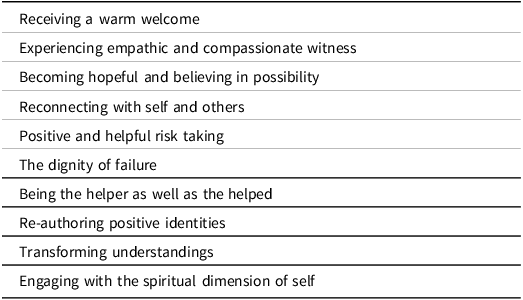
Today’s world is small. It would be wonderful to pool different sources of knowledge from lived experience, professional practice and from different cultures around the world to see if mental illness can be a gateway to a ‘re-enchantment with life’ instead of a form of disability and to see what happens if our mental health system reflects the 10 dialogues of healing reported in my research.
The views I express in this article are my own and do not represent the formal beliefs of any organisation with which I am or have been affiliated.
Stages of recovery.

Understanding the human growth processes over time (Watts & Higgins, Reference Watts and Higgins2017).

Ten key elements of recovery

Funding statements
This article received no specific grant from any funding agency, commercial or not-for-profit sectors.
Competing interests
The author has no competing interests to disclose.
Ethical standards
The author asserts that all procedures contributing to this work comply with the ethical standards of the relevant national and institutional committee on human experimentation with the Helsinki Declaration of 1975, as revised in 2008.



 Open access

