Chapter 3 - Cons and Pros
Published online by Cambridge University Press: 05 December 2014

Summary
What a community chooses to punish and how severely tells us what (or whom) it values and how much. That members of the public understand punishment to have this signification is confirmed by the familiar complaint that an insufficiently severe punishment endorses the criminal’s behavior and devalues his victim. …
… A theory of criminal-law policy that abstracts from social meaning – by, say, reducing the value of all policies solely to their cost effectiveness in deterring crime – will generate morally uncompelling, and hence politically naïve, prescriptions.
Dan M. Kahan, Social Meaning and the Economic Analysis of CrimeLegal Commentator Opposition and Social Scientist Support
Two discrete groups of commentators – the first from the legal academy and the second from the closely connected disciplines of sociology and criminology – have dominated the policy debate over the merits of prosecuting corporations and individuals for white collar crimes. Surprisingly, after extensive research I have not uncovered much collaboration between the two groups and I believe this book is the first to juxtapose their insights.
A prolific group of business-oriented legal academics argues that white collar criminal prosecutions are unfair and ineffective, especially with respect to corporations. The gist of their position is that corporations are paper entities that lack minds capable of formulating the guilty intent (mens rea) considered as an indispensable element of criminal culpability. Because the largest corporations have complex management structures and depend on the activities of many employees, no single executive – or even a committee of executives – is able to police everyone’s conduct. Individuals may well violate the criminal law, but most often they engage in such behavior contrary to official corporate policy. Criminal prosecutions impose considerable stigma and can result in grave and disproportionate damage to the corporation’s profitability. Therefore, such charges are both unfair to innocent bystanders such as the company’s stockholders and unwise in all but the most egregious circumstances. Instead, the government and the public at large should rely on civil actions to recoup any damages caused by rogue agents.
Information
- Type
- Chapter
- Information
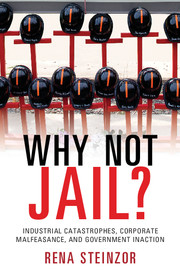
- Why Not Jail?Industrial Catastrophes, Corporate Malfeasance, and Government Inaction, pp. 66 - 94Publisher: Cambridge University PressPrint publication year: 2014
References
, Social Meaning and the Economic Analysis of Crime, 27 J. Legal Stud.609, 615–16 (1998)CrossRefGoogle Scholar
First Nat’l Bank of Boston v. Bellotti, 435 U.S. 765 (1978)
, In Defense of Corporate Criminal Liability, 23 Harv. J.L. & Pub. Pol’y833, 844–49 (2000)Google Scholar
, “No Soul to Damn: No Body to Kick”: An Unscandalized Inquiry into the Problem of Corporate Punishment, 79 Mich. L. Rev.386, 401 (1981)CrossRefGoogle Scholar
, Corporate Criminal Liability: What Purpose Does It Serve?, 109 Harv. L. Rev.1477, 1499 (1996)CrossRefGoogle Scholar
, Empirical Research on the Deterrent Effect of Environmental Monitoring and Enforcement, 30 Envtl. L. Rep. (Envtl. L. Inst.)10,245 (2000)Google Scholar
& , Effectiveness of the EPA’s Regulatory Enforcement: The Case of Industrial Effluent Standards, 33 J.L. & Econ.331 (1990)CrossRefGoogle Scholar
& , Environmental Pollution: Modeling Occurrence, Detection and Deterrence, 27 J.L. & Econ.29 (1984)CrossRefGoogle Scholar
, Beyond Elegance: A Testable Typology of Social Norms in Corporate Environmental Compliance, 22 Stan. Envtl. L.J.55 (2003)Google Scholar
, Assimilating Environmental Protection into Legal Rules and the Problem with Environmental Crime, 27 Loy. L.A. L. Rev.867, 881–82 (1994)Google Scholar
, Meeting the Demands of Integration in the Evolution of Environmental Law: Reforming Environmental Criminal Law, 83 Geo. L.J.2407 (1995)Google Scholar
, Suite Violence: Why Managers Murder and Corporations Kill, 33 Crime, L. & Soc. Change243, 245 (2004)CrossRefGoogle Scholar
et al., Moral Responsibility in the Age of Bureaucracy, 90 Mich. L. Rev.2348 (1992)CrossRefGoogle Scholar
, Blast at BP Texas Refinery in ’05 Foreshadowed Gulf Disaster, ProPublica (July 2, 2010), Google Scholar
Accessibility standard: Unknown
Why this information is here
This section outlines the accessibility features of this content - including support for screen readers, full keyboard navigation and high-contrast display options. This may not be relevant for you.Accessibility Information
Accessibility compliance for the PDF of this chapter is currently unknown
and may be updated in the future.