





Impact statement
This study addresses a pressing issue facing many low-income countries regarding how to satisfy their energy needs while meeting international climate obligations. Focusing on Malawi, this article examines the government’s decision to integrate coal into the national electricity mix amidst growing global calls for energy transition. Through stakeholder analysis and policy review, the study uncovers a lack of strategic direction and implementation in current energy policy, particularly concerning coal.
The broader impact of this work lies in its contribution to understanding the complex trade-offs that countries like Malawi face in balancing economic development, energy security and climate responsibility. While the energy transition is often dominated by global North perspectives, this article brings a much-needed Sub-Saharan African voice to the conversation. It highlights the contextual realities that shape energy decisions in low-income countries and calls for tailored, inclusive and realistic pathways to sustainability.
Introduction
In recent years, Malawi has faced significant challenges in the energy sector, characterised by a growing demand for electricity amidst insufficient, and unreliable supply with electricity access covering less than 15% of the population. As a developing nation, the pursuit of economic growth and improved living standards for its population is inherently linked to the expansion and diversification of its energy sources. The government of Malawi plans to incorporate coal into its electricity mix. However, this decision presents a paradoxical stance against international climate commitments and contradicts several Sustainable Development Goals (SDGs), including SDG 7 (Affordable and Clean Energy), SDG 13 (Climate Action), SDG 9 (Industry, Innovation and Infrastructure) and SDG 12 (Responsible Consumption and Production). While the use of coal-fired electricity may support short-term energy access, it undermines efforts to promote clean and renewable energy sources, compromising climate resilience, and increasing greenhouse gas emissions, thereby conflicting with Malawi’s obligations under global climate frameworks.
The transition to sustainable energy sources remains a global challenge, particularly for developing countries like Malawi, facing the dual pressures of satisfying their energy needs and adhering to international climate commitments. The decision to incorporate coal into the energy mix, as highlighted in recent studies and reports (World Coal Association, 2012; IEA, 2023), represents a tangible policy shift with profound implications for national energy security and environmental integrity. The decision contrasts with the growing global momentum towards renewable energy sources, which offer cleaner alternatives to meet energy needs without compromising environmental integrity and public health (IRENA, 2017). This scenario demands the urgent need for a balanced and sustainable energy transition strategy that harmonises the country’s developmental needs with environmental stewardship and adherence to international climate commitments (Taulo et al., Reference Taulo, Gondwe and Sebitosi2015; Berjawi et al., Reference Berjawi, Walker, Patsios and Hosseini2021). This article positions Malawi’s energy dilemma within the global transition towards renewable energy. By examining Malawi’s strategy to incorporate coal into the electricity mix, the article contributes to understanding how developing countries navigate the challenges and opportunities presented by the global shift towards cleaner energy sources. It contributes to the uncovering of how countries like Malawi can reconcile national energy goals with international climate obligations, aligning with key global frameworks such as the United Nations SDGs (SDG 7, SDG 9, SDG 12 and SDG 13).
Literature review
The fossil fuel dilemma in Africa
The call for energy transition presents a significant dilemma for many developing countries. According to Bellos (Reference Bellos2018), studies of energy transitions in developing countries need to be regarded with more critical reflectiveness because they are unlikely to merely involve the straightforward conversion of guiding frameworks from their origins to different implementation contexts. Several scholars and expert debates support and believe that Africa has the highest potential to transition to renewable energy. Schwerhoff and Sy (Reference Schwerhoff and Sy2018) concluded that a complete switch to renewable energy in electricity production is feasible and economically compatible with climate goals in Africa. They highlight the importance of regional cooperation and the exchange of electricity between countries to address the intermittency and capital intensity of renewable energy in Africa. Ouedraogo (2017) forecasts Africa’s energy future, stressing the importance of transitioning to renewable energy and improving energy efficiency to address the steady increase in energy requirements, dependency on fossil fuels and environmental issues.
A study by Nsafon et al. (Reference Nsafon, Same, Yakub, Chaulagain, Kumar and Huh2023) argued for a just and inclusive energy transition in Africa, emphasising that transitioning to clean energy must not exacerbate socio-economic challenges but support sustained poverty reduction and economic growth. They advocate for an incremental transition focusing on low-carbon development as the most feasible approach to energy transition in Africa. This dilemma existing in developing countries is overlooked and has not received adequate attention. While the imperative to mitigate climate change is acknowledged, the reliance on fossil fuels remains integral to addressing pressing socio-economic challenges, including energy poverty and economic growth in Africa (Phakati, Reference Phakati2024). Oviedo-Toral et al. (Reference Oviedo-Toral, François and Poganietz2021) in their article stated that in low-income countries, ‘energy transition’ deals with the dilemma of gaining access to affordable energy services, without becoming trapped in a fossil fuel-intensive future. Nurwanty et al. (Reference Nurwanty, Afinnas, Rachmawati, Hepasari and Fauzi2022) in a similar study on the coal dilemma in Indonesia tacked mainly on coal business and environmental sustainability. Based on the scope of this study, we define energy dilemma as a concept comprised of two terms: energy security and international environmental commitment.
The dilemma of coal in Malawi
The GoM (2003) envisages a steady increase in hydroelectric power generation, a reduction in biomass use and steady growth in renewable sources, especially solar, wind and micro-hydropower plants. There has been tension among experts, the government and concerned environmentalists surrounding the decision to incorporate coal into Malawi’s electricity portfolio. Some experts believe it is the usual balance between development and fighting climate change, and consider Malawi is at a difficult point in terms of access to electricity. Mtika (Reference Mtika2020) believes that the country’s rush to build coal power plants seems a knee-jerk and desperate reaction following in the footsteps of South Africa, Botswana, Kenya, Tanzania, Mozambique and Nigeria, among other African countries. Environmentalists are worried that as the global community transitions to clean energy, those initiating new fossil fuel-powered projects risk becoming dumping sites for the technology that is being phased out. Others back the decision on the premise that power from coal is guaranteed, arguing that while renewable energy is clean, it cannot be optimally relied on for Malawi to meet all its power needs.
The Society for Mining, Metallurgy and Exploration (SME), a United States-based firm, states that coal, which provides more than 36% of global electricity, provides affordable, reliable and constant power. SME argues that as much of the world lacks access to modern, clean energy, coal is still essential to alleviating energy poverty. Malawi finds itself at a crossroads in terms of power generation. However, while electricity from coal may prove crucial in the short term in the Malawian context, the ramifications are likely to linger on for decades. Even though emissions in Malawi are very low compared with other countries in the same region, the country needs to be cautious regarding the energy technology it opt for. Coal power has the undeniable capacity to hasten the socio-economic development in Malawi. Nevertheless, it is of utmost importance to recognize that the window of opportunity to maximise its benefits might be very thin. Striving to attain a harmonious balance in this scenario is undeniably crucial.
Local initiatives and innovation for energy transition
Innovative experiments in Malawi’s renewable energy sector reveal a positive response to international climate commitment. Examples include solar mini-grid pilot projects, biomass briquette manufacturing, and private-led hydro experiments in Malawi. These efforts represent localised, bottom-up pressures challenging the planned coal power. Oviedo-Toral et al. (Reference Oviedo-Toral, François and Poganietz2021) and Sovacool (Reference Sovacool2013) emphasise that such bottom-up innovations are crucial for avoiding fossil-fuel lock-in. However, they require institutional support, market incentives and integration with national strategies. Thus, these local developments can evolve into regime-changing forces, but only if supported by clear policy signals and public–private partnerships.
Conceptual framework
Maswabi et al. (Reference Maswabi, Chun and Chung2021) recognises energy security and energy transition are portrayed as co-evolving attractor states that vary in strength over time, representing different pathways that the energy system could follow. Due to the complexity of energy transition, theories adopted by researchers will differ depending on the context and scope of the study. For this study, the multi-level perspective (MLP) framework used by Maswabi et al. (Reference Maswabi, Chun and Chung2021) was utilised to analyse Malawi’s coal dilemma, which is a modified version of Marquardt et al. (Reference Marquardt, Steinbacher and Schreurs2016) framework for studying energy transition. The MLP posits that developments emerge from the interplay within and between three specific layers: (i) the broader socio-technical context, or ‘landscape,’ (ii) established structures, or ‘regimes’ and (iii) innovative spaces, or ‘niches’ (Geels, Reference Geels2012).
Marquardt et al. (Reference Marquardt, Steinbacher and Schreurs2016) used the framework to highlight the links between niche-level experiments and the electricity regime when carrying out a study on energy transition in Morocco and the Philippines. Maswabi et al. (Reference Maswabi, Chun and Chung2021) modified this framework to study the barriers to energy transition in Botswana. The framework provides a useful framework for analysing the dynamics of low-carbon transport system transitions, and assessing drivers, barriers and potential pathways (Geels, Reference Geels2012). For purposes of this study, the MLP framework was modified to fit into the context of global energy transition and energy security to provide a basis for examining the coal dilemma in Malawi resulting from pressures of the landscape elements such as the global pressure as shown in Figure 1.
-
▪ Global and regional influences (landscape level): The broader context of energy policy and practice must consider the macro-environmental and socio-political dynamics, such as international climate commitments and regional energy strategies. The influence of the global energy landscape and the pressure to align with international commitments like the Paris Agreement will form the background against which Malawi’s coal power industry is framed.
-
▪ National energy policies and economy (regime level): This constitutes the established practices and infrastructures that currently dictate Malawi’s energy sector. The use of coal power, economic imperatives, existing policies, infrastructure and the interplay with societal values.
-
▪ Local initiatives and innovations (niche level): At this level, the focus was on localised and small-scale initiatives that demonstrate the potential of alternative energy sources. These innovations serve as testing grounds for broader implementation and are often where transformative change begins.
Framework for analysing Malawi’s coal dilemma (adapted from Maswabi et al., Reference Maswabi, Chun and Chung2021).

Methodology
We combined desktop research and survey techniques to comprehensively investigate the dilemma of coal and associated intricacies in the Malawian context. The survey was designed to explore the participants’ perspectives on the current state of integrating coal into the electricity portfolio. A critical analysis was conducted to understand both the local and international governance context the study is operating in.
Data collection and analysis
Data was collected from reviewed articles, Malawi government reports on energy and minerals, energy policy documents and strategies for Malawi. Online and physical surveys were conducted from February 10 to March 14, 2024, capturing perspectives from 40 participants sampled using purposive and snowball techniques. The survey questionnaire was distributed to experts in the energy sector in Malawi, academicians, NGOs in the environment and energy industry, government agencies working in the environment, energy and mining industries, and the public purposively selected based on their knowledge of energy and the environment, focusing on their perceptions of coal power. This article adopts a thematic analysis as the research question seeks to investigate through analysis of participant’s views, opinions, knowledge, experiences or values from a set of qualitative data.
Results and discussions
Malawi’s coal strategy and international commitments
An assessment of Malawi’s energy policy reveals that the NEP presents only a theoretical reflection of the international climate agreements, committed to reducing its greenhouse gas emissions and aligning its development with low-carbon and climate-resilient principles. The results show that the NEP is more tailored to reducing the contribution of biomass in the energy mix than climate concerns.
‘Cognizant of the fact that biomass dominates the current energy mix, at 89%, this Policy aims at reducing the contribution of biomass in the energy mix by promoting development and use of modern energy sources’ (GoM, 2018).
The policy rationale is grounded in the argument that coal is a cost-effective and reliable energy source capable of supporting Malawi’s industrial sector and economic aspirations. However, the alignment of economic and environmental agenda is somewhat myopic, focusing on immediate gains rather than long-term sustainability. It was noted that the policy recognizes coal as a modern energy source, having the capacity to provide a more efficient and competitive energy source. The policy identifies eight priority areas and coal is considered as one of the priorities, signalling a strategic inclination towards coal utilisation but lacking a clear roadmap for its sustainability in both economic and environmental spheres. It was observed that there is no strategic roadmap for coal use in the country other than the policy statements in the NEP. No comprehensive strategy or document is available to guide the use of coal for electricity and the whole coal industry. A comprehensive coal strategy would help to ensure environmental sustainability by providing a predictable framework for management. It would enable long-term planning, facilitating decisions on energy development, such as power plants, and ensuring that these are aligned with global sustainability goals. With growing global emphasis on reducing carbon emissions, a coal strategy must not only mention but also address environmental concerns in both national and global contexts. It should include detailed measures to mitigate the environmental impact of coal usage, such as investing in cleaner coal technologies as mentioned in the policy and ensuring compliance with international environmental agreements like the Paris Agreement. A look at the planned coal power plants shows no integration of fuel-efficient or clean coal technologies, contrary to what the NEP states.
Participants’ analysis of the energy policy reveals that the policy is moderately aligned with international commitments. However, the policy has not been as effective in practice due to the non-commitment of the government in implementing the policy. A respondent from the academia (A01) stated that the policy is not sustainable, implying scepticism about the long-term viability of coal in the energy mix citing lessons learned from neighbouring countries such as South Africa. The results show 78% of the participants analysing the NEP as being aligned with the international climate agendas but lacking practical implementation. Non-commitment of the government in implementing policies was mentioned as one of the major reasons. One of the energy experts (E03) mentioned that the policy has not been sustainable over the years with just very little progress in energy access and diversification of energy sources, with a huge potential for the policy to be feasible. An academician (A03) suggested that the policy requires the commitment of the government, coupled with strategic investment and implementation programs. The results show 60% of participants affiliated to Non-Governmental Organisations in the energy and environmental sector recommend a balance between economic growth and sustainability in Malawi’s context of energy policy and the electricity sector.
Scholarly literature supports the notion that transitioning to cleaner energy sources is not just an environmental imperative but also an economic and social one. Moreover, the operational lifetimes of coal-powered units must be considered in light of the Paris Agreement targets. Edwards et al. (Reference Edwards, Cui, Bindl, Hultman, Mathur, McJeon, Iyer, Song and Zhao2022) suggest that lifetimes for coal power plants should be limited to ensure global warming remains below the critical thresholds. The concept of a ‘viable-competitive framework’ proposed by Danish et al. (Reference Danish, Elsayed, Ahmadi, Senjyu, Karimy and Zaheb2020) emphasises the need for a holistic approach to national energy policy, incorporating managerial, technical, economic and sustainability aspects. This framework could facilitate the alignment of Malawi’s coal industry with global energy transition goals, thereby enhancing the policy’s effectiveness and sustainability. Aligning coal strategy with the Paris Agreement offers profitable opportunities for resource sectors to contribute to meeting the Paris Agreement and United Nations SDGs (Hodgkinson and Smith, Reference Hodgkinson and Smith2021).
Strategic investments, coupled with strong commitment to implementing and adhering to a comprehensive energy policy, are imperative for Malawi to navigate the dichotomy between energy security and environmental sustainability. This approach would not only support Malawi’s economic aspirations but also contribute to the global effort in combating climate change, fulfilling the Paris Agreement, and achieving the United Nations SDGs.
The study framework suggests that the transition to sustainable energy systems in Malawi is hampered by the lack of a clear roadmap for coal usage and an overemphasis on immediate economic gains. A strategic shift is required to integrate coal power with environmental sustainability, encompassing cleaner coal technologies and adherence to international climate agreements, to ensure a balanced approach to economic growth and climate commitments. Table 1 shows a summary of key findings from the survey we conducted.
Summary of key findings from survey participants

Addressing the coal dilemma
Practical toolkit for navigating the coal dilemma
The World Bank recognizes that poorer countries are stuck in a vicious cycle where they pay more for electricity; cannot afford the high upfront cost of clean energy, and are locked into fossil fuel projects. In essence, they are paying a triple penalty for the energy transition and the poverty trap is becoming an energy trap that is becoming a climate trap. A typical example was revealed by Nguyen et al. (Reference Nguyen, Hoang, Wilson and Managi2019) where energy transition in Vietnam decreased electricity poverty but increased energy-cost poverty, with a national program for poverty alleviation needed to lower energy costs and assist poor and ethnic minority households. This article, therefore, proposes a toolkit for addressing the coal dilemma (Figure 2) to prevent Malawi from being a victim of the climate trap.
Coal dilemma toolkit.
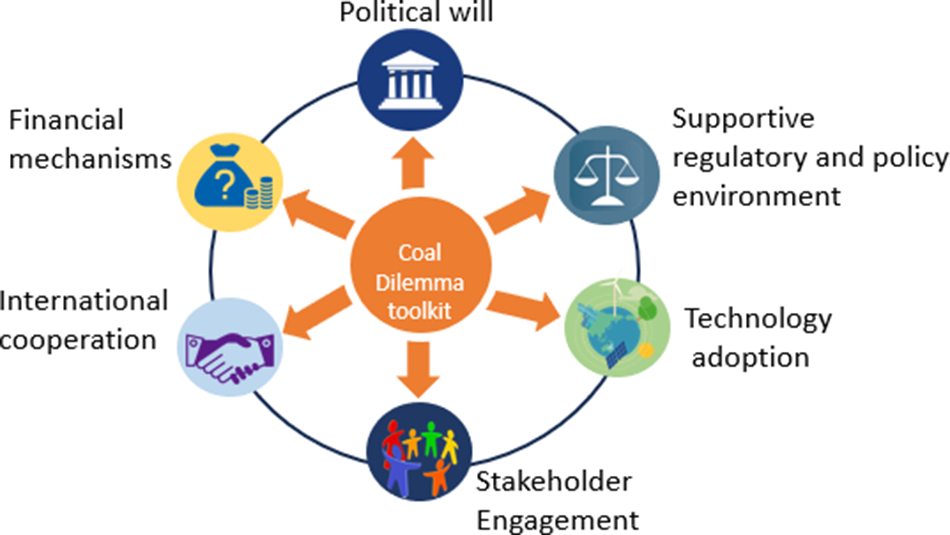
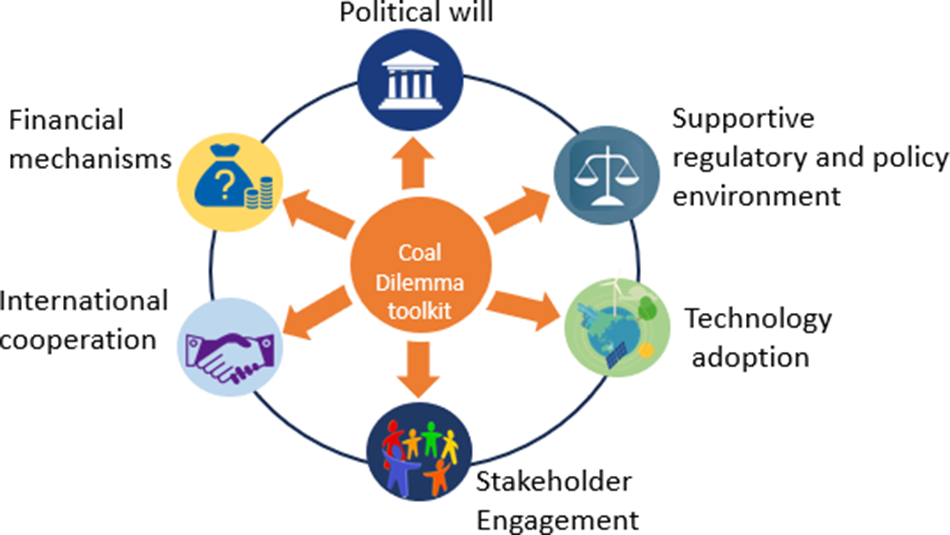
The toolkit starts with government leadership, which translates to a supportive regulatory and policy environment, followed by the ability to adopt emerging technologies and instruments to minimise risks that can deliver clean energy that serves immediate imperatives, including energy security, energy affordability and jobs. Malawi government can take the lead in forming policies that not only promote clean energy but also provide a sustainable framework for investments in the coal industry. This calls for comprehensive engagement of stakeholders, balancing economic and environmental sustainability. A comprehensive stakeholder engagement will enable a strong private sector. Genc and Kosempel (Reference Genc and Kosempel2023) believe that a stronger public sector can help ensure energy security, reliability, access, affordability and sustainability during the energy transition.
Additionally, international cooperation can provide technical expertise, knowledge sharing and capacity building to support Malawi in developing its renewable energy sector. This collaboration can help Malawi access best practices, innovative technologies, and lessons learned from other countries that have successfully transitioned to renewable energy sources. Moreover, international cooperation can facilitate the implementation of policies and regulations that promote renewable energy development. This includes supporting Malawi in setting ambitious renewable energy targets, implementing carbon pricing mechanisms and establishing regulatory frameworks that incentivise investment in renewable energy.
Financial mechanisms, such as international grants, loans and investments, can provide the necessary capital to fund renewable energy projects in Malawi. These financial resources can be used to develop renewable energy infrastructure, such as solar and wind farms, mini-grids and off-grid solutions, which can help reduce reliance on coal and improve energy access in rural areas.
A strong political will is key to the toolkit, governments need the support of low-cost and concessional climate finance to prepare for the transition and then realise a pipeline of affordable clean energy investments. The initial stages of the toolkit are critical and signal to investors that the country is ready for larger flows of private capital to sustain the clean energy scale-up.
Strategic coal dilemma balancing
Qualitative analysis reveals a complex array of perspectives among stakeholders regarding Malawi’s energy integration of coal into Malawi’s electricity mix. While some support the move due to coal’s economic benefits and energy security implications, others argue against it and support increased renewable energy development, citing environmental sustainability and long-term economic viability. The data show a consensus on the need for a balanced approach to the coal strategy, incorporating both immediate economic needs and long-term sustainability goals.
Developing robust energy policies and regulatory frameworks that encourage investment in renewable energy and ensure the sustainable use of coal is crucial. The government is central to the coal dilemma, with its policies directly influencing the energy sector’s trajectory. The role of government agencies is critical in ‘making, enforcing and implementing policies/regulations on energy transition and climate change’. The government faces the challenge of balancing energy security, at the disposal of cheap and readily available coal, with the need to adhere to the Paris Agreement. The NEP (2018) provides a broad endorsement of coal but lacks concrete regulations on clean coal deployment. There is an urgent need for strict and binding regulatory frameworks that mandate environmental impact assessments, efficiency standards and technology benchmarks for coal power plants. For example, legislation requiring carbon capture readiness or minimum efficiency standards could help align with Malawi’s NDCs under the Paris Agreement. Drawing lessons from South Africa’s 2018 Coal Strategy, Malawi can develop complementary regulatory instruments, including emissions capping, licensing conditions tied to technology type and fiscal penalties for polluting plants.
Moreover, the government should establish a comprehensive coal supply industry and strategy. A comprehensive coal strategy would help to ensure economic and environmental sustainability by providing a predictable framework for investments and management of the coal industry. It would enable long-term planning, facilitating decisions on coal power development and ensuring that these are aligned with the global climate agenda.
About 67.8% of participants stated lack of coordination among government institutions as one of the factors impeding the development of sustainable energy development in the country and advised effective coordination for a smooth transformation of Malawi’s energy landscape.
‘…strengthening corporate governance to enhance coordination and operational efficiency among state-owned institutions’ (E03).
This was also backed by N03,
“…putting existing policies into practice by revitalising the country’s energy resources, developing sensible approaches, and cross-sectoral coordination and collaboration to pull up resources together.”
Ensuring institution coordination as well as involving all concerned stakeholders, including local communities, civil society and the private sector, in the decision-making process can lead to more inclusive and sustainable energy policies. Public awareness campaigns and education programs about the benefits of renewable energy, the efficient use of energy to reduce demand and the impacts of coal can also foster public support for the energy transition.
Collaborating with neighbouring countries in Southern Africa to share best practices, develop regional energy projects and invest in cross-border energy infrastructure, thanks to the ongoing Mozambique–Malawi interconnection project the government is undertaking. For instance, South Africa is currently one of the top coal producers in the world. Domestically, coal is a major source of energy, accounting for over 77% of the country’s electricity production (IRENA, 2023). Apart from the South African whitepaper on energy policy, the South African government formulated a coal strategy in 2018. The strategy aims to minimize key constraints in the coal industry and maximize the economic benefits of coal while managing its environmental and social impacts including strategies on clean coal technologies. Currently, new power plants in South Africa are adopting more efficient coal technologies to comply with climate and environmental requirements. For example, the Kusile coal power plant adopts supercritical-pressure technologies for more efficient generation of power than standard coal-fired systems, resulting in a significant reduction in carbon dioxide emissions. The technology is also an atmospheric emission abatement technology in line with current international climate commitments. South Africa also formulated the Integrated Resource Plan (IRP) that considers the deployment of CCS technology, underground coal gasification and other clean coal technologies to enable them to continue using coal resources in an environmentally responsible way into the future. IRP also aims to reduce reliance on coal, even though it still acknowledges coal’s significant role in the energy mix for the foreseeable future. Additionally, the government established the centre for carbon capture and storage that is still under pilot. Projections show that coal will remain the biggest source of electricity generation in 2030; however, its share has been falling over the years with growing demand being increasingly supported by renewables in South Africa, unlike in Malawi where an increased share of coal is observed in electricity projections. The government should utilise its existing bilateral agreements and seek capacity-building assistance from other governments. Capacity building can be instated as a component in programmes that are funded by international organisations. Moreover, the government should facilitate access to finance for renewable energy projects through partnerships with international donors, development banks, and the private sector to accelerate renewable energy development. Financial instruments like green bonds, concessional loans and grants can support the development of renewable energy projects and the modernisation of planned coal-fired power plants.
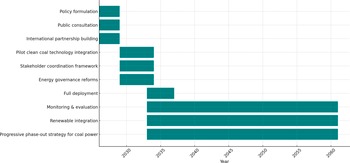
Furthermore, implementing robust mechanisms for monitoring, reporting and verifying greenhouse gas emissions from coal power can help track sustainability and progress towards emission reduction targets and inform policy adjustments. Formulation of a special task team on coal power would be very recommendable to achieve sustainability goals. Figure 3 is a proposed timeframe for implementing the coal strategy for a successful coal power integration into the electricity mix.
A proposed timeframe for implementing the coal strategy.

Recommendations and policy implications
Our findings highlight the need for Malawi to balance its immediate energy security and economic development goals with long-term environmental sustainability. Even though emissions in Malawi are very low when compared to other countries in the same region, caution must be exercised regarding the energy technologies Malawi opt for. We recommend the formulation of a comprehensive coal industry framework coupled with a holistic coal strategy. This strategy should be distinct yet integrated with the national energy policy, aligning with the national development agenda and sustainable development goals. To ensure effectiveness, the government must include specific, actionable policies on coal use within the broader national energy policy. Generalised statements currently present in the policy fail to address the unique challenges and opportunities of coal. A well-defined and targeted approach is essential to balance energy needs, economic growth and environmental sustainability. It should provide strategic guidelines and framework with detailed measures to mitigate the environmental impact of coal usage in the electricity sector, strict control measures and sustainable coal strategies such as the practical implementation and investment in cleaner coal technologies as mentioned in the energy policy. The government needs to take deliberate actions at the energy governance level to formulate a strategic coal power roadmap. That being said, coal power should not be considered as baseload electricity. Heavy investment and an increase in budget allocation to renewable energy technology, principally solar due to its undeniable potential, is recommended. Moreover, budgetary allocations can be directed toward research and development efforts to enhance the efficiency and effectiveness of renewable energy technologies.
The government should encourage private sector investments in renewable energy through incentives such as tax holidays, subsidies and permit exemptions for small-scale independent power producers. Facilitating the growth of renewable energy will help Malawi from the risk of getting into fossil fuel lock-in. By prioritising funding for the RE sector, Malawi can accelerate its transition towards a more sustainable and environmentally friendly energy system, aligning with global efforts to combat climate change.
The insights and findings from this article can serve as a policy or practice model for other developing countries facing similar energy dilemmas. We have provided a contextual understanding that can inform energy transition strategies in countries with comparable economic, environmental and social landscapes. This article enriches the global discourse on energy transitions, offering a perspective from a Sub-Saharan African country, grappling with the dual challenges of economic development and climate change mitigation. It adds to the body of knowledge on how developing countries can balance immediate energy needs with long-term sustainability goals. We believe that the energy dilemma can be solved through strong government commitment coupled with political will and strategic planning in policy and action development towards renewable energy sources with less focus on fossil fuels.
Methodological limitations and future directions
This study is grounded in qualitative analysis supported by a purposively selected sample of 40 stakeholders. While the data offer rich insight into stakeholder perspectives, we acknowledge the limitation of the small sample size and the absence of quantitative modelling.
Future studies should adopt a mixed-methods approach, integrating structured surveys with econometric analysis, which was not included in this study due to funding challenges. This will strengthen the empirical basis for understanding trade-offs in energy policy. We suggest techniques use of discrete choice experiments to assess policy preferences, regression analysis to correlate stakeholder attributes with energy preferences, and cost–benefit models to compare coal and renewable options.
Open peer review
To view the open peer review materials for this article, please visit https://doi.org/10.1017/etr.2025.10004.
Data availability statement
The dataset generated during this study is available from the corresponding author upon reasonable request, subject to confidentiality agreements.
Author contribution
M.L. led the study’s conceptualisation, design and methodology, conducted data analysis, created visualisations, interpreted findings and drafted the initial manuscript. J.L.T. contributed to synthesising relevant literature, in addition to reviewing and editing the manuscript. E.G.T. and T.K. validated the analytical framework, curated key literature and participated in manuscript review, editing and revisions. All authors critically evaluated and approved the final version of the manuscript.
Financial support
This research did not receive any specific grant from funding agencies in the public, commercial or not-for-profit sectors.
Competing interests
The authors declare no competing interests, financial or otherwise, that could influence the work reported in this article.
Ethics statement
The study engaged adult stakeholders (energy/environmental professionals) through voluntary surveys. Informed consent was obtained from all participants. Ethical clearance was waived as the research did not involve sensitive personal data, vulnerable populations or interventions requiring institutional review.



 Open access


Comments
Submission of Manuscript for Consideration Energy Transitions Journal
Dear Editor,
I am pleased to submit my manuscript titled “The Dilemma of Coal in Malawi Amidst Global Energy Transition: A Critical Analysis of Policy and Practice” for consideration in Energy Transitions. This paper critically examines Malawi’s ongoing energy challenges, particularly the tension between the country’s plans to incorporate coal in its electricity portfolio and global climate commitments. Given the urgent need for sustainable energy solutions in Malawi and the broader Sub-Saharan African region, this study provides a timely and policy-relevant analysis.
Malawi faces persistent electricity deficits, with national electrification rates remaining below 15%. While coal has the potential to enhance the country’s energy security, its role is highly contested due to international climate commitments such as the Paris Agreement. This study employs qualitative methods, including a survey of 35 participants, desktop research, and comparative analysis, to assess perspectives on integrating coal into Malawi’s energy mix. The findings reveal diverse viewpoints, with 78% of respondents acknowledging the necessity of coal while also recognizing the imperative of transitioning to cleaner energy sources. These insights contribute to ongoing policy discussions on energy transitions in developing economies.
This manuscript aligns with the scope of your journal by addressing critical issues in energy policy, climate commitments, and sustainable development. I believe it will be of interest to scholars, policymakers, and practitioners engaged in energy transition discourse. The paper has not been published elsewhere, nor is it under consideration by another journal.
I appreciate your time and consideration of my submission. Please do not hesitate to contact me should you require any further information.
Sincerely,
Maxwell Likhule
Kamuzu University of Health Sciences
Malawi