




Solfeggio Traditions in the Shadows: The Spanish Case
During recent decades, as the Historically Informed Performance movement has continued to explore new fields, a great deal of scholarship on the music theory and pedagogies of the past has appeared. In research into eighteenth-century teaching methods, Neapolitan partimenti and solfeggi in particular have occupied a central place, owing to the upsurge in scholarly interest in all aspects of Italian music. This has led to a reassessment of those learning tools and an understanding of their importance for comprehending forms of improvisation and composition, and for developing analytical methods that address the idiosyncrasies of eighteenth- and nineteenth-century repertoire in greater detail.Footnote 1 Regarding analytical methods, Robert O. Gjerdingen has identified formulas, called schemata, in the music of composers of diverse backgrounds and differing periods, first and foremost those appropriated from the solfeggi books and partimenti.Footnote 2
Increased scholarly interest in teaching practices within the Neapolitan conservatories and their dissemination throughout Europe has led to a certain neglect of sources from other pedagogical traditions, such as those of Spain. This is despite the well-established cultural and political ties between Spain and Italy, exemplified by Naples as viceroyalty of the Spanish monarchy until 1707, and as a kingdom governed by the House of Bourbon from 1734. Both Italy and Spain followed the common model for music education established by the Catholic Church, although teaching methods most certainly differed according to teacher, educational centre and geographical area. Thus pedagogical sources from Spain can shed light upon practices common to other Catholic countries during the eighteenth century, such as Portugal, Italy and Austria, as well as parts of Germany. Yet as for the Spanish didactic collections of canto de órgano (mensural music, or canto figurato in Italian, canto de órgão in Portuguese or chant figuré in French), they have been overlooked in even the most exhaustive research on the history of solfeggio and singing in Spain,Footnote 3 as well as in Nicholas Baragwanath’s significant work The Solfeggio Tradition (2020).Footnote 4 These mensural music lessons or solfeos served to train beginners in reading and interpreting different types of repertoires, from renaissance polyphony to modern-style monody.Footnote 5
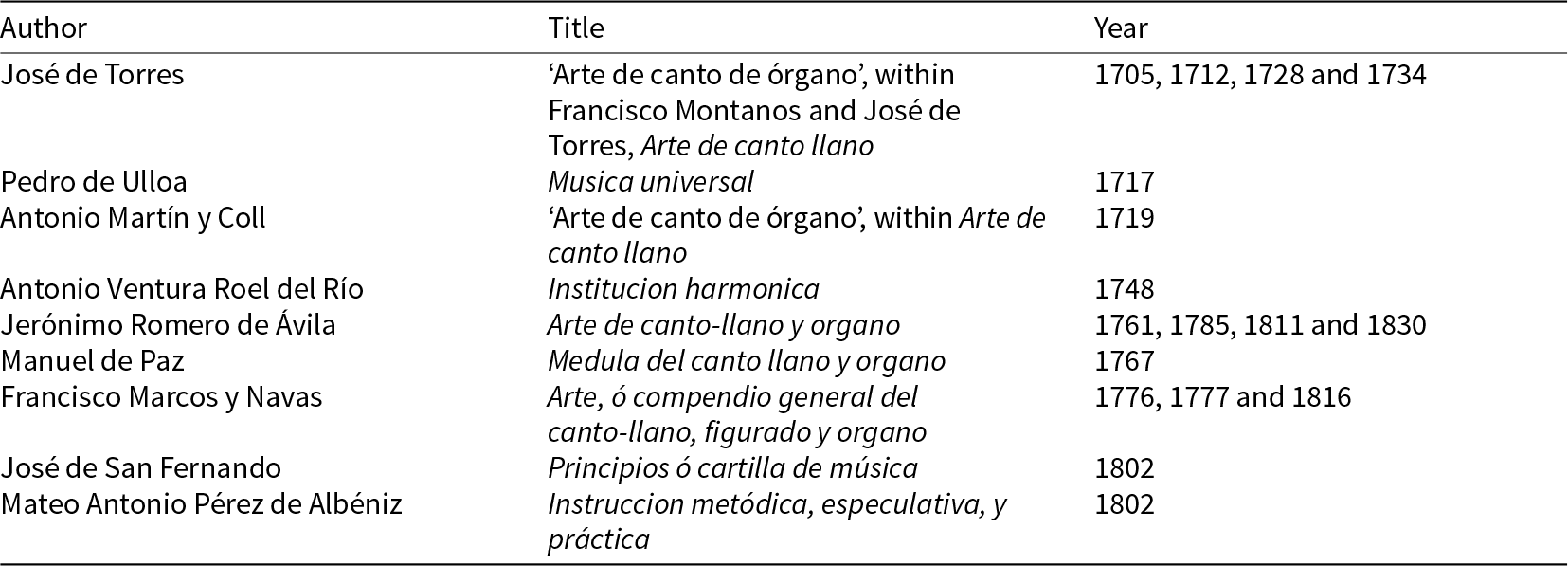
This article will focus on Spanish printed collections of this type up until 1808, when the Peninsular War interrupted their publication. The vast majority were published within the body of larger musical treatises (see Table 1), which may well be the reason for their being overlooked. In order to provide an initial overview, this study will address the following aspects: (1) their context; (2) historical evidence about their usefulness in cultivating ‘good taste’; (3) the ways in which their development and practice conformed to Spanish music treatises; and (4) the types of lesson books. I establish points of commonality with the other solfeggio traditions, particularly that of Italy, drawing on other foundational works – such as the aforementioned study by Baragwanath and those by Robert O. Gjerdingen, Andrea Bornstein, Paolo Sullo and Peter van TourFootnote 6 – with the aim of enriching modern notions of historical music pedagogy during the Age of Enlightenment.
Treatises on mensural music printed in Spain between 1705 and 1802

Printed Canto de órgano Lessons in Context
Before the eighteenth century, Spanish imprints of graded teaching pieces for the study of mensural music were rare, other than the instrumental books of previous centuries.Footnote 7 The only known precedent is the Sumula de canto de organo (Compendium of Mensural Music, c1503), by Domingo Marcos Durán, whose exercises were used to learn to read music and sing it aloud, but also to practise ‘discant’ and teach diction by means of various vowels.Footnote 8 In preceding centuries, pedagogical practices would probably have mirrored the kind of material found in a work such as Andrés Lorente’s El por qué de la música (The Why of Music, 1672). Lorente omitted didactic pieces for the sake of brevity and because ‘the master who teaches canto de órgano is the one who should rightfully assign it when giving lessons to his students, or find them music scores that contain it, so that they know how to sing the words to the most commonly used time signatures’ (‘al maestro que enseñare el Canto de Organo, pertenece echar Lecciones à sus discípulos con ella, ò buscarles papeles de Musica que la tengan, para q[ue] sepa[n] cantar Letra en los Tiempos mas usados’)Footnote 9 – although he provides plainchant solfeos. However, the publication of various lesson books of canto de órgano was something of a novelty to eighteenth-century Spain, and came about largely because of the development of new publishing technologies: initially with a more advanced system of movable type at the Imprenta de Música (1699–1736), operated by José de Torres, organist and later Master of the Royal Chapel, and later by means of the engraving process, arguably the most significant innovation in music printing of the century.Footnote 10
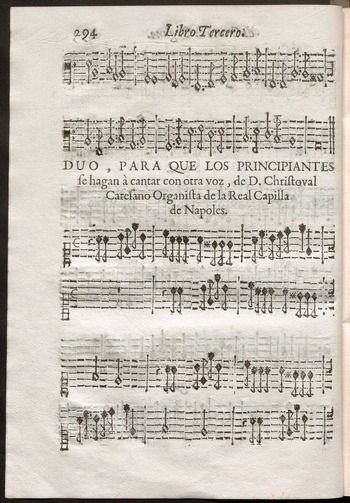
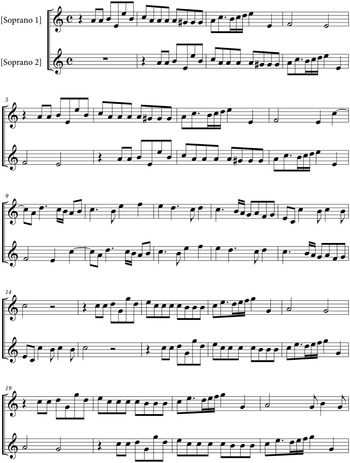
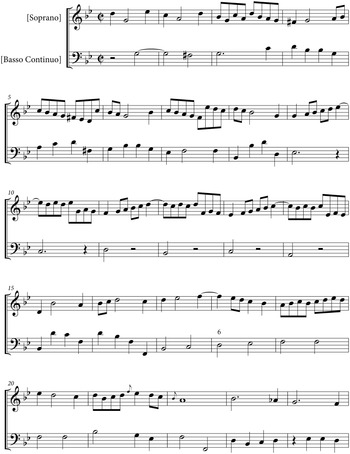
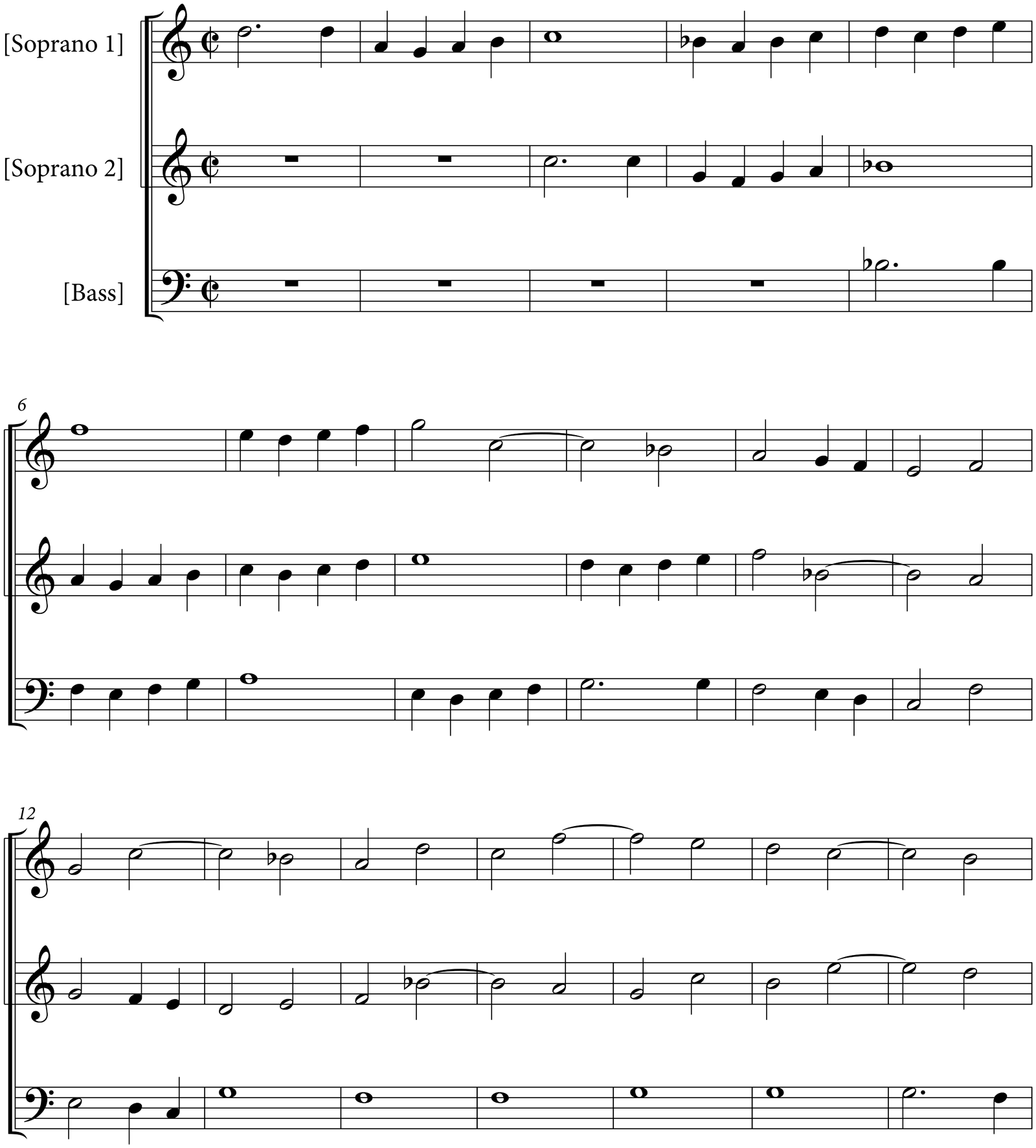
The inclusion of solfeo collections within Spanish treatises was likely to have been related not only to advances in music printing, but also to the circulation of and familiarity with foreign prints, such as the duets published in 1681 and 1693 by Cristoforo Caresana, organist of the Royal Chapel of Naples.Footnote 11 Antonio Martín y Coll, organist of the monastery of San Diego in Alcalá de Henares, included the ‘Duo decimoterzo à Due Tenori’ from Caresana’s 1693 volume amongst the lessons in his own ‘Arte de Canto de Organo’ (1719) (see Figure 1 and Example 1),Footnote 12 though this solfeggio now appears for two sopranos rather than two tenors. Italian music had been gaining a stronger foothold throughout Europe, so it is no surprise that some Neapolitan solfeggi should have been published in Spain; in fact, a beginners’ book of lessons by Leonardo Leo, Solfeos de Leo para los principiantes, appeared in print in Madrid, possibly in 1771.Footnote 13
‘Duo, para que los principiantes se hagan à cantar con otra voz, de D. Christoval Caresano [Cristoforo Caresana] Organista de la Real Capilla de Napoles’, bars 1–6. Antonio Martín y Coll, Arte de canto llano, y breve resumen de sus principales reglas para cantores de choro, dividido en dos libros: en el primero se declara, lo que pertenece à la theorica; y en el segundo, lo que se necessita para la practica; y las entonaciones de los psalmos con el organo; y añadido en esta segunda impression con algunas advertencias, y el Arte de Canto de Organo (Madrid: Imprenta de Musica, por Bernardo Peralta, 1719), 294. Biblioteca Nacional de España, Madrid, M/1921. Used by permission

Antonio Martín y Coll, ‘Duo, para que los principiantes se hagan à cantar con otra voz, de D. Christoval Caresano Organista de la Real Capilla de Napoles’, bars 1–22 (original clefs: C1, C1). In Martín y Coll, Arte de canto llano, 294–296

The motive for publication would have been to produce methods for children and beginners who could follow well-structured lessons that were progressively ordered, along the lines of the famous Solfèges d’Italie (1772, first edition) published in France and dedicated to the page boys (roughly ages seven to fifteen) of Louis XV’s musical establishment, La Musique du Roi.Footnote 14 It is important to emphasize that some Spanish treatises are particularly methodical and abound in solfeggio exercises, such as those by Jerónimo Romero de Ávila, maestro de melodía (‘master of melody’, that is, of musical rudiments) of Toledo Cathedral, and by Francisco Marcos y Navas, psalmista in Madrid’s Church of San Isidro. The various reprints of both method books up to the nineteenth century affirm their success (Table 1). Both authors, Romero de Ávila and Marcos y Navas, show a logical design to their lessons, starting with scales of different qualities or hexachord mutations up to the octave, and then singable, disjunct intervals in the ‘natural’ key signature (as opposed to key signatures with flats and sharps), continuing with accidentals – a gradual increase in the number of flats before progressing to lessons with sharps. Likewise, both authors usually began with exercises in simple metres, considered easier to count, before gradually progressing to compound metres.Footnote 15 Clearly, the methods of these two masters were rooted in commonly held principles of eighteenth-century pedagogy: the progression of their lessons was quite similar to that of their Italian counterparts, such as Francesco Feo (maestro at the conservatories of San Onofrio between 1723 and 1739 and the Poveri di Gesù Cristo between 1739 and 1743)Footnote 16, as transcribed in the ‘Vezerro de lecciones’ and preserved in Mexico City.Footnote 17
However, printed collections did not necessarily cover all stages of learning. Some authors were well aware that they were not fully sufficient for a musician’s training. Marcos y Navas stated that in the event that his exercises did not meet the needs of the learner, ‘his teacher should endeavour to write others until he knows that [the student] has become proficient’ (‘Procurará su maestro el escribirle otros hasta tanto que conozca que [el discípulo] ya está diestro’).Footnote 18 Antonio Ventura Roel del Río, chapel master of Mondoñedo Cathedral, maintained that his printed lessons were useful only for beginners and that the teacher should provide others of greater depth.Footnote 19 Other musicians, such as José Onofre Antonio de la Cadena and Pedro Carrera Lanchares, also maintained that the master should be responsible for copying or composing lessons for the student.Footnote 20 In a similar vein to Giambattista Mancini’s Riflessioni pratiche sul canto figurato (1774),Footnote 21 Miguel López Remacha – a tenor in the Real Capilla – argued in his Arte de cantar (1799) that solfeo had to be adapted to singers’ abilities, ages and vocal tessituras in a straightforward way, following a methodical progression:
Instruido suficientemente el principiante en este utilísimo ejercicio, le escribirá el maestro de su puño, o buscará de un buen autor, los principios o elementos prácticos que necesite aquel para su instrucción, debiendo residir en ellos el orden, método y buen gusto que exige el arte del canto. Esto es, orden en el uso de llaves, compases, accidentes, figuras, apuntaciones, etc.; método en no anteponer lo difícil a lo fácil; en proporcional el estudio a la capacidad, edad y voz de cada uno; gusto en la melodía discurriendo frases de buena cadencia y formando de cada solfeo un plan único y consiguiente.Footnote 22
Once the beginner has been sufficiently instructed in this very useful exercise, the teacher will write down for him in his own hand, or will seek out from a good author, the principles or practical elements that the former needs for his instruction, and in these must reside the ordering, method and good taste that the art of singing demands. That is, ordering in the key signatures, time signatures, accidentals, note values, performance markings, etc.; methodical in not putting the difficult before the easy; in tailoring the study to the ability, age and voice of each person; good taste in the melody, crafting phrases with a good cadence and forming a unique and consistent approach for each solfeggio exercise.
Since they considered solfeggio exercises a part of the teaching and practice to be moulded to the individual student, two chapel masters of the Royal Monastery of San Lorenzo de El Escorial, fray Pablo Ramoneda and fray Jaime Ferrer, and the master of melody fray Isidro Moreno, had the following objections to Romero de Ávila’s book in the official inspection (censura, to determine whether it was worth publishing) on 18 September 1789:
Las lecciones para la practica de cantar (cosa mui facil de hacer) cada cual se las compone a su arbitrio, y de este modo el M[aest]rô. las proporciona como conviene à cada uno de sus Discipulos segun su capacidad, y adelantamiento, de cuya práctica utilissima y aun precisa, no se puede usar con los artes impresos. La verdad de esto la acredita la practica comun y g[ene]ral, pues es constante q.e en ninguna Escuela de Musica se usa de Arte impreso.Footnote 23
Lessons for the practice of singing (something very easy to do) are composed by each person at their discretion, and in this way the teacher supplies them, as is convenient, for each of his students according to their ability and progress, and this very useful and even exacting practice cannot be used with printed materials. The truth in this is proven by common and general practice, as invariably no music school uses printed materials.
A good example of personalized lessons would be the manuscript ‘Cuaderno de lecciones de violón’ (Book of Cello Lessons) for Joaquín de Acuña, who began his study on 12 October 1763 as a student of Baltasar Rocafort. In addition to didactic pieces for cello, it also contains ‘Lecziones para Gorgear, de D.n Juan Acuña. en el Año de 1768’ (Lessons in Vocalizing, for D. Juan Acuña, in the Year 1768), that is to say, for solfeggio.Footnote 24
Despite the aforementioned opinion regarding ready-made instruction, the use of printed collections in musical institutions cannot be ruled out. We know that Romero de Ávila, who taught at Toledo Cathedral, one of the most prominent ecclesiastical institutions in Spain, dedicated his opus to its deacon and governing board, and left there three copies of his treatise: one in the library, another in the school of the maestro de capilla and a third in that of the maestro de melodía. His volume was probably not just a work for reference, but indeed may have been employed in practical teaching, as the chapel master Jaime Casellas as well as ‘other authorities’ (‘otros facultativos’) considered it very useful.Footnote 25
It seems reasonable to assume that those in charge of teaching the most basic rudiments would have had no need to compose exercises on the fly for each student, as had teachers such as Leo.Footnote 26 López Remacha proposed appropriating them from good pedagogues; many of them were already available in print or manuscript. For example, the canon Manuel de Paz in his Medula de canto llano y de organo (1767) avoided adding too many lessons to his treatise, ‘because there are many good ones printed in the works of the master Jerónimo Romero, where one will find everything one could wish for’ (‘porque hay muchas y buenas impresas en las obras del maestro don Jerónimo Romero, en donde se encontrará cuanto se puede desear’).Footnote 27 It is not surprising, then, that the anonymous manuscript ‘Arte de canto llano’ (dated 1792 but written between 1788 and 1802) presents a compendium of canto de órgano that includes numerous exercises from Torres’s and Romero de Ávila’s books alongside a sacred cantata by Sierra (a Hieronymite monk).Footnote 28
At least one collection in manuscript was intended for several pupils rather than one individual in particular: the ‘Quaderno de duos’ (1751) by the chapel master of Almería Cathedral, Antonio Ladrón de Guevara, as copied out by his pupil Juan Diego López Moreno.Footnote 29 This source testifies to a solfeggio tradition primarily preserved through handwritten copies. In fact, one of the oldest Spanish collections of solfeggi from the Neapolitan schools is itself handwritten: it is part of the ‘Cinco quadernos de lecciones de musica cantavile’ (c1725), attributed to the Flemish bassoonist and organist of Seville Cathedral, Arnaldo de Hesper, and produced for the Convent of Santa Clara in the same city.Footnote 30 The pieces in the first volume, at least, appear to be Neapolitan because they correspond in large part to those by Feo in the ‘Vezerro de lecciones’; nevertheless, Hesper would have been its compiler, even though it cannot be ruled out that some of the exercises in the subsequent volumes could indeed have been from his own hand.
The way in which didactic collections circulated in the Spanish capital followed patterns similar to those known from Naples: Madrid had a publishing business based primarily on the sale of manuscript copies, and reliant on printing to a much lesser extent.Footnote 31 Although there has yet to be an exhaustive list of manuscript solfeos held in the archives and libraries of Spain and Latin America, it is certain that some of them originated with Italian masters. These collections feature solfeggi by Italian and also Spanish composers. For example, the Real Colegio de Niños Cantores (Royal College of Child Singers) in the Spanish capital owned solfeos by some of its own teachers as well as by musicians from the Royal Chapel and the Royal Chamber, such as Francesco Corradini, Antonio Corvi y Moroti, Domenico Scarlatti, Francesco Corselli, Francisco Osorio and José Lidón. But the school also relied on solfeggi by Leonardo Leo, duets by Agostino Steffani and canons by Antonio Caldara, amongst other materials.Footnote 32
Mexico City presents another interesting case. The Colegio de San Miguel de Belén owned a copy of the aforementioned ‘Vezerro de lecciones’ with solfeggi by Feo, Ignacio Jerusalem (a former student of the Conservatorio di Sant’Onofrio a Porta Capuana) and Leo; the Mexican doctor and mathematician José Ignacio Bartolache owned books of exercises by Niccolò Piccini and Leo;Footnote 33 likewise, the cathedral preserves a collection of lessons including some by Leo, whose name appears repeatedly and who, as demonstrated above, was just as highly regarded in the Hispanic world as elsewhere. Regarding his reputation, it is striking that his Solfeos de Leo para los principiantes de musica was the only such collection by an Italian author printed in Madrid. An example of a Leo lesson that circulated widely (in Spain, Mexico, Italy and France) is the first of this printed Spanish collection, which also is included in ‘Vezerro de lecciones’,Footnote 34 six Italian manuscriptsFootnote 35 and in the second part of Solfèges d’Italie (1778, second edition, No. 94).Footnote 36 In both Spanish and Mexican sources, however, it appears in G minor instead of B minor (see Example 2).
The opening solfeggio by Leonardo Leo, bars 1–24 (original clefs: C1, F4), in the first printed Spanish collection. Leo, Solfeos de Leo para los principiantes de musica ([Madrid:] por direccion de Dn. Fernando Blumenstein[, 1771?]), 1–2

Lessons such as this one by Leo and others by the same author were endorsed by Spanish musicians such as Manuel Cavaza, Antonio Eximeno and Miguel López Remacha. According to López Remacha, Leo’s exercises were ‘the most generally accepted so far and the most justifiably valued of those of all the good masters’ (‘los mas generalmente recibidos, hasta ahora, y los mas justamente ponderados de todos los buenos Profesores’).Footnote 37 In Antonio Eximeno’s novel Don Lazarillo Vizcardi (c1806), Leo’s prestige is mirrored in the way the character Mosen Juan explains his teacher’s methods:
Todo este largo y penoso estudio de la escala precedia á la variedad de solfeos, en los cuales no seguia la vulgar costumbre de dar á los discípulos solfeos hechos por el maestro segun su capricho. Les ponia en las manos los solfeos de Leo, los cuales forman un curso completo de canto, compuesto y ordenado por un autor que sabía á fondo todos los primores del arte, y el método de conducir al discípulo por lo fácil á lo difícil, y formarle el buen gusto con sabrosísimas cantilenas llenas de expresion y gracia.Footnote 38
All this long, painful study of scales preceded the variety of solfeos, in which he did not follow the common custom of assigning the pupils exercises composed by the teacher on a whim. He would give them Leo’s solfeos, which constitute a complete method in singing, written and ordered by a composer who had a thorough knowledge of all the intricacies of the art, and a method of leading the student from the easy to the difficult, and cultivating good taste in him with the most delicious cantilenas, full of expression and grace.
This excerpt is fictional, but such a process could indeed have taken place either in Spain or in Rome, in which city Eximeno had received his musical training. In fact, in his Dell’origine e delle regole della musica of 1774 (published in Spanish translation in 1796), he had indeed recommended studying the solfeggi of Leo and other masters.Footnote 39 However, Eximeno seems to show that Leo’s solfeggi could also serve as models for composition, as Hans Aerts asserts in his work on the Italian maestro;Footnote 40 this use of such pedagogical collections was nothing new to the eighteenth century.Footnote 41
The Lessons as Models of Style
Robert O. Gjerdingen has explained that the study of solfeggi resulted in the internalizing of galant schemata.Footnote 42 Solfeggio appears to have been a way to teach refinement in singing, improvisation and composition. Antonio Rodríguez de Hita, chapel master of the Real Monasterio de la Encarnación in Madrid, in his censure of Marcos y Navas’s book written on 12 March 1776, deemed the lessons in canto de órgano not good enough, and called for others of better taste to be published in their place.Footnote 43 As seen above, López Remacha maintained in 1799 that the exercises had to be of ‘good taste in the melody, flowing phrases with good cadence’, an idea reiterated by Mancini in his Riflessioni pratiche.Footnote 44 In 1806, in the Diario de Madrid, a musician of the Real Capilla, Manuel Sardina, announced the sale of the solfeo books by José de ZayasFootnote 45 that Sardina had used in his own school, with the aim of ‘propagating good taste in these precious lessons’ (‘que se extienda el buen gusto que tienen tan preciosas lecciones’) and so meeting the demand of the court, the cathedrals and the collegiate churches.Footnote 46 Two years later, the same newspaper announced the sale of the Spanish translation of Jean-Paul-Égide Martini’s Melopée moderne (1791), touting the same musical refinement.Footnote 47
Likewise, some authors, compilers and owners of didactic collections vouched for their worth as good examples for composition students. Singing these melodies was beneficial for composing music, because, according to Eximeno in Dell’origine, ‘the composer of sonatas who has not cultivated his taste through the singing of the human voice will find it difficult to compose with good taste’ (‘el compositor de Sonatas que no se haya formado el gusto con el canto de la voz humana, con dificultad compondrá con buen gusto’).Footnote 48 He advised starting by studying ‘compositions in the sacred de capilla style of the ancients, which, in addition to being very easy to perform, are very suitable for acquiring the simplicity and naturalness of modulation’ (‘composiciones del estilo de capilla de los antiguos, que á mas de ser muy fácil su execucion, son muy á propósito para adquirir la sencillez y naturalidad de la modulacion’), and then moving on to exercises by Leo and other masters.Footnote 49 Roel del Río hoped that his lessons would also ‘serve as examples to new composers when they need to study the way the duets flow in their passages, cadences, suspensions and other things regarding composition that must be in their proper place, so to speak’ (‘sirvan de exemplares à los nuevos Compositores quando necessiten mirar el modo de proceder de los Duos en sus passajes, clausulas, ligaduras, y mas cosas que pertenecen, como se dirà en su lugar, tratando de la Composicion’).Footnote 50
Such opinions are not unique to this collection; the cover of the manuscript ‘Quaderno de Musica para ejersitarse en solfear’ (Music Book for Practising Solfeggio, 1723–1725), belonging to the organist of Seville Cathedral, José Muñoz Monserrat, includes the comment that ‘these notebooks are of particular invention in composition and I have preserved them, because the time may come when one questions whether one has always been able to write with such artistry. The scholar in this field who peruses them will applaud their finesse’ (‘Son estos quadernos de Particular invension en la Composision y Porque llegara el tiempo q.e sedude si sea savido [se ha sabido] escrivir con tanto arte siempre los [h]ê Guardado. el docto en esta faculta[d] q.e los vea, Aplaudira del los Primores’).Footnote 51 Consequently, they would have served as a first point of contact with counterpoint in the manner of the Italian solfeggi canoni and fugatti, as well as compositional models.Footnote 52 This may be why López Moreno declared that the lessons of his teacher Ladrón de Guevara ‘are each special, from the first to the last’ (‘Son cosa especial todos desde el primero hasta el último’).Footnote 53 David Mesquita has recognized the recurrence of archetypal counterpoint formulas in the exercises of this maestro that pupils would ultimately assimilate, and that would contribute to their proficiency improvising and composing counterpoint. Through Ladrón de Guevara’s didactic pieces, his students familiarized themselves as much with the old renaissance style as with the contemporary style of the eighteenth century.Footnote 54 The pedagogical usefulness of the manuscript may have been what prompted the tenor of Almería Cathedral, Andrés de Sierra, to purchase it in 1819.Footnote 55
These sources are relevant for two reasons: (1) because they support the thesis that solfeggi could be used for composition; and (2) because they validate the discovery that Nicola Sala and his students, in their own exercise collections, reused solfeggi exercises by Alessandro Scarlatti and Leo,Footnote 56 in addition to confirming the accounts of Marco Aurelio Desiderii in the seventeenth century and of Nicolò Zingarelli and his students in the nineteenth century.Footnote 57
In view of the above, although the canto de órgano lessons were written for practising the reading of music notation, it seems they may have also served improvisation and composition to some extent. How this was achieved may have depended on how well musicians had mastered these fields. Those who did not thoroughly know the arts of counterpoint and composition could rely on their unconsciously assimilated ‘thesaurus’ of schemata, imitating models and using their ear and intuition for improvising and composing. In addition, the canto de órgano lessons could serve as models to be consciously imitated by those aspiring to become competent contrapuntists and composers.
Finally, it is important to remember that the solfeggio, solfège or solfeo repertoire was also the first in which children acquired the subtleties of performance practice in various styles. For example, Mateo Antonio Pérez de Albéniz, chapel master at the Parish of Santa María in San Sebastián, provides, alongside his solfeos, some concise instructions on how to perform certain types of compositions such as recitative. He explains ‘that the recitative is sung without a pulse, lingering on certain note values as the intensity of the lyrics may require to give it its proper expression; at other times it is sung in tempo, that is, according to the intention of the composer, which the composer himself indicates in due course’ (‘que el recitado se canta sin compás, deteniendose en las figuras segun lo pide la fuerza de la letra, para darle su debida expresion, otras veces se canta a compás, esto es segun el intento del Compositor, lo que el mismo advierte á su tiempo’).Footnote 58 In another specific case later than 1801, that of Melopéa (1815) by López Remacha, the author appears concerned to offer general instruction in styles as varied as ecclesiastical, theatrical, symphonic, martial and pantomimic, as well as ‘ancient’ and ‘modern’.Footnote 59 López Remacha’s expectation is that students will begin to familiarize themselves with reading different styles and learn how to interpret them correctly. For example, he writes:
Las melodías caracterizadas con puntillos y que abundan de notas stacadas ó picadas, son fuertes, varoniles, y propias de un estilo marcial y belicoso: deben, pues, executarse con esfuerzo y valentía para que surtan su efecto. Pero golpeadas y agitadas con exceso, suelen degradar el Cánto pasando de lo heróico á lo risible y burlesco.Footnote 60
Melodies characterized by dotted notes and abundant staccato notes are strong, masculine and suggestive of a martial and bellicose style. They must therefore be played with effort and courage in order to achieve their effect. However, when played too harshly or agitatedly, they tend to degrade the song, turning it from heroic to ridiculous and burlesque.
This tenor singer from the Royal Chapel does not explain how to interpret each of these styles, which would be taught by the maestro in charge of the lessons. He merely provides some instructions on aspects to bear in mind when performing and related to good taste: pronunciation, use of voice, grace notes and variations, and expression. In summary, didactic repertoires served various purposes beyond the mere mechanics of sight-singing.
The Practice of Those Who ‘Wish to Become Solfistas’
The methods of music teaching in eighteenth-century Spain were fairly similar to those in Italy. In both countries the foundation of solfeggio was the Guidonian hexachordal system, until the French heptachordal system began to gain ground at the end of the century.Footnote 61 In fact, Jean-Jacques Rousseau, in his explanation of the Italian gamut in his Dictionnaire de musique (1768), stated: ‘It is nearly the same thing in Spain and Portugal’ (‘C’est à-peu-près la même chose en Espagne & en Portugal’).Footnote 62 Most Spanish treatises taught elementary musical concepts through plainchant: the gamut, intervals, clefs and some symbols such as sharps, naturals and flats. Normally, once the student was relatively familiar with plainchant, they would begin to study mensural music, by means of which they learned to read metres, rhythmic figures, key signatures, keys, time signatures, performance indications and ornamentation, as well as becoming familiar with transposition. With the solfeggio exercises they put all this knowledge into practice, encompassing all the essential elements for performing any piece of written music.
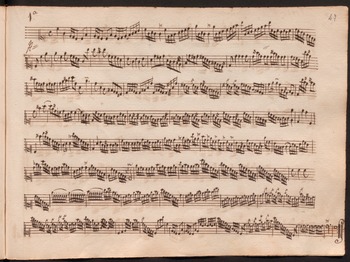
As had been the usual practice since at least the Renaissance, training involved three levels of execution: first was singing with Guidonian syllables, the second was on vowels or a specific Latin word, and the third was with the text added.Footnote 63 This was the prescribed order of study of plainchant in treatises of such authority as Cerone’s El melopeo y maestro (1613), for example.Footnote 64 Similarly, these steps are mirrored in various eighteenth-century treatises on plainchant published in Spain. Ramoneda advised that ‘these same lessons will be sung not on the musical notes ut, re, etc., but rather on a single vowel, for example on “A”’ (‘se entonarán estas mismas Lecciones, no ya con las voces musicales de ut, re &c., sino con sola una letra vocal, v. g. [verbigracia] con la A’).Footnote 65 Romero de Ávila then recommended moving on to antiphons, still sung on a single vowel.Footnote 66 This second step corresponded to what in Italy were called vocalizzi: drilling melodies for the technical development of the voice on a single vowel or a word such as ‘Amen’, to avoid stumbling while reading the music or going off key.Footnote 67 Evidence of this practice as applied to metrical singing appears in the Prontuario músico (Musicians’ Handbook, 1771) by Fernando Ferandiere, violinist of Malaga Cathedral.Footnote 68 The letter ‘A’ at the beginning of a solfeo lesson in a manuscript prepared perhaps in the 1720s or later for doña Ana María Ramirez, possibly by Giacomo Facco, also suggests this practice (Figure 2).Footnote 69 Here we see a very thorough exercise for practising scales, leaps, grace notes and staccatos with this vowel.
Solfeggio for vocalizing with the letter ‘A’. [Giacomo Facco?], ‘[Apuntes y copias de piezas para aprender la música]/[hechos por Dª Ana María Ramirez]’, manuscript c1701, M/5004, fol. 47r. Biblioteca Nacional de España, Madrid. Used by permission

The third step was aimed at good diction, as seen in López Remacha’s Arte de cantar. To that end he recommended psalms, motets and similar works in one or two parts, as well as ‘the arias or cantatas of the famous Italian masters Porpora and Leo . . . which, although they are not of the most modern taste, are worthy of acceptance by sensible teachers and have been the true school of the most outstanding singers’ (‘las Arias ó Cantadas de los célebres Maestros italianos Pórpora, y Leo . . . que aunque no son del gusto mas moderno, merecen la aceptacion de los Profesores sensatos, y han sido la Escuela verdadera de los Cantores mas sobresalientes’).Footnote 70 The oboist of the Real Capilla (and student of Leo) Manuel Cavaza included some lessons by these two masters, together with his own pieces, in his 1754 manuscript treatise ‘El cantor instruido ò Maestro aliviado’ (The Tutored Singer and the Unburdened Master).Footnote 71 Likewise, Roel del Río’s treatise contained a cuatro (four-part piece) of his own composition in letra vulgar, that is, in the Spanish vulgate, as opposed to Latin, to accustom beginners ‘to singing different verses to the same tune’ (‘à cantar diferentes Coplas sobre una misma Musica’).Footnote 72 Thus texted solfeggio exercises with lyrics clearly existed as well. Torres’s book Arte de canto de órgano (Art of Mensural Music, first published in 1705) dispelled any doubt that his own texted pieces were of this sort, as they were all aimed ‘at [the person] who wish[es] to become a solfista’ (‘al que deseare hazerse Solfista’).Footnote 73
Another important issue to address is the type of musical accompaniment that the children relied on in their studies, as it was not always an instrumental basso continuo. They did not have, for example, the didactic repertoires by composers such as Georg Philipp Telemann, Johannes Mattheson or William Croft.Footnote 74 In turn, a large number of duets without accompaniment, mainly for violins or flutes, were written in Madrid, as in the rest of Europe (by composers including José de Herrando, Carlo Canobbio, José Castel, Luigi Boccherini, the Pla brothers, Juan Oliver and Gaetano Brunetti).Footnote 75 In some of the lesson books printed in Spain, accompaniment could be provided by another voice instead. Indeed, several eighteenth-century Spanish treatises reflect the necessity of becoming accustomed to singing with someone else.Footnote 76 Furthermore, Charles Burney, in the memoir of his trip through Italy, attested to both accompanied and a capella duets by Milanese street musicians.Footnote 77 Duets without basso continuo seem to have been an everyday occurrence, one of the pillars of foundational training. Thus some lesson books required neither instrumental accompaniment nor assistance from the teacher. That is how Roel del Río conceived his own one:
En las siguientes Obras practicas que se veràn [que] he evitado el concierto de voces gruessas à 3. y à 4. porque lo considerè superfluo para principiantes que casi siempre son niños con voces sobreagudas y delgadas. Algunos Autores, no deteniendose en esto no solo lo ponen à 3. y à 4. con dichas voces gruessas, mas tambien con acompañamiento de Arpa, ù Organo numeradas en èl las posturas; . . . tuve por mas conveniente formar à Duo, y con voces proprias de tales principiantes Tiple, y Contralto, pues esta corresponde à los que entran en muda, casi todas las Obras de este Capitulo, y Libro para que solos entre sì se exerciten, llevando el que fuere Contralto la guia, y compàs como quien se supone estàr mas instruido que los aprendices Tiples en el Canto de Organo.Footnote 78
In the following practical works, one will see that I have avoided the combination of low vocal lines in three and four parts because I considered it superfluous for beginners, who are nearly always children with high-pitched and thin voices. Some composers do not stop at writing for three and four parts with low vocal lines but also add harp or organ accompaniment with figured bass; . . . I thought it more convenient to make almost all the works of this chapter and book duets with treble and contralto vocal lines suitable to such beginners (since this corresponds to those whose voices are beginning to change), so that they can practise on their own, with the contralto, as the one who is meant to be more skilled than the treble learners of canto de órgano, leading and keeping time.
As an aside, it is interesting to see the validity of peer-to-peer teaching reflected in these explanations, beyond the well-known cases of the Neapolitan conservatories or the Colegio de Niños Cantores of the Real Capilla.Footnote 79 It consisted of older students charged with training their younger classmates, somewhat freeing the teachers from obligations. The above account illustrates how older, more experienced students could take the reins in singing practice and instruction.
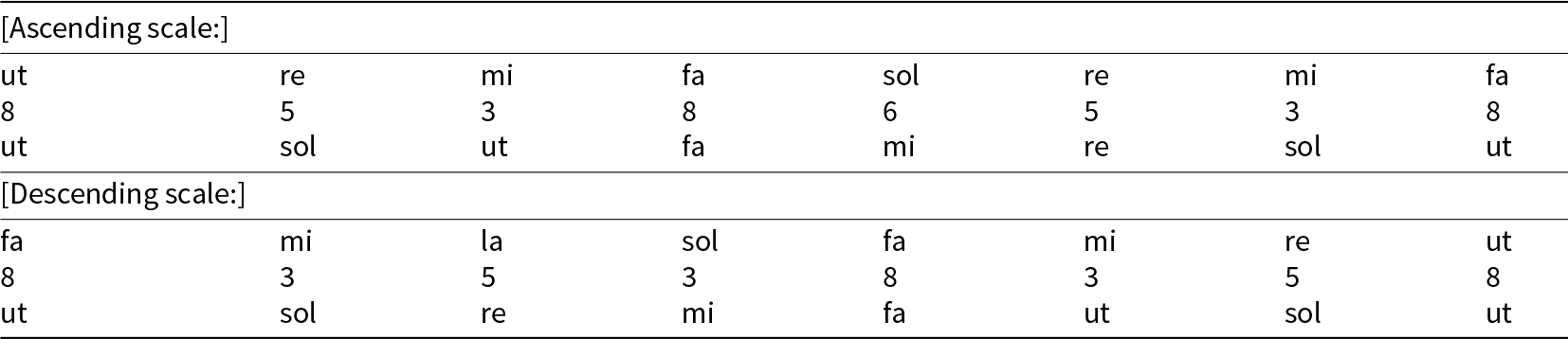
As for Romero de Ávila, he explains that ‘all the lessons have their own bass line, so that the new singer gets used to singing against another [singer]’ (‘Todas las lecciones tienen su Baxo, para que el nuevo Cantor se habitúe á cantar con otro’),Footnote 80 perhaps under the assumption that the lowest voice (bass clef, F clef on the fourth line) would be sung by the teacher, as was customary.Footnote 81 This is precisely what the Hieronymite monk Francisco de Santa María maintained when he explained how to teach child beginners. He suggested in Dialectos músicos (Musical Dialects, 1778) that teachers have the children sing ‘the whole octave ascending and descending, singing the two natural tetrachords ut, re, mi, fa, sol, re, mi, fa, from C to C, accompanying them on an instrument or singing along, so that they achieve more perfect intonation’ (‘toda la octava, subiendo, y baxando, diciendo los dos tetracordos naturales, ut, re, mi, fa, sol, re, mi, fa: de C. á C, acompañándoles con algun instrumento, ó con la voz, para que logren mas perfecta la afinacion’).Footnote 82 Baragwanath considers the possibility that teachers may have sometimes sung the bass line of the exercise rather than accompanying them,Footnote 83 as indeed these sources seem to confirm. In addition, Santa María shows how to sing the scale and the accompaniment line on Guidonian syllables, with numbers to indicate the intervallic distances between the two parts (see Table 2). This type of diagram was commonplace in counterpoint treatises from the end of the fifteenth century;Footnote 84 Santa María also used them in his ‘Tratado quarto. De los contrapuntos’ (Fourth Treatise: On Counterpoint) of Dialectos músicos.Footnote 85
Diagram of the ascending and descending scales with their accompaniment in Francisco de Santa María, Dialectos músicos, en que se manifiestan los mas principales elementos de la armonía (Madrid: Joaquín Ibarra Impresor de Cámara de S. M., 1778), 83

These tables illustrate the intersection of counterpoint, thoroughbass and solfeggio, in which the accompaniment can be understood as a contrapuntal line in whole notes under the soprano.Footnote 86 Evidently, as late as the 1770s accompanimental bass lines could still be conceived in Guidonian syllables, and their contrapuntal relationship to the other lines could be parsed.Footnote 87 Could these tables possibly reflect an obscure – or unknown – practice in eighteenth-century music pedagogy involving the improvisation of sung accompaniments to solfeggio?Footnote 88 Obviously, this lone example is insufficient for hard and fast conclusions; on the other hand, it seems a legitimate basis for such a hypothesis. If good teachers were able to accompany solfeggio from the keyboard without a bass line written out,Footnote 89 they could also do so singing, while the beginning students sang basic exercises in scales or in leaps of thirds, fourths and fifths, for example. This kind of intervallic motion was commonplace in the teaching of counterpoint, partimento and basso-continuo formulas;Footnote 90 any good teacher and even novices could easily learn to improvise contrapuntal drills. According to Santa María, children studied them first in written form and then memorized them, eventually becoming quite skilful at improvising them.Footnote 91 Coincidentally, improvised counterpoint was also practised at that time, as evidenced by the Quaderno de las obligaciones (Book of Obligations, 1770) of Málaga Cathedral.Footnote 92 Even if this hypothesis cannot be confirmed, it seems plausible at least, given the above.
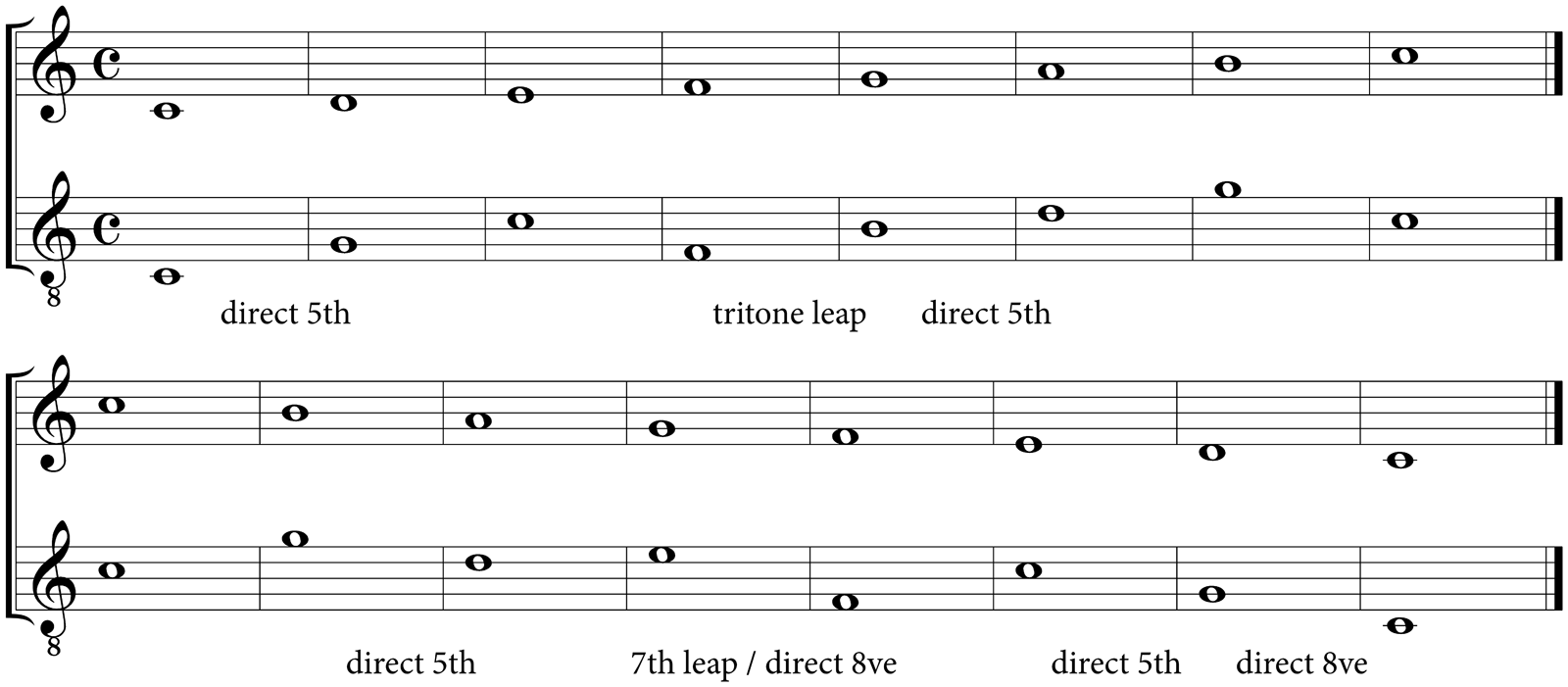
In transcribing Santa María’s diagram note for note onto the staff, some clumsiness in the bass becomes evident: there appear leaps of a tritone and a seventh (Example 3), intervals which, along with the diminished fifth, were to be avoided according to the composer’s own rules of counterpoint.Footnote 93 Santa María explained that in counterpoint over plainchant, fifths and octaves were to be approached only by contrary motion, in accordance with the rules of Pablo Nassarre.Footnote 94 This example, on the other hand, has perfect intervals approached via direct motion. Santa María seemed to be more flexible in this respect, as shown in his accompanying explanation, which drew on the treatises of Pietro Cerone, Giovanni Battista Martini, Jean-Philippe Rameau, Jean le Rond d’Alembert and Giuseppe Tartini.Footnote 95 Thus the scale accompaniment was more a loose outline that allowed for multiple possibilities of execution rather than a polished and precise model: for example, the scale and its accompaniment begin with the do–re–mi schema (scale degrees  $\hat{1}$, $\hat{2}$, $\hat{3}$ in the upper voice and $\hat{1}$, $\hat{5}$, $\hat{1}$ in the bass)Footnote 96and end with a variant of the archetypal fa–mi–sol–ut bass line (fa–mi–re–sol–ut).Footnote 97 The treatise emphasized the importance of memorizing written counterpoint examples throughout; however, a teacher well versed in the art might have been able to sing simple accompaniments based on contrapuntal schemata such as this, thus contributing to aural training among other things, as Santa María himself acknowledged.Footnote 98
Transcription of the tables in Francisco de Santa María, Dialectos músicos, en que se manifiestan los mas principales elementos de la armonía (Madrid: Joaquín Ibarra Impresor de Cámara de S. M., 1778), 83

However, in contrast to the evidence for accompanying the singing with another voice, other musicians exclusively favoured accompaniment with instruments, at least in the initial stages of learning.Footnote 99 López Remacha, for example, maintained that every lesson should be accompanied with keyboard.Footnote 100 On the other hand, it did not always happen in practice. Miguel Coma Puig, in his Elementos de musica, para canto figurado, canto llano, y semi-figurado (1766), discussed the advantages of the harpsichord, guitar and even wind instruments as reinforcement for learning intervals without the help of a teacher.Footnote 101 Likewise, the treatise by Jean-Paul-Égide Martini, first published in 1791 and known in Madrid at the beginning of the nineteenth century, suggested the use of the pianoforte or the violin to help with intonation in high passages.Footnote 102
Finally, it is noteworthy that whilst printed collections such as those by Marcos y Navas included exercises for reading any score and playing an instrument, others are partially tailored for vocal specialization. Pérez de Albéniz, anticipating training both instrumentalists and vocalists, divided his Instruccion metódica into a first part with rudiments and solfeggio in the treble clef (G clef on the second line) for both staves, and a second and third part that contain instruction and solfeggio for singers only. In the latter, he dealt with other clefs; went into depth regarding fingir claves or ‘feigning key signatures’ (that is to say, mental transposition) and how to sing solfeggio on modulations with the syllables of the French system; and addressed some basic features of style and the character of the music, such as how to align the text with the notes, or how to read the antiquated white mensural notation.
The Repertoire
The printed treatises in Spain contain both lessons with and without text for the student. Some authors, such as Martín y Coll, mixed the two types. Others, such as Romero de Ávila and Marcos y Navas, were the first in the country to publish only untexted lessons. Both types fit into the categories of solfeggi established by Baragwanath, as follows:Footnote 103
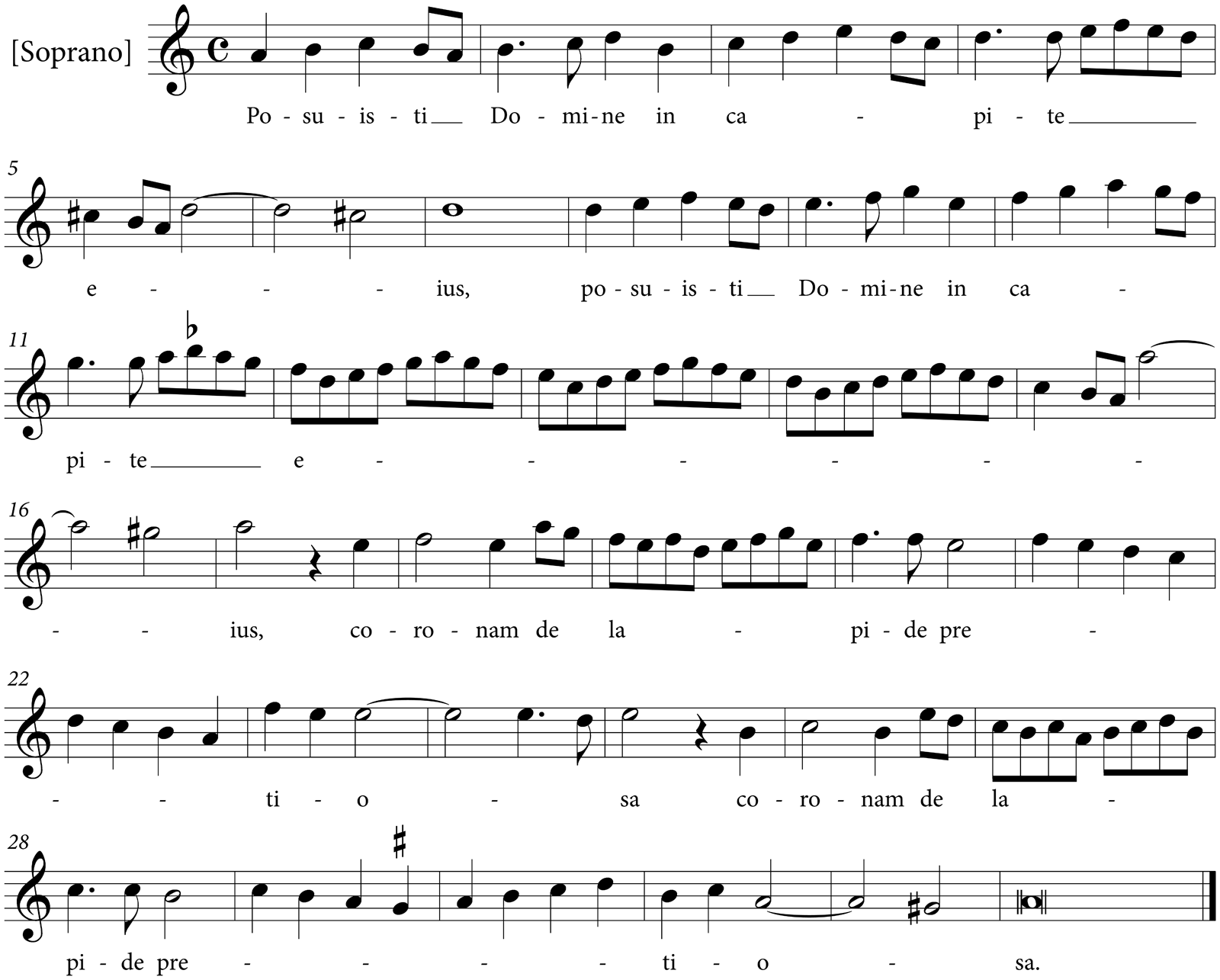
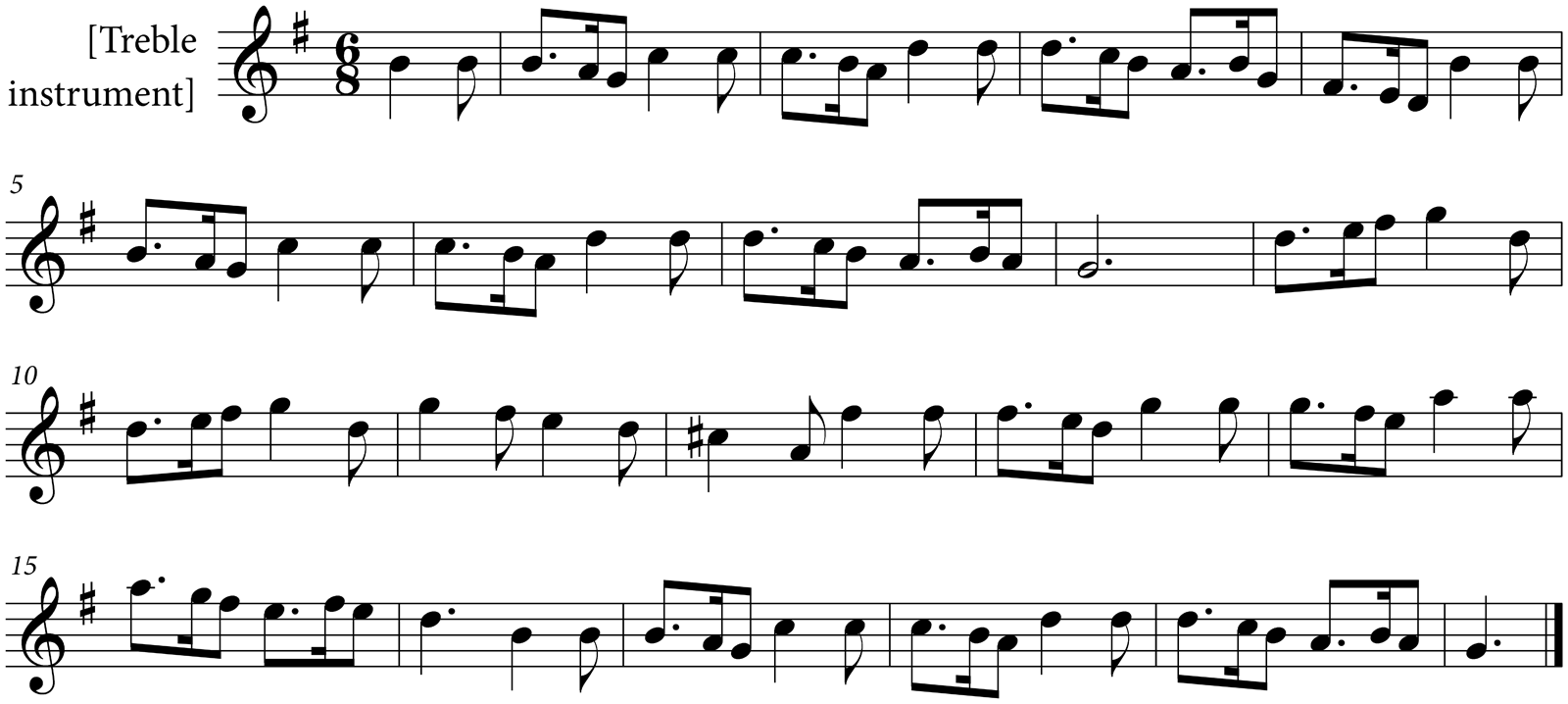
Type 1: melodies for solo voice, which mainly appeared in lessons on plainchant covering basic rudiments such as scales and leaps. This would also have included Torres’s lessons, which were not as basic and in fact required vocal agility (Example 4). However, any melody without written accompaniment can be included here, as well as the minuets and contredanses for violin, flute or oboe included by Paz in his Médula del canto llano y órgano (see Example 5).
José de Torres, solo motet ‘Posuisti Domine’ (original clef: G2). In Francisco Montanos and José de Torres, Arte de canto llano, con entonaciones de coro, y altar, y otras cosas. Compuesto por Francisco Montanos, y aora nuevamente corregido, y aumentado El arte practico de canto de organo, con motetes, o lecciones diversas, por todos los tiempos, y claves por don Joseph de Torres, organista principal de la Capilla de su Magestad, second edition, corrected and expanded (Madrid: Imprenta de Musica, 1712), 162

‘Contradanza’ for violin, flute or oboe (original clef: G2). In Manuel de Paz, Medula del canto llano y organo (Madrid: Joaquín Ibarra, 1767), 118

Type 2: pieces for two or more voices similar to the renaissance ricercare, contrapuntal duets and trios, and fugues or canons, all accompanied. This could even include some kinds of unaccompanied pieces for multiple voices, such as Roel del Río’s ‘Cuatro al SS.mo [Santísimo]’.Footnote 104 The ‘Duo en canon’ shown as Example 6, by Romero de Ávila, can be classified within this typology as well as in type 4, as it seems to emulate the style of renaissance sacred music, such as Philippe Rogier’s Benedictus in Example 11, which will be discussed in more detail later. However, this solfeo by the maestro de melodía of Toledo Cathedral does not exactly follow the most common renaissance standards, as can be seen in the imitation of the canon at the second below rather than at the unison, fourth, fifth or octave. Likewise, in this type of lesson, imitative counterpoint can be synthesized with the modern style, as can be seen in ‘Magnificat a dúo’, by Roel del Río (Example 7).
‘Duo en canon. Punto baxo sobre la Leccion passada’, bars 1–18 (original clefs: C1, C1, F4). In Jerónimo Romero de Ávila, Arte de canto-llano y organo, ó Promptuario musico, dividido en quatro partes (Madrid: Joaquín Ibarra, 1761), 253–255

‘Magnificat a dúo’, bars 1–27 (in the C1 and C3 clefs in the original source). In Antonio Ventura Roel del Río, Institucion harmonica, o Doctrina musical theorica y practica, que trata del canto llano y de organo, exactamente y segun el moderno estilo (Madrid: Herederos de la viuda de Juan García Infanzón, 1748), [part 2:] ‘Motetes y Obras diferentes al Santissimo y à N[uest]ra S[eño]ra’, 19–21 (copy in Biblioteca Nacional de España, M/1877)

Type 3: melodies over a figured or unfigured bass line for keyboard accompaniment. In Neapolitan circles this was the most common type, ranging from aria-style solfeggio exercises to fugues. Lessons for solo voice with sung accompaniment also belong here. In this typology, we can find cases that are stylistically close to the Neapolitan solfeggi, such as Marcos y Navas’s twelfth lesson, ‘Largo’ (Example 8). Another interesting demonstration of this type 3 is Example 9, by Romero de Ávila, composed in the tercer tono (‘E minor’). It is worth mentioning that the solfeos by Romero de Ávila are organized according to the eight tonos de canto de órgano or church keys of the previous century rather than the major/minor tonality designations that became widespread in the eighteenth.Footnote 105
‘Lección duodécima. Largo’ (original clefs: C1, F4). In Francisco Marcos y Navas, Arte, ó compendio general del canto-llano, figurado y organo, en método facil (Madrid: Imprenta de don Joseph Doblado[, 1776]), 382–384

Extract (bars 1–14) from untitled solfeo (original clefs: C1, F4). In Romero de Ávila, Arte de canto-llano y organo, 459–461

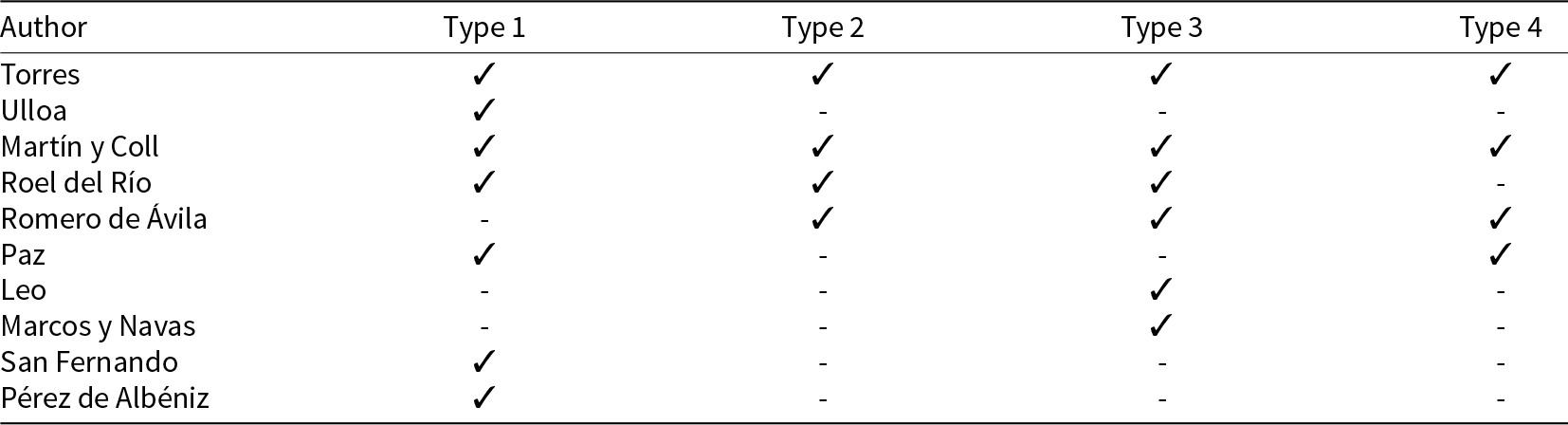
Type 4: combinations of melodies for two or more voices over a figured or unfigured bass line for keyboard accompaniment. Lessons for two or more voices with instrumental basso continuo fit here, as well as lessons for two or more voices with sung accompaniment. These settings can be in imitative counterpoint or in simpler style. Example 10, by Romero de Ávila, clearly fits into this category. Table 3 shows the types of solfeo lessons in each of the printed collections studied here. The list is not intended to be exhaustive, as some lessons fit into multiple groups.
‘Duo’, bars 1–23 (original clefs: C1, C1, F4). Romero de Ávila, Arte de canto-llano y organo, 335–337

Types of canto de órgano lessons printed in Spain between 1705 and 1802, following the paradigm given in Nicholas Baragwanath, The Solfeggio Tradition: A Forgotten Art of Melody in the Long Eighteenth Century (New York: Oxford University Press, 2020), 239–287

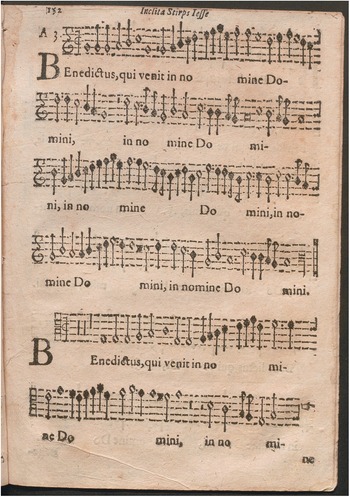
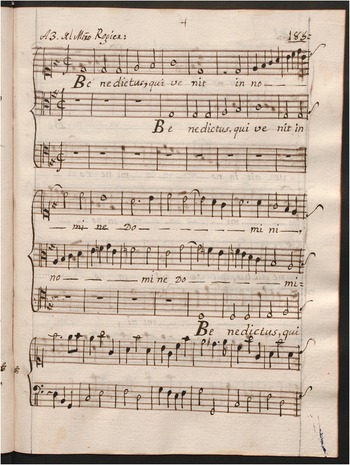
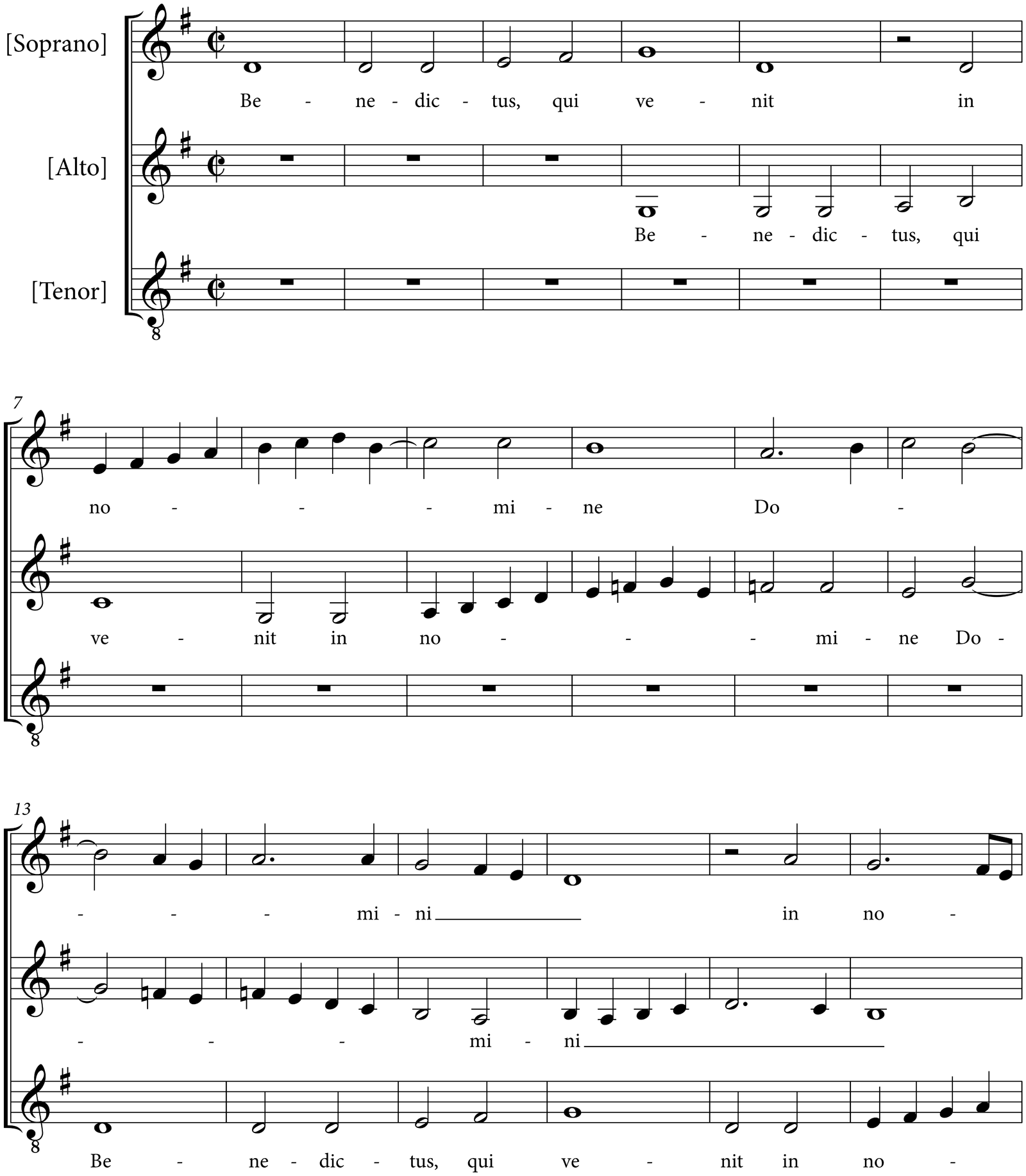
It is worth noting that type 2 is one of the most abundant types among those prints studied here, even though it does not appear in every method book. A number of type-2 exercises appear in handwritten Spanish collections such as those of Monserrat and López Moreno, or the ‘43 Cánones’ by the organist of the Real Capilla Félix Máximo López, preserved in the British Library.Footnote 106 This use of canons as an educational resource parallels Bologna, where material of type 2 continued to be published until the final decades of the eighteenth century.Footnote 107 Among these collections there appeared several Benedictus settings that Torres had extracted from older choir books, specifically from the Missa Inclita stirps Iesse and Missa Philippus II Rex Hispaniae (1598) by Philippe Rogier and Missa Simile est regnum caelorum and Missa O Rex gloriae (1602) by Alonso Lobo.Footnote 108 Likewise, several Benedictus settings by Rogier and Lobo appear in the aforementioned manuscript ‘Arte de canto llano’ (1792) and were most likely taken directly from Torres’s Arte de canto de órgano. These were copied at the end of the eighteenth century or the beginning of the nineteenth century with slight modifications, perhaps to make them easier to read for beginners. For example, the Benedictus from Rogier’s Missa Inclita Stirps Iesse appears transcribed in modern notation in score format instead of the original choir-book format. Furthermore, it is copied with barlines and transposed down a fourth (see Figures 3 and 4 and Example 11), as was traditionally done when singing the so-called claves altas (chiavette), clefs of transposition as opposed to claves bajas (chiavi naturali).Footnote 109
Philippe Rogier, Benedictus from Missa Inclita Stirps Iesse (1598), soprano part and beginning of tenor part. In Francisco Montanos and José de Torres, Arte de canto llano, con entonaciones de coro, y altar, y otras cosas. Compuesto por Francisco Montanos, y aora nuevamente corregido, y aumentado El arte practico de canto de organo, con motetes, o lecciones diversas, por todos los tiempos, y claves por don Joseph de Torres, organista principal de la Capilla de su Magestad, second edition, corrected and expanded (Madrid: Imprenta de Musica, 1712), 152. Biblioteca Nacional de España, Madrid, M/81. Used by permission

Rogier, Benedictus from the Missa Inclita Stirps Iesse (1598), bars 1–15. (The last two staves are unrelated.) In Anonymous, ‘Arte de canto llano repartido en tres partes segun se practica en la Religion Geronimiana, en el que se da reglas faciles y breves con la practica immediata para su cabal inteligencia, a honrra y gloria de Maria SSma. de la Mejorada, con otro compendio de canto de organo con las reglas precisas y breves para el conocimiento de los que principian el canto de organo’, 185. Biblioteca Nacional de España, Madrid, M/1216. Used by permission

Rogier, Benedictus from the Missa Inclita Stirps Iesse (1598), bars 1–18 (original clefs: C1, C3, C4). In ‘Arte de canto llano repartido en tres partes segun se practica en la Religion Geronimiana’, 185

It is not surprising that Torres and the anonymous author chose pieces for treble voices from choir books for educational use, as they had been used in previous centuries for the training and showcasing of child singers.Footnote 110 At that time the old polyphonic books were still used for singing (as they were in Italy and other countries), as well as for teaching purposes in places such as the Real Colegio de Niños Cantores (the institution where Torres trained and became rector) and the Capilla de Nuestra Señora de la Granada in Seville.Footnote 111 It is noteworthy that, as in the case of the solfeggio books, melodic, harmonic and contrapuntal gestures were also assimilated into the choir books, as Jean-Paul C. Montagnier argues in his study on their French counterparts.Footnote 112
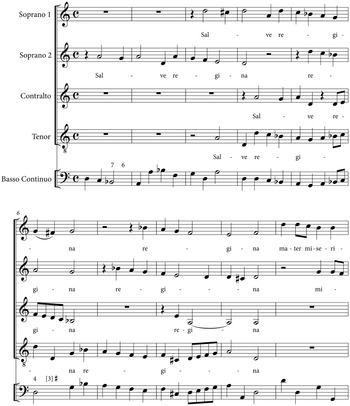
Incidentally, the type-4 Salve by Torres, from his 1734 edition (Example 12), is remarkable because it allowed for different vocal combinations; the subheading indicated that it could be sung ‘as a duet, as a trio, and as a quartet, as a duet with two trebles, as a trio with two trebles and the tenor, and as a quartet as printed’ (‘a duo, a tres, y a quatro, à Duo los dos Tiples. A 3. los dos Tiples, y el Tenor, y à 4. como esta’).Footnote 113
José de Torres, ‘Salve a duo, a tres, y a quatro, à Duo los dos Tiples. A 3. los dos Tiples, y el Tenor, y à 4. como esta’, bars 1–10 (original clefs: C1, C1, C3, C4, F4). In Francisco Montanos and José de Torres, Arte de canto llano, con entonaciones de coro, y altar, &c. Compuesto por Francisco Montanos. Y arte practico de canto de organo con motetes, y lecciones diversas, nuevamente corregidos: y aora aumentadas novissimamente en esta ultima impression; en el canto llano, las dos sequencias Victimæ Paschali, &c. Y Veni Sante Spiritus. Y en el Canto de Organo un Admirable, con voz, y acompañamiento, y una salve à duo, à tres, y à quatro segun la oportunidad de las voces. Por Don Joseph de Torres, organista principal que fue, y aora Maestro de la Real Capilla de su Magestad, y Rector de su Real Colegio, fourth edition, newly corrected and expanded (Madrid: Imprenta Real de Musica, 1734), 235–236

Moreover, some treatises provide guidance on which existing repertoires early-stage learners could sing. Devotional pieces in Romance languages were deemed suitable because they were spiritually edifying.Footnote 114 As such, villancicos and cantadas a lo divino (sacred cantatas) were deemed suitable for study. Echoes of this practice are found in Roel del Río’s recitatives and arias. Other sacred compositions such as psalms and motets could serve as lesson material. Martín y Coll includes a Tota pulchra es for SATB choir and basso continuo by Francisco Valls (chapel master of Barcelona Cathedral) along with other exercises.Footnote 115 Among the didactic collections with text, Latin pieces predominate, including antiphons, but motets in particular. This last genre also appeared in German and Italian collections,Footnote 116 reaffirming that solfeggio on religious repertoires, both liturgical and paraliturgical, must have been commonplace in the musical pedagogy of the period.
Of course, secular repertoires could also serve as solfeos. For example, Pérez de Albéniz appropriated two recitatives, one by Mozart and the other attributed to Haydn, to demonstrate solfeggio on modulations according to the French heptachord system. He published both without citing the works from which they came, and omitted their texts; the first of them (see Figure 5) was ‘Don Ottavio, son morta!’ from Mozart’s Don Giovanni (1787).Footnote 117 One of the advantages of repertoire from such renowned composers was that it would have been stimulating to study, especially for consumers among the amateur public. It seems that solfeggio also became a leisure activity for the dilettante musician, as suggested by the title of the Libro para solfear del uso y divertimento del doctor don José Ignacio Bartolache, compuestos por Cayetano Echeverría (Book for Learning to Sing Solfeggio for the Use and Entertainment of Doctor don José Ignacio Bartolache, composed by Cayetano Echeverría).Footnote 118 The same idea of entertainment surfaces in an advertisement from 1826 in the Diario de avisos de Madrid, in which a teacher offered lessons with his own method ‘of solfeo on themes from the operas of the famous maestro Rossini, to make it more enjoyable for whosoever should dedicate themselves to music, the knowledge of solfeo, and of the guitar’ (‘de lecciones de solfeo sobre los temas de las operas del célebre maestro Rossini, para que sea más agradable á los que se dediquen á la música el conocimiento del solfeo y de la guitarra’).Footnote 119
Wolfgang Amadeus Mozart, recitative ‘Don Ottavio, son morta!’, from Don Giovanni (1787), used as a solfeo exercise. In Mateo Antonio Pérez de Albéniz, Instruccion metódica, especulativa, y práctica, para enseñar á cantar y tañer la música moderna y antigua (San Sebastián: Antonio Undiano, 1802), 115. Biblioteca Nacional de España, Madrid, M/986. Used by permission

Conclusion
There is a verifiable concordance between the pedagogical traditions stemming from Hispanic and Italian musical contexts. The sources presented in this article not only serve to demonstrate the teaching methods of a specific geographical area, but also help us to reflect on more widespread practices in the Age of Enlightenment. Amongst other things, they support the hypothesis that didactic repertoires served as models to study and emulate in counterpoint and composition. The accompaniments to the solfeo exercises were sung by the teachers or older students, allowing the learner to become more accustomed to textures of two or more voices, and providing aural training of the different intervals and types of contrapuntal motion. Thus the teaching of solfeggio, accompaniment and counterpoint were interrelated, as other researchers have previously asserted.
For this reason, some canto de órgano lessons could be understood as eloquent musical discourses whose constituent elements (melody, suspensions, cadences, form and style) could be imitated. Perhaps that is why there was such an emphasis on the lessons being tasteful, as taste was something that one acquired. According to the sources discussed above, good taste seemed to have been defined as naturalness, elegance, grace, expression or even simply invention. This musical eloquence depended not only on the latest trends, but also on what had been canonized over time. Most children would not have had much notion of good taste, but their music teachers would have acted as guardians of refinement, as several sources attest. Nevertheless, the term ‘good taste’ is not easy to explain: as López Remacha said, it is a ‘term whose meaning is so hidden that we cannot define it’ (‘el Buen-gusto: palabra á la verdad de tan oculta significacion, que no podemos definirla’).Footnote 120 But surely children, teenagers and especially adult amateurs would have appreciated it if the lessons were enjoyable.
One rather striking point is the continuity with the past in spite of the seemingly major change brought about the ‘galant style’, which tends to move decisively away from the stricter or traditional forms of composition. Past tradition played a significant role in music education, and this is why it is worthy of a greater place in the study of eighteenth-century music. Indeed, the separation between tradition and modernity is blurred in some canto de órgano lessons presented here.
That aside, the above categorization of lessons reveals common features with other pedagogical traditions such as those of Germany and France, though parallels with Italy are particularly salient. Solfeggi books from the Neapolitan schools made it to Spain, but repertoires from outside sources became part of the pedagogical materials as well. The repertoires for study included recitatives, arias, psalms, motets, antiphons, villancicos and even renaissance polyphony. Such diversity would have fulfilled Torres’s wish that ‘the beginner should become accustomed to singing all kinds of music’ (‘el principiante se haga à cantar en todo genero de Musica’),Footnote 121 an essential skill for the professional musician. In turn, the use of non-didactic pieces for practising (such as the recitative from Don Giovanni) further broadens our understanding of what solfeggio exercises were in the long eighteenth century.
If indeed the Italian collections contributed to the unconscious assimilation of the musical lexicon of the ‘galant style’, as Gjerdingen asserts, it is conceivable that other pieces drilled from the beginning days of study had a similar effect on the memory of the musician. Certainly, the exercises examined here seem to have contributed to the internalization of formulas beyond those of the Italian and modern composers of the time. Hopefully, future research will reveal precisely what those formulaic elements are in the canto de órgano lessons composed in Spain and how these schemata could have affected music education.




 Open access

