


Introduction
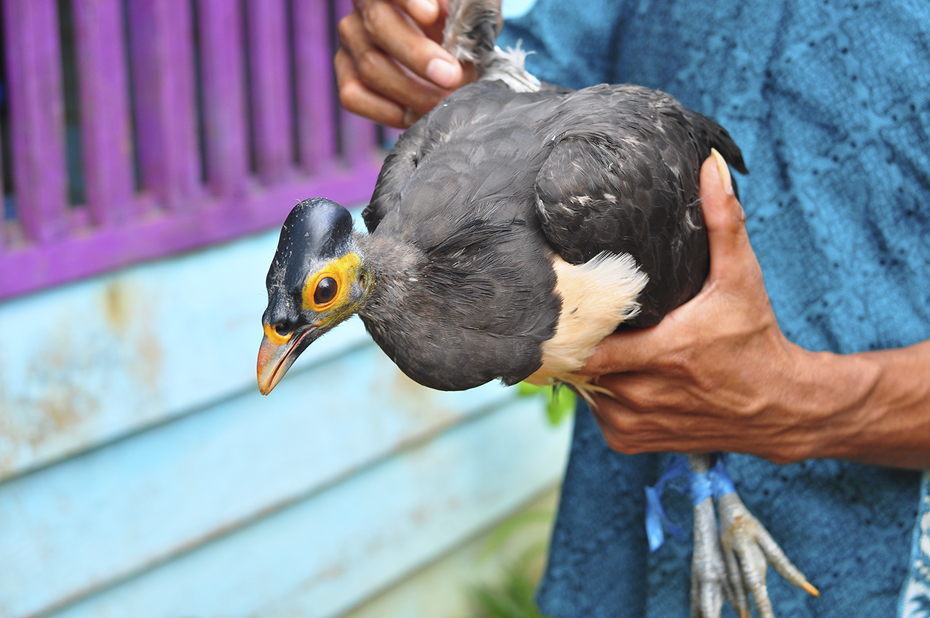
The Maleo Macrocephalon Maleo is a megapode bird endemic to Sulawesi, Indonesia (Figure 1). The Maleo has a unique reproductive strategy where over a period of several months each year pairs lay numerous large eggs in communal nesting grounds on naturally-heated substrates of either sun-warmed coastal sand or inland geothermal-heated soil; chicks are born without parental care and disperse to the nearest suitable forest habitat until they reach reproductive age and begin to return yearly to a nesting ground with their mate (Butchart and Baker Reference Butchart and Baker2000). The highly specific habitat requirements and localised reproductive strategy of the Maleo makes them especially vulnerable to habitat loss and overexploitation of their eggs; they are listed as ‘Endangered’ due to rapidly declining and fragmented populations (BirdLife International 2016).
Maleo accidently captured (and subsequently released uninjured) on Buton, Sulawesi (photograph: Graden Froese).
It was documented in English as early as the 1980s that overharvesting of Maleo eggs was driving populations at some nesting grounds to local extirpation (MacKinnon Reference MacKinnon1981). Further surveys in 1998 showed that 31.7% of sites in Central and South Sulawesi were abandoned and 61.9% severely threatened or threatened (Butchart and Baker Reference Butchart and Baker2000). In 2003–2004, 50% of nesting grounds in North Sulawesi were abandoned and the remaining 50% were severely threatened or threatened (Gorog et al. Reference Gorog, Pamungkas and Lee2005). However, there is almost no available data on possible Maleo populations in South-east Sulawesi, due in part to the greater logistical difficulty of completing research in the area and perhaps a perceived lesser regional importance to the species at large (Buthchart and Baker 2000; Indrawan et al. Reference Indrawan, Wahid, Argeloo, Mile-Doucet, Tasirin, Koh, Summers and McGowan2012). Buton is an island of approximately 4,520 km2 located just off the south-east coast of Sulawesi (Froese et al. Reference Froese, Contasti, Mustari and Brodie2015). There are at least three confirmed Maleo nesting grounds on Buton, but prior to this study the status of only one had been formally assessed, and was severely threatened (Catterrall 1996), and the potential for other sites had not been investigated (Butchart and Baker Reference Butchart and Baker2000).
Methods
In July 2014, we visited these three nesting grounds with local egg collectors. We were accompanied by a local colleague well-respected across the island; his presence quickly established a sense of trust and frankness between the collectors and us. We categorised the condition, access, and status of each nesting ground using a method created by Dekker (Reference Dekker1990) and further used by Argeloo (Reference Argeloo1994), Butchart and Baker (Reference Butchart and Baker2000), and Gorog et al. (Reference Gorog, Pamungkas and Lee2005). We also conducted interviews with the egg collectors at each site to gain insight into the drivers of threats and population trends over time (Table 1).
Questions asked in interviews with egg collectors.

Results
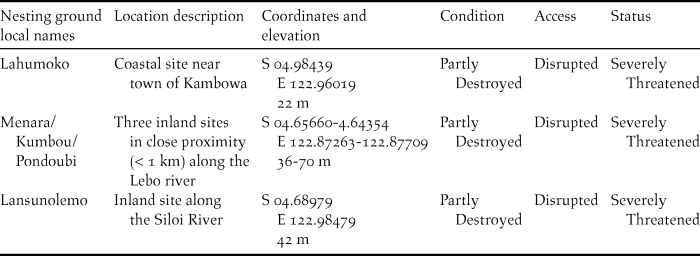
All nest sites were partly destroyed (disturbed by deforestation and /or overgrown with secondary vegetation), had disrupted access (were completely separated from intact forest), and were severely threatened (few pairs remained in the area and abandonment appeared imminent) (Table 2). Interviews suggested that Maleo populations at all sites had declined over the previous decade and at one site for over thirty years (Table 3). Given that Maleo have been declining throughout Sulawesi for a far longer period than the time in which our interviewees have been collecting eggs, the observed decline on Buton likely comes on top of already reduced populations.
Assessments of Maleo nesting grounds on Buton, Sulawesi, as following Dekker (Reference Dekker1990). Lahumoko is called Bubu and the Menara complex is called Maligano in Butchart and Baker (Reference Butchart and Baker2000); the latter is classified as Severely Threatened in Catterrall (1997). Lansunolemo is unmentioned in previous literature.
Data collected from interviews with egg collectors at three Maleo nesting grounds on Buton, South-east Sulawesi. Interviews at the Menara complex were conducted together, and the younger men deferred to the elder for population estimates.

Egg harvesting at visited sites came in two distinct forms. Intensive harvesters regularly visited the nesting ground throughout the season and sold the majority of their take, often to people from large urban centers far away who came to their homes to purchase the eggs (such visits would require extensive travel, including ferries). One man claimed that “they know my name in Jakarta”. Opportunistic harvesters collected eggs more sporadically, for example when they were in the general vicinity for another reason such as cutting timber, and both ate and sold the eggs. These eggs were more likely to be sold locally. The price of locally sold eggs was usually less expensive than those sold to people from cities, but this was not universal (Table 3). The harvesters we interviewed at visited sites struggled to estimate a number of how many other egg collectors were using each nesting ground, but the general consensus was very many along the Lebo and Siloi rivers, and a handful of others at the coastal site near Kambowa.
Overexploitation of eggs is not the only threat facing the Maleo. Interviews showed they were sometimes caught in snares, but this seemed to be a low frequency event. Snares were generally set for jungle fowl rather than actively targeting Maleo. More detrimental is deforestation, which severs connectivity between nesting grounds and intact forests (and thus potentially greatly increasing chick mortality rates) (Indrawan et al. Reference Indrawan, Wahid, Argeloo, Mile-Doucet, Tasirin, Koh, Summers and McGowan2012). In North Sulawesi, such disrupted access was the habitat characteristic most strongly associated with recently-abandoned nesting grounds (Gorog et al. Reference Gorog, Pamungkas and Lee2005). Connectivity to intact forest was destroyed at all nesting grounds we visited. The main change over time the collectors noted was a proliferation of illegal logging. Many of the men directly blamed this illegal logging for both increasing flooding and decreasing Maleo populations.
There are more Maleo nesting grounds on Buton than those we assessed during this study. Talking to people across the island, we were told of many other putative sites, as well as forested areas where people had seen adult birds. In August 2014, a villager came to us with a Maleo which he had caught in his farmland in a trap intended for his own domestic chickens (it was alive and uninjured; we released it in a nearby forest close to its capture site) (Martin et al. Reference Martin, Monkhouse, Akbar, Halliday, Baddams, Mulyani, Kaban, Sumanto, Keogh and Nightingale2017) (Figure 1). This was over 20 km from the nearest known nesting ground.
Discussion
The current situation of the Maleo is dire and requires urgent action. It is not, however, too late to prevent their extinction. The continued decentralisation of natural resource management in Indonesia means that locally-led conservation efforts now offer a viable hope for the future of Maleo populations (Indrawan et al. Reference Indrawan, Wahid, Argeloo, Mile-Doucet, Tasirin, Koh, Summers and McGowan2012). For example, in Central Sulawesi, the number of pairs visiting a nesting ground increased by over 60% in just a decade due to collaboration between a grassroots NGO and local people buoyed by governmental support (The Alliance for Tompotika Conservation 2016). It is currently impossible to say whether any nesting grounds across South-east Sulawesi contain a population size large enough to be “important” for the survival of the species, and it could be argued that all nesting grounds are important due to their immense cultural significance and ability to engender local concern for and pride in Sulawesi’s unique natural heritage. The first vital step towards assessing overall population status and trends and identifying the most promising candidate sites for follow-up conservation action is to find and assess the remaining nesting grounds unknown by the conservation community.
Acknowledgements
We thank the Indonesian Institute of Sciences (LIPI) and Kementerian Riset dan Teknologi Republik Indonesia(RISTEK) for providing permission to undertake this work (permit number 211/SIP/FRP/SM/VI/2013 & 143/SIP/FRP/SM/VI/2014). We also thank Balai Konservasi Sumber Daya Alam (BKSDA) for their assistance. Funding was provided by the Natural Sciences and Engineering Research Council Canada, the Canada Foundation for Innovation, the University of British Columbia, and Operation Wallacea. We thank Operation Wallacea for providing logistical and other in-kind support, particularly Chris Majors and Tom Martin. Tom Martin further provided valuable comments on the manuscript. Most of all we thank the many people on Buton with whom we lived and worked, especially Sabir, without whom this study would never have occurred.



