

Introduction
In a speech given at Fort Hare in 2016, Robert Mugabe, the then ninety-two-year-old president of Zimbabwe,Footnote 1 spoke of the importance of university student activists to the establishment of the anti-colonial struggle against settler colonialism.Footnote 2 Fort Hare was, Mugabe said, ‘the cradle of African anti-colonial ideology and a seminal source of African intellectualism’ where he first ‘became fully aware of the evils of settler colonialism’.Footnote 3 He continued:
[We used] to whisper to each other about what had happened and to sit and analyse the international situation. Gandhi had left South Africa, he had gone to India with Nehru [where] they had combined as leaders to lead the struggle through passive resistance, the struggle for Indian independence. If he could do that, why could we in Africa not do it?
To Mugabe, student activism was not simply the beginning of his political career but the whole anti-colonial struggle for the ‘African nation’.
As Elleke Boehmer argues, nationalist leaders have been particularly adept at heroic public renderings of their own pasts to represent the broader aims of the anti-colonial struggle in order to justify their continued political rule (Boehmer Reference Boehmer2012: 67). Through stories, ceremonies and memorials, nationalist leaders have represented themselves as the embodiment of anti-colonialism. Seen in this light, Mugabe's story is not a simple nostalgic rendering of his student past; rather, it was a piece of political theatre. Through it, he laid out a set of normative characteristics for political leadership that he embodied. In his particular version of the anti-colonial struggle, educated black student activists, such as himself, who were committed to the overthrow of settler colonialism were the intellectual leaders of nationalism and the Zimbabwean nation-building project (Nyathi Reference Nyathi2013). These leadership traits, he argued, were not historical artefacts but critical to Zimbabwe in 2016, as it was these characteristics that were key to the completion of the ‘patriotic’ political project of economic liberation, as I discuss below.Footnote 4
This article explores the politics of stories told about African university student activism in Rhodesia between 1960 and 1980.Footnote 5 Student protest was politically significant during this period, as many scholars have shown, in large part because of its role as a ‘modern’ process of elite formation. Through this lens, scholars have explored the antagonistic relations between students and independence-era African nationalist leaders, who themselves reified university education as an important form of political authority in their own nation-building projects (Barkan Reference Barkan1975; Burawoy Reference Burawoy1976; Melchiorre Reference Melchiorre2019; Monaville Reference Monaville2019; Smirnova Reference Smirnova2019). In contrast to these independence contexts, in Rhodesia white-settler leaders placed little value on educated ‘intellectuals’ in their own racially segregated nation-building project. Rhodesian nation building ultimately failed under international pressure and an armed struggle waged by African nationalists and gave way to Zimbabwe in 1980 (White Reference White2015; Kenrick Reference Kenrick2016). The experience of white-settler rule did not mean that African student activism in Rhodesia followed a similar trajectory to that in South Africa, where Steve Biko and others who were cut off from nationalist organizing founded the Black Consciousness Movement. As I show in the first half of this article, the Rhodesian state's comparative weakness in relation to its South African counterpart meant that liberal university traditions and nationalist underground organizing were able to endure. In these circumstances, young Africans at university took up entangled forms of activism that saw liberation through a nationalist frame of reference. Hence, throughout these years, student activism remained a resilient yet complex and contested mechanism in the formation of the Zimbabwean African National Union (Patriotic Front) (ZANU(PF)) political elites. At independence, many former activists took up key roles in Zimbabwe's political elite and state bureaucracies. Political success for former activists in ZANU(PF) after independence was not guaranteed, as they had to carefully navigate the party's acrimonious and divisive political fields. This frustrated many former student activists in their attempts to realize their political aspirations, and many decided to leave the country or were pushed out of the party.
The second half of this article explores how and why three former activists – Dzingai Mutumbuka, Simba Makoni and Ranga Zinyemba – gave meaning to their pasts at university in Rhodesia. Like Mugabe, these men all considered their university activism as a foundational moment in their political careers: their first experience on a national stage, which established political beliefs that later found form in their nationalism. Yet these men's narrated younger selves embodied older historical or imagined forms of ZANU(PF) nationalism, which had been abandoned as the party increasingly turned to authoritarian rule. These stories therefore operated as implicit and explicit critiques of ZANU(PF)’s patriotic rule. Through these stories, more expansive and diverse depictions of university life were told, depictions that were riddled with nostalgic and humorous anecdotes about being a young man on campus. In my analysis, I build on both Boehmer's contention that nationalists’ stories of their pasts can function as a personification of nationalism and on Jacob Dlamini's argument that his fond, nostalgic memories of his childhood in apartheid South Africa were caused, in part, by present anxieties with ‘the distorting master narrative of black dispossession that dominates the historiography of the struggle’ (Dlamini Reference Dlamini2009: 18).
ZANU(PF)’s ‘patriotic’ uses of Rhodesian student activism
Controlling the nation's history has always been part of ZANU(PF)’s claim to rule. Memorials that commemorate the liberation war dead, such as Hero's Acre, national holidays, school history curriculums and government media strategies, attempt to reinforce a specifically ZANU(PF) interpretation of Zimbabwean nationhood, in which the party is the ultimate safeguard of sovereignty and liberation (Kriger Reference Kriger, Bhebhe and Ranger1995; Ndlovu-Gatsheni and Willems Reference Ndlovu-Gatsheni and Willems2009; Tendi Reference Tendi2010; Barnes et al. Reference Barnes, Williams and Bokhorst-Heng2016). The value of this ‘patriotic history’ was that it provided a discursive legitimation not only for ZANU's governance but also for the brutal use of force against the party's perceived enemies, particularly after 2000 when the new opposition party, the Movement for Democratic Change (MDC), threatened to remove ZANU(PF) as the party of government (Ranger Reference Ranger2004; Ndlovu-Gatsheni Reference Ndlovu-Gatsheni2009; Tendi Reference Tendi2010).
During these years, the government produced a specific nationalist narrative, which Terence Ranger termed ‘patriotic history’, that emphasized racialized, violent anti-colonial struggle (Ranger Reference Ranger2004). This narrative was central to justifying both the populist seizure of white-owned farms and the violent suppression of opposition supporters and activists as neocolonial agents that occurred during these years. As Robert Muponde (Reference Muponde, Raftopoulos and Savage2004: 176) has said of this ‘patriotic history’:
It is a virulent, narrowed-down version of Zimbabwean history, oversimplified and made rigid by its reliance on … binaries of insider/outsider, indigene/stranger, landed/landless, authentic/inauthentic, patriot/sell-out … For the other to insist on being different is to invite the title of enemy of the state: it is to invite treason charges upon oneself.
In this context, experiences of student activism became an important means by which ZANU(PF) leaders sought to personify this ‘patriotic’ narrative and reaffirm their own intellectual legitimacy to lead. Astrid Rasch argues in her work on nationalist autobiography that nationalist leaders’ stories of their colonial education also allow them ‘to distance themselves from past imperialism, including their own “complicity” with the snobbery and exclusionary behaviour they now associate with colonial schooling’ (Rasch Reference Rasch2016: 256). In Zimbabwe after 2000, state-owned media outlets began similarly using experiences of university student activism in Rhodesia as a means of inserting ZANU(PF) leaders into the anti-colonial ‘patriotic’ struggle narrative. Consider the obituaries of ZANU(PF) leaders such as Charles Utete, a career civil servant who was chief secretary to the president, and Sam Mumbengegwi, a ZANU(PF) stalwart who held several ministerial portfolios during the 2000s. Neither of these men had obvious anti-colonial credentials, such as experience of prison or war or political leadership in exile, but they rose to prominence in the party as technocrats after independence, when ZANU(PF) was recruiting loyal expatriate professionals to return and assist in their centralized independence-era project of National Development. These men maintained their positions in the party through their academic record, political acumen and rigid public loyalty to ZANU(PF). Because anti-colonial credentials were so important after 2000, in the ‘patriotic’ obituaries of these men the University of Rhodesia became a site where they were ‘exposed to the evils of racial discrimination’ and their studenthood became a ‘platform’ from which these men ‘intensified [their] activism in the fight for independence’.Footnote 6 In this narrative, the university – like the prison and the battlefield – was a site of anti-colonial struggle.
Yet for many other former student activists, their experiences of politics at university in Rhodesia formed the starting point of alternative stories of political possibilities that were much more expansive than ‘patriotic’ narratives permit. Before turning to how and why former student activists who left the ZANU(PF) government used these alternative narratives, I first explore the history of student activism in Rhodesia and argue for an understanding of it as a contested process of political elite formation.
Student activism and elite formation in Rhodesia, 1960–80
As many scholars have shown, African student activists in the 1960s and 1970s considered themselves to be intellectuals and felt entitled to elite futures as political leaders and professionals, a stance that often brought them into confrontation with nationalist leaders (Barkan Reference Barkan1975; Burawoy Reference Burawoy1976; Balsvik Reference Balsvik1985; Lentz Reference Lentz1994; Livsey Reference Livsey2017; Zeilig Reference Zeilig2007; Mann Reference Mann2014). These studies, however, centre on independence-era contexts and the specific dynamics of newly independent nation- and state-building programmes, in which the university played an important ideological role. This was not the same as the context in the settler states of Southern Africa, where segregationist nation-building projects sought to undermine Africans’ claims to intellectual status. The development of student activism in Rhodesia in the 1960s and 1970s, however, was unlike that in South Africa. There, the racial segregation of higher education in 1959 and the effective suppression of nationalist underground organizing ultimately led to the rise of the Black Consciousness Movement in which students such as Steve Biko turned away from apartheid educational institutions and radically rethought notions of black selfhood (Magaziner Reference Magaziner2010; Heffernan Reference Heffernan2014). Unlike the apartheid state, the white nationalist Rhodesian Front (RF) government could never reconfigure the university's principles of multiracialism and academic freedom because of financial and political constraints and the economic need for expert manpower. Nor could the Rhodesian state so effectively control the underground operations of nationalist organizations. In Rhodesia, therefore, because the university provided the freedoms to publicly challenge the RF, African student activists continued to use their establishment university identities as a basis for imagining political change and personal futures in nationalist terms. In arguing this, I give an overview of African student activism during the Rhodesian period that builds on several studies that have explored specific aspects of this history (Cefkin Reference Cefkin and Hanna1975; Gelfand Reference Gelfand1978; Tengende Reference Tengende1994; Mlambo Reference Mlambo1995). I then explore how student activism as a mechanism of elite formation in ZANU functioned during these years.
Student activism in Rhodesia, as elsewhere, was rooted in the specificities of the colonial university. The University College of Rhodesia and Nyasaland (UCRN), like most African colonial universities, was designed as an elite institution. In 1945, the British Colonial Higher Education Commission made recommendations that led to the founding of the University Colleges of Ibadan (1948), Makerere (1949) and Rhodesia and Nyasaland (1954) as well as the University of the West Indies (Mills Reference Mills2011; Livsey Reference Livsey2016). Fired up with new modernizing discourses, Colonial Office civil servants and educationalists viewed universities as the ‘indispensable’ means ‘for the production of men and women with the standards of public service and capacity for leadership which self-rule requires’.Footnote 7 Metropolitan designers imagined that out of these elite universities would emerge the African political leaders, professionals and bureaucrats who would lead the development and modernization process that would transform ‘trustee’ colonies into modern nation states. Fred Cooper argues that this modernizing belief in universities and the African students they trained became central to decolonization, as colonial authorities:
came to envision a world … that they no longer ruled but that they thought could function along principles they understood: through state institutions, by Western-educated elites, in the interests of progress and modernity, through integration with global markets and international organizations. (Cooper Reference Cooper1994: 1539)
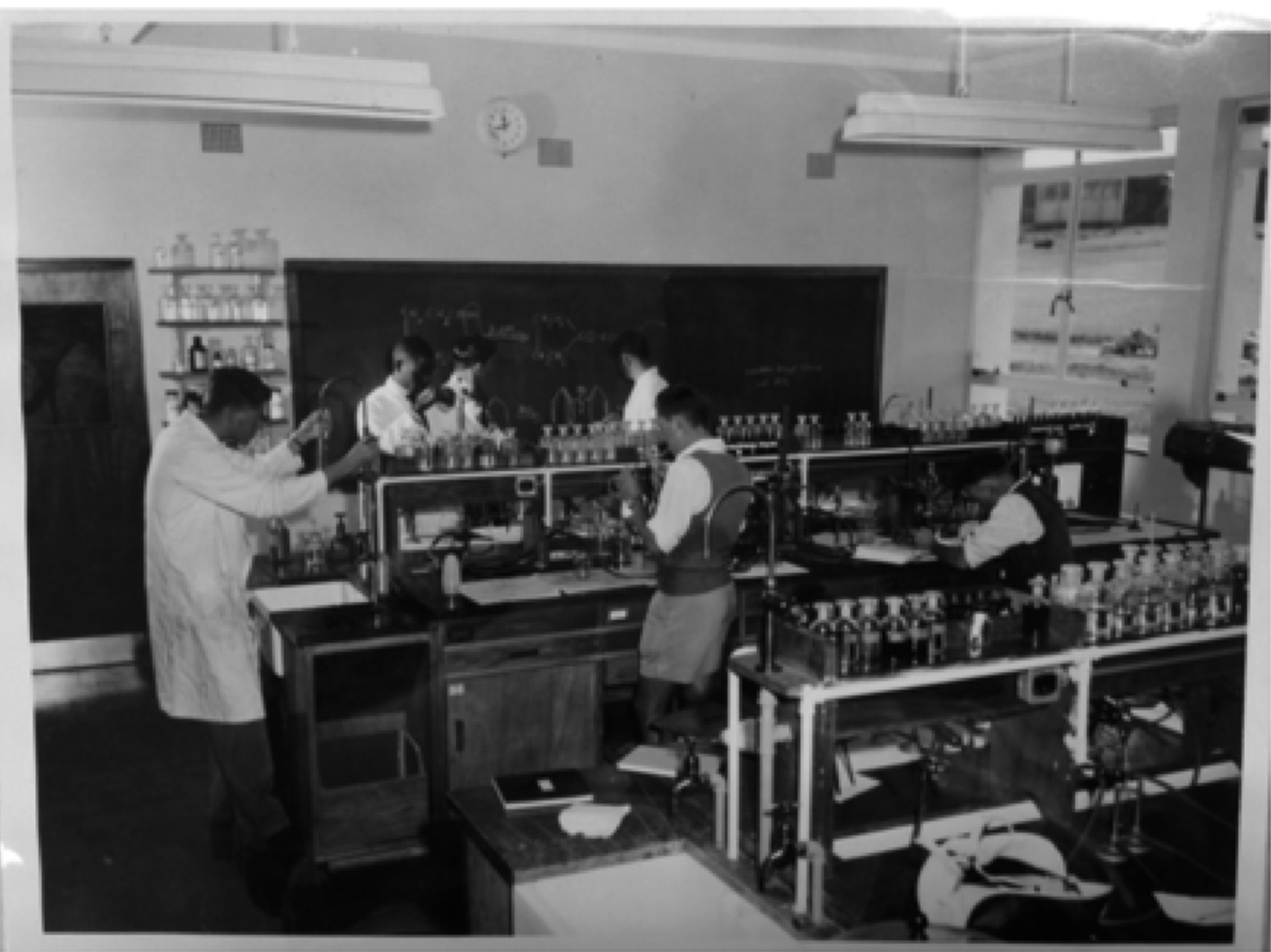
Unlike other British colonial universities, UCRN was to serve both African students and Southern Rhodesia's white settler community. Because of this racial division, the university became a particularly important institution in 1950s politics. This era's politics was dominated by the ideological agenda of ‘multiracialism’ – the belief that gradual advance through ‘meritocratic’ institutions would create the basis of a new, racially mixed nation. As Michael West (Reference West2002) and Allison Shutt (Reference Shutt2015) have shown, in 1950s Southern Rhodesia educated and ‘respectable’ Africans gained greater means to assert their rights as citizens through an emergent set of elite, multiracial political parties and associations. The multiracial university was ideologically important to this politics. This was captured in the Central African Film Unit's production Turning Point in Africa, in which the narrator, over images of black and white students working in a laboratory, says: ‘Here white and black students study side by side ... a bridge must be built between the races. They must be fused into one nation.’Footnote 8 In this sense, the classrooms and libraries of UCRN were a social laboratory where African and white university students were wired into the elite circuits of Salisbury's multiracial politics (see Figure 1; Gelfand Reference Gelfand1978).
UCRN as a multiracial laboratory: African and European students in a science laboratory, November 1958. Source: INF 10/273, UK National Archives, Kew. Published with permission.
This view of multiracial development and the emergence of a new African professional class were not welcome in all quarters of Southern Rhodesia's politics. By the late 1950s, white farmers and artisanal classes were increasingly fearful that educated Africans would overturn their privileges and upset their racial notions of social order. This caused the rise of white Rhodesian nationalism in the late 1950s, which stymied the move towards a multiracial form of decolonization, as the government supressed African political organizing through legislative means, particularly the use of emergency powers legislation (Scarnecchia Reference Scarnecchia2008). This shift dramatically reconfigured educated African politics and precipitated the breakdown of multiracialism as a mainstream political ideology. This occurred after August 1960, when, following widespread riots against the arrest of three nationalist political leaders, the head of the multiracial Central Africa Party (CAP), Garfield Todd, and the nationalist leader, Joshua Nkomo, called for the constitution to be suspended. The event fatally undermined the multiracial principle of slowly expanding the franchise and caused African professionals and university students to turn to African nationalism.
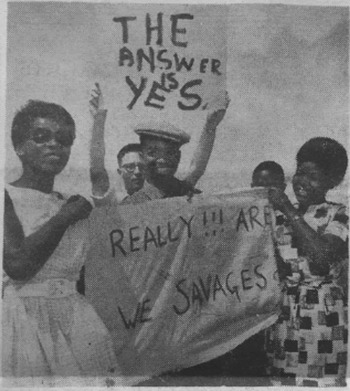
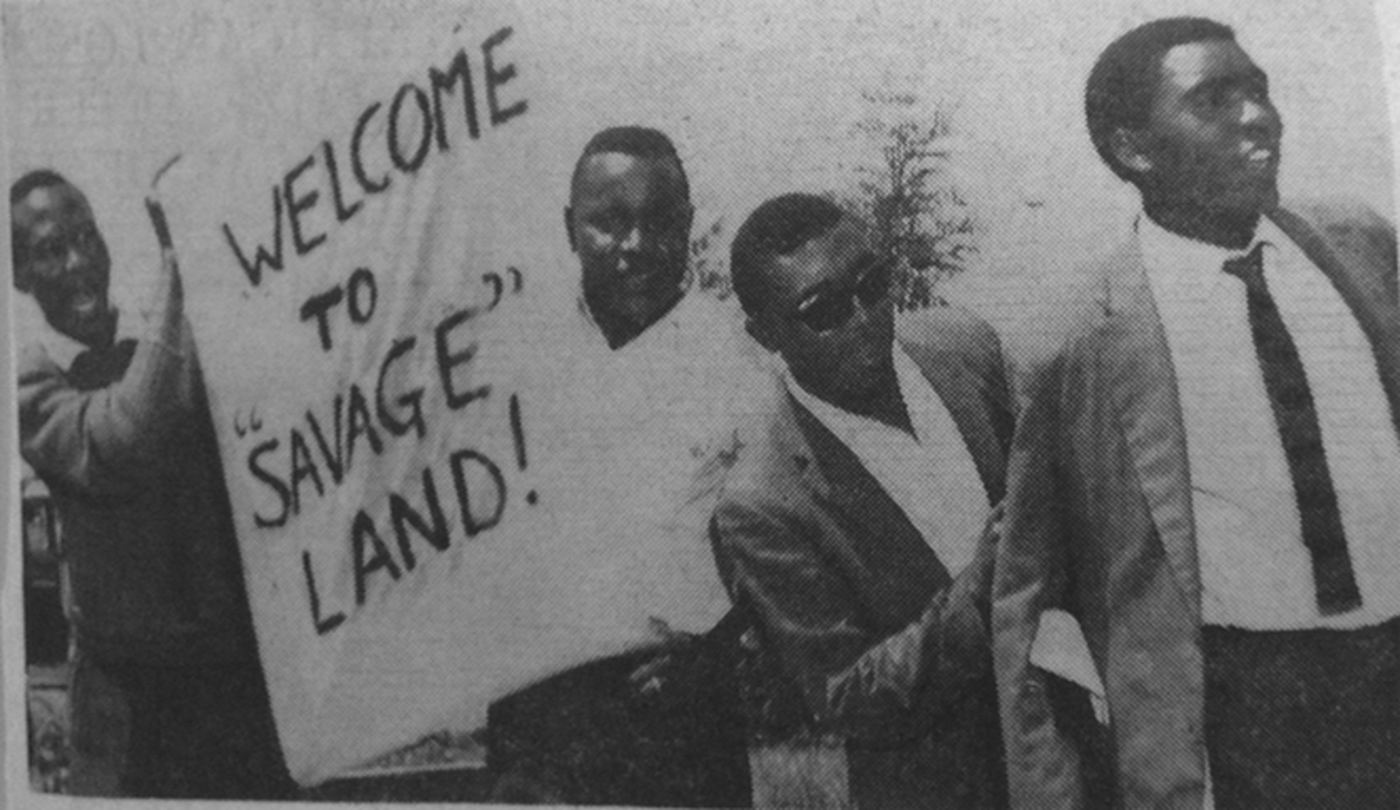
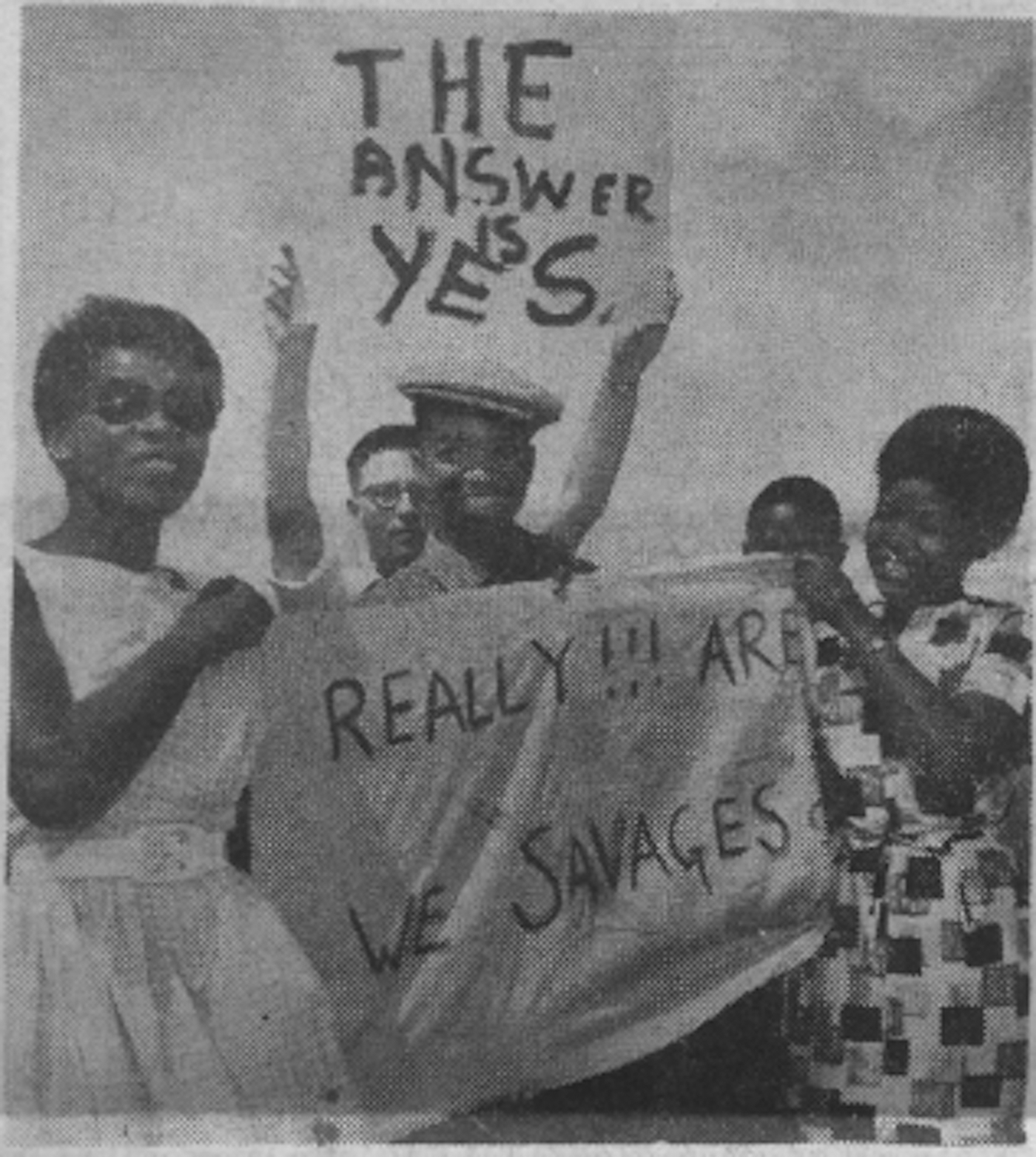
It was at this time that student activism in Rhodesia first arose. This was largely in response to white nationalist politicians’ attempts to push back multiracialism and stifle African-educated authority and their ‘meritocratic’ aspirations for political transformation and professional futures. In 1962, for instance, African students demonstrated against a visit by the Portuguese Consul of South-East Africa (later Mozambique, where Africans were banned from entering universities). A year later, students protested against Lord Salisbury's visit to campus, after he had earlier referred to Africans as ‘savages’ in the British parliament. In these protests, African students publicly performed their intellectual and respectable status through their smart dress and peaceful protest chants and placards, some of which read ‘Are we Savages?’, in an effort to counter the right-wing rhetoric of African ‘backwardness’ (see Figure 2). These protests attracted the praise of nationalist leaders, who were also educated graduates and shared their belief in educated authority.
African students demonstrate against Lord Salisbury's visit to UCRN, Rhodesian Herald, 6 April 1963.
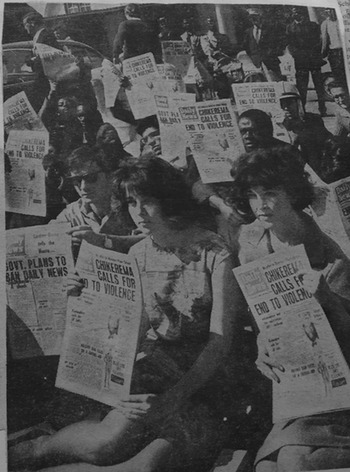
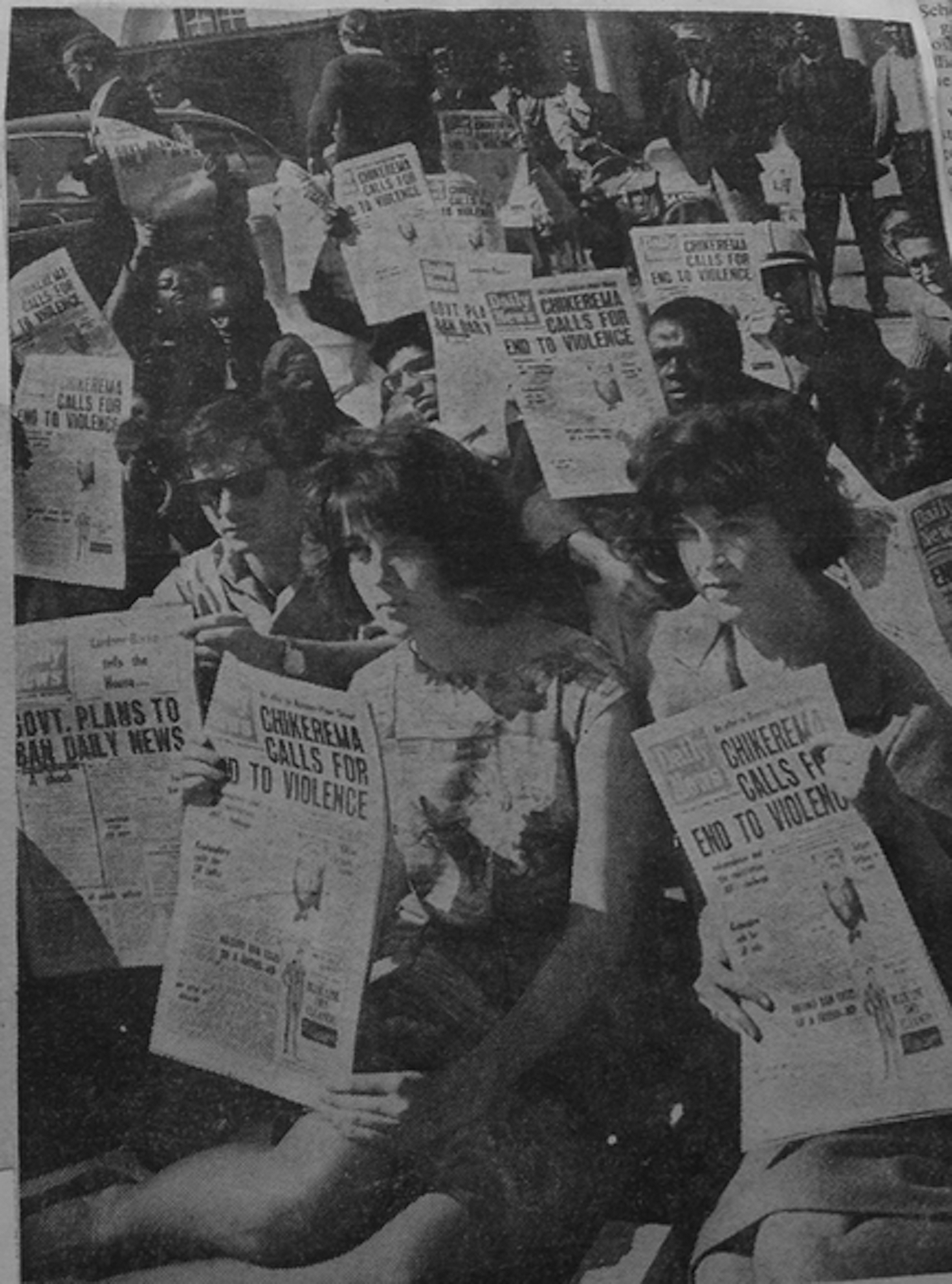
The university's maintenance of its liberal freedoms in the face of the RF's segregationist policies allowed African student activists to organize around their claims of educated respectability and intellectual status. By upholding their intellectual authority, these student activists attacked the RF's increasingly segregationist and repressive policies as promoting a deviant and regressive form of decolonization. This was evident in 1964 in a sit-down demonstration outside parliament led by black and white students against the banning of the African Daily News – the African daily newspaper with the widest circulation (see Figure 3). Students' use of their intellectual status as a form of political authority was also evident in a series of campus-based protests in the first half of 1966, following the RF's Unilateral Declaration of Independence (UDI), which had been proclaimed the previous November. These student protests eventually caused the temporary closure of the university and the resignation of its principal, Walter Adams (who went on to become the director of the London School of Economics, where he faced the student protests of 1968). In explaining this protest action, one of the leaders, Michael Holman, said that their aims were about ‘taking the privileges of the university, which was really an isolated area of tolerance, and extending those principles to wider society’.Footnote 9
Student protest outside parliament after the closing of the Daily News, Rhodesian Herald, 27 August 1964.
The RF's banning of nationalist parties and the imprisonment of their leaders in 1964 nevertheless shaped African student organizing, causing them to operate over multiple layers of political action and affiliation – what Luise White calls the political ‘entanglements’ of the period (White Reference White2011: 322). For instance, in the late 1960s, some African students, such as Arthur Chadzingwa, used their student positions to gain access to and operate within nationalist underground networks, where they organized rural school students to support nationalist efforts (Mhanda Reference Mhanda2011: 10).Footnote 10 They did this while also performing a dissenting public politics that challenged the RF's nation-building project. In 1969, a group of African students led by Chadzingwa caused outrage when they protested against the Mayor of Salisbury, Florence Chisholm, after she publicly voiced concerns about providing university education to ‘a mass of people with a primitive background’.Footnote 11 Of course, circumstances such as UDI, or entering a hostile job market, or (after 1972) the war often caused student activists to give up their entangled activism and flee the country to join the armed struggle or to further their studies abroad (White Reference White2014: 1295–7).
Alois Mlambo has argued that student activism reached a turning point in 1973, when African student activists launched a series of violent protests, the last of which became known as the Chimukwembe demonstration and resulted in 155 students being arrested (see Figure 4; Mlambo Reference Mlambo1995: 474). Sparked by abusive statements made by RF parliamentarians against African university students, the protests intensified after the new principal, Robert Craig, refused to meet protestors, and students stoned two cars. The university administration responded by expelling six student leaders, which caused further student riots. Counter to Mlambo's turning point argument, the entangled forms of African student activism continued throughout the war and did not end despite the harsh punishments of the 1973 student demonstrators (Mlambo Reference Mlambo1995). Tense everyday encounters between white and black faculty and students became more commonplace, but throughout the mid- and late 1970s student activists continued their traditions of entangled organizing and often worked with Rhodesia's few embattled civic organizations, such as the Catholic Justice and Peace Commission (CJPC) (Caute Reference Caute1983: 145–9). In 1977, African students led by Students Representative Council (SRC) president Ranga Zinyemba publicly challenged the government in a demonstration outside parliament over the suggestion that African students would be conscripted into the Rhodesian army (White Reference White2004: 118–19).Footnote 12
Student demonstration on 7 August 1973 after the disciplinary hearing and the police response. Source: Rhodesian Herald, in the University of Zimbabwe Library Godlonton Collection, taken from Veit-Wild (Reference Veit-Wild1992: 126).
Despite these shifts, during these years many Rhodesian African student activists believed in the ‘modern’ view that, based on their educational entitlement, they could play a transformative role in the struggle against the RF regime and for the liberation of Zimbabwe. Critically, this modernist belief was shared by many within the ZANU leadership and so enabled student activism to be a route to political leadership within the party.
Student activism as elite formation in ZANU(PF)
The shifts in student activism during these years had significant implications for the ways in which student activism functioned as a mechanism of elite production in ZANU(PF). The recognition of students’ intellectual authority within ZANU during the 1960s and 1970s was not unqualified. Rather, it was one of a number of different forms of political authority that were used by party leaders to establish and maintain their control over the movement. This made student activism a complex, fragmented and contingent mechanism of political elite formation during these years, and particularly after the armed struggle picked up in 1972.
At its founding, Southern Rhodesian nationalism established that the intellectual status of education was an important source of political authority. The colony's first nationalist party, the Southern Rhodesian African National Congress (SRANC), was established in September 1957. Joshua Nkomo was elected leader, in part because, according to Maurice Nyagumbo, the influential Salisbury City Youth League had ‘made up their minds that the new party had to be led by an African graduate’ (West Reference West2002: 210). Yet the movement's educated leaders were always aware of the suspicions and resentments that many of their less well-educated trade unionist followers harboured towards ‘respectable’ educated leaders (Scarnecchia Reference Scarnecchia2008: 94–133).
After the breakdown of multiracialism in 1960, student activists began to imagine and organize their politics within the parameters of nationalism. Yet by establishing themselves as a constituency in the nationalist movement, student activists faced nationalist leaders’ attempts to control their activism. As such, student activists became deeply involved in the movement's fractious and acrimonious split in 1963. Student activists during that time were largely in favour of a group of breakaway leaders who had sought to remove Nkomo as leader. Because of this, student activists were a prominent constituency at the foundation of the rival liberation movement, ZANU, in 1964.Footnote 13 In response, ZAPU leaders labelled students as sell-outs who deserved the strongest punishment (Makhurane Reference Makhurane2010: 68). These currents of anti-intellectualism did not seriously undermine the political authority claimed by students as educated intellectuals in the long term in ZAPU, but the episode did ensure that party loyalty in both parties became a prerequisite for any serious student aspirations to nationalist political leadership.
Student aspirations to lead transformational political change through nationalist politics were complicated further by the Rhodesian government's decision to ban nationalist parties and to detain or imprison their leaders in 1964. The few leaders who were not imprisoned fled into exile, from where they began the armed struggle and helped set up military structures to wage war against the Rhodesian state. As Gerald Mazarire has argued, these developments caused nationalist organizing in the late 1960s and early 1970s to be split across five fields: the detained leadership in Rhodesia; the leadership in exile in the Front Line states;Footnote 14 underground networks within Rhodesia; new military organizations that were conducting the war; and the external networks in countries across the world whose members fundraised, advocated and maintained diplomatic channels for the movement (Mazarire Reference Mazarire2017: 94). For African student activists, furthering aspirations to liberate the country required entering into one of these fields. Ranga Zinyemba, for instance, first entered ZANU's structures as the SRC president when Canaan Banana recruited him into the Zimbabwe People's Movement underground network. For others, this meant following a romantic ideal of fighting the armed struggle and involved leaving the country and crossing the border to Zambia or Mozambique to join nationalist armed wings (White Reference White2014: 1295–7). These educated volunteers often faced difficult circumstances in military camps and theatres of war, as less well-educated commanders often felt intimidated and resentful of their juniors’ educational achievements and sense of entitlement. Disciplinary drills, corporal punishment and threats of insubordination were all common, particularly in the rear-base camps (Tendi Reference Tendi2017: 152). Rather than following this route, some student activists instead took advantage of scholarship schemes that had been established for African refugee students to study at prestigious foreign universities, where many of them operated as political activists for the nationalist parties. This was how Simba Makoni and Dzingai Mutumbuka entered into ZANU's political structures abroad while on scholarships at universities in the UK (Hodgkinson Reference Hodgkinson2016; McGregor Reference McGregor2017). Fay Chung, who helped coordinate ZANU's educational programme in Mozambique in the late 1970s, estimates that by 1979 there were over 4,000 Zimbabwean students and professionals in exile (Chung Reference Chung2006: 146).
At independence, university-trained ZANU(PF) student members were especially able to take advantage of the opportunities for African professionals in Zimbabwe. This was because Robert Mugabe and his generation of nationalist political leaders were able to successfully exert their control over the party in the late 1970s by removing a more radical grouping of young Marxist leaders (Moore Reference Moore1991; Reference Moore1995). Unlike the left of the party, Mugabe and his ministers in the 1980s sought to maintain and build on Rhodesia's centralized state bureaucracies to achieve a programme of National Development. Hence, educated and professional party members or supporters – many of whom had not fought in the war but operated as professionals in the party's external networks – were called back to Zimbabwe in order to fill top government and civil service positions. Ibbo Mandaza, who worked under Bernard Chidzero and Dzingai Mutumbuka in developing Zimbabwe's Manpower plans in exile, said that just prior to independence, they ‘began the mobilization of Zimbabweans in the diaspora for professional life’.Footnote 15 The opportunities open to these student and professional party members abroad stood in stark contrast to those of the uneducated war veterans, who at independence were marginalized and often unable to find work.
From their new positions as state leaders, former student activists set about attempting to implement a state-led, technocratic programme of National Development. In these roles, they took on new professional and political subjectivities and faced circumstances that caused them to reconsider the meaning of the transformational politics of their student pasts. For the three men discussed below, and many others who went into government, this reckoning was made explicit over the government's response to large and violent student demonstrations in the late 1980s. Beginning in 1986, and protesting against South Africa after the death of Mozambican leader Samora Machel, a new tradition of post-independence student activism emerged that would seek to radically transform Zimbabwean politics from outside ZANU(PF). In 1988, university students launched extensive demonstrations in Harare against corruption in ZANU(PF)’s leadership, which continued the following year against the party's plans to create a one-party state.Footnote 16 These protests were suppressed by the riot police and in 1989 the student leaders were arrested – an event that was hotly debated by former student activists in the cabinet. The government's authoritarian response to student dissent in the late 1980s frustrated many former student activists who had gone into government. Over the subsequent decades, many of these people left their positions in government or were pushed out of ZANU(PF). It was from these new positions and careers outside the ZANU(PF) government that they constructed alternative narrations of their past student experiences. These narrations, as I discuss now, both implicitly and explicitly invoked normative frameworks that these storytellers used to evaluate their political legacies in ZANU and to distinguish themselves from the post-2000 ‘patriotic’ politics.
Alternative nationalisms and nostalgic pasts
The meaning that former student activists gave to their past student protest was mediated through their present-day circumstances. Based on the stories told by Dzingai Mutumbuka, Simba Makoni and Ranga Zinyemba, I argue that these former activists who, as students, had sought to transform the country's politics through the party invoked different forms of nationalist politics at odds with ZANU(PF)’s ‘patriotic’ politics through narrations of their student activism in Rhodesia. In this sense, like Mugabe, they sought to personify alternative forms of nationalism. These three men had all followed the pathway into politics explored above. They had all been university students in Rhodesia at different periods and used their student activism in foreign universities to enter into ZANU(PF)’s political structures abroad.Footnote 17 At independence, both Mutumbuka and Makoni became ZANU(PF) ministers. Mutumbuka became the Minister for Education, a position he held until 1988, and Makoni went through a series of promotions over two years, from Deputy Minister of Agriculture, to Minister of Industry and Energy, to Executive Secretary of the Southern African Development Community (SADC). Zinyemba, however, had become disillusioned with ZANU(PF)’s violent rivalry with ZAPU in the early 1980s and so chose to give up his political ambitions and decided instead ‘to become an academic’.Footnote 18 At the time of our interview, Zinyemba was a university vice chancellor at the Catholic University in Harare. Both Mutumbuka and Makoni had also ended their careers as ZANU(PF) ministers prior to my interviewing them. In 1989, Mutumbuka had been involved in the high-profile Willowvale corruption scandal, which cost him his ministerial post. In the early 1990s, he left the country and took up a position at the World Bank in Washington DC. Makoni remained a member of the party throughout the 1990s and most of the 2000s, but in 2008 decided to run in that year's election as an independent presidential candidate against Mugabe. His campaign won only 8.3 per cent of the vote, but since then he had remained a public critic of ZANU(PF) in Zimbabwe's politics.
Occupying new subjectivities as a World Bank official, an opposition leader and a vice chancellor, these men told stories of Rhodesian student experiences in which they personified alternative nationalisms or institutional politics that implicitly challenged the ‘patriotic’ narratives and that were used to explicitly critique ZANU(PF). By using these narrative frameworks, these men's stories opened up the space to describe more nostalgic renderings of the university as a place of enjoyment and growth, in a manner similar to the memories explored by Dlamini. Hence, these stories can be viewed as defending the abandoned political futures that they had aspired to achieve as student activists but that were no longer possible because of the ruling party's more authoritarian rule.
Precious legacies: developmental nationalism in Dzingai Mutumbuka's story
Mutumbuka's narration of his student past invoked an anti-racist, modernist nationalism that had led to his becoming an important architect in ZANU(PF)’s post-independence 1980s programme of National Development. Through this alternative but abandoned form of ZANU(PF) nationalism, he could express pride in his political legacy as the country's first Minister of Education and distance himself from the party's history of authoritarian rule. The massive expansion of Zimbabwe's education system after 1980, which largely maintained educational standards, is commonly considered to be one of the country's most obvious post-independence success stories. As Minister of Education in 1980, Mutumbuka announced the abolition of primary school tuition fees and automatic entry into secondary school regardless of examination results. In 1981, primary school intakes increased by 25 per cent and secondary school intakes by 176 per cent, and they continued to grow year on year until in 1991 there were 3 million people enrolled in school at all levels (Ndlovu Reference Ndlovu2013: 2).
Mutumbuka spoke of his political goal as creating a skilled labour force that was able to operate the economy of the new Zimbabwe and deliver the government's 1980s policy of National Development:
Basically, the system needed to be rapidly expanded but the quality maintained. That is what is unique about Zimbabwe up to this day. That Zimbabwe is the only country that rapidly expanded education whilst maintaining quality.Footnote 19
Critical to this project of conservation and expansion was allowing many formerly white schools to maintain their Rhodesian traditions, the important exception to this being the removal of the colour bar. In justifying the maintenance of these traditions, Mutumbuka argued that the Rhodesian school system was not problematic because of its colonial content or curriculum but because ‘education was rationed’. By defending his political legacy as the minister who expanded Zimbabwe's education system, Mutumbuka affirmed an older 1980s developmental, state-building version of ZANU(PF) nationalism, which had sought to build on Rhodesian institutions and was distinct from the party's ‘patriotic’ narrative.
Narrating his Rhodesian studenthood according to this developmental nationalism afforded Mutumbuka more latitude to describe how university experiences shaped him. He said that there were, of course, ‘rabidly racist’ students and staff members at UCRN. He recalled an incident, for instance, in which his science tutor commented that Mutumbuka ‘does not think like an African … I was quite hurt by that … he was just trying to give justification for why I was not African.’ Yet, instead of narrating his experiences of university in Rhodesia only as a site of racial and anti-colonial struggle, Mutumbuka also spoke in nostalgic terms about the possibilities that the institution opened up for social advancement. Despite incidents of racism, day-to-day student life was amicable and racially mixed. He said that ‘aside from going to classes together we would meet sometimes at the students’ union for a drink or have a cheese and wine party’. Mutumbuka's political affiliation was as a Catholic and he became the first African chair of the Catholic Students’ Association, where he was able to mix with the upper classes of Rhodesia's liberal white community, such as the society's patron, Lady Acton. After his election to the chairmanship, she took him to Borrowdale racecourse: ‘It was the first time I'd ever gone to a racecourse, and she gave me a few pounds and said if I betted and I won, we'd share the prizes; if I lose, I lose.’
His narration of the university as an ambivalent site where one could advance one's social aspirations did not mean that Mutumbuka was apolitical, as it was here that he seriously began to agitate against the RF. He said that he had been political prior to university as his experience of 1950s Rhodesian destocking policies (which forced Africans to sell their cattle at well below market prices) had radicalized him at an early age: ‘Nobody whose parents were black and had suffered the yoke of rampant discrimination and dehumanization could escape [being politically active].’ Rather, his narration of his student past provided him with the latitude to depict his more tolerant politics and critique the anti-white attitudes held within ZANU(PF). This was evident in a story of his involvement in a student protest against Ian Smith in 1965, when the prime minister was giving an address in Salisbury's Memorial Hall. Mutumbuka said, ‘We went as students to disrupt the meeting.’ In response to the student disruption, Smith responded by singing in Afrikaans a song, which, Mutumbuka said, ‘was like, “Baboon, why don't you go and climb the mountain.”’ He continued to describe the incident:
When we were heckling Smith down, a very tough group of ruffians, rugby-playing whites, came and wanted to beat us to a pulp and we were protected by some other people who were wishful thinkers … As we were getting out of this place, there was a very elderly white lady, she was quite elderly and she said, ‘I'm old and I don't quite have the strength but I support everything that you are doing, because this is how Hitler started and many good people did not stop him.’
The event, he said, showed him that, ‘Yes, racism is real; yes, that there is discrimination but it also showed me that not all white people are racists.’ Mutumbuka used this caveat as a narrative device to distance himself from the racialized dimension of ZANU(PF)’s ‘patriotic’ discourses and the widespread anti-white views held within the party. This was made explicit as he went on to say that ‘when I was in government there were also some rabid black racists’.
Mutumbuka narrated his student activism as anti-RF but also as maintaining the educational values and liberal principles of the college. In constructing a life narrative that emphasized his modernist authority and cosmopolitan politics, Mutumbuka attempted to awkwardly silence his complicity in ZANU(PF)’s authoritarian suppression of dissent during the 1980s. In discussing his role in cabinet deliberations about how to respond to student demonstrations in the late 1980s, Mutumbuka presented himself as a voice of tolerance. Throughout the 1980s, he had met with student leaders and attempted to accommodate their demands. He contrasted his approach with that of the Minister of Home Affairs, Enos Nkala, who ‘was livid … he spoke at length about the misbehaviour of the students, the lack of discipline, all that’. In contrast, Mutumbuka explained that he said how, ‘considering what Mozambique did for us and for our freedom … I would have been shocked and disgusted if after [Samora Machel's] murder our students would not even protest.’ Yet, in contrast to his defence of Pan-African student protestors, when Mutumbuka spoke of the authoritarian way in which anti-ZANU(PF) student protests were dealt with a year later, he was much more evasive about his own role. In his account of the cabinet discussion about the 1987 protest, he said: ‘Cabinet asked me to make a statement in parliament, which included the withdrawal of the student grants from the demonstration leaders.’ In this narration, unlike his story about the Samora Machel demonstration, Mutumbuka obscured his role by emphasizing the collective decision-making processes of the cabinet.
In summary, through his story, Mutumbuka narrated how Rhodesian student activism culminated in a developmentalist ZANU nationalism that contrasted with the party's post-2000 ‘patriotic’ discourses. Organized according to this narration, the university is described as an ambivalent site distinct from the racism of the RF, where he began his first serious engagement with critical political activism while furthering his intellectual development and aspirations of social advancement. Through this narrative, Mutumbuka distanced himself from his complicit involvement in ZANU(PF)’s more authoritarian approach to dissent during the 1980s. More significantly, however, was how Mutumbuka safeguarded his political legacy as a ZANU(PF) leader through his story. By rendering his student experiences as the starting point of his anti-racist and intellectually critical politics that led to his nationalism, Mutumbuka provided himself with the ideological means to discuss with pride how he expanded the country's education system as the first ZANU(PF) Minister of Education. This legacy was personally and professionally important to him in his subsequent career as a World Bank official responsible for international education programming.
Lost tolerance: anti-authoritarian nationalism in Simba Makoni's narration
Like Mutumbuka, Simba Makoni spoke of his student activism in the 1970s not as the awakening of his political consciousness but rather as his first serious engagement in politics. Unlike Mutumbuka, this was not an ambivalent experience of liberal academic traditions but a moment when he ‘came face to face with the reality of racial discrimination’. Makoni's narration invoked a different type of ZANU nationalism to that of Mutumbuka's developmentalism. Instead, Makoni upheld a more tolerant and just form of nationalism that was distinct from ZANU(PF)’s authoritarian practices, a view that was consistent with his own present-day political agenda as an opposition figure in Zimbabwean politics.
When Simba Makoni decided to leave ZANU(PF), he did not leave Zimbabwean politics. Instead, he ran as an independent candidate in the 2008 presidential election. From this perspective, Makoni explicitly critiqued ZANU(PF)’s patriotic history and its brutal campaign of MDC suppression. Speaking to me in 2014, he said that:
We did not attempt, let alone succeed, to change the state. That's why we're in the condition we're in now … when you look at the Zimbabwean state today and compare it with the Rhodesian state you'd find very little difference except for the degree – if you had a ruler to measure it, you'd find the degree of brutality of the Zimbabwean state is in many ways worse than the degree of the brutality of the Rhodesian state.Footnote 20
Standing against injustice was central to Makoni's narrative self-construction and was evident in his story as a university student in Rhodesia. He had arrived as a student at the university in 1971, in the early years of Robert Craig's principalship, a period that was marked by a more accommodating position towards the government. In 1972, he became the secretary general of the Students’ Representative Council alongside Witness Mangwende as president. Both of these men were expelled for leading a confrontational protest the following July, which precipitated the largest and most violent student demonstration prior to independence.
In his story, unlike Mutumbuka's, the university under Craig accommodated the unjust, racist views that were common to the RF. By emphasizing his role in challenging the infringements of the university's liberal principles, Makoni presented his younger self as a defender of justice and tolerance. This was evident in his description of how the student protests started, as a response to the racial attacks by Rhodesian parliamentarians. The right-wing RF MP Rodney Simmonds had launched a vitriolic tirade against black university students, who he saw as ‘self-stylized African nationalists’ who had degraded student hostels so that white students had to walk through ‘pools of urine’ and were ‘accosted by prostitutes even in their own rooms’ (Mlambo Reference Mlambo1995: 475). Makoni said that:
These were the stories, these blacks they pee any- and everywhere. That was the real trigger. When that happened and the university administration did not respond to it and did not correct it, we said to Professor Craig, ‘This is your non-racial or multiracial, founded by royal charter, institution that is being denigrated.’
The lack of response by the institution to their plight, Makoni said, caused African student activists to mobilize against the university rather than targeting the RF. They organized the ‘Pots and Pans’ demonstration against the unequal pay that African workers got at the university compared with white workers, which involved taking all of the equipment used by university staff so that they were unable to do their jobs. The university's response to their protest was an example of the injustice against which Makoni sought to define his politics. He said:
It became the first and last demand that we were able to mobilize on, because the moment we did that, they called the police and the whole campus went off … They didn't ask us to go and face the disciplinary committee, we were just told that five of us were expelled, immediately. Then the rest of the student population went on the rampage.
While Makoni's story depicts the university in similarly oppressive terms as in ‘patriotic’ accounts, there is an important distinction. Unlike ‘patriotic’ histories, where the university is rendered as a colonial institution because of its association with Rhodesia, to Makoni the institution had failed to maintain its own standards of multiracial tolerance. This distinction was important to Makoni as it allowed him to both claim nationalist credentials and position himself as a critic of ZANU(PF)’s authoritarianism. He did this through the description of an exchange he had with Witness Mangwende sixteen years later, when they were both ZANU(PF) leaders (Mangwende was then Information Minister) and were discussing how the government should respond to anti-government student demonstrations in 1988. Makoni described their discussion as follows:
[Mangwende] was denouncing the students. I said, ‘You can't do that because that's where we came from. How can you not understand let alone empathize with the students, when they say that the system is not serving them?’ He says, ‘Ah, no, no, no. They have lost direction … we were fighting for the liberation of the country.’
In Makoni's rendering of Mangwende's ‘patriotic’ position, student protests were now ‘directionless’, given that the country's liberation had been won. This depiction allowed him to contrast his politics with ZANU(PF)’s authoritarianism as a form of tolerant and just nationalism. In doing so, Makoni recognized that these protests were in part valid:
So, I said, ‘What country do you want them to fight for? Those are the issues of their time. Liberation was the issue of our time, so you can't expect them to fight for liberation when the country has already been liberated.’ But in a way, they are also fighting for liberation because they are saying this new state is not delivering to them to their expectation. So, I don't think they were misguided.
Simba Makoni's experiences of student activism in the early 1970s were very different to those experienced by Dzingai Mutumbuka in the mid-1960s. Yet, they provided a similar means through which to assert their own stories of nationalist politics that distinguished them and their records from ZANU(PF)’s ‘patriotic’ renderings of student activism in Rhodesia. Unlike Mutumbuka, Makoni did not narrate his past according to a 1980s version of developmental nationalism, but rather through an emphasis on a much more tolerant and just form of nationalism that set him apart from the politics that had dominated the party after 2000. It was for this reason that Makoni stated that ‘when the students started demonstrating in 1988, 1989, I could relate to them’.
Freedom to grow: a ‘proper university’ in Ranga Zinyemba's Bildungsroman
Unlike Mutumbuka and Makoni, Ranga Zinyemba did not use his stories of Rhodesian student activism to personify and revive alternative or abandoned forms of ZANU(PF) politics; rather, he sought to use his story of student activism to critique the party's management of the higher education sector, in which he had worked since the early 1980s. Like Dlamini and Mutumbuka, he narrated with nostalgia the life of his younger self in a way that implicitly critiqued ZANU(PF)’s rule. At the time of our interview in 2017, Zinyemba was the vice chancellor of the Catholic University, a small private university in Harare. Prior to this, Zinyemba had had a long track record working at the University of Zimbabwe as an English tutor and then as registrar before leaving in the late 1990s after falling out with the then pro-vice chancellor, Levi Nyagura, who later went on to become the vice chancellor of the institution after 2000.
Zinyemba's story of his Rhodesian student activism is deeply rooted in the freedoms and privileges that he enjoyed as a student at the university – aspects that were central to his critique of ZANU(PF). Zinyemba arrived at university in 1974 and stayed there until part way through 1977, when he was forced to flee because of his political involvement in student protests. Although his student activism led to his fleeing the country, Zinyemba discussed his time at university as a form of Bildungsroman. In Zinyemba's story, being a university student in Rhodesia was not just about politics but a privileged and important site of personal growth. Discussion of these privileges provided significant latitude for Zinyemba to nostalgically describe a broad range of university experiences that were often exciting and fun and were important, he said, to students ‘maturing’ as people:
I remember saying to somebody at the end of my first year, ‘You know what, I feel my head has got bigger.’ They said, ‘You've got a big head.’ I said, ‘No, no. I don't mean that. I feel my knowledge base has expanded. I have matured. I have grown.’ I certainly feel that my university life at the University of Rhodesia was perhaps the best experience I've ever had.
Part of this process of ‘maturing’, as this passage shows, was exposure to ‘new things’. In describing this self-development, Zinyemba portrayed his younger self as green and naive. He grew up in a rural area and said that he only found out what a university was when he was fourteen. This isolated life contrasted with his cosmopolitan view of the university, which acted both as an institution of learning and as a means to access a professional career. In this fraught process of growth, Zinyemba had to contend with a sense of inadequacy because of his race and rural background. Academic ability, he said, was central to overcoming this sense of inferiority:
I did feel a bit inadequate … it took a while for us to feel like we belonged. I remember after we wrote our examinations for the first term and I'd done very well. That's when people started noticing me. Girls started noticing me as well. Prior to that, I didn't exist.
It was also through his student experiences that Zinyemba aspired to bring about political transformation and first became a nationalist. In his story, unlike Makoni, his political activism was not directed towards the university but against the regressive and racist practices and attitudes of the RF. In 1976, he became the SRC president, where he quickly became embroiled in national politics and led demonstrations against the visit of the UK's Foreign Minister, David Owen, and against the RF government's policies. This included a demonstration in 1977 against black students’ military call-up. As president of the SRC, Zinyemba described how he addressed students outside parliament from the top of an upturned dustbin. He said: ‘We will not do this, these are our brothers and sisters … We will not join the army. We will not do that.’ Zinyemba's rejection of conscription was a moral statement of political belonging to a different nationalist nation than that imagined by the RF. In Zinyemba's story, university students could publicly uphold these insurgent ideas of an alternative nationhood because of their freedoms as students. The demonstration dispersed peacefully, there were no immediate arrests, and no action was taken by the university authorities against the leaders.
This freedom to demonstrate was not, however, without consequences. Zinyemba went on to say that, a few weeks after the demonstration against the call-up, he was ordered to appear in front of the Permanent Secretary for Education, who said that he must cease political activities and resign as president of the SRC. Zinyemba refused and a few weeks later was issued with an order forbidding him from entering the campus or Salisbury. Zinyemba said: ‘Life suddenly changed … I had no money in my pocket. If I had anything to carry, where do I carry it to? So, I just left.’ Zinyemba escaped Rhodesia with the help of the CJPC by posing as a trainee Catholic priest on his way to a seminary in Malawi. He got a refugee scholarship to continue his studies in the UK.
Zinyemba's story of his student activism is one of personal and political growth into an academic, adult and committed nationalist. It is also the basis for his implicit and explicit critiques of ZANU(PF)’s management of the country's higher education system, where he spent most of his professional career. As the serving executive of a university, Zinyemba had a strong normative view of what a proper university was, which he explicitly drew from his experience in Rhodesia and abroad: ‘Universities should be open to people, not coming for harassment.’ In contrast, the University of Zimbabwe had suffered in the mid-1990s when he was registrar, he said, because of ‘the government's great involvement’. The traditional freedoms that students had enjoyed, he said, were eroded, as was evident in the fate of the students’ union. In the late 1990s, the university seized the building and banned the sale of alcohol. Zinyemba said that the union ‘used to be a hub of student life on campus … That's where we went for entertainment, meet friends, have meals, just like we used to do at the University of Rhodesia, but that now is gone.’ Zinyemba lamented the loss of the freedoms that he argued were those of any ‘proper’ university. He said that, as registrar, he encouraged student activists after independence to claim the privileges that he had enjoyed as a student activist in Rhodesia. He said that he supported a series of dramatic anti-government student protests in the late 1980s against government corruption, even though as university registrar he was in a position of institutional authority. He said, ‘Given my background and my history, I was stood right behind [the students] … I would say, “Guys, you have the right to do what you're doing.”’
For Zinyemba, the university in Rhodesia was not seen as a mere instrument of oppression. Rather, it was an institution from within which more expansive forms of identity could emerge and processes of maturation take place that he nostalgically and humorously remembered. Through using his Rhodesian past to establish what a ‘proper’ university was, Zinyemba implicitly and explicitly critiqued ZANU(PF)’s management of the country's higher education system.
***
The stories told by these three men, whose young aspirations and life trajectories were shaped by their Rhodesian student activism, were starkly different to the ‘patriotic’ depictions of anti-colonial student activists who ‘were exposed to the evils of racial discrimination’ within this colonial institution and so fought against it. To these men, narrations of their student past were anti-colonial but also expansive, invoking ZANU(PF)’s abandoned developmentalism or lost tolerance or nostalgia for the Rhodesian university. These men's stories were attempts to find within their pasts an agenda that had long been lost as the ruling party increasingly turned to more authoritarian forms of governance.
Conclusion
Rhodesian student activism was an experience through which many of Zimbabwe's professional and political leaders passed and that shaped their aspirations to politically transform Rhodesia into Zimbabwe. Because student activism was a mechanism that helped form many of ZANU(PF)’s political elite, stories of these experiences played a particular and important role in ZANU(PF)’s ‘patriotic’ discourses as legitimating anti-colonial credentials and educational authority as prerequisites for rule. As I argued in the first half of this article, this mechanism endured throughout the 1960s and 1970s in Rhodesia, albeit through complex and entangled forms. Through ZANU(PF)’s National Development agenda at independence, many of these former student activists were brought into prominent positions in politics and professional fields in Zimbabwe. However, ZANU(PF)’s divisive and violent politics over the past thirty years have been treacherous to navigate, and many leaders have been pushed out or have chosen to leave their positions in government. Stories of past student activism in Rhodesia for the three men discussed above involved their narrative embodiment of alternative forms of historical or imagined nationalism that had been abandoned by ZANU(PF) and that were used to criticize the party's ‘patriotic’ and authoritarian rule. These alternative narratives enabled these men to talk of their political careers beyond descriptions of anti-colonial struggle and to recount humorous anecdotes, fond memories and alternative politics of transformation that the party could have led.
Acknowledgements
My thanks to Dzingai Mutumbuka, Simba Makoni and Ranga Zinyemba for being such generous storytellers. Thanks also to the University of Zimbabwe's Special Collections newspaper archives, the image library at the UK's National Archives at Kew and Africa World Press for the use of images that appear in this article. This article improved immeasurably because of feedback from Miles Larmer and those who participated in the ‘Student Activism Reconsidered’ workshop held at Oxford's Department of International Development in July 2016. Lastly, thanks to Joss Alexander and Hannah Waddilove for reading over working drafts.