




INTRODUCTION
Archaeological investigations into the collapse of Classic Maya sociopolitical systems have a long history within the field of Maya archaeology (Webster Reference Webster2002, Reference Webster, Nichols and Pool2012; Demarest Reference Demarest2004; Aimers Reference Aimers2007; Kennett et al. Reference Kennett, Breitenbach, Aquino, Asmerom, Awe, Baldini, Bartlein, Culleton, Ebert, Jazwa and Macri2012; Turner and Sabloff Reference Turner and Sabloff2012). Continuing archaeological research has increasingly demonstrated a great deal of variability in the timing and nature of cultural change at the end of the Classic period (Iannone Reference Iannone2014), as well as the continuity of some populations at a limited number of sites well into the Postclassic period (Aimers Reference Aimers2007). The major societal changes that are noted during the Terminal Classic period (AD 750–1000) can be broadly categorized into at least two categories, those associated with the disintegration of Classic Maya political systems and those that center on the processes of abandonment and depopulation of settlements and their hinterlands (Webster Reference Webster, Nichols and Pool2012). This paper primarily focuses on the first category and reconstructs the processes associated with the breakdown in great traditions associated with the political institution of divine kingship (k’uhul ajaw) and its associated material correlates, building Bayesian radiocarbon models to better understand the timing and nature of abandonment behavior in the ceremonial center of Baking Pot, Belize.
Archaeological research on the processes of “political collapse” have focused on the timing of the final carved monuments bearing hieroglyphic dates (Ebert et al. Reference Ebert, Prufer, Macri, Winterhalder and Kennett2014; Premo Reference Premo2004), the abandonment of royal palaces (Inomata et al. Reference Inomata, Triadan, Ponciano, Pinto, Terry and Eberl2002), reductions or cessation of monumental construction efforts (Aimers Reference Aimers2007: 346), as well as declines in the production and/or distribution of elite paraphernalia associated with the upper tier of Classic Maya society (Iannone et al. Reference Iannone2016). Recent archaeological research in the Maya lowlands has worked to identify a broader variety of archaeological correlates to better understand the processes associated with sociopolitical disintegration at the end of the Classic period. Central to this research is a renewed focus on what have been alternately termed “problematic deposits,” “terminal deposits,” “terminal occupation debris,” and “termination deposits,” which include large quantities of broken items, particularly ceramics, and in some cases faunal remains and human bone, atop the terminal plaza or courtyard floors of ceremonial spaces (Aimers et al. Reference Aimers, Hoggarth and Awe2020). These contexts offer important information about the nature of the breakdown in political systems, since they were deposited atop terminal architecture and represent some of the final activities that were occurring in these ceremonial spaces. The ability to manage labor to maintain ceremonial spaces is centrally linked to political authority; therefore, the processes of abandonment highlight the ways in which political systems break down over time. Hoggarth and colleagues (Reference Hoggarth, Davis, Awe and Helmke2020) have recently suggested the use of the term “peri-abandonment deposits” to describe those features identified in ceremonial spaces that are associated with abandonment behavior, since similar patterns have been identified for deposits from both Preclassic and Classic abandonment episodes. This term also avoids applying interpretations on the features (e.g., termination, feasting) prior to an analysis of the materials present within deposits (see Houk Reference Houk2016) and recognizes that distinct deposits might reflect differing activities or time frames. Therefore, this new terminology offers flexibility in describing both the timing and nature of activities associated with abandonment activities. Increasing efforts have been made to understand the types of activities associated with the formation of peri-abandonment deposits (Freidel et al. Reference Freidel, Suhler and Palma1998; Ambrosino et al. Reference Ambrosino, Ardren, Stanton, Brown and Stanton2003; Chase and Chase Reference Chase, Chase, Demarest, Rice and Rice2004, Reference Chase and Chase2020; Guderjan Reference Guderjan2004; Clayton et al. Reference Clayton, Driver and Kosakowsky2005; Stanton et al. Reference Stanton, Brown and Pagliaro2008; Mock Reference Mock and Mock2009; Houk Reference Houk2016; Inomata Reference Inomata2016; Navarro-Farr Reference Navarro-Farr, Iannone, Houk and Schwake2016; Tsukamoto Reference Tsukamoto2017; Aimers et al. Reference Aimers, Hoggarth and Awe2020; Awe et al. Reference Awe, Helmke, Aimers, Ebert and Hoggarth2020; Hoggarth et al. Reference Hoggarth, Davis, Awe and Helmke2020). Sometimes these features are interpreted as singular events that occurred at the very end of the use of ceremonial spaces, such as in the case of warfare events that led to the rapid abandonment of a center, leaving artifacts in the location of their final use (e.g., Aguateca, see Inomata et al. Reference Inomata, Triadan, Ponciano, Pinto, Terry and Eberl2002). In other cases, some deposits have been described as de facto refuse, being the result of the breakdown of garbage collection systems in the final days/weeks of occupation (e.g., Caracol, see Chase and Chase Reference Chase, Chase, Demarest, Rice and Rice2004). No one functional explanation can be applied to all sites in the Maya lowlands (Aimers et al. Reference Aimers, Hoggarth and Awe2020); therefore, more nuanced approaches can identify multiple types of activities that occurred conjointly. Deposits at many sites do not exhibit evidence of rapid abandonment and are thought to be reflective of termination episodes (Guderjan Reference Guderjan2004; Harrison-Buck et al. Reference Harrison-Buck, McAnany and Storey2007), secondary material from feasts (Helmke Reference Helmke2001; Clayton et al. Reference Clayton, Driver and Kosakowsky2005), or other abandonment behaviors that might be more protracted in nature (Houk Reference Houk2016). Archaeologists in the Maya area are increasingly dedicating attention towards using contextual information found within these deposits to pinpoint the timing of their formation. It could be the case that many, if not all, of these deposits were formed during distinct and singular events. However, until recently the exploration of this question has not been possible due to the reliance on relative ceramic chronologies with phases that typically span several centuries, potentially masking more rapid cultural transformations (Inomata et al. Reference Inomata, Triadan, MacLellan, Burham, Aoyama, Palomo, Yonenobu, Pinzón and Nasu2017). Recent innovations in high-precision radiocarbon dating (Bronk Ramsey Reference Bronk Ramsey2009), coupled with the third radiocarbon revolution of Bayesian chronological modeling (Bayliss Reference Bayliss2009), offer the ability to date events in the past more accurately and precisely than ceramic chronologies can at present.
In this paper, we describe three peri-abandonment deposits identified at the Classic Maya center of Baking Pot, located in western Belize (Figure 1). We describe our detailed excavations of these features, noting distinct stratigraphic layers within each deposit, as well the high-precision AMS 14C dates for individual deposits. Using different chronological assumptions about the formation of the deposits, we built three distinct Bayesian models (Figure 2) for each feature to test the agreement between the radiocarbon dates and the chronological assumptions associated with the deposits being the result of singular events or more protracted episodes in time. The recovery of polychrome ceramics bearing hieroglyphic dates within two deposits offer important a priori data that were also integrated within the chronological frameworks. This study offers important information about the variability in the timing and nature of abandonment processes at Baking Pot, with implications for reconstructing similar processes across the broader region of the Maya lowlands.
(a) Map of the Upper Belize River Valley, showing the location of Baking Pot. Map by C.E. Ebert; (b) map of Group A and B at Baking Pot (Map by C. Helmke); (c) locations of peri-abandonment deposits in Group B as indicated by the orange squares (modified from Helmke Reference Helmke, Helmke and Awe2008). (Please see electronic version for color figures.)

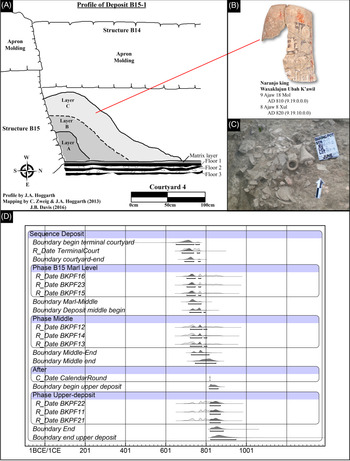
(A) Profile of peri-abandonment deposit located in the corner of Strs. B14 and B15 in Courtyard 3 of the royal palace complex at Baking Pot; (B) polychrome ceramic sherd with short count calendar dates of AD 810 and AD 820; (C) top-down view of peri-abandonment deposit; and (D) Bayesian model for Deposit B15–1 modeled in OxCal. Blue shading shows the commands used for the Bayesian modeling in OxCal.

BACKGROUND
The Upper Belize River Valley is located in western portion of central Belize, defined geographically by the lower sections of the Macal and Mopan Rivers and their confluence to form the Belize River as it flows eastward towards the Caribbean Sea (Figure 1). Within the broader political landscape of the region, the site is positioned approximately 10 km east of the major center of Cahal Pech and 6 km west of Lower Dover (Figure 1a). Baking Pot has been the focus of research by some of the pioneers of Maya archaeology, including Oliver Ricketson (Ricketson Reference Ricketson1931), William and Mary Bullard (Bullard and Bullard Reference Bullard and Bullard1965), and Gordon Willey and colleagues (Willey et al. Reference Willey, Bullard, Glass and Gifford1965). Excavations of the site by the Belize Valley Archaeological Reconnaissance (BVAR) Project began in 1992 (Conlon Reference Conlon and Awe1993) and have continued into recent years (see Hoggarth et al. Reference Hoggarth, Davis, Awe and Helmke2020; Helmke et al. Reference Helmke, Hoggarth and Awe2021). Archaeological investigations are continuing to reconstruct the chronological sequence of the rise and fall of the Baking Pot polity. Radiocarbon dates on human burials, as well as one date from a cache deposited into sterile soil below the earliest plaza construction in Group A, indicate that the site was first occupied around 700–400 cal BC (Hoggarth et al. Reference Hoggarth, Culleton, Awe and Kennett2014a). Monumental construction in both groups suggest significant architectural construction efforts in the ceremonial center in the Early Classic period. However, current data suggests that many of the identified monumental construction episodes appear to date to the Late Classic period. While hieroglyphic inscriptions on portable objects at Baking Pot suggest that its rulers had royal titles (Colas et al. Reference Colas, Helmke, Awe and Powis2002; Helmke and Awe Reference Helmke and Awe2013), no emblem glyph has yet been discovered at the site. At its height at around AD 700, Baking Pot’s immediate population reached around 2,500 residents in the immediate 9 km2 settlement area (Hoggarth Reference Hoggarth2012), with clusters of settlement groups in hinterland locations of North Caracol Farms, Bedran, and other areas. Baking Pot is an ideal site to understand abandonment processes occurring at the end of the Classic period. Unlike its larger and more powerful neighbors to the west (Naranjo) and south (Caracol), the moderate size of the ceremonial epicenter and the surrounding settlement has allowed for intensive excavations over the past 80+ years. Aimers (Reference Aimers, Inomata and Webb2003: 157–160) notes that the initial abandonment of the site core likely occurred around AD 800–900, although the presence of Postclassic ceramics in Group A and in house mounds to the east and southeast of the epicenter, suggests that reduced populations lived at the site during the Postclassic period for some unknown amount of time after AD 900.
Excavations at the southern monumental group, Group B, at Baking Pot show a differing occupational trajectory than the northern group. Audet (Reference Audet2006) and Helmke (Reference Helmke, Helmke and Awe2008: 127–128) noted a presence of Terminal Classic artifact types in the fill of the terminal construction of the royal palace complex and associated eastern shrine, suggesting that formal construction may have continued into the Terminal Classic period in Group B. To date, no Postclassic ceramics or other coeval materials have been recovered in excavations in Group B (Hoggarth et al. Reference Hoggarth, Zweig and Mzayek2014b). Excavations in Courtyard 3 of the palace complex were conducted in 2013, identifying a large peri-abandonment deposit in the southwestern corner of the courtyard that measured over 1 m in height (Hoggarth et al. Reference Hoggarth, Zweig and Mzayek2014b). The location of this deposit aligned with the spatial pattern identified by Awe and colleagues (Awe et al. Reference Awe, Helmke, Aimers, Ebert and Hoggarth2020a) in which deposits at many Belize Valley sites were located in the corners of plazas and courtyards, atop stairs, and in alleyways between monumental structures. In 2015, we initiated a new research project that specifically targeted these locations in order to identify peri-abandonment deposits to help illuminate the processes associated with the abandonment of the royal palace complex and associated ceremonial epicenter of Baking Pot (Hoggarth et al. Reference Hoggarth, Awe, Bednar, Lopez Johnson, McKeown, Lonaker, Green, Moraza-Keeswood, Ray and Walden2016). Excavations in 2015 and 2016 identified three additional deposits in Plaza B, located next to the stair side outset of Str. B6, in the corner of Structures B6 and B7, and in the corner of Structures B2 and B21 (Figure 1). Descriptions of three of these deposits can be found in the results section of this paper (see also Davis Reference Davis2018).
Peri-abandonment deposits in Group B exhibited evidence of stratified layers within the deposits (Hoggarth et al. Reference Hoggarth, Zweig and Mzayek2014b), which suggested that the events which formed the deposits might have been separated in time. However, other formational processes might have contributed to the presence of layers within the deposits. Below the deposits, excavations revealed a thin matrix layer of sediment ˜5 cm in depth directly atop the terminal floor in each location (Hoggarth et al. Reference Hoggarth, Zweig and Mzayek2014b; Hoggarth and Sullivan Reference Hoggarth and Sullivan2015), an observation that Awe and colleagues (Awe et al. Reference Awe, Helmke, Aimers, Ebert and Hoggarth2020b) notes for other Belize Valley sites. This suggests that some time elapsed between when these ceremonial spaces were no longer being maintained and the deposition of the deposits. In some cases, facing stones from the adjacent architecture were present within layers of the deposits (see Lonaker et al. Reference Lonaker, Davis, Moraza-Keeswood and Hoggarth2017; Davis Reference Davis2018), only to be covered over with subsequent deposition of additional archaeological materials. This evidence offers support in favor of the interpretation that some time passed between the deposition of different layers of each deposit and that structures were undergoing decay and partial collapse as these deposits formed. However, other possibilities may have contributed to the formation of distinct layers within deposits, including the deposition of materials from different sources in a single chronological event. The discovery of partial polychromatic vases with Long Count and Calendar Round dates suggested that (at least) the final deposition of materials in the Plaza B (B7) deposit and that in Courtyard 3 (B15) occurred in the first half of the ninth century. However, the presence of both early facet (˜AD 700–800) and late facet Spanish Lookout (˜AD 800–900) ceramic types in the deposits (see Davis Reference Davis2018 for the details of the ceramic analysis) made the identification of the timing of depositional events more ambiguous.
Given the relatively low temporal resolution of the regional Belize Valley ceramic chronologies (e.g., Gifford Reference Gifford1976), with ceramic complexes spanning several centuries, identifying multiple events that occurred within a single ceramic phase, or across multiple phases, has proven difficult. A similar problem prevails with deposits across the Maya lowlands. For this reason, and in order to more accurately resolve the timing of depositional events associated with the peri-abandonment deposits at Group B at Baking Pot, we decided to date selected multiple samples of faunal or human remains identified within distinct stratigraphic layers for each deposit. This allows for the integration of multiple dates within Bayesian chronological models to test different assumptions regarding the deposition of each stratigraphic layer. These were complemented by charcoal samples from the final plaza and courtyard floors in Group B, allowing us to constrain the timing for the initiation of depositional activity atop the terminal floors. By expanding efforts aimed at refining regional chronologies through radiocarbon dating and Bayesian chronological modeling at sites across the Maya lowlands (Culleton et al. Reference Culleton2012; Kennett et al. Reference Kennett, Hajdas, Culleton, Belmecheri, Martin, Neff, Awe, Graham, Freeman, Newsom, Lentz, Anselmetti, Robinson, Marwan, Southon, Hodell and Haug2013; Hoggarth et al. Reference Hoggarth, Culleton, Awe and Kennett2014a; Inomata et al. Reference Inomata, Ortiz, Arroyo and Robinson2014, Reference Inomata, MacLellan, Triadan, Munson, Burham, Aoyama, Nasu, Pinzón and Yonenobu2015, Reference Inomata, Triadan, MacLellan, Burham, Aoyama, Palomo, Yonenobu, Pinzón and Nasu2017; Ebert et al. Reference Ebert, Culleton, Awe and Kennett2016; Prufer et al. Reference Prufer, Thompson, Meredith, Culleton, Jordan, Ebert, Winterhalder and Kennett2018), archaeologists are beginning to unravel the chronological details of the development and disintegration of Classic Maya political systems and the abandonment of site peripheries at more precise time scales.
METHODS
Major refinements in archaeological chronologies have become commonplace with the implementation of high-precision radiocarbon dating into archaeological research programs (Bronk Ramsey Reference Bronk Ramsey2009). To target the human activities associated with depositional events within each feature, faunal remains were selected for dating from different levels in each of the three peri-abandonment deposits included in this study. Animal bone was selected instead of charcoal since the faunal remains were part of the activities that formed these deposits. Faunal remains were also more abundant in the deposits than charcoal. Human inhumations were identified in two deposits (Plaza B, Str. B7 and Plaza B Str. B2) and were dated, the results of which are also included in this study. Dating faunal samples also avoids issues of old charcoal that can sometimes yield earlier than expected dates than the context being dated (Kennett et al. Reference Kennett, Ingram, Southon and Wise2002, Reference Kennett, Culleton, Voorhies and Southon2011, Reference Kennett, Culleton, Dexter, Mensing and Thomas2014). To constrain the timing of the beginning of depositional activities, we also selected charcoal samples from the construction fill below the final plaza or courtyard floor(s) associated with each deposit.
Radiocarbon Dating
Charcoal samples were collected in situ from within the construction fill of the terminal plaza and courtyard floors. Samples were cleaned of adhering sediment and pretreated using the standard acid/base/acid (ABA) method, with repeated baths in 1N HCl and NaOH at 70°C for 20 min on a heater block. A final acid wash completed this process to remove secondary carbonates formed during the base treatment and the samples were then returned to neutral pH with two 15 min baths in nanopure water at 70°C to remove chlorides and then dried on a heater block. Sample CO2 was produced by combustion at 900°C for 3 hr in evacuated sealed quartz tubes using a CuO oxygen source and Ag wire to remove chloride compounds. Primary (OXII) and secondary standards were selected to match the sample type/expected age and underwent the same chemical steps for quality assurance. The CO2 generated was reduced to graphite at 550°C using a modified hydrogen reduction method onto a Fe catalyst (Santos et al. Reference Santos, Southon, Druffel-Rodriguez, Griffin and Mazon2004), with reaction water drawn off with Mg (ClO4)2. The Fe catalyst used is baked monthly at 300°C for 3 hr in air, and subsequently baked at 400°C in H2 for 45 min prior to analysis, to reduce modern carbon contamination. Solid graphite samples were pressed into Al targets and loaded on the target wheel with OX-II (oxalic acid), secondary standards and wood blanks for AMS analysis.
Selected faunal and human bone samples were pretreated for collagen extraction and purification using a modified version of the XAD chromatography method (Stafford et al. Reference Stafford, Brendel and Duhamel1988, Reference Stafford, Hare, Currie, Jull and Donahue1991; see Lohse et al. Reference Lohse, Madsen, Culleton and Kennett2014). Samples were cleaned of adhering sediment and were demineralized for 24–36 hr in 0.5N HCl at 5°C followed by a brief (<1 hr) alkali bath in 0.1N NaOH at room temperature to remove humates. The demineralized collagen pseudomorph was rinsed to neutrality in multiple changes of Nanopure H2O, and then gelatinized for 12 hr at 60°C in 0.01N HCl. Sample gelatin was pipetted into a pre-cleaned 10 mL disposable syringe with an attached 0.45 mm Millex Durapore PVDF filter (precleaned with methanol and Nanopure H2O) and driven into a thick-walled culture tube. The filtered solution was then lyophilized and percent gelatinization and yield determined by weight. The sample gelatin was hydrolyzed in 2 mL 6N HCl for 24 hr at 110°C. Supelco ENVI-Chrom® SPE (Solid Phase Extraction; Sigma Aldrich) columns which were equilibrated with 50 mL 6N HCl with a 0.45-mm Millex Durapore filter attached. Next, 2 mL collagen hydrolyzate as HCl was pipetted onto the SPE column and driven with an additional 10 mL 6 N HCl dropwise with the syringe into a 20-mm culture tube. The hydrolyzate was finally dried into a viscous syrup by passing UHP N2 gas over the sample heated at 50°C for approximately 12 hr. The sample was then combusted and graphitized using the methods described in the charcoal sample section above. Samples of Pleistocene whale bone (background, >48 14C kyr BP), late Holocene bison bone (˜1850 14C yr BP), late AD 1800s cow bone, and OX-II oxalic acid standards for normalization were selected to match the sample type/expected age and underwent the same chemical steps for quality assurance. Sample quality was evaluated by % crude gelatin yield, %C, and %N, before AMS 14C dating.
All dates are reported as conventional radiocarbon ages corrected for fractionation with δ13C values measured on the AMS following Stuiver and Polach (Reference Stuiver and Polach1977). Calibrations were produced using OxCal 4.3.2 (Bronk Ramsey Reference Bronk Ramsey1995, Reference Bronk Ramsey2001, Reference Bronk Ramsey2009), employing the IntCal13 atmospheric curve (Reimer et al. Reference Reimer, Bard, Bayliss, Beck, Blackwell, Bronk Ramsey, Buck, Cheng, Edwards, Friedrich, Grootes, Guilderson, Haflidason, Hajdas, Hatte, Heaton, Hoffmann, Hogg, Hughen, Kaiser, Kromer, Manning, Niu, Reimer, Richards, Scott, Southon, Staff, Turney and van der Plicht2013). Calibrated dates are discussed in terms of “cal AD” as distinct from epigraphic dates reported simply as “AD” (using a 584286 correlation coefficient; see Martin and Skidmore Reference Martin and Skidmore2012).
Bayesian Chronological Modeling
Bayesian chronological models are constructed using available radiocarbon dates combined with prior information from the archaeological record (e.g., stratigraphic position, artifact assemblages, historical dates). The Bayesian model provides a framework in which the assumptions of the priors (e.g., information from archaeological context) are made explicit and the posteriors are modeled using a likelihood function. This would be idealized as in the case of when two dated samples are in stratigraphic superposition and the assumption within the model is that the lower samples pre-date the deposition of upper samples. Agreement indices (A) are not actual Bayes factors but are pseudo-Bayes factors and offer a method for identifying how well each alternative model fits with the posterior distributions of individual radiocarbon dates in the model (Bronk Ramsey Reference Bronk Ramsey1995: 427–428, Reference Bronk Ramsey2000: 201). Outlier dates and/or problematic assumptions can be identified when agreement indices fall below a critical value (A’c = 60%), indicating a poor fit between the data and the model. However, agreement with the model does not necessarily prove that the assumptions used are correct (Culleton et al. Reference Culleton2012: 1577), but simply suggest that there is no reason to discard the model or radiocarbon date based on the fit between the model and the data. As with other uses of Bayesian statistics in archaeology and other fields, the outcomes of the Bayesian statistical modeling are only as reliable as the assumptions on which they are based.
Micro-stratigraphic excavations of the peri-abandonment deposits were conducted to peel back each layer of the deposit (Hoggarth et al. Reference Hoggarth, Zweig and Mzayek2014b; Hoggarth and Sullivan Reference Hoggarth and Sullivan2015; Lonaker et al. Reference Lonaker, Davis, Moraza-Keeswood and Hoggarth2017). Samples were selected from various strata or layers within each deposit to assess whether the features represented single events or accretional activities separated in time. The distinct strata within deposits were suggestive of multiple events; however, if materials from different sources were being used during singular depositional events, this might also account for the stratigraphic distinctions noted in excavations. We set up multiple Bayesian models for each deposit to test differing assumptions regarding the deposition of each peri-abandonment deposit.
First, each deposit was modeled as a single event, using the assumption that the materials were deposited during a single “moment in time” episode that fully formed each deposit. In this case, we would assume that the animals that were included in each deposit were killed at the same time, which would yield statistically identical AMS 14C dates on those materials. We refer to this possibility as Scenario 1 throughout the text. To test this proposition, we used the R_Combine command to assess how well all dates fit within an assumed single depositional event. It should be noted that we do not use the R_Combine command indiscriminately to merge dates in these cases to obtain greater precision; but rather, we only use this command to assess the likelihood of a singular depositional event. As seen in the results section, the Bayesian models using this command show low agreement in all cases and therefore are discarded; however, others should exercise caution when using this command in a model. Following this step, the deposit dates were placed within a larger Sequence that assumes that the deposition of each deposit post-dates the final construction event associated with the terminal plaza or courtyard floor(s) on which each deposit sits. If ceramics bearing hieroglyphic dates or other known historical events were present within the deposit, the associated date was used as a terminus post quem, using the After command to model the dates based on the assumption that the deposition of organic materials cannot pre-date the known events described within the hieroglyphic text.
Second, referred to herein as Scenario 2, we set up a Bayesian model to assess whether the deposits could have been the result of more protracted events that were clustered into a short period of time (e.g., several years or decades), rather than one singular event in time. To test this assumption, we modeled the individual AMS 14C dates within a Sequence that assumes the date(s) from the fill of the terminal plaza or courtyard floor pre-date the depositional events on top of those features. All radiocarbon dates from each deposit were modeled within a single Phase, assuming that their deposition represents an unordered and unspecified period of time rather than a singular event. Historic dates or events recorded in hieroglyphic texts on ceramics from deposits were used as a terminus post quem, with the assumption that the deposition(s) occurred sometime after the historic events described in the texts. In both instances, it is unlikely that the ceramics bearing these hieroglyphic texts moved very far from their depositional context, given that in the case of the Komkom Vase that the sherds were largely clustered together and artifacts were very dense.
Third, described in the text as Scenario 3, each deposit was modeled as being the result of multiple events separated by an unknown amount of time. To test this assumption, we modeled individual AMS 14C dates in a Sequence, in which we assumed that the AMS 14C dates from the terminal construction of plazas and courtyard floors predated the lowest stratigraphic levels of each deposit. Within the Bayesian model, multiple AMS 14C dates that belonged to a single stratigraphic layer were placed in a Phase, which assumes unordered chronological relationships between samples within a single layer, and each Phase was modeled within the broader sequence based on the identification of distinct strata within each of the deposits. The ceramics with hieroglyphic dates serve as termini post quos for the upper layer of two deposits (B7 and B15), as the final events that deposited materials in those layers would not have pre-dated the known events described in these historic texts. In order to identify any gaps in activity, as well as identify the timing of each depositional event, the Sequence was modeled with additional Boundaries to distinguish events along with the Interval command. All boundaries used were based on stratigraphic information recorded throughout excavations, either changes in soil matrices or artifact density/composition.
Agreement indices for AMS 14C dates were used to assess whether individual dates needed to be rejected, potentially due to issues of bioturbation moving samples out of their original context, or due to deposited items having been heirloom pieces. The latter prospect is unlikely for faunal remains or charcoal, but we remain open to this possibility, especially in the case of secondary human inhumations. This method is particularly relevant for charcoal samples, which are more prone to old wood effects, rather than faunal bone that were part of the materials forming each deposit. Agreement indices for the larger model offer important information about whether the assumptions that were used to model the radiocarbon dates need to be rejected. In the event that multiple models show agreement exceeding the critical value (A’c>60), we recognize that we might not be able to choose one model over another. Contextual information from individual deposits will help to guide our final interpretations. It might be the case that some deposits were the result of singular events, whereas other deposits were the result of long-term processes of material deposition. Therefore, we consider multiple Bayesian models for each deposit rather than assuming that all deposits are the same.
RESULTS
Courtyard 3 Str B15 Deposit
A large and dense deposit measuring 127 cm in diameter and over 1m in height was identified in the southwestern corner of Courtyard 3, adjacent to Structures B15 and B14 within the royal palace complex of Group B (Hoggarth et al. Reference Hoggarth, Zweig and Mzayek2014b, Reference Hoggarth, Davis, Awe and Helmke2020). The deposit was the largest of those identified at Baking Pot, with both jars and bowls dominating the ceramic assemblage (Davis Reference Davis2018). Musical instruments were present, including several ocarinas and a ceramic drum, indicating that music and entertainment were part of the activities that formed this deposit. Although they were present in low frequency, this feature contained the most grinding stones identified across deposits, which is not surprising given that this area is associated with the living spaces of the royal court. However, other indicators of domestic activities, such as obsidian blades, were nearly 11 times less common in the deposits than in commoner households in the settlement area of Baking Pot (Hoggarth et al. Reference Hoggarth, Davis, Awe and Helmke2020). As also identified within the other deposits, faunal remains lacked the typical correlates associated with feasting activities (e.g., high utility elements, evidence of butchery), prompting Burke and colleagues (2020) to propose ritual rather than quotidian activities contributed to the deposition of faunal remains across Baking Pot Group B. Other items, such as spindle whorls, bone needles, and figurines were also identified. Miseria applique incensario fragments, as well as pie-crust Cayo Unslipped jars, suggest that at least some of the materials were deposited in the Terminal Classic period.
Detailed excavations revealed three distinct stratigraphic layers. The upper section (Layer C) included broken ceramics and other materials within a fine matrix. Late facet Spanish Lookout ceramics indicate that (at least) the final deposition of materials within the feature occurred during the Terminal Classic period. A partial polychrome vase with a hieroglyphic text naming the last known king of Naranjo, Waxaklajun Ubah K’awil, as well as describing the period-ending rituals of AD 810 and 820 (based on Calendar Round dates) also firmly anchor the uppermost strata of the deposit in the ninth century. The middle section (Layer B) of the deposit was characterized by loamy matrix and fewer diagnostic artifact types. The innermost section of the deposit (Layer A) included few artifacts but contained a large amount of daub and burned limestone. These indicators suggest localized burning that was restricted only to the deposit. Unlike features identified at other sites in the Maya lowlands that include large-scale burning associated with warfare, the burning in the B15 deposit was only identified within the deposit. No other evidence of a destructive event within Courtyard 3 or in the broader area excavated in Group B indicated that this was a desecratory event.
Nine AMS 14C dates on purified bone collagen from faunal remains, with three dates from the lower strata, three from the lower section of the upper strata, and three from the top of the deposit offer additional chronological control that provide important details about the sequence of deposition associated with the feature. One charcoal date from below the terminal courtyard floor directly below the deposit serves to anchor the timing for the final architectural renovation of the courtyard. Bayesian models based on assumptions of single “moment in time” (Scenario 1) and protracted depositional events (Scenario 2) showed low agreement. In the case of Scenario 1 and 2, dates on faunal remains had agreement indices below A’c=60 (Scenario 1: Amodel=32; Scenario 2: Amodel=27.6). The inclusion of the Calendar Round date of AD 820 within the Sequence greatly constrains the timing of the deposition of the B15 deposit. However, excluding the terminus post quem date results in agreement exceeding the critical value for both individual dates and for the overall sequence, with no outliers identified when combined (χ2 = 2.35, df = 8, T crit = 15.51; Ward and Wilson 1978). This might offer support for combining the 8 dates in the sequence, and lacking the calendar date from the ceramic sherd, we likely would not have rejected the models associated with a singular event contributing to the formation of the B15 deposit. However, given the contextual information from the distinct stratigraphic layers, as well as the Calendar Round dates from the partial polychromatic vase in the deposit, we were able to reject the models based on singular depositional formation of the B15 deposit.
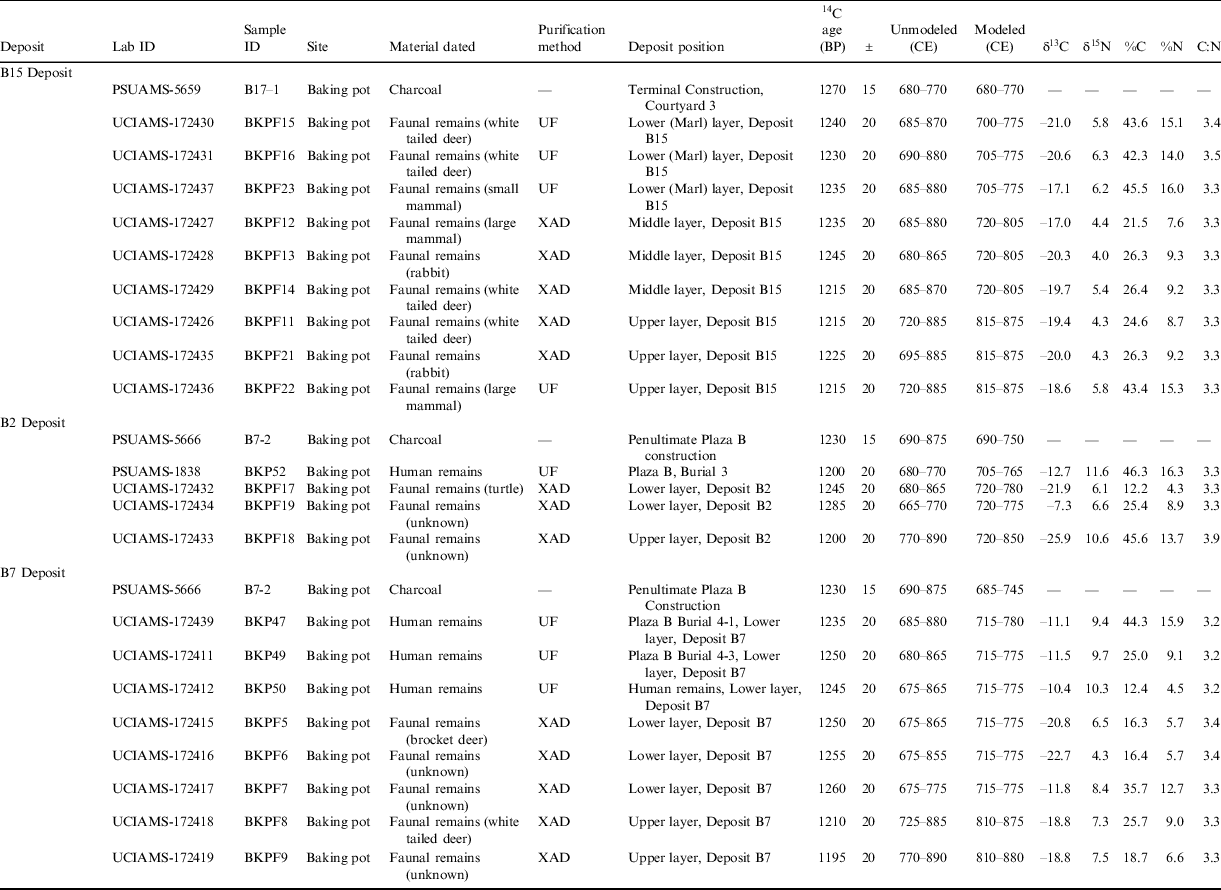
Given the low agreement of dates within the models for Scenarios 1 and 2, we are left only with Scenario 3 that shows high agreement (Amodel = 194.7) between the Bayesian model and the data. The final construction of the courtyard floor occurred between cal AD 680–770, followed by the first deposition of marl, daub, and other artifacts at cal AD 705–775 (Table 1). The second depositional event for the B15 deposit occurred at between cal AD 720–805, followed by the final deposition between cal AD 815–875. The intervals between each stratum ranged between 0 to 45 years (Layer C), 0 to 85 years (Layer B), and 0 to 90 years (Layer A), respectively. This suggests that the time between each depositional event could have taken place anywhere from having no gap up to a gap of nearly a century in time. Since it is unlikely that the painted ceramic vessel with the hieroglyphic text moved within the artifact dense deposit, being firmly encased by other materials, there is little chance that it is not in its primary context. Three depositional episodes are identified within the B17 deposit and suggest that the activities associated with the formation of the deposit spanned across nearly 15 decades associated with the decline of the royal court at Baking Pot. The deposit represents at least three depositional events, the first and second in the mid-to-late eighth century and the third occurring during the ninth century.
Radiocarbon dates from peri-abandonment deposits in Group B at Baking Pot, Belize. Note that the modeled dates use the Scenario 3 OxCal model, which showed the best agreement across all three deposits.
Plaza B (Str. B7) Deposit
Covering an area of approximately 5.5 m by 2.5 m, a large and artifact rich deposit was identified in excavations in the northeast corner of Plaza B in Group B at Baking Pot in 2016 and 2017 (Hoggarth et al. Reference Hoggarth, Awe, Bednar, Lopez Johnson, McKeown, Lonaker, Green, Moraza-Keeswood, Ray and Walden2016; Lonaker et al. Reference Lonaker, Davis, Moraza-Keeswood and Hoggarth2017). Artifacts were piled up in two distinct concentrations (Figure 3), with one concentration piled in the corner of Str. B6 and B7 (northern B7 deposit) and the second cluster against the stair side outset associated with Str. B7 (southern B7 deposit). There was no visible gap between the two concentrations, as artifacts that were piled up in each corner tapered off in the middle section of the deposit. This was suggestive of two distinct depositions that grew to merge, rather than a single deposition across the entire area. The tallest part of the northern deposit was approximately 35 cm above the terminal plaza floor and dark organic stains were identified against the walls of Str. B7. This evidence indicates that each section of the deposit was taller in height, originally around 50 cm, and the weight of structural collapse contributed to the compression and breakage of materials into the more compact deposits identified in excavations (Helmke et al. Reference Helmke, Hoggarth and Awe2018: 9–14).
(A) Profile of peri-abandonment deposit located in the corner of Strs. B6 and B7 in Plaza B of Group B at Baking Pot; (B) profile of the Komkom Vase, bearing a Long Count date of AD 812 (Image by C. Helmke); (C) side view of peri-abandonment deposit; and (D) Bayesian model for Deposit B7–1 modeled in OxCal. Blue shading shows the commands used for the Bayesian modeling in OxCal.
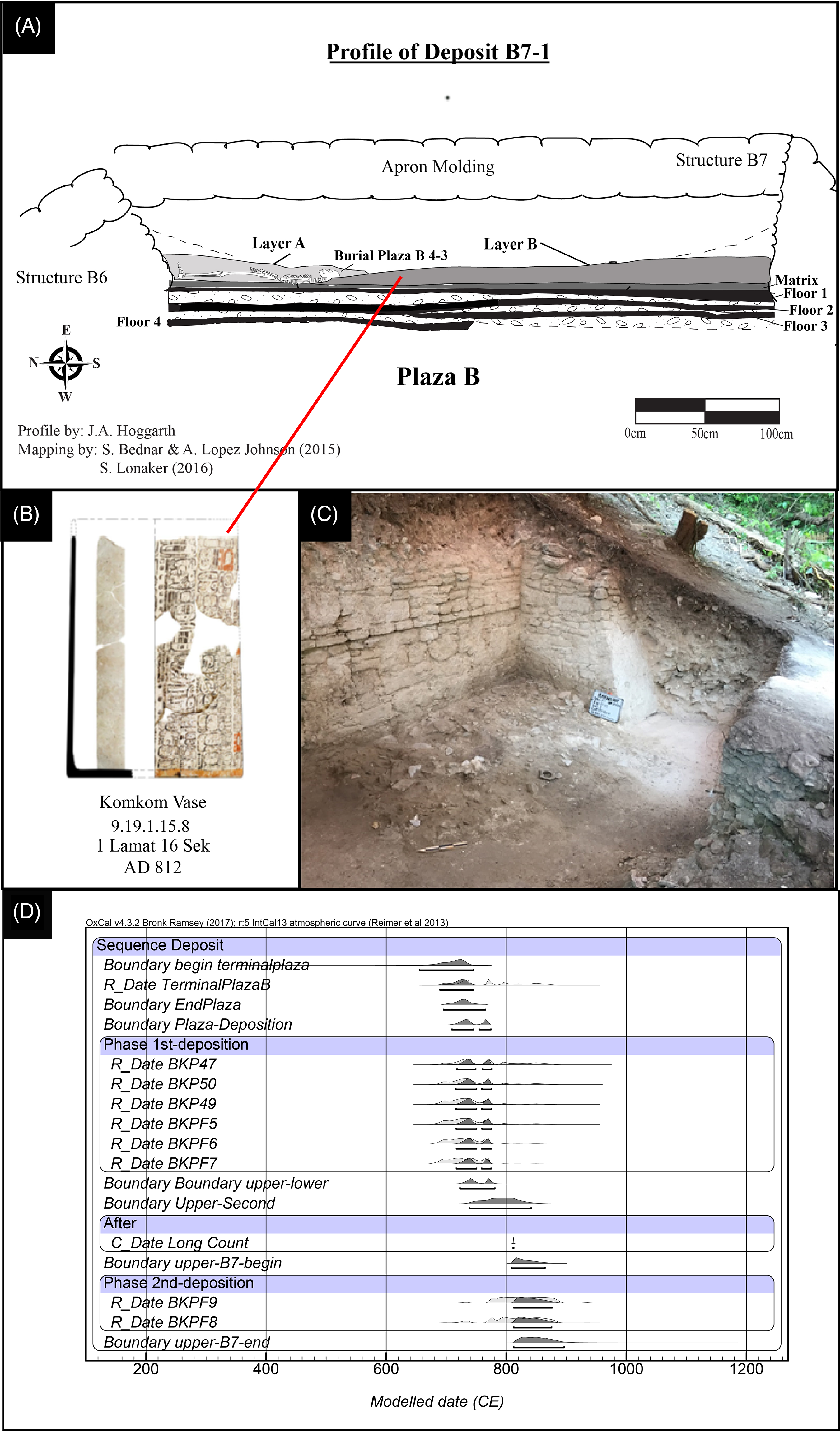
A variety of materials were identified within the deposit, with the artifact assemblage dominated by broken ceramics, faunal remains, freshwater shell, and human bone (Hoggarth et al. Reference Hoggarth, Awe, Bednar, Lopez Johnson, McKeown, Lonaker, Green, Moraza-Keeswood, Ray and Walden2016; Davis Reference Davis2018). Prestige goods, including polychrome ceramic vessels, carved jade adornments, worked shell and bone, and other items were also present within the deposit. The presence of late facet Spanish Lookout types, including pie-crust rims on Cayo Unslipped jars suggests that at least the final events that formed these deposits occurred during the Terminal Classic period (Davis Reference Davis2018). Early facet Spanish Lookout types, including Belize Red, were also found within the deposit, suggesting that the deposits were formed over the span of the transition from the end of the Late Classic to Terminal Classic periods (AD 700–900). Two intact primary burials were identified in the lower levels of the northern deposit. Burial 4-1 (Plaza B) was a 15–18-year-old male individual buried in an extended prone position with the head oriented to the west (Hoggarth et al. Reference Hoggarth, Awe, Bednar, Lopez Johnson, McKeown, Lonaker, Green, Moraza-Keeswood, Ray and Walden2016: 251). Although the head was absent from the interment, a skull and long bone fragments were identified in the center of the deposit, which likely belong to this individual (Burial 4-2, Plaza B), suggesting displacement of these elements following decomposition of the body, in antiquity. A second primary burial, Burial 4-3 (Plaza B), was identified along the face of Structure B7, interred in an extended position with its head oriented to the south, the prominent burial pattern identified throughout the Preclassic and Classic periods in the Belize Valley (Hoggarth et al. Reference Hoggarth, Awe, Bednar, Lopez Johnson, McKeown, Lonaker, Green, Moraza-Keeswood, Ray and Walden2016: 252). Towards the middle of the deposit, where the two deposits merged, broken fragments of a polychrome vase completely covered with a hieroglyphic text was recovered. Approximately 67% of the vase was recovered and reconstructed. The vase, now called the Komkom Vase, includes a hieroglyphic inscription that would have consisted of around 202 glyphs at its full length, with a Long Count calendar date of AD 812 that initiated the text and marked the commemoration of the vase for the King of Komkom (Helmke et al. Reference Helmke, Hoggarth, Awe, Bednar and Johnson2017, Reference Helmke, Hoggarth and Awe2018). The remarkable text, with a ninth century Long Count date, is unique for the Maya lowlands, as this period has broadly been described a period of political instability and the abandonment of centers across the central and southern Maya lowlands. The retrospective text describes a series of warfare events in AD 799 in which the king of Komkom and allies from Naranjo sacked and burned various locations within the eastern Maya lowlands (see Helmke et al. Reference Helmke, Hoggarth and Awe2018). The text describes the location of Komkom as being east of Naranjo, which suggests that its location was likely in or around the Belize Valley. The same events are recorded in less detail within the hieroglyphic corpus of Naranjo. The Long Count calendar date on the Komkom Vase, firmly anchored at AD 812, offers precise chronological information that was used as a terminus post quem for the formation of the deposit.
Three AMS 14C dates on purified bone collagen from faunal remains, in addition to three dates on human remains within the northern deposit, were included in the Bayesian models. Two faunal remains from the southern deposit were dated. In the center where the two concentrations meet, the southern deposit appears to have overlain the northern deposit. It is in this area where sherds from the Komkom Vase were identified. The Long Count date from the Komkom Vase (AD 812) was included as a terminus post quem within the three different Bayesian models. Two charcoal dates from below the terminal courtyard floor serve to anchor the timing for the final architectural renovations of Plaza B. As in the Bayesian models for B17, those that were constructed using the assumptions associated with singular formation processes met the critical value for agreement between the models and data for Scenario 1 (Amodel=73.4). However, two dates within that sequence (BKPF8, BKPF9) show poor agreement within the model (BKPF8 Amodel=15.2, BKPF9 Amodel=49.1). The model for the second scenario shows very low overall agreement (Amodel=2.5). However, like in the B15 deposit, excluding the AD 812 terminus post quem resulted in high agreement with no outliers being detected (χ2 = 9.38, df = 7, T crit = 14.07; Ward and Wilson 1978). Again, the results of the χ2 test would suggest that we could combine dates in this case. However, the presence of the Long Count date on ceramics within the deposit, coupled with the span of the radiocarbon dates, and the identification of stratigraphic layers within the deposit, suggest that the B7 deposit was not formed as the result of a singular depositional event as would have been identified in Scenario 1 or 2.
The Bayesian model for Scenario 3 shows the good overall agreement (Amodel=162.2) with no outliers detected in the sequence. Charcoal from the penultimate Plaza B construction dates between cal AD 685–745, suggesting that the final construction of the plaza occurred in the early to mid-eighth century. The interval between the plaza construction and the beginning of deposition appears to be rather rapid, being a decade or less. Radiocarbon dates on the faunal remains, in addition to the two primary burials, were all statistically identical and when constrained within the sequence are modeled to a period between cal AD 715–775. A time interval between 0 to 95 years passed between the first and second depositions. Both dated faunal remains in the southern concentration post-date the northern deposition, aligning well with the AD 812 Long Count date on the Komkom Vase. The Bayesian model constrains the timing of this final depositional episode to cal AD 812–880. Given that the matrix layer below the deposits suggests that the plaza had already fallen into disuse prior to the initial deposition of artifacts in the B7–100 deposit, these data suggest that the first depositional event likely dates to the eighth century, while the final deposition that included the Komkom Vase occurred in the mid to late ninth century.
Plaza B Str. B2 Deposit
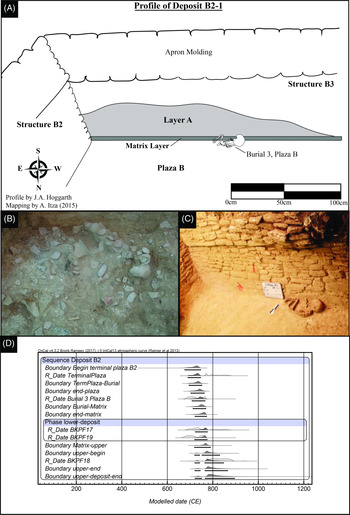
A third deposit was identified in excavations in the southeastern corner of Plaza B, at the intersection of Structures B2 and B21 (Figure 4). The deposit extended around 2 m in diameter and was around 30 cm in height (Hoggarth et al. Reference Hoggarth, Awe, Bednar, Lopez Johnson, McKeown, Lonaker, Green, Moraza-Keeswood, Ray and Walden2016: 257). This was the smallest of the three identified deposits, consisting of broken ceramics, chopped stone debitage, faunal remains, and freshwater shell. The ceramic assemblage was dominated by early facet Spanish Lookout ceramic types, although some late facet types were also present in the deposit. Similar to the other deposits, ceramic forms were dominated by jars and decorated/polychrome ceramics were not as common in this feature (Davis Reference Davis2018). However, unlike other deposits this feature also included a large amount of daub throughout. These were not restricted only in the upper sections, as we might expect if the perishable structures atop the adjacent structures were collapsing onto the deposit but were dispersed throughout. In addition, unlike the B7 and B17 deposits, decorated ceramics were rare in this feature and obsidian was absent. No stratigraphic layers were identified in the B2 deposit. A matrix layer of fine sediment (˜6 cm in depth) was identified below the deposit and atop the terminal plaza floor, as identified at all other deposits. A primary interment (Burial 3, Plaza B) was identified within this matrix layer, the remains of a 2–3-year-old child of indeterminate sex that was placed in a flexed position with the head to the west and facing south, positioned against the face of Str. B2. The burial was lying directly on the terminal plaza floor within the matrix layer, with no grave goods present that might suggest the timing of its interment. Two possibilities could have contributed to the location of this burial in the matrix layer beneath the deposit. In the first option, the interment of this individual could have occurred around the time that the site core fell into disrepair and cleaning activities ceased, with sediment accumulating over the remains. A second possibility is that the burial could have been interred within the matrix sediment, long after this part of the plaza had fallen into disuse, around the same time or prior to the deposition of the artifacts in the deposit that lie above the interment.
(A) Profile of peri-abandonment deposit located in the corner of Strs. B2 and B3 in Plaza B of Group B at Baking Pot; (B) top-down view of peri-abandonment deposit; (C) Plaza B Burial 3 at the base of the peri-abandonment deposit, resting atop the terminal plaza floor; and (D) Bayesian model for Deposit B2-1 modeled in OxCal. Blue shading shows the commands used for the Bayesian modeling in OxCal.

Radiocarbon dates on three faunal samples from the deposit, as well as one human bone sample from Burial 3 in Plaza B from the matrix layer below the B2-2 deposit, and the charcoal sample from the penultimate construction of Plaza B were included in the three models. The Bayesian model for Scenario 1, that of a single “moment in time” deposition in materials showed low agreement within the broader Sequence (Amodel=28.4), with samples BKPF18 (A=44.4) and BKPF19 (A=18.1) below the critical value. No ceramics bearing hieroglyphic dates were identified within the deposit and the B2 deposit exhibited no evidence of distinct stratigraphic levels. However, outliers were detected (χ2 = 9.04, df = 2, T crit = 5.99; Ward and Wilson 1978) when we combined these dates as a single depositional event (Acomb=27%). Therefore, we can reject a singular event being responsible for the formation of the B2 deposit. This is curious, given that the B2 deposit was the only one identified in Group B at Baking Pot that lacked either distinct stratigraphic layers, which made us consider that this deposit may have been deposited in a singular episode. This deposit also lacked calendar dates on ceramics, so the Bayesian models were not constrained by a terminus post quem as the other two deposits were. Unlike those deposits, the B2 deposit would have been identifiable as being formed through multiple depositional events rather than a single episode.
Although the Bayesian model for Scenario 2 exceeds the critical threshold (Amodel=81.5), sample BKPF18 shows poor agreement (A=56.5) within the broader sequence. Given that this sample comes from faunal remains rather than charcoal, the poor fit cannot be explained due to old wood effects. The Bayesian model constructed around the assumptions associated with multiple depositional events (Scenario 3) show high agreement (Amodel=93.5). The model constrains the timing for the penultimate Plaza B construction episode to the interval between cal AD 690–750. Although we were not able to date the terminal Plaza B construction, the interment of Burial 3 in the matrix layer below the deposit occurred between cal AD 705–770. These two dates suggest that the final Plaza B constructions occurred at the beginning of the eighth century, while the Burial 3 was intrusively/secondarily/subsequently interred in the early to mid-eighth century. The interval between the plaza constructions and the interment ranges from 0 to 25 years. These data suggest that either no temporal gap was present or else only a few decades persisted between events. Given the time that would have been needed for sediment to build up in Plaza B, we would suggest that the larger value is more likely. Based on this information, we would likely place the interment towards the mid-eighth century. Although no stratigraphic layers were evidence within the B2 deposit, dates from the lower section of the deposit were constrained to between cal AD 720–780, while those in the upper section date to cal AD 720–850. OxCal indicates the interval between the upper and lower sections of the deposit being between 0–55 years. Given that the visible upper layers of the B17 and B7 deposits dated to the mid to late ninth centuries, it could be possible that all three deposits experienced ninth century final deposition. However, the lack of calendar dates within the B2 deposit leaves the timing for that deposition open.
DISCUSSION
The integration of high-precision AMS 14C dates, contextual information from the distinct stratigraphic layers within the deposits and terminal floors beneath the features, as well as calendar dates in hieroglyphic texts on ceramics, offer a detailed glimpse into the timing of activities that formed peri-abandonment deposits at Baking Pot. Although each deposit showed a unique depositional sequence, marked by different types of artifacts present within individual features, the deposits showed many similarities in the timing and nature of their formations. The Bayesian models that were built upon assumptions of a singular “moment in time” event of deposition (Scenario 1) and a more protracted single phase of deposition (Scenario 2) showed low agreement between the models and the data. This suggests that the assumptions of singular depositional activities, whether restricted to deposition in the last days (single events) or years (singular protracted episodes) that the royal palace complex and surrounding ceremonial structures were used do not fit with the chronological data recovered from the deposits. Instead, only the third scenario, that of a series of punctuated depositional events, dispersed in time, showed consistently high agreement in all cases.
These findings have important implications for the study of peri-abandonment deposits across the Maya lowlands and for understanding the processes of the breakdown in Classic political institutions at Baking Pot. The construction of the penultimate and terminal plaza and courtyard floors occurred at cal AD 680–745, earlier than we had expected given the presence of Terminal Classic artifacts in the (undated) final construction episodes of Str. B1 and B7 of Group B (Helmke Reference Helmke, Helmke and Awe2008). This may suggest that while construction in the plazas and courtyards may have ceased, that construction in the adjacent ceremonial structures continued at least in a more limited fashion. Charcoal or other dateable materials were not present within the fine matrix layers that was noted atop the terminal floors. However, the primary child burial that was interred within this sediment layer dated to cal AD 705–765 (Plaza B), suggesting that the plaza fell into disuse or was no longer swept and maintained around the early part of the eighth century. The initial deposition in all three deposits appears to cluster in the mid-to-late eighth century, with the later deposition occurring nearly 100 years later during the ninth century.
Limestone facing stones from the adjacent structures were identified within the distinct stratigraphic layers of the deposits. This contextual information suggests that the palatial structures were collapsing during the period in which the depositional events were occurring. Given that the Bayesian model for chronologically dispersed deposition (Scenario 3) was the only model with high agreement, this combined information indicates that maintenance and use of Group B ceased earlier than previously identified. Although archaeological evidence in the palatial complex in particular, as well as mortuary activity at Baking Pot in general (Hoggarth et al. Reference Hoggarth, Culleton, Awe and Kennett2014a) suggests that the royal court and its associated political institutions associated with divine kingship persisted to around the first half of the ninth century, the ability of the rulers to maintain the ceremonial spaces may have been reduced beginning around the mid-eighth century. In the B7 deposit, the latter deposition was constrained to the interval between cal AD 812–890, based on the presence of the Komkom Vase. At the B15 deposit this was constrained to the interval between cal AD 820–875 based on the partial vase with Calendar Round dates associated with the final king of Naranjo. The chronological details offered by the Bayesian model and the hieroglyphic dates align with Aimers’ (Reference Aimers, Inomata and Webb2003) observations about Terminal Classic construction in Group A at the site, where these architectural renovations were less prominent and used less-durable materials. Unlike the northern ceremonial group where evidence of Postclassic activities has been identified, no Postclassic ceramics or other items have been identified to date in Group B. The end of activity in this group, with its strong spatial domination of the royal palace complex and associated ancestral shrine, might reflect a rejection of Classic Maya political systems or the institution of divine rulership itself, as suggested at some other sites (Harrison-Buck Reference Harrison-Buck2012, Reference Harrison-Buck2016; Iannone et al. Reference Iannone2016). In the same token, the proximity of the north group to the Belize River may simply reflect differences in settlement patterns between the Terminal Classic and Postclassic periods.
Similar peri-abandonment deposits have been identified at sites across the Belize River Valley and broader western Belize (Awe et al. Reference Awe, Helmke, Aimers, Ebert and Hoggarth2020). Unlike the features at Baking Pot, the Cahal Pech and Xunantunich peri-abandonment deposits tended to be more horizontally dispersed, with none of the identified deposits reaching heights that are recorded for the B15 deposit (˜1 m) or B7 and B2 deposits (˜35 cm) in height. This might indicate that the timing for the formation of those deposits may be more limited in time, dating to only a short period, as compared to the multiple depositional episodes identified at Baking Pot. Future radiocarbon dating projects will test this prospect. These deposits are also highly comparable in context and composition to those found at non-royal residential sites in the area, such as the intensively investigated plazuela at Pook’s Hill (Helmke Reference Helmke2006: 182–183). The broad similarities between peri-abandonment deposits at such different Belize Valley sites suggests that the abandonment processes that have been recorded at Baking Pot were occurring across the entire region during the eighth and ninth centuries.
Within this broader geopolitical context, it appears that the ability for the rulers of Baking Pot to maintain ceremonial spaces within Group B may have been waning as early as the eighth century. Further excavations are needed in Group A to identify whether there was a shift in ceremonial activity towards the northern ceremonial group or whether similar processes of abandonment were occurring across the entire epicenter at Baking Pot. Future research will explore how the timing of the peri-abandonment deposits at Baking Pot relate to the end of elite and royal interment across the site, as well as across the broader settlement area. A pilot study dating 12 burials at Baking Pot shows that burial activity across the site (both ceremonial and domestic) largely declined by the turn of the ninth century (Hoggarth et al. Reference Hoggarth, Culleton, Awe and Kennett2014a). An expanded project is working on increasing the number of dated burials from Baking Pot and other Belize Valley sites (Ebert et al. Reference Ebert, Hoggarth, Awe, Culleton and Kennett2019; Hoggarth et al. Reference Hoggarth, Freiwald, Ebert, Helmke, Awe, Green, Powless and McKeownforthcoming). In the future it is our intention to compare the high-precision chronology presented here for the peri-abandonment deposits in Group B with the dated burials from across the site to begin to untangle the complex processes of abandonment across the broader Belize River Valley.
CONCLUSION
Research at the Classic Maya center of Baking Pot implemented detailed stratigraphic excavation of peri-abandonment deposits as one line of evidence to reconstruct the timing of the breakdown in Classic Maya political institutions at the end of the Classic period. Since these important features sit atop the terminal plaza and courtyard floors of ceremonial centers, they offer important information into the processes of abandonment. These deposits are sometimes interpreted as representing single short-term events; however, distinct strata identified within the deposits at Baking Pot suggested that the processes that contributed to their formation may have been protracted in time. We integrated the stratigraphic and historic information from deposits as prior information within Bayesian chronological models, testing three different chronological scenarios for their formation. The two models that were based on assumptions that the deposits were formed during singular short-term events, either brief or protracted, showed low agreement between the model assumptions and the data. The third scenario, that of multiple depositional events that were dispersed in time, showed high agreement. This third Bayesian model allowed us to constrain the timing of depositional events to ˜65 yr intervals on average, identifying the final construction of plaza and courtyard floors occurred in the first half of the eighth century. The initial depositional activity dated to the mid-to-late eighth century and was temporally distinct from the later deposition in the mid-to-late ninth century. Together, these data offer a detailed view of the end of the Classic period at Baking Pot, in which the ceremonial spaces of the site slowly fell into disuse, preceding depopulation and eventual abandonment.
ACKNOWLEDGMENTS
Archaeological excavations at Baking Pot were conducted under the auspices of the Belize Valley Archaeological Reconnaissance (BVAR) Project, directed by Jaime Awe, Julie Hoggarth, and Claire Ebert. Funding for archaeological research came from the Tilden Family Foundation, the BVAR field school and the National Science Foundation (BCS-1460369 to Kennett, Culleton, Hoggarth) and laboratory support at the Human Paleoecology and Isotope Geochemistry lab at Penn State was also supported by the National Science Foundation (BCS-1460367, to Kennett and Culleton). Epigraphic analyses at Baking Pot were conducted in part with internal funding from the Department of Cross-cultural and Regional Studies of the University of Copenhagen (to Helmke). We thank Christina Zweig, Sarah Bednar, and Amber Lopez Johnson, who all served as supervisors for the Baking Pot excavations, as well as Antonio Itza (excavation foreman), Manuel Itza, Edgar Penados, and Orvin Martinez (excavation assistants), and the BVAR field school students who took part in excavations. We also thank Dr. John Morris and the Belize Institute of Archaeology for the permitting of BVAR Project research, as well as their continued support of the project.
Supplementary material
To view supplementary material for this article, please visit https://doi.org/10.1017/RDC.2021.30





 Open access

