


Introduction
Civil Society Organizations (CSOs) are crucial intermediary organizations that connect citizens with policymakers (Easton Reference Easton1971; Putnam Reference Putnam1993; Rasmussen et al. Reference Rasmussen, Carroll and Lowery2014; Truman Reference Truman1951). By acting as transmission belts between the preferences of civil society and the actions of policymakers, CSOs can supplement the deficiencies of public institutions and contribute to a well-functioning democracy, promoting the legitimacy and effectiveness of governance systems (Greenwood Reference Greenwood2007; Kohler-Koch Reference Kohler-Koch2010). Yet, as several studies have indicated, the representative function of many CSOs is severely flawed (Binderkrantz Reference Binderkrantz2009; Halpin Reference Halpin2006; Jordan and Maloney Reference Jordan and Maloney2007; Kohler-Koch Reference Kohler-Koch2010). And even when CSOs successfully involve their membership base to ensure representativeness, they may lack the organizational capacity that facilitates an effective interaction with policymakers (Schmitter and Streeck Reference Schmitter and Streeck1999; van der Pijl and Sminia Reference van der Pijl and Sminia2004).
The idea that CSOs function as transmission belts denotes, although often implicitly, that they are able to aggregate member preferences and efficiently transfer these to policymakers. To date, and despite the burgeoning literature on CSOs and interest groups in general, there is little understanding of how well CSOs manage this balancing act. The main reason for this gap in the literature is that scholarly work has usually emphasized just one of the constituting elements of the transmission belt. Studies focus either on membership involvement (Binderkrantz Reference Binderkrantz2009; Jordan and Maloney Reference Jordan and Maloney1998; Kohler-Koch Reference Kohler-Koch2010; Moe Reference Moe1991), or on the organizational capacities developed to be more professionalized (Klüver Reference Klüver2012; Klüver and Saurugger Reference Klüver and Saurugger2013; Maloney Reference Maloney, Lowery, Halpin and Gray2015; Skocpol Reference Skocpol2003), but not on how CSOs can and do manage the combination of these two aspects. Furthermore, most studies use indirect variables and proxies to assess CSO membership involvement and organizational capacity—the most frequent ones being resources, organizational type (citizen vs. business groups), scope of action (specialist vs. generalist organizations), and organizational scale (individual organizations, national associations, or supranational associations)—thereby obscuring key organizational processes that facilitate the connection between society and policymakers. We thus do not have a clear understanding of how organizational processes can contribute to a genuine transmission belt function of CSOs, a function that is often assumed or required by public institutions. This is problematic as it results in limited knowledge of the role of CSOs in representative democracies and hinders a good understanding of how public institutions might involve them in a more effective way.
This paper aims to fill this gap by unpacking the organizational structure of CSOs and examining how it relates to fulfilling a transmission belt role. By focusing on the internal structure of CSOs, the paper builds upon recent work that has highlighted the importance of organizational factors for connecting CSOs with their members and transferring their demands to policymakers (Albareda and Braun, forthcoming; Berkhout Reference Berkhout2013; Binderkrantz Reference Binderkrantz2009; Braun Reference Braun2013, Reference Braun, Lowery, Halpin and Gray2015; Fraussen and Beyers Reference Fraussen and Beyers2016; Fraussen et al. Reference Fraussen, Beyers and Donas2015; Halpin Reference Halpin2014; Halpin et al. Reference Halpin, Fraussen and Nownes2018; Klüver Reference Klüver2012; Minkoff et al. Reference Minkoff, Aisenbrey and Agnone2008; Muñoz Marquez Reference Muñoz Marquez2016; Naoi and Krauss Reference Naoi and Krauss2009). Drawing on these studies in conjunction with organizational theory, the paper conceptualizes the transmission belt function by distinguishing two organizational dimensions directly related to the two audiences with whom CSOs mostly interact: members and policymakers (Ainsworth and Sened Reference Ainsworth and Sened1993). Importantly, involving members and having organizational capacity to be politically active may lead to organizational tensions (Maloney and Saurugger Reference Maloney and Saurugger2014; Schmitter and Streeck Reference Schmitter and Streeck1999; van der Pijl and Sminia Reference van der Pijl and Sminia2004), hindering CSOs’ capacity to function as transmission belts. However, there is limited evidence on whether this trade-off in fact exists. This paper draws on a large survey of CSOs active at the European Union (EU) level to test the occurrence of the two organizational dimensions and, hence, the capacity of CSOs to relay members’ preferences to policymakers (Kohler-Koch Reference Kohler-Koch2010; Schmitter and Streeck Reference Schmitter and Streeck1999; van der Pijl and Sminia Reference van der Pijl and Sminia2004). In other words, this paper examines CSOs by focusing on their organizational structure, which reflects member involvement (i.e., internal democratic structures) and organizational capacity (i.e., features aimed at efficiently generating, processing, and transferring information to policymakers). The focus on these organizational dimensions enables us to assess how much organizational variety exists among CSOs and how many of them are effectively organized as transmission belts. The paper shows that one out of every three CSOs at the EU level is effectively organized as a transmission belt as they invest in structures to foster representativeness of their members and, simultaneously, have the features that facilitate an effective interaction with policymakers. Yet, the majority of CSOs do not invest in both organizational dimensions at the same time and, thus, do not have the same potential contribution to a legitimate and effective EU governance.
Unpacking the Transmission Belt: Dimensions of Organizational Structure
Any organization has to design a formal structure to effectively implement a strategy and reach their goals (Chandler Reference Chandler1962). CSOs are no exception. Defined in its broader sense, the term CSO includes organizations representing social and economic players (e.g., trade unions, employers’ federations, consumer organizations and non-governmental organizations), organizations that bring people together in a common cause (e.g., environmental organizations and human rights groups), and organizations pursuing member-oriented objectives (e.g., youth organizations and family associations) (European Commission 2002, p. 6). As such, CSOs are complex entities that require certain organizational structures to reach their objectives. Thus, when CSOs are formed, the leadership together with members and other key stakeholders needs to respond to the inescapable question of ‘how should we organize’ (Halpin Reference Halpin2014, p. 85). From a functionalist approach, the organizational structure of CSOs is aimed at solving collective action problems and achieving desired outcomes for their membership base as effectively and efficiently as possible (Williamson Reference Williamson1981). In this perspective, the main assumption is that the organizational structure ‘X’ is an instrument for achieving calculable and predictable control of organizational performance, and thus, it serves function ‘Y’ (Pierson Reference Pierson2000, p. 476). Accordingly, the organizational structure of CSOs can be conceived as a driver for the successful formulation and implementation of strategies, and thus, for achieving organizational goals (Greenwood and Miller Reference Greenwood and Miller2010).
As intermediary organizations that relay constituents’ demands to policymakers, CSOs that intend to act as transmission belts require organizational attributes that enhance their ability to speak and interact with their two main audiences: members and policymakersFootnote 1 (Ainsworth and Sened Reference Ainsworth and Sened1993). In their seminal article, Schmitter and Streeck (Reference Schmitter and Streeck1999, p. 19) note that CSOs have to, on the one hand, ‘structure themselves and act so as to offer sufficient incentives to their members to extract from them adequate resources to ensure their survival, if not growth. On the other hand, they must be organized in such a way as to offer sufficient incentives to enable them to gain access to and exercise adequate influence over public authorities.’ Hence, CSOs aiming to operate as transmission belts have to ensure that their work is well received by both their members and policymakers (Jordan and Maloney Reference Jordan and Maloney2007) and, consequently, set up adequate organizational structures to fulfill these objectives. Specifically, CSOs require organizational features that facilitate the alignment of preferences with their members (Kohler-Koch Reference Kohler-Koch2010), but also the structures that enable them to efficiently generate, process, and transfer valuable resources to policymakers. To examine the extent to which CSOs are organized as transmission belts, the paper builds upon an organizational configuration approach (cf., Miller Reference Miller1996; Mintzberg Reference Mintzberg1979; Short et al. Reference Short, Payne and Ketchen2008). This approach enables to depict common patterns across CSOs and develop typologies of organizations that resemble each other along the critical organizational dimensions identified to accomplish the transmission belt function: member involvement and organizational capacity.
Member Involvement
Members are the inner core of CSOs’ constituency. As such, membership involvement is essential to derive legitimacy for their advocacy and lobbying activities by claiming broad representativeness (Johansson and Lee Reference Johansson and Lee2014, p. 405). When policymakers seek to increase input legitimacy through stakeholder involvement, representative CSOs are expected to be better positioned to make their voice heard. Being attentive to members’ preferences is also important for maintenance and survival of organizations (Wilson Reference Wilson1995), in particular for those whose budget highly relies on membership fees. Moreover, involving the membership base, and thus being responsive toward their demands, is a critical internal element that shapes the identity of the organization (Heaney Reference Heaney2004) and the issues prioritized in the policy agenda of the organization (Halpin et al. Reference Halpin, Fraussen and Nownes2018).
Despite these inducements to actively involve members, previous work has demonstrated that CSOs engage with members to different degrees and that organizations have different representation strategies (Johansson and Lee Reference Johansson and Lee2014). Some CSOs are structured to actively involve their members, gather their opinions and preferences, and act accordingly. In contrast, other CSOs have a managerialist discourse and work as professionalized oligarchies where the senior staff has the autonomy and discretion to take every relevant decision without consulting with a largely passive membership base that is weakly involved in the internal functioning of the organization (Jordan and Maloney Reference Jordan and Maloney2007; Maier and Meyer Reference Maier and Meyer2011).
There is a large variety of tools and methods to involve members (e.g., consultation mechanisms, internal surveys, plenary and ad hoc meetings, and involvement of members in executive bodies and working groups); yet, as shown by Johansson and Lee (Reference Johansson and Lee2014), CSOs rely heavily on formal structures to involve their members in the internal functioning. In this vein, this paper conceptualizes member involvement with three crucial formal elements that enable CSOs to collect and aggregate members’ preferences and become representative organizations; these are: the processes set up to facilitate interaction among members and CSOs representatives (Hayes Reference Hayes and Press1986); the decision-making system (Berry Reference Berry1984); and the formal connections between the organization and its local/regional constituency (Skocpol Reference Skocpol2003).
Firstly, providing a forum where members can interact among themselves and with representatives of the CSO is conceived as crucial to facilitate member involvement (Hayes Reference Hayes and Press1986; McFarland Reference McFarland, Maisel, Berry and Edwards2010, p. 55). As highlighted by Jordan and Maloney (Reference Jordan and Maloney2007, p. 2), CSOs should ‘offer opportunities for face interaction to enhance social integration and democracy itself.’ Besides, the interaction among members is an occasion to develop quality relationships, foster the cohesion of the organization, and promote a more homogenous message across members. As specified by Albers et al. (Reference Albers, Wohlgezogen and Zajac2013), the relationship derived from the interaction of members cultivates ties, supports the development of trust in the organization, and strengthens the flow of information among members and between members and the organization.
Secondly, the decision-making system determines the actual power of members to establish positions and strategies (Albareda and Braun forthcoming; Berry Reference Berry1984; Binderkrantz Reference Binderkrantz2009; Halpin and Fraussen Reference Halpin and Fraussen2017; Hollman Reference Hollman2017). CSOs can be subject to the preferences of their members or, instead, may delegate the decision-making power to the executive board, the leader of the organization, or to senior staff. When decisions are taken by members, it means that these actors have strong powers to determine the avenues of the organization. Using Berry et al.’s (Reference Berry, Portney and Thomson1993) terms, decision-making systems are about the depth of participation of members in a group. More generally, engaging members in decision making is a way to internalize conflict and, as a consequence, the likelihood that members take individual steps to circumvent the organization is reduced (Hollman Reference Hollman2017).
Finally, the organizational structures set to reach the local constituency of the CSO ease the engagement of members that are not based in the same location as the headquarters of the organization and strengthen the societal embeddedness of the organization (Fraussen et al. Reference Fraussen, Beyers and Donas2015; Skocpol Reference Skocpol2003). Having local branches ensures that the long chain of representation of multilayered CSOs is not broken (Johansson and Lee Reference Johansson and Lee2014; Kohler-Koch Reference Kohler-Koch2012, p. 818). That is, CSOs with local branches are expected to have closer connections to the membership base and empower the grassroots, thus facilitating the involvement of every member. Making a parallel with the political party literature, local branches constitute the most tightly knit connection between CSO representatives and their constituency (Poguntke Reference Poguntke, Luther and Müller-Rommel2002, p. 9).
Organizational Capacity
Apart from involving their members, CSOs intending to function as transmission belts also aim to gain access to policymakers and shape public policy. Consequently, it is necessary to assess the organizational capacity, that is, an organization’s potential to achieve its mission and objectives (Eisinger Reference Eisinger2002). For a CSO that aims to operate as a transmission belt, organizational capacity refers to those organizational features that enable them to efficiently generate, process, and transfer information from members to policymakers (Daugbjerg et al. Reference Daugbjerg, Fraussen, Halpin, Wu, Howlett and Ramesh2018; Schmitter and Streeck Reference Schmitter and Streeck1999). More specifically, organizations need to go beyond loose and network-type organizational arrangements and become more formalized entities with autonomy, hierarchical structures, and certain levels of specialization (Schmitter and Streeck Reference Schmitter and Streeck1999).
Recent studies have empirically shown that there is an increasing trend toward the professionalization of CSOs (Klüver and Saurugger Reference Klüver and Saurugger2013; Maloney Reference Maloney, Lowery, Halpin and Gray2015; Skocpol Reference Skocpol2003). The conceptualization of organizational capacity highly relies and speaks to the idea of professionalization, in particular to having the expertise to generate technical knowledge and centralized governance structures pursuing a technocratic and scientific approach to organizational maintenance and influence (Maloney Reference Maloney, Lowery, Halpin and Gray2015). However, in contrast to the literature on professionalization (Klüver and Saurugger Reference Klüver and Saurugger2013; Maloney Reference Maloney, Lowery, Halpin and Gray2015), this paper assumes that organizational capacity is compatible with having active membership, which is indispensable to attain the transmission belt ideal.Footnote 2
Importantly, not all CSOs have the organizational attributes that are expected to foster organizational capacity. Whereas organizations like Friends of the Earth or Greenpeace have autonomous and centralized structures and generate cutting-edge expertise, professional associations of lawyers or doctors are more focused on exchanging information and on determining professional standards and good practices. As can be inferred from the previous discussion, CSOs that want to increase their likelihood of shaping public policy require three organizational elements that determine their capacity to efficiently generate, process, and transfer information to policymakers. These organizational features are: autonomy (Verhoest et al. Reference Verhoest, Peters, Bouckaert and Verschuere2004), centralization (Christensen et al. Reference Christensen, Lægreid and Rykkja2016), and functional differentiation (Pugh et al. Reference Pugh, Hickson, Hinings and Turner1968).
Autonomy is understood as the delegation of discretionary authority to the secretariat, the office, or the senior leadership of the organization (cf., King et al. Reference King, Felin and Whetten2010). An autonomous CSO has the delegated power from its members to act on their behalf. This paper focuses on de facto and operational autonomy, which comprises the actual decision-making competences of CSOs with regard to specific subject matter (Bach Reference Bach2014, p. 345). This type of autonomy enhances managerial flexibility, contributes to better services, and fosters organizational efficiency (Pollitt et al. Reference Pollitt, Talbot, Caulfield and Smullen2004). In this vein, autonomy enables the organization to rapidly react to specific events or changing policy environments and, subsequently, it is expected to increase the efficiency in which CSOs process and transfer information to policymakers.
Secondly, CSOs’ centralization is understood as the hierarchical integration that serves as a mechanism to coordinate the vertical and horizontal specialization of an organization (Christensen et al. Reference Christensen, Lægreid and Rykkja2016). In centralized CSOs, the apex of the organization (i.e., top representatives) has significant formal and informal power to control the decisions and activities of the organization. In contrast, in a decentralized CSO, mid-managers in charge of departments or committees are expected to have considerable leeway when taking and implementing decisions and to be loosely connected among themselves and with the apex of the organization (Damanpour Reference Damanpour1991). Through centralization, CSOs can minimize internal conflict, overcome ‘silo-thinking’, feed the different units of the organization, and produce valuable information that goes beyond particular niches (Young Reference Young1992). Centralized CSOs not only ensure unity of command and coordination, safeguarding a smooth transmission of member preferences to policymakers, they also favor the accumulation and exchange of information and knowledge produced by the different units and branches of a CSO (Caimo and Lomi Reference Caimo and Lomi2015).
Lastly, functional differentiation refers to the development of organizational units or committees that deal with concrete policy issues (Klüver Reference Klüver2012). It is defined as the division of labor within an organization and the distribution of official duties among several positions (Pugh et al. Reference Pugh, Hickson, Hinings and Turner1968: 72–3). Organizational scholars also refer to this feature as horizontal specialization or complexity, which measures the number of different occupational specialties or specialized units at a given hierarchical level (Fioretti and Bauke Reference Fioretti and Bauke2004). Functional differentiation might be understood as an organizational element that processes the preferences of members and produces specialized knowledge that, ultimately, can be used to generate valuable information for policymakers. In this vein, being functionally differentiated is an organizational mechanism to internalize interdependencies and generate research capacity (Fraussen and Halpin Reference Fraussen and Halpin2017).
Transmission Belts: A Balancing Act Between Member Involvement and Organizational Capacity
As discussed earlier, the combination of the two dimensions (i.e., member involvement and organizational capacity) is crucial for CSOs to forge a transmission belt capacity. Ideally, a genuine transmission belt requires both involving members and having organizational capacity, and therefore CSOs need to have most of the items in each of these two organizational dimensions. Yet, this is a complex organizational endeavor and, as highlighted by Kohler-Koch (Reference Kohler-Koch2012, p. 815), it is not clear whether and how CSOs ‘manage to reconcile the contradictory demands of effective lobbying and boosting democratic participation.’ This twofold objective ‘puts substantial organizational demands on groups’ (Berkhout et al. Reference Berkhout, Hanegraaff and Braun2017, p. 1126), and, as noted by van der Pijl and Sminia (Reference van der Pijl and Sminia2004), may lead to organizational dilemmas that CSOs need to solve (cf., Schmitter and Streeck Reference Schmitter and Streeck1999). That is, CSOs struggle to find a balance between engaging their members in democratic structures while being politically active in an efficient manner.
Indeed, some of the objectives linked to the organizational items presented above might be difficult to combine. At a general level, these two organizational dimensions reflect two somewhat contradictory approaches: one bottom–up—emphasizing the heterogeneity of members and the need to represent every single voice within the organization—and the other one top–down—emphasizing homogeneity and the need to control members (van der Pijl and Sminia Reference van der Pijl and Sminia2004). Fostering member involvement may lead to the inclusion of different voices present in the organization and strengthen its representativeness character, but it is also linked to cumbersome consultations processes that hamper the capacity of CSOs to efficiently respond to policy demands in changing environments (Hollman Reference Hollman2017). In contrast, centralized and autonomous organizations tend to be more addressable (Rajwani et al. Reference Rajwani, Lawton and Phillips2015); that is, they are able to speak with one single voice in an efficient way. This may represent and advantage when seeking access to policymakers pressured by time and resources (Braun Reference Braun2013; van Schendelen Reference van Schendelen2005), but it also can damage the representativeness of the organization and its capacity to provide input legitimacy to policymakers.
Even though the combination of member involvement and organizational capacity implies clear difficulties and requires overcoming tensions and dilemmas (Jordan and Maloney Reference Jordan and Maloney2007; Klüver and Saurugger Reference Klüver and Saurugger2013), CSOs that invest in both dimensions are organizationally prepared to effectively relay citizens’ demands to policymakers. Importantly, the constituting elements of each organizational dimension presented above are not mutually exclusive. Thus, CSOs can actively involve their members in democratic ways and have the structures that characterize organizational capacity. In other words, some CSOs are expected to be able to accommodate the two organizational dimensions and, thus, approximate the transmission belt ideal.
While this paper focuses on the structures that facilitate information flow from members to the leadership of the organization, it is also important to acknowledge that this relationship might work in the opposite direction. That is, the leadership of the organization may be able to shape members’ attitudes and preferences (Berkhout Reference Berkhout2013). This is particularly true in the case of transmission belts because they have the necessary capacity to influence their membership base through their own expertise and, at the same time, they have the organizational attributes that facilitate communication with members. In short, the relationship between members and CSOs, particularly among transmission belts, is expected to be bidirectional.
Research Design and Data
To empirically study the extent to which CSOs organize themselves to function as a transmission belt, the paper relies on data from the INTEREURO project, and more specifically from the INTEREURO Interest Group Survey, a tool designed to examine organizational characteristics and policy activities performed by interest groups to influence policy-making at the EU level. For the first time, this survey generates large-n data on the internal functioning of CSOs active at the EU level. The survey was conducted from March 9 to July 2, 2015 and targeted senior leadership of CSOs (Bernhagen et al. Reference Bernhagen, Beyers, Braun, Fink-Hafner, Heylen and Maloney2016). Initially, 2028 organizations were selected from the Transparency Register of the EU, the OECKL Directory, and via elite interviews and media analyses (Beyers et al. Reference Beyers, Bernhagen, Braun, Fink-Hafner, Heylen and Maloney2016). The object of study of the survey was European and national associations; therefore, firms and individual organizations were excluded from the population. In total, 738 organizations completed the questionnaire, reaching a response rate of 36.2%. To test how the organizational dimensions considered apply to different types of CSOs, the sample includes business as well as citizen CSOs and excludes all the organizations that are not categorized in any of these two groups as well as organizations without members.Footnote 3 This reduces the sample to 500 organizations.
The focus on the CSOs mobilized at the EU level is justified by institutional as well as organizational factors. At the institutional level, CSO’s participation is considered as an important way to ‘nurture EU’s weak democratic legitimacy and contribute to more effective policy-making by bringing the voice of civil society’ (Johansson and Lee Reference Johansson and Lee2014, p. 407). EU institutions actively reach out to organizations that link members with decision-makers and as such contribute to the legitimacy and effectiveness of EU governance (European Commission 2001, 2002; Kohler-Koch Reference Kohler-Koch2010). In this vein, the role of CSOs is particularly relevant at the EU level because they are expected to mediate the representative distance between society and the EU (Greenwood Reference Greenwood2007). At the organizational level, CSOs active in the EU are complex (multilayered) entities that require certain organizational structure to involve their members and engage with policymakers. The focus on CSOs at the EU level has obvious implications in terms of generalization that are discussed in the concluding section of the paper.
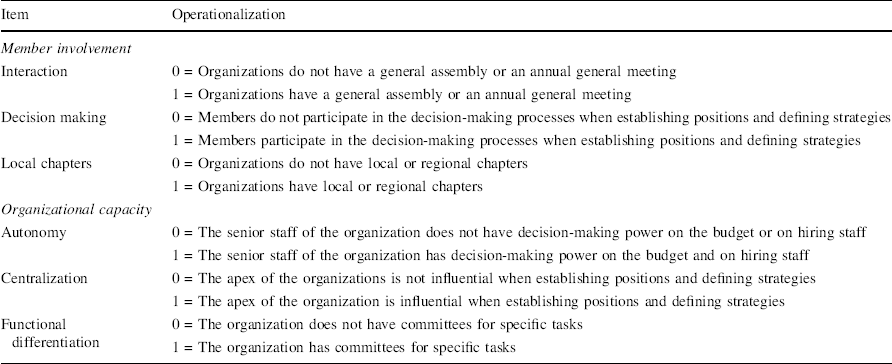
Table 1 presents the operationalization of the six items included to measure the two organizational dimensions. These variables are based on different questions of the INTEREURO Interest Groups Survey. Firstly, the presence or absence of a general assembly or an annual meeting is considered as crucial to enable the involvement of members in the work of the organization (Jordan and Maloney Reference Jordan and Maloney2007; McFarland Reference McFarland, Maisel, Berry and Edwards2010), and thus, this binary measure is intended to measure the ‘Interaction” among members and between members and CSOs’ leadership. Secondly, the measurement of ‘Decision-making’ relies on two sub-items of the questionnaire that are key for CSOs’ strategy, namely how they make decisions when (1) establishing their organization’s position on policy issues and (2) deciding on advocacy/lobbying strategies and tactics (Binderkrantz Reference Binderkrantz2009). These two items have been grouped based on the results of a principal component analysis (PCA) and confirmed by an acceptable level of a Cronbach’s alpha test of reliability (α = .700) (Field Reference Field2009, p. 675). This variable has been recoded as 1 when members are involved in the decision-making process and 0 when otherwise, thus, showing the formal decision-making capacity of members to determine the fate of the organization (Johansson and Lee Reference Johansson and Lee2014). Thirdly, ‘Local chapters’ are based on a single question aimed at identifying whether the organization has local or regional branches (Fraussen et al. Reference Fraussen, Beyers and Donas2015).
Measuring transmission belts: member involvement and organizational capacity

Item |
Operationalization |
|---|---|
Member involvement |
|
Interaction |
0 = Organizations do not have a general assembly or an annual general meeting 1 = Organizations have a general assembly or an annual general meeting |
Decision making |
0 = Members do not participate in the decision-making processes when establishing positions and defining strategies 1 = Members participate in the decision-making processes when establishing positions and defining strategies |
Local chapters |
0 = Organizations do not have local or regional chapters 1 = Organizations have local or regional chapters |
Organizational capacity |
|
Autonomy |
0 = The senior staff of the organization does not have decision-making power on the budget or on hiring staff 1 = The senior staff of the organization has decision-making power on the budget and on hiring staff |
Centralization |
0 = The apex of the organizations is not influential when establishing positions and defining strategies 1 = The apex of the organization is influential when establishing positions and defining strategies |
Functional differentiation |
0 = The organization does not have committees for specific tasks 1 = The organization has committees for specific tasks |
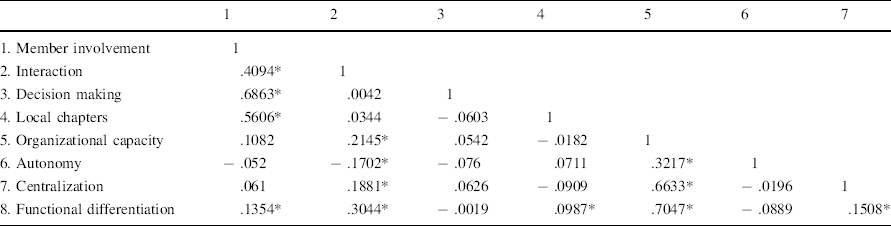
Regarding the second dimension on organizational capacity, ‘Autonomy’ reflects whether the senior staff of the organization has decision-making competences on budgetary issues and hiring staff. By focusing on operational autonomy, which indicates the capacity of the group to take human resource management decisions by itself, this variable is conceived as a powerful indicator of the ‘degree of [member] interference in the day-to-day management of the [group]’ (Bach Reference Bach2014, 345). Results have been recoded as 1 when the senior staff can decide on both issues and 0 when otherwise. ‘Centralization’ is a construct that captures whether the apex of the CSO (i.e., executive director, the chair of the board, and the board of directors) is somewhat or very influential when (1) establishing EU positions and (2) deciding on advocacy and lobbying tactics. Thus, this operationalization reflects the effective concentration of power/influence on the apex of the organization (Albers et al. Reference Albers, Wohlgezogen and Zajac2013; Damanpour Reference Damanpour1991), or in Pugh et al.’s (Reference Pugh, Hickson, Hinings, Macdonald, Turner and Lupton1963) terms, the real authority of CSOs’ apex. The variable relies on six items that have been grouped after examining the data with a PCA and estimating the reliability of the construct (α = .786). Finally, ‘Functional differentiation’ reflects whether CSOs have committees for specific tasks or not (Klüver Reference Klüver2012, p. 496). ‘Appendix 1’ presents the complete list of questions used to construct the two dimensions, and Table 4 in ‘Appendix 2’ includes a correlation matrix among the main variables.Footnote 4
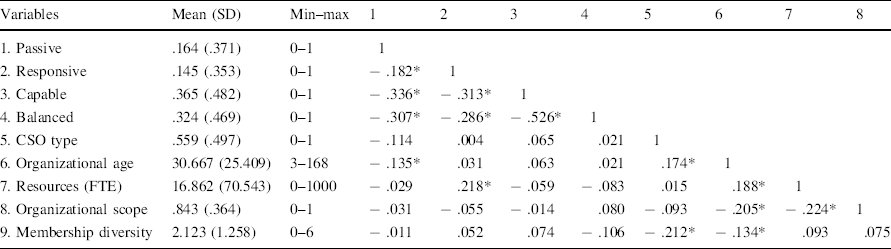
To further explore variation in the organizational forms resulting from the cluster analysis, the paper considers five basic characteristics of CSOs: type of CSO, age, resources, organizational scale, and membership diversity. Type of CSO distinguishes whether the organization is composed of business organizations (i.e., trade, business, and professional associations) or if, instead, gathers citizen organizations (i.e., non-governmental organizations, platforms, and networks and similar). Organization age indicates how old the CSO is. Resources are measured via the equivalent employees working full time in the organizations. Organizational scale indicates whether CSOs are national or a supranational association. Lastly, we include membership diversity, which captures how many different types of members has each CSO, the options being: individual members, firms, local and regional governments, national associations, and European associations (see Table 5 in ‘Appendix 2’ for descriptive statistics and correlations among variables).
Analysis
The analyses proceed in two steps. Firstly, the paper presents the results of cluster analysis to, subsequently, examines how the resulting clusters relate to basic characteristics of CSOs presented in the previous section.
A cluster analysis is conducted to examine how the constructs of member involvement and organizational capacity are distributed across CSOs. This approach offers a description of organizations by identifying organizational forms of CSOs that resemble each other along the two dimensions identified (Short et al. Reference Short, Payne and Ketchen2008, p. 1054). Hence, cluster analysis fits the purposes of the paper, namely to assess the extent to which the organizational structure of CSOs conforms to the ideal-type transmission belt and to reveal possible variations. The cluster analysis gathers CSOs into categories such that organizations in the same cluster are more alike to each other than to other clusters (Hair et al. Reference Hair, Black, Babin, Anderson and Tatham2008). More specifically, the chosen analysis is Ward’s method, a type of hierarchical clustering aimed at joining cases into clusters such that the variance within a cluster is minimized (Szekely and Rizzo Reference Szekely and Rizzo2005). This agglomerative method is appropriate when no outliers are present and when equally sized clusters are expected (Mooi and Sarstedt Reference Mooi and Sarstedt2011).Footnote 5 The number of clusters considered is based on the interpretation of the Ward’s linkage cluster dendrogram (see Fig. 1 in ‘Appendix 2’). To cross-validate this result, the same analysis has been conducted with ten subsamples (Gordon Reference Gordon, Hayashi, Yajima, Bock, Ohsumi, Tanaka and Baba1998). The resulting clusters of the subsamples have been compared to the ones obtained in the complete sample. In every case, the results of the Chi-square tests comparing the clusters of the whole sample with the ones of the subsamples are significant, confirming the validity of the findings.
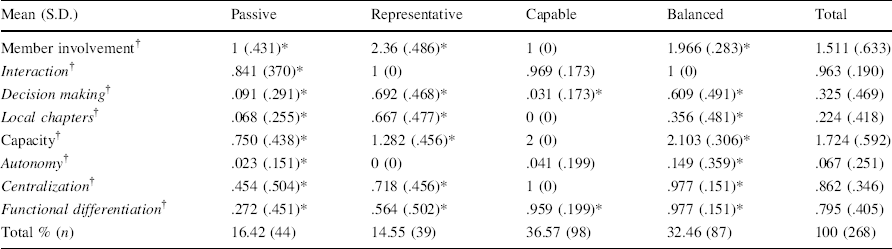
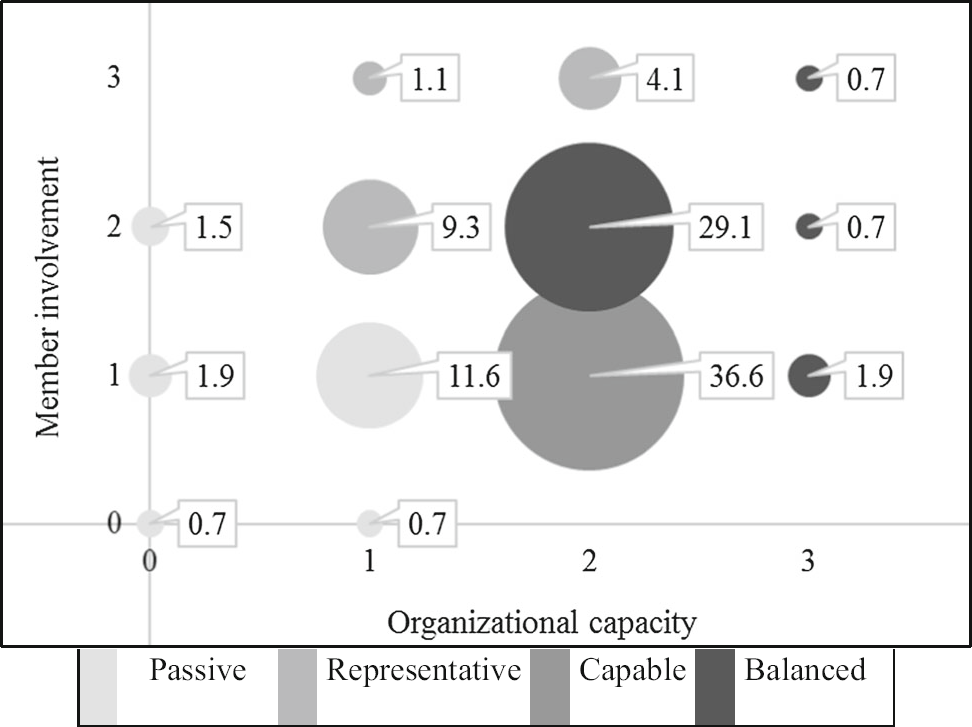
Table 2 presents the main results of the cluster analysis (see also Fig. 2 in ‘Appendix 2’). The cluster analysis generates four different combinations of the two dimensions. That is, based on the presence of the organizational features associated with involving members and having organizational capacity, the analysis discerns four different ways in which CSOs organize.Footnote 6 This finding is aligned with previous studies that highlighted organizational diversity among CSOs, even within citizen or business CSOs (Baroni et al. Reference Baroni, Carroll, William Chalmers, Marquez and Rasmussen2014; Minkoff et al. Reference Minkoff, Aisenbrey and Agnone2008). More specifically, the results show a similar pattern to what Minkoff et al. (Reference Minkoff, Aisenbrey and Agnone2008) found in the US context: There is substantial variation in the organizational structures of CSOs active at the EU level. This variation is very relevant considering the institutional pressure (DiMaggio and Powell Reference DiMaggio and Powell1983) at the EU level for organizations that function as transmission belts (European Commission 2001, 2002), or that are professionalized (Klüver and Saurugger Reference Klüver and Saurugger2013; Maloney Reference Maloney, Lowery, Halpin and Gray2015). Despite these isomorphic forces, CSOs seem to have some degree of discretion to develop the organizational structure that they believe is more appropriate for their own purposes, and not the one that is mostly demanded from public institutions.
Comparison of cluster characteristics (see footnote 6)

Mean (S.D.) |
Passive |
Representative |
Capable |
Balanced |
Total |
|---|---|---|---|---|---|
Member involvement† |
1 (.431)* |
2.36 (.486)* |
1 (0) |
1.966 (.283)* |
1.511 (.633) |
Interaction † |
.841 (370)* |
1 (0) |
.969 (.173) |
1 (0) |
.963 (.190) |
Decision making † |
.091 (.291)* |
.692 (.468)* |
.031 (.173)* |
.609 (.491)* |
.325 (.469) |
Local chapters † |
.068 (.255)* |
.667 (.477)* |
0 (0) |
.356 (.481)* |
.224 (.418) |
Capacity† |
.750 (.438)* |
1.282 (.456)* |
2 (0) |
2.103 (.306)* |
1.724 (.592) |
Autonomy † |
.023 (.151)* |
0 (0) |
.041 (.199) |
.149 (.359)* |
.067 (.251) |
Centralization † |
.454 (.504)* |
.718 (.456)* |
1 (0) |
.977 (.151)* |
.862 (.346) |
Functional differentiation † |
.272 (.451)* |
.564 (.502)* |
.959 (.199)* |
.977 (.151)* |
.795 (.405) |
Total % (n) |
16.42 (44) |
14.55 (39) |
36.57 (98) |
32.46 (87) |
100 (268) |
P values (†) indicate significance for a test of equality of a variable’s distribution among the four clusters; analysis of variance for continuous variables and Pearson Chi-square for categorical variables
P values (*) indicate significance for a test of equality of a variable’s distribution within a cluster versus the variable’s overall distribution; t statistics for continuous variables and Pearson Chi-square for categorical variables
*, †p < .05
Out of the 268 observationsFootnote 7 included in the analysis, 44 CSOs (16.42%) have an organizational structure that score low in both member involvement and organizational capacity. Consequently, organizations in this cluster are labeled as Passive. More specifically, CSOs in this cluster have a poorly developed organizational structure and can be considered as loose and weakly connected networks that invest few resources to engage with their own members or have organizational capacity.
The second cluster (i.e., named as Representative) gathers 39 CSOs (14.55%) that possess organizational features that foster member involvement, yet do not have the characteristics that are considered indicative of the capacity to generate, process, and transfer members’ preferences and information to policymakers. Hence, Representative organizations are mainly oriented toward their membership base, promoting participation and fostering the internal cohesion. These organizations are more akin to what Schmitter and Streeck termed clubs or forums, with organizational structures that facilitate interaction among members, participation in collective activities, exchange of information and expertise, and formation of a collective identity (Schmitter and Streeck Reference Schmitter and Streeck1999). The existence of such a cluster demonstrates that despite the current debate about the democratic flaws of organized interests (Halpin Reference Halpin2010; Jordan and Maloney Reference Jordan and Maloney2007), there are still some organizations that have the necessary organizational features to be internally democratic. Yet, the low percentage of Representative CSOs is surprising considering the EU’s explicit request for representative CSOs that are connected with their members (Kohler-Koch Reference Kohler-Koch2010).
The third cluster gathers 98 CSOs (36.57%) with those organizational features that are expected to foster their capacity to effectively generate, process, and transfer information to policymakers. However, as the structure to engage with members and supporters of most of the organizations in this cluster is underdeveloped, they have been labeled as Capable organizations. This finding is aligned with Halpin’s (Reference Halpin2006) observation that not all CSOs seek representation. Additionally, it speaks to the trend toward professionalization that has been identified at the EU level (Jordan and Maloney Reference Jordan and Maloney2007; Klüver and Saurugger Reference Klüver and Saurugger2013; Maloney Reference Maloney, Lowery, Halpin and Gray2015). As noted by Van Deth and Maloney (Reference Van Deth and Maloney2012), there is a gradual change in which organizations become more specialized and centralized and give less priority to organizational democracy. In this regard, organizations in this cluster are expected to be more strongly focused on policy advocacy and on the provision of expertise to policymakers. A paradigmatic example of an organization clustered as ‘Capable’ is Friends of the Earth Europe, an organization that, as Rootes (Reference Rootes, Crowson, Hilton and McKay2009, pp. 210–211) noted, was not ‘established to be responsive or accountable to members. Instead, they were founded to be ‘uninhibited campaigning’ groups and campaign effectiveness was privileged over democratic involvement.’ Intriguingly, results indicate that there are twice as many Capable groups as Representative ones. As noted, this is surprising if we consider the rhetoric of the Commission and its preference for representative groups that favor democratic participation (European Commission 2001, 2002); yet, the dominance of Capable over Representative groups is aligned with recent research assessing the representational capacity and the policy engagement of interest groups at the EU level (Berkhout et al. Reference Berkhout, Hanegraaff and Braun2017).
Finally, 87 organizations (32.46%) closely approximate the transmission belt ideal, with a high potential to link members’ preferences to policymakers (Berkhout et al. Reference Berkhout, Hanegraaff and Braun2017; Braun Reference Braun, Lowery, Halpin and Gray2015). More specifically, these CSOs are able to effectively represent their members thanks to democratic structures, and transform the preferences of their members and other organizational resources into relevant access goods for policymakers. Because of their ability to integrate both dimensions, organizations in this cluster have been labeled as Balanced. CSOs in this cluster meet the demands of the Commission for representative organizations that effectively functions as intermediaries of the public, enhancing input and output legitimacy of EU institutions (European Commission 2001; Greenwood Reference Greenwood2007; Kohler-Koch and Quittkat Reference Kohler-Koch and Quittkat2013). Additionally, the existence of this cluster demonstrates that the tensions and dilemmas associated with having both organizational dimensions are not insurmountable. That is, even though involving members and having organizational capacity are not easy or cheap (Jordan and Maloney Reference Jordan and Maloney2007), an important number of CSOs successfully combine both organizational dimensions.Footnote 8
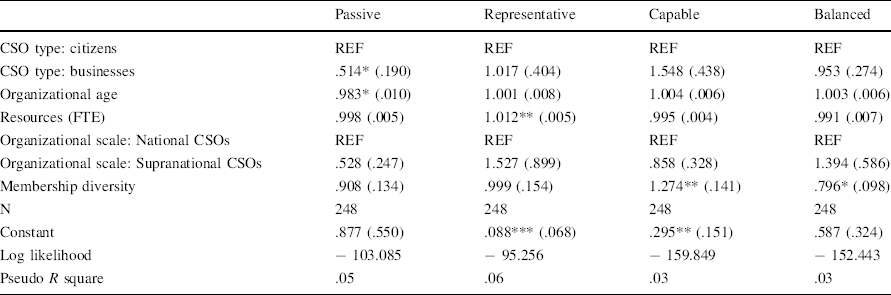
To further explore these results, this second part of the section examines the relationship between the four clusters and five basic variables of CSOs: type of organization (i.e., citizens vs. businesses), organizational age, resources, organizational scale, and membership diversity. Results in Table 3 do not present a clear linkage between CSO characteristics and the four clusters. That is, none of the five characteristics is related to the four organizational forms resulting from the cluster analysis. Yet, there are significant relationships in Table 3 that are worth discussing. Firstly, being Representative, Capable or Balanced is not significantly related to whether the CSO gathers citizen or business organizations. With the only exception of Passive organizations which are significantly associated with citizen groups, the results demonstrate that the distinction between business and citizen groups, and the assumptions linked to each of them, does not hold when considering the organizational form of CSOs (cf., Hollman Reference Hollman2017). More specifically, our findings suggest that business and citizen groups are equally capable of functioning as transmission belts (cf., Flöthe and Rasmussen Reference Flöthe and Rasmussen2018), which contradicts previous investigations that find significant relationship between being a business group and acting as transmission belt (Berkhout et al. Reference Berkhout, Hanegraaff and Braun2017). More generally, this result reinforces the applicability of this conceptualization across any type of CSOs, regardless of whether they are business or citizen organizations. Secondly, the cluster labeled as Passive gathers the youngest organizations. From an organizational perspective, Passive CSOs may be evolving toward one of the three typologies that are regarded as legitimate in the EU environment (Hannan and Freeman Reference Hannan and Freeman1977). However, an alternative explanation could be that these younger organizations use new, less-formalized, or untraditional mechanisms to communicate with their members and policymakers (cf., Fraussen and Halpin Reference Fraussen and Halpin2018). Regarding the amount of resources, it is only significantly and positively related to Representative organizations; that is, CSOs that actively involve their members require more resources in terms of staff. Intriguingly, the distinction between national and supranational CSOs does not matter for explaining their organizational form. Finally, membership diversity (i.e., whether the organizations gather more or less heterogeneous members) is significantly related to Capable and Balanced organizations, but in opposite ways. Whereas more heterogeneous CSOs tend to organize themselves as Capable organizations that hardly involve their members, homogenous CSOs tend to be organized as Balanced organizations. CSOs with higher levels of membership diversity have lower chances of investing in democratic structures, but do invest in organizational capacity. That is, CSOs with a heterogeneous membership base emphasize a top–down perspective to control their members (van der Pijl and Sminia Reference van der Pijl and Sminia2004; Williamson Reference Williamson1981). In contrast, the more homogenous the CSO, the higher the likelihood that it can be organized as a transmission belt (Berkhout Reference Berkhout2013; Kröger Reference Kröger2018). That is, having the same type of members facilitates the development of organizational structures aimed at involving members and at having the necessary organizational structures to generate, process, and transfer information to policymakers.
Logistic regressions by cluster

Passive |
Representative |
Capable |
Balanced |
|
|---|---|---|---|---|
CSO type: citizens |
REF |
REF |
REF |
REF |
CSO type: businesses |
.514* (.190) |
1.017 (.404) |
1.548 (.438) |
.953 (.274) |
Organizational age |
.983* (.010) |
1.001 (.008) |
1.004 (.006) |
1.003 (.006) |
Resources (FTE) |
.998 (.005) |
1.012** (.005) |
.995 (.004) |
.991 (.007) |
Organizational scale: National CSOs |
REF |
REF |
REF |
REF |
Organizational scale: Supranational CSOs |
.528 (.247) |
1.527 (.899) |
.858 (.328) |
1.394 (.586) |
Membership diversity |
.908 (.134) |
.999 (.154) |
1.274** (.141) |
.796* (.098) |
N |
248 |
248 |
248 |
248 |
Constant |
.877 (.550) |
.088*** (.068) |
.295** (.151) |
.587 (.324) |
Log likelihood |
− 103.085 |
− 95.256 |
− 159.849 |
− 152.443 |
Pseudo R square |
.05 |
.06 |
.03 |
.03 |
Odds ratio, standard error in parenthesis
*p < .1; **p < .05; ***p < .01
Conclusion
The capacity of CSOs to act as transmission belts is crucial to their contribution to policy processes and democracy. This paper theoretically develops and empirically assesses the organizational ability of CSOs to function as transmission belts that connect members’ preferences with policymakers. As clarified in the Introduction, the literature either considers only one side of the transmission belt coin (by focusing on engagement with members or on having organizational capacity) or refers to organizational form in very general terms (e.g., by using organizational type as proxy for certain organizational feature and practices). To move the literature forward and increase our understanding of the role of CSOs in policy-making, this paper theoretically unpacks the transmission belt notion based on the distinction of two organizational dimensions: member involvement and organizational capacity. The paper offers a fine-grained conceptualization of the constituting elements of these organizational dimensions and unites them in a new theoretical framework of organizational form to assess the capacity of CSOs to function as transmission belts. This tool can be understood as a foundation to go beyond traditional proxies and to better theorize on the role of CSOs in representative democracies. In this vein, the empirical examination of this conceptualization indicates that 32% of EU CSOs approximate the ideal-type transmission belt, as they have a balanced organizational structure with elements aimed at both involving members and having organizational capacity. This suggests that at least some CSOs indeed are able to manage the tensions related to the challenge of both listening to members and talking to policymakers. Yet, we also observe important variation concerning the organizational form, as the majority of the CSOs do not have the organizational features associated with both processes. While almost 50% of the organizations prioritize either member involvement or organizational capacity, 16% invest very little in both organizational dimensions. Hence, despite the rhetoric of the Commission and its preference for CSOs that function as transmission belts, there is significant variation in how CSOs are organized, which results in unequal capacities to function as a transmission belt.
It is worth to acknowledge a potential source of bias related to the research design and the EU-centered sample. A particularity of CSOs operating at the EU level is that they are encouraged by EU institutions to function as a transmission belt, which, from an institutionalist perspective, may lead to higher incidence of this type of organizations (cf., DiMaggio and Powell Reference DiMaggio and Powell1983). Yet, they also face a larger distance between elementary membership units and the decision-making center, which places higher organizational demands to connect members to policymakers. Therefore, the distribution of the different typologies of CSOs identified may vary across institutional settings that place different institutional and organizational pressures on CSOs organizational structure (cf., Berkhout et al. Reference Berkhout, Hanegraaff and Braun2017). Consequently, future comparative research could examine the relationship between systems of interest intermediation and the presence of CSOs operating as transmission belts. Besides, this paper has analyzed how CSOs are organized by using reported survey data that tap into key organizational elements of each dimension. Future research might build upon this conceptualization by conducting in-depth qualitative investigations to further examine the validity of the measurement and operationalization of the variables that compose each organizational dimension and to gain more insight on how transmission belts are organized. Lastly, this paper builds upon a functionalist approach to conceptualize CSOs organizational structure. Yet, as has been already noted, the data available do not allow us to know whether CSOs are deliberatively organized as they are or if instead, and despite their willingness to be organized in a certain way, they fail to set up the necessary organizational features to achieve their goals. In addition, some CSOs may have concrete organizational structures not because they serve a concrete function, but because they are the most accepted and legitimate in the EU institutional environment (DiMaggio and Powell Reference DiMaggio and Powell1983). This could explain the limited explanatory power of the main features included in the analysis of Table 3 and the higher frequency of Balanced and Capable CSOs at the EU level—which are the forms that are more frequently demanded by EU institutions (European Commission 2001, 2002; Klüver and Saurugger Reference Klüver and Saurugger2013; Maloney Reference Maloney, Lowery, Halpin and Gray2015). In that regard, future research could combine functionalist and institutionalist approaches to assess the extent to which the organizational form of CSOs rationally serves certain functions and responds to institutional and isomorphic forces (cf., Pierson Reference Pierson2000).
Returning to the role of CSOs in policy-making and democracy, the results obtained suggest that approximately one-third of CSOs operating at the EU level can contribute to the legitimacy and effectiveness of EU governance by connecting members and supporters with decision-makers (European Commission 2001, 2002). In contrast to Balanced organizations, the contribution of Representative and Capable organizations to EU governance can be questioned, or at least seems of a different nature. On the one hand, Representative organizations are relevant to foster input legitimacy and compliance with common goals because of their engagement and strong connection with members. On the other hand, Capable organizations can contribute to EU effectiveness due to their organizational capacity to be politically active. More specifically, Capable organizations can mostly contribute to EU governance with output legitimacy as well as expertise. Consequently, only a minority of CSOs are organizationally prepared to account as surrogates for the democratic deficit of the EU by fostering democratic participation and, in particular, the effectiveness and legitimacy of the policy process. That is, only Balanced organizations are organizationally prepared to contribute to different types of legitimacies and resources that are highly valued by EU institutions. In that regard, future research may also look into whether CSOs that effectively involve members and have organizational capacity are, in fact, more relevant among policymakers and thus contribute to more legitimate and effective governance systems.
Acknowledgements
I am grateful to Caelesta Braun and Bert Fraussen for their guidance, support and constructive suggestions throughout the research process. I would also like to thank all the scholars involved in the INTEREURO Interest Group Survey for granting me access to the survey data. The paper benefited from excellent comments from Darren Halpin, Michelle Hollman and the participants of the Politicologenetmaal Conference (Leiden, 1–2 June 2017). I am thankful to the journal reviewers for their helpful feedback and constructive criticism. Lastly, this research received financial support from the Netherlands Organisation for Scientific Research (Nederlandse Organisatie voor Wetenschappelijk Onderzoek (NWO)), grant 452-14-012 (Vidi scheme).
Appendix 1: Selected Questions of the INTEREURO Interest Group Survey
Member Involvement
1. Interaction
Does your organization have any of the following? Please tick all boxes that apply.
○ A general assembly or an annual general meeting
2. Decision making:
Organizations like yours can make decisions in different ways, such as consensus among individual members or board members or by voting procedures. Can you please indicate below how your organization primarily makes decisions in the following areas?

3. Local chapters:
Does your organization have any of the following? Please tick all boxes that apply.
○ Local or regional chapters
Organizational Capacity
1. Autonomy
Organizations like yours can make decisions in different ways, such as consensus among individual members or board members or by voting procedures. Can you please indicate below how your organization primarily makes decisions in the following areas?

2. Centralization
Thinking about your organization’s position on EU policies, how would you rate the relative influence of the following actors?

Thinking about your organization’s decisions on advocacy and lobbying tactics, how would you rate the relative influence of the following actors?

3. Functional differentiation:
Does your organization have any of the following? Please tick all boxes that apply.
○ Committees for specific tasks
Appendix 2
See Figs. 1, 2 and Tables 4, 5.
Dendrogram for Ward’s linkage cluster analysis

Scatter plot of CSOs by cluster (weighted by %)

Correlation matrix of organizational variables

1 |
2 |
3 |
4 |
5 |
6 |
7 |
|
|---|---|---|---|---|---|---|---|
1. Member involvement |
1 |
||||||
2. Interaction |
.4094* |
1 |
|||||
3. Decision making |
.6863* |
.0042 |
1 |
||||
4. Local chapters |
.5606* |
.0344 |
− .0603 |
1 |
|||
5. Organizational capacity |
.1082 |
.2145* |
.0542 |
− .0182 |
1 |
||
6. Autonomy |
− .052 |
− .1702* |
− .076 |
.0711 |
.3217* |
1 |
|
7. Centralization |
.061 |
.1881* |
.0626 |
− .0909 |
.6633* |
− .0196 |
1 |
8. Functional differentiation |
.1354* |
.3044* |
− .0019 |
.0987* |
.7047* |
− .0889 |
.1508* |
*p < .05
Descriptive statistics and correlation matrix of the four clusters and explanatory factors

Variables |
Mean (SD) |
Min–max |
1 |
2 |
3 |
4 |
5 |
6 |
7 |
8 |
|---|---|---|---|---|---|---|---|---|---|---|
1. Passive |
.164 (.371) |
0–1 |
1 |
|||||||
2. Responsive |
.145 (.353) |
0–1 |
− .182* |
1 |
||||||
3. Capable |
.365 (.482) |
0–1 |
− .336* |
− .313* |
1 |
|||||
4. Balanced |
.324 (.469) |
0–1 |
− .307* |
− .286* |
− .526* |
1 |
||||
5. CSO type |
.559 (.497) |
0–1 |
− .114 |
.004 |
.065 |
.021 |
1 |
|||
6. Organizational age |
30.667 (25.409) |
3–168 |
− .135* |
.031 |
.063 |
.021 |
.174* |
1 |
||
7. Resources (FTE) |
16.862 (70.543) |
0–1000 |
− .029 |
.218* |
− .059 |
− .083 |
.015 |
.188* |
1 |
|
8. Organizational scope |
.843 (.364) |
0–1 |
− .031 |
− .055 |
− .014 |
.080 |
− .093 |
− .205* |
− .224* |
1 |
9. Membership diversity |
2.123 (1.258) |
0–6 |
− .011 |
.052 |
.074 |
− .106 |
− .212* |
− .134* |
.093 |
.075 |
*p < .05


 Open access

