





Introduction
When children encounter objects in the world, they might hear adults provide many different labels for them. For example, consider the car owned by Batman. To refer to this object, adults could name it using a proper name (“Batmobile”) or they could describe it using a noun phrase (“Batman's car”). Either type of expression could be used to refer unambiguously to a single object at a particular time, raising the question of whether children understand any semantic differences between them. The current research addressed this question by examining whether children understand that a proper name, unlike a description, is an expression that applies to only one (i.e., a unique) individual.
An extensive body of research on lexical development has examined how children learn and understand proper names (e.g., Gelman & Taylor, Reference Gelman and Taylor1984; Hall, Reference Hall, Jackendoff, Bloom and Wynn1999, Reference Hall2009; Imai & Haryu, Reference Imai and Haryu2001; Macnamara, Reference Macnamara1982; Markman & Jaswal, Reference Markman, Jaswal, Hall and Waxman2004). One key theoretical question in this literature centers on whether children understand proper names differently from descriptions. This question is a source of longstanding debate. Descriptivist accounts (Frege, Reference Frege and Harnish1892; Russell, Reference Russell1905) posit that the meanings of proper names and descriptions are equivalent. In contrast, non-descriptivist accounts (e.g., Mill, Reference Mill1843/1941; see also, Kripke, Reference Kripke1980) maintain that they are not interchangeable: a proper name refers to an object as an individual without describing it, whereas a description refers to an object as something that bears a property (or properties).
If proper names and descriptions differ semantically as proposed by non-descriptivist accounts, then two predictions about lexical development follow. The first concerns re-identification: learners should understand that a proper name refers to the same object over time, even if the object experiences changes to its properties. A description, in contrast, refers to the same object only if it continues to have the property (properties) contained in the description. The second prediction pertains to the number of referents: learners should understand that a proper name used in a given context refers to only one (i.e., a unique) object, whereas a description may refer to multiple objects if the objects have the properties mentioned in the description.
Prior research has provided evidence to support the first prediction by exploring how preschoolers re-identify objects over time in conjunction with proper names and descriptions. In Hall, Waxman, Brédart and Nicolay (Reference Hall, Waxman, Brédart and Nicolay2003), 3- and 4-year-olds saw a novel creature with a particular property (he was red) and heard that the creature underwent a transformation that resulted in the loss of the property (he became green). When the experimenter labeled the original creature with a conventional proper name (“Mr. Smith”), children extended the expression to the creature following the transformation, even though the property had changed. In contrast, they did not extend an originally true description (“a red one”) to the creature. Strikingly, even when the proper name was derived from the description (“Mr. Red”), 4-year-olds extended the expression to the creature following the change, though 3-year-olds did not. Together, the results suggest that children as young as three years understand that proper names function to re-identify the same object through change even if its properties have changed, though it is not until later that they extend these expressions in a way that overlooks the descriptive content that the expressions may contain. This last point is notable because names and descriptions often have a connected history. For example, many English surnames originated as descriptions – they described people's occupations (e.g., “Smith”, “Baker”), physical features (e.g., “White”, “Small”), or parentage (e.g., “Johnson” for son of John) (Alford, Reference Alford1987).
Previous research has not, however, generated direct evidence in support of the second prediction. For example, Hall et al. (Reference Hall, Waxman, Brédart and Nicolay2003) and other researchers (e.g., Liittschwager & Markman, Reference Liittschwager and Markman1993; Sorrentino, Reference Sorrentino2001) found that young children extended a proper name to an originally labeled object after it experienced a change in a salient property rather than to a second object that looked more similar to the original object. In other studies, young children heard a novel proper name for an object and then saw it paired with a second identical-looking object; they systematically selected (e.g., Hall, Lee & Bélanger, Reference Hall, Lee and Bélanger2001) or preferentially looked at (e.g., Bélanger & Hall, Reference Bélanger and Hall2006) the original object when asked to locate a referent of the name. These results suggest that from early in development language learners understand that a proper name serves to pick out only one object, rather than any objects that have a particular property (or properties). Yet while children's behavior is consistent with this interpretation, the dependent measures used in past studies (e.g., the object chosen in a forced choice or looked at preferentially) leave open the possibility that participants believe that a proper name could refer to two objects. Prior studies also did not directly assess the number of referents children are willing to include in the extension of a description.
The current studies provide the first direct test of the prediction that children understand that a proper name refers to only one object, whereas a description may refer to multiple objects if they satisfy the description. To conduct this test, we adapted the famous “Ship-of-Theseus” puzzle, in which a ship is described as undergoing a gradual and complete part-by-part transformation in which the replacement parts look identical to the original parts (Hobbes, Reference Hobbes1672 /1913). At the end of the transformation, the ship appears unchanged but consists entirely of new parts (new-parts object). At this point, the complete set of original parts is reassembled to create a second identical-looking ship (old-parts object). This puzzle allowed us to determine directly how many objects children include in a linguistic expression's extension because it involves one object that becomes two – one that is continuous in its parts/material (old-parts object) and the other that is continuous as a whole (new-parts object). Either or both of these objects could plausibly be judged to be in the expression's extension.
Recent experimental research using this puzzle suggests that adults' judgments of how many objects fall in an expression's extension differ depending on whether the expression used to label the original object is a name or description. Marchak and Hall (Reference Marchak and Hall2019) found that when adults were asked about the extension of a name (the designating expression, “X”) to both post-transformation objects, they provided higher ratings of certainty for one object (specifically the old-parts object). In contrast, when asked about the extension of a description (“Theseus' ship”), they provided equally high ratings for both objects when they could infer or were explicitly told that both objects matched the description (were owned by Theseus). Adults' responses indicate that they extended a proper name to only one object, whereas they extended a description to as many objects as matched the description.
Do young children have the same understanding as adults about the number of referents that can be included in the extension of a proper name or a description? To answer this question, we developed a child-friendly version of the Ship-of-Theseus puzzle involving toy artifacts. In two studies, an experimenter presented participants with an object (e.g., a truck), stating that she owned it. In one condition, participants then heard the object labeled with a proper name (e.g., “This is Tommy”); in a second condition, another group of participants heard it labeled with a descriptive noun phrase (e.g., “This is my truck”). In both conditions, the experimenter subjected the object to a complete part-by-part transformation and then reassembled the original parts, creating two identical-looking objects. In both conditions, the replacement parts were described as being owned by the experimenter; thus, both post-transformation objects could be inferred to match the description. The experimenter then asked participants in both conditions to judge whether the expression they had heard at the outset applied to each of the post-transformation objects (old-parts and new-parts objects). Participants thus had the option to extend the expression to both objects, one object, or neither object.
If children understand proper names and descriptions in the same way as adults, then we expected them to extend a name (e.g., “Tommy”) to only one post-transformation object – specifically, the one made of the original parts (cf. Hall, Reference Hall1998; Marchak & Hall, Reference Marchak and Hall2017, Reference Marchak and Hall2019). In contrast, we expected participants to extend a description (e.g., “my truck”) to both post-transformation objects, because both matched the description (i.e., were composed of parts owned by the experimenter).
Further, we were interested in how children reason about descriptions embedded in the linguistic context of names, given the historical connection between names and descriptions (Alford, Reference Alford1987), and given the prior evidence that children's understanding of descriptive proper names lags behind their understanding of conventional proper names (Hall et al., Reference Hall, Waxman, Brédart and Nicolay2003). We therefore tested another group of participants in a third condition in which we converted our descriptions into names by inserting the words “named” and “called” before the ownership information (e.g., “This is named/called My Truck”). Some readers will note the similarity of this expression to the popular product called “MyPillow,” which is a name not a description. If participants were sensitive to the fact that the presence of the words “named” and “called” turned descriptions into names, we expected to observe the same pattern of results as in our conventional name condition – that is, extension to only one object. Given young children's difficulty in understanding descriptive proper names (Hall et al., Reference Hall, Waxman, Brédart and Nicolay2003), however, we expected that this pattern might emerge at a later age than in the conventional name condition.
We tested 5- to 7-year-olds, focusing on this age range for two reasons. First, prior research has established that children as young as five years can follow object transformations based on the Ship-of-Theseus puzzle (see Hall, Reference Hall1998). Second, in pilot testing, preschoolers found these transformations to be harder to follow than the shorter and simpler transformations studied in related prior research (Hall et al., Reference Hall, Waxman, Brédart and Nicolay2003). We also included a group of adults for comparison with prior work (Marchak & Hall, Reference Marchak and Hall2019).
Study 1
Method
Participants
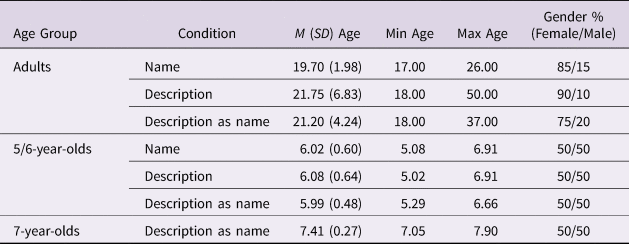
Sixty English-speaking undergraduates (M age = 20.88 years, SD = 4.78 years) received course credit for participating. Sixty English-speaking 5/6-year-olds also took part (M age = 6.03 years, SD = 0.57 years). See Table 1 in the Appendix for detailed demographic information. Participants were randomly assigned in equal numbers to the name, description, and description as name conditions. Fifteen additional adults were tested but not included in the final sample due to inattention (n = 2), experimenter error (n = 9), or a failure to accurately repeat the expressions they heard (see Procedure; n = 4 in the description as name condition). Fifteen additional children were tested but not included in the final sample due to a failure to cooperate (n = 3), experimenter error (n = 1), or a failure to accurately repeat the expressions (n = 11 total; n = 3 in the name condition; n = 8 in the description as name condition). For example, participants were excluded from the description as name condition if they mistakenly repeated the intended names as descriptions (e.g., repeated the label “My Truck” as “your truck”). This exclusion criterion allowed for a conservative test of children's understanding of descriptive names, because we included participants in the final sample only if they accurately encoded the target expression at the outset.
Materials
There were four sets of stimuli. Each set consisted of a pair of identical toy artifacts. The artifacts were each composed of three separable parts. We also used four boxes.
Procedure
Adults sat at a table in small groups across from the experimenter and provided written answers to all questions. Children were tested individually and responded to all questions verbally. Participants saw four trials, one per stimulus set, presented in a counterbalanced order. On each trial, the procedure had four phases.
1) Object introduction
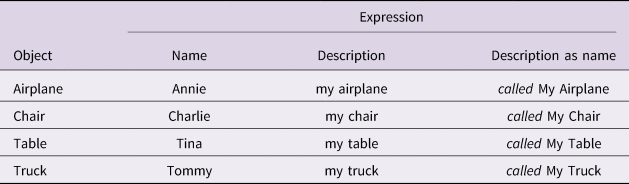
The experimenter placed one of the toys from the pair on the right side of the table and labeled the object's kind (e.g., “This is a truck”). She then stated that the object belonged to her. The remainder of the object introduction differed across conditions. See Table 2 in the Appendix for a list of objects and expressions used across conditions. In the name condition, the experimenter labeled the object with a familiar proper name (e.g., “This is Tommy”). In the description condition, the experimenter labeled the object with a possessive noun phrase (e.g., “This is my truck”). In the description as name condition, the experimenter labeled the object with a possessive noun phrase embedded in the linguistic context of a proper name (e.g., “This is called/named My Truck”). In all conditions, participants were then asked to repeat the expression that they had heard. Note that in all conditions it was equally clear that the expression referred to only one object.
2) Introduction of replacement parts
The experimenter then brought out a box containing the disassembled set of parts of the other toy in the pair (see Figure 1, Step 1). These parts were identical to the parts of the original object. The experimenter stated that the things in the box belonged to her, thus signaling that the description (e.g., “my truck”) would be true of a post-transformation object that contained the replacement parts.
Sample transformation.

3) Transformation
As participants watched, the experimenter subjected the object to a complete part-by-part transformation – essentially a live re-enactment of the Ship-of-Theseus event. The experimenter first removed a part from the original object and placed it on the left side of the table (see Figure 1, Step 2). She then withdrew the corresponding replacement part from the box and added it to the original object (see Figure 1, Step 3). She continued to remove parts from the original object and replace them with their corresponding parts until the object on the right side of the table was made entirely of replacement parts (new-parts object) (see Figure 1, Steps 4–7). She then reassembled all the original parts to create an object made entirely of original parts on the left side of the table (old-parts object) (see Figure 1, Step 8).
4) Test
Participants were asked to judge whether the expression applied to each of the post-transformation objects (old-parts and new-parts objects) independently using the expression they had heard at the outset (e.g., in the name condition, “Is this Tommy?”; in the description condition, “Is this my truck?”; and in the description as name condition, “Is this called My Truck?”). On half the trials, we asked participants whether the expression extended to the new-parts object before the old-parts object, and on the other half of the trials we reversed the order.
Results and Discussion
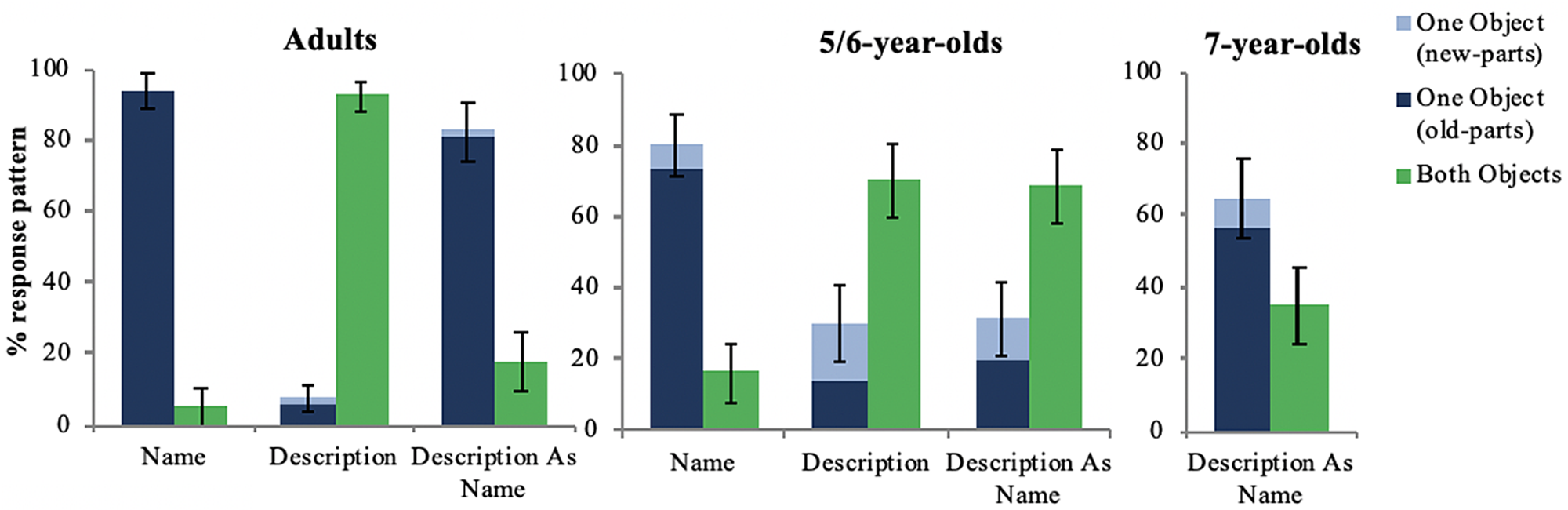
To examine how many objects participants included in an expression's extension, we coded participants' responses on each trial based on the pattern of their “yes”/“no” answers to the two questions (i.e., about the old-parts object and about the new-parts object; see Figure 2). We coded their response as “one object” if they said “yes” to only one object (either the old-parts or the new-parts object). We coded their response as “both objects” if they said “yes” to both the old-parts and the new-parts objects. Finally, we coded their response as “No Objects” if they said “no” to both objects: this response was very rare (occurring on 0.7% of trials across studies) and will not be included in subsequent analyses.
Percentage of trials in which adults and 5/6-year-olds (Study 1) and 7-year-olds (Study 2) were coded as showing “One Object” (new-parts object in light blue and old-parts object in dark blue) or “Both Objects” patterns. Error bars represent one standard error.
We submitted adults' and children's responses (“one object” = 0; “both objects” = 1) to a logistic regression model using the glmer command in the lme4 package in R. The model included linguistic expression (name = 0, description as name = 1, description = 2; between subject), age group (children = 0, adults = 1; between subject), and their interaction as predictors. We also included random effects for participant and item.
We observed main effects of linguistic expression, b = 10.88, SE = 2.58, p < .001, and age group, b = −21.68, SE = 4.89, p < .001. However, these main effects need to be interpreted within the context of a significant interaction between linguistic expression and age group, b = 10.44, SE = 3.57, p = .003. Children's and adults' responses did not differ in the name condition (Average Marginal Effect (AME) = 0.005, SE = 0.02, p = .76, 95% CI = −0.03, 0.04) or in the description condition (AME = −0.02, SE = 0.04, p = .68, 95% CI = −0.09, 0.06), suggesting that children (like adults) understood that names and descriptions differ semantically (i.e., they extended a name to only one object but a description to both objects). In the description as name condition, however, we found a difference between children's and adults' responses (AME = 0.81, SE = 0.02, p < .001, 95% CI = 0.77, 0.85): children provided significantly more “both objects” responses than adults, suggesting that 5/6-year-olds treated a description in the context of a name as a description, whereas adults treated the expression as a name.
The results of Study 1 indicate that 5/6-year-olds, like adults in prior work, interpret a name as a term that extends to only one object, but interpret a description as an expression that extends to two objects if the description is true of both. However, 5/6-year-olds did not show sensitivity to linguistic contexts (i.e., the presence of the words “named” and “called” placed before one of our descriptions) that for adults converted the description that extended to both objects into a name that extended to only one.
Study 2
To examine when in development children show sensitivity in our task to linguistic contexts that convert a description into a name, we replicated the description as name condition of Study 1 with 7-year-olds.
Method
Participants
Twenty English-speaking 7-year-olds (M age = 7.41 years, SD = 0.27 years) participated. Two additional participants were tested but not included in the final sample because of a failure to accurately repeat the expressions they heard.
Materials and Procedure
The materials and procedure were the same as in the description as name condition in Study 1.
Results and Discussion
We coded participants' responses in the same way as in Study 1 (see Figure 2). To explore how 7-year-olds treated descriptions embedded in the linguistic context of names, we compared their pattern of responses to adults' and 5/6-year-olds' responses from the description as name condition of Study 1. We submitted responses (“one object” = 0; “both objects” = 1) to a logistic regression model that included age group (5/6-year-olds = 0, 7-year-olds = 1, adults = 2; between subject) as a predictor. We also included a random effect for participant. (We omitted item as a random effect, because the estimate for the SD of the intercept was almost zero leading to issues with convergence.) We observed a main effect of age group, b = –24.04, SE = 3.33, p < .001. In post-hoc comparisons, seven-year-olds were significantly more likely than 5/6-year-olds to extend a description embedded in the context of a name to “one object” (AME = –0.72, SE = 0.01, p < .001, 95% CI = –0.74, -0.69), but they were as likely as adults to extend the expression to “one object” (AME = −0.005, SE = 0.02, p = .78, 95% CI = –0.04, 0.03). These results suggest that 7-year-olds, unlike 5/6-year-olds, treat descriptions modeled in the linguistic context of names as names, and judge them to extend to only one object.
General Discussion
Five- to 7-year-olds and adults saw a part-by-part transformation of a toy artifact after which the original parts were reassembled – an event that resulted in two objects. They then judged whether a linguistic expression given to the original object also applied to each post-change object. When the expression was a name (e.g., “Tommy”), participants usually extended it to only one post-transformation object (specifically, the old-parts object). In contrast, when the expression was a description that applied to both post-change objects (e.g., “my truck”), they typically extended it to both. The findings offer the first direct evidence that children, like adults, understand that proper names used in a given context differ from descriptions in terms of how many referents they may have: they know that a name refers to only one (i.e., a unique) object, whereas a description may refer to multiple objects if the objects have the properties in the description (Marchak & Hall, Reference Marchak and Hall2019). The results represent an important addition to prior findings indicating that children understand that proper names differ from descriptions with respect to re-identification: they know that a name refers to the same object over time, even if the object undergoes a change in its properties. A description, in contrast, refers to the same object only if the object continues to have the property (or properties) contained in the description (Hall et al., Reference Hall, Waxman, Brédart and Nicolay2003).
The findings advance our understanding of children's lexical semantic knowledge: specifically, their knowledge of the meanings of proper names and descriptions. They provide new evidence that even kindergarteners and first-graders do not represent these expressions as interchangeable, as posited by descriptivist accounts of proper names (e.g., Frege, Reference Frege and Harnish1892; Russell, Reference Russell1905). Instead, our findings lend support to non-descriptivist accounts (e.g., Mill, Reference Mill1843/1941; see also, Kripke, Reference Kripke1980): they indicate that from early in development, children, like adults, understand that a proper name refers to an object as a unique individual without describing it, whereas a description refers to an object as something that bears a property (or properties).
In this research, we focused on one particular type of description that is commonly used in conjunction with artifacts (i.e., ownership, such as “my truck”), raising the question of the generalizability of our results to other types of descriptions. Children may view ownership as a highly persistent property, and it would be interesting to explore their extensions of descriptions of properties that are more (e.g., “dirty truck”) or less (e.g., “red truck”) transient in a task like the one used in the current studies. In order to be consistent with our conclusions, the results of these further investigations should demonstrate that learners extend these descriptions to as many objects as have the property (properties).
The current studies also contribute to our knowledge of children's understanding of object persistence. Specifically, they offer new insight into the criteria that children use to make judgments about individual artifact persistence following complete part replacement. When we used a proper name in our task, participants did not choose randomly between the two post-change objects. Like adults, children favored the object made of reassembled original parts, appearing to depend on a criterion of the continuity of the parts/material, consistent with prior research (Hall, Reference Hall1998; Marchak & Hall, Reference Marchak and Hall2017, Reference Marchak and Hall2019). It would be interesting in future research to explore the generalizability of our findings to other kinds of transformations in which a single object becomes multiple objects through different causal mechanisms (e.g., a copying machine; Hood & Bloom, Reference Hood and Bloom2008).
We also observed a developmental difference in sensitivity to linguistic cues that were intended to convert descriptions into names. When the words “named” and “called” were inserted before one of our descriptions, adults and 7-year-olds tended to extend the resulting expression to only one object following the transformation, as they did when we used a conventional name. 5/6-year-olds, in contrast, extended the resulting expression to both objects, as they did when we used a description. As in previous related research (Hall et al., Reference Hall, Waxman, Brédart and Nicolay2003), the current results thus suggest that an understanding of descriptive proper names (e.g., “Mr. Red”, “My Truck”) lags behind an understanding of conventional proper names (e.g., “Mr. Smith”, “Tommy”).
It is unlikely that the observed difference between 5/6- and 7-year-olds reflects the emergence of an understanding of the words “named” or “called”, given prior evidence that even 2-year-olds can use these cues to interpret a novel word as extending to an individual object (e.g., Hall et al., Reference Hall, Lee and Bélanger2001). Instead, it seems more likely that the difference stems from a change in the salience of the property information included in the descriptions: ownership information is particularly salient for young children (see Blake & Harris, Reference Blake and Harris2011, for a review; see also Friedman & Neary, Reference Friedman and Neary2008; Friedman et al., Reference Friedman, Van de Vondervoort, Defeyter and Neary2013; Gelman, Manczak & Noles, Reference Gelman, Manczak and Noles2012; Gelman, Noles & Stilwell, Reference Gelman, Noles and Stilwell2014) and may be especially difficult for 5/6-year-olds to disregard. In contrast, 7-year-olds may have an increased ability to inhibit a response that is based on the content of the expression (see Davidson, Amso, Anderson & Diamond, Reference Davidson, Amso, Anderson and Diamond2006 for a discussion of the prolonged developmental trajectory of executive functioning). In future research, it will be important to explore other kinds of proper names derived from descriptions (e.g., those related to cleanliness or color) to document more fully the development of children's understanding of the linguistic contexts that indicate that a description should be treated as a proper name.
Acknowledgments
This research was supported by a fellowship to the first author and a grant to the second author from the Natural Sciences and Engineering Research Council of Canada.
Appendix
Descriptive Statistics: Age and Gender by Condition
Objects and Expressions Used in Studies 1 and 2



 Open access

