

1. INTRODUCTION
In recent decades, an influential school of thought in institutional economics has posited the critical role of a formal legal system in offering secure and stable property and contract rights for economic development.Footnote 1 This proposition has been described as the “Rights Hypothesis.”Footnote 2 Based on this hypothesis, a global policy discourse has emerged around certain “institutional pre-requisites” or “best practices” for development, which include a legal order designed to promote market efficiency and economic growth.Footnote 3 The notion of a “recipe” for “successful development” has largely underpinned the Washington Consensus, in which countries have been urged (and sometimes compelled) to adopt prescribed institutional reforms. The emphasis of this purported “recipe” to date has been on “constitutional guarantee for private property, a minimalist state, and the liberalisation of trade and capital flows.”Footnote 4
Meanwhile, such a “recipe” excludes certain types of legal and institutional arrangements that apparently distort the market. Notably, the argument that “laws created to protect workers often hurt them … their employment opportunities vanish”—embodied in the World Bank’s influential “Doing Business” report—has informed an efficiency-based economic case against labour laws.Footnote 5 The “best practice” associated with labour-market regulation is premised on the assertion that “more flexible labour regulations boost job creation.”Footnote 6 Although the “Doing Business” report in recent years has shown a shifting position in recognizing the necessity of employment regulation for worker protection and efficiency goals, its long-standing view has significantly influenced labour-law reforms in numerous developed and developing countries over the past two decades. As such, there have been “few more controversial ideas today than the claim that … worker-protective laws, which includes legally mandated labour standards and social security systems, contribute positively to positive growth.”Footnote 7
The “China Story” proves to be an exception to conventional claims regarding the relationship between economic and legal developments. First, the idea of transplanting laws and institutions associated with the Washington Consensus has not found robust empirical support in the world’s largest industrializing economy. There appears to be growing consensus among scholars from diverse disciplines that China’s experience of law and development over the past three decades cannot be accounted by the “Rights Hypothesis.” The purported importance of securing property rights as a prerequisite to a functioning market economy has not played out in China, which has seen tremendous economic growth largely without a “clear and strong” property-rights regimeFootnote 8 and without robust formal contract law and enforcement institutions.Footnote 9
Second, which is the focus of this paper, the state has adopted certain laws and institutions that fall within the realm of social rights to support the marketization of the Chinese economy and address the attendant risks of social instability arising from market reform. I refer to this proposition as the “Social Rights Hypothesis.” An important aspect of social rights are the rules and institutions that govern the relationship between labour and capital, particularly in countervailing the inequality of bargaining power inherent in such a relationship.Footnote 10 As I argue in this paper, labour-law rules and institutions in China have co-evolved with its labour market as part of the country’s transition to a market-oriented economy. The state has developed and refined an extensive system of formal laws and institutions to respond to a myriad of challenges in a highly complex labour market associated with growing inequality, insecurity, and instability in the context of rapid economic growth.
It is beyond the scope of this paper to delve deeply into all varieties of claims and contestations in the debates on law and development as well as those surrounding the so-called “Beijing Consensus.” In this paper, I specifically focus on the role of labour law in China’s development. The paper is structured as follows. In Section 2, I draw on insights from relevant literature to develop a “Social Rights Hypothesis.” Section 3 examines the evolution of labour laws and labour-market regulation since China embarked on its market reforms. Section 4 applies the “Social Rights Hypothesis” to analyze the market-constituting, market-correcting, and market-limiting functions of labour law in China’s transition to a market-oriented economy. Section 5 concludes.
2. THE “SOCIAL RIGHTS HYPOTHESIS”
The “Rights Hypothesis” in recent decades has seen its most influential articulation in the work of institutional economists such as Douglass North. According to North and Thomas’s analysis of European economic history, an efficient system of property rights and enforcement of contract rights was crucial to sustained economic development in capitalist countries in Western Europe.Footnote 11 Focusing on the economic development of England, North argues that the security of property rights against the Crown’s threats of arbitrary and unpredictable expropriation was essential to the development of capital markets (in securing lenders’ expectations). Furthermore, North claims that “impersonal exchange with third-party enforcement … has been the critical underpinning of successful modern economies involved in the complex contracting necessary for modern economic growth.”Footnote 12 In an often-cited empirical study that upholds the “Rights Hypothesis,” Knack and Keefer conclude that, without the security of expectations offered by strong property and contract rights, entrepreneurs would be discouraged from investment and specialization.Footnote 13
North’s work on institutions has subsequently influenced the principles of neoclassical economics as well as a vernacular of ideas relating to “rule of law” and development that have shaped the Washington Consensus.Footnote 14 These ideas have buttressed the promotion of economic deregulation and liberalization policies on the back of a purported global template of “good governance” arrangements for an efficient, well-functioning market economy. Such influence can be seen in the design of lending and structural adjustment policies and programmes of the World Bank and International Monetary Fund. Conditions for loans to developing countries often include “rule of law” reforms to protect property and contract rights, especially through formal adjudicative institutions.
To be clear, framing the debate concerning the role of legal institutions in economic development is not the same as examining the role of legal institutions in a country’s transition to a market economy. To conflate the two questions would be to regard the only path to economic development as through the market.Footnote 15 China has pursued a distinctive approach to economic development and market transition that has not followed the models of the Western economies described in North’s work. As Stiglitz points out, China’s idiosyncratic market development represents a divergence away from models based on the neoliberal framework famously associated with the Chicago School.Footnote 16
It is important to note that, in North’s later publications, he criticizes the promoters of the Washington Consensus for their erroneous thinking regarding the possibility of transplanting neoclassical economics around the world without considering the specific political, cultural, and ideological contexts.Footnote 17 North and colleagues consider the importance of different social orders as organizational foundations of development, specifically in relation to the control of violence or coercion.Footnote 18 Based on this concept, they argue that attempts to transplant institutions modelled on the experiences of industrialized economies that are open-access ordersFootnote 19 to developing countries that are limited-access ordersFootnote 20 are misguided. Such transplants (such as democracy, competitive markets, and corporate law) often fail to work and, worse, may have unintended perverse consequences on developing countries.Footnote 21 Here, North’s arguments are slightly closer to those of other critics of the Washington Consensus who reject the transplants of legal and institutional prescriptions.
There has been an increasingly prominent view in policy and academic debates that China’s experience of economic development challenges or at least problematizes the general foundations of the “Rights Hypothesis.” There has been a prevailing perception of very weak legal rules and institutions for enforcing property and contract rights in China, especially through Chinese courts. At the same time, the world’s largest industrializing country has seen tremendous economic development in the absence of an effective formal legal system of rights enforcement. Nevertheless, some advocates of the “Rights Hypothesis” may insist that China could have achieved even more growth if a stronger set of rights and institutions was in place. Another argument supporting this hypothesis is that rights are vital for development and may be enforced through other mechanisms besides courts.Footnote 22
Scholars challenging the “Rights Hypothesis” in the Chinese context have considered the role of different areas of law. Clarke reformulates the “Rights Hypothesis” by pointing out that a formal legal (judicial) system that effectively enforced contractual rights between strangers is less important than a property-rights regime that could prevent arbitrary government confiscation. The absence of the former affects “only a relatively small number of growth-enhancing transactions” compared to the latter, which “makes a very large number of growth-enhancing investments impossible.”Footnote 23 This is partly because “third-party enforcement through government coercion is not … the only effective enforcement mechanism available” and other mechanisms such as relational practices may be more effective.Footnote 24 On the other hand, Ginsburg revisits the “Rights Hypothesis” and concludes that the legal protection of property rights has not actually played a significant role in China’s “property regime.”Footnote 25 In a later study, Clarke, Murrell, and Whiting examine the role of laws and institutions relating to property, contract, and corporate governance in China and conclude that “the legal system currently plays a less important role in property rights than in agreements to trade.”Footnote 26
The predominant focus on the importance of property and contract rights in the debates on law and development (especially within a neoliberal framework) has resulted in the marginalization or sometimes denunciation of the role of social rights (including labour rights) in economic development. For example, an influential neoliberal critique of labour law posited that “during the nineteenth century, the area of labour relations was governed by a set of legal rules that spanned the law of property, contract, tort, and procedure. There was no special set of rules for labour cases as such.”Footnote 27 As Deakin points out, North hardly mentions the emergence of labour markets in his work.Footnote 28
Scholars who have sought to debunk the “Rights Hypothesis” in China have said relatively little about the role of labour laws and labour-market institutions. Kennedy and Stiglitz acknowledge that
the legal and institutional structures provide some of the most important “social protections” in modern societies. In every market economy, the particular form of these structures reflects social as well as economic considerations. This is also the case in China. Inattention to the relationship between economic opportunities and social outcomes can have terrible consequences that are difficult or impossible to correct through the political process.Footnote 29
Their edited collection of essays covering a wide range of topics on law and development in China includes three related chapters on social rights in China, namely a minimum livelihood guarantee scheme,Footnote 30 health-care spending,Footnote 31 and hukou reform and rural–urban social welfare.Footnote 32 However, the book omits any substantive analysis of the legal rules and institutions governing the labour market—a major mechanism of economic and social co-ordination in China’s development.Footnote 33
The “Social Rights Hypothesis” advanced in this paper builds on the idea that legal and regulatory arrangements to promote a wide range of social objectives contribute to economic and human development. In recent decades, there has been a broader conception of economic development and growth, namely the advancement of human capabilities in developmentFootnote 34 and the prominence of the UN’s Sustainable Development agenda. In another reformulation of the Rights Hypothesis, I apply relevant insights from this scholarship to explain how labour-law rules and institutions have co-evolved with the distinctive form of market-oriented economy pursued by Chinese policy-makers.
The proposed hypothesis considers how distributional choices are embedded in legal rules and institutions that affect equity and efficiency.Footnote 35 As Deakin puts it:
The efficiency-based case against labour law regulation … rests upon a view of markets as self-equilibrating which … is remote from the historical conditions under which labour markets emerged in industrial societies, and from the societal contexts in which they currently operate. Labour law systems embody solutions to coordination problems which are capable of promoting economic growth and development in various ways. At the same time, these solutions are based on contingent distributional compromises.Footnote 36
The “Social Rights Hypothesis” does not attempt to represent a full theoretical approach to law and development. It does not posit a causative relationship between economic and legal developments. In reformulating (and problematizing) the “Rights Hypothesis,” the proposed approach offers an alternative platform for analyzing the multifaceted functions of social rights in the context of economic development. In doing so, the “Social Rights Hypothesis” seeks to go beyond a simplistic labelling of laws and institutions as “market-supporting” or “market-distorting,” which wrongly assumes the market per se is self-equilibrating. Deakin has persuasively argued that labour-law mechanisms contribute to development in a number of ways. First, labour law has a “market-constituting” role in setting in place enabling conditions that make the labour market possible. Second, it has a “market-correcting” function—that is, correcting market outcomes that lead to negative externalities. Third, it limits the market in the interests of broader conception of individual and societal wellbeing, cohesion, and stability. Deakin acknowledges that “The possibility of tension between these approaches clearly exists, and there is no consensus on how far they can be reconciled.”Footnote 37
As I will examine in the next section, Chinese policy-makers have sought to develop a legal and institutional framework for dealing with various challenges associated with new market-based labour relations since China’s opening up. Achieving social and political stability has been a key objective of the Chinese state’s development agenda, as reflected in the commonly espoused concept of “building a harmonious society.” Widening disparities between segments of Chinese society, such as between urban and rural residents, between those from more developed and less developed areas/regions, between labour and capital, have posed greater possibilities for social conflict in the country’s transition to a market-oriented economy with “Chinese characteristics.” As this paper highlights, labour laws have helped to counteract some of the dislocating or destabilizing effects of rapid growth and development in China. It is no coincidence that the goal of improving “harmonious labour relations” has been actively promoted by the state as a crucial foundation of a “New Normal” economy.Footnote 38
In illustrating the “Social Rights Hypothesis” through the example of Chinese labour law, legal rules are understood broadly as a range of normative documents issued at various levels by legislative bodies (such as the National People’s Congress and local people’s congresses), State Council and its ministries, local governments, courts, and official state-sanctioned industrial relations actors (such as the All-China Federation of Trade Unions (ACFTU)). These rules include various “policy” documents such as circulars, notices, and guidelines issued by these actors, which may not have strict legal effect, but are considered as regulatory documents that should be complied with. Furthermore, individual and collective employment contracts are included in the scope of legal rules. Institutions are also understood in a wider sense to include a system of collective bargaining, labour inspection, and procedures for dispute resolution such as mediation, arbitration, and litigation. Some commentators have observed that “Chinese labour regulation is in many ways dispersed and fragmentary.”Footnote 39 The scope of this paper only allows a general examination of major labour-law legislation at the national/central level.
3. LABOUR LAW AND DEVELOPMENT IN CHINA
The trajectory of China’s socioeconomic development since 1979 has seen the transformation of the relationship between the state, labour, and capital. Under the centrally planned economy prior to the late 1970s, the labour regulatory system was characterized by the “three old irons.” First, there was the “iron rice bowl” of lifetime employment and cradle-to-grave social welfare provided by the state. Second, the “iron wage” referred to centrally administered and fixed wages that sought to minimize disparities within and across workplaces. Third, the “iron chair” entailed state-controlled appointments and promotion of managers, generally based on the worker’s tenure of employment and political orientation.Footnote 40
China’s shift to a market-oriented economy from the 1980s onwards entailed reforms to break the “three old irons” that were seen to be associated with low labour flexibility and productivity. This period of reform also saw the dismantling of official barriers to urban labour-market access for the rural population. At the heart of China’s industrialization and urbanization was a new labour force of hundreds of millions of rural migrant workers who moved from villages to the fast-growing cities for employment in the burgeoning private sector. A salient feature of this rural-to-urban migration was the household registration (“hukou”) system. Without a local urban hukou in the cities where they worked, rural migrant workers and their families were not entitled to reside permanently or receive a range of social benefits available to local urban hukou holders.
A key feature of labour-market reforms during this period was the creation of a legal regime based on labour contracts. The Labour Law 1994 was a major breakthrough as the first national law of its kind and formally established the system of labour contracts as the primary means for regulating labour relationships. Its provisions covered a wide range of matters, including the conclusion, variation, and termination of labour contracts, a system for minimum wages, a framework for collective consultation (the official term in the legislation to describe collective bargaining), reasonable working hours, holiday leave, labour inspection, anti-discrimination, equal pay, and a dispute-resolution framework among others.
Underlying the introduction of new legal institutions was the state’s reliance on the growth of private-sector employment as it was restructuring and downsizing state-owned enterprises (SOEs). The proportion of state-related enterprises (including SOEs, township and village enterprises, and collectives) declined from 25% of the labour force in 1996 to only 7% in 2003, with 30 million workers losing their jobs at SOEs during this period.Footnote 41 The establishment and formalization of the labour contract system have been seen by some as a decisive step by the state in “smashing the iron-rice bowl” to facilitate and accelerate economic restructuring.Footnote 42 Not only did the 1994 Labour Law provide for the use of short-term contracts as part of enhancing labour efficiency; it also legitimized the mass redundancies undertaken by SOEs. As Gallagher, Kuruvilla, and Lee have argued, “the termination of employment at the end of the contract was done using the language of the law.”Footnote 43
China’s accession to the World Trade Organization in 2001 accelerated the pace of economic restructuring, bringing with it an even more diversified and segmented labour market. Labour relations grew increasingly complex and inequalities between labour forces in urban and rural areas significantly widened. Chinese workers’ access to and enjoyment of employment and social rights and protections, in law and practice, became increasingly differentiated based on the type of labour contract they had. For many workers, the absence of a written formal contract resulted in their inability to enforce labour rights against employers.
From the mid-2000s onwards, there were significant legislative efforts targeted at enhancing labour standards and their enforcement. In 2007–08, legislators enacted the Labour Contract Law (LCL), the Law on Labour Dispute Mediation and Arbitration (LLDMA), and the Employment Promotion Law (EPL). The LCL introduced new provisions to enforce formal written labour contracts, restrict the use of fixed-term contracts, and dispatch labour, among others. The LLDMA sought to expedite official dispute-resolution procedures, extend limitation periods for workers to lodge complaints, eliminate filing fees for arbitration, and expand the scope of disputes that can be resolved through mediation and arbitration. The EPL brought in a new ground of prohibited discrimination against rural migrant workers based on their social origin. The legislation also explicitly spelt out the right of discrimination victims to bring claims before local courts and imposed liability on wrongdoing employers.
The introduction of the Social Insurance Law in 2011 was also an important worker-protective legislation. It clarified the portability of social-insurance schemes across different localities, enabling rural migrant workers to accumulate and transfer their contributions from the cities where they worked to their hukou locality. Rural migrant workers could also partake in the same social-insurance schemes as urban hukou holders. Local governments could formulate the contribution rates and the basis for calculation of such rates. The legislation also imposed hefty penalties on employers who failed to contribute various types of mandatory social insurance on their employees’ behalf.
A primary goal of the LCL has been to increase the proportion of the workforce with written labour contracts. In particular, rural migrant workers were commonly engaged without formal written contracts, which made it difficult to establish the existence of a labour relationship when they sought to claim wage arrears and other labour and social-security protections. Under the LCL, the failure of the employer to sign a written labour contract can deem the labour relationship to be an open-ended contract as well as require the employer to provide additional compensation to workers (such as the doubling of wages for each month the worker worked without a formal/written labour contract).Footnote 44
Based on a study by Gallagher and colleagues, there was a significant expansion of written labour contracts after the LCL’s enactment, especially for rural migrant workers (see Table 1). Freeman and Li’s survey on rural migrants in the Pearl River Delta also came to a similar conclusion.Footnote 45 Some studies have suggested that these workers’ conditions and benefits also improved overall after the passage of the new labour laws.Footnote 46 Others have found mixed results regarding the impact of the LCL on the coverage of written labour contracts, with divergences between regions, enterprise ownership, education levels of employees, and urban/rural migrant workers.Footnote 47
Proportion of wage workers with written labour contracts
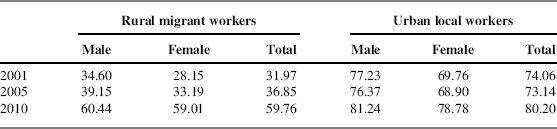
Source: Gallagher, Giles, Park, & Wang (Reference Gallagher, Giles, Park and Wang2015), p. 197.
The LCL also sought to regulate the widespread use of fixed-term labour contracts, which became a prevailing form of employment relations since the Labour Law 1994. During the restructuring of SOEs, many urban workers had their former ongoing employment converted into fixed-term contracts. Prior to the LCL, there was no restriction on the minimum length of fixed-term contracts, which provided employers with considerable freedom in using short-term contracts. Under the LCL, the worker can request the signing of an open-ended contract if she has been working continuously for the employer for ten or more years,Footnote 48 or if she has already been on two consecutive fixed-term contracts with the employer.Footnote 49
There is good evidence to suggest that the labour-law reforms in 2008 raised workers’ expectations about improvement of their wages and working conditions and enhanced access for workers to pursue their claims through formal mediation and arbitration mechanisms. Within the first 12 months of the passage of the labour laws in 2008, official statistics reported a doubling of cases accepted by labour-dispute arbitration committees from 350,182 in 2007 to 693,465 in 2008.Footnote 50 While the majority of cases involved payment of wages and social insurance, there was also a growing number concerning the signing of labour contracts, termination of employment, working hours and holiday leave, work injuries, and other issues.Footnote 51
Table 2 illustrates the growth of settled mediation and arbitration cases since the enactment of the LCL. Considerable regional differences exist in terms of the number of disputes, with a concentration of cases in localities with the highest economic growth and investment such as Guangdong, Shanghai, and Jiangsu, and increasingly in a number of fast-growing inland provincial capitals such as Shandong, Chongqing, and Sichuan.Footnote 52
Number of cases settled by official dispute-resolution mechanisms

Source: National Bureau of Statistics (2014).
An important objective of the labour-law reforms in 2008 was to channel the growing number of labour disputes through formal mechanisms of dispute resolution. As Table 3 shows, the total number of disputes brought before official channels jumped from 350,182 in 2007 to 693,000 in 2008. There was also a substantial increase in the number of collective disputes during 2007–08. A partial explanation for the decline in the number of collective disputes brought before mediation and arbitration committees from 2009 onwards is the change in the official definition of collective labour disputes from a dispute involving at least three workers to one involving at least ten workers.
Number of labour disputes brought before official channels
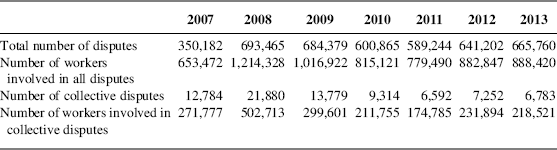
Source: National Bureau of Statistics (2014).
Overall, the above-mentioned labour-law reforms strengthened the substantive legal norms for individual workers’ rights in China. At the same time, there has been an accelerated expansion of formal institutions to promote unionization under the auspices of the ACFTU as well as collective consultation at various levels. The party-state and ACFTU have actively promoted collective consultation as a crucial mechanism for resolving collective labour disputes. It has been observed that collective disputes entailing industrial action organized by workers without the official trade unions have been on the rise.Footnote 53 Growing expectations among a new generation of younger rural migrant workers and their amplified bargaining power in the context of high labour turnovers and shortages in some sectors and geographical areas saw the rise of interests-based collective disputes. Such disputes involved demands for higher wages, improved working conditions, social insurance, and housing benefits.Footnote 54
Since the 2000s, the coverage and number of collective contracts rapidly expanded as part of a concerted push by the party-state and the ACFTU, with numerical targets set for local government and union officials. These targets have been set out in formal normative documents. For example, in 2010, the Ministry of Human Resources and Social Security, the China Enterprise Management Association, and the ACFTU issued a circular setting out specific targets of 60% and 80% in collective contract coverage in 2010 and 2011, respectively.Footnote 55 Based on ACFTU statistics, 1.9 million enterprises signed 1.1 million collective contracts in 2008, covering 150 million workers. In 2012, these figures had increased to a total of 5.79 million enterprises and 267 million workers covered by 2.24 million collective contracts.Footnote 56 There has also been important developments in collective contracts at the sectoral and regional levels, especially concerning wage issues.Footnote 57
China has quickly developed a formal regulatory framework for collective consultation within a relatively short period. Within this framework, pilot experiments in law-making and institutional building have been taking place at a local level in specific regions and sectors. For example, multi-employer and sectoral collective consultations have seen some innovative localized experimentation in recent years. Furthermore, there have been instances of “directly elected” rank-and-file worker representatives in collective consultation processes under the careful guidance and supervision of local ACFTU federations.Footnote 58 Whether such localized and ad hoc experimentation in legal and institutional arrangements can develop into more systemic changes remains uncertain. Nevertheless, these arrangements reflect the mobilization of labour laws and institutions at all levels by the party-state (and the ACFTU as a “transmission belt”) to respond to fast-evolving labour-market dynamics and challenges in different sectors and localities, and at different times of the country’s economic development.
4. AN ILLUSTRATION OF THE “SOCIAL RIGHTS HYPOTHESIS”?
The Chinese state at national/central and local levels has created, developed, and reformed a multifaceted web of labour-law rules and institutions over the past three decades. Regulatory approaches have gone beyond merely legislating for individual labour rights, to developing a repertoire of legal and institutional tools to deal with the increasing complexity of labour disputes, especially collective disputes. Far from distorting the market and harming development, labour law has played important market-constituting, market-corrective, and market-limiting roles in China’s transition to a market-oriented economy with “Chinese characteristics.”
The market-constitutive function of labour law is reflected in the creation of a labour-contracts regulatory regime in the 1990s, notably with the introduction of the Labour Law 1994. This new regime provided the legal and institutional structures that facilitated the shift from a system of state-organized personnel administration (the “three old irons”) to a system where workers are “reconceived and reorganised as individual subjects, selling their labour on a labour market.”Footnote 59 In China’s transition to a market-oriented economy, the commodification of labour was underpinned by a set of legal rules and institutions that became part of the process of constituting a labour market that operated closer to those of modern capitalist economies.
In a labour market, labour laws have also served a corrective role for various kinds of market failures. Deakin uses the example of minimum-wage regulation to address a market failure involving employers that are able to act as “monopsonists” and can depress wages below the market-clearing rate. The consequence of artificially lower wages is a reduced labour supply, as workers have fewer incentives to offer their labour. Minimum-wage laws, “by restoring wages to a level closer to the market-clearing rate, can bring a simultaneous increase in both wages and employment.”Footnote 60 This market-corrective approach may help to explain, in part, the significant increases in the statutory minimum wage by local governments across China since 2010. Acute labour shortages arose in sectors traditionally characterized by low-waged work undertaken by the rural migrant workforce. Between 2009 and 2012, rural migrant workers’ monthly real wages grew by 17.4% per year compared to a gross domestic product (GDP) growth rate of 9.2%.Footnote 61
Labour-law rules and institutions have also provided Chinese workers with access to protection against labour-market risks. Workers have resorted to formal laws and institutions to protect their rights and interests, as reflected in the growth of written labour contracts and use of official dispute-resolution mechanisms (in which workers usually won their claims) after the passage of the LCL and LLDMA. In this sense, one could argue that labour laws indeed “provide some of the most important ‘social protections’ in modern societies.”Footnote 62 This is the market-limiting function of labour law (and of a broader set of social legislation), which can constrain market outcomes where extreme and pervasive inequalities are the products of unbalanced growth. The labour-law reforms that took place in China during 2007–08 occurred in a broader macroeconomic policy backdrop of “rebalancing the economy,” after the deregulatory drive of the 1990s.
In recent years, the Chinese state has been pursuing a comprehensive “deepening reform” economic agenda, aimed at slower but more stable and sustainable development. The Chinese economy is going through a period of transition from high growth to moderate growth. China’s average annual GDP growth in the 1990s and 2000s was at 11.4% and 10.2%, respectively. Average annual GDP growth from 2010 to 2013 was at around 8.8% and has fallen to 6–7% since 2014.Footnote 63 This policy agenda involves the supply-side restructuring and upgrading of the Chinese economy, shifting the bases of growth from private investment and export-oriented, labour-intensive sectors (such as manufacturing) to domestic consumption and services sectors. Increasing household income and wage levels have been a key tenet of reform.
The “re-regulation” of the labour market in light of this “New Normal” economy comes with the goal of “building harmonious labour relations.”Footnote 64 The worker-protective direction of labour-law reforms over the past decade has represented policy-makers’ attempt to curb the socially destabilizing effects of economic growth during the 1990s and 2000s. Labour unrest has dramatically increased in number, scale, and complexity, constituting the bulk of “mass protests” in China and posing serious challenges to the party-state’s desire to maintain social stability. The expansion of collective consultation institutions represents attempts by the state to prevent and control labour conflicts associated with the actual and/or perceived widening of distributive inequality between capital and labour.
There is a concern that the espoused policy of “building harmonious labour relations” essentially entails the party-state’s attempts to inhibit the independent organization of labour. In other words, the policy seeks to ensure that labour should and could only function under the circumstances set by the party-state, namely through the auspices of the ACFTU. The ACFTU has a monopolistic representation of Chinese workers, with a long-standing role as a “transmission belt” of the party-state. This structure not only ensures that the party-state has ultimate authority over trade unions, but also controls the functions that unions are able to perform. In this sense, the “Social Rights Hypothesis” is put to the test in the case of China when assessing the role of labour law in
not just mitigating the effect of social risks, but in establishing the conditions for effective deliberation in and beyond the workplace, through support for trade unions and other autonomous worker organizations and for the principle of freedom of association in the context of collective bargaining and the right to strike.Footnote 65
Despite the significant growth in the number of collective contracts as mentioned earlier, there have been limited forms of direct involvement by workers in collective bargaining and the resolution of collective labour disputes.Footnote 66 Commentators have expressed doubt over the potential for genuine reform towards more democratic structures of worker participation and representation at the workplace. There have also been considerable regulatory constraints on activities of labour non-government organizations in recent years.Footnote 67 As Estlund argues,
The powers-that-be in China fear that, if workers were permitted to organize themselves autonomously, they would pose a significant threat to the stability of the political-economic status quo. That fear puts sharp limits on the liberalization of collective labour activity and the democratization of the official union.Footnote 68
The above discussion of China’s distinctive collective-consultation/bargaining institutions and regulatory framework highlights the need to consider the “Social Rights Hypothesis” in each country’s political and economic contexts. One could argue that China may not feel the same competitive pressures that have propelled other developing countries to adopt the policy prescriptions of the Washington Consensus. As mentioned earlier, a manifestation of the Washington Consensus is the World Bank’s Doing Business project, which includes an annual index that evaluates and benchmarks different countries’ business regulations. A higher ranking generally indicates a more conducive regulatory environment for starting and operating a business in a particular country. Under the Index, China has been ranked 78 out of 190 economies in 2016, 2017, and 2018.Footnote 69 This relatively low ranking for the world’s second largest economy does not seem to have “pressured” the party-state to adopt the types of policies associated with the Washington Consensus. As the analysis in this paper has shown, reforms to Chinese labour laws and labour-market regulations over the past decade have pointed to a divergent trajectory.
At the same time, China’s labour-law regime has reflected the influence of international standards, such as those of the International Labour Organisation (ILO). As I have argued elsewhere, the promotion of the ILO’s Fundamental Principles and Rights at Work (which include freedom of association and the effective recognition of the right to collective bargaining, the elimination of forced labour, the abolition of child labour, and the elimination of employment discrimination) can contribute to more sustainable growth and development in China.Footnote 70 More systematic reforms to labour-market institutions will be needed to deal with the challenges of increasingly complex labour relations in China, especially reforms that will better enable the ACFTU to provide a meaningful voice for workers and effectively represent their interests.
5. CONCLUSION
Far from advocating certain “best practices” for development, the “Social Rights Hypothesis” seeks to offer a useful analytical framework to consider the role of legal and institutional arrangements that address social objectives in the course of a country’s economic development, while taking into account local institutional and contextual factors that affect the design of such arrangements. In this paper, I have sought to show how labour law has played various important roles in the emergence of a complex, modern labour market as China shifts to a market-oriented economy. Such analysis challenges a conventional view based on the Washington Consensus that labour laws and regulations distort markets and impair growth and development. Economic restructuring and reform in recent times have signalled the Chinese state’s goal of achieving more “balanced” growth and development. At the same time, labour-law rules and institutions with “Chinese characteristics” will continue to evolve with the “New Normal” and the goal of “harmonious labour relations” will remain ever so important for the party-state. It is hoped that the proposed “Social Rights Hypothesis” can provide a tentative foundation for future empirical research to understand the theoretical and practical implications of social protections for debates on law and development in China and elsewhere.



