





Introduction
Although working outside of the formal legal sector, organizational and professional actors such as managers, consultants, and doctors, among others, play a critical role in the interpretation, implementation, and construction of law on the ground (Edelman et al. Reference Edelman, Erlanger and Lande1993; Kirkland et al. Reference Kirkland, Talesh and Perone2021; Talesh and Pélisse Reference Talesh, Pélisse and Sarat2019). Daily, these “legal intermediaries” (Talesh and Pélisse Reference Talesh, Pélisse and Sarat2019) deal with legal categories, rules, and guidelines. Like scholarship on street-level bureaucrats (Lipsky Reference Lipsky1980) and the devolution of immigration policy (Varsanyi et al. Reference Varsanyi, Lewis, Provine and Decker2012), research on legal intermediaries examines the role of discretion in how people enact and experience policy (Billows et al. Reference Billows, Buchter, Pélisse and Sarat2019). However, while the street-level bureaucrats and immigration literatures focus on the decisions of frontline state actors implementing policy, the legal intermediaries perspective emphasizes how nonlegal actors help individuals – and, crucially, organizations – interpret, contest, and comply with legal rules. In doing so, they shape the meaning of law and legal categories at the organizational level, not just through individual, case-by-case discretion. For example, sociolegal scholars have documented the ability of the U.S. Equal Employment Opportunity Commission to expand the interpretation of sex discrimination law so that it encompasses discrimination based on gender identity (Baumle et al. Reference Baumle, Steven Boutcher and Tomaskovic-Devey2024); of consultants to narrow the meaning of discrimination such that it aligns with managerial goals (Edelman et al. Reference Edelman, Fuller and Mara-Drita2001); and of health professionals to challenge prevailing interpretations of “medical necessity” to ensure that the needs of individuals who identify as transgender or nonbinary are included in insurance coverage (Kirkland et al. Reference Kirkland, Talesh and Perone2021). In the process, different social actors across varying contexts advance competing interpretations of law and alter the way it is understood at their respective organizations. Indeed, ambiguity in legal terminology and procedures – a characteristic intrinsic to law (Grattet and Jenness Reference Grattet and Jenness2005) – often creates opportunities for legal intermediaries to interpret and contest what does or does not fall within the scope of law (Talesh and Pélisse Reference Talesh, Pélisse and Sarat2019). Thus, understanding the role of legal intermediaries has important implications for longstanding debates among law and society scholars concerning law’s ability to address social inequalities in access, opportunities, or resources (Rosenberg Reference Rosenberg1991; Sarat and Scheingold Reference Sarat and Scheingold1998).
Despite significant advances in the study of legal intermediaries, scholars have devoted less attention to immigration intermediaries, even as immigration law is marked by ambiguity, uncertainty, and broad discretionary authority, thereby constituting a highly complex and multi-layered landscape shaped by overlapping federal, state, local, and institutional policies. Lawyers representing immigrants must navigate these legal uncertainties, often relying on narratives of “clean” victimhood (Lakhani Reference Lakhani2013) or recasting their clients’ suffering as “humanitarian capital” (Galli Reference Galli2020). The categories within immigration law are themselves ambiguous: forms of legal protection such as Deferred Action for Childhood Arrivals (DACA) and Temporary Protective Status (TPS), profoundly shape immigrants’ everyday lives (Abrego and Lakhani Reference Abrego and Lakhani2015; Menjívar Reference Menjívar2006), yet are acted upon in inconsistent and sometimes contradictory ways by immigration officers (Zatz and Rodriguez Reference Zatz and Rodriguez2014).Footnote 1 These patterns point to a legal landscape in which uncertainty and discretion circulate widely. Beyond the discretion exercised by formal legal actors, however, across the federal, state, local, and institutional levels, a wide range of social actors are now implicated in the interpretation, enforcement, and ultimately the effects of U.S. immigration law (Valdivia Reference Valdivia2026). This includes police officers (Armenta Reference Armenta2012), landlords (Pham Reference Pham2007), employers (Gleeson and Griffith Reference Gleeson and Griffith2021), admissions officers (Briceno Mosquera Reference Briceno Mosquera2024), and staff members at community-based (Young et al. Reference Young, Tafolla and Perez-Lua2023) and faith-based organizations (Longazel Reference Longazel2018). A legal intermediaries framework can deepen our understanding of how nonlegal actors not only affect the individual experiences of immigrants but also more broadly shape the way (il)legality is understood across institutional and organizational contexts.
The growing ambiguity, uncertainty, and discretionary implementation of immigration policies create significant barriers for undocumented students pursuing higher education (see, e.g., Aranda et al. Reference Aranda, Vaquera, Castañeda and Rosas2023). Without legal status, these students are unable to legally work or receive federal financial aid (Clark-Ibañez Reference Clark-Ibañez2015; Gonzales Reference Gonzales2015).Footnote 2 Moreover, place increasingly matters: depending on the state in which students reside, they may have access to in-state tuition rates and state financial aid (Abrego Reference Abrego2008), face heightened restrictions on enrollment, or even be barred from attending public universities altogether (Roth Reference Roth2017). Undocumented students also contend with mounting fear, uncertainty, and stress over their future and family’s safety (Gonzales Reference Gonzales2015; Valdivia Reference Valdivia, Abrego and Negrón-Gonzalez2020). At the same time, there has been significant organizing on the part of undocumented students to advocate for greater resources and support both on- and off-campus (Cisneros and Valdivia Reference Cisneros and Valdivian.d.; Escudero Reference Escudero2020; Negrón-Gonzales Reference Negrón-Gonzales2013). In response, some colleges and universities have created Undocumented Student Resource Centers (USRCs) staffed with employees to help students navigate financial aid, academics, basic needs, and legal services, among other issues that students face (Cisneros and Valdivia Reference Cisneros and Valdivia2020; Cisneros et al. Reference Cisneros, Valdivia, Rivarola and Russell2022; Salazar et al. Reference Salazar, Puig, Rojas and Zúñiga2024). Taken together, these conditions pose an important and increasingly pertinent question, namely, to what extent can universities mitigate the effects of illegality, particularly given the profound role that place plays in structuring students’ academic experiences? Relatedly, how do higher education professionals shape institutional understandings and constructions of (il)legality through their everyday practices?
Despite great advances in the literature to understand the role of USRC staff and others who work closely with undocumented students (Cisneros and Valdivia Reference Cisneros and Valdivia2020; Cisneros et al. Reference Cisneros, Valdivia, Rivarola and Russell2022; Salazar et al. Reference Salazar, Puig, Rojas and Zúñiga2024), there remains a need for further exploration of how staff can mitigate the impacts of legal restrictions within organizational contexts as a means of facilitating students’ access to education despite their legal status. This inquiry is particularly important at a time when the landscape is rapidly changing across the federal, state, local, and institutional levels through the devolution of immigration law (Gulasekaram and Ramakrishnan Reference Gulasekaram and Ramakrishnan2015; Motomura Reference Motomura1999; Spiro Reference Spiro1997; Valdivia Reference Valdivia2026; Varsanyi et al. Reference Varsanyi, Lewis, Provine and Decker2012; Young et al. Reference Young, Tafolla and Perez-Lua2023), leading to varying “nested contexts of reception” (Golash-Boza and Valdez Reference Golash-Boza and Valdez2018). The work of higher education professionals serving undocumented students presents a unique opportunity to examine how legal intermediaries impact law and its social consequences – in this case, the extent to which immigration law restricts college students’ educational access and opportunity – in a rapidly changing legal landscape. Bridging the work of sociolegal, organizational, and immigration scholars, we situate the work of higher education professionals as a prime example of legal intermediation.
Drawing on 52 in-depth interviews with staff members who work in the realm of undocumented student support services and basic needs, we find that staff often work within the boundaries of immigration law – identifying areas for change and adopting flexible and dynamic approaches to law – to create distinct opportunities for undocumented college students that do not necessitate legal status or work authorization to promote their well-being and overall success. Officials construct compliance with federal law in relation to their institutional or professional commitments, often characterizing these efforts as “creative solutions” or “workarounds.” These are terms that staff organically employed to refer to the set of opportunities that would otherwise remain inaccessible to segments of the student population due to legal constraints. This article examines the “creative solutions process” that staff undertake at the intersection of U.S. immigration law and the higher education context, with particular attention to undocumented college students. While these solutions are legally permissible, they necessitate the initiative of legal intermediaries to navigate and construct opportunities within ambiguous or underdefined areas of the law in a series of several steps, including developing an understanding of one’s legal context and professional goals, implementing and troubleshooting solutions, raising awareness and mobilizing support across and beyond the institution, and institutionalizing workarounds. As staff mitigate the effects of illegality on students, they more broadly shape the way (il)legality is understood at their respective institutions. In the process, staff are hindered or aided by dynamic and contextual factors, including the position of their campus leaders on immigration, the funding and resources at their disposal, and the perspectives of campus legal counsel.
Our findings have several implications for theory and practice. We use the legal intermediaries perspective to expand our understanding of how nonlegal actors – particularly those working in the context of U.S. immigration law and higher education – can mitigate the effects of restrictive immigration law, thereby aiding undocumented students’ access to educational opportunities. We examine how school personnel not only exercise discretion and creativity within their professional domain – a point well-documented by others employing Lipsky’s (Reference Lipsky1980) concept of street-level bureaucrats in the context of undocumented students (see, e.g., Briceno Mosquera Reference Briceno Mosquera2024; Lauby and Ross Reference Lauby and Ross2022) – but more broadly drive social change. More specifically, staff develop new policies, norms, and constructions of compliance within their respective organizations and broader “organizational fields” (as conceptualized by DiMaggio and Powell Reference DiMaggio and Powell1983), and in the process shape institutional interpretations of (il)legality. We thus analyze how staff members facilitate social change both by addressing the academic opportunities and well-being of individual immigrant students and by advancing campus-wide policies and procedures that alter the institutional meaning of (il)legality. By conceptualizing staff as legal intermediaries (Talesh and Pélisse Reference Talesh, Pélisse and Sarat2019) and attending to the organizational construction of law, we highlight their ability to transform how institutions understand (il)legality in ways that are expansive and longer-lasting – impacting both individual students and the greater immigrant student population, including future generations – particularly when creative solutions become institutionalized.
Through our analysis, we also advance the legal intermediaries literature by identifying and examining creative solutions as a novel process of legal meaning-making within organizations. This theoretical tool can be applied in other contexts to understand how nonlegal actors not only create and codify opportunities for segments of the population that would otherwise remain inaccessible due to the constraints of the law but also actively generate forms of compliance that align these opportunities with existing legal frameworks. As we delineate the steps through which legal intermediaries pursue creative solutions, we further extend the literature by adding new processes and mechanisms through which nonlegal actors construct legality within their institutional setting. This includes insight into the opportunities and barriers legal intermediaries encounter in their efforts.
How nonlegal actors exercise discretion and moral commitments
Actors responsible for implementing law and policy exercise discretion as they apply various moral commitments, professional norms, or institutional logics to formal rules (Binder Reference Binder2007; Chiarello Reference Chiarello2013, Reference Chiarello2015; Lipsky Reference Lipsky1980; Marrow Reference Marrow2009; Maynard-Moody and Musheno Reference Maynard-Moody and Musheno2003; Shiff Reference Shiff2021; Silver Reference Silver2018). Though such practices can undermine law’s attempts to mitigate inequalities (Albiston Reference Albiston2005; Edelman Reference Edelman2016; Marshall Reference Marshall2005), these actors can also extend protection or services through their interpretation and application of law. Efforts to extend support are likely when actors understand their professional missions to be service-oriented or client-centered (Bell and Smith Reference Bell and Smith2022; Marrow Reference Marrow2009), or when they understand these clients as worthy of assistance (Crawford et al. Reference Crawford, Aguayo and Valle2019; Shiff Reference Shiff2021). Indeed, Shiff (Reference Shiff2021) notes that the “discordance” between formal policies and subjective perceptions of worthiness or professional aims can “promp[t] creative and morally conscious bureaucratic action” (Shiff Reference Shiff2021: 341). In the immigration context, educators and administrators may draw on perceptions of education as a public good to serve, empower, or advocate for immigrant students, even amid hostile legal or political contexts (Bell and Smith Reference Bell and Smith2022; Crawford et al. Reference Crawford, Aguayo and Valle2019; Jones-Correa).
Much of the scholarship on street-level bureaucrats analyzes actors’ decision-making based on their discretion, noting their individual efforts to interpret and flexibly apply law within their domain of professional responsibility. For example, educators and school counselors may directly transmit resources to students based on their legal and subjective evaluations (Lauby and Ross Reference Lauby and Ross2022; Stanton-Salazar Reference Stanton-Salazar2011). Beyond education, asylum officials creatively draft evaluations of applicants to extend legal provisions to applicants they deem morally worthy (Shiff Reference Shiff2021). Despite these important accounts, this literature attends less to how nonlegal actors advance their own problem-solving to change the rules and norms of their organization, or more broadly, their organizational field (DiMaggio and Powell Reference DiMaggio and Powell1983).
We adopt the legal intermediaries perspective to better understand how higher education professionals draw on moral and legal understandings of undocumented students’ experiences to creatively respond to U.S. immigration law in the higher education context, as well as how they navigate organizational resources and constraints when seeking to change university policies and practices. As nonlegal actors who “affect, control or monitor how legal rules are interpreted, implemented, or constructed once they are passed by public legal institutions,” legal intermediaries also work as street-level bureaucrats or frontline workers (Talesh and Pélisse Reference Talesh, Pélisse and Sarat2019: 113; Billows et al. Reference Billows, Buchter, Pélisse and Sarat2019; Pélisse Reference Pélisse and Sarat2019). Nevertheless, while these actors do much of the same work, the legal intermediary perspective emphasizes how everyday legal interpretation transforms the meaning of legality (and, as we also consider, illegality) within and across organizations. As Talesh and Pélisse (Reference Talesh, Pélisse and Sarat2019) distinguish, “unlike street-level bureaucrats that use their discretion to implement policy on the ground, the intermediaries we examine are actually shaping the content and meaning of law among public legal institutions and in organizational domains” (Talesh and Pélisse Reference Talesh, Pélisse and Sarat2019: 138, emphasis added). Following this perspective’s emphasis on the organizational context, we examine how higher education professionals not only navigate understandings of law, their professional missions, and students’ worth within the work of their offices, but also how they seek to alter their organizations’ policies and practices – and in the process shape how (il)legality is understood in the broader institutional context. This effort includes both spreading awareness and mobilizing allies, as well as formally implementing new policies and programs.
Given their central role in constituting, circumscribing, or expanding legal meaning, Talesh and Pélisse (Reference Talesh, Pélisse and Sarat2019) argue that legal intermediaries condition the ability of law to create social change in that they can “provid[e] concrete resources such as jobs, health care, and education to marginalized people, and […] transform individual and collective identities and assumptions in society” (Talesh and Pélisse Reference Talesh, Pélisse and Sarat2019: 114, referencing Kostiner Reference Kostiner2003). Though scholars have documented instances in which legal intermediaries interpret law such that it provides greater resources (by, for example, expanding legal categories (e.g., Kirkland et al. Reference Kirkland, Talesh and Perone2021) or favoring individual access over organizational protection (Talesh Reference Talesh2015a)), research primarily explores how intermediaries impede law’s ability to address inequalities based on race/ethnicity, class, or gender (e.g., Dobbin and Kelly Reference Dobbin and Kelly2007; Edelman Reference Edelman1992; Edelman et al. Reference Edelman, Fuller and Mara-Drita2001; Huising and Silbey Reference Huising and Silbey2013; Talesh Reference Talesh2015b).
Multiple factors shape how legal intermediaries interpret and implement law, thereby influencing the extent to which their definitions drive change. Beyond intermediaries’ own legal understandings (Talesh and Pélisse Reference Pélisse and Sarat2019), organizational and field-level dynamics also affect their capacity to advance particular interpretations and alter legal meaning (Pélisse Reference Pélisse and Sarat2019: 5). Inside the organization, informal micro-politics shape legal construction (Billows et al. Reference Billows, Buchter, Pélisse and Sarat2019: 4; Pélisse Reference Pélisse and Sarat2019), including intermediaries’ status and amount of power within the organization. Huising and Silbey (Reference Huising and Silbey2013) indicate that particularly powerful intermediaries not only have an outsized role in promoting their interpretation of regulation, but that these interpretations are often self-interested rather than protective. When intermediaries do not have particularly influential positions, they can improve their leverage by collaborating with others in their organization. Kellogg (Reference Kellogg2009), for example, finds that collaborative efforts between middle managers and beneficiaries in hospitals allow actors to promote organizational change. Conflict, rather than collaboration, also informs the process of intermediation. As Surubaru (Reference Surubaru and Sarat2019) indicates, organizational complexity can promote diverse opinions among intermediaries about how to respond to regulation. Scholars also highlight the influence of field-based logics and resources on legal construction (Talesh and Pélisse Reference Talesh, Pélisse and Sarat2019: 114). Legal approaches reach intermediaries through professional associations and journals in one’s field. Indeed, in confronting ambiguous law, intermediaries can turn to advice shared in journals, conferences, or by consultants (Dobbin and Kelly Reference Dobbin and Kelly2007; Edelman Reference Edelman2016; Edelman et al. Reference Edelman, Fuller and Mara-Drita2001).
This article documents a novel process through which legal intermediaries impact law: pursuing “creative solutions” or “workarounds” that mitigate the legal restrictions that undocumented students face by constructing compliance according to their professional commitments to students’ well-being and academic trajectories. Importantly, these practices also point toward broader processes of social change. As workarounds become routinized, shared across professional networks, and embedded in institutional policies and practices, they can evolve from ad hoc responses into durable supports. In this way, the efforts of staff not only address immediate constraints but also contribute to the gradual institutionalization of more inclusive frameworks – potentially helping ensure that future generations of undocumented students can access opportunities. We document how higher education professionals develop, mobilize, and eventually institutionalize campus policies that alter the organizational understanding and treatment of illegality in relation to immigrant students. Amid a complex, rapidly evolving, and increasingly punitive immigration landscape, these efforts bolster undocumented students’ access to opportunities and services. As we delineate the micro-processes and organizational barriers involved in the interpretation of (il)legality at the institutional level, we refine and extend knowledge about how legal intermediaries construct legal compliance in line with their personal commitments and organizational contexts.
Understanding the role of legal and nonlegal actors in the context of immigration federalism
Scholars have examined how various actors have become implicated in the process of enforcing U.S. immigration law on the ground (see, e.g., Lewis et al. Reference Lewis, Provine, Varsanyi and Decker2013; Pham Reference Pham2007; Valdivia Reference Valdivia2026). This includes both legal actors such as immigration judges (Asad Reference Asad2019), agents (Vega Reference Vega2025), and police officers (Armenta and Alvarez Reference Armenta and Alvarez2017), and nonlegal actors like employers (Gomberg-Muñoz and Nussbaum-Barberena Reference Gomberg-Munoz and Nussbaum-Barberena2011) and landlords (Pham Reference Pham2007). Yet less is known about how higher education professionals who work closely with undocumented students interpret and work around legal restrictions in ways that simultaneously shape students’ educational opportunities, institutional practices, and broader understandings of (il)legality within organizational contexts. Moreover, while there are studies on the experiences of USRC staff (Cisneros and Valdivia Reference Cisneros and Valdivia2020; Cisneros et al. Reference Cisneros, Valdivia, Rivarola and Russell2022; Salazar et al. Reference Salazar, Puig, Rojas and Zúñiga2024), little is known about how these actors (and others working in similar positions) can mitigate the impact of illegality on educational equality at their respective institutions and in their organizational field more broadly.
Context is crucial to understanding the role of higher education professionals who work directly with undocumented college students, including the ambiguities or underdefined areas of the law that might allow them to shape the effects and understandings of illegality at their respective institutions. To this end, we draw on a related body of literature on immigration federalism, which charts the devolution of immigration law from the federal government onto states and cities (Gulasekaram and Ramakrishnan Reference Gulasekaram and Ramakrishnan2015; Motomura Reference Motomura1999; Spiro Reference Spiro1997), and on contexts of incorporation and exclusion, which examines the interplay between the federal, state, local, and institutional levels in shaping immigrants’ experiences (Golash-Boza and Valdez Reference Golash-Boza and Valdez2018; Marrow Reference Marrow2005; Silver Reference Silver2018; Valdivia Reference Valdivia2026).
Indeed, undocumented students and staff members alike must contend with a rapidly changing, and often contradictory, landscape of U.S. immigration law. This is in large part because policies such as the Illegal Immigration Reform and Immigrant Responsibility Act and the Personal Responsibility and Work Opportunity Reconciliation Act enabled states and cities to enforce matters of immigration law and to expand or restrict noncitizen’s access to benefits and opportunities (Armenta Reference Armenta2012). With respect to higher education, states such as California provide eligible undocumented students access to in-state tuition rates and state financial aid (Abrego Reference Abrego2008; Ngo and Hinojosa Reference Ngo and Hinojosa2022). In sharp contrast, states like South Carolina bar undocumented students from its public colleges and universities (Roth Reference Roth2017). Other states such as Florida have more recently rescinded in-state tuition benefits to undocumented students (Weissman Reference Weissman2025). This poses a significant challenge for students who must not only keep up to date with policy changes and determine eligibility but must also identify trustworthy and knowledgeable institutional actors who can assist them (see, e.g., Gonzales Reference Gonzales2015; Patler Reference Patler2018; Valdivia Reference Valdivia2026). Moreover, the process of determining one’s eligibility can be made particularly burdensome and complicated at the institutional level. This process can also become imbued with a sense of shame and anxiety, as admissions officers impose their own interpretations of the kinds of evidence that are necessary, misinform students about the process, or abstain from serving undocumented students altogether (Briceno Mosquera Reference Briceno Mosquera2024; Castrellón Reference Castrellón2021; Nienhusser et al. Reference Nienhusser, Vega and Carquin2016). Among staff working with undocumented students (in both the K-12 and higher education settings), there is a wide range of views and practices – from those who are highly supportive, act as advocates, and create opportunities, to those who are reluctant to help or hold anti-immigrant views (Luedke and Corral Reference Luedke and Corral2021; Silver Reference Silver2018; Valdivia and Clark-Ibañez Reference Valdivia and Clark-Ibañez2018).
While there are clear and firm laws barring undocumented students from certain opportunities at the federal and state levels, the effects of illegality on undocumented students can vary widely depending on the city they live in and the institution they are enrolled in (see, e.g., Garcia Reference Garcia2019; Golash-Boza and Valdez Reference Golash-Boza and Valdez2018). This is in part because institutional support for undocumented students (or the lack thereof) varies significantly across the country. Some campuses may have a center dedicated to serving immigration-impacted students (Cisneros and Valdivia Reference Cisneros and Valdivian.d.), others may just have one paid staff, or none. In a similar vein, there are programs specifically tailored to undocumented students. Such types of support may also be accompanied by public statements from institutional leadership (Vega Reference Vega2011).
It is in this landscape of varying federal, state, and local laws, and institutional practices, that staff members who serve undocumented students may work within legal boundaries to create new institutional guidelines or opportunities to provide experiences similar to those available to students who are U.S. citizens. For example, students who do not have legal authorization cannot legally work (Clark-Ibañez Reference Clark-Ibañez2015; Gonzales Reference Gonzales2015). This prevents them from earning a stable source of income and obtaining professional experience (Abrego and Gonzales Reference Abrego and Gonzales2010). Nevertheless, some staff members have implemented non-employment-based opportunities (NEBOs) or paid fellowships, which are different means to the same outcome: funding and professional experience.Footnote 3 Fellowships, in particular, are distinct from formal employment in that there is an advisee-advisor relationship (as opposed to that of employee-employer), they are often project-based (as opposed to requiring a number of set hours), and the individual maintains a high degree of independence (as opposed to being highly supervised).Footnote 4 Staff members may draw on recommendations from advocacy organizations or their colleagues at peer institutions to advance more flexible and supportive interpretations of the law in other areas, including that of independent contracting.Footnote 5
Nonlegal actors ultimately operate within a rapidly changing and highly ambiguous landscape, where the boundaries between legality and illegality, citizenship and non-citizenship, documentation and lack thereof, and moral categories of the “good” and “bad” are increasingly blurred.Footnote 6 Within this context, they are tasked with advising students about their educational opportunities amid uncertainty and constraint. As Silver (Reference Silver2018) demonstrates, even students who benefit from forms of liminal inclusion, such as DACA or TPS (see also, e.g., Menjívar Reference Menjívar2006), face persistent barriers to higher education. Although these programs provide limited legal protection and temporary access to work authorization, they do not confer full membership or consistent access to public benefits (see also, e.g., Roth Reference Roth2019). This ambiguity becomes especially evident in the realm of higher education, where federal recognition of lawful presence under DACA or TPS does not necessarily translate into eligibility for in-state tuition or financial aid at the state level (Cebulko and Silver Reference Cebulko and Silver2016). As a result, students may perceive themselves as included within higher education systems yet remain effectively excluded by state policies that deny them affordable access (Flores Reference Flores2016; Gonzales Reference Gonzales2015; Silver Reference Silver2018). In navigating this complex legal terrain, school personnel may step in to interpret shifting policies, inform students about their rights and financial options, and connect them with critical resources, such as scholarships available to undocumented students (Silver Reference Silver2018). This pervasive ambiguity – rooted in the tension between federal and state-level measures on the one hand, and their application at the local or institutional level on the other – shapes not only the lived experiences of students but also how higher education professionals understand their roles, provide guidance, and cultivate practices of support.
Such discretion and ambiguity are central to the inner workings of how law is not only understood but also implemented or circumvented at the local level (Grattet and Jenness Reference Grattet and Jenness2005). Building on this work, this article examines how school personnel mobilize such discretion and ambiguity to alter the law’s meaning and impact. To this end, we join relatively recent efforts to examine the role of school personnel in mitigating the effects of illegality (Murillo Reference Murillo2021; Parkhouse et al. Reference Parkhouse, Massaro, Cuba and Waters2020; Reed et al. Reference Reed, Aptekar and Hsin2022).
How illegality impacts undocumented students and the role of higher education professionals
Undocumented students encounter a unique set of financial, social, and emotional challenges. First, without the ability to receive federal financial aid, undocumented students must generally rely on working (often “under the table” if they do not have DACA or other forms of temporary work authorization), support from family, and scholarships (Diaz-Strong et al. Reference Diaz-Strong, Gómez, Luna-Duarte and Meiners2011). Consequently, students may face a difficult decision: to pursue their higher education with limited resources or “stop out” (i.e., withdraw from continuous enrollment) (Terriquez Reference Terriquez2015). In some states, access to in-state tuition rates or financial aid has significantly helped eligible undocumented students continue their education (Abrego Reference Abrego2008; Flores Reference Flores2010), though obstacles to their educational and professional success remain (Cebulko and Silver Reference Cebulko and Silver2016; Conger and Chellman Reference Conger and Chellman2013). Second, the omnipresent threat of deportation (De Genova Reference De Genova2002) permeates the lives of undocumented young adults and their families (Valdivia Reference Valdivia2026). Under the threat and reality of deportation, undocumented students experience chronic fear, anxiety, stress, and a sense of hopelessness (Abrego Reference Abrego2006; Bazo Vienrich and Stone Reference Bazo Vienrich and Stone2022; Gonzales et al. Reference Gonzales, Suárez-Orozco and Dedios-Sanguineti2013). These fears and uncertainties are particularly acute at a time of heightened enforcement and growing anti-immigrant sentiment (Valdez et al. Reference Valdez, Wagner and Minero2021; Valdivia Reference Valdivia2026). Third and relatedly, undocumented students may refrain from accessing resources or support for fears of being reported to immigration authorities following disclosure (Mangual Figueroa Reference Mangual Figueroa2017; Patler Reference Patler2018; Valdivia et al. Reference Valdivia, Clark-Ibáñez, Patten, Escutia and Espino2025).
Despite these challenges, it is important to note that undocumented students are civically and politically engaged both on their campuses and in their local communities (Escudero Reference Escudero2020; Negrón-Gonzales Reference Negrón-Gonzales2013; Nicholls Reference Nicholls2013; Wong et al. Reference Wong, García and Valdivia2019). Indeed, these efforts have culminated in the creation of USRCs or similar initiatives across the country (Cisneros and Valdivia Reference Cisneros and Valdivia2020). School personnel such as USRC staff often facilitate information about resources, serve as mentors or sources of motivation, and provide emotional support (Allen-Handy and Farinde-Wu Reference Allen-Handy and Farinde-Wu2018; Bjorklund Reference Bjorklund2018; Gonzales Reference Gonzales2015). Notably, school personnel often find themselves fulfilling multiple roles as facilitators of resources, compliance officers, advocates, crisis managers, programmers, fundraisers, content experts, and many more (Nienhusser Reference Nienhusser2018; Tapia-Fuselier Reference Tapia-Fuselier2023). Consequently, school personnel in this field may find themselves at a crossroads: fulfilled by their ability to impact students’ trajectories yet overburdened by limited resources and constant structural barriers (Valdivia and Clark-Ibañez Reference Valdivia and Clark-Ibañez2018).
An essential component of staff members’ work entails navigating constantly changing policies and practices at the federal, state, local, and institutional levels, which can make them feel particularly overwhelmed and helpless (Diaz-Strong Reference Diaz-Strong2025; Martinez Hoy and Nguyen Reference Martinez Hoy and Nguyen2021). For example, policies prevent undocumented students from receiving federal financial aid (Flores Reference Flores2016), although depending on where they reside and whether they meet eligibility requirements, they may still qualify for in-state tuition fees and financial aid (Serna et al. Reference Serna, Cohen and Nguyen2017). Further constraining their opportunities is the reality that many scholarships generally have restrictions based on immigration status (Garcia and Tierney Reference Garcia and Tierney2011). Under these circumstances, USRC staff not only help students determine their eligibility and complete forms, but they may also help students identify scholarship opportunities (Diaz-Strong and Moreno Reference Diaz-Strong and Moreno2025) or establish campus-specific scholarships open to undocumented students (Cisneros and Rivarola Reference Cisneros and Rivarola2020). Such practices illuminate the work that USRC staff perform to create opportunities for undocumented students within highly restrictive contexts. In this article, we situate the work of staff members in similar positions as key institutional actors who – as they interpret immigration law – can mitigate the way (il)legality is both experienced and understood on campus, with significant implications on students’ access to resources, well-being, and trajectories beyond college.
Methods
This article is based on 52 in-depth interviews with professionals who have experience working with students who identify as undocumented or from mixed-status families in the realms of USRCs and Basic Needs at either an institution of higher education (n = 48) or a community-based organization (n = 4).Footnote 7 This includes staff across a range of professional roles within undocumented student support services, multicultural centers, counseling officers, or basic needs centers. These units were typically small and hierarchically structured, often led by a director, coordinator, or program manager – sometimes supported by an assistant director – with additional staff such as interns in supporting roles. With the exception of one interview that was conducted in early 2025, the remaining interviews were conducted in 2024 as part of the UndocuBasic Needs project, which examines the basic needs of undocumented college students, and those from mixed-status families, and the experiences of school personnel who work with them.
To recruit participants, we contacted staff members working in different campuses and across units/departments. We included information about the project, eligibility requirements, and a flyer so that staff members who were interested in participating could reach out to us with any questions or to schedule an interview. We also shared the flyer on social media and through our project website.
Participants varied in terms of their race and ethnicity, role, gender, age, and type of institution they worked in (see Table 1). On average, staff members worked in their respective positions for five years. To protect participants’ confidentiality, we replaced the names of all individuals with pseudonyms. We also refrained from sharing other identifiable information, such as the names of the centers or institutions where staff worked. We did not disaggregate demographics per participant, particularly because the field of undocumented support staff and basic needs are relatively small.
Participant demographics
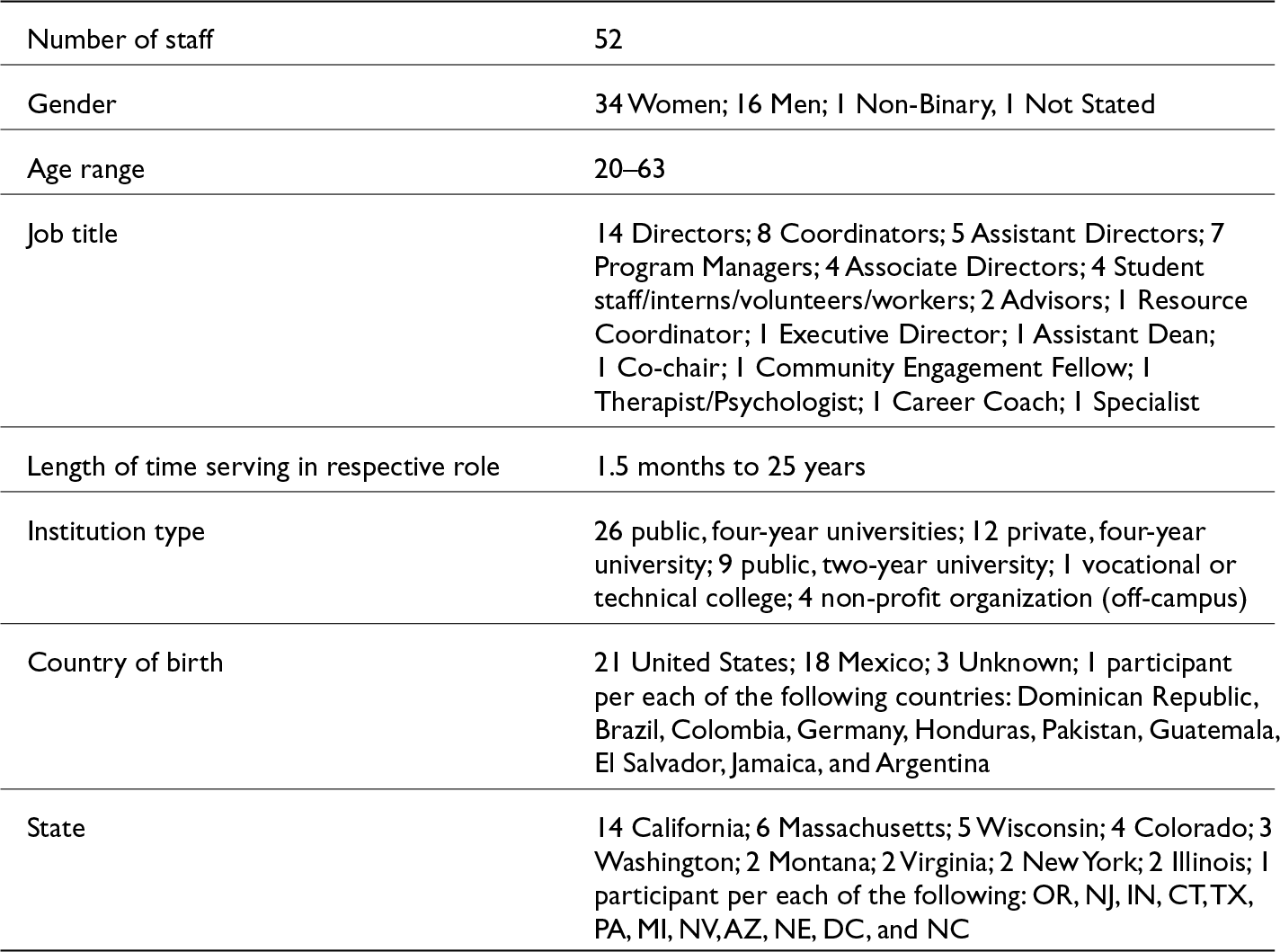
Table 1 Long description
The table details demographics of 52 staff members, including gender, age, job titles, tenure, institution type, country of birth, and state of residence. There are 34 women, 16 men, 1 non-binary, and 1 not stated. Ages range from 20 to 63, with job roles spanning directors to interns. Staff have served from 1.5 months to 25 years. They work in 26 public and 12 private four-year universities, among other institutions. Most were born in the U.S. or Mexico, with others from various countries. California has the highest representation with 14 staff members.
Staff worked in states that varied widely in how receptive they were to undocumented students’ access to higher education. Some states offered comprehensive support. For instance, California provides in-state tuition, state financial aid, and access to professional licenses. Other states imposed significant barriers, such as South Carolina, which prohibits undocumented students from enrolling in public institutions. Following the Higher Education Immigration Portal’s state policy analysis, we categorize states as “accessible” (n = 42), “limited” (n = 3), or “restrictive” (n = 7) to reflect these differing policy environments.Footnote 8
Each interview was structured around six themes: introduction (personal/educational background); context of workplace; basic needs resources (general); basic needs resources (specific to undocumented students, and those from mixed-status families); Covid-19 context; and recommendations. We asked staff about the set of factors that motivated them to pursue a career in higher education, their job role(s) and responsibilities, the challenges they encountered in their work, and their perception of students’ needs and barriers as it pertains to their health, ability to secure food and housing, career development, and finances. The interviews ranged in duration from 31 minutes to 1.25 hours.Footnote 9 We list the date of each interview when quoting participants in our findings. Because each staff member was interviewed in a single session, we note the interview date only with their initial quote.
Interviews were audio-recorded for transcription purposes. All interview transcripts were coded using Dedoose. A team of four graduate students carefully read through the transcripts and created labels to mark pertinent themes that arose in the interviews, such as: “outreach” to describe participants’ strategies to reach undocumented and mixed status students; “state context” to refer to participants’ description of state-level policies or practices; or “origin of center/services” to describe how the center or their particular role came to be at their respective campus. From this inductive coding process emerged the theme of “creative solutions,” which was a term that several staff members organically employed during the interview when speaking about the barriers undocumented students face and the strategies they employed to support them. After an initial round of coding, we conducted a thorough, iterative review of the transcripts to identify and refine patterns in how staff described the creative solution process. This analytic process enabled us to systematically surface recurring examples of innovative approaches and to explore the individual and institutional factors that motivated such efforts, the areas such solutions addressed, and the challenges staff encountered along the way. To further illustrate these emergent themes, we compiled a separate document featuring representative quotes that capture the diverse strategies staff employed to support undocumented students across their campuses.
The meaning and process of creative solutions
Higher education professionals who work closely with undocumented students are acutely aware of the federal and state immigration laws that create significant barriers to access and participation. As most staff members were first- or second-generation immigrants themselves, they were compelled to work closely with undocumented students based on their personal (or their families’) experiences with the educational system. As Gabriella, an Assistant Director of a center at a public four-year university in an accessible state, explained, “I would say it’s my undocumented identity that has really driven me to want to continue supporting undocumented students like myself” (11/8/24). Staff members like Gabriella are often motivated to support undocumented students out of a shared personal experience (see also, e.g., Cisneros and Valdivia Reference Cisneros and Valdivia2020; Tapia-Fuselier Reference Tapia-Fuselier2023). Moreover, roughly half of the participants expressed that they believed their institution had an obligation to provide equitable opportunities to undocumented students. These professional and institutional missions facilitate staff members’ distinctive approach to constructing compliance with immigration law to mitigate its impact on undocumented students’ education. Other motivating factors include a belief among staff members that undocumented students are worthy of support and that their status represents an equity issue. Staff were also motivated by suggestions from their various professional networks and associations. Similar to how personnel in work organizations are driven to comply with anti-discrimination laws (see, e.g., Edelman Reference Edelman2016), staff were inspired by ideas shared by professionals in their field.
Once in their respective roles, staff members developed means to navigate and interpret the legal landscape to support students while maintaining compliance with restrictive federal or state law. In practice, this often meant identifying and working within areas of legal ambiguity – spaces where the law is underdefined or silent – to expand opportunities for undocumented students. For example, while federal law explicitly forbids employment without legal status, it does not mention fellowships. This distinction allows institutions to offer paid fellowships or stipends that provide both financial support and professional experience without contravening federal employment restrictions (see, e.g., Presidents’ Alliance on Higher Education and Immigration 2020a). Similarly, while undocumented individuals are ineligible for state-sponsored benefits such as food stamps or housing subsidies, no laws prohibit universities from creating parallel forms of assistance specifically for undocumented students (e.g., emergency food or housing support). Indeed, some campuses already provide these kinds of parallel and inclusive supports (see, e.g., Aggie Compass Basic Needs Center, N.d.). Nor are universities prohibited from ensuring that undocumented students can access other campus-based resources that are open to all students and do not require disclosure of immigration status (e.g., residence halls and food pantries). Through these legally permissible practices – what staff members referred to as part of their efforts to be “creative,” engage in “problem solving,” or create “workarounds” – staff effectively mitigate illegality: they operate within the constraints of the law while creatively leveraging its ambiguities to reduce barriers and expand opportunities. Though examples of creative solutions varied across institutions, these efforts fell into five broad categories of support: food, housing, scholarships, parallel opportunities, and NEBOs (see Table 2). With respect to NEBOs, the solution most frequently mentioned in our interviews, staff emphasized their role in mitigating a significant barrier students face: the inability to legally work. Taken together, these efforts demonstrate that supporting undocumented students is not solely about confronting exclusionary practices, but also about identifying and activating the underdefined zones of law where meaningful inclusion can occur.
Categories and frequencies of creative solutions
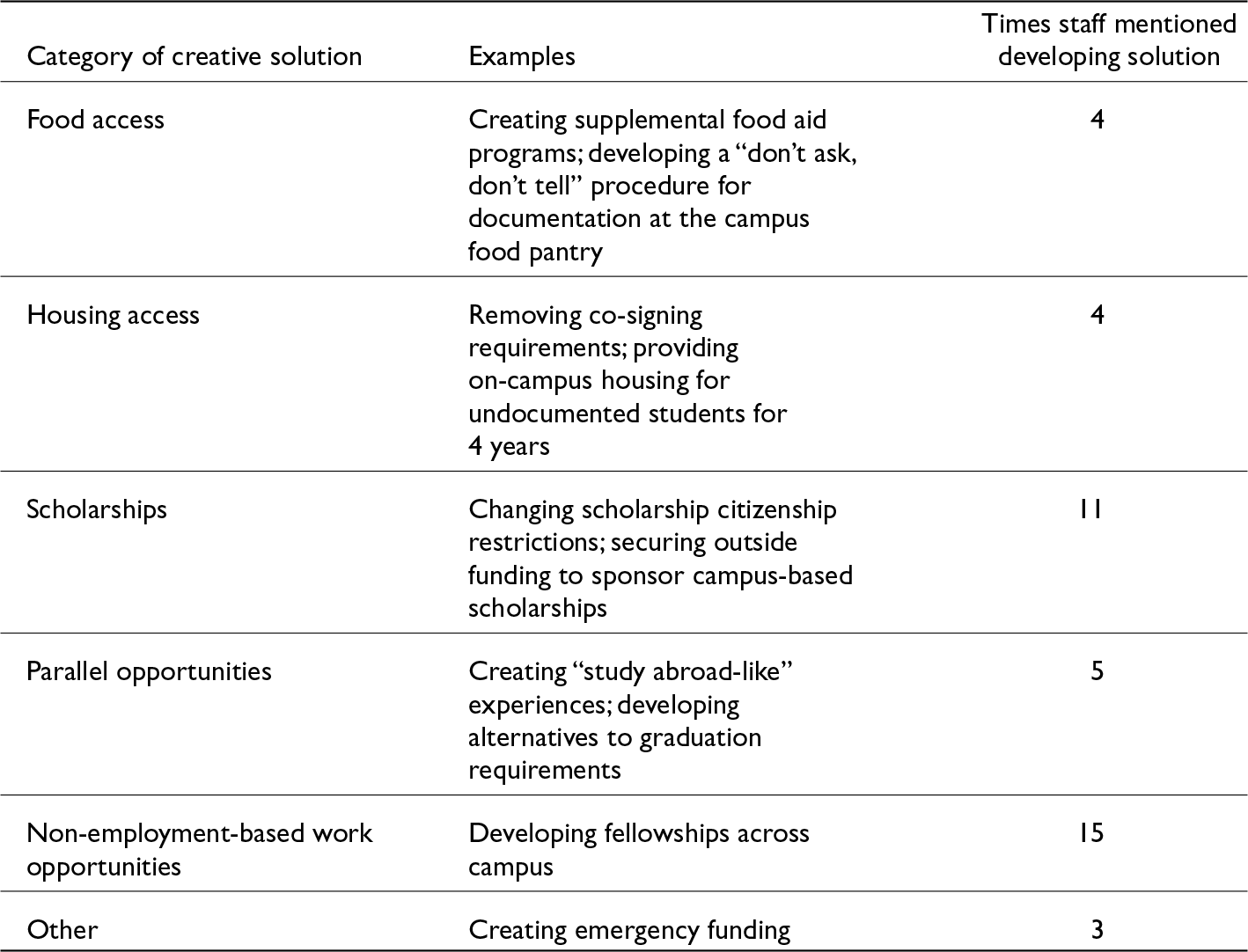
Table 2 Long description
The table measures the frequency of staff mentions for developing creative solutions across various categories. Non-employment based work opportunities were the most frequently mentioned solution, with 15 mentions. Scholarships were the second most mentioned category, with 11 mentions. Both food access and housing access solutions were mentioned 4 times each. Parallel opportunities were noted 5 times, while other solutions, such as emergency funding, were mentioned the least, with 3 mentions. This suggests a focus on creating work opportunities and scholarships as primary solutions, while emergency funding is less emphasized.
An essential part of staff members’ roles then entails navigating constantly changing legal landscapes while simultaneously shaping how students experience illegality on the ground. For example, Kai has worked as Director of a center in undocumented student services and basic needs at a private four-year institution in an accessible state for nearly two years. When describing his work, he noted, “we owe it to our students to get them through for the next four years and also [to] ensure that they do have the same experiences than other students. That is equity. And so that is a part of the conversation that I’m having constantly. So we have to find workarounds to make sure that their experience isn’t being botched” (12/13/24). Kai was aware of the challenges that undocumented students encounter during their educational trajectories. He also recognized that undocumented students require additional resources, support, and opportunities – what he referred to as “workarounds” – to access an educational experience comparable to that of their peers and successfully graduate. At his university, Kai sought to expand opportunities for undocumented students whose immigration status legally prevents them from working or leaving the country. These legal barriers mean that undocumented students are categorically excluded from educational opportunities such as study abroad programs, which typically require international travel and valid federal identification. As a result, undocumented students miss out on the academic, linguistic, cultural, and professional benefits that study abroad experiences provide – advantages that can strengthen students’ resumes, enhance language proficiency, and broaden students’ cultural perspectives. Recognizing how this exclusion could affect students’ future job or graduate school prospects, Kai worked to develop parallel, though not fully equivalent, initiatives. More specifically, he partnered with the career center to connect students with alumni and businesses for professional experiences and created “study abroad-like” programs. This included offering enrollment in domestic language-immersion programs that, while not replicating the full cultural immersion of living abroad, still allowed students to build meaningful linguistic and cross-cultural experiences to include on their resumes. Through his role, Kai implemented creative solutions on-campus and ensured that senior leadership supported these efforts. Like educators and counselors working with undocumented students in the K-12 setting (Crawford and Valle Reference Crawford and Valle2016; Marrow Reference Marrow2009; Parkhouse et al. Reference Parkhouse, Massaro, Cuba and Waters2020), higher education professionals often think of their roles as commensurate with carving out opportunities for undocumented students – doing what they can within restrictive legal constraints to broaden students’ educational possibilities.
As ideas for creative solutions emerge, staff such as Kai begin to recognize their institutional roles in navigating legally ambiguous areas. These efforts often emerged when undocumented students faced disadvantages compared to their U.S. citizen peers, such as ineligibility for employment, food assistance, housing support, or in-state tuition, due solely to their immigration status. Sara, a Director of a center at a public four-year university in an accessible state, explained, “there [are] a lot of our students who are very impacted by what’s going on at the state level and nationally,” prompting her office “to be more creative to offer solutions that will support our students” (5/6/24). One such initiative was a campus fellowship program that provided financial support without classifying students as employees. As Sara explained, her center “partner[ed] with units across campus so that they can host undocumented students and provide a year-long project. A student would get a stipend for that. It’s kind of like paid work, although it’s not.” This distinction is crucial: undocumented students are legally barred from employment, but they can receive stipends through paid fellowships, which occupy an underdefined area of the law (see, e.g., Presidents’ Alliance on Higher Education and Immigration 2020a). Sara’s example illustrates how institutional actors mobilize legal ambiguity to expand access and opportunity. While existing scholarship on immigration federalism and nested contexts of reception emphasizes how state, local, and institutional policies shape undocumented students’ experiences (Golash-Boza and Valdez Reference Golash-Boza and Valdez2018; Murillo Reference Murillo2021; Valdivia et al. Reference Valdivia, Clark-Ibañez and Carreon2023), we find that staff actively reshape those experiences – transforming illegality not only by confronting barriers but also by carving out new forms of support and alternative pathways within the institution.
We conceptualize the creative solutions process as occurring through four stages: (1) Understanding institutional responsibility within areas of ambiguity and flexibility; (2) Identifying solutions, implementing, and troubleshooting; (3) Raising awareness and mobilizing support; and (4) Institutionalizing solutions (see Figure 1). As these steps suggest, staff members’ efforts often begin in their own offices but eventually spread across campus departments and thus involve altering the practices and opinions of actors throughout the institution. As such, staff are also met with various organizational restrictions or boons to their efforts (this is a theme we return to in section 3 of the findings).
A visual representation of the creative solutions process.
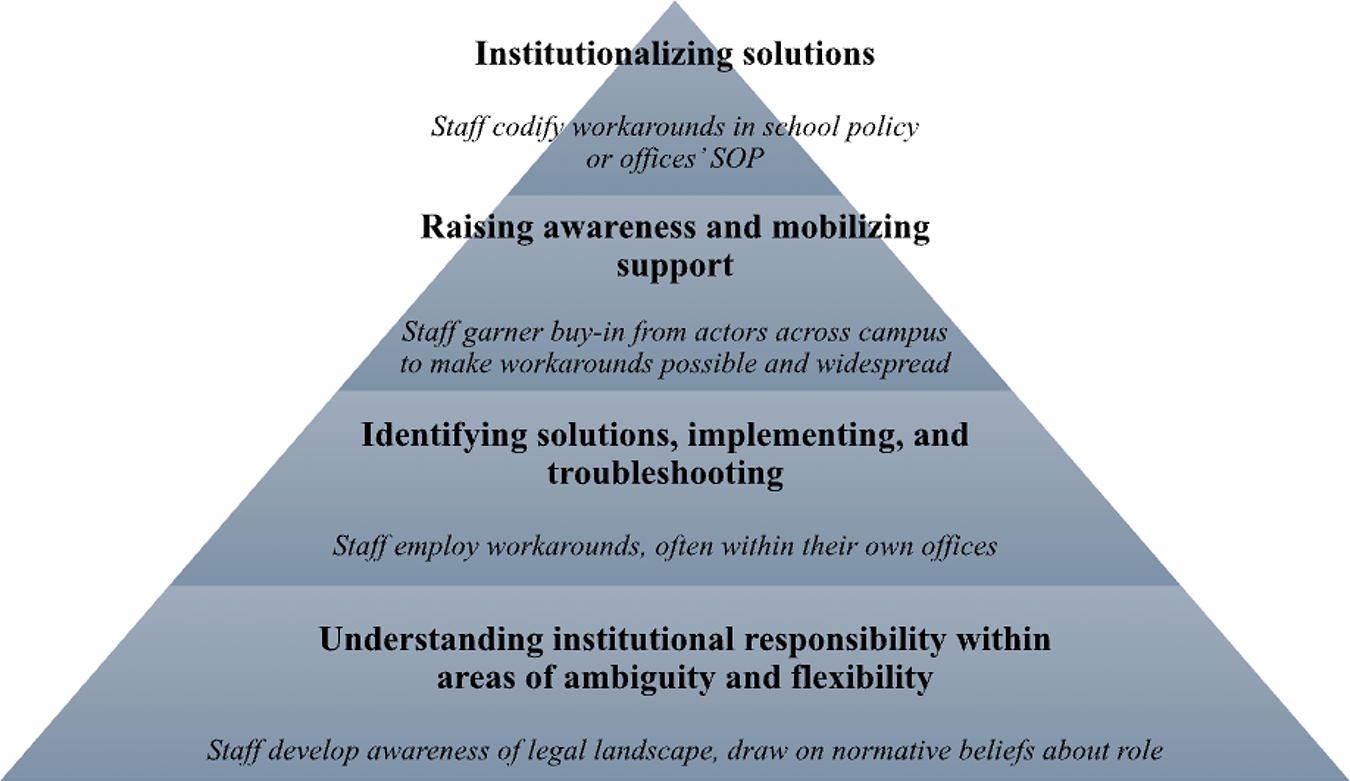
Figure 1 Long description
A pyramid diagram showing the creative solutions process divided into four stages. At the base, 'Understanding institutional responsibility within areas of ambiguity and flexibility' is described as staff developing awareness of legal landscapes and narrative beliefs about roles. The next level, 'Identifying solutions, implementing and troubleshooting,' involves staff employing workarounds within their own offices. The third level, 'Raising awareness and mobilizing support,' highlights staff garnering buy-in from actors across campus to make workarounds possible and widespread. At the top, 'Institutionalizing solutions' involves staff codifying workarounds in school policy or officers' standard operating procedures.
Though we discuss creative solutions as occurring in discrete stages, it is important to note that these stages are not strictly linear.Footnote 10 Despite this non-linearity, we do understand this process as having a discrete end: in the final stage, staff transform informal arrangements into formal policy and practice, encoding them into written procedures. Institutionalizing means developing and spreading information about explicit, documented procedures that staff employ as part of their formal operations, rather than establishing covert agreements between several offices. Indeed, while some solutions only exist if current staff have bought into the process, institutionalized solutions are taught to, expected of, and enacted by any new employee whose office is involved in the process. When staff reach this rare final step, they are proud that their workarounds are durable and more likely to be insulated from bias or change.
The creative solutions process is importantly facilitated by the position of universities within the immigration landscape. Staff navigates complex legal landscapes in which federal or state restrictions may limit access to employment or benefits programs, but no such prohibitions exist at the institutional level. Within these parameters, staff engage in the creative solutions process to expand resources for undocumented students, often in partnership with non-campus organizations during stages two and three of the process. Universities retain the flexibility to design internal procedures to meet students’ basic needs, such as providing access to food and housing without requiring Social Security numbers (see, e.g., mechanisms of support developed through the Undocumented Student Services program at UCSB; UC Santa Barbara Undocumented Student Services, N.d.). In states where undocumented students are ineligible for state financial aid or in-state tuition rates, staff can seek external funding sources that are not legally tied to citizen status (see, e.g., Presidents’ Alliance on Higher Education and Immigration 2020b). At the public two-year college in an accessible state where Camila served as Director of a center, her team prioritized working with “community partners to identify any scholarships that do not require any sort of citizenship status […] We have also started a scholarship on campus using foundation money, which is considered aid for students who are not eligible for federal and state aid. So that was something that started about, I think, three years ago, we were able to officially get that off the ground” (10/11/24). By responding flexibly to legal restrictions, staff like Camila found creative and compliant ways to support students despite federal and state prohibitions on access to financial aid for undocumented students.
As mentioned, staff also work to institutionalize such solutions. Those leading these efforts recognized the need for clear documentation and encoded practices to make creative solutions sustainable. Through this process, staff transform ad hoc workarounds into institutional norms – establishing guidelines, standard operating procedures, or yearly professional training offerings. These practices not only coordinate support for undocumented students across departments (see also, e.g., Cisneros and Valdivia Reference Cisneros and Valdivia2020; Tapia-Fuselier Reference Tapia-Fuselier2023), but more broadly shape how the institution interprets and enacts formal law. As Alejandra, a Director of a center at a private four-year university in an accessible state, described, institutionalizing solutions distinguishes them from “side door, back door solutions” approaches that are hidden, temporary, and unsustainable (11/8/24). She emphasized the importance to “do things legally, do things ethically, sustainably, to create some kind of policy and process that bureaucracy is going to have to be a part of it, but it’s a front door public policy.” By embedding creative solutions within formal procedures, staff act as legal intermediaries. Namely, they mitigate the impact of ambiguous state-level immigration policies and the daily realities of campus life. Their actions determine how students experience illegality within the university, whether as bureaucratic exclusion or incorporation (Marrow Reference Marrow2005). In this way, staff translate ambiguities within immigration law into durable institutional practices, turning creative solutions into a means of both compliance and resistance while ensuring that undocumented students can navigate the university through recognized, lawful, and sustainable pathways.
Indeed, when identifying areas in which they could work around immigration law, staff members were clear that their solutions had to be legally compliant. To staff, developing creative solutions was very different from breaking the law. Marty, a program manager at a public four-year university in an accessible state, explained that it is staff members’ responsibility “to be compliant” and “follow institution and state guidelines” (11/14/24). At the same time, there is room to “be creative” and “accommodating,” he explained. Marty added, “I’m not trying to say do shady things, but just finding ways that are within the parameters of again, the guidelines from the institution and the state […].” Rocio, who also worked at a public four-year university in an accessible state as a Coordinator, offered a similar explanation, noting that, “we have to think creative and outside of the box. Outside of the box does not mean we’re breaking any laws. It just means we’re literally being creative” (2/20/24). These reflections highlight both what creative solutions are and what they are not. They do not involve non-compliance or engaging in “shady” practices. Rather, they are about being an active legal navigator – an institutional actor who understands the guidelines and policies at various levels and strategically works within those constraints to mobilize support and resources for undocumented students. In the process, staff members alter the way students experience illegality and how institutions come to understand (il)legality.
How staff shape experiences and understandings of (il)legality through creative solutions
Staff advance creative solutions at their respective institutions and, in the process, challenge existing understandings of (il)legality through education – informing and educating others across campus. One area where this occurs is in relation to the pressing issue of employment. Because federal law prohibits the formal employment of individuals without work authorization, many undocumented students are excluded from traditional on-campus jobs. In this context, immigrant rights organizations and scholarship providers have identified independent contracting as a crucial alternative (see, e.g., guidance from Immigrants Rising, N.d.A; The Dream.US, N.d.). Unlike standard employment, independent contracting allows individuals to perform specific services for payment without being classified as employees, which means the same work authorization requirements do not apply (see, e.g., recognition of this by Northwestern University (Undocumented/DACA at Northwestern, N.d.) and UCSB (UC Santa Barbara Career Services, N.d.). This legal distinction provides a pathway through which undocumented students can be compensated. Linda, a Director of a center at a public four-year university in an accessible state, described the multi-step process involved in spreading such awareness and practices across her campus:
So we’re going to do a recording of “what does independent contracting mean?” And what is the process? And what are the different types and what does that mean for paying taxes […] So then that brings awareness to people across campus that yes, you can do this, it’s legal, you can do this, here’s the way to go about it. The second thing we’re going to do is then have an in-person “Train the Trainer.” So that would mean that [the student hired as an independent contractor] comes in, we’re bringing in people from human resources, people from DEI, specialists, people that basically would be the gatekeepers of hiring within departments, schools, and colleges at our university. That’s going to happen over the summer, we’re going to bring them in, and [the student is] going to talk to them about what that might look like in your own department, here’s how you can implement and also promote. And so, if a student wants to get their independent contract license, then they can work for the university in that manner. The third thing we’re doing is then also having a workshop directly with students that are interested in becoming independent contractors. So that’s where we’re pivoting to. And I’m really excited about that, because it’s starting to gain momentum. And we are getting buy-in from some of those folks across campus that are also interested in doing this, they just don’t know where to begin.
Through workshops, conversations, and policy guidance, Linda challenged the prevailing assumption that undocumented status equates to complete exclusion from paid work. Her efforts call attention to the lived experience of illegality, namely, the way undocumented students navigate systems that constrain access to economic opportunity. Through the creative solutions process, illegality is not a “fixed” category but rather can be continuously negotiated through institutional practices and interpretations. Within this broader landscape, Linda spread an inclusive and alternative understanding of legal paid opportunities to “gatekeepers” who would have to sign off on, and eventually implement, the solution. In doing so, she worked to transform conceptions of limitations associated with status and broadly alter the opportunities for students across campus. Notably, Linda’s experience also illustrates how workarounds blur the lines between legality and illegality. The legality of paying undocumented individuals as independent contractors is often misunderstood, contested, or applied across institutions unevenly. In practice, this makes the higher education context not only a site of legal interpretation but also of moral negotiation, where the meaning of “legal” paid opportunities becomes socially constructed through policy, training, and everyday practice.
During the creative solutions process, staff members often encountered competing interpretations of legal terms – some expansive enough to include undocumented students, and others that excluded them. When university definitions relied on restrictive interpretations, staff either challenged the exclusion directly or devised alternative pathways to support students outside formal institutional structures. Annie, a Director of a center in a public four-year university in a restrictive state, confronted this dynamic when she sought to create a scholarship for undocumented students. She “went to the University” with a proposal (10/22/24), but the request was ultimately denied. Administrators told her that “undocumented students are not a protected class, so the university couldn’t help us out [with a scholarship].” The institution’s reliance on a narrow understanding of a “protected class” – a category legally safeguarded from discrimination – effectively prevented Annie from establishing a campus-based scholarship opportunity for undocumented students. Recognizing that this exclusionary interpretation would have material consequences on students, Annie pursued alternative avenues to ensure they still had access to the scholarship. She turned to community organizations, explaining: “I went to various churches to see if somebody would hold the money for us. And finally I found this sort of a small congregation … and they were keeping the money for us so people could write the checks to the church and the donations would be tax deductible.” Annie later partnered with another local church with whom she was able to “give out $10,000, about $5,000 each to two students. Over the course of time, since 2012, we distributed over $200,000. Our scholarship is open to whoever applies for it.” Through these efforts, Annie challenged the university’s restrictive definition of a “protected class” by collaborating with external organizations that were willing to support undocumented students. In doing so, she not only shaped how students experienced the effects of illegality – by creating a mechanism through which they could access material resources – but also subtly pushed the institution to reconsider, at least informally, its own categorical boundaries. Her work demonstrates how staff navigate contested legal definitions across institutional and community contexts to ensure that students receive support despite formal constraints.
By working with different units across campus, staff play an active role in interpreting, negotiating, and reshaping how institutions understand and respond to illegality. Rather than treating immigration restrictions as fixed constraints, staff use their expertise, relationships, and institutional knowledge to mediate the meaning of illegality within the university. Ben, a Program Manager at a public four-year university in a limited state, explained how students’ “lives are exposing flaws in the system,” compelling staff to use their “navigational capital” to advocate for structural change (10/23/24). Ben described a situation in which a doctoral student’s work authorization under DACA expired, prompting human resources to terminate his university employment and, by extension, his funding and health benefits. Ben coordinated with the student’s department, the graduate school, and the international center to devise a compliant workaround that allowed the student to remain enrolled and supported. This collaborative process, he explained, involved “talking to people who maybe have not dealt with this before, but dealt with an aspect of the problem or aspect of the situation” to piece together a viable solution. By surfacing the issue, Ben pushed key stakeholders to confront – rather than ignore – where institutional procedures fail to accommodate undocumented students. Ben’s advocacy extended beyond the individual case. He also sought to mobilize the Graduate Student Union to institutionalize more inclusive policies, such as creating experiential positions not contingent on work authorization. As he explained to the Union, “next time you go for negotiation, can you negotiate some of these positions not being employment-based but being experiential based … because right now, your current policies are going to exclude anyone without DACA or any work authorization.” Ben’s approach illustrates how staff can transform moments of enforcement into opportunities for creative solutions – both by addressing immediate crises and advancing long-term structural change. By enlisting allies across campus, Ben worked to ensure that future generations of undocumented students would not face the same barriers. This is particularly significant given that many undocumented students are presently unable to benefit from DACA.
Staff across campus often work with different units to contest how illegality is understood and to create alternative pathways that expand access for students who might otherwise be excluded. Alejandra’s experience illustrates how this work unfolds in practice. At a previous institution, she tried to implement NEBOs but found little support. It was not until she moved to another institution (one more receptive to creative solutions) that she successfully implemented NEBOs after nine months of sustained effort. Even then, contradictions persisted. While innovation was encouraged in some areas, Alejandra still faced bureaucratic resistance elsewhere. She described “fighting with the financial aid office” to ensure an undocumented student received a stipend they had earned, only to be questioned about documentation and whether the payment qualified as work-study (11/8/24). Such experiences reveal how varying interpretations of policy and (il)legality among higher education professionals can create inconsistent practices. Because little is standardized, Alejandra emphasized the importance of institutionalizing creative solutions so that access does not depend on individual discretion. If there is “a new person or a bad actor,” Alejandra warned, “[it] can really screw up the process.” Through her consequent efforts to institutionalize NEBOs – which we discuss in greater detail below – Alejandra sought to shape how (il)legality is understood and enforced at the institutional level such that it becomes “very hard for somebody to make a personal decision rather than a policy decision.” Ultimately, these efforts influence how students experience the effects of illegality in college, and more specifically, whether they gain access to opportunities that would otherwise remain out of reach.
Because the successful implementation of creative solutions often required involvement from institutional actors in other offices or agreement from university leaders, staff had to engage and persuade networks across campus. For example, providing on-campus housing for undocumented students required working with the housing office; ensuring that external financial aid reached students’ accounts involved coordination with financial aid staff; and creating alternatives to status-dependent major requirements meant meeting with department chairs. Each initiative required explaining both the proposed change and its significance, given undocumented students’ circumstances. Gaining the support of key stakeholders, such as HR, accounts payable, basic needs centers, dining services, legal counsel, and campus leadership, was essential to advancing these creative solutions. Most staff noted that peer education was a necessary step in the process of implementing creative solutions, informed by the bureaucratic nature of their institution.
Unlike prior studies on street-level bureaucrats and discretion (see, e.g., Castrellón Reference Castrellón2022; Chiarello Reference Chiarello2015; Lauby and Ross Reference Lauby and Ross2022), staff advancing creative solutions were not merely exercising individual discretion in line with their professional missions. Instead, they worked to shape institutional practices – aligning other units and centers with their interpretations of the law, facilitating access to resources, and expanding benefits beyond the students with whom they immediately worked. In doing so, they sought to transform institutional understandings of (il)legality and student policy itself, extending their influence beyond their own centers to the broader organization and transforming policy in the institution more broadly.
How varied contexts facilitate or hinder creative solutions
There are various factors that can help staff members advance creative solutions. First, staff may secure support from outside organizations and subsequently form partnerships or networks that can provide opportunities to students that are otherwise unavailable (or limited) at their respective campuses. Such was the case for Camila, the only paid staff member at a two-year college in an accessible state. Camila’s role focused on supporting immigrant students, including those who are undocumented as well as asylum seekers, TPS holders, DACA beneficiaries, and recent arrivals. Aware of her limited capacity and expertise, she “built a network of partners outside of the campus who can support students with needs like housing, legal services, food, [and] sometimes policy advocacy around their cases to ensure that they’re connected […]” (10/11/24). Camila’s work to form a “network of partners” was an essential step to ensure that immigrant students, with varying immigration statuses and therefore distinct needs, could “get their needs met that I can’t provide,” as she explained. Existing literature on the experiences of USRC staff indicates that they are often wearing multiple hats as coordinators, advisors, mentors, advocates, among other roles (Tapia-Fuselier Reference Tapia-Fuselier2023). Given these circumstances, staff members like Camila utilize networks to engage in the process of implementing creative solutions. Faced with institutional constraints and limited capacity, staff like Camila may be compelled to search for resources and partnerships in the local community to advance workarounds.
The institutional context in part informs staff’s experience and success throughout the creative solutions process, including the kinds of resources or obstacles they face along the way. Kai explained,
[T]hat’s something that I’ve appreciated about the support for our undocuplus community at [this] college is creative problem solving … workarounds. There’s a lot of support with that to the point where students at [college] … they do have access to legal advising from attorneys, and so there are a lot of resources in place, not just from our center, but from the institution at large.
From Kai’s perspective, the institution where he worked had successfully implemented various workarounds. What was especially noteworthy to Kai was that students had expert legal advice and that such resources were not just constrained to his center but rather were available in other parts of campus. Students also had direct access to the campus police chief who helped address their specific concerns and needs. Institutional support and the availability of workarounds throughout campus were critical for staff as it helps them not to “feel like I’m fighting every day,” as Kai noted. A key benefit of reaching the final phase of the creative solutions process – institutionalization – is operating in a work environment where support and opportunities for undocumented students come from varied places. In this way, the onus is not on a few (or one) personnel but rather is shared among multiple actors. As Kellogg (Reference Kellogg2009) suggests, collaborative environments aid frontline workers in accomplishing their goals. Relatedly, we found that in “accessible states,” over half of respondents (22 out of 40) indicated implementing creative solutions. This suggests that supportive state policies may foster an environment where all staff feel both empowered and resourced to innovate on behalf of undocumented students.
In addition to harnessing networks of support both on- and off-campus, staff were aided by participation in professional associations. Guidance from these groups not only motivated staff to pursue creative solutions at their respective institutions but also equipped them with the tools necessary to successfully institutionalize them. Henrich, a Director of a center at a public four-year university in an accessible state, was inspired by a national scholarship provider for undocumented students. After learning about their work, he was eager to explore the process of creating NEBOs for students (4/16/24). Amanda, who worked as a Director of a center at a private four-year university in an accessible state, similarly looked to a “blueprint for creating a non-employment-based opportunity program” from a national consortium of higher education leadership (3/22/24). At a professional conference, Lorena (a Coordinator at a public four-year university in an accessible state) also “learned about NEBOs” (4/17/24). At the time of our interview, she was “researching more [and] trying to find more successful experiences in our universities. That way I can bring them [to the campus].” The kinds of resources and programs staff learned about in their professional networks motivated them to pursue creative solutions. These organizations and other universities also served as “blueprints” or “successful experiences” through which staff could transform their own university’s policies. Notably, Henrich, Amanda, and Lorena all worked in different states, revealing the broad reach of national professional organizations and their ability to influence the implementation of creative solutions at the institutional level across state lines.
Some staff members also communicated with colleagues at other institutions, revealing staff’s ability to rely on, and influence, their broader professional field. Amanda described “hav[ing] a call probably once a week with somebody at another school, oftentimes schools that are a lot like [my] University, so like small private schools, are like, ‘I heard you have [NEBOs], how do you make this work?’ And it’s actually one of my favorite things to do to be able to talk with them about it and share the materials and everything.” Tellingly, Amanda indicated that educating other universities about her school’s approach to NEBOs indirectly helped her students. If she leveraged the institutionalization of NEBOs at her university to spread similar efforts across peer institutions, Amanda perceived that the program would gain recognition from her campus leadership, potentially shielding it from waning enthusiasm, funding, or changes in leadership. Amanda’s account also demonstrates how staff’s creative solutions can impact meanings of (il)legality not only at their campus, but more broadly across their organizational field (DiMaggio and Powell Reference DiMaggio and Powell1983). As staff implement and disseminate information about creative solutions that lessen the impacts of immigration law, they contribute to changes in legal understanding not just within universities but also across them. Taken together, because staff members must juggle their various professional responsibilities in addition to pursuing workarounds, they are significantly aided by external resources, whether these come from non-profit or legal organizations directly providing services to students, from professional associations and peers who supply model policies, or from similarly situated institutions whose adoption of a solution could help safeguard their own. Networking efforts allowed staff to make the most of their limited time, and they also had a legitimating effect on institutionalized creative solutions across campuses.
During the creative solutions process, staff are often not only navigating their respective institutional context but may also be working with local organizations (as was the case for Camila), as well as professional organizations and boards. These contexts can also pose their own set of barriers and may create difficult conversations with students. In the process of implementing NEBOs for undocumented students, Gabriella, who worked as an Assistant Director of a center at a public four-year university in an accessible state, realized that it would be more difficult to implement creative solutions for students interested in pursuing a law or medical degree. The main challenge for students in these fields entailed “get[ting] into residency if part of the requirements require you to have some sort of status or a social security number” (11/8/24). Notably, these barriers were coming from professional associations that set the residency requirements for students (i.e., the Accreditation Council for Graduate Medical Education in the case of medical residency and State Bar Associations for law residency). These circumstances led to the partial implementation of creative solutions: while undocumented students in the social sciences or related fields could benefit from NEBOs, those interested in law or medical school could not. It also created internal dilemmas among staff like Gabriella, who explained,
[T]hat’s where, as a counselor, it can be very difficult again, speaking personally for myself, to have conversations with students about that because part of me is like… I want to let them know, “no, continue doing what you’re doing. If this is what’s calling you, this is your passion, do it.” But then […] when they ask, like, “Well, can I do x, y, and z in this field as an undocumented student?” I’m like, “I don’t have the answer to that.” Or even if I do look it up, and I’m like, “well, based on this information, like, no.”
The challenge for staff like Gabriella was recognizing that significant legal barriers prevented undocumented students from pursuing their career interests, leaving her unable to offer meaningful assistance. While Gabriella ultimately found comfort “just knowing that knowledge is power, having shared resources for them is power as well,” it was difficult to be in a position where despite best intentions and students’ needs, there are areas that remain impermeable to staff’s creative compliance efforts.
Notably, staff members’ perceptions of potential legal hurdles on campus may compel them to refrain from attempting to implement workarounds. Humberto, a Coordinator at a public two-year college in a limited state, identified housing for undocumented students as a key issue requiring further attention. However, he hesitated to pursue the creative solutions process within this area. He shared,
We are a commuter institution, we don’t have housing on campus. So, we are not really messing with housing recommendations for students. We can’t provide housing advice. We can’t do any of that. There’s always that legal concern, and it makes the legal team very, very nervous whenever we start approaching those conversations, because it’s a lot of liability for the college. So we haven’t been able to provide any services on that front (4/22/24).
While undocumented students are not legally barred from renting a room or apartment – either on- or off-campus – there are unique challenges they contend with during their search for housing. Without a social security number, students may be unable to undergo a background or credit check. Some landlords may subsequently require students to pay higher deposits or secure a co-signer (Golash-Boza and Valdez Reference Golash-Boza and Valdez2018). Some students may also lack government-issued identification that they can present to landlords. Although it is difficult to say which specific concerns would make the legal team at Humberto’s institution “very, very nervous,” his statement nevertheless suggests that there are certain areas that may prove more difficult for staff to address. Indeed, those that pertain to students’ basic needs around food and housing may be such areas in part because there are often misconceptions around eligibility.
Whether staff members work at a public or private institution can also shape their perception of legal hurdles, and subsequently their willingness and ability to implement creative solutions. Humberto explained that working at a public institution stymied his ability to implement solutions centered on student employment:
It’s complicated. I mean, I would like to see work… employment opportunities for our students, but it’s a gray area […] So that’s not something that we can really do. […] I just don’t see how we would be able to do that. Because at the end of the day, we’re still a state institution. So, there’s a lot of red tape that we need to comply with. There’s all of these limitations that we have.
Notably, whether staff perceive certain areas to be “complicated” or impossible to carve out creative solutions is shaped in part by the type of institution in which they work. For Humberto, being at a public institution meant dealing with “red tape” and “compl[iance]” which would make implementing employment policies legally impossible. It is important to note, however, that staff at other public institutions moved forward with creating NEBOs or paid fellowships for undocumented students. More generally, a strong majority of staff working at public four-year universities (15 out of 26) implemented a creative solution, while six did not and five were unknown, indicating that roughly 70% of those with known outcomes were adopters of a creative solution. Others like Humberto refrained from developing similar efforts, especially when they expected other campus actors to dismiss such conversations.
There is also an issue of time, as staff often need to be persistent – dedicating months, if not years, to pursuing creative solutions before they eventually become institutionalized. This poses a significant challenge for staff who are hired on a temporary basis or through budget lines that are not fixed and instead depend on fluctuating state priorities (as is common practice in the field of USRCs).
Moreover, support for undocumented students varies widely across units and departments, even in institutions that are otherwise perceived to be supportive of undocumented students. This variability means that staff may continue to face challenges, including resistance from colleagues or departments that do not share the same level of commitment toward undocumented students. At the institution where Alejandra worked, senior leadership was generally and openly supportive of undocumented students. Consequently, she felt that “no one would have openly said, ‘I don’t agree with this’ or ‘I think this is a bad idea.’” However, subtle signs led her to suspect that not everyone shared the same sentiment. She explained, “when it came down to it, there was a lot of red tape. So, what I experienced, to be honest, was sort of blood, sweat, and tears.” Alejandra shared examples of students receiving conflicting messages. One office might have agreed to take on a student as a paid fellow, but those in charge of distributing the stipend would object to following through with compensation. Alejandra described this as part of the “red tape” that signaled to her that there were “still institutional actors that allow their own biases to get in the way.” Alejandra’s experience reveals the nested contexts of reception (Golash-Boza and Valdez Reference Golash-Boza and Valdez2018) that staff must navigate in the creative solutions process, as well as the kinds of exclusionary and inclusionary practices that can co-exist in ways that challenge binary categorizations of institutions as either “welcoming” or “hostile.” Moreover, such resistance can often be invisible or unspoken yet manifest through the creation of bureaucratic red tape.
The lack of campus leadership that is willing to support initiatives for undocumented students can disrupt not only its institutionalization but also the entire process up to that point. Reflecting on how leadership changes derailed her center’s ability to implement a burgeoning HSI initiative and receive funding, Lourdes commented, “it was easier when you had a champion in the office of the provost” (10/11/24). Lourdes, who worked as a Director of a center at a private four-year university in a restrictive state, continued,
That’s what it comes down to. Honestly. I’ve talked to a lot of practitioners…and this is a resounding theme over and over and over again. If you don’t have your leadership on board, it’s not going anywhere. You’re not going to get the resources, you’re not going to get the support, you’re not going to get the buy in. You’re not going to be able to move people, move coalitions across the campus.
Other staff argued that – beyond just supporting undocumented students – campus leadership needed to prioritize them. Maria, who worked as an Academic Advisor at a public four-year university in an accessible state with different campus presidents over the years, explained the difference between active and passive support. Describing one campus leader, she clarified that “it wasn’t that they didn’t like or didn’t approve of our policy, it was that they had different priorities. So, when this [new university president] came into power, he was very much so like, ‘I want to prioritize minority students’” (emphasis added) (5/7/24). As Maria discussed, having a champion in the university president’s office made a significant difference from one who signaled support without acting.
Despite their efforts, staff were hindered by legal strictures outside of their control, by their own perceptions of legality, time constraints, or by the opinions of campus actors. As we highlight, it becomes essential during the creative solutions process for staff to ask others (either on- or off-campus) for support and buy-in, particularly in the second, third, and fourth phases. Yet these same junctures can also delay creative solutions or halt them entirely. When solutions get stuck in “red tape,” are rejected by other offices, or are not prioritized by campus presidents, it becomes difficult for staff to move them forward. In response to this possibility, staff like Humberto decided to forgo creative solutions altogether, opting not to give proposals the chance to be shot down. Others nevertheless pursued the process and navigated the speed bumps that emerged along the way. However, given the set of conditions that must align for staff to successfully institutionalize creative solutions – alongside students’ growing needs, staff pressures, and dwindling resources – few (n = 8) were able to reach the fourth phase.
Discussion and conclusion
There is a long-standing tradition within sociolegal scholarship that highlights the ability of actors and organizations to alter legal meaning and, in so doing, shape its impact (Edelman Reference Edelman2016; Grattet and Jenness Reference Grattet and Jenness2005). Situated within this tradition, our findings illustrate how higher education professionals – acting as legal intermediaries within the constraints of U.S. immigration law in higher education – navigate complex and ambiguous areas of law to transform experiences and understandings of (il)legality within institutional contexts. More specifically, staff transformed illegality from a fixed concept into one negotiated through ongoing interpretation and supportive practices, and ultimately created tangible opportunities that support the well-being, academics, and aspirations of undocumented students. To this end, we build on the work of scholars who examine how legal intermediaries engage in legal meaning-making by interpreting regulations, implementing policies, and moderating access to resources or opportunities across institutions, as well as how these efforts alter the organizational meaning of legal or social categories (Talesh and Pélisse Reference Talesh, Pélisse and Sarat2019). More specifically, we introduce the theoretical concept of “creative solutions” to capture the processes by which legal intermediaries draw on their professional goals and legal understandings to work within law’s restrictions and facilitate organizational change.
Notably, legal intermediary scholars have largely studied how nonlegal actors navigate laws that seek to provide people opportunities and protections. On the contrary, our respondents undertake intermediation efforts with respect to restrictive law. Like the work of nonlegal actors featured in other studies, staff draw on their own understanding of the law, their institutional setting, as well as their personal and professional beliefs. However, staff undertake these efforts to create substantive change within their organizations by targeting legal ambiguity to facilitate access to opportunities and subsequently bolster educational equity. Intermediaries reduce the impact of legal restrictions not by violating them, but by constructing compliance within their undefined areas and by maximizing the flexibility born from their institutional context. While previous literature on frontline workers or bureaucrats documents these actors’ creative approaches to rules, as well as their attempts to “incorporate” or support immigrant populations (Binder Reference Binder2007; Lauby and Ross Reference Lauby and Ross2022; Marrow Reference Marrow2009; Shiff Reference Shiff2021), we demonstrate how – beyond mobilizing ideas of deservingness and employing individual discretion within their professional domain – staff more broadly shape the legal landscape of their organization by altering its policies and practices through steps such as spreading awareness, mobilizing allies, and formally changing institutional rules.
While we extend the legal intermediaries literature by identifying how intermediaries can contribute to opportunity, access, and the meaning of legal categories amid restrictive law, we also refine the literature by identifying additional processes of implementation. Our findings demonstrate that part of staffs’ navigation involves education and mobilization, through which they can inform and persuade others to adopt their legal interpretations and legal strategies. This includes staff members’ efforts to train other institutional actors across departments (or institutions) about U.S. immigration law, the experiences of undocumented students, potential biases individuals may hold, and best practices. In the process of implementation, staff must navigate a vast and complicated web consisting of the beliefs and behaviors of other legal intermediaries. In this regard, our work builds on the legal intermediaries literature by deepening our understanding of the micro-level processes through which institutional actors try to propel their own interpretations of legality. While scholars have noted some “processes and mechanisms” through which organizational actors produce law (Talesh and Pélisse Reference Talesh, Pélisse and Sarat2019), including collaboration (Kellogg Reference Kellogg2009), conflicting legal interpretations (Kirkland et al. Reference Kirkland, Talesh and Perone2021; Talesh Reference Talesh2012; Surubaru Reference Surubaru and Sarat2019), and variations in institutional power (Huising and Silbey Reference Huising and Silbey2013), we refine and further contribute to this sociolegal understanding of intermediaries’ behavior.
Moreover, unique to our study is an explicit bridge between the work of legal intermediary and immigration scholars. The latter has similarly helped elucidate how law is constructed on the ground by examining the ambiguities that exist in discretionary enforcement (Armenta and Alvarez Reference Armenta and Alvarez2017; Motomura Reference Motomura1999; Zatz and Rodriguez Reference Zatz and Rodriguez2014) and temporary legal protections (Abrego and Lakhani Reference Abrego and Lakhani2015; Menjívar Reference Menjívar2006). To be sure, immigration scholars have primarily focused on the work of police officers, employers, and landlords in interpreting and enforcing the law on the ground (Armenta and Alvarez Reference Armenta and Alvarez2017; Gomberg-Munoz and Nussbaum-Barberena Reference Gomberg-Munoz and Nussbaum-Barberena2011; Pham Reference Pham2007; Varsanyi et al. Reference Varsanyi, Lewis, Provine and Decker2012). Thus, our findings advance this work by demonstrating that discretion can not only be mobilized to enforce immigration law and target families (as others have done), but it can also help fuel inclusive institutional practices. Relatedly, and contrary to analyses of the organizational interpretation of law, staff imagine, pursue, and in some cases successfully institutionalize legal interpretations that aim to maximize law’s potential for social equality. Moreover, we find that the experiences of illegality among undocumented immigrants are shaped not only by the state or city in which they reside (see, e.g., Garcia Reference Garcia2019; Wong and García Reference Wong and García2016), but also by the institutions in which they are enrolled, since different schools may interpret and apply the law differently.
Staff working at the intersection of higher education and U.S. immigration law are facing growing responsibilities and diminishing support. To this end, USRC staff (or those in similar positions) may not only find themselves increasingly encouraged to participate in developing creative solutions, but may also find that such efforts necessitate working with outside organizations. Scholars can examine this dynamic in greater depth by also attending to how the city in which an institution is located supports or excludes immigrants – whether through bureaucratic incorporation or exclusion (De Grauuw Reference De Grauuw2016; Marrow Reference Marrow2009). Staff members’ ability to draw on external resources may depend, in part, on the local density of community-based organizations (see also, e.g., the work of Wong and Garcia Reference Wong and García2016 on how the broader organizational environment shapes young adults’ ability to apply for DACA).
To our knowledge, this study represents the first effort to date to delineate the stages through which staff in undocumented student support services and basic needs interpret law to support students, including the set of opportunities and barriers that they confront along the way. As our findings demonstrate, staff can adapt existing programs within their universities or in their professional fields, as well as utilize funding or support within and beyond the university. While several staff successfully implemented and institutionalized their creative solutions, others were hindered by the nature of their institution or the support of those around them. These findings suggest that creative solutions are most feasible in institutions with supportive senior leadership and in which staff across key offices such as financial aid or legal counsel are willing to implement changes or are receptive to training or educational programming. We also find that creativity peaks in the mid-experience range (4–7 years), where staff almost universally implemented creative solutions (8 out of 10). Furthermore, findings indicate that the diffusion of creative solutions across institution types may provide these policies legitimacy and safeguard against intra-institutional change. While few participants expressed an outright unwillingness to implement creative solutions, those who did were affiliated with public universities, suggesting that individuals at private institutions may have more flexibility or leverage. Because private institutions are not dependent on federal funding, they may be relatively less concerned about government oversight or regulation compared to their public counterparts.
Although our focus is on higher education professionals, we also interviewed staff members who worked in non-profit organizations. Despite their different roles, funding mechanisms, and organizational structures, we found that staff across both higher education institutions and non-profit organizations had similar reasons for pursuing creative solutions. They also encountered similar challenges during the process of implementing creative solutions. Notably, we also found that only one out of four non-profit staff members we interviewed had in fact pursued a creative solution. This suggests that staff working in non-profit organizations may either have less flexibility or more restrictions in their attempts to implement creative solutions. Future research can be conducted in a variety of contexts (including non-profit organizations) and with different groups of students to deepen scholarly understanding of how creative solutions operate under varying legal and political constraints. Diversifying the institutional logics, organizational fields, and intra-organizational contexts in which intermediaries employ creative solutions, as well as the unique needs and legal realities of the groups with which they work, offers the opportunity to theoretically expand the mechanisms and processes through which creative constructions of compliance come to be.
Acknowledgements
We are grateful to the staff members who trusted us with their stories and participated in this project. We thank fellow UndocuBasic Needs research team members, especially Josefina Espino, Evelyn Jimenez, Angie Monreal, Danielle Puretz, Daphne Ramirez, and Maria Calva, who helped with the data collection process. We are also grateful to the staff at various Undocumented Student Support Services and Basic Needs offices for their help spreading the word about the project.
Funding statement
This work was supported by the ECMC Foundation, the UCI Dream Center, and the Center for Population, Inequality, and Policy at UC Irvine.
Conflicts of interest
The authors declare no conflicts of interest.
The editorial handling and assessment of this article was conducted under surrogate editors, given potential conflicts of interest among members of the editorial team and the author.
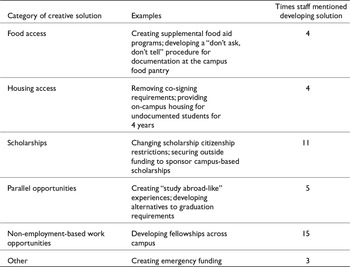
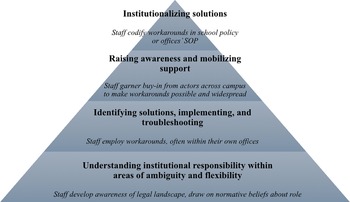

 Open access

