




Introduction
Cancer survival rates have doubled in the UK over the last 40 years (Cancer Research UK 2021). Consequently, many survivors now live with cancer as a long-term chronic health condition (Phillips and Currow Reference Phillips and Currow2010). This can lead to long-term consequences for them and their families as they face social, financial, employment, and other health and health-care issues over-and-above treatment effects (Bray et al. Reference Bray, Dhillon and Vardy2018), impairing their ability to return to their previous normality. One such health issue can be cancer-related cognitive change (CRCC).
Cancer-related cognitive change
CRCC typically impacts the domains of executive functioning, memory, attention, language, and processing speed (Lange et al. Reference Lange, Licaj and Clarisse2019). Multiple factors contribute to its emergence, including treatment, neurophysiological effects of cancer, the cognitive impact of post-traumatic stress linked to diagnosis and treatment, and mood impairment and fatigue inherent in dealing with cancer (Hermelink et al. Reference Hermelink, Bühner and Sckopke2017; Schagen and Wefel Reference Schagen and Wefel2017; Vannorsdall Reference Vannorsdall2017). Longitudinal studies have found that up to 75% of survivors experience cognitive issues during or posttreatment (Janelsins et al. Reference Janelsins, Kohli and Mohile2011; Lange et al. Reference Lange, Licaj and Clarisse2019).
While some individuals’ symptoms diminish, others report decades-long ongoing concerns (Koppelmans et al. Reference Koppelmans, Breteler and Boogerd2012; Wefel et al. Reference Wefel, Lenzi and Theriault2004). Although objective neuropsychological measurements assess CRCC as mild to moderate, its impact on the quality of life (QoL) can be significant (Boykoff et al. Reference Boykoff, Moieni and Subramanian2009; Von Ah et al. Reference Von Ah, Habermann and Carpenter2013a). Individuals experiencing CRCC report avoiding social situations due to difficulty word-sourcing or following conversations (Boykoff et al. Reference Boykoff, Moieni and Subramanian2009). Working ability and economic circumstances can be impacted, with some work-age individuals requiring extended leave and others retiring early or taking a less-responsible role (Munir et al. Reference Munir, Burrows and Yarker2010). Impaired cognitive function can impact ability to work, learn, and resume family life precisely when individuals expect to resume these activities (Ferguson et al. Reference Ferguson, Sigmon and Pritchard2016; Ottati and Feuerstein Reference Ottati and Feuerstein2013; Von Ah et al. Reference Von Ah, Habermann and Carpenter2013a).
Interventions
These effects have led to the emergence of cognitive rehabilitation interventions (CRIs) (Fernandes et al. Reference Fernandes, Richard and Edelstein2019). Devised to intervene in posttreatment recovery to mitigate CRCC consequences (Kucherer and Ferguson Reference Kucherer and Ferguson2017), CRIs demonstrate significant impact on cognitive functioning (Fernandes et al. Reference Fernandes, Richard and Edelstein2019; Zeng et al. Reference Zeng, Dong and Huang2020) in both objective and subjective report measures (e.g. Dos Santos et al. Reference Dos Santos, Hardy‐Léger and Rigal2020; Mihuta et al. Reference Mihuta, Green and Shum2018).
A Scottish Government-led (Scottish Government 2008, 2015, 2016) new model of care to integrate health, social care, and third-sector services led to the Transforming Care After Treatment pilot project in NHS Greater Glasgow and Clyde in 2016/2017. This resulted in the development of a cognitive intervention for self-reported CRCC (Joyce Reference Joyceunpublished) the Memory and Concentration Changes after Cancer Treatment (MCCCT) CRI intervention. Over 5 weekly sessions, this intervention blends elements of Memory and Attention Adaptation Training psychoeducation (Ferguson et al. Reference Ferguson, Sigmon and Pritchard2016) with compensatory strategies, involving subgroup work and homework, which addresses attention, memory, planning, and problem-solving. The final session is accessible to family and friends.
MCCCT is delivered weekly in a group format of 2-hour sessions adapted to enable remote web-based participation during the COVID-19 pandemic lockdown. While quantitative effectiveness measures are embedded within the program, no qualitative research has examined what participation in this intervention means to people living with CRCC. Despite a growing body of research into quantitative CRI effectiveness measures (e.g. Dos Santos et al. Reference Dos Santos, Hardy‐Léger and Rigal2020; Fernandes et al. Reference Fernandes, Richard and Edelstein2019; Liang et al. Reference Liang, Erich and Bailey2019; Mihuta et al. Reference Mihuta, Green and Shum2018; Myers et al. Reference Myers, Cook-Wiens and Baynes2020; Von Ah et al. Reference Von Ah, Storey and Jansen2013b; Zeng et al. Reference Zeng, Dong and Huang2020), there is a lack of consideration of experience of a CRI intervention for CRCC. This study therefore aims to better understand key issues perceived by those self-reporting CRCC and how MCCCT has supported mitigation.
Methodology
Participants
Ethical approval was obtained from Glasgow Caledonian University PSWAHS Research Ethics Committee (HLS/PSWAHS/19/134). Recruitment was undertaken by the intervention host organization, Maggie’s Centers, and the lead author. All participants were advised of the study in session through the intervention provider and subsequently volunteered, providing informed consent to the lead author before participating in the study. Six participants were recruited and no one withdrew. All were aged 18 or older, were fluent in English, and had completed the CRI. A reasonably homogenous sample of predominantly female, white middle-aged participants was obtained through this recruitment method. Nevertheless, 6 participants were deemed acceptable due to the small sample pool and homogeneity of participant presentation. Smith et al. (Reference Smith, Flowers and Larkin2009) highlight the importance of sample homogeneity: “IPA studies are conducted on relatively small sample sizes … to find a reasonably homogeneous sample, so that, within the sample, we can examine convergence and divergence in some detail” (p. 3). Due to pandemic restrictions, consent was taken electronically. Interviews were conducted online and recorded with participants’ permission. The researcher was in a private space, and participants were asked to ensure that they were somewhere private where they could speak freely.
Materials and analysis
Following a review of literature (e.g. Rubin and Rubin Reference Rubin and Rubin2011), a semi-structured interview format was selected. Broad themes regarding CRCC experience and CRI effectiveness from relevant literature provided content to guide the interviews (e.g. Fernandes et al. Reference Fernandes, Richard and Edelstein2019; Myers Reference Myers2012), but all were flexible and responsive to the participants.
Within health psychology research, interpretative phenomenological analysis (IPA) has gained widespread acceptance as a method of examining how individuals make sense of significant life experience (Smith and Shinebourne Reference Smith and Shinebourne2012). IPA was selected due to the recognition of its fit when considering emotionally laden and complex health considerations (Smith and Osborn Reference Smith and Osborn2015). Interviews were manually transcribed verbatim by the lead author using IPA process and procedures (Smith and Shinebourne Reference Smith and Shinebourne2012), facilitating an acknowledgment of the complexity between what is said, felt, and thought by an individual. IPA focuses on the diverse ways in which people experience and interpret events, rather than assuming consistency of perception of events with an external reality (Weitzman et al. Reference Weitzman, Denzin and Lincoln2000). Interviews lasted 40 to 60 minutes, and all were conducted by the first author.
An initial list of preliminary themes was identified through line-by-line coding. Minor recurring themes were then clustered under superordinate themes and labeled to capture their essence (Willig Reference Willig2013). Illustrating quotes were selected to add depth and richness to the subsequent narrative.
Results
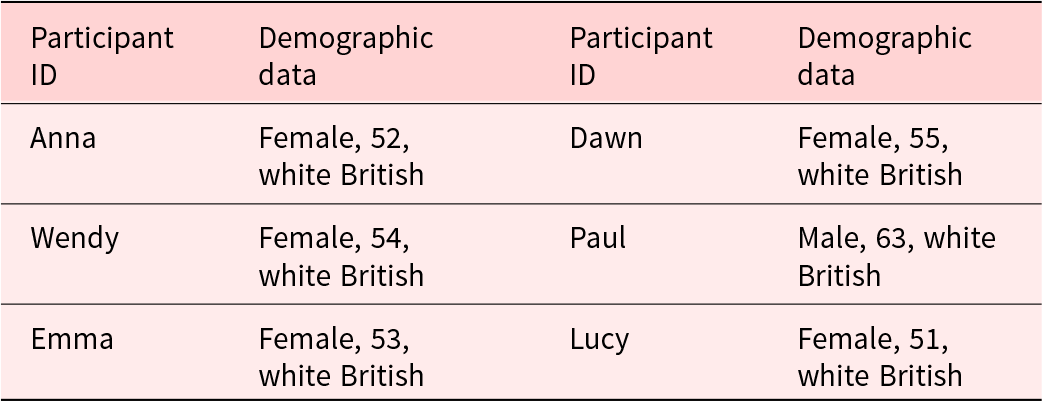
Summary participant information is given in Table 1. The sample comprised 6 service users. Pseudonyms have replaced participant names for anonymity.
Participant demographic data

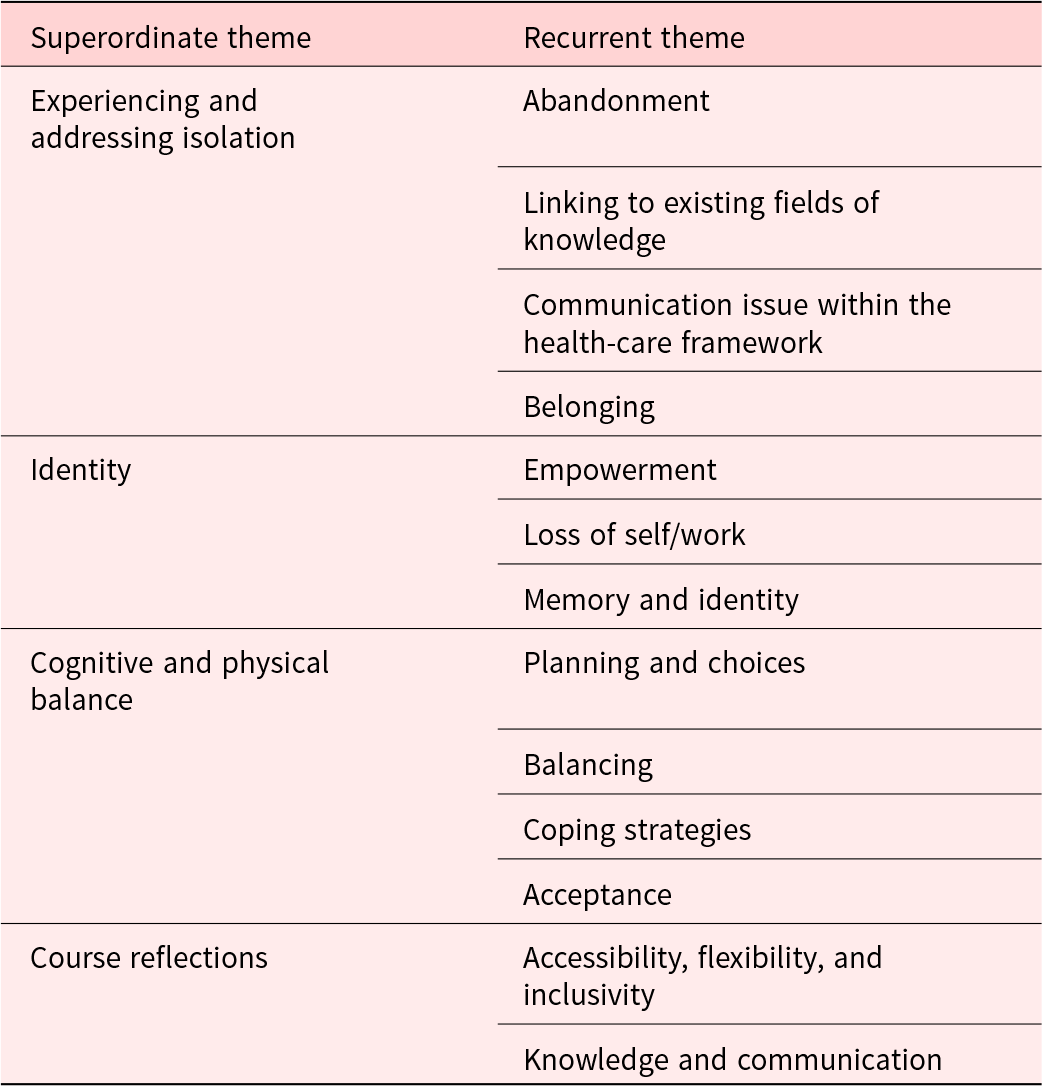
Four higher-order themes emerged from this analysis: experiencing and addressing isolation, identity, cognitive and physical balance, and course reflections. Each informed both aspects of the study aim: the lived experience of CRCC and the experience of CRI participation (Table 2).
Superordinate and recurrent themes

Theme 1: Experiencing and addressing isolation
Participants highlighted feelings of isolation posttreatment: being expected to return to normality but feeling alone while dealing with an unanticipated, unknown cognitive side effect that impacted daily functioning. All participants believed that the intervention addressed isolation. There were 4 recurrent themes within this, abandonment, use of existing knowledge, communication, and belonging.
Abandonment
Participants reflected on feelings of abandonment conveying a finality and an assumption that normality returns as contributing to their isolation. Anna reflected on this experience when completing treatment: “There’s this misconception out there that you get out of treatment, you come back and that … you’re fine now … and nobody really understands the physical and definitely not the cognitive side effects of your cancer treatment.” This patient-perceived lack of understanding on the part of the medical community can lead to survivors living with symptoms of an unanticipated cognitive impairment, searching for understanding of their experience without any support network. As Wendy explained “I wasn’t expecting any sort of cognitive impact with my treatment, … and then I found that there was no obvious external help out there.”
Linking to existing fields of knowledge
Existing knowledge was an important resource for participants and a way of making sense of what was happening. Lucy, for example, reflected on how this informed her thoughts about what was happening to her; “am I getting signs of Alzheimer’s? That’s what I thought.” Anna described the following “I actually mentioned it to my oncologist. And the expression I used was ‘I feel like I’ve got early onset dementia.’” These demonstrate efforts made to make meaning of the experiences and label experiences based on prior knowledge.
Communication issue within the health-care framework
The intervention was noted as a mechanism by which further knowledge and, importantly, language could be developed to facilitate communication in this previously unknown health-care framework. As Emma indicates “This is getting told things on a course that you weren’t warned about or told by your specialists or doctors, so it’s nice to be enlightened, y’know, that this is something.” Or as Lucy said, “Why it isn’t, um why there isn’t something in the aftercare….”
Belonging
Participants reported that the course provided a sense of community and belonging with common experience of addressing isolation. Dawn disclosed “It was really really good…. Part of it was quite reassuring to think, well I’m not the only one…it was also nice to listen to other peoples” experiences which then reassured me. Similarly, Paul reported “…it’s actually quite comforting to just interface with people who have the same kind of problems. Just realizing that …, it’s not just me”
Theme 2: Identity
All participants reflected on the impact of CRCC on friendships, family, and life, leading some to question their own identity posttreatment. There were 3 recurrent themes here, loss, memory, and empowerment.
Loss of self/work
Returning to work can be challenging, or prohibitive, for some with CRCC, leading to questioning about their future work capacity, as Paul explains: “I recognized that my ability to concentrate had evaporated … And I just wondered … would this capability come back again. Would I be able to work again?.” Anna also reported that she would never be able to work as she had before “I continued to try and build my hours back up at work …. but never able to get back full time … the harder I tried, the worse it got.”
Memory and identity
Anna reflected on the importance of memory and summarized what it means for her as follows: “I guess with regard to memories, they’re so important because they form who you are.” This captures the impact of memory loss on a personal sense of identity, which can be experienced by someone living with CRCC in any home or work environment. Wendy also made reference to this stating “I think for your own sense of self. … If your thought process is changed then you lose that identity.”
Empowerment
Helping to address these issues associated with identity, participants reported the impact of feeling empowered by the information provided. Wendy, for example, approached her line manager regarding difficulties at work and suggested a work-around for herself, which led to organizational changes. Wendy explains: “Everybody was doing this … my boss then took it to her boss and said … this is actually highlighting the issue that my boss had as well. So from that, that’s actually spread throughout the (organization) … It’s very warming … because I’ve done something about the cognitive issues I’ve had, that’s actually helping other people.” This demonstrates Wendy, equipped with knowledge following the intervention, had become empowered to help both herself and others, in this instance at work. Or for Anna, the course helped build her confidence back “it (the course) gave me confidence … it gave me more confidence than I’d had for a long while.”
Theme 3: Cognitive and physical balance
Participants reported daily compromises, avoiding multitasking and embedding coping strategies within daily routine due to cognitive difficulties. Some strategies emerged independently, and others were learned through the intervention: furthermore, the CRI group format provided opportunity for idea exchange between participants, in addition to psychoeducation. Four recurrent themes emerged within this: planning and choices, balancing, coping strategies, and acceptance.
Planning and choices
Finding a route through CRCC can mean difficult daily choices as survivors try to return to normality as Anna explains: “I cannot in any way shape or form continue with the life I had before. Either physically or mentally.” Anna refers to the planning and compromises required to navigate a typical day and reduce the likelihood of cognitive overload, impacting physical well-being and vice versa. Paul reports he also had to make choices “when I was working I could deal with 6 or 7 complex things concurrently, what I discovered was, I can’t deal with more than one thing at a time.”
Balancing
A need to continually reassess or “balance” the cognitive load emerges. Anna states: “And everything is balanced.… I seem to bounce between my upper and lower parameters… it certainly isn’t what I had, but it is a quality of life. … I have these checks and balances every single day, because if I get it wrong, I’m no good to anybody, definitely not myself.” Similarly, Lucy reflects on the challenges of balancing stimuli in relation to undertaking individual tasks: “I’m much more distracted by any outside background noise … literally if somebody has the radio on now and is talking to me I can’t” and consequently makes strategic choices for daily activities “I probably don’t listen to as much music as I used to unless I’m focusing on listening to it. If I’m doing something that requires brain power I have to have quiet.”
Coping strategies
Participants benefited from learning and sharing tips and simple techniques to offset the impact of CRCC on their daily lives. Paul explains: “I think it was important to pick up a couple of strategies that you might think your granny would do like put things in bowls, keys in bowls, put the same thing in the same place. There were all sorts of strategies in place and I framed my life in terms of what value and key decisions in a framework.” Anna highlights an exercise from the Memory session regarding cognitive capacity: “What was really really beautiful for me was the bucket. Your daily bucket. And um, what goes in and what comes out. And not letting it overflow … I’ve used that tool as my daily bucket image to help me balance my days now.”
In this way, participants have embedded both practical and psychoeducational aspects of the course into their daily lives.
Acceptance
Emma reflects on another aspect of the course: “…finding y’know that other people are in the same situation as you, and being able to accept that as part of the process is good, you know. it kind of eases the stress of things not being quite right and an acceptance that obviously it does, it does have a bearing.” This indicates that providing information and a structured network of support can lead to acceptance of a new normal. Wendy also focused on acceptance stating “… I was never looking for the normal I had, I understood that was gone. It was really to see how to improve it the most.”
Theme 4: Course reflections
All participants reflected on the intervention, providing feedback regarding what resonated for them, and highlighted possible improvements. There were 2 recurrent themes here, first, accessibility, flexibility, and inclusivity and second, knowledge and communication.
Accessibility, flexibility, and inclusivity
Most participants highlighted course design and structure as concise and responsive to their needs as individuals and collectively. Anna, who participated in early sessions of the first group, then rejoined a later group, reflects on course content: “The first course we were inundated with papers, leaflets about it. The second course had refined it a bit more … we focused much more on the (work)book … they were learning as well.” Wendy highlights course delivery: “the way (the psychologist) did it, it was really led by the participants. So we changed it as we went, it wasn’t just ‘answer this question’ … it was sort of guided towards us …. But how the group got to that point was how we needed to get to that point. I really liked that.”
Lucy reflected on the online format, which for most study participants was adapted from an in-person setting due to pandemic restrictions: “I’ve managed to meet with people who are on the other side of Scotland which is wonderful … I probably wouldn’t have been able to physically be somewhere, so I think that they should certainly look at the groups that meet online.”
Therefore, course adaptation enabled the intervention to reach more participants, helping address the sense of isolation experienced.
Knowledge and communication
Communication and knowledge imparted gave a sense of belonging and met the need for psychoeducation. Emma expands on this: “…once I’d went on the course … and I realized that … other people who’d been through cancer treatment struggled with the same things. And you know that made me feel better, because I understood that it was something more normal after treatment. As I say, I wasn’t warned about it by any Dr or specialists.” Dawn reflected on the course content, highlighting information that resonated with her own experience: “…when they sent out the pack for the intervention, there’s a part, quite near the beginning, where somebody has written their experience … suddenly, in meetings they were not able to recall things. And when I read it I thought that describes exactly what happened to me. And it actually made me feel better.” However, participants, unaware of what caused their CRCC, mostly discovered the intervention by chance. Dawn explains: “I didn’t know anything about it in my first chemo, it was only by accident that I found it this time and it has been really beneficial.”
This highlights that more needs to be done, to both increase awareness of CRCC among health professionals and to promote availability of CRI interventions.
Discussion
The hermeneutic approach within IPA facilitated tentative conclusions to be drawn regarding participants’ experience of CRCC and the intervention. Four superordinate themes emerged from the data. These were experiencing and addressing isolation, identity, cognitive and physical balance, and course reflections.
Experiencing and addressing isolation
A perceived assumption that normality would return conflicted with participants’ experiencing of diverse and wide-ranging ongoing issues, including CRCC. This resonates with a report from Macmillan Cancer Support (2013), highlighting seemingly little acceptance both within health care and generally of commonly experienced long-term emotional and physical side effects. Indeed, an expectation that survivors usually recover within a year (Galgut Reference Galgut2020) could explain the lack of support and therefore sense of isolation experienced by those with CRCC.
Participants therefore sought meaning from their existing field of knowledge, with some linking their CRCC experience with early onset Alzheimers’ disease or menopause. The psychoeducational course elements were therefore described as enlightening: this new information enhanced their understanding of CRCC. Indeed, mixed methods longitudinal research has found psychoeducational support for women with breast cancer and family involvement delivers the best positive outcomes (Cipolletta et al. Reference Cipolletta, Simonato and Faccio2019). Participants highlighted the lack of communication from health-care professionals, with most stating that they would have preferred to know about the possibility of developing CRCC pretreatment, consistent with past research findings (Boykoff et al. Reference Boykoff, Moieni and Subramanian2009; Cappiello et al. Reference Cappiello, Cunningham and Knobf2007; Rust and Davis Reference Rust and Davis2013; Von Ah et al. Reference Von Ah, Storey and Jansen2013b).
The course addressed isolation and abandonment: the group-participation format provided reassurance that they were not alone. This sense of belonging to a group whose experience resembled their own suggests validation of their experiencing.
Identity
Participants’ reflected on how the course helped empower them in different ways and environments, improving issues around lost confidence from perceived diminished cognitive function. This empowerment suggests a belief that they perceive the intervention as improving their cognitive abilities, consistent with recent findings using psychometric measures within quantitative studies into CRIs (Dos Santos et al. Reference Dos Santos, Hardy‐Léger and Rigal2020; Mihuta et al. Reference Mihuta, Green and Shum2018; Myers et al. Reference Myers, Cook-Wiens and Baynes2020). However, others reflected on their lost sense of self, with most making reference to the high-level executive functioning required within their now former demanding work roles. Indeed, around one-third of working age cancer survivors are unable to return to work and those who do may experience problems (Duijts et al. Reference Duijts, Spelten and Verbeek2014). One meta-analysis found that cancer survivors are 1.4 times (95% CI 1.2–1.6) more likely to be unemployed than individuals without a cancer diagnosis (De Boer et al. Reference De Boer, Taskila and Ojajärvi2009).
More broadly, participants linked their impaired cognition to changes not only in the work environment but also in relationships with friends and family. They identified memory as important in underpinning their identity within family and social circles, seeking ways to address this in order to move forward with their life. From this, the third theme emerges.
Cognitive and physical balance
Participants spoke of making compromises in order to live meaningfully and within their available energy resources, planning their day and making choices. This seems to be a constant exercise of self-re-evaluation as survivors seek to resume life activities with reduced cognitive capacity. Multitasking is impaired, with some participants finding they can only focus on one task at a time, removing distraction such as background noise from radios or telephones. Fatigue and anxiety are common side effects of cancer treatment among breast cancer patients, impacting QoL (Bower et al. Reference Bower, Ganz and Irwin2021; Williams et al. Reference Williams, Khan and Heckler2021). While some studies of noncentral nervous system cancers have found cognitive changes primarily associated with chemotherapy (Schagen et al. Reference Schagen, Muller and Boogerd2006; Wefel et al. Reference Wefel, Lenzi and Theriault2004), other factors may include fatigue and mood (Hermelink et al. Reference Hermelink, Bühner and Sckopke2017; Schagen and Wefel Reference Schagen and Wefel2017).
Coping strategies were highlighted as vital, with participants finding ideas shared among themselves and psychoeducation within the course as helpful for meaningful understanding of their experience and their ability to manage their day-to-day activities both cognitively and physically. These findings support past studies, which found that survivors recognized consistently locating items such as car keys and mobile phones avoids misplacing them, thereby alleviating disruption associated with their loss (Boykoff et al. Reference Boykoff, Moieni and Subramanian2009; Fitch et al. Reference Fitch, Gray and Godel2008; Mulrooney Reference Mulrooney2008). Furthermore, they found that the psychoeducation helped with both managing their day and explaining their experience to family, friends, and work colleagues: previous research has found that survivors wanted information to be shared with these groups (Munir et al. Reference Munir, Burrows and Yarker2010; Myers Reference Myers2012).
Most participants found that the group format helped them reach an acceptance of their changed cognitive functioning, addressing issues related to QoL. This is consistent with recent findings using psychometric measures of QoL within quantitative studies into CRIs (Dos Santos et al. Reference Dos Santos, Hardy‐Léger and Rigal2020; Green et al. 2018; Liang et al. Reference Liang, Erich and Bailey2019; Mihuta et al. Reference Mihuta, Green and Shum2018; Myers et al. Reference Myers, Cook-Wiens and Baynes2020).
Course reflections
Participants reflected positively on the course, highlighting benefits of both online and in-person group sessions and appreciation of participant-led content. The workbook format was well received as easily digestible and welcomed as psychoeducation regarding CRCC impact and mitigation strategies. All participants highlighted lack of prior knowledge and communication of information about CRCC, which raises the question of psychoeducation for not only cancer patients but also for health professionals involved in their care.
Study limitations
Limitations include the fairly homogenous sample of predominantly female, white, middle-aged participants. Nevertheless, recruitment self-selection impedes ability to mitigate this and is a further limitation: all participants were positive about the course, but others who did not volunteer may have had course-related reasons for choosing not to do so. This would have been insightful to explore. Furthermore, while justification for sample size is provided within the methodology (Smith et al. 2009), authors acknowledge that sample homogeneity may impact saturation and therefore generalizability of this research. Finally, this research did not consider the potential benefits of participation, which may only emerge in the longer-term, post-intervention.
Clinical implications
Findings from this study suggest that MCCCT is a viable CRI to educate and mitigate the impact of CRCC symptoms, supporting its continued clinical implementation and recommending further dissemination in health-care settings. Health professionals’ awareness of and consequent ability to signpost appropriate support is essential. Ability to access the course either in-person or online expands its potential reach to more individuals experiencing CRCC.
Conclusion
CRCC impairs daily functioning for some cancer survivors, leading to feelings of isolation. This is exacerbated by lack of prior communication within the health-care environment regarding the possibility of developing cognitive impairment and what support is available. By providing a strategy and psychoeducation-based course within a group setting, this CRI mitigated issues reported by participants, including isolation and impact on identity, through providing both strategy training and a platform for participants to share their own experiencing and ideas. This research suggests that MCCCT is a suitable CRI for those self-reporting CRCC and seeking support with its cognitive impact. Dissemination to health-care professionals involved with cancer patients is recommended, and future research should explore the longer-term outcomes from MCCCT participation and its impact on participants’ daily functioning.
Acknowledgments
First and foremost, sincere thanks are extended to all participants who gave up their time to contribute their experience and insight to this study. Sincere thanks are also extended to Dr Lesley Howells and the team at Maggie’s Centers for their partnership in this study and to Dr Natalie Rooney and Dr Chris Hewitt for supporting this research at the outset.
Funding
This research received no specific grant from any funding agency, commercial, or not-for-profit sectors.
Competing interests
The authors declare none.

 Open access

