

1. Introduction
The relationship between female employment and fertility has attracted economists’ attention in recent decades. Understanding the mechanisms underlying such a relationship is important for several reasons. First, childbirth may affect the choice between market and non-market work, as an increase in women’s reservation wages may reduce female labor supply. This may have consequences for the short and long-run perspectives of the career paths of mothers and future fertility decisions. Second, although female employment has risen in high-income countries (Bar et al., Reference Bar, Hazan, Leukhina, Weiss and Zoabi2018), reaching desirable levels of labor market integration remains a goal for many governments, especially in Southern Europe. Finally, since the 1970s, fertility rates have experienced a long-term decline, falling below the population replacement rate (i.e., Bloom et al., Reference Bloom, Kuhn and Prettner2024). After a brief recovery in the early 2000s, fertility dropped again following the Great Recession (1.21 in Italy and 1.12 in Spain in 2023, Eurostat).
The negative relationship between female labor supply and fertility was a staple in this stream of literature, as determined by two key ideas, that is, the quantity–quality trade-off proposed by Becker (Reference Becker and Roberts1960), and the opportunity cost of women’s time (e.g., Hotz et al., Reference Hotz, Alex Klerman, Willis, Rosenzweig and Stark1997). More recently, however, empirical evidence on high-income countries has shown a weakening of the negative relationship (e.g., Del Boca, Reference Del Boca2002, Apps & Rees, Reference Apps and Rees2005). At the macroeconomic level, the association between female employment and total fertility rates has even reversed its sign, becoming positive. Researchers highlighted that various mechanisms may explain such evidence. The reduction of the quantity–quality trade-off because of the expansion of public education and the reduction of the opportunity cost of women’s time due to the marketization of childcare are possible explanations (e.g., Doepke et al., Reference Doepke, Hannusch, Kindermann, Tertilt, Lundberg and Voena2023), as well as the flexibilization of the labor market (e.g., Del Boca & Sauer, Reference Del Boca and Sauer2009; Del Bono et al., Reference Del Bono, Weber and Winter-Ebmer2012, Reference Del Bono, Weber and Winter-Ebmer2015). Adequate public policies related to childcare provision, taxation, and parental leave are prominent explanations for the reverse association between female labor supply and fertility within the country and contribute to clarifying the existing differences across countries. The expenditure for early childhood education and available and accessible public childcare may positively affect the total fertility rate and female employment (Brilli et al., Reference Brilli, Del Boca and Daniela Pronzato2016).
Family policies for mothers’ labor market outcomes and fertility have been widely debated. Olivetti and Petrongolo (Reference Olivetti and Petrongolo2017), stressed that their effects are mixed, depending on mothers’ skill levels, pre-birth earnings, or family conditions.Footnote 1 The European debate highlighted the different roles of cash and in-kind benefits in promoting female employment and combating child poverty, suggesting a more effective role for in-kind transfers (e.g., Nygård et al., Reference Nygård, Lindberg, Nyqvist and Härtull2019; Esping-Andersen, Reference Esping-Andersen2005).
We offer an empirically based perspective on how childbirth affects female employment in Europe, using 2003–2020 longitudinal sections of the EU-SILC microdata. We focus on seven European countries: Denmark, the UK, the Netherlands, France, Italy, Spain, and Poland, chosen within each welfare regime for their relatively large population and sample size. These countries represent different European welfare regimes (social-democratic, liberal, conservative, Mediterranean, and Eastern), and they differ in generosity, structure, and recent patterns of family policies. Including both early- and late-developing welfare models from diverse geographic and cultural contexts strengthens the robustness of our analysis.
While the literature on how family measures may affect fertility decisions is well established (e.g., Bergsvik et al., Reference Bergsvik, Fauske and Hart2021), several papers mainly focused on the direct motherhood effect on wage and employment penalties against females (Angrist & Evans, Reference Angrist and Evans1998; Gutiérrez-Domènech, Reference Gutiérrez-Domènech2005; Datta Gupta et al., Reference Datta Gupta, Smith and Verner2008; Del Boca & Sauer, Reference Del Boca and Sauer2009; Herrarte et al., Reference Herrarte, Moral-Carcedo and Sáez2012; Davia & Legazpe, Reference Davia and Legazpe2014; Brilli et al., Reference Brilli, Del Boca and Daniela Pronzato2016; Kleven et al., Reference Kleven, Landais, Posch, Steinhauer and Zweimüller2019; Kleven, Reference Kleven2022; and Kleven et al., Reference Kleven, Landais and Leite-Mariante2025). However, only recently has a growing body of literature focused on whether and how expenditure for family policies may mitigate the effect of motherhood on labor outcomes, providing evidence on both wage and employment effects (e.g., Kunze, Reference Kunze2016; Olivetti & Petrongolo, Reference Olivetti and Petrongolo2017; Chirkova, Reference Chirkova2019; Hook & Paek, Reference Hook and Paek2020; Sung-Tae & Sun-Moon, Reference Sung-Tae and Sun-Moon2024).
We contribute to this latter stream of literature by exploiting time and geographical variations in the data to highlight the role of family policies in reconciling female work and motherhood and how childbirth effects have changed over time. European labor markets, total fertility rates, and public policies faced important changes in that period because of the Great Recession and the adoption of austerity measures.
In line with the literature assuming a lifecycle perspective (e.g., Nakamura & Nakamura, Reference Nakamura and Nakamura1985; Carrasco, Reference Carrasco2001; Michaud & Tatsiramos, Reference Michaud and Tatsiramos2011), we model the employment-childbirth relationship using a dynamic bivariate empirical strategy to account for the dynamic interrelation between the two processes and the potential endogeneity of childbirth decisions.
Our analysis reveals that the average effect of childbirth on female employment diverges across countries and persists in the medium term. The effect strengthened in several countries, such as the UK, France, Italy, and Spain. We also noted a polarization in fertility decisions between previously employed and non-employed females.
Higher expenditure on family policies is associated with higher employment levels of new mothers. Disentangling the contribution of cash and in-kind transfers, however, reveals that cash transfers are associated with declining employment probabilities of new mothers, while in-kind transfers have an opposite effect. The contribution of specific measures, such as family allowances, birth grants, or child day-care, is mixed.
The paper is organized as follows. Section 2 reviews the existing literature. Section 3 offers a background on public policies for children in the countries explored. Section 4 describes the empirical model. Section 5 presents the dataset and provides descriptive statistics. Section 6 discusses the main findings, and Section 7 offers some concluding remarks.
2. Literature
There is a strand of literature exploring the relationship between fertility and (female) labor supply, that is, labor market participation. In broad terms, given the wide and long-standing interest in the link between childbearing and labor supply, hundreds of empirical studies have estimated this relationship.
The majority of these studies, for many years, found a negative association between fertility and female labor supply (i.e., Angrist & Evans, Reference Angrist and Evans1998; Del Boca & Sauer, Reference Del Boca and Sauer2009; Herrarte et al., Reference Herrarte, Moral-Carcedo and Sáez2012). The negative sign of this relationship was due to both economic and demographic issues. Having fewer children subsequently increased female labor market attachment, a trend that began in the postwar period (i.e., Blau & Grossberg, Reference Blau and Grossberg1992).
Some works found that decisions about fertility and labor market participation are interrelated and associated with both individual and household characteristics, especially the education of women (Hazan & Zoabi, Reference Hazan and Zoabi2015), the employment and earnings of all household members (Bar et al., Reference Bar, Hazan, Leukhina, Weiss and Zoabi2018), the availability of childcare services (Herrarte et al., Reference Herrarte, Moral-Carcedo and Sáez2012) and, more broadly, the role of institutions. As suggested by Del Boca (Reference Del Boca2002), for instance, several institutional rigidities limiting the availability of both part-time jobs and affordable childcare increased the costs of working for mothers, thereby explaining the low fertility and low labor market participation rates of women in the past. Moreover, the opportunity costs associated with childbirth, including the increasing labor market opportunities for women, may induce them to forgo having children to preserve their employment (Garibaldi & Wasmer, Reference Garibaldi and Wasmer2004; Bloom et al., Reference Bloom, Kuhn and Prettner2024).
However, many countries, including European and other developed countries, have experienced significant changes in female labor market participation and fertility over the last 40 years. Many countries have seen an increase in female labor market participation, especially among women with children (Del Boca & Sauer, Reference Del Boca and Sauer2009). As a result, the relationship between female labor force participation and fertility became even more complex over time (Bloom et al., Reference Bloom, Kuhn and Prettner2024).
In the last 20 years, empirical evidence on high-income countries has shown a weakening or even a reversal of the negative relationship (see, for instance, Michaud & Tatsiramos, Reference Michaud and Tatsiramos2011; Doepke, Reference Doepke, Hannusch, Kindermann, Tertilt, Lundberg and Voena2023). Researchers have highlighted various competing mechanisms contributing to the explanation of the reversed relationship.
These include the expansion of public education, the reduction of the opportunity cost of women’s time due to the marketization of childcare in high-income countries (e.g. Doepke et al., Reference Doepke, Hannusch, Kindermann, Tertilt, Lundberg and Voena2023), family policies – that is, benefit schemes (Gonzalez & Trommlerova, Reference González and Trommlerová2023) – and the availability of public childcare (Bauernschuster et al., Reference Bauernschuster, Hener and Rainer2016; Olivetti & Petrongolo, Reference Olivetti and Petrongolo2017), a stronger involvement of fathers in childcare (Doepke & Kindermann, Reference Doepke and Kindermann2019; Fanelli & Profeta, Reference Fanelli and Profeta2021), more favorable social norms that make more acceptable for women with children to work (Kleven et al., Reference Kleven, Landais, Posch, Steinhauer and Zweimüller2019), and the role of institutions and public policies (Del Boca & Sauer, Reference Del Boca and Sauer2009; Del Bono et al., Reference Del Bono, Weber and Winter-Ebmer2012, Reference Del Bono, Weber and Winter-Ebmer2015). Rindfuss et al. (Reference Rindfuss, Guzzo and Philip Morgan2003) and Brewster and Rindfuss (Reference Brewster and Rindfuss2000), for instance, argued that changes in the institutional context, such as changing social norms toward working mothers, evolving family policies (such as cash benefits and increasing childcare availability), all reduced the incompatibility between child-rearing and female employment (Kögel, Reference Kögel2004).
There is a strand of literature exploring the role of family/children policies (such as spending on cash and in-kind benefits) on the relationship between childbearing and female employment. However, the majority of studies available investigate the direct effect of such interventions on fertility, and not on the relationship between fertility and female employment. We try to fill this gap in the literature.
Gauthier and Hatzius (Reference Gauthier and Hatzius1997) explore the effect of family-friendly policies, such as cash and maternity benefits, on fertility in 22 industrialized countries from 1970 to 1990. Their findings suggest that cash benefits in the form of family allowances are positively related to fertility. Maternity leave, instead, did not appear to be significantly related to fertility. Bokun (Reference Bokun2024) studied the effect of a cash transfer program in Poland named Family 500+, introduced in 2015 to increase fertility and alleviate child poverty. D’Albis et al. (Reference D’Albis, Gobbi and Greulich2017) that middle-income women are the most affected by the lack of access to formal and accessible childcare.
Nygård et al. (Reference Nygård, Lindberg, Nyqvist and Härtull2019) suggest that spending on family benefits in kind (such as childcare) primarily aims to facilitate parental employment (Ferrarini, Reference Ferrarini2006), and they are often coupled with different cash transfers that provide some income protection for households (Esping-Andersen, Reference Esping-Andersen2005). Dinale (Reference Dinale2024) on OECD countries suggests that in-kind benefit provision has the most positive association with female employment and fertility, thereby confirming previous findings (Thévenon, Reference Thévenon2011; Brinton & Lee, Reference Brinton and Lee2016).
Finally, a few studies explored the effect of specific policy/institutional interventions by country aimed at increasing fertility as well as enhancing female employment. For Spain, Sánchez-Mangas and Sánchez-Marcos (Reference Sánchez-Mangas and Sánchez-Marcos2008) investigate the effects of a public policy introduced in 2003 aimed at reconciling family and work; for the UK, Francesconi and van der Klaauw (Reference Francesconi and van der Klaauw2007) explore the effect of “in-work” benefits to single mothers on female employment rates.
3. Employment, childbirth, and public policies
In this Section, we describe the evolution of the female employment rate for women aged 20–44Footnote 2 and total fertility ratesFootnote 3 from 1995 to 2021, as reported in Figs. 1 and 2 within welfare systems and family/children policies in the countries analyzed
Evolution of the female employment rate.
Source: Authors’ calculation on Eurostat data.

Figure 1a. Long description
The line graph illustrates the evolution of the female employment rate for women aged 20 to 44 from 1995 to 2021. The x-axis represents the years from 1995 to 2021, while the y-axis represents the employment rate in percentage, ranging from 40 to 85. The graph includes multiple colored lines representing different countries and regions: EU-27, Denmark, the United Kingdom, the Netherlands, France, Italy, Spain, and Poland. Each line shows the trend of the female employment rate over the years. Denmark and the Netherlands consistently have the highest employment rates, while Italy and Poland have the lowest. The EU-27 average shows a steady increase over the years. All values are approximated.
Evolution of childless women and mothers’ employment rates.
Source: Authors’ calculation on Eurostat data.

Figure 1b. Long description
The image contains four line graphs showing the employment rates of childless women and mothers with one, two, or three or more children from 2006 to 2021. Each graph represents different categories of women: childless women, women with one child, women with two children, and women with three or more children. The x-axis represents the years from 2006 to 2021, and the y-axis represents the employment rate percentage ranging from 35 to 90. The graphs include data for the EU-27 and several individual countries: Denmark (DK), the United Kingdom (UK), the Netherlands (NL), France (FR), Italy (IT), Spain (ES), and Poland (PL). Each country is represented by a different colored line. The employment rates for childless women show a general trend of stability with slight fluctuations. For women with one child, the employment rates are relatively high and stable. Women with two children show a gradual increase in employment rates over the years. For women with three or more children, the employment rates are lower but show a slight upward trend. The data indicates variations in employment rates across different countries and family structures. All values are approximated.
Evolution of the total fertility rate.
Source: Authors’ calculation on Eurostat data.

Figure 2. Long description
The line graph illustrates the evolution of the total fertility rate in various countries from 1995 to 2021. The x-axis represents the years, ranging from 1995 to 2021, while the y-axis represents the total fertility rate, ranging from 1.1 to 2.1. The graph includes multiple lines, each representing a different country or region: EU-27, Denmark, United Kingdom, Netherlands, France, Italy, Spain, and Poland. Each line shows the trend of the total fertility rate over the specified period. The lines for France and Denmark are at the top, indicating higher fertility rates, while the lines for Italy and Spain are at the bottom, indicating lower fertility rates. The other countries fall in between, with varying trends over the years. All values are approximated.
Notably, there are structural differences in EU countries both in the rate and in the evolution of the female employment rate. Among Mediter ranean countries, female employment rates were very similar in 2000 (49.6% in Italy and 51.9% in Spain), but the gap widened considerably over the following two decades. Italy recorded only a modest increase, whereas Spain saw a substantial rise (Fig. 1a). The rise in Spain’s female employment rate was driven by higher female educational attainment and the expansion of family–work reconciliation policies, which facilitated women’s access to skilled jobs and reduced barriers to maternal employment (Ibáñez, Reference Ibáñez2017; Duarte et al., Reference Duarte, Sarasa and Serrano2019). Conversely, Italy faces a “low-participation trap” due to high marginal taxes on second earners and chronic shortage of affordable childcare, which remains lower than in Spain (Reljic & Zezza, Reference Reljic and Zezza2025). In contrast, Denmark’s female employment rate has stayed high compared with other EU countries, though it declined slightly from 78% in 2000 to 75.9% in 2021, likely due to structural labor market factors such as widespread part-time work among women balancing childcare and family responsibilities (OECD, 2024; Eurofound, 2025). Female employment is also relatively high in the Netherlands and less affected by the recession (75.2% in 2000 to 79.4% in 2020). Overall, EU female employment followed a common trend: rising in the early 2000s, dropping during the Great Recession and austerity, then recovering in the late 2010s (Fig. 1).
Figure 1b reports employment rates for childless women and for mothers with one, two, and three or more children aged 20–49, documenting the motherhood employment penalty across the countries studied. Overall, childbirth is associated with lower female employment. Denmark displays a distinctive pattern, with employment increasing after the first and second child before declining among mothers with three or more children, reflecting extensive family-friendly policies (Pylkkänen & Smith, Reference Pylkkänen and Smith2004; Cebrián, Reference Cebrián, Davia, Legazpe and Moreno2019). By contrast, in Southern European countries such as Spain and Italy, employment drops sharply after the first child and continues to decline with subsequent births, reflecting more limited childcare provision and less flexible work arrangements (De Quinto et al., Reference De Quinto, Hospido and Sanz2021; Alderotti, Reference Alderotti2022). Across all countries studied, the transition to three or more children is consistently associated with reduced maternal employment, as cumulative care responsibilities outweigh policy support (Kleven et al., Reference Kleven, Landais and Leite-Mariante2025).
The fertility rate followed a similar pattern. After years of decline, fertility rates were increasing in late ‘90s in EU countries (later in the UK and Poland) until the Great Recession. Thereafter, fertility rates dropped, and only 10 years later, the fall stopped (Fig. 2).
Immigration contributed to aggregate fertility in Europe, especially in Southern countries such as Spain, where foreign-born women had higher fertility than natives in the late 1990s and early 2000s, partly offsetting the decline (Coleman, Reference Coleman2006; Sobotka, Reference Sobotka2008; Castro-Martín & Rosero-Bixby, Reference Castro-Martín and Rosero-Bixby2011). However, while immigration influenced fertility dynamics in specific periods, it does not explain persistently low fertility across Europe (Bloom et al., Reference Bloom, Kuhn and Prettner2024). The decline in fertility and female employment during the Great Recession reflects broader perceptions of uncertainty (Matysiak et al., Reference Matysiak, Sobotka and Vignoli2021), as economic downturns often reduce fertility and encourage postponement (Cherlin et al., Reference Cherlin, Erin Cumberworth, Morgan and Wimer2013). Such shocks affect fertility in both the short- and medium-long run, with rising unemployment historically linked to declines lagged by 1 to 2 years (Adserà, Reference Adserà2011; Neels et al., Reference Neels, Theunynck and Wood2013). Evidence after 2008 confirms these pro-cyclical patterns, with fertility rates declining or stabilizing across most European countries, particularly in Southern and parts of Central and Eastern Europe (Lanzieri, Reference Lanzieri2013).
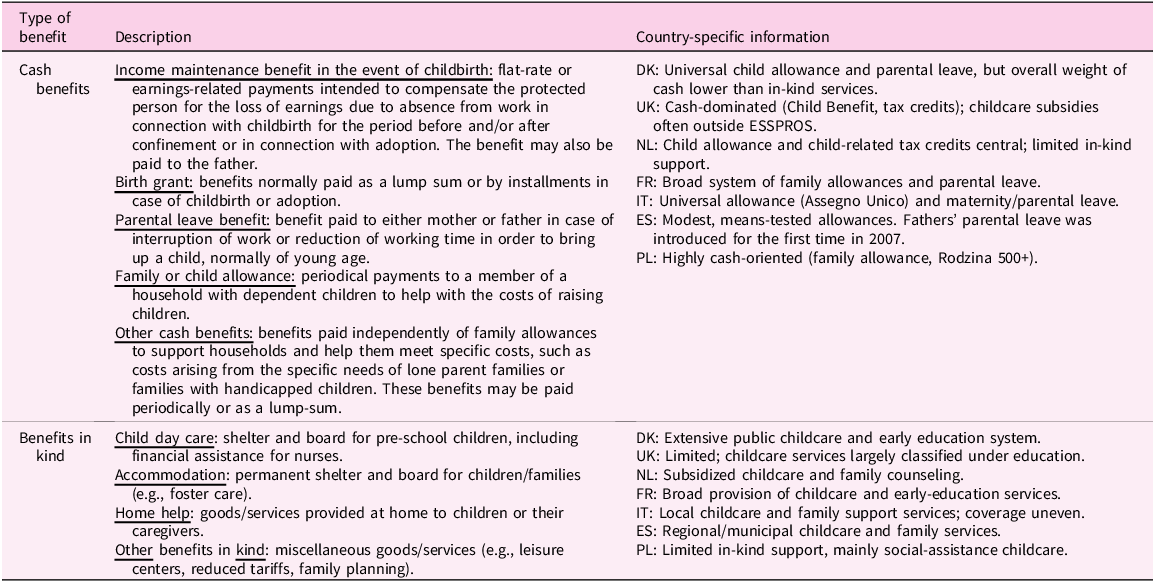
France maintained relatively high fertility, supported by state policies for working mothers, childcare, and child transfers, while female employment rose from 64.8% in 2000 to 69.3% in 2020, only marginally affected by the Great Recession (Thévenon & Gauthier, Reference Thévenon and Gauthier2011). Poland saw rising female employment (59.3% in 2000 to 67.1% in 2008) and a modest fertility increase before the recession, but fertility remained low due to demographics, motherhood costs, and limited labor participation (Suwada, Reference Suwada2021). In the Nordic countries, fertility declined during the Great Recession despite mild economic shocks, though Denmark experienced pre-recession and 2016–2017 fertility rises, remaining above Poland (Comolli et al., Reference Comolli, Neyer, Andersson, Dommermuth, Fallesen, Jalovaara, Jónsson, Kolk and Lappegård2019; Fig. 2). These trends unfolded within fragmented welfare systems and varying levels of family policy expenditure. For the family/children function, social (protection) benefits provide support in cash or in kind in connection with the costs of pregnancy, childbirth, and adoption, bringing up children, and caring for other family members (for details, see Eurostat, 2008). For the definitions of cash benefits and benefits in kind for the family/children function, see Table 1.
Classification of benefits in the Family/Children function and country-specific information

Table 1. Long description
The table presents a comparison of various types of benefits related to family and children support across different countries. It is structured into three main columns: Type of benefit, Description, and Country-specific information. The table has multiple rows detailing different benefits such as cash benefits, including income maintenance benefits, birth grants, parental leave benefits, family or child allowances, and other cash benefits. It also covers benefits in kind, such as child day care, accommodation, home help, and other benefits in kind. Each type of benefit is described, and country-specific information is provided for Denmark, the United Kingdom, the Netherlands, France, Italy, Spain, and Poland. The table highlights the variations in family support policies and expenditures across these countries.
Source: ESSPROS, Eurostat (2008) and Social protection statistics, Eurostat (2023).
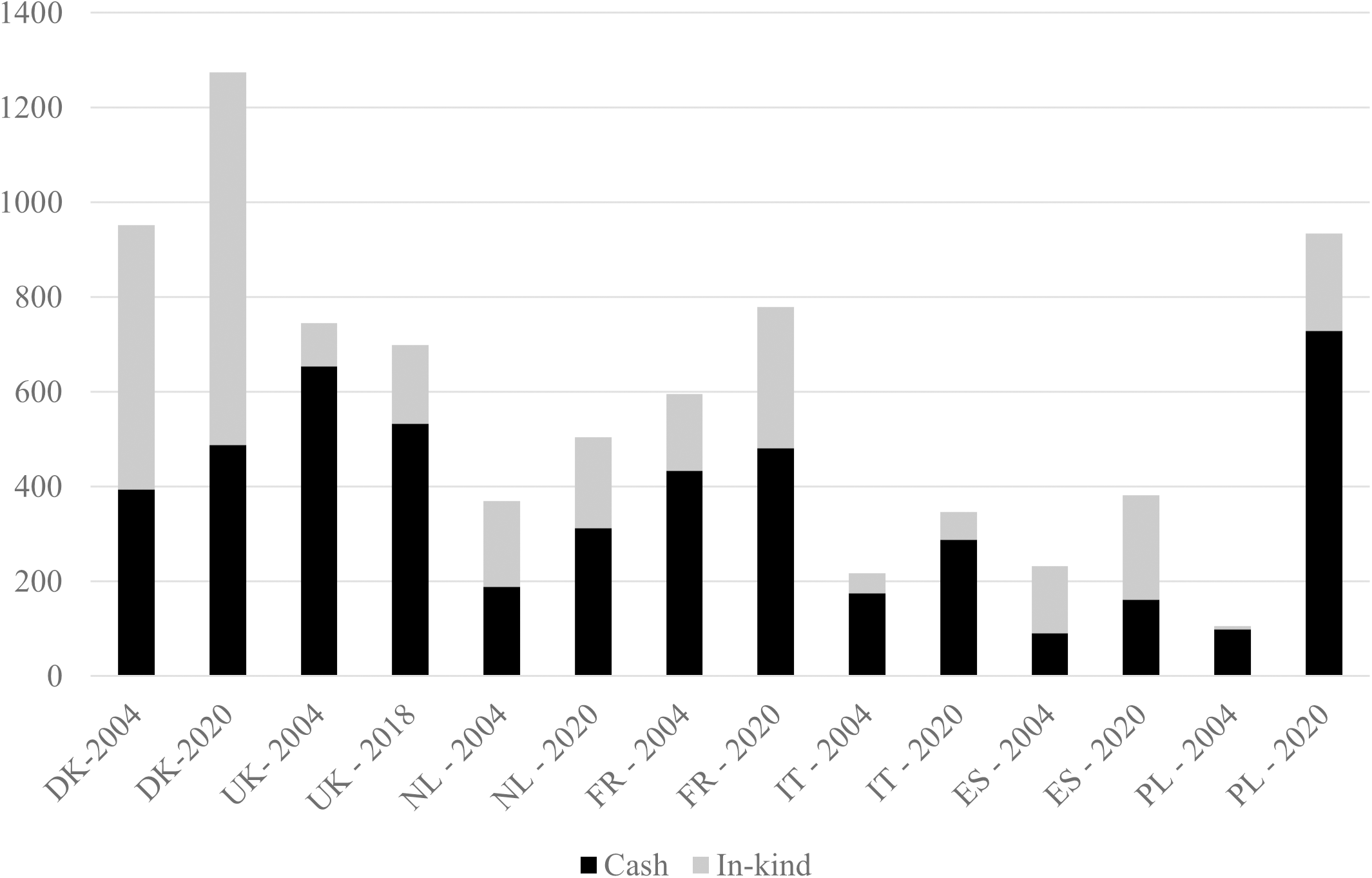
Notably, the composition of the overall expenditure on family/children benefits, according to Eurostat data, differs importantly across the countries explored.Footnote 4 Figure 3 shows the composition and evolution of the expenditure for family policies, namely cash and in-kind benefits. Overall, we note an increase in social expenditure in all countries from 2004 to 2020 and a prevalence of the cash benefits component. For the year 2020, we see that in France, Italy, the Netherlands, Poland, and the UK, periodic cash benefits are the most important component of the total expenditure on family/children benefits. Denmark and Spain, instead, see a prevalence of the in-kind component.
Composition and evolution of expenditure for family policies.
Source: Authors’ calculation on Eurostat data. Note: PPS euros per inhabitant.

Figure 3. Long description
The bar graph compares cash and in-kind expenditures for family policies across various countries and years. The x-axis lists countries and years, including Denmark 2004, Denmark 2020, United Kingdom 2004, United Kingdom 2018, Netherlands 2004, Netherlands 2020, France 2004, France 2020, Italy 2004, Italy 2020, Spain 2004, Spain 2020, Poland 2004, and Poland 2020. The y-axis measures expenditure levels ranging from 0 to 1400. Each country-year pair has two bars: one for cash expenditures in black and one for in-kind expenditures in gray. Notable trends include significant increases in both cash and in-kind expenditures from 2004 to 2020 for most countries, with the United Kingdom 2020 showing the highest in-kind expenditure. All values are approximated.
Nygård et al. (Reference Nygård, Lindberg, Nyqvist and Härtull2019) show a stable growth in GDP-related and real levels of spending on both cash benefits and in-kind benefits. From Fig. 3, we see that all the countries analyzed show an increase in spending on cash benefits, in some cases even exceeding the increase in in-kind benefits (e.g., the Netherlands, Spain, and Italy). However, spending on benefits in kind was more efficient for alleviating child poverty than spending on cash benefits (e.g., Esping-Andersen, Reference Esping-Andersen2005, and Ferrarini, Reference Ferrarini2006).
More specifically, according to the family policy regime literature, countries in Europe used a mix of “transfer-based” and “service-based” policies (i.e., Korpi, Reference Korpi2000; Ferrarini, Reference Ferrarini2006). Countries of the Nordic regime, such as Denmark, have generally invested heavily in in-kind benefits, but also in transfers to families. These countries display relatively higher levels of female labor force participation. Countries in the Continental regime, such as France, have traditionally used relatively generous cash benefits and tax credits, whereas spending on in-kind benefits has been low (Mahon, Reference Mahon2002; Hemerijck, Reference Hemerijck2013). In the Anglo-Saxon market-based family regime, for instance, in the UK, governments generally spend less on direct cash benefits to families, but more on tax subsidies for market-provided childcare services. This has made mothers more inclined to part-time rather than full-time employment (Esping-Andersen, Reference Esping-Andersen2009). In Mediterranean countries, family cash benefits have generally been modest, and in-kind benefits almost non-existent, with low levels of female employment (Nygård et al., Reference Nygård, Lindberg, Nyqvist and Härtull2019). However, in some countries, such as Spain, there was a shift toward de-familizing family policies, including higher childcare provision and increased family benefits, in the 1990s and early 2000s (Ahrendt et al., Reference Ahrendt, Blum and Crepaldi2015). By contrast, Eastern European countries (i.e., Poland) share a legacy of broad coverage of public social services from the communist era. They have also used a transfer-based strategy, although the generosity level has been lower than in the Nordic and Continental countries (Saxonberg & Szelewa, Reference Saxonberg and Szelewa2007).
On the whole, the importance of in-kind benefits seems to have grown since the 1990s, largely driven by the expansion of childcare/day-care provision. This, together with the austerity era, as suggested by, among others, Farnsworth and Irving (Reference Farnsworth, Irving, Farnsworth and Irving2015), made in-kind benefits even more relevant. There is a substantial body of literature suggesting that in-kind benefits, particularly childcare services, positively influence female labor force participation (Del Boca et al., Reference Del Boca, Pasqua and Pronzato2005; Bárcena-Martin et al., Reference Bárcena-Martin, Lacomba-Arias, Moro-Egido and Pérez-Moreno2014; Ahrendt et al., Reference Ahrendt, Blum and Crepaldi2015; Chzhen Reference Chzhen2017).
4. Econometric approach
In line with the life cycle approach proposed by Nakamura and Nakamura (Reference Nakamura and Nakamura1985), we adopt a dynamic approach to model employment and fertility choices. We tackle their dynamic interrelation and the existence of endogeneity issues (e.g., Del Boca et al., Reference Del Boca, Pasqua and Pronzato2005) by incorporating state dependence, endogenous initial conditions, and potential feedback effects from employment to future fertility decisions (e.g., Carrasco, Reference Carrasco2001, Michaud & Tatsiramos, Reference Michaud and Tatsiramos2011). Because both employment and childbirth are binary variables, our specification results in a dynamic bivariate probit model, which we apply to each analyzed country.
Let e it represent the employment status of individual i = 1…n at time t = 1…T, the benchmark specification of female employment reads: ${e_{it}} = 1\left\{ {\gamma {e_{it - 1}} + \beta {b_{it}} + \delta {b_{it - 1}} + \omega {x_{it}} + \vartheta {z_i} + {a_i} + {u_{it}} \gt 0} \right\}$
where 1 is a binary indicator function, e it−1 is the lagged employment status, b it is a dummy variable indicating whether a child was born in the current (surveyed) year or not, b it−1 is the lagged childbirth dummy variable, while x it and z i are vectors of strictly exogenous time-variant and time-invariant (respectively) individual and household characteristics.Footnote 5 γ is the state dependence parameter, β is the parameter of interest describing the impact of childbirth on female employment, δ measures the impact of past childbirth, while ω, ϑ, and φ are sets of parameters to be estimated. Finally, a i and u it represent the unobserved time-invariant individual effect and the idiosyncratic error term; we assume that these are both normally distributed and that u it is not serially correlated.
The childbirth equation reads as: ${b_{it}} = 1\left\{ {\alpha {e_{it - 1}} + k{b_{it - 1}} + \tau {x_{it}} + \varphi {z_i} + \lambda {m_{it}} + {h_i} + {\varepsilon _{it}} \gt 0} \right\}$
where m it is a variable indicating if the first-born is male or not and introduced for identification purposes, h i is the random effects term, and εit is an idiosyncratic error we assume to be normally distributed. α, κ, τ, φ, and λ are parameters to be estimated.
The so-called initial conditions problem (Heckman, Reference Heckman, Manski and McFadden1981), due to the potential misalignment between the start of the observed data and the beginning of the analyzed process, is addressed using an alternative conditional maximum likelihood (CML) estimator proposed by Wooldridge (Reference Wooldridge2005).Footnote 6 This requires specifying the conditional densities of the unobserved effects via the following auxiliary models: ${a_i} = {\theta _0} + {\theta _1}{e_{i1}} + {\theta _2}{b_{i1}} + {\theta _3}{\bar x_i} + {\mu _i}$ ${h_i} = {\pi _0} \pm {\pi _1}{e_{i1}} + {\pi _2}{b_{i1}} + {\pi _3}{\bar x_i} + {\varepsilon _i}$
Where e
i1
is the initial employment status, b
i1
is the value of the childbirth dummy variable at time 1, ${\bar x_i}$
is a set of time-averaged time-variant control variables calculated from periods 2 to T.Footnote
7
Finally, θ
k
and π
k
are parameters to be estimated.
${\bar x_i}$
is a set of time-averaged time-variant control variables calculated from periods 2 to T.Footnote
7
Finally, θ
k
and π
k
are parameters to be estimated.
Finally, because unobservable factors such as norms, employer discrimination, and sectoral shocks may affect both equations,Footnote
8
we model the correlation between unobserved heterogeneity terms to reduce the potential risk of bias when estimating the effect of childbirth on employment. Their association is captured by the correlation term $\rho = {{corr}}\left( {{\mu _i},{\varepsilon _i}} \right) $
.Footnote
9
$\rho = {{corr}}\left( {{\mu _i},{\varepsilon _i}} \right) $
.Footnote
9
Based on the benchmark specification, we run two augmented models. The former estimates the change in childbirth effects on female employment over time, the latter analyses how family policies shape childbirth effects.
In the former specification, the childbirth indicator in the employment equation and the lagged employment indicator in the childbirth equation interact with a categorical variable identifying four distinct periods: the pre-Great Recession period (2003–2007), the Great Recession period (2008–2009), the Austerity period (2010–2014), and the post-Great Recession period (2015–2020). The two equations are then modified as follows ${e_{it}} = 1\left\{ {\gamma {e_{it - 1}} + \beta \left( {{b_{it}}*perio{d_i}} \right) + \delta {b_{it - 1}} + \omega {x_{it}} + \vartheta {z_i} + {a_i} + {u_{it}} \gt 0} \right\}$ ${b_{it}} = 1\left\{ {\alpha \left( {{e_{it - 1}}\;*perio{d_i}} \right) + k{b_{it - 1}} + \tau {x_{it}} + \varphi {z_i} + \lambda {m_{it}} + {h_i} + {\varepsilon _{it}} \gt 0} \right\}$
In the latter specification, the childbirth indicator in the employment equation interacts with several family policy indicators, which are included in the childbirth equation as controls. We consider the total expenditure for family policies, expenditure for cash and in-kind benefits, and expenditure for specific measures, including family allowances, income maintenance, birth grant, child day-care, and accommodation. In a supplementary exercise, we consider labor market conditions and characteristics, namely female part-time employment, female fixed-term employment, and female unemployment.
In this case, we pool information for the seven countries (c subscript) to exploit the geographical variations. The related equations read: ${e_{itc}} = 1\left\{ {\gamma {e_{itc - 1}} + \beta \left( {{b_{itc}}*family\;polic{y_{tc}}} \right) + \delta {b_{itc - 1}} + \omega {x_{itc}} + \vartheta {z_{ic}} + {a_{ic}} + {u_{itc}} \gt 0} \right\}$ ${b_{itc}} = 1\left\{ {\alpha {e_{itc - 1}} + k{b_{it - 1}} + \tau {x_{itc}} + \varphi {z_{ic}} + \lambda {m_{itc}} + \varsigma \;family\;polic{y_{tc}}\; + \;{h_{ic}} + {\varepsilon _{itc}} \gt 0} \right\}$
Finally, we emphasize that although the estimated coefficients indicate the sign of the relationship, they are not suitable for determining the magnitude of the impact between the outcome and explanatory variables. Therefore, we compute and report the average marginal effects (AMEs).
5. Data
Our data are from the EU-SILC survey, which is conducted in most European Union countries by the relevant national institutes of statistics using harmonized definitions and survey methodologies. The topics covered by the survey include living conditions, income, social exclusion, housing, work, demography, and education.
We explore EU-SILC longitudinal data files covering the period from 2003 to 2020. Since each longitudinal data file in the EU-SILC survey covers 4 years, we decided to use multiple data files to cover a longer period.Footnote 10 For each subperiod, that is, 4-year period, we consider the sample of individuals/households interviewed in at least three of the four successive waves. We select data for seven European Countries, that is, Denmark, the UK,Footnote 11 the Netherlands, France, Italy, Spain, and Poland. We focus on women of childbearing age, defined as those between 18 and 45 years old, that is, fertile females. Our unit of analysis is therefore the fertile female, and our sample includes both mothers and childless women. This selection results in a total of 327,377 observations for the period investigated. We model both employment and childbirth (benchmark analysis), which are our variables of interest. For the employment equation, we estimate our model using a dummy variable for being employed (employee, excluding the self-employed).
Regarding childbirth/fertility, in line with existing literature (see, for instance, Barbieri & Bozzon, Reference Barbieri and Bozzon2016; Mussida & Sciulli, Reference Mussida and Sciulli2023), childbirth is defined as a new birth in the current (surveyed) period.
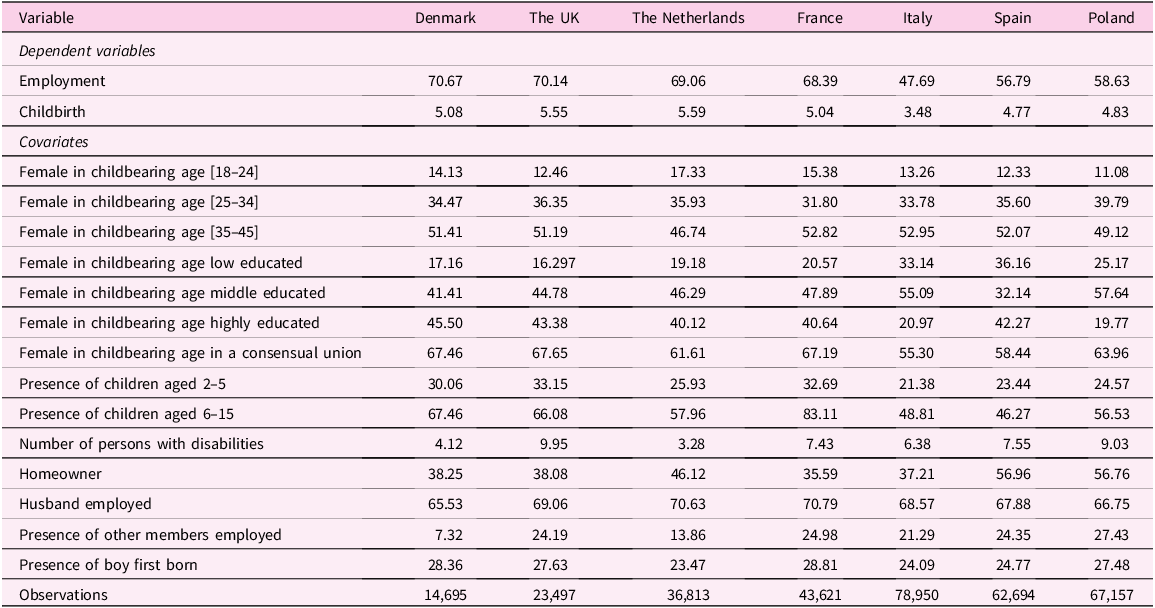
Table 2 reports the weighted summary statistics by country for both dependent variables and covariates used in the econometric analysis. The dependent variables in our investigation are female employment status (employed or not) and childbirth for our sample of women aged between 18 and 45. We now briefly describe the covariates included in each equation, keeping in mind that due to the model used, we also include lagged employment status, lagged childbirth dummies, initial employment condition, initial childbirth, and the average of time-varying covariates (for details, see Section 4).
Weighted descriptive statistics

Table 2. Long description
The table presents weighted descriptive statistics for employment and childbirth across Denmark, the UK, the Netherlands, France, Italy, and Poland. It includes dependent variables such as employment rates and childbirth percentages, as well as covariates like the age and education level of females in childbearing age, presence of children, number of persons with disabilities, homeownership, employment status of husbands, presence of other employed members, and the presence of a boy as the first born. The table has 18 rows and 7 columns, with each row representing a different variable and each column representing a different country. Notable trends include higher employment rates in Denmark and the UK compared to Italy and Poland, and varying childbirth rates across the countries.
Note: Given the composition of the sample, including mothers (and childless women), the indicators “presence of children aged 2–5” and “presence of children aged 6–15” do not sum to 100%, as some households include more than one child.
Source: Authors’ elaborations on EU-SILC data. Note: Mean (percentages). We also control for regions, where available.
For both equations, we control for certain characteristics of the fertile femaleFootnote 12 as well as household characteristics. The former includes age (splitting into age ranges within the 18–45 years considered), education, and consensual union (whether legal or not). Household characteristics include the presence of children of different age ranges (2–5 and 6–15 years),Footnote 13 the number of disabled individuals in the household, home ownership, the employment status of the husband (either employee or self-employed versus not employed), and the presence of other employed household members (other than the husband). We also control the geographical area of residence, where available, for the entire period under investigation.Footnote 14
Additionally, for identification purposes in the childbirth equation, we include a dummy variable indicating the presence of a first-born boy (male child) in the household. According to the literature (e.g., Ichino et al., Reference Ichino, Lindström and Viviano2014), this variable is expected to increase the likelihood that women will have additional children and would be independent from employment probabilities. Finally, since we analyze data over a long period, we also include yearly dummy variables.
The analyses of the evolution of childbirth effects and the role of family policies required additional variables aimed at identifying specific economic periods (i.e., a categorical variable distinguishing among pre-Great Recession, Great Recession, Austerity, and post-Great Recession periods), and characterizing family policies. For the latter, we employ family policy indicators of the social expenditure on family/children function gathered by Eurostat.Footnote 15 As for the social expenditure on the family/children function, since this indicator is somewhat associated with fertility rates and the share of children in the population, we consider the expenditure for each resident. The expenditure is expressed in purchasing power standard (PPS), which eliminates the price level differences between countries (measured in PPS per inhabitant). Footnote 16 Table A1 in the Appendix shows the figures for the first and last year available for each policy in each country.
In detail, we merge our data with the indicators provided by Eurostat by obtaining a pooled dataset for all seven countries explored. We consider the role of the overall expenditure on family/children functions and its components of cash and in-kind benefits. We then also investigate specific cash and in-kind benefits, namely family allowances, income maintenance, birth grant, child day-care, and accommodation.
6. Results
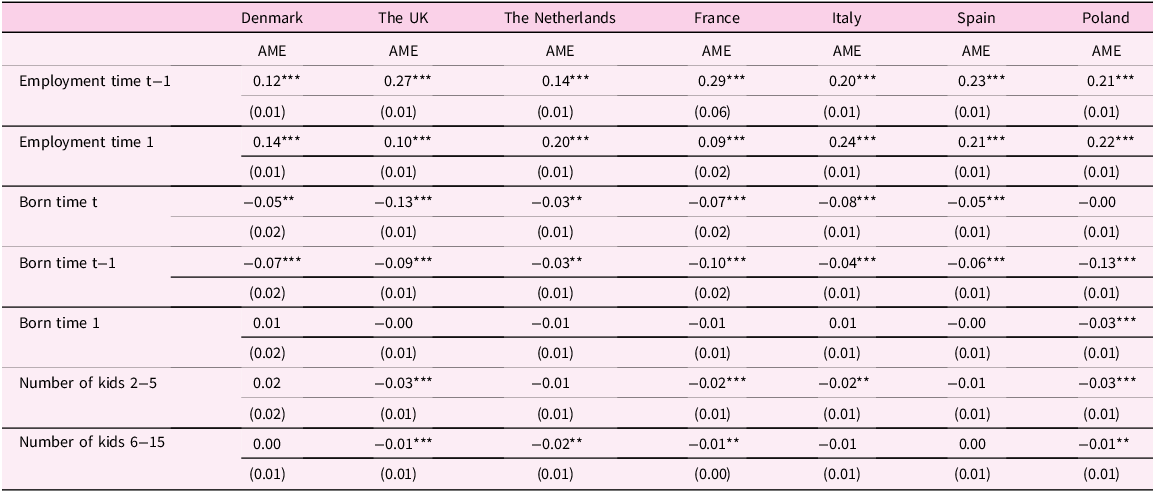
In what follows, we present results from the benchmark specification of the dynamic bivariate model of employment and childbirth (Table 3). We discuss the benchmark analysis (sub-section 6.1), examine the evolution of childbirth effects on female employment using predicted probabilities (sub-section 6.2), analyze the role of public support (sub-section 6.3), and report robustness and supplementary analyses on labor market conditions and characteristics (sub-sections 6.4 and 6.5). We report AMEs, standard errors, and statistical significance related to employment and childbirth variables, while AMEs for other covariates are available upon request.
Results for the employment equation

Table 3. Long description
The table presents results from a dynamic bivariate model of employment and childbirth across Denmark, the UK, the Netherlands, France, Italy, Spain, and Poland. It includes average marginal effects (AME) and standard errors for various variables related to employment time, birth time, and the number of kids. The table has seven columns, each representing a different country, and eight rows, each representing different variables. Employment time at different periods shows positive AMEs across all countries. Born time variables generally show negative AMEs, indicating a reduction in employment probabilities around the time of birth. The number of kids aged 2-5 and 6-15 also shows varying impacts on employment probabilities across countries. The table provides insights into how employment probabilities change with respect to childbirth and the number of children.
Note: The control variables include characteristics of the fertile female age (ranges within the 18–45 years considered), education, and consensual union (whether legal or not), and household characteristics (no children, number of disabled individuals, home ownership, employment status of the husband, presence of other (than the husband) employed household members. We also control the geographical area of residence (where available) and yearly dummy variables. Source: Authors’ elaborations on EU-SILC data. Note: Standard errors are in brackets. *p < .10, **p < .05, ***p < .01.
6.1 Benchmark analysis
The benchmark analysis’s results rely on the estimation of equations (1) and (2) applied to each of the seven EU countries. In what follows, we primarily comment on the findings for the employment equation reported in Table 3.Footnote 17
From the top panel, we note statistically significant genuine state dependence in female employment in all countries, ranging from +12 p.p. in Denmark to +29.4 p.p. in France. The AMEs for the initial employment variable are statistically significant across all countries. According to some interpretations (e.g., Ayllón, Reference Ayllón2015), the estimates suggest that in some countries (Denmark, the Netherlands, Italy, and Poland), the lock-in effect of employment increases over time, while in others (e.g., the UK, France, and Spain), it decreases.
Turning to the effect of childbirth on female employment, we consider both the current effect (birth event at time t) and the past effect (birth event at time t−1). The former reduces the current probability of being employed elsewhere, except in Poland. The effect of past childbirth may help to identify the female employment condition once new children grow up, and the intensity of public support may decline. This is reflected by the greater magnitude of past childbirth effects in certain countries like Denmark, France, Spain, and Poland. Other countries show, instead, a decline in childbirth effects.
Finally, we comment on the AMEs associated with the number of children aged 2–5 and 6–15. The presence of children in pre-primary school age is negative, except in Denmark. In other countries, the presence of children aged 2–5 undermines female employment in a statistically significant way in the case of the UK (−2.7 p.p.), France (−1.9 p.p.), Italy (−2 p.p.), and Poland (−3 p.p.). Such negative effects persist in several countries also during the schooling age, though their magnitude usually declines. Summing up, our results suggest that the childbirth effect is penalizing for female employment, both at the time of birth and later. The magnitude of such effects is greatest at the time of birth and in the first year of life of children, when caring activities are more intense. Later, the effects decline but do not disappear, except in Denmark and Spain.
As for the childbirth equation, from Table A2, we note the presence of feedback effects from past employment to current fertility (e.g., Carrasco, Reference Carrasco2001, Michaud & Tatsiramos, Reference Michaud and Tatsiramos2011) in France, Spain, and Poland. In these countries, there is a positive association between past employment and current childbirth, ranging from +0.5 p.p. in France to +1.7 p.p. in Poland. These positive effects might be due to the presence of public policies supporting female employment. The analysis of the possible role of such policies, including social expenditure for family and children, cash benefits, in-kind benefits, and selected benefits from both categories, on female employment in Section 6.3 will help clarify these findings. In contrast, in Denmark, the UK, the Netherlands, and Italy, no univocal relationship between past employment conditions and current fertility decisions is observed.
6.2 The evolution of childbirth effect on female employment
In this Section, we explore the evolution of predicted female employment and the related motherhood penalty (Fig. 4), as well as childbirth patterns conditional on past employment status (Fig. A1 in the Appendix). We split the period under investigation into four sub-periods, that is, (1) the pre-Great Recession period (2003–2007), (2) the Great Recession period (2008–2009), (3) the Austerity measures period (2010–2014), and (4) the post-Great Recession period (2015–2020). In addition to highlighting the pattern over time of female employment and childbirth, the analysis enables us to uncover possible time heterogeneities in childbirth and feedback effects.
The evolution of employment probabilities by childbirth.
Source: Authors’ elaborations on EU-SILC data.

Figure 4. Long description
The image contains eight line graphs, each representing a different country: Denmark, the UK, the Netherlands, France, Italy, Spain, and Poland. Each graph shows the predicted mean of fertile female employment over four time periods: Pre GR, GR, Austerity, and Post GR. The blue line represents childbirth time t equals No, while the red line represents childbirth time t equals Yes. In Denmark, the predicted mean for both lines fluctuates slightly but remains relatively stable. In the UK, the blue line shows a slight decline, while the red line shows a more significant drop during the Austerity period. The Netherlands and France exhibit similar trends with minor fluctuations. Italy shows a decline in both lines during the Austerity period. Spain and Poland have relatively stable trends with minor variations. The graphs illustrate the relationship between female employment and fertility across different economic periods in these countries. All values are approximated.
Figure 4 shows heterogeneous patterns of female employment in the period under investigation. Generally speaking, however, the Great Recession and the austerity periods were marked by a decline in female employment, which recovered in the late ‘10s.
Our long-time horizon allows us to track the evolution of the motherhood/fertility penalty across multiple macroeconomic shocks. During the Great Recession (2008–2013), predicted employment among mothers fell more sharply than among non-mothers, increasing the penalty, particularly in the UK, Italy, and France (Bettio & Verashchagina, Reference Bettio, Verashchagina, Karamessini and Rubery2014; Addabbo et al., Reference Addabbo, Rodríguez-Modroño and Gálvez-Muñoz2015). The subsequent austerity period maintained this elevated penalty, reflecting sluggish recovery and limited expansion of family support policies. In the post-recession period, the penalty declined where family-friendly policies and employment opportunities expanded, such as in Poland (Naldini & Jurado-Guerrero, Reference Naldini and Jurado-Guerrero2019; Del Boca et al., Reference Del Boca, Oggero, Profeta and Cristina Rossi2022). Overall, compared with pre-recession levels, the negative effect of childbirth strengthened in the UK, France, Italy, and Spain, slightly declined in Denmark, and remained largely unchanged in the Netherlands and Poland. This suggests that the motherhood penalty is sensitive to both cyclical downturns and structural policy contexts.
Turning our attention to the probability of childbirth (Fig. A1), we note a sharp decline, particularly in countries where the childbirth rate was relatively high in the pre-Great Recession period, such as the UK, the Netherlands, and Poland. The role of past employment status in fertility decisions is relatively small in several countries but statistically significant in others, as emerged from the benchmark analysis (see Section 6.1). In addition, during the post-Great Recession period, the gap in the childbirth probability conditional on past employment status slightly rose, indicating a polarization in fertility decisions between employed and non-employed females. This has occurred especially due to the significant decline in childbirth probability over time in countries such as Denmark, the Netherlands, Italy, and Spain. Overall, these results suggest the importance of financial security in fertility decisions and stress the dividing role of the Great Recession and the subsequent austerity period in the dynamic relationship between female employment and childbirth.
6.3 The role of family policies
This section presents results from estimating equations (7) and (8), exploring how family policy expenditures shape female employment around childbirth and the likelihood of having children. The analysis distinguishes between cash and in-kind transfers, as well as means-tested and universal programs. Cash benefits include income maintenance at childbirth, family or child allowances, and birth grants,Footnote 18 while in-kind benefits cover services such as childcare and accommodationFootnote 19 (see Table 1). Results are illustrated in Figs. 5 and 6. Footnote 20
The effect of social expenditure on female employment.
Source: Authors’ elaborations on EU-SILC data.

Figure 5. Long description
The image contains five line graphs comparing the marginal predicted mean of female employment under different social expenditure policies. The graphs are titled Expenditure for family children policies, Cash transfer, In kind transfer, Means tested, and No means tested. Each graph shows two lines representing childbirth time t equals No in blue and childbirth time t equals Yes in red. The x-axes represent different expenditure levels or time periods, while the y-axes represent the marginal predicted mean of female employment. The graphs illustrate how different types of social expenditures affect female employment rates, with variations based on whether childbirth occurred. The trends show that in kind transfer and expenditure for family children policies have a positive correlation with female employment, while cash transfer and means tested policies show a negative correlation. No means tested policies show a relatively stable trend. All values are approximated.
The effect of different cash and in-kind benefits on female employment.
Source: Authors’ elaborations on EU-SILC data.

Figure 6. Long description
The image contains five line graphs showing the relationship between female employment and fertility under different conditions. Each graph represents a different factor: income maintenance, family allowances, birth grant, child day care, and accommodation. The x-axis represents time, while the y-axis represents the marginal predicted mean of fertile females employed. The graphs compare two scenarios: childbirth time t equals No and childbirth time t equals Yes. In the income maintenance graph, the blue line representing no childbirth shows an upward trend, while the red line representing childbirth shows a slower increase. In the family allowances graph, the blue line remains relatively stable, while the red line shows a slight decline. The birth grant graph shows minimal changes in both lines. The child day care graph indicates a downward trend in both lines, with the blue line decreasing more sharply. The accommodation graph shows an upward trend in both lines, with the blue line increasing more steadily. All values are approximated.
Consistent with previous research (e.g., Blundell et al., Reference Blundell, Pistaferri and Saporta-Eksten2016; Adda et al., Reference Adda, Dustmann and Stevens2017), female employment declines in the year of childbirth. However, the magnitude of this motherhood employment gap differs with the level and type of family policy spending. Figure 5 (top-left) shows predicted employment for women with and without recent childbirth across spending levels. Higher expenditure is associated with relatively higher employment for new mothers. However, the effect is stronger for women without childbirth, indicating that increased family spending may amplify the relative impact of childbirth on employment.
Expenditure composition plays a key role. Cash transfers are linked to lower employment probabilities for new mothers, while in-kind transfers have a positive and stronger effect. As cash benefits rise, predicted employment for new mothers declines from just below 0.6 to slightly above 0.5, whereas employment for women without childbirth slightly increases, suggesting an income effect that reduces labor supply. Nevertheless, cash transfers can improve household welfare by increasing income and spending capacity, benefiting both mothers and children.
In-kind transfers, in contrast, raise employment probabilities for both groups. For new mothers, predicted employment increases from around 0.5 to over 0.7 as in-kind benefits rise to €3,800, effectively narrowing the childbirth employment gap. The impact of in-kind programs, however, may depend on quality, accessibility, and coverage; weaknesses in these areas can limit actual benefits (Gadenne et al., Reference Gadenne, Norris, Singhal and Sukhtankar2021).
Means-tested benefits show a modest negative correlation with employment, whereas non-means-tested transfers appear largely neutral. Overall, these findings highlight that family policy spending can mitigate the employment impact of childbirth, but the type and structure of support – cash versus in-kind, means-tested versus universal – critically determine outcomes. In-kind programs, particularly, are more effective in protecting maternal employment, while cash benefits primarily enhance household welfare.
Figure 6 reports the effects of specific cash and in-kind benefits on female employment. The contributions of measures such as family allowances, birth grants, or child day-care support are mixed. For cash benefits, income maintenance shows a positive association with predicted female employment, though the effect is stronger for women without recent childbirth. Family or child allowances have opposite effects: slightly positive for women without childbirth but negative for new mothers. Birth grants show a small positive effect for new mothers but little or even a slightly negative impact for women without childbirth.
For in-kind benefits, child day care has a mixed effect: negatively associated with employment for women without childbirth, but no clear effect for new mothers. Accommodation support shows a clearer positive effect, increasing predicted employment regardless of childbirth status.
Overall, the results highlight the heterogeneous association of family policies with maternal employment. In-kind benefits, particularly universal supports and housing assistance, play a stronger role in supporting employment after childbirth, consistent with European evidence emphasizing the importance of service-oriented policies (e.g., Nygård et al., Reference Nygård, Lindberg, Nyqvist and Härtull2019; Esping-Andersen, Reference Esping-Andersen2005). By contrast, cash-based supports such as income maintenance or family allowances show weaker or even negative associations, likely reflecting not the monetary nature per se, but rather their design, which is often maternal-focused with limited paternal engagement (Thévenon, Reference Thévenon2011).
These findings suggest that both the level and composition of household resources shape mothers’ labor supply responses. Access to affordable childcare and secure housing appears particularly effective in facilitating maternal employment, aligning with prior research on labor market participation (Del Boca & Vuri, Reference Del Boca and Vuri2007). The analysis underscores the importance of designing family policies that combine adequate financial support with accessible services to better protect female employment around childbirth.
6.4 Robustness checks
This section presents two robustness checks examining the effects of a wider sample and working-time flexibility. First, we include self-employed workers, who may enjoy greater flexibility than salaried employees, potentially favoring female employment. Findings for the employment equation are reported in Table A3 (Appendix).Footnote 21 Including self-employed workers reduces genuine state dependence in the UK, Italy, and Spain, while initial employment rises. Considering initial and lagged employment jointly strengthens the employment lock-in effect across all countries. These results suggest that self-employment can support mothers’ employment (Lim, Reference Lim2019). Table A3 also confirms the negative association between childbirth and female employment. The presence of pre-primary-aged children negatively affects childbirth across all countries, but effects persist for children aged 6–15 only in the Netherlands and Italy.
The second check investigates the heterogeneous effect of childbirth on working hours, distinguishing full-time and part-time employment. Using a dynamic bivariate ordered probit-probit model (Tables A4a and A4b), we find that childbirth increases the likelihood of part-time employment in Denmark, the UK, and France, while effects are neutral or slightly negative in the other countries explored. One year later, the shift toward part-time work is more pronounced. Full-time employment is more strongly reduced, particularly in the UK, France, and Poland, reflecting the larger adjustment margin.
Overall, results suggest substitution between full-time and part-time work after childbirth, supporting the conciliation role of part-time employment. Immediate effects are often mild, possibly due to family policies such as parental leave, while over time, women tend to return to part-time work. Cross-country differences indicate that institutional settings shape labor supply responses to childbirth. Finally, state dependence is statistically significant for both full-time and part-time work, showing that past employment strongly predicts current employment, with some segmentation between the two types of work.
6.5 Supplementary analyses: the role of labor market conditions and characteristics
As supplementary analyses, we investigate the role of labor market conditions and characteristics on female employment. We use equations (7) and (8), enabling us to explore how female part-time employment, fixed-term employment, and the unemployment rate shape the effect of childbirth on female employment, and how such labor market features affect the probability of childbirth. Results are shown in the Appendix Fig. A4.
We find evidence of a positive effect of part-time work on female employment, especially among women without children. In other words, the mere availability of part-time positions is not sufficient to close the employment gap between mothers and non-mothers. The presence of fixed-term contracts appears beneficial for mothers’ employment: fixed-term employment is positively associated with mothers’ employment, but negatively with that of non-mothers. An increasing female unemployment rate is, as expected, negatively associated with overall female employment, while the employment gap between mothers and non-mothers remains unchanged. Overall, improving female labor market conditions, especially by reducing the flexibility of employment, might significantly reduce the employment gap between mothers and non-mothers.
7. Conclusions
Despite a weakening of the detrimental role of childbirth for female employment and recent macroeconomic findings of the reversal of the relationship between female employment and total fertility rates, the motherhood penalty continues to be an issue in several countries.
Our analysis shows that, on average, the effect of childbirth on female employment is negative, diverges across countries, persists, and even reinforces 1 year later. These results are established after controlling for several factors, including the dynamic interrelated nature of the two processes (female employment and fertility decisions), endogeneity issues, and endogenous initial conditions.
Thanks to the richness of the EU-SILC database, we can reconstruct the evolution of such an effect on female employment. Overall, the 2003–2020 period was marked by a strengthening of such an effect in several countries, that is, the UK, France, Italy, and Spain, a slight decline in Denmark, and an almost unchanged effect in the Netherlands and Poland. In detail, during the austerity era, the penalty for mothers remained important, consistent with constrained labor market and family policy conditions. In the post-Great Recession period, the penalty declined only in Poland, where expanded family-friendly policies accompanied improved employment opportunities. We also noted a possible initial employment detrimental effect of the COVID-19 pandemic in France and the Netherlands. Finally, we found a polarization in fertility decisions between previously employed and non-employed females, especially during the Great Recession.
We devote specific attention to the role of family policies. Exploring time and geographical variations in the data and matching EU-SILC information and Eurostat indicators, we note that higher expenditure is associated with higher employment levels of new mothers. However, this is insufficient to close the employment probabilities gap with other females, which actually widens as family policy spending increases. This result may be explained by the opposing roles of cash and in-kind benefits. Disentangling their contributions reveals that cash transfers are associated with declining employment probabilities of new mothers, while in-kind transfers effectively sustain female employment during motherhood. Therefore, income effects may play a role against female employment in the short to medium term. Looking at cash and in-kind specific measures, we note again that the contribution of family allowances, birth grants, or child day care is mixed. The effects on fertility decisions are positive but relatively weak for cash and in-kind transfers.
The persistent motherhood employment gap and the declining fertility rates characterizing European countries require policies supporting both female employment and childbirth. Our results suggest that increasing expenditure for family policies may boost fertility, but the effect may be small. Cash transfers (particularly family allowances) may activate the income effect, depleting female employment. Investing more resources in in-kind benefits and, particularly, housing assistance, would be preferable, since these measures appear more effective in promoting fertility and narrowing the motherhood employment gap. The distinction between cash and in-kind transfers alone, however, may be insufficient to advise the design of effective family policies, as they may depend on multiple (social and institutional) factors, such as greater gender equality in leave rights and fathers’ involvement, as well as promoting a labor market structure that enables mothers’ return to work.
Finally, our analyses present some limitations. First, our analysis does not include women’s nationality, an omission that may limit the understanding of fertility behavior in Europe, as fertility rates are generally higher among immigrant than native women. Second, we recognize that using national-level Eurostat indicators of family policy expenditures may mask within-country variation, such as regional differences in implementation, access, or targeting. Unfortunately, data on both nationality and comparable regional expenditure are not available across countries for the period covered by our analysis. Future research would benefit from the availability of such data.
Supplementary material
To view supplementary material for this article, please visit https://doi.org/10.1017/dem.2026.10023
Data availability statement
Restrictions apply to the availability of the data used under license from EUROSTAT for this study. Data are available from the authors upon reasonable request and with permission of EUROSTAT only.
Funding statement
This work was supported by the the Università Cattolica del Sacro Cuore under the Strategic Research Poject “The economic and social exclusion risk faced by NEETs and the role of public and private strategies in enhancing access to education and employment” [grant number R2104500128].
Competing interests
The author(s) declare none.
Ethical standards
Not applicable.




 Open access

