

China’s rise has heightened concerns about great power conflict. These concerns are established by scholars who use bargaining models to study power transitions. When power shifts slowly, declining powers prefer appeasement – incremental, minimalist concessions that avoid war as power shifts – to war. When power shifts rapidly, declining powers prefer a preventive war instantly, to a large concession in the next period (Powell Reference Powell1999, 123). Variations in regimes (Schweller Reference Schweller2004), uncertainty (Reed Reference Reed2003), and alliances (Benson and Smith Reference Benson and Smith2022) complicate incentives for war. Nevertheless, the prediction – large and rapid power shifts cause war – is robust (Souva Reference Souva and Thompson2017).
The evidence, however, is mixed. Scholars identify specific cases where rapid power shifts caused war (Streich and Levy Reference Streich and Levy2016; Copeland Reference Copeland2015). But well-designed cross-national studies find that high rates of economic growth or military spending explain little variance in war onset, even controlling for regime type and other confounding factors (Bell Reference Bell2017; Kim and Morrow Reference Kim and Morrow1992; Lemke Reference Lemke2003).Footnote 1 One important study finds the expected rate of shifting power predicts conflict (Bell and Johnson Reference Bell and Johnson2015). But even their measure explains less than 1% of the variance in conflict. Quantitative studies struggle to fit the dogs that don’t bark: cases of rapidly shifting power that end peacefully, or that only end in war after long periods of rapid militarization and concessions. For example, during the 1800s, the USA sought to expel British influence from the Western Hemisphere. When American power grew most rapidly, Britain withdrew from key economic interests and ceded influence to the USA – the opposite of preventive war (Schake Reference Schake2017). Similarly, Japan (1980s) and Germany’s (1990s) rapid economic growth ended in peace.
Why do power transitions that seem destined for war often end peacefully? We adjust Powell’s (Reference Powell1999) infinite horizon model so each power shift is endogenous and costly.Footnote 2 This generates two new and interconnected results. First, the opportunity to repeatedly consume can induce preventive war under complete information when power shifts are longFootnote 3 (unfold over many periods) but neither rapid nor large (per period).Footnote 4 Our mechanism exhibits features of costly peace (Coe Reference Coe2011), but unlike past accounts, the declining state selects preventive war, even though it pays no militarization cost and the issue’s value is constant across periods.Footnote 5 The rising power could fight today and consume the resources it would have spent on militarization tomorrow. But if the rising power militarizes, the declining power must compensate it for arming when it could have fought and consumed instead.Footnote 6 The size of compensation per period depends on the rising power’s opportunity cost for consumption and not the rate of shifting power. Thus, the declining state selects preventive war when it anticipates paying this opportunity cost in peace over many periods, whether power shifts fast or slow.
Second, the declining power has a strategy other than war to stop power from shifting: a grand bargain. In it, the declining power concedes more than it must under appeasement and promises to repeat this generous offer in future periods if the rising power does not militarize again. This generous offer is backed by a threat of war if the rising power militarizes again. The rising power consumes henceforth because it prefers this generous offer and consumption to costly militarization and war.
Grand bargains have recently been popularized by China-focused researchers (Glaser Reference Glaser2015).Footnote 7 However, they focus on large offers that generate reassurance under uncertainty (Haynes and Yoder Reference Haynes and Yoder2020). These arguments have lost salience as China has revealed aggressive motives. Our grand bargain relies on a one-way transfer in exchange for a stable future. This advances the incoming USA-China debate because we start with the premise that China’s aggressive motives are known, but still find that shifting power does not pre-destine war (Allison Reference Allison2017).
Scholars have rationalized similar mechanisms in models of nuclear proliferation (for example, Debs and Monteiro Reference Debs and Monteiro2014; Bas and Coe Reference Bas and Coe2018; Spaniel Reference Spaniel2019)Footnote 8 and other “unconventional” power shifts (Coe Reference Coe2018).Footnote 9 But it is not clear that these results translate to conventional cases. Indeed, scholars who select modelling assumptions to study conventional shifts have not rationalized a grand bargain (McCormack and Pascoe Reference McCormack and Pascoe2015; McBride et al. Reference McBride, Milante and Skaperdas2011). As those who debate a USA-China grand bargain argue, a core challenge in sustaining a grand bargain to offset conventional shifts is making the declining power’s threat of war credible (Easley et al. Reference Easley, Kim and Glaser2016, 179–181). If a grand bargain is struck, the rising state will only honour its commitment to avoid militarization if the declining state can credibly threaten war after learning that the rising state has militarized. The declining power’s threat of war is credible if it prevents a large, imminent power shift (Bas and Coe Reference Bas and Coe2018). But in a conventional transition, by the time the declining state realizes that the rising state has violated the terms, power has shifted (Joseph Reference Joseph2023). Thus, the declining state cannot rely on the expectation of a sudden shift to make their post-violation threat credible.
How can the declining power promise to revert to war after militarization shifts power? We resolve this puzzle using our first result: the declining power’s threat of war is credible so long as it expects many future shifts from incremental, repeated investments in conventional forces.Footnote 10 Enforcing a grand bargain through this mechanism for war holds three important empirical implications for grand bargains in conventional cases. First, conventional cases that end in either wars (Modelski Reference Modelski1987) or grand bargains (Schake Reference Schake2017; Copeland Reference Copeland2015) often begin with repeated power shifts that induce significant appeasement-like concessions. We show that delayed grand bargains are rational. Repeated power shifts create delayed incentives to settle and strategic opportunities to enforce compliance because even after power has shifted a little, there are many future shifts to incentivize Declining states to punish violations. Second, it suggests nuclear and conventional grand bargains may arise under different structural conditions. Scholars have rationalized nuclear grand bargains when power shifts are imperfectly observed and would trigger rapid shifts in the next period (for example, Spaniel Reference Spaniel2019, 135–136). By contrast, the binding constraint for our grand bargain is that there are enough shifts remaining to make the declining state’s threat of war credible. Thus, conventional grand bargains may arise whether power shifts rapidly or slowly, and even if militarization follows from observable actions such as conscription or tank production. But they likely require that states expect incremental shifts over many periods.
Third, we can rationalize grand bargains under the same conditions that declining powers strictly prefer preventive war to appeasement. Why is the declining power willing to make a large grand bargain offer but not a small appeasement offer? From the declining power’s perspective, the grand bargain serves the same purpose as war: it stops power from shifting. Since both strategies serve the same purpose, the declining power prefers them both to appeasement under the same conditions. In parameter ranges, where past conventional shift models with repeated shifts uniquely predict war (Powell Reference Powell1999, 128–129), we find both grand bargains and war are equilibria.Footnote 11
Multiple equilibria are consistent with the weakly positive relationship between power and war observed in quantitative evidence (Bell and Johnson Reference Bell and Johnson2015).Footnote 12 If states do consider multiple equilibria in real life, then factoring in case selection (Lemke and Reed Reference Lemke and Reed2001), better measures (Carroll and Kenkel Reference Carroll and Kenkel2019), and salient controls may marginally increase the significance, but not the size of shifting power’s beta coefficient nor the amount of variance that power explains in statistical studies of war. Instead, our theory illuminates a new direction for quantitative scholars: code variation across peace outcomes in terms of the intent of peace (a grand bargain, or appeasement) and the scope of offers. While a cross-national data collection effort is beyond our scope, S3 shows how to use our theory to code Allison’s (Reference Allison2017) major power cases and the additional insights that can be drawn.
We illustrate the plausibility of our grand bargain mechanism in an important but understudied case: Anglo-Russian competition in Central Asia (1869–1907). Internal debates among British elites reveal that pressures for war accumulated based on the anticipation of many future concessions, given a slow but persistent shift in power. Then British elites crafted a delayed grand bargain, backed by a credible threat of war. We show that most elites supported appeasement (and not grand bargains or war) when our theory predicts appeasement is the best choice. But when our theory predicts grand bargain and war equilibria, key individual decision makers considered these policies – but not appeasement – as plausible policy responses. Similarly, internal bureaucratic fissures formed when we find multiple equilibria exist. Thus, disagreements may reflect that multiple rationalist baselines exist, and not a deviation from a unique baseline (Schub Reference Schub2022; Schweller Reference Schweller2004).
We contribute to research into the sources of state power (Barnett and Duvall Reference Barnett and Duvall2005; Kugler and Tammen Reference Kugler and Tammen2012) by exploring the strategic implications of the latent-actual power distinction. Our grand bargain explains the international origins of large, rapid, territorial transfers, and therefore shifts in governance given latent power shifts. Our mechanism for war during long, slow shifts illuminates a novel cause of major war (Weisiger 2013). It overturns Powell’s (Reference Powell1999, 188) finding that there is “nothing special about power transitions”, and partly reconciles the bargaining framework with Power Transition Theory (PTT) (Organski and Kugler Reference Organski and Kugler1980) because it supports preventive wars in the middle of power transitions, and also given the anticipation of long, slow shifts.Footnote 13 But the mechanism is general. It could illuminate bargaining failure whenever one actor can repeatedly improve its bargaining position. This includes power consolidation in autocracies (Svolik Reference Svolik2012), post-civil conflict (Walter Reference Walter1999), and war termination after repeated costly battles (Reiter Reference Reiter2009). We also broaden formal diplomacy studies, which have recently emphasized information transmission (Joseph Reference Joseph2021; Trager Reference Trager2016), by rationalizing strategic incentives for fair division (Brutger Reference Brutger2021).
Two types of peace: Grand bargain, appeasement
We distinguish between peace as appeasement and a grand bargain. Much of the power transition literature ignores this difference. Instead, it asks: is appeasement a rational alternative to war? Since the Munich Agreement, many have argued that the answer was no (for example, Mearsheimer Reference Mearsheimer2001, 163–164).Footnote 14 By contrast, bargaining theorists find that appeasement is sometimes rational because incrementally increasing offers can avoid war as power shifts (Souva Reference Souva and Thompson2017).
Appeasement assumes rising powers repeatedly militarize. This assumption is implicit when scholars assume exogenous power shifts (Powell Reference Powell1999). We assume endogenous shifts. Thus, we define appeasement as a pair of strategies that characterize both militarization choices and offers:
Appeasement is any strategy pair with two observable features:
-
(a) Consecutive militarization: the rising power militarizes in the first period and every subsequent period until she cannot shift power any further.
-
(b) Peace: States successfully negotiate a war-avoiding settlement in every period.
This intuitive definition is intentionally broad. We define rationalist appeasement as any strategy pair that both fits our intuitive definition of appeasement, and that is supported in equilibrium. Our model confirms Powell’s (Reference Powell1999) logic for rationalist appeasement. In each period, the declining power makes the smallest offers that the rising power is willing to accept, given the rising power’s expectation that it will militarize in the future.
We argue that declining powers can use offers to achieve more than barely avoiding war as the rising power repeatedly militarizes. The declining power can also make larger offers that entice the rising power to accept a settlement and consume its surplus instead. We call this a grand bargain. Like appeasement, we define a grand bargain as a pair of strategies that create an observable outcome:
A Grand Bargain is any strategy pair that converges to a stable state of peace before the power transition is complete. Once the stable state commences, the declining power makes the same offer, and the rising power never militarizes and accepts that offer.
This is consistent with Glaser (Reference Glaser2010), who asserts a Sino-American grand bargain occurs if the US makes a generous concession by ending “its commitment to defend Taiwan. In return, China would… accept the United States’ long-term military security role in East Asia.” As he later acknowledges, “China accepting the US role limits its relative military expansionism.”
Our model supports many grand bargain equilibria that vary in their timing (allow for delay) and the scope of concessions. Many have argued that grand bargains are not rational because of a two-sided commitment problem that is most severe when the incentives for war are high (see Easley et al. Reference Easley, Kim and Glaser2016 for discussion). First, nothing prevents the rising power from accepting a large offer today and militarizing to coerce even more concessions tomorrow. As we detail after we present equilibria, two factors help the rising power overcome the commitment problem: (1) the grand bargain offer is larger than what the rising power would expect to get from militarization and war in that period; (2) the declining power can credibly promise to revert to war if the rising power continues investing in her military. Second, once the rising power has spent its surplus that period, nothing prevents the declining power from deviating from the large offer to a smaller one. We will show that the declining power still offers generously because the rising power can credibly promise to deviate to militarization in every future period following a lowball offer. This generates a seemingly paradoxical result that departs from nuclear grand bargains: grand bargains are rational when war is rational because the two-sided commitment problem is surmountable with strong incentives for war.
Model
A Declining and Rising state bargain over a pie, standardized to value 1, over an infinite horizon. Like Powell (Reference Powell1999), the pie represents all the territories that both $R$
and
$R$
and $D$
have a common interest in controlling. The power transition arises because the rising power’s economy is growing at a faster rate than the declining power’s. Our innovation on Powell is that
$D$
have a common interest in controlling. The power transition arises because the rising power’s economy is growing at a faster rate than the declining power’s. Our innovation on Powell is that $R$
has a per period economic surplus that it can invest (to instantly shift power), or consume.Footnote
15
$R$
has a per period economic surplus that it can invest (to instantly shift power), or consume.Footnote
15
The game begins in a power transition phase. In it, each period unfolds as follows. $R$
chooses whether to militarize or not. If
$R$
chooses whether to militarize or not. If $R$
militarizes, power immediately shifts in
$R$
militarizes, power immediately shifts in $R{\rm{'}}s$
favour. Otherwise,
$R{\rm{'}}s$
favour. Otherwise, $R{\rm{'}}s$
power does not change. Regardless of
$R{\rm{'}}s$
power does not change. Regardless of $R{\rm{'}}s$
choice,
$R{\rm{'}}s$
choice, $D$
chooses between war or demanding an
$D$
chooses between war or demanding an ${x_t} \in \left[ {0,1} \right]$
share of the pie (
${x_t} \in \left[ {0,1} \right]$
share of the pie ( $t \in \left\{ {1,2, \ldots } \right\}$
denotes the period).Footnote
16
Initiating a war ends the game. If
$t \in \left\{ {1,2, \ldots } \right\}$
denotes the period).Footnote
16
Initiating a war ends the game. If $D$
proposes
$D$
proposes ${x_t}$
,
${x_t}$
, $R$
chooses to accept or reject it. If
$R$
chooses to accept or reject it. If $R$
rejects, the game ends in war. If
$R$
rejects, the game ends in war. If $R$
accepts, players accrue payoffs and the game moves to the next period.
$R$
accepts, players accrue payoffs and the game moves to the next period.
The duration of the (possibly infinite) power transition phase depends on how many times $R$
has militarized over the history of the game. Let
$R$
has militarized over the history of the game. Let $n$
denote that number. If
$n$
denote that number. If $n \lt T$
, we remain in the power transition phase. If
$n \lt T$
, we remain in the power transition phase. If $n = T$
,
$n = T$
, $R$
has completed the power transition; so there are no more militarization decisions. Each period after
$R$
has completed the power transition; so there are no more militarization decisions. Each period after $n = T$
truncates the interaction to the negotiations.
$n = T$
truncates the interaction to the negotiations. $D$
proposes
$D$
proposes ${x_t} \in \left[ {0,1} \right]$
, and
${x_t} \in \left[ {0,1} \right]$
, and $R$
accepts or rejects.
$R$
accepts or rejects.
In the power transition phase, $R{\rm{'}}s$
militarization choice affects the balance of power.Footnote
17
Let
$R{\rm{'}}s$
militarization choice affects the balance of power.Footnote
17
Let $p \in \left( {0,1} \right)$
be
$p \in \left( {0,1} \right)$
be $D{\rm{'}}s$
probability of victory in war when
$D{\rm{'}}s$
probability of victory in war when $n = 0$
. Each time
$n = 0$
. Each time $R$
militarizes, we subtract
$R$
militarizes, we subtract ${\rm{\Delta }} \gt 0$
from this value. Thus,
${\rm{\Delta }} \gt 0$
from this value. Thus, $D{\rm{'}}s$
probability of winning in period
$D{\rm{'}}s$
probability of winning in period $t$
equals
$t$
equals $p - n{\rm{\Delta }}$
.Footnote
18
$p - n{\rm{\Delta }}$
.Footnote
18
For convenience, let $T{\rm{\Delta }} = p$
. This assumption means that if
$T{\rm{\Delta }} = p$
. This assumption means that if $R$
militarizes T times, she guarantees herself victory in war.Footnote
19
Returning to our definitions, this assumption means that appeasement equilibria must transition from
$R$
militarizes T times, she guarantees herself victory in war.Footnote
19
Returning to our definitions, this assumption means that appeasement equilibria must transition from $p$
to
$p$
to $0$
in the first
$0$
in the first $T$
periods of the game.Footnote
20
However, grand bargain equilibria must converge to a stable period before the balance of power reaches
$T$
periods of the game.Footnote
20
However, grand bargain equilibria must converge to a stable period before the balance of power reaches $0$
.
$0$
.
Payoffs are as follows. States are risk-neutral with a common discount factor $\delta \in \left( {0,1} \right)$
.Footnote
21
For each period that ends in a settlement,
$\delta \in \left( {0,1} \right)$
.Footnote
21
For each period that ends in a settlement, $D$
receives
$D$
receives ${x_t}$
and
${x_t}$
and $R$
receives
$R$
receives $1 - {x_t}$
.
$1 - {x_t}$
. $R$
pays
$R$
pays $k \gt 0$
each period it militarizes.
$k \gt 0$
each period it militarizes. $k$
represents
$k$
represents $R{\rm{'}}s$
opportunity cost of armament. This opportunity could include competition in another region with another rival, spending on domestic welfare or elite rents. Thus, a high
$R{\rm{'}}s$
opportunity cost of armament. This opportunity could include competition in another region with another rival, spending on domestic welfare or elite rents. Thus, a high $k$
represents that
$k$
represents that $R$
has something more salient to dedicate resources to than the pie.
$R$
has something more salient to dedicate resources to than the pie.
War costs the respective parties ${c_D},{c_R} \gt 0$
.
${c_D},{c_R} \gt 0$
. $D{\rm{'}}s$
payoff for fighting a war from that period forward is
$D{\rm{'}}s$
payoff for fighting a war from that period forward is ${{p - \Delta n - {c_D}} \over {1 - \delta }}$
.
${{p - \Delta n - {c_D}} \over {1 - \delta }}$
. $R{\rm{'}}s$
payoff for fighting a war from that period forward is
$R{\rm{'}}s$
payoff for fighting a war from that period forward is ${{1 - p + \Delta n - {c_R}} \over {1 - \delta }}$
. A subtle feature of this payoff structure is that it omits
${{1 - p + \Delta n - {c_R}} \over {1 - \delta }}$
. A subtle feature of this payoff structure is that it omits $R{\rm{'}}s$
expectation for future militarization costs (
$R{\rm{'}}s$
expectation for future militarization costs ( $k$
). The reason is that
$k$
). The reason is that $R{\rm{'}}s$
advantage from militarization comes when the threat of war is plausible. Once war has happened,
$R{\rm{'}}s$
advantage from militarization comes when the threat of war is plausible. Once war has happened, $R$
has no reason to militarize.
$R$
has no reason to militarize.
Putting everything together, imagine that states successfully negotiate in the first $m$
periods,
$m$
periods, $R$
militarizes in period
$R$
militarizes in period $m + 1$
, and
$m + 1$
, and $D$
fights. Then
$D$
fights. Then $D{\rm{'}}s$
payoff equals:
$D{\rm{'}}s$
payoff equals:
 $${x_1} + \delta {x_2} + \ldots + {\delta ^{m - 1}}{x_m} + {{{\delta ^m}\left( {p - \Delta - {c_D}} \right)} \over {1 - \delta }}$$
R’s payoff equals:
 $$1 - {x_1} + \delta \left( {1 - {x_2}} \right) + \ldots + {\delta ^{m - 1}}\left( {1 - {x_m}} \right) + {{{\delta ^m}\left( {1 - p + \Delta - {c_R}} \right)} \over {1 - \delta }} - {\delta ^m}k$$
Payoffs are similar in cases where $R$
militarizes multiple times, adjusting the number of
$R$
militarizes multiple times, adjusting the number of ${\rm{\Delta }}$
values and the instances of discount-adjusted
${\rm{\Delta }}$
values and the instances of discount-adjusted $k$
costs.
$k$
costs.
Our introduction of endogenous, repeated, and costly power shifts makes two substantive advances over existing bargaining theory with conventional power shifts. First, it highlights an often overlooked fact: militarization is inefficient (Coe and Vaynman Reference Coe and Vaynman2020), and these inefficiencies accumulate each time $R$
militarizes.
$R$
militarizes. $R{\rm{'}}s$
inefficient militarization appears necessary to increase bargaining leverage over the contested issues. We’ll explore what
$R{\rm{'}}s$
inefficient militarization appears necessary to increase bargaining leverage over the contested issues. We’ll explore what $R$
can extract even absent this inefficient spending. Second, it parses shifts in latent productivity that give
$R$
can extract even absent this inefficient spending. Second, it parses shifts in latent productivity that give $R$
the opportunity to rise from
$R$
the opportunity to rise from $R{\rm{'}}s$
conscience political choice to mobilize resources to compete with
$R{\rm{'}}s$
conscience political choice to mobilize resources to compete with $D$
. Following the nuclear literature (Spaniel Reference Spaniel2019), we initially assume that latent shifts in
$D$
. Following the nuclear literature (Spaniel Reference Spaniel2019), we initially assume that latent shifts in $R{\rm{'}}s$
favour creates an opportunity to shift power, but
$R{\rm{'}}s$
favour creates an opportunity to shift power, but $R$
must invest to shift actual power. This isolates the independent strategic effects for different sources of actual power. We investigate latent-actual interactions more in section ‘Latent versus Actual Power’.
$R$
must invest to shift actual power. This isolates the independent strategic effects for different sources of actual power. We investigate latent-actual interactions more in section ‘Latent versus Actual Power’.
Our intuitive definition of a grand bargain assumed $R$
wants to militarize. Thus, we assume:
$R$
wants to militarize. Thus, we assume:
 $${\rm{\Delta }} \gt \left( {1 - \delta } \right)k$$
When C1 is violated our model matches existing predictions (Debs and Monteiro Reference Debs and Monteiro2014). $R$
is unmotivated to militarize because the opportunity cost
$R$
is unmotivated to militarize because the opportunity cost $k$
is large relative to the bargaining leverage it produces
$k$
is large relative to the bargaining leverage it produces ${\rm{\Delta }}$
.Footnote
22
${\rm{\Delta }}$
.Footnote
22
Analysis: Long power shifts and inefficient militarization as a cause of war
We solve for sub-game perfect equilibria (SPE). We generate a novel mechanism for war driven by long (increasing in $T$
) and not rapid (
$T$
) and not rapid ( ${\rm{\Delta }}$
) power shifts. We detail this novel mechanism because it is intrinsically interesting and empirically plausible. It also helps us establish our core claims: (1) a grand bargain can act as a substitute for warFootnote
23
because it also stops power from shifting and (2) appeasement is not rational under the same conditions. To satisfy these claims, we need to identify all the conditions when war is an equilibrium and appeasement is not. Later, we will focus on these conditions to describe a specific kind of grand bargain: a grand bargain that is backed by the threat of war and repeated, instant power shifts.
${\rm{\Delta }}$
) power shifts. We detail this novel mechanism because it is intrinsically interesting and empirically plausible. It also helps us establish our core claims: (1) a grand bargain can act as a substitute for warFootnote
23
because it also stops power from shifting and (2) appeasement is not rational under the same conditions. To satisfy these claims, we need to identify all the conditions when war is an equilibrium and appeasement is not. Later, we will focus on these conditions to describe a specific kind of grand bargain: a grand bargain that is backed by the threat of war and repeated, instant power shifts.
First, we isolate the conditions where existing bargaining theories predict peace.Footnote 24
 $$\Delta \lt {{\left( {1 - \delta } \right)\left( {1 - p - {c_R} + k} \right)} \over \delta }$$
In analogous models where militarization is exogenous (for example, Powell Reference Powell1999), this condition ensures that $D$
prefers appeasement-style concessions to preventive war. In appeasement,
$D$
prefers appeasement-style concessions to preventive war. In appeasement, $D$
offers
$D$
offers $R$
her minimum demand each period and keeps the surplus.Footnote
25
Further, most versions of the Folk Theorem applied to the SPE of infinite horizon games support war as
$R$
her minimum demand each period and keeps the surplus.Footnote
25
Further, most versions of the Folk Theorem applied to the SPE of infinite horizon games support war as $\delta \to 1$
(Abreu, Dutta and Smith Reference Abreu, Dutta and Smith1994). But C2 places an upper bound on
$\delta \to 1$
(Abreu, Dutta and Smith Reference Abreu, Dutta and Smith1994). But C2 places an upper bound on $\delta $
. We will rationalize war within this bounded discount factor.Footnote
26
$\delta $
. We will rationalize war within this bounded discount factor.Footnote
26
The conventional wisdom is that appeasement is an equilibrium and war is not when C2 holds (Spaniel Reference Spaniel2019, 40–41). However, we identify a novel war equilibrium that dominates appeasement. This mechanism is especially important because it defines the threshold for which war is an equilibrium but appeasement is not. As we explain after we present the equilibria, whether we observe war or appeasement depends on if the duration of the power transition ( $T$
) exceeds a critical threshold
$T$
) exceeds a critical threshold ${T^{\rm{*}}}$
:Footnote
27
${T^{\rm{*}}}$
:Footnote
27
 $$T \gt {T^{\rm{*}}} \equiv {{ln\left( {1 - {{{c_D} + {c_R}} \over {\delta k}}} \right)} \over {ln\left( \delta \right)}}$$
Proposition 2.1
Appeasement equilibrium: Suppose C1 and C2 hold but C3 does not. Then there is a sub-game perfect equilibrium of appeasement. In it, $R$
militarizes for
$R$
militarizes for $T$
consecutive periods. During the power transition phase,
$T$
consecutive periods. During the power transition phase, $R$
accepts iff
$R$
accepts iff ${x_t} \le p - \Delta n + {\Delta \over {1 - \delta }} + {c_R} - \delta k$
. During the phase after the power transition is complete,
${x_t} \le p - \Delta n + {\Delta \over {1 - \delta }} + {c_R} - \delta k$
. During the phase after the power transition is complete, $R$
accepts iff
$R$
accepts iff ${x_t} \le {c_R}$
. In the power transition phase, proposes
${x_t} \le {c_R}$
. In the power transition phase, proposes ${x_t} = p - \Delta n + {\Delta \over {1 - \delta }} + {c_R} - \delta k$
. During the phase after the power transition is complete,
${x_t} = p - \Delta n + {\Delta \over {1 - \delta }} + {c_R} - \delta k$
. During the phase after the power transition is complete, $D$
proposes
$D$
proposes ${x_t} = {c_R}$
.
${x_t} = {c_R}$
.
Proposition 2.2.
War equilibrium: Suppose C1, C2 and C3 hold. Then there is a sub-game perfect equilibrium that ends in first period war. In it, $R$
militarizes for
$R$
militarizes for $T$
consecutive periods. In a sub-game in which there are more than
$T$
consecutive periods. In a sub-game in which there are more than ${T^*}$
opportunities for militarization remaining,
${T^*}$
opportunities for militarization remaining, $D$
fights a preventive war if
$D$
fights a preventive war if $R$
militarizes. In a sub-game in which there are fewer than
$R$
militarizes. In a sub-game in which there are fewer than ${T^*}$
periods remaining,
${T^*}$
periods remaining, $D's$
offer and
$D's$
offer and $R's$
accept strategies that correspond with those defined in Proposition 2.1.
$R's$
accept strategies that correspond with those defined in Proposition 2.1.
We jointly prove these equilibria in S1.1. Here we describe how their logics are connected, and explain why ${T^{\rm{*}}}$
determines whether we see war or appeasement. The appeasement equilibrium is similar to that described by Powell (Reference Powell1999) and others.
${T^{\rm{*}}}$
determines whether we see war or appeasement. The appeasement equilibrium is similar to that described by Powell (Reference Powell1999) and others. $D$
offers
$D$
offers $R$
enough to leave
$R$
enough to leave $R$
indifferent to war every period, given that
$R$
indifferent to war every period, given that $R$
expects that it will continue to militarize until the power transition is complete. In this way,
$R$
expects that it will continue to militarize until the power transition is complete. In this way, ${x_t} = p - \Delta n + {\Delta \over {1 - \delta }} + {c_R} - \delta k$
represents
${x_t} = p - \Delta n + {\Delta \over {1 - \delta }} + {c_R} - \delta k$
represents $R{\rm{'}}s$
minimum demand from fighting during the power transition phase given
$R{\rm{'}}s$
minimum demand from fighting during the power transition phase given $n$
military investments. Consistent with standard results,
$n$
military investments. Consistent with standard results, $R{\rm{'}}s$
minimum demand is
$R{\rm{'}}s$
minimum demand is ${\Delta \over {1 - \delta }}$
less than
${\Delta \over {1 - \delta }}$
less than $R{\rm{'}}s$
present value for war because
$R{\rm{'}}s$
present value for war because $R$
anticipates that it will be stronger in the next period.
$R$
anticipates that it will be stronger in the next period.
Inconsistent with standard results, $R{\rm{'}}s$
minimum demand is
$R{\rm{'}}s$
minimum demand is $\delta k$
larger than
$\delta k$
larger than $R{\rm{'}}s$
present value for war because militarization deprives
$R{\rm{'}}s$
present value for war because militarization deprives $R$
of the opportunity to consume its surplus (which could be interpreted as avoiding militarization costs). Under appeasement,
$R$
of the opportunity to consume its surplus (which could be interpreted as avoiding militarization costs). Under appeasement, $R$
expects to spend its surplus every period on militarization. However, once war settles the dispute, future military investments cannot benefit
$R$
expects to spend its surplus every period on militarization. However, once war settles the dispute, future military investments cannot benefit $R$
. Thus, if
$R$
. Thus, if $R$
chooses to fight at
$R$
chooses to fight at $t$
, it can consume its surplus in all future periods. To avoid war,
$t$
, it can consume its surplus in all future periods. To avoid war, $D$
must compensate
$D$
must compensate $R$
an additional
$R$
an additional $\delta k$
for this opportunity to consume resources in the next round.
$\delta k$
for this opportunity to consume resources in the next round.
The war mechanism hinges on $R{\rm{'}}s$
larger minimum demand under appeasement. Notice that
$R{\rm{'}}s$
larger minimum demand under appeasement. Notice that $D$
must compensate
$D$
must compensate $R$
an additional
$R$
an additional $\delta k$
in every period of the power transition phase. In the first period,
$\delta k$
in every period of the power transition phase. In the first period, $D$
anticipates paying
$D$
anticipates paying $R$
an additional
$R$
an additional $\delta k$
for T future periods. When
$\delta k$
for T future periods. When $T \gt {T^{\rm{*}}}$
, the accumulation of these time-adjusted compensations exceeds the inefficiency of war. Figure 1 illustrates this. The x-axis varies the duration of the power shift. The solid line represents the total inefficiency from first-period war. It is horizontal because the cost of instant war is insensitive to the unrealized power shifts. The dots represent the time-discounted cost to
$T \gt {T^{\rm{*}}}$
, the accumulation of these time-adjusted compensations exceeds the inefficiency of war. Figure 1 illustrates this. The x-axis varies the duration of the power shift. The solid line represents the total inefficiency from first-period war. It is horizontal because the cost of instant war is insensitive to the unrealized power shifts. The dots represent the time-discounted cost to $D$
from playing
$D$
from playing $T$
periods of appeasement. If power can shift more than
$T$
periods of appeasement. If power can shift more than ${T^{\rm{*}}}$
times, then
${T^{\rm{*}}}$
times, then $R{\rm{'}}s$
accumulated opportunity costs generate more inefficiency than fighting an instant war. In this case,
$R{\rm{'}}s$
accumulated opportunity costs generate more inefficiency than fighting an instant war. In this case, $D$
reverts to war to avoid paying
$D$
reverts to war to avoid paying $\delta k$
for
$\delta k$
for $T \gt {T^{\rm{*}}}$
periods.Footnote
28
$T \gt {T^{\rm{*}}}$
periods.Footnote
28
Contrasting cumulative inefficiencies from appeasement and war.

Dots plot anticipated inefficiency from militarization given the power transition will last $T$
periods. The solid, horizontal line captures the total cost of instant war.
$T$
periods. The solid, horizontal line captures the total cost of instant war.
Substantively, our mechanism for war matches the concerns of many foreign policy experts in the early 2000s. Those who called for war argued that China would militarize slowly over many years and not that China would rapidly rise in the next year.
Analysis: Grand Bargain Equilibrium
We focus on the conditions defined in Proposition 2.2. We might expect that a grand bargain is especially unlikely under these conditions because war is an equilibrium and appeasement is not. Appeasement involves small offers, and a grand bargain likely involves larger offers. Why would $D$
be willing to make a large offer when it is unwilling to make a small one? The reason is that there are two kinds of inefficiencies that states want to avoid: war and militarization. In the war equilibrium, players avoid the inefficiency of many periods of militarization. But they still deal with the costs of war. By definition, appeasement strategies allow states to avoid the cost of war, but force them to confront costly militarization. As we shall see, a grand bargain is possible even when war is attractive because it allows states to avoid both inefficiencies.
$D$
be willing to make a large offer when it is unwilling to make a small one? The reason is that there are two kinds of inefficiencies that states want to avoid: war and militarization. In the war equilibrium, players avoid the inefficiency of many periods of militarization. But they still deal with the costs of war. By definition, appeasement strategies allow states to avoid the cost of war, but force them to confront costly militarization. As we shall see, a grand bargain is possible even when war is attractive because it allows states to avoid both inefficiencies.
We introduce one final condition:
 $${\rm{\Delta }} \lt {c_D} + {c_R} + \left( {1 - \delta } \right)k$$
As we explain later, this assures the per-period power shift is smaller than the combined inefficiencies of war and (time-adjusted) armaments.Footnote 29
We now report the simplest (that is, first period) grand bargain equilibrium to focus on the novel mechanism and contrast it with war. Later we report delayed grand bargains and other novel results.
Proposition 2.3 Suppose Conditions C1–C4 hold. For all $x \in \left[ {p - {c_D},p - \Delta + {c_R} + \left( {1 - \delta } \right)k} \right]$
, there exists a subgame perfect equilibrium in which
$x \in \left[ {p - {c_D},p - \Delta + {c_R} + \left( {1 - \delta } \right)k} \right]$
, there exists a subgame perfect equilibrium in which $R$
never arms,
$R$
never arms, $D$
proposes
$D$
proposes $x$
in every period, and
$x$
in every period, and $R$
accepts that
$R$
accepts that $x$
in every period. If any state ever deviates, then they switch to the strategies from Proposition 2.2:
$x$
in every period. If any state ever deviates, then they switch to the strategies from Proposition 2.2: $R$
arms at every opportunity and
$R$
arms at every opportunity and $D$
reverts to preventive war.
$D$
reverts to preventive war.
See S1.2. In the manuscript, we complete two tasks. We informally explain how the grand bargain’s mechanism is supported by war reversion. We explain that the grand bargain is never unique because it requires a credible threat of war reversion. Thus, for this grand bargain to hold together, war must also be an equilibrium strategy.
The grand bargain’s mechanism
Under our definition of any grand bargain, $D$
makes an offer larger than
$D$
makes an offer larger than $R{\rm{'}}s$
minimum demand for war under appeasement. Then,
$R{\rm{'}}s$
minimum demand for war under appeasement. Then, $D$
repeats that offer and
$D$
repeats that offer and $R$
never militarizes again. But our analysis shows that both states face strategic incentives to deviate. All else equal,
$R$
never militarizes again. But our analysis shows that both states face strategic incentives to deviate. All else equal, $R$
wants to accept, then militarize in the future;
$R$
wants to accept, then militarize in the future; $D$
wants to offer less. We can rationalize the above grand bargain because two other conditions are met.
$D$
wants to offer less. We can rationalize the above grand bargain because two other conditions are met.
First, both states prefer the grand bargain to both war and appeasement because it is fairer and more efficient. Efficient means that the cumulative expected utilities are larger because resources are not wasted on either militarization or war. Fair means that players distribute this additional surplus between them. Thus, both players get more in a grand bargain than they would have gotten under either war or appeasement. It follows that $R$
and
$R$
and $D$
both have something to lose if the other deviates from the grand bargain and cannot recover it.Footnote
30
$D$
both have something to lose if the other deviates from the grand bargain and cannot recover it.Footnote
30
Second, each expects ex-ante that they will be punished if they deviate from their commitment. $R$
expects
$R$
expects $D$
will reverting to war if
$D$
will reverting to war if $R$
militarizes.
$R$
militarizes. $D$
expects that
$D$
expects that $R$
will revert to appeasement in the next period (which, in turn, triggers
$R$
will revert to appeasement in the next period (which, in turn, triggers $D$
into war in the next period) if
$D$
into war in the next period) if $D$
under-offers this period. While we never observe these punishments on path, we could not sustain the grand bargain if the threats of punishment were not genuine. Thus, establishing their credibility is central to the result. Indeed, it is not obvious that we can sustain
$D$
under-offers this period. While we never observe these punishments on path, we could not sustain the grand bargain if the threats of punishment were not genuine. Thus, establishing their credibility is central to the result. Indeed, it is not obvious that we can sustain $D{\rm{'}}s$
credible threat of war because R’s deviation instantly shifts power. If we assumed R could only militarize once (
$D{\rm{'}}s$
credible threat of war because R’s deviation instantly shifts power. If we assumed R could only militarize once ( $T = 1$
), then after R deviated to militarization D would not revert to war because power had already shifted. D’s threat of war must rely on expectations, not shifts that have already materialized.
$T = 1$
), then after R deviated to militarization D would not revert to war because power had already shifted. D’s threat of war must rely on expectations, not shifts that have already materialized.
We rationalize D’s off-path threat of war using D’s concerns over long power transitions articulated in proposition 2.2. Once $D$
observes
$D$
observes $R{\rm{'}}s$
deviation,
$R{\rm{'}}s$
deviation, $D$
knows that
$D$
knows that $R$
will not accept a renewed
$R$
will not accept a renewed $x$
in the future. Faced with this realization,
$x$
in the future. Faced with this realization, $D$
cannot benefit from making another generous offer because
$D$
cannot benefit from making another generous offer because $R$
will militarize anyway. Since
$R$
will militarize anyway. Since $D$
cannot benefit from playing the agreed-upon grand bargain,
$D$
cannot benefit from playing the agreed-upon grand bargain, $D$
considers other strategies. In the analysis of the war equilibrium, we showed that when condition C3 was satisfied,
$D$
considers other strategies. In the analysis of the war equilibrium, we showed that when condition C3 was satisfied, $D$
strictly prefers war to any offer that
$D$
strictly prefers war to any offer that $R$
will accept under the assumption that power repeatedly shifts. This clarifies why incentives for war help the grand bargain hold together when militarization has an instant effect on power. As we showed in the analysis of the war equilibrium, the longer the power transition is, the easier it is for
$R$
will accept under the assumption that power repeatedly shifts. This clarifies why incentives for war help the grand bargain hold together when militarization has an instant effect on power. As we showed in the analysis of the war equilibrium, the longer the power transition is, the easier it is for $D$
to rationally prefer war to appeasement across multiple periods. For
$D$
to rationally prefer war to appeasement across multiple periods. For $D$
to credibly promise to revert to war, it must be the case that
$D$
to credibly promise to revert to war, it must be the case that $D$
wants to fight if
$D$
wants to fight if $R$
deviates from the grand bargain. If this condition is satisfied, then if
$R$
deviates from the grand bargain. If this condition is satisfied, then if $D$
makes the grand bargain offer in the first period backed by the threat of war, then
$D$
makes the grand bargain offer in the first period backed by the threat of war, then $D$
can credibly promise to revert to war.
$D$
can credibly promise to revert to war.
The grand bargain is a (weak) substitute for war
Figure 2 plots our equilibrium expectations as a function of the cost of militarization ( $k$
) and the rate of shifting power (
$k$
) and the rate of shifting power ( ${\rm{\Delta }}$
).Footnote
31
In region (3) both war and a grand bargain backed by the threat of war (Proposition 2.3) are equilibria but appeasement is not. This result is counter-intuitive given what we know from past research on conventional shifts, which finds that D offers R her minimum demand, or otherwise selects war Powell (for example, 1999, pp. 276–277). Thus, when we cannot support appeasement, we expect that power transitions will end in war. However, unlike others (for example, Coe Reference Coe2011), the grand bargain we have identified overlays considerably with the war equilibrium.
${\rm{\Delta }}$
).Footnote
31
In region (3) both war and a grand bargain backed by the threat of war (Proposition 2.3) are equilibria but appeasement is not. This result is counter-intuitive given what we know from past research on conventional shifts, which finds that D offers R her minimum demand, or otherwise selects war Powell (for example, 1999, pp. 276–277). Thus, when we cannot support appeasement, we expect that power transitions will end in war. However, unlike others (for example, Coe Reference Coe2011), the grand bargain we have identified overlays considerably with the war equilibrium.
Equilibrium Plot.

Why is this the case? A grand bargain backed by the threat of war must overlap with the war because the grand bargain is held together by $D{\rm{'}}s$
promise to revert to war. From
$D{\rm{'}}s$
promise to revert to war. From $D{\rm{'}}s$
perspective, war and a grand bargain serve the same purpose:
$D{\rm{'}}s$
perspective, war and a grand bargain serve the same purpose: $D$
wants to lock in a stable negotiated settlement because it anticipates repeated shifts in power, where
$D$
wants to lock in a stable negotiated settlement because it anticipates repeated shifts in power, where $D$
is forced to repeatedly compensate
$D$
is forced to repeatedly compensate $R$
as the strategic setting shifts against him. War imposes a final resolution to the contest on both states based on the current level of relative power. The grand bargain ensures a stable balance of power by encouraging
$R$
as the strategic setting shifts against him. War imposes a final resolution to the contest on both states based on the current level of relative power. The grand bargain ensures a stable balance of power by encouraging $R$
to consume its surplus. Once
$R$
to consume its surplus. Once $D$
decides that it wants to stop power from shifting,
$D$
decides that it wants to stop power from shifting, $D$
can use either a grand bargain or war to do it.
$D$
can use either a grand bargain or war to do it.
Other novel grand bargain equilibria
The grand bargain in Proposition 2.3 assumed no delay. But given the conditions in Proposition 2.3, we can support delayed grand bargains so long as $D$
can still credibly threaten to revert to war (a variant of condition C3).Footnote
32
Proposition 2.3 only explored grand bargains under the threat of war. In the supplementary information, we show that we can support grand bargains under limited conditions if appeasement dominates war. See S1.3.
$D$
can still credibly threaten to revert to war (a variant of condition C3).Footnote
32
Proposition 2.3 only explored grand bargains under the threat of war. In the supplementary information, we show that we can support grand bargains under limited conditions if appeasement dominates war. See S1.3.
Delayed grand bargains as a solution to hazards
Historians argue that incentives for war are heightened if states locked in a power transition confront a hazardFootnote 33 – shocks to the rate of shifting power, an immovable status quo, indivisibilities, accidents, and third-party competitors (Treisman Reference Treisman2004).Footnote 34 Do grand bargains survive these hazards?
We assume states confront a hazard during the power transition in S1.6. Consistent with past studies, we find hazards increase conditions where war is an SPE. Inconsistent with past studies, hazards also increase the conditions where a grand bargain backed by the threat of war is an SPE. Declining powers that anticipate hazards want to stop power from shifting. Since both war and a grand bargain stop power from shifting, they can use either.
This highlights our substitution logic. Our grand bargain requires that $D$
can credibly threaten to revert to war if
$D$
can credibly threaten to revert to war if $R$
accepts the offer and militarizes anyway. It does not matter where the threat of war comes from, only that
$R$
accepts the offer and militarizes anyway. It does not matter where the threat of war comes from, only that $D$
can promise to turn to it if
$D$
can promise to turn to it if $R$
shirks on the grand bargain.
$R$
shirks on the grand bargain.
Latent versus Actual Power
Power shifts involve latent factors (for example, economic growth) and strategic choices (for example, military investments)Footnote
35
(Kugler and Tammen Reference Kugler and Tammen2012). Can the grand bargain survive if latent growth shifts actual power absent $R{\rm{'}}s$
investment? We illuminate two mechanisms in S1.4. First, we allow
$R{\rm{'}}s$
investment? We illuminate two mechanisms in S1.4. First, we allow $D$
to pay a per-period cost to offset latent shifts.Footnote
36
$D$
to pay a per-period cost to offset latent shifts.Footnote
36 $D{\rm{'}}s$
cost could represent new alliances or modernization (Mearsheimer Reference Mearsheimer2001).
$D{\rm{'}}s$
cost could represent new alliances or modernization (Mearsheimer Reference Mearsheimer2001). $D$
is willing to pay almost the cumulative cost of war to offset latent shifts and sustain a grand bargain. This twists the guns-butter finding by showing states may desire militarization to keep power roughly constant not shift it if they are in relative economic decline (Powell Reference Powell1993).
$D$
is willing to pay almost the cumulative cost of war to offset latent shifts and sustain a grand bargain. This twists the guns-butter finding by showing states may desire militarization to keep power roughly constant not shift it if they are in relative economic decline (Powell Reference Powell1993).
Second, we assume that latent shifts are inevitable. We still find grand bargains hold if cumulative latent shifts do not exceed ${c_D} + {c_R} - {\rm{\Delta }} + \left( {1 - \delta } \right)k.$
Larger latent shifts require renegotiation. Recall that size of the grand bargains is in a range
${c_D} + {c_R} - {\rm{\Delta }} + \left( {1 - \delta } \right)k.$
Larger latent shifts require renegotiation. Recall that size of the grand bargains is in a range $x \in \left[ {p - {c_D},p - {\rm{\Delta }} + {c_R} + \left( {1 - \delta } \right)k} \right]$
. The grand bargain
$x \in \left[ {p - {c_D},p - {\rm{\Delta }} + {c_R} + \left( {1 - \delta } \right)k} \right]$
. The grand bargain $x = p - {\rm{\Delta }} + {c_R} + \left( {1 - \delta } \right)k$
can survive the most latent shifts against
$x = p - {\rm{\Delta }} + {c_R} + \left( {1 - \delta } \right)k$
can survive the most latent shifts against $D$
.Footnote
37
$D$
.Footnote
37
A reader may wonder how long, static grand bargains can survive latent shifts. Mathematically, the latent shifts can exceed several ${\rm{\Delta }}$
-sized shifts if
${\rm{\Delta }}$
-sized shifts if ${c_R} + {c_D}$
is large. A recent review of empirical research into latent power finds “over time, wealth as a static measure of power was found wanting, because all aggregate indicators, including GDP, fail to account accurately for political performance” (Tammen et al. Reference Tammen, Kugler, Lemke and Thompson2017), and a machine learning analysis of CINC-score components shows that conscience military investments are stronger predictors of victory than latent factors such as GDP and access to resources (Carroll and Kenkel Reference Carroll and Kenkel2019).Footnote
38
But in any specific case, the precise interactions depend on historical and strategic context. In cases where states have little agency, and latent, exogenous factors shift power substantially over a short period of time, we could not support a grand bargain.
${c_R} + {c_D}$
is large. A recent review of empirical research into latent power finds “over time, wealth as a static measure of power was found wanting, because all aggregate indicators, including GDP, fail to account accurately for political performance” (Tammen et al. Reference Tammen, Kugler, Lemke and Thompson2017), and a machine learning analysis of CINC-score components shows that conscience military investments are stronger predictors of victory than latent factors such as GDP and access to resources (Carroll and Kenkel Reference Carroll and Kenkel2019).Footnote
38
But in any specific case, the precise interactions depend on historical and strategic context. In cases where states have little agency, and latent, exogenous factors shift power substantially over a short period of time, we could not support a grand bargain.
Empirical Implications and Illustrative Evidence
We illuminate that scholars can better understand how power transitions unfold if they disaggregate peace into grand bargains and appeasement. As Table 1 summarizes, we clarify that grand bargains and appeasement depart in their decision making logic, and the observable features of offers, and also are rationalized under different structural conditions. Quantitative studies can use all shaded indicators to code temporal variation in peace for cross-national studies. Qualitative scholarship can use specific distinctions to rigorously evaluate our theorized mechanism within a single case. Specifically, we identify all major concessions within a case, then use the light-shaded indicators, which follow from the ex-ante definition we developed in section ‘Two Type of peace: Grand bargain, appeasement’, to code each concession as a grand bargain or appeasement. Once coded, we use the dark-shaded indicators to verify that when we observe a grand bargain or appeasement, decision makers presented these concessions because of the logic identified in our model. This includes the complex set of threats and incentives necessary to support a conventional grand bargain (cf Spaniel Reference Spaniel2019; Debs and Monteiro Reference Debs and Monteiro2014). Finally, we use the unshaded indicators to verify that appeasement and our grand bargain offers are made at the moments our theory expects, and that support the novel conventional shift grand bargain we identify.
Qualitative differences in grand bargains and appeasement
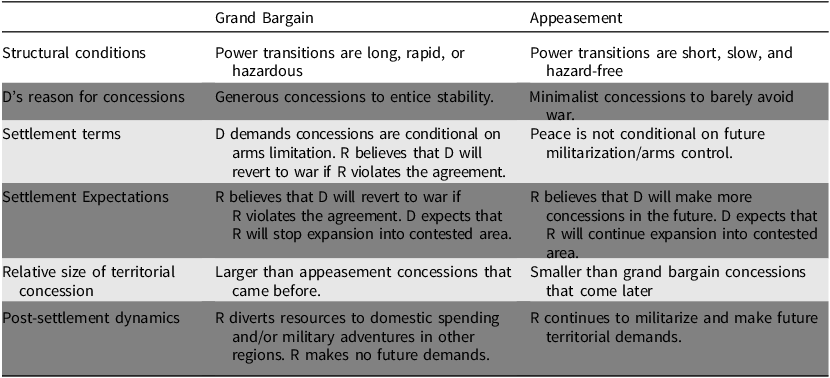
Note: Light-grey differences (rows 3 and 5) follow from ex-ante assumption. Dark grey differences (rows 2, 4, and 6) are expectations from the model’s mechanism. Unshaded differences represent parameter ranges where we expect each offer. We elaborate in the text of the manuscript.
Our theory not only contrasts appeasement and grand bargains, but it explains that each holds a different relationship with war during conventional power shifts. Based on the hazards examined in section ‘Delayed grand bargains as a solution to hazards’, we generate the following prediction about how declining powers change their strategies over time:
Expectations about the timing of war, appeasement and a grand bargain. When declining powers anticipate the power transition is short, slow, and hazard-free, they select a strategy of appeasement. When declining powers realize the power transition will be long and rapid, or that they will soon confront a hazard that will trigger large or frequent demands, they select either a grand bargain or war.
Cross-nationally, this prediction is violated if grand bargains occur when expected transitions are short, or slow, or appeasement occurs when expected transitions are rapid and long. Our grand bargain mechanism would lose import if we never observed grand bargains when power shifts were long or rapid. Within cases, we expect that elite preferences for different policies will change if their perceptions about pending hazards, and the duration and rate of power shifts change in response to unexpected information about the rising power. Our expectation is violated if elites thought that grand bargains and appeasement were attractive policy alternatives at the same moment, or if they failed to consider grand bargains as a viable alternative to war when they confronted a hazard, or otherwise anticipated long and rapid shifts. It would support our theory if an important elite acknowledged that grand bargains and war (but not appeasement) were both attractive policies in the face of hazards because both effectively could stop power from shifting. To the extent that policies require support from key stakeholders, it would also support our theory if divergent elite factions formed only at the moment we predict grand bargains and war, but all factions broadly favour appeasement when we predict appeasement.
The Anglo-Russian Great Game, 1869-1907
Following its defeat in the Crimean War (1853–1856), Russia increasingly focused on Central Asia. Britain saw this as a threat to India, its most important colony. Decades of Anglo-Russian geopolitical competition over Central Asia followed, called “the Great Game” (Sergeev Reference Sergeev2013). British policymakers understood that logistical difficulties prevented a full-scale Russian invasion of India. Nevertheless, the 1857 Indian Rebellion demonstrated the fragility of British rule. London feared that even a small Russian force could destabilize Britain’s hold over the subcontinent (Rawlinson Reference Rawlinson1875). Furthermore, Russia’s expansion threatened Britain’s commercial interests in Central Asia and the Middle East.
Our case material draws from an extensive review of primary documents, specialized works on the cases, and general works of diplomatic history and political science. Following best practices in the evaluation of the formal model (Bates Reference Bates1998; Joseph, Poznansky and Spaniel Reference Joseph, Poznansky and Spaniel2022) we focus on the core actors (Britain, Russia) and core decision nodes (major concessions) in our model. We then address three questions: Do important diplomatic negotiations reflect a logic of appeasement, a grand bargain, or something else? What are the structural conditions that surround these different choices? Looking at elite deliberations and debate, how did elites justify their choices?
We acknowledge recent historical work has examined the agency of Central Asian governments, and episodes of inadvertent Russian expansion during the period of appeasement (Morrison Reference Morrison2011; Anderson Reference Anderson2023). However, this was more important before the telegraph reached the region in 1873 (Morrison Reference Morrison2011, 256–257) and even before that points out that “the importance of local initiative should not be exaggerated” (Morrison Reference Morrison2011, 305) given that local commanders usually could rely on tacit support or at least acceptance in the War Ministry. What is more, our theory survives so long as Russia selects to expand, but is agnostic as to which actor within Russia is making that choice.
Coding concessions
We identified four major British concessions to Russia in Central Asia, summarized in Table 2. For more details, see section S2.4. Based on our review of deliberations and diplomatic negotiations, we code the 1873, 1885, and 1895 concessions as appeasement and the 1907 concession as a grand bargain.
Coding British Strategy Towards Russia
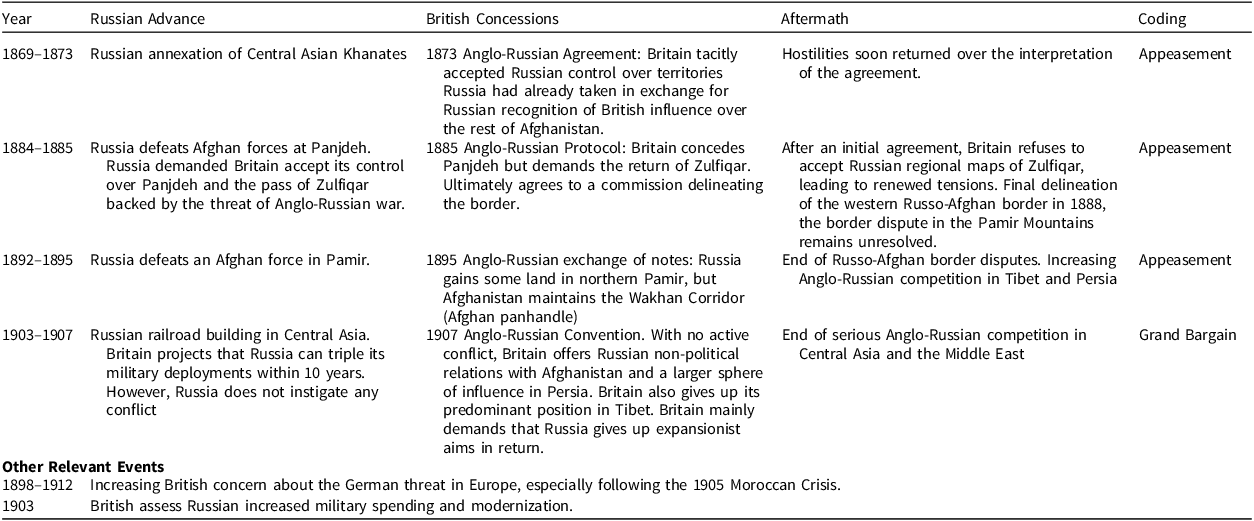
Notably, the 1907 Anglo-Russian convention conceded much more territory to Russia than previous agreements. The 1907 convention covered Afghanistan, Tibet, and Iran, an area of roughly 3.5 million square kilometres, covering all Anglo-Russian disputes in Central Asia and the Middle East.Footnote 39 By contrast, previous concessions dealt with individual disputes. For instance, the 1884–85 Panjdeh Crisis concerned the delineation of a quarter of the Russo-Afghan border.
We use diplomatic records to explore the logic of these settlements. Consistent with our theoretical focus, we emphasize events surrounding the 1907 Anglo-Russian Convention. However, we make clear that the logic of a grand bargain differs from appeasement by including contrasting cases of appeasement.
Shifting structural conditions and the shift to a grand bargain
We predicted that a sudden shift in British beliefs about the rate of Russian demands would shift Britain’s strategy. This is what we find. In the first three decades of the power transition, Russia’s rate of growth was slow, as Russia gradually consolidated its hold on the former Central Asia Khanates (Morrison Reference Morrison2011). During this period, Britain pursued an appeasement strategy.
At the turn of the century, several factors led Britain to estimate that Russia’s rate of expansion into Central Asia would soon increase. The main factor was the Russian railroad building into the region. When these lines were complete, Russia could rapidly deploy its huge army in Central Asia. The Trans-Caspian Railroad reached Tashkent in 1898, and Russia planned to extend it to Termez on the Afghan border (Pierce Reference Pierce1960, 188). British policymakers understood these implications. A 1907 War Office study argued that with only a few additional connecting lines, Russia could deploy a “practically unlimited” number of men anywhere in the region.Footnote 40 Rapid industrialization also meant that the Russian economy grew much faster than Britain’s prior to the First World War was also a fear of other countries, most notably Germany (Copeland Reference Copeland2000, 35–55).
To be clear, there were complicating factors. One surrounded Russia’s poor military performance and defeat during the Russo-Japanese War. Although Russia’s naval losses mattered little in Central Asia, its losses of manpower, ammunition, and finances did (Herrmann Reference Herrmann1996, 37–58). Nevertheless, the British continued to see Russia as a significant threat in Central Asia. Hardinge, the British Ambassador to Russia, feared that after making a settlement with Japan, Russia would “concentrate its entire energy and forces in a determined attack on India. The network of railways converging on Orenburg and the Caspian make the transport of troops and war material a task of small difficulty as compared with those experienced in Manchuria”.Footnote 41 The British Ambassador to Japan pointed out that “notwithstanding the crushing defeats which Russia has received in this war, she has transported and still maintains, at a distance of over 3,000 miles from Russia proper and connected by a single line of rail, an army of 250,000 men, and that the frontiers of India are much nearer to her base than the spot, where the above army is now encamped”.Footnote 42 Continued Russian railroad building increased the threat further, something which in 1907 made the War Office fear that “the military burdens of India and the Empire will be so enormously increased that, short of recasting our whole military system, it will remain a question of practical politics whether it is worth our while to retain India or not”.Footnote 43
This concern was amplified because Russia’s temporary military weakness encouraged alignment with Germany. Berlin offered Russia an alliance in late 1904 (Taylor Reference Taylor1954, 419–423), and in 1905 Nicholas II and Wilhelm II signed the Russo-German Treaty of Björkö. Russia did not ratify the treaty but continued Russo-German negotiations distressed London (White Reference White1995, 242–293).Footnote 44 The Russo-Japanese War also amplified Britain’s risk of accidental war, particularly during the 1904 Dogger Bank Crisis. This came in addition to the 1898 Fashoda Crisis with France. The fear was sufficiently serious that, until 1906, all British plans for major war were directed against France and Russia (Tomes Reference Tomes1997, 131–132). In summary, while the Russo-Japanese War helped to facilitate the Anglo-Russian Convention, it did not over-determine it (White Reference White1995, 241).Footnote 45
Britain was also concerned that a rising Germany would force it to balance two great power rivalries simultaneously (Williams Reference Williams and Hinsley1977, 133–134). While it is true that Grey argued that “[a]n entente between Russia, France and ourselves would be absolutely secure. If it is necessary to check Germany it could then be done”,Footnote 46 most historians argue that the Anglo-Russian Convention had many causes (Siegel Reference Siegel2002, 287–294). Indeed, the topic of Germany rarely came up during Anglo-Russian negotiations, with two exceptions. First, Russia repeatedly pointed out that the agreement was “not in any way be directed against Germany”.Footnote 47 Second, Britain and Russia agreed on the need to keep German influence out of Iran. This has made some historians argue that the agreement had “little to do with Germany” (Taylor Reference Taylor1954, 442).Footnote 48 Further, ending almost a century of Anglo-German rivalry and the threat to India had considerable value in themselves. Even the Crowe Memorandum, which is famous for arguing for a balancing strategy against Germany argued in January 1907 that the Anglo-Russian negotiations were motivated by “the adjustment of a number of actually-existing serious differences”.Footnote 49 Our theory is consistent with a balance of power explanation because the rise of a third-party competitor (Germany) acts as a hazard by causing rapid relative power shifts that may encourage a grand bargain. It also explains why extensive negotiations and British concessions were necessary to ensure Anglo-Russian cooperation.
Connecting British reasoning to hazards in the early 1900s
How did British policymakers respond once they realized that Russia would rapidly rise? The conventional wisdom is that the fear of rapidly shifting power drives states from appeasement to war (Powell Reference Powell1999). We argue that a grand bargain and war are both rational. Consistent with our theory, deliberations after 1900 illustrate these multiple equilibria.
In 1902, future Foreign Secretary and architect of the Anglo-Russian Convention, Edward Grey, proposed three options. First, Britain could pursue a policy of “perpetual resistance to Russian expansion everywhere in Asia” that would carry a serious risk of war. Second, Britain could “remove, at any rate between the British Government and the Russian Government, that cloud of suspicion and mistrust and that continual friction that has existed for so long between the two countries”. He believed this could only come in the form of an agreement considering “Russian policy in Asia and British policy in Asia must be looked upon as a whole” rather than looking at individual disputes in isolation.Footnote 50 This corresponds to a grand bargain. Third, Britain could continue to make individual concessions in response to Russian moves, which correspond to appeasement.Footnote 51
Consistent with our theory, Grey thought that both a grand bargain and war were good options. Conversely, appeasement was “a policy which [Britain] must not pursue”Footnote 52 because appeasement combined “in a most extraordinary way the disadvantages both of yielding and of resistance without getting the advantages of either course”. Under appeasement, Britain would make “all the concessions which ought to have entitled [it] to reward and friendship in return, while we have incurred odium and enmity and friction, even though the concessions were made in the end”. Thus, Grey believed appeasement was “intolerable”.Footnote 53 Grey’s contrast of appeasement and grand bargains highlights another aspect of our theory: militarization and bargaining continue after appeasement; a grand bargain provides lasting peace.
Grey thought that the grand bargain was the “desirable” option. However, he was unsure whether it was achievable. He wanted “to find out what the Russian Government really want… [to determine] how far it is so compatible with [British] interests to come to an agreement with Russia”.Footnote 54 Following our theory, Grey’s reasoning reflects how grand bargains are efficient, but require mutual consent.
Most British policymakers agreed that a grand bargain and war were Britain’s main options. However, they disagreed about the preferred strategy. For example, Foreign Secretary Lansdowne supported a grand bargain and initiated discussions with Russia for this aim in 1903 (Monger Reference Monger1963). Other policymakers argued for war because they believed that Russia’s demands in Central Asia and the Middle East were too extensive to make a satisfactory agreement feasible. For instance, Indian Viceroy Curzon, believed that “an agreement was impossible because no government aware of its country’s geographical and strategic advantages over Britain, would ever set a limit on its expansion” (Gilmour Reference Gilmour2003, 201).
Interestingly, given our multiple equilibria prediction, Britain came close to going to war with Russia. Proponents of war wanted to take advantage of the growing Russo-Japanese tensions in East Asia. Chancellor Austen Chamberlain argued that a Russo-Japanese war would be “the proper time for us to secure, and to secure promptly, whatever we want in places where Russia is our rival” (Otte Reference Otte2007, 313). Calls for war became even louder in October 1904 when the Russian Baltic Fleet en route to Asia accidentally opened fire on British trawlers at Dogger Bank. The British public and press responded with outrage, and several cabinet members argued for war (Monger Reference Monger1963, 172). The Royal Navy prepared to intercept the Russian Baltic Fleet at Gibraltar. Fisher, the First Sea Lord argued that “the Russian Fleet is ours whenever we like to take it” (Morgan-Owen Reference Morgan-Owen2017, 139). However, Lansdowne ultimately prevented the crisis from escalating into war by securing a Russian apology and reparations.Footnote 55
Consistent with our theory, proponents of war and a grand bargain both pointed to the same underlying structural conditions when justifying their strategy. For instance, the pro-war First Lord of the Admiralty Selborne summarized that “[i]t is a terrific task to remain the greatest naval Power when naval powers are year by year increasing in numbers and in naval strength and at the same time to be a military Power strong enough to meet the greatest military power in Asia”.Footnote 56 Similarly, the pro-grand bargain Secretary of State for India, Hamilton, wrote that “time is on Russia’s side; the longer we delay coming to an arrangement, the worse the settlement for us will be” Monger (Reference Monger1963), 110.
The logic for a grand bargain differed from the logic of appeasement in the previous decades. As our theory predicts, policymakers favoured appeasement prior to 1904. Their goal was to make the smallest possible concessions and avoid war believing that power would shift slowly. The Panjdeh Crisis, which began in March 1885 when the Russians defeated an Afghan force at Panjdeh, illustrates this. This attack could have forced Britain into war because Britain had previously committed itself to Afghanistan’s defence (Langer Reference Langer1931, 315). Prime Minister Gladstone planned for the “sad contingency of an outbreak of war” by securing emergency funds in parliament. However, he promised to “continue to labour, for an honourable settlement by pacific means”.Footnote 57
Most British policymakers shared Gladstone’s desire to avoid war with Russia over a remote and sparsely populated corner of Afghanistan. Nevertheless, we find no evidence that Gladstone or his critics seem to have considered accepting Russia’s possession of Panjdeh, let alone broader concessions in Central Asia.Footnote 58 Indeed, British policymakers did their best to minimize their concessions. After the initial war scare, Britain reluctantly agreed that Russia would keep Panjdeh, but had to withdraw from Zulfiqar further east.Footnote 59 Then they quickly resurrected the crisis by disagreeing with Russia about Zulfiqar’s geographic extent.Footnote 60 It was only in September the Anglo-Russian Protocol finally averted the risk of war.
Terms of the Concessions
Consistent with our expectations, the Anglo-Russian convention explicitly limited Russian militarization in Central Asia and the Middle East. Russia promised not to seek a port in the Indian Ocean or build railroads in the British sphere of influence; meaning that it would not be able to extend its railroad network to the Indian Ocean.Footnote 61 Russian power continued to grow in Europe, again particularly due to railroad expansion. However, this did not threaten Britain.Footnote 62
British policymakers did consider the possibility that Russia would not stick to the agreement. However, Grey believed this would not be the case, arguing that “I do not believe the Agreement will be broken if our general relations with Russia are good: which I believe will be the result of the Agreement.”Footnote 63 Nicholson, the British Ambassador to Russia, agreed, arguing that “[o]nce we have come to an agreement with Russia and have obtained her signature, I do not consider it likely that she will disown her engagements, it would not be in her interests to do so”.Footnote 64
Russia also understood that continued militarization would result in war. For instance, the Russian Foreign Minister Izvolsky stated to the British that “[i]f after the signature of the convention, Russia were to take action of any character whatsoever in Afghanistan, it would be a violation of the Convention and constitute an act of war”.Footnote 65
By contrast, previous agreements did not limit Russian militarization. Again, the 1885 Anglo-Russian Protocol is a good example. This agreement only dealt with defining the scope of Panjdeh and Zulfiqar, and for a commission to delineate the border, making no mention of Russian military deployments or railroad building.Footnote 66 Following this agreement, Russia continued to expand its military presence and make demands elsewhere in Central Asia. However, Britain did not assess that Russia violated the protocol.
Post-Settlement Dynamics
We expect that the Anglo-Russian convention significantly dampened Anglo-Russian competition, while previous concessions did not. This is what we find. Following the Anglo-Russian Convention, Russia made no significant demands in Central Asia. A 1908 Foreign Office Memorandum summarized that the Anglo-Russian Convention “has successfully removed the causes of friction between Great Britain and Russia in Asia… The removal of all causes of discord in Asia would no doubt contribute to more harmonious relations between the two powers.”Footnote 67 Historians Steiner and Neilson describe the Anglo-Russian Convention as “a milestone that ended nearly a century of Anglo-Russian hostility” (2003, 90). Russia also increasingly shifted its focus to opposing Austria-Hungary in the Balkans, which Britain encouraged.Footnote 68 Previously, Russia had cooperated with Austria-Hungary on Balkan affairs following the 1897 Austro-Russian Entente.
Consistent with the logic of our grand bargain, Russia consulted Britain on future construction in Persia and adapted its plans to accommodate British interests beyond the Anglo-Russian Convention’s stipulations (Spring Reference Spring1976). When planning to build a Trans-Persian railway through the neutral zone, Russia decided to build it in cooperation with Britain and France. According to Grey, this “will enable us to say where and when a Trans-Persian line would be made”.Footnote 69 Thus, such railroad building would not threaten India. Critically, Russia abandoned plans to construct the railroad from Tashkent to Termez because the decrease in Anglo-Russian tensions removed its strategic rationale (Becker Reference Becker2004, 148–149). This railroad had been a major concern to British policymakers.
The decrease in tensions in Central Asia helped to facilitate Britain’s alliance with France and Russia during the First World War Unfortunately, we cannot know how durable the Anglo-Russian Convention was because the Soviet Union denounced treaties made by the Tsarist government in 1918.Footnote 70 However, the Anglo-Russian Convention did have an important impact while the Tsar remained in power.
The consequences of the Anglo-Russian Convention are different from all earlier agreements. For instance, Prime Minister Salisbury expressed hope that the 1885 Anglo-Russian Protocol would solve a specific border crisis but did not express hope for lasting peace. Almost immediately, Britain and Russia became embroiled in a dispute over Bulgaria (Langer Reference Langer1931, 323–364). An Anglo-Russian crisis in Central Asia soon followed over the undelineated eastern part of the Russo-Afghan border. The contrast between the 1885 Protocol and the 1907 Convention was noted by contemporaries. In 1911, Grey himself argued that “the Anglo-Russian Agreement has been of enormous relief” to the defence of India, highlighting the lower tensions it brought compared to the Panjdeh and Pamir incidents.Footnote 71
Conclusion
Bargaining theorists conclude that “large, rapid shifts in the distribution of power undermine peaceful settlements” (Powell Reference Powell2006, 195), leading to a consensus view that large, one-period (Powell Reference Powell2006) conventional power shifts cause preventive war (Souva Reference Souva and Thompson2017). We showed that preventive war can arise during long, incremental power shifts, whether they are fast or slow per period, and that a grand bargain can sustain peace when long power shifts are either fast or slow per period. In a grand bargain, the declining power offers more than it must to avoid war. In return, the rising power promises not to militarize and seek further gains. Wars and grand bargains serve the same purpose: they prevent power from shifting. Thus, declining powers turn to them under the same conditions. This insight helps clarify why so many conventional power shifts destined for war end in peace. Declining powers offer grand bargains under conditions past scholars of conventional shifts predict preventive war. This fits the persistent but puzzling cross-national finding that measures of shifting power weakly predict war.
Our theory explains how scholars can code different types of peace and suggests doing so will yield important empirical insights within and across conventional power transition cases. We used the Great Game to illustrate the within-case implications. The Anglo-Russian Convention illuminates the complex threats and promises necessary to support a grand bargain with conventional shifts (cf Spaniel Reference Spaniel2019) and clarifies real-world differences between appeasement and a grand bargain following the strategic logic we lay out. Notably, British elites seriously consider both war and a grand bargain (but not appeasement) when our theory rationalizes both equilibria simultaneously. Of course, Britain could only select one of these policies. Thus, in S2, we contrast the Anglo-Russian Convention with the Russo-Japanese War to show that war and grand bargains can arise under similar structural conditions. In S3, we show how future researchers can use our coding scheme to analyze grand bargains distinctly from appeasement to shed light on critical cases. Specifically, we code all of Allison’s (Reference Allison2017) great power transition cases and find preliminary evidence that declining powers consider grand bargains concurrently with war in a diverse set of cases. Some of these cases end in war and others end in peace.
Our two predictions are valuable for Sino-American relations. Many policymakers are worried that the pressures of shifting power over a long period of time destine us for war. Our mechanism for preventive war suggests that this long, slow shift does create a serious concern. However, our multiple equilibria suggest war is not pre-determined in this case because a grand bargain is also rationalizable. We do not argue that a grand bargain with China is necessarily optimal. However, we argue that policymakers should look beyond military tools when assessing the best way to respond to China’s rise. We also clarify the specific threats and incentives necessary to hold a grand bargain together given that China’s rise is primarily conventional. Thus, our theory provides a framework for how the USA can strategically use concessions to minimize the cost of Sino-American competition.
Supplementary material
To view supplementary material for this article, please visit https://doi.org/10.1017/S0007123424000577
Acknowledgements
We thank Jack Levy, Sam Bell, Alexandre Debs, Bradley Smith, Nuno Monteiro, Brandon Yoder, Michael K. Miller, and the participants at the ANU International Relations Workshop for helpful comments that improved the paper.
Author contributions
The authors contributed equally and are ordered alphabetically. We consider each author as a first author.
Funding statement
None.
Competing interests
None.


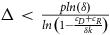


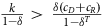


 Open access

