

Risk-taking behavior refers to engaging in actions that are associated with potentially adverse consequences (Boyer, Reference Boyer2006). Adolescents and young adults have more frequent and prevalent risk-taking behavior than individuals in any other age group (Arnett, Reference Arnett1996). This may be the result of imbalances between an increased susceptibility to motivational stimuli (e.g., rewards) and the ongoing development of cognitive control (e.g., inhibition) during adolescence (Steinberg, Reference Steinberg2008). Studies in both Eastern and Western cultures have found that young adults have a tendency to engage in risky behaviors, such as speeding, drinking, smoking and having unsafe sex. For example, Vassallo et al. (Reference Vassallo, Smart, Sanson, Harrison, Harris, Cockfield and McIntyre2007) found that young adults tended to speed, which was a major contributing factor to their having the highest rates of injury and death in road traffic accidents compared with Australian drivers from other age groups. The situation is similar in China. A study by An (Reference An2015) found that 17.6% of high and 39.3% of moderate sensation seekers among 786 Chinese young adults were punished for speeding every year. Moreover, Xu and Deng (Reference Xu and Deng2016) reported that about 11.2% of Chinese young adults had a dangerous and harmful drinking problem, which can impede healthy physical development and hinder academic performance. With so many young adults taking risks involving so many negative consequences, it is very important to form a comprehensive model by which to understand risk-taking behaviors in young adults.
According to social cognitive theory, the development of risk-taking behavior might be related to both external stimuli (e.g., family, school, peers) and internal factors (e.g., personal characteristics, self-efficacy, self-regulation; Perry, Baranowski, & Parcel, Reference Perry, Baranowski, Parcel, Glanz, Lewis and Rimer1990). As a typical and unavoidable external stimulus, parenting style is closely associated with behavioral development in adolescents and young adults. Parenting style, which refers to the typical ways that parents think, feel and behave in terms of child-rearing (Levin, Reference Levin, Goldstein and Naglieri2011), has been divided into different types, such as warmth, rejection and overprotection. These parenting styles predict the propensity for behavior problems in adolescents and young adults. For instance, parental warmth (understood as physical affection, praise and other forms of emotional support) is associated with lower levels of delinquent and aggressive behavior in adolescents (Stright & Yeo, Reference Stright and Yeo2014). In contrast, parental rejection, which is characterized by hostility, punishment and derogation, is associated with increased externalizing problems, such as smoking (Fuemmeler et al., Reference Fuemmeler, Yang, Costanzo, Hoyle, Siegler, Williams and Ostbye2012), suicide (Sobrinho, Campos, & Holden, Reference Sobrinho, Campos and Holden2016) and aggression (Barbot, Crossman, Hunter, Grigorenko, & Luthar, Reference Barbot, Crossman, Hunter, Grigorenko and Luthar2014). Finally, parental overprotection, which refers to excessively intrusive and highly regulative parenting, is associated with an increased lifetime likelihood of smoking (Huver, Engels, Vermulst, & De, Reference Huver, Engels, Vermulst and De2007). Based on these studies, we predict that parental warmth is negatively correlated with risk-taking behavior, whereas parental rejection and overprotection are positively correlated with risk-taking behavior in young adults.
As an internal factor, coping efficacy is also associated with behavior problems in adolescents and young adults. Coping efficacy refers to the global belief that one can deal with the demands made and the emotions aroused by a stressful or problematic situation (Sandler, Tein, Mehta, Wolchik, & Ayers, Reference Sandler, Tein, Mehta, Wolchik and Ayers2000). Researchers have postulated that adolescents with higher coping efficacy use better coping strategies, greater effort and prolonged persistence to overcome barriers or life stressors, resulting in fewer externalized behavior problems (Hampel & Petermann, Reference Hampel and Petermann2006). Consistently, empirical studies have found that young adults who lack confidence in their coping abilities (i.e., poor coping efficacy) are more likely to have problematic eating attitudes and behaviors and may be at risk for disordered eating problems (MacNeil, Esposito-Smythers, Mehlenbeck, & Weismoore, Reference MacNeil, Esposito-Smythers, Mehlenbeck and Weismoore2012). These findings suggest that coping efficacy may be negatively related to risk-taking behavior in young adults.
There is also a significant relationship between parenting styles and coping efficacy in adolescents and young adults. Specifically, parental warmth is likely to include opportunities for instruction about and reinforcement of adaptive coping efforts, which may in turn increase coping efficacy (Camisasca, Miragoli, Blasio, & Grych, Reference Camisasca, Miragoli, Blasio and Grych2017). In contrast, parental rejection may lead to withdrawal in young adults when confronted with stressors, and this withdrawal may in turn decrease coping efficacy (Stevens, Bardeen, & Murdock, Reference Stevens, Bardeen and Murdock2015). Similarly, parental overprotection may prevent the learning of action-oriented coping strategies (Spada et al., Reference Spada, Caselli, Manfredi, Rebecchi, Rovetto, Ruggiero and Sassaroli2012), which may in turn decrease coping efficacy. Thus, we can predict that parental warmth is positively correlated with coping efficacy, whereas parental rejection and overprotection are negatively correlated with coping efficacy in young adults.
In addition to these direct relationships, could there be indirect relationships between parenting styles, coping efficacy and risk-taking behavior? Some theorists have asserted that parenting may affect subsequent coping efficacy in adolescents, which in turn is related to externalization problems (Zhou et al., Reference Zhou, Wang, Deng, Eisenberg, Wolchik and Tein2008). There is some evidence for this hypothesis. Research has indicated that improvement in the mother-child relationship (e.g., increased warmth, acceptance and support) leads to increased coping efficacy in teenagers (Vélez, Wolchik, Tein, & Sandler, Reference Vélez, Wolchik, Tein and Sandler2011), and that adolescents with higher coping efficacy can reduce the prevalence of problematic behaviors through effective coping with life difficulties (Smith et al., Reference Smith, Eisenberg, Spinrad, Chassin, Morris, Kupfer and Kwok2006). Moreover, in a longitudinal study, Yaacob Idris, and Wan (Reference Yaacob, Idris and Wan2015) reported that coping efficacy played a mediating role in the relationship between maternal attachment and antisocial behavior in adolescents from divorced families. These studies suggest that parenting styles are probably associated with risk-taking behavior through coping efficacy.
A review of the literature shows that many studies have examined the relationships between parenting styles, coping efficacy and risk-taking behaviors. However, some gaps need to be addressed further. First, previous studies only focused on each parenting style separately and did not try to integrate the three parenting styles into a single, unified model that could be used to explore the relationships between these styles and coping efficacy and risk-taking behavior. Thus, whether there is a unique effect of each parenting style on coping efficacy and risk-taking behavior above and beyond the effects of the other two parenting styles is unknown. Second, most of the previous studies focused solely on maternal parenting, ignoring paternal parenting (e.g., Yaacob et al., Reference Yaacob, Idris and Wan2015; Vélez et al., Reference Vélez, Wolchik, Tein and Sandler2011). To the authors’ knowledge, no research has examined the parenting styles of both mothers and fathers. Previous studies have indicated that maternal and paternal parenting styles are associated with variations in adolescent adjustment. For example, Milevsky, Schlechter, Netter, and Keehn (Reference Milevsky, Schlechter, Netter and Keehn2007) found that authoritative mothering was related to higher self-esteem, life-satisfaction and lower depression, whereas authoritative fathering was only related to lower depression. Moreover, both maternal and paternal parenting are critical dimensions in predicting adolescent functioning (Forehand & Nousiainen, Reference Forehand and Nousiainen1993). For instance, researchers found that child development was influenced by fathers’ supportiveness, which acted as a potential buffer against unsupportive maternal parenting, but mothers’ supportiveness did not buffer against unsupportive paternal parenting (Martin, Ryan, & Brooks-Gunn, Reference Martin, Ryan and Brooks-Gunn2010). Thus, examining the respective roles of both maternal and paternal parenting styles on risk-taking behavior is necessary.
To address these gaps, the goal of the current study was to integrate both mothers’ and fathers’ three parenting styles (i.e., warmth, rejection or overprotection), coping efficacy and risk-taking behavior into a model and explore the respective roles of both mothers’ and fathers’ three parenting styles on coping efficacy and risk-taking behavior in young adults. Based on findings that the three parenting styles all have direct effects on coping efficacy and risk-taking behavior and that parenting has an indirect effect on externalizing behavior via coping efficacy, we tentatively expected that all three parenting styles (i.e., warmth, rejection and overprotection) of both mothers and fathers might have indirect effects on risk-taking behavior via coping efficacy. The three main hypotheses of this study were as follows:
H1: Maternal (and paternal) warmth negatively correlate with risk-taking behavior, while maternal (and paternal) rejection and overprotection positively correlate with risk-taking behavior.
H2: Higher levels of coping efficacy are associated with lower levels of risk-taking behavior.
H3: The three parenting styles (i.e., warmth, rejection and overprotection) of both mothers and fathers all have indirect effects on risk-taking behavior via coping efficacy.
Methods
Participants
The data were collected through a college student self-report survey during 2016 in a western Chinese city, Xi’an. College students who lived in two-parent families were recruited from 16 institutions. The local institutional review board approval was obtained for this study. Incentives in the form of money (10 yuan, which is approximately equivalent to 1.50 USD in 2019) were provided to the participants. The participant sample varied with respect to socio-demographic characteristics (age, gender and family demographic variables) and seemed to be a reasonable representation of college students from the west of China. We initially recruited 720 college students to participate in our survey; however, one participant reported that she was 15 years old. Therefore, we eliminated her data in the final statistical analysis as she had not reached adulthood. Thus, the final analytic sample included 719 participants (women n = 399; men n = 320). The sample’s mean age was 19.96 years (SD = 0.97, with an age range of 18 to 21 years). 61.05% and 55.91% of the participants’ fathers and mothers, respectively, had a bachelor’s degree or above.
Measures
Parenting style
The Chinese version of the short Egna Minneu av Bardndosnauppforstran (s-EMBU-C; Jiang, Lu, Jiang, & Xu, Reference Jiang, Lu, Jiang and Xu2010) was used to measure the perceived maternal (and paternal) parenting styles. The s-EMBU-C consists of 21 self-report items with three dimensions; namely, emotional warmth (seven items), rejection (six items) and overprotection (eight items). Each item consists of two declarative sentences relating to fathering and mothering respectively. For example, the assessment form uses “Father comforts me” and “Mother comforts me” to assess warmth, “Father is strict to me” and “Mother is strict to me” to assess rejection, and “Father interferes with anything I do” and “Mother interferes with anything I do” to assess overprotection. The participants responded to each item using a 4-point Likert scale ranging from 1 = never to 4 = always. We recorded the total scores of the three dimensions for the mother and father separately. Jiang et al. (Reference Jiang, Lu, Jiang and Xu2010) reported that this scale achieved good reliability when used on a Chinese sample. In their study, the Cronbach’s alpha for both the maternal and paternal scales ranged from .74 to .84, the split-half reliability ranged from .73 to .84, and the retest reliability after 10 weeks ranged from .70 to .81. Jiang et al. (Reference Jiang, Lu, Jiang and Xu2010) also reported that the questionnaire showed good structural validity. High correlations were found between the s-EMBU-C and the original Chinese version of the EMBU (Yue, Li, Jin, & Ding, Reference Yue, Li, Jin and Ding1993): .82 for rejection, .92 for emotional warmth and .89 for overprotection. Because of its good reliability, validity and accessibility, the s-EMBU-C has been widely used with Chinese college students (Lu et al., Reference Lu, He, Zhu, Wu, Cai, Hu and Mao2015; P. Wu, Liu, Lu, & Tian, Reference Wu, Liu, Lu and Tian2013). In the current study, the Cronbach’s alpha coefficients for the three subscales were acceptable: .82 for paternal and .79 for maternal emotional warmth, .77 for paternal and .74 for maternal rejection, and .67 for paternal and .68 for maternal overprotection.
Coping efficacy
Coping efficacy in the participants was measured by a Chinese version of the 17-item Coping Efficacy Questionnaire (CEQ-17; Tong, Reference Tong2005). The CEQ-17 includes three dimensions: competency (nine items), cognition (five items) and confidence (three items). Examples of items pertaining to each dimension are as follows: “I am able to turn pressure into motivation” (competency); “I think trouble is a friend” (cognition); and “I’m afraid I cannot cope with these problems” (confidence; reversed items). The participants were asked, “When things are not going well for you or when you are having problems, do you have the following experience?” Then, they were instructed to provide a rating on a 4-point Likert scale ranging from 1 = strongly disagree to 4 = strongly agree. A global coping efficacy score was computed by adding the ratings on the 17 items with reverse coding of the relevant items. The scores ranged from 17 to 68, with a higher score indicating better coping efficacy. Tong (Reference Tong2005) reported that the CEQ-17 had good reliability in a sample of 1806 Chinese college students. The Cronbach’s alpha coefficient was .86, the split-half reliability coefficient was .79, and the CEQ-17 also correlated with the General Self-Efficacy Questionnaire, r(1804) = .63, p < .001 (Schwarzer, Bäßler, Kwiatek, Schröder, & Zhang, Reference Schwarzer, Bäßler, Kwiatek, Schröder and Zhang1997), Rosenberg’s Self-Esteem Questionnaire, r(1804) = .53, p < .001) (Schmitt & Allik, Reference Schmitt and Allik2005), and the Center for Epidemiological Studies Depression Scale r(1804) = −.48, p < .001. In the current study, the Cronbach’s alpha coefficients were .89 for competency, .82 for cognition and .54 for confidence. Since the Cronbach’s alpha coefficient for confidence was not acceptable, this dimension was excluded from further analysis. After deleting the confidence subscale, the total Cronbach’s alpha coefficient for coping efficacy in the current study was .91. The split-half reliability coefficient was .81. The coping efficacy questionnaire used in the current study is presented in the Appendix.
Risk-taking behavior
The Chinese short version of the Adolescent Risk-taking Questionnaire — Risk Behavior Scale (ARQ-RB; Zhang, Zhang, & Shang, Reference Zhang, Zhang and Shang2011), revised based on the Adolescent Risk-Taking Questionnaire (Gullone, Moore, Moss, & Boyd, Reference Gullone, Moore, Moss and Boyd2000), was used to measure the levels of risk-taking behavior in college students. The ARQ-RB is a 17-item questionnaire used to rate the frequency of participation in risky behaviors. Thrill-seeking (five items), rebellious (six items), reckless (two items), and antisocial behaviors (four items) make up the four subscales of the ARQ-RB. Examples of each dimension are as follows: snow skiing (thrill-seeking), smoking (rebellious), having unprotected sex (reckless), and cheating (antisocial). Participants indicated the frequency of experiences on a 5-point Likert scale (0 = never done, 1 = hardly ever done, 2 = done sometimes, 3 = done often, and 4 = done very often). A total behavior score is calculated by summing up the frequency rating for all items, with a high score indicating a high overall level of participation in a risky activity. The ARQ-RB has been reported to have good reliability and validity when utilized on a Chinese adolescent sample (Zhang et al., Reference Zhang, Zhang and Shang2011). In the current study, the Cronbach’s alpha coefficient was .66 for thrill-seeking, .76 for rebellious, .47 for reckless, and .72 for antisocial behavior. Since the Cronbach’s alpha coefficient for reckless behavior was not acceptable, this dimension was excluded from further analysis. After deleting the reckless behavior subscale, the overall alpha coefficient for the entire scale was .80, demonstrating good reliability.
Data analysis
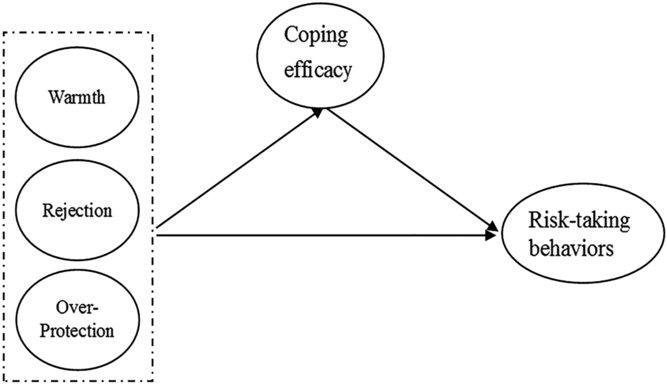
We used structural equation modeling (SEM) to test the theoretical model (see Figure 1). In the theoretical model, parenting warmth, rejection and overprotection were three latent variables, and the items on each subscale were used to make up two parcels as indicators for each latent variable. We constructed the parcels by randomly assigning a similar number of items from each dimension to each parcel. This approach, which has been shown to have satisfactory statistical properties, is widely used in SEM (Y. Wu & Wen, Reference Wu and Wen2011). Coping competence and coping cognition were the two indicators for coping efficacy; while thrill-seeking behaviors, rebellious behaviors and antisocial behaviors were the three indicators for risk-taking behavior. For SEM, a good fit is obtained when Bentler’s comparative fit index (CFI) is larger than .95, and the root mean square error of approximation (RMSEA) is below .05 (Hu & Bentler, Reference Hu and Bentler1999). We considered the model to have an adequate fit if the CFI was larger than .90 and the RMSEA was between .06 and .08 (Yu, Reference Yu2002).
Theoretical model of the relationship between parenting styles, coping efficacy, and risk-taking behavior.
To test our hypotheses, we performed the following data analysis. First, we conducted a correlation analysis using SPSS 13.0 to examine the relationships between the three maternal (and paternal) parenting styles and risk-taking (H1), and the relationships between coping efficacy and risk-taking behaviors (H2). Then we used the two-step procedure recommended by Anderson and Gerbing (Reference Anderson and Gerbing1988) to analyze the indirect effect of maternal (and paternal) parenting styles on risk-taking behavior via coping efficacy using AMOS 20.0. The measurement model was first tested to assess the extent to which each latent variable was represented by its indicators. If the measurement model was shown to have an acceptable fit, then the structural model was tested using the maximum likelihood estimation. Both the measurement and structural analyses were done for the maternal and paternal parenting styles separately. The goodness of fit of the theoretical model was compared with that of two competing models to validate H3. Specifically, in Competing Model 1, the three parenting styles were specified as independent variables, while coping efficacy and risk-taking behavior were specified as dependent variables; in Competing Model 2, the three parenting styles and coping efficacy were specified as independent variables, while risk-taking behavior was specified as a dependent variable. Differences in the chi-square and fit indices were used to compare the models and to determine those that best fit the data. We used a bootstrapping analysis in AMOS 20.0 to examine the indirect effects because this method has adequate control over type I errors (Preacher & Hayes, Reference Preacher and Hayes2008). We considered a significant indirect effect to be identified if the 95% bias-corrected bootstrap confidence intervals (BC CIs) for the indirect effect did not contain a zero or end at zero. Finally, we conducted multiple group analyses to examine the gender differences in the model.
Results
Descriptive statistics
Table 1 presents the means, standard deviations, and bivariate correlations for all the variables. Maternal (and paternal) warmth was negatively related to all the indicators of risk-taking behavior, whereas maternal (and paternal) rejection and overprotection were positively related to all the indicators of risk-taking behavior. These results supported H1. In addition, the results of the correlation analysis showed that of the three indicators of risk-taking behavior, only antisocial behaviors and rebellious behaviors were negatively correlated with indicators of coping efficacy, while thrill-seeking behaviors had no correlations with any indicator of coping efficacy. That is, higher levels of coping efficacy were associated with lower levels of antisocial behaviors and rebellious behaviors but not associated with thrill-seeking behaviors. Thus, H2 was partially supported. We also found that maternal parenting styles and paternal parenting styles strongly correlated with each other. Specifically, maternal warmth correlated with paternal warmth, r(717) = .67, p < .001; maternal rejection correlated with paternal rejection, (717) = .76, p < .001; and maternal overprotection with paternal overprotection, r(717) = .71, p < .001. These results indicate that there are some similarities between perceived maternal and paternal parenting styles within the same home, a finding which is consistent with previous studies (Winsler, Madigan, & Aquilino, Reference Winsler, Madigan and Aquilino2005).
Means, standard deviations, and bivariate correlations of variables (N = 719)

Note: M = mean; SD = standard deviation; The data outside parentheses refer to paternal parenting style, while the data inside parentheses refer to maternal parenting style. *p < .05; **p < .01.
Measurement model for maternal and paternal parenting
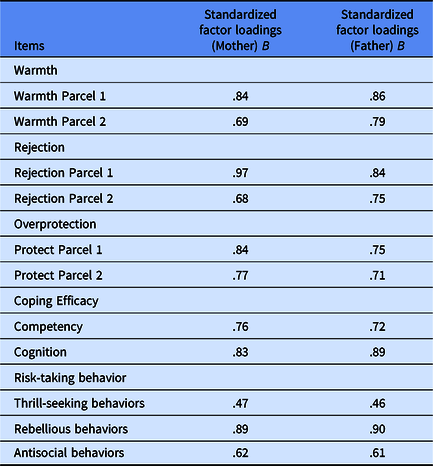
The measurement model for all the latent variables provided a good fit to maternal parenting, χ2(34, N = 719) = 111.04, p < .001, CFI = .97, RMSEA = .05; also, the measurement model for all the latent variables provided a good fit to paternal parenting, χ2(34, N = 719) = 120.27, p < .001, CFI = .96, RMSEA = .06. In both the maternal and paternal measurement models, all the factor loadings for the indicators on the latent variables were significant (p < .001), indicating that all the latent factors were well represented by their respective indicators (see Table 2).
Factor loadings for the indicators on the latent variables in both maternal and paternal measurement models
Structural model for maternal parenting
For perceived maternal parenting styles, the results showed that the theoretical model fit the data well, χ2(34, N = 719) = 111.04, p < .001, CFI = .97, RMSEA = .06. We compared the theoretical model with two other competing models. The model comparison results showed that the overall fit of Competing Model 1, χ2(35, N = 719) = 127.10, p < .001, CFI = .96, RMSEA = .06) was worse than the fit of the theoretical model, Δχ2(Δdf = 3) = 60.33, p < .001. Additionally, Competing Model 2, χ2(37, N = 719) = 171.37, p < .001, CFI = .95, RMSEA = .06, had a worse fit than did the theoretical model, Δχ2(Δdf = 1) = 16.06, p < .001. As a result, the theoretical model was retained (Figure 2).
Structural model for the association between participants’ report of their mothers’ parenting, coping efficacy, and risk-taking behaviors; model fit: χ2(34, N = 719) = 111.04, p < .001, CFI = .97, RMSEA = .06. Comp = Competency; Cogn = cognition; Thrill = thrill seeking; Reb = rebellious; Anti = anti-social. Standardized path coefficients are presented. The non-significant paths are presented in dashed lines.
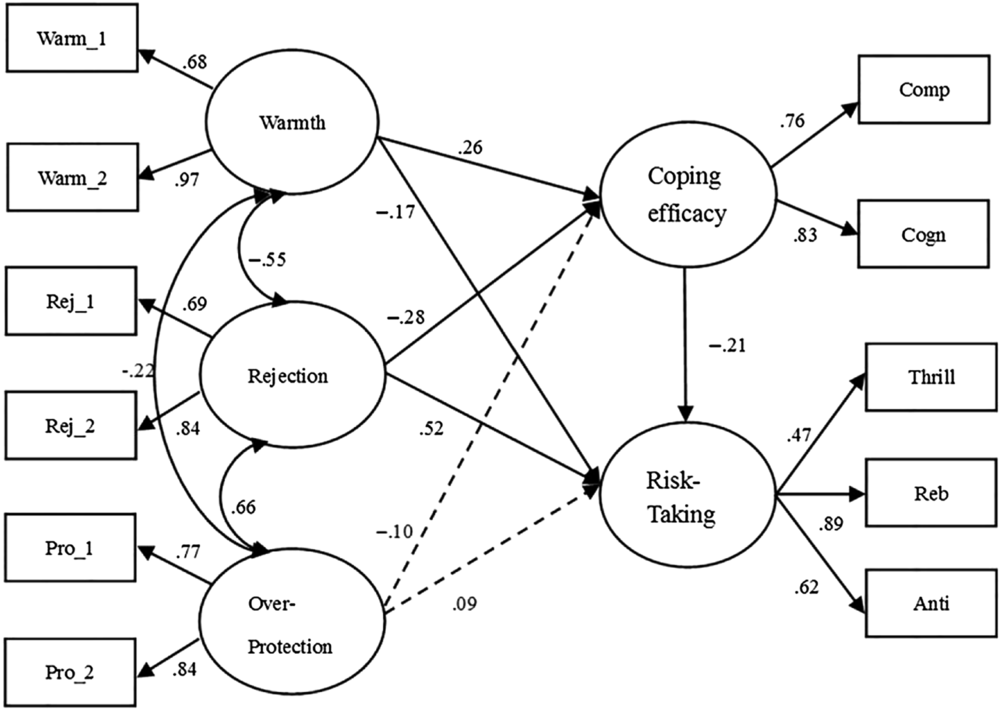
Significant relationships between maternal parenting styles, coping efficacy and risk-taking behavior were found. Specifically, coping efficacy was positively associated with maternal warmth (B = .26, p = .01) and negatively associated with maternal rejection (B = −.28, p = .04). Risk-taking behavior was negatively associated with maternal warmth (B = −.17, p = .01) and positively associated with maternal rejection (B = .52, p = .01). However, maternal overprotection was not associated with coping efficacy (B = −.10, p = .23) or risk-taking behavior (B = .09, p = .18). Coping efficacy was negatively associated with the young adults’ risk-taking behavior (B = −.21, p < .01).
Bootstrapping analyses revealed significant indirect effects only for maternal warmth and rejection but not for overprotection. Specifically, the indirect effect of maternal warmth on risk-taking behavior via coping efficacy was significant (indirect effect = −.05, 95% BC CI [−.14, −.02]). Similarly, the indirect effect of maternal rejection on risk-taking behavior via coping efficacy was significant (indirect effect = .06, 95% BC CI [.01, .13]).
Structural model for paternal parenting
For perceived paternal parenting styles, the theoretical model also fit the data best, χ2(34, N = 719) = 120.26, p < .001, CFI = .96, RMSEA = .06. The model comparison results indicated that both Competing Model 1, χ2(35, N = 719) = 135.24, p < .001, CFI = .95, RMSEA = .06; Δχ2 (Δdf = 1) = 14.98, p < .001, and Competing Model 2, χ2(37, N = 719) = 189.56, p < .001, CFI = .95, RMSEA = .06; Δχ2(Δdf = 3) = 69.30, p < .001, were worse than the theoretical model. Thus, the theoretical model was retained (see Figure 3).
Structural model for the association between participants’ reports of their fathers’ parenting, coping efficacy and risk-taking behaviors; model fit: χ2(34, N = 719) = 120.26, p < .001, CFI = .96, RMSEA = .06. Comp = Competency; Cogn = cognition; Thrill = thrill seeking; Reb = rebellious; Anti = anti-social. Standardized path coefficients are presented. The non-significant paths are presented in dashed lines.
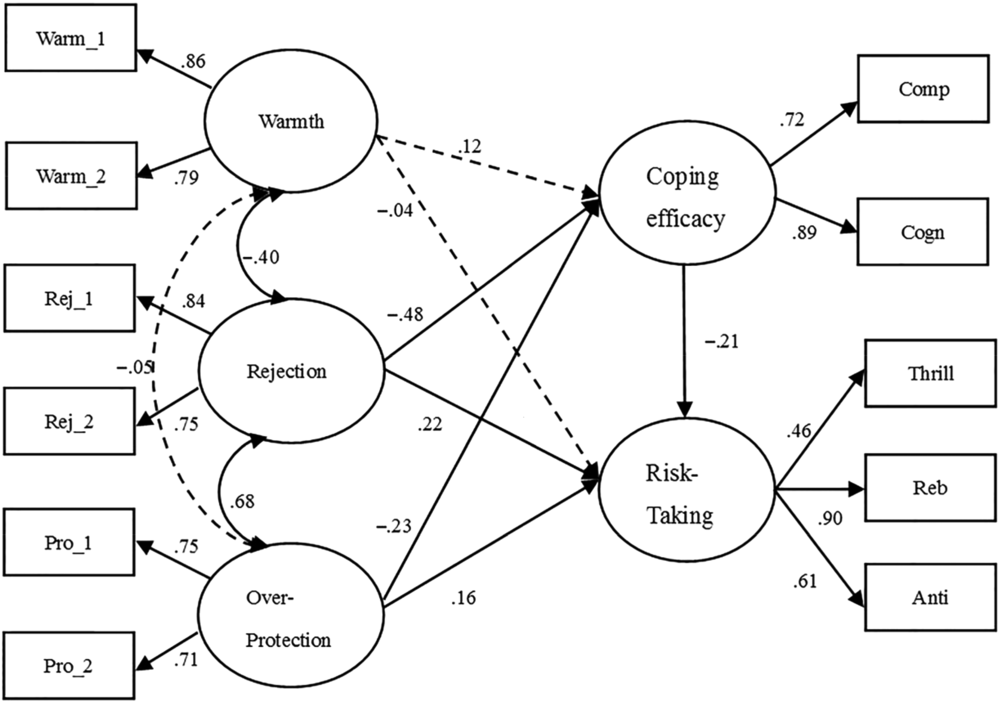
Significant relationships were also found between paternal parenting styles, coping efficacy and risk-taking behavior. Specifically, coping efficacy was negatively associated with paternal rejection (B = −.48, p < .01) and paternal overprotection (B = −.23, p = .04) but was not associated with paternal warmth (B = .12, p = .14). In addition, risk-taking behavior was positively associated with paternal rejection (B = .22, p = .05) and paternal overprotection (B = .16, p < .01) but not associated with paternal warmth (B = −.04, p = .57). Coping efficacy was negatively associated with young adults’ risk-taking behavior (B = −.21, p < .01).
The bootstrapping analyses only revealed significant indirect effects for paternal rejection and overprotection but not for warmth. Specifically, the indirect effect of paternal rejection on risk-taking behavior via coping efficacy was significant (indirect effect = .10, 95% BC CI [.04, .21]) as was the indirect effect of paternal overprotection on risk-taking behavior via coping efficacy (indirect effect = −.05, 95% BC CI [−.13, −.01]).
Therefore, with respect to maternal parenting, warmth and rejection (but not overprotection) had indirect effects on risk-taking behavior via coping efficacy, whereas with respect to paternal parenting, rejection and overprotection (but not warmth) had indirect effects on risk-taking behavior via coping efficacy. These results partially support H3.
Gender differences
A multigroup analysis was used to identify whether the path coefficients differed significantly between the male and female participants in the theoretical model. Two models were contrasted for the maternal parenting variables. The first allowed the structural paths to vary across gender, and the second constrained all the structural paths across genders to be equal. The chi-square differences between the two models were not significant, Δχ2(Δdf = 7) = 2.80, p = .90. Similarly, no gender differences in the theoretical model for paternal parenting variables were found, Δχ2(Δdf = 7) = 2.88, p = .89. These results suggest that the theoretical model did not differ according to gender.
Discussion
This study examined the relationships between three parenting styles (i.e., warmth, rejection, and overprotection), coping efficacy, and risk-taking behavior using a sample of Chinese college students. The results of the correlation analysis showed that the three parenting styles of both mothers and fathers all had a direct association with risk-taking behavior in young adults. Moreover, higher levels of coping efficacy were associated with lower levels of risk-taking behavior (only antisocial and rebellious dimensions). Structural equation modeling results showed that maternal warmth (negatively) and rejection (positively), but not overprotection, correlated with risk-taking behavior via coping efficacy, whereas paternal rejection and overprotection (positively), but not warmth, correlated with risk-taking behavior via coping efficacy. Our findings suggest that perceived parenting styles of mothers (or fathers) associate with risk-taking behavior through coping efficacy in young adults.
As expected, we found that mothers’ and fathers’ three parenting styles (i.e., warmth, rejection and overprotection) all had direct associations with risk-taking behavior in young adults. Specifically, maternal (and paternal) warmth were negatively related to risk-taking behavior, whereas maternal (and paternal) rejection and overprotection were positively related to risk-taking behavior. These results are consistent with earlier studies that reported a relationship between parenting style and risk-taking behavior (Coley, Carrano, & Lewin-Bizan, Reference Coley, Carrano and Lewin-Bizan2011; Davids, Roman, & Leach, Reference Davids, Roman and Leach2016; Hoeve et al., Reference Hoeve, Dubas, Eichelsheim, van der Laan, Smeenk and Gerris2009).
In addition, the current study found that the perceived parenting styles of mothers (or fathers) relate to risk-taking behavior through coping efficacy in young adults. This result was consistent with previous studies that found that parents shape their children’s social behavior indirectly through influences on the latter’s self-regulation and autonomy (Schneider, Atkinson, & Tardif, Reference Schneider, Atkinson and Tardif2001). According to social cognitive theory, human behavior is explained in terms of a triadic, dynamic and reciprocal model of interrelations among behaviors, personal factors (including cognitions) and environmental influences (Perry et al., Reference Perry, Baranowski, Parcel, Glanz, Lewis and Rimer1990). In this study, we consistently found support for an association between parenting styles (as environmental influence) and young adults’ risk-taking behaviors through their coping efficacy (as personal factor).
The most interesting finding of this study was that only mothers’ (not fathers’) warmth was found to negatively correlate with risk-taking behavior via coping efficacy, while only fathers’ (not mothers’) overprotection was found to positively correlate with risk-taking behavior via coping efficacy. Why would this be the case? We assume that these distinct patterns may be explained by gender role differentiation in Chinese families. Chinese mothers are expected to be kind and to assume the role of caregivers, whereas Chinese fathers are expected to be strict and assume the role of disciplinarians, as illustrated in the Chinese phrase “yan-fu-ci-mu” (“strict father, kind mother”). In addition, mothers and fathers show their warmth and overprotection for their children in different ways. For example, mothers often show their warmth via emotional support, whereas fathers often show their warmth via instrumental support (Liu, Li, Lv, & Li, Reference Liu, Li, Lv and Li2013). As a result, maternal warmth may be more likely to be perceived as a more positive emotional experience than paternal warmth. Thus, maternal (not paternal) warmth was found to negatively correlate with risk-taking behavior via coping efficacy. Similarly, mothers often overprotect in what the child may perceive as minor aspects of life (e.g., mothers’ over-control of their children’s eating or clothing or making friends), whereas fathers often overprotect in what the child may perceive to be the more important aspects of life (e.g., father’s over-control of their children’s choice of a professional direction, a school, a job career). As a result, paternal overprotection might be more likely to be perceived as an obstacle to self-identity than maternal overprotection (Wang, Reference Wang2005). Thus, paternal (not maternal) overprotection was found to positively correlate with risk-taking behavior via coping efficacy.
To our knowledge, our study is the first to focus on the three maternal and paternal parenting styles (i.e., warmth, rejection and overprotection) and ways in which they may be associated with risk-taking behavior via coping efficacy in Chinese young adults. We highlight the importance of coping efficacy, as it reflects an individual’s capability to have confidence in performing a behavior (including overcoming problems in performing the behavior). It can help young adults cope with stress more positively, thus reducing the propensity toward risk-taking behavior. Moreover, based on our results, we think that parents can be encouraged to adopt appropriate parenting styles to prevent risk-taking behavior in young adults. Specifically, it is important to encourage Chinese mothers to show more warmth and less rejection, while encouraging Chinese fathers to show less overprotection and rejection in the rearing of their children. Such parenting styles could help increase coping efficacy in young adults, which could further prevent young adults from risk-taking behavior.
Certain limitations of this study might influence the interpretation of the results. First, the study used a cross-sectional design, which means that causal inferences cannot be obtained from these data. Thus, the results of the indirect association analysis presented here should be interpreted with caution. Future studies should use a longitudinal design to test the mediating effect of coping efficacy in the relationship between parenting style and risk-taking behavior in adolescents. Second, the data in this study were collected only through self-report measures, which could have led to subjective social desirability bias. Future studies should use multiple methods to evaluate parenting practices and risk-taking behavior, to reduce the impact of subjectivity. Third, the study only sampled college students who live in two-parent homes, while those who live with a single parent were not included. Therefore, whether the results obtained from this study could be applied to those with other family structures cannot be conclusively ascertained. Future studies should examine the relationships between parenting styles, coping efficacy, and risk-taking behaviors in young adults who grew up in divorced or other single-parent families.
Acknowledgments
The authors would like to thank the Fundamental Research Funds for the Central Universities (300102508638) and the MOE (Ministry of Education in China) Project of Humanities and Social Sciences (17XJC190009) for funding this research.
Financial Support
None.
Appendix

Note: *refers to reverse item. The confident dimension of coping efficacy includes three items: item 1–3; the competence dimension of coping efficacy includes nine items: item 4–12; the cognitive level dimension of coping efficacy includes five items: item 13–17.


 Open access

