

Introduction
In 2023, Switzerland's response to both the fading out of unprecedented crises and the emergence of novel large-scale crises underscored the country's close interconnectedness with global developments. This interconnectedness has reshaped Swiss politics, with multilateral policy initiatives often driving the legislative agenda. Swiss lawmakers are compelled to take action to ensure compliance between international and domestic regulations, such as extending the application of certain provisions to combat potentially dangerous variants of the coronavirus. In an era of internationalization and globalization, even the notorious “Swiss” direct democracy no longer solely reflects citizen-initiated proposals. Instead, many referendum topics, like the 2023 referendum on the introduction of the Organisation for Economic Co-operation and Development (OECD)/G20 minimum tax, are predetermined outside Switzerland. As a result, Switzerland primarily engages in the formally autonomous transposition of multilateral policy regimes (“autonomer Nachvollzug”), with ballot proposals largely focusing on technical aspects to facilitate domestic implementation of policies, rather than fundamentally shaping them.
However, as Switzerland is recognized as the most globalized country in the world (Freiburghaus & Mueller Reference Freiburghaus, Mueller, Emmenegger, Fossati, Häusermann, Papadopoulos, Sciarini and Vatter2024: 779), domestic regulations also strongly reverberate across the globe—especially in cases of policy failure. This was exemplified by the 2023 collapse of Credit Suisse Group AG, one of the two leading Swiss banks, marking “the most sweeping shake-up of the global banking sector since the 2008 financial crisis” (de la Merced et al. Reference de la Merced, Farrell and Sorkin2023). Credit Suisse’s collapse laid bare that domestic rules are often insufficient, also due to the strong advocacy efforts of the banking industry against stricter regulation of the financial sector. Having transformed into a global investment entity, Credit Suisse lost touch with its Swiss roots and ignored over 100 warnings (“red flags”) issued by Swiss financial watchdogs. The imminent threat to global financial stability posed by the bank's failure could only be contained by invoking emergency laws that not only bypassed the ordinary Swiss legislative procedure but also infringed upon shareholders’ rights.
In this context of polycrisis, where global developments strongly shaped domestic politics, and Swiss (non-)regulation, in turn, had far-reaching global implications, political parties competed for votes ahead of the 2023 federal elections. And the outcome, that is, the resurgence of right-wing populism and significant polarization, further confirmed Switzerland's profound integration into global developments, with the country often even foreshadowing major challenges affecting liberal democracies worldwide (Freiburghaus & Mueller Reference Freiburghaus, Mueller, Emmenegger, Fossati, Häusermann, Papadopoulos, Sciarini and Vatter2024).
Election report
Parliamentary elections
Parliamentary elections were held on 22 October 2023, during which eligible Swiss voters elected members to both chambers of the Swiss Federal Assembly for the 2023–2027 fixed term. In the lower house (Nationalrat/Conseil national), consisting of 200 MPs, each of the 26 cantons serves as a constituency, with the constitution ensuring that each canton is allocated at least one MP regardless of its size. Consequently, the district magnitude varies significantly from 1 to 36, contributing to a higher level of disproportionality, compared to other proportional representation electoral systems.
The electoral campaign featured three historic “firsts”: It marked the first time in a federal election that donations exceeding CHF 15,000 and campaign budgets over CHF 50,000 were subject to financial transparency rules. Contributions totaling CHF 54.6 million were disclosed, with the Liberal Party (FDP/PLR) and the right-wing populist Swiss People's Party (SVP/UDC) clearly outspending the left-green camp (the Social Democratic Party, SPS/PSS, and the Green Party, GPS/PES) by more than twice as much (Swiss Federal Audit Office 2024). Second, artificial intelligence (AI)-fueled campaigns first appeared on the scene, with the usage of “deepfakes” of re-running incumbents or AI-generated campaign posters. These instances raised deep ethical concerns, leading to lawsuit filing for identity misuse and attempts at self-regulation. For instance, a joint code on the use of AI in Swiss politics has been signed by all major Swiss parties, except for the SVP/UDC (Bernhard Reference Bernhard2024). Third, a record number of 5909 candidates ran for office.
Unlike ahead of the 2019 federal elections, with the strong presence of climate change and gender equality, no single issue dominated the 2023 campaign. Instead, the co-occurrence of inflation, global turmoil, as well as all-time record-high temperatures rendered social security, migration, and climate change as equally salient topics (Leemann et al. Reference Leemann, Wasserfallen, Willi and Yin2023).
Polls revealed that in this volatile multi-issue context, where no single party could claim sole issue ownership and where feelings of “lost certainties” prevailed, those parties that could most credibly deliver a message of “increased security” could hope to make electoral gains. While the SVP/UDC proposed a crackdown on migration as a measure to reduce crime, the SPS/PSS promised to restore purchasing power and social security benefits for “ordinary people.”
Election Day indeed witnessed a resurgence of the poles, further exacerbating the polarization of the Swiss party system, which is already notorious for being the most polarized in Europe, with the most electorally successful parties also being the most ideologically distant (Zollinger & Traber Reference Zollinger, Traber, Emmenegger, Fossati, Häusermann, Papadopoulos, Sciarini and Vatter2024; see also Table 1). The main results observed in 2019 were reversed in 2023, with the (radical) right returning to its winning ways. With its third-best result of all time (27.9 per cent; +2.3 per cent) and nine additional seats, the SVP/UDC emerged as the largest radical right-wing populist party in contemporary Europe (Bernhard Reference Bernhard2024). Increasing its vote share by 1.5 per cent, the SPS/PSS safely confirmed its longstanding status as Switzerland's second-largest party (18.3 per cent).
Elections to the lower house of the Parliament (Nationalrat/Conseil national) in Switzerland in 2023

Notes:
1. Since Swiss federal elections are organized by the cantons, with non-harmonized reporting standards, no absolute numbers for votes are available at the federal level. However, the Federal Statistical Office provides calculated the number of fictitious voters, which are presented here.
2. In the 2019 Swiss federal elections, the former BDP/PBD and CVP/PDC (merged into “The Centre” since 2021) ran as separate political parties. To ensure comparability over time, their separate vote share and seat share from 2019 were counted together.
3. In the 2019 Swiss federal elections, the FGA/AVF did not run. Accordingly, no difference of the vote share and seat share, respectively, can be calculated (empty cells).
Source: Federal Statistical Office (2024a).
For the other governing parties, the 2023 election elicited mixed sentiments. The FDP/PLR notably fell short of its electoral goal to surpass the SPS/PSS. Amid the population's growing scepticism toward unfettered free markets, the Liberals’ steady decline reached a new record low (14.3 per cent; −0.8 per cent). In contrast, after its 2021 rebranding, The Centre ran for the first time on an interdenominational platform. The merged party fared better than the combined vote share of the previously distinct parties (14.1 per cent). It successfully overtook the FDP/PLR as the third party in terms of seat share (but not of vote share), marking a historic upset, since the Swiss “magic formula” dictates that the three largest parties get two seats each in Cabinet and the fourth party gets only one.
The two Green parties were declared the main losers of the 2023 federal elections. While in 2019, the GPS/PES achieved the most significant electoral gains ever recorded by a Swiss party since the 1919 switch to PR, their vote share dropped below the 10 per cent mark, declining from 13.2 to 9.8 per cent in 2023. Nonetheless, the Greens managed to secure their second-best result ever, and most of the votes they lost were cast for the equally pro-environmentalist SPS/PSS. The Green Liberals (GLP/PVL) performed solidly, only 0.2 per cent below their all-time high in 2019. However, due to strategic differences between some regional party leaders, the GLP/PVL was less able to capitalize on strategic alliances between several party lists (apparentments), and their seat count was almost halved.
Overall, the radical right-wing populist camp accounts for 33.5 per cent of all seats in the lower house, which is roughly the same share as the left, comprising 32 per cent. The centre and moderate parties continue to constitute the largest bloc (34.5 per cent), maintaining their pivotal role in constructing legislative majorities flexibly, on a case-by-case basis, as required by Switzerland's non-parliamentary and non-presidential assembly-independent government system.
As has always been the case in recent decades, more than half the electorate failed to turn out at the polls, although, at 46.6 per cent, turnout was slightly higher than in 2019 (45 per cent). Importantly, however, in Switzerland, abstention is a sign of “silent approval” rather than alienation (Fatke & Freitag Reference Fatke, Freitag, Freitag and Vatter2015).
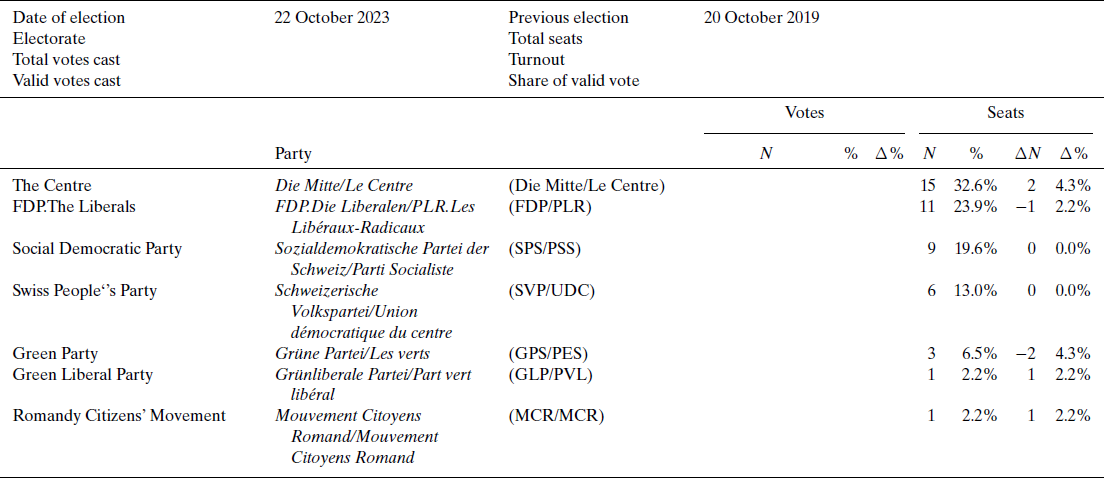
Among the 46 members of the upper house (Ständerat/Conseil des États), every canton is represented with two seats.Footnote 1 The 2023 elections yielded fairly stable results, with the SPS/PSS and SVP/UDC both succeeding in defending their nine and six seats, respectively. While The Centre gained two additional mandates, the FDP/PLR lost one. Although the dominating plurality electoral formulae privilege the governing parties, the GLP/PVL and the Geneva Citizens’ Movement (MCR/MCR) managed to secure representation, with one seat each. Nevertheless, the Council of States continues to be the historic stronghold of centre and moderate parties (Table 2).
Elections to the upper house of the Parliament (Ständerat/Conseil des États) in Switzerland in 2023

Notes:
1. The election date refers to the first round of elections for the Swiss upper house. Several cantons hold a runoff contest within two to four weeks. The specific date for this runoff varies as it is determined by the individual cantons.
2. The Swiss upper house is elected according to cantonal rules, with most cantons employing majority rule. As a result, electorate as well as turnout varies between the cantons. Furthermore, the number of votes at the federal level is neither available nor suitable for interpretation.
Source: Federal Statistical Office, 2024a.
[Correction added on 30 May 2024, after first online publication: Table 2 has been updated in this version.]
Presidential elections
The president and the vice-president of the Swiss Confederation are elected annually in a joint proceeding of the two chambers of the Swiss federal Parliament (United Federal Assembly). In Swiss-style consociationalism, presidential elections are not competitive at all, and there is an “unwritten rule” that Federal Councillors are elected to the said positions in order of seniority. On 13 December 2023, the outgoing vice-president of the year 2023, Viola Amherd (The Centre), federal councillor and head of the Federal Department of Defence, Civil Protection, and Sport, was thus chosen president of the Swiss Confederation for 2024. She received 158 votes (64.2 per cent), clearly undercutting the average share of some of the 71 per cent of the votes the elected post-2000 Swiss presidents have usually obtained (Vatter Reference Vatter2020: 394).
It should be kept in mind that Switzerland is the only country in the world whose federal government works according to the constitutionally enshrined “principle of collegiality.” The seven members of the Federal Council each have equal rights, that is, the president is but primus inter pares (“first among equals”) in order to ensure that no single person can concentrate too much power in their own hands. But with the presidential office, there still comes a whole series of traditional duties (e.g., chairing government meetings and performing representational functions).
Regional elections
Although there has been a wide-ranging process of legislative centralization since the 1848 foundation of the Swiss federation, the 26 Swiss cantons have retained considerable administrative and, especially, fiscal autonomy (Dardanelli & Mueller Reference Dardanelli and Mueller2019). The cantons serve as “echo chambers” (Bochsler Reference Bochsler2019: 401) capable of foreshadowing electoral dynamics.
In 2023, elections were held in the cantons of Basel-Landschaft, Zurich, Appenzell Ausserrhoden, Geneva, Lucerne, Ticino, and Appenzell Innerrhoden, in that respective chronological order. The empirical interconnectedness in which cantonal elections are influenced by electoral swings in other cantons, and, in turn, hold predictive power for federal elections, is evidenced by three major instances. First, the SVP/UDC made inroads in four cantons (i.e. Zurich, Lucerne, Ticino, Geneva), capitalizing on the mounting concerns of parts of the population amid the surge in asylum applications (+43 per cent, compared to 2022). Second, the Greens suffered bitter defeats throughout, except for Geneva. Despite the proliferation of extreme weather events and ongoing concerns about climate disruption, the “green wave” stopped rolling—a paradoxical situation observers attributed to the urgency of climate change fostering a sense of powerlessness among the electorate, coupled with hard-hitting actions of radical climate activists sparking a backlash (Hermann & Bütikofer Reference Hermann and Bütikofer2023: 20–23). A third instance is the increasing number of candidates standing for Parliament. The prevalent low level of professionalization in cantonal parliaments, where MPs often struggle to accommodate their professional commitments with their political mandate, contrasts with the increasing competitiveness of cantonal elections. While this trend may be interpreted as a positive sign for the vitality of regional democracy, the persistent decline in voter turnout, which averaged at 38.7 per cent in 2023, is cause for concern (Federal Statistical Office 2024b) (Table 3).Footnote 2
Results of regional (i.e., cantonal: Basel-Landschaft; Zurich; Appenzell-Ausserrhoden; Geneva; Lucerne; Ticino) elections in Switzerland in 2023

Notes:
1. Blank cells indicate that the political party did not participate in the election.
2. The residual category labeled “Other” (Übrige) encompasses minor (or: splinter) political parties that are grouped together by the Federal Statistical Office. For a detailed breakdown, please refer to the source below.
3. In the canton of Geneva, the extreme left, including the Swiss Party of Labour, competed for votes on a joint list (gemeinsame Liste). Therefore, the respective vote share of the parties on the joint list cannot be reported individually.
4. Regional (i.e., cantonal) elections were also held in the Canton of Appenzell Ausserrhoden. However, in this canton, there is no elected Parliament. Instead, the legislative body is formed by the “Landsgemeinde,” where eligible voters are invited to assemble annually in the open air. During this event, they elect the government in a non-secret public show of hands.
5. In the canton of Ticino, the Left, including the Social Democratic Party, competed for votes on a joint list (gemeinsame Liste). Therefore, the respective vote share of the parties on the joint list cannot be reported individually.
Source: Federal Statistical Office (2024b).
Referenda
In 2023, Swiss voters voted on three nationwide ballot proposals, a total number that is well below the annual average of some nine nationwide ballot proposals during the last three decades (Swissvotes 2024). For the first time since 2011, Swiss voters headed to the polls only once, on 18 June 2023 (Table 4).

The first proposal was a mandatory referendum concerning the implementation of the “OECD/G20 minimum tax.” Switzerland, along with some 140 other countries, has acknowledged the necessity for large multinational enterprises with an annual turnover of at least CHF 744 million to pay a minimum tax rate of 15 per cent on their profits in each country. This measure aims to combat international tax competition and counter tax avoidance strategies (as employed by, e.g., US tech giants like Alphabet or Meta Platforms). To introduce the minimum tax rate in Switzerland and ensure stable domestic framework conditions, the Federal Council proposed a “supplementary tax”. This tax would cover the difference between the effective tax rate in the relevant canton and the 15 per cent minimum rate. The revenue generated from the supplementary tax would then be redistributed through the fiscal equalization system, with a ratio of 3:1 between cantons and the federal government. While the federal government and the cantons, as the primary proponents of the OECD/G20 minimum tax, underscored the inevitability of this externally imposed tax reform, they emphasized the importance of retaining the tax base within the country. However, opponents expressed concern that the proposed supplementary tax would exacerbate tax competition among cantons. With a share of 78.5 per cent “yes” votes and 23 of the 26 cantons in favor, the reform passed comfortably—an approval that was driven by Swiss voters’ desire to enhance tax justice (Golder et al. Reference Golder, Keller, Bürgi, Schena, Bartlome, Pagani, Tschanz and Rey2023: 21–23).
On the same day, Swiss voters also voted on an optional referendum on the Climate and Innovation Act. In order to incorporate some of the main demands raised by a likely successful popular initiative, the Federal Assembly accepted new legislation to accelerate the energy transition in order to both lessen dependency from energy imports and achieve net zero emissions by 2050. The novel legislation mandated financial support worth CHF 2 billion over 10 years to promote the replacement of gas and oil heating systems, as well as aid to spur technological innovation. Even though fossil energy sources were not explicitly outlawed (as the so called “Glacier Initiative” would have done), the SVP/UDC launched a referendum, contending that the novel legislation would harm both the economy and the population by increasing electricity costs. However, a broad alliance of seven left to center-right parties, alongside major business associations, pro-environmentalists interest groups, and the “climate strike” movement, successfully persuaded a majority of 59.1 per cent of the voters of the overall benefits of the measures. Exit polls indicated that voters embraced the overarching vision of a more sustainable, greener future (Golder et al. Reference Golder, Keller, Bürgi, Schena, Bartlome, Pagani, Tschanz and Rey2023: 31–33).
Finally, on 18 June 2023, Swiss voters cast their ballots for the third time in a referendum regarding an amendment of the COVID-19 Act, namely, against a six-month extension of certain regulations including immunity or vaccination certificates or contact tracing. Since these “sunset provisions” were set to expire in summer 2024 anyway, anti-vaxxers and small civil society organizations campaigning against COVID-19 measures were clearly defeated, winning only 38.1 per cent of the vote (Golder et al. Reference Golder, Keller, Bürgi, Schena, Bartlome, Pagani, Tschanz and Rey2023: 39–41).
Cabinet report
On 21 June 2023, Alain Berset (SPS/SSP), federal councillor and head of the Federal Department of Home Affairs, who also held the rotating Swiss presidency twice, announced that he is stepping down at the end of the year. With a period of office of 12 years, Federal Councillor Berset has served for a period well above the average of some 10 years (Vatter Reference Vatter2020: 112). Known for his flamboyance in contrast to Switzerland's generally reserved, non-eccentric political elite, he has been in charge of highly salient issues like public health or social security, making him one of the most visible and well-known leaders in recent times, especially during the COVID-19 pandemic. However, toward the end of his term, he faced closer scrutiny amid allegations that his staff leaked information to the media before official announcements. Additionally, he attracted headlines for his private life (e.g., an extra-marital affair that led to blackmail or an incident while flying a light aircraft).
Parliament was due to elect a successor on 13 December 2023. In Swiss-style consociationalism, the outcome of government elections is in uttermost cases a story of “fresh faces, old coalition formula”: The outgoing minister was replaced by Federal Councillor-elect Beat Jans (SPS/PSS). Hence, neither the party-political nor the gender composition of the Cabinet has changed (Table 5). Still, there was a historic component in the election, as Mr. Jans became the first person from the canton of Basel-Stadt to be represented in the federal government in 50 years—one out of only eight net contributors in the fiscal equalization scheme.
Cabinet composition of the Federal Council in Switzerland in 2023

Notes:
1. In Switzerland, the term of office of the members of the government (Federal Council) is constitutionally fixed, that is, all Federal Councillors are elected for a four-year-period. The Cabinet cannot be dismissed/dissolved. The term of this Council is 1 January 2020–31 December 2023.
2. “Parliament” refers to the United Federal Assembly and thus consists of the seats in both chambers (i.e., National Council and Council of States), adding up to a total of 246 seats.
3. The president and the vice-president of the Swiss Confederation rotate annually. Since they are elected from the seven members of the Federal Council, their one-term-period-of-office does not change the party/gender composition of the Cabinet (see section “Election Report: Presidential Elections” for details).
Source: The Federal Council (2024).
Parliament report
The 2023 federal elections resulted in a Parliament that is not only more right-wing and less green (see section “Parliamentary Elections”) but also more male. Despite a historic surge in female representation four years ago, the proportion of women elected slipped back from 42 per cent to 38.5 per cent in the lower house. Women's representation continues to vary considerably across political parties, with the green-left and progressive camp exceeding gender parity, while the center-to-radical-right parties still fall short of the symbolic 50 per cent mark. Notably, among the 21 National Councillors-elect of the SVP/UDC, only three are women (Table 6).
Party and gender composition of the lower house of Parliament (Nationalrat/Conseil national) in Switzerland in 2023

Note: Parliamentary groups are not identical to political parties, as either MPs who belong to the same political party or MPS who share similar ideological views may get together to form a parliamentary group.
Source: The Federal Assembly (2024).
In contrast, the upper house, historically characterized by a particularly pronounced gender imbalance, saw a historic outcome in 2023: The number of female MPs increased from 12 to 16, reaching an all-time high of 34.9 per cent. However, despite this progress in descriptive representation, women's policy preferences remain underrepresented, compared to those of men (Persson et al. Reference Persson, Schakel and Sundell2024). These biases extend to other marginalized groups, such as persons with a migratory background and/or disabilities, as well as low-skilled workers (Table 7).
Party and gender composition of the upper house of Parliament (Ständerat/Conseil des États) in Switzerland in 2023

Source: The Federal Assembly (2024).
Political party report
There were no changes in the Swiss party landscape, neither in terms of the parties’ organization nor in terms of leadership.
Institutional change report
At the national level, no major institutional changes occurred besides the amendments to the Federal Constitution, triggered by the mandatory referendum on the introduction of the OECD/G20 minimum tax (see section “Referenda”). Despite numerous evaluations scrutinizing Swiss federalism's crisis management capacity in the aftermath of the COVID-19 pandemic and proposing far-reaching measures, such as the introduction of a joint governing body comprising federal and cantonal government members (as suggested by Freiburghaus Reference Freiburghaus2024), the actual implemented changes were modest at best. To enhance informal multi-level coordination, the Federal Council and the Conference of the Cantonal Governments (KdK/CdC) merely agreed that an already existing exchange forum, known as “Föderalistischer Dialog,” shall meet annually.
Due to strong path dependency and high hurdles for institutional change, cantonal and local political institutions remain highly stable as well. Proposals for major institutional changes consistently lacked majority support as demonstrated by, for example, the failed attempt to slightly increase assembly size in the canton of Schaffhausen to address low levels of professionalization. Similarly, the introduction of a Parliament in Rapperswil-Jona was rejected. Consequently, Rapperswil-Jona, with its population of 27,200, remains the largest municipality adhering to the model of “assembly democracy,” where citizens convene in town halls to decide on all legislative matters—a model that is primarily prevalent in smaller, German-speaking municipalities.
Issues in national politics
Traditionally, the Swiss political discourse is largely shaped by the practice of direct democracy, that is, the many proposals that are launched and/or put directly to the ballot. Also in 2023, proposals have set new topics on the agenda (e.g., replacement of men-only conscription with a “civil service” for all) and/or manufactured broad ad hoc campaigning coalitions that Swiss politics is in need of in order to pass the high referendum hurdles (e.g., Climate and Innovation Act). Additionally, three major events underscored the significant interconnectedness between Switzerland and the world.
The most significant event of the year was the collapse of Credit Suisse Group AG, a global investment bank founded and headquartered in Zurich. Years of mismanagement, including “material weaknesses” in its financial reporting, miscalculated risk assessments, massive legal and reimbursement costs, and exposure to hedge fund collapses evaporated investor confidence in the bank's ability to reform itself. When the chair of Saudi National Bank, Credit Suisse’s largest shareholder, ruled out financial aid on 14 March 2023, deposits flowed out and the share price plummeted. In response, the Swiss National Bank provided Credit Suisse with CHF 50 billion as a “liquidity backstop,” but this failed to reassure investors. Declaring insolvency, resolution, nationalization, and merger were explored as options available for the failing bank. On 19 March 2023, members of the Swiss federal government, along with bank managers and main financial regulators, announced plans to fast-track the takeover of Credit Suisse by UBS Group AG, Switzerland's other leading bank and traditional rival. The acquisition was structured as an all-stock deal valued at CHF 3 billion.
The collapse of Credit Suisse threatened global financial stability and exposed shortcomings in domestic reforms intended to supervise such banks, prompting the Swiss federal government to issue an ordinance based on emergency law. This ordinance facilitated the merger by circumventing shareholder approval and included substantial loans, amounting to CHF 9 billion for UBS and CHF 100 billion for the Swiss National Bank. Leading experts expressed concern about the existence of a single “monster bank,” with the entire risk of the rescue now resting onto the shoulders of but one Swiss bank, notorious for its growth ambitions. In a gesture akin to a symbolic “protest note” (Bernhard Reference Bernhard2024: 3), the Federal Assembly therefore rejected the loans already provided and opted to appoint a parliamentary investigation committee (PUK)—the first in 28 years and only the fifth of its kind ever. PUKs represent the most powerful tool of parliamentary oversight, comprising seven members from both chambers of the federal Parliament. Endowed with extensive rights to information, PUKs can interview persons as formal witnesses and inspect the minutes of Federal Council meetings. The PUK commenced its mission on 13 July 2023, with ongoing inquiries anticipated to span several years.
The second noteworthy issue concerned Swiss–EU relations, a major “elephant-in-the-room” issue (Freiburghaus Reference Freiburghaus2023: 517). Following the Federal Council's 2021 unilateral termination of negotiations on an overriding institutional framework agreement, multiple rounds of exploratory talks were held to explore a path forward. The last round occurred on 27 October 2023. On this basis, the Federal Council decided on 8 November 2023 to draw up a novel mandate for negotiations with the EU. This mandate will be presented to the foreign affairs committees for further consideration. Additionally, the federal administration has been instructed to continue “technical discussions” with social partners and the cantons on domestic measures aimed at maintaining current wage levels for posted workers in Switzerland, as well as regarding “implementation safeguards” related to a potential electricity agreement (The Federal Council 2023a). These developments represent a potential breakthrough in the longstanding stalemate in Swiss–EU relations.
Finally, and as a third issue, the wars in Ukraine and Gaza put pressure on Switzerland to “join the real world” (The Economist, 2023) and internationally discredited its neutrality—a constitutionally enshrined and “traditional pillar of Swiss identity” (Freiburghaus Reference Freiburghaus2023: 498). Switzerland joined the EU's sanctions against Russia only after initial hesitation and politely declined a request from G7 nations to join an international sanctions task force to ensure smooth implementation (e.g., in terms of the seizure of frozen assets). Similarly, Switzerland's stance toward the North Atlantic Treaty Organization (NATO) remains notoriously ambivalent, with a growing segment of Swiss citizens—around a third in 2023—approving NATO membership. Swiss politicians, however, are still cautious, setting limits on how far closer cooperation with the military alliance should extend. The war in Gaza posed an equally fundamental challenge to Switzerland's policy of neutrality. Although the federal government took the unprecedented step of introducing legislation to ban Hamas and declare it a terrorist organization (The Federal Council 2023b), doing so proved difficult due to feared consequences for humanitarian aid, peace negotiations, and the Swiss financial sector.
Acknowledgments
Open access funding provided by Universitat Bern.



 Open access

