

On February 9, 2020, El Salvador’s president, Nayib Bukele, marched into the National Assembly accompanied by heavily armed police officers and soldiers to pressure lawmakers debating his crime-fighting plan. Bukele credited his security policy, which included a social media spectacle where gang members were frequently shown handcuffed, half-naked, and sitting in tightly packed rows, for the drastic reductions in homicides registered during his administration. Some 4,000 miles away from El Salvador, Alberto Fernández approved in March 2023 the involvement of the armed forces to combat insecurity in Rosario, which is Argentina’s most violent city. The former Peronist President, however, downplayed the initiative and denied the militarization of the country’s domestic security. Along similar lines, in March 2019, Mexico’s Andrés Manuel López Obrador created a highly militarized unit known as the Guardia Nacional (National Guard) after strongly criticizing his predecessors’ hardline approach to fight the country’s drug cartels. Although the leader of the Movimiento Regeneración Nacional (National Regeneration Movement—Morena) party promised “abrazos no balazos” (hugs not bullets), more than 300 National Guard barracks have been built across the country and around 100 more are under construction (Rosen et al. Reference Rosen, Zepeda, Cutrona, Huizar, Rosen and Cutrona2023; Pansters and Serrano Reference Pansters and Serrano2023).
These recent events suggest that Latin American presidents are increasingly adopting mano dura initiatives to combat gangs, organized crime, and insecurity (Malone Reference Malone, Rosen and Cutrona2023; Flores-Macías and Zarkin Reference Flores-Macías and Zarkin2021; Malone and Dammert Reference Malone and Dammert2021; Muggah Reference Muggah, Shaw, Mahrenbach, Modi and Yi-chong2018). The wide variety of tactics, narratives, and political connotations also call into question commonly held views about the singularity of Latin America’s policing strategies. While mano dura has been a concept of increasing empirical interest, especially after several Latin American governments responded to the rising levels of criminal violence in their own territories, there seems to be limited conceptual clarity about the wide spectrum of strategies developed to combat crime and associated fear. As a result, mano dura has become an “essentially contested concept,” often used to describe policies of a different nature across largely heterogenous contexts, including those of El Salvador, Argentina, and Mexico briefly described in the introduction of this work.
This article proposes a definition of mano dura that has three different dimensions, each of them containing specific elements. The form of mano dura depends on formal, informal, and rhetorical practices. Drawing on 46 scholarly works in the social sciences, we develop our definition anchored in the knowledge of Latin American policing policies, contributions on responses to crime in the region, and the conceptual development literature. With the purpose of supplementing our effort to standardize the usage of the term with the need to retain a degree of conceptual differentiation, we also offer a stylized model to better classify policing strategies in Latin America. In our stylized model, the numerous ways policies and narratives as well as their implementation (or not) interact can be grouped into four broad categories: full mano dura, institutional mano dura, performative mano dura, and covert mano dura.
In this article, we first introduce the methodology used to assess the main conceptual contributions of this work. We then explore different definitions of mano dura in the Latin American context. Looking at 46 different publications, we summarize the most cited defining attributes of mano dura offered by scholars conducting research in the region. Since there is no definitive agreement about the operationalization of mano dura, we provide a clear working definition and discuss some of the main trade-offs of conceptual standardization. We present a new typology of mano dura in Latin America in the final section. We build our stylized model on Collier and Mahon’s (Reference Collier and Mahon1993) notion of “radial categories” and empirical evidence from the region. We conclude by summarizing the main findings and implications of this work.
Methodology
To analyze the definitions of mano dura in the scholarly literature, we conducted an extensive literature review of academic works in English, Spanish, and Portuguese. Footnote 1 We developed an inclusion and exclusion criteria for the materials reviewed. We first reviewed works in peer reviewed scholarly journals and books published between 2000 and 2023. While there are works on mano dura published during the twentieth century, we believe that the nature of violence and the state responses are qualitatively different. We, however, did not focus on newspaper articles published by journalists or think tank reports. Footnote 2 We conducted a Google Scholar and database search of articles published in reputable scholarly outlets. Google Scholar’s metrics are based on an H-5 index, which quantifies the number of citations that an article receives (American University n.d.). Indeed, the notion of “reputable” scholarly outlet creates some challenges. Focusing on top academic journals in the English language would eliminate a litany of relevant scholarship produced in Spanish and Portuguese in the Global South. In addition, defining what is a “top journal” and impact factor is something that has been debated intensely in academia. Some scholars, for instance, assert that there is geographic bias in the production of knowledge (Henry Wai-Chung Reference Henry Wai-Chung2001), while others note the levels of discrimination in the journal rankings systems, focusing on issues such as gender bias (Van den Besselaar and Sandström Reference Van den Besselaar and Sandström2017). In summary, we focused on scholarly articles and books published in different regions around the globe where one of the principal arguments revolved around the notion of mano dura.
Furthermore, we did not only include articles that had “mano dura” in the abstract or title, as there are many scholarly pieces that discuss the topic in great length but do not have this phrase in the title or abstract. When conducting our Google Scholar and database search we did not focus on citation counts alone, as this could exclude important scholarly works that were just published or perhaps have a more nuanced target audience. Similarly, we did not concentrate on the literature from other regions around the world, as there is a litany of relevant academic works on punitivism, the drug war, mass incarceration, the criminal justice system, among others. Given that this article is about Latin America, we also decided not to include the vast literature on the United States to provide a more parsimonious typology for mano dura in the region.
We attempted to include a diverse group of scholars from Latin America. We, however, recognize that the sample of the research cited tends to be published largely by scholars focusing on crime from the disciplines of political science, international relations, and criminology or criminal justice. Indeed, we focused less on the historical literature, as we are interested in understanding the recent trends and manifestations of mano dura policies in the Latin American context. We also acknowledge that the scholarly research cited deserves more than the scant attention it receives within the limits of this literature review. Nevertheless, the articles we reviewed in this work include scholars that are not only diverse in disciplines, but they also have different methodological approaches. Some of the scholarly works assessed here utilize quantitative methods, while other works are largely qualitative in nature.
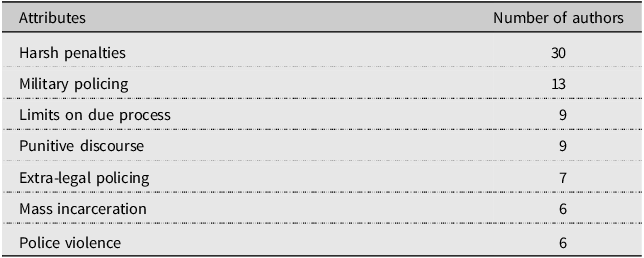
After compiling the articles, we reviewed them to determine how mano dura was defined. We developed 13 different categories for coding the term by the scholars in our sample, as displayed in Appendix 1. We then summarize and collapse some of the most cited attributes in Table 1. We attempted to provide nuanced definitions of mano dura. Since some conceptualizations fit it to more than one category, we also elaborated a correlation matrix in Appendix 2 utilized in statistics that helps to shed light on the overlapping definitions utilized by scholars. We considered further collapsing several categories but decided against this, as it would exclude the granular nuances we are seeking to explore in this work.
Attributes of Mano Dura in the Scholarly Literature
Source: Created by authors.
Ultimately, we cannot claim that this is an exhaustive list of all the works written on mano dura, as we only reviewed the literature in three languages. Yet we have defined a parsimonious and verifiable selection criterion and reviewed what we believe are key scholarly works that make a critical contribution to the literature to understand the concept of mano dura.
Conceptual Considerations
Stable concepts and shared understandings are routinely viewed as a foundational feature of scholarship (Collier and Mahon Reference Collier and Mahon1993). In search of generalization, concepts help to extend the coverage of research to test a hypothesis or validate assumptions across time and place. Yet scholars often disagree about the dimensions, indicators, and levels of measurement. Gallie (Reference Gallie1956) argues that concepts of common sense are particularly liable to be contested for various reasons. He introduces the idea of “essentially contested concepts” to describe the “endless disputes about their proper uses on the part of their users” (Gallie Reference Gallie1956, 169). In a subsequent book, he refines some of his original ideas and offered a criterion for identifying such concepts: (i) their appraisive nature, (ii) internal complexity, (iii) diverse describability, (iv) openness, (v) the recognition of their contested character by contending parties, (vi) an original exemplar underlying the conceptual meaning, and (vii) progressive competition (Gallie Reference Gallie1968).
Differences can arise, for example, when the same concept is applied across widely heterogenous contexts or when scholars attempt to increase analytic differentiation. Collier and Levitsky (Reference Collier and Levitsky1997) claim that concepts with fewer attributes can apply to more cases and rank higher on the ladder of generality, whereas concepts with more defining attributes can apply to fewer cases and hence rank lower on the ladder. While the first strategy helps to avoid what Sartori (Reference Sartori1970) defines as conceptual stretching, generalizations often come at the expense of their specificity. Thus, Collier and Levitsky (Reference Collier and Levitsky1997) discuss an intermediate strategy, where classical subtypes are generated to differentiate specific types of the concept. Diminished subtypes, they contend, are another useful means to avoid conceptual stretching.
Various scholars studying policing strategies in Latin America have been affected by similar conceptualization challenges. Research on the repressive measures and political strategies utilized to combat crime and associated fear, often referred to as mano dura, shows that contested concepts can have open and vague connotations or multiple meanings, often “travelling” across different contexts. If the conceptualization of the term varies extensively in the literature, causal assessment becomes difficult and case studies are unlikely to be checked against each other. Under these circumstances, comparative analysis in social sciences becomes increasingly challenging despite the need to better understand the driving forces and implications of mano dura in a region ripe with gangs, organized crime, and violence.
Mano Dura
There is no clear equivalent of the term mano dura in English. This concept is often interpreted as the “rule by an iron fist” (Godoy Reference Godoy2005, 600) and used colloquially to refer to repression (Holland Reference Holland2013). The term is also used politically, favoring multiple connotations among the population. Not only legal reforms such as the lowering of the age of criminal responsibility, increasing penalties, or the expansion of the definition of criminal behavior are considered examples of mano dura, but also informal measures such as extra-legal detention, police violence, or racial profiling. Even some of the consequences of these hardline initiatives like mass incarceration or human rights violations are commonly lumped together and called mano dura. In her study of authoritarian responses to violent crime in Guatemala, Krause (Reference Krause2014) demonstrates that interpretations of mano dura vary widely among citizens. Fifteen percent of Guatemalans, for instance, believe that mano dura means a specific candidate’s political campaign, although there is no clear recognition of its defining attributes.
Identifying the components of mano dura has also been a subject of debate among scholars. As Muggah and colleagues point out (Reference Muggah, Garzón and Suarez2018), this concept has been better described than defined. Scholars from various fields have used the term mano dura as shorthand for a vast array of hardline policing strategies adopted in Latin America (Holland Reference Holland2013). In this section, we review different scholarly publications. Some of the authors include more than one attribute of mano dura, meaning that the frequency does not necessarily match the sample of our study.
Table 1 summarizes the seven most cited attributes of mano dura and the number of scholars that have included them in their definition. There is overwhelming consensus in the literature that mano dura implies the adoption of harsh penalties to combat crime. Scholars have mentioned, for example, the expansion of the definition of criminal behavior (Flom Reference Flom, Rosen and Cutrona2023; Muggah and Boer Reference Muggah and de Boer2019; Liebertz Reference Liebertz2017; Bruneau Reference Bruneau2014; Jütersonke et al. Reference Jütersonke, Muggah and Rodgers2009; Rodgers Reference Rodgers2009; Aguilar Reference Aguilar2006; Hume Reference Hume2007), expedited and longer sentences (Cutrona and Rosen Reference Cutrona, Rosen, Rosen and Cutrona2023; Rodrigues and Rodríguez-Pinzón Reference Rodrigues and Rodríguez-Pinzón2020; Singer et al. Reference Singer, Chouhy, Lehmann, Stevens and Gertz2020), increased penalties (Flom Reference Flom, Rosen and Cutrona2023; Ferreira and Gonçalves Reference Ferreira, Gonçalves, Rosen and Cutrona2023; Rosen et al., Reference Rosen, Cutrona and Lindquist2022, Reference Rosen, Zepeda, Cutrona, Huizar, Rosen and Cutrona2023; Rios et al. Reference Rios, Prieto and Ibarra2020; Rodrigues and Rodríguez-Pinzón Reference Rodrigues and Rodríguez-Pinzón2020; Rosen Reference Rosen2020; Rosen and Cutrona Reference Rosen and Cutrona2020; Bonner Reference Bonner2019; Footnote 3 Muggah Reference Muggah, Shaw, Mahrenbach, Modi and Yi-chong2018; Wolf Reference Wolf2017), punishment for minor offenses (Brienen Reference Brienen, Rosen and Cutrona2023; Polga-Hecimovich Reference Polga-Hecimovich, Rosen and Cutrona2023; Muggah and Boer Reference Muggah and de Boer2019; Muggah Reference Muggah, Shaw, Mahrenbach, Modi and Yi-chong2018; Glebbeek Reference Glebbeek, Kuhns and Knutsson2010; Rodgers Reference Rodgers2009; Dammert and Malone Reference Dammert and Malone2006), and the introduction of discretionary crimes (Holland Reference Holland2013) as components of harsh penalties. Table 1 also shows that military policing Footnote 4 is the second most frequent characteristic (Cutrona and Rosen Reference Cutrona, Rosen, Rosen and Cutrona2023; Ferreira and Gonçalves Reference Ferreira, Gonçalves, Rosen and Cutrona2023; Polga-Hecimovich Reference Polga-Hecimovich, Rosen and Cutrona2023; Dammert Reference Dammert2022; Muggah et al. Reference Muggah, Garzón and Suarez2018; Liebertz Reference Liebertz2017; Pion-Berlin and Carreras Reference Pion-Berlin and Carreras2017; Wolf Reference Wolf2017; Schuberth Reference Schuberth2016; Bruneau Reference Bruneau2014; Holland Reference Holland2013; Glebbeek Reference Glebbeek, Kuhns and Knutsson2010; Dammert and Malone Reference Dammert and Malone2006).
There, however, seems to be less agreement—or scholars have paid less attention when conducting their analyses—that limits to due process (Brienen Reference Brienen, Rosen and Cutrona2023; Cutrona and Rosen Reference Cutrona, Rosen, Rosen and Cutrona2023; Polga-Hecimovich Reference Polga-Hecimovich, Rosen and Cutrona2023; Singer et al. Reference Singer, Chouhy, Lehmann, Stevens and Gertz2020; Muggah and Boer Reference Muggah and de Boer2019; Muggah Reference Muggah, Shaw, Mahrenbach, Modi and Yi-chong2018; Bruneau Reference Bruneau2014; Holland Reference Holland2013; Jütersonke et al. Reference Jütersonke, Muggah and Rodgers2009), punitive discourses (Brienen Reference Brienen, Rosen and Cutrona2023; Flom Reference Flom, Rosen and Cutrona2023; Ferreira and Gonçalves Reference Ferreira, Gonçalves, Rosen and Cutrona2023; Wade Reference Wade, Rosen and Cutrona2023; Dammert Reference Dammert2022; Rodrigues and Rodríguez-Pinzón Reference Rodrigues and Rodríguez-Pinzón2020; Bonner Reference Bonner2019; Antillano and Ávila Reference Antillano and Ávila2017; Glebbeek Reference Glebbeek, Kuhns and Knutsson2010), and extra-legal policing (Cutrona and Rosen Reference Cutrona, Rosen, Rosen and Cutrona2023; Muggah and Boer Reference Muggah and de Boer2019; Muggah Reference Muggah, Shaw, Mahrenbach, Modi and Yi-chong2018; Bruneau Reference Bruneau2014; Krause Reference Krause2014; Glebbeek Reference Glebbeek, Kuhns and Knutsson2010; Dammert and Malone Reference Dammert and Malone2006) constitute elements of mano dura. Regarding punitive discourses, scholars have focused on slightly different components, including populist narratives centered on delinquents and other criminal deviants (Brienen Reference Brienen, Rosen and Cutrona2023), punitive discourses that are not translated into policy outputs (Flom Reference Flom, Rosen and Cutrona2023), rhetoric that frames hardline strategies as the only way to decrease drug-related violence (Ferreira and Gonçalves Reference Ferreira, Gonçalves, Rosen and Cutrona2023), the discursive association with “zero-tolerance” policies (Rodrigues and Rodríguez-Pinzón Reference Rodrigues and Rodríguez-Pinzón2020), anti-crime rhetoric characterized by theatrics (Wade Reference Wade, Rosen and Cutrona2023), colorful language or rhetoric aimed at gaining popular support and winning elections (Bonner Reference Bonner2019), and discourses and speeches that attribute moral causes to crime and define offenders as enemies (Antillano and Ávila Reference Antillano and Ávila2017).
Moreover, various scholars have included mass incarceration (Brienen Reference Brienen, Rosen and Cutrona2023; Flom Reference Flom, Rosen and Cutrona2023; Rodrigues and Rodríguez-Pinzón Reference Rodrigues and Rodríguez-Pinzón2020; Schuberth Reference Schuberth2016; Bruneau Reference Bruneau2014; Gutiérrez Rivera Reference Gutiérrez Rivera2010) and police violence (Rios et al. Reference Rios, Prieto and Ibarra2020; Rodrigues and Rodríguez-Pinzón Reference Rodrigues and Rodríguez-Pinzón2020; Bonner Reference Bonner2019; Antillano and Ávila Reference Antillano and Ávila2017; Weichert Reference Weichert2017; Fuentes Reference Fuentes2005) within their definitions. Similar to military policing, police violence can be legal or illegal. While the former case refers to situations where political leaders, for example, pass laws allowing officers to shoot to kill when a suspect is running away, the latter describes events where the actions of the police or the use of force is excessive given the legal and institutional context. Indeed, it could be argued that police violence becomes extra-legal when deemed excessive—although this evaluation is often subjective. However, there appears to be relatively less consensus about mass incarceration and police violence as particular aspects of mano dura.
Other characteristics such as the association with the consumption of illicit drugs (Rodrigues and Rodríguez-Pinzón Reference Rodrigues and Rodríguez-Pinzón2020), the use of lethal force (Flom Reference Flom, Rosen and Cutrona2023), or de deportation of migrants and their connection with crime (Dammert Reference Dammert2022) do not appear in more than one of the approximations of the 46 works reviewed and are not included in Table 1. Finally, 12 publications (Isacson Reference Isacson, Rosen and Cutrona2023; Ruiz Reference Ruiz, Rosen and Cutrona2023; Rennó Reference Rennó2022; Gutiérrez Rivera et al. Reference Gutiérrez Rivera, Strønen, Ystanes, Strønen and Ystanes2018; Lessing Reference Lessing2017b; Míguez Reference Míguez2013; Swanson Reference Swanson2013; Bateson Reference Bateson2012; Wolf Reference Wolf2012; Cruz Reference Cruz2010; Ungar Reference Ungar, Bergman and Whitehead2009; Godoy Reference Godoy2005) do not explicitly mention any distinctive attribute of mano dura, although some of them discuss other elements associated with equivalent or similar concepts.
Some conceptualizations fit in more than one category. Appendix 2, which is akin to a correlation matrix utilized in statistics, helps shed light on the overlapping definitions utilized by scholars. It demonstrates that military policing and harsh penalties as well as harsh penalties and limits on due process have the most number of authors, revealing both that defining attributes are not assessed individually and that authors have a certain degree of agreement. There are fewer scholars that focus on the notion of punitive rhetoric, extra-legal policing, and police violence. Interestingly, the matrix shows that mass incarceration alone has few authors in this category when compared to military policing, harsh penalties, and limits on due process.
The characteristics of mano dura reviewed above have certain limitations. First, many scholars associate their definition of mano dura with country-specific initiatives. Several studies, for example, revolve around El Salvador’s mano dura policy, including Francisco Flores’ (1999–2004) formal plan to imprison gang members for having gang-related tattoos or flashing gang signs in public. The frequency of attributes, therefore, are highly dependent on the selection of case studies and the formal name of those policies. Similarly, the fact that some scholars do not mention a particular attribute (e.g., police violence) does not necessarily mean that it is not seen as relevant to the concept. For instance, fewer scholars study police violence compared to prisons or mass incarceration. Third, methodological considerations can also affect the frequency distribution of mano dura’s defining characteristics. It may not be surprising that informal initiatives such as illegal police violence, extra-judicial killings, or racial profiling are more difficult to quantify, especially for researchers conducting quantitative analysis. Consequently, various studies have relied extensively on aspects such as incarceration even though this dimension of mano dura is not an intrinsic property but rather a result of such policies. Fourth, our literature review does not consider practices of extrajudicial retribution. Relevant actions such as lynchings or vigilante violence often developed to “protect” marginal communities from criminals, gangs, and other actors (Goldstein et al. Reference Goldstein, Achá, Hinojosa and Roncken2007; Godoy Reference Godoy2006; Kloppe-Santamaría Reference Kloppe-Santamaría2020) are not contemplated in this work as the focus of our analysis is the nation state.
A final limitation, already highlighted in the methodology of this work, is the exclusion of a vast and rich literature revolving around different policing strategies implemented in other regions. For instance, scholars such as Garland (Reference Garland2001) and Wacquant (Reference Wacquant2009) have discussed extensively the economic, social, and political forces that gave rise to punitivism and its associated fear as well as its policy implications in countries like the United States and Great Britain. Their academic contributions, however, often focus on particular aspects like legal changes or punishment and do not illuminate the colorful rhetorical practices characteristic of Latin America or certain distinctive institutional factors such as the region’s limited accountability. Ungar (Reference Ungar, Bergman and Whitehead2009), for example, notes that unlike the American version of tough-on-crime, mano dura in Latin America lacks solid police training, oversight over their practices, coordination with social services, and more effective courts to process detainees.
These caveats aside, the literature review reveals that five commonalities of mano dura—harsher penalties, military involvement, limits to due process, punitive rhetoric, and extra-legal policing—are analytically relevant among scholars in the social sciences studying Latin America. This operationalization provides a useful starting point for the elaboration of a working definition of mano dura, which is the main purpose of the following section.
A Working Definition
While some agreement about certain elements has emerged, a critical examination of how scholars have operationalized mano dura reveals the need to standardize the usage of the term. The first task in arriving at a definition is deciding who conducts those initiatives—the actor behind mano dura. We find a relatively limited debate on this subject. Whether those policies come from the executive, legislative, or judicial power, most scholars focus on state policies. A smaller group, however, expands the definition of mano dura to include violent groups and non-state actors that engage in extrajudicial practices of social control like lynchings. We exclude these bottom-up initiatives because they are non-state-led and for two additional reasons. On the one hand, these initiatives seem to have significantly different causal mechanisms. Godoy (Reference Godoy2006), for example, demonstrates that they emerge as a response to an ineffective and corrupt justice system in deeply unequal societies and not just as a consequence of crime and fear. Others find that lynchings can be motivated by the propagation of conservative and reactionary ideologies among Catholic activists (Kloppe-Santamaría Reference Kloppe-Santamaría2020). On the other hand, these actions tend to be concentrated only in certain countries. Research shows that Guatemala and Bolivia registered 19 and 11 lynchings per million inhabitants between 2010 and 2019, respectively, whereas El Salvador did not report these kinds of incidents (Nussio and Clayton Reference Nussio and Clayton2024).
The second task is to consider the target of those initiatives. Most of the scholars reviewed in the prior section emphasize that mano dura aims to combat gangs (Schuberth Reference Schuberth2016; Bruneau Reference Bruneau2014; Gutiérrez Rivera Reference Gutiérrez Rivera2010; Jütersonke et al. Reference Jütersonke, Muggah and Rodgers2009; Rodgers Reference Rodgers2009; Hume Reference Hume2007; Aguilar, Reference Aguilar2006). Others provide more details and claim that these initiatives target specific groups such as young males (Rodrigues and Rodríguez-Pinzón Reference Rodrigues and Rodríguez-Pinzón2020; Gutiérrez Rivera et al. Reference Gutiérrez Rivera, Strønen, Ystanes, Strønen and Ystanes2018) or communities of color (Rios et al. Reference Rios, Prieto and Ibarra2020). While we acknowledge that mano dura is largely associated with the actions against gangs, our definition is consistent with a second group of scholars who propose a broader conceptualization that focuses on crime (Muggah and Boer Reference Muggah and de Boer2019; Pion-Berlin and Carreras Reference Pion-Berlin and Carreras2017; Krause Reference Krause2014; Dammert and Malone Reference Dammert and Malone2006). This approach helps to include other relevant actors such as drug trafficking organizations. However, we agree with Holland (Reference Holland2013) that fluctuations in crime rates cannot solely account for patterns of mano dura implementation across space and time. We thereby consider a second aspect in our definition: fear of crime. Scholars show that mano dura is not always associated with personal experiences with crime but politicians tap into fear and anxiety (Rosen et al. Reference Rosen, Cutrona and Lindquist2022), suggesting that mano dura could be seen not just as a repressive action but also as a political strategy.
The final aspect of our definition revolves around the tactics used to combat crime and its associated fear. The set of defining attributes—or tactics for the purpose of the present exercise—reviewed in Table 1 can be grouped into three different dimensions: formal, informal, and rhetorical. While harsh penalties—whether legitimate or not—fall into the first dimension, the Latin American experience shows that military policing or police violence can be implemented within the legal framework or in explicit violation of the law. By contrast, limits on due process and extra-legal policing are all characteristics that fall into the informal dimension of mano dura. In this case, the actions of law enforcement are discretionary. Most of these initiatives are illegal, but various administrations in Latin America have strategically navigated the sometimes-blurred line between legality and illegality (Malone and Dammert Reference Malone and Dammert2021; Pion-Berlin and Carreras Reference Pion-Berlin and Carreras2017; Brinks Reference Brinks2007). Yet not all the elements or tactics of mano dura have clear material foundations. There is also a rhetorical or theatrical dimension, often accomplished through punitive discourses intended to convince the audience that citizen security is taken seriously, which does not necessarily imply the adoption of formal or informal initiatives. Said differently, punitive discourses do not always translate into policy outputs. In her analysis of El Salvador, Wade (Reference Wade, Rosen and Cutrona2023) effectively labels this tactic as “performative punitivism,” a term that we adopt in this work. Given that incarceration is not a policy per se but depends upon the implementation of harsh penalties or informal crime control measures, this final aspect or tactic often associated with mano dura can be rather interpreted as an impact.
Having defined the who, the target, and the tactics, our conceptualization of mano dura includes state repressive policies and political strategies aimed at tackling crime or its associated fear through formal, informal, and rhetorical tactics. In the present Latin American context, however, not all the elements of our working definition are always present. For instance, a government can utilize only formal tactics (e.g., harsh penalties and the involvement of the armed forces) but not informal ones (e.g., extra-legal policing) to tackle crime and its associated fear, meaning that this case will not share all of what we have seen as defining attributes of mano dura. Hence, we present a new typology of mano dura for Latin America with the purpose of supplementing our effort to standardize the usage of the term with the need to retain a degree of conceptual differentiation. We illustrate some of the attributes of mano dura by addressing the experiences of various Latin American countries. Our goal here is not to trace the origins of mano dura or discuss its causal mechanisms but rather to showcase the contrasting types.
A Mano Dura Typology
Collier and Mahon (Reference Collier and Mahon1993) warn that either abandoning a concept when it does not appear to fit additional cases or eliminating attributes not held in common by all the cases can be counterproductive. Building on the work of cognitive scientists such as Lakoff (Reference Lakoff1987), they propose the adoption of “radial categories.” Footnote 5 Unlike Sartori’s framework (Reference Sartori1970, Reference Sartori1984), in this type of non-classical categorization two members of the same concept do not necessarily have to share all the defining attributes. In radial categories, the overall meaning of the concept is anchored in a central subcategory, which represents the “best case” or “prototype.” They further explain that while the central subcategory is made up of a set of traits that are learned together, noncentral subcategories are variants of the core one. This, therefore, means that it is possible that they do not share all attributes with each other but only with the central subcategory.
Based on the various elements reviewed and the conceptualization developed in the second and third section of this work, respectively, we offer a stylized model to better understand mano dura in Latin America. We draw on Collier and Mahon’s (Reference Collier and Mahon1993) notion of radial categories and introduce three variants of mano dura (the central subcategory of our analysis): institutional mano dura, covert mano dura, and performative mano dura (Figure 1). These policy options are created based on the number of defining attributes or dimensions constituting the noncentral subcategories of mano dura. Since the variants can be interpreted as subsets of an overall version of mano dura, and all the defining attributes are expected to be present in this prototype case, we label the central subcategory our analysis as full mano dura for analytical purposes.
Mano Dura Typology * The involvement of the military is approved by law. ** The use of force is legal. *** Police violence is illegal. **** The involvement of the armed forces is not approved by law. Source: Created by authors.
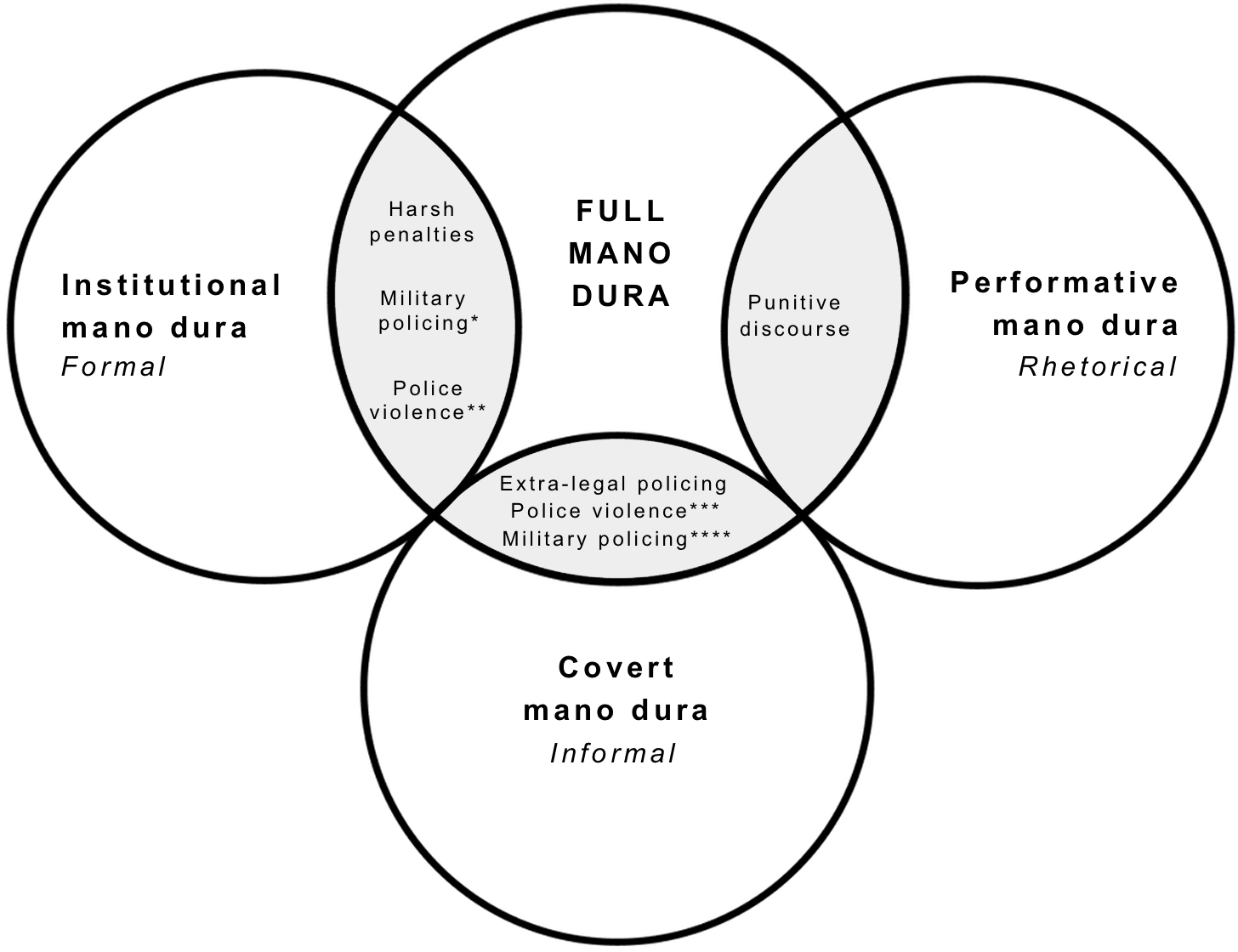
The elements and dimensions of mano dura are not mutually exclusive. At most two of its dimensions can be combined into one single policy option (i.e., three dimensions would transform the subcategory into full mano dura). In Colombia, for example, the César Gaviria administration (1990–1994) shows that harsh penalties and military policing can coalesce with extra-legal policing and police or military violence. Initially, the president prioritized institution building initiatives to tackle violence in a country with nearly 80 homicides per 100,000 inhabitants (Guerrero and Fandiño-Losada Reference Guerrero and Fandiño-Losada2017). Gaviria not only created the Unidades Antiextorsión y Secuestro (anti-extorsion and kidnapping—UNASE), Footnote 6 but he also appointed a civilian as the minister of defense, Footnote 7 created the Consejería de Seguridad y Defensa (Security and Defense Counseling), Footnote 8 and launched the Estrategia Nacional contra la Violencia (National Strategy against Violence), showing the government’s decision to strengthen key democratic institutions while subordinating the military to civilian oversight (Orozco Abad Reference Orozco Abad1995).
Rather than promoting punitive discourses or theatrical practices, Gaviria was considered a technocrat and a pragmatic leader (Duque Daza Reference Duque Daza2018). The new constitution sanctioned in 1991 and policies such as the Sometimiento a la Justicia (Compensation for Justice) showed his conciliatory profile to address the country’s high levels of violence, as the first legal mechanism prohibited extradition Footnote 9 and the second proposed sentence reductions in exchange for the surrender of criminals and the confession of their crimes. His approach, however, changed after Pablo Escobar escaped from his self-constructed prison known as the Cathedral (Ariza and Iturralde Reference Ariza, Iturralde and Sozzo2022). The Gaviria administration went to an “integral war” with Escobar and his government used the declaration of the state of internal commotion and a total of 21 decrees since November 1992 to combat the Medellín cartel and other organizations threatening the state (Orozco Abad Reference Orozco Abad1995). Gaviria also consolidated the Bloque de Búsqueda (Search Block) of the Policía Nacional de Colombia (National Police of Colombia) in charge of capturing Escobar and promoted legislation such as Law 40, known as the Ley Antisecuestro (anti-kidnapping law).
Yet Gaviria’s mano dura was not limited to the formal realm. His government also allied with paramilitary groups to crack down on the Medellín cartel and its leader, Pablo Escobar (Brewer-Osorio Reference Brewer-Osorio2024; Lessing Reference Lessing2017a). The evidence indicates that between 1990 and 1994, the government was involved in at least 288 extrajudicial killings, known as “falsos positivos” (false positives) (CINEP 2011), suggesting that his administration can be also characterized by covert mano dura. According to Rodríguez Gómez (Reference Rodríguez Gómez2020), the increment of extrajudicial killings happened at the time the alliance between paramilitary groups and sectors of the armed forces strengthened. Ultimately, Escobar was shot and killed in Medellín in 1993, and the cartel subsequently collapsed. This was hailed as a victory, both in Colombia and the United States, marking the end of the reign of Escobar (Lessing Reference Lessing2017a; Bagley Reference Bagley2011, Reference Bagley2013).
The informal dimension of mano dura was less evident among other governments in the Andes. Bolivia, for example, embraced a series of institutional reforms to confront the threats associated with the expansion of the cocaine industry in the 1980s. Unlike the military dictatorship that governed the country earlier that decade, the constitutional administrations largely relied on formal initiatives to combat coca cultivation and cocaine refinement, indicating a case of institutional mano dura. Indeed, the Víctor Paz Estenssoro administration (1985–1989) created in 1987 the Fuerza Especial de Lucha contra el Narcotráfico (Special Drug Police Force—FELCN), absorbing the Unidad Móvil Policial para Áreas Rurales (Rural Mobile Patrol Unit—UMOPAR) created in 1984. At the legislative level, Law 1.008 criminalized new coca production in most of the country. The new legal framework further established the process for the forceful eradication of coca and a special branch of the judiciary to deal with drug-related crimes (Brewer-Osorio Reference Brewer-Osorio2021; Grisaffi Reference Grisaffi2018). Moreover, mano dura was not accompanied by theatrical elements. As Ledebur (Reference Ledebur2005) notes, the presence of the military in drug control initiatives was a source of contention due to the country’s long-standing history of military rule. Since Bolivia’s coca cultivation and consumption are ancient practices that are not associated with high levels of violence, it is not surprising that the Paz Zamora administration (1989–1993) negotiated secretly an annex to a US assistance package that allowed the Bolivian armed forces to participate in coca eradication. When the annex was exposed to the public, the government tried to retreat and the next president, Gonzalo Sánchez Lozada, was forced to call for the removal of US military personnel from Bolivia’s territory (Lehman Reference Lehman2006).
The formal or informal dimensions of mano dura can be combined with theatrical or performative elements such as framing criminals as public enemies or highly punitive discourses. In Argentina, for example, the rise of Mauricio Macri from the center-right Cambiemos (Let’s Change) coalition was linked to the public’s rising concerns of insecurity (Cutrona Reference Cutrona, Rosen and Kassab2018). President Macri strongly criticized Cristina Fernández (2007–2015) for being “soft on crime” and defined insecurity as “one of the biggest debts of 30 years of democracy” (Infobae 2014). Notwithstanding the initial impetus and the harsh rhetoric of several government officials, including the hardliner Patricia Bullrich who was appointed as the security minister, many reforms were not fully materialized (Flom Reference Flom, Rosen and Cutrona2023). Security spending dropped from 2.95 to 2.04 percent of Argentina’s GDP (Cutrona Reference Cutrona2021). The national government focused instead on several ad hoc procedural changes with high social impact that contributed to strengthen the narrative of mano dura such as the security emergency decree, the shoot-down policy, Footnote 10 or the so-called “Chocobar protocol.” Footnote 11 In practice, these formal policy changes implied saturating certain areas (e.g., shantytowns, indigenous territory, and the border area) with the police or the military, increasing their discretion to use force while also limiting civilian oversight.
The Alberto Fernández administration (2019–2023) from the Peronist Frente de Todos (Everyone’s Front) showed that performative acts can be avoided. He not only reversed the security narrative, but also appointed Sabina Frederic, a social anthropologist with a progressive stance on crime, as security minister. Based on the idea that security meant “protecting people, not repression,” Frederic contested Bullrich’s approach to crime. Nonetheless, in a context of increasing violence in Rosario, Argentina’s third largest city and home to the powerful criminal group known as los monos (the monkeys), the president announced in March 2023 a series of mano dura measures “to pacify Rosario.” Footnote 12 The package included the intervention of the armed forces’ Command of Engineers, who were in charge of “urbanizing popular neighborhoods,” whereas the National Gendarmerie and the Federal Police were involved in the fight against crime. Fernández’s decision was the first modern precedent in which the armed forces were involved in security operations within the national borders despite the legal framework prohibiting it. Footnote 13 Yet the president downplayed the role of the military, arguing that it did not violate the legal distinction between external defense and domestic security and said that the military were the “forces of democracy” (Gutiérrez and Costantino Reference Gutiérrez and Costantino2022).
Similarly, in Mexico, Andrés Manuel López Obrador, who was elected president in 2018, sought to distinguish himself from his predecessors, who openly militarized the fight against drug trafficking organizations (Zepeda et al. Reference Zepeda, Rosen and Rodrigues2020). He argued that Mexico had been turned into a cemetery by the failed war on drugs and the country needed abrazos no balazos. Yet upon assuming office, López Obrador implemented mano dura policies. The leader of the Morena party created the Guardia Nacional, which combined the police and armed forces into one unit (Kilroy Reference Kilroy2021). In September 2019, López Obrador also turned over control of the Guardia Nacional to the armed forces, leading to further criticism that he adopted the same punitive policies that he criticized endlessly (Serrano Carreto Reference Serrano Carreto2019). Yet the president avoided performative or theatrical acts to tackle Mexico’s violence. López Obrador denied publicly that he continued the same mano dura strategies and did not market the captures of key criminals or drug seizures like his predecessors. Instead, he argued that he did not militarize the drug war and refused to use colorful phrases such as “war on crime” or “war on drugs.”
In Central America, as in many other subregions of the continent, governments from all sides of the political spectrum have implemented mano dura policies (Wade Reference Wade, Rosen and Cutrona2023; Wolf Reference Wolf2017; Cruz Reference Cruz2010). El Salvador, for instance, has a long history of hardline strategies from both the left-wing Frente de Liberación Nacional Farabundo Martí (Farabundo Martí National Liberation Front—FMLN) and the right-wing Alianza Republicana Nacionalista (Nationalist Republican Alliance—ARENA) parties. Presidents Francisco Flores (1999–2004) and Elías Antonio “Tony” Saca (2004–2009) launched mano dura and super mano dura initiatives. During the administration of Salvador Sánchez Cerén (2014–2019), who assumed office after the failed truce with gangs promoted by the Mauricio Funes (2009–2014) government, the Supreme Court classified gangs as terrorists, elevating the threat of this criminal organization on the country’s security agenda (Paarlberg Reference Paarlberg2022; Ruiz and Mackey Reference Ruiz and Mackey2020; Wolf Reference Wolf2017).
However, it was not until the late 2010s that mano dura reached a completely different dimension. At the time El Salvador ranked as one of the most violent countries in the world (Van Damme Reference Van Damme2018; Martínez Reference Martínez2017), the Nayib Bukele administration (2019–2024) followed, in part, the strategy of his predecessors and launched the Territorial Control Plan after his inauguration in June 2019. The plan, which consisted of increasing the presence of the police and military in 17 municipalities, resulted in 5,000 arrests of gang members in the first two months (Stelmach Reference Stelmach2022; Nagovitch Reference Nagovitch2020). During the Bukele government, the Legislative Assembly has passed more than ten bills increasing the sentences of people suspected of gang membership. People in El Salvador could receive 45 years in prison for being a gang member, and having a tattoo—even if a former gang member—enables the government to confirm it (Rosen and Cruz Reference Rosen and Cruz2018). Moreover, children 12 and older can be tried as adults. Bukele also implemented “a state of exception,” resulting in more than 50,000 alleged gang members being arrested. In addition to these formal measures characteristic of institutional mano dura, the evidence suggests that the practices of law enforcement forces are largely discretionary, as the president encouraged the police to use lethal force during the pandemic and indicated that the government will no longer record extrajudicial killings. Indeed, there are more than 13,000 forced disappearances that are not included into the country’s official statistics (Nilsson Reference Nilsson2022; Wolf Reference Wolf2021), suggesting that El Salvador can be also seen as a case of covert mano dura.
Furthermore, the president has focused on marketing these mano dura initiatives through performative practices and public spectacles (Wade Reference Wade, Rosen and Cutrona2023), including the deployment of the military to the National Assembly to intimidate politicians who did not support his security law and the publication on Twitter of multiple photos and videos of shirtless gang members in the penitentiary system one on top of another. In mid-June 2022, Bukele also announced the creation of a mega prison—the Center for Confinement of Terrorism (CECOT)—designed to hold approximately 40,000 gang members (International Crisis Group 2022).
In summary, our typology reveals two different things. First, that politicians and the policies promoted can meet the characteristics of more than one form of mano dura strategies during their time in office. Second, there are likely to be very few events which are purely institutional, covert, or performative. These types of mano dura represent instead ideal or “best” illustrations within a continuum of laws, policies, and practices visible in the real world. Consequently, perhaps full mano dura does not completely exist in practice or it is an extraordinary event like the case of Nayib Bukele in El Salvador. Under these circumstances, full mano dura can be seen rather as an ideal type from where other policies can be interpreted.
Conclusions
There are numerous studies in the social sciences that focus on different strategies designed to combat gangs, organized crime, and violence in Latin America. A review of the current scholarly literature on mano dura policies reveals that there is a vast inconsistency in the usage of the term, suggesting that mano dura is an essentially contested concept. Indeed, there is no definitive consensus on what mano dura is and many scholars mention this concept to refer to a wide variety of policing strategies adopted in the region, including harsh penalties, the deployment of the military, limits on due process, punitive discourses, mass incarceration, extra-legal policing, police violence, and the use of lethal force. Furthermore, some of the academic works discuss this topic but do not provide a clear definition of the term or enumerate its attributes.
If mano dura cannot be defined, one cannot say whether or not certain policies fall into this category. This article is an effort to standardize the usage of mano dura while also illuminating its various dimensions, as this term has become a “catchy concept,” but one that is not always clear. Drawing on the experiences of different Latin American countries, we build on Collier and Mahon’s (Reference Collier and Mahon1993) conceptual approximation and propose a definition that interprets mano dura as state repressive policies and political strategies aimed at tackling crime or its associated fear. Since we demonstrate that mano dura consist of three different dimensions, each of them presenting a set of defining attributes, we also offer a stylized model that contains four forms of mano dura: full mano dura, institutional mano dura, covert mano dura, and performative mano dura. While not mutually exclusive, these radial categories allow us to retain the concept of mano dura without eliminating critical attributes not held in common by all cases.
Echoing Marradi (Reference Marradi1990, 147), this typology is intended to confer “organization and stability on our thoughts about reality.” It is also a starting point for scholars seeking to untangle the nuances of mano dura policies and the policymaking process. More research is needed on the legal process of applying mano dura and the impact of security policy. Future studies over space and time are also required to test this model empirically in different Latin American countries where mano dura is increasing its popularity among government officials to combat organized crime, gangs, violence, and associated fear. Indeed, it is very likely that some of the attributes and forms of mano dura are not unique to Latin America but could be also studied in other regions with similar social, economic, and political contexts.
Supplementary material
To view supplementary material for this article, please visit https://doi.org/10.1017/lap.2024.32
Acknowledgements
A special thanks to the two anonymous peer reviewers for their excellent comments as well as the editors of LAPS. The keen insights of the reviewers helped us improve the article significantly. We also would like to thank Juan Albarracín and Eduardo Bechara-Gómez, who we consulted for their expertise. Finally, thanks to Eduardo Moncada and Bill Smith for reviewing drafts of the manuscript.
Competing interests
The authors declare no conflict of interests.


 Open access

