

1. Introduction
2020 was touted as a ‘super-year for the environment’ (The Lancet Planetary Health, 2020) for setting ambitious policies and targets for global conservation and greenhouse gases (GHG) for future decades. However, due to the COVID-19 pandemic, the 15th Conference of the Parties (COP) of the United Nations Convention on Biological Diversity (UNCBD) and the 26th COP of the UN Framework Convention on Climate Change (UNFCCC), which were due to take place in October and November 2020 were eventually postponed (Figure 1). There remains much uncertainty as the world continues to grapple with the ‘twin pandemic’ of COVID-19 and its economic recession (Mayhew & Anand, Reference Mayhew and Anand2020).
Adjusted timeline of the main United Nations Convention on Biological Diversity (UNCBD) and the Framework Convention on Climate Change (UNFCCC) meetings and conferences postponed due to COVID-19 restrictions.

Amid this uncertainty, 2021 is a critical time to set forward-thinking environmental policies to overcome the failure to meet previous biodiversity and climate targets. The Aichi Biodiversity Targets remain largely unrealized a decade since their adoption, and millions of species and their habitats will be lost if transformative action is not taken (IPBES, 2019; Secretariat of the Convention on Biological Diversity, 2020a; The Lancet Planetary Health, 2020). Emissions reduction pledges in Nationally Determined Contributions (NDCs) are also insufficient to meet the ‘well below 2°C’ target of the Paris Agreement. Warming is projected to exceed 3°C with the conservative national targets currently represented in the first round of submitted NDCs (Peters et al., Reference Peters, Andrew, Canadell, Fuss, Jackson, Korsbakken, Le Quéré and Nakicenovic2017; UNEP, 2019).
There are opportunities to address these setbacks and raise ambition at the upcoming COPs, but the uncertainty caused by the pandemic, fueled by the economic downturn, could trigger shifts away from global priorities to more immediate domestic concerns. Some national governments and politicians may argue that environmental action is less pressing, as they turn inward to focus on investments for health services, the economy, and welfare while undermining environmental protections (Hanna et al., Reference Hanna, Xu and Victor2020; Helm, Reference Helm2020; McKee & Stuckler, Reference McKee and Stuckler2020). Indeed, only a limited number of countries have included climate or biodiversity measures in their recovery packages, and a number have introduced measures that reduce environmental taxes or regulatory enforcement (McElwee et al., Reference McElwee, Turnout, Chiroleu-Assouline, Clapp, Isenhour, Jackson, Kelemen, Miller, Rusch, Spangenberg, Waldron, Baumgartner, Bleys, Howard, Mungatana, Ngo, Ring and Santos2020). Developing countries may be particularly affected, as budgets for climate and biodiversity programs are cut or realigned to COVID-19 response.
Despite these challenges and continued disruption, the delays in the international negotiations could still be providential and result in positive outcomes if they lead to transformative environmental policies that reflect the important connections between climate, biodiversity, health, and human communities. Importantly, global biodiversity and climate policies must heed the urgent message from science: without preventative strategies, pandemics will emerge more often and spread more rapidly, causing more human deaths and crippling the global economy at devastating levels (IPBES, 2020a). There is much research to be carried out, but we share the optimism that the pandemic could serve as a wake-up call to catalyze political decisions and lead to more aggressive action at UNCBD COP 15 and UNFCCC COP 26, with countries and stakeholders demonstrating a greater willingness to tackle biodiversity loss, accelerate the transition to a green economy, and create more integrated environmental policies (Barbier, Reference Barbier2020; Hanna et al., Reference Hanna, Xu and Victor2020; Helm, Reference Helm2020; Turney et al., Reference Turney, Ausseil and Broadhurst2020). Hopes are particularly high for enhanced cooperation due to the renewed commitments from the United States to the Paris Agreement and the World Health Organization.
Here, we highlight where progress is needed in both Conventions to address the COVID-19 crisis and the climate and biodiversity emergencies. We emphasize the important interlinkages between biodiversity and climate based on a critical analysis of recent studies and the framework agreements from a global perspective.
2. Interlinkages among climate, biodiversity, health, and effective policy
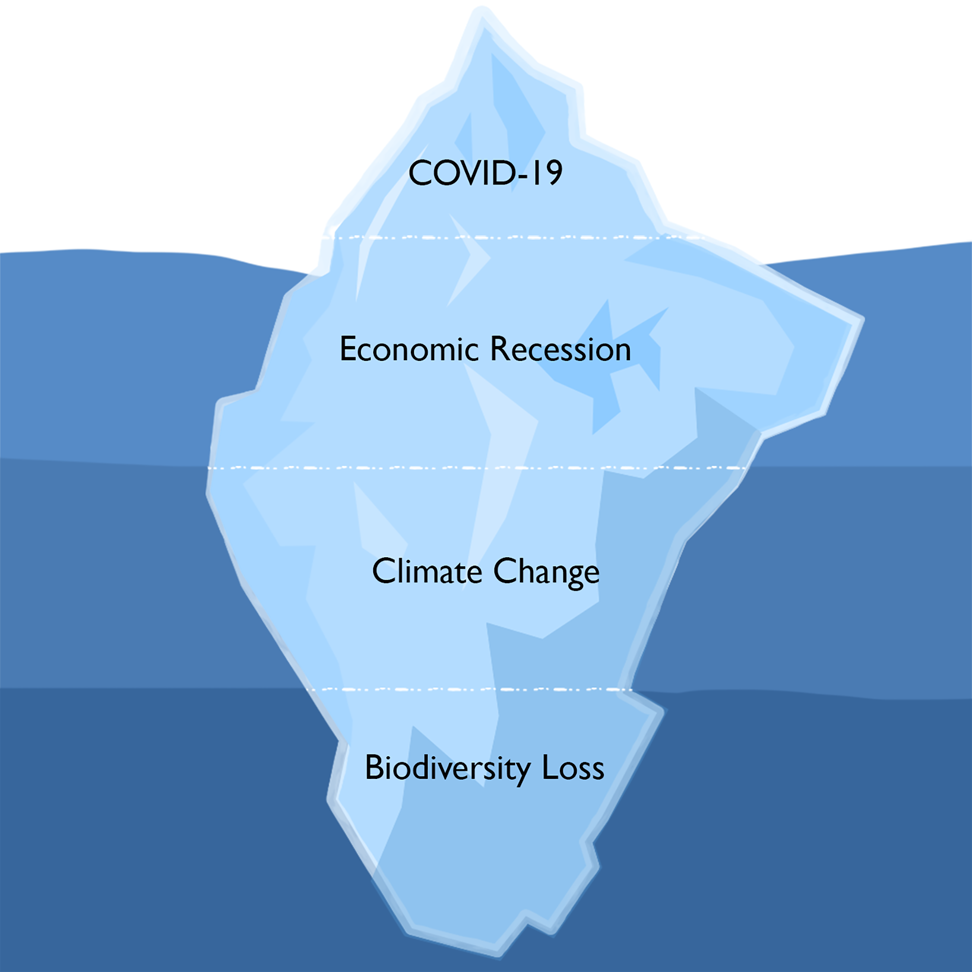
The COVID-19 pandemic is just the tip of the iceberg, preceding complex issues of an ongoing economic recession, climate change, and biodiversity loss (Figure 2). COVID-19 is itself an environmental problem brought by unsustainable human practices. The transmission of most known zoonotic diseases happens indirectly, and is interlinked with the biodiversity crisis and food systems (Everard et al., Reference Everard, Johnston, Santillo and Staddon2020; UNEP & ILRI, 2020). The major drivers of zoonotic disease transmission are: (1) increasing human demand for animal protein, (2) unsustainable agricultural intensification, (3) increased use and exploitation of wildlife, (4) unsustainable utilization of natural resources accelerated by urbanization, land-use change, and extractive industries, (5) increased travel and transportation, (6) changes in food supply, and (7) climate change (UNEP & ILRI, 2020).
COVID-19 is the tip of the iceberg of interconnected environmental challenges. The pandemic-fueled economic recession caused by COVID-19 is only surpassed by other global challenges like climate change and biodiversity loss.

Indeed, the underlying causes of pandemics are the same global environmental changes that drive biodiversity loss and climate change: land-use change, agricultural expansion and intensification, and wildlife trade and consumption (IPBES, 2020a). Among these, land-use change driven by agricultural expansion and intensification accounts for the most significant impacts on biodiversity in terrestrial and freshwater ecosystems (IPBES, 2019; Newbold et al., Reference Newbold, Hudson, Hill, Contu, Lysenko, Senior, Börger, Bennett, Choimes, Collen, Day, De Palma, Díaz, Echeverria-Londoño, Edgar, Feldman, Garon, Harrison, Alhusseini and Purvis2015, Reference Newbold, Adams, Albaladejo Robles, Boakes, Braga Ferreira, Chapman and Williams2019). The drivers of increased land-use change arise from the demands of a growing world population with increased affluence (Godfray et al., Reference Godfray, Aveyard, Garnett, Hall, Key, Lorimer and Jebb2018; Myers & Kent, Reference Myers and Kent2003; Weinzettel et al., Reference Weinzettel, Hertwich, Peters, Steen-Olsen and Galli2013). International trade has also enabled the spatial decoupling of food consumption and production systems, with significant impacts on developing nations with high biodiversity (Fader et al., Reference Fader, Gerten, Krause, Lucht and Cramer2013; Lenzen et al., Reference Lenzen, Moran, Kanemoto, Foran, Lobefaro and Geschke2012; MacDonald et al., Reference MacDonald, Brauman, Sun, Carlson, Cassidy, Gerber and West2015; Meyfroidt et al., Reference Meyfroidt, Lambin, Erb and Hertel2013). This makes it imperative to find ways to feed the global population and transform food systems to minimize harm to biodiversity, not only to prevent the next COVID-19, but also for food security (Baudron & Liégeois, Reference Baudron and Liégeois2020).
Climate change exacerbates these impacts on biodiversity, human and ecosystem health, livelihoods, infrastructure, and food systems (IPCC, 2019). Climate change also affects the abundance and distribution of pathogens, host species, and wildlife (Casadevall, Reference Casadevall2020; Mills et al., Reference Mills, Gage and Khan2010; Ogden, Reference Ogden2018) and is projected to lead to more human–wildlife conflicts in ecologically disturbed habitats (Aryal et al., Reference Aryal, Brunton and Raubenheimer2014; Johnson et al., Reference Johnson, Lewis, Verzuh, Wallace, Much, Willmarth and Breck2018; König et al., Reference König, Kiffner, Kramer-Schadt, Fürst, Keuling and Ford2020; Yurco et al., Reference Yurco, King, Young and Crews2017). Climate change will likely cause substantial future pandemic risk by driving changes in the movement of people, wildlife, disease reservoirs, and vectors (IPBES, 2020a).
Using systems thinking (Figure 3), we show the interconnections among the seven drivers of zoonotic diseases, climate change, and biodiversity along with factors that influence the transmission of COVID-19 and other zoonotic diseases, such as urbanization (Connolly et al., Reference Connolly, Keil and Ali2020), population density (Simpson et al., Reference Simpson, Kaufmann, Glozman and Chakrabarti2020), and international trade, which has been linked to invasive species introductions (Gallardo et al., Reference Gallardo, Zieritz and Aldridge2015). Causal loop diagrams and systems thinking are useful for representing interconnections, causes, and effects in complex systems (Lezak & Thibodeau, Reference Lezak and Thibodeau2016; Palmberg et al., Reference Palmberg, Hofman-Bergholm, Jeronen and Yli-Panula2017) and have been used to represent the connections in the interacting domains of the environment, agriculture, climate change, and international trade (Ortiz et al., Reference Ortiz, Outhwaite, Dalin and Newbold2021). This diagram will undoubtedly simplify the complex and nuanced connections between these domains. For example, although increased yields from improved practices may have helped agriculture become more carbon efficient, this efficiency has not necessarily led to decreases in resource use (Burney et al., Reference Burney, Davis and Lobell2010; Pellegrini & Fernández, Reference Pellegrini and Fernández2018), in what is known as Jevon's paradox. Nevertheless, we use the diagram's simplicity to emphasize that effectively implemented policies are critical to mitigating emissions, protecting biodiversity, and addressing and managing zoonotic diseases such as the COVID-19 pandemic.
Interconnections between the seven main drivers (in bold) of zoonotic diseases (UNEP & ILRI, 2020), food systems, land use, climate change, and opportunities for policy intervention related to the UNCBD and UNFCCC. An arrow indicates a positive feedback loop (+), for example, more income has been shown to drive greater demands for animal-based protein. Red arrows indicate policy interventions which can in turn limit (−) some of the drivers related to increased opportunities for zoonotic disease transmission. For example, achieved mitigation targets mean that emissions are reduced, and this reduction could also mean a reduction in climate change that drives the changes in distribution and abundance of pathogens, host species, and other wildlife. Although this causal loop diagram does not sufficiently represent the complexity of relationships between these dynamic variables, it aims to communicate the important role of effective policies.

Effective public health programs are important in addressing and managing the current pandemic (Legido-Quigley et al., Reference Legido-Quigley, Asgari, Teo, Leung, Oshitani, Fukuda, Cook, Hsu, Shibuya and Heymann2020) and approaching the nexus of food safety, zoonoses, and health, such as through the World Health Organization's One Health program (Gibbs, Reference Gibbs2014). Emphasizing the connections between health and biodiversity, a key recommendation of the IPBES pandemic report is to support the institutionalization of One Health programs nationally (IPBES, 2020a). Already, the One Health framework has been adopted by government agencies in ASEAN Member States, namely Vietnam and the Philippines, but increased support, particularly for developing countries, is needed to continue the work of national governments toward early warning systems, wildlife surveillance, education and public awareness campaigns, and inter-agency coordination (Philippine Information Agency, 2020). The drivers of zoonotic diseases can also be addressed through effective biodiversity and climate policies. The establishment of protected areas and other site-based conservation measures can reduce the number of overexploited species, ensure the persistence of biodiversity, and limit opportunities for zoonotic disease transmission (Geldmann et al., Reference Geldmann, Manica, Burgess, Coad and Balmford2019; Sokolow et al., Reference Sokolow, Nova, Pepin, Peel, Pulliam, Manlove, Cross, Becker, Plowright, McCallum and De Leo2019). At present, protected areas have insufficient global coverage and face many practical challenges, leading to variation in the extent to which they prevent extinctions (Butchart et al., Reference Butchart, Clarke, Smith, Sykes, Scharlemann, Harfoot, Buchanan, Angulo, Balmford, Bertzky, Brooks, Carpenter, Comeros-Raynal, Cornell, Ficetola, Fishpool, Fuller, Geldmann, Harwell and Burgess2015; Le Saout et al., Reference Le Saout, Hoffmann, Shi, Hughes, Bernard, Brooks, Bertzky, Butchart, Stuart, Badman and Rodrigues2013) and provide other ecosystem services.
‘Effective’ is the key word for the role of policy in reducing the negative effects of anthropogenic activity on the environment, and its feedbacks to human communities. It is not the mere existence of biodiversity and climate policies, but their implementation, monitoring and evaluation against targets that demonstrate effectiveness. Measuring effectivity for biodiversity targets means evaluating whether an intervention produces the conservation benefits as desired ex ante (Doremus, Reference Doremus2003); this can be interpreted in terms of biodiversity conserved or ecosystem functions and services maintained (Maestre Andrés et al., Reference Maestre Andrés, Calvet Mir, van den Bergh, Ring and Verburg2012). Climate policy can similarly be evaluated in terms of its environmental effectiveness, its cost-effectiveness, and consideration of carbon leakage (Steininger et al., Reference Steininger, Lininger, Meyer, Munõz and Schinko2016).
Although decisive leadership and strong public health policy are needed during the pandemic, biodiversity and climate policies will be key to transitioning societies to truly sustainable economies. Amid the limited resources and competing priorities of a post-COVID world, it is imperative to devote efforts to setting ambitious targets and monitoring progress comprehensively, to ensure that resources are strategically deployed.
3. Opportunities to better consider interactions in the UNCBD and UNFCCC
We analyzed the UNCBD and UNFCCC frameworks to investigate how these integrate the drivers of zoonotic disease transmission, which are the same drivers of biodiversity loss and climate change. Many drivers of zoonotic diseases, biodiversity loss, and climate change are already addressed in the conventions and their activities (Table 1). The Zero Draft of the post-2020 Global Biodiversity Framework (GBF) names the ‘safety and security in use of biodiversity to prevent spillover of zoonotic diseases, spread of invasive alien species and illegal trade in wildlife’ as an enabling condition to the implementation of the framework (Secretariat of the Convention on Biological Diversity, 2020b). However, for post-pandemic recovery, we find significant gaps in the Conventions and their programs to address climate change and biodiversity. In particular, more focus on agricultural impacts, including those facilitated by international trade (see Table 1, Items 1, 2 and 6) and carbon markets, including trading and offsetting through nature-based solutions (NbS), are needed. Although more efforts to bridge one Convention to the other are key, it is encouraging that joint work and programs between the Intergovernmental Panels on Climate Change and Biodiversity and Ecosystem Services (IPCC and IPBES, respectively) are taking place, including a high-level agreement that links human and animal health and the environment sectors (IPBES, 2020b).
Drivers of zoonotic disease that are closely linked to biodiversity loss and climate change, current consideration in framework agreements and programs, and references to the drivers in the post-2020 agenda of the UNCBD and/or UNFCCC

iCollaborative Partnership on Sustainable Wildlife Management 2015, cited in Decision 14/7.
iiUNCBD, Decision 14/1.
iiiUNCBD, Decision 14/7.
ivUNCBD, Decision 14/1.
vUNCBD/WG2020/REC/2/1, 25.
viUNFCCC, Article 4.1(c).
viiUNFCCC/SBI/2018/9.
viiiUNFCCC Paris Agreement, Article 4.13.
ixUNCBD, Decision 14/1.
xUNFCCC, Article 4.1(d).
xiUNCBD/WG2020/REC/2/1, 8, 10.
xiiUNFCCC Paris Agreement, Article 4.9.
xiiiREDD+ Decision Booklet; Article 5, Paris Agreement.
xivUNCBD/WG2020/REC/2/1, 19.
xvUNCBD Decision 14/5.
3.1. Gaps in addressing agricultural production and food systems
Agriculture is a cross-cutting theme across conventions, because of its role in food security, sustainable development, and climate change adaptation and mitigation. However, despite agriculture being established as the leading cause of biodiversity loss (Kehoe et al., Reference Kehoe, Romero-Muñoz, Polaina, Estes, Kreft and Kuemmerle2017), it is not comprehensively addressed in the Zero Draft of the GBF (Secretariat of the Convention on Biological Diversity, 2020b). Agriculture has also historically struggled to find prominence in the climate negotiations. At present, the Koronivia Joint Work on Agriculture (KJWA), co-managed by the Subsidiary Bodies on Scientific Advice and Implementation, addresses the vulnerabilities of agriculture to climate change and approaches to food security. As COVID-19 is linked to food systems, and many pandemics are from zoonotic spill-overs (e.g. from wildlife and livestock), it would be key for the future of the KJWA – to be negotiated at COP 26 – to consider pandemic risk and preventative strategies in agriculture that also benefit mitigation and/or adaptation.
The pandemic has highlighted the interconnections between the exploitation and unsustainable consumption of wildlife and human health, and how these are exacerbated by socio-economic drivers, especially in developing countries, where communities face food insecurity, lack of access to clean water, and limited economic opportunities (IPBES, 2019). There has been a disproportionate focus on calls for wildlife bans on Africa and Asia, whereas a reduction in global meat consumption, and increased efforts to combat the illegal wildlife trade would be more beneficial than banning small-scale animal husbandry (Petrikova et al., Reference Petrikova, Cole and Farlow2020). Additionally, many countries routinely outsource their biodiversity threats to other nations (Eskew & Carlson, Reference Eskew and Carlson2020; Lenzen et al., Reference Lenzen, Moran, Kanemoto, Foran, Lobefaro and Geschke2012). The international food trade must be more clearly acknowledged as a facilitator of biodiversity loss in the post-2020 agenda.
Another gap is the absence of scientific targets for achieving healthy diets from sustainable food systems, which hinders efforts to transform the global food system (Willett et al., Reference Willett, Rockström, Loken, Springmann, Lang, Vermeulen, Garnett, Tilman, DeClerck, Wood, Jonell, Clark, Gordon, Fanzo, Hawkes, Zurayk, Rivera, De Vries, Majele Sibanda and Murray2019). Evidence shows that meeting the Paris Agreement is not possible without widespread dietary change, and as such, these issues should be considered in Agriculture, Forestry and Other Land Use negotiations at the UNFCCC (Gralak et al., Reference Gralak, Spajic, Blom, Omrani, Bredhauer, Uakkas, Mattijsen, Ali, Iturregui, Ezzine, Alqodmani and Singh2020). Developing targets for sustainable diets can potentially address the interactions between biodiversity, livestock, human health, as well as climate change and sustainable development. Although some NDCs address agriculture and food systems, it is urgent that food systems are seen as whole rather than in separate parts; this includes diets and food waste (Schulte et al., Reference Schulte, Bakhtary, Siantidis, Haupt, Fleckenstein and O'Connor2020). There is thus great value in addressing food systems, and using the advantages of systems thinking, to bridge more coordinated work across the Conventions through national pledges in NDCs.
3.2. Gaps in safeguards for meeting the Paris Agreement through carbon markets and nature-based solutions
Rules and guidelines on voluntary carbon markets and a Sustainable Development Mechanism being negotiated under Article 6 of the Paris Agreement should reflect strong environmental and social safeguards. Article 6 remains an outstanding negotiation item under the Paris Agreement ‘Rulebook’, a major sticking point for parties at COP 25. Aside from questions around accounting and the integrity of offsets, inclusion of human rights considerations was controversial and the final draft text from Madrid excluded rights-related language, much to the dismay of NGOs and indigenous peoples groups (Evans & Gabbatis, Reference Evans and Gabbatis2019; Timperley, Reference Timperley2019). Safeguards in Article 6 are crucial to ensure that future actions afford protections for communities and ecosystems where large-scale climate projects are to take place, as well as align with countries' obligations under other human rights and environmental agreements. Mistakes in the implementation of the Clean Development Mechanism (Ervine, Reference Ervine2015; Obergassel et al., Reference Obergassel, Peterson, Mersmann, Schade, Hofbauer and Mayrhofer2017) must be avoided while maintaining the gains on safeguards in the negotiations on Reducing Emissions from Deforestation and Forest Degradation-Plus (REDD+).
NbS have been featured as cross-cutting interventions for biodiversity and climate change. They include a wide range of adaptation and mitigation responses, such as preserving and restoring natural ecosystems, biodiversity conservation, and other risk management options (Griscom et al., Reference Griscom, Adams, Ellis, Houghton, Lomax, Miteva, Schlesinger, Shoch, Siikamäki, Smith, Woodbury, Zganjar, Blackman, Campari, Conant, Delgado, Elias, Gopalakrishna, Hamsik and Fargione2017; IPCC, 2019). NbS can potentially provide 37% of the mitigation needed to meet the Paris Agreement (IPBES, 2019). However, this figure may also be overestimated as its success is highly dependent on many factors, including governance and financing capacity (Griscom et al., Reference Griscom, Busch, Cook-Patton, Ellis, Funk, Leavitt and Worthington2020; Seddon et al., Reference Seddon, Chausson, Berry, Girardin, Smith and Turner2020). Although there is much optimism for NbS, binding social and environmental safeguards are vital for their implementation. Advocates are concerned that private sector- and fossil fuel industry-driven forest restoration initiatives will be veiled substitutes for more progressive actions to reduce GHG emissions and address land-use change. It is expected that civil society will keep a close eye on the discussions on Article 6 and NbS to ensure that they are carried out with due regard for human rights – particularly the rights of indigenous peoples and local communities – and ecosystems integrity.
4. Moving discussions and actions forward in the pandemic
There is a herculean task of building the momentum for positive change, and preventing the global community from falling back to ineffective and insufficient climate and biodiversity actions. Calls for sustainable recovery should be enhanced at the COPs, in setting the principles and criteria for these sustainable recovery plans, and seeking that they are compatible with the Paris Agreement (Obergassel et al., Reference Obergassel, Hermwille and Oberthür2020). Apart from the need for frameworks to cover the gaps we outline, there are opportunities to regain lost momentum and move the delayed discussions forward in a pandemic/post-pandemic environment.
The increased use of virtual spaces during the pandemic should be taken advantage of to streamline discussions leading up to the resumption of in-person conferences. Virtual spaces may be useful in overcoming the typical pace of international negotiations, which take place over 2 weeks with many breakthroughs at the 11th hour. Major decisions are not being made in these online spaces – and rightly so, due to differences between developed and developing nations' internet connectivity and technological capacity, as well as practical considerations such as regional time zones. In-person negotiations are also affected by the politics of internal discussions and huddles, and calls from civil society. However, virtual spaces present an important, low-cost, and low-emissions opportunity to accelerate the anticipated in-person discussions. Online dialogues in 2020, including the first joint workshop between the IPCC and IPBES and the UNFCCC climate dialogues in late 2020, have set an important tone to maintain science and policy momentum.
Well-considered post-pandemic recovery policies and programs can potentially deliver a ‘quadruple-win’ on economic, biodiversity, climate, and health goals through programs achieved with incentives that make conservation schemes economically viable. For example, community forestry and conservation programs and climate-smart agriculture have been implemented successfully in many parts of the world, generating livelihood opportunities, building resilience and fostering empowerment in local communities where interactions and conflicts between humans and nature often occur. Investments to prevent tropical deforestation and to limit wildlife trade can not only prevent and control future pandemics, but also bring the benefits of sequestering carbon and preventing more deforestation (Dobson et al., Reference Dobson, Pimm, Hannah, Kaufman, Ahumada, Ando, Bernstein, Busch, Daszak, Engelmann, Kinnaird, Li, Loch-Temzelides, Lovejoy, Nowak, Roehrdanz and Vale2020). Green recovery packages that align with NDCs can continue to decouple economic growth from GHG emissions and ecosystem degradation, and this is needed in particular for developing nations, which are hotspots of risk for biodiversity loss, pandemics, and climate change. Well-planned interventions can reduce existing welfare inequalities exacerbated by the pandemic in the short-term, and climate change in the long-term (Hepburn et al., Reference Hepburn, O'Callaghan, Stern, Stiglitz and Zenghelis2020).
Compared to the losses caused by COVID-19 – approximately $15.8T with a high mortality forecast – pandemic prevention is a fraction of the cost at $31B (Dobson et al., Reference Dobson, Pimm, Hannah, Kaufman, Ahumada, Ando, Bernstein, Busch, Daszak, Engelmann, Kinnaird, Li, Loch-Temzelides, Lovejoy, Nowak, Roehrdanz and Vale2020). However, there are two significant obstacles to sustaining long-term green structural transformation after the COVID-19 crisis, which require deep, systemic change: removing fossil fuel subsidies and employing carbon taxes to re-allocate support toward green innovation and investment (Barbier, Reference Barbier2020). Key for the post-pandemic recovery are high political ambition, evidence-based interventions, realized climate and conservation finance pledges, and continued international collaboration under the enshrined principles of the UNCBD and UNFCCC.
5. Conclusions
COVID-19 and the responses thereto continue to reveal systemic weaknesses in policy and governance related to health, social services, and the environment. These are the same systems that affect action on climate and biodiversity and reinforce existing inequalities. However, post-pandemic recovery need not be a zero-sum game between returning to ‘normal’ in terms of economic recovery and restoration of social services on one hand, and protecting the environment on the other.
The pandemic presents opportunities to ‘build back better’ and achieve multiple targets – on climate, biodiversity, sustainable development, and health – with cross-cutting actions that increase resilience. Although there have been efforts in this direction, significant areas, such as agriculture, food systems, carbon markets, and NbS present important opportunities. Ultimately, it is critical for the global community to demand, and work to meet, the higher ambition needed to address the biodiversity and climate emergencies. The pandemic must not be an excuse for further failure but a reason for accelerated and ambitious actions. Achieving the global climate and biodiversity goals while ensuring an equitable recovery may require more than what policy solutions can deliver. Nevertheless, clear, ambitious, and grounded international policy is an important first step.
Acknowledgements
The authors gratefully acknowledge the Global Sustainability team, and feedback from the editors and the anonymous reviewer in the development and revision of this manuscript. The authors acknowledge the help of Adrian Ortiz with the original graphics of Figure 2.
Author contributions
AMDO and AMDL conceived the study. AMDO, AMDL, JNVT, CTTG, and AGMLV co-wrote the manuscript. AMDO designed the causal loop diagram with feedback from co-authors.
Financial support
AMDO is supported by UK Natural Environment Research Council grant (NE/R010811/1).
Conflict of interest
The authors declare no conflicts of interest.



 Open access

