

Introduction
Plant genetic resources for food and agriculture (PGRFA) form the foundation of global food security and agricultural adaptation to climate change (FAO 2019; Ebert and Engels Reference Ebert and Engels2020). Their conservation, particularly in centers of crop origin and diversity, is crucial for maintaining agricultural options for the future generations. Sudan, with its diverse agroecological zones, serves as a center of origin and diversity for several globally important crops, such as sorghum (Sorghum bicolor), pearl millet (Pennisetum glaucum), okra (Abelmoschus esculentus), and sesame (Sesamum indicum) (APGRC 2018; Crop Trust 2025a). Sudan is part of the East African Primary Region for crop genetic diversity, with a high diversity in coffee, cotton, cowpeas, melons, millets, olives, peas, sesame, and sorghum (El Tahir et al. Reference El Tahir, Babiker, Abdalla, Elhuda Ahmed, Yousif Goda and Mohamed Elgabri2025).
The loss of plant genetic resources during conflict is not new. Throughout history, wars and civil unrest have threatened agricultural biodiversity, from crop collection destruction during World War II to more recent losses in Iraq, Afghanistan, and Syria (Richards et al. Reference Richards, Ruivenkamp, Longley, Mcguire, Drift, Malcolm and Longley1997; Raloff Reference Raloff2002; Clarke Reference Clarke2003; Hanson et al. Reference Hanson, Brooks, Da Fonseca, Hoffmann, Lamoreux, MacHlis, Mittermeier, Mittermeier and Pilgrim2009; Bhattacharya Reference Bhattacharya2016; Westengen et al. Reference Westengen, Lusty, Yazbek, Amri and Asdal2020; Poole et al. Reference Poole, Sharma, Nemat, Trenchard, Scanlon, Davy, Ataei, Donovan and Bentley2022). These events show that ex situ conservation facilities are specifically vulnerable during conflict and require specialized approaches to preserve irreplaceable genetic material (Fu Reference Fu2017).
Sudan’s Agricultural Plant Genetic Resources Conservation and Research Center (APGRC) has served as a national repository for agricultural biodiversity since its inception as a Horticultural Germplasm Unit in 1982 (APGRC 2018; Mohamed Reference Mohamed2025). However, the ongoing civil war in the country, which is one of the world’s most severe humanitarian crises, has put both physical infrastructure and germplasm collections at grave risk (Mohamed Reference Mohamed2025; Crop Trust 2025a). This situation mirrors the challenges faced by other genebanks in conflict zones, such as the ICARDA’s genebank in Syria, which was forced to evacuate its Aleppo facility during the Syrian Civil War (ICARDA 2015).
Following an extensive review of the status of APGRC since the ongoing civil war in Sudan and, based on lessons learnt from other genebanks similarly impacted by war and conflict, this paper outlines a framework for recovery, development and long-term resilience for APGRC. This proposal aims to inform international support efforts and provide a roadmap for rebuilding and strengthening Sudan’s capacity to conserve plant agricultural biodiversity despite ongoing challenges.
Methodology
We conducted a comprehensive review of available documentation from authoritative sources, including institutional reports from the Crop Trust and APGRC, documentation from the Svalbard Global Seed Vault (SGSV) regarding Sudanese deposits, reports from the Food and Agriculture Organization, recent news releases and situation updates from international organizations and individuals, and peer-reviewed literature on plant genetic resources conservation in conflict zones.
Our analysis focused on triangulating information across multiple sources to ensure accuracy, particularly regarding the current situation and the impact assessment. Owing to the ongoing nature of the conflict, some information may change as the situation evolves.
We systematically reviewed case studies of gene bank recovery in other conflict-affected regions to identify the applicable lessons and best practices. These include the ICARDA Genebank in Syria (ICARDA 2015; Bhattacharya Reference Bhattacharya2016), National Genebank of Afghanistan (Raloff Reference Raloff2002; Saidajan Reference Saidajan2012; FAO 2016), Sierra Leone Rice Research Station (Richards et al. Reference Richards, Ruivenkamp, Longley, Mcguire, Drift, Malcolm and Longley1997), and the Rwanda Agriculture and Animal Resources Development Board (Ishimwe Reference Ishimwe2013; RAB (Rwanda Agriculture and Animal Resources Development Board) 2023) (Table S1).
A plan for recovery from the current situation for the genebank to fully reoperate was proposed based on the lessons learned from previous similar cases in other genebanks. Proposals for further developments in the future were put forward to fully fulfill the institute’s objectives and cope with the recent developments in the area of PGRFA conservation in the world based on the lessons learned from what happened.
The APGRC genebank: A vital national resource
Institutional evolution
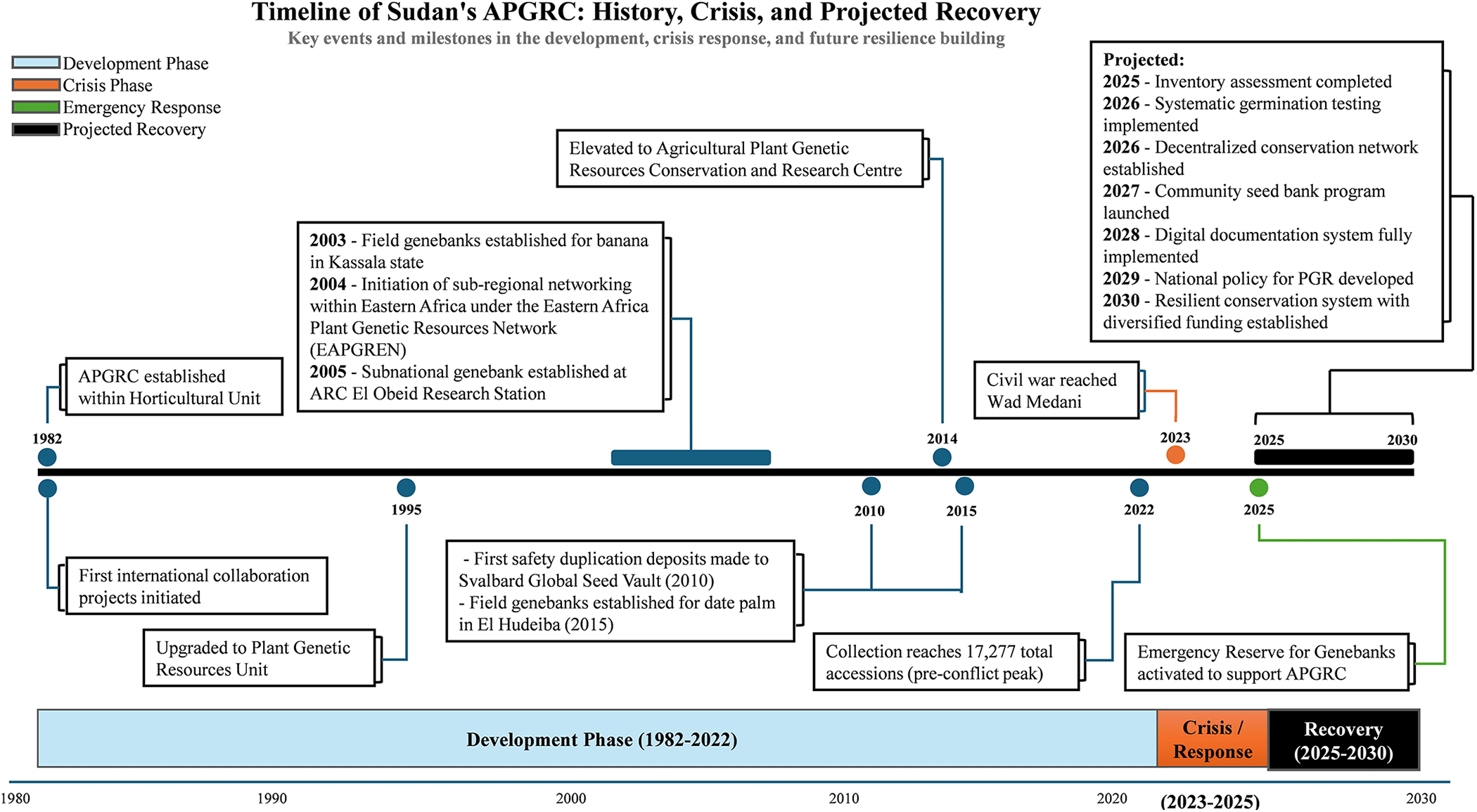
APGRC’s development reflects the growing recognition of plant genetic resource conservation as a national priority in Sudan. The center has evolved through several key institutional phases (Fig. 1).
Key events and milestones in the development, crisis response, and future resilience building of Sudan’s Agricultural Plant Genetic Resources Conservation and Research Center.

Figure 1 Long description
A horizontal timeline infographic titled “Timeline of Sudan’s APGRC: History, Crisis and Projected Recovery” with the subtitle “Key events and milestones in the development, crisis response and future resilience building.” A legend lists: Development Phase, Crisis Phase, Emergency Response, Projected Recovery. The timeline runs from 1982 to 2030 with dated markers and callout boxes. 1982: “APGRC established within Horticultural Unit”. 1985: “First international collaboration project initiated”. 1996: “Upgrade to Plant Genetic Resources Unit”. 2003: A callout box lists: “2003 - Field genebank established for banana in Kassala state 2004 - Initiation of sub-regional networking with Eastern Africa under the Eastern Africa Plant Genetic Resources Network 2005 - Substantial genebank established at ARC’s Oilseed Research Station”. 2008: “Elevated to Agricultural Plant Genetic Resources Conservation and Research Center”. 2015: A callout box lists: “First safety duplication deposits made to Svalbard Global Seed Vault (2010) Field genebanks established for date palm in El Hudieb (2015)”. 2020: “Collection reaches 17,277 total accessions (pre-conflict peak)”. 2023: “Civil war reached Wad Medani”. 2023: “Emergency Reserve for Genebanks activated to support APGRC”. Projected section callout box lists: “Projected: 2025 - Inventory assessment completed 2026 - Systematic germination testing implemented 2026 - Decentralized conservation network established 2027 - Community seed bank program launched 2028 - Digital documentation system fully implemented 2029 - National policy for PGR endorsed 2030 - Resilient conservation system with improved funding established”. A phase bar along the bottom is labeled “Development Phase (1982-2022)”, “Crisis / Response (2023-2025)” and “Recovery (2025-2030)”.
The Plant Genetic Resources Program in Sudan began in 1982 as an activity within the Horticultural Research Section of the Agricultural Research Corporation (ARC). It was initially established as a Horticultural Germplasm Unit and focused on the collection, conservation, and characterization of the local genetic resources of horticultural crops. In 1995, the program was upgraded to a semi-autonomous plant genetic resource unit, and in 2014, it was elevated to the Agricultural Plant Genetic Resources Conservation and Research Center (APGRC 2018; Mohamed Reference Mohamed2025; Crop Trust 2025a).
APGRC operates under the parent organization of the Agricultural Research Corporation (ARC) and is headquartered in Wad Medani, Sudan. The center manages a network of conservation facilities, including the central genebank at Wad Medani, a subnational genebank at the ARC El Obeid Agricultural Research Station in North Kordofan state, a field genebank for banana in Kassala state (eastern Sudan), and a field genebank for date palm in El Hudeiba in the River Nile state (Northern Sudan) (CBD (Sudan fifth national report to the convention on biological diversity) 2014; APGRC 2018; Crop Trust 2025a).
Germplasm collection: Scope and significance
As of November 2022, APGRC’s collection had reached 17,277 accessions including 16,739 seed accessions of 69 crops in long-term storage, 359 accessions of banana in field genebanks, and 179 accessions of date palm in field genebanks (Crop Trust 2025a). This collection is significant because several important crops likely originated in Sudan, including sorghum, pearl millet, okra, melons, watermelon, sesame, and dry dates (CBD (Sudan fifth national report to the convention on biological diversity) 2014). It is particularly rich in sorghum (6,985 accessions) and pearl millet (3,124 accessions), which together constitute approximately 58% of the conserved seed materials. Other significant holdings include okra, melon, watermelon, sesame, and groundnut, each with over 500 accessions (Crop Trust 2025a). Nearly 90% of seed samples are local landraces or farmers’ varieties, and much of the collection is unique and not found in genebanks elsewhere in the world, making the APGRC collection an irreplaceable resource for global agricultural biodiversity (APGRC 2018; Crop Trust 2025a).
According to an assessment report for the APGRC by the Crop Trust (2023), about 70% (11,851) of the accessions conserved are of crops included in Annex I of the International Treaty on Plant Genetic Resources for Food and Agriculture (ITPGRFA) within the multilateral system for access and benefit sharing (Crop Trust 2023). The germplasm collection activities of the APGRC from 2002 to 2022 have significantly contributed to this situation, where crops and plant species covered by the multilateral system of the ITPGRC have become dominant in the germplasm materials held by the APGRC, as recently reported by El Tahir et al. (Reference El Tahir, Babiker, Abdalla, Elhuda Ahmed, Yousif Goda and Mohamed Elgabri2025). The two main cereal crops in Sudan, sorghum and pearl millet, account for 83% of the Annex I crops. The non-Annex I crops are mainly vegetables and oil crops, and five of these crops have more than 500 conserved accessions. Overall, 57% of the non-Annex I accessions were okra, pumpkin, snakemelon, sweet melon, watermelon, sesame, and groundnuts. In general, the composition of the collections would be described as 75% accessions from seven crops, six of which originated in Sudan. The remaining 25% of the collections consisted of accessions from 62 crops of importance to Sudan’s agricultural systems; however, many of these have only a small representation of diversity.
Conservation methods
APGRC implemented international standard conservation protocols. Seeds are dried to a moisture content of 3–7% in a controlled drying room maintained at 15°C and 15% relative humidity before being vacuum-sealed in laminated aluminum foil packets, and placed in freezers. The freezers are housed in rooms with ambient temperature control to reduce thermal stress on the cooling units. Seed samples tested for viability prior to storage and subsequently re-tested at 5–10 year intervals (depend on the crop and the results of last test) to monitor their long-term health, with the collection partially duplicated in long-term storage at El Obeid subnational genebank. Approximately 7000 accessions, primarily landraces of sorghum, millet, and groundnut from western Sudan viz Kordofan and Darfur regions, were stored at the El Obeid. In addition, over 4000 accessions, including unique varieties of sorghum, pearl millet, and cowpea, were safety duplicated internationally at institutions such as the United States Department of Agriculture (USDA), the International Crops Research Institute for the Semi-Arid Tropics (ICRISAT), the International Institute of Tropical Agriculture (IITA), the French National Research Institute for Agriculture, Food and Environment (INRAE), and the Millennium Seed Bank (APGRC 2018; Crop Trust 2025a). A complete four-way inventory to determine the exact overlap between the main collection, the El Obeid site, and international genebanks is a critical priority for the recovery phase.
Information management
Information on germplasm collection activities has been documented within the APGRC GenBank documentation system as well as in the global PGR data platform Genesys (El Tahir et al. Reference El Tahir, Babiker, Abdalla, Elhuda Ahmed, Yousif Goda and Mohamed Elgabri2025). Passport data on more than 15,000 accessions have been shared on Genesys, the global portal (http://www.genesys-pgr.org/wiews/SDN002), making them visible to the international research community. However, the availability for distribution has been suspended since the onset of the conflict.
International collaboration
The center has established important international partnerships, and APGRC has collaborated throughout its history with a number of international organizations such as Bioversity International (formerly known as IPGRI), the Crop Trust, FAO, and ICARDA (Svalbard Global Seed Vault 2025; Crop Trust 2025a; Genesys, Reference Genesysn.d.). It was a founding member of the Eastern Africa Plant Genetic Resources Network (EAPGREN), which got significant financial support from the Swedish International Development Cooperation Agency (Sida) during 2003–2010 (El Tahir et al. Reference El Tahir, Babiker, Abdalla, Elhuda Ahmed, Yousif Goda and Mohamed Elgabri2025). These international partnerships focused on capacity building, germplasm exchange, and joint research. For example, collaboration with the Crop Trust and the Food and Agriculture Organization (FAO) facilitated the installation of improved storage infrastructure and staff training in modern conservation techniques. Participation in the Eastern Africa Plant Genetic Resources Network (EAPGREN) enabled Sudanese researchers to engage in regional conservation strategies and benefit from shared expertise.
Impact of the 2023–2025 conflict
Chronology of events
Fighting erupted in the capital of Khartoum on April 15, 2023, between the Sudan Armed Forces (SAF) and what has been officially known as the Rapid Support Forces (RSF) in the background of what seemed to be political differences. Both factions have been sharing top ruling political power in the country for a number of years prior to that date. Since then, the SAF declared an RSF rebel militia.
Eight months later, the fighting spread to the south of Khartoum on December 15, 2023, when the RSF started attacking the Gezira state, and moved to capture on December 18, the capital of the state, Wad Medani city, where the headquarters and main compound of the ARC are located, including the headquarters of the APGRC. This situation forced the APGRC staff to flee to safer regions of the country (Mohamed Reference Mohamed2025).
A few days later, news spread that the genebank at the APGRC was looted of all the deep freezers, where seed packets of approximately 17,000 accessions were kept. The seed samples and the boxes they contained were left scattered all around the floors of the seed bank rooms or on the ground outside the rooms, until they were assembled and put back inside the rooms with the efforts of some people who were still there. Moreover, all servers and computers through which the GenBank documentation system was run were looted, impairing access to the GenBank database, including passport, characterization, and management data on thousands of germplasm entries (Eltahir Ibrahim Mohamed Reference Mohamed2025).
Current status
When Wad Medani was liberated by the SAF in January 2025, the top management of the ARC and APGRC returned to find that a number of aluminum pouches of seeds were still around either within the buildings of the APGRC or moved out to other buildings within the ARC compound. Some were ripped open, and the contents were scattered. The pre-conflict holding of 16,739 seed accessions is now considered a baseline. An immediate priority of the recovery effort is to conduct a full inventory of the remaining materials to quantify the exact number of accessions that have been physically lost or rendered nonviable due to exposure.
Attempts to rescue the remaining germplasm materials began onsite at the APGRC headquarters shortly after the liberation of Wad Medani City in January 2025 Seed packets have been visually assessed, separating the damaged from the intact packets (Fig. 1) and, with the generator now repaired, cooler temperature conditions can be maintained inside the genebank storage rooms. Efforts are ongoing to assess the viability and moisture status of the damaged seed samples (outlined in section 5.1) (Mohamed Reference Mohamed2025; Crop Trust 2025c).
Emergency responses
Several international organizations have expressed concerns about what happened to the Sudanese Genebank. In fact, the concern was already shown since the war erupted in Khartoum and prior to its expansion to Wad Medani eight months later. The Genebank Emergency Reserve (GER), managed by the Crop Trust and FAO International Treaty on Plant Genetic Resources, mobilized resources earlier to support the Genebank facility at Wad Medani to install a solar energy system to ensure a constant supply of electricity, when power cut-offs started to prevail for long hours a day since the beginning of the war, with scarcity of fuel supply for the stand-by generator (Crop Trust, 2023). This was not achieved due to the subsequent spread of war into Wad Medani, where the Genebank facilities were looted soon thereafter.
Instead, a solar energy system was later installed using funds from the GER in the sub-national Genebank at Elobeid City in North Kordofan state, where duplicate samples of more than 7000 accessions were deposited, ensuring electricity supply to this Genebank facility as a measure against the probable complete loss of collection in Wad Medani.
Seed samples of more than 2000 accessions were rescued from the Elobeid Sub-National Genebank with support from the Crop Trust to transfer them to the Svalbard Global Seed Vault, passing through the Nordic Genetic Resources Center (Nordgen) in Sweden (Crop Trust 2025b, 2025c). At the Nordic Genetic Resource Center (NordGen), staff sorted, catalogued, re-packed, and documented rescued seeds. In February 2025, more than 1,800 rescued seed samples were deposited in the Svalbard Global Seed Vault (Svalbard Global Seed Vault 2025). Furthermore, ICARDA provided aluminum foil packets to the APGRC to package new seed samples from those still in Elobeid to be sent during the subsequent openings of the vault in the coming months (Crop Trust 2025c).
A framework for recovery and resilience
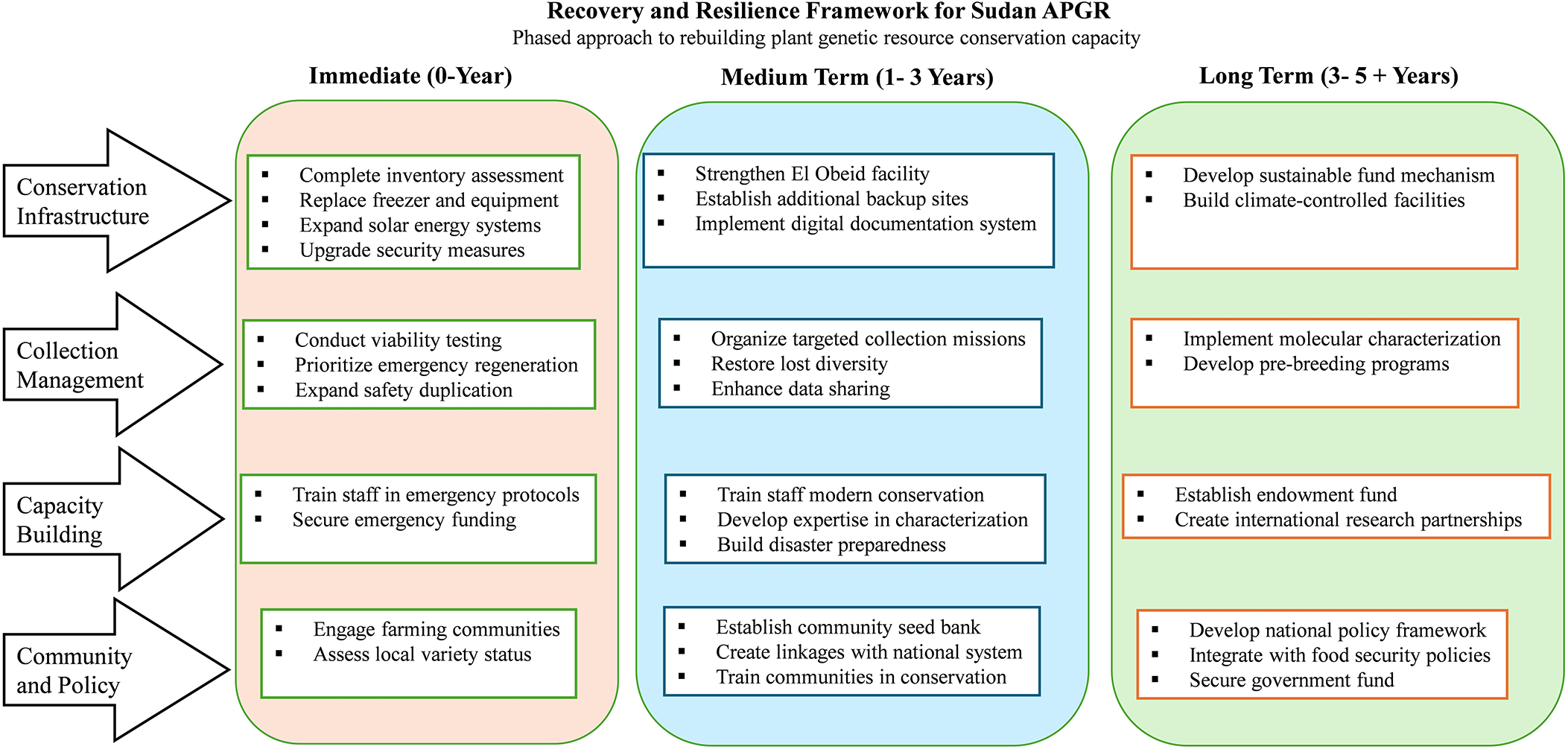
Based on lessons learned from other conflict-affected genebanks and the specific circumstances of the APGRC, we propose a comprehensive phased recovery framework. This framework addresses immediate needs while building long-term resilience to prevent future loss (Fig. 2).
Phased approach to rebuilding plant genetic resource conservation capacity in Sudan, organized by timeframe and functional category. Based on (Richards et al. Reference Richards, Ruivenkamp, Longley, Mcguire, Drift, Malcolm and Longley1997; FAO 2019; Ebert and Engels Reference Ebert and Engels2020; Crop Trust 2023).

Figure 2 Long description
A phased roadmap infographic titled “Recovery and Resilience Framework for Sudan APGR.” The content is arranged as three timeframe sections: “Immediate (0-Year),” “Medium Term (1-3 Years),” and “Long Term (3-5+ Years).” Each timeframe section contains four category blocks: “Conservation Infrastructure,” “Collection Management,” “Capacity Building,” and “Community and Policy.” Immediate (0-Year) • Conservation Infrastructure o Complete inventory assessment o Replace broken and equipment o Expand solar energy systems o Upgrade security measures • Collection Management o Conduct viability testing o Prioritize emergency regeneration o Expand safety duplication • Capacity Building o Train staff in emergency protocols o Secure emergency funding • Community and Policy o Engage farming communities o Assess local variety status Medium Term (1-3 Years) • Conservation Infrastructure o Strengthen El Obeid facility o Establish additional backup sites o Implement digital documentation system • Collection Management o Organize targeted collection missions o Restore lost diversity o Enhance data sharing • Capacity Building o Train staff modern conservation o Develop expertise in characterization o Build disaster preparedness • Community and Policy o Establish community seed bank o Create linkages with national system o Train communities in conservation Long Term (3-5+ Years) • Conservation Infrastructure o Develop sustainable fund mechanism o Build climate-controlled facilities • Collection Management o Implement molecular characterization o Develop pre-breeding programs • Capacity Building o Establish endowment fund o Create international research partnerships • Community and Policy o Develop national policy framework o Integrate with food security policies o Secure government fund.
Phase 1: Immediate actions (0–6 months)
The immediate phase focused on damage assessment, securing the remaining materials, and emergency rescue operations. Immediate recovery actions will be implemented over the next 6 months. The first priority is to conduct a rapid inventory of all remaining germplasms. This inventory categorizes materials into three groups: intact and viable, damaged but potentially recoverable, and completely lost.
Viability testing will be prioritized based on the uniqueness and irreplaceability of the accessions, starting with endemic sorghum and millet landraces for which no safety duplicates exist. For accessions with a limited number of seeds, a single-seed descent approach will be used for regeneration to minimize genetic drift.
Emergency infrastructure repairs will focus on restoring basic storage conditions. The installation of backup power systems, including solar panels and battery storage, will ensure the continuous operation of freezers and air-conditioning systems. Replacement of looted equipment, including computers, servers, and laboratory instruments, is essential for resuming basic operations.
Data recovery efforts will attempt to reconstruct the database from backup sources, including information shared with genesys and partner institutions. Staff will be recalled and provided emergency support to resume basic operations.
Phase 2: Medium-term stabilization (6–24 months)
The medium-term phase covers infrastructure rebuilding, staff capacity development, and the regeneration of key collection subsets. Infrastructure rebuilding includes construction of improved storage facilities with enhanced security features and redundant power systems. The design incorporates lessons learned from other conflict-affected regions, including underground storage areas and distributed storage across multiple sites.
Capacity building will focus on training staff in modern conservation techniques, database management, and emergency preparedness. Partnerships with international institutions will provide opportunities for staff exchange and advanced training programs.
Collection regeneration will begin with the most critical accessions, particularly those unique to Sudan and those with immediate agricultural importance. Field multiplication will be conducted at secure locations using strict protocols to maintain genetic integrity.
Database reconstruction will involve the systematic re-entry of passport data, characterization information, and management records. Digital backup systems will be established using off-site storage to prevent future data loss.
Phase 3: Long-term resilience (2–5 years)
The long-term phase outlines strategies for developing a comprehensive national PGRFA policy, strengthening regional and international collaborations, and implementing advanced conservation technologies.
A key long-term goal will be to develop a comprehensive national policy for the conservation and sustainable use of PGRFA. This policy will establish a national strategy that integrates both in situ and ex situ conservation approaches, clarifies institutional mandates, and creates a framework for benefit-sharing.
This includes documenting the traditional knowledge associated with specific landraces. For example, documenting the cultivation practices and culinary uses of the unique “Feterita” sorghum varieties grown by smallholder farmers in the Kordofan region will be a priority. This knowledge is essential to understand the cultural value and agronomic potential of these genetic resources.
Regional collaboration will be strengthened through renewed participation in networks such as EAPGREN and the establishment of new partnerships with neighboring countries for mutual backup of collections. International partnerships will be expanded to include more institutions that are willing to provide safety duplication services.
Advanced conservation technologies will be implemented, including cryopreservation of recalcitrant seeds and tissue culture for vegetatively propagated crops. Modern characterization techniques, including molecular markers, can be used to better understand and manage collections.
Risk management strategies will be developed to address various threats, including natural disasters, political instability, and climate change. These strategies will include early warning systems, emergency response protocols, and insurance mechanisms. The successful implementation of this recovery framework will require sustained financial commitment from international donors and government.
Lessons for the global community
The Sudan experience offers valuable insights into the global genebank community, particularly for institutions that operate in politically unstable regions. Analysis of recovery strategies from other conflict-affected genebanks reveals both successful approaches and critical gaps that inform our recommendations.
Successful recovery strategies
Safety duplication is the most critical factor for a successful recovery. The ICARDA genebank’s pre-conflict deposits at the Svalbard Global Seed Vault enabled a complete recovery after the Syrian conflict (Westengen et al. Reference Westengen, Lusty, Yazbek, Amri and Asdal2020). Similarly, Sudan’s partial safety duplication at international institutions is crucial for maintaining access to key genetic resources.
Emergency evacuation protocols have proven effective when implemented early. ICARDA’s timely evacuation of the remaining samples to Lebanon and Morocco prevented total losses (ICARDA 2015). The recent evacuation of Ukrainian genebank materials with support from the FAO and the European Union demonstrates the continued relevance of this strategy (FAO 2023).
The relocation of genebank activities to safer locations, either within the country or internationally, provides a continuity of operations. ICARDA’s establishment of new facilities in Lebanon and Morocco allowed for continued research and conservation activities during the Syrian conflict (Bhattacharya Reference Bhattacharya2016).
International coordination through organizations like the Crop Trust, FAO, and CGIAR centers has been essential for mobilizing resources and expertise. The rapid response to the Sudan crisis, including the Genebank Emergency Reserve funding and Nordic Genetic Resources Center support, exemplifies effective international cooperation (Crop Trust 2023, 2025b).
Critical gaps and challenges
Despite successful intervention, several challenges persist. Incomplete safety duplication remains a major vulnerability. Many genebanks, including the APGRC, have only partially duplicated their collections, leaving unique materials at risk (Fu Reference Fu2017).
Limited early warning systems mean that many crises develop faster than response mechanisms can be activated. The rapid spread of conflict from Khartoum to Wad Medani has caught the international community unprepared.
Insufficient local capacity for emergency responses often delays critical interventions. The lack of trained personnel and equipment in conflict zones hampers the immediate rescue efforts.
Inadequate funding mechanisms for long-term recovery mean that while emergency responses are often well funded, sustained support for rebuilding and capacity development is more difficult to secure.
Recommendations for genebank resilience
Based on Sudan’s experience and lessons from other conflict-affected regions, we recommend several proactive measures that can be implemented to improve resilience in vulnerable regions.
Comprehensive Safety Duplication: All genebanks should prioritize complete safety duplication of their collections, with particular emphasis on unique materials. This should include both international backup (preferably at the Svalbard Global Seed Vault) and regional backup arrangements with neighboring countries.
Decentralized Storage Networks: Rather than concentrating all materials in a single location, genebanks should establish distributed storage networks across multiple sites. This reduces the risk of total losses from localized disasters or conflicts.
Digital Data Backup: Complete digitization of all collected data, with secure off-site backup systems, is essential. Cloud-based storage with multiple geographical locations provides additional security.
Emergency Preparedness Plans: All genebanks should develop and regularly update emergency response plans, including evacuation procedures, staff safety protocols, and communication strategies with international partners.
Regional Cooperation Networks: Strengthening regional networks for mutual support and backup arrangements provides additional security. The success of the EAPGREN in East Africa demonstrates the value of such cooperation (El Tahir et al. Reference El Tahir, Babiker, Abdalla, Elhuda Ahmed, Yousif Goda and Mohamed Elgabri2025).
Staff Training and Capacity Building: Regular training in emergency procedures, modern conservation techniques, and international best practices ensures that staff can respond effectively to crises.
International Partnership Development: Building strong relationships with international organizations and partner institutions before crises occur facilitates rapid responses when emergencies arise.
The role of international organizations
The Sudan crisis highlights both the strengths and limitations of current international support mechanisms. The Crop Trust, FAO, and CGIAR centers have played crucial roles in emergency response and recovery support (Crop Trust 2023, 2025b, 2025c). However, there is scope for improvement in several areas.
Enhanced Early Warning Systems: International organizations should develop better mechanisms for monitoring political and environmental risks to genebanks worldwide. This could include regular risk assessment and contingency planning for vulnerable institutions.
Rapid Response Mechanisms: While the Genebank Emergency Reserve has proven valuable, the faster deployment of resources and expertise could prevent greater losses. Streamlined procedures and pre-positioned resources would improve response times.
Long-term Commitment: International support often focuses on emergency response but may not provide adequate long-term support for rebuilding and capacity development. Sustained funding mechanisms are required to ensure complete recovery.
Capacity Building Programs: International organizations should expand their capacity-building programs to include emergency preparedness and crisis management training for genebank staff in vulnerable regions.
Technology Transfer: Advanced conservation technologies and equipment should be made more accessible to genebanks in developing countries, particularly those in conflict-prone regions.
What can a genebank do to improve resilience? The answer lies in proactive preparation, rather than a reactive response. Genebanks should immediately assess their vulnerability, prioritize the duplication of unique materials, establish emergency protocols, and build strong international partnerships. The cost of preparation is always lower than the cost of recovery, and the value of preserved genetic resources extends far beyond any individual institution or country.
Conclusion
The crisis facing Sudan’s Agricultural Plant Genetic Resources Conservation and Research Centre represents both a tragedy and opportunity. The loss of irreplaceable genetic material is a disaster to global agricultural biodiversity, not only to Sudan. However, the international response to this crisis demonstrates the growing recognition of plant genetic resources as global commons requiring collective stewardship.
The recovery framework presented here provides a roadmap for rebuilding APGRC, which is stronger and more resilient than before. This three-phase approach addresses immediate needs while building long-term capacity and resilience. Success requires sustained commitment from the international community, adequate funding, and strong leadership from Sudanese institutions.
The lessons learned from Sudan’s experience, combined with insights from other conflict-affected genebanks, offer valuable guidance to the global community. The vulnerability of ex situ conservation facilities in politically unstable regions is a reality that must be addressed through proactive measures rather than reactive responses (Hanson et al. Reference Hanson, Brooks, Da Fonseca, Hoffmann, Lamoreux, MacHlis, Mittermeier, Mittermeier and Pilgrim2009; Fu Reference Fu2017).
The unique crop diversity of Sudan, particularly its drought-tolerant sorghum and millet varieties, represents an invaluable resource for global food security and climate adaptation (Ebert and Engels Reference Ebert and Engels2020). The international community’s investment in preserving these resources is not just an act of solidarity with Sudan, but a strategic investment in humanity’s agricultural future.
Moving forward, the global genebank community must embrace a new paradigm for resilience-based conservation. This includes comprehensive safety duplication, decentralized storage networks, robust emergency preparedness, and strengthened international cooperation. The cost of such measures is minimal compared with the irreplaceable value of the genetic resources they protect.
The APGRC crisis served as a wake-up call for the entire conservation community. We must now act to protect other vulnerable collections before they face similar threats. The framework and recommendations presented herein provide a starting point for building a more resilient global conservation system.
International, financial, technical, and political support is essential for realizing this vision. The global community has a shared interest in preserving the unique crop diversity in Sudan and other vulnerable regions. The response to the APGRC crisis thus far demonstrates the recognition of this shared interest; however, sustained commitment is needed to ensure long-term conservation of the world’s irreplaceable plant genetic heritage.
The path forward is clear: We must learn from this crisis, support Sudan’s recovery, and build a more resilient global conservation system that can withstand future challenges. The genetic resources that we preserve today will determine the agricultural options available to future generations. We cannot afford to fail this critical mission.
Supplementary material
The supplementary material for this article can be found at https://doi.org/10.1017/S147926212510035X.
Acknowledgements
We acknowledge the dedication and courage of the staff of Sudan’s Agricultural Plant Genetic Resources Conservation and Research Centre, who worked under extremely challenging conditions to preserve the country’s plant genetic heritage. We also recognize the critical support provided by Crop Trust, FAO, NordGen, ICARDA, and Svalbard Global Seed Vault in emergency response efforts.
Authors’ contributions
M.I.Y.A. and E.I.M. conceptualized and designed the study. M.I.Y.A. gathered materials, collected and analysed data, and drafted the initial manuscript. A.Z.B. and E.I.M. provided detailed information on the current status of the genebank and contributed to data interpretation. All authors critically reviewed the manuscript, revised the manuscript, and approved the final version for submission.
Funding statement
This work was undertaken voluntarily by the authors as part of their commitment to the recovery and long-term conservation of Sudan’s plant genetic resources. No external funding was received for this study.
Competing interests
The authors declare no known financial or non-financial conflicts of interest that could have influenced the work reported in this paper.


 Open access

