


The international political landscape in which Britain and other nations operate has been transformed dramatically since the Cold War.Footnote 1 No longer are interests at home and abroad under threat from particular states, but rather from a complex web of security threats said to include international terrorism, weapons of mass destruction, conflict and failed states, pandemics and transnational crime. After 9/11, governments in Britain and America in particular pledged not only to develop a resilient security architecture designed to identify and mitigate against the effects of these threats but, as key objectives, to reassure their publics, heighten collective levels of security among the population and reduce subjective feelings of being ‘threatened’. Importantly, they also sought to achieve these objectives in part by what Jarvis and Lister characterize as ‘conscripting “ordinary” citizens into the state's security apparatuses’,Footnote 2 although there are obvious ambiguities in the effects of these new demands on citizens and the extent to which publics are reassured or made to feel more anxious as a result, as Jarvis and Lister, among others, acknowledge.Footnote 3
The stakes in contemporary threat perceptions are high for governments and citizens alike. While liberal democracies attempt to balance civil liberties and security, a threatened public skews the trade-off toward the latter, tending to favour repression, intolerance, aggressive and exclusionist attitudes toward minorities and targets with different political ideologies, and to show a greater willingness to support war against external sources of threat.Footnote 4 A threatened public may also be more receptive to the enhancement of elite power to enact otherwise unpopular or illiberal policies.Footnote 5 Indeed, the combination of threats and the belief that elites sanction punitive actions that combat threats is particularly dangerous to democracy. Instead of adapting levels of protection to the perceived existence of threats, it may lead to the modulation of threat perceptions in order to justify enhanced levels of protection, such that protection itself may become a threat.Footnote 6 At the extremes, this can result in what Fromm referred to as an escape from freedom,Footnote 7 or what Heymann more recently described as the undermining of nations’ democratic traditionsFootnote 8 – and to the temptation to support charismatic leaders such as Juan Peron and Adolf Hitler.Footnote 9
The events and aftermath of 9/11 have presented what some analysts consider to be a new world order in terms of threat perceptions: it has ‘resulted in chronic changes to schematic representations of the social world as a dangerous and threatening place for many people’,Footnote 10 giving a ‘new urgency to understanding the degree, origins, nature and consequences’ of threats.Footnote 11 The securitization of migration and its increasing association with transnational crime and international terrorism – particularly, though not exclusively, in Europe and North AmericaFootnote 12 – is just one example of ‘“new politics” and “new security” issues’ since 9/11.Footnote 13
At a time when attempts have been made to ‘conscript’ ordinary members of the public into the state's security apparatuses, and national security strategies make a virtue of involving citizens in the risk management cycle, it is more important than ever to understand public perceptions of security threats and their role in contemporary political life. Yet our knowledge of public perceptions of security threats tends to be confined to discrete policy areas such as terrorism or relates to specific areas of personality, predispositions or attitudes such as authoritarianism and tolerance.Footnote 14 The persistence of an elite focus in security studies means that we still know relatively little about the range of issues that individuals regard as security threats, as well as their causes and the levels at which such threats are perceived, for example, as global or national threats.
This article alone cannot address all the issues associated with public perceptions of threat; we do not examine elites’ behaviour, for example. Nor do we argue that contemporary perceptions of threat have reached the extremes described by authors like Fromm. Yet the article does begin to address the urgent questions of what individuals feel threatened by, why this might be the case and what the effects of threat perceptions are for society at large. With this enhanced understanding and deepened analysis of threat perceptions, we can obtain a stronger sense of the relationships between threats and individual and contextual variables, and between threats and political attitudes and behaviour. Such understanding highlights the limitations of the national frame when thinking about public perceptions of security threats. It offers a more nuanced picture of how a citizen's sense of (in)security is linked to the levels at which they perceive certain issues as threatening. In this way, the article contributes to academic knowledge and challenges policy makers to embrace a more variegated approach to the question of ‘national’ security and citizens’ roles within it.
Threat Perceptions and Their Consequences
There has been a great deal of research on different aspects of threat perceptions. This section starts by examining four elements in order to justify and situate our research: the origins of threat perceptions, the focus on specific threats such as terrorism, the distinction between personal and sociotropic threats, and the effects of threat perceptions. We end by presenting our own theory and discussion of the origins and consequences of threats from our analysis of these four elements.
Perceptions of Security Threats and their Origins
For international relations/security studies scholars, policy and academic discourses about threat have broadened and deepened since the end of the Cold War.Footnote 15 Instead of relating exclusively to the survival of the state under anarchical conditions,Footnote 16 understandings of the concept of security threat have broadened beyond the military context to include other sectors such as environmental (threats to earth as biosphere), societal (threats to notions of community), economic (threats to citizens’ welfare) and political (threats to particular national identities).Footnote 17 Such understandings have also deepened to include not only the state as threatened, but also the individual (human security)Footnote 18 and even the planet (eco-security).Footnote 19 Moreover, in the critical constructivist account, security threats are not treated as an objective set of conditions that exists independently of our knowledge, representations and perceptions of them, but rather as a highly politicized category of interpretation.Footnote 20 As typified by the work of the Copenhagen School, perceived threats to security are brought into being performatively via acts of securitization in which a particular issue is framed in terms of an existential threat in, for example, political speeches and media representations, and is accepted as such by legitimizing audiences.Footnote 21
Political psychologists were also heavily influenced by the Cold War and its precursors when thinking about threat. For example, they sought to understand mass and elite behaviour in dictatorships, before turning to explanations of political attitudes such as ethnocentrism and intolerance.Footnote 22 A common theme that continues in contemporary research in these areas is the centrality of threat perceptions. Thus Marcus et al. and Gibson and Gouws argue that normative threat from disliked groups renders individuals both less tolerant and more responsive to information about threats.Footnote 23 Altemeyer, Stenner, and Hetherington and Weiler,Footnote 24 while disagreeing about the relationship between threat and authoritarianism, also all have perceptions of threat at the core of their theories; for example, authoritarians ‘stand about ten steps closer to the panic button than the rest of the population’.Footnote 25 Other research examines threat in particular contexts, such as the threats from immigration,Footnote 26 environmental degradation,Footnote 27 cybercrime,Footnote 28 religious threat,Footnote 29 racism, sexism and stereotype threat,Footnote 30 while much of the context and focus since 9/11 has been on threats associated with international terrorism.
There is, however, uncertainty about the causes of individual perceptions of threats. Some research suggests that the causes are highly unsystematic. Gibson and Gouws refer to ‘the failure of earlier research to account for any variability in threat perceptions’.Footnote 31 Marcus et al. find threat from groups to be ‘exogenous to measures of social background, personality, ideology, and support for the general norms of democracy’.Footnote 32 Similarly, Feldman, Feldman and Stenner, Hetherington and Suhay, and Stenner uncover weak correlations between their measures of threat and authoritarianism.Footnote 33 Yet as the quote from Gibson and Gouws suggests, other research has identified systematic causes of threats. Lavine et al. ‘view a chronic fear of a dangerous and threatening world to be a key component of the authoritarian personality’.Footnote 34 Sniderman, Hagendoorn and Prior find that perceptions of threats from immigration are linked to cultural identity,Footnote 35 while Huddy et al. show that demographic factors such as education, gender and race, and the predisposition of authoritarianism, are linked to perceptions of threat.Footnote 36 The heightened sense of threat induced by ‘mortality salience’ – both a greater awareness of one's own mortality and feelings of vulnerability – also increases ‘the positivity of evaluations of people and ideas that support one's cultural worldview and the negativity of evaluations of people and ideas that threaten it’.Footnote 37 Finally, Ridout, Grosse and Appleton indicate that media exposure heightens perceptions of ‘modern’ and ‘postmodern’ threats.Footnote 38
In sum, while there is disagreement, variables including dispositions such as authoritarianism, demographic characteristics such as education and age, and exposure to information via media appear to influence threat perceptions. But do they lead to perceptions of greater collective threat, personal threat or both? And if so, are those perceptions of a specific threat or a range of threats?
Perceptions of the Breadth of Threats vs. Specific Threats
The common emphasis in the research on perceptions of threats is on specific threats, such as terrorism or immigration and their intensity, rather than on perceptions of the breadth of threats. This raises two problems that relate to the focus on an ‘extreme stimulus’. First, just as Lupia and Menning argue that ‘researchers tend to ask about people and events that they suspect have caused emotional reactions’Footnote 39 and that the generalizability of results is therefore questionable, the same is true of perceptions of threats, hence the predominant focus in the extant literature on terrorist threats since 2001. Secondly, there is a parallel to the debate in the tolerance literature about measurement error and the conceptual limitations of focusing on a single ‘least-liked group’. The argument there is that it misses the extent to which individuals vary in the breadth of their intolerance. Some individuals may harbour an intense dislike for one group, and others for multiple groups; but concentrating on a single disliked group lumps them together. The parallel with threats is the tendency to examine the intensity of single ‘threats of the moment’ and thus to miss potentially important and consequential differences between individuals for whom the threat of the moment is one of many, and those for whom it is the only threat.Footnote 40 In the tolerance literature, those who have argued for a focus on breadth have claimed that concentrating on an extreme stimulus limits understanding and can lead to erroneous inferences such as of the effects of education.Footnote 41
Sociotropic vs. Personal Threat
A third issue is what we term here to be the level at which threats are perceived. Whether referring to a normative, economic or racial threat, research has largely conceived of threats as either sociotropic- or aggregate-level concerns or personal, individual-level concerns. Most of the research has also found sociotropic threat to be a stronger influence than personal threat, with regard to the economy, race and – more recently – terrorism.Footnote 42 For example, Huddy et al. argue that national threat has far more influence over perceptions of the economic consequences of terrorism, while personal threat is more likely to alter behaviour designed to mitigate threat, such as changing air travel habits to avoid the possibility of harm from a terrorist attack.Footnote 43 They conclude that, as in other policy areas, the influence of the personal on political judgements is limited.
These differences in the effects of sociotropic versus personal judgements on political attitudes and behaviour have attributions as their core explanation. Although sociotropic factors are frequently described as more remote and less vivid than personal concerns,Footnote 44 individuals are said to be more able to make connections between societal conditions and government than they are between their own circumstances and the actions of public officials. It may also be the case that individuals simply view sociotropic factors as more reliable indicators of the likely personal impact of government policies than personal factors,Footnote 45 and, relatedly, because sociotropic factors present the greater threat.Footnote 46 Sociotropic and personal situations may also bring different values and considerations to the fore: sociotropic threat may call to mind a value like freedom of expression, whereas personal threat renders the value of safety more salient.Footnote 47 Another argument is based on information: there is more media coverage of national than local circumstances, more contextualizing of national conditions, and media coverage tends to emphasize sociotropic rather than personal concerns.Footnote 48
However, other research suggests that the national-personal distinction is too limited in two respects. The first limitation is in effects. For example, some studies of economic effects claim that globalization has dampened the influence of national factors while making international economic indicators more salient to individuals;Footnote 49 that is, ‘the global’ is of growing importance relative to the national. Moreover, while the consensus is that personal considerations tend to carry less weight, there is plenty of evidence that both personal and sub-national considerations can matter. Chong, Citrin and Conley argue, for example, that personal considerations exert influence on reasoning when an individual's ‘stakes in the policy are clear’.Footnote 50 Moreover, Huddy et al. note that perspectives on the influence of personal threat could be limited by dependent variables that are frequently related to national consequences.Footnote 51 Jones et al. demonstrate the importance of local context, and Johnston et al. of local unemployment in particular, to voting behaviour in Britain.Footnote 52 Similarly, studies in the United States have shown sub-national influences on economic perceptions,Footnote 53 support for social welfare spending,Footnote 54 immigration,Footnote 55 opinion on the Vietnam WarFootnote 56 and voting behaviour.Footnote 57 Even research that shows a more pervasive influence of sociotropic than of personal considerations often finds that sub-national considerations matter too – but, according to Lau and Heldman, only ‘sporadically, here and there and under particular circumstances’.Footnote 58
The second limitation of the national-personal distinction is in measurement. First, the vast majority of research on sociotropic and personal threats presents them as a dichotomy in which the sociotropic perspective is a national one and personal threat pertains to the individual.Footnote 59 Yet there is no logical reason why sociotropic threat should be confined to the nation. Secondly, measurement of the national-personal dichotomy provides little theoretical or empirical guidance as to whether perceptions of national (let alone global) threats have the same kinds of determinants as personal threats, because the assumption that these are the salient levels of consideration leads to a focus on their effects rather than their causes.
Yet Chanley's research suggests that for an issue such as global warming, conceiving of it as a concern of the planet rather than as a threat that is confined to individual nations may connote a different political outlook and the salience of different value considerations.Footnote 60 Lee, Dallaire and Lemyre's research in Canada also provides a suggestive example in which one of their focus group participants says of terrorism: ‘We're in Canada. It could happen, there, but it worries me in a global sense, the repercussions, international politics with the USA and other countries and the lifestyle change that it brings to us in North America.’Footnote 61 This respondent thinks of terrorism in global terms, but another might see the world primarily in terms of national boundaries or the physical threat terrorism presents to them as an individual.Footnote 62 Indeed, Huddy et al.'s research suggests that authoritarianism may be one influence on whether terrorism is regarded as a global or national threat.Footnote 63 They find that authoritarianism is positively related to preferences for military action and limiting civil liberties in the wake of 9/11 but negatively related to the desire for the United States to be active in world affairs, and unrelated to the desire to see the United States take the leading role in solving international problems. This implies a view of the world that – far from simply being ten steps closer to the panic button – wants action to resolve national disorder and is unsympathetic to action designed to mitigate international disorder.Footnote 64 Kahan's research on cultural world views also points to systematic differences between individuals on the meaning of various issues and therefore on societal dangers.Footnote 65 Such differences may be reflected in tendencies to see threats at one level, for example global rather than personal.
Consequences of Threats
Previous research has explored disparate consequences of threats, including on political attitudes and behaviours,Footnote 66 and effects on other attitudes such as parenting,Footnote 67 the efficacy of government responses,Footnote 68 and the justification of illiberal policies and actions.Footnote 69 In keeping with past research, post-9/11 security threats related to international terrorism have been shown to render individuals more illiberal and less tolerant of difference: making individuals more willing to trade civil liberties for security measures; elevating antipathy toward the entry of immigrants; elevating antipathy toward Muslims as a cultural and religious minority; altering the social identities of majority and minority populations and making them more salient; and leading to a tendency to prefer leaders with particular traits such as strength and charisma.Footnote 70 In addition, a heightened sense of security threat is associated with mortality salience, aggression, and a greater tendency to stereotype outgroups and to dislike stereotype-inconsistent members of outgroups.Footnote 71
Theorizing about the Origins and Consequences of Threats
Previous research has therefore provided mixed perspectives on the origins and consequences of threat perceptions. While we have argued that it is limited by its focus on specific threats and by virtue of the dominant national-personal dichotomy in measurement, certain antecedents (such as mortality salience, authoritarianism and media habits) recur, along with consequences such as hostility toward minority outgroups. We turn now to a discussion of those antecedents and consequences from the broader perspective we have provided.
Mortality salience
Previous research tells us that individuals for whom thoughts of mortality are most accessible are prone to manifest feelings of threat and danger by defending their cultural world views against perceived challenges from outgroups, although this research is usually based on manipulation of mortality salience rather than directly assessing the influence on threat itself.Footnote 72 Our interest is precisely in the relationship between dispositional (that is, unmanipulated) mortality salience and breadth of threats. Given that mortality salience is influential under conditions of mortal physical danger or threats to cultural world view – and is not aroused by mere insecurity, uncertainty or anxiety-producing eventsFootnote 73 – we would expect that mortality salience enhances perceptions of the breadth of global and national threats but not perceptions of sub-national threats if they are more strongly related to issues such as economic insecurity and the anxiety produced by crime.
Authoritarianism
Claims such as Altemeyer's about authoritarian sensitivity to threat would lead us both to expect authoritarianism to affect perceptions of the breadth of threats and for that influence to be consistent across levels.Footnote 74 However, other research on authoritarianism argues either that it is not a cause of elevated threats but is activated for those higher in authoritarianism when the social order is threatened,Footnote 75 or that it is a cause of perceptions of threat, but only in relatively benign societal situations.Footnote 76 We are agnostic on the issue of authoritarian sensitivity to threat, but clearly the latter theories suggest that we may not find a relationship between authoritarianism and perceptions of the breadth of threats.
Media habits
News media may exacerbate perceptions of threatsFootnote 77 through such tendencies as focusing on conflict and catastrophe – on raised but not lowered threat levels, for exampleFootnote 78 – and a tendency to limit coverage of minorities to stories about crime.Footnote 79
Education
Education has been associated with perceptions of lower threat levels; highly educated individuals are thought to have a greater grasp of probabilistic information,Footnote 80 for example the likelihood of a terrorist attack being low, or that immigration, far from being costly to the economy, may be necessary for future economic prosperity given low indigenous birth rates.
Race, religion, age and sex
Sex (being a woman) and religiosity may also heighten threat perceptions, while age may have a negative effect on perceptions of threat.Footnote 81 Finally, British Muslims ‘suffered disproportionately greater levels of stress than respondents from other faiths’ following the 7/7 bombings in London.Footnote 82 Thus we might expect different perceptions of the breadth of global threats from British Muslims because of a different perspective on issues such as religious extremism. Adopting a similar logic about possible differences due to ethnicity, we might also expect an influence of white ethnicity.
Consequences
The range of effects of specific threats that previous research has examined is broad, as outlined above. It indicates that global- and national-level threats, rather than community- or personal-level threats, are particularly salient considerations. However, theorizing about when we should see sub-national influences, rather than simply describing them as sporadic, is important. If international and national government responsibility and global and national implications are the drivers, global- and national-level threats should exert more influence than community or personal threats, for example, on individuals’ willingness to pay increased taxes for enhanced security measures or on vote intention. Similar logic would suggest more evidence of the influence of community and personal threats on attitudes toward outgroups (such as perceptions of immigrants), which are not dependent on attributions of governmental responsibility, may not be seen to have national consequences, and where personal and community threats may be more vivid and emotionally arousing than global or national threats.Footnote 83 In addition, if individuals who are more threatened are more inclined to defend their cultural world views and identity, it is likely that ethnic and racial considerations are central components of that defence via the desire to reduce the relative power of outgroups.
RESEARCH DESIGN AND DATA
Thus our research provides new insights by focusing on: (1) the breadth of security threats that members of the public identify – how many, and whether seeing one type of threat is associated with seeing others; (2) the extent to which perceptions of the breadth of threats vary as individuals move from global to personal security threats; (3) the individual-level influences on perceptions of the breadth of threats; and (4) the relationships between perceptions of threats and other political attitudes and behaviours, such as attitudes toward minority groups and intention to vote in an election.
To gauge the breadth of public perceptions of security threats, we conducted a twenty-five-minute internet survey of 2,004 respondents in Britain from 6–15 June 2012. It included a booster sample of 251 Muslims, a unique group that is both threatened and often seen as threatening by other groups in British society.Footnote 84 Online Appendix Table A1 shows that, other than ethnicity (due to the booster sample), survey respondents were representative of the British population on dimensions of sex, age, region and the party for which they voted in the 2010 general election.Footnote 85
We asked about perceptions of a range of twenty-two potential threats as global, national, community and personal security threats. Some were drawn directly from the tier one, two and three threats identified in the UK government's 2010 National Security Strategy, including terrorism, ‘hostile attacks upon UK cyber space’ and ‘disruption to oil or gas supplies to the UK’, while others emerged as recurrent security threats identified by participants in focus groups we conducted prior to developing the survey, including the economy, immigration, the Far Right, burglary and online fraud.Footnote 86 The survey questions did not define ‘security threat’ for respondents, nor did the list of twenty-two threats privilege any particular type or level of threat; rather, the survey covered potential threats that were domestic and international, economic, political, technological, health related and group based. Indeed, while we would expect identification of some of these threats to be confined to the national or international level, such as the increasing power of Russia and China, others in the list are likely to be seen only as sub-national threats, including knife crime and burglary, while still others could span multiple levels, including the economic crisis, immigration, online fraud and religious extremismFootnote 87 (see the online appendix for details).
Our examination of threats runs from the broadest collective (the global) through national to community-level threats, which are still collective but at a much more intimate and personal level than the state or the globe. Thus we see community-level threats as closer to what is usually meant by personal rather than sociotropic threats.Footnote 88 We operationalize perceptions of threat as the number of issues that people see as global, national, community or personal threats. We did not ask about the intensity with which these threats were felt, or about their content (for example, whether threat from the Far Right stems from it being viewed as dangerous or powerful).Footnote 89 Threats to social cohesionFootnote 90 or from particular groups will be captured by our measure if they rise to the level of security threats. Our measurement of the key antecedents of threat perceptions was as follows:
Mortality salience
Mortality salience was measured using three agree-disagree questions about thoughts of death (details are in the online appendix).Footnote 91
Authoritarianism
We assess authoritarianism through the child-rearing values questions used in the American National Election Study that have become standard; they do not conflate authoritarianism with conservatism or prejudice.Footnote 92
Media habits
We gauge news media effects by examining the influence of the amount of time that respondents claimed to watch news and current affairs programmes on television as a proportion of their total time spent watching television.
Education
We operationalize education with a dummy variable for respondents with a higher education degree or above. We expect that where level of education has an impact, it will be on the identification of threats at the global or national level rather than at lower levels, where perceptions of threats are likely to be less dependent on probabilistic knowledge than on day-to-day experiences in the neighbourhood in which a person lives.Footnote 93
Consequences
We examine views of immigration and of what should be necessary for British citizenship; the extent to which respondents would be willing to pay more in taxation for provision of different kinds of security; and respondents’ certainty that they would vote in the next general election. Attitudes toward immigrants were measured in two ways. First, we asked about the importance of criteria for UK citizenship, ranging from education and work skills to race and religion. Exploratory factor analysis revealed two strong factors, one that we label skills – the need for work skills, education and the ability to speak English – and another that we call culture, which has parallels with Reijerse et al.'s notion of cultural citizenship, which includes being Christian and white (although it also includes being wealthy).Footnote 94 We combined these indicators into separate indexes of the importance of skills and culture for citizenship.
Second, we factor analysed answers to a series of agree-disagree statements about immigration and immigrants, again finding two strong factors: one focused on the effects of immigrants on the economy (and their possible impact on terrorism), and the other focused on culture and multiculturalism. We combined the statements with the highest loadings on these factors into indicators of concerns about the impact of immigration on the economy and terrorism, and about the impact of immigration on Britain's culture. To gauge certainty of voting at the next general election, we constructed a three-point scale based on whether a respondent expected to vote at the next election and whether they could name the party they would vote for (see the online appendix for details). Figure 1 provides an illustrated summary of the model.
The structural equation models Note: Figure 1 presents the basic approach to modelling without showing arrows for each individual relationship estimated. In the models, Education is specified as an influence on global and national threat only, and White on community and personal threat only.

ANALYSIS
Breadth of Threats
What do perceptions of the breadth of threats at different levels look like? Previous research provides us with little guidance. One possibility is that individuals compartmentalize, identifying a single security threat at different levels, such as terrorism as the principal global threat, the economy as the national threat, knife crime as the community threat and so on. This would lead us to expect limited variation in the breadth of threats at different levels – basically one threat at each level – but variation in what those threats are. A second possibility is that individuals identify more threats that are closer to home; that is, they are more sensitive to threats on their doorstep, which would lead to the expectation of perceptions of more threats at the personal than at the global or national levels.
Figure 2 demonstrates that neither of these possibilities turns out to be accurate. It shows the proportion of respondents identifying particular threats as the number of security threats identified increases from one to seven. The four graphs display the five main security threats identified at each level. The sub-headings for each graph indicate that the average number of perceived threats was greatest at the global level, with fewer issues identified as national-level security threats. The lowest number of perceived threats was personal threats, where perceptions were of roughly two on average.Footnote 95
Major threats at the global, national, community and individual levels

Figure 2 also demonstrates a pattern in perceptions of threats: the particular threats identified at each level tend not to change as the breadth of security threats increases; that is, it is not the case that a threat like terrorism is particularly important to respondents who identify two threats but not to respondents who identify seven threats. With global threats, for example, terrorism was the most frequently identified threat for respondents who identified one threat, at 30 per cent; racial or religious hate crime ranked fourth at 6 per cent. For respondents identifying seven global threats, terrorism was still the most frequently mentioned, and racial or religious hate crime was the fifth most frequently mentioned. Thus Figure 2 indicates agreement on what the most salient threats are at each level: the differences between respondents perceiving more or fewer threats are not in the issues that are most threatening, but in whether or not an issue crosses a threshold to become a tangible security threat.Footnote 96
Figure 2 also shows that there is variation in the kinds of security threats that are salient at different levels. At the global and national levels the concerns are terrorism, the economy and religious extremism, but whereas immigration and border control are key national security threats, issues like nuclear weapons are seen as more pressing global security threats. Perceptions of salient community- and personal-level security threats are different from global and national threats: the economy and immigration are also threats at the community and personal levels, but burglary, knife crime and online fraud loom much larger.
Huddy et al. characterize the effects of national and personal threats from terrorism as distinct but related.Footnote 97 This notion of threats at different levels as distinct but related appears to be true more broadly: the correlations in the breadth of threats at different levels are mostly in the 0.4–0.5 range (see online Appendix Table A2 for details), which demonstrates that while the specific threats may vary, individuals who see more threats at one level are also likely to see more threats at other levels – they are related. But they are distinct in that the breadth of threats perceived at one level is far less than entirely predictive of the breadth of threats perceived at another level, accounting for no more than one-quarter of the variance.Footnote 98
We now turn to a more detailed examination of the influences on perceptions of the breadth of threats at different levels before looking at the breadth of threats as predictors of: attitudes toward immigrants, policy areas for which respondents would be willing to pay more tax and voting behaviour.
Influences On the Breadth of Threats
Rather than separate models for each level of threat, we examine the four levels of threat simultaneously in a structural equation model.Footnote 99 The predictors for each threat are those depicted in Figure 1. Table 1 presents the estimates. The endogenous variables – perceptions of the breadth of threats – are a count of the number of perceived threats at each level. All of the independent variables, including age, are coded from zero to one, meaning that effect sizes are easily compared (see online appendix for details). We display the estimates in separate columns for each level of threat. We begin by discussing the influences that are common across levels of threat and then turn to those whose effects on perceptions are distinct across levels of threat.
Influences on Global, National, Community and Personal/ Family Threats

Note: Estimates are from a generalized structural equation model using Stata 13, and assume the endogenous variables – breadth of threats – have Poisson distributions. Statistical significance may not always appear accurate due to rounding. *p < 0.05, #p < 0.10 (two-tailed test).
The results in Table 1 confirm that there are common influences on perceptions of the breadth of threats that are associated with some individuals systematically perceiving more threats than others. Indeed, several of the variables have pervasive effects on perceptions of the breadth of threats. One is mortality salience. Somewhat contrary to our expectation that the influence of mortality salience would be confined to global and national-level threats, individuals whose mortality was more accessible perceived more threats at all levels.Footnote 100 This suggests that the predisposition to be more aware of one's mortality not only affects perceptions of physical danger but also elevates perceptions of threats that induce uncertainty or anxiety (contrary to some previous researchFootnote 101 ) perhaps because mortality salience leads to a conservative shiftFootnote 102 that elevates perceptions of threat in general, regardless of whether they are physical or uncertainty/anxiety inducing.Footnote 103
Figure 3 shows the maximum effects of mortality salience (and three other variables discussed below) when all other variables are set at their mean or mode. It indicates that, as expected, mortality salience has relatively large effects on perceptions of global and national threats, adding more than one additional threat at each level. But Figure 3 also illustrates the impact of mortality salience on perceptions of personal threats, where although the effect is to raise the number of perceived threats by less than half the amount it does for global threats, it should also be borne in mind that the average number of global threats is more than three times larger than that of personal threats.
Maximum effects of main influences on breadth of threats Note: Simulations are with all other variables set at their mean or mode (a white, non-Muslim woman, without higher education).

Table 1 shows that watching proportionally more television that covers politics and current affairs also has a consistent influence on harbouring more threats at all levels, echoing Ridout, Grosse and Appleton's finding,Footnote 104 and suggesting either that the world presented on television news heightens the threat perceptions of its most dedicated viewers or that threatened individuals monitor current affairs more closely. The effects of watching political and current affairs television are most consequential at the community and personal levels: the maximum effect of watching politics and current affairs programmes is to raise the breadth of personal threats by about 0.7, while the influence on global and national threats is marginally larger but less noteworthy, given the higher number of threats identified on average at these levels. Age also has a consistent impact on perceptions of the breadth of threats; older individuals feel more threatened, and the effect of age is larger than any of the other variables on breadth of personal threats.
The influence of variables like mortality salience and age does not fluctuate much in terms of their statistical significance on perceptions of the breadth of threats at different levels. Authoritarianism is different, however: while it has the expected positive relationship with perceptions of the breadth of national, community and personal threats – in this sense, authoritarians are chronically threatened – its influence does not extend to perceptions of global-level threats. Thus while authoritarians may be ‘relentlessly sociotropic boundary maintainers’,Footnote 105 their fears about non-conformity or the undermining of approved authority figures do not extend beyond an individual's national borders according to this analysis. Figure 3 shows that the impact of authoritarianism on perceptions of personal threats is also relatively modest.
In addition, we see systematic variation in the effects of the other variables at different levels. For example, sex affects perceptions of threats at all levels other than community (women perceive more threats), while religiosity primarily affects perceptions of local and personal threats. We cannot establish why religiosity influences perceptions of threats at these levels rather than at the global or national levels, but it is noteworthy that attending a place of worship more often is associated with perceptions of more community threats; perhaps places of worship are seen as refuge from the world that is on your doorstep rather than further afield. Education is associated with identifying more global threats but has no influence on perceptions of national threats, while white individuals identify fewer community and personal threats. Lastly, being a British Muslim does not result in perceptions of more threats at the community or personal levels, but Muslims see fewer global and national threats than others.Footnote 106
Effects of Breadth of Threats on Political Attitudes and Behaviour
Our approach is straightforward: in separate models in Table 2, we add additional paths to the structural equation models from threats at each level to variables that capture attitudes toward immigrants, services for which threatened individuals are willing to be taxed more and intention to vote in the next general election. We also add direct paths from each of the exogenous variables in Table 1 to the dependent variables. In other words, we allow variables such as mortality salience and authoritarianism to have a direct impact on measures like the attributes necessary for citizenship and an indirect impact via their effects on perceptions of threats – this is a conservative approach to gauging the effects of perceptions of threats. Table 2 indicates statistical significance from zero, and also whether the differences in the impact of perceptions of the breadth of threats at different levels are statistically significant. All dependent variables are coded from zero to one with the exception of the counts of the breadth of threats at each level (see online appendix for details). For simplicity, we limit our presentation and discussion to the influence of perceived threats.Footnote 107
The Effects of Threats on Political Attitudes and Behaviour
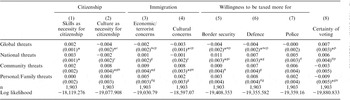
gdifferent from global threat at <0.10;ndifferent from national threat at <0.10;cdifferent from community threat at <0.10;pdifferent from personal/family threat at <0.10.
Note: Estimates are from a generalized structural equation model using Stata 13, and assume the count variables – breadth of threats – have Poisson distributions. Statistical significance may not always appear accurate due to rounding. *p < 0.05,#p < 0.10 (two-tailed test).
Table 1 and Figure 3 suggest that global and national threats differ somewhat in their determinants, both from each other and from community and personal threats. The first four columns of results in Table 2 indicate that their effects on attitudes toward citizenship and immigration also differ, but not in the ways that previous research would lead us to expect. Perceptions of global and national threats do not have a more pervasive influence on these attitudes than community or personal threats: four of the eight estimates are statistically significant for global and national threats (p < 0.10), which is no more than for community and personal threats. Neither is it the case that global and national threats are statistically significant for different dependent variables (that is, influence different attitudes in Models 1 to 4 than community or personal threats). The direction of effects is also inconsistent with previous claims about sociotropic threat effects: (1) perceptions of the breadth of global threats have a more consistent impact than perceptions of the breadth of national threats and (2) the direction of effects for perceptions of global threats tends to be opposite to that of community and personal threats. Models 1 to 4 show that perceptions of more global threats are associated with viewing cultural conformity as less important to citizenship and with less concern about immigration, but also with considering attributes such as education and work skills as more important for citizenship.Footnote 108 By contrast, perceptions of more community and personal threats are associated with heightened concerns about the importance of cultural considerations for citizenship and immigration, and with linking immigration with negative economic outcomes and terrorism.Footnote 109 In sum, the first four columns of results in Table 2 show community and personal threats connected with various kinds of antipathy toward immigrants, while global threats are associated with the opposite.
Models 5 to 7 in Table 2 show the estimated relationships between perceived threats and respondents’ willingness to pay £50 more in taxes toward border control, defence and policing – a small increase but one that divided respondents. These are largely national-level issues, and one might therefore expect a more pronounced influence of sociotropic than sub-national threats. To an extent this is borne out in the estimates: the relationships between perceptions of global and national threats are statistically stronger than those for community and personal threats – five of six estimates are significant at p < 0.10 compared to one for sub-national threats (p < 0.10). However, the estimates also show the same contrast as in Models 1 to 4 between the effects of perceptions of global threats and perceptions of the breadth of threats at other levels. Perceptions of global threats are associated with less support for extra taxation to pay for border control and defence, whereas perceptions of national threats are associated with a willingness to pay more for all three forms of security, and community and personal threats are associated with support for extra tax for defence. The fact that there is overlap between the kinds of security threats that are identified at the global and national levels in particular – terrorism, religious extremism, the economic crisis – but that the relationships with other political attitudes vary, indicates, as suggested in our discussion above, that identifying these threats as world problems rather than as national or sub-national threats may represent a different cultural world view, or perhaps that global threats raise different considerations than national or sub-national threats.
The last column of results in Table 2, Model 8 estimates the relationship between breadth of threats and certainty of voting. The estimates contrast with those we found for attitudes toward immigrants and taxation. The theory that threatened individuals are more motivated to vote is confirmed, but the positive effects are confined to sociotropic threats. With voting, global and national threats do not pull in opposite directions; both are associated with greater certainty that a respondent will vote in the next general election, and with significantly greater certainty than where there are perceptions of more personal threats. Indeed, more personal threats are associated with a reduced certainty to vote, suggesting either that personal threats are seen as less likely to be resolved by the national government or that personal travails limit an individual's motivation to vote.
Figure 4 puts these results into substantive perspective by estimating the maximum effects of perceptions of the breadth of threats at different levels on key variables in Table 2. It clearly shows the differences in the influence of perceptions of global and sub-national threats – community-level threats in particular – on attitudes toward immigrants and between perceptions of the breadth of global and national threats on the willingness to pay more in taxes. These differences amount to as much as 30 per cent for the willingness to pay more in tax toward border security: all else equal, this means that whereas perceiving more global threats moves a respondent from tending to support paying more tax for border security to indifference, perceptions of more national security threats moves a respondent from indifference to support for paying more tax. Figure 4 also shows that while the impact of perceptions of community and personal threats varies, it is frequently as large as that from global and national threats.
Maximum effects of breadth of threats Note: Simulations are with all other variables set at their mean or mode (a white, non-Muslim woman, without higher education).

In addition, Figure 4 illustrates the contrasting impact of perceptions of threats on certainty of voting: global and national threats enhance the certainty of voting by between 0.1 and 0.2, while perceptions of personal threats reduce the certainty of voting by more than 0.1, or 10 per cent of the scale. This implies that perceptions of more global and national threats are associated with both expecting to vote at the next general election and being able to name the party they are going to vote for, whereas respondents who are more personally threatened are also less certain of the party they will vote for.
Another way of gauging the size of these effects is to compare them with the other variables in the model. These calculations show that where the effects of threats are greatest in Figure 4, they are the largest (or among the largest) of any of the variables in the models. For example, the maximum effect of perceptions of the breadth of community threats on attitudes toward cultural convention as a necessity for citizenship is slightly smaller than that of authoritarianism, but is comparable to age and religiosity and greater than any other variable; the maximum effect of perceptions of national threats on the willingness to pay more tax for border control is larger than that of any other variable; the effect of perceptions of global threat on vote intention is larger than for all variables except age.
CONCLUSION
This article has examined public perceptions of security threats at a time when citizens are increasingly expected to play an active role in states’ security apparatuses. Vigilance and engagement can, however, be accompanied by a heightened sense of threat, and democratic citizenship may become strained under such conditions. To address the issue of how to both combat and mitigate perceptions of security threats, we must first understand them. Our argument has been that we do not understand them adequately due in large part to an elite focus in security studies, and a lack of empirical research on public attitudes toward the breadth of security threats at different levels in the political behaviour literature.
We have focused in this article on the breadth of threats perceived by individuals at the global, national, community and personal levels, as well as their origins and consequences. We began by arguing that the predominant focus on the intensity of specific threats of the moment, or extreme stimuli, limits our ability to understand how threatened individuals are (and by what) and whether there is variation in the determinants and effects. This is the first study we know of that examines perceptions of the breadth of threats.
We have shown that members of the British public perceive the most threats at the global level and the least at the community and personal levels, and that the kinds of threats they identify as global or national tend to differ from those they identify as community or personal. We have also demonstrated variation in the origins of perceptions of the breadth of threats, which illustrates the value of our approach. For example, while age consistently elevates perceptions of the breadth of threats at all levels, the influence of authoritarianism is limited to national and sub-national perceptions, while education affects perceptions of the breadth of global but not national-level threats. This suggests that ways to address the insidious effects of authoritarian attitudes toward democracy, such as by a ‘greater appearance of unity and consensus, less display of diversity and airing of differences’,Footnote 110 need the focus to be specifically national and sub-national – stressing unity and consensus beyond the nation will not affect the perceptions of authoritarians.
The effects of threats on attitudes and behaviour have also provided new evidence. While our analysis has confirmed that sociotropic, rather than sub-national, concerns drive vote intention, this frequently observed relationship was shown to be sui generis. We theorized and demonstrated that attitudes with less clear national responsibility and consequences, such as toward immigrants, would show a greater influence on perceptions of community and personal threats. We also showed that perceptions of global threats appear to reflect a different outlook, leading to effects on attitudes that differ from those of community or personal threats in particular, but also from national threats in some areas.
If sociotropic threats are paramount, as previous research has concluded, it implies that ameliorating national threat should be the focus in order to strengthen political tolerance or reduce aggression toward outgroups. But our findings suggest that such a focus would be misplaced – amelioration of threats requires attention to perceptions at the community and personal levels as well. In addition, the differences we have shown between the effects of perceptions of global and national threats indicate that reducing perceptions of global threats is far less important to elements of democratic citizenship such as tolerance – indeed, such a reduction could in fact backfire – than reducing perceptions of national threats. This implies that government attempts to manipulate perceptions of threat in order to sway public attitudes may not be quite as straightforward as previously thought: depiction of the ‘global’ threat of terrorism, for example, would have different consequences than framing terrorism as a threat to the ‘homeland’.
As well as providing new evidence about the origins and consequences of security threats, our findings suggest the need for future research to apply and extend this work. Our research is based on a single country in 2012: the findings require testing at different times and in different countries. Future research should look at specific threats, such as the threat from terrorism or the environment, and at the extent to which the differences we have found in the origins, levels and consequences of threats apply to them. Further extensions of the research should also explore potential moderators of the relationships we have shown for variables like mortality salience and authoritarianism, such as political knowledge, and should examine the intensity as well as the breadth of threats. If we are right about different political outlooks being responsible for perceptions of threats as global rather than national, future research should examine the origins of those outlooks: for example, whether individuals who identify more global threats do so as a consequence of stronger identities as international (rather than national) citizens.
Our findings also have broader implications for future research. For example, we expressed frustration with the notion that the effects of sub-national considerations are ‘sporadic’ and ‘here and there’Footnote 111 and sought a firmer grasp on when they will be influential. Not only are voting intentions unique in the extent to which sociotropic concerns dominate, but when we move away from dependent variables that refer to national consequences (or for which the national government has clear responsibility), sub-national considerations become increasingly powerful. This article also suggests that the level of threat on which researchers choose to focus, for example the physical threat of terrorism,Footnote 112 will affect the findings such that the results cannot be generalized to the perceptions of the national or global threat of terrorism.
Speer writes of how, ‘The terms international, national, and social security have to be used by some securitizing actors to amplify small threats.’Footnote 113 Yet our research suggests that framing security threats as international rather than national may have very different consequences on who is threatened and on public preferences for policies such as spending on security – an insight that also has implications for ongoing efforts to refine and further develop the insights of securitization theory.Footnote 114 Meyer says that ‘variations in threat perceptions can explain some of the variation in policy responses [to terrorism]… within the EU’,Footnote 115 but our research adds an additional layer of nuance: it is not simply variation in how threatened individuals are that matters, but the level at which they perceive those threats. This insight is potentially of direct relevance to policy makers who purport to incorporate citizens’ views into the formulation of national security policy. Equally, from a citizen's perspective, this finding questions the adequacy of the ‘national’ frame and points to the need for more contextualized and less homogenized approaches to understanding the contemporary politics of security threat perceptions.



