

Introduction
In 2020, there were 11,900 registered dairy holdings in the United Kingdom (Uberoi, Reference Uberoi2021). Cattle and calves are regularly transported from these holdings to other farms, auction markets and slaughterhouses, equating to thousands of trips each month. Animals can be transported by private vehicles but often, especially for larger holdings, they are picked up by professional livestock hauliers who visit multiple holdings across a wide geographical area. This raises concern on whether animal transport can contribute to the spread of zoonotic pathogens and AMR between holdings, and on to the food production chain. Recently, the European Food Safety Authority Panel on Biological Hazards released an opinion article which concluded that livestock transport is ‘almost certain’ to contribute to the spread of antibiotic resistance (BIOHAZ, 2022). Furthermore, the report highlights the ‘urgent need’ for a direct assessment of the impact of livestock transport on AMR spread, as there is a lack of direct observational studies in this field. Previous work conducted on pigs (Abdalla et al., Reference Abdalla, Abia, Amoako, Perrett, Bester and Essack2021; Galvis and Machado, Reference Galvis and Machado2024) and poultry (Rule et al., Reference Rule, Evans and Silbergeld2008) found transport vehicles to be a source of pathogenic and/or antibiotic-resistant microorganisms; however, evaluation of risk during cattle transport, especially in the United Kingdom, is lacking. Studies of American veal production have reported calf transport trailers to harbour AMR E. coli and Salmonella spp. (Locke et al., Reference Locke, Pempek, Meyer, Portillo-Gonzalez, Sockett, Aulik and Habing2022; Dunmyre, Reference Dunmyre2024), although the efficacy of cleaning regimes of those trailers was not investigated.
The UK government guidelines stipulate that any vehicle used to transport livestock needs to be cleaned within 24 hours of use, or prior to re-use, whichever comes first. Cleaning of the interior with water ‘until it is free of dirt’ must always be completed, and disinfectant should be applied ‘where appropriate’, but is not required (The Transport of Animals (Cleansing and Disinfection) Order, 2000). A recent survey conducted in abattoirs suggests low compliance amongst hauliers (Weber and Meemken, Reference Weber and Meemken2018); furthermore, even if cleaning and disinfection guidelines are closely followed, it is likely that not all potential pathogens will be removed.
The aim of this study was to evaluate the level of microbiological contamination of trailers used to transport cattle, following cleaning and disinfection as per current UK government guidelines. We focus on contamination with Escherichia coli as a sentinel species, as it is a potential foodborne pathogen known to easily acquire antibiotic resistance genes (Poirel et al., Reference Poirel, Madec, Lupo, Schink, Kieffer, Nordmann and Schwarz2018). FAM30® was selected as the disinfectant of choice as it is commonly used by livestock farmers and veterinarians and is approved by the Department of Environment, Food & Rural Affairs for general disinfection purposes (DEFRA, 2025). We hypothesised that even if government guidelines are strictly followed, cleaning and disinfection would reduce but not eradicate E. coli from trailer surfaces, with concealed areas showing less of a reduction in E. coli counts post-disinfection than exposed areas.
Materials and methods
Animal transport, trailer cleaning and sampling
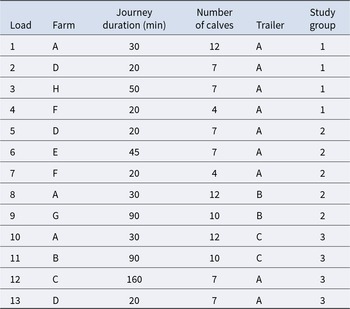
A convenience sample of trailer journeys associated with another study (grant no. BB/Y006887/1) was investigated. Thirteen trailer-loads (TLs) of weaned 10–12 weeks old Angus x Holstein calves were transported by the authors from dairy farms (n = 8) to a livestock research facility at the University of Liverpool (UoL), Leahurst Campus in Neston, Cheshire (Table 1). Farms were located in North Wales (Farm D), Cheshire (Farms A/E/F/H), Staffordshire (Farm B), Yorkshire (Farm C) and Shropshire (Farm G). Trailers A and B were owned by UoL (farm animal practice trailer and university-operated mixed livestock farm trailer, respectively). Trailer C was owned by one of the authors (JN) who owns a beef cattle farm in North Wales. Trailers were cleaned prior to being used as described below. There was at least 3 hours of downtime between the end of cleaning and the collection of the subsequent TL of calves.
Calf transports investigated as a part of this study. A: 2.4 × 1.5 m, B: 3.7 × 1.8 m and C: 3.0 × 1.5 m twin-axle trailer. Samples from the same study group were collected within 5 days of each other

Trailers were washed by an experienced livestock technician within 20 minutes of calf unloading at the research facility, at a designated location situated on a concrete floor sloping towards a central drain. First, the trailer was rinsed using either a pressure washer or high-flow hose to flush most of the faecal material from the trailer. Mains tap water was used throughout the cleaning process. A washing brush was then used to scrub areas of faecal material that were adhered to the inside of the trailer. Next, the trailer was sprayed with a pressure washer (Karcher HDS 5/12 C) at 60°C starting at the back wall and working towards the trailer ramp. Within 5 minutes of the final pressure wash, five sites within the trailer were swabbed three times whilst rotating the tip (10 cm x 5 cm area) with an autoclaved rayon-tipped swab (McKesson Medical) pre-dipped in sterile phosphate buffered saline (PBS): top of the outside railing, ramp, inside railing, back wall and underneath side panel (Supplementary Figure 1). Sampling sites were pre-marked with a permanent marker pen to ensure a consistent size of the swabbing area. The inside of the trailer was then sprayed with a commonly used multi-purpose iodophor disinfectant (FAM® 30, Evans Vanodine International Plc., Preston, UK). A 1:100 disinfectant to water dilution and 30-minute contact time was used as per the manufacturer’s guidelines. The disinfectant was sprayed onto the trailer surfaces using a 10 L hand-pumped pressure washer with a full cone spray nozzle in the same sequence as pressure-washing (back wall to front ramp) and left to dry for 30 minutes. Afterwards, swabbing was repeated on corresponding sites (e.g. if the left side railing was swabbed prior to disinfection, the right side railing was swabbed after), as it was reasoned that swabbing the same site twice would result in a reduced bacterial count due to the physical removal of bacteria by the initial swab, regardless of the action of the disinfectant.
Swabs were stored in 3 mL of PBS at 4°C and plated on agar plates on the same day. An air swab opened inside the trailer for 1 minute was used as the negative control.
E. coli isolation and antibiotic susceptibility screening
Swabs suspended in PBS were vortexed for 1 minute, and 100 µL of PBS was plated on Harlequin E. coli/coliform chromogenic selective agar (HECA) (Neogen). Plates were incubated aerobically for 16–20 hours at 37°C. Colonies were counted with a colony counter, where on HECA agar purple colonies were classified as E. coli, blue as non-E. coli coliforms and white as non-coliforms, according to the agar manufacturer's instructions. A total of 30 presumed E. coli isolates (10 per study group) were selected for further investigation stratified by TL, site, and disinfection status (pre-/post-FAM application in the trailer). Within each study group, presumed E. coli colonies were selected so that one isolate from each site pre- and post-disinfection and at least one isolate from each TL was included, if possible. If no isolates were recovered from a given site at a certain disinfection status or from a given TL, a colony from a different plate was selected at random to maintain an equal number of isolates between study groups. This meant that the number of isolates was not necessarily equal between sites and TLs within the study group.
Species identification was confirmed by matrix-assisted laser desorption ionisation-time of flight mass spectrometry (MALDI-TOF) at the UoL Veterinary Microbiology Diagnostic laboratory, and isolates were subsequently screened for their antibiotic susceptibility profiles with the Sensititre broth microdilution system (ThermoFisher Scientific): Bovine/Porcine BOPO6 Vet AST plate and Gram Negative GN3F plate, according to manufacturer’s instructions. Resistance breakpoints were obtained from the European Committee on Antimicrobial Susceptibility Testing (EUCAST) v.14.0 clinical breakpoints table (EUCAST, 2024). Isolates classified as ‘intermediate’ were grouped separately from resistant isolates. Extended spectrum β-lactamase (ESBL) and carbapenem resistant Enterobacteriaceae (CREs) were classified according to EUCAST guidelines for detection of resistance mechanisms and specific resistances of clinical and/or epidemiological importance version 2.0 (EUCAST, 2017).
FAM30 disinfectant susceptibility was investigated using a broth microdilution method as described previously (Andrews, Reference Andrews2001). Briefly, bacterial cultures were grown in Mueller Hinton (MH) broth overnight, at 37°C and 200 rpm shaking. Cultures were then diluted 1:200 in fresh media and incubated for 2–3 hours until they reached mid-log phase of growth (OD600 ∼ 1–1.2). Cultures were then diluted to 0.5 McFarland standard and further diluted 1:1000 in MH broth for a final inoculum size of ∼ 105 CFU/mL. Within 30 minutes of preparation, the inoculum was added at 1:1 v/v to a 96-well plate containing 1:25 and 1:50 dilutions of FAM30 disinfectant in MH broth (starting at 2x the highest concentration assayed). Assayed concentrations were selected as per manufacturer’s instructions for standard cleaning and disinfection (1:100) and general order disease outbreaks (1:50) (Evans Vanodine). Plates were incubated aerobically for 24 hours at 37°C. Following incubation, plates were inspected visually for the presence of turbidity. Each isolate was assayed in duplicate, with three technical replicates of each biological replicate. Minimum inhibitory concentration was the lowest concentration that inhibited the growth of both replicates.
Calf treatment history and feeding of waste milk
Antibiotic treatment records of the calves transported in our study were provided by the participating farms. Individual animal veterinary medicine records must be kept for food-producing animals in the United Kingdom for at least 5 years. The feeding of waste milk from cows treated with antibiotics was also recorded.
Statistical analysis
The amount of E. coli recovered among the sampled sites was compared with a Kruskal–Wallis test with Dunn’s correction for multiple comparisons. Hierarchical clustering was not performed due to co-linearity between clustering variables (the largest trailer was always used to collect the greatest number of calves which originated from the same farm and vice versa); however, this did not violate the assumptions of the Kruskal–Wallis test. The effect of disinfection on E. coli count was determined using the Wilcoxon matched-pairs signed rank test, with paired values of E. coli CFU/mL before/after disinfection for each site within a TL. The proportion of recovered multidrug-resistant (MDR) isolates and sites with undetectable E. coli count before or after disinfection was compared with Fisher’s exact test. All statistical analyses were performed in GraphPad Prism v.10.2.3 (GraphPad Software LLC).
Results
E. coli load did not differ amongst sites within the trailer and was reduced by application of disinfectant
E. coli were recovered from all trailer loads and across all sites before and after disinfection; although, not all sites were contaminated in each TL. Values ranged from < 10 CFU/mL to 6.3 × 10³ CFU/mL, with the overall median of 10 CFU/mL (Fig. 1A). The amount of recovered E. coli did not differ among sampled sites (p > 0.99). No E. coli were recovered from 39% (25/64) and 78% (50/64) of sampled surfaces before and after the application of disinfectant respectively, within the limit of detection of 10 CFU/mL. Application of disinfectant reduced the overall median E. coli count by 10-fold, (p < 0.0001), and doubled the number of sites with an undetectable E. coli count (p < 0.0001) (Fig. 1B).
Boxplot of E. coli CFU/mL: A. recovered from different sites within the trailer and B. recovered across all sites within the trailer prior (pressure-wash) and post (pressure wash + FAM30) disinfection. Boxes represent 25th to 75th percentiles, with line at the median. Range is represented by bars. **** = p < 0.0001 by Wilcoxon matched-pairs signed rank test, with match-pairs assigned for each site within trailer load prior/post-disinfection.

AMR E. coli were recovered from livestock trailers before and after application of disinfectant
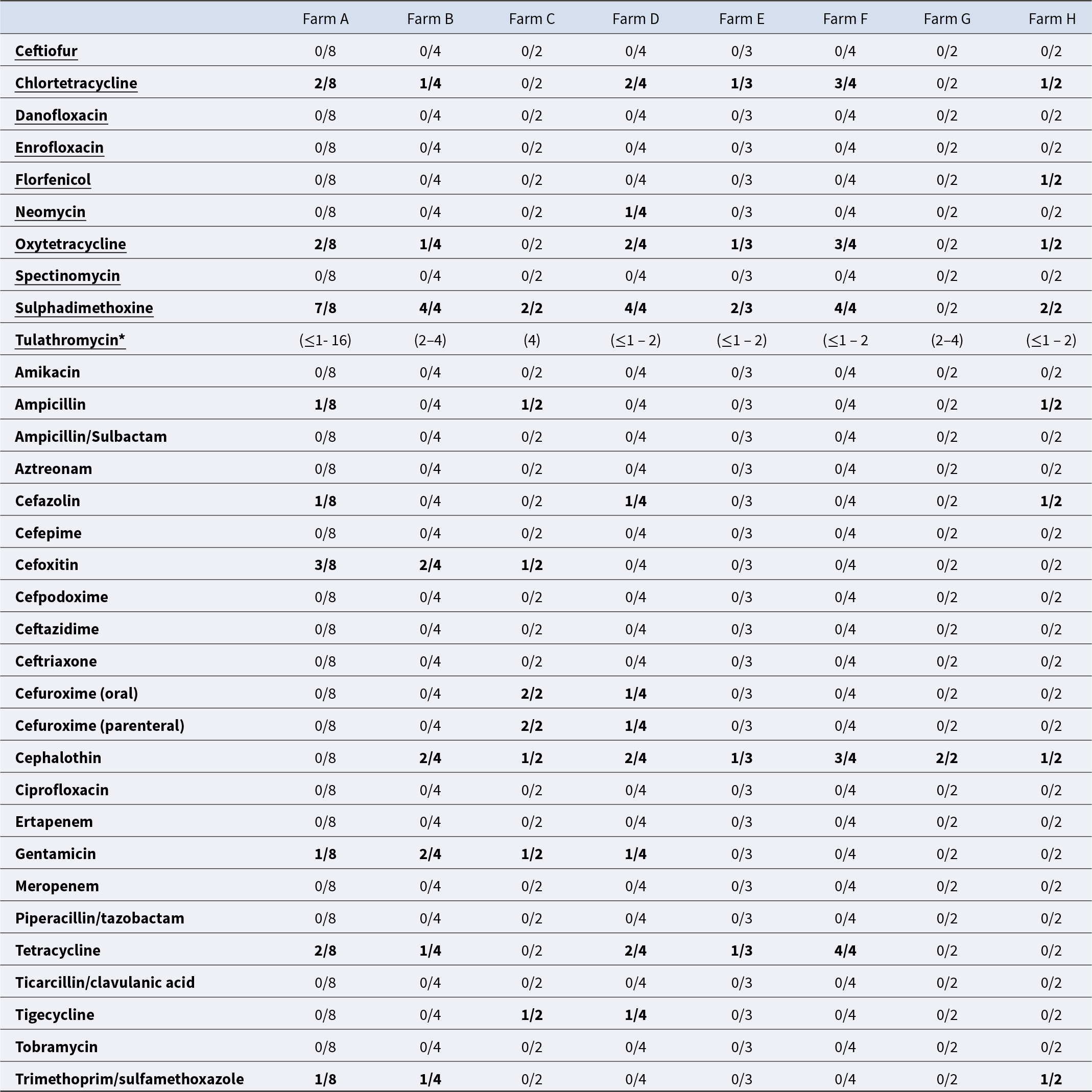
Species identity of 30 presumed E. coli isolates, chosen randomly across all sites and TLs, was confirmed by MALDI-TOF spectrophotometry. One isolate subsequently failed to grow in culture and therefore 29 of the original 30 isolates were exposed to a panel of 10 veterinary-use and 23 human-use antibiotics, as well as manufacturer-recommended working concentrations of FAM30 (Supplementary Table 1). Antibiotics with the highest prevalence of resistance were sulfadimethoxine (93%) and cephalothin (55%), followed by tetracyclines (34%), gentamicin (20%), ampicillin (17%), cefazolin (14%) and trimethoprim/sulphamethoxazole (14%). No ESBLs (isolates resistant to third-generation cephalosporins: cefpodoxime, ceftazidime and ceftriaxone), or CREs (isolates resistant to meropenem and ertapenem) were recovered. All isolates failed to grow in the presence of disinfectant at assayed concentrations.
Twelve isolates, each from a different TL, were classified as multidrug resistant, that is, resistant to at least one antibiotic from three or more classes. The proportion of isolates exhibiting MDR was 45% (5/11 isolates) and 39% (7/18 isolates) post and prior to disinfection, respectively (RR: 1.17, p > 0.99). The proportion of MDR isolates recovered following transport from different farms varied from 100% MDR (Farms C and H), 50% MDR (Farms B, D and F), 25% MDR (Farm A), to 0% MDR (Farms E and G) (Table 2).
Prevalence of antibiotic resistance amongst E. coli recovered from calf transport trailers. Prevalence expressed as ratio of resistant isolates to the total number of isolates recovered from transport(s) from given farm. Veterinary use antibiotics are underlined. Clinical resistance breakpoints were obtained from EUCAST v.14.0 (European Committee on Antimicrobial Susceptibility Testing, 2024); for danofloxacin, norfloxacin and spectinomycin epidemiological cut-off values were used due to lack of established clinical breakpoints (Tomazi et al., Reference Tomazi, Coura, Gonçalves, Heinemann and Santos2018); for tulathromycin MIC range was provided due to lack of either
Antibiotic treatment history did not appear to directly influence E. coli resistance profiles
At least one calf had been treated with antibiotics prior to transport in six out of thirteen TLs (Supplementary Table 2). Antibiotics used were oxytetracycline (TLs 2 and 13), tulathromycin (TLs 7 and 9), cloxacillin (TL 8) and florfenicol (TL 11).
Tulathromycin, oxytetracycline and florfenicol were part of the antibiotic susceptibility panel in this study. Prevalence of AMR to the aforementioned antibiotics did not appear to be dependent on previous exposure. No resistance to florfenicol was observed in TL 11 isolates, compared to 14% overall resistance. Two out of three (66%) isolates from TL 2 were resistant to tetracyclines, compared to 34% overall resistance. There is no clinical resistance breakpoint available for E. coli for tulathromycin; however, MIC values of TLs 7 and 9 were comparable to the overall MIC values for this antibiotic (medians of 2.5 and 2, respectively).
Discussion
Livestock transport vehicles can act as fomites for pathogens and AMR
This study demonstrated that livestock trailers are likely to be contaminated with antibiotic-resistant E. coli, even when current disinfection guidelines are strictly followed. It is likely that in a practical setting, the levels of contamination may be greater than reported here, as compliance with sanitation guidelines will vary (Weber and Meemken, Reference Weber and Meemken2018). Therefore, if we assume that some degree of contamination is unavoidable, effective risk reduction measures should begin upstream in the food production process. Numerous studies have shown that increased antibiotic use on farms increases shedding of antibiotic-resistant pathogens (Avrain et al., Reference Avrain, Humbert, L’Hospitalier, Sanders, Vernozy-Rozand and Kempf2003; Brunton et al., Reference Brunton, Reeves, Snow and Jones2014; Cameron-Veas et al., Reference Cameron-Veas, Moreno, Fraile and Migura-Garcia2016), as well as increases the risk of spread of AMR genes via horizontal gene transfer (Heuer and Smalla, Reference Heuer and Smalla2007). Reducing antibiotic use in livestock would reduce shedding of AMR pathogens during transport and subsequently reduce vehicle contamination.
Proper cleaning practices are nonetheless important, and here we demonstrated that use of iodophor disinfectant, applied in the form of a full cone spray, significantly reduced E. coli count within the trailer. Currently, the use of chemical disinfectants for routine cleaning of livestock transport vehicles is not mandatory in the United Kingdom (The Transport of Animals Order, 2000), and can raise concerns regarding environmental contamination, increased costs and increased risk of resistance development. Iodophors, including FAM30, are known to corrode and stain equipment, and can cause serious skin and eye irritation if not handled properly; consequently, staff training and use of appropriate personal protective equipment should be included in farm risk management considerations. Another potential issue is the potential for co-selection of AMR with disinfectant resistance genes encoded on MDR plasmids (Sheikh et al., Reference Sheikh, Gholipour, Ghodsi and Nikaeen2025); however, we did not recover a higher proportion of MDR isolates following disinfectant application, and all screened E. coli isolates failed to grow in the presence of disinfectant used at manufacturer-recommended concentrations. Our results suggest that chemical disinfection following pressure-washing is beneficial; however, larger-scale investigations, including evaluation of different application methods and disinfectant types, are needed to validate these conclusions.
Escherichia coli isolated from livestock transport vehicles harbours resistance to human and veterinary antibiotics
Although E. coli is intrinsically susceptible to nearly all commonly used antibiotics, MDR and extensively-drug resistant isolates are recovered at increasing frequency which poses significant public health concerns (Wang et al., Reference Wang, Wang, Niu, Liu, Li, Zhang, Li, Su, Liu, Zhang and Xu2020; Simner et al., Reference Simner, Bergman, Conzemius, Jacobs, Tekle, Beisken and Tamma2023). Whilst antibiotics licenced in human medicine are not commonly licenced for veterinary use, resistance mechanisms to both groups can overlap, especially if it is mediated via MDR plasmids (Poirel et al., Reference Poirel, Madec, Lupo, Schink, Kieffer, Nordmann and Schwarz2018). In this study, we demonstrated that E. coli recovered from livestock trailers can carry resistance to multiple human and veterinary antibiotics. Almost all isolates were resistant to sulfadimethoxine (brand name Albon), a sulphonamide licensed in the United Kingdom to treat respiratory infections, calf diphtheria, foot rot and less commonly coccidiosis (Zoetis, 2022). Conversely, we observed moderate resistance to sulfamethoxazole/trimethoprim (Bactrim), a sulphonamide commonly prescribed in human medicine for urinary tract infections, most often caused by E. coli (Flores-Mireles et al., Reference Flores-Mireles, Walker, Caparon and Hultgren2015). Although sulfamethoxazole is not approved for veterinary use, cross resistance between different sulphonamide antibiotics is common (Skold, Reference Skold2001). Approximately half of the isolates were resistant to cephalothin, a first-generation cephalosporin that is most used for surgery prophylaxis and treatment of a broad range of infections in human and veterinary medicine (Del Pilar Zarazaga et al., Reference Del Pilar Zarazaga, Tinti, Litterio, Himelfarb, San Andrés-Larrea, Rubio-Langre, Serrano-Rodríguez and Lorenzutti2024). However, apart from one isolate, we did not observe resistance to second-/third-generation cephalosporins. Interestingly, we did not observe high resistance levels to ampicillin, suggesting a cephalothin resistance mechanism other than β-lactamase production, as both antibiotics possess a β-lactam ring as part of their structure (Cho and Kim, Reference Cho and Kim2018). Finally, we observed a moderate prevalence of resistance to tetracyclines and gentamycin. Tetracyclines are no longer recommended to treat E. coli infections in humans due to a high prevalence of resistance; however, they are still commonly prescribed in veterinary medicine and are considered a first-line antibiotic choice (Category D) under the European Medicines Agency, likely maintaining positive selective pressure on resistant isolates (Karami et al., Reference Karami, Nowrouzian, Adlerberth and Wold2006; Kimura et al., Reference Kimura, Kudo, Fukuda, Yamada, Makita, Oka, Takahashi, Tamura and Usui2022). Reassuringly, we did not isolate any ESBLs or CREs from the trailers in our study. However, an MDR isolate was recovered following a trip to six out of eight farms, irrespective of the antibiotic treatment history of transported animals. Notably, one isolate exhibited resistance to 14 out of 29 tested antibiotics. Although the animals participating in this study had not been treated with these antibiotics, the farm environment can facilitate the dissemination of MDR plasmids via surfaces (e.g. equipment, clothing or bedding), feed (e.g. waste milk) or waste (e.g. wastewater and manure). Therefore, strict biosecurity practices, including effective cleaning of transport vehicles, together with antibiotic stewardship, are crucial to minimise the risk of AMR spread onto the food production chain.
Altogether, our study demonstrates that E. coli found in ‘clean’ livestock transport trailers harbour resistance to multiple clinically relevant antibiotics. Isolates recovered from those vehicles are a potential health hazard not only to stockpersons but also to the public, as they have the potential to spread during animal transport through persistent low-level contamination.
Supplementary material
The supplementary material for this article can be found at https://doi.org/10.1017/S0022029925101581.
Acknowledgements
This work was supported by Biotechnology and Biological Sciences Research Council (award number: BB/Y006887/1), and University of Liverpool Faculty of Health and Life Sciences Research and Impact Directorate Early Career Fund. Authors would like to gratefully acknowledge Giorgia Cavalli and University of Liverpool Veterinary Microbiology Diagnostics Laboratory for their technical assistance on this project.
Ethical statement
Animal transport was conducted in association with Home Office Project Licence PP6326528.



 Open access

