1. Introduction
The detection of Cyclotron Resonance Scattering Features (CRSFs) in spectra of many accreting neutron stars (NSs) with high magnetic field ( $\textrm{B} \geq 10^{12} \textrm{G}$
) provides valuable insights into the physics of emitting regions and the evolution of these systems. They form due to resonant scattering processes with electrons, protons, and other ions in the plane and perpendicular to the magnetic field (Voges et al. Reference Voges1982; Wilson, Finger, & Camero-Arranz Reference Wilson, Finger and Camero-Arranz2008; Ye et al. Reference Ye2020). The cyclotron line features provide the only direct estimate of the magnetic field strength of NSs in X-ray binary systems. In High-Mass X-ray Binaries (HMXBs), a NS accretes matter from a companion star via stellar wind. The accreted matter is channeled along field lines of the strong magnetic field of the NS onto the magnetic poles. X-ray emission from the NS is produced in regions around the magnetic poles (see Podsiadlowski et al. Reference Podsiadlowski2004; van den Heuvel Reference van den Heuvel2009; Cai et al. Reference Cai, Taani, Zhao and Zhang2012). It is noteworthy to mention here that most observed cyclotron lines have been detected above 10 keV and are interpreted as electron features, with inferred magnetic fields
$\textrm{B} \geq 10^{12} \textrm{G}$
) provides valuable insights into the physics of emitting regions and the evolution of these systems. They form due to resonant scattering processes with electrons, protons, and other ions in the plane and perpendicular to the magnetic field (Voges et al. Reference Voges1982; Wilson, Finger, & Camero-Arranz Reference Wilson, Finger and Camero-Arranz2008; Ye et al. Reference Ye2020). The cyclotron line features provide the only direct estimate of the magnetic field strength of NSs in X-ray binary systems. In High-Mass X-ray Binaries (HMXBs), a NS accretes matter from a companion star via stellar wind. The accreted matter is channeled along field lines of the strong magnetic field of the NS onto the magnetic poles. X-ray emission from the NS is produced in regions around the magnetic poles (see Podsiadlowski et al. Reference Podsiadlowski2004; van den Heuvel Reference van den Heuvel2009; Cai et al. Reference Cai, Taani, Zhao and Zhang2012). It is noteworthy to mention here that most observed cyclotron lines have been detected above 10 keV and are interpreted as electron features, with inferred magnetic fields $B\sim 10^{12}$
G (Heindl et al. Reference Heindl2003). The combined effects of poor statistics, photoelectric absorption and the lack of evidence for a remnant accretion disk have made these energy sources elusive.
$B\sim 10^{12}$
G (Heindl et al. Reference Heindl2003). The combined effects of poor statistics, photoelectric absorption and the lack of evidence for a remnant accretion disk have made these energy sources elusive.
Most efforts to calculate theoretical cyclotron lines have been performed in a line-forming region with a constant temperature and density of an electron-proton plasma permeated by a uniform magnetic field (Wheaton et al. Reference Wheaton1979; Orlandini et al. Reference Orlandini1999; Yamamoto et al. Reference Yamamoto2011; Ye et al. Reference Ye2019). Nishimura (Reference Nishimura2005) calculated cyclotron lines assuming a strong variation in field strength with distance from an emission region. However, no model generating such high flux and high temperature at a layer deeper than absorbing heavy atoms has been proposed.
According to recent studies, several pulsars show changes in luminosity dependence in the cyclotron resonance energy (Coburn et al. Reference Coburn2002; Pottschmidt et al. Reference Pottschmidt2011; Reig et al. Reference Reig2016; El Mellah et al. Reference El Mellah, Sander, Sundqvist and Keppens2019a). The first aim of this paper is to derive magnetic field strengths, which is crucial for these systems, and obtain clues about the evolution of HMXBs, which can be understood in terms of the conservative evolution of normal massive binary systems.
The second aim of this study is to derive unknown parameters of HMXBs without uncertainty in the strength of the NS magnetic field. With robust data on the NS magnetic field, combined with spin period ( $P_{\mathrm{spin}}$
) and orbital period (
$P_{\mathrm{spin}}$
) and orbital period ( $P_{\mathrm{orb}}$
), we can fix several hitherto-unknown parameters, such as wind velocity and wind mass-loss rate. These parameters influence significantly the model of wind-fed binary systems and can constrain the effects of binary evolution (Taani & Khasawneh Reference Taani and Khasawneh2017; Dai et al. Reference Dai2017; Taani et al. Reference Taani2019a, b; Karino et al. Reference Karino, Nakamura and Taani2019; El Mellah et al. Reference El Mellah, Sander, Sundqvist and Keppens2019a, b; Karino Reference Karino2020). From this standpoint, with observations of NS magnetic fields, we could constrain the end products of HMXBs, such as a NS-NS merger, (Taani Reference Taani2016; Kasen et al. Reference Kasen2017) and core-collapse supernovae (see Frebel & Norris Reference Frebel and Norris2015; Mardini et al. Reference Mardini2019a, b, Reference Mardini2020), which is considered to be one of the most powerful gravitational wave sources and also the most probable site for heavy element creation (Postnov & Yungelson Reference Postnov and Yungelson2006; Taani Reference Taani2015).
$P_{\mathrm{orb}}$
), we can fix several hitherto-unknown parameters, such as wind velocity and wind mass-loss rate. These parameters influence significantly the model of wind-fed binary systems and can constrain the effects of binary evolution (Taani & Khasawneh Reference Taani and Khasawneh2017; Dai et al. Reference Dai2017; Taani et al. Reference Taani2019a, b; Karino et al. Reference Karino, Nakamura and Taani2019; El Mellah et al. Reference El Mellah, Sander, Sundqvist and Keppens2019a, b; Karino Reference Karino2020). From this standpoint, with observations of NS magnetic fields, we could constrain the end products of HMXBs, such as a NS-NS merger, (Taani Reference Taani2016; Kasen et al. Reference Kasen2017) and core-collapse supernovae (see Frebel & Norris Reference Frebel and Norris2015; Mardini et al. Reference Mardini2019a, b, Reference Mardini2020), which is considered to be one of the most powerful gravitational wave sources and also the most probable site for heavy element creation (Postnov & Yungelson Reference Postnov and Yungelson2006; Taani Reference Taani2015).
In the next section, we introduce the recent results of NS magnetic field given by the CRSF observations to find the wind equation solution. In Section 3, we discuss the method to obtain hitherto-unknown binary parameters from robust data on the NS magnetic field in SG-HMXBs. In Section 4, we discuss our findings. The last section is devoted to conclusions.
List of some observational parameters of all known persistent sources with supergiant companions.

References.– These references are to period measurements in the literature. Some have errors originating from applied analysis, designated with a dagger, or from the supplied data, designated with an asterisk. (1) Cusumano et al. (Reference Cusumano1998); (2) Coburn et al. (Reference Coburn2002); (3) Rivers et al. (Reference Rivers2010); (4) Clark et al. (Reference Clark1990); (5) Rodes-Roca et al. (Reference Rodes-Roca2009); (6) Robba et al. (Reference Robba2001); (7) Kreykenbohm et al. (Reference Kreykenbohm2005); (8) Makishima et al. (Reference Makishima1999); (9) Kreykenbohm et al. (Reference Kreykenbohm2002); (10) Schanne et al. (Reference Schanne2007); (11) Santangelo et al. (Reference Santangelo1998); (12) Barbera et al. (Reference la Barbera2001); (13) Orlandini et al. (Reference Orlandini1999); (14) Denis, Bulik, & Marcinkowski (Reference Denis, Bulik and Marcinkowski2010); (15) Pottschmidt et al. (Reference Pottschmidt2011); (16) Nespoli, Fabregat, & Mennickent (Reference Nespoli, Fabregat and Mennickent2010); (17) D’Ai et al. (Reference D’Ai2011); (18) Reynolds et al. (Reference Reynolds1999); (19) Bonning & Falanga (Reference Bonning and Falanga2005); (20) den Hartog et al. (Reference den Hartog2006); (21) Bodaghee et al. (Reference Bodaghee2016); (22) Lutovinov, Tsygankov, & Postnov (Reference Lutovinov, Tsygankov and Postnov2017).
2. Cyclotron lines
Since the physical conditions are expected to vary over the emission region, the X-ray spectrum is expected to change with the viewing angle and therefore with pulse phase. This variation can be because during one rotation phase different parts of the surface are exposed and also due to change in local field structure due to accretion dynamics, e.g. change in accretion rate, as is seen for sources like Her X-1 and V0332+53. The difference in time scales of variation for cyclotron line energy $E_{\mathrm{cyc}}$
and luminosity will allow researchers to distinguish between these two distinct cases. (Nagase et al. Reference Nagase1991; Wilson et al. Reference Wilson, Finger and Camero-Arranz2008). In this work, we have selected 11 persistent sources with SG companions known to have at least one cyclotron line (see Table 1). Here, our analysis of all pointing observations provides an opportunity to infer the values of magnetic field strength according to their spectra. The gravitational redshift z that at the NS surface is approximately
$E_{\mathrm{cyc}}$
and luminosity will allow researchers to distinguish between these two distinct cases. (Nagase et al. Reference Nagase1991; Wilson et al. Reference Wilson, Finger and Camero-Arranz2008). In this work, we have selected 11 persistent sources with SG companions known to have at least one cyclotron line (see Table 1). Here, our analysis of all pointing observations provides an opportunity to infer the values of magnetic field strength according to their spectra. The gravitational redshift z that at the NS surface is approximately
 \begin{equation}z\simeq\frac{1}{\sqrt{1-\frac{2GM_{\mathrm{NS}}}{R_{\mathrm{NS}}c^{2}}}}-1\simeq0.3,\end{equation}
where $M_{\mathrm{NS}}, R_{\mathrm{NS}}$
, G, and c are the NS mass, radius, gravitational constant and speed of light, respectively. Assuming canonical values for
$M_{\mathrm{NS}}, R_{\mathrm{NS}}$
, G, and c are the NS mass, radius, gravitational constant and speed of light, respectively. Assuming canonical values for $M_{\mathrm{NS}}$
and
$M_{\mathrm{NS}}$
and $R_{\mathrm{NS}}$
of 1.4
$R_{\mathrm{NS}}$
of 1.4 $\mathrm{M}_{\odot}$
and 10 km, thus z = 0.3. As such, the line energy changes the fundamental cyclotron line (keV) to become related to the magnetic field strength and its configuration (Trüemper et al. Reference Trüemper1978) by the equation
$\mathrm{M}_{\odot}$
and 10 km, thus z = 0.3. As such, the line energy changes the fundamental cyclotron line (keV) to become related to the magnetic field strength and its configuration (Trüemper et al. Reference Trüemper1978) by the equation
 \begin{equation}\begin{array}{rcl} E_{\mathrm{cyc}}=11.6 keV B_{12} (1+z)^{-1} .\end{array}\end{equation}
Here B $_{12}$
is the magnetic field strength in units of 1012 G, and the higher harmonics have an energy n times the fundamental energy
$_{12}$
is the magnetic field strength in units of 1012 G, and the higher harmonics have an energy n times the fundamental energy $E_{\mathrm{cyc}}$
(see, e.g. Wilson et al. Reference Wilson, Finger and Camero-Arranz2008, and references therein). The effect of NS rotation on the variation in the shape of the cyclotron line features is considered. This could be correlated to the accretion geometry and other mechanisms (Bachetti et al. Reference Bachetti2014).
$E_{\mathrm{cyc}}$
(see, e.g. Wilson et al. Reference Wilson, Finger and Camero-Arranz2008, and references therein). The effect of NS rotation on the variation in the shape of the cyclotron line features is considered. This could be correlated to the accretion geometry and other mechanisms (Bachetti et al. Reference Bachetti2014).
In general, the magnetic field of NSs spans a range from $10^{8}\mathrm{G}$
or less (LMXBs) to
$10^{8}\mathrm{G}$
or less (LMXBs) to $10^{15} \mathrm{G}$
(magnetars). We list the computed magnetic strengths along with other system parameters for selected SG-HMXBs in Table 2. These values show no correlation with the spin period of wind-fed systems (see Figure 1).
$10^{15} \mathrm{G}$
(magnetars). We list the computed magnetic strengths along with other system parameters for selected SG-HMXBs in Table 2. These values show no correlation with the spin period of wind-fed systems (see Figure 1).
List of derived parameters for SG HMXBs.

The data on mass and radius of donor are taken from Falanga et al. (Reference Falanga2015), Reig et al. (Reference Reig2016), Chaty et al. (Reference Chaty2008), Rawls et al. (Reference Rawls2011), Cusumano et al. (Reference Cusumano2010), Mason et al. (Reference Mason2012). The luminosity and effective temperature are computed by their approximated stellar evolution track given by Hurley et al. (Reference Hurley, Pols and Tout2000). From these donor data, the terminal velocity of the wind and the wind mass-loss rate from SG stars are derived by polynomial approximation given by Vink et al. (Reference Vink, de Koter and Lamers2001).
The magnetic field as a function of the spin period of SG-HMXBs.

It should be noticed that, of course, we need to consider some observational biases, such as: too strong of a magnetic field prevents accretion onto the NS and we could not observe such systems as bright X-ray sources (Taani et al. Reference Taani2020; Karino Reference Karino2020). Besides such possibility of biases, this concentration around $B \approx 10^{12} \mathrm{G}$
will draw a lot of interest and promote further studies on the NS magnetic field (Taani et al. Reference Taani2019a, b). The fundamental energy covers a wide range, starting at 10 keV for Swift J1626.6-5156 (DeCesar, Pottschmidt, & Wilms Reference DeCesar, Pottschmidt and Wilms2009) to 100 keV for LMC X-4 (la Barbera et al. Reference la Barbera2001).
$B \approx 10^{12} \mathrm{G}$
will draw a lot of interest and promote further studies on the NS magnetic field (Taani et al. Reference Taani2019a, b). The fundamental energy covers a wide range, starting at 10 keV for Swift J1626.6-5156 (DeCesar, Pottschmidt, & Wilms Reference DeCesar, Pottschmidt and Wilms2009) to 100 keV for LMC X-4 (la Barbera et al. Reference la Barbera2001).
The strong energy variation of the cyclotron lines (for example, in V0332+53, GRO J1008-57 and GX301-2) can be used to argue that during different phases of the X-ray pulses, regions with different magnetic fields are observed.
It is noteworthy to mention here that 4U 0115+634 is one of the pulsars whose CRSFs have been studied in great detail (see, e.g., Wheaton et al. Reference Wheaton1979; Nagase et al. Reference Nagase1991; Nishimura Reference Nishimura2005). In previous outbursts, CRSFs have been detected up to the fifth harmonic (Heindl et al. Reference Heindl2003; Ferrigno et al. Reference Ferrigno2011). This high number of detected CRSFs in 4U 0115+634 makes this system an outstanding laboratory to study the physics of cyclotron lines in X-ray pulsars.
3. Investigating wind parameters in SG HMXB systems
Under the assumption that the spin period of a NS is nearly in torque equilibrium at a steady mass accretion rate, the magnetic radius (where the magnetic pressure balances with the accretion ram pressure) and corotation radius $r_{\mathrm{co}}$
(the radius where the Keplerian angular velocity equals the NS spin angular velocity) have similar values (Donati et al. Reference Donati2011), and enough amount of angular momentum could be received via wind accretion (Karino et al. Reference Karino, Nakamura and Taani2019), one estimates the magnetic field strength as
$r_{\mathrm{co}}$
(the radius where the Keplerian angular velocity equals the NS spin angular velocity) have similar values (Donati et al. Reference Donati2011), and enough amount of angular momentum could be received via wind accretion (Karino et al. Reference Karino, Nakamura and Taani2019), one estimates the magnetic field strength as
 \begin{equation}B_{\mathrm{NS}} = 2.2 \times 10^{12} \mathrm{G} \times \zeta^{1/2}\left( \frac{\dot{\textit{M}}}{10^{18} \mathrm{g\, s}^{-1}} \right)^{1/2}\left( \frac{\textit{P}_{\mathrm{s}}}{1 \mathrm{s}} \right)^{7/6} ,\end{equation}
assuming that the mass of the NS is 1.4 M $_\odot $
and its radius is 10 km (Ghosh & Lamb Reference Ghosh and Lamb1979; Campana et al. Reference Campana2002; Tsygankov et al. Reference Tsygankov, Mushtukov, Suleimanov and Poutanen2016). The parameter
$_\odot $
and its radius is 10 km (Ghosh & Lamb Reference Ghosh and Lamb1979; Campana et al. Reference Campana2002; Tsygankov et al. Reference Tsygankov, Mushtukov, Suleimanov and Poutanen2016). The parameter $\zeta$
is the ratio of accretion velocity to the free-fall velocity, and hereafter we fix this value as 0.5. However, we should note here that, the effect of the accretion flow geometry (spherical, disk-like or planar) must be taken into account (Karino et al. Reference Karino, Nakamura and Taani2019).
$\zeta$
is the ratio of accretion velocity to the free-fall velocity, and hereafter we fix this value as 0.5. However, we should note here that, the effect of the accretion flow geometry (spherical, disk-like or planar) must be taken into account (Karino et al. Reference Karino, Nakamura and Taani2019).
Plots of the wind velocity vs mass-loss rate, in various accretion regimes. The position of each source is shown by a black filled circle. As shown clearly, the parameter space can be categorised into (A) supersonic inhibition regime, (B) subsonic inhibition regime, (C) supersonic propeller regime, (D) subsonic propeller regime, and (E) direct accretion regime indicated by the shaded region, and the solution of the wind equation is represented by solid curves.

The mass accretion rate $\dot{M}$
can be obtained as the following, if we assume the Hoyle–Lyttleton accretion scenario using the local density at the position of the NS (see, e.g. Bondi & Hoyle Reference Bondi and Hoyle1944 and references therein).
$\dot{M}$
can be obtained as the following, if we assume the Hoyle–Lyttleton accretion scenario using the local density at the position of the NS (see, e.g. Bondi & Hoyle Reference Bondi and Hoyle1944 and references therein).
 \begin{equation}\dot{M} = \rho_{\mathrm{w}} v_{\mathrm{rel}} \pi R_{\mathrm{acc}}^{2} .\end{equation}
Under the condition of the spherical stellar wind (Walter, Lutovinov, & Bozzo Reference Walter, Lutovinov and Bozzo2015), the local density of the wind matter becomes
 \begin{equation}\rho_{\mathrm{w}} = \frac{ \dot{m}_{\mathrm{w}} }{ 4 \pi a^{2} v_{\mathrm{w}} },\end{equation}
where $\dot{m}_{\mathrm{w}}$
is the wind mass-loss rate from the donor. The estimation depends on the empirical stellar-evolution model. Here, orbital radius a can be obtained from the orbital period of the system and donor mass. Note that we assume here that, the systems are in circular orbits. Combining them, we have
$\dot{m}_{\mathrm{w}}$
is the wind mass-loss rate from the donor. The estimation depends on the empirical stellar-evolution model. Here, orbital radius a can be obtained from the orbital period of the system and donor mass. Note that we assume here that, the systems are in circular orbits. Combining them, we have
 \begin{equation}\dot{M} = \dot{m}_{\mathrm{w}} \times\frac{ G^{2} M^{2}_{\mathrm{NS}} }{ a^{2} v_{\mathrm{w}} v^{3}_{\mathrm{rel}} } .\end{equation}
We can deduce the mass accretion rate from the observed X-ray luminosity. The relative velocity of the wind to the NS is
 \begin{equation}v_{\mathrm{rel}} = \left( v^{2}_{\mathrm{orb}} + v^{2}_{\mathrm{w}} \right)^{1/2}\end{equation}
and the velocity of the line-driven wind is usually prescribed in the model by so-called $\beta-$
low:
$\beta-$
low:
 \begin{equation}v_{\mathrm{w}} = v_{\infty}\left( 1 - \frac{R_{\mathrm{d}}}{a} \right)^{\beta} .\end{equation}
In this study, we assume $\beta$
to be in the range of around 0.6–1.5 based on models of the donor (Puls, Vink, & Najarro Reference Puls, Vink and Najarro2008),
$\beta$
to be in the range of around 0.6–1.5 based on models of the donor (Puls, Vink, & Najarro Reference Puls, Vink and Najarro2008), $v_{\infty}$
denotes the terminal velocity of the wind.
$v_{\infty}$
denotes the terminal velocity of the wind.
On the other hand, unless the orbital radius is very small, the ratio of mass accretion rate to mass-loss due to stellar wind, can be approximated as the ratio of the accretion region $\left(4 \pi G^{2} M^{2}_{\mathrm{NS}} / v^{2}_{\mathrm{rel}}\right)$
to the sphere whose radius is the orbital radius (
$\left(4 \pi G^{2} M^{2}_{\mathrm{NS}} / v^{2}_{\mathrm{rel}}\right)$
to the sphere whose radius is the orbital radius ( $4 \pi a^{2}$
). This is equivalent to replacing the stellar wind velocity by the relative velocity in Equation (6). Then, with the help of this equation, we get
$4 \pi a^{2}$
). This is equivalent to replacing the stellar wind velocity by the relative velocity in Equation (6). Then, with the help of this equation, we get
 \begin{equation}v^{2}_{\mathrm{w}} = -v^{2}_{\mathrm{orb}} \pm \sqrt{ \frac{ G^{2} M^{2}_{\mathrm{NS}} }{ a^{2} \dot{M} } \dot{m}_{\mathrm{w}} }.\end{equation}
The wind parameters such as $\dot{m}_{\mathrm{w}}$
and
$\dot{m}_{\mathrm{w}}$
and $v_{\infty}$
contain large uncertainties. The observational biases should be considered, as the opacity reduction and the unknowns in the geometry and emission mechanisms of the system (see, e.g., Mushtukov et al. Reference Mushtukov, Suleimanov, Tsygankov and Poutanen2015). Combining above wind equations with CRSF data introduced in the previous section, a single relationship between
$v_{\infty}$
contain large uncertainties. The observational biases should be considered, as the opacity reduction and the unknowns in the geometry and emission mechanisms of the system (see, e.g., Mushtukov et al. Reference Mushtukov, Suleimanov, Tsygankov and Poutanen2015). Combining above wind equations with CRSF data introduced in the previous section, a single relationship between $\dot{m}_{\mathrm{w}}$
and
$\dot{m}_{\mathrm{w}}$
and $v_{\infty}$
can be obtained as a solution. In addition, the CRSF data help us to make a concentration on the estimation of the stellar wind parameters. The orbital semi-major axis a is obtained from the orbital period if the mass of the donor is known. In Table 2, we show the values of donor mass and donor radius, which has appeared in Equation (8).
$v_{\infty}$
can be obtained as a solution. In addition, the CRSF data help us to make a concentration on the estimation of the stellar wind parameters. The orbital semi-major axis a is obtained from the orbital period if the mass of the donor is known. In Table 2, we show the values of donor mass and donor radius, which has appeared in Equation (8).
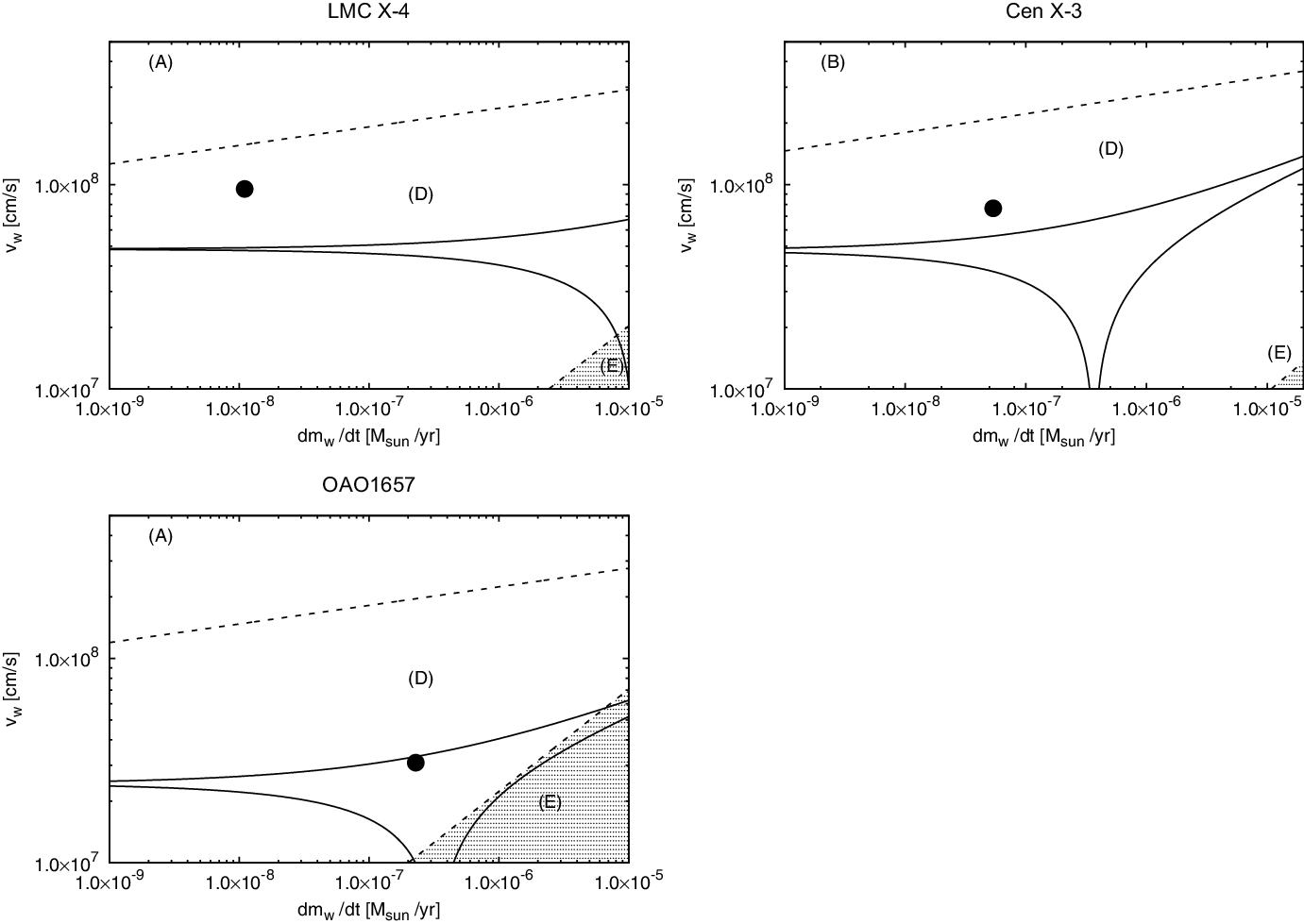
The same as previous, for the wind mass-loss rate, accretion mass-loss rate and accretion regimes. The position of each source is shown by a black filled circle.


If we choose the mass-loss rate from the donor $\dot{m}_{\mathrm{w}}$
as a fundamental variable, then Equation (9) becomes a biquadratic equation and has four solutions. Two of them are physically nonsense, so we consider the other two solutions since they have a clear correlation between wind velocity and the mass loss rate of donors in SG-HMXBs. These solutions of the wind velocity are shown in Figures 2–4 by solid curves, as functions of mass-loss rate in SG-HMXBs. Note that, the uncertainty caused by the strength of the NS magnetic field is negligible, since this uncertainty is determined fairly accurately from CRSF data, and is also much smaller than the uncertainty of all other considered parameters such as in
$\dot{m}_{\mathrm{w}}$
as a fundamental variable, then Equation (9) becomes a biquadratic equation and has four solutions. Two of them are physically nonsense, so we consider the other two solutions since they have a clear correlation between wind velocity and the mass loss rate of donors in SG-HMXBs. These solutions of the wind velocity are shown in Figures 2–4 by solid curves, as functions of mass-loss rate in SG-HMXBs. Note that, the uncertainty caused by the strength of the NS magnetic field is negligible, since this uncertainty is determined fairly accurately from CRSF data, and is also much smaller than the uncertainty of all other considered parameters such as in $\dot{m}_{\mathrm{w}}$
and
$\dot{m}_{\mathrm{w}}$
and $v_{\infty}$
. In these figures, the wind parameters given by the frequently used wind model by Vink, de Koter, & Lamers (Reference Vink, de Koter and Lamers2001) are shown at the same time. The approximated wind mass-loss rates from SG stars are given by the complex functions of mass, radius (escape velocity) and luminosity (effective temperature) of SG stars. To derive the mass-loss rate of the HMXB donors, we use the mass and radius data which are derived and introduced in previous papers (Chaty et al. Reference Chaty2008; Cusumano et al. Reference Cusumano2010; Rawls et al. Reference Rawls2011; Mason et al. Reference Mason2012; Falanga et al. Reference Falanga2015; Reig et al. Reference Reig2016) based on the observations and the stellar-evolution model. The estimation depends on the empirical stellar-evolution model. From these data, we derive the effective temperature and corresponding luminosity using approximated stellar evolution scheme. We compile Equations (1)–(30) in Hurley, Pols, & Tout (Reference Hurley, Pols and Tout2000) and find the evolution stage of each donors in SG-HMXBs listed in Table 2. Then, we derive the effective temperature at this evolutionary stage.
$v_{\infty}$
. In these figures, the wind parameters given by the frequently used wind model by Vink, de Koter, & Lamers (Reference Vink, de Koter and Lamers2001) are shown at the same time. The approximated wind mass-loss rates from SG stars are given by the complex functions of mass, radius (escape velocity) and luminosity (effective temperature) of SG stars. To derive the mass-loss rate of the HMXB donors, we use the mass and radius data which are derived and introduced in previous papers (Chaty et al. Reference Chaty2008; Cusumano et al. Reference Cusumano2010; Rawls et al. Reference Rawls2011; Mason et al. Reference Mason2012; Falanga et al. Reference Falanga2015; Reig et al. Reference Reig2016) based on the observations and the stellar-evolution model. The estimation depends on the empirical stellar-evolution model. From these data, we derive the effective temperature and corresponding luminosity using approximated stellar evolution scheme. We compile Equations (1)–(30) in Hurley, Pols, & Tout (Reference Hurley, Pols and Tout2000) and find the evolution stage of each donors in SG-HMXBs listed in Table 2. Then, we derive the effective temperature at this evolutionary stage.
The wind parameters ( $v_{\infty}$
and
$v_{\infty}$
and $\dot{m}_{\mathrm{w}}$
) we obtained are reported in Table 2. From these results, we could confirm that terminal velocities of the wind from donors in SG HMXBs are rather slow. In seven systems, the terminal velocities of donors dip from the typical wind velocity of galactic single SG stars
$\dot{m}_{\mathrm{w}}$
) we obtained are reported in Table 2. From these results, we could confirm that terminal velocities of the wind from donors in SG HMXBs are rather slow. In seven systems, the terminal velocities of donors dip from the typical wind velocity of galactic single SG stars $\left(1000-2000\, \mathrm{km\,s}^{-1}\right)$
. This result is consistent with recent result given by Giménez-García et al. (2016) who argued that the stellar wind of donors in persistent HMXBs is systematically slow.Footnote a For instance, from recent observations, it is suggested that the wind velocity in persistent SG HMXBs, Vela X-1, is relatively slow
$\left(1000-2000\, \mathrm{km\,s}^{-1}\right)$
. This result is consistent with recent result given by Giménez-García et al. (2016) who argued that the stellar wind of donors in persistent HMXBs is systematically slow.Footnote a For instance, from recent observations, it is suggested that the wind velocity in persistent SG HMXBs, Vela X-1, is relatively slow $\left(v_{\infty} = 700\,\mathrm{km\,s}^{-1}\right)$
, this might be due to the ionisation of the stellar wind by the radiation from NS, and thus prevents the acceleration of the stellar wind (Kretschmar et al. Reference Kretschmar2021). In our samples, even for systems with higher
$\left(v_{\infty} = 700\,\mathrm{km\,s}^{-1}\right)$
, this might be due to the ionisation of the stellar wind by the radiation from NS, and thus prevents the acceleration of the stellar wind (Kretschmar et al. Reference Kretschmar2021). In our samples, even for systems with higher $v_{\infty}$
, the wind velocities at the NS positions are typically
$v_{\infty}$
, the wind velocities at the NS positions are typically $v_{\mathrm{w}} \approx 500\,\mathrm{km\,s}^{-1}$
, and still show very slow wind. However, in some tight binaries, the tidal effects could reduce stellar wind velocity towards the accretor (Hirai & Mandel Reference Hirai and Mandel2021).
$v_{\mathrm{w}} \approx 500\,\mathrm{km\,s}^{-1}$
, and still show very slow wind. However, in some tight binaries, the tidal effects could reduce stellar wind velocity towards the accretor (Hirai & Mandel Reference Hirai and Mandel2021).
It is broadly considered that in wind-fed HMXBs, the wind matter is captured by the NS magnetic field at a certain radius, and transported onto the polar regions of the NS. In this process, around the polar region, the accretion column is formed, and the potential energy of the accretion matter is converted into strong X-ray radiation.
However, it is believed that, when the NS (and consequently NS magnetic field lines) rotates rapidly, the accretion matter cannot fall onto the NS surface and in some conditions it could be expelled out (Pfahl et al. Reference Pfahl2002; Podsiadlowski et al. Reference Podsiadlowski2004). This rotational inhibition of the accretion matter is called the propeller effect (see Reig and Zezas Reference Reig and Zezas2018). The propeller/accretion limit could be defined by three typical radii (accretion radius $R_{\mathrm{acc}}$
, is the distance at which inflowing matter is gravitationally concentrated toward the NS. Magnetic radius
$R_{\mathrm{acc}}$
, is the distance at which inflowing matter is gravitationally concentrated toward the NS. Magnetic radius $r_{\mathrm{m}}$
, is the distance at which the pressure of the NS magnetic field balances the ram pressure of inflowing materials. Corotation radius
$r_{\mathrm{m}}$
, is the distance at which the pressure of the NS magnetic field balances the ram pressure of inflowing materials. Corotation radius $r_{\mathrm{co}}$
is the radius where the Keplerian angular velocity equals the NS spin angular velocity.
$r_{\mathrm{co}}$
is the radius where the Keplerian angular velocity equals the NS spin angular velocity.
The parameter space could divided into five accretion regimes based on their magnitude relation (Stella, White, & Rosner Reference Stella, White and Rosner1986; Bozzo, Falanga, & Stella Reference Bozzo, Falanga and Stella2008). That is, the parameter space can be categorised into
-
(A) supersonic inhibition regime ( $r_{\mathrm{m}} > r_{\mathrm{a}}, r_{\mathrm{co}}$
),
$r_{\mathrm{m}} > r_{\mathrm{a}}, r_{\mathrm{co}}$
), -
(B) subsonic inhibition regime (
$r_{\mathrm{co}} > r_{\mathrm{m}} > r_{\mathrm{a}}$
), -
(C) supersonic propeller regime (
$r_{\mathrm{a}} > r_{\mathrm{m}} > r_{\mathrm{co}}$
), -
(D) subsonic propeller regime (
$r_{\mathrm{co}} , r_{\mathrm{a}} > r_{\mathrm{m}}$
,
$\dot{M} < \dot{M}_{\mathrm{c}}$
), -
(E) direct accretion regime (
$r_{\mathrm{m}} < r_{\mathrm{a}}, r_{\mathrm{co}}$
).


Here, $\dot{M}_{\mathrm{c}}$ $\left(\sim 10^{-7} \mathrm{M}_{\odot} \mathrm{yr}^{-1}\right)$
denotes the critical limit where radiative cooling starts working (see Bozzo et al. Reference Bozzo, Falanga and Stella2008).
$\left(\sim 10^{-7} \mathrm{M}_{\odot} \mathrm{yr}^{-1}\right)$
denotes the critical limit where radiative cooling starts working (see Bozzo et al. Reference Bozzo, Falanga and Stella2008).
In the figures shown below (Figures 2–4), the different accretion regimes (A) to (E) are divided by dashed lines. The propeller regime is defined when the accretion radius of the accretion disk is larger than the magnetic radius. In contrast, in the supersonic inhibition regime, the magnetic radius is larger than the accretion radius and corotation radius, so it rotates more slowly than the inner regions of the disk (Frank, King, & Raine Reference Frank, King and Raine2002). The shaded region denotes the direct accretion regime such that only systems in this region can be observed as a persistent HMXB. The efficiency of the propeller depends weakly on the magnetic moment of the star (Ustyugova et al. Reference Ustyugova2006). Since if the angular velocity of the star is larger, then the efficiency of the propeller becomes higher (Tsygankov et al. Reference Tsygankov, Mushtukov, Suleimanov and Poutanen2016). In contrast, the magnetic gate (or magnetic barrier), which refers to the effect of magnetic pressure, will prevent the material from accreting in the inhibition regime. Thus, the centrifugal gate (or centrifugal barrier), which refers to the propeller effect, will also propel away material along the magnetospheric boundary of the NS. The two gates are closed, preventing accretion onto the NS. In addition, the subsonic propeller regime becomes clearer as the strength of the propeller increases. As the strength increases there is a sharp decrease in the accretion rate to the star.
It is noteworthy to mention here that the CRSF data allow us to better identify the propeller region and the accretion region as shown clearly in the Figures 2–4. In particular, the solid curves in these figures represent the wind equation solution for the theoretical relations between $\dot{m}_{\mathrm{w}}$
and
$\dot{m}_{\mathrm{w}}$
and $v_{\mathrm{w}}$
as given by Equation (9) with the CRSF data. In addition, the CRSF data make us concentrate on the estimation of the stellar wind parameters. We show that when these curves come into the direct accretion region (shaded region) created in the figures, the systems with corresponding parameters can lead to X-ray emission.
$v_{\mathrm{w}}$
as given by Equation (9) with the CRSF data. In addition, the CRSF data make us concentrate on the estimation of the stellar wind parameters. We show that when these curves come into the direct accretion region (shaded region) created in the figures, the systems with corresponding parameters can lead to X-ray emission.
4. Discussion
4.1. Wind parameters
In this work, the orbits of binary systems have consistently been assumed to be circular. As in HMXB, the orbital eccentricity becomes smaller due to the tidal effects, as well as the wind-NS interaction (Zahn Reference Zahn1977). Therefore, when dealing with wind-fed SG-HMXBs, the semi-major axis is often used as a representative value of the binary separation (e.g. Bozzo et al. Reference Bozzo, Falanga and Stella2008; Shakura et al. Reference Shakura, Postnov, Kochetkova and Hjalmarsdotter2012). However, HMXB is a young system and some systems are not yet fully circularised. Indeed, 4U1907 has non-zero eccentricity ( $e \sim 0.3$
). Here, assuming an eccentricity of 0.3, we examined how much the results would be affected. For systems with a
$e \sim 0.3$
). Here, assuming an eccentricity of 0.3, we examined how much the results would be affected. For systems with a $P_{\mathrm{orb}}\sim 10\,\rm$
d, the wind is already sufficiently accelerated that no significant change is expected. On the other hand, the binary separation varies from
$P_{\mathrm{orb}}\sim 10\,\rm$
d, the wind is already sufficiently accelerated that no significant change is expected. On the other hand, the binary separation varies from $(1-e)a$
to
$(1-e)a$
to $(1+e)a$
with semi-major axis a. This leads to variations in the mass accretion rate, roughly between a factor of 0.5 and 2, for
$(1+e)a$
with semi-major axis a. This leads to variations in the mass accretion rate, roughly between a factor of 0.5 and 2, for $e = 0.3$
. The values obtained here are considered to be average values within this range, for the system with the largest orbital eccentricity.
$e = 0.3$
. The values obtained here are considered to be average values within this range, for the system with the largest orbital eccentricity.
In the Figures 2–4, we show the direct accretion region where the systems with corresponding parameters can emit strong X-rays. In the same figures, we plot the wind parameters given by the standard wind model combined with the stellar evolution track; furthermore we show the theoretical relations between the $\dot{m}_{\mathrm{w}}$
and
$\dot{m}_{\mathrm{w}}$
and $v_{\mathrm{w}}$
given by Equation (9) with the CRSF data. The position of each source is based on the results reported in Table 2. In systems shown in Figures 2 and 3, these plots show good consistency: the plots are located in the direct accretion region (shaded region) and roughly follow the theoretical curves (obtained with CRSF data). These results partly explain the slow wind tendencies in SG-HMXBs. Namely, when the wind velocity becomes too high, the wind plots might go outside of the accretion regime from the upper boundary of the shaded region. For typical mass-loss rate in SG stars (say,
$v_{\mathrm{w}}$
given by Equation (9) with the CRSF data. The position of each source is based on the results reported in Table 2. In systems shown in Figures 2 and 3, these plots show good consistency: the plots are located in the direct accretion region (shaded region) and roughly follow the theoretical curves (obtained with CRSF data). These results partly explain the slow wind tendencies in SG-HMXBs. Namely, when the wind velocity becomes too high, the wind plots might go outside of the accretion regime from the upper boundary of the shaded region. For typical mass-loss rate in SG stars (say, $10^{-7} \mathrm{M}_{\odot} \mathrm{yr}^{-1}$
), the upper bound of the accretion regime is
$10^{-7} \mathrm{M}_{\odot} \mathrm{yr}^{-1}$
), the upper bound of the accretion regime is ${\approx}800\,\mathrm{km \, s}^{-1}$
. Then, the systems with fast-wind donors cannot be observed as bright persistent X-ray sources.
${\approx}800\,\mathrm{km \, s}^{-1}$
. Then, the systems with fast-wind donors cannot be observed as bright persistent X-ray sources.
On the other hand, our model cannot be applied for three binaries, such as LMC X-4, Cen X-3 and OAO1657 (see Figure 4) although they share similar donor parameters. Since in systems with shortest orbital periods (LMC X-4 and Cen X-3) the Roche-lobe filling factors approach quite near to 1, their accretion mode may not be typical wind accretion any more. Their accretion mode could enter in the regime of RLOF, or quasi RLOF (Shakura et al. Reference Shakura, Postnov, Kochetkova and Hjalmarsdotter2012; Shakura, Postnov, & Hjalmarsdotter Reference Shakura, Postnov and Hjalmarsdotter2013). In this case, it is little wonder that we cannot obtain consistent wind parameters for these sources. Additionally, OAO1657 shows an inconsistent parameter set. Note that, the Roche lobe filling factor is much smaller and RLOF cannot be realised. On the other hand, it is suggested that the donor in this system is a Wolf-Rayet star (Mason et al. Reference Mason2009; Mason et al. Reference Mason2012). In this case, it might be an ill choice to adopt to the line-driven wind for typical SG stars. It is also argued that the system parameters of OAO1657 cannot be reproduced with standard binary evolution theory: a lot of mysteries remained in the understanding of this system (Jenke et al. Reference Jenke, Finger, Wilson-Hodge and Camero-Arranz2012; Walter et al. Reference Walter, Lutovinov and Bozzo2015). Recently, it has been shown that wind-RLOF accretion, a process that connects from wind accretion to RLOF, occurs in systems with short orbital periods (El Mellah et al. Reference El Mellah, Sundqvist and Keppens2019b).
4.2. NS magnetic field
The question of where exactly the magnetic field is measured still remains unanswered. This depends on the accretion geometry and flow and other mechanisms (Wei et al. Reference Wei2010; Coburn et al. Reference Coburn2002; Kreykenbohm et al. Reference Kreykenbohm2005), since their line profiles reflect the geometrical and physical properties of the accretion column near the magnetic poles of the NS, and therefore constitute a diagnostic tool for accessing the physics of accretion.
It is noteworthy to mention here that the NS magnetic fields in Table 2 are surprisingly concentrated in a narrow range ${\sim}10^{12} \mathrm{G}$
. Despite the fact that their physical properties, in particular their energy band (10–100 keV) which governs the evolution, are different, they strongly depend on the assumed parameters, and these parameters dominate their evolutionary stages. Thus, the magnetic field itself is of fundamental significance to having a thorough insight into the physics of the emitting region structure and could also be imperative to assisting us in improving our understanding of binary evolution. Otherwise, the implementation of known stellar evolution and observational statistics in population synthesis codes will remain a major issue in our understanding of the processes occurring in binaries or in the treatment of selection effects (Postnov & Yungelson Reference Postnov and Yungelson2006; Taani & Khasawneh Reference Taani and Khasawneh2017; Taani, Vallejo, & Abu-Saleem Reference Taani, Vallejo and Abu-Saleem2022). A note should be made concerning the validity of the torque equilibrium assumption, it was qualitatively interpreted that it is most likely that the NSs considered in this work reached torque equilibrium. Karino et al. (Reference Karino, Nakamura and Taani2019) considered the wind accretion mechanisms associated with angular momentum transport in an asymmetric wind model. They found that large amount of angular momentum can be transported to form an accretion disk, just because enough wind-inhomogeneity occurs at a small separation distance in binary and/or if the stellar wind is slow.
${\sim}10^{12} \mathrm{G}$
. Despite the fact that their physical properties, in particular their energy band (10–100 keV) which governs the evolution, are different, they strongly depend on the assumed parameters, and these parameters dominate their evolutionary stages. Thus, the magnetic field itself is of fundamental significance to having a thorough insight into the physics of the emitting region structure and could also be imperative to assisting us in improving our understanding of binary evolution. Otherwise, the implementation of known stellar evolution and observational statistics in population synthesis codes will remain a major issue in our understanding of the processes occurring in binaries or in the treatment of selection effects (Postnov & Yungelson Reference Postnov and Yungelson2006; Taani & Khasawneh Reference Taani and Khasawneh2017; Taani, Vallejo, & Abu-Saleem Reference Taani, Vallejo and Abu-Saleem2022). A note should be made concerning the validity of the torque equilibrium assumption, it was qualitatively interpreted that it is most likely that the NSs considered in this work reached torque equilibrium. Karino et al. (Reference Karino, Nakamura and Taani2019) considered the wind accretion mechanisms associated with angular momentum transport in an asymmetric wind model. They found that large amount of angular momentum can be transported to form an accretion disk, just because enough wind-inhomogeneity occurs at a small separation distance in binary and/or if the stellar wind is slow.
Finally, our results shown in Figures 2–4 clearly demonstrate the variety of SG-HMXBs based on the different types of interactions between the wind mass-loss rate and the characteristic of three NS radii (accretion, and corotation radius). This diversity of X-ray binary systems is important in principle, and could be used to demonstrate the properties of wind-fed systems such as SG-HMXBs, and the parameters entirely control their evolution. We should note that in Figures 2 and 3, 7, objects are located in the direct accretion regimes, and their evolutionary stages can be manifested as wind-fed HMXBs, while 3 objects in Figure 4 (LMC X-4, Cen X-3, and OAO1657) are clearly moving from the normal wind accretion phase to a partial RLOF.
5. Summary and conclusions
The following conclusions and implications are obtained:
We have investigated some physical quantities for several HMXBs with supergiant companions. The magnetic field, which is generated by the cyclotron lines- gives the mass accretion rate, based on the assumption of torque balance. The mass accretion rate allows us to derive a relation between the terminal wind velocity and the mass-loss rate of the donor. Furthermore, for all systems, our analysis (direct accretion condition shown by shaded region, and wind equation solution with CRSF data shown by solid curves) indicates that the wind velocity must be systematically slow.
By adopting the accretion regime model by Bozzo et al. (Reference Bozzo, Falanga and Stella2008), we have explored the parameter space in several regimes to support the intrinsic variabilities of mass accretion rate and wind velocity. This may allow us to study an evolutionary path for several SG-HMXBs in these diagrams. Different regimes are sufficient to distinguish the bright X-ray sources spatially, and the magnetic field-wind velocity can be probed. As a result, the persistent SG HMXBs within the shaded region can be observed through the direct accretion regime. This interpretation is predicated on its emission of accretion in high-energy X-rays.
It is seen that the wind velocity causes a significant effect on the results of their X-ray features and it could be used to determine the ejection mechanism of mass. When the wind velocity is slow, the accretion disk is often formed even in systems with large orbital period. This will allow us to better characterise the HMXB of both types, SG and Be, hosting NS, by deriving accurate properties of those compact binaries.
From the updated measurement of HMXB cyclotron lines, the derived magnetic fields given by the CRSF data are all concentrated around ${\sim}10^{12} \mathrm{G}$
. Note that, the fundamental energy during X-ray observation, spin and other physical parameters property diverges and varies. The existence of a high magnetic field has the potential to regulate their formation and evolution.
${\sim}10^{12} \mathrm{G}$
. Note that, the fundamental energy during X-ray observation, spin and other physical parameters property diverges and varies. The existence of a high magnetic field has the potential to regulate their formation and evolution.
The accretion mechanism for the fast spinning NSs ( $P_{\mathrm{spin}} \leq 40$
s) with a short orbital period (
$P_{\mathrm{spin}} \leq 40$
s) with a short orbital period ( $P_{\mathrm{orb}} \leq 10$
d), like in LMC X-4, Cen X-3 and OAO1657 (see Figure 4) can not be constrained by our model. In LMC X-4 and Cen X-3, these two binary systems are extremely tight systems. Thus, the accretion mechanism can therefore not be approximated by spherical wind, because in such tight systems the concentrated asymmetric wind or RLOF accretion should be considered (El Mellah et al. Reference El Mellah, Sander, Sundqvist and Keppens2019a, b). Although OAO 1657 is a further evolved star with a long orbit, the donor of this system can be detected throughout its evolution as a Wolf-Rayet star. On the contrary, it can be seen from Figures 2 and 3, that the results are good for systems with long orbital periods, and we can successfully apply the stellar evolution code directly to these systems.
$P_{\mathrm{orb}} \leq 10$
d), like in LMC X-4, Cen X-3 and OAO1657 (see Figure 4) can not be constrained by our model. In LMC X-4 and Cen X-3, these two binary systems are extremely tight systems. Thus, the accretion mechanism can therefore not be approximated by spherical wind, because in such tight systems the concentrated asymmetric wind or RLOF accretion should be considered (El Mellah et al. Reference El Mellah, Sander, Sundqvist and Keppens2019a, b). Although OAO 1657 is a further evolved star with a long orbit, the donor of this system can be detected throughout its evolution as a Wolf-Rayet star. On the contrary, it can be seen from Figures 2 and 3, that the results are good for systems with long orbital periods, and we can successfully apply the stellar evolution code directly to these systems.
Finally, one would hope that the results of this work will be improved with data from INTEGRAL, ${eRosita}$
and
${eRosita}$
and ${HXMT}$
, which can provide significant increase in the observational sensitivity of a few cyclotron sources as well as population synthesis studies.
${HXMT}$
, which can provide significant increase in the observational sensitivity of a few cyclotron sources as well as population synthesis studies.
Acknowledgements
We are grateful to O. Nishimura, M. Orlandini, V. Sguera, and G. Jaiswal for their comments and suggestions that allowed us to improve the clarity of the original version. Special thanks to Nicola Masetti for comparing our data with the data in his web page http://www.iasfbo.inaf.it/masetti/IGR/sources/17391.html. A. Taani gratefully acknowledges support and hospitality from the Institute of High Energy Physics, Chinese Academy of Sciences through the CAS President’s International Fellowship Initiative (PIFI).
Data availability
The data that support the findings of this study are available from the corresponding author upon reasonable request.