

Introduction
Since the US Supreme Court’s 5–4 decision in Republican Party of Minnesota v. White,Footnote 1 there has been an influx of new-style campaign ads that emphasize policy views of the judicial candidates (Gibson Reference Gibson2009; Hojnacki and Baum Reference Hojnacki and Baum1992; Hughes Reference Hughes2019), making it easier for voters to distinguish where potential justices stand on a variety of policy issues. Judicial candidates have long used the template of traditional campaign ads to boast of their past accomplishments and their judicial philosophies. However, new-style campaign ads, which are distinct from their traditional counterparts – characterized by large campaign contributions, mudslinging, and direct policy pronouncements – lend space for judicial candidates to convey how they would decide on cases (Gibbs and Zamora Reference Gibbs and Zamora2008) or vocalize disagreement with competitors (Hall Reference Hall2014; Hall and Bonneau Reference Hall and Bonneau2013).
Now ubiquitous, the new-style judicial campaign contradicts with the seemingly provincial civility of the traditional judicial campaign. Traditional campaigns focus on judicial legitimacy – the notion that the court is divorced from politics and justices are simply arbiters of the law (Gibson Reference Gibson2009, Reference Gibson2012). During the traditional era of campaigning, many judicial candidates shied away from launching attack ads against their opponents.Footnote 2 For one, judicial candidates did not want voters to perceive them as politicians, thinking that such belief would be inconsistent with the rectitude expected of impartial, even-tempered judges (Hannah Reference Hannah2022). In addition, many states had the announce clause, which prohibited judicial candidates from announcing their policy stances – a clause that the White decision curtailed (Caufield Reference Caufield and Streb2007; Gibson Reference Gibson2008). Despite concerns about professional decorum, one major advantage of the new-style campaign is that it helps increase voter turnout (Gibson Reference Gibson2009; Hall Reference Hall2014). While the traditional campaign imagines a justice system untarnished by political machinations and ideological allegiances, the new-style campaign reconciles justice, politics, and ideology to appeal to voters (Gibson Reference Gibson2009). And unlike congressional campaigns, elected judges benefit from their geographic proximity to their home states, as judicial candidates campaign to serve the state and, once elected, remain residents of the state and decide cases within the state. While there is no need to bridge two homes, there is indeed a need to reconcile two expectations: one of a justice who obeys the law, and one of a justice who the public holds accountable.
Given the recent shift to bolster policy accomplishments and campaign promises in judicial elections, do retrospective and prospective messages about judicial candidates influence whether people vote in state high court elections? State high court elections have been gaining mainstream attention in recent years due to the US Supreme Court’s punting on the most contentious issues, and there is no doubt that state high courts are gradually more likely to operate on a nationalized rather than localized framework (Weinschenk et al. 2021). Previous research shows that partisan cues and policy-oriented information can prevent ballot rolloff in state high court elections (Hall Reference Hall2014), but scholars have not fully explored the degree to which past- and future-oriented messaging could influence voter turnout.
In this article, I investigate whether exposure to a higher proportion of retrospective and prospective messaging in judicial campaign advertising increases voter participation in partisan, nonpartisan, hybrid, and retention judicial elections.Footnote 3 Such messaging can adopt many forms. For instance, judicial candidates may discuss policies they will champion if and when they win, such as being “hard on crime” once they are on the court. Moreover, some justices may cite their record of giving harsh sentences to criminals when they presided over lower courts. Additionally, judicial candidates may align themselves or their opponents to an overtly political public figure, noting endorsements from former and current party leaders. Similarly, judicial candidates often highlight endorsements by a well-known advocacy group to provide a clear ideological signal – conservative judicial candidates may proclaim their endorsement from the Fraternal Order of Police, while liberal candidates may advertise their endorsement from Planned Parenthood. Finally, judicial candidates may attack their opponents’ record of leniency, especially on matters of crime and punishment.
Regardless of the myriad of information available to voters in this day and age, the bottom line is that candidates use the past and the future to make their case about why they are the best candidate. As such, I expect to see that mechanism at work in the context of judicial elections. In my observational study, I analyze 1,056 state high court campaign television adsFootnote 4 from 2000 to 2018 and evaluate whether exposure of retrospective and prospective information in television advertising affected ballot rolloff. I find that increased exposure to ads containing retrospective messaging increased the average ballot rolloff and individual ballot rolloff for individual races, but this has no effect on a candidate’s vote proportion or win probability. Furthermore, there is no substantive effect between exposure to prospective messaging on any measure of voter participation in judicial elections.
Understanding the impact of retrospective and prospective messaging on voting behavior in state high court races is critical to understanding campaign messaging more broadly. As judicial candidates and advocacy groups begin to increase resources spent on state high court campaigning, it is important to evaluate whether certain framing tactics are effective. This article uses real television ads to explore whether retrospective and prospective information mobilized voters and considers how campaigns should approach the framing of candidate information in state high court elections going forward.
Advertising in judicial campaigns
From 2015 to 2016, judicial campaigns spent a total of $36.9 million on television advertising, with some races spending almost nothing on television advertising and other races spending more than $12 million.Footnote 5 Television advertising has become an important staple in judicial campaigns, making them essential to mining insights about the judicial campaign process. More specifically, the influx of new-style messages not only weaponizes the opponents’ record to jeopardize their future in the judiciary but also provides explicit information signals that tell voters exactly where the candidates lie on the political spectrum and suggest how they would act once elected.
First and foremost, research supports the notion that attack ads prevent ballot rolloff. Affective polarization, which is the phenomenon wherein Americans feel great animosity toward members of the other party (Iyengar et al. Reference Iyengar, Lelkes, Levendusky, Malhotra and Westwood2019), underscores this dynamic. Specifically, Hall and Bonneau (Reference Hall and Bonneau2013) demonstrate that White mobilized voters. They find that in both partisan and nonpartisan races from 2002 and 2006, ballot rolloff decreased in the presence of liberalized speech codes and attack ads. Further, Hall (Reference Hall2014) uses data from state high court races from 2002 to 2008 that show that attack advertising increases voter participation in nonpartisan races, and may even reduce the vote share in nonpartisan elections. In addition, Hughes (Reference Hughes2019) finds that “churlish” retention elections increase voter turnout and hurt incumbents’ efforts to win retention. The study expands on Hall and Bonneau (Reference Hall and Bonneau2013) to examine a longer period and retention elections, as well as partisan and nonpartisan races, by suggesting that attack content in state high court ads does move voter participation.
Unsurprisingly, judicial campaign ads with partisan information motivate voters to participate in elections and the candidate to succeed in elections. In low-information elections, such as judicial elections, people look for the party affiliation of the candidate for most if not all of their information. If party affiliation is absent, voters will look to cues that signal the party affiliation of the candidate (Bonneau and Cann Reference Bonneau and Cann2015; Burnett and Tiede Reference Burnett and Tiede2015; Rock and Baum Reference Rock and Baum2010). Endorsements deliver the clearest signals on behalf of candidates (Champagne Reference Champagne2001). The most obvious examples of partisanship being conveyed in judicial election ads are where they feature prominent Democratic or Republican politicians – typically governors – endorsing the candidates (Vining and Wilhelm Reference Vining and Wilhelm2011). The ads sometimes also mention the candidates’ ties to national politicians. For example, Ed Fallone, who was running for a position on the Wisconsin Supreme Court in 2020, noted that the “Obama White House asked Ed to speak out about the obstruction of Merrick Garland’s nomination.” Here, the candidate makes his partisanship clear without explicitly calling himself a Democrat. These ads of the new-style campaign genre provide clear information signals that align with national party politics.
Specific policy views can be more subtle. Scholars have considered explicit mentions of partisanship in ads (Neiheisel and Niebler Reference Neiheisel and Niebler2013) but have not explored how voters perceive more passive mentions of policy. For example, Republican candidates favor the American flag, bald eagles, and the Constitution in their ads to evoke feelings of patriotism (Kalmoe and Gross Reference Kalmoe and Gross2016). Many ads that focus on candidates’ dedication to crime reduction show the judicial candidate talking to police officers, and sometimes even explicitly mention an endorsement by the police. Ads focusing on civil justice issues may show stacks of dollar bills, usually in a negative light, to either poison opinions about the candidate’s opposition or provide visual commentary that money does not influence the uncorrupted candidate. Religious symbols, such as a church, a cross, and a Bible, are common for conservative candidates. Including one’s family in an ad has both new-style and traditional implications, as family imagery can demonstrate devotion to family values; on the other hand, it can also humanize the candidate. Oftentimes, policy and personality go hand-in-hand for most judicial candidates. Most voters only know a fraction of the candidates’ policies, so they turn to heuristics to make decisions (Rahn Reference Rahn1993). Especially in the context of low-information elections, voters tend to rely on one or two pieces of information about the candidates to form an opinion about them (Schaffner and Streb Reference Schaffner and Streb2002), which 30-second ads could shape. Judicial elections, which are low-information in nature, often exacerbate the effects of partisan cues. People know less about the candidates and are dependent on information recall (McDermott Reference McDermott1997, Reference McDermott1998; Schaffner and Streb Reference Schaffner and Streb2002). Predictably, judicial candidates who exhibit clear political inclinations attract partisan-minded voters (Hall Reference Hall2014; Schaffner and Streb Reference Schaffner and Streb2002).
Effects of retrospective and prospective information
Retrospective and prospective voting are tools for rational voters seeking to maximize their expected utility (Downs Reference Downs1957). Scholars of retrospective voting often describe it as a report card of the government’s previous term. In other words, the retrospective voter keeps the government accountable based by evaluating government performance on a litany of other domestic and international issues (Fair Reference Fair1978; Key Reference Key1966; Kramer Reference Kramer1971). Some scholars (e.g., Fiorina Reference Fiorina1978) argue that even voters who are not politically sophisticated act as rational voters and seek other measurements of government performance that are more subjective and intuitive, such as how much money they have in their bank account the current year versus the previous year. Prospective voters, on the other hand, are a different breed of rational voters, as they focus heavily on the future when calculating their expected utility (Kuklinski and West Reference Kuklinski and West1981). In considering what a candidate or party would do once in power, Lockerbie (Reference Lockerbie1991) suggests that prospective voting is more cognitively challenging because voters are no longer simply evaluating the incumbent’s performance thus far, but must evaluate options by forecasting what will maximize their future gains.
Research on retrospective and prospective voting focuses on voter assessments of past and future political environments, particularly on how voters assess economic conditions (Anderson Reference Anderson2007; Gomez and Wilson Reference Gomez and Wilson2001). Scholars find that the relationship between economic conditions and vote choice is strongest for people who place the blame for poor economic conditions on the incumbent (Abramowitz, Lanoue, and Ramesh Reference Abramowitz, Lanoue and Ramesh1988; Stein Reference Stein1990). Furthermore, scholars find that voters tend to assign blame for poor economic conditions based on partisanship derived from national, state, and local levels (Duch and Stevenson Reference Duch and Stevenson2008; Malhotra and Kuo Reference Malhotra and Kuo2008; Rudolph Reference Rudolph2006; Tilley and Hobolt Reference Tilley and Hobolt2011). In contrast, prospective voting based on economic conditions has had less impact in the voting literature. There are some mixed assertions in the presidential literature, however. Norpoth (Reference Norpoth1996) argues that there is no such thing as a prospective evaluation of the economy, while Lewis-Beck (Reference Lewis-Beck1988) argues that electoral contexts with strong reactions to future economic expectations could help shape prospective voting behavior.
Less is known about retrospective and prospective voting beyond economic issues in major elections. What scholars do know is that retrospective voting is context-specific. Research shows that people do hold school board members accountable for performances in their schools when there is public scrutiny on student performance (Berry and Howell Reference Berry and Howell2007). Voters also reward the incumbent presidential party for delivering disaster relief spending, but not for investing in disaster preparedness, even though disaster preparedness often ends up being more beneficial when disaster strikes (Healy and Malhotra Reference Healy and Malhotra2009). Voters perceive spending positively when they engage in retrospective voting; policymakers engage in spending to reap the retrospective rewards (Cole, Healy, and Werker Reference Cole, Healy and Werker2008). Thus, both candidate and voter have the potential to benefit from retrospective voting.
While there are different accounts of retrospective and prospective voting in different institutional contexts, there is no existing work on retrospective and prospective voting for state high court elections to my knowledge. Within the courts literature, Braman (Reference Braman2023) has considered how citizens evaluate about retrospective benefits and prospective risks in Supreme Court decisions, but the work does not examine the citizens’ behavioral outcomes. Given research on retrospective and prospective voting at the state and local levels, I can infer that retrospective information appears to mobilize people, especially when it is negative and incorrectly attributed to the incumbent candidate. The influence of prospective information, however, appears to be highly context-dependent, only impacting a handful of highly visible issues, suggesting that what previous research says about prospective voting might not apply to traditionally low-information election contexts such as judicial elections.
Despite work on voter-level behavior when it comes to retrospective and prospective voting, scholars have not considered how retrospective and prospective messaging about candidates could affect how voters make decisions. An example of retrospective messaging that could impact contested races is discussion of the candidate’s qualifications, experience, and record. Unlike traditional mechanisms that activate retrospective voting, retrospective messaging can use a candidate’s past as a way to advocate or oppose a particular candidate. Although voters struggle to evaluate qualifications as part of their decision-making process in judicial elections, Hall and Bonneau (Reference Hall and Bonneau2006) find that incumbent justices do not perform as well in elections when facing challengers with prior judicial experience. However, prior judicial experience comes in all forms, especially within a pool of state high court candidates, who may have had recent experiences as public defenders, legal counsels, state district court judges, or trial court judges before deciding to run for office. The American Bar Association (ABA) provides ratings for federal judicial appointments, which takes into account professional qualifications and other types of courtroom experience, but the ABA does not provide ratings for state high court candidates. Without a straightforward rating of judicial qualifications, some voters rely on Judicial Performance Evaluation guides for a better understanding of an incumbent’s record, although these guides are not released consistently and have been criticized for gender biases (Gill Reference Gill2014). Some states, such as Missouri, have state bar associations that provide similar assessments of their judicial candidates.Footnote 6 Furthermore, some prominent state papers and local organizations, such as the Atlanta Journal-Constitution and the Atlanta Civic Circle in Georgia, also present accessible insights into their judicial candidates to the broader public.Footnote 7 Nevertheless, the casual rank-and-file voter is more likely to be exposed to a candidate’s qualifications through campaign advertising and media coverage, and judicial candidates waste no time in presenting their qualifications and their opponents’ past professional blunders. Campaigns are eager to show that one’s past inevitably shapes what one becomes.
Scholars have examined judicial candidates who offer some kind of prospective information on what they plan to do once they are in office. While Bonneau, Hall, and Streb (Reference Bonneau, Hall and Streb2011) find that the changes stemming from the White decision in 2002 did not affect electoral or voter participation in judicial races from 1996 to 2008, Gibson (Reference Gibson2012), focusing on the Kentucky Supreme Court, finds that campaign promises and stated policy positions actually enhance how people perceived judicial legitimacy. In contrast, critics of White have persisted, with some suggesting that there should be limits in how they discuss their policy preferences on the campaign trail (Caufield Reference Caufield and Streb2007; Gillers Reference Gillers2001). Despite extensive research and discussion focusing on the aggregate effects of the White decision and its subsequent effects (Caufield Reference Caufield and Streb2007; Hall and Bonneau Reference Hall and Bonneau2013), there has been little systematic investigation into whether the amount of campaign promises, or future-oriented messaging, peppered in campaign materials affect voter participation in judicial elections.
Voter participation in judicial elections
Scholars often study voter participation in judicial races by measuring ballot rolloff, which is defined as the percentage of the electorate who voted for major offices on the ballot in a given election, but did not vote in the state high court race. Election scholars typically define “major office” as the presidential, gubernatorial, or US senatorial races – traditionally “top of the ticket races” – which often draw the most voters and media attention during an election (Dubois Reference Dubois1980). A high ballot rolloff for a state high court race means there are lower levels of participation in the state high court race than in the top races, so naturally, ballot rolloff tends to be high for lower-level elections and are even higher when held in tandem with high-profile elections. Lack of information often contributes to rolloff in races without a strong media presence.
Ballot rolloff in judicial races is inevitably intertwined with the judicial selection methods of the state. Most notably, Klein and Baum (Reference Klein and Baum2001) show in their experimental study that partisan information on ballots improves participation, asserting that a state’s decision to have a partisan or nonpartisan ballot is extremely consequential to how voters keep the courts accountable. Perhaps the most effective balm to ballot rolloff is the addition of partisan cues (Cover and Mayhew Reference Cover, Mayhew, Dodd and Oppenheimer1977; Holbrook and Tidmarch Reference Holbrook and Tidmarch1991). Hall (Reference Hall2007) finds that people vote in state high court elections based on contextual forces, such as competition and incumbency, which help boost candidate recognition and provide information cues to voters. The study also revealed that nonpartisan and retention elections increase ballot rolloff, even in contested nonpartisan elections. Similarly, Streb, Frederick, and LaFrance (Reference Streb, Frederick and LaFrance2009) and Shortell (Reference Shortell2013) examined intermediate appellate courts and trial courts, respectively, and their results largely confirmed the findings of Hall (Reference Hall2007).
There are other ways to ensure publicity in the judicial race without explicitly adding partisan labels to the ballot. For one, judicial candidates can increase expenditures on their campaigns. In a study that examines 18 states and 260 elections from 1990 to 2004, Hall and Bonneau (Reference Hall and Bonneau2008) find that expensive campaigns increase knowledge about the state high court elections and, in turn, increase voter participation. Furthermore, Clopton and Peters (Reference Clopton and Peters2013) find that, during the 2010 Iowa Supreme Court retention elections, when Iowa chose not to retain three candidates who voted to invalidate Iowa’s ban on gay marriage, advocacy groups targeted advertising in the most evangelical parts of the state to prevent ballot rolloff in those regions. In sum, liberalized speech codes, as a result of the White decision, and attack ads, which often match judicial candidates with specific policy stances, are effective at preventing ballot rolloff (Bonneau, Hall, and Streb Reference Bonneau, Hall and Streb2011; Hall Reference Hall2014; Hall and Bonneau Reference Hall and Bonneau2013). Additionally, local media coverage of state high courts can also decrease ballot rolloff (Hughes Reference Hughes2020). While partisan labels may be the strongest antidote against ballot rolloff, other mechanisms that support the spread of information, knowledge, and coverage are also practical tools to combat voter disinterest.
Voter fatigue – when voters become apathetic, disengaged, or cynical about elections – looms large in low-information elections. These feelings can lead voters to abstain from voting in a particular election or race. Often research on fatigue addresses ballot measures or propositions, which are not only low-information in the sense that they lack partisan cues (Burnett and McCubbins Reference Burnett and McCubbins2014), but they are also often overly complex and difficult to understand (Reilly and Richey Reference Reilly and Richey2011; Seabrook, Dyck, and Lascher Reference Seabrook, Dyck and Lascher2015). Nevertheless, there is a lot of information available about all elections, and the details feel even more overwhelming when elections are frequent (Kostelka Reference Kostelka2025). In most cases, voter fatigue, and its brethren, voter turnout, have been best summarized by candidate-level factors, such as age and education (Smets and Van Ham Reference Smets and Van Ham2013), or state contextual factors (Hall Reference Hall2007), but less attention has been given to characteristics inherent in political advertising and media coverage. Although research focused exclusively on judicial election advertising has shown, overall, positive effects on voter participation (Wood and Duff Reference Wood and Duff2012), there has not been much research on whether frequent exposure to specific types of messages in advertisements beyond attack rhetoric (Hall Reference Hall2014; Hall and Bonneau Reference Hall and Bonneau2013) mobilizes voters.
Increased exposure to election-related content could certainly lead to voter fatigue, as information overload has long been detrimental in the political decision-making process, and people seek cues to optimize the decision-making processes (Bawden and Robinson Reference Bawden and Robinson2020; Simon Reference Simon, Durlauf and Blume2018). Gurr and Metag (Reference Gurr and Metag2023) find that repeated information, complexity, and strategy framing may cause issue fatigue, but media coverage exposure has no effect. Moreover, they find that information overload about a particular issue leads to avoidance of information related to that issue via the media even though they are still willing to discuss the issue with others. Taken together, when people become inundated with detailed information about elections, they suffer fatigue, but casual discussions allow them to abbreviate the information in a way (i.e., rely on partisan cues) to reduce cognitive demands. Yet whether overexposure of complex information about a candidate’s past or future deeds in television advertising discourages voter participation in elections remains to be examined.
Hypotheses
Given previous work on judicial campaign advertising, retrospective rhetoric in campaign messaging, and voter participation in judicial elections and other low-information elections, I expect that increased exposure to television ads containing a higher proportion of retrospective messaging leads to more voter participation in judicial elections. Research on judicial campaigns suggests that advertising is effective, especially when it focuses on the policies of the candidates or the candidates’ opponents and highlights the candidates’ partisan propensities. In addition, voters often decide retrospectively, using party or incumbency as cues, and are more likely to vote for justices with past judicial experience. As exposure to new-style judicial campaign ads appears to mobilize voters, and retrospective information is a primary way to signal policy information so inherent in the new-style campaign and acts as a signpost for how voters decide on a variety of elected offices, there is ample evidence to support the expectation that when voters are exposed to retrospective messages in judicial campaign ads, they are more likely to participate in voting within the specific race related to the ad and in judicial elections more broadly.
Hypothesis 1a: As television ad airings with a higher proportion of retrospective messages increase, voter participation in the judicial elections increases.
While many scholars have investigated what causes voter turnout, others have looked into what causes voter fatigue. In other words, what makes voters not want to vote? Too much information and exposure appear to be a common culprit in people abstaining from voting, especially in low-information elections, such as those pertaining to ballot initiatives. Based on previous work on voter fatigue, there is some evidence of a competing hypothesis that more exposure of retrospective messages may actually suppress voter participation. Retrospective information can often be detailed and complex, providing information on a judicial candidate’s record or policy preferences, which might be perceived as too overwhelming for the average voter. Thus, I posit a competing hypothesis – that as airings of retrospective-focused ads increase, voter participation in judicial elections may also decrease.
Hypothesis 1b: As television ad airings with a higher proportion of retrospective messages increase, voter participation in judicial elections decreases.
Although the literature for retrospective voting is far more robust than that on prospective voting, there is some discussion of prospective voting in the broader political science literature. Conventional wisdom suggests that prospective voting rarely occurs, and when voters do engage in it, it is when the electoral context is greatly shaped by future-oriented economic issues. As judicial elections are often focused on criminal justice issues, not economic ones, there is no previous work to suggest that voters in judicial elections would be inclined to vote based on the candidates’ prospective ideals. Furthermore, studies in the judicial election context suggest that prospective messaging has the power to change perceptions of the judiciary, but it does not seem to have much of a meaningful effect on how much individuals participate in the election as candidates, voters, or donors. Given existing understanding about prospective voting, I hypothesize that as exposure to television ads with a higher proportion of prospective messages increases, people are less likely to participate in judicial elections because voters may see prospective ads as unpersuasive and unsubstantiated.
Hypothesis 2: As television ad airings with a higher proportion of prospective messages increase, voter participation in judicial elections decreases.
Data
Similar to research on other low-information elections (Bullock and Dunn Reference Bullock and Dunn1996; Wattenberg, McAllister, and Salvanto Reference Wattenberg, McAllister and Salvanto2000), judicial scholars have historically measured voter participation in judicial races as the average ballot rolloff for all judicial races (Hall and Bonneau Reference Hall and Bonneau2013; Hughes Reference Hughes2020). I posit that it is optimal to look at ballot rolloff in two ways: average ballot rolloff for all judicial races in a single election cycle and ballot rolloff per race. Evaluating the average ballot rolloff in all judicial races in a particular election can provide a sense of how much attention on the ballot that all judicial races have compared to prominent top-of-the-ballot races, but looking at the ballot rolloff per race can provide context about a particular race. In this study’s dataset, the average ballot rolloff variable ranges from −0.03 to 0.92, with a median of 0.13 and a mean of 0.20 as well as a standard deviation of 0.21. Similarly, the ballot rolloff per race variable ranges from −0.03Footnote 8 to 1, with a median of 0.13, a mean of 0.20, and a standard deviation of 0.22.Footnote 9
I created my independent variables by categorizing information in storyboards from the Brennan Center for Justice (Shieh et al. Reference Shieh, Munir, Catalano and Henceroth2025)Footnote 10 and ballot rolloff data (Hall Reference Hall2007; Hughes Reference Hughes2020; Kritzer Reference Kritzer2016).Footnote 11 The Brennan Center compiles advertisements from Kantar Media/CMAG tracking data, which includes satellite data in the country’s largest media markets. A team of undergraduate research assistants and I extracted the text from the storyboards into individual text files for analysis; for storyboards without text, we watched the video to transcribe the script. Then, two undergraduate research assistants and I reviewed each frame of the storyboards and coded for specific characteristics in each ad. For each candidate, we coded for the year of the election, the state where the election takes place, whether the ad features an attack on an opponent, and whether policy references are present. In addition, we included information from the Brennan Center’s supplementary dataset to obtain the number of airings per ad. Airings of ads ranged from 1 to 2,765, with a median of 204, a mean of 341.34, and a standard deviation of 401.59. Figure 1 features an example storyboard from the 2012 Louisiana Supreme Court elections of the Jeff Hughes campaign and the following contains the transcript (i.e., words spoken in the audio of the ad).Footnote 12
Louisiana Supreme Court, experience counts! Judge Jeff Hughes has been a judge for 22 years, with 14 years trial court experience. And Judge Jeff Hughes wrote the first opinion that confirmed the conviction of Derek Todd Lee. His opponent never tried a jury trial, never tried a criminal case, zero years trial court experience. Experience counts! Vote this Saturday, December 8th. Judge Jeff Hughes, Louisiana Supreme Court.
To construct my independent variable, I used Linguistic Inquiry and Word Count (LIWC) to determine the proportion of retrospective and prospective words in a transcript. LIWC has been used in a variety of credible studies within judicial politics (Boston Reference Boston2020; Bryan and Ringsmuth Reference Bryan and Ringsmuth2016; Hazelton Reference Hazelton, Fix and Montgomery2024). To categorize the words in the transcripts into retrospective and prospective categories, I used LIWC to measure the “past focus” and “future focus” words within a transcript. For instance, words such as “was, had, were, been” are considered words that imply a focus on the past (i.e., retrospective), while words such as “will, going to, have to, may” imply a focus on the future (i.e., prospective). Retrospective messaging could involve discussions about an incumbent’s accomplishments in the office they wish to run for reelection to a candidate’s accomplishments in a related position that may bolster the candidate’s credentials. As LIWC outputs percentages, I divided the scores for each category by 100. I used these proportions of retrospective and prospective words to create an interaction term with the number of airings per ad to examine increased exposure to these types of messages. For the proportion of retrospective messages, the variable ranges from 0 to 0.13 with a median of 0, a mean of 0.01, and a standard deviation of 0.02. These descriptive data on retrospective messages in the ads indicate that retrospective messaging is rare in the ads in the sample and at its maximum only dominates 13% of an ad. Considering that the transcripts of the ads are on average merely 76 words long for an average 30-second television spot, any particular framing is likely to have an impact on the viewer. For the proportion of prospective messages, the variable ranges from 0 to 0.1 with a median and mean of 0, and a standard deviation of 0.01, suggesting that most ads do not engage in much prospective messaging. For prospective messaging, the descriptive data show that the ads use prospective messaging less than they do retrospective messaging, but it is worth reiterating that framing candidates’ characteristics in the past and future tenses is likely to be meaningful in these ads with such short runtimes. I selected to use the proportion of words rather than raw counts, because proportions allow me to compare across texts of varying lengths, such as ad transcripts.
Example of a storyboard for an ad from the dataset featuring retrospective messaging, with a focus on the Judge Jeff Hughes’ qualifications and experience to be a Louisiana Supreme Court justice and his opponent’s lack thereof.

Figure 1. Long description
Top-left panel features a blue and gold campaign card with large text: ‘Please vote! Judge Jeff Hughes Louisiana Supreme Court Saturday, Dec 8th.’ Below, smaller text reads ‘Louisiana Supreme Court, experience counts!’ Top-center panel shows a suited man in a courtroom with text: ‘Jeff Hughes has been a judge for twenty-two years, with fourteen years trial court experience.’ Top-right panel displays a man in a judge’s robe, with text: ‘Jeff Hughes 14 years civil criminal family trial court experience.’ Below, text states: ‘And Judge Jeff Hughes wrote the first opinion that confirmed the conviction of Derek Todd Lee.’ Bottom-left panel shows another man in a robe, labeled ‘John Michael Guidry,’ with text: ‘Never tried a jury trial. Never tried a criminal trial. No trial court experience.’ Caption below reads: ‘His opponent never tried a jury trial, never tried a criminal case, zero years trial court experience.’ Bottom-center panel has large gold text: ‘Experience counts!’ Bottom-right panel repeats the campaign card with text: ‘Please vote! Judge Jeff Hughes Louisiana Supreme Court Saturday, Dec 8th Paid for by Jeff Hughes.’ Below, small text reads: ’[PFB] Vote this Saturday, December eighth. Judge Jeff Hughes, Louisiana Supreme Court. Paid for by the Jeff Hughes Campaign.’ Panels emphasize Hughes’s qualifications and his opponent’s lack of experience.
To detect policy references in the ads, I used the LexiCoder Policy Agenda dictionary to identify the number of policy-related words spoken in each ad. I also included the types of policies: economics, civil rights, healthcare, agriculture, forestry, labor, immigration, education, environment, energy, fisheries, transportation, crime, social welfare, housing, finance, defense, science and technology, foreign trade, international affairs, government operations, land and water management, culture, local government, intergovernmental issues, constitutionality, native people, and religion. If the ad referenced any policy-related words in the audio, I coded it as 1, and 0 otherwise. The variable ranged from 0 to 1, with a median of 1, a mean of 0.65, and a standard deviation of 0.48.
Furthermore, I controlled for other ad-level characteristics, such as whether the ad featured an attack on an opponent, whether the ad referenced a policy position, whether the ad contained a policy image, and whether the ad was paid for by the candidate, a PAC, or some other group (i.e., nonprofit, grassroots, chamber of commerce, or law firm). I also controlled for state-level characteristics, such as the method of judicial selection in the state,Footnote 13 whether the state had district elections, whether the court was competitive (i.e., whether candidates won in the most recent judicial elections by an average of 10% or less), and whether the race was competitive (i.e., whether the race was won by a 10% or less difference), and the state’s policy mood. The Lagodny et al. (Reference Lagodny, Jones, Koch and Enns2023) policy mood variable provides insights into whether the voters in the state want less or more government involvement in policy areas, which can in turn contribute to understanding the impact of retrospective and prospective messaging, specifically in whether campaigns believe that voters favor the past levels of government involvement, or desire changes in the level of government involvement.Footnote 14 I took into consideration candidate-level characteristics, such as whether the candidate was an incumbent, whether the candidate was appointed, whether the candidate ran in an open seat, whether the candidate was a chief justice at the time of the election, whether the candidate was a minority, and whether the candidate was female.Footnote 15
Lastly, I accounted for whether the election took place before or after the White and Citizens United decisions.Footnote 16 I expect ads to increase in the proportion of direct policy pronouncements in the aftermath of these case outcomes. While White clearly signaled to judicial candidates that they could voice their policy positions during campaigns, the relationship between Citizens and direct policy pronouncements requires some more empirical context. In 18 states, Wood and Duff (Reference Wood and Duff2012) show that, post-Citizens, states that removed bans on independent spending in elections had far more independent expenditures and was more than twice as large than states that did not have bans in the first place. Furthermore, LaRowe (Reference LaRowe2016) finds that independent spending did increase in 15 state high court elections. Taken together, these studies suggest that candidates are more likely to leverage policy pronouncements during their campaigns to signal to corporate and union donors that they are worthy of their financial contributions in this post-Citizens era.
Methods
The unit of analysis for the dataset is on the ad-candidate level. As my dependent variable for average ballot rolloff in an election and ballot rolloff per race are proportions ranging from 0 to 1 and my dataset is hierarchical in nature, I conducted my analyses by estimating linear mixed-effects models with state and year random effects.Footnote 17 I also considered whether the candidates win the race as a dependent variable. For those models, as the dependent variable is binary, I estimated a generalized linear mixed-effect model with the election identifier (i.e., each election identifier level includes the candidates within the particular race) random effects. I controlled for relevant covariates for each model.
Results
I first assess my two competing hypotheses, where I posit that as television ad airings with a higher proportion of retrospective messaging increase, voter participation in judicial elections may increase or decrease. The results in Table 1 confirm Hypothesis 1a (and reject Hypothesis 1b), in that the frequency of ad airings given a higher proportion of retrospective messaging increases ballot rolloff, thus suppressing voter participation on average in judicial elections.
Linear mixed-effect models with and without controls with dependent variables for average ballot rolloff and ballot rolloff per race

Table 1. Long description
The table consists of four columns labeled from left to right as average rolloff, average rolloff, race rolloff, and race rolloff. Each column represents a model variant, with and without controls. The rows list model variables, beginning with the intercept, followed by retrospective focus x airings (logged), prospective focus x airings (logged), retrospective focus, prospective focus, attack ad, policy reference, policy symbol, hybrid election, nonpartisan election, partisan election, incumbent, appointed, chief justice, minority, female, open seat, total contributions (logged), district election, competitive court, competitive race, state policy mood, post-White, post-Citizens, paid for by PAC, paid for by other groups. For each variable, the table provides coefficient estimates and standard errors in parentheses. Significant coefficients are marked with asterisks: three for p less than 0.001, two for p less than 0.01, one for p less than 0.05. Notable findings include positive significant coefficients for retrospective focus x airings (logged) across all models, negative significant coefficients for retrospective focus, and negative significant coefficients for state policy mood. Additional rows at the bottom report A I C, B I C, log likelihood, number of observations, number of groups by state and year, variance for state and year intercepts, and residual variance. All values are presented exactly as shown, with significance indicated by asterisks.
***p < 0.001; **p < 0.01; *p < 0.05.
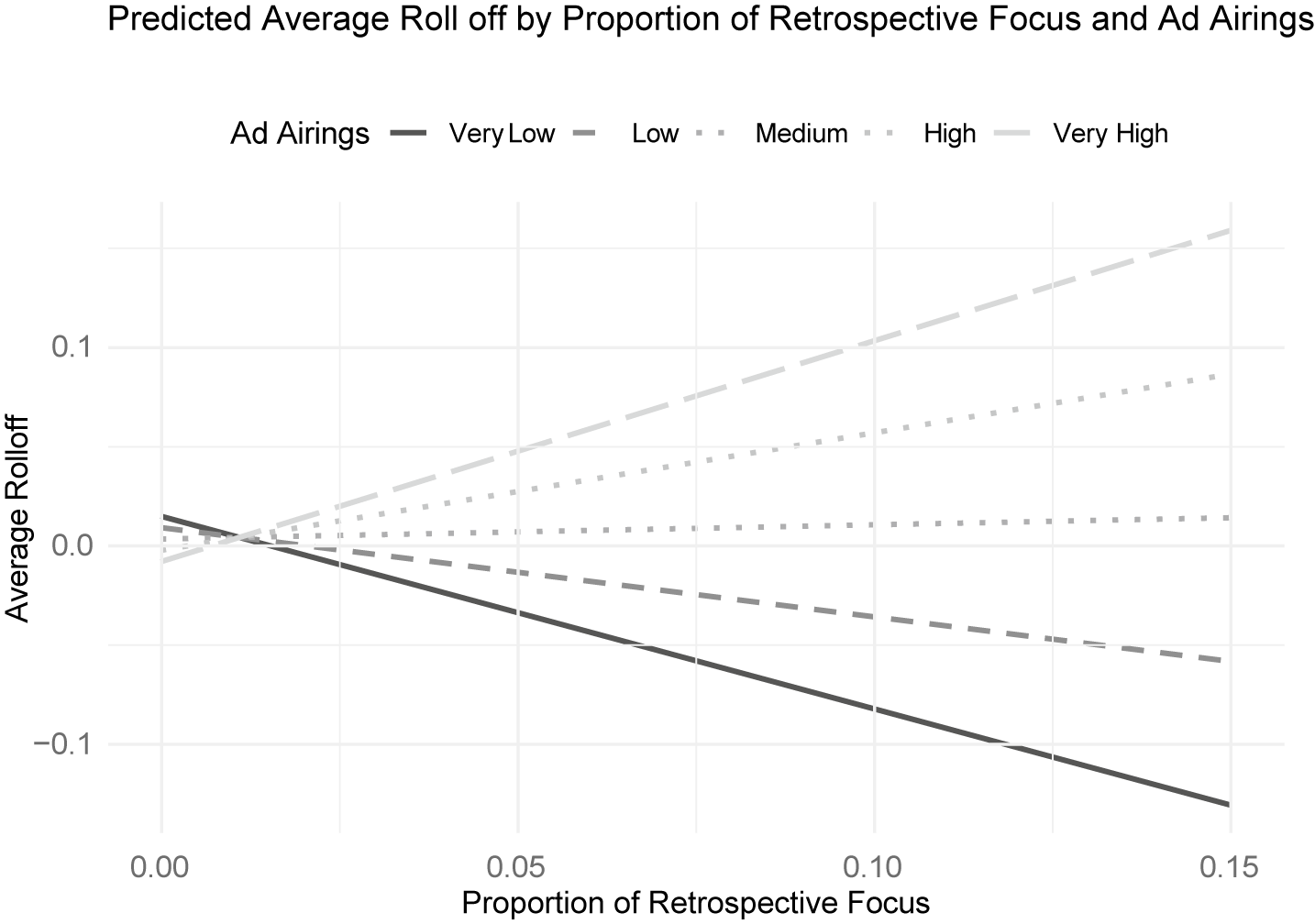
In Figure 2, I show the statistically significant interaction between the proportion of retrospective messaging and ad airings. For the reference lines, “Very Low” represents a logarithm of 3, which is approximately 20 ad airings; “Low” represents a logarithm of 4, which is approximately 55 ad airings; “Medium” represents a logarithm of 5, which is approximately 148 ad airings; “High” represents a logarithm of 6, which is approximately 403 airings; and “Very High” represents a logarithm of 7, which is approximately 1,096 airings. The figure illustrates that when there are 20 airings of an ad, average rolloff – which is the average participation of all judicial elections within an election – could decrease to as much as 12.4% if there is more retrospective messaging in the ad, thus increasing voter participation. However, when a campaign airs an ad 55 times, the average rolloff decreases from 1.8 to −5.1 percent as the proportion of retrospective messages increases in the ads. When I evaluate the ads that air with medium frequency (148 airings), I find that as the proportion of retrospective focus increases, ballot rolloff goes from 1.3% when there is no retrospective messaging to 2.2%. For high-frequency ads (403 airings), ballot rolloff increases when the proportion of retrospective increases, going from less than 1% rolloff to nearly 10% rolloff. Similarly, for very high-frequency ads (1,096 airings), the results show that as the proportion of retrospective increases, it goes from less than 1% rolloff to nearly 17%. Thus, there is a statistically significant interaction effect between the retrospective focus and ad airing variables, suggesting that if a campaign has the resources to air a particular ad many times, the campaign should avoid retrospective messaging, as such messaging appears to be most effective when aired sparsely. In addition, airing an ad at medium frequency seems to have only some effect on average ballot rolloff.
Predicted average rolloff by proportion of retrospective focus and ad airings. “Very Low” represents a logarithm of 3, which is approximately 20 ad airings; “Low” represents a logarithm of 4, which is approximately 55 ad airings; “Medium” represents a logarithm of 5, which is approximately 148 ad airings; “High” represents a logarithm of 6, which is approximately 403 airings; “Very High” represents a logarithm of 7, which is approximately 1,096 airings.

Figure 2. Long description
The x axis is labeled proportion of retrospective focus, ranging from 0 to 0.15. The y axis is labeled average rolloff, ranging from negative 0.1 to 0.15. Five lines represent ad airings levels: very low (solid), low (long dash), medium (dotted), high (dot dash), and very high (light solid). At the leftmost point, all lines start near zero. As the proportion of retrospective focus increases, the very low line slopes downward, reaching about negative 0.1 at the rightmost value. The low line also trends downward but less steeply. The medium line is nearly flat, slightly increasing. The high and very high lines slope upward, with very high increasing most steeply, reaching about 0.15 at the rightmost value. The legend at the top identifies line styles and corresponding ad airings: very low (logarithm 3, about 20 airings), low (logarithm 4, about 55), medium (logarithm 5, about 148), high (logarithm 6, about 403), very high (logarithm 7, about 1,096). The graph shows that higher ad airings amplify the positive effect of retrospective focus on average rolloff, while lower ad airings reverse the effect.
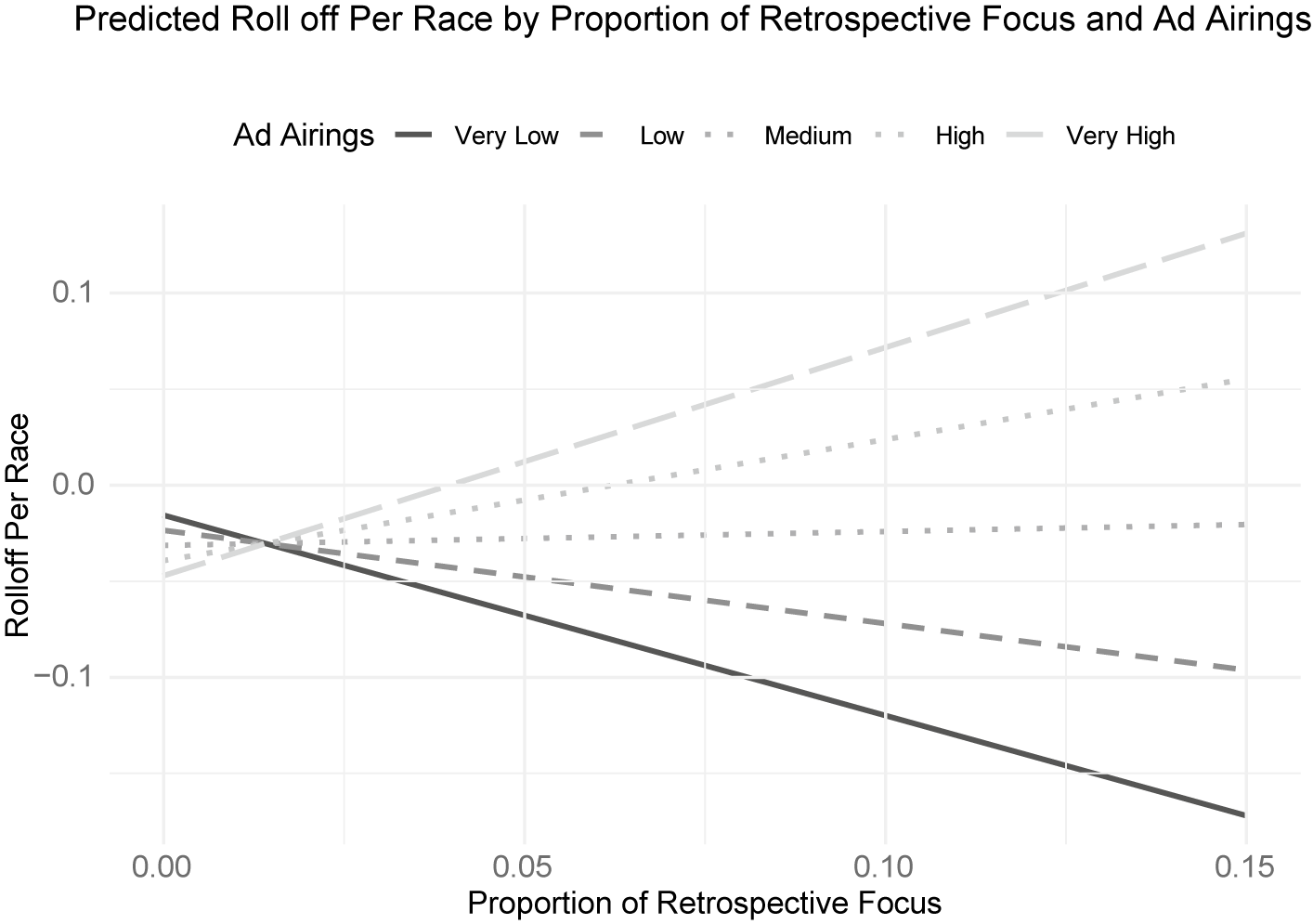
Then I examined the two competing hypotheses through the lens of ballot rolloff per race. The preceding analysis considered the average rolloff in all judicial races within an election, but this analysis will provide information on whether proportion of retrospective focus and ad airings influence the predicted rolloff per race. I find similar results to those of the model where I use average rolloff as the dependent variable. In Figure 3, I show that with very low number of ad airings and a higher proportion of retrospective messaging in the ads, rolloff per race could decrease by 16% per race. Similar to average ballot rolloff, it appears that fewer ads describing the past have a far more meaningful effect on motivating people to vote in specific races. Also, like average ballot rolloff, low airings of ads only have modest effect on average rolloff, with a 7.5% from no proportion of retrospective messaging to 15% of such messaging. Furthermore, my results show that when an ad with a medium proportion of retrospective focus airs frequently, ballot rolloff can increase up to 1%, suggesting that pouring resources into airing ads with a heavy retrospective focus could suppress voter participation in the specific race that features the candidates in the ad, especially in comparison to the effects of low and medium airings of ads. Finally, increasing ad airings and the proportion of retrospective messaging in those ads appears to discourage voter turnout per race. For high-frequency ads, ballot rolloff per race goes from −3.4% to nearly 6% rolloff, while ads that air with very high frequency, rolloff goes from less than −4.1% rolloff to nearly 14%.Footnote 18
Predicted race rolloff by proportion of retrospective focus and ad airings. “Very Low” represents a logarithm of 3, which is approximately 20 ad airings; “Low” represents a logarithm of 4, which is approximately 55 ad airings; “Medium” represents a logarithm of 5, which is approximately 148 ad airings; “High” represents a logarithm of 6, which is approximately 403 airings; “Very High” represents a logarithm of 7, which is approximately 1,096 airings.

Figure 3. Long description
The graph plots Rolloff Per Race on the y-axis and Proportion of Retrospective Focus on the x-axis. From left to right, five lines represent Very Low, Low, Medium, High, and Very High Ad Airings, as defined in the legend at the top. The Very Low line (solid, darkest) slopes downward, starting near zero and decreasing to about negative 0.13 as retrospective focus increases to 0.15. The Low line (long dash) is nearly flat but slightly negative. The Medium line (dot dash) is nearly flat but slightly positive. The High line (dotted) slopes upward, and the Very High line (solid, lightest) has the steepest positive slope, rising from near zero to above 0.1. All lines intersect near the origin. The legend clarifies that Very Low corresponds to about 20 ad airings, Low to about 55, Medium to about 148, High to about 403, and Very High to about 1,096 airings.
In Hypothesis 2, I posit that as television ad airings with a higher proportion of prospective messaging increase, voter participation in judicial elections decreases. I find that the frequency of television ad airings and the proportion of prospective messaging have no effect on the average ballot rolloff, the ballot rolloff per race, proportion of votes received, or a winning outcome.Footnote 19, Footnote 20 While frequency of ad airings and the proportion of retrospective messaging within those ads have a meaningful effect on different measures of voter participation, the interaction term of frequency of ad airings and prospective messaging does not move voter participation.Footnote 21, Footnote 22
Discussion and conclusion
In 2006, former Associate Justice Sandra Day O’Connor of the US Supreme Court, who served as an Arizona Supreme Court justice prior to her ascent to the Court, publicly expressed regret over her vote in the White case by saying, “That case, I confess, does give me pause.” Rarely are retired justices so candid about their regrets, and O’Connor’s confession may have intensified the rising concerns over judicial independence that shaped legal debates in the mid-2000s. However, the findings in this article suggest that future-focused language does not have much of an effect on voter participation in judicial races as a whole, even when the campaign has the resources to air a specific ad thousands of times.
Although prospective messaging is not much of an issue in television advertising in judicial elections, the results show that frequent airings of ads featuring a higher proportion of retrospective messaging could demobilize voters in individual judicial elections and judicial races more broadly. While prospective messaging may explicitly make campaign promises, voters may perceive retrospective messaging as better evidence of how the candidates would act when they do enter office. Retrospective messaging may not be explicitly prospective in nature, but voters may infer retrospective messaging as a more trustworthy harbinger of a candidate’s prospective actions. Voters may perceive prospective messages as fluff and consider them irrelevant to their broader decision-making calculus.
Given that retrospective messaging provides information about the candidates’ prior experiences, it is surprising that a higher frequency of ads that includes more retrospective messaging could deter voters from participating in judicial elections. Voters have the information and are frequently exposed to it; their knowledge should equip them to participate in the elections. Unfortunately, voters also do not enjoy overt politicization of the judiciary and such behaviors may decrease perceived legitimacy of the courts. Also, with more frequent reminders that the candidates running for a seat in the judiciary have aligned themselves with a particular policy in the past, voters may not see them as mere partisan cues that hint at how they might conduct themselves on the bench, but as an ambush on the integrity of the institution. Most importantly, campaigns should aim for keeping as many of the voters who are there to vote for the top of the ballot race, and the results suggest that the optimal number of ad airings – where the campaign will not lose or gain voters – is around 150 ad airings. With this number of ad airings, it does not seem to matter how much retrospective or prospective content campaigns put into the ads as the campaigns will save a majority of voters from rolling off.
This observational study sheds information on the relationships between exposure, messaging, and voter participation. Going forward, scholars should consider an experiment in which specific respondents are exposed to ads with retrospective and prospective messaging over a period of time, and observe whether the respondents are more likely to vote in those elections, or whether candidates are more likely to receive the lion’s share of the votes with the assistance of particular types of messaging in the ads. In addition, scholars should also consider other types of messaging that could influence voter participation in judicial elections, such as evoking specific social issues, such as religious freedom or reproductive health.
This study contributes to further understanding the broader effects of resources that are now inundating judicial elections. Recognizing that increased exposure to ads with high proportions of retrospective language could deter voter participation in judicial elections can help campaigns strategically craft their messages and allocate their resources. Taking into account that prospective messages have no effect in mobilizing voters, voters may not put much credence into mere campaign promises. Or, if campaigns want to play it safe, they should not air too many or too few ads, and aim for the rolloff “sweet spot” where they will not lose voters and do not have to take particular care whether they are including too much retrospective messaging. As advertising on television and online become integral to the modern judicial election landscape, campaigns should carefully consider what kind of messages and at what frequency draw voters, and avoid what turns voters away.
Supplementary material
The supplementary material for this article can be found at http://doi.org/10.1017/spq.2026.10026.
Data availability statement
Replication materials are available on SPPQ Dataverse at https://doi.org/10.7910/DVN/BWWX1B (Shieh 2026).
Acknowledgements
I am grateful for comments from Tao Dumas, Lisa Holmes, Adeline Lo, Ellie Powell, Wendy Martinek, Michael Olson, Ryan Owens, Alex Tahk, Teena Wilhelm, the excellent research assistance of Hayden Coss and Nick Rogers, attendees at Democracy of the US States at Pennsylvania State University in 2023, MPSA 2022, APSA 2022, the Cultivating Networks & Innovative Scholarship in Law and Courts Workshop, the Law and Courts Women’s Writing Group, the anonymous journal reviewers, and the generous sharing of ballot rolloff data from Melinda Gann Hall, David Hughes, and Bert Kritzer.
Funding statement
The author received conference travel funds for the presentation of this work from the Elections Research Center at the University of Wisconsin-Madison, but no further financial support was provided for the research, authorship, and/or publication of this article.
Competing interests
The author declares no potential competing interests with respect to the research, authorship, and/or publication of this article.
Author biography
Marcy Shieh is an Assistant Professor in the Department of Politics, Government, and Law at the University of Wisconsin-Whitewater. She earned her PhD at the University of Wisconsin-Madison. She has published in academic journals including Political Research Quarterly, American Politics Research, The Journal of Law and Courts, Social Science Quarterly, and other outlets.




 Open access

