


Introduction
Churches and religious organizations have long been recognized as important sources of social capital. The sense of duty to the poor is central to all major religions, which especially urges religious people, it is often claimed, to engage in social activities on behalf of others in need (cf. Batson et al. Reference Batson, Schoenrade and Ventis1993, pp. 331–364 for a detailed account of this relationship). This supposed link between religion and voluntary action is also established empirically in countries like for instance the US (Jackson et al. Reference Jackson, Bachmeier, Wood and Craft1995; Putnam Reference Putnam2000; Lam Reference Lam2002), Canada (Berger Reference Berger2006; Perks and Haan Reference Perks and Haan2011) and various European countries (Reitsma Reference Reitsma2007; Savelkoul et al. Reference Savelkoul, Gesthuizen and Scheepers2011). Also in the Netherlands this link is found. For instance, De Hart (Reference De Hart and Dekker1999) found that the majority of Dutch volunteers is affiliated to a Christian denomination even when religious voluntary work is left out of consideration. In addition, he also found that especially church attendance matters in this respect. People who attend church more often are more likely to be engaged in voluntary work even if this is non-religious voluntary work. A similar finding is reported by Ruiter and De Graaf (Reference Ruiter and Graaf2006), who studied the relationship between religion and volunteering by analysing data from 53 countries. They too found that especially church attendance, more than mere church membership, determines volunteering. An effect of church attendance these authors explain in terms of network-theory; i.e. people who attend church are involved in local close-knit networks in which engagement in voluntary action has become a social norm difficult to ignore. In line with this network explanation are also findings of Jackson et al. (Reference Jackson, Bachmeier, Wood and Craft1995), Park and Smith (Reference Park and Smith2000) and Becker and Dhingra (Reference Becker and Dhingra2001). Jackson et al. studied a sample of 800 Indiana residents and found that participation in church groups increases non-religious volunteering, but when controlled for church group participation church attendance has no significant effect on volunteering. Park and Smith studied a US sample of churchgoing Protestants and again found that the participation in church activities more than church attendance increases the likelihood of religious as well as non-religious volunteering. Similarly, Becker and Dhingra (Reference Becker and Dhingra2001, p. 326) concluded that “(…) much of the ‘church effect’ on volunteering operates through friendship networks. (…). Those who consider congregation members among their closest friends are much more likely to volunteer.” In sum, this network explanation stresses the importance of close social bonds and thus accounts for the influence of religion by referring to its unmistakable social character. Especially religion brings people together in local communities and congregations, which urges them to volunteer (Putnam Reference Putnam2000, p. 67).
Although this network explanation is plausible, there is an underlying difficulty especially if it is applied to the Netherlands or other West-European countries. For the past decades the Netherlands have been characterized by an ongoing process of religious disaffiliation (Becker and De Hart Reference Becker and De Hart2006; Bernts et al. Reference Bernts, Dekker and De Hart2007), but as yet this has not resulted in a significant drop in volunteering with still 43% of the Dutch population being engaged in unpaid work for a non-profit organization in 2010 (Schuyt et al. Reference Schuyt, Gouwenberg and Bekkers2011; cf. also Van Ingen Reference Van Ingen2008 for trends in hours spent per week on volunteering). This makes one wonder if the network explanation still holds. Does religion only facilitate volunteering because it offers social networks or does it also facilitate volunteering in other ways? In view of this question, we focus on an aspect of religion not very often discussed in literature: religious socialization. Taking advantage of advanced panel data on religious socialization during adolescence in Christian families and adult volunteering later in life, we test the hypothesis that being raised in a religious way by one’s parents strengthens one’s propensity to volunteer later in life even if one has already lapsed as an adult. If this hypothesis holds, the network explanation is extended in an important respect. For it is shown, then, that orientations towards a religious community early in life continue to be influential well into adulthood and affect a person’s orientation towards civil society.
Theoretical Background and Research Question
Religious socialization concerns the conscious and deliberate attempt of parents to transmit their religious beliefs and commitment to their children. Something parents primarily do by establishing a religious climate in the family, which among other things may imply taking their children to church, attending church themselves, offering religious education to their children, conducting religious practices at home et cetera (Vermeer et al. Reference Vermeer, Janssen and De Hart2011). Now, there are several reasons why religious socialization thus understood may be important in view of adult volunteering. To begin with, it is important for integrating children in a religious community as well as for the inculcation of religious values. Thus, already at an early age children learn to orient themselves towards a community beyond the family and may also internalize prosocial values (Park and Smith Reference Park and Smith2000). Moreover, since several studies established a link between church attendance and volunteering, as we already mentioned in the introduction, there is a good chance that religious parents, who raise their children in a religious way, are volunteers themselves and thus these parents may also serve as important models for prosocial behaviour. Hence, religious socialization could in part also be an initiation into volunteering (Wilson and Janoski Reference Wilson and Janoski1995). But perhaps most important is age. Since religious socialization processes at least partly take place during the formative years of adolescents, they may have a lasting effect on their identity and their social orientations (Vollebergh et al. Reference Vollebergh, Iedema and Raaijmakers2001; Perks and Haan Reference Perks and Haan2011). Even if these adolescents lapse later in life, they may still have internalized a lasting orientation towards the broader community. In our opinion, therefore, it is consistent with these socialization theories and plausible to propose that religious socialization processes in the family are positively related to volunteering later in life.
However, in the Netherlands being socialized in a religious community is not a strong determinant for church attendance later in life (Vermeer et al. Reference Vermeer, Janssen and De Hart2011). Most children disaffiliate despite the fact that they were raised in a religious way by their parents. But exactly this phenomenon could explain, at least for now, why a drop in church attendance not necessarily induces a decline in volunteering. Perhaps a substantial part of today’s volunteers was still raised in a religious way by their parents and could thus have developed a propensity to volunteer, which remained influential throughout their lives even if they already lapsed (cf. also Bekkers and Schuyt Reference Bekkers and Schuyt2008, p. 93). If this explanation is correct, the stable figures in volunteering could in part be interpreted as an aftereffect of the religious socialization a lot of today’s volunteers presumably enjoyed as a child. But this would also be a temporary aftereffect, because those who lapsed will probably no longer socialize their own children in a religious community (Voas and Crockett Reference Voas and Crockett2005). So, the effect of a religious socialization we hint at here especially concerns a specific cohort; i.e. lapsed churchgoers who were socialized in a religious community by religious parents. Especially for this group, we assume that a religious socialization has an effect on volunteering. An effect which will be less strong for those who are still churchgoers, and who are thus involved in a contemporary socio-religious network, and which will be absent of course for those who have never been socialized religiously. Studying the effect of religious socialization on volunteering later in life thus offers an important extension of the network explanation, if it is shown that among lapsed churchgoers earlier orientations towards a religious community indeed remain influential throughout their lives.
But instead of looking for an extension of the network explanation, it is also possible to consider real alternatives. According to sociologists like Davie (Reference Davie2007), a large part of the European population still adheres to religious beliefs although most Europeans are no longer committed to a religious community. Hence, an alternative to the network explanation could be that nowadays especially individual aspects of religiosity affect volunteering. Several Dutch scholars have, therefore, tested the hypothesis that next to collective aspects of religiosity, like church membership and church attendance, also individual aspects, like religious convictions or religious experiences, are important motivators for volunteering. However, the results are ambivalent. Stronger effects for individual religiosity than for collective religiosity were only found by Reitsma (Reference Reitsma2007), who used an extensive sample of residents of 11 European countries to study the relative effect on non-religious and religious volunteering of several indicators of individual religiosity, like: private prayer, dogmatic conviction, religious particularism, religious experience and the perceived influence of religion on one’s daily life. Similarly, using a random sample of the Dutch population, Bekkers and Schuyt (Reference Bekkers and Schuyt2008) studied the effect of, what they called, ‘community’ (collective religiosity) and ‘conviction’ (individual religiosity) on volunteering, but contrary to the findings of Reitsma (Reference Reitsma2007) they again found that collective aspects of religiosity are most important in explaining religious volunteering. However, when it comes to non-religious volunteering they did also find some evidence of the effect of altruistic values mediated by church attendance. Different effects of collective and individual religiosity on volunteering for the Dutch population were again specifically studied by Van Tienen et al. (Reference Van Tienen, Scheepers, Reitsma and Schilderman2011). Instead of distinguishing between religious and non-religious volunteering, they distinguished between formal volunteering, i.e. voluntary work for an association, and informal volunteering, i.e. providing practical help to others, looking after children et cetera. They again found that church attendance is the most crucial religious aspect for explaining formal volunteering. Only with regard to informal volunteering, they found a weak effect of ‘spirituality’ and no effect of collective religiosity.
The aforementioned Dutch studies thus reveal ambivalent results regarding the relative effects of individual and collective religiosity on volunteering. In this respect, the results of these studies in large part resemble the results of American studies by for instance Cnaan et al. (Reference Cnaan, Kasternakis and Wineburg1993), Lam (Reference Lam2002) and Taniguchi and Thomas (Reference Taniguchi and Thomas2011). Although these latter studies specifically included several aspects of individual religiosity and indeed revealed some effects of these aspects, non-religious volunteering was again best explained by collective aspects such as being involved in a religious organization or attending church. All things considered, then, studying the effect of individual aspects of religiosity does not seem to be a fruitful alternative to the network explanation, which, in our opinion, again underscores the importance of studying the effect of religious socialization as a valuable extension of the network explanation.
As mentioned already, next to the effect of the contemporary involvement in a socio-religious network, we expect that religious socialization during adolescence also has a lasting effect on one’s propensity to volunteer. Thus, we actually look for an independent effect of religious socialization on volunteering. For only an independent effect shows that early religious socialization experiences still determine adult volunteering behaviour next to the possible effect of being involved in a socio-religious network or the possible effect of individual aspects of religiosity; the latter we also consider for reasons of comparison with previous studies. As a result, the following research question is addressed in this paper: To what extent does a religious socialization in Christian families during adolescence, independent of individual and collective religious characteristics, determine non-religious volunteering later in life? As previously mentioned, we will answer this research question taking advantage of a panel dataset containing information of the same respondents as youths, gathered in 1983, and as adults, gathered in 2007. This is already an important contribution to the existing body of research in which panel data are rarely used. In addition, also our explicit focus on religious socialization as well as our multidimensional operationalization of this concept are important contributions to the existing body of literature on the link between religion and volunteering.
Method
Respondents
This study partially replicates a study carried out by De Hart (Reference De Hart1990) in 1983 into the religious and political activities of Dutch teenagers. De Hart carried out a random sample survey among 3,532 Dutch secondary school students who at that time were in the higher grades of pre-university (VWO) or pre-college (HAVO) programmes. De Hart collected a sample that was considered representative of the whole population of higher grade VWO and HAVO students in the Netherlands.Footnote 1 Using the old address file from 1983, 834 of these students were traced in 2006. In the first half of 2007, a questionnaire was sent to these 834 former participants, enquiring after several dimensions of their upbringing as well as their current religious beliefs and practices including their engagement in voluntary action. By the end of July 2007, 474 completed questionnaires had been returned; a response rate of 56.8% relative to the 834 questionnaires we sent. Our subsample of De Hart’s original sample thus includes 474 respondents, with an average age of 39.7 years, who were interviewed both in 1983 and in 2007. It is important to note that only those former students were contacted who had, in 1983, agreed in writing to participate in future research.
Given the fact that ‘only’ 474 out of the initially 3,532 surveyed respondents were included in the second wave, the level of attrition of our study is high. Still, we need to bear in mind that our study covers an unusually long period of over 20 years and that attrition only causes problems if our subsample is not representative of De Hart’s original sample in some important way (cf. Perks and Haan Reference Perks and Haan2011). It is interesting to enquire, therefore, whether the present subsample is still a random subsample of the original 1983 sample. Comparisons of gender, church attendance and religious affiliation have revealed that this is not the case. Compared to the overall sample from 1983, our subsample in 2007 contains significantly more women and also more churchgoers than one would expect to find on the basis of the 1983 sample. Only when it comes to religious affiliation, the actual numbers of Dutch Reformed, Catholics and Re-Reformed pretty well resemble the numbers expected on the basis of the 1983 sample. Thus, in the present subsample especially churchgoers are overrepresented. But since we are interested in the effect of the respondents’ religious background on volunteering, we do not think that this overrepresentation of churchgoers in an otherwise very secular subsample causes problems here.
Although De Hart’s original sample was never intended to be representative of all Dutch secondary school students of that time, it was only representative of those attending the higher levels of secondary education, it is nevertheless interesting to also look at the correspondence of our subsample with the Dutch population aged around forty.Footnote 2 This gives us a better insight into the specific profile of our subsample. To this end, comparisons were made of such general characteristics as gender, income, marital status and education. We also, by comparing church attendance and religious affiliation, studied its correspondence with the general Dutch population in respect of involvement in institutional religion. Compared to the general Dutch population, then, in our subsample women are again overrepresented, both the lowest and the highest income categories are overrepresented, marriage rates are higher, divorce rates lower and the level of education much higher. In addition, it again turns out that our subsample contains more churchgoers and, in particular, more Dutch Reformed. Apart from these latter religious variables, which are important independent variables in our study, the other socio-demographic characteristics, i.e. gender, income, marital status and education, will be included in our analyses as controls.
Measures
Our respondents were questioned in 1983 (Wave 1) and in 2007 (Wave 2). In 1983, De Hart (Reference De Hart1990) questioned them about their religious socialization in the family. More specifically, he tried to capture the religious climate of the families they were raised in by enquiring after: the importance of religion to the respondents’ father and mother, the importance of religious education in the family, the noticeable effect of religion on the daily lives of their father and mother, the respondents’ level of church attendance at the age of ten, the level of church attendance of their father and mother, the frequency of bible reading and the frequency of prayer in the family. In 2007, we assessed the respondents’ belief in God, their level of orthodoxy and we also enquired if they ever experienced a sense of transcendence or mystical union. Next to these individual aspects of religiosity, we also enquired after several collective aspects of religiosity such as: the respondents’ level of church attendance, their involvement in a religious community and their religious affiliation. Finally, the respondents’ involvement in non-religious volunteering was also assessed in 2007. The following measures were used for the dependent variable, the aspects of individual and collective religiosity, for religious socialization and for the control variables.
Dependent Variable (Wave 2)
First, a question enquiring after earlier engagements in voluntary work was posed to our respondents. This question offered a list of several non-religious activities respondents could choose from, like being active in health care, the environment, elderly, refugees et cetera. Immediately thereafter, non-religious volunteering was measured by the single question: “Are you currently involved in volunteering?” Respondents could answer “yes” or “no” to this question. Although there is no explicit mentioning of ‘non-religious’ in this question, it addresses non-religious volunteering, because the previous question concerning earlier engagements in voluntary work already focused the respondents on secular activities.
Independent Variables—Individual Religiosity (Wave 2)
Belief in God was measured by the question: “Do you believe in a personal God?” The scale ran from 1 “no” to 5 “absolutely”. The level of orthodoxy was measured with the help of an instrument from the European Values Studies (Ester et al. Reference Ester, Halman and De Moor1993; Halman Reference Halman1991), which enquires into respondents’ belief in seven traditional Christian doctrines: life after death, the soul, the devil, hell, heaven, sin and the resurrection.Footnote 3 Respondents could answer “yes”, “no” or “don’t know”. This third category was recoded as “no”, whereupon the times respondents answered “yes” were simply summed. In this way a scale of orthodoxy ranging from 0 to 7 was created, with a higher score indicating a higher level of orthodoxy. On this scale the corrected item total correlations range from .53 to .79 and Cronbach’s alpha is .87. As regards the respondents’ experiences of transcendence and mystical union, a set of sixteen items derived from Hood’s Mysticism Scale and from Cloninger’s temperament and character inventory, subscale ‘self-transcendence’ was used. An example of an item on the experience of mystical union from Hood (Reference Hood2001) is: “I have had an experience in which I lost all sense of time and space.” An example of an item relating to an experience of transcendence from Cloninger’s self-transcendence subscale is: “I often feel part of a spiritual force on which all life depends” (Duijsens et al. Reference Duijsens, Spinhoven, Goekoop, Spermon and Eurelings-Bontekoe2000). The scale ran from 1 “not at all” to 5 “yes”. Factor analysis revealed that two factors underlie these sixteen items: experience of mystical union and experience of transcendence (factor loadings ≥ .53; explained variance 55.7%; Cronbach’s alpha .90 and .91, respectively).
Independent Variables—Collective Religiosity (Wave 2)
Church attendance was assessed by asking: “How often do you go to church or attend religious services?” The scale ran from 1 “never” to 7 “regular: at least three times a month”. Respondents’ involvement in a religious community was measured by asking: “Are you active in church or a religious community other than attending religious services?” Respondents could answer “yes” or “no” to this question. With regard to their religious affiliation, respondents could choose between: 1 “Catholic”, 2 “Dutch Reformed”, 3 “Re-Reformed”, 4 “other Christian denomination” and 5 “no affiliation”.Footnote 4
Independent Variables—Religious Socialization (Wave 1)
As mentioned above, information regarding the respondents’ religious socialization was gathered in the first wave in 1983. The importance of religion (religious saliency) to the respondents’ father and mother was measured with the help of the following question: “Is religion of importance in the life of your father/mother?” The scale ran from 1 “unimportant” to 5 “very important”. The importance of religious education in the family was assessed by asking: “Is religious education an important aspect of your upbringing in the family?” Again the scale ran from 1 “unimportant” to 5 “very important”. With regard to the noticeable effect of religion on the parents’ daily life, the question posed was: “Do you notice that your father’s/mother’s religious faith influences his/her daily life?” Respondents could answer “yes” or “no” to this question. The respondents’ church attendance at the age of ten was assessed by asking: “How often did you go to church or attend religious services when you were 10 years old?” And with regard to the church attendance of their father and mother, the question used was: “How often does your father/mother go to church or attend religious services?” The scales were similar to the scale for the respondents’ adult church attendance ranging from 1 “never” to 7 “regular: at least three times a month”. Bible reading in the family was measured by asking: “Does reading in the bible take place in your family?” The scale ran from 1 “never” to 5 “regular” And, finally, with regard to the practice op prayer, the question posed was: “Does prayer or saying grace take place in your family?” Here, the scale ran from 1 “never” to 5 “daily”.Footnote 5
Control Variables (Wave 2)
The control variables included in our study not only refer to the specific socio-demographic profile of our subsample, but are also known to influence the likelihood of non-religious volunteering. Thus, we include gender, income, marital status and education in our analyses and also consider the influence of having children. Women may be more inclined to volunteer, just like people from higher income categories, people who are married or people who are well-educated. Similarly, having children also increases people’s integration in their social network, which in turn may increase their propensity to volunteer (Park and Smith Reference Park and Smith2000; Ruiter and De Graaf Reference Ruiter and Graaf2006; Van Tienen et al. Reference Van Tienen, Scheepers, Reitsma and Schilderman2011). These control variables were measured as follows. Income was assessed by the question: “What is your monthly gross salary?” The response scale ran from 1 “less than 2000 Euro” to 8 “more than 5000 Euro”. Respondents could state their marital status by choosing between: 1 “married”, 2 “not married and single”, 3 “living with a partner to whom one is not married” and 4 “divorced”. Education was assessed by asking the respondents to state the highest level of education they had completed. The response scale ran from 1 “junior general education” to 6 “university”. And, finally, respondents could state whether or not they have children by simply answering “yes” or “no”.
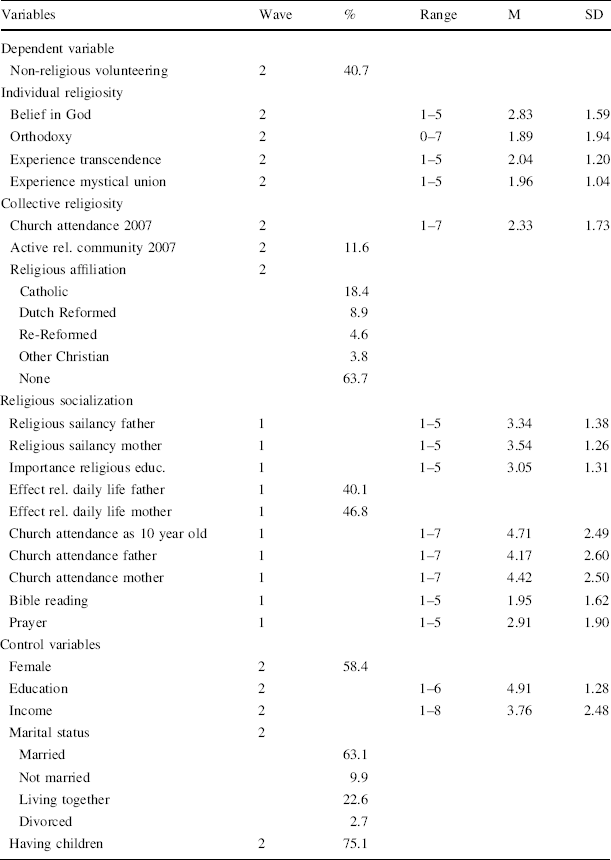
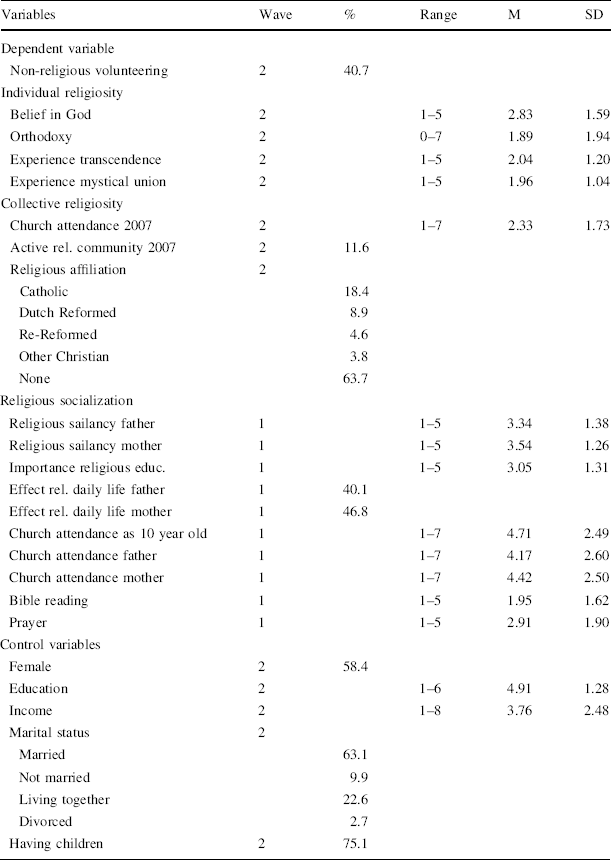
Percentages, range, means and standard deviations of these variables are presented in Table 2 in the Appendix.
Strategy for Analysis
Since our dependent variable is a binomial variable, we used logistic regression for estimating three regression models for the likelihood to engage in non-religious volunteering. The first model contains the individual and collective aspects of religiosity and the control variables, the second model the different aspects regarding religious socialization and the control variables and the third model contains all variables. This strategy enables us: to determine the effect of several aspects of individual and collective religiosity, often mentioned in the literature, on volunteering (Model 1); to determine the effect of religious socialization on volunteering (Model 2); and, finally, to test if a possible effect of religious socialization still holds if aspects of individual and collective religiosity are added to the equation (Model 3).
Results
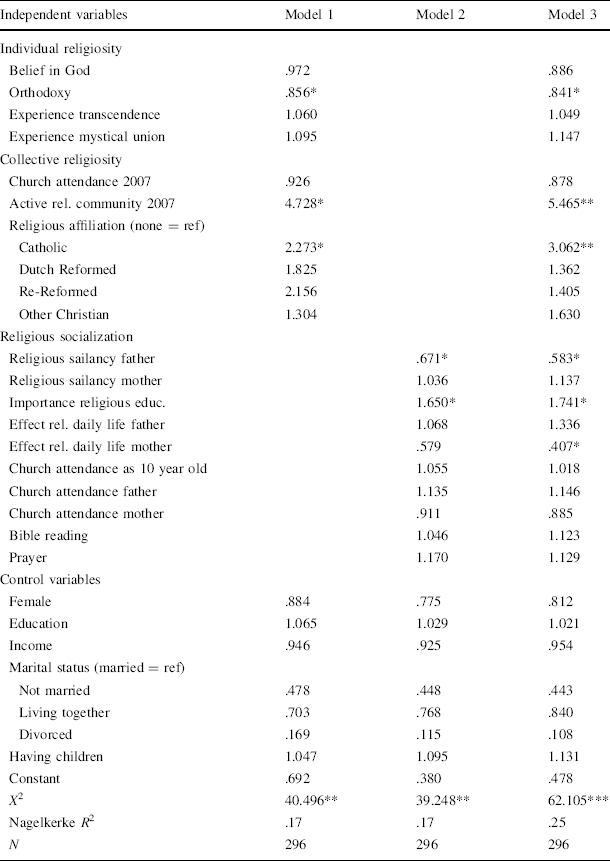
Table 1 presents the results of the estimation of three regression models. In view of our research question, the third model is most important. This model clearly shows that there is indeed an independent, enduring effect of religious socialization on non-religious volunteering over and beyond the effect of individual and collective religiosity. Moreover, the inclusion of several aspects of religious socialization also results in a substantial increase of the explained variance from .17 to .25. The full model thus better explains non-religious volunteering than the model only including the individual and collective aspects of religiosity, i.e. Model 1, or the model only including the aspects of religious socialization, i.e. Model 2.
Odds ratios for non-religious volunteering

|
Independent variables |
Model 1 |
Model 2 |
Model 3 |
|---|---|---|---|
|
Individual religiosity |
|||
|
Belief in God |
.972 |
.886 |
|
|
Orthodoxy |
.856* |
.841* |
|
|
Experience transcendence |
1.060 |
1.049 |
|
|
Experience mystical union |
1.095 |
1.147 |
|
|
Collective religiosity |
|||
|
Church attendance 2007 |
.926 |
.878 |
|
|
Active rel. community 2007 |
4.728* |
5.465** |
|
|
Religious affiliation (none = ref) |
|||
|
Catholic |
2.273* |
3.062** |
|
|
Dutch Reformed |
1.825 |
1.362 |
|
|
Re-Reformed |
2.156 |
1.405 |
|
|
Other Christian |
1.304 |
1.630 |
|
|
Religious socialization |
|||
|
Religious sailancy father |
.671* |
.583* |
|
|
Religious sailancy mother |
1.036 |
1.137 |
|
|
Importance religious educ. |
1.650* |
1.741* |
|
|
Effect rel. daily life father |
1.068 |
1.336 |
|
|
Effect rel. daily life mother |
.579 |
.407* |
|
|
Church attendance as 10 year old |
1.055 |
1.018 |
|
|
Church attendance father |
1.135 |
1.146 |
|
|
Church attendance mother |
.911 |
.885 |
|
|
Bible reading |
1.046 |
1.123 |
|
|
Prayer |
1.170 |
1.129 |
|
|
Control variables |
|||
|
Female |
.884 |
.775 |
.812 |
|
Education |
1.065 |
1.029 |
1.021 |
|
Income |
.946 |
.925 |
.954 |
|
Marital status (married = ref) |
|||
|
Not married |
.478 |
.448 |
.443 |
|
Living together |
.703 |
.768 |
.840 |
|
Divorced |
.169 |
.115 |
.108 |
|
Having children |
1.047 |
1.095 |
1.131 |
|
Constant |
.692 |
.380 |
.478 |
|
X 2 |
40.496** |
39.248** |
62.105*** |
|
Nagelkerke R 2 |
.17 |
.17 |
.25 |
|
N |
296 |
296 |
296 |
* p < .05, ** p < .01, *** p < .001
As far as the effect of religious socialization is concerned, the full model shows that three aspects are related to non-religious volunteering. Being raised by a father for whom religion is important and by a mother whose daily life is influenced by religion appear to be negative determinants for non-religious voluntary action, whereas being raised in a family in which religious education was considered important, in contrast, increases the odds of being involved in voluntary action. Hence, raising children religiously may indeed strengthen their propensity to volunteer later in life. But such a religious upbringing must perhaps not be too ‘strict’, as parents who are overtly religious seem to decrease the odds of their children becoming non-religious volunteers.
Apart from these aspects of religious socialization, several aspects of individual and collective religiosity are also related to non-religious volunteering. Orthodoxy, as an instance of individual religiosity, is negatively related to non-religious volunteering. This is partly in line with the findings of Reitsma (Reference Reitsma2007), who found that religious particularism, i.e. the conviction that there is only one religious truth, is negatively related to non-religious volunteering. In contrast, instances of collective religiosity like being involved in a religious community and religious affiliation are positively related to non-religious volunteering. Being actively involved in a religious community appears to be the most important determinant in this respect, which is a clear illustration of the so-called ‘spillover effect’ (Ruiter and De Graaf Reference Ruiter and Graaf2006; Van Tienen et al. Reference Van Tienen, Scheepers, Reitsma and Schilderman2011). In addition, it also turns out that being involved in a religious community is more important than merely attending church, a finding similar to results reported by Jackson et al. (Reference Jackson, Bachmeier, Wood and Craft1995), Park and Smith (Reference Park and Smith2000) and Becker and Dhingra (Reference Becker and Dhingra2001). Next to the involvement in a religious community also religious affiliation is of importance here. Compared to those who are not affiliated, especially Catholics are more likely to be engaged in non-religious voluntary action. This contradicts the findings of De Hart (Reference De Hart and Dekker1999), who found that the percentage of both religious and non-religious volunteers is highest among the Re-Reformed, as well as the findings of Scheepers and Janssen (Reference Scheepers and Janssen2003), who did not find clear differences between denominations in this respect, but it is perfectly in line with recent findings of Bekkers and Schuyt (Reference Bekkers and Schuyt2008) who found that in the Netherlands especially Catholics are more involved in non-religious than religious volunteering.Footnote 6
Overall, our results thus show that those who are already active in a religious community and who are Catholic rather than non-affiliated are most likely to be engaged in non-religious voluntary action. But, in addition, our results also show that the odds of being involved in non-religious volunteering further increase if one was raised in a family in which religious education was considered important, while the odds decrease if one was raised by parents who were overtly religious or if one is an orthodox believer. And these effects are independent of the possible influence of gender, education, income, marital status and having children, since we did not find any relationship between these control variables and the odds of becoming a non-religious volunteer.
Discussion
In the introduction, we referred to the following somewhat paradoxical situation: although there is a link between religion and volunteering, declining levels of church attendance in the Netherlands have as yet not resulted in declining levels of volunteering. In order to account for this situation, we tested the hypothesis that volunteering is perhaps an aftereffect of the religious socialization some of today’s volunteers enjoyed as a child. Consequently, we addressed the following research question: To what extent does a religious socialization in Christian families during adolescence, independent of individual and collective religious characteristics, determine non-religious volunteering later in life? A question we may now answer as follows: There is indeed a positive effect of religious socialization, i.e. of being raised by parents who consider the religious upbringing of their children of importance, on the likelihood of becoming involved in non-religious volunteering later in life. This is also an independent, enduring effect of religious socialization, because this effect persists even when aspects of individual and collective religiosity are added to the equation. As to conclude this article, we would like to discuss four issues.
To begin with, despite this positive effect of religious socialization on non-religious volunteering, our study still confirms the network explanation as aspects of collective religiosity remain the most important religious determinants for adult non-religious volunteering. Religious affiliation and being actively involved in a religious community are the most important determinants we found in this respect, which is in line with the aforementioned Dutch studies of De Hart (Reference De Hart and Dekker1999) and Ruiter and De Graaf (Reference Ruiter and Graaf2006) as well as with the US studies of Jackson et al. (Reference Jackson, Bachmeier, Wood and Craft1995), Park and Smith (Reference Park and Smith2000) and Becker and Dhingra (Reference Becker and Dhingra2001). Moreover, our results are also an illustration of the so-called spillover effect. That is to say, religious volunteering seems to promote non-religious volunteering. This finding shows that churches are still important sources of social capital, but which immediately raises the question about the future of non-religious voluntary work in the Netherlands. For, the ongoing process of secularization in the Netherlands will certainly affect the level of religious volunteering and, because religious volunteering has such a strong spillover effect, it will eventually also affect the level of non-religious volunteering, as Ruiter and De Graaf (Reference Ruiter and Graaf2006, p. 207) quite rightly argue.
Nevertheless, as an extension of the network explanation, our study does render support for the assumption that a religious socialization during adolescence is positively related to volunteering later in life. It clearly shows that experiences with religion during adolescence are positively related to adult non-religious volunteering. Hence, religious socialization indeed seems to make a difference even after 23 years. This finding confirms the common notion in socialization theory, that adolescence is an important formative phase for the development of certain cultural orientations (Vollebergh et al. Reference Vollebergh, Iedema and Raaijmakers2001). And, apparently, adolescence is also an important phase for the internalization of prosocial values. However, we must admit that some reservation is in place here. Recently, Bekkers (Reference Bekkers2007; cf. also Van Houwelingen et al. Reference Van Houwelingen, De Hart, Den Ridder, van den Broek, Bronneman-Helmers and Veldheer2010) has shown, that also parental volunteering itself determines non-religious volunteering in the next generation. This is considered an effect of parental modelling, which even persists when some of the aspects of religious socialization included in our study are controlled for. Now, Bekkers did not use panel data, respondents retrospectively answered questions about their parents’ volunteering, nor did he use our multidimensional operationalization of religious socialization, but his findings nevertheless challenge our results. If there is indeed a modelling effect of parental volunteering on volunteering in the next generation, it is possible that the non-religious volunteering of our respondents as adults is to some extent the effect of the modelling behaviour of their parents. Even more so, if we bear in mind that religious parents are more likely to be volunteers themselves. Thus, respondents who were raised in a religious way by their parents, probably were also confronted with parents who modelled volunteering. A more robust test of a possible independent effect of religious socialization on adult non-religious volunteering would, therefore, require that also the former, and perhaps also the current, volunteering activities of the parents were taken into account. Unfortunately, we were not able to do this, since our dataset contains no information on the voluntary activities of the respondents’ parents. Although this does not change the fact that we did find an independent effect of religious socialization on volunteering later in life, we admit that considering the possible effect of parental modelling behaviour on volunteering in the next generation should be an important point of interest in future research.
The third issue concerns our multidimensional operationalization of religious socialization. Since, our results reveal that not all aspects of religious socialization are equally important in predicting non-religious volunteering in the next generation; this multidimensional operationalization enables us to distinguish between positive and negative determinants for non-religious volunteering. Thus, we found that being raised in an overt religious family climate in fact reduces the chance of becoming a non-religious volunteer, whereas this chance increases if religious education as such was considered important by one’s parents. Presumably, this is a matter of the level of religious integration. Being raised by parents for whom religion is very important in life may especially strengthen the integration in one’s own religious community and thus may have a negative impact on non-religious volunteering outside this religious community (Wilson and Janoski Reference Wilson and Janoski1995). This explanation is supported by the fact that also orthodoxy is a negative determinant for non-religious volunteering. Analogous to findings reported by Reitsma (Reference Reitsma2007) and Van Tienen et al. (Reference Van Tienen, Scheepers, Reitsma and Schilderman2011), our study thus also suggests that a strong commitment towards a religious community actually reduces the odds of becoming a non-religious volunteer. Consequently, it seems that only a specific instance of religious socialization is a positive determinant for adult non-religious volunteering; viz. a religious socialization which is not too strict. Of course, we are ignorant of the exact form and content of the religious socialization our respondents actually enjoyed. But our findings do suggest that being raised in a family in which religious education was considered important is only a favourable condition for non-religious volunteering later in life if one’s parents were not too religious. Apparently, a more strict religious family climate is not a very favourable condition for the production of, what Putnam (Reference Putnam2000) called, ‘bridging’ social capital.
The fourth and final issue we would like to discuss, concerns the denominational differences we found. In our subsample, only Catholics differ significantly from the non-affiliates in that they are more involved in non-religious volunteering. Of course, we have to be wary of emphasising this finding too much. Our subsample is rather small and not representative for the Dutch population, so these denominational differences could also be the result of a random variability in our subsample. Nevertheless, the finding that the spillover effect is stronger for Catholics than for members of other denominations is supported by national (Bekkers and Schuyt Reference Bekkers and Schuyt2008) as well as international, comparative studies (Ruiter and De Graaf Reference Ruiter and Graaf2006). Furthermore, it is also an interesting finding in view of the issue we discussed above. Elsewhere it was shown (Vermeer et al. Reference Vermeer, Janssen and De Hart2011) that the religious socialization of children was significantly less central in the families in which our Catholic respondents were raised than in the families of our Dutch Reformed and Re-Reformed respondents. This again supports the above explanation, that the odds of religious people becoming involved in non-religious volunteering increases to the extent that they are oriented less to their own religious community. Hence, this Catholic spillover effect could in part be due to the fact, that the integration of Catholics within there own religious community is weaker as a result of a more lenient religious upbringing.
In conclusion, our study again confirms that religion is important for non-religious volunteering, because it offers a supportive, social network. But it also shows that having been socialized in a religious tradition as an adolescent is also an independent, positive determinant for adult non-religious volunteering. Religious socialization experiences thus proof to be very powerful in this respect. Furthermore, given the fact that especially a less explicit religious and more lenient religious socialization is a positive determinant for adult non-religious volunteering, it might very well be the case that the volunteers who have been socialized in a religious tradition as an adolescent are more motivated by general prosocial values than by explicit religious values. If this indeed holds true, our study confirms the expectation of Bekkers and Schuyt (Reference Bekkers and Schuyt2008, p. 93), that “(…) ultimately, secularization may change the motives for philantropy in a value-based direction.”
Appendix
Descriptive statistics
|
Variables |
Wave |
% |
Range |
M |
SD |
|---|---|---|---|---|---|
|
Dependent variable |
|||||
|
Non-religious volunteering |
2 |
40.7 |
|||
|
Individual religiosity |
|||||
|
Belief in God |
2 |
1–5 |
2.83 |
1.59 |
|
|
Orthodoxy |
2 |
0–7 |
1.89 |
1.94 |
|
|
Experience transcendence |
2 |
1–5 |
2.04 |
1.20 |
|
|
Experience mystical union |
2 |
1–5 |
1.96 |
1.04 |
|
|
Collective religiosity |
|||||
|
Church attendance 2007 |
2 |
1–7 |
2.33 |
1.73 |
|
|
Active rel. community 2007 |
2 |
11.6 |
|||
|
Religious affiliation |
2 |
||||
|
Catholic |
18.4 |
||||
|
Dutch Reformed |
8.9 |
||||
|
Re-Reformed |
4.6 |
||||
|
Other Christian |
3.8 |
||||
|
None |
63.7 |
||||
|
Religious socialization |
|||||
|
Religious sailancy father |
1 |
1–5 |
3.34 |
1.38 |
|
|
Religious sailancy mother |
1 |
1–5 |
3.54 |
1.26 |
|
|
Importance religious educ. |
1 |
1–5 |
3.05 |
1.31 |
|
|
Effect rel. daily life father |
1 |
40.1 |
|||
|
Effect rel. daily life mother |
1 |
46.8 |
|||
|
Church attendance as 10 year old |
1 |
1–7 |
4.71 |
2.49 |
|
|
Church attendance father |
1 |
1–7 |
4.17 |
2.60 |
|
|
Church attendance mother |
1 |
1–7 |
4.42 |
2.50 |
|
|
Bible reading |
1 |
1–5 |
1.95 |
1.62 |
|
|
Prayer |
1 |
1–5 |
2.91 |
1.90 |
|
|
Control variables |
|||||
|
Female |
2 |
58.4 |
|||
|
Education |
2 |
1–6 |
4.91 |
1.28 |
|
|
Income |
2 |
1–8 |
3.76 |
2.48 |
|
|
Marital status |
2 |
||||
|
Married |
63.1 |
||||
|
Not married |
9.9 |
||||
|
Living together |
22.6 |
||||
|
Divorced |
2.7 |
||||
|
Having children |
2 |
75.1 |
|||
Wave 1 variable measured in 1983, Wave 2 variable measured in 2007
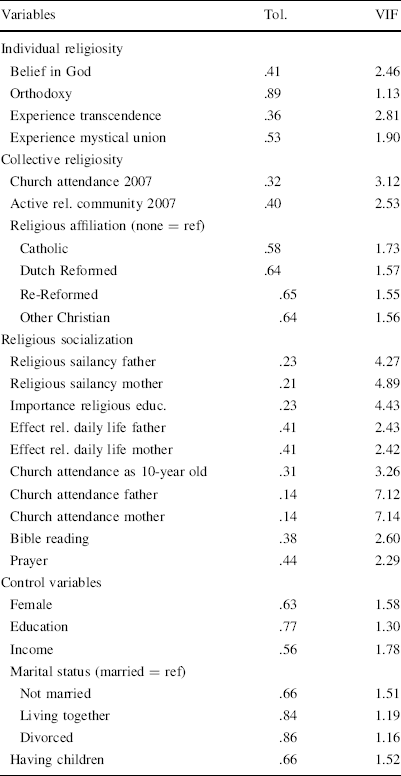
Collinearity statistics
|
Variables |
Tol. |
VIF |
|---|---|---|
|
Individual religiosity |
||
|
Belief in God |
.41 |
2.46 |
|
Orthodoxy |
.89 |
1.13 |
|
Experience transcendence |
.36 |
2.81 |
|
Experience mystical union |
.53 |
1.90 |
|
Collective religiosity |
||
|
Church attendance 2007 |
.32 |
3.12 |
|
Active rel. community 2007 |
.40 |
2.53 |
|
Religious affiliation (none = ref) |
||
|
Catholic |
.58 |
1.73 |
|
Dutch Reformed |
.64 |
1.57 |
|
Re-Reformed |
.65 |
1.55 |
|
Other Christian |
.64 |
1.56 |
|
Religious socialization |
||
|
Religious sailancy father |
.23 |
4.27 |
|
Religious sailancy mother |
.21 |
4.89 |
|
Importance religious educ. |
.23 |
4.43 |
|
Effect rel. daily life father |
.41 |
2.43 |
|
Effect rel. daily life mother |
.41 |
2.42 |
|
Church attendance as 10-year old |
.31 |
3.26 |
|
Church attendance father |
.14 |
7.12 |
|
Church attendance mother |
.14 |
7.14 |
|
Bible reading |
.38 |
2.60 |
|
Prayer |
.44 |
2.29 |
|
Control variables |
||
|
Female |
.63 |
1.58 |
|
Education |
.77 |
1.30 |
|
Income |
.56 |
1.78 |
|
Marital status (married = ref) |
||
|
Not married |
.66 |
1.51 |
|
Living together |
.84 |
1.19 |
|
Divorced |
.86 |
1.16 |
|
Having children |
.66 |
1.52 |

 Open access

