





Introduction
Over the past decade, support for authoritarian populism has reached historic highs, as far-right, authoritarian, and openly fascist movements and actors have increasingly gained prominence on political stages worldwide (Timbro 2024). Some of these actors are newcomers to the political scene, having transitioned from entrepreneurial or media prominence to party leadership, as seen with Donald J. Trump in the United States or Kamiya Sōhei (Sanseitō) in Japan (see Marcantuoni & Fahey Reference Marcantuoni and Fahey2025 for an analysis of the latter). Others, such as the French “Nouvelle Droite” and the German “New Right,” have worked on a “conservative revolution” in the pre-political sphere of culture long term, developing their strategies to influence the public and political sentiment since the 1960s. These diverse movements share common threads in their illiberal tendencies, global networking efforts, and metapolitical strategies aiming at transforming culture prior to engaging in politics (e.g., Griffin Reference Griffin2000; Kooistra Reference Kooistra2024; Maly Reference Maly2023). This article aims to analyze the recent political initiatives and media strategies of Japan’s organization “Happy Science” (HS) and its political wing, the Happiness Realization Party (HRP), with particular focus on their anti–mass media discourse and disinformation, within the background of global right-wing populist movements. Until now, the group has primarily been studied either as a controversial new religious movement with political aspirations and/or as a phenomenon largely confined to Japan. Although the political arm of the movement has not found success in elections, some of its proponents have built connections with a global network of political actors over the past decades, such as the MAGA movement (Havenstein and Schäfer Reference Havenstein and Schäfer2024; Adelstein Reference Adelstein2021; Right Side Broadcasting Network 2025).
In order to identify a larger cross-media strategy, we analyze a variety of media, ranging from magazine-style publications aimed at HS followers to an email newsletter for people interested in its political party, and a YouTube channel that finds its audience algorithmically on the platform. Rather than tracking a single narrative across all media, our quantitative analysis provides an overview of prevalent narratives and their development over time. This is followed by an in-depth qualitative analysis of their rendering of a current form of disinformation. Additionally, we begin our analysis with a historical outline of the organization’s origins, developments, and ideological framework. By doing so, we aim to provide an account that situates the organization’s narratives within their historical context, identifies broader patterns in its media use and discursive shifts, as well as examines the workings of specific narratives in depth, while avoiding the pitfalls of oversight, cherry-picking, and ahistoricity. As we will demonstrate, spreading disinformation and conspiracy narratives—extending beyond, but also informed by HS religious teachings—has become a central element of its media content. We contend that the dissemination of disinformation and anti-media rhetoric forms part of a discursive strategy similar to those employed by far-right and right-wing populists in the United States and Europe, and that their media content has shifted over time toward discourses prevalent in the far-right online media sphere. HS’s current disinformation-based media strategy and outreach to far-right populist actors worldwide have been shaped by a combination of historical distrust of mass media, eclectic esotericism, and political ambitions, all set against the broader global trend toward the political use of fake news and disinformation. We further argue that it is precisely the eclectic nature of its ideology—mixing esotericism, ufology, and spirituality, with political agenda and messianic proselytism—that lends itself well to a diversified, outward-facing, and connective social media strategy.Footnote 1
We will begin summarizing the history and ideological background of the movement. We will explore the origins of its anti-media stance and political ambitions, which date back to the 1990s. We will then present the findings of an analysis of the content of online magazines and YouTube channels, with a particular focus on far-right terminology, discursive shifts, and Ukraine-related disinformation.
The history of Happy Science
Kōfuku no Kagaku (幸福の科学, literally: Science of Happiness), previously known as IRH, The Institute for the Research in Human Happiness, and more recently as Happy Science, was founded in 1986 by Ōkawa Ryūhō (大川隆法, born Nakagawa Takashi, 1956–2023), a graduate of the University of Tokyo. During the early 1990s, the group received media attention for its public events, which were widely advertised and attracted a large crowd of followers. It also became well known for taking legal action against the publisher Kōdansha, as well as for attacking critics and other religious organizations. According to Ōkawa’s autobiographical accounts, he began receiving messages from the spirit world in 1981 (Ōkawa Reference Ōkawa1987). From 1986 onwards, the publishing house connected to the organization started publishing “spiritual messages” (霊言, reigen, usually translated into English as “spiritual interviews”) from various spirits, including philosophers, religious figures, deities, and famous artists. Over the years, the group developed a wider publication agenda (see below), but spiritual messages remained popular. As their educational and political activities expanded, more reigen were published with messages from political figures and academics. Ōkawa also claims to be able to communicate with the guardian spirits of living individuals, and spiritual interviews have been published with a number of high-profile politicians and leaders, including Barack Obama, Hilary Clinton, Vladimir Putin, Xi Jinping, Kim Jong-un, and Donald Trump—indicating a strong connection between practices of interacting with spirits and the political activities of the group.
Over the years, Ōkawa’s publications have addressed current events, political issues, and cultural debates. For example, as for other religious organizations at the time, some of Ōkawa’s writing in the 1990s focused on Nostradamus prophecies and on calamities that would happen at the end of the millennium. While Ōkawa’s first book on the topic (Ōkawa Reference Ōkawa1991) was a “record” of his spiritual conversations with Nostradamus and borrowed extensively from the best-selling book published by Gotō Ben (1973), all while incorporating references to HS’s doctrine, a later volume had a more pessimistic tone. It references an imminent apocalypse and nuclear wars, while also conveying a message of a “new utopian era of happiness” (Baffelli and Reader Reference Baffelli and Reader2011: 17). As shown in these examples, references to current trends helped HS to attract a certain readership interested in themes circulating in the media at the time, but ultimately the focus of the organization was to reach wider audiences, and when the interest in the end of the Millennium diminished, so did their publications on the topic (Fukui Reference Fukui2004).
HS publications often provide examples of how teaching could be implemented in daily lives, such as in relationships with colleagues or family members. The creation of a “global utopia on Earth” (地球ユートピア, chikyū yūtopia, or, “eternal Utopia” 恒久ユートピア kōkyū yūtopia) is conceived as a continuation of the present, based on the idea that individuals can transform society. This Utopia is an idealized world regulated by Ōkawa’s teachings and will lead to the transformation of society and its members. Therefore, creating an ideal world and society doesn’t necessarily imply apocalyptic events, but rather a transformation of individuals and their personal relationships. However, references to impending disasters and calamities (and how to avoid them through his teachings), as well as to prophecies, are recurrent themes in Ōkawa’s talks and publications. For instance, references to UFOs have become more prevalent in publications and talks since the 2010s, following a supposed UFO sighting in December 2010, shortly after Ōkawa delivered a lecture in Yokohama predicting the arrival of the space age. HS’s flexible doctrine and ability to adapt to current fashionable discourses have allowed it to show the relevance of its teachings to current events, while also showing a tendency to sympathize with a variety of conspiracy theories.
In 2009, the group founded a new political party, the “The Happiness Realization Party” (幸福実現党, kōfuku jitsugentō) demonstrating an escalating involvement in political activities. It also established a private university in 2015 (Baffelli Reference Baffelli2017). Political and educational activities played an important role in the group contributing to its vision of building a utopian society on Earth.
Early political ambitions and the origins of HS’s anti-media stance
HS’ transition into politics was paved by the rivalry among contemporaneous new religious movements and manifold challenges (Baffelli and Reader Reference Baffelli and Reader2011; Baffelli Reference Baffelli2017; Klein Reference Klein2006, Reference Klein2011). Although HS did not establish a political party until 2009, their interest in politics and their attempts to exert political influence were already evident in the 1990s, when they supported LDP politician and HS member Mitsuzuka Hiroshi as a candidate for prime minister (Astley Reference Astley1995). HS’s increased political ambitions happened in a period of changes in Japan’s political landscape. The Liberal Democratic Party (LDP) lost its majority in 1993, forming a coalition government with Kōmeitō (Clean Government Party), a political party established in 1964 by Sōka Gakkai, one of the largest Buddhist organizations in Japan (McLaughlin Reference McLaughlin2019). Several so-called new religions were active in politics after the Second World War, especially in supporting candidates during elections (Baffelli Reference Baffelli2010). However, Sōka Gakkai was the only religious organization to establish an independent political party that would become an enduring presence in Japanese politics. HS, in its publications, criticized Sōka Gakkai as heretical and a threat to the nation, and intensified its criticism through manifold means. At the same time, it is undeniable that Sōka Gakkai also set an example, especially with regard to political success.
The use of a variety of media has been crucial to how HS has operated since its inception (Baffelli Reference Baffelli2005, Reference Baffelli2016). As mentioned above, the spiritual messages received by Ōkawa were published in book format, and a publishing house was established at an early stage in the organization’s development. More than 3,000 books, including magazines and manga, have been published with Ōkawa as author, some of which have been translated into different languages and distributed to centers overseas. In Japan, HS publications are sold in major bookshops, and are aimed at different audiences, including specific magazines for young members, women, and the general public. They include articles on doctrinal aspects and practical examples of how to apply teachings to daily life and commentaries on current socio-political events and lifestyles (Baffelli Reference Baffelli, Staemmler and Dehn2011: 32). While manga has also been part of HS publications, its films, including anime, are better known and screened at major theatres across Japan. These films are based on Ōkawa’s publications, but they are also part of a wider multimedia strategy involving advertising campaigns, collectable merchandise, websites, and so on (Baffelli Reference Baffelli, Staemmler and Dehn2011: 34). To reach a wider (and possibly younger) audience, they integrate references from Ōkawa’s publications into fantasy stories, and the main, often young, character experiences adventures, eventually being revealed as members of HS (Baffelli Reference Baffelli, Staemmler and Dehn2011: 34).
While the publishing house’s website was established in 1999 (Baffelli Reference Baffelli, Staemmler and Dehn2011, Reference Baffelli2016), an official HS website did not appear until December 2004. Since then, however, the organization’s online presence has grown rapidly, with the creation of several dedicated websites, including those for the new political party HRP, a radio program, and film promotions. The initial cautious approach to the internet was not unusual among so-called new religions in Japan partly due to the difficulty of controlling reactions and criticism online. In particular, HS had implemented a media strategy that enables it to control the external transmission of images and messages about the organization especially, as the relationship between HS and the mainstream media has been particularly tense since the conflict with publisher Kōdansha in the 1990s. Following a large advertising campaign sponsored by the group in 1991 to promote an event at the Tokyo Dome and the publication of the leader’s work, Kōdansha’s weekly magazines published a series of critical articles attacking Ōkawa. The organization responded aggressively, with members organizing street demonstrations against the publishing house and sending protest faxes (Astley Reference Astley1995: 370). HS also published a series of books on the legal battle with Kōdansha, which lasted a few years. In one of these publications, the publishing house is portrayed as “the evil of our time” (現代の悪魔, gendai no akuma) (Baffelli Reference Baffelli, Staemmler and Dehn2011: 107) and criticized for its immorality. This publication provides an early example of how, since the 1990s, HS has used its own publications, including spiritual messages, to attack its enemies, particularly the media, as well as other religious organizations and anyone who criticizes them.
As discussed below, HS’s anti-media attitude has extended into the realm of online media, reflecting a broader trend of distrust toward legacy media that is prevalent across social platforms, and aligned with the anti-media stance characteristic of right-wing populism, two phenomena observed globally (Fawzi Reference Fawzi2019).
Political views and online anti-media media strategy
Axel Klein (Reference Klein2011) summarizes the three main areas of the political vision and strategies included in the manifesto of the HRP as follows: economic stimulus through tax reductions, national defense, and a population policy aimed at increasing Japan’s population. The proposed political measures reflect neoliberal elements and a focus on economic promotion. The HRP advocates for a “slim government” that minimizes regulation and supports businesses through tax cuts to invigorate consumption. The party’s social policy centers on tax reductions and a population strategy that strengthens the pension and social systems through immigration. North Korea is a central theme for the HRP, which prompted the party’s founder to form the party in the first place, according to the manifesto. Japan, in HRP’s view, must be capable of self-defense and should put an end to its colonial dependency on the United States. Japanese Self-Defense Forces should have the capability for a preemptive strike against North Korea; therefore, Article 9 of the Japanese Constitution should be reformed. The party’s ideology was initially highly compatible with that of the LDP. Nationalism has always played a role for HS (Tsukada Reference Tsukada2012, 2015), and while it maintained a hostile stance toward North Korea, the manifesto lacked anti-foreign or nativist elements. However, this changed as Japan’s political climate shifted along with a wider global trend toward exclusivist views, as we will discuss below.
Since the early 2010s, the organization has established networks with US conservative figures and organizations as part of its “mission to export American-style conservatism—the gospel of small government, low taxes, and free enterprise—to the Land of the Rising Sun” (Ball Reference Ball2012). In recent years, apart from efforts to network with US conservative networks, actors associated with HS and HRP have also imported their discourse, including the conspiracy narratives of the “deep state” and “globalism” into the organization and organized pro-Trump rallies in Japan (Havenstein and Schäfer Reference Havenstein and Schäfer2024; Mainichi 2020; Fujikura 2020; Adelstein Reference Adelstein2021; Hall Reference Hall2023; Right Side Broadcasting Network 2025). By channeling MAGA ideology into the organization, HS not only voices its support for Trump but also aligns itself with networks advocating for conservative and populist causes worldwide, aiming to position itself within a global network of populist and right-wing movements.
HS’s social media channels often promote a slogan along the lines of “What the mass media is hiding,” to advance an anti-establishment and populist political agenda. The objectives behind these tactics are twofold: to mobilize support for HS and to foster distrust in both legacy political parties and traditional mass media. According to Andrew Deck, HS has “built a social media apparatus to import harmful disinformation peddled by the American Far-Right and circulate it in Japan in service of its own political agenda” (Deck Reference Deck2021). Also, HS has run disinformation campaigns during the pandemic, claiming that it could defeat the coronavirus by spiritual means (Pokorny and Mayer Reference Pokorny and Sophie Mayer2022; Kestenbaum Reference Kestenbaum2020; Deck Reference Deck2021). Disinformation as both a monetizable and a mobilizing tool potentially allows HS to enhance its media strategy by simultaneously exploiting disinformation to generate revenue and galvanize political and religious support. By disseminating anti-media narratives that are widespread among the Far-Right and on social media, HS also caters to its longstanding hostility toward mainstream media. This approach not only reinforces its political objectives but also potentially draws new followers to its religious teachings. Additionally, the eclectic ideology of HS, combining elements such as UFO, aliens, deities, faith, spirituality, and keywords resonant within far-right discourse, enables the group to attract algorithmic attention on revenue-generating platforms like YouTube and rank highly in keyword-based indexing on platforms such as Amazon.
Given this background, we were interested in identifying the scope of discursive connections with online far-right and disinformation networks, beyond the connective nodes already described. In order to identify a broader media strategy, we analyzed media outlets targeting different audiences and using various distribution means. We mapped out discursive shifts for selected narratives and analyzed in detail how HS incorporated pro-Russian disinformation into their media strategy. In the following sections, we present the results of a computational discourse analysis of (a) two of the group’s online news publications, namely “The Liberty” and “HRP Newsfile,” and (b) of one of the group’s YouTube channels, to show how the group strategically uses disinformation and its anti-media stance as content and discursive bridge on online and social media.
Analysis
A quantitative analysis of HS’s “The Liberty” and “HRP Newsfile”
For our quantitative analysis, we used two online news sources associated with HS and HRP: “The Liberty,” and “HRP Newsfile.” “The Liberty,” a news magazine published by HS’s publishing house IRH Press in print since 1995 and as web magazine since 2010, sports its anti-media stance already in its description, namely “A future Japan that the mass media does not mention” (マスコミが言わない、次の日本, masukomi ga iwanai, tsugi no nihon). The web magazine has daily article updates and includes sections on “politics,” “economy,” “technology,” “self-development,” and “spirituality.” The magazine presents itself as a publication intended to “replace” traditional newspapers for its readers, offering news curated and selected by HS. It promises its readers to “gain a clear understanding of politics,” as it provides interpretations through the lens of “Buddhist truth” and “value judgment” (see Figure 1) and aims to become the primary source of information for members (The Liberty n.d.). This reinterpretation of news within an ideologically driven framework aligns with HS’s anti-media strategy, positioning themselves as an alternative to legacy media and thus controlling information flow and news framing. Given its self-description as a publication that “will handle the information processing for you” (The Liberty n.d.), we understand “The Liberty” to be a medium aimed at an audience already familiar with HS and its teachings, and that is open to its editorial guidelines.
“The Liberty” in their introduction of interpreting the news for their readers under “Buddhist” and “value” principles, featuring books by Ōkawa about Russia and Putin (The Liberty n.d.).
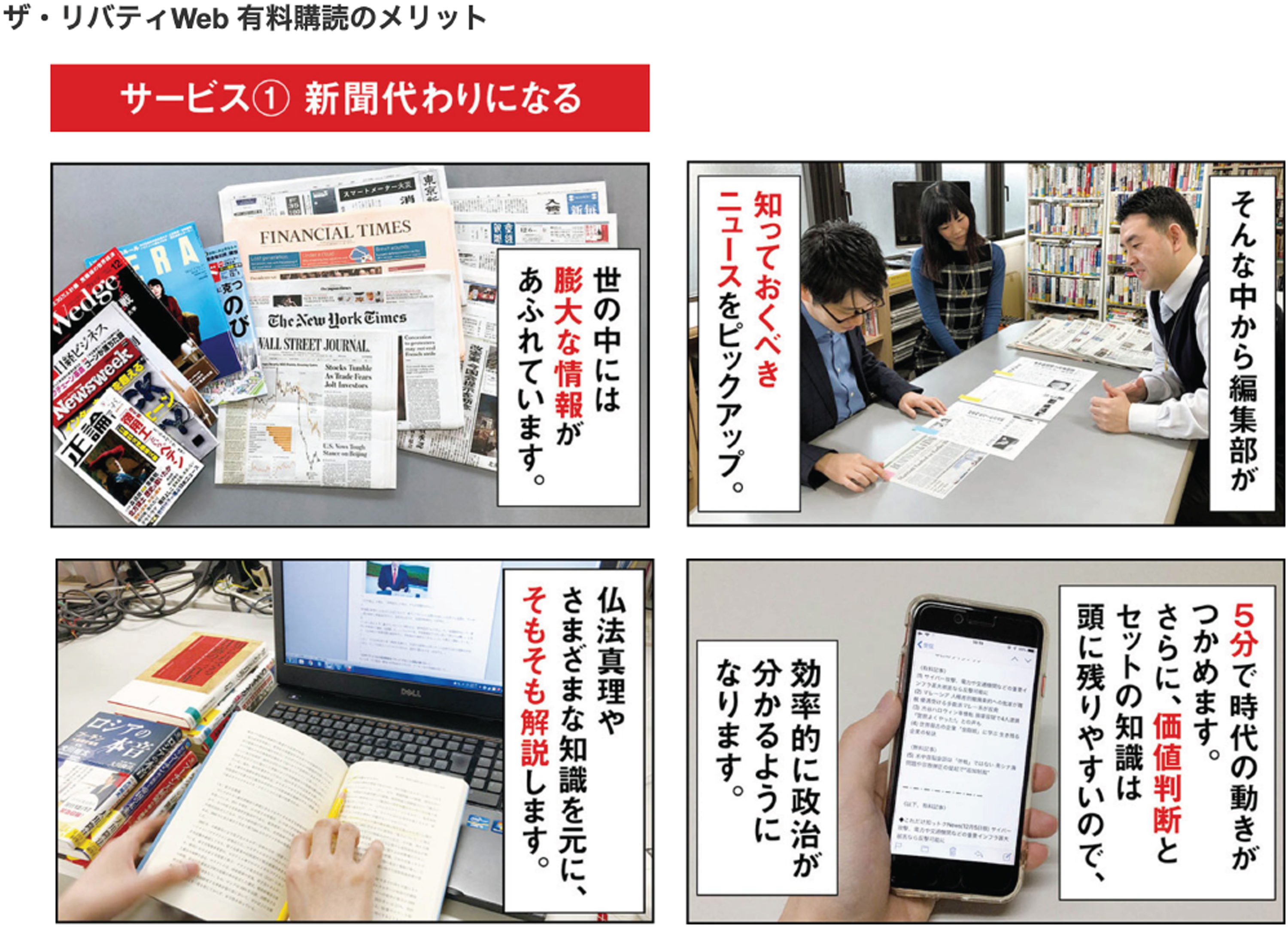
Figure 1: Long description
The first image shows a collection of international newspapers and magazines, including titles like Financial Times, The New York Times, and Wall Street Journal, with a text explaining the importance of understanding significant global information. The second image depicts three individuals discussing news articles at a table, with a text highlighting the importance of staying informed. The third image shows a person reading a book and taking notes on a laptop, with a text emphasizing the understanding of true principles and knowledge. The fourth image features a smartphone displaying a news article, with a text discussing the efficiency of information access and the importance of understanding value judgments.
“HRP Newsfile” serves as the official email newsletter for the HRP, and is also archived and accessible online. Registering online for the newsletter is assumably open to anyone, as well as the free access to their full articles in their archive. According to the website, it has been in circulation since 2011 and covers a range of topics, including current affairs, international issues, politics, diplomacy, national defense, economics, education, and other areas, as well as providing updates on events and activities related to the HRP (HRP Newsfile 2026). The news categories include traditional topics such as finance and tax, international politics, and education, but also a section on history. Some articles attribute their authorship, with several penned by HRP officials and associates. We assume that the target reader of this content is primarily interested in the political party and its activities, and the content is intended for an audience that is already affiliated with the party and/or interested in its politics. As a free newsletter and website, we assume that the content does not generate revenue but that the costs are also limited to website hosting.
Data collection and method
“The Liberty’s” website features short teasers of longer articles, which can then only be accessed with a subscription login. We obtained all of these teasers found online between 1997 and late 2024, totaling 19,938 items. From “HRP Newsfile,” we obtained the full set of 2,525 published articles from mid-2011 to 2024 (see Table 1).Footnote 2 To identify thematic structures within the corpora, we employed BERTopic, a topic modeling framework that represents textual units using transformer-based embeddings and groups them through density-based clustering. Text segments were encoded using a pretrained Sentence Transformer model to generate semantic embeddings optimized for sentence similarity. These embeddings were clustered to group semantically related texts. Based on these representations, we compiled a keyword setFootnote 3 to trace the temporal development of topics and their relative prevalence over time. To validate the contextual consistency of the extracted keywords, we conducted concordance-based cross-checks using AntConc.
Details on the two corpora analyzed

Table 1. Long description
The table presents data on two analyzed corpora. It includes columns for platform, URL, article count, first post date, last post date, and total tokens. The first row shows data for HRP newsfile, with 2,525 articles published between August 22, 2011, and November 30, 2024, totaling 2,544,198 tokens. The second row shows data for The Liberty, with 19,938 articles published between May 1, 1997, and December 12, 2024, totaling 20,604,356 tokens.
Overview of the content distribution of both magazines
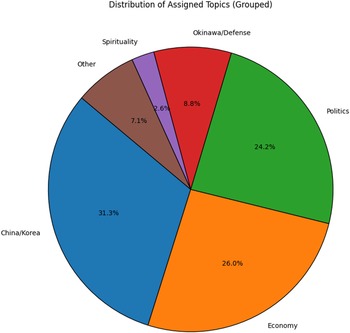
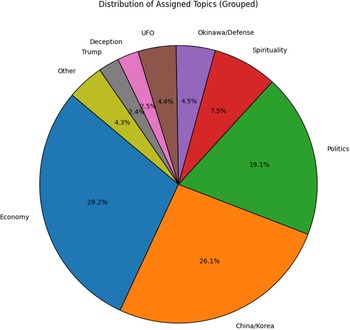
Given that “The Liberty” is a direct publication of HS, while the “HRP Newsfile” serves as the publication for HRP, the group’s political division, one might expect each publication to emphasize distinct thematic areas, namely religious and political topics. However, our analysis revealed that nearly 75% of the articles on both platforms were similarly distributed, with a primary focus on the three topics “economics,” “politics,” and “China/Korea.” Nevertheless, “spirituality” also plays a consistent role in the former (see Figures 2 and 3). As anticipated, the magazine of HS places a significant emphasis on “spirituality.” Interestingly, it also prominently features articles on “Okinawa and Defense.” However, the topic cluster “Okinawa and Defense”Footnote 4 takes up a slightly larger part in the HRP publication than in “The Liberty.” Additionally, news articles related to “UFOs,” “Trump,” and “deception” stand out as thematic outliers in “The Liberty”Footnote 5 (see Figure 3).Footnote 6 The predominance of main topics such as politics, economy, and China/Korea, which together constitute approximately 75% of all topics in both publications, indicates a largely consistent distribution of topics across the two. The remaining content is variably distributed. This alignment supports the observation of the blending of secular and religious themes within both HS and HRP.
Content distribution for “HRP Newsfile”.
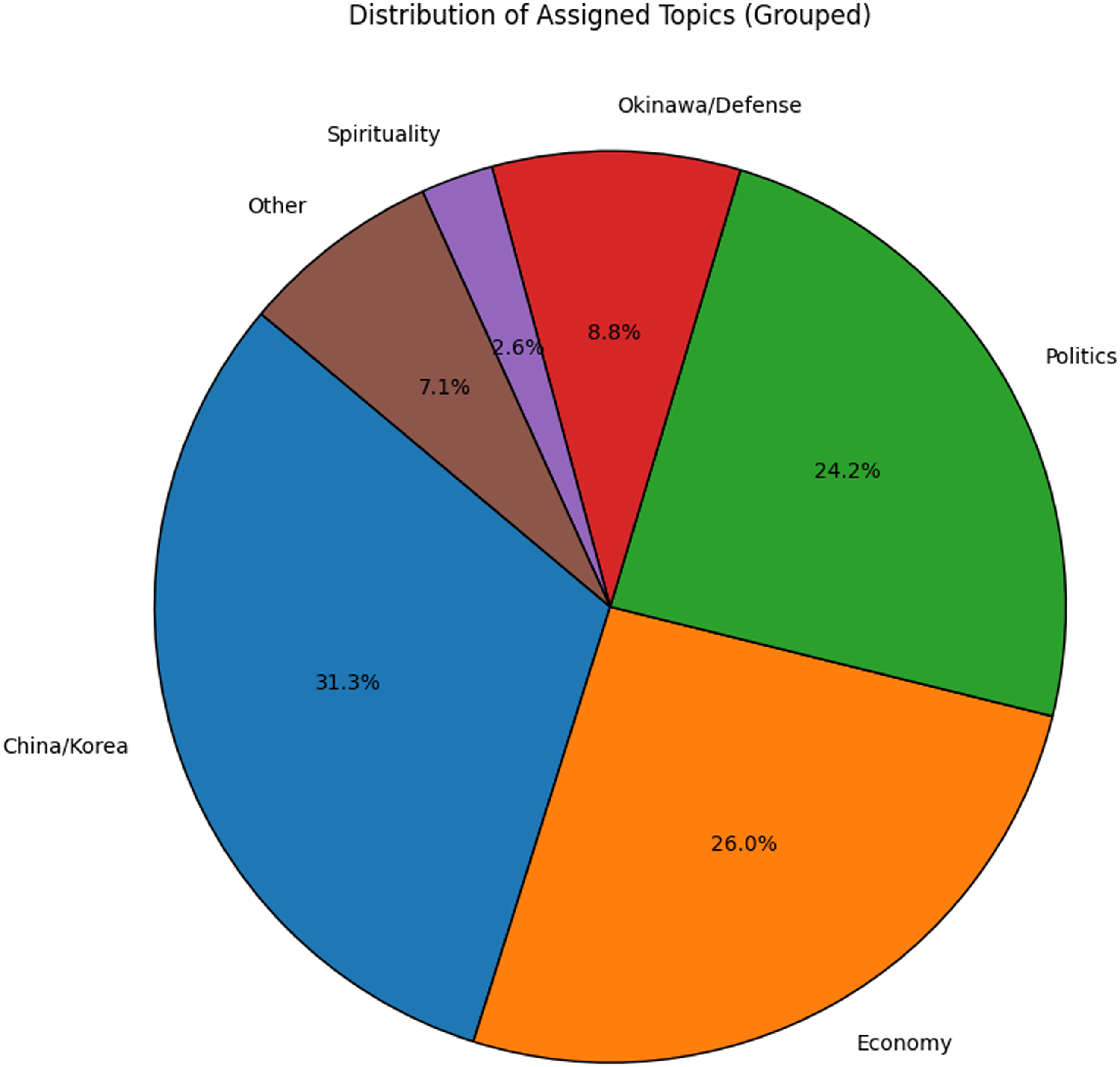
Figure 2: Long description
A pie chart titled ‘Distribution of Assigned Topics (Grouped)’ displays the proportional breakdown of different topics. The chart consists of seven segments, each representing a distinct category. The largest segment, labeled ‘China/Korea,’ accounts for 31.3 percent of the distribution. The second-largest segment, labeled ‘Economy,’ represents 26 percent. ‘Politics’ is the third-largest segment with 24.2 percent. ‘Okinawa/Defense’ follows with 8.8 percent. ‘Other’ and ‘Spirituality’ account for 7.1 percent and 2.6 percent, respectively. Each segment is color-coded for visual distinction, with ‘China/Korea’ in blue, ‘Economy’ in orange, ‘Politics’ in green, ‘Okinawa/Defense’ in red, ‘Other’ in brown, and ‘Spirituality’ in purple. The chart provides a clear visual representation of the relative importance of each topic within the dataset.
Content distribution for “The Liberty”.
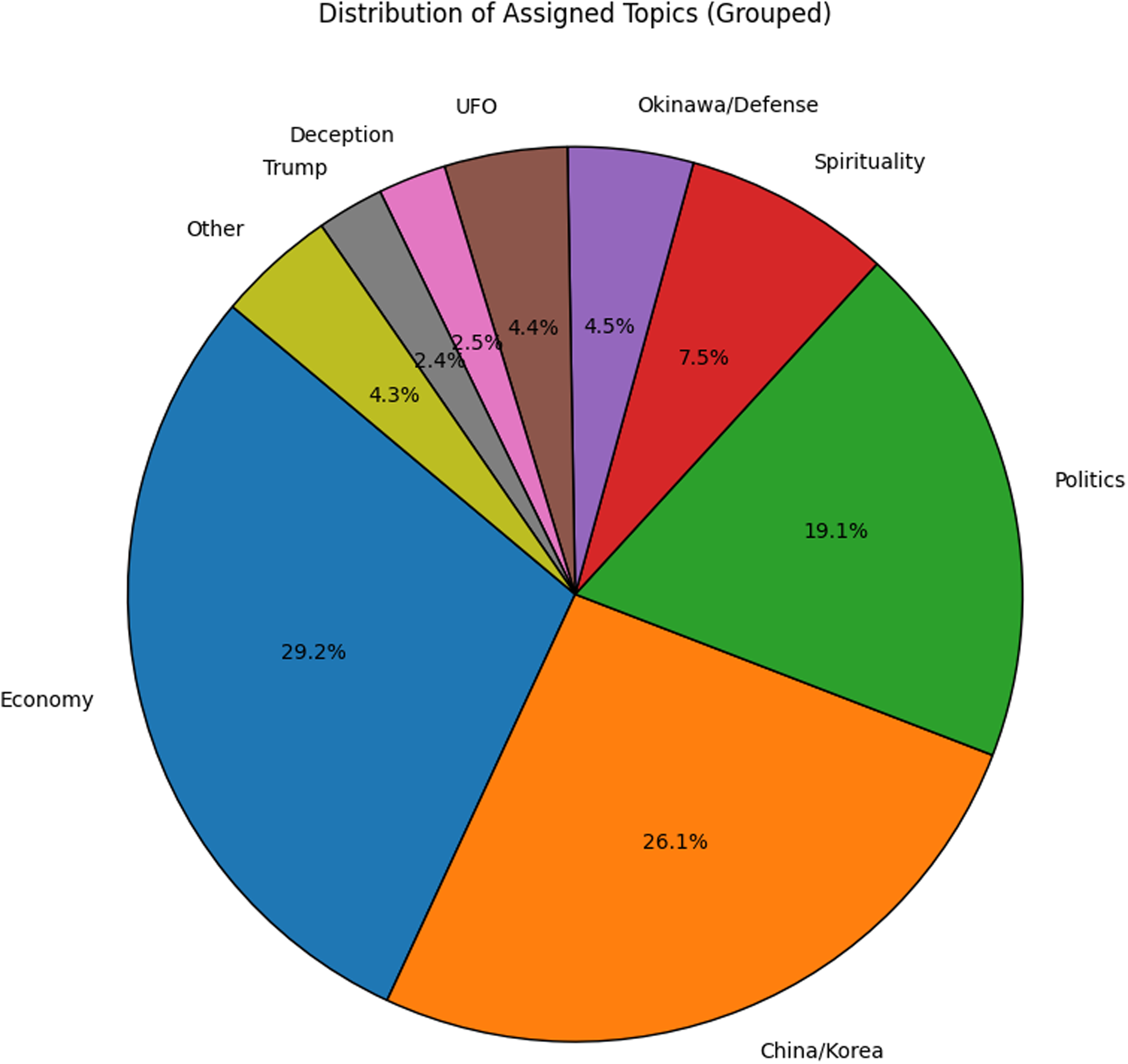
Figure 3: Long description
A pie chart titled ‘Distribution of Assigned Topics (Grouped)’ displays the proportional breakdown of various topics. The chart consists of twelve segments, each representing a different topic. The largest segment is labeled ‘Economy’ and accounts for twenty-nine point two percent of the distribution. The second-largest segment is labeled ‘China/Korea’ with twenty-six point one percent. ‘Politics’ is the third-largest segment at nineteen point one percent, followed by ‘Spirituality’ at seven point five percent. Smaller segments include ‘Okinawa/Defense’ at four point five percent, ‘UFO’ at four point four percent, ‘Trump’ at four point four percent, ‘Deception’ at two point five percent, ‘Other’ at four point three percent, and an unlabeled segment at two point four percent. The chart visually represents the relative emphasis on each topic within the dataset.
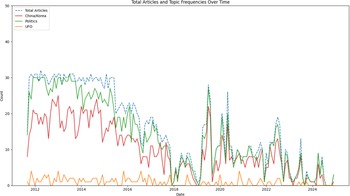
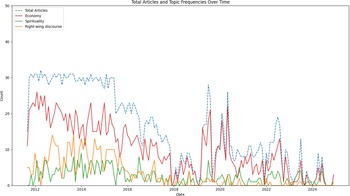
Beyond the overall percentage of topics covered, examining their representation over time provides deeper insights. Topics like “economy,” “politics,” and “Okinawa and Defense” fluctuate in relation to the overall and highly variable article count, likely reflecting current events. In contrast, certain topics such as “UFOs” and “spirituality” remain relatively constant throughout the observed time span, showing little to no relation to daily events. This consistency suggests they might be considered a core element of the group’s dogma (see Figures 4 and 5) and supports the hypothesis that the media strategy of the organization has multiple, intertwined functions. On the one hand, it provides a spiritual view, namely a mix of moral views, prophecies, and extraterrestrialism, on the other hand, it functions as a platform for HS’s political strategy, including right-wing views, as well as an entry point to HS platforms through current, political content popular online (cf. Figure 5).Footnote 7
Fluctuation of topics “China/Korea”, “Politics” and “UFO” over time in “HRP Newsfile”.
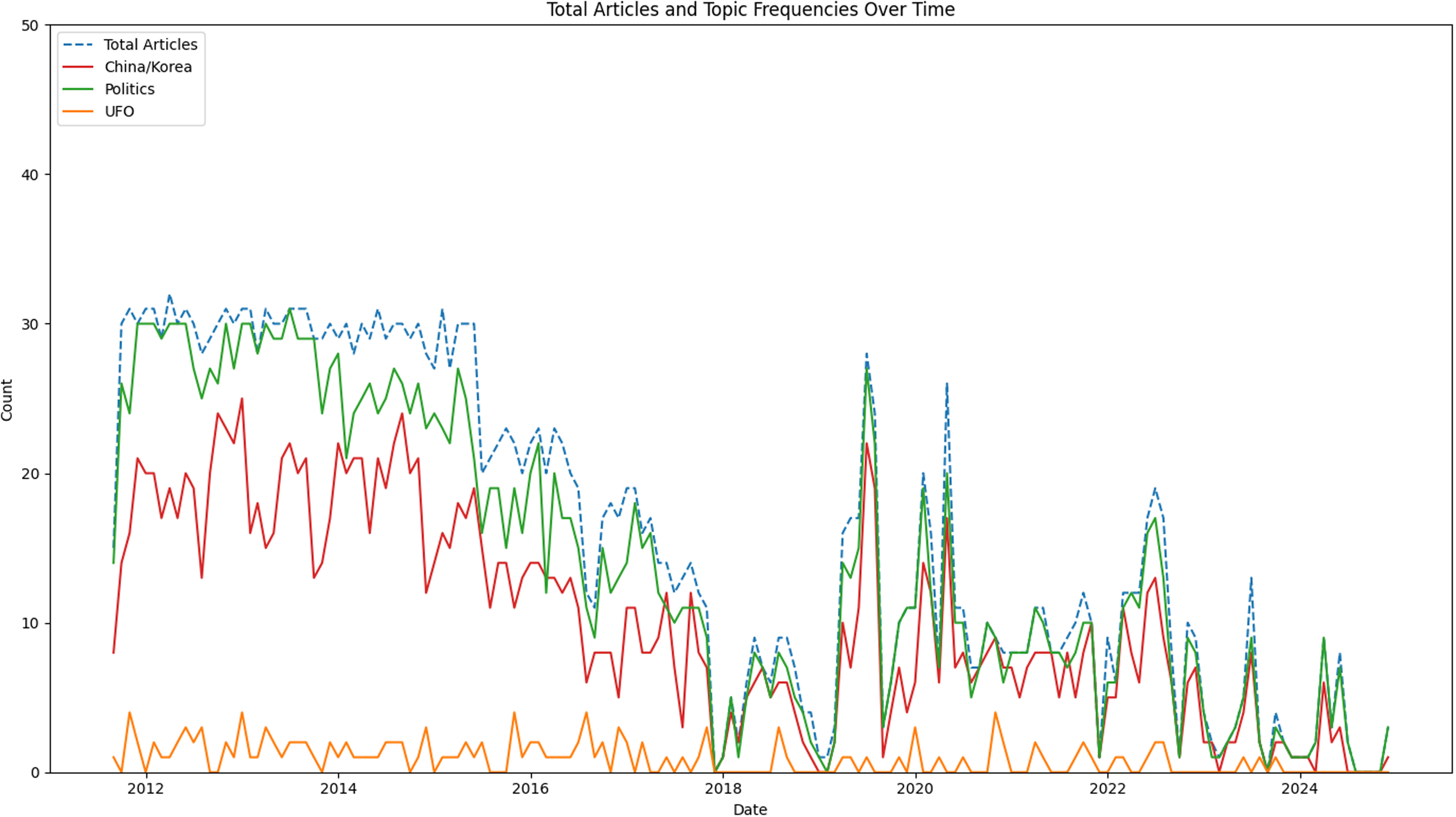
Figure 4: Long description
The line graph titled ‘Total Articles and Topic Frequencies Over Time’ features four distinct data lines representing the total number of articles and the frequencies of three specific topics: China/Korea, Politics, and UFO. The x-axis represents the date range from 2012 to 2024, while the y-axis represents the count of articles, ranging from 0 to 50. The blue dashed line indicates the total number of articles, which fluctuates over time, peaking around 2013 and 2014, and showing significant drops around 2018 and 2020. The red line represents the frequency of articles on China/Korea, which shows a general decline after 2014 but has occasional spikes. The green line represents the frequency of articles on Politics, which also shows fluctuations with notable peaks around 2013 and 2020. The orange line represents the frequency of articles on UFOs, which remains relatively low throughout the period but shows minor fluctuations. All values are approximated.
Fluctuation of topics “Economy”, “Spirituality” and “Right-wing discourse” over time in “HRP Newsfile”.
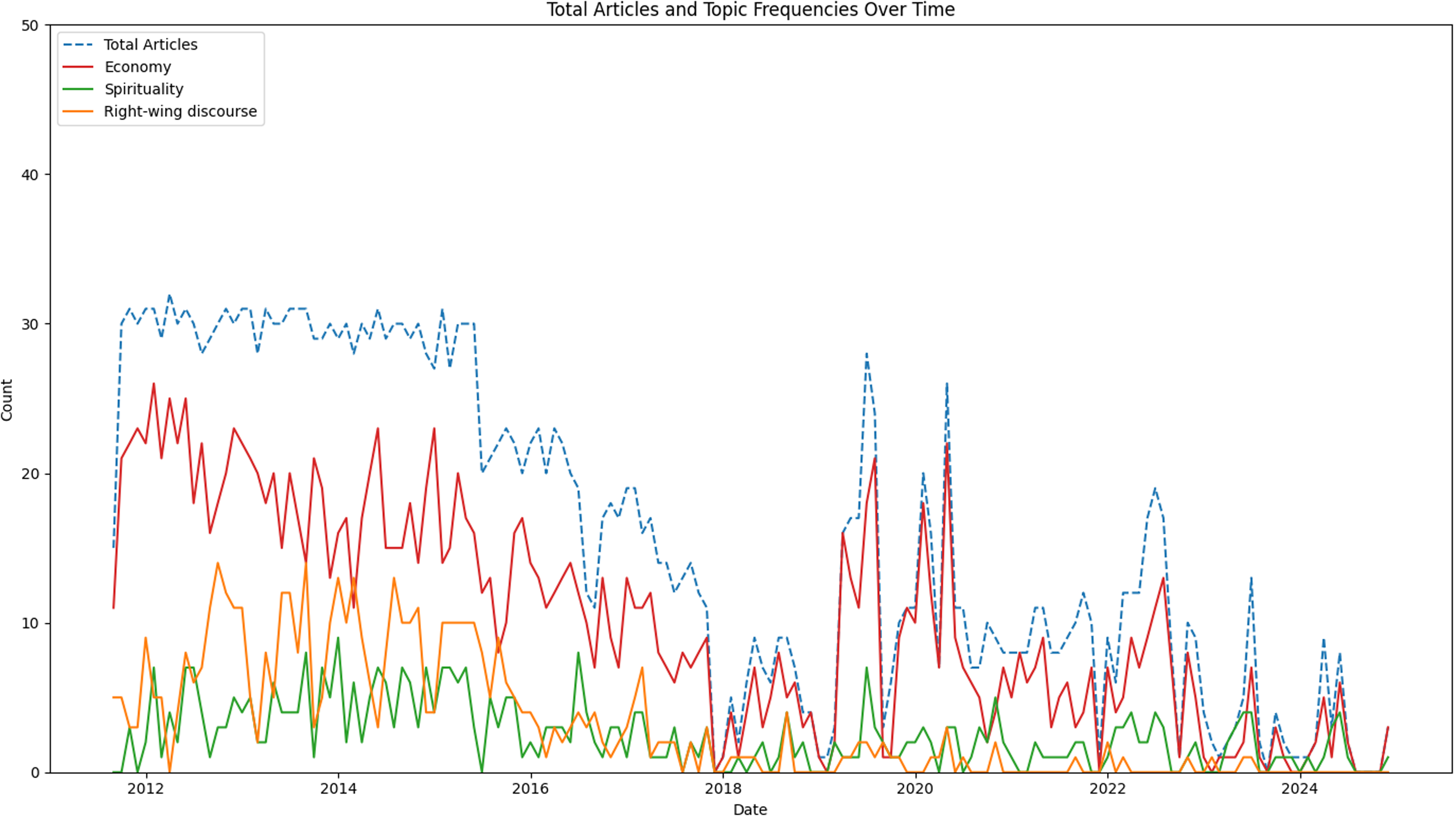
Figure 5: Long description
A line graph titled ‘Total Articles and Topic Frequencies Over Time’ displays the count of articles and specific topics over a period from 2011 to 2024. The x-axis represents the date, while the y-axis represents the count. The graph includes four data lines: Total Articles (dashed blue line), Economy (red line), Spirituality (green line), and Right-wing discourse (orange line). The Total Articles line fluctuates between 0 and 30 counts, peaking around 2012 and 2020. The Economy line shows significant fluctuations, peaking around 2012 and 2020. The Spirituality and Right-wing discourse lines exhibit lower counts, with occasional peaks. All values are approximated.
In the next two sections, we will explore significant thematic shifts in the content of both magazines, which illustrate a clear ideological and (geo-)political reorientation of the group.
The shift from North Korea to China as Japan’s geopolitical nemesis
The shift in focus from North Korea to China as Japan’s primary geopolitical adversary marks a significant change over time. Figures 6 and 7 illustrate that, up until 2008, articles on North Korea and China were relatively balanced in number. However, after 2011, reports on China markedly surpassed those on North Korea.
Reports on China outweigh reports on North Korea and Fukushima in “HRP Newsfile”.
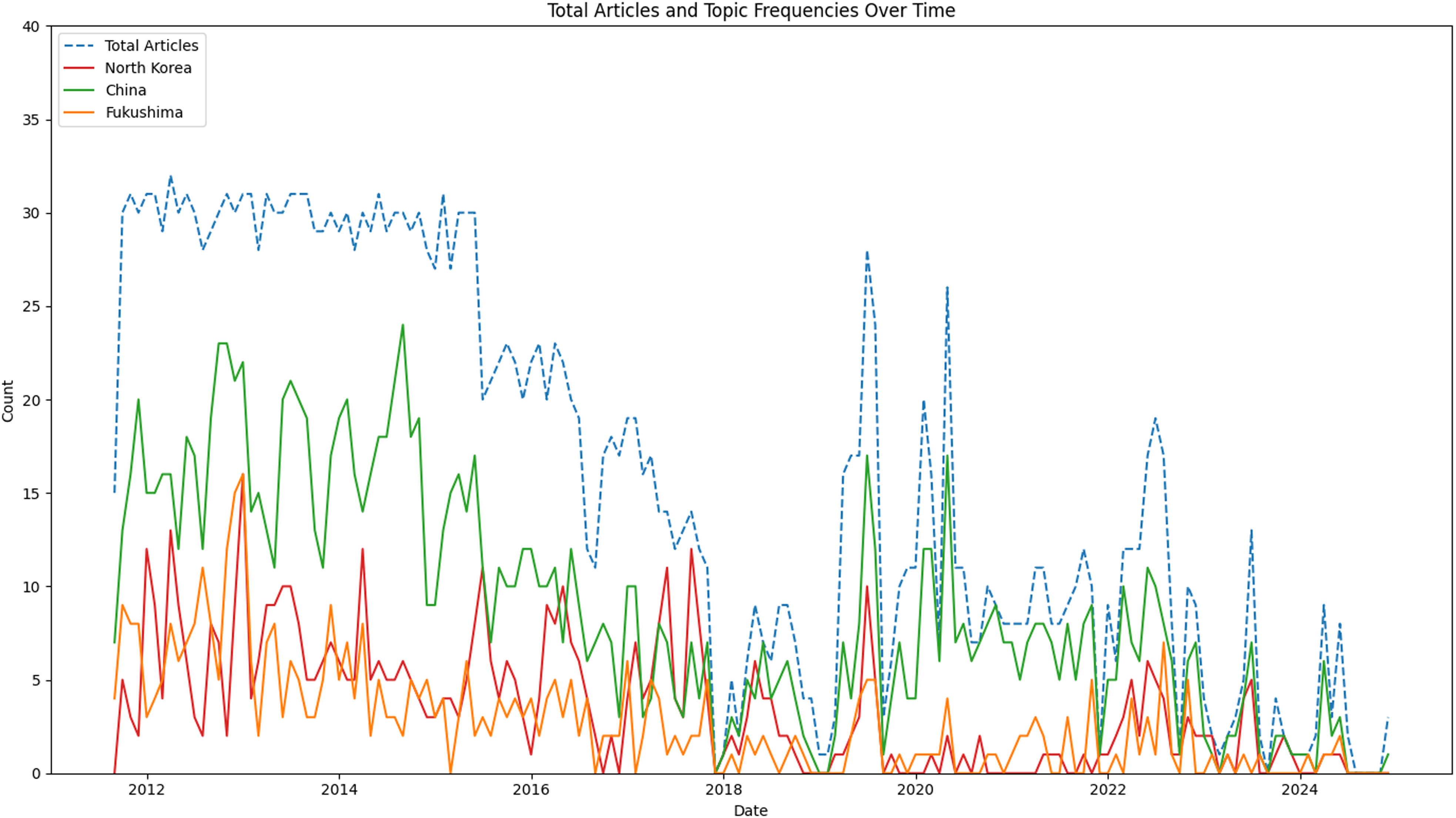
Figure 6: Long description
The line graph illustrates the total articles and topic frequencies over time from 2011 to 2024. The x-axis represents the date, ranging from 2011 to 2024, while the y-axis represents the count, ranging from 0 to 40. The graph includes four data lines: a blue dashed line for total articles, a red line for North Korea, a green line for China, and an orange line for Fukushima. The blue dashed line for total articles shows fluctuations, peaking around 30 articles and dipping to around 10 articles. The red line for North Korea shows lower counts, generally ranging from 0 to 10. The green line for China shows higher counts, peaking around 25 articles and dipping to around 5 articles. The orange line for Fukushima shows the lowest counts, generally ranging from 0 to 5 articles. All values are approximated.
Reports on China outweigh reports on North Korea and Fukushima in “The Liberty”.
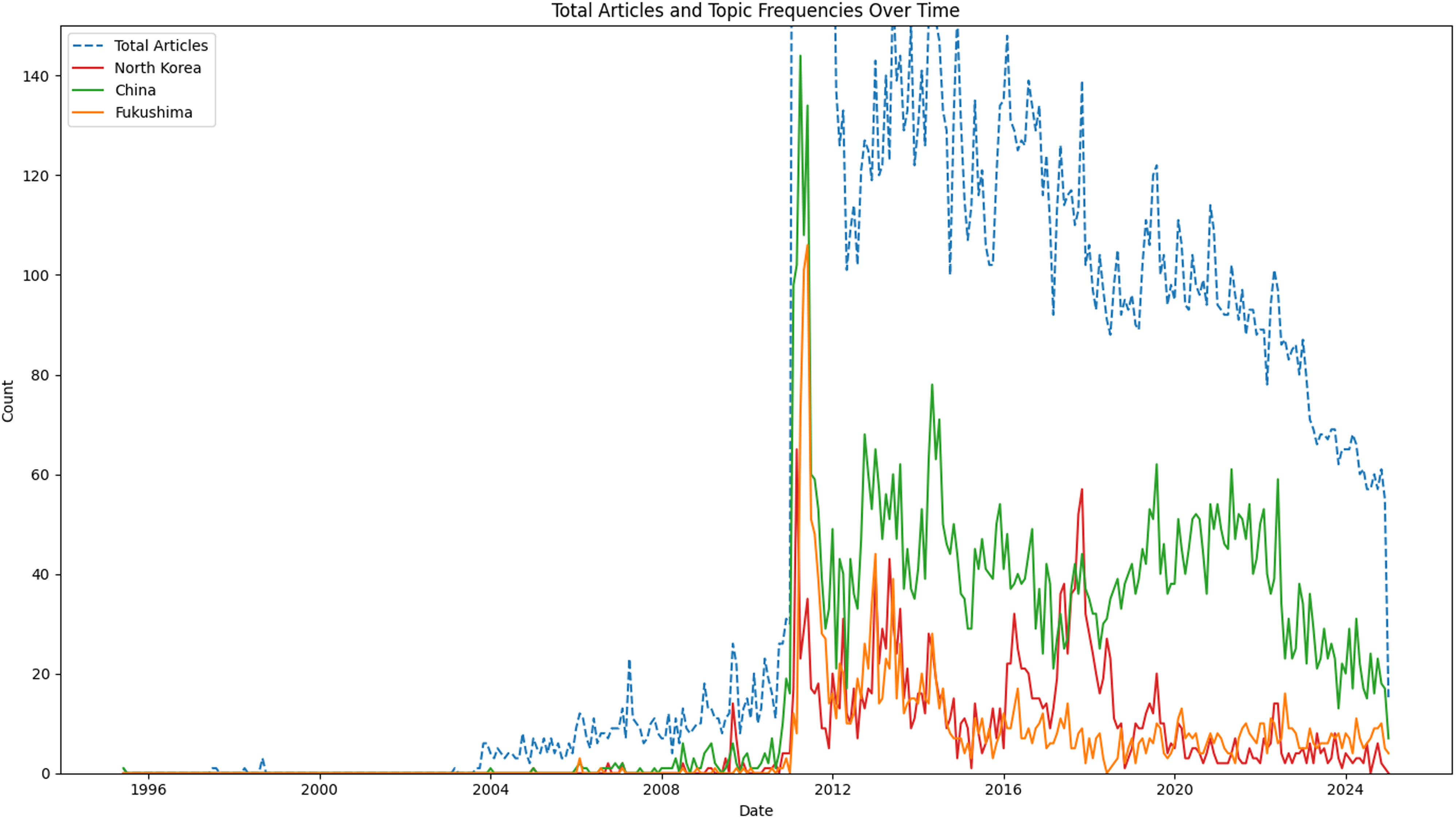
Figure 7: Long description
The line graph illustrates the total number of articles and the frequencies of specific topics over time from 1996 to 2024. The x-axis represents the date, ranging from 1996 to 2024, while the y-axis represents the count of articles, ranging from 0 to 140. The graph includes four data lines: total articles, North Korea, China, and Fukushima. The total articles line, depicted with a dashed blue line, shows fluctuations with peaks around 2012 and a gradual decline after 2020. The North Korea line, shown in red, exhibits a significant spike around 2012 and fluctuates thereafter. The China line, in green, shows a sharp increase around 2012 and maintains a higher frequency compared to other topics. The Fukushima line, in orange, peaks around 2012 and then declines. All values are approximated.
The figures also indicate an intense increase of total article count (indicated by the blue dotted line) after 2010–2011 in “the Liberty” (Figure 7), only slowly decreasing after its all-time high in 2011–2012. This point in time coincides with the 2010s Senkaku crisisFootnote 8 in September 2010 to the wave of protests in China in 2012, but also shortly after the founding of the HRP in 2009. Splitting the “Liberty” corpus into two parts, before and after September 2010, gives further insights: the term “China” appeared in 99 articles out of 791 before September 2010, that is, in 12.5% or every 8th article. After September 2010, China appeared in 7,029 articles out of 19,147, that is 36.7% or every 3rd article. Additionally, applying a contextual word embedding model to analyze all posts, we can identify eight distinct semantic clusters for each corpus.
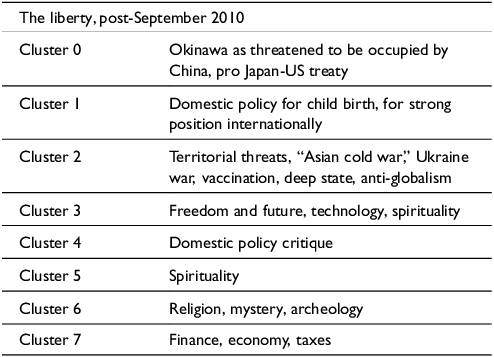
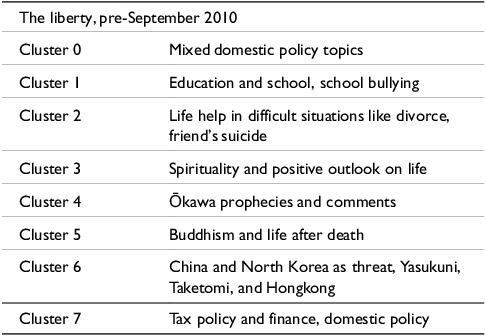
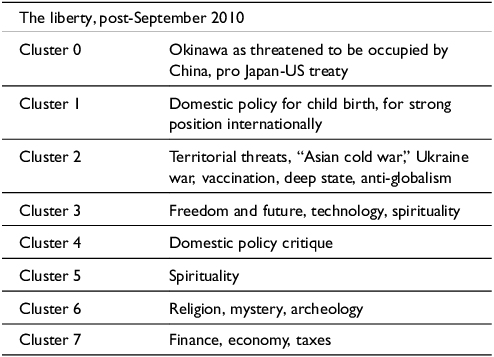
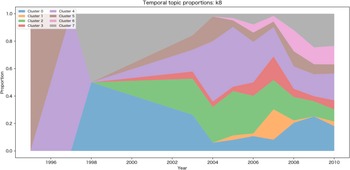
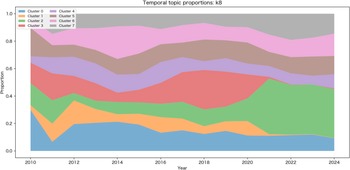
It becomes apparent that before September 2010 the magazine displayed much fewer political clusters than after, with only one cluster regarding territorial and international matters (see Table 2). After September 2010, there are three of such clusters, and less of life help and spirituality than before (see Table 3). Plotting these clusters on a timeline shows that cluster 6 in Table 2 with anti-Chinese and nationalist discourse started off only in 2004 and steadily increased after that (see Figure 8).Footnote 9 Before September 2010, Ōkawa’s prophecies made up a much larger part of the articles (cluster 4), as well as life help (cluster 2) and Buddhist teachings (cluster 5). After the Senkaku crisis the clusters 0–2 regarding territorial threats, international positioning, and conspiracist narratives became steady content (see Figure 9).
Semantic clusters in “The Liberty” before the Senkaku crisis
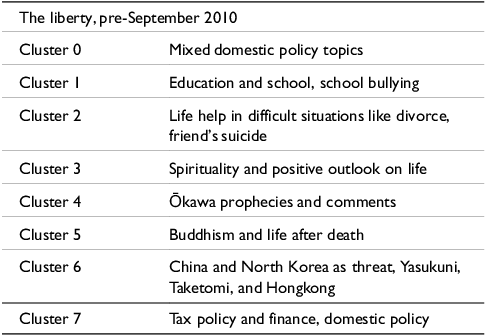
Table 2. Long description
A table titled ‘The liberty, pre-September 2010’ lists eight semantic clusters and their respective topics. The table has two columns: one for cluster numbers and one for the topics covered in each cluster. Cluster 0 covers mixed domestic policy topics. Cluster 1 focuses on education and school, specifically school bullying. Cluster 2 addresses life help in difficult situations such as divorce and a friend’s suicide. Cluster 3 discusses spirituality and a positive outlook on life. Cluster 4 pertains to Okawa prophecies and comments. Cluster 5 explores Buddhism and life after death. Cluster 6 highlights China and North Korea as threats, along with topics like Yasukuni, Taketomi, and Hongkong. Cluster 7 deals with tax policy and finance, as well as domestic policy.
Semantic clusters in “The Liberty” after the Senkaku crisis
Semantic clusters in “The Liberty,” over time, from 1995 to 2010.

Figure 8: Long description
A line graph titled ‘Temporal topic proportions: k8’ displays the proportions of eight clusters over time from 1995 to 2010. The x-axis represents the years, while the y-axis represents the proportion. Each cluster is represented by a different color: Cluster 0 in blue, Cluster 1 in orange, Cluster 2 in green, Cluster 3 in red, Cluster 4 in purple, Cluster 5 in brown, Cluster 6 in pink, and Cluster 7 in gray. The graph shows how the proportions of each cluster change over time, with some clusters increasing and others decreasing. All values are approximated.
Semantic clusters in “The Liberty,” over time, from 2010 to 2024.
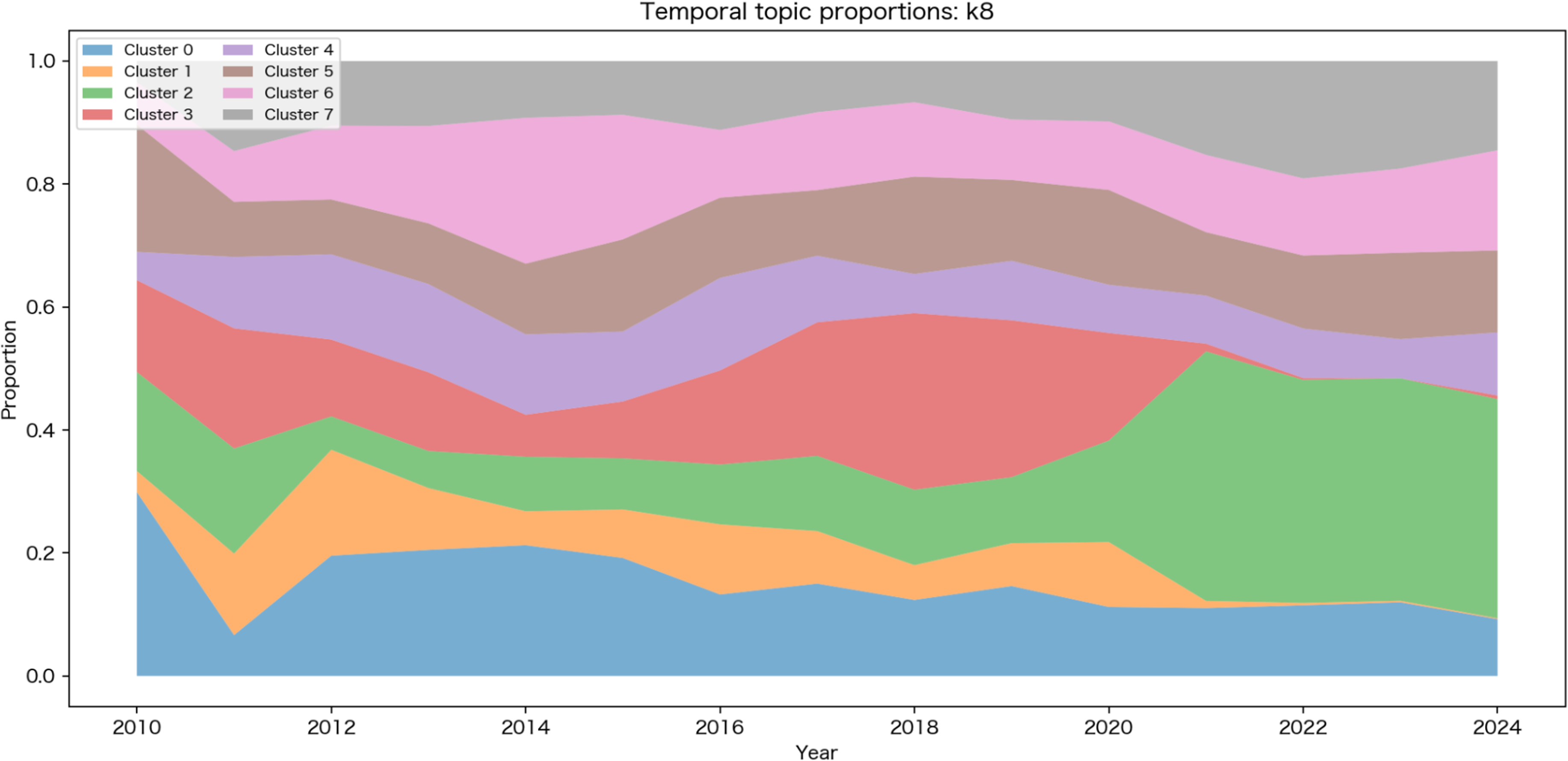
Figure 9: Long description
A line graph titled ‘Temporal topic proportions: k8’ displays the proportions of eight clusters over time from 2010 to 2024. The x-axis represents the years from 2010 to 2024, and the y-axis represents the proportion ranging from 0.0 to 1.0. The graph includes eight distinct clusters, each represented by a different color: Cluster 0 in blue, Cluster 1 in orange, Cluster 2 in green, Cluster 3 in red, Cluster 4 in purple, Cluster 5 in brown, Cluster 6 in pink, and Cluster 7 in gray. Each cluster’s proportion varies over the years, showing different trends and fluctuations. Cluster 0 starts high in 2010 and gradually decreases, while Cluster 1 shows a steady decline. Cluster 2 and Cluster 3 have fluctuating proportions, with Cluster 2 increasing over time and Cluster 3 decreasing. Cluster 4 and Cluster 5 maintain relatively stable proportions with slight variations. Cluster 6 and Cluster 7 show a gradual increase in their proportions over the years. All values are approximated.
This indicates a strong shift toward an increasingly China-focused reporting and siding with right-wing discourse after the Senkaku crisis and HS’ entry into the party-politics realm. It also marks a moment when HS’ ideological framework aligned with a general public debate on China and territorial safety, offering an exploitable moment of attention and positioning within a wider discursive right-wing ecosystem.
Remarkably, the focus on China persists into 2011, despite the occurrence of the tsunami catastrophe and Fukushima meltdown. During this period, China is mentioned more frequently than keywords related to Fukushima or radioactivity, with the latter being comparable in frequency to mentions of North Korea.Footnote 10 That is to say, even during the much larger domestic crisis of the Great East Japan Earthquake Disaster and Fukushima nuclear accident, the discourse on China as territorial threat served as a much more expedient talking point to HS with its clear position in HS’ anti-communist and nationalist ideology, compared to the less exploitable catastrophe composed of natural disaster and struggling state institutions.
Additional collocation analysis suggests that the terms “China” and “North Korea” are discussed in a proximate semantic field, thus both occupy a very similar discursive position in the group’s narrative. The five most frequent collocates to the term “China” are “communist,” “party,” “government,” “North Korea,” and “army,” and for “North Korea” these are “missile,” “China,” “nuclear,” “radiation,” and “problem.” Despite specific differences, the collocation profile for both terms suggests that both countries are considered a (military) threat.
Furthermore, it is important to note that many articles are not single-themed but rather display a mix of topic nodes. North Korea and China often appear together in a list of threats Japan has to face, alongside South Korean and domestic hostilities. For example, a suggestively titled dystopian fiction series “201X: Japan Reoccupied!?”,Footnote 11 which outlines events that could lead to the occupation of Japan by China during the decade of 2010s illustrate the group’s mixed geo-political alarmism. Notably, this series was published in early October 2010, just when the Senkaku crisis was in full escalation. In five parts, the story outlines how Chinese troops are about to win military hegemony in the China Sea and eventually occupy Okinawa (The Liberty, 2010a), how the US will bankrupt in 2016 and therefore withdraw its troops from Japan, which opens the door for Chinese aggression, to articles outlining how to combat this impending scenario with military and nuclear armament and through a revised, patriotic education (The Liberty 2010b). Remarkably, the driving forces of this threat are not only China, but also domestic politicians prioritizing democratic rules over national security and Okinawans voting against US base relocation inside Okinawa (The Liberty 2010b).
Apart from an alarmist rhetoric that presents the scenario to be imminent, some article headlines suggest a religious or spiritual resistance, like the title of part four, which calls to “Stand up to an expanding China with the Japanese spirit”Footnote 12 ; however, the mentioned spirit turns out to be a military solution (The Liberty 2010c). As well as part five, presenting “‘The Lifelines’ rewriting the path to the nightmare scenario,”Footnote 13 which are of mixed political and moral nature, such as a strong army, strong military, and economic treaties to isolate China, but also an education teaching a patriotic history view and “the spirit of hard work and capitalism, symbolized by Ninomiya Sontoku” (The Liberty 2010b).Footnote 14 This series is therefore a good example of HS ideology, where spiritual and secular realms are all intertwined, and equally how this can be realized in a media strategy, where current political news are connected to an established right-wing worldview and discourses, as well as mixed with a spiritual and millenarian invocation of impending doom and resolve.
The use of right-wing populist rhetoric: “anti-Japanese”
A closer look into the use of the term “anti-Japanese” (反日, hannichi),Footnote 15 a term employed by far-right politicians and internet right-wingers in Japan to label perceived internal and external enemies of the country, substantiates our hypothesis that HS has adopted the language and discursive strategies of the Far-Right (cf. Schäfer Reference Schäfer2022). In a subcorpus containing all texts mentioning the term “anti-Japanese” in “HRP Newsfile,” we find 1252 mentions of China, 601 mentions of South Korea, and only 232 mentions of North Korea, providing a clear idea about the group’s perceived external threats.
However, the characterization of regional geopolitical competitors as hostile to Japan’s interests predates contemporary right-wing populist discourse. Using the term to describe China reflects an older application of the word, whereas it is its use against internal adversaries, typically against the political Left or the liberal media, what transforms it into right-wing populist rhetoric (cf. Schäfer Reference Schäfer2022). Examples of this can be found in an article where “anti-Japanese lawmakers” (反日的な議員, hannichiteki na giin) is used to refer to local assemblies in “regions where left-wing forces are generally strong,”Footnote 16 that have supported the Kono statement ( Minato Reference Minato2014).Footnote 17 We also find the rhetoric of “anti-Japanese Japanese” (反日的日本人, hannichiteki nihonjin and 反日日本人, hannichi nihonjin) in both corpora in 12 instances, referring to domestic supporters of “comfort women” memory (The Liberty 2014a; Uematsu Reference Uematsu2016), but also in book reports where the terms are used to describe left-wing intellectuals or Japanese acknowledging Japan’s war atrocities (The Liberty 2014b; The Liberty 2013a). The application of the framing on media can be found in the form of “a leftist newspaper, long regarded as ‘pro-China, anti-Japanese’”Footnote 18 when reporting on the Asahi Shimbun (The Liberty 2013b), “anti-base, anti-American, anti-Japanese”Footnote 19 when reporting on Okinawan media (The Liberty 2011), and in an article saying that the Japan’s teacher’s union and the Japanese media laid the foundation for South Korea’s anti-JapanesenessFootnote 20 (Baba Reference Baba2018).
A qualitative analysis of HP’s YouTube channel “TheFact”
In this section, we examine the YouTube presence of HS through its prominent video channel, TheFact, which is the “most explicitly political” channel (Deck Reference Deck2021) of the group, providing a combination of news reels and talk show segments to its subscribers. Established in 2013, the channel boasts 168,000 subscribers as of January 2026. In addition to its YouTube presence, “TheFact” operates an X account with 7,462 followers and a Facebook account with 4,600 followers, both promoting newly released videos on their YouTube channel and their website (https://thefact.jp/). What differentiates this medium from the other media surveyed in this article is its embedding in the YouTube platform and its recommendation algorithms. Here, content is much more likely to reach an audience interested in the topic discussed in the video title, or via algorithmic recommendation systems even without knowing much about the channel, HS, HRP, or their mission. Among the media surveyed, this channel therefore appears most likely to reach audiences unaffiliated with HS; in other words, it is more likely to seek discursive connectivity in order to generate broader reception. Additionally, as with other YouTube content, the distribution of these videos incurs no direct costs for the organization or the viewer, but can generate revenue for the organization through automated advertising on the platform. “TheFact” perpetuates an anti-media narrative akin to that of the previously discussed online magazines. The channel’s motto, “A program that conveys the ‘facts’ to the world that the mass media does not report,”Footnote 21 indicates that “TheFact” positions itself as an investigative news source offering alternative or allegedly underreported news that frequently verges on disinformation. In this analysis, we focus on the channel’s framing of the Russo–Ukrainian War as an exceptional form of disinformation that deserves further inquiry. Aside from the topics surveyed earlier, the channel’s stance on the war cannot be explained by historical events or prevalence within a nationalist or far-right Japanese media sphere. Apart from a few outliers, the vast majority of Japanese political and media actors took a critical stance on Putin’s invasion, and a favorable view could not be predicted by political leanings (Kalashnikova and Schäfer Reference Kalashnikova and Schäfer2024). Among the very few online pro-Kremlin voices were prolific HRP politicians, and their discourse seemed to stem, among others, from their pro-Trump and anti-media stance (Havenstein and Schäfer Reference Havenstein and Schäfer2024).
The connection between the channel and HRP is apparent, with many of the channel’s hosts being party officials. One of the key hosts in the videos is Satomura Eiichi (里村英一), who serves as the Policy Chairman of the HRP as of early 2026, and former editor-in-chief of “The Liberty.” Frequent guests on the channel are Ide Hirohisa (井手裕久), a member of the HRP’s Political Affairs Investigation Committee, and Chō Hanako (長華子), a member of the editorial board of “The Liberty.”
Data collection and method
For our study, we collected metadata for 606 videos published between August 6, 2013, and April 30, 2024, using the YouTube API tool. This article focuses only on a subset of videos selected using specific keywords to analyze two thematic clusters: (1) videos containing the term “mass media” (マスコミ, masukomi) and (2) videos containing Ukraine- or Russia-related keywordsFootnote 22 in their titles or descriptions. A total of 19 videos published between August 2013 and April 2024 included the keyword “mass media” in their titles, and 53 in their descriptions. These videos were analyzed as a case study to examine the channel’s pervasive anti-media stance and its recurring criticisms of mainstream media. The selection of Ukraine-related videos focuses on how “TheFact” constructed narratives that align with or mirror Kremlin propaganda. Between February 24, 2022, and February 27, 2023, a total of 12 videos featured Ukraine- or Russia-related keywords in their titles, and an additional 11 videos mentioned Ukraine or Russia within their descriptions.
In the next step, we conducted a qualitative content analysis on all of these videos to identify dominant narratives and recurrent discursive patterns. For the Ukraine-related videos, coding was based on a previously developed typology of pro-Kremlin and war-related narratives for text messages on social media platforms (cf. Kalashnikova and Schäfer Reference Kalashnikova and Schäfer2024). For the mass media–related videos, the analysis focused on the topics addressed, the framing of media criticism, and the general anti-media rhetoric of the channel’s output. Many videos contained overlapping themes and narrative strategies, and frequently combined elements of conspiratorial narratives.
Discursive pattern 1: anti-media narrative
In most of the analyzed videos, Japanese and Western major media outlets are described as biased, with the Japanese mass media often also depicted as less democratic than their Western counterparts. Among 19 videos that include the term mass media in their title, 11 specifically highlight aspects that mass media do not cover, frequently using phrasesFootnote 23 that accuse the mainstream media of withholding facts from the Japanese public. Within the same subset of mass media–related videos, the thematic focus shifts over time: those published between 2015 and 2016 focus on what the channel frames as biased Japanese media coverage of US military bases in Okinawa. In 2019–2020, the channel shifted its focus to Japanese politics more broadly. Between 2021 and 2023, the focus shifted to China, with a particular emphasis on addressing human rights violations.
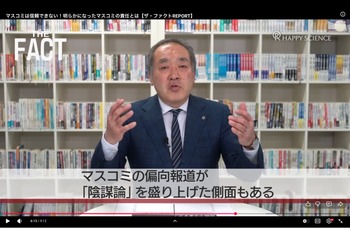
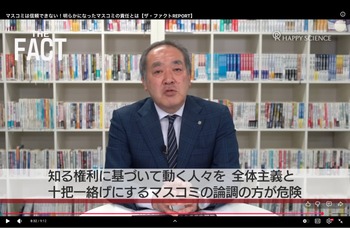
In 2016 and 2021, “TheFact” conducted unrepresentative public polls of 100 people in the Shinjuku area to inquire into their opinion on the mass media (The Fact 2016, 2021). According to this survey, the majority of young people (75% in 2016 and 2021) do not trust the mass media, mentioning the manipulation of content by sponsors or the government, interference from China, and biased media coverage of the COVID-19 pandemic and US elections as reasons. Moreover, the channel criticizes mass media for categorizing claims widely regarded as conspiracy theories or disinformation, such as QAnon, US election fraud allegations, and COVID-19 origin narratives, as conspiratorial, framing such practices as media bias and ideological suppression (The Fact 2021: 5:22). Figures 10 and 11 showcase Satomura’s criticism of mass media for dismissing various viewpoints as conspiracy theories. This critique resonates with sentiments expressed by Trump and other MAGA movement advocates, who see themselves as defenders of truth and frequently label mainstream media as “fake news.” According to Satomura, such reporting obstructs the public’s right to information (The Fact 2021).
Screenshot from the YouTube program “TheFact,” showing host Satomura criticizing mass media. The subtitle reads: “Biased reporting by the media also fuels ‘conspiracy theories’” (The Fact 2021).
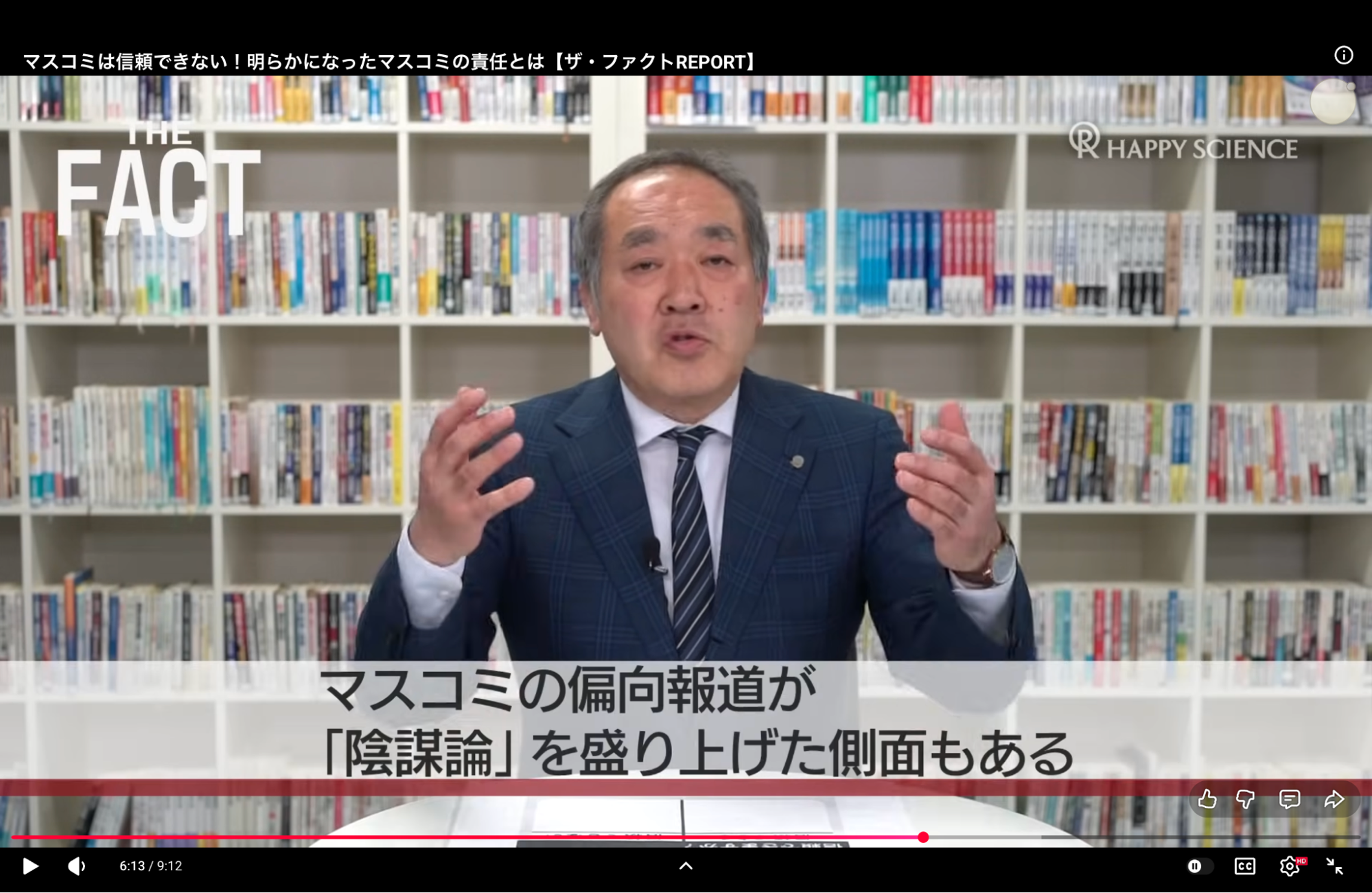
Figure 10: Long description
A man with gray hair, wearing a blue suit and tie, gestures with his hands while speaking. He is positioned in front of a large bookshelf filled with various books. The background suggests a studio or office setting. The man appears to be engaged in a discussion or presentation.
Screenshot from the YouTube program “TheFact,” showing host Satomura criticizing mass media. The subtitle reads: “I see danger in the media’s tone, which lumps together those who act based on the right to know, with totalitarianism” (The Fact 2021).
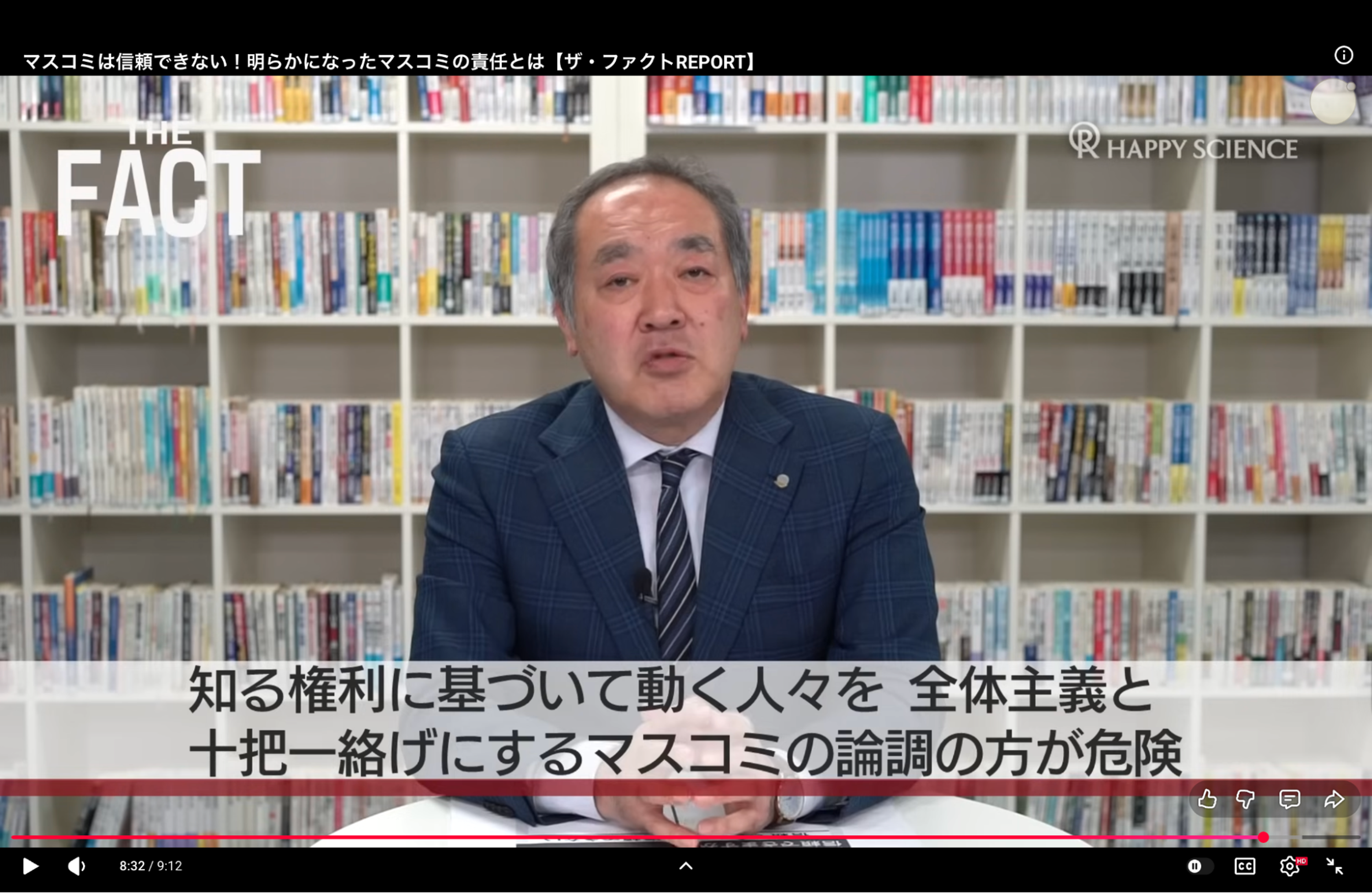
Figure 11: Long description
A man in a suit and tie sits in front of a bookshelf filled with various books. He appears to be speaking critically about the mass media, with a subtitle in Japanese text displayed below him. The subtitle reads: ‘I see danger in the media’s tone, which lumps together those who act based on the right to know, with totalitarianism.’ The setting suggests a formal or academic environment, emphasizing the seriousness of the discussion.
The role of the government is described as that of a manipulator of the mass media (instead of the mass media being the watchdog), with the goal to (a) push certain policies that serve specific interests, such as catering to the Chinese economy, or (b) justify legislation through allegedly unproven reasons, such as the role of greenhouse gas in climate change. Moreover, it is claimed that (c) the mass media is then shaping public opinion by controlling the information in favor of government interests. In another video, this framing is reinforced through analogies to the rise of totalitarian regimes, specifically German Nazism, which manipulated the media to control public opinion and suppress dissent (The Fact 2020). The host draws parallels between the “unscientific theories” portraying Jewish people as inferior in the times of National Socialism in Germany and what he describes as “unproven conclusions” regarding the impact of greenhouse gas on climate change, thereby describing the Japanese government as totalitarian rule, which “introduces new measures based on unscientific grounds” (The Fact 2020: 11:55). The goal of this anti-media and anti-science stance is clear. It seeks to erode public trust in the government, science, and mainstream media, portraying the media and politics as compromised and positions alternative perspectives from dubious sources as more credible.
With regard to China, videos of “TheFact” argue that China is underreported in the Japanese media due to the political pressure, suggesting that the Japanese Ministry of Foreign Affairs has historically worked to shield the Chinese government from negative coverage, which allegedly remains largely unchanged today (The Fact 2020: 7:00). Another notable video example refers to an incident involving the Asahi Shimbun and its journalist Minemura Kenji (峯村健司), known for his coverage of foreign diplomacy, including China (The Fact 2022a). Minemura was suspended for one month for violating journalistic ethics after attempting to obtain a transcript of an interview with former Prime Minister Abe from the deputy editor of the weekly magazine Shūkan Diamond before its publication, claiming that Abe had requested clarification regarding potential inaccuracies (Jiji Press 2022). Although not directly involved in the interviewing, Asahi judged his actions to have violated journalistic ethics by interfering with another outlet’s editorial independence and aligning himself with a political figure (Brasor and Tsubuku Reference Brasor and Tsubuku2022). “TheFact” frames this suspension as a demonstration of Asahi Shimbun’s compliance with the Chinese government, suggesting that the Japanese media avoids reporting on sensitive issues related to China to prevent political backlash (The Fact 2022a: 7:37). The creation of half-truths, or factoid narratives that are partially grounded in true events or facts, is a central element not only in the content of “TheFact” but also in strategic disinformation and online misinformation more broadly (Gess Reference Gess2021). In this vein, it is argued in this video that the lack of support from the Japanese government for journalists like Minemura discourages the Japanese mass media from providing in-depth reporting on China. By contrast, “TheFact” highlights how Western media (mentioning the New York Times and BBC) support journalists in situations like this, implying that this support upholds the freedom of the press in other countries. The selective reporting by the Japanese media, according to “TheFact,” ultimately restricts the public’s right to be informed, which would qualify as a violation of an entrenched basic right of democratic societies.
Discursive pattern 2: the Russo–Ukrainian War
The second part of our analysis deals with the channel’s stance on the Russo–Ukrainian War. Videos of “TheFact” on Russia’s full-scale invasion of Ukraine are less related to the events unfolding on the Ukrainian front and more on the potential global repercussions and interpreted through Japan’s domestic politics, particularly the Japanese government’s response, casting doubt on its credibility and decision-making, the impact of shifting geopolitics on Japan, and economic issues. The videos frequently critique Japan’s sanctions against Russia, portraying them as decisions made under US influence. In doing so, “TheFact” diverts attention away from Russian aggression and instead reproduces familiar pro-Russian narratives, including claims that NATO provoked the conflict and that Ukraine is merely a pawn in a proxy war between the United States and Russia, the latter being depicted as resisting US global hegemony. Furthermore, the Japanese media is accused of uncritically echoing Western perspectives while ignoring controversial topics, namely, alleged neo-Nazi activity in Ukraine, thus reinforcing broader anti-establishment messaging, as described above.
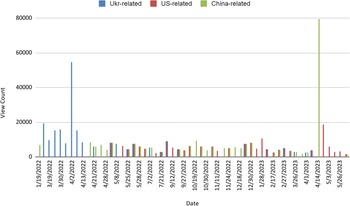
As illustrated in Figure 12,Footnote 24 interest in the topic declined sharply after September 2022, suggesting that the channel shifted its focus away from the topic once the novelty of the subject had worn off. This trend reflects a broader pattern in HS’s social media strategy: jumping on and exploiting any report-worthy international events to attract engagement and reinforce their ideological stance through counter-narratives.
TheFact: number of views per video based on topic (2022–2023).
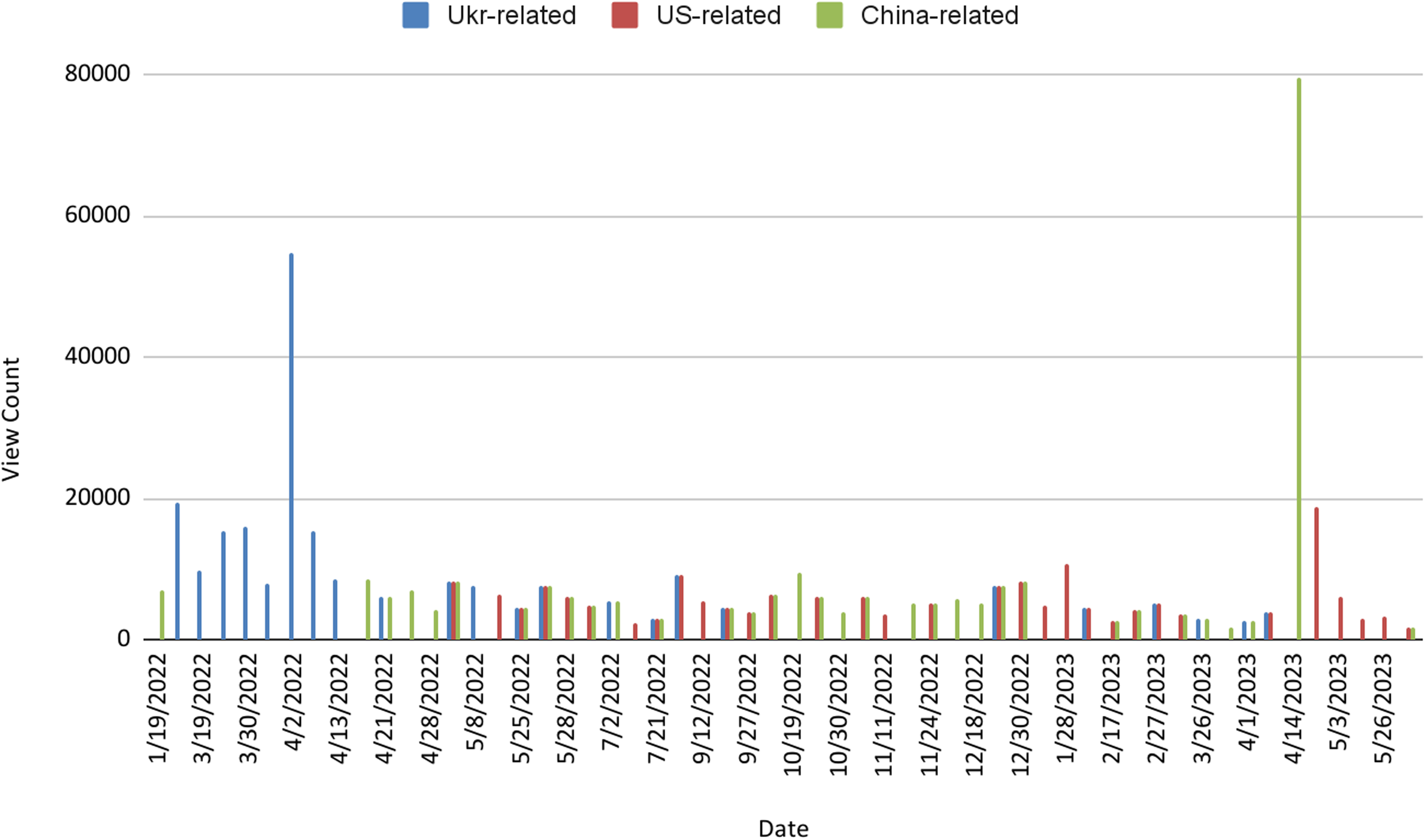
Figure 12: Long description
The bar graph compares the number of views per video based on topics related to Ukraine, the United States, and China from January 2022 to May 2023. The x-axis represents the date, ranging from January 19, 2022, to May 26, 2023. The y-axis represents the view count, ranging from 0 to 80,000. The graph uses three colors to represent different topics: blue for Ukraine-related, red for United States-related, and green for China-related. Notable spikes in view counts are observed on specific dates. For Ukraine-related videos, a significant spike occurs around April 2, 2022, with views reaching approximately 50,000. For China-related videos, a major spike is seen around April 14, 2023, with views exceeding 80,000. United States-related videos show smaller, more consistent view counts throughout the period. All values are approximated.
Topos 1: narratives contesting Western hegemony
The prominent theme in Ukraine-related coverage is related to anti-Western narratives, particularly related to NATO expansion and the broader Russia–US geopolitical tension. One of the main arguments centers on Russia’s perception of NATO’s expansion as a significant threat to its security, making the invasion justifiable or, at the very least, understandable. Ukraine, in turn, is framed not as an independent actor but as a victim entangled in the proxy conflict between Russia and the United States. This narrative is consistent with Kremlin narratives of the war as a part of a resistance to US hegemony and toward a “multipolar world order.”
Besides the geopolitical framing, “TheFact” casts suspicion on the motivations of the United States and Japan for supporting Ukraine. The channel argues that American engagement is driven by self-interest to strengthen its economy and defense industry, rather than humanitarian or democratic concerns. To strengthen the argument, “TheFact” draws parallels between the war in Ukraine and the past American interventions in countries like Iraq and Afghanistan, framed as events that caused suffering and chaos without providing sufficient support to civilians (The Fact 2022b). The implication is that Ukraine risks a similar fate once American strategic objectives have been met. “TheFact” also suggests that the US’s global influence is declining, particularly in the Middle East and Africa, and questions the level of support for the American and EU perspectives on the war in Ukraine across various countries. By amplifying these narratives, the channel positions the West, particularly the United States, as a self-serving and losing power, fostering skepticism toward Western-led responses to the war.
This instance exemplifies a central strategy employed by the channel: whataboutism. This approach is used to deflect criticism by drawing attention to selective incidents of wrongdoing elsewhere. Combined with pars pro toto, whataboutism serves to demonstrate evidence of selective reporting, suggesting a bias in media coverage. The example above illustrates how reference to the past American interventions is used to frame Russia’s actions in Ukraine within a broader narrative of Western imperialism, diverting attention from Russian aggression. These strategies serve to undermine the credibility of both Japanese and Western media, eroding public trust and legitimizing alternative perspectives.
Furthermore, the channel uses various strategies to support the notion of Russia as a counterforce to American global dominance. In April 2022, “TheFact” circulated a conspiracy-laden documentary movie titled Ukraine on Fire (dir. Igor Lopatonok, prod. Oliver Stone, 2016) with Japanese subtitles. The movie revisits the 2014 Maidan protests in Kyiv and presents a pro-Putin version of the events. The movie portrays the demonstrations as a Western-backed coup rather than a democratic revolution, challenging the established narrative. This dissemination aligns with broader pro-Russian information strategies on social media. As demonstrated by Lai et al. (Reference Lai, Toriumi and Yoshida2024) , “Ukraine on Fire” was one of the most widely shared pieces of pro-Russian misinformation during the early months of the full-scale invasion. Their multilingual Twitter analysis revealed that the film circulated across English, Japanese, and Spanish, and was particularly influential within Japanese-language misinformation clusters, where it garnered high levels of engagement and retweets.
Topos 2: geopolitical impact of the war on Japan
“TheFact” frames pro-Russian and anti-American narratives also through a domestic lens reflecting HS’s political agenda, including issues such as energy security and the enhancement of national security. The channel frequently warns of the strategic risks posed by Japan’s proximity to hostile nuclear neighbors: China, North Korea, and Russia, as well as the possibility of their alignment.
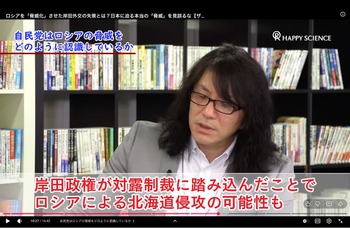
A recurring theme across TheFact’s coverage is the notion that unfriendly nuclear states encircle Japan. This framing occurs in many videos discussing the war in Ukraine, including the first video on the topic (The Fact 2022c, 2022d, 2022e, 2022f, 2022g, 2022h, 2022i, 2023c). The channel argues that Japan’s measures regarding the invasion, such as imposing sanctions on Russia, may provoke Russian aggression (Figure 13) or facilitate closer strategic alignment between Russia and China, adding to its existing challenges with other unfriendly neighbors.Footnote 25 This scenario, known as “Three-Front Strategy” (三正面作戦, san shōmen sakusen), would require Japan to confront three states simultaneously.
Screenshot from the YouTube program TheFact, showing guest Hirohisa Ide delivering commentary. The subtitle reads: “Sanctions against Russia imposed by the Kishida government increase the possibility of Russia invading Hokkaido” (The Fact 2022g).
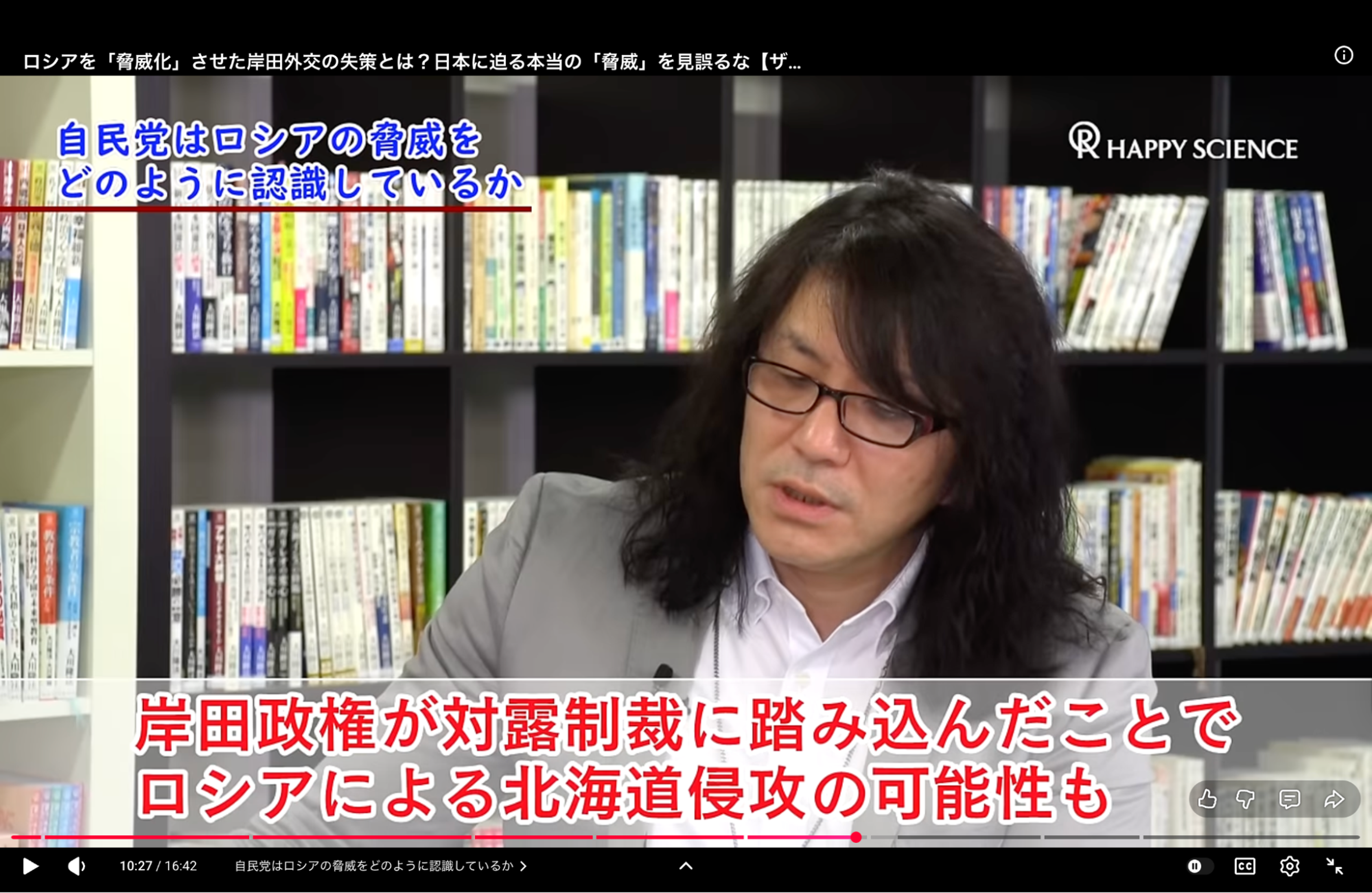
Figure 13: Long description
A man with glasses and long hair speaks in front of a bookshelf filled with various books. He wears a light-colored jacket over a white shirt. The subtitles in Japanese text read: ‘The sanctions against Russia imposed by the Kishida government increase the possibility of Russia invading Hokkaido.’ The logo ‘Happy Science’ is visible in the top right corner.
To respond to these perceived threats, “TheFact” presents two approaches. One emphasizes the importance of a more cautious diplomatic stance by the Japanese government toward the war in Ukraine. To support this idea, the channel released a video drawing analogies from the strategic thinking of the historical figure Oda Nobunaga, suggesting that Japan should prioritize handling conflicts through diplomacy (The Fact 2022j).
Additionally, another video criticizes Japan’s financial and military assistance to Ukraine, including the provision of body armor, helmets, and drones (The Fact 2022h). The channel questions Japan’s alignment with the United States in expanding sanctions against Russia, portraying these actions as potentially escalating the war. These criticisms are framed within HS’s broader ideological aim of achieving global peace and justice, which it claims is threatened by increased militarization.
A second approach advocated in multiple videos addresses Japan’s national security strategy (国家安全保障戦略, kokka anzen hōshō senryaku). “TheFact” repeatedly underscores the need to strengthen national military capabilities to prevent potential aggression from China, North Korea, and now Russia, framing it as preventative measures to avoid the outbreak of future conflict, and thereby to keep peace in the region (The Fact 2022g, 2022i, 2022d, 2022k). In particular, the party HRP advocates for the acquisition of nuclear weapons as a deterrence force (Fact 2022i: 6:55). According to this perspective, enhancing Japan’s independent defense capabilities would allow the country to address threats from neighboring nuclear states while pursuing diplomatic solutions, rather than relying solely on the American “nuclear umbrella.”
Finally, across the videos discussed above the channel argues for the strategic importance of maintaining a friendly relationship with Russia amid Japan’s energy challenges. In line with this position, it also advocates expanding nuclear energy as a solution to ensure national energy security.
Conclusion
The examination of HS and its online and social media apparatus reveals a strategic engagement with modern media landscapes for the propagation of its ideological objectives. One of the most consistent elements of their approach has been a deeply rooted anti-media stance. Positioning themselves as an alternative to mainstream media enables HS to project an image of underdog truth-seekers battling biased journalism, thereby attracting followers who are increasingly skeptical of traditional media outlets. This strategy aligns with HS’s broader historical critique of the media, describing it as “factors of pollution” for people as noted by Baffelli (Reference Baffelli2016, Reference Baffelli2017).
A notable shift in HS’s strategy is the transition of perceived adversaries, moving from North Korea and other religious groups to China, and increasing their coverage of China as a threat in favor of other, potentially less actual and ideologically less exploitable topics. This change reflects a long-standing narrative in Japan that emphasizes spiritual and economic superiority, thus resonating with nationalist sentiments already critical of global institutions. Furthermore, “TheFact” criticizes international frameworks such as NATO and Japan’s pacifist constitution, advocating for greater military sovereignty—an approach echoing Trump’s rhetoric, emphasizing self-reliance and defense autonomy and a global far-right approach to favor nationalist instead of international solutions.
Overall, HS’s media practices and strategies reflect an attempt to politically and spiritually mobilize its base and potentially attract new members while fostering distrust in legacy political parties and traditional mass media. This media strategy aligns with broader far-right movements worldwide. Through a deliberate construction of narratives, the establishment of strategic international alliances, and the creation of discursive connections with the global Far-Right, they have developed a platform that challenges mainstream narratives while promoting an alternative worldview that is gaining traction with a wider audience. This strategic positioning potentially allows HS to not only amplify its influence but also underscores the complexities and challenges inherent in navigating today’s media environments. This discursive reposition is facilitated by the group’s flexible and adaptable ideology, which allows it to integrate and omit discursive strands if public debate allows it, such as an anti-Chinese moment and Russian disinformation. Furthermore, its manichean world-image serves as a canvas for the integration of recent forms of disinformation and anti-media as well as far-right populist rhetoric, as clear images of evil as well as milleniarian messaging follow the same logic. Or, as Pokorny and Mayer (Reference Pokorny and Sophie Mayer2022) put it: “Ōkawa created a discursive canvas onto which topics of interest are accordingly inscribed. The semantic spectrum is malleable; that is, themes may vary, evolve, and conflate, but their ‘grammar’ is bound to several ‘syntactic rules’ (…).” It is these syntactic rules that allow HS to spread a prayer to prevent COVID-19 that contains anti-Chinese stances (Pokorny and Mayer Reference Pokorny and Sophie Mayer2022) and also to integrate political issues into a cosmology inhabited by angels, aliens, and deities. Our analysis showed that HS adapted to new enemy images during heightened public debates and also was able to integrate its highly connected political and spiritual ideology into a new media sphere of disinformation and conspiracy narratives. And this new media sphere appears as equally highly connected, allowing for even more intertwined religious and secular realms. Or, as Michael Butter put it: “the Internet turns the conspiracy theorists’ mantra that ‘everything is connected’ into reality,” with the “interpretative logic of conspiracy theories mirroring the ordering principle of the World Wide Web” (Butter Reference Butter2020: 137). By extension, HS’s ideology connecting politics and esoterism follows the same logic, as everything is connected by Ōkawa, the cosmos, its deities, and mediators.
Financial support
This work was supported by the German Research Foundation (DFG), research grant no. 466328567.
Competing interests
The authors declare that they have no competing interests.
Author Biographies
Linda Havenstein is a media artist and researcher. She is currently a Research Associate and PhD candidate in Japanese Studies at the Friedrich-Alexander-Universität Erlangen-Nürnberg (FAU). Her research interests include New Right discourses and digital civil society.
Olena Kalashnikova is a researcher specializing in Japanese media studies. She received her PhD from Friedrich-Alexander University Erlangen–Nürnberg. Her research interests include post-Fukushima energy discourse, pro-Russian disinformation and propaganda in Japanese mass and social media.
Erica Baffelli is Professor of Japanese Studies at The University of Manchester (UK). She is interested in religion in contemporary Japan, with a focus on groups founded from the 1970s onwards. Her research projects and publication focus on religion in contemporary Japan; religion and media; new and minority religions; religion, gender and violence; and Buddhism and emotions. She currently PI on a Leverhulme Research Project on “Fear and Belonging in Minority Buddhist Communities” (2023-2027). She is co-editor, with Michael Stausberg and Alexander van der Haven, of the open access publication Religious Minorities Online (De Gruyter Brill).
Fabian Schäfer received his PhD from Leipzig University in 2008. He was appointed full professor and chair of Japanese studies at the Friedrich-Alexander-Universität Erlangen- Nürnberg (FAU) in 2013. His research interests include the digital transformation of the public sphere, particularly computational propaganda, hate speech, and disinformation.





 Open access

