


1. The importance of land tenure security for development
Government is the custodian of the most critical (and limited) factor of production, namely, land. Assuring the security of tenure, arbitrating disputes, and facilitating the transfer or sales of titles renders the land market more efficient and less volatile, attracting investors and promoting sustainable urban development. Yet, one of the most underperforming parts of public administration in developing countries is land administration. This is borne out by the observed land conflicts, squatting in undesignated urban areas, non-compliance to land use planning and construction regulations, and lack of investment in housing and farms across the world.
Private land in developing countries remains largely unmapped and unregistered. Generally, urban areas are better mapped and registered than rural areas. Globally, only 24% of rural areas are mapped (46% in urban areas), with approximately the same percentage registered, i.e., 22%. There is no region with universal mapping and registration; even the Organisation for Economic Co-operation and Development (OECD) region has 97% and 68% of urban plots mapped and registered, respectively, as compared to 71% and 68% for rural areas (Enemark et al., Reference Enemark, Bell, Lemmen and McLaren2014). However, Sub-Saharan Africa has the lowest proportion of mapped land in the world, i.e., 14%.
A further complexity is the rate of migration from rural to urban areas: By 2050, 66% of the world’s population is projected to be living in urban areas. The most urbanized regions include Northern America (82% of the population living in urban areas in 2014), Latin America and the Caribbean (80%), and Europe (73%). In contrast, Africa and Asia remain mostly rural, but are urbanizing faster than the other regions and are projected to become 56% and 64% urban, respectively, by 2050 (UN-HABITAT, 2021).
Land tenure, as defined by the United Nations Food and Agriculture Organization, is the relationship, whether legally or customarily defined, among people, as individuals or groups, with respect to land. It involves rules to regulate behavior, as it defines how access is granted to rights to use, control, and transfer land as well as associated responsibilities and restraints, hence determining market participation. Practically, land tenure security implies two main right dimensions: (a) the rights to use and the rights to transfer, and (b) the autonomy to enjoy these rights (Bambio & Bouayad Agha, Reference Bambio and Bouayad Agha2018).
Land can be private, communal, open access, or public, and there are a variety of instruments that assign rights to the use of land, including use rights, control rights, and transfer rights. There are various proven instruments, as listed below, to improve land tenure security, which range from issuing transferable user certificates and community mapping with customary leader adjudication under customary tenure regimes (e.g., China and Benin) to land titling under freehold regimes (e.g., Rwanda).
-
• certificates of customary ownership in areas where customary tenure dominates (e.g., Uganda)
-
• social land concessions (e.g., Cambodia)
-
• land use certificates in the case of informal settlements like in Senegal, community land trusts in Kenya, or certificates of comfort in Trinidad and Tobago; all have the objective of protecting squatters from eviction. Experience has shown repeatedly that such tenure security does not require the allocation of individual titles.
-
• user certificates and transferable user certificates (e.g., China)
-
• land titles under both freehold and leasehold regimes, known as an emphyteutic lease (e.g., Rwanda)
Security of tenure refers to the recognition of these rights by others, the absence of which results in competing claims to the land and possibly conflict. In Niger, although an extreme case, only 4.5% of the adult population has land documents. Other countries, which report in their Voluntary National Reviews on the Sustainable Development Goal Indicators, reflect more moderate tenure security: Nepal 26%, Peru 34%, Uganda 36%, Benin 43%, and Georgia 60%. The gender (female–male) gap in tenure security among rural farmers is also palpable: in Nigeria (30% vs 60%), Peru (8% vs 19%), Uganda (31% vs 49%), and Tanzania (49% vs 61%) (SDG Land Momentum Group, 2020a).
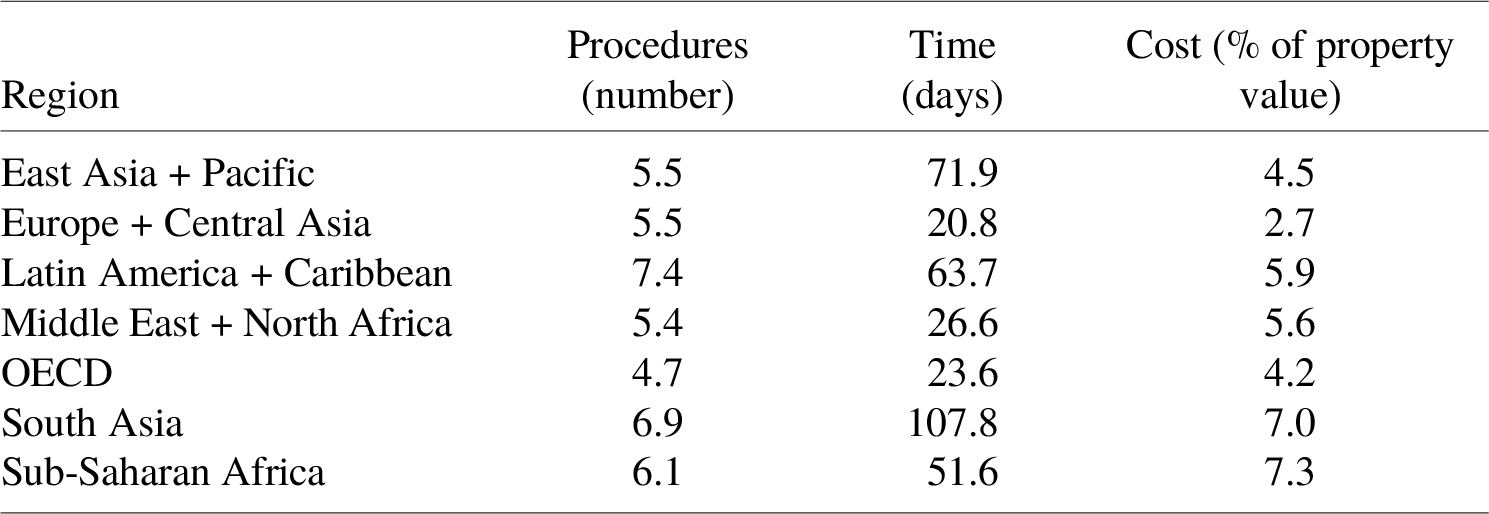
Land administration is the way in which the rules of land tenure are applied and made operational. Land administration, whether formal or informal, comprises an extensive range of systems and processes to administer. These include but are not limited to the allocation of rights to use, lease or sell land; land use regulation as is the case for public works or better managed environmental impacts; and land valuation and taxation. Land is typically administered at the lowest levels of government where there are capacity constraints relating to human resources and technology. This is reflected in the performance indicators in the World Bank’s Doing Business Survey that attempts to determine the efficiency of the land registration process. Tables 1 and 2 list the results of the land registration indicators by region. While it is not the most inefficient region where it relates to time, Sub-Saharan Africa has the highest compliance costs, measured as a percentage of the property value.
Baseline data on population, household, and land parcels.

Under the Sustainable Development Goal 1 target to end poverty by 2030, all men and women, in particular the poor and the vulnerable, should have equal rights to economic resources as well as access to basic services, ownership and control over land and other forms of property, inheritance, natural resources, and appropriate new technology and financial services, including microfinance. Sustainable Development Goal 5 speaks to gender disparity in land ownership, in which, globally, of agricultural land holders. Despite the plethora of organizations working towards the realization of these targets, there has been limited uptake to the global monitoring mechanism. During the years 2016 and 2019, no countries reported in their Voluntary National Reviews on SDG 1.4.2, and only 10 countries submitted reports on SDG 5a. There has also been no country reporting on the perceptions of tenure security (SDG Land Momentum Group 2020a, b).
Low levels of land registration and ailing land administration coupled with urban migration pressure place the focus on Sub-Saharan Africa. Tenure insecurity is costly to society. Land transfers, where they are possible, consume time and resources on both sides of the transaction and for the government. Land registration and other compliance costs as a percent of property value are higher. Another consequence of tenure insecurity is the sub-optimal agricultural output: agricultural lands suffer under insecure tenure and are subject to conflicts, thus showing 20% lower yields than those without conflicts (Byamugisha, Reference Byamugisha2016).
To unlock the vast agricultural potential of Sub-Saharan African countries as well as ensure that urban land is allocated to its highest yielding potential, the granting of tenure security (in its locally relevant form) is considered the best investment based on countries’ experiences; the material outcome being a legal document ascertaining that the rights held on a plot of land are provided by the law against any third party.
2. Cost–benefit analysis of land tenure security in Sub-Saharan Africa
Establishing land tenure security goes beyond land parcel registration and involves policy, administrative and regulatory actions including sensitization, awareness, and education campaigns; participation and the engagement of opinion leaders (including cultural and religious ones); mobilizing and training of field staff; adjudicating, surveying, mapping and demarcating boundaries; capturing and digitizing field data; publicly disclosing and confirming field adjudication results; and registering and distributing land rights documents.
3. The state of land tenure security in Sub-Saharan Africa
Customary tenure prevails on the continent, estimated to be over 78% of land holdings. Individual land holdings (or private property) dominate in only six of the 54 states and cover only 10% of the land in Africa.
Tenure security can and does exist under customary tenure. Among the Kikuyu in Kenya, wills are not recognized, and all sons inherit in equal parts. Linkow (Reference Linkow2019) demonstrates that this is sufficient security to incentivize investment: both tree-planting and tree density (conditional on trees having been planted) are positively related to inheritance by sons. In cases where women find themselves in possession, there is insecurity of tenure and thus significantly less investment.
Thirty-one African states now formally recognize customary tenure as a viable system for regulating land rights. Socially based collective property is fast becoming an accepted part of property relations guided and protected by statutes, taking its place among more traditional and individual-centric norms (Alden Wily, Reference Alden Wily2018). This recognition is characterized by (a) the formalization of tenure; (b) the incorporation of customary practices into statutory law, and (c) the professionalization and creation of institutional legibility in customary tenure and democratization of customary tenure practices. Land administration is adopting a hybrid approach, bringing together elements of traditional authority and fusing this with some of the values of the statutory institutions with which they interface. The result is the facilitation of land transactions because local authorities are becoming more professional in the way that they administer and manage land (Chimhowu, Reference Chimhowu2019).
4. Baseline data
To estimate the shares of rural land that is registered or unregistered in Sub-Saharan Africa, we derive them from survey data analyzed by Deininger et al. (Reference Deininger, Savastano and Xia2017)) using the Living Standards Measurement Study—Integrated Surveys on Agriculture (LSMS-ISA) implemented by the World Bank. An agricultural household owns 2.2 land plots (parcels), which is the weighted average (weighted by the country’s population) of farm plots owned by a household in the surveyed six Sub-Saharan African countries (five surveyed in 2010/2011 and one in 2011/2012) whose total population makes up 41% of Sub-Saharan Africa’s populationFootnote 1; a 14% weighted average of the area (weighted by the country’s population) is covered by formal ownership documents.
Regarding the share of urban land that is registered in Sub-Saharan Africa, no data are available on this. In the absence of such data, we make estimates based on registration information obtained for two Sub-Saharan African cities, namely, Nairobi in Kenya and Dar es Salaam in Tanzania, whose land registration experiences have been studied more closely and reported by Henderson et al. (Reference Henderson, Liu, Peng and Storeygard2020). Using their findings, we assume that half of the urban areas in Sub-Saharan Africa have as good a land registration record as Nairobi, with 90% of private land (outside slums) registered while the other half of Sub-Saharan African urban areas is assumed to have as poor a registration record as Dar es Salaam, with only about 20% of the urban land registered. It should be noted that the latter category of urban area cities, including Bamako, Kampala, and Lagos, have a large proportion of their unregistered land covered by less formal documents, such as Residential Licenses in Dar es Salaam that cover about 50% of its unregistered land, have some legal backing and give a level of comfort to occupants but fall short of formal titles (Henderson et al., Reference Henderson, Liu, Peng and Storeygard2020. To conclude, therefore, we assume that half of Sub-Saharan African private urban land parcels, excepting slums, are of the Nairobi type with a 90% registration rate while the other half are of the Dar es Salaam type with a 20% registration rate. We also assume that lands in urban slums all over Sub-Saharan Africa are all unregistered and are treated separately in the costing.
To estimate the number of households and corresponding land parcels in both rural and urban areas, we begin with the latest estimate of the total population in Sub-Saharan Africa in 2020, which was 1.136 billion (World Bank Open Data), and approximately, 41.3% lived in urban areas (by deduction, 58.7% in rural areas).
Thus, the total number of rural and urban land parcels in Sub-Saharan Africa is 212.6 million and 68 million, respectively.
5. Costs
The costs of establishing tenure security in Sub-Saharan Africa include the costs of rural and urban land registration; the cost of digitizing land registries and information to improve efficiency and transparency; the cost of strengthening institutions and systems to resolve land disputes and manage expropriations, and the annual operations costs of the new or expanded land administration and land records maintenance costs.
6. Rural registration costs
Of the 213 million total rural land parcels, an estimated 14% are registered, leaving 86% of the total or 183 million parcels, unregistered. The bulk of this unregistered rural land―estimated at 90% of the total and amounting to 164.5 million parcels―is of relatively low value and can be demarcated using aerial photos or high-resolution satellite imagery, as Rwanda and Ethiopia have done, and registered at an average cost of US$ 10 per parcel, for a total cost of US$ 1.65 billion (see Table 3).
Costs of securing Sub-Saharan Africa’s land.
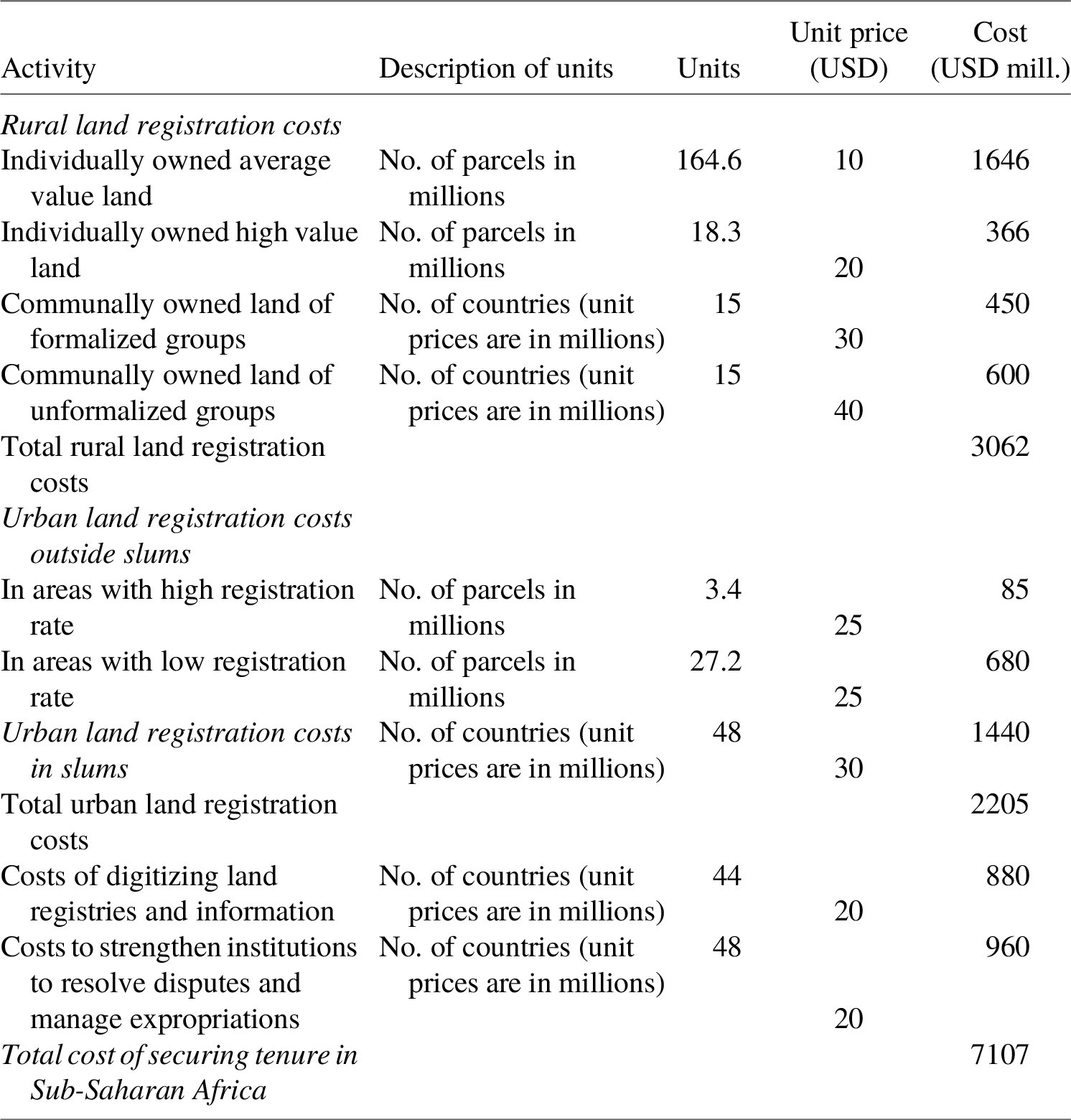
The balance of the unregistered land, 18.3 million parcels, is estimated to be of higher value due to increasing demand either for production or conversion to urban or other high-value uses. This land is vulnerable to contestation and hence requires more precise boundary measurement at a higher cost. Based on experience from Ethiopia, Uganda, and Ghana, we estimate an average cost of surveying and registration of US$ 20 per parcel, for a total cost of US$ 366 million. Hence, the total cost of adjudicating, demarcating, and registering the individually owned rural arable land (both relatively low value and high value) would amount to about US$ 2.0 billion (see Table 3).
6.1. Communally owned land, excluding rangelands and forests
Until recently, registration of communal land was not urgent since the rights of community members in many countries were quite secure and demand for land from non-community members was minimal. However, increases in land values due to population growth and investor demand have raised demand and contestation over communal lands, hence raising the need for their registration. The urgency for communal land registration is in countries with large chunks of communal land, such as Mozambique, Zambia, Angola, Ghana, Sierra Leone, Liberia, Tanzania, and the DRC and in parts of countries with large chunks of communal lands such as northern Uganda and the western and south-eastern areas of Ethiopia. Registration and securing tenure typically involve (a) organizing and formalizing land-owning groups and strengthening local institutions of land governance, and (b) adjudicating and demarcating external boundaries and registering the rights of the formalized groups (Byamugisha, Reference Byamugisha2013; Barnes et al., Reference Barnes, Digiano and Augustinus2015). Cost estimates are based on experiences of Tanzania (about US$ 500 − US$ 2,000 for survey and registration per village) where villages were already organized into administrative units and in Mozambique (US$ 2,000 − US$ 10,000 per community) to formalize land-owning community groups, delineate external community boundaries and register communal rights. We estimate the total cost of registering communal land rights (about 15,000 community groups) in a country to be about US$ 30 million if communities are already organized and formalized as in Tanzania (about 15 countries), or about US$ 40 million if land owning community groups are not yet organized and formalized like in Mozambique and Kenya (also about 15 countries). The total budget for approximately 30 countries is US$ 1.05 billion (see Table 3).Footnote 2
Exclusion of rangelands and forests from the quantification of costs (and benefits) of land tenure security does not mean they are not important. Indeed, they are important not only in generating national economic benefits and providing livelihoods to vulnerable people but also in providing climate change and environmental services. These benefits together with the associated land tenure intervention costs are difficult to quantify partly because there has not been much implementation experience on which to base the quantification. Moreover, since surveying of rangelands and forests is mostly based on community mapping, it would be considerably cheaper than the surveying and mapping commonly used in the registration of rural and urban lands. Since surveying and mapping is a big part of the costs of registration, the provision of land tenure security for rangelands and forests based on communal mapping is likely to be cost-effective. Hence, excluding rangelands and forests in the quantification of costs and benefits would not affect the conclusions of the overall cost–benefit analysis.
Altogether, the total cost of registering individually and communally owned rural land in Sub-Saharan Africa is approximately US$ 3.1 billion.
7. Urban registration costs
In terms of registration of urban land, no reliable information is available on the share of registered land in urban areas in Sub-Saharan Africa. In the absence of data, we use the studies of two cities, Nairobi (Kenya) and Dar es Salaam (Tanzania), as representing two categories of urban entities in Sub-Saharan Africa. In Nairobi, 90% of private land is registered, while in Dar es Salaam, only up to 20% of land is registered, with about 50% of the unregistered land having documents that have a legal backing and give a level of comfort to occupants but fall short of formal titles (called Residential Licenses and renewable after every five years). Bamako (Mali), Kampala (Uganda), Lagos (Nigeria) and many more Sub-Saharan African cities are in a similar property rights situation as Dar Es Salaam (Henderson et al., Reference Henderson, Liu, Peng and Storeygard2020).
We assume that half of Sub-Saharan Africa’s private urban land parcels, with the exception of slums, are of Nairobi type with a 90% registration rate and the other half are of the Dar es Salaam type with a 20% registration rate. Given that Sub-Saharan Africa has an estimated 68 million urban land parcels in total, the unregistered parcels for the Nairobi-type amount to 3.4 million while the unregistered parcels for the Dar es Salaam type amount to 27.2 million, together generating a total of 30.6 million unregistered parcels. Assuming a planning, surveying, and registration cost of US$ 25 per parcel (based on the Thailand, Ghana, and Uganda experiences), the cost of registering 30.6 million urban land parcels, excluding land in slums, is estimated to be US$ 765 million (see Table 3).
7.1. Unregistered land in slums
We assume that land in urban slums is all unregistered. Informal settlements (slums) arise mostly on public land and did not originally form part of local land use plans. Preliminary results from donor-supported formalization programs in Kenya, Lesotho, and Tanzania indicate that it can be done more cost-effectively if it is done through joint field activities of physical planning and surveying, area by area systematically and done in bulk. This bulk planning and surveying, when coupled with new participatory and cheaper approaches to capture land rights information using tablets and smartphones, can reduce costs in participatory processes involving representatives of slum dwellers in a six-step process: community education and participation on rights and responsibilities; adjudication and enumeration of rights of individuals and groups (including tenants and structure owners); agreement on and survey of land boundaries; physical planning with wide community participation; adjustment of boundaries, walls, fences, and buildings to meet the physical plan; and registration of rights in a local or central public land registry (Byamugisha, Reference Byamugisha2013).
Experience from Kenya indicates that at least five types of titles can be issued from regularization of tenure in urban slums: individual titles; joint titles including for couples; block titles (with shares of each member indicated); community or communal titles (with members organized into legal entities); and sectional property titles similar to condominium titles, with individual ownership of structural units but common ownership of the land (personal communication with Kenyan Authorities, January 2022). Given that slums, although declining, have persisted with urbanization in developing countries (Cai et al., Reference Cai, Selod and Steinbuks2018) including those where registration of urban land is quite advanced such as Vietnam, China, South Africa, Ghana, and Rwanda,Footnote 3 not all land in slums will be registered entirely or eliminated in Sub-Saharan Africa within 10 years even with increased funding and policy reforms. It will take a longer time of engagement to tackle not only the issues of planning, surveying, and registration but also other issues that contribute to the proliferation of slums to eventually reduce slums closer to levels in developed countries. For this costing exercise, we provide cost estimates of a sizable program to enable Sub-Saharan African countries to learn and customize global and regional best practices and initiate or accelerate implementation of long-term programs to register about half of the land in slums and to prevent new slums from occurring. For such a program, we are estimating an average cost of US$ 30 million per country in all Sub-Saharan African countries (n = 48), totaling US$ 1.44 billion (see Table 3).
Altogether, the cost of registering urban land including slums is about US$ 2.2 billion.
8. Estimating the cost of digitizing land registries and information to improve efficiency and transparency
Improving efficiency and transparency in Sub-Saharan Africa involves streamlining and digitization of processes and data in public land registries and other land administration services. The digitization builds on the successes of Rwanda, Uganda, Mauritius, and South Africa that have completed their digitization programs as well as on some progress made in this area by other Sub-Saharan African countries including Ethiopia, Benin, Côte D’Ivoire, Malawi, Mozambique, and Zambia. The digitization program is budgeted to cover about 44 countries at an average cost of US$ 20 million per country, based on Uganda’s experience with the development and implementation of its digitization program but excluding infrastructure such as buildings (personal communication with Ugandan Authorities, January 2022). The total cost of digitization of land registries and information services is US$ 880 million (see Table 3).
9. Estimating the cost of strengthening institutions and systems to resolve land disputes and manage expropriations
In almost all Sub-Saharan African countries, land disputes make up a high share of court cases, in the range of 50% in Ghana and Uganda, and one-third to one-half in Ethiopia. Weaknesses in resolving land disputes undermine land tenure security. Sub-Saharan African countries including Ghana and Tanzania, have implemented incremental measures to strengthen judicial systems including hiring retired judges and paying overtime for sitting judges to reduce the backlog of court cases, increasing capacity of the courts through training of judges and giving them more resources, establishing specialized courts, and deploying alternative dispute resolution (ADR) mechanisms and customary institutions. A review of experience with such incremental efforts to strengthen judicial systems and the rule of law in resolving land disputes indicates that while there was some progress, no single mechanism alone has been successful (Byamugisha, Reference Byamugisha2013). Success requires a combination of approaches to ensure system-wide reforms.
A similar review of experience with implementation of interventions to tackle problems in compulsory land acquisition and compensation, which are common in Sub-Saharan Africa and undermine land tenure security, suggests that multiple actions as opposed to single solutions have a greater chance of success; such actions should include updating laws to keep pace with innovations in land policy and passing laws like a number of countries, including Tanzania, Ghana and Uganda, have done; avoiding the undervaluing of land rights and poorly tailored forms of compensation; avoiding the use of the “public interest” principle to acquire land for the production of private goods and services or to lease to investors; and fixing deficiencies in governance such as underpayment or delayed payment of compensation (Byamugisha, Reference Byamugisha2013). Implementing system-wide reforms to resolve land disputes and multiple actions to tackle problems in land acquisition and compensation is estimated to cost an average of US$ 20 million per country and, for the 48 Sub-Saharan African countries, total US$ 960 million (see Table 3).
10. Annual operations and maintenance costs
A key benefit of registries is their ability to provide authoritative information on all parcels of interest, within a reasonable period for land transactions (transfers, sales, inheritances). Even in a low-income country, the size of the land market is non-negligible. For example, in Rwanda, 5.6% and 1.54% of Kigali’s residential and agricultural land parcels, respectively, were transferred through a registered sale each year. For the other provinces, figures are 0.27% and 0.07% for residential and agricultural land, respectively (Ali et al., Reference Ali, Deininger and Duponchel2016). They also estimated a total of USD 2.6 billion of mortgage lending annually.
The costs associated with land administration services include the following:
-
• Back-office costs, including personnel, hardware and software maintenance and upgrades, and information technology upgrades, like integration of blockchain technology. As the technology is rapidly evolving, there is now emerging literature of migrating land registries from physical servers to blockchain, which would improve security and traceability, thereby increasing user confidence.
-
• Decentralization costs, while highly contextual, typically entail some combination of sub-national land service offices and agents who cover the last mile for remote and rural residents. In Rwanda, there are sector land managers (SLMs) to receive, validate and notarize transactions, disseminate information, and help implement land use plans at sector local level (Ali et al., Reference Ali, Deininger and Duponchel2016).
-
• Networking costs that link the registry to other public agencies like the revenue authorities and credit agencies like the Land Administration Information Service of Rwanda, which is integrated with data on land use and agro-ecological suitability and is maintained by the Ministry of Agriculture and Animal Resources to monitor land use and its changes and in doing so, facilitate siting of investments higher up in the value chain, e.g., in agro-processing (Ali et al., Reference Ali, Deininger and Duponchel2016).
-
• Document management system of cadastral surveys and certificates.
-
• Complaints management system to manage disputes and competing claims.
-
• Land use planning and development, which need to be revised as populations grow and migrate and economic activity evolves.
-
• Continued sensitization of land rights and responsibilities, as well as communication on how to access services, costing, etc., to encourage the continued registration of parcels and stem informal transactions of land. In Rwanda, it was discovered that some buyers believed taking possession of the seller’s title without a name change would establish ownership. Thus, the government conducted two national campaigns, referred to as “land weeks,” during 2014–15, which involved extensive coverage on television and radio and some face-to-face events (Ali et al., Reference Ali, Deininger and Duponchel2016).
These operations and maintenance costs ensure the sustainability of the overall land tenure security intervention. When these functions are insufficiently budgeted for, beneficiaries, especially women and rural residents, are unable to access the potential wealth that the exploitation of land can bring. One of the observed consequences is the increased informality of land transactions. Mozambique is a case in point. Despite the legal and institutional reform and the development of the Land Information Management System (SiGIT), challenges associated with land administration include institutional weaknesses. Municipalities, which remain responsible for establishing and maintaining the cadaster in urban areas are unable to perform basic land administration tasks, partly due to insufficient human and financial resources. They were also using outdated maps, which vary between 27 and 40 years (World Bank, 2017). In Colombia, only 5.7% of the parcels are up to date, while 66% are outdated, showing an average last registration of 12 years prior, and with 28.3% of parcels unregistered. The main reasons were attributed to a shortage of human and technical capacity of the institutions responsible for the creation and maintenance of the cadastral records and the use of outdated procedures and regulations that are based on compliance with technical standards rather than on the purpose and use of the information collected (Morales et al., Reference Morales, Lemmon, de By, Ortiz Davila and Molendjik2021).
The national agency tasked with administering lands and maintaining records has annual costs, assumed here to be proxied by the ratio of annual running costs per registered parcel. A survey undertaken by Burns et al. (Reference Burns, Grant, Nettle, Britts and Dalrymple2006) revealed that the average is between US$ 5 and US$ 10. Individual country costs are shown in Table 4.
Land administration costs by country.
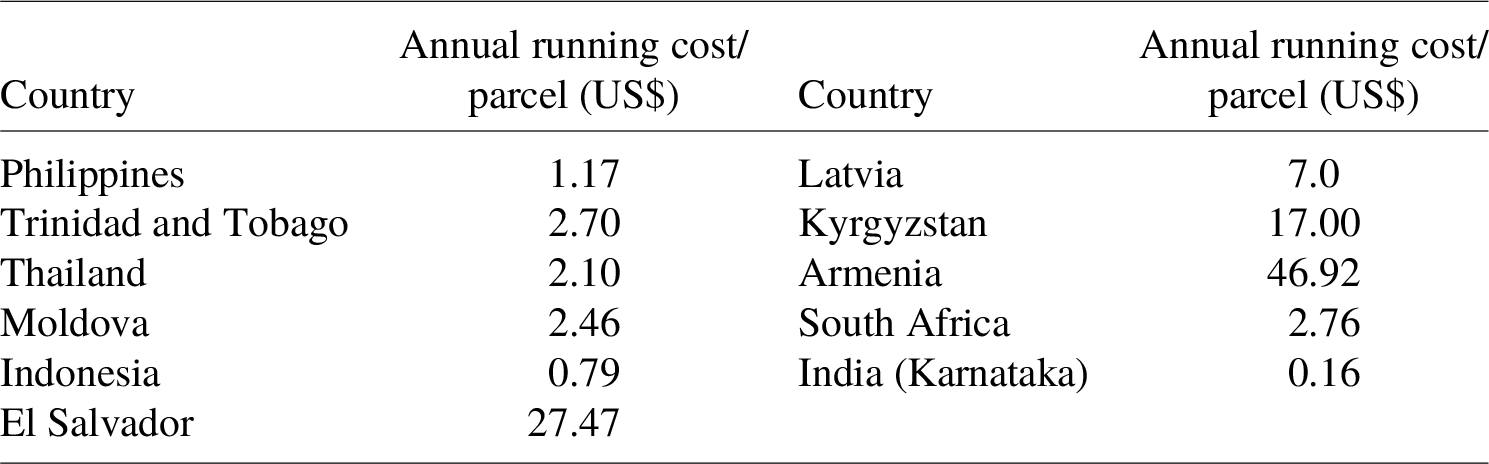
The midpoint of the range (US$ 7.50) is used in the analysis and inflation-adjusted to US$ 10.16 in 2020. It is assumed that there is no significant difference in administration of rural and urban parcels. These costs increase with parcel registration uptake, which occurs in increments of 10% over ten years, followed by an annual markup of 2% for the remaining intervention period, an additional 20 yearsFootnote 4. The undiscounted rural land administration costs over the 30-year period are estimated to be US$ 69 billion and US$ 14 billion for urban parcels (see Table 5).
Costs summary in US$ millions (undiscounted).

The total cost of securing land tenure in Sub-Saharan Africa over 10 years, including registering the remaining unregistered rural and urban land (both individually and communally owned), initiating or accelerating implementation of long-term programs of participatory planning and regularization of tenure to steadily reduce urban slums to the levels in developed countries, digitizing public land registries and information, implementing system-wide reforms to resolve land disputes and multiple actions to tackle problems in land expropriation and compensation, extending land administration, and ensuring records maintenance for an exclusively rural tenure security intervention has a net present value of US$ 21.7 billion and US$ 5.3 billion when efforts are concentrated solely in urban areas.
11. Benefits
The observed benefits of land registration vary depending on whether the intervention takes place in rural or urban areas. Appendix Tables A1 and A2 summarize the evidence in the literature on rural and urban tenure security interventions.
12. Benefits of improved rural tenure security
With respect to land registration in rural areas, there is a narrow range of impacts observed and measured. The anticipated benefits include an (a) increase in farmers’ demand for farm improvements, productive and land conservation technologies, a consequence of improved confidence of being in possession of the parcel in the long run; (b) increase in the supply of formal credit through the creation of tradable collaterals; and (c) as a result of either or both of the preceding benefits, an increase in yields and income.
Successful country examples of rural land tenure interventions include the national land certification and registration programs in Vietnam, Rwanda, and Ethiopia. In the former, land titling results, on average, in a 7.5% increase in the cultivation of perennial crops and a reallocation of 11–12 weeks of nonfarm labor time by the household (Do & Iyer, Reference Do and Iyer2007). In Rwanda, households affected by land tenure were almost 10 percentage points more likely to make or maintain soil conservation investments in structures such as bunds, terraces, and check dams, which was double the change in investment in the control group (Ngoga, Reference Ngoga2019). There is also the case of Benin, which in the context of customary tenure, demonstrated that treatment households are 39% to 43% more likely to grow perennial cash crops and invest in trees on their parcels (Wren-Lewis et al., Reference Wren-Lewis, Becerra-Valbuena and Houngbedji2020). Korsaga (Reference Korsaga2018) evaluates the impact of land security tenure on technical efficiency of 706 villages across 45 provinces in Burkina Faso. Farmers with land tenure security are more efficient in their use of inputs than are farmers with unsecured farms. The difference in technical efficiency between the two groups was low (0.029) but significant at 1%.
However, there are studies that show limited or no impact of tenure security on agricultural productivity or household welfare evidence. Alban and Willem Ertsen (Reference Alban Singirankabo and Willem Ertsen2020) found, after reviewing 85 studies, that in 34% of studies, land rights were not found to be a significant factor in determining whether farmers made land-improving investments, used yield-enhancing inputs, accessed credit, or improved the productivity of land. Other country cases that also reveal less than spectacular results of land titling on agricultural productivity, credit or migration include Ahn (Reference Ahn2019) for Cambodia; Aikaeli and Markussen (Reference Aikaeli and Markussen2017) for Tanzania; Huntington and Shenoy (Reference Huntington and Shenoy2021) for Zambia, and Coulibaly et al. (Reference Coulibaly, Sagoe and Shixiang2021)) for Mali.
Huntington and Shenoy (Reference Huntington and Shenoy2021) undertook a randomized trial in Zambia in which customary land certificates were issued at the end of a process that included sensitization, the formation of a village land committee, and training in land management and conflict resolution. One treatment arm was also the beneficiary of agroforestry extension. These certificates were signed by the chief and confirmed in writing the right to use the land in perpetuity. The parcels could not be sold or transferred except through inheritance. The researchers found a statistically significant 3 percentage point increase in agroforestry at the household-level from the treatment arm that was exposed to both interventions. Looking at over 3000 large Zambian farms, Ali and Deininger (Reference Ali and Deininger2021) also find no impact of de jure certification on productivity as measured by gross profit per ha. They conclude, also noting Huntington and Shenoy’s (Reference Huntington and Shenoy2021) findings, that the reason for this finding is that user rights granted by chiefs are not legally recognized, nor can they be collateralized. In Zambia, the only way to have land rights formally documented is to convert customary land to “state land.” Since 1995, more than 30 million hectares have been transferred to the State.
Key to the notion of tenure security is the transferability and collateralization of parcels. A similar occurrence was observed in China. Following a national initiative to improve land tenure security in 2009, there remained suppressed farmer investment even though farmers held 30-year use rights to land. They were subsequently granted the right to transfer, and a subset of counties officially recognized farm user certificates as a form of collateral. These households were 9.1 percentage points more likely to receive a loan. Whereas in the other counties that had titles but no official recognition of them as collateral, there was a 5.5 percentage point increase in unmet demand for credit. Low productivity was ameliorated by letting small-holder farmers transfer farmland to others for agricultural production and use the certificates as collateral (Li et al., Reference Li, Zhang and Hayes2018; Cheng et al., Reference Cheng, Zhou and Zhang2021).
Another randomized trial of a land formalization program was in Benin, which involved raising awareness about the demarcation and documentation of parcel boundaries. The issuance of certificates was not part of the treatment, but owners had the expectation of receipt from authorities. Treated parcels were 2.4 percentage points more likely than control parcels to be used primarily for perennial crops, and they are 1.7 percentage points more likely to have a newly planted tree.
These two experiments share a common finding of statistically significant farm investment, evidenced by increased use of fertilizer, improved seeds, labor time, and/or the decision to plant perennial crops. Other studies demonstrating this outcome include Deininger et al. (Reference Deininger, Xia, Kilic and Moylan2021) for Malawi, Aberra and Chemin (Reference Aberra and Chemin2021) for Kenya; Hayes et al. (Reference Hayes, Roth and Zepeda1997)) for Gambia, and Do and Iyer (Reference Do and Iyer2007) for Vietnam. Perennial and annual crops do not generate similar income streams. While the payback period for the latter is at least 1 year, it takes 3 years for a cocoa tree to start bearing fruit and an additional 6–7 years to reach full maturity and its highest yield, which may last for at least 10 years (Bros et al., Reference Bros, Desdoigts and Kouadio2019).
Identification of the impacts of tenure security depends greatly on the timing of data collection and the context in which the intervention is applied. Goldstein et al. (Reference Goldstein, Houngbedji, Kondylis, O’Sullivan and Selod2018) conclude that it is generally difficult to observe increases in agricultural productivity because it takes more than one year for investments in perennial crops to generate productivity gains; a notion supported by Higgins et al. (Reference Higgins, Balint, Liversage and Winters2018), who, after investigating 59 studies, found strong support for productive or commercial investment by farmers, but no change in productivity or income. Thus, farm investment may be the channel through which higher productivity and thus incomes are realized.
A specific example of this is Vietnam where land reform led to a statistically significant increase in the proportion of total cultivated area devoted to multi-year crops: households in provinces that had completed land certification increased their proportion by 7.5 percentage points over the period 1993–98. Households also increased non-farm activity by 2.7 weeks per working member between 1992–93 and 1997–98, the most reported activities being sales in markets, food processing, woodworking, and work in the textiles and garment industry. This corresponds to an increase of between 11 and 12 weeks worked in the nonfarm sector for the household, as the average number of working members in the household was 4.37 in 1992–93 and 4.46 in 1997–98. Do and Iyer (Reference Do and Iyer2007) concluded that while they found no significant impact on overall household consumption expenditure or agricultural income at the time of analysis, the increases in investment were likely to yield greater returns in the future.
For the purposes of this cost–benefit analysis, the benefit of rural land tenure security is largely based on a meta-analysis by Lawry et al. (Reference Lawry, Samii, Hall, Leopold, Hornby and Mtero2017), which was limited to lower-income and lower-middle-income countries (Table 6).
-
• Eight of the 20 cases (two in Africa) reveal that there was an average increase of 42% on the monetary value of agricultural productivity; however, the prediction interval (the distribution of effects in the true population) includes zero, albeit in the far-left tail. The two lowest mean effects (less than 25%) are attributed to Ethiopia and Madagascar, and the study of the former includes zero in its mean confidence interval at 95%.
-
• The ten studies used, including five African countries, show evidence of an increase in the probability of farmer investment by 5 percentage points, but the prediction interval also includes zero. Again, this includes both Ethiopia and Madagascar, as was also the case for China, although the study used was before the transferability and collateralization of land mentioned above.
-
• Four of the cases (Nicaragua, Peru, India, and Vietnam) show evidence of a 15% increase in household income. Heterogeneity is low, and the prediction interval is positive; however, there are no African countries included in the sample.
Impact of increased rural land tenure security from Lawry et al. (Reference Lawry, Samii, Hall, Leopold, Hornby and Mtero2017).

Note: Authors’ estimation of the confidence interval is based on results published by Lawry et al. (Reference Lawry, Samii, Hall, Leopold, Hornby and Mtero2017) and not on the source data.
The wide dispersion observed for both agricultural productivity and farm investment is critical because the authors demonstrate that the effects for the Sub-Saharan African countries were markedly lower. Using eight publications involving Sub-Saharan African countriesFootnote 5, the authors conducted a formal moderator analysis for effects on productivity and long-term investment in the region. Effects sizes are significantly lower for agricultural productivity; the mean effect is below zero (−0.42; p-value 0.01). The coefficient for farm investment was not statistically significant, and there was not enough evidence to calculate a mean effect for household income.
Lawry et al. (Reference Lawry, Samii, Hall, Leopold, Hornby and Mtero2017) also conducted an assessment of seven qualitative studies carried out in Sub-Saharan Africa, a study focused on Peru, and one on Vietnam. While there was significant variation, there were almost exclusively positive experiences regarding investment, long-term production, leasing out land, and consumption.
Since the systematic review of Lawry et al. (Reference Lawry, Samii, Hall, Leopold, Hornby and Mtero2017), additional evidence has emerged. In a more recent systematic review, Higgins et al. (Reference Higgins, Balint, Liversage and Winters2018) investigate the impact of tenure security in 59 low- and middle- income countries (25 on Sub-Saharan African countries), and found that there is strong support that land tenure security increases productive and commercial investment, for which it is assumed that higher income will be realized in the future. Table 7 lists the most recent evidence of tenure security intervention impacts in sub-Saharan Africa.
Recent evidence of impact of land tenure interventions in Sub-Saharan Africa post Lawry et al. (Reference Lawry, Samii, Hall, Leopold, Hornby and Mtero2017).
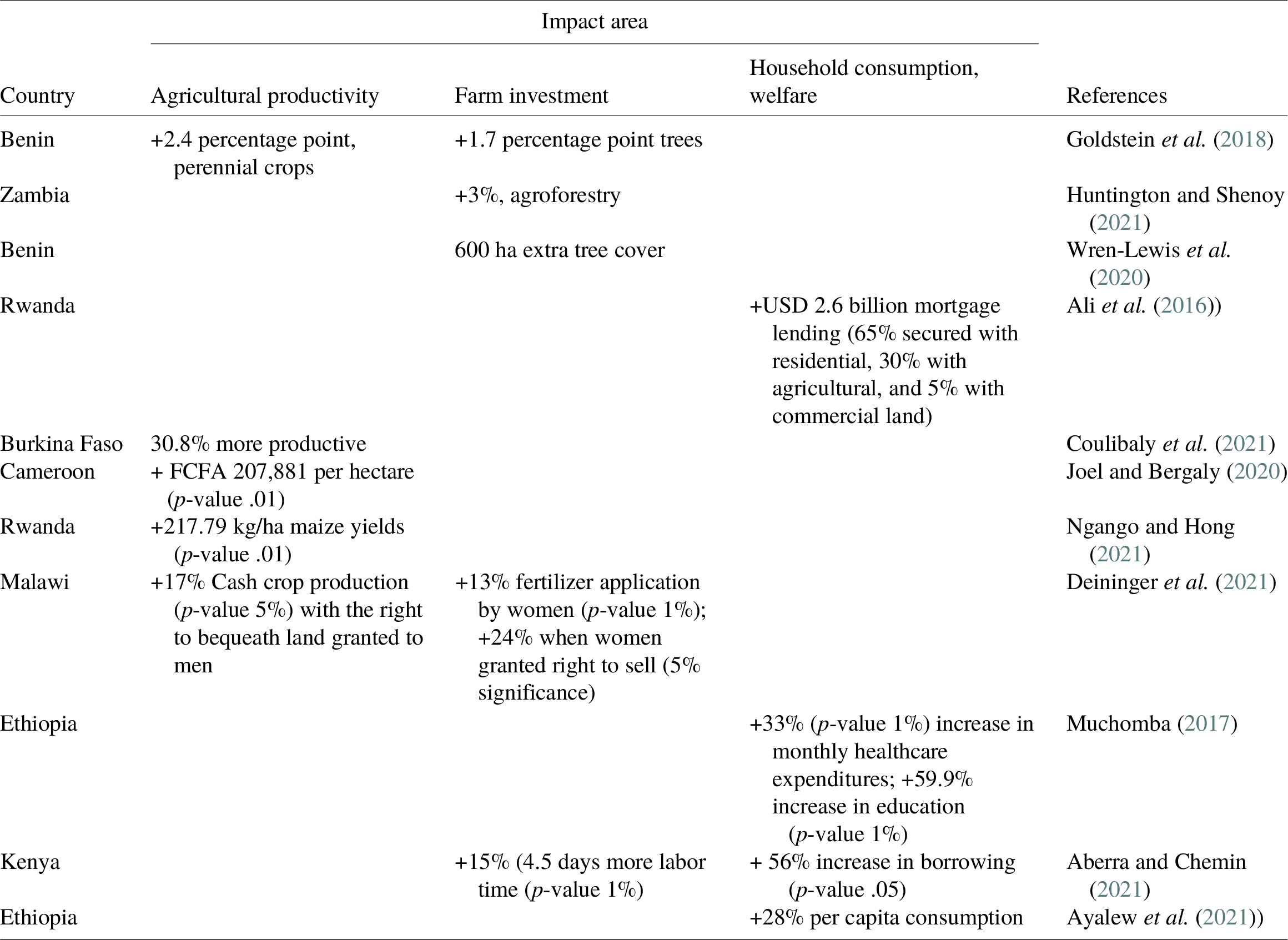
Although the channels vary, it can be concluded that household welfare improves in the medium to long term as a result of improved land tenure security and the subsequent investments made by farmers. The rights to transfer, exchange, and lease land-user certificates create a formal market for land, which may achieve a better allocation of land than a centralized/informal system. The right to mortgage land-user certificates allows farmers to undertake investments that have high up-front costs, such as planting multi-year crops (Do & Iyer, Reference Do and Iyer2007).
Some country examples include the following:
-
• Deininger et al. (Reference Deininger, Xia, Kilic and Moylan2021) reveal that the right to bequeath or sell land in Malawi is estimated to significantly increase the likelihood of long-term investment via organic manure application by 0.12 and 0.07 percentage points, respectively.
-
• Muchomba (Reference Muchomba2017) examines household consumption patterns in the Tigray region of Ethiopia after a land-certification exercise that provided households with the right to use, lease, and bequeath land to family members. Monthly expenditures on healthcare increased by 33% after joint certification (p-value .01); the consumption of homegrown food increased by 57% (p-value 0.10); consumption of clothing increased by 36.9% (p-value 0.10), and investment in education increased by 59.9% (p-value 0.01).
-
• In Kenya, tenure security increased the proportion of people borrowing by 9 percentage points. People who borrowed from a credit union indicated that the loans are not only used for agriculture: 26% report using the loan for human capital investment, 23% for business investment, and 22% for health-related expenses. The main source of collateral for these credit union loans is the harvest. Aberra and Chemin (Reference Aberra and Chemin2021) conclude that increased security of property rights is used as collateral to obtain loans and is used for more general purposes than just agriculture.
-
• In Ethiopia, Ayalew et al. (Reference Ayalew, Admasu and Chamberlin2021)) observe a significant welfare difference between treated and control groups and note that rental market participation and hired labor are the main channels through which certification affects household consumption. Average treated households used around 19.15 more hours of hired labor and spent 75.8 hours more on soil conservation.
To summarize, the bulk of studies on Sub-Saharan Africa find modest to no impact on agricultural productivity and household income but do demonstrate substantive evidence of farmer investment in its various forms. Given the body of evidence around farm investment in African countries and the increase in household income and consumption in non-African countries (but also low-income) as a result of farmer investment, we therefore use the central income estimate of 15%, established by the results of Lawry et al. (Reference Lawry, Samii, Hall, Leopold, Hornby and Mtero2017). This increased welfare could come from expanded farm area or from non-farm activities like investment in livestock or agroforestry (see Table 7). Noting that impacts in Sub-Saharan Africa tend to be more modest and that the studies in Lawry et al. (Reference Lawry, Samii, Hall, Leopold, Hornby and Mtero2017) demonstrating household wealth benefits had a minimum of 5 years between initiation and assessment, we delay benefits for the first five years of the intervention period.
13. Benefit–cost ratio, rural land tenure
According to the World Bank’s Open Data, the value added from Agriculture, Forestry, and Fishing to GDP of Sub-Saharan Africa in 2020 was approximately US$ 342.9 billion. Assuming that 84% of rural areas are characterized by unregistered land parcels, the value added of this subregion is US$ 287.7 billion.
The number of households treated by the intervention is approximately 83 million, with a starting point household income of US$ 3461, on average. The benefits of tenure security are assumed to be enjoyed over a span of 30 years, and Agricultural GDP increases at an annual rate of 3.3% over that period, the average from 2011–2020.
The 15% wealth effect and an annual household uptake rate of 10% are applied to start in Year 6Footnote 6; household income at this point is US$ 4075. Afterward 100% of the benefit is assessed until Year 30, at which point it is assumed that there is an increase in uncertainty, which could arise from several sources: radical political movements, the death of the original beneficiary, and intergenerational transfer, among other things. The net present value (8%) of the benefits stream is US$ 395.7 billion, and the net present value (8%) of costs, which run over 10 years, is just under US$ 21.7 billion. Thus, the benefit–cost ratio is 18.
14. Benefits of improved urban tenure security
Regarding the benefits of urban tenure security (Table A2), by far the most common and consistent benefit is the increase in land values, which appears to concentrate around the value of 25% when outliers Indonesia (45%) and Cambodia (66%) are removed. This was the case in Peru, Ecuador, the Philippines, and Tanzania. Durand-Lasserve et al. (Reference Durand-Lasserve, Fernandes, Payne and Rakodi2007) find considerable support for the claim that urban land titling increases property values: they observe that price increases of 25% are common following the provision of land titles.
15. Benefit–cost ratio, urban
The monetized benefit is a 25% level increase in housing values, realized in the year following registration, and is assumed to be preserved over the duration of the intervention period.
Average national housing prices were taken from the Center for Affordable Housing Finance in Africa, which posts the prices in purchasing power parity (PPP) dollars $ (2020), for the 20 largest Sub-Saharan African countries by population. The inflation adjusted average housing price in 2020 is US$ 41,845. The net present value (8%) of the benefits stream is US$ 236.9 billion. Again, with the net present value of costs being US$ 5.3 billion, the benefit–cost ratio is 45.
When weighted by the proportion of urban residents of total population, the average housing price is US$ 28,240. Here, the net present value (8%) of the benefits stream is US$ 159.9 billion, yielding a benefit–cost ratio of 30.
16. Conclusion
The summary of the benefit–cost analysis can be found in Table 8.
Summary results of benefit–cost analysis (US$ billion).

Previous cost–benefit analyses of land tenure security interventions by the Copenhagen Consensus Center yielded similar good results. In Ghana, the central benefit–cost ratio of a national land titling program, which covered 75% of land in both rural and urban areas was 91, ranging from 5 to 219 depending on various scenarios (Adjasi et al., Reference Adjasi, Adiaba, RAzvi and Wong2020). In Malawi, for a similar country-wide titling intervention, the BCR ranged from 18 to 138, with a central estimate of 73 (National Planning Commission, 2021).
Although not included in the calculations for both urban and rural land titling programs, there are efficiency gains in modernizing land administration services. Technical (e.g., digitization) and managerial innovations can create efficiencies and improve workflow, thereby reducing the costs (direct and indirect) of registering land transactions. In Lesotho, the total days required to register property declined from 101 to 43 following regulatory reform. In Jamaica, institutional and administration reforms reduced property registration and transfer times from 70 to 30 and 25 to 5 days, respectively, while reducing survey check times from 182 to 35 days (Millennium Challenge Corporation, 2019). Ghana reduced the number of days to transfer property from 169 in 2005 to 34 in 2011; Uganda reduced the number of days to transfer property from 227 in 2007 to 48 in 2011. In Madagascar, titles, which involved 24 steps and took up to 6 years at a cost of US$ 500 per title, reduced to US$ 14 per title and a processing time of 6 months (Byamugisha, Reference Byamugisha2013).
17. Critical success factors
-
• The cost of parcel registration and subsequent land transactions borne by the private sector is a critical determinant of the program’s success. Ali et al. (Reference Ali, Deininger, Mahofa and Nyakulama2021) found that despite a desire for formalization, 87% of rural land transactions in Rwanda remain informal because the cost of registration is higher than the willingness to pay. The authors estimate the willingness to pay at about 2% of the land’s value. Reforms to increase compliance by reducing rural fees to affordable levels (including a waiver for the poor) would be revenue-neutral but greatly enhance social welfare. According to the World Bank’s (2019) Ease of Doing Business Survey, the cost of property registration in Sub-Saharan Africa is currently 10% of property value.
-
• According to Higgins et al. (Reference Higgins, Balint, Liversage and Winters2018), attention must be given to the potential exclusion that can result from the securitization of land. Certain groups were found to have been blocked or hindered from benefiting from land formalization for a variety of reasons but mainly due to local institutions tasked with implementing the intervention doing so unfairly, with common instances of corruption, elite capture, and clientelism leading to poorer households and women being unable to benefit from these interventions.
-
• There is also the challenge of sufficient funds allocated to capacity-building and implementation. The authority and power of local chiefs to govern land has been diluted by the incorporation of their powers into statutory law. Creation of “new” institutions to support land governance creates new checks and balances on their authority in ways that did not exist before. This is an extension of state power into areas where it had limited influence. In reality, however, a lack of state capacity to follow through on this statutory influence implies that by default customary institutions have continued to dispense local justice and resolve conflicts over land just like before (Chimhowu, Reference Chimhowu2019). This should also include reinforcement of the legal system, as the inability to enforce contracts and secure property rights could erode all anticipated benefits (Aberra & Chemin, Reference Aberra and Chemin2021). The authors undertook a randomized intervention in Kenya offering the services of a free lawyer for 2 years (85% uptake in the treatment group) in a rural setting with prohibitive lawyer fees and numerous land disputes. Not all cases were fully resolved after two years, but legal representation increased the security of property rights, which translated into greater investment and access to credit. Two years after the start of the intervention, treated households had increased the number of days worked on their plot by 15% compared to control households. Investment increased by 21%. Access to credit to finance long-run productive investments (set up a business or agricultural and human capital investment) increased by 56% in the treatment versus the control group. Agricultural production increased by 42%.
Land titling and supportive investments to improve land administration are complex, involving many stakeholders. While the monetary costs are low if implemented efficiently and the benefits, at least to urban land titling, extraordinarily high, implementing a streamlined low-cost process to register land will reduce rents to some groups (such as surveyors), who benefit from current regulations that impede low-cost systematic process and reduce opportunities for land-related corruption. In many African countries, legacy titles will also have to be addressed. To initiate such a process, regulatory changes are a precondition; otherwise, reforms will not be sustainable. Furthermore, high-level commitment to reform and detailed monitoring of implementation will be essential, and this should be highlighted.
Given the difference in benefit–cost ratios between urban and rural land and the need for regulatory changes to facilitate implementation, it may make sense to suggest the adoption of a sequenced approach at the country level. Phase I would consist of registration of all urban land outside of slum areas (the scope involved can easily be quantified using satellite imagery, as was done in Nigeria) as well as elaboration of the regulatory framework for Phase II (area-based adjudication of all rural land at village/community level together with the definition of processes for rural–urban land conversion and village-wide issuance of titles where appropriate), to be followed by the actual implementation of Phase II.
Appendix
Principal benefits of rural land tenure interventions

Principal benefits observed for urban land titling


 Open access

