

19.1 Introduction
Cultural property has always been a target in armed conflicts. From the 1870 French–German war to the recent conflict in Ukraine, cultural property has been destroyed during military hostilities, even if it is protected by international humanitarian law. To try to increase the protection of the cultural heritage of humankind, the international community has adopted the 1954 Hague Convention for the Protection of Cultural Property in the Event of Armed Conflict (the 1954 Hague Convention) in the aftermath of the Second World War. The Convention stipulates the obligation to safeguard and respect cultural property in armed conflict and during a military occupation. However, the effectiveness of this Convention is often disputed. Violations of the Convention have yet to be brought before an international court, even if courts have dealt with the destruction of historical monuments.Footnote 1
One interesting case study on the application of the Convention concerns the Preah Vihear Temple. Situated in Cambodia near its border with Thailand, the Temple is composed of a series of sanctuaries with a complex history that can be traced to the ninth century.Footnote 2 In 1954, the Temple’s area was occupied by Thailand,Footnote 3 starting a fifty-five-year border dispute,Footnote 4 which almost escalated into armed conflict in 2008.Footnote 5 During this period, several international forums were seized with the protection of the Temple, including: the International Court of Justice (ICJ), United Nations Security Council (UNSC), United Nations Educational, Scientific and Cultural Organization (UNESCO) and a Joint Border Commission established by Cambodia and Thailand. This chapter will assess the contribution of all of these processes and agencies to the protection of cultural property in armed conflict with reference to this study.
Dealing with the related territorial sovereignty dispute between Cambodia and Thailand in the 1960s, the ICJ held that the Temple was in Cambodian territory and that Thailand was under an obligation to withdraw any military or police force stationed there.Footnote 6 Following this decision, UNESCO also dealt with the conflict. As the main international organisation dedicated to protecting cultural heritage, UNESCO’s purposes and functions are to ‘maintain, increase and diffuse knowledge by assuring the conservation and protection of the world’s inheritance of books, works of art and monuments of history and science, and recommending to the nations concerned the necessary international conventions’.Footnote 7 As will be narrated later in this chapter, in April 1966, four years after the ICJ judgment, the Permanent Delegation of the Kingdom of Cambodia to UNESCO contacted the UNESCO Director-General concerning clashes at the Temple, which, according to the Cambodian Government, had damaged the historical monument.Footnote 8 Cambodia alleged that Thailand had violated the obligation to respect the Temple,Footnote 9 a customary international norm codified in the 1954 Hague Convention, and that Thailand had failed to comply with other obligations under the Convention.Footnote 10 However, the UNESCO Director-General conveyed the view that the UN Secretary-General would provide a more adequate response.Footnote 11
The Temple of Preah Vihear was added in 2008 to the World Heritage List established by the World Heritage Convention, following a request by Cambodia in 2007.Footnote 12 However, Thailand contested the extent to which the land around the Temple was also to be protected and claimed that the protective zone that Cambodia had established around the Temple was in Thai territory. The Temple’s area as included in the World Heritage List excluded this zone. The continued conflict on the location of the Thai–Cambodian border was the object of a second ICJ judgment in 2013 interpreting the 1962 decision. In this second proceeding, the Court once more did not mention the 1954 Hague Convention and only cited the 1972 UNESCO World Heritage Convention as a reminder to the Parties that they should co-operate in matters related to World Cultural Heritage.Footnote 13
This case study on the overlapping competence of UNESCO, the ICJ and the UN Secretary-General, highlights the shortcomings of the existing international forums as vehicles to help protect cultural property in armed conflict, and to enforce compliance with relevant international law. First, this chapter will analyse the original ICJ proceedings, including the arguments of the Parties and the law applied by the Court, to demonstrate how cultural heritage law was overlooked. Then, the chapter will examine UNESCO’s actions, as the main international organisation dedicated to protecting cultural heritage. The limits of UNESCO’s actions to enforce international obligations in this particular case will be demonstrated, as will the influence of international politics on the actions of international organisations. Finally, the ICJ proceedings of 2013 will be studied.
19.2 The Original Case before the ICJ
Situated on the border between Thailand and Cambodia, in a 154.7-hectare area, the Temple of Preah Vihear was dedicated to Shiva. The first testimonies of the Temple date to the ninth century, when the monument was founded, and it was finished in the eleventh century.Footnote 14 It is composed of various sanctuaries on the edge of a plateau that dominates the plain of Cambodia. As stated by UNESCO: ‘the site is exceptional for the quality of its architecture, which is adapted to the natural environment and the religious function of the temple, as well as for the exceptional quality of its carved stone ornamentation.’Footnote 15 The Temple was included on the World Heritage List in 2008 on the basis it is ‘an outstanding masterpiece of Khmer architecture’. The sovereignty over the Temple’s surrounding area, however, remained then still disputed.
In 1954, the year of Cambodian independence, Thailand occupied the area of the Temple. First, it should be noted that, even though Cambodia declared its independence on 9 November 1953, it became officially independent only in 1954. At the time, the Cambodian Government saw Thailand as one of the ‘greatest threats to Cambodia[’s] survival’.Footnote 16
On 6 October 1959, the Cambodian Government submitted a case before the ICJ requesting (i) Thailand withdraw the armed forces that it had installed in 1954 in the ruins of the Temple and (ii) that the territorial sovereignty of the Temple belonged to Cambodia.Footnote 17 The Cambodian Government highlighted that it was
not driven by any political, strategic or economic ulterior motive. It intends that the authentic Khmer Temple of Preah Vihear, placed by the delimitation agreements on the Cambodian side of the border, should be piously preserved as part of the spiritual, moral, and cultural heritage of the country.Footnote 18
In its 1962 judgment, the Court recognised that the 1904 Franco–Siamese Treaty had established the frontier in dispute, following the work of a Mixed Delimitation Commission. According to the map used in the dispute, the Temple area was in Cambodian territory. The Court found that the map had been accepted by Thailand and concluded that the Temple was indeed situated on Cambodian territory. The Court also held that ‘Thailand is under an obligation to withdraw any military or police forces, or other guards or keepers, stationed by her at the Temple, or in its vicinity on Cambodian territory’,Footnote 19 and ‘is under an obligation to restore to Cambodia any objects of the kind specified in Cambodia’s fifth Submission which may, since the date of the occupation of the Temple by Thailand in 1954, have been removed from the Temple or the Temple area by the Thai authorities’.Footnote 20
In the written proceedings before the ICJ, both States argued the importance of the Temple for the cultural heritage of humanity as an example of Khmer art and heritage. It should be noted that Cambodia became a member of UNESCO on 3 July 1951, before its formal independence, but ratified the 1954 Hague Convention for the protection of cultural property in the event of an armed conflict only on 4 April 1962, after the application to the ICJ.
On the one hand, according to Cambodia’s pleadings before the Court, the Temple is part of the country’s spiritual, moral and cultural heritage.Footnote 21 As such, the Cambodian Government has summitted several documents that refer to the Temple as a Cambodian monument,Footnote 22 including a Minute de la Lettre du Directeur de l’École française d’Extrême-Orient au Gouverneur Général de l’Indochine that recognised the Temple as a Protected Monument.Footnote 23
On the other hand, the Thai Government contested the religious importance of the Temple for Cambodians since, according to its memorial, ‘the temple is a Brahminic monument, whereas Thailand and Cambodia are now both Buddhist countries’.Footnote 24 Thailand also argued that
[i]t played so small a part in the religious life of either people that by the 19th century, it had been forgotten, and it was the Thai Prince Sanphasit who rediscovered it in 1899 … . Even after its rediscovery, the temple remained isolated and received only occasional visitors. Visitors from Cambodia were specially few, because it is difficult to get to the heights of the temple from Cambodia, there being only one very steep path up the eastern side of the cliff.Footnote 25
Furthermore, according to Thailand, the fact that the Temple was authentically Khmer did not automatically give Cambodia sovereignty since, for instance, one can see Roman heritage throughout Europe, and not only in Italy.Footnote 26
The Court recognised in its judgment the importance of the Temple as cultural heritage, as highlighted by both Parties:
The Temple of Preah Vihear is an ancient sanctuary and shrine situated on the borders of Thailand and Cambodia. Although now partially in ruins, this Temple has a considerable artistic and archaeological interest and is still used as a place of pilgrimage.Footnote 27
However, during the oral and written proceedings, the Parties invoked neither conventional nor customary international law on the protection of historical monuments against military activities to denounce or justify the presence of troops in the Temple. The pleadings focussed on the question of territorial sovereignty.Footnote 28 It should be noted that the 1954 Hague Convention could not be applied since Cambodia had ratified the Convention only in 1962. However, at the time, the protection of cultural property was established in customary international law. We might ask why the Court did not refer to this body of law when analysing the legality of Thailand’s actions.
The 1907 Hague Convention (IV) respecting the Laws and Customs of War on Land and its Annex, ‘Regulations Concerning the Laws and Customs of War on Land’ was also potentially applicable in the case, if the following provisions could be considered customary norms. Article 27 of the Regulations states that ‘in sieges and bombardments all necessary steps must be taken to spare, as far as possible, buildings dedicated to religion, art, science, or charitable purposes, historic monuments …, provided they are not being used at the time for military purposes’. Moreover, Article 56 prohibits ‘all seizure of, destruction or willful damage done to institutions of this character, historic monuments, works of art and science’.
The fact that the Parties did not refer to the 1954 Hague Convention, to customary international law or to the 1907 Hague Convention need not have prevented the Court from considering this body of law. According to the principle recognised in the Lotus case by the Permanent Court of International Justice in 1927,Footnote 29 and reaffirmed by the ICJ,Footnote 30 the Court is not limited to the arguments that the Parties to a dispute present in the written and oral proceedings. However, the Parties had made no claims to which this law might be relevant. On the merits, the Court highlighted that
[t]he subject of the dispute submitted to the Court is confined to a difference of view about sovereignty over the region of the Temple of Preah Vihear. To decide this question of territorial sovereignty, the Court must have regard to the frontier line between the two States in this sector.Footnote 31
The Cambodian Government’s claims were confined to questions of sovereignty, while also asking that the Kingdom of Thailand ‘withdraw the armed forces that it has installed since 1954 in the ruins of the Temple of Preah Vihear’.Footnote 32 The law on the special protection of cultural property in the event of an armed conflict was not invoked. An additional factor at play may have been that, as Cambodia had so recently come to independence, the Court was particularly inclined to focus on the question of territorial sovereignty and take into account also the conflict in Vietnam then taking place.Footnote 33 After ratifying the 1954 Hague Convention, Cambodia, however, went on to seek from UNESCO the protection of its cultural property.
19.3 The Case before UNESCO
Thailand refused to enforce the ICJ judgment for months. However, six months after the judgment, and following a complaint by Cambodia regarding Thailand’s non-compliance with the judgment, Thailand withdrew its armed forces from the Temple area.Footnote 34 However, four years later, Thailand intensified its military presence in the region. On 3 April 1966, the Cambodian Government reported that nine Cambodian guards were attacked by an estimated fifty individuals from the Thai armed forces. The site was not retaken by the Cambodian armed forces until the night of 5 to 6 April 1966. Moreover, the Thai armed forces fired against the Preah Vihear Temple almost every day from 11 April, causing considerable damage to the monument and sculptures. One month after this series of incidents in the area surrounding the Temple, Cambodia requested UNESCO protect it. Cambodia noted that ‘the persistence of these facts would risk the total destruction of this jewel of Khmer art, which is at the same time a heritage of the whole humanity’,Footnote 35 and made a formal request for UNESCO in the following terms:
In order to save this temple from disaster, the Permanent Delegation of Cambodia to UNESCO, in accordance with the instructions given by its Government, would like to request the Director-General of the United Nations Educational, Scientific and Cultural Organization to
1. communicate these facts to the States Parties to the 1954 Convention for the Protection of Cultural Property in the Event of Armed Conflict
2. assist in seeking ways and means to save the Temple of Preah Vihear from these destructive acts.Footnote 36
The organisation’s ability to respond to such a request was debated within UNESCO.Footnote 37 Even though the 1954 Hague Convention stipulated two Articles that establish procedures to assist States Parties in the protection of an endangered cultural property – the conciliation procedure provided by Article 22 and the assistance of UNESCO stipulated by Article 23 – the application of such Articles was still relatively new. Cambodia’s request for assistance did not mention explicitly any Article of the 1954 Hague Convention.
19.4 The 1954 Hague Convention Procedures for Compliance
The 1954 Hague Convention was a response from the international community to the massive destruction of art and historical monuments during the Second World War.Footnote 38 The Convention aimed to establish an international regime to prevent damage to cultural property during international armed conflicts and occupation.Footnote 39
This Convention protects, inter alia:
(a) movable or immovable property of great importance to the cultural heritage of every people, such as monuments of architecture, art or history, whether religious or secular; archaeological sites; groups of buildings which, as a whole, are of historical or artistic interest; works of art; manuscripts, books and other objects of artistic, historical or archaeological interest … .Footnote 40
Two main obligations are stipulated: to safeguard and to respect cultural property. The first obligation, established in Article 3, concerns the preparation in time of peace for the protection of cultural property in times of war. In addition, it concerns positive action to be undertaken by the State in which the cultural property is located. The second obligation relates to negative actions. Parties are to
[refrain] from any use of the property and its immediate surroundings or of the appliances in use for its protection for purposes which are likely to expose it to destruction or damage in the event of armed conflict; and [refrain] from any act of hostility, directed against such property.Footnote 41
Thus, during hostilities States must take all necessary steps to spare cultural property from destruction, to the extent military necessity allows. This includes not conducting any military activities in the vicinity of cultural property or using cultural property in a way that transforms it into a military objective.Footnote 42 Moreover, Article 5 of the 1954 Hague Convention includes obligations for an occupying State to ‘support the competent national authorities of the occupied country in safeguarding and preserving its cultural property’, and to ‘take measures to preserve cultural property situated in occupied territory and damaged by military operations, take the most necessary measures of preservation in close co-operation with such authorities, among others’.Footnote 43
This Convention also stipulates two procedures to assist in the protection of cultural property in the event of an armed conflict: the conciliation procedure established by Article 22 and the assistance of UNESCO as provided by Article 23. Both Articles were inspired by certain common Articles of the four 1949 Geneva Conventions, that is, the Convention (I) for the Amelioration of the Condition of the Wounded and Sick in Armed Forces in the Field of 12 August 1949, the Convention (II) for the Amelioration of the Condition of Wounded, Sick and Shipwrecked Members of Armed Forces at Sea of 12 August 1949, the Convention (III) Relative to the Treatment of Prisoners of War of 12 August 1949 and the Convention (IV) Relative to the Protection of Civilian Persons in Time of War of 12 August 1949.
19.4.1 Article 22 of the 1954 Hague Convention: Conciliation Procedure
Article 22 was established to resolve any conflict between States arising from the application of the 1954 Hague Convention. Initially, the experts drafting the 1954 Hague Convention contemplated a solution referring disputes on the Convention’s application to the ICJ. However, this option was renounced since States seemed reluctant to provide for this as only a low number of States had accepted the ICJ jurisdiction.Footnote 44 In the end, States decided to adopt a provision for conciliation based on the formula for the exercise of good offices in common Articles 11/11/11/12 respectively of the four 1949 Geneva Conventions.
For analysis of Articles 11/11/11/12 of the 1949 Geneva Conventions, one can refer to the 2016 International Committee of the Red Cross Commentaries to the 1949 Geneva Convention (‘2016 ICRC Commentaries’). A first version of the commentaries published in the 1950s is considered ‘a major reference for the application and interpretation of these treaties’.Footnote 45 The new version of the Commentary to the First Geneva Convention, published in 2016, aims to update the 1950 Commentaries ‘in order to document developments and provide up-to-date interpretations’.Footnote 46 Table 19.1 sets out the text of Articles 11/11/11/12 alongside the text of Article 22 of the 1954 Hague Convention.

According to the 2016 ICRC Commentaries,Footnote 47 in International Law, ‘conciliation was originally conceived as a method of peaceful settlement of disputes between States’.Footnote 48 Thus, it ‘usually involves powers of investigation and active participation in finding a solution to the dispute that is acceptable to all Parties to the procedure’.Footnote 49 However, it is not binding. As for the good offices to be provided on the basis of the Geneva Conventions, these do ‘not necessarily suppose a disagreement between the Parties involved, but may be used, more generally, each time that it is “advisable in the interest of protected persons”’.Footnote 50 Moreover,
The purpose of Article 11 is to determine the conditions for establishing a dialogue between Parties to an international armed conflict. Paragraph 1 invites Protecting Powers to facilitate such a dialogue through their ‘good offices’. Paragraph 2 describes one possible way to proceed, namely the organization of a meeting of the representatives of the Parties to the conflict. Article 11 does not, however, suppose the creation of a panel of experts tasked with examining the dispute and proposing the terms of a settlement, as would be the case under the traditional conciliation procedure. In other words, the mechanisms established under Article 11 may involve less formal diplomatic means, as indicated by the notion of ‘good offices’ in paragraph 1.Footnote 51
This type of ‘good offices’Footnote 52 is also created by the 1954 Hague Convention, but this time in the best interest of the protection of cultural property. According to Jiri Toman, under Article 22, States do not interpret the Convention or the Regulations but resolve disagreements between the Parties on the application or interpretation of the Convention and the Regulations.Footnote 53
Article 22 of the 1954 Hague Convention does not stipulate the type of good offices to be applied, with paragraph 2 only describing one example. This Article provides an avenue for belligerents to have their conflict mediated during a meeting presided over by a neutral third party, as illustrated in Figure 19.1. In this meeting, proposals can be presented to the belligerents to better protect the cultural property in question. The meeting can, for instance, be a forum to discuss the evacuation of cultural property or the establishment of safe havens.Footnote 54 This Article depends for its operation, however, on the appointment of a Protecting Power, a neutral third party agreed by the belligerents who will preside over their negotiations.Footnote 55
Procedure of conciliation under the 1954 Hague Convention

States and UNESCO might avoid the application of this Article since reliance on good offices based on the four 1949 Geneva Conventions could be more appropriate. The 1949 Geneva Conventions’ good offices procedure would deal with multiple issues over a range of topics and can include the protection of cultural property – the protection of cultural property is present in the 1977 Protocols to the Geneva Conventions. However, according to the ICRC, ‘the mechanism established under Article 11 has to date never been used’.Footnote 56 According to the 2016 Commentaries:
The non-use of the conciliation procedure is a direct consequence of the lack of effectiveness of the system of Protecting Powers. Protecting Powers have been appointed on only five occasions since the adoption of the Geneva Conventions in 1949 and they have never had the opportunity to apply their formal competence based on Article 11.Footnote 57
Similar reasoning could be applied to the system under Article 22; non-use of the conciliation procedure under the 1954 Hague Convention could be ‘a direct consequence of the lack of effectiveness of the system of Protecting Powers’.Footnote 58
19.4.2 Article 23 of the 1954 Hague Convention: Assistance of UNESCO
Article 23 envisages UNESCO’s technical assistance, broadening UNESCO’s mandate to protect cultural property in the event of an armed conflict. This Article is one of the fundamental provisions on which later legal work concerning the protection of cultural property has been built. From the first propositions of an organisation or rule to protect historical monuments and works of art, the necessity of an impartial organism or State to assist belligerents is often present.Footnote 59 States and authorities have often called for the creation of a Red Cross for historical monuments and works of art.Footnote 60 According to Jiri Toman’s Commentaries, the first paragraph of Article 23 is inspired by Article 9/9/9/10 respectively of the 1949 Geneva Conventions.Footnote 61 Table 19.2 sets out the text of Articles 9/9/9/10 alongside the text of Article 23.
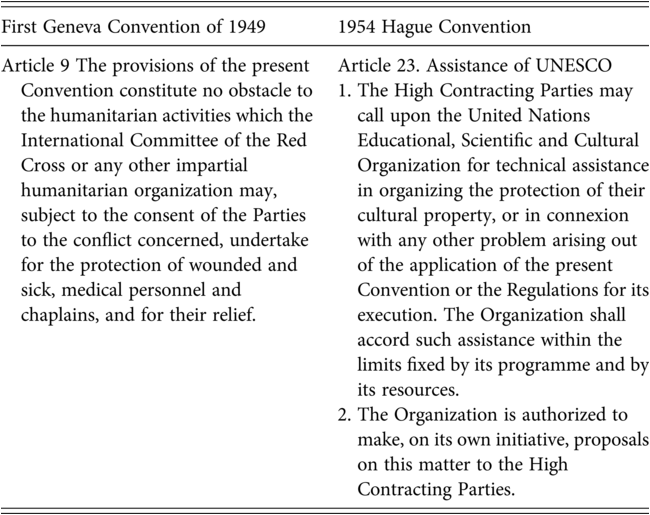
Having again as an example the work of the ICRC, the authors of Article 23 intended to exclude any assistance from UNESCO of a political or military character:Footnote 62 UNESCO could assist States inter alia in the creation of National Committees for the Protection of Cultural Property; affixing distinctive signs to identify historical monuments; the construction of safe havens; and in the elaboration of protecting measures such as plans for bombardments.Footnote 63 This assistance is limited, however, to UNESCO’s programme and budget. It cannot create extraordinary expenses for the organisation or State Parties. Moreover, this Article appears to exclude the belligerents from the process, which was interpreted by the UK Government during the conference for the Convention adoption as a violation of State sovereignty.Footnote 64 This exclusion was rejected by States who understood that the suggestions and proposals made by UNESCO will still depend on the approval of the concerned State.Footnote 65 Figure 19.2 illustrates the workings of the assistance procedure.
UNESCO assistance under the 1954 Hague Convention

One interesting example of UNESCO assistance occurred in 1956 and 1957, when Professor Gérard Garitte, at the request of the UNESCO Member States, carried out a mission to Egypt and Israel. He prepared a detailed report on the state of the monastery of Saint Catherine (Sinai) and made several suggestions for its protection.Footnote 66
It is, therefore, within this technical, even apolitical, mandate that UNESCO should seek to attempt to resolve disputes.Footnote 67 However, whereas Article 22 stipulated the possibility for a meeting between Parties presided over by a Protecting Power appointed by both Parties, Article 23 can be applied whenever UNESCO or other States have a concern for the protection of cultural property, without the necessity to appoint a neutral party – the neutral party can be UNESCO itself. A supplementary step – negotiations to agree on a Protecting Power – is thus suppressed. However, Cambodia did not invoke explicitly Article 23 of the 1954 Hague Convention when seeking assistance from UNESCO to protect the Temple of Preah Vihear. It should be mentioned that another, later convention, the Convention Concerning the Protection of the World Cultural and Natural Heritage (the 1972 World Heritage Convention), adopted on 16 November 1972, also provides for UNESCO assistance in relation to World Cultural Heritage included in the World Heritage List.Footnote 68 This UNESCO assistance is often granted.
19.5 UNESCO’s Response to Cambodia’s Request
After receiving the Cambodian request for assistance, the UNESCO Director-General asked his legal adviser for recommendations on how to proceed. A memo dated 4 May 1966 analysed the implementation mechanism of the 1954 Hague Convention:
The control of [the application of the 1954 Hague Convention] is entrusted, under these conditions, to authorities (protecting powers, commissioners general, etc.) which are only designated when this conflict arises. This control is carried out according to a mechanism which is only implemented at that time and which does not currently exist.
Nothing in the note of the Delegation of Cambodia appears to state [the situations that may attract the application of the Convention. However, a request to safeguard the Temple] is not necessarily limited to the 1954 Convention.
In any case, there is a provision in [the Convention], Article 23, which provides that the Contracting Parties may call upon the technical assistance of the Organization in respect of any problem arising from the application of this instrument.
I believe that in the absence of a control mechanism provided for in the Convention, it is up to the Director-General to inform the Thai Government of the protest he has received, to express his concern for the preservation of the temple and to ask Thailand to respond to the allegations.Footnote 69
According to advice provided to the Director-General, a ‘fact-finding’ mission – that is, technical assistance with the objective of assessing the factual circumstances that endangered the cultural property – ‘would go beyond the strict framework of the application of the 1954 Convention but … would seem to correspond to its spirit’.Footnote 70 However, after a study of the potential political consequences of UNESCO’s intervention, and given that the case had been submitted to the UN Secretary-General by the Cambodian Government; the Director-General decided against UNESCO involvement.Footnote 71 Several UN missions were sent to the region between 1958 and 1968.Footnote 72 For its part, the UNSC also has appointed a special representative of the Secretary-General to both countries to review the situation and propose solutions.Footnote 73
Thus, even if UNESCO is the specialised organisation for the protection of cultural heritage, the UNESCO Director-General understood that the UN Secretary-General had more means and tools to respond to the conflict. According to the Director-General, a more comprehensive solution that included the protection of cultural property, civilians and civilian property was preferred.
A similar decision to refer the protection of cultural heritage to the UN Secretary-General was taken during the conflicts in the Balkans:Footnote 74
The Director-General of UNESCO, Mr Koïchiro Matsuura, has however clearly defined on several occasions what should be the exact role of the Organization in [situations of armed conflicts]: not to intervene during the period before the conflict, to try to prevent it, or after the end of the fighting to try to rebuild a peace process between the community, throughout appropriate action in the various fields of competence of UNESCO.Footnote 75
UNESCO has, however, granted some assistance to Cambodia in another conflict, with Vietnam. On 8 June 1970, the Permanent Delegate to UNESCO sent a letter to the Director-General expressly requesting assistance under Article 23 of the 1954 Hague Convention.Footnote 76 This time, UNESCO provided assistance to Cambodia for the protection of historical monuments. A technical mission was sent to Cambodia to assess necessary measures to protect cultural property and the following recommendations were made: (a) to send a mission to assist in the safe packing and storage of valuable objects, (b) to send a mission to advise Cambodian authorities on methods to be used to protect cultural property against fire and the effects of bombardments, and (c) to appoint a high-ranking technical adviser to supervise operations from the technical point of view. This assistance demonstrates UNESCO can sometimes intervene in ongoing conflicts, however, the assistance provided will be limited to the Party that made such a request and UNESCO should not interfere in ongoing hostilities. Thus, UNESCO has continued to preserve its position as a neutral agency.
A gap in available information about the situation of the protection of Cambodian cultural heritage follows this request. This may be due to the civil war that started in 1970, the establishment of the Khmer Rouge regime (1975–1979) and the ‘tutelage’ of Cambodia by the Vietnamese who withdrew their armed forces only in 1989.Footnote 77 In the ICJ reinterpretation proceedings Cambodia acknowledged that it did not protest the Thai occupation of an area surrounding the Temple ‘during the period of armed conflict in Cambodia or during the succeeding years’.Footnote 78
19.6 Request for Inscription of the Temple on the UNESCO World Heritage List
Cambodia’s request for the Temple’s inscription in the UNESCO World Heritage List was made in 2007 and submitted that ‘the entire promontory of Preah Vihear, as well as the hill of Phnom Trap immediately to the west of the promontory’, were within Cambodian territory.Footnote 79 The Cambodian Government submitted that the Temple and a buffer zone – an area necessary to the application ‘to give an added layer of protection to the property’Footnote 80 – were both within its territory. Thailand contested the Cambodian submission and argued that the border submitted by Cambodia was inaccurate. The Thai Government added to the listing procedure a different map that included a buffer zone on Thai territory. The International Council on Monuments and Sites (ICOMOS) study undertaken for the inscription of the Temple in the World Heritage List observed that
the precise location of the frontier between Cambodia and Thailand to the north of the nominated site is currently the subject of a dispute between the two States Parties. The property nominated … and parts of its buffer zone lay partly within the disputed area.Footnote 81
The site as inscribed in July 2008 excluded the disputed area,Footnote 82 maybe as an easy solution to assure the inclusion of the Temple without any further delay. However, following the site’s inscription, several incidents took place in the area surrounding the Temple, endangering it. Two UNESCO assistances (as per Article 13 of the 1972 World Heritage ConventionFootnote 83) were approved for the Temple Preah Vihear: one assistance for the Conservation and Management of the Preah Vihear Temple adopted in 2009 and one emergency assistance for the World Heritage property ‘Temple of Preah Vihear’ adopted in 2011.Footnote 84
19.7 Referral to the UN Security Council and Establishment of a Joint Border Commission
The UNSC has also been called to act in this conflict. On 18 July 2008, the Permanent Representative of Cambodia to the United Nations addressed a letter to the President of the Security Council. In this letter, the Cambodian Permanent Representative recalled the inscription of the Temple in the World Heritage List and alleged that
[on 15 July 2008] about 50 Thai soldiers crossed into Keo Sikha Kiri Svara pagoda, located inside Cambodian territory, about 300 metres from the Temple of Preah Vihear. By 16 and 17 July 2008, the number of Thai soldiers on the grounds of the pagoda had increased to 480.
In a letter of 21 July 2008, the Cambodian Permanent Representative asked the President of the UNSC to convene an urgent meeting.Footnote 85 In a letter of 22 July 2008 from the Permanent Representative of Thailand addressed to the President of the Security Council, the Thai Government asked for bilateral consultations and negotiations.Footnote 86 A Joint Border Commission, created by a memorandum of understanding,Footnote 87 was thus established to survey and demarcate the entire Thai–Cambodian border.Footnote 88 However, after years of on-again-off-again talks, bilateral diplomacy met a standstill ‘because the approval of the minutes, apparently a minor matter, became a highly politicised issue in Thailand’.Footnote 89
No final and peaceful solution was achieved through this forum. In February 2011, soldiers from Thailand and Cambodia clashed once again in the area surrounding the Temple. According to a UNSC Report, ‘the clashes may have been prompted by rising tensions associated with the sentencing by a Cambodian court on 1 February of two members of a Thai nationalist movement to up to eight years in prison after finding them guilty of espionage.’Footnote 90 At the same time, the UNESCO Director-General expressed concern over the escalation of violence between Thailand and Cambodia.Footnote 91 For the protection of the Temple of Preah Vihear, UNESCO sent a mission to assess the state of the TempleFootnote 92 and convened a meeting with Thai and Cambodian prime ministers to discuss measures to protect the Temple.Footnote 93
19.8 Request for the Interpretation of the 1962 ICJ Judgment
On 28 April 2011, Cambodia submitted to the ICJ a request for interpretation of the 1962 judgment in the Case Concerning the Temple of Preah Vihear. The Cambodian request concerned the meaning and scope of the 1962 judgment, particularly concerning the territorial scope of the second operative paragraph – ‘that Thailand is under an obligation to withdraw any military or police forces, or other guards or keepers, stationed by her at the Temple, or in its vicinity on Cambodian territory’ – namely the territorial extent of the ‘vicinity’ of the Preah Vihear Temple. In 1962, when Thailand withdrew its armed forces deployed in the Temple area, it built a ‘barbed wire fence which divided the Temple ruins from the rest of the promontory of Preah Vihear’.Footnote 94 Such a fence was considered by the Cambodian Government as ‘incompatible with the 1962 judgment’.
On 18 July 2011, the ICJ rendered a provisional measure ordering ‘both Parties [to] immediately withdraw their military personnel currently present in the provisional demilitarised zone and refrain from any military presence within that zone and from any armed activity directed at that zone’.Footnote 95 On 11 November 2013 the Court gave judgment on the question of interpretation of its 1962 decision. The Court stated that ‘Cambodia had sovereignty over the whole territory of the promontory of Preah Vihear … and that, in consequence, Thailand was under an obligation to withdraw from that territory the Thai military or police forces, or other guards or keepers, that were stationed there’.Footnote 96
In the Court’s judgment of 11 November 2013, the religious and cultural significance of the Temple for the peoples of the region was recognised, and the Court recalled that ‘under Article 6 of the World Heritage Convention, to which both States are Parties, Cambodia and Thailand must co-operate between themselves and with the international community in the protection of the site since it is listed as a World Heritage’.Footnote 97 Moreover, it stated that
… each State is under an obligation not to ‘take any deliberate measures which might damage directly or indirectly’ such heritage. In the context of these obligations, the Court wishe[d] to emphasize the importance of ensuring access to the Temple from the Cambodian plain.Footnote 98
This time round the ICJ referred to international legal obligations to protect cultural heritage and to the importance of the Temple as such. The 1954 Hague Convention is not cited, only the 1972 World Heritage Convention. Maybe the expected demarcation of the border consistent with the 1962 judgment pre-empted the idea that international law on the protection of cultural property in armed conflict, or occupation, would apply, since it is forbidden to deploy military forces in another State’s territory. Judge Cançado Trindade extensively explored the cultural significance of this Temple in his Separate Opinion, demonstrating a special interest in the field, and it may be due to his interest and influence that the Court emphasized the importance of protecting the Temple as cultural heritage.Footnote 99 No more clashes between Thailand and Cambodia have been reported since 2011,Footnote 100 however, the decrease of tensions is thought to be due to the general improvement in bilateral relations.Footnote 101
19.9 Conclusion
UNESCO is the main organisation dealing with the protection of cultural heritage; thus, States often request assistance from UNESCO in the international protection of cultural heritage in times of crisis. However, UNESCO’s ability to provide a satisfactory response seems limited. Over the years, certain States have asked for UNESCO to help them ensure compliance with the 1954 Hague Convention. Most of the steps taken by UNESCO focus on prevention rather than intervention, as implied in the Jiri Toman’s Commentaries to the 1954 Hague Convention on the Procedure for Conciliation and Technical Assistance, and are employed only when States involved in the disaster, crises or conflict agree. Requests can be refused for political reasons, as was the case with Cambodia in 1966 and in the Balkans conflict.
Even if the Temple of Preah Vihear case was referred to be dealt with through the office of the UN Secretary-General and by the UN Security Council, UNESCO as the related specialised agency should have played a more important role. In this particular case, only the ICJ has been able to directly address the legal dispute on the territory sovereignty – it has ruled that the Temple is on Cambodian territory, a fact recognised by international organisations and States. However, compliance with the ICJ’s decisions has also met difficulties. Despite several UN missions sent to the region and the establishment of a Joint Border Commission, no long-lasting solution has been found. The action by the UNSC and United Nations General Assembly (UNGA), through missions sent in loco, did not provide a permanent solution, and tensions between both States remained.
Nowadays, a synergy between organisations is proposed to provide better protection of cultural property in times of conflict. In this sense, United Nations peacekeeping forces have also acted to protect tangible and intangible cultural heritage.Footnote 102 This approach has sometimes been successful, for instance in the case of Cyprus. Though not involved in a situation of active conflict, the creation in 2009 of the Technical Committee on Cultural Heritage for the protection of cultural heritage in Cyprus is an example of an operative partnership between different actors, including the European Union and the UNDP.Footnote 103 However, once again, the main problem – how to enforce compliance in practice – was not addressed. The best answer to these difficult situations may lie in the broader context of bilateral diplomacy. For the Preah Vihear Temple case, the strengthening of Cambodian–Thai relations, notably economic relations, has stabilised the conflict, even if the two countries usually avoid addressing the issue regarding the border.Footnote 104


 Open access