

Introduction
The gastrointestinal parasitic nematode Haemonchus contortus (Rudolphi, 1803) is a highly pathogenic haematophagous species that inhabits the abomasum of ruminant hosts and is among the most important helminth parasites of veterinary concern. The species parasitises a broad range of ruminants, primarily domestic sheep, goats, and cattle, as well as numerous wild ruminants (Hoberg and Zarlenga Reference Hoberg and Zarlenga2016; Ma et al. Reference Ma, Lv, Zhang, Zhu, Liu and Wang2025). Together with other parasites that affect livestock, the nematode causes significant economic losses worldwide (Charlier et al. Reference Charlier, Rinaldi, Musella, Ploeger, Chartier, Vineer, Hinney, von Samson-Himmelstjerna, Băcescu, Mickiewicz, Mateus, Martinez-Valladares, Quealy, Azaizeh, Sekovska, Akkari, Petkevicius, Hektoen, Höglund, Morgan, Bartley and Claerebout2020). In addition to the high pathogenicity, a high level of resistance of H. contortus to all groups of anthelmintic drugs has been registered all over the world (Babják et al. Reference Babják, Königová, Komáromyová, Kuzmina, Nosal and Várady2023; Kotze and Prichard Reference Kotze and Prichard2016), which significantly complicates its control. Compounding this difficulty is the high daily egg output in females, commonly reported as 5,000–15,000 eggs per day (Carson et al. Reference Carson, Reichel, Bell, Collins, Smith and Bartley2023).
At the same time, published information on the female daily egg output of this nematode species is highly variable, despite a large number of studies on H. contortus and haemonchosis in small ruminants worldwide (Ma et al. Reference Ma, Lv, Zhang, Zhu, Liu and Wang2025; Saccareau et al. Reference Saccareau, Sallé, Robert-Granié, Duchemin, Jacquiet, Blanchard, Cabaret and Moreno2017). In particular, reported daily egg output per female ranges from as little as 18.4 eggs (SD = 4.71) (Valderrábano et al. Reference Valderrábano, Calvete and Uriarte2010) to as much as 10,000–15,000 eggs (Carson et al. Reference Carson, Reichel, Bell, Collins, Smith and Bartley2023; Coyne et al. Reference Coyne, Smith and Johnstone1991; Gordon Reference Gordon1967). Most of the publications that provide information on the high daily egg output of H. contortus relied on a rough estimation of total daily egg output in sheep faeces divided by the total number of females collected after necropsy (Saccareau et al. Reference Saccareau, Sallé, Robert-Granié, Duchemin, Jacquiet, Blanchard, Cabaret and Moreno2017). Such an indirect approach may, therefore, lead to inflated estimates of true female daily egg output.
To our knowledge, there are no published estimates of in utero egg numbers for H. contortus females. Nevertheless, this measure may serve as an additional, though relatively direct proxy for fertility and may help place the values reported in the literature in a more critical context. Therefore, the present study aimed to determine in utero egg counts in female H. contortus recovered from experimentally infected sheep and to assess their implications on female daily egg output compared with values commonly reported in the literature.
Materials and methods
Source of nematode material
Female H. contortus nematodes analysed in the present study were recovered post-mortem from experimentally infected lambs included in a previous study (Leško et al. Reference Leško, Bombárová, Petrič, Batťányi, Komáromyová, Königová, Babják, Halada, David, Łukomska, Pawlak, Sidoruk, Cieslak, Čobanová, Váradyová and Várady2025). In that experiment, Tsigai breed lambs were assigned to three groups: two dietary treatment groups, including a chicory-supplemented group (CHIC) and a zinc oxide nanoparticle group (ZnO-NPs), and a control group. All animals were experimentally infected with approximately 5,000 infective larvae of the susceptible isolate ISE of H. contortus and monitored for 107 days. The details of the original study design, animal procedures, and primary outcomes have been partially published elsewhere (Leško et al. Reference Leško, Bombárová, Petrič, Batťányi, Komáromyová, Königová, Babják, Halada, David, Łukomska, Pawlak, Sidoruk, Cieslak, Čobanová, Váradyová and Várady2025). Archived female nematodes recovered from three 2% aliquots of the nematode material retained from the original experiment were used for in utero egg counts. No lambs were killed specifically for the present measurements and analysis. Female worms were selected from these aliquots to include 50 mature females from each experimental group; however, only 47 suitable females were available for the ZnO-NPs group. Because no nematodes were recovered from some animals at the experimental endpoint, the present analysis was based on material from 14 lambs.
In utero egg counts
The ex utero egg count method (Austin et al. Reference Austin, Budischak, Ramadhin, Hoberg, Abrams, Jolles and Ezenwa2017; Kuzmina et al. Reference Kuzmina, Lyons, Tolliver, Dzeverin and Kharchenko2012) was used to count eggs in the female uterus. For this, nematodes were measured and dissected under a stereomicroscope (Leica S8APO, Leica Microsystems, Wetzlar, Germany) at ×20 magnification. The reproductive system was extracted from the female’s body, placed on a microscope slide in a drop of lactophenol solution (25% phenol, 25% glycerol, 25% lactic acid, 25% distilled water), and opened using entomological needles. All eggs present in both branches of the female reproductive system were extracted into a drop of lactophenol, covered with a slide, and counted under a Leica DM 4000 B microscope (Leica Microsystems, Wetzlar, Germany) at ×100 magnification.
Statistical analysis
All analyses were performed in R version 4.4.2 (R Core Team 2024), using the tidyverse collection of packages for data manipulation and visualisation (Wickham et al. Reference Wickham, Averick, Bryan, Chang, McGowan, François, Grolemund, Hayes, Henry, Hester, Kuhn, Pedersen, Miller, Bache, Müller, Ooms, Robinson, Seidel, Spinu, Takahashi, Vaughan, Wilke, Woo and Yutani2019). The main purpose of modelling was not to assess predictors of egg counts as such, but to estimate potential group-related differences when interpreting in utero egg counts. For this reason, variation in egg counts was analysed using a negative binomial mixed-effects model fitted with the glmmTMB package (Brooks et al. Reference Brooks, Kristensen, van Benthem, Magnusson, Berg, Nielsen, Skaug, Maechler and Bolker2017). The experimental group was included as a fixed effect; female body length was modelled as a nonlinear term using splines with seven degrees of freedom implemented via the splines package; and host identity was included as a random intercept to account for nonindependence among worms recovered from the same host. To check model adequacy to the data, simulation-based residual diagnostics implemented in the DHARMa package (Hartig Reference Hartig2024) were used. Model-based comparisons on the response scale were obtained using the marginaleffects package (Arel-Bundock et al. Reference Arel-Bundock, Greifer and Heiss2024). The raw dataset is provided in Supplement 1, whereas part of the analytical outputs is provided in Supplement 2. In the text, N denotes the sample size, SD denotes the standard deviation, and CI denotes the confidence interval.
Additionally, to place the in utero egg counts observed in the present study in a broader comparative context, data on daily egg output and female body length for different nematode species compiled in Table 1 of Morand (Reference Morand1996) were re-analysed using a log–log regression model. Values reported as total reproductive output or larval output were excluded because they are not directly comparable with daily egg production, and the H. contortus record was also excluded to avoid circularity. The resulting model was then used to predict expected daily egg output based on the mean female body length measured in the present study.
Results and discussion
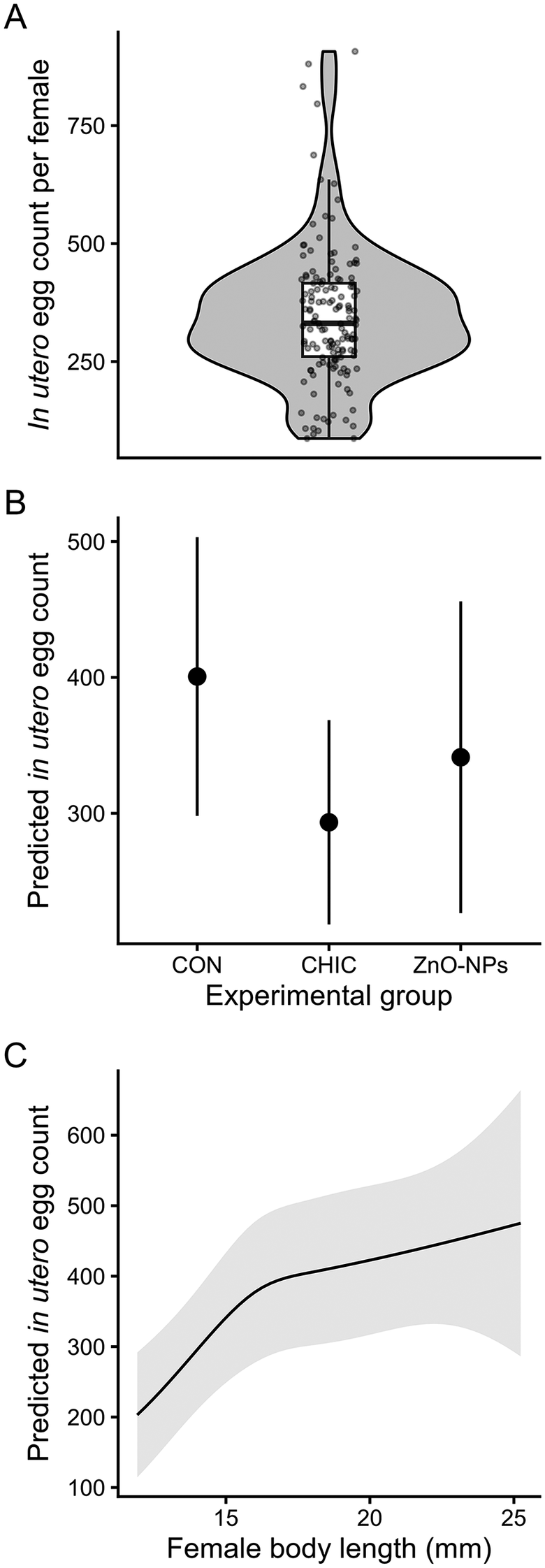
A total of 147 nematode females were examined; in utero egg counts per female ranged from 87 to 907, with an overall mean of 345 (SD = 145, N = 147) and a median of 331 eggs (Figure 1A). The regression model (Supplement 2, Tables S1 and S2) did not provide clear evidence of systematic differences among groups of experimental lambs in egg counts (Figure 1B), allowing us to consider the overall sample mean to be unbiased by the experiment.
Observed distribution and model-based estimates of in utero egg counts in female Haemonchus contortus recovered from experimentally infected lambs. (A) Observed distribution of in utero egg counts in the sample; the violin shows distribution density, the boxplot shows the median and interquartile range, and points represent individual worms. (B) Model-predicted in utero egg counts for the experimental groups; points show predicted means and error bars indicate 95% CI. Abbreviations: CON – control group; CHIC – chicory-supplemented group; ZnO-NPs – zinc oxide nanoparticle group. (C) Model-predicted relationship between female body length and in utero egg counts; the line shows fitted values, and the shaded band indicates 95% CI.

Figure 1. Long description
Panel A is a violin plot with an overlaid boxplot and individual data points. The y-axis is labeled In utero egg count per female, ranging from 0 to over 750. The distribution is widest between 250 and 400, with a median line near 330. A narrow tail extends upward to nearly 900.
Panel B is a dot plot with error bars. The x-axis is labeled Experimental group with three categories: C O N, C H I C, and Z n O-N P s. The y-axis is labeled Predicted in utero egg count, ranging from 200 to 500. C O N shows the highest mean at approximately 400 with a 95% C I from 300 to 500. C H I C shows the lowest mean near 290 with a C I from 220 to 370. Z n O-N P s shows a mean near 340 with a C I from 230 to 450.
Panel C is a line graph showing a positive correlation. The x-axis is Female body length in millimeters, ranging from 12 to 25. The y-axis is Predicted in utero egg count, ranging from 100 to 600. A solid black line shows a non-linear increase, starting at 200 for a 12 millimeter length and rising to nearly 500 at 25 millimeters. A light gray shaded band representing the 95% C I widens as body length increases.
The analysis also indicated a significant positive association between female body length and in utero egg counts. In particular, the model-estimated average effect (Figure 1C) was an increase of approximately 14 eggs per 1 mm increase in body length (95% CI: 2.5 to 25). However, this estimate should be interpreted with caution, because the relationship was not modelled as linear. Post-fit diagnostics suggested that the model provided an acceptable overall fit to the data (Supplement 2, Figure S1). Overall, the model supported an estimated mean in utero egg count of 344 eggs (95% CI: 289 to 398) for an average female.
In ecological terms, fecundity has been defined as ‘the physiological maximum potential reproductive output of an individual (usually female) over its lifetime’, while the related term fertility refers to ‘the current (actual) reproductive performance of an individual’ (Bradshaw and McMahon Reference Bradshaw, McMahon, Jørgensen and Brian2008). For female H. contortus, fecundity can be understood as the potential lifetime number of eggs produced by an individual female, whereas fertility more closely refers to the realised reproductive performance of a given female under particular conditions. Although fecundity and fertility are fundamental to the biology of the species, they are also of practical importance for parasite control, as their quantification, alongside estimation of adult worm burdens, can provide valuable insight into the costs of infection, patterns of environmental dissemination, and the dynamics of parasite transmission (Austin et al. Reference Austin, Budischak, Ramadhin, Hoberg, Abrams, Jolles and Ezenwa2017).
To our knowledge, direct measurement of fertility in H. contortus remains unavailable because of major methodological challenges. In this context, the present study provides the first individual-level assessment of in utero egg counts in female H. contortus. While still indirect, this measure provides a relatively direct proxy of individual worm fertility. The method used in the study to quantify nematode eggs is time- and labour-consuming (Austin et al. Reference Austin, Budischak, Ramadhin, Hoberg, Abrams, Jolles and Ezenwa2017; Kuzmina et al. Reference Kuzmina, Lyons, Tolliver, Dzeverin and Kharchenko2012). Nevertheless, it may provide a more direct and individually linked measure proxy of female daily egg output than approaches based on the ratio of faecal egg output to the number of H. contortus mature females recovered from the abomasum at necropsy (Coyne et al. Reference Coyne, Smith and Johnstone1991; Coyne and Smith Reference Coyne and Smith1992; Saccareau et al. Reference Saccareau, Sallé, Robert-Granié, Duchemin, Jacquiet, Blanchard, Cabaret and Moreno2017; Valderrábano et al. Reference Valderrábano, Calvete and Uriarte2010) or than estimates derived from homogenization of females using a McMaster counting slide (Coadwell and Ward Reference Coadwell and Ward1982).
Under the conditions of the present study, model-based comparisons provided no clear evidence of systematic differences among females collected from three experimental groups of lambs. The results suggest that the effectiveness of ZnO-NPs or chicory dietary supplements (Komáromyová et al. Reference Komáromyová, Petrič, Demčáková, Leško, Čobanová, Babják, Königová, Kuzmina, Ślusarczyk, Fortuna, Łukomska, Sidoruk, Cieslak, Váradyová and Várady2025; Leško et al. Reference Leško, Bombárová, Petrič, Batťányi, Komáromyová, Königová, Babják, Halada, David, Łukomska, Pawlak, Sidoruk, Cieslak, Čobanová, Váradyová and Várady2025) was mainly linked to a reduction in parasite burden – as evidenced by a significant reduction in faecal egg counts – rather than with changes in the daily egg output of females. In addition to comparing experimental groups, the analysis accounted for an observed nonlinear relationship between female body length and in utero egg counts (Supplement 2, Figure S2). Given that worms were recovered following experimental infection, age-related variation among females was likely minimal, suggesting that this pattern may in part reflect the conditions of the experiment rather than a general feature of H. contortus biology. Importantly, this result does not contradict the strong positive association previously reported between worm size and fertility proxies (Rowe et al. Reference Rowe, McMaster, Emery and Sangster2008), as our data still revealed an overall positive relationship between in utero egg counts and body length.
The main results of this study, namely the direct assessment of in utero egg counts, should be interpreted in the context of the broad variation in indirect female daily egg output estimates reported for H. contortus in the literature (Carson et al. Reference Carson, Reichel, Bell, Collins, Smith and Bartley2023; Coyne et al. Reference Coyne, Smith and Johnstone1991; Gordon Reference Gordon1967; Valderrábano et al. Reference Valderrábano, Calvete and Uriarte2010). The figure we have obtained, 345 eggs per female at a single point in time in a uterus, matches the recent meta-analytic estimate of 1,295.9 eggs (SD = 280.4) per H. contortus female per day (Saccareau et al. Reference Saccareau, Sallé, Robert-Granié, Duchemin, Jacquiet, Blanchard, Cabaret and Moreno2017). The connection between these two numbers seems reasonable, as they together suggest only a few times daily turnover of the uterine egg load. In contrast, the range 5,000–15,000 eggs per female per day (Carson et al. Reference Carson, Reichel, Bell, Collins, Smith and Bartley2023; Coyne et al. Reference Coyne, Smith and Johnstone1991; Gordon Reference Gordon1967) should be treated with caution unless supported by direct measurements.
The additional log–log regression analysis based on the previously published dataset of Morand (Reference Morand1996) yielded the following relationship between daily egg output and female body length:

where (b) is daily egg output and (L) is female body length in millimetres. In nonlogarithmic form, this corresponds to:

Applying this model using the observed mean female length of H. contortus in the present study (17.4 mm, SD = 2.8) gives an expected daily reproductive output of approximately 3,200 eggs per female. Although this estimate cannot be interpreted as an accurate prediction, it provides an independent comparative reference point. Overall, the predicted value is closer to the more modest estimate of 1,295.9 eggs per female per day reported for H. contortus by Saccareau et al. (Reference Saccareau, Sallé, Robert-Granié, Duchemin, Jacquiet, Blanchard, Cabaret and Moreno2017) and remains much lower than the frequently cited high values of 10,000–15,000 per female per day.
The present study has several limitations, as it is based on a secondary analysis of archived material from a previous experiment and on a dataset derived from retained aliquots rather than from the full recovered nematode material. In addition, because all worms obtained after experimental infection were similar in age, the findings reflect only a relatively narrow stage of the parasite life cycle, whereas nematode female daily egg output varies throughout the life cycle (Lee Reference Lee2002; Scharf et al. Reference Scharf, Pohl, Egan, Kocsisova and Kornfeld2021). Finally, all analysed nematodes originated from a single strain (Leško et al. Reference Leško, Bombárová, Petrič, Batťányi, Komáromyová, Königová, Babják, Halada, David, Łukomska, Pawlak, Sidoruk, Cieslak, Čobanová, Váradyová and Várady2025), which may have introduced a systematic bias in egg production. Taken together, these limitations indicate that a more extensive study will be needed to confirm the patterns observed here. All things considered, the study provides a methodically transparent and individually linked estimate of a fertility-related trait in H. contortus and may help place commonly cited female daily egg output values in a more critical context.
Supplementary material
The supplementary material for this article can be found at http://doi.org/10.1017/S0022149X26101850.
Financial support
The study was partially supported by the EU NextGenerationEU through the Recovery and Resilience Plan for Slovakia, projects No. 09I03–03-V01–00015 and 09I03-03-V04-00200/2024/VA.
Competing interests
None.
Statement on the use of AI-assisted technologies
During the preparation of this article, the authors used Grammarly (https://www.grammarly.com/) to correct grammatical errors and enhance readability. After using this tool, the authors reviewed and edited the content as needed. The authors accept full responsibility for the content of the published article.


 Open access

