




Introduction
A longstanding question for language development has been how children learn the complex inflectional morphology of polysynthetic languages, which are under-represented in the acquisition literature (Kidd & Garcia, Reference Kidd and Garcia2022). This paper considers the roles of perceptual salience, frequency, and semantic complexity in the acquisition of morphology within a polysynthetic language, Northern East Cree (ISO 639-3 code crl) – henceforth Cree. Northern East Cree is also called Iiyiyiuyimuwin, but because it is common for people and institutions to call themselves and the language “Cree” – see, e.g., Cree Nation Government Bill 1: An Act Respecting the Cree Language of Eeyou Istchee (2019) – the present study does the same.
The following sections review the relevant literature and the Cree system of possessive inflection. Then two studies examine naturalistic video recordings involving one adult and two children. Study 1 describes the frequency, perceptual salience, and semantic complexity of possessor-marking morphemes in the input. Study 2 traces the acquisition of this inflection by Ani (2;01–4;03) and Daisy (3;08–5;10). Findings indicate that perceptual salience plays a key role in the early acquisition of noun forms. Frequency – especially for high-frequency morphemes in the input – corresponds to important patterns regarding order of acquisition. Semantic complexity plays less of a clear role. This paper concludes by considering implications for acquisition science and Cree communities.
“Hooks” to acquiring polysynthetic morphology
Although debate continues around operationalizing the term (Fortescue et al., Reference Fortescue, Mithun and Evans2017; Haspelmath, Reference Haspelmath2018; Zúñiga, Reference Zúñiga2019), “polysynthetic” generally signifies languages “in which words are highly morphologically complex, expressing in a single word what in English takes a multi-word clause” (Kelly et al., Reference Kelly, Wigglesworth, Nordlinger and Blythe2014). In their review, Kelly et al. (Reference Kelly, Wigglesworth, Nordlinger and Blythe2014) survey research on the acquisition of several polysynthetic languages, asking which “hooks” children use to gain a foothold in acquiring morphologically complex words.
Perceptual salience
Perceptual salience has long been of interest in acquisition research (e.g., R. Brown, Reference Brown1973; Slobin, Reference Slobin and Slobin1985), and Kelly et al. (Reference Kelly, Wigglesworth, Nordlinger and Blythe2014) pay much attention to the role of salience in the segmentation and production of word forms. As a variable with a range of operationalizations – also called salience, prosodic salience, phonological salience, etc. – perceptual salience generally refers to the parts of a word that “stick out” due to their phonetic/phonological properties. The basic prediction is that more salient parts of a word should be easier for children to use as footholds in acquiring morphology.
A foundational proponent of this idea, Peters (Reference Peters and Slobin1985) posits that more perceptually salient chunks of words – such as syllables that are stressed and/or at word boundaries – are more easily identified and segmented by children. Furthermore, Peters predicts that properties operating together, such as when a syllable is stressed and at a word boundary, will reinforce and increase the salience of a unit.
Evidence from several polysynthetic languages indicates that children attend to perceptual salience, particularly in the early stages of acquiring morphology. These studies generally assess production, which necessarily involves considerations such as articulatory and phonological constraints, so this evidence must nonetheless be interpreted as indirect. Two studies of Mohawk (Feurer, Reference Feurer1980; Mithun, Reference Mithun1989) report that children begin by producing stressed syllables from target words, whether they correspond to morphemes or not. Evidence from Navajo (Courtney & Saville-Troike, Reference Courtney and Saville-Troike2002) shows two children produce prefixes that occur in more salient slots within the verb template, and another two children master prefixes in more salient slots before prefixes in less salient slots. Pye (Reference Pye and Slobin1992) argues that perceptual salience – not input frequency or syntactic and semantic complexity – correlates with the acquisitional order of K’iche’ inflectional morphemes. Research on four Mayan languages (P. Brown et al., Reference Brown, Pfeiler, De León and Pye2013) finds that verbal affixes closer to word-final stress are acquired more readily. Forshaw (Reference Forshaw2016) demonstrates that children’s early Murrinhpatha verb forms preserve stressed, word-final syllables from targets.
Just one study of Cree has considered perceptual salience in the acquisition of morphology. Terry (Reference Terry2010) examines the speech of Ani and argues that salience plays a key role in her early production of verb forms. Ani’s first verbs are unanalyzed chunks largely consisting of stressed and stress-adjacent syllables from targets. She also begins by more frequently producing suffixes when they occur in stressed, word-final positions, and she less frequently produces prefixes that are word initial and often unstressed.
Bare roots/stems
Kelly et al. (Reference Kelly, Wigglesworth, Nordlinger and Blythe2014) also discuss how early word forms in some polysynthetic languages consist of bare roots/stems, noting that this production intersects with salience. In Navajo and Quechua, children begin by producing bare roots/stems, which occur at word boundaries but never appear in the input (Courtney & Saville-Troike, Reference Courtney and Saville-Troike2002). Studies of Q’anjob’al, Tzeltal, and Tzotzil indicate that children are more likely to produce bare roots/stems when those elements occur more frequently at the right edge of target words and phrases (Mateo Pedro, Reference Mateo Pedro2015; Pye et al., Reference Pye, Pfeiler, de León, Brown, Mateo Pedro and Pfeiler2007). Forshaw (Reference Forshaw2016, pp. 152–153) notes Murrinhpatha-acquiring children sometimes produce bare verb stems, which he attributes partly to the fact that such stems occur at the end of target words. Terry (Reference Terry2010) also finds Ani using bare Cree verb stems that do not occur in adult speech, but such stems appear after a period where she uses unanalyzed inflected chunks.
Frequency
Although not addressed in depth by Kelly et al. (Reference Kelly, Wigglesworth, Nordlinger and Blythe2014), the frequency of elements in child-directed speech (CDS) is a foundational focus in acquisition research. In their review, Ambridge et al. propose that frequency has effects throughout first language acquisition, making a range of predictions regarding inflectional morphology (2015, pp. 245–248), including: higher-frequency forms will be acquired first, when all else is equal; children will be more accurate with higher-frequency forms; and inflectional patterns with a higher type frequency (i.e., that are applied to a wider variety of word types) will be associated with more productivity. Peters (Reference Peters and Slobin1985) also predicts perceptually salient chunks which are more frequent should be more easily extracted and segmented.
Accounts of the acquisition of polysynthetic morphology differ in how much weight they place upon frequency. P. Brown (Reference Brown1998) argues that the frequency of Tzeltal verb combinations drives early production more than their general semantics. Mazara and Stoll (Reference Mazara and Stoll2021) find that the frequency of a morpheme is the strongest predictor for ease of acquisition in Chintang. They also report an interaction with perceptual salience: between two low-frequency morphemes, the more salient one is acquired before the more frequent one. Although perceptual salience drives one child’s early Mohawk word forms, Feurer (Reference Feurer1980) argues that the subsequent development of morphology hinges on the interaction of frequency and semantics. Studies of Navajo (Courtney & Saville-Troike, Reference Courtney and Saville-Troike2000; Saville-Troike, Reference Saville-Troike, Jelinek, Midgette, Rice and Saxon1996) indicate that complexity can reduce the benefits of frequency, and a frequent affix is acquired later if it is homophonous with other affixes. Pye et al.’s (Reference Pye, Pfeiler, Pedro, Bavin and Stoll2013) analysis of Mam, Q’anjob’al and Yucatec finds that language-specific grammatical considerations and contexts of usage rather than frequency predict the acquisition of extended ergative marking. Prosodic factors reportedly outweigh frequency in the child production of Northern Pame affixal morphology (Pye et al., Reference Pye, Berthiaume and Pfeiler2021).
Existing work on Cree tends to qualify the primacy of frequency. Rose and Brittain (Reference Rose, Brittain, Pirvulescu, Cuervo, Pérez-Leroux, Steele and Strik2011) argue that Ani’s application of stress and verbal morphology shows she overgeneralizes simpler grammatical properties rather than the most frequent ones. Henke (Reference Henke2019, Reference Henke2020) finds Ani’s first possessives use a low-frequency construction from CDS, perhaps circumventing more complex morphology. Henke (Reference Henke2023) focuses on a single inflectional suffix and examines whether Ani and Daisy look toward the distributional pattern involving the greatest number of noun types (i.e., the path of frequency) or the pattern that entails the fewest exceptions (i.e., the path of consistency). Ani more plausibly looks toward consistency, although frequency cannot be ruled out, while Daisy relies on consistency over frequency.
Semantic complexity
Foundational work on English has considered the role of semantic complexity in the acquisition of morphology. R. Brown (Reference Brown1973, pp. 368–371) operationalizes semantic complexity largely in terms of cumulative exponence: the greater the number of meanings (i.e., morphosyntactic features) encoded by a single morpheme, the higher its semantic complexity. Brown contends that complexity is a better predictor than frequency for order of acquisition, and de Villiers and de Villiers (Reference de Villiers and de Villiers1973) find similar results. Peters (Reference Peters and Slobin1997) also proposes that grammatical morphemes with more cumulative exponence should be more difficult to acquire.
Little consideration has been paid to the role of semantic complexity in the acquisition of polysynthetic morphology. In one of the few studies explicitly investigating this issue, Pye’s (Reference Pye and Slobin1992) results contrast with R. Brown’s (Reference Brown1973), showing that perceptual salience rather than semantic complexity correlates with acquisitional order. Brittain and Rose (Reference Brittain and Rose2021) operationalize semantic complexity differently from Brown and Pye, and they contend Ani acquires preverbs with more transparent meanings before those with more abstract meanings.
Summary
Previous research demonstrates that perceptual salience, frequency, and semantic complexity may play roles in the acquisition of morphology in polysynthetic languages – although debate surrounds the primacy of any single factor as well as how factors interact and/or mitigate one another. The present study advances this debate and adds to the body of research on Cree, where only one study has considered perceptual salience (Terry, Reference Terry2010), and none have explored semantic complexity as operationalized by R. Brown (Reference Brown1973) and Pye (Reference Pye and Slobin1992). Furthermore, Cree nouns have a different inflectional template from verbs. The present study also builds upon previous work by Henke (Reference Henke2020), which details the frequency of possessive morphemes in CDS and the speech of three children, but focuses on describing frequency distributions rather than connecting frequency, salience, and complexity to acquisitional patterns.
Northern East Cree
This section reviews the most relevant grammatical characteristics, primarily synthesizing Collette (Reference Collette2014) and Junker et al. (Reference Junker, Salt and Visitor2013). Northern East Cree is one of two major dialects of East Cree in the Algonquian language family (MacKenzie, Reference MacKenzie1980). It is spoken in four communities within Eeyou Istchee (‘The People’s Land’) in Northern Québec. The present study analyzes Cree as spoken in the Cree Nation of Chisasibi, a community where almost 4,000 people report speaking Cree as their mother tongue (Statistics Canada, 2022). Cree is also undergoing rapid language shift and loss (Brittain & MacKenzie, Reference Brittain, MacKenzie, Faries, MacKenzie, Brittain, Morris, Demers, Junker, Chiskamish, Dostaler and Runnels2010) stemming from the legacy of colonization – particularly changes in Cree society, economics, and culture since hydroelectric projects began in the 1970s (Collette, Reference Collette2005; Morantz, Reference Morantz2002). Nonetheless, Cree communities have been active for decades in language preservation and promotion, and the present study aims to contribute knowledge in support of such efforts (see, e.g., Grand Council of the Crees, 2019; Louttit et al., Reference Louttit, Stewart, Bishop and Iserhoff2018).
Notation conventions
Examples such as (1) use East Cree Standard Roman Orthography and are interlinearized following Leipzig Glossing Rules (Max Planck Institute for Evolutionary Anthropology, 2015). Examples also include an IPA transcription signifying syllable boundaries and primary stress.

Bespoke abbreviations are: AI (intransitive verb with an animate subject); AN (animate); DIM (diminutive); DUB (dubitative); EMPH (emphatic); HES (hesitation); II (intransitive verb with an inanimate subject); IN (inanimate); INV (inverse); OBV (obviative); PVB (preverb); and TA (transitive verb with an animate object). Subscript abbreviations indicate verb class. Cree third persons are gender neutral, so ‘she’ is used in translations for consistency/convenience. Parenthetical citations for examples drawn from video recordings indicate the name of the speaker; the age of the child speaker or child present; the file number of the recording; and a timestamp within the recording.
Primary stress
Stress plays an important role in perceptual salience. The Cree stress system has been described primarily by Dyck et al. (Reference Dyck, Brittain, MacKenzie, Gurski and Radišić2006, Reference Dyck, Power, Terry, Valentine and Macaulay2014) and Swain (Reference Swain2008), whose work is synthesized here. Each citation form for a Cree word has one syllable bearing primary stress, which most strongly correlates with greater pitch and sometimes greater intensity, but not greater length. Cree generally builds iambic feet from right to left and ignores the final syllable. Primary stress regularly is assigned to the rightmost stress-able syllable. This is typically the penult, but the antepenult can be stressed if it is heavy while the penult is light. There are also many exceptions to this stress assignment pattern, which may be attributed to lexicalization, historical changes, or inter-speaker variation. Lastly, word-final syllables will receive primary stress if the word ends with one of Cree’s several homophonous /-h/ morphemes. From an acquisition perspective, Rose et al. (Reference Rose, Brittain, Dyck, Swain, Franich, Iserman and Keil2010) and Rose and Brittain (Reference Rose, Brittain, Pirvulescu, Cuervo, Pérez-Leroux, Steele and Strik2011) argue that this stress system is complex and opaque.
The noun template
All Cree noun types inflect along the template represented in Table 1. Each morpheme within the template displays allomorphy contingent on (morpho)phonological factors, but the present study focuses on the morphemic level.
Cree Noun Template: Positions and Inflectional Features

Note: PSR = possessor. POSS = possession. This table adapts Collette (Reference Collette2014, p. 327).
The Prefix and Suffix 1–3 positions are used only for encoding possession. The present study focuses exclusively on the Prefix and Suffix 2–3 positions, which encode information about the possessor. The following description does not focus on Suffix 1 or Suffix 4. The Suffix 1 slot hosts the morpheme -im, which marks the possessed status of certain noun types. See Collette (Reference Collette2014) for discussion of this morpheme’s distribution and Henke (Reference Henke2020, Reference Henke2023) for its acquisition. Suffix 4 hosts several complementary morphemes such as the locative case marker as well as markers encoding interacting grammatical features of animacy, number, and obviation. Previous work from Henke (Reference Henke2020, Reference Henke, Macaulay and Noodin2021) addresses some aspects of acquiring the Suffix 4 position.
The possessor Prefix
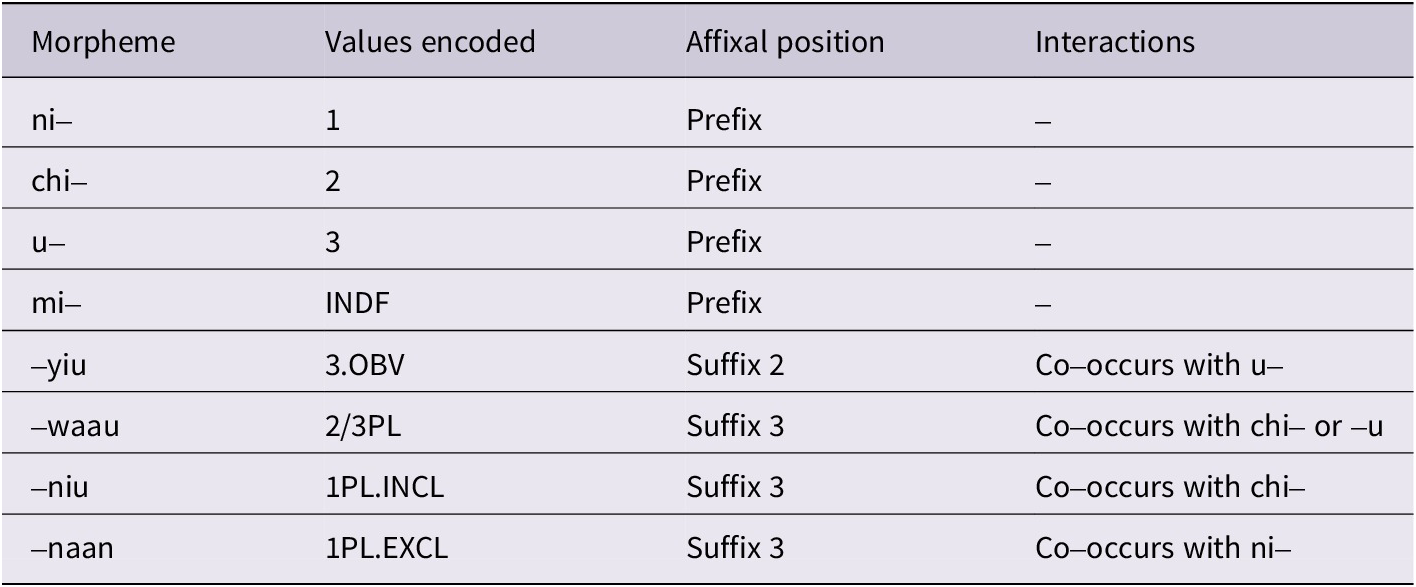
The Prefix position hosts four complementary morphemes that encode the grammatical person of the possessor (2–5). All possessive nouns require a prefix, and a noun token can only bear one prefix. Some recent work on Cree (Henke, Reference Henke2023; Henke & Brittain, Reference Henke and Brittain2022) has analyzed these prefixes as clitics, but in the interest of convenience, the present study defers to the traditional view of these morphemes as prefixes.
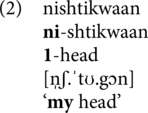
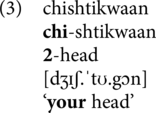

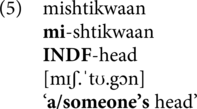
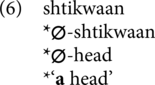
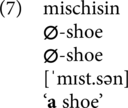
Each Cree noun type is classified as either grammatically animate or inanimate, which generally – but not always – corresponds to biological animacy. Additionally, each noun type is classified as inalienably or alienably possessed. Inalienable nouns generally signify kinship relations, body parts, or close personal belongings, and always require a prefix (2–6). alienable nouns only take a prefix when possessed (7–8).

Suffix 2
Obviation is a long-studied feature of Algonquian languages (e.g., Bloomfield, Reference Bloomfield1946) that distinguishes between third persons within a particular span of syntax and/or discourse: one third person must be designated as proximate (often unmarked) and all other third persons must be designated as obviative. The usage of obviation is rich and complex (e.g., Russell, Reference Russell, Nichols and Ogg1996), but the proximate generally can be considered as more in focus, while any obviative referent plays more of a background role.
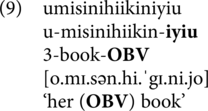
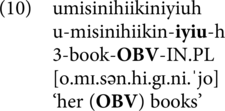
The Suffix 2 position hosts a single morpheme, -yiu, which encodes the obviative status of a possessor. Third-person possessors that are proximate are unmarked (4, 8), but obviative possessors are marked by -yiu (9–10).
Suffix 3
The Suffix 3 position hosts three complementary morphemes that mark grammatical properties of plural possessors.
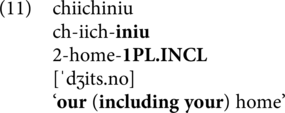
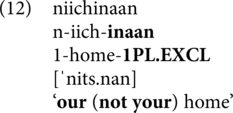
Possessors involving the first person employ a clusivity distinction: -niu marks the inclusive (11) while -naan marks the exclusive (12). In the Cree person hierarchy (Macaulay, Reference Macaulay2009), the second person outranks the first, so chi- occupies the Prefix position in (11).
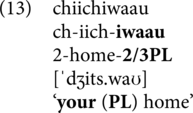
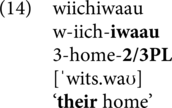
The suffix -waau marks plural possessors not involving the first person. The prefix distinguishes between second- (13) and third-person possessors (14).
Summary
Cree is a polysynthetic language that uses the inflectional morphemes in Table 2 to encode nouns with information about a possessor. The present study analyses each affix at the morphemic level, and readers may refer to Collette (Reference Collette2014) for details about the allomorphy involved with each affix. Children acquiring Cree must analyze each affixal position within the noun template, its constituent morphemes, and the interactions between positions.
Possessor Morpheme Inventory in Cree
Research questions and method
This paper pursues answers to four research questions by conducting two studies. Study 1 analyzes CDS to answer RQ1, and Study 2 investigates child speech to answer RQs 2–4.
RQ1: “What is the frequency, perceptual salience, and semantic complexity of possessor inflection morphemes in child-directed speech?”
RQ2: “How does possessor inflection emerge in child speech?”
RQ3: “What is the order of acquisition for possessor inflection morphemes?”
RQ4: “How might the development of possessor inflection relate to frequency, perceptual salience, and semantic complexity in the input?”
Data
The present study analyzes 39 recordings from the video corpus of the Chisasibi Child Language Acquisition Study (CCLAS), which recorded approximately 60 hours of naturalistic CDS and child speech from 2004–2007. Each sampled recording represents one adult interacting with one of two children in Cree within a home setting: Ani (2;01–4;03) and Daisy (3;08–5;10). The adult knows each child very well, and both children are acquiring Cree as a first language. See Brittain et al. (Reference Brittain, Dyck, Rose, MacKenzie and Wolfart2007) for additional details on the origin of CCLAS and its methodology.
The present study chooses recordings using a mixture of convenience and purposive sampling, aiming to select one recording per month per child – although some larger gaps exist between analyzable recordings – while also using the best-quality recordings and representing the widest age range per child. This sample includes all of the recordings for Ani and Daisy analyzed by Henke (Reference Henke2023) and follows the coding procedures created by Henke (Reference Henke2020, pp. 60–75). Table 3 summarizes the sampled recordings per speaker.
Summary of the Sampled Data

Note: Types (Tokens).
Criteria for establishing acquisition
For Study 2, a morpheme is considered acquired once a child establishes productivity with it. “Productivity” is the demonstration that a child has recognized a morphological pattern and can apply that pattern to new word types. This conceptualization of productivity acknowledges that a child can have productive knowledge of a morpheme before achieving full adultlike usage. Adapting approaches from Allen (Reference Allen1996, pp. 49–52), R. Brown (Reference Brown1973, pp. 254–259), Bybee (Reference Bybee1995), and Ketrez and Aksu-Koç (Reference Ketrez, Aksu-Koç, Stephany and Voeikova2009, pp. 21–22), the present study revises criteria from Henke (Reference Henke2020, pp. 74–75) to assess productivity in a manner that better represents this conception and suits the available sample of naturalistic recordings, where datapoints are less numerous and more dispersed than in bigger-data studies.
Study 2 employs the following Productivity Criteria. A child is considered to have demonstrated productivity with a morpheme when she satisfies Criterion 1 and either Criterion 2 or any two combinations of Criteria 3.
Criterion 1: The child correctly uses the morpheme with at least two different noun types.
Criterion 2: The child has used at least two of these noun types in contrasting word forms.
Criterion 3a: The child has a self-correction involving the morpheme.
Criterion 3b: The child has demonstrated a creative error with the morpheme, such as an overgeneralization conveying her intended meaning.
Criterion 3c. The child alternates between using the morpheme in obligatory contexts and applying a similar pattern which conveys her intended meaning. This shows “the child has understood the function and structure of the morpheme but is in the process of working out the exact circumstances in which it is obligatory” (Allen, Reference Allen1996, p. 51).
Study 1: Possessor inflection in CDS
This study answers RQ1 by considering frequency, perceptual salience, and semantic complexity in turn.
Frequency
The sampled CDS contains 91 noun types (599 tokens) occurring with Cree possessive inflection. The following sections analyze the frequency of Prefix and Suffix 2–3 morphemes.
Prefix morphemes
Table 4 tallies the token frequencies for each prefix. To illustrate the type frequency for each prefix and its usage in contrasting forms, Table 11 (Appendix) lists the 15 most frequent noun types used in possessives.
Frequency of Prefix Morphemes in CDS
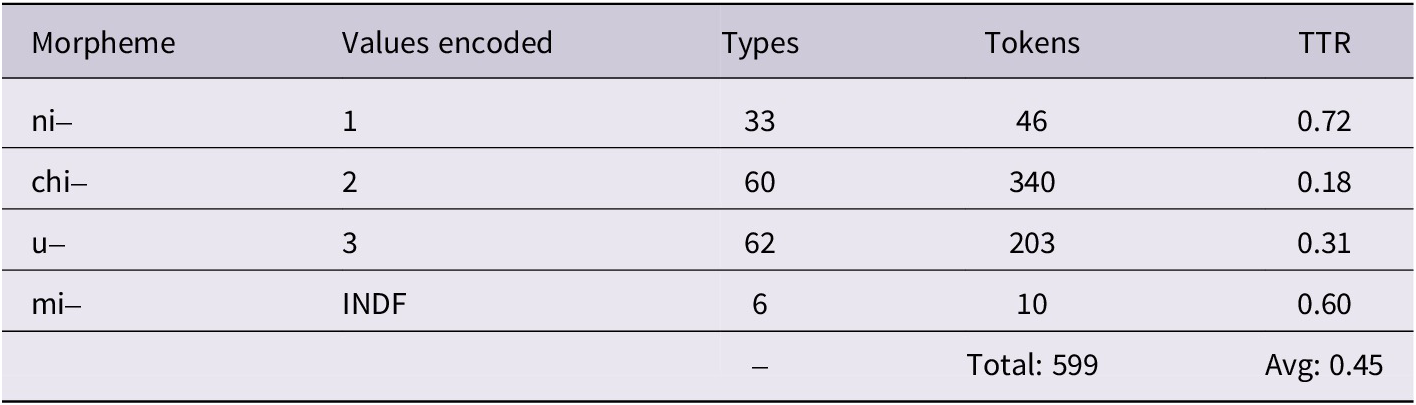
Note: Types = unique noun types used with a morpheme. Tokens = tokens of a morpheme. TTR = Type/Token Ratio. Avg = average. No total is given for Types because multiple prefixes can be applied to a single type.
Two important patterns are clear. First, the second-person chi- and third-person u- comprise more than 90 percent of the input (543/599 tokens, 90.7 percent) – and chi- alone represents the majority of all prefix tokens (340/599, 56.8 percent). Each prefix is also used with a much greater number of noun types than first-person ni- and indefinite mi-. Context primarily drives these imbalances: the adult most often refers to the belongings, body parts, and personal relationships of the child, people the child knows, or people in stories.
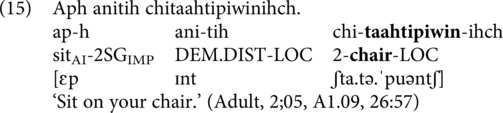
Second, many noun types are used in contrasting forms as in (15–16), which provide children important opportunities to identify noun stems, the Prefix position, and its constituent morphemes. For example, each noun type in Table 11 (Appendix) is used with more than one prefix morpheme.

Suffix morphemes
Table 5 provides the token frequencies for each suffix morpheme, and Table 12 (Appendix) lists all noun types that occur with any possessor suffix.
Frequency of Suffix Morphemes in CDS
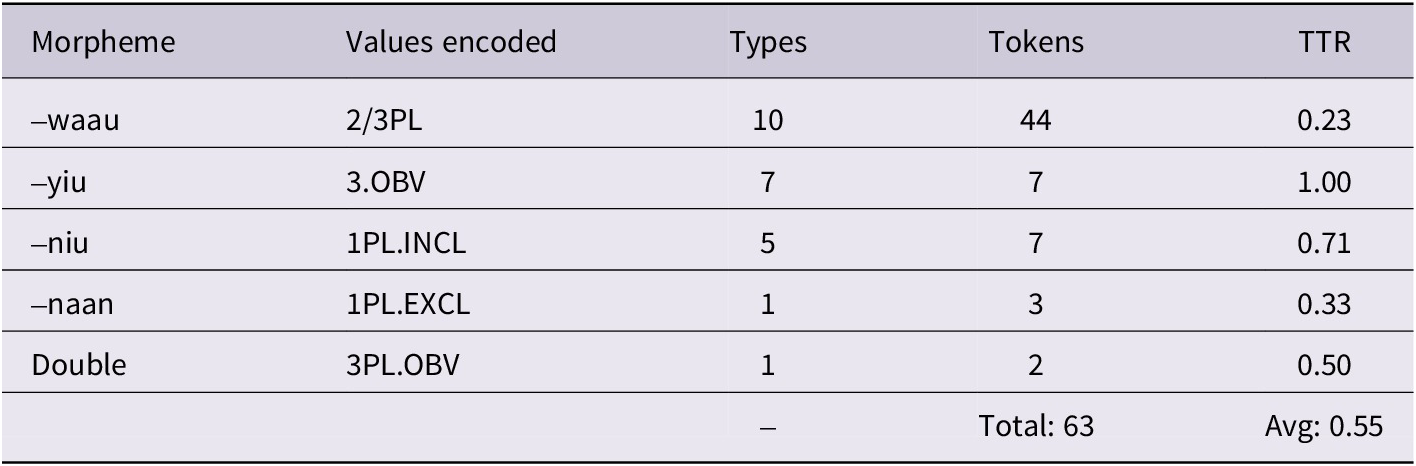
Note: Double = a pattern where a noun hosts two suffix tokens. Types = unique noun types used with a morpheme. Tokens = tokens of a morpheme. TTR = Type/Token Ratio. Avg = average. No total is given for Types because multiple suffixes can be applied to a single type.
Several important patterns emerge. First, suffix tokens have a much different frequency distribution from the prefixes, because a suffix is only needed when the possessor is plural or obviative. This leads to a crucial imbalance: suffix tokens overall (63 total) are far less frequent than prefix tokens (599 total). There are also critical imbalances in token frequency between suffix morphemes. The morpheme -waau accounts for 44/63 (69.8 percent) of all suffix tokens, and the remaining suffixes are used quite infrequently.
This low token frequency is compounded by a low type frequency. Although the prefixes and suffixes do not differ drastically in their average type-token ratios (0.45 and 0.55, respectively), the suffixes are used with far fewer noun types. These low token and type frequencies mean children have fewer chances to encounter contrasting forms and identify the Suffix positions and their constituent morphemes.
Another important facet of type frequency from Table 12 (Appendix) is that a single noun type dominates the distribution for suffixes: -iich ‘home’ bears the majority of all suffix tokens (39/63, 61.9 percent). Furthermore, this is the only noun type with any contrasting forms involving suffixes.
Finally, CDS evinces a double-marking pattern where two suffixes occur within the same word form (17) to encode a third-person possessor who is plural and obviative. Not only do the suffixes violate the order predicted from the template (Table 1), but previous description indicates that a single word form cannot contain two possessor suffix morphemes (e.g., Collette, Reference Collette2014).
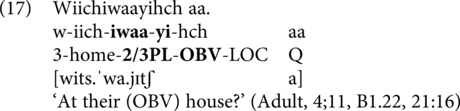
This pattern could signify under-described language variation, change, or loss – or it might simply be a rare pattern. It only occurs twice in the sampled data, and the CDS sampled by Henke (Reference Henke2020) did not contain the pattern.
Perceptual salience
The present study operationalizes perceptual salience quantitatively as a score from 0–2, which is calculated for a morpheme based on its relationship to word boundaries and primary stress:
-
• A morpheme within a word-initial or word-final syllable is scored 1.
-
• A morpheme within a syllable bearing primary stress is scored 1.
-
• A morpheme within a primary stressed syllable and at a word boundary is scored 2.
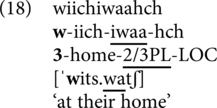
For example, the word form wiichiwaahch ‘at their home’ in (18) contains a prefix w- (an allomorph of u-) and suffix -iwaa (an allomorph of -waau). The vowel indicated by <i> undergoes syncope in casual speech. The bolded prefix is word initial and occurs within the stressed syllable, so it receives a score of 2. The underlined suffix occurs within the word-final syllable, so it receives a score of 1.
Salience within the most frequent possessives
It is beyond the scope of the present study to analyze salience within all 599 possessive tokens in the sampled CDS. Therefore, this study first considers the salience of morphemes within word forms that children encounter most often: Table 13 (Appendix) lists the 21 most frequent word forms used in child-directed possessives. Each of these word forms occurs with seven or more total tokens. Word forms in Table 13 include morpheme breaks indicated by hyphens, and the vowel bearing primary stress is bolded and underlined.
The most crucial pattern from Table 13 is that the Prefix position is not necessarily very salient. The average score for any morpheme in the Prefix slot is 1.14/2,00. Each prefix token is word initial, but a prefix infrequently occurs within the primary stressed syllable. If this stressed syllable is automatically scored as 1, an average prefix token is just slightly more salient than that. Furthermore, only two prefix morphemes occur in Table 13, and neither is much more salient than the other: second-person chi- has an average score of 1.13/2.00, and third-person u- averages 1.20/2.00.
Salience of prefixes vs. suffixes
Just two word forms in Table 13 use a possessor suffix, which does not indicate much about the potential salience of the Suffix 2–3 positions and their morphemes. Therefore, Table 14 (Appendix) lists all of the word forms in CDS that contain any possessor suffix, excluding the double-marking pattern in (17). To assess the relative salience of the possessor prefixes and suffixes, Table 6 tallies the average score for each morpheme from Table 14.
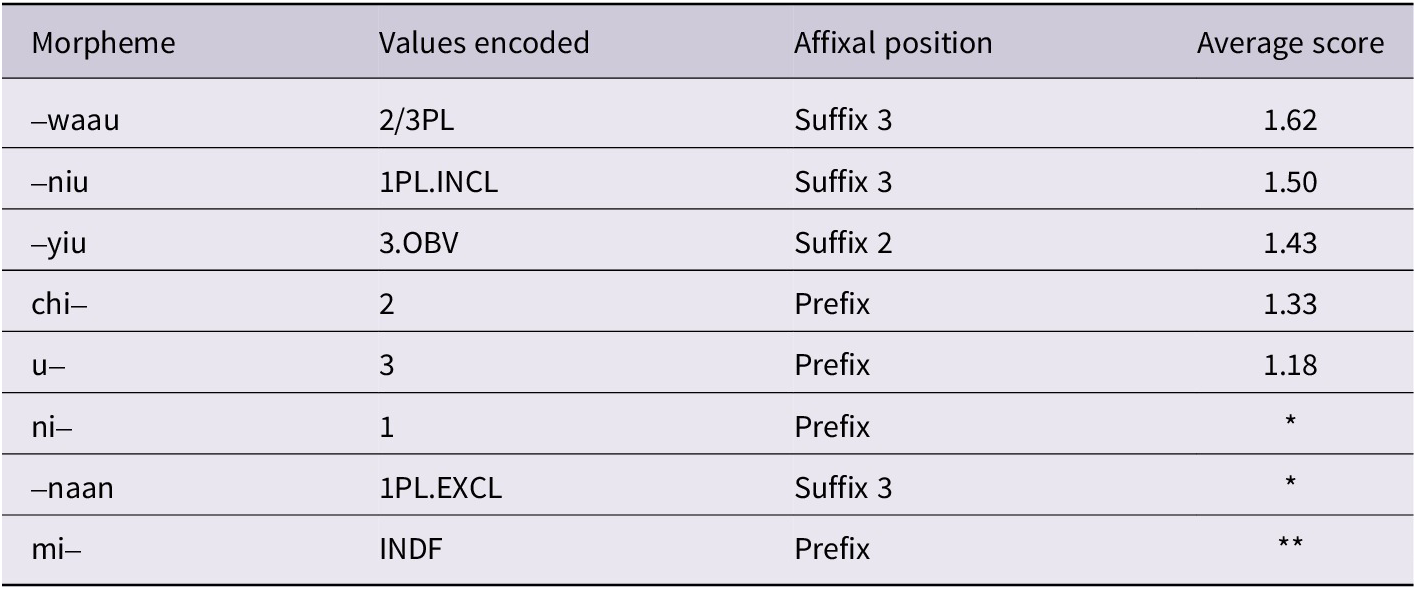
Two important patterns deserve discussion. First, the Suffix position is more salient on average (1.52/2.00) than the Prefix position (1.26/2.00). Each suffix morpheme in Table 14 (Appendix) occurs within a word-final syllable, which cancels out any word-initial advantage for the prefix. The Suffix position is also more likely to occur within a stressed syllable, conferring a greater perceptual advantage. Second, individual morphemes have advantages over others in salience as well. Each of the suffixes scored in Table 14 has a higher average salience than any prefix. Furthermore, the marker -waau is not only the most frequent suffix but also the most salient possessor morpheme.
Semantic complexity
Following R. Brown (Reference Brown1973), Peters (Reference Peters and Slobin1997), and Pye (Reference Pye and Slobin1992), the present study operationalizes semantic complexity in terms of cumulative exponence: the more inflectional features a morpheme marks, the higher its semantic complexity. Table 7 organizes the possessor morphemes by semantic complexity, from the least complex (Tier 1) to the most (Tier 3).
Semantic Complexity for Possessor Prefix and Suffix Morphemes
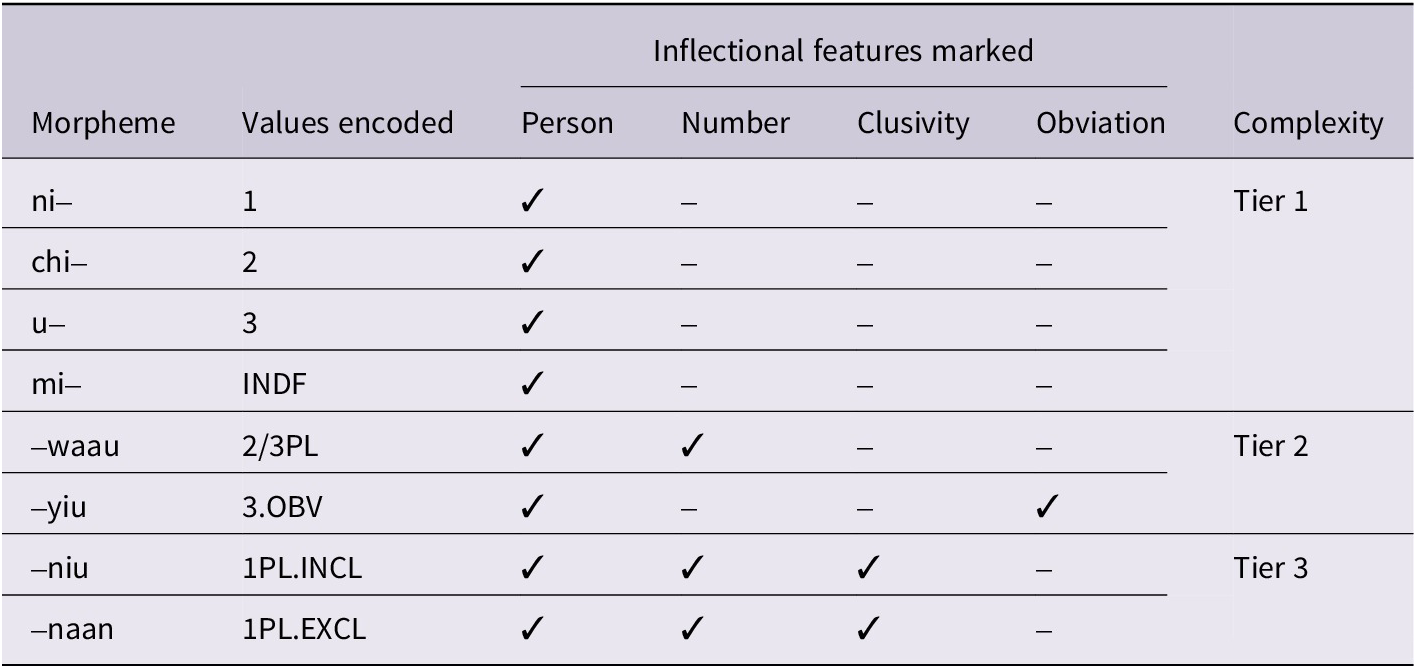
All four Prefix position morphemes encode only the person of the possessor, so they occupy Tier 1. The clusivity-marking suffixes -niu and -naan are the most complex, because they encode three inflectional features, while -waau and -yiu encode person and one other feature.
Answers for RQ1 and predictions for Study 2
The possessor prefixes have a large overall advantage in frequency over the suffixes. In terms of token frequency, type frequency, and contrasting word forms, children have many more opportunities to identify and analyze the Prefix position and its constituent morphemes compared to those hosted at the Suffix 2–3 positions.
In terms of semantic complexity, all four morphemes that occur in the Prefix position are simpler than any suffix morpheme. The two suffixes encoding clusivity are the most complex of any possessor marker.
However, perceptual salience generally favors suffixes over prefixes. In the sampled CDS, suffixes tend to occur in word-final syllables bearing primary stress. Furthermore, each suffix morpheme in Table 6 has a higher perceptual salience score than any given prefix morpheme.
These answers for RQ1 enable some predictions for Study 2. The advantages of the Prefix position in frequency and semantic complexity should outweigh the advantage of the Suffix 2–3 positions in perceptual salience. Children should be able to identify the Prefix position before the Suffix 2–3 positions, and they should acquire the prefix morphemes before the suffix morphemes. Because the prefix morphemes do not differ much from each other in salience or complexity, frequency should drive their order of acquisition: chi- > u- > ni- > mi-.
The suffix -waau should be acquired first among suffixes because it is the most frequent and perceptually salient, and it is not within the tier of highest semantic complexity. The clusivity-marking suffixes -niu and -naan should be acquired last of all possessor morphemes, because of their infrequency and semantic complexity. The latter suffix is the least frequent, so the order of acquisition for suffixes should be -waau > -yiu > -niu > -naan.
Study 2: Possessor inflection in child speech
This study examines speech from Ani (2;01–4;03) and Daisy (3;08–5;10) to answer RQs 2–4 and evaluate the predictions from Study 1. Each child is considered in turn.
Ani: age 2;01–4;03
As the youngest child, Ani provides the earliest window into the process of acquiring possessor inflection. This section identifies four stages of development, beginning with her first noun productions.
Stage 1: Reliance on primary stressed syllables
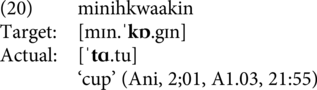
Ani’s earliest nouns show that she uses perceptual salience as a hook to acquire word forms. During her first recording at 2;01, she produces the general required phonetic forms for monosyllabic and disyllabic nouns. She attempts just two nouns with three or more target syllables (19–20): each time, she extracts segments from primary stressed syllables and uses them to produce a trochaic C1VC1V foot. This constraint on Ani’s production necessarily circumscribes her ability to produce fully inflected noun forms. The bolded IPA symbols in such examples indicate target segments that Ani produces.

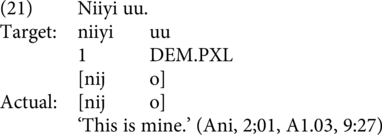
Ani has not discovered possessive noun inflection. Instead, her possessives consist of a possessor with a demonstrative (21). See Henke (Reference Henke2019, Reference Henke2020) for more details on such constructions.
Stage 2: Extension to secondarily stressed syllables
Ani evinces a further stage of development at age 2;03, where all four multisyllabic noun types are off target, as in (22–23). She has no multisyllabic noun targets recorded from age 2;04–2;05.
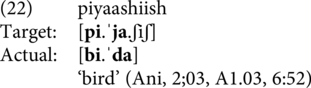
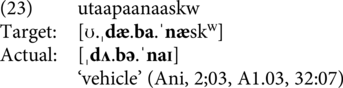
(22–23) show that Ani continues to rely on perceptual salience: for each multisyllabic target, she retains the (C)V not only of the primary stressed syllable but also the secondarily stressed syllable. From the last such syllable, Ani builds her words leftward and retains everything except unstressed, word-initial vowels. However, Ani has not yet made a clear attempt to use a noun to signify a possessee.
Stage 3: Analysis of noun stems but omission of inflection
At age 2;07, Ani has four multisyllabic noun targets that represent her first recorded usage of nouns as possessees. In all four cases, as in (24–25), Ani omits all possessive inflection.
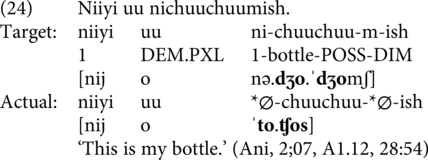
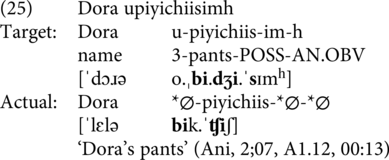
This omission of possessive inflection persists through age 3;02, which indicates that Ani has analyzed the morphological status of noun stems.
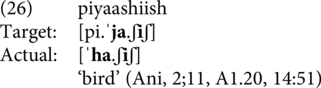
The role of perceptual salience has also changed: Ani still focuses on the primary stressed syllable, but she now produces the ends of her target words and syllables more often. She more often produces the final syllable from the target, whether it is stressed or not, and she more frequently deletes unstressed material near the beginning of the word, as in (26).
Stage 4: Discovery and ongoing analysis of possessor inflection
Ani engages in a new period of morphological analysis when she starts using the personal pronoun niiyi ‘I, me, myself, mine’ as a proto-prefix element with possessees lacking obligatory inflection (Henke, Reference Henke2023, pp. 1138–1139). She has one such token with car at 3;02 (27) and two with balloon at 3;05.
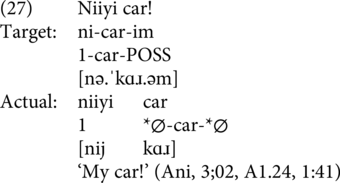
This usage of the pronoun in place of the prefix resembles the kinds of “filler” elements (Peters & Menn, Reference Peters and Menn1993; Veneziano & Sinclair, Reference Veneziano and Sinclair2000) reported during the acquisition of Navajo (Chee, Reference Chee2017; Courtney & Saville-Troike, Reference Courtney and Saville-Troike2002; Saville-Troike, Reference Saville-Troike, Jelinek, Midgette, Rice and Saxon1996).
At 3;06, Ani shows her first adultlike application of any possessor inflection (Henke, Reference Henke2019, Reference Henke2020, Reference Henke2023). This corroborates prior claims that Ani enters a new phase of morphological analysis around this age: Terry (Reference Terry2010) observes that Ani also analyzes and applies intransitive verbal morphology between 3:04–3;08.
Ani uses no bare stems as possessees at this age point, and she has on-target tokens of the first-person prefix ni- with three different noun types, as in (28–29). Ani has discovered the Prefix position before any other slots in the noun template, as she omits the required Suffix 1 morpheme -im in (29).
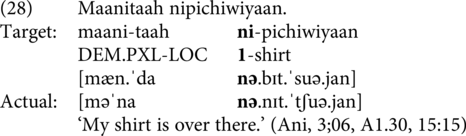
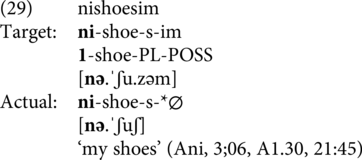
This age point also sees Ani acquire ni- as her first possessor inflection morpheme, because she satisfies Productivity Criteria 1 and 2: she has used ni- with three different noun types, and she has also used contrasting word forms for two of those types.
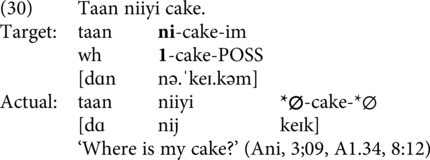
Although Ani is productive with ni-, she is still analyzing its morphological status and obligatory usage. From 3;08–3;09, she reverts to omitting ni- and using the pronoun niiyi to signify the possessor, as in (30). Ani has no adultlike usage of any possessor prefix during these two recordings.
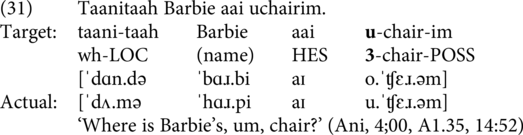
Ani’s morphological analysis progresses during her next recording at age 4;00, where she has no such bare stems for possessees. The child also has her first usage of the third-person prefix u-, and she demonstrates acquisition of the morpheme by fulfilling Productivity Criteria 1–2: she applies u- to one token of three different noun types – bed, chair (31), and purse – and she uses contrasting forms for chair and purse.
At this age point, Ani also has her first usage of the second-person prefix chi-, with three adultlike tokens of -iipit ‘tooth’. These tokens satisfy Productivity Criterion 3a for chi- because they come during an exchange where Ani clears up a misunderstanding (32–33).
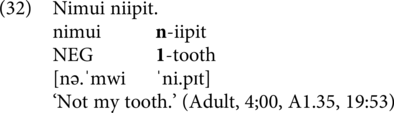
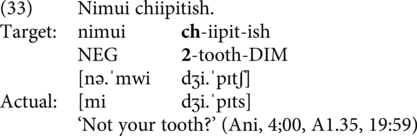
Ani also goes back-and-forth in her accuracy applying prefixes at age 4;00, which testifies to her ongoing analysis. She omits u- once each with Barbie, bed, and chair, although this does not negate her satisfaction of Productivity Criteria 1. She also has one omission of chi-.
Ani’s recording at age 4;01 shows more important developments in her acquisition of possessor inflection. She previously established productivity with the third-person prefix u-, and she has another two on-target tokens of friend. Ani also applies the second-person prefix chi- to the noun type -iich ‘home’ in (35) below, which satisfies Productivity Criterion 1.
Ani continues to analyze the first-person prefix ni-, despite the fact that she demonstrated productivity with the morpheme at age 3;06. She has two attempts at nifriendim ‘my friend’, and in both cases she omits the prefix and uses the first-person pronoun niiyi instead, as in (34).
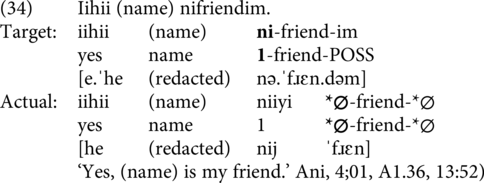
The most important development at 4;01 is that Ani produces her first two tokens involving a possessor suffix. Each token is an attempt at the word form chiichiniuhch ‘at our (including your) home’ (35), and each involves the same error.
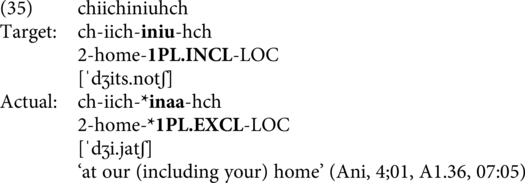
In (35), Ani is speaking to a member of her own household, so she needs inclusive marking. She correctly uses the second-person prefix chi- but she uses the exclusive suffix -naan instead of the required inclusive -niu. Ani’s word chiichinaahch is ungrammatical because of this mismatch of second-person chi- with exclusive -inaa, and this word form does not occur in adult speech nor in the speech of the two other children within the corpus. Despite this error, it is clear that Ani has identified the Prefix position, and she has also correctly identified the Suffix 3 position.
Ani’s next and final recording comes at age 4;03. Here she correctly applies the third-person prefix u- to three noun types with no errors, further testifying to her established productivity.
She uses the first-person prefix ni- correctly with one new noun type, akuhp ‘coat’, in (36). She also meets Productivity Criterion 3c by alternating this correct application of the prefix with the first-person pronoun niiyi in (37). Ani understands the form and function of ni- but is still analyzing its obligatory usage.
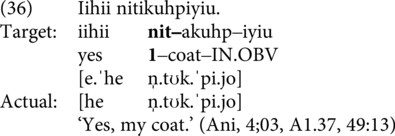

Ani continues to grapple with marking clusivity, and she has two more off-target attempts at chiichiniuhch ‘at our (including your) home’. Example (38) is particularly important: Ani again uses the exclusive suffix -naan when she needs the inclusive -niu, but she also demonstrates that she understands some important rules governing clusivity. She correctly uses the inclusive personal pronoun chiiyaaniu and the second-person prefix chi-. This counts for satisfying Productivity Criterion 3b with chi-, because despite her error with the suffix, Ani clearly demonstrates that she understands the form, position, and meaning of the prefix. Thus, Ani establishes acquisition of the prefix chi- at age 4;03.

By the time her recordings end, the sample contains no instances of Ani using any of the other three possessor suffixes, nor any contexts clearly requiring their usage.
Summary
The sampled recordings evince four stages in Ani’s acquisition of possessor inflection. She begins by using perceptual salience as a hook to acquire noun word forms. During Stage 1 (age 2;01), she extracts primary stressed syllables to build a foot, and at Stage 2 (2;03), she includes secondarily stressed syllables and builds words leftward – omitting only word-initial unstressed vowels. Ani does not begin by using bare stems for her first nouns. Although she sometimes ends up producing bare stems, this is epiphenomenal: she is actually producing sequences hinging on perceptual salience, which do not necessarily correspond to morphemes.
Ani successfully analyzes noun stems during Stage 3 (age 2;07–3;02), but she does not yet recognize the inflectional elements needed for possessives. This recognition develops during Stage 4 (age 3;02–4;03). Ani first discovers the Prefix position within the noun template, and she discovers the Suffix 3 position several months later. She acquires three prefix morphemes but no suffixes. The only possessor suffix Ani uses is the exclusive -naan, which she only applies in overgeneralizations with -iich ‘home’. She has no clear attempts at or contexts requiring any other possessor suffix morpheme.
Daisy: age 3;08–5;10
As an older child with a more talkative temperament, Daisy’s acquisition of possessor inflection is underway before her recordings begin, so any periods similar to Stages 1–3 in Ani’s development are not represented in the sampled data. Her first recording at age 3;08 demonstrates that she has already discovered the Prefix position, so this portion of Study 2 focuses on Daisy’s demonstrations of productivity with possessor morphemes, beginning with prefixes before moving on to suffixes.
Prefix morphemes
Throughout her recordings, Daisy uses 79 noun types (360 total tokens) requiring Cree possessive inflection. Table 8 tabulates Daisy’s overall usage of each prefix morpheme.
Frequency of Prefix Morphemes in Daisy’s Speech

Note. Types = unique noun types used with a morpheme. Tokens = tokens of a morpheme. TTR = Type/Token Ratio. Avg = average. No total is given for Types because multiple prefixes can be applied to a single type. The Errors column indicates noun types(tokens).
In terms of tokens, Daisy’s prefix usage differs from CDS (Table 4) due to the contexts of her interactions with the adult. Daisy talks much more about herself than her interlocutor, and the child also frequently tells stories about friends, family members, and fictional characters. Daisy uses her prefixes with a wide variety of noun types, and her average type-token ratio of 0.43 (Table 8) is nearly identical to the 0.45 in CDS (Table 4).
In her first recording at age 3;08, Daisy uses ni- in adultlike fashion with one token each of three different noun types. She also has one creative error applying ni- to an unanalyzed form of chiipit ‘your tooth’ (39).
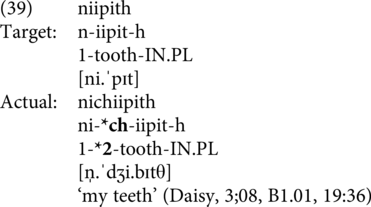
At age 3;09, Daisy uses ni- with five total noun types (10 tokens), and she also has produced contrasting forms of multiple types, such as minihkwaakin ‘cup’ (40–41).
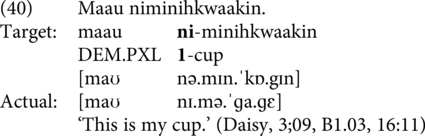
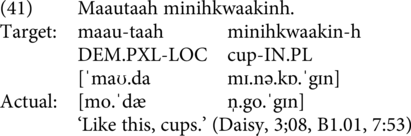
Thus, at age 3;09, Daisy satisfies Productivity Criteria 1, 2 and 3b to establish her acquisition of the prefix ni-.
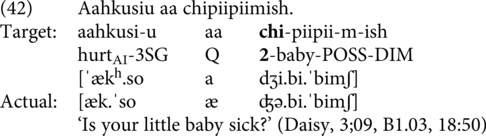
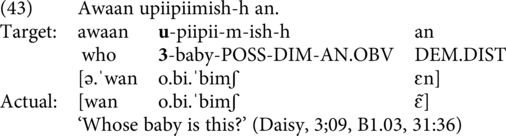
Daisy first uses the second-person marker chi- at age 3;09, and she also demonstrates acquisition by meeting Productivity Criteria 1–2. She applies the prefix correctly to five different noun types, and she has used contrasting word forms for each type, as in (42–43).
At age 3;09, Daisy also demonstrates her acquisition of the third-person prefix u- by meeting Productivity Criteria 1–2. She first uses the prefix at 3;08 with four noun types, then with eight additional types at 3;09, and she uses contrasting forms of several types.
The last prefix she acquires is the unspecified possessor marker mi-, which is the least frequent in CDS (Table 4). Daisy first uses the prefix with two noun types at age 3;08, -shihkun ‘toe’ (44) and -tihchii ‘hand’.
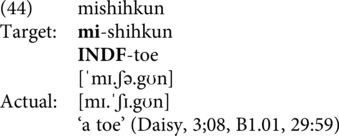
By 4;00, she also has produced contrasting forms of -shihkun ‘toe’ and -tihchii ‘hand’, meeting Productivity Criteria 1–2 and establishing her acquisition of the prefix.
Suffix morphemes
As in CDS, Daisy uses far fewer possessor suffixes than prefixes. Table 9 tallies Daisy’s overall application of each possessor suffix morpheme. Her average type-token ratio of 0.59 is again very similar to the 0.55 in CDS (Table 5). The child’s only significant departure from patterns in the input is that she uses the exclusive suffix -naan as frequently as -waau. As with the prefixes, this difference is driven by the fact that Daisy refers often to herself.
Frequency of Suffix Morphemes in Daisy’s Speech
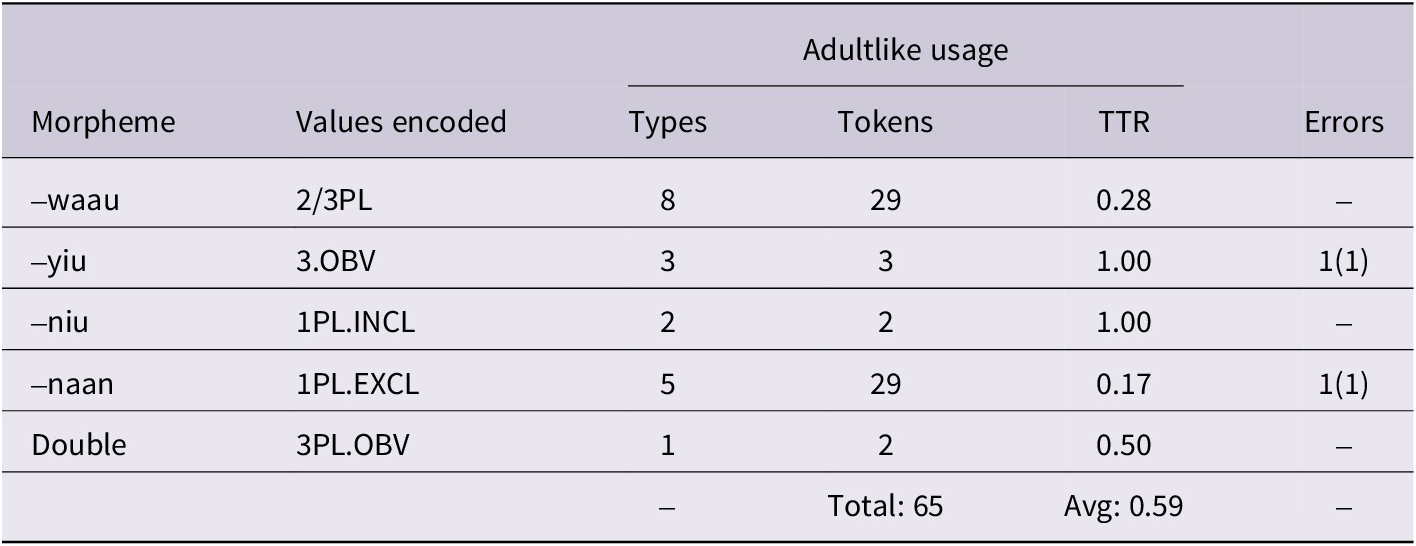
Note: Double = a pattern where a noun hosts two suffix tokens. Types = unique noun types used with a morpheme. Tokens = tokens of a morpheme. TTR = Type/Token Ratio. Avg = average. No total is given for Types because multiple suffixes can be applied to a single type. The Errors column indicates noun types(tokens).
Daisy’s usage of possessor suffixes parallels CDS in another important way. Compared to her prefix distribution, the child uses suffixes with a small range of noun types – just 15 unique types, which are compiled in Table 15 (Appendix). As in CDS, she overwhelmingly applies her suffix tokens to the noun type -iich ‘home’. The remainder of this section analyzes Daisy’s acquisition of individual suffix morphemes per their acquisitional order.
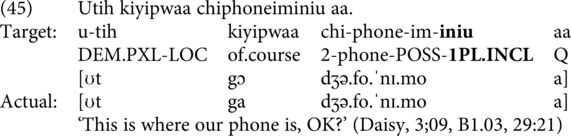
Daisy only uses the inclusive suffix -niu twice in her entire sample, but it is the first possessor suffix she uses and acquires. Her first usage comes with one token of phone at age 3;09 (45) and another with -uhtaawii ‘father’ at 3;11. She also has contrasting forms of each type, which satisfies Productivity Criteria 1–2 and establishes acquisition of -niu at age 3;11.
The next suffix Daisy acquires is the exclusive -naan, which is the rarest in the sampled input. Daisy first uses the suffix at age 3;09 with one token of -iich ‘home’ (46), and she applies it to two tokens of room at 3;11. This meets Productivity Criterion 1.
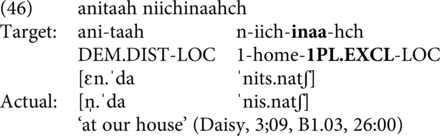
But Daisy does not establish acquisition of -naan until she produces a contrasting form for -iich and room to satisfy Productivity Criteria 1–2 at age 4;01.
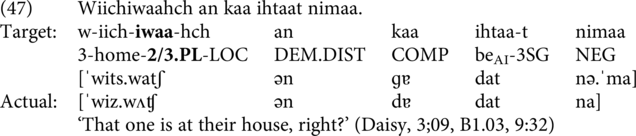
The child then acquires the non-first-person plural suffix -waau, which is the most frequent suffix in CDS (Table 5). She first applies the suffix at age 3;09 to two tokens of -iich ‘home’. Both are the same word form, wiichiwaahch ‘at their home’ (47).
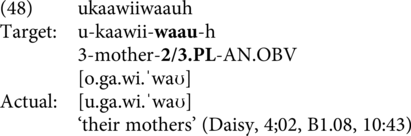
She does not use the suffix with a different noun type until -kaawii ‘mother’ at age 4;02 (48). By this point, she also has produced contrasting forms for both -iich ‘home’ and -kaawii ‘mother’, which satisfies Productivity Criteria 1–2 and establishes her acquisition of -waau at 4;02.
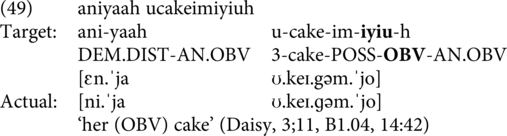
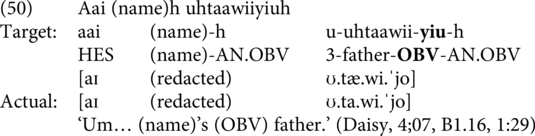
The last suffix Daisy acquires is -yiu, which marks an obviative possessor. Her first usage of the suffix comes with cake at age 3;11 (49), but she does not use the suffix again until 4;07 (50). She also meets Productivity 1–2 and establishes her acquisition of -yiu at 4;07, because she has used contrasting forms of both noun types.
Lastly, on two occasions – once at age 3;11 and at age 5;07 – Daisy applies two possessor suffixes to a single noun token. Both times, she uses the word form wiichiwaayihch ‘at their (OBV) home’, which is the same pattern found twice in the sampled input.
Summary
Daisy is older than Ani and in the midst of acquiring possessor inflection when her recordings begin. We do not get to see the emergence of nouns in her speech nor the earliest hooks she uses to acquire polysynthetic morphology. However, because she produces many more possessive tokens, Daisy provides a richer look into the acquisition of individual morphemes.
Despite the infrequency of some inflectional markers, Daisy eventually demonstrates productivity with all possessor morphemes. In fact, the child employs each possessor morpheme within her first three months of recordings. Daisy first evinces acquisition of the three most frequent prefix morphemes before any suffix morpheme. Her acquisition of suffixes unfolds over time.
Answers for RQs 2–4 and Evaluation of Predictions from Study 1
This section answers RQs 2–4 and evaluates the predictions made at the end of Study 1.
RQ2: “How does possessor inflection emerge in child speech?”
Only Ani’s data provide insight into the initial emergence of possessor inflection. She first extracts and produces chunks of nouns and then eventually begins using stems while omitting possessor inflection in all required contexts. Ani later discovers possessor-marking slots within the inflectional template, first analyzing the Prefix position and then the Suffix 3 position.
RQ3: “What is the order of acquisition for possessor inflection morphemes?”
Table 10 summarizes the order of acquisition for both Ani and Daisy. Their attested orders support some of the predictions made from Study 1. Ani only ever demonstrates acquisition of prefixes, and Daisy evinces productivity with the three most frequent prefixes before any suffix. This supports the prediction that children will identify the Prefix position before any Suffix position. It also mostly supports the prediction the children will acquire the prefix morphemes before the suffix morphemes – only the infrequent prefix mi- lags for Daisy.
Ani and Daisy’s Order of Acquisition for Possessor Morphemes
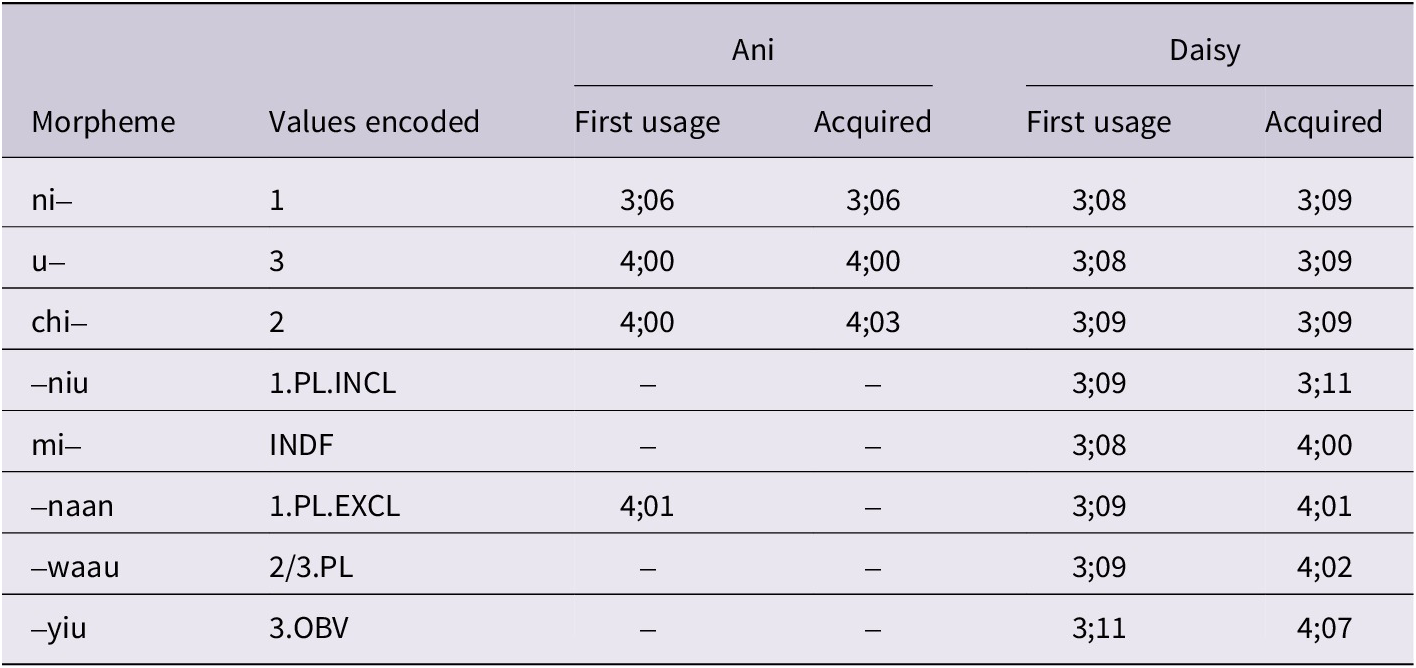
Other outcomes for acquisitional order are more mixed regarding the predictions. Ani’s order of acquisition for prefixes does not follow the predicted order of chi- > u- > ni-. She demonstrates productivity with ni- first, despite her persistent difficulty analyzing its obligatory usage, but she does acquire u- second as predicted. Daisy shows productivity with those three prefix morphemes all at once, because she has mastered much of their usage before her recordings begin. However, some of Daisy’s acquisitional order for suffixes goes against the predicted order of -waau > -yiu > -niu > -naan. She first acquires the clusivity-marking suffixes -niu > -naan. Then she acquires the remaining suffixes in the predicted order of -waau > -yiu.
RQ4: “How might the development of possessor inflection relate to frequency, perceptual salience, and semantic complexity in the input?”
The available naturalistic data make it difficult to isolate and quantify the influence of any individual factor, but Study 2 sheds some light on the roles of each in the development of possessor inflection.
The role of frequency
Frequency clearly corresponds to important facets of the acquisition of possessor inflection – at least when it comes to the most frequent morphemes in CDS. Both children first show productivity with the three prefixes that are the most frequently used possessor morphemes in the input. The Suffix 2–3 positions are used much less frequently in CDS, and Daisy generally takes longer to demonstrate her productivity with those morphemes – while Ani never does.
However, it is also clear that frequency does not solely determine order of acquisition. The most obvious departure from the order predicted by frequency is that Ani acquires ni- and u- before chi-, which is by far the most frequent possessor morpheme in CDS. As frequency-based accounts note (e.g., Ambridge et al., Reference Ambridge, Kidd, Rowland and Theakston2015, pp. 245–246), this signals the importance of context when evaluating frequency effects. Ani is very motivated to discuss herself, so she less commonly refers to her adult interlocutor using a second-person form.
Another clear departure from frequency-driven predictions is that Daisy acquires clusivity-marking -niu and -naan before she acquires the most frequent suffix -waau. This may indicate that the strength of frequency effects wanes among low-frequency morphemes, as in Chintang (Mazara & Stoll, Reference Mazara and Stoll2021). It could also be that Daisy is more motivated to talk about herself, so she uses ‘we’ forms before demonstrating her facility with non-first-person plural forms.
The role of perceptual salience
Accounts emphasizing perceptual salience (e.g., Peters, Reference Peters and Slobin1985) predict this factor may play more of a role in earlier processes of morphological segmentation and analysis, and the present study supports such predictions. During Stages 1–2 (ages 2;01–2;03), Ani uses perceptual salience as a hook to acquire noun word forms. This reliance on salience eventually fades: although the prefixes are not very salient, Ani first discovers the Prefix position and acquires prefix morphemes. Daisy also shows more command of prefixes before suffixes. The available evidence does not correspond to findings from Chintang showing salience prevails among relatively low-frequency suffixes (Mazara & Stoll, Reference Mazara and Stoll2021): Daisy acquires -niu before -waau, even though the latter is more salient.
The role of semantic complexity
The present study does not find a clear role for semantic complexity in the acquisition of possessor inflection. A critical problem is the difficulty teasing apart semantic complexity from frequency. Both children more readily acquire prefixes, which are the least complex of the possessor morphemes – but also overwhelmingly frequent compared to suffixes.
The available evidence indicates that semantic complexity does not clearly relate to acquisitional order for low-frequency suffix morphemes. Ani only attempts one suffix, but it is among the most complex possessor morphemes. Daisy demonstrates productivity with the two most complex suffixes before the others. These results do not correspond with R. Brown’s (Reference Brown1973) observation for English that semantic complexity better predicts acquisitional order than frequency. However, the present findings also do not correspond with Pye’s (Reference Pye and Slobin1992) argument that perceptual salience rather than semantic complexity correlates with acquisitional order. Perhaps this points to a role for pragmatics and communicative interests in acquiring Cree possessor inflection, because the two children start with suffixes that entail first-person meanings.
Conclusions and implications
The present study advances debate regarding the roles that frequency, perceptual salience, and semantic complexity play as hooks to acquiring morphology in a polysynthetic language. Focusing on the possessor-marking morphemes required for possessive inflection in Cree, this study has traced the usage of such morphology in CDS as well as its acquisition by two children.
The story of acquiring Cree possessor inflection involves a combination of factors whose influences shift over time. There is some resemblance here to the story for Mohawk told by Feurer (Reference Feurer1980), where perceptual salience drives one child’s early word forms, and then the subsequent development of verbal morphology hinges on interacting factors of frequency and semantics.
For Ani, perceptual salience plays a key role in the early production of nouns. This is consistent with accounts from Peters (Reference Peters and Slobin1985), some experimental studies of children acquiring stress-timed languages (e.g., Jusczyk et al., Reference Jusczyk, Houston and Newsome1999), and reports from some other polysynthetic languages. The frequency of contrasting forms in the input also helps Ani identify noun stems, which emerge in her speech before any elements of possessor inflection. Ani’s production of bare stems departs from findings in languages such as Navajo and Quechua, because bare noun stems quite frequently appear in Cree input. Ani’s period of omitting obligatory possessive marking also resembles findings from many other languages (see, e.g., Marinis, Reference Marinis, Lidz, Snyder and Pater2016).
Frequency rather than salience corresponds to important patterns regarding order of acquisition, at least for high-frequency morphemes. The two children show earlier facility with prefixes, which are less salient than suffixes but much more frequent and less semantically complex. But neither frequency nor complexity seems to be particularly deterministic for the acquisitional order of low-frequency morphemes. Other factors, such as a child’s communicative interests, may play a key role there.
This story does not contravene acquisitional accounts emphasizing frequency that also acknowledge its interaction with other effects (e.g., Ambridge et al., Reference Ambridge, Kidd, Rowland and Theakston2015), but it also does not necessarily conflict with previous studies of Cree acquisition that emphasize frequency less strongly (Henke, Reference Henke2019, Reference Henke2023). However, the evidence here does not support the idea that children look toward simpler rather than more frequent patterns (cf. Rose & Brittain, Reference Rose, Brittain, Pirvulescu, Cuervo, Pérez-Leroux, Steele and Strik2011), at least among low-frequency morphemes. The present study testifies to the complexity of frequency’s influence in acquisition and demands further examination.
The present study also differs significantly from previous assessments of Ani and Daisy’s productivity with possessor-marking morphemes (Henke, Reference Henke2020). This reflects the revised criteria for determining productivity. Henke (Reference Henke2020) finds that Ani only acquires the prefix u-, because those criteria rely too much upon finding patterns in consecutive recordings. The revisions employed for the present study provide a more nuanced understanding of how each child actually learns to identify and apply morphological patterns.
The findings presented here are illustrative, but they must be interpreted with certain limitations in mind. They also raise important questions for future research. Most crucially, this study cannot resolve the question of whether certain morphemes are indeed harder to acquire or whether they are simply harder to ascertain as acquired within a small corpus of naturalistic data. Likewise, the relative paucity of available datapoints for three out of four suffix morphemes necessitates caution when interpreting their order of acquisition. Future research, particularly experimental studies targeting production, could help provide answers. More study is also needed regarding the role of pragmatics in the acquisition of morphemes. One reviewer recommended a syllable-based study on the development of the Cree prosodic template for nouns as well as other word categories. The present author agrees, especially in light of Ani’s usage of the personal pronoun niiyi as a proto-prefix element in Stage 4. Additional research should also consider how children acquire the allomorphs of each possessor-marking morpheme. Regarding semantic complexity, future work could investigate whether the meanings associated with individual inflectional features may be more or less complex. The feature of obviation may be more difficult for a child to grasp than the rather concrete feature of number – and the obviative possessor suffix is indeed the last acquired by Daisy.
Finally, the present study offers potential contributions to Cree communities engaged in language teaching and revitalization. For example, findings from Study 2 can be used to help establish Cree-specific expectations for morphological acquisition. This could be useful for speech-language clinicians and parents raising children with Cree as their L1, and it could also help inform planning and assessment in programs such as language nests. Findings from Study 1 could perhaps inform efforts in revitalization, such as the creation of resources for parents, educators, and policy-makers seeking more information about how Cree is used with young children on their journey acquiring the language.
Supplementary material
The supplementary material for this article can be found at http://doi.org/10.1017/S0305000924000230.


 Open access

