





For more than six decades, the Swedish Twin Registry (STR) has been a vital resource for studying genetic and environmental influences on various traits and diseases. It continues to be one of the most comprehensive twin registries globally. STR serves as a central repository for information from numerous national data collection efforts, covering twin births since 1886, as well as ongoing data collections. Systematic biobanking started in 2004 (Magnusson et al., Reference Magnusson, Almqvist, Rahman, Ganna, Viktorin, Walum, Halldner, Lundstrom, Ullen, Langstrom, Larsson, Nyman, Gumpert, Rastam, Anckarsater, Cnattingius, Johannesson, Ingelsson, Klareskog and Lichtenstein2013), and in 2019 the STR evolved into a national research infrastructure (Zagai et al., Reference Zagai, Lichtenstein, Pedersen and Magnusson2019), with central economic support from the Swedish Research Council and establishment of a National Council with members from the major universities and higher education institutions in Sweden. This national status comes with a requirement of equal access and prioritization for principal investigators, independent of affiliation or involvement by researchers at Karolinska Institutet, which hosts the infrastructure. In 2025, STR transformed into a new role as a ‘certain research database’ under Swedish legislation, with a mission to collect and store research data for future projects without requiring Swedish ethical approval for the data collection itself. This article provides an overview of the current role and function of STR, with particular emphasis on recent developments in policy, new data and legal aspects.
The New Legal Act on Research Databases in Sweden
The long-standing Swedish tradition of using unique personal identification numbers for authentication and authorization in large parts of society, including interactions with authorities and governmental units, has created great potential for epidemiological research.
In Sweden, all research involving sensitive personal data and/or human biological samples requires approval from the Swedish Ethical Review Authority prior to initiation. Such approval can only be obtained for clearly defined research projects. However, the definition of a research project, in terms of how broad its scope can be, has been subject to debate. In 2021, the National Board of Health and Welfare concluded that the STR was too broad in scope to be considered a research project and consequently denied linkage to updated health data from the major national health registers. As a result, the legal framework governing STR activities as a resource for future, not yet specified research projects remained unclear until recently.
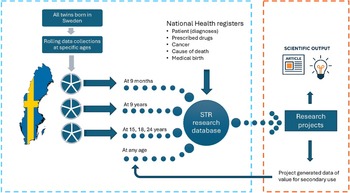
Efforts to establish a legal framework for research databases as research infrastructures have been ongoing for more than a decade in Sweden, and in 2025, the Swedish Government enacted a new law titled ‘The Act on Certain Research Databases’ (SFS 2024:1146). It constitutes framework legislation that enables universities in Sweden to establish research databases whose primary purpose is to collect, store, and distribute personal data for future research (not to be confused with mandatory population registers such as the Patient Register and the Prescribed Drug Register). Each database aiming to obtain the legal status as a certain research database needs to pass an evaluation by the Swedish Research Council before the government can grant the regulation. The target is restricted to data collected from study persons who actively participate and have been informed about the activity. Concurrent with when the act came into force, STR was granted its own regulation (SFS 2024:1150). Since January 2025, this regulation has constituted STR’s legal framework. Under this framework, STR is legally permitted to collect and store sensitive personal data, as defined by the General Data Protection Regulation (GDPR), for future research without requiring specific ethical approval at the time of data collection, meaning that specific research questions do not need to be defined a priori. STR is also authorized, and mandated, to share pseudonymized data (as defined by the GDPR) with researchers for their clearly specified research purposes. Accordingly, STR asks the participating twins for their broad consent, including that before any data are shared for research, there needs to be a Swedish ethical approval in place. The ethical vetting is thus shifted from the data collection phase to the data utilization phase (Figure 1).
Data collection activities are done within the legal framework of STR as a certain research database (light blue dotted frame). Data are used by researchers in specified research projects that are approved by the STR expert committee and have Swedish ethical approval (orange dotted frame). Projects may generate new data of general value for secondary use. The policy states (in the contract with the researcher) that such data should be fed back to the STR database. The conditions for when this approach is applicable depend on both scientific value (STR expert committee assesses) as well as ethical and legal considerations.

One unresolved issue under the new act concerns how biobank samples from study participants should be integrated with the database. According to the Swedish Biobank Act, human biological samples collected for research must still be collected within the framework of specific research projects with Swedish ethical approval. Consequently, STR must continue to perform new biological sample collections within approved research projects rather than under the database framework itself.
Another unresolved issue stemming from the new act relates to the international sharing of personal data. At present, it remains unclear whether personal data may be transferred abroad, as the intended recipient should operate under Swedish secrecy jurisdiction. However, a recent ruling by the Court of Justice of the European Union (CJEU; 2025) states that pseudonymized data should not necessarily be classified as personal data for recipients who lack access to the re-identification key. This ruling potentially opens the possibility for sharing individual-level data with researchers outside Sweden.
Evolution of STR
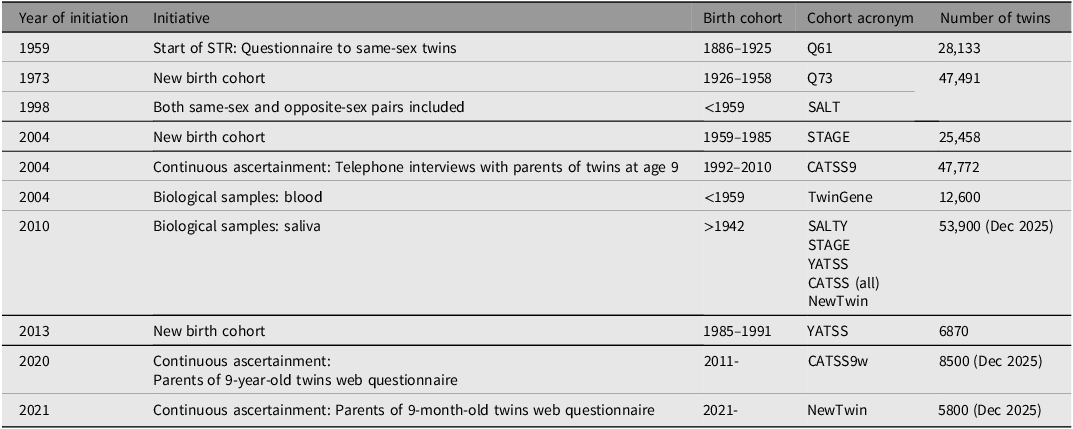
The registry was initiated by Lars Friberg and Rune Cederlöf in the late 1950s to investigate the role of smoking and alcohol on disease (Cederlöf, Reference Cederlöf1966; Cederlöf & Lorich, Reference Cederlöf and Lorich1978). The first questionnaires were sent to same-sex adult twins in 1959–1960. Nearly 12,000 pairs participated, forming the first STR cohort. Nowadays, all Swedish-born twins turning 9 months (born 2021 or later) or 9 years (born 1992 or later) are invited to participate in a long-term rolling ascertainment system (Table 1). The registry consists of data collections that have been nationwide, covering entire birth cohorts and using a persistent pair and twin ID. Over the years, STR has developed into a comprehensive research database including both same-sex and opposite-sex pairs with twin data for epidemiological, interventional and molecular/omics studies. The STR holds identity information on approximately 232,700 Swedish-born twins. Currently, more than 160,000 twins have participated in at least one study. Among participants, 153,705 twins have known zygosity, have not withdrawn, and were born between 1886 and 2024. Of these, 138,878 twins form 69,439 complete pairs, with an approximately equal distribution of monozygotic, dizygotic same-sex, and dizygotic opposite-sex pairs. Zygosity was determined by DNA, similarity algorithm, or by being of opposite sex. By comparing zygosity determined by similarity questions with the DNA-based gold standard, among same-sex pairs, the accuracy is 98.6% for monozygotic twins and 95% for dizygotic twins.
Key milestones in the development of the Swedish Twin Registry (STR)

Genomics
Genomewide Genotyping
About 57,400 twins (representing 48,000 unique genomes when counting monozygotic pairs as one) have been genotyped at the SNP&SEQ Technology Platform at Uppsala University between 2008–2024 (Figure 2). Overall, 38% of participating twins have genomewide genotyping (GWAS) data available. Coverage varies across earlier birth cohorts but reaches a stable level of approximately 50% in cohorts born during the recent decades. The number of genotyped twins increases annually by approximately 1000. Over the years, three different Illumina SNP arrays (OmniExpress, PsychChip and GSA-MD) have been used, and a unified quality control and imputation pipeline harmonizes the data across these SNP arrays. Currently available GWAS data is imputed to the Haplotype Reference Consortium reference panel release 1.1 (European Genome-phenome Archive subset) (McCarthy et al., Reference McCarthy, Das, Kretzschmar, Delaneau, Wood, Teumer, Kang, Fuchsberger, Danecek, Sharp, Luo, Sidore, Kwong, Timpson, Koskinen, Vrieze, Scott, Zhang, Mahajan and Durbin2016), combined with the local SweGen reference panel (see ‘Whole-genome sequencing’ below; Ameur et al., Reference Ameur, Dahlberg, Olason, Vezzi, Karlsson, Martin, Viklund, Kahari, Lundin, Che, Thutkawkorapin, Eisfeldt, Lampa, Dahlberg, Hagberg, Jareborg, Liljedahl, Jonasson, Johansson and Gyllensten2017) on genome build GRCh37/hg19.
Numbers of participating twins (blue) by birth cohort and corresponding number of twins with GWAS data available (orange).

Polygenic Indices
Polygenic indices (PGIs), also known as polygenic risk scores (PRS), aiming to estimate genetic propensities towards various phenotypes are available for a multitude of traits, including psychiatric disorders, anthropometrics, cognition and education, fertility and sexual development, health and health behaviors, and personality and wellbeing (Alemu et al., Reference Alemu, Terskaya, Howell, Guan, Sands, Kleinman, Me Research, Bann, Morris, Ploubidis, Fitzsimons, Harris, Caspi, Corcoran, Moffitt, Poulton, Sugden, Williams, Steptoe and Okbay2025; Becker et al., Reference Becker, Burik, Goldman, Wang, Jayashankar, Bennett, Belsky, Karlsson Linner, Ahlskog, Kleinman, Hinds, Me Research, Caspi, Corcoran, Moffitt, Poulton, Sugden, Williams, Harris and Okbay2021). Since the PGIs have been created by external researchers on the STR samples available for their specific projects, some twins may not have data for a given PGI.
Whole-Genome Sequencing
Because of the complete outreach to all Swedish born twins (independently of residence), STR was identified as a suitable reference sample for the overall genetic variation of native adult Swedes. A whole-genome sequencing project was conducted in 2015, which resulted in a frequency database over identified variants and can be accessed through https://swefreq.nbis.se. In total, 942 randomly selected, unrelated twins (one individual per twin pair) from the TwinGene cohort have been whole-genome sequenced (Ameur et al., Reference Ameur, Dahlberg, Olason, Vezzi, Karlsson, Martin, Viklund, Kahari, Lundin, Che, Thutkawkorapin, Eisfeldt, Lampa, Dahlberg, Hagberg, Jareborg, Liljedahl, Jonasson, Johansson and Gyllensten2017).
Register Data From National Authorities Within the STR Database
Backbone data in the form of personal identity number, name, address and vital status are updated biweekly through an automated process accessing national population registry held by the Swedish Tax Agency.
National Health Registers
A major point of performing longitudinal cohort studies is the potential to learn from considering data on genetics, exposures and behavior collected throughout the life course, in relation to outcomes of interest such as longevity, somatic and mental symptoms and disease. Through regular linkages to the long-standing national registers over deaths, diagnoses and prescriptions, the STR holds updated health data on the full spectrum of diagnoses and medical prescriptions.
The conditions under which these linkages have been conducted have varied over the years. Historically, the STR could hold national health register data on all participants for use in various future projects, although in 2020 this practice was deemed by the register holder, the National Board of Health and Welfare, to be inconsistent with the the Public Access to Information and Secrecy Act (OSL). Consequently, each project applying for STR data had to perform their own linkage for each specific purpose. However, under the new legal act of 2025, STR is now entitled to hold complete health register data from the National Board of Health and Welfare, and linkages to all diagnoses and prescriptions will be conducted on an annual basis. The national health data registers include information on cancer diagnoses from the National Cancer Registry (since 1958); inpatient and specialist care diagnoses from the National Patient Register (since 1964, with nationwide coverage from 1987); prescribed medications from the National Prescribed Drug Register (since 2005); pregnancies and childbirths from the National Medical Birth Register (since 1973); dental care from the National Dental Health Register (since 2008); and causes of death from the National Cause of Death Register (since 1961).
Possibilities for External Linkages for Specific Research Projects
By using the personal identity numbers, researchers can extend their datasets by linkages to various external registers and biobanks. The personal identity numbers are then solely used to identify the twins across different data holders, while importantly, the researchers only receive pseudonymized data.
Beside the health registers at the National Board of Health and Welfare, another highly utilized data provider is Statistics Sweden, which maintains comprehensive nationwide demographic and socio-economic information. Furthermore, there are around 100 healthcare quality registers in Sweden providing detailed clinical data that complement the national health registers (Emilsson et al., Reference Emilsson, Lindahl, Koster, Lambe and Ludvigsson2015). Examples of external linkages include the Swedish Quality Registry for Caries and Periodontitis (SkaPa; Esberg et al., Reference Esberg, Haworth, Kuja-Halkola, Magnusson and Johansson2020) and the Swedish National Spine Register (Swespine), which monitors outcomes of spine surgery (Szigethy et al., Reference Szigethy, Sigmundsson and Joelson2024).
Medical Biobank Samples
STR data can be linked to samples collected within healthcare and stored in medical biobanks without recontacting the study participants for consent, provided that a Swedish ethical approval has been granted for a specific research project. Especially useful are samples from the pathology departments, which have a long history of storing paraffin embedded biopsies. Concordant and discordant twins can be linked to the biobanks and samples of particular interest can be requested for research.
New Participants and Expansions of Research Areas
CATSS9w (Born 2011 and Later)
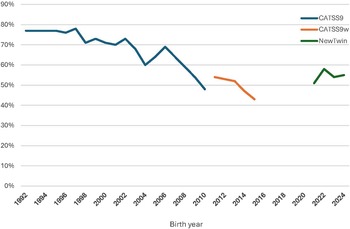
Questionnaire and saliva. A decreasing response rate for the telephone interview with guardians of 9-year-old twins in CATSS9 led to the decision to change collection mode to an online questionnaire (for a more complete description of CATSS in general see Anckarsater et al., Reference Anckarsater, Lundstrom, Kollberg, Kerekes, Palm, Carlstrom, Langstrom, Magnusson, Halldner, Bolte, Gillberg, Gumpert, Rastam and Lichtenstein2011). The invitation procedure is still the same; an information letter is sent to the guardians of the twins. This online implementation has been used since 2020 with a response rate maintained around 50% (Figure 3). As before, the twins are asked to donate saliva for zygosity, genotyping and DNA biobanking.
Participation rate by birth year in the CATSS and NewTwin studies. CATSS9: telephone interviews conducted during 2004–2019; CATSS9w: web questionnaires conducted during 2020–2024; NewTwin: web questionnaires conducted during 2021–2024. The birth-year 2011 is missing since that year involved the transition with a mixture between telephone interview and web questionnaires, 2016–2020 are missing since these birth years are yet to be contacted.

Accelerometery. Since the summer 2020, in collaboration with the Swedish School of Sport and Health Sciences, twins have the option to wear an accelerometer for one week. The device is carried near the hip and measures physical activity in three dimensions (Wiklund et al., Reference Wiklund, Ekblom, Wang and Ekblom2024). Accelerometric data are transmitted back to the STR and made accessible to researchers. During the first 5 years, approximately 2500 twins completed the measurement.
COVID-19. Not long after the transition to the online questionnaire, the COVID-19 pandemic struck and a set of COVID-19 related questions about symptoms, lab tests (PCR and antibodies), parental worry, COVID-19 infection in the rest of the family and severity of the disease, were added (Hedman et al., Reference Hedman, Palm, Magnusson, Rhedin, Kuja-Halkola and Almqvist2025). The questions were included until the middle of 2024.
NewTwin (Born 2021 and Later)
Questionnaire and saliva. A suitable system for systematic recruitment of twins younger than 9 years of age had been considered for quite some time. The intention was to enable research during the first 9 years of life and included health-related parameters during pregnancy and delivery. An investigation to find a sustainable setup for this recruitment scheme was conducted during 2019–2020. The initial idea of recruiting women pregnant with twins or during labor for a twin birth was abandoned, as it was not feasible to implement with consistent quality across all labor units nationwide. Training all midwives to collect data and samples effectively was deemed too challenging. Therefore, STR decided to use the same approach as in CATSS9w. In the autumn of 2021, STR initiated the recruitment of twin infants, aged between 9 and 12 months, by contacting their guardians, identified through records from the Swedish Tax Agency. The study protocol includes an online questionnaire, and the optional provision of saliva samples from the twins.
Follow-Up Studies
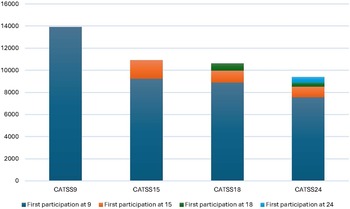
There are ongoing follow-up studies in STR. Twins are reinvited at ages 15, 18, and 24 years. At each follow-up wave, invitations are extended both to previous participants and to twins who have not participated previously. As shown in Figure 4, adherence across waves is rather high, with 64% of participants taking part in multiple waves. Attrition has been low, with only 30 participants withdrawing consent over the study period.
Longitudinal participation in CATSS follow-ups among twins born 1994–2000 who all were contacted for the first time in CATSS9. The bars show the number of participants at each assessment wave: telephone interview at age 9 years (CATSS9; guardians only) and web-based questionnaires at ages 15 and 18 years (CATSS15, CATSS18; guardians and/or twins) and age 24 years (CATSS24; twins). The color-coding indicates at which wave the twins chose to participate for the first time.

Subscriptions and Adjustments in Questionnaires
STR took over the management of the follow-up studies of CATSS on July 1, 2021, and in connection with this, an inventory of the questionnaire batteries resulted in a reduction in the number of questions in the surveys. This opened-up opportunities to include new questions, a service called ‘subscription’. All applications for STR data are evaluated by the STR expert committee, consisting of experienced epidemiologists and twin researchers. The same group also decides on suggested changes in the surveys. If the scientific value of the proposed questions is judged to be sufficiently high and space permits in the survey(s), researchers can include their own favourite questions. Before access to the subsequent collected data is provided, a Swedish ethical approval is required.
Since the data collections are largely subsidized by the Swedish Research Council and Karolinska Institutet, no exclusive rights nor embargo are granted for the extraction of survey data from subscription questions. However, the principal investigator for a specific question battery must be consulted for collaboration on data that are less than 3 years old.
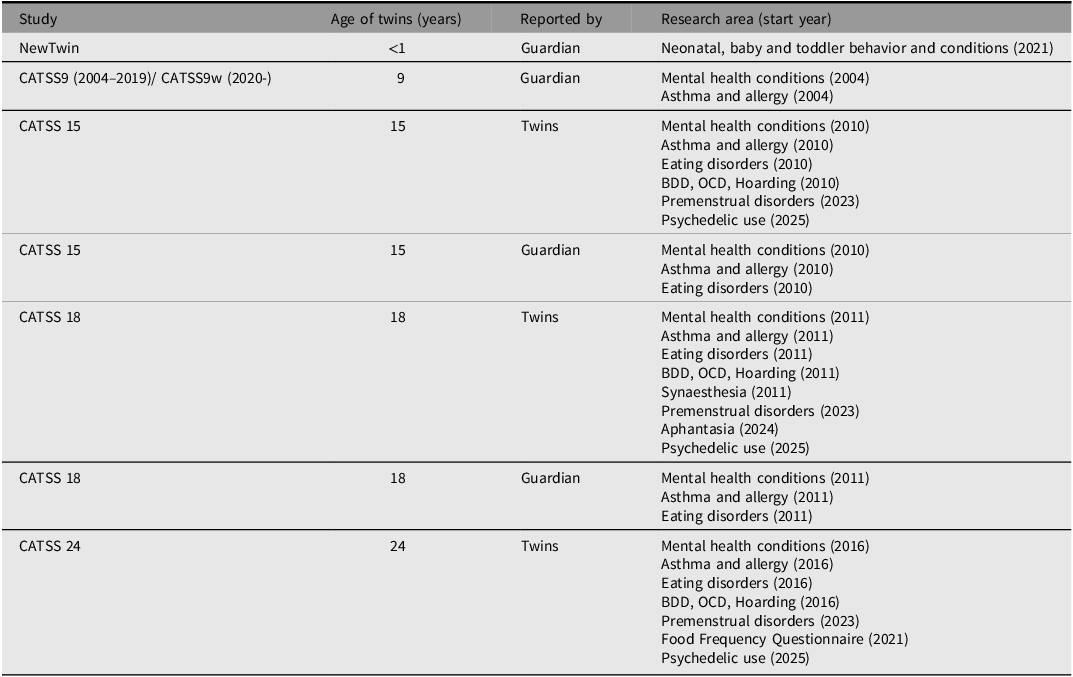
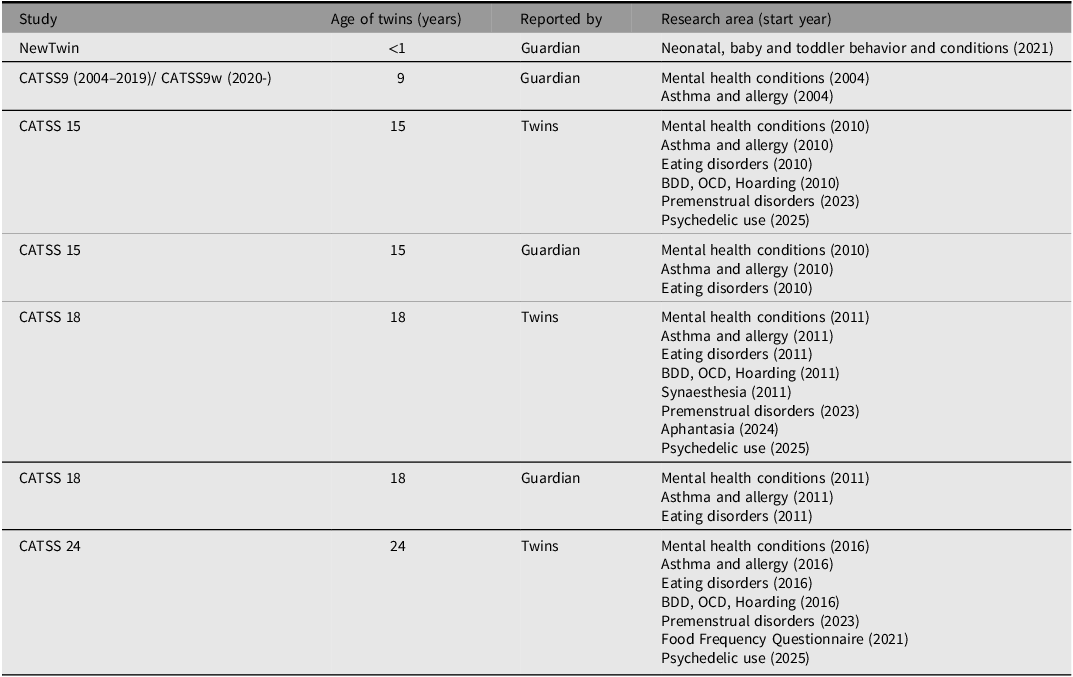
At present, there are subscribers for the following topics: mental health conditions, asthma and allergies, eating disorders, body dysmorphic disorder (BDD), obsessive-compulsive disorder (OCD) and hoarding, premenstrual disorders, synaesthesia and aphantasia, and a food frequency questionnaire (FFQ; Table 2). Some of these questionnaire batteries have been added recently, while others have gathered data for over 10 years. The questionnaire for 18-year-old twins (CATSS18) is currently the most popular and fully subscribed, while there is ample space for additional questions for the youngest twins (NewTwin).
Questionnaires available for subscriptions and current research topics with ongoing subscriptions
Note: BDD, body dysmorphic disorder; OCD, obsessive-compulsive disorder.
Biomarker Measurements in TwinGene
In 2004, the TwinGene project was launched to collect blood for DNA and serum biobanking among older twins who had participated in the SALT study. By 2008, approximately 12,600 twins had provided blood samples (Zagai et al., Reference Zagai, Lichtenstein, Pedersen and Magnusson2019). For all samples, clinical blood chemistry assessments were conducted, including levels of cholesterol, triglycerides, HDL, LDL, C-reactive protein, glucose, apolipoprotein A1, apolipoprotein B, hemoglobin, and hemoglobin A1C (Rahman et al., Reference Rahman, Bennet, Pedersen, de Faire, Svensson and Magnusson2009). Subsequently, telomere length and levels of anticitrullinated protein antibodies (ACPA), immunoglobulin A (IgA), cystatin C, creatinine, pepsinogen I and II, IgG antibodies against Helicobacter pylori, and insulin were measured in all samples. The TwinGene serum samples are available for researchers with interests in performing new biomarker measurements, either in cherry-picked subsets of participants or in the full cohort.
Metabolomics
In 2021, STR made an investment in metabolomic analyses through the Nightingale Health platform (Mak et al., Reference Mak, Kananen, Qin, Kuja-Halkola, Tang, Lin, Wang, Jaaskelainen, Koskinen, Lu, Magnusson, Hagg and Jylhava2023). The analyses measured the concentrations of 250 different metabolites in the full TwinGene cohort. By analyzing the metabolites, researchers can investigate how metabolic profiles relate to genetics, lifestyle, and health conditions.
Proteomics
Following the metabolomic measurements, two additional major investments were made in 2023–2024 to measure proteomics using two different platforms. First, the entire TwinGene cohort was analyzed by The Charité Core Facility in Berlin, Germany, using High Throughput Mass Spectrometry, a platform suitable for large-scale epidemiological cohorts. This measurement provides concentrations for the 350 most abundant protein groups in the 12,600 samples (Messner et al., Reference Messner, Demichev, Bloomfield, Yu, White, Kreidl, Egger, Freiwald, Ivosev, Wasim, Zelezniak, Jurgens, Suttorp, Sander, Kurth, Lilley, Mulleder, Tate and Ralser2021; Messner et al., Reference Messner, Demichev, Muenzner, Aulakh, Barthel, Rohl, Herrera-Dominguez, Egger, Kamrad, Hou, Tan, Lemke, Calvani, Szyrwiel, Mulleder, Lilley, Boone, Kustatscher and Ralser2023). Second, all same-sex TwinGene twin pairs (7000 twins) were analyzed using the Olink multiplex protein analysis with the Explore 384 Oncology I panel covering 350 targeted proteins (Olink® Part of Thermo Fisher Scientific).
New Major Data Contributions From Research Projects Using STR
In some research projects, new data are generated in the form of systematic measurements that may be of considerable value for secondary use (Figure 1). In such cases the STR may request feedback of the data into the STR database.
HUMMUS
In 2022 a recontact of the entire STAGE cohort (born 1959–1985; Zagai et al., Reference Zagai, Lichtenstein, Pedersen and Magnusson2019) was done. The study, called HUMMUS (Humans Making Music Study), contained three parts, a web questionnaire, piano training and magnetic resonance imaging (MRI) of the brain, and the research focus was on musicality and creativity (Bignardi et al., Reference Bignardi, Wesseldijk, Mas-Herrero, Zatorre, Ullen, Fisher and Mosing2025). Although STR assisted in the practical aspects of the data collection in all three parts, STR’s predominant role was in the web questionnaire, for which all collected data have been incorporated into the STR research database and are thus available for external researchers.
Microbiota in Saliva
In STR’s ongoing data collections, twins are invited to donate saliva. Participants who have provided a saliva sample are not reinvited for subsequent saliva collections. As a result, saliva samples are obtained at a single time point, occurring at age 1, 9, 15, 18, or 24 years.
A research project involving the mapping of the saliva microbiome in infants (NewTwin) and middle-aged twins (STAGE) was conducted in 2024. The study used stored saliva DNA samples from the STR biobank to characterize the microbiome through 16S rRNA gene sequencing (to identify and quantify bacterial communities by targeting a highly conserved region of the ribosomal RNA gene). The data generated have been fed back to the STR, which in turn has made them accessible to other applying researchers.
Access to Data
The activities of the Swedish Twin Registry involve collecting, storing, linking, and sharing data. The STR is dedicated to serve as a longitudinal research database, facilitating epidemiological, biobehavioral and molecular research involving twin data. Due to the sensitive nature of personal data stored in STR, individual-level data are not openly accessible. However, researchers may apply for data through the STR application process as described further below.
Metadata and Open Access
Aligned with the research community’s commitment to open science, the STR promotes openness by providing comprehensive metadata through STR’s web portal (https://strdata.se/) and Researchdata.se (https://researchdata.se/en). At the STR web portal, researchers can register and search for variables within and across the STR cohorts and data collections. At Researchdata.se, a national web portal for research data managed by the Swedish National Data Service, descriptions of the various twin cohorts, including birth cohort, age at data collection, questionnaire categories, omics data measurements, and participation rates, are available.
Individual-Level Data
Researchers can apply for access to individual-level data from the STR. For more information, visit https://ki.se/en/research/research-infrastructure-and-environments/core-facilities-for-research/swedish-twin-registry-core-facility. Applications are reviewed quarterly by the STR expert committee. Data are distributed only after approvals from the Swedish Ethical Review Authority are in place. It is worth noting that new ethical approvals do not require reconsent, as participants’ original consent remains valid. If the applicant is not based at a Swedish university, a collaborator from a Swedish university is required to ensure ethical compliance and to benefit the Swedish research community.
Data Sharing
After an application has been granted by STR’s expert committee and ethical approval is in place, a tailored dataset is extracted. A unique coding of the twins and pairs (pseudonymization key) is used for each new project to protect integrity and minimize the risk that data are combined between projects without permission. Most of the phenotypic data are made accessible in this way, but for large-scale genetic and other types of omics data, the access is made through a secure processing environment provided within the National Academic Infrastructure for Supercomputing in Sweden (NAISS).
Future
The STR maintains a continuous focus on development and innovation to better serve the scientific community. Our new role as a certain research database works well for research conducted in Sweden, and the utilization of STR has spread to more groups and disciplines.
In an increasingly digitized society, and with young adults frequently relocating, the STR is currently piloting the use of digital mailboxes for distributing invitation letters. Among 24-year-old Swedes, over 80% have access to some form of digital mailbox. Utilizing digital delivery may enhance accessibility while also reducing costs. For individuals without a digital mailbox, invitations will continue to be sent via traditional postal mail.
Further, STR is considering recontacting twins in several birth cohorts. In CATSS (born 1992–2015) the oldest in CATSS are moving from young adults to adults. Twins in this cohort have previously been surveyed at ages 9, 15, 18, and 24. As the oldest CATSS participants are now approaching 35 years of age, a follow-up survey at this stage would provide valuable longitudinal data and insights into adult development. Additionally, researchers have expressed interest in recontacting participants from STAGE/HUMMUS (born 1959–1985) to collect data on everyday habits. This includes the use of a time-use diary to capture how twins allocate their time across different activities during a typical day or week. Finally, all participants in SALT/TwinGene (born before 1959) are now 67 years or older (Zagai et al., Reference Zagai, Lichtenstein, Pedersen and Magnusson2019). To facilitate research on health and ageing in pensioners and older adults, the STR plans to recontact these twins and collect new blood samples.
Acknowledgments
We acknowledge all the twins and their guardians who have generously participated and contributed over the years. Their commitment to providing questionnaire responses, health data, and biosamples has been instrumental in advancing twin-based research in Sweden. We acknowledge the dedicated researchers who initiated the various national twin cohorts that now form the STR. Their pioneering efforts have been fundamental to the success and growth of this rich research resource. The authors would like to acknowledge support of Affinity Proteomics at SciLifeLab and the National Genomic Infrastructure Uppsala (NGI), supported by SciLifeLab, the Swedish Research Council and the Knut and Alice Wallenberg Foundation, for providing support for sample analyses.
Author disclosures and statements
None.
Financial support
The Swedish Twin Registry is managed by Karolinska Institutet and receives funding through the Swedish Research Council under the grant no 2021-00180. Data handling was enabled by resources provided by the National Academic Infrastructure for Supercomputing in Sweden (NAISS) at Uppsala Multidisciplinary Center for Advanced Computational Science (UPPMAX) partially funded by the Swedish Research Council under the grant no 2022-06725.
Competing interests
The authors declare no potential conflict of interests.
Ethical standards
The authors assert that all procedures contributing to this work comply with the ethical standards of the relevant national and institutional committees on human experimentation and with the Helsinki Declaration of 1975, as revised in 2008.
AI contributions to research content
Language editing and proofreading were supported by Microsoft 365 Copilot, which was used to improve clarity and consistency in the text.


 Open access

