





Dementia is a rapidly growing public health problem affecting around 50 million people worldwide, with approximately 60% living in low- and middle-income countries (LMICs). This figure is set to triple by 2050. International reports indicate a growing number of people with dementia in South Asian countries1,Reference Khan, Afridi, Javed, Burns and Robert2 (Table 1).
Projected population and number of people with dementia in South Asia in 2015–2050

Source: Alzheimer's Disease International & Alzheimer's Australia.1
Many South Asians view memory loss as a normal part of ageing or understand symptoms of dementia through religious belief.Reference Kenning, Daker-White, Blakemore, Panagioti and Waheed3 Providing affordable and sustainable dementia care services in these countries poses numerous challenges. COVID-19 has forced rapid changes in global healthcare, with a significant increase in remote consultations to enable people to access healthcare during physical distancing. Remote healthcare poses specific challenges for memory services owing to patients’ cognitive impairment and the reliance of the clinician on relatives. In May 2020, NHS England's London Clinical Network distributed its Guidance on Remote Working for Memory Services during COVID-19 to staff (this is not on the LCN website but copies may be found online). At the same time, we planned an innovative webinar-based dementia course called Memory First Aid (MFA). MFA aspires to train a pool of non-medical graduates in South Asian countries to offer dementia screening and brief assessment. The course is adapted from mental health first aid courses run in Australia,Reference Jorm, Kitchener, O'Kearney and Dear4 NepalReference Jha, Kitchener, Pradhan, Shyangwa and Nakarmi5 and elsewhere. We have also planned a post-COVID-19 remote memory service based on the Rural and Remote Memory Clinic (RRMC) project, which reported high patient and caregiver satisfaction with telehealth video conferencing.
The Memory First Aid pathway and action plan
Figure 1 depicts the MFA pathway, which consists of screening, assessment and post-diagnostic support. On this pathway, the local branch of Memory First Aid International will organise awareness-raising events along with the nearest Alzheimer's Society and/or similar organisations. The local MFA centre will have a helpline to offer a free memory screening service. All individuals who screen positive will be offered a brief initial assessment using the Rowland Universal Dementia Assessment Scale (RUDAS) cognitive test.
Components of the Memory First Aid pathway.

RUDAS is a copyright-free instrument particularly useful for people in low- and middle-income countries where literacy or education is low.Reference Komalasari, Chang and Traynor6 RUDAS is a short interview-based questionnaire that assesses multiple cognitive domains, including memory recall, visuospatial orientation, praxis, visuoconstructional drawing, judgement and language. It has been validated in Nepal (Nepali-RUDAS)Reference Nepal, Shrestha and Acharya7 and is relevant to all South Asian countries.
In any first aid course, participants learn an action plan for the best way to help someone who is injured or ill. For example, in the UK, when ambulance paramedics are trained to recognise the symptoms of stroke, they are taught to remember the mnemonic FAST, which stands for: Face (can the person smile?), Arms (can the person raise both arms?), Speech problems (can the person speak clearly and understand what you say?) and Time (If you see any of these three signs, it's time to call 999). The MFA course provides an action plan on how to help a person experiencing memory difficulties. Its mnemonic is SSAD: Suspect dementia, Screen for Alzheimer's disease, Assess cognition and organise Diagnosis (Fig. 2).
The Memory First Aid action plan. AD, Alzheimer's disease.

Course content
The MFA course teaches volunteers how to recognise the symptoms and signs of Alzheimer's dementia, how to screen older people with memory problems for dementia, how to offer basic cognitive assessment, and how to organise diagnostic assessment for people with suspected dementia.
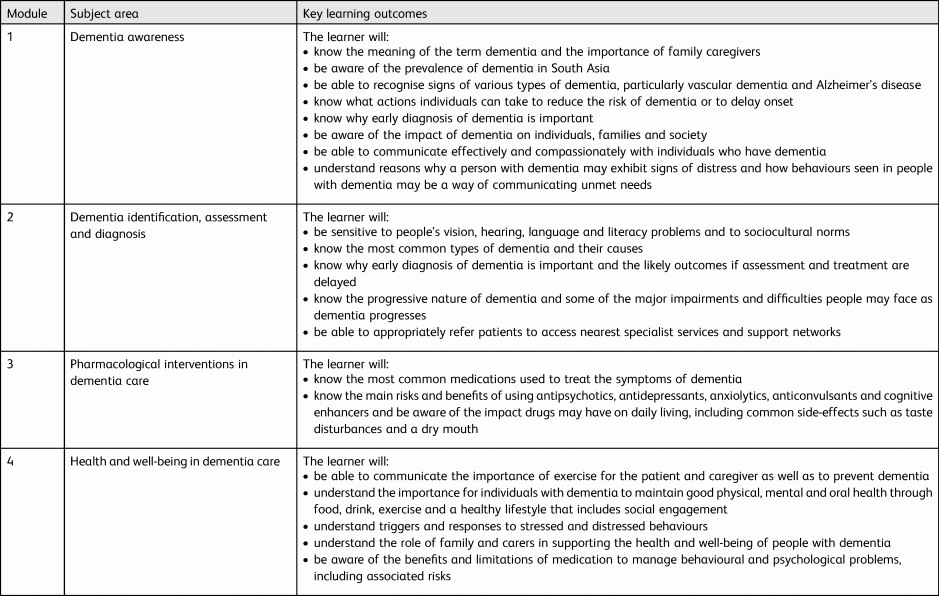
MFA is a 12-hour webinar-based course consisting of four modules (3 h each) delivered over 4–6 weeks. The course is based on tier 1 and tier 2 of the Dementia Training Standards Framework developed by NHS Health Education England in 2018.8 Tier 1 is related to dementia awareness raising, in terms of knowledge, skills and attitudes for all those working in health and care settings. Tier 2 is about knowledge, skills and attitudes for roles that have regular contact with people living with dementia. Table 2 lists the key subject areas and learning outcomes for the four MFA modules.
Key subject areas and learning outcomes for the modules of the Memory First Aid course
Pilot testing
Evaluation of the course at three pilot sites – Kathmandu in Nepal, Darbhanga in India and Colombo in Sri Lanka – will commence in September 2020. Its effectiveness will be measured using the pre- and post-test Alzheimer's Disease Knowledge Scale (ADKS).Reference Carpenter, Balsis, Otilingam, Hanson and Gatz9 This method has been previously used by authors in the UK for a similar course, Dementia First Aid, for family caregivers of people with early dementia.Reference Tomar, Jha, Gale and Huzzey10 The success of the programme will be measured by the number of people with suspected dementia being screened and diagnosed. Patient and caregiver satisfaction with telescreening will be evaluated using the Telehealth Satisfaction Scale (TeSS).Reference Morgan, Kosteniuk, Stewart, O'Connell, Karunanayake and Beever11 If successful, the MFA course and tele-memory service will be rolled out to other South Asian countries.
Author contributions
A.J. conceived the idea and all authors were involved in writing the article.
Declaration of interest
None.
ICMJE forms are in the supplementary material, available online at https://doi.org/10.1192/bji.2020.42.


 Open access


eLetters
No eLetters have been published for this article.