

In semi-authoritarian regimes – often termed hybrid regimes or competitive authoritarian systems (Levitsky and Way Reference Levitsky and Way2002) – civil society actors frequently mobilise against government projects, policies or abuses of power. Yet despite these efforts, success is rare (Bedford and Vinatier Reference Bedford and Vinatier2019; Heurlin Reference Heurlin2016; Huang et al. Reference Huang, Boranbay-Akan and Huang2019; Leuschner and Hellmeier Reference Leuschner and Hellmeier2023; Sinkkonen Reference Sinkkonen2021; Spasojević and Lončar Reference Spasojević and Lončar2023). These regimes typically avoid the overt, systematic repression seen in fully authoritarian states (Bánkuti et al. Reference Bánkuti, Halmai and Scheppele2012; Bermeo Reference Bermeo2016; Galston Reference Galston2018; Gandhi and Przeworski Reference Gandhi and Przeworski2007; Levitsky and Way Reference Levitsky and Way2002; Reny Reference Reny2021; Trantidis Reference Trantidis2022), instead relying on more subtle forms of control: manipulation, media capture, co-optation, intimidation and selective repression (Gerschewski Reference Gerschewski2013; Handlin Reference Handlin2017; Hess Reference Hess2016; Schedler Reference Schedler2006; Tilly Reference Tilly2010; van Lit et al. Reference van Lit, van Ham and Meijers2023). Such tactics are often sufficient to neutralise social mobilisation, thereby reducing the need for concessions. Nevertheless, hybrid regimes do occasionally yield – halting controversial projects or reversing contested decisions (de Vogel Reference de Vogel2024; Heurlin Reference Heurlin2016; Li Reference Li2019; Lorentzen Reference Lorentzen2014; Mueller Reference Mueller2022; Rasler Reference Rasler1996). However, conceptual frameworks that explain and predict when such concessions occur remain limited (de Vogel Reference de Vogel2024; Greene Reference Greene2014; Leuschner and Hellmeier Reference Leuschner and Hellmeier2023).
This paper addresses this gap by presenting a framework to predict when semi-authoritarian regimes are likely to concede to civic demands. The framework rests on two dimensions: (1) the extent to which meeting a demand would undermine one of the regime’s structural pillars of power – such as powerful alliances (e.g. with transitional political or business elites), media control or access to critical resources (Diamond Reference Diamond2002; Levitsky and Way Reference Levitsky and Way2002; Schedler Reference Schedler2013); and (2) the degree to which the contested issue resonates emotionally with a broad segment of the population, including parts of the regime’s own support base – a factor often shaped by activists’ framing strategies (Snow and Benford Reference Snow and Benford1988). The interaction of these dimensions, and the position of an issue within this matrix, determines the regime’s willingness to yield.
We demonstrate the framework’s utility through six case studies of campaigns carried out between 2020 and 2024 by the Serbian non-governmental organisation (NGO) Move, Change, a prominent civic organisation opposing the regime of Aleksandar Vučić, which has undergone major democratic backsliding since 2012 (Pavlović et al. Reference Pavlović, Stanojević, Jović and Vučićević2025; Vučković et al. Reference Vučković, Radeljić and Djordjević2025) and transformed into a hybrid regime (V-Dem Institute 2024). The campaigns examined here span the full range of positions within the framework, enabling a robust test of its explanatory and predictive power.
The paper makes three key contributions to the literature on authoritarian resistance. First, it offers a predictive means to identify when civic mobilisation is most likely to succeed. It moves beyond structural-deterministic views – which attribute concessions solely to existential threats – by incorporating the agency of civic actors; particularly their ability to select, articulate and manage campaigns and to shape frames that amplify resonance (Gamson and Modigliani Reference Gamson and Modigliani1989; Snow and Benford Reference Snow and Benford1988).
Second, our framework extends the practical literature on resisting authoritarian measures in hybrid regimes by shifting the focus from organisation and resources (Ganz Reference Ganz2011; Ganz et al. Reference Ganz, Nohria, Khurana, Nohria and Khurana2010) to strategic issue selection and framing. Our framework points to ways to increase an issue’s mobilising potential. Existing accounts tend to focus on moments when threats have already crystallised (de Vogel Reference de Vogel2024), overlooking earlier mobilisation processes that set the stage for concessions.
Finally, we highlight the importance of often-overlooked, smaller-scale, non-radical confrontations in undermining hybrid regimes. While much of the literature emphasises macro-political events such as regime change, revolutions or mass uprisings (Chenoweth et al. Reference Chenoweth, Perkoski and Kang2017; Escribà-Folch Reference Escribà-Folch2013; Ginkel and Smith Reference Ginkel and Smith1999; Ritter Reference Ritter2014), incremental and sometimes symbolic victories – often secured through effective framing – can gradually erode regime legitimacy. Over time, such wins accumulate, weakening authoritarian control and creating conditions for eventual change. Our framework can also ‘reverse-engineer’ campaigns to explain why some succeeded and others failed, helping identify common missteps by the opposition, such as underestimating regime resolve when core pillars of power are threatened or failing to craft resonant frames.
Mobilising concessions in hybrid regimes: strategic framing and threats to structural power
Hybrid regimes rarely concede to civic mobilisation. Their typical strategy is to ignore public pressure or outlast it through attritional delay, expecting public interest to dissipate (Bishara Reference Bishara2015; Frantz and Kendall–Taylor Reference Frantz and Kendall-Taylor2017; Tilly Reference Tilly2010; Yuen and Cheng Reference Yuen and Cheng2017). When repression is applied, it is usually less violent than in fully authoritarian systems. Nevertheless, concessions do occur (Bermeo Reference Bermeo2016; de Vogel Reference de Vogel2024; Heurlin Reference Heurlin2016; Leuschner and Hellmeier Reference Leuschner and Hellmeier2023; Levitsky and Way Reference Levitsky and Way2002; Musil and Yardımcı-Geyikçi Reference Musil and Yardımcı-Geyikçi2024; Li Reference Li2019; Spasojević and Lončar Reference Spasojević and Lončar2023; Trantidis Reference Trantidis2022). Even fully authoritarian regimes may occasionally yield to civic mobilisation when legitimacy is at stake (Acemoglu and Robinson Reference Acemoglu and Robinson2006; Bishara Reference Bishara2015). However, such concessions tend to be partial, symbolic or reversible – carefully calibrated to manage dissent while safeguarding the regime’s core power structures (Bermeo Reference Bermeo2016; Leuschner and Hellmeier Reference Leuschner and Hellmeier2024; Lührmann and Rooney Reference Lührmann and Rooney2021; Pierskalla Reference Pierskalla2009). This behaviour closely resembles what Christine Oliver (Reference Oliver1991) terms ‘acquiescence’: appearing responsive while protecting the foundational pillars of power.
We argue that understanding when and how concessions are granted requires analysing two variables in tandem. The first is structural threat: whether meeting the demand would undermine one or more of the regime’s core pillars of power. The second is issue resonance: the extent to which the particular cause gains traction across diverse social groups, raising legitimacy costs if the regime refuses to act. Consequently, it is possible to predict the regime’s response depending on where an issue is positioned across the two dimensions (Table 1). Concessions are most likely when structural threat is low but resonance is high. When structural threat is high, even increased emotional resonance produces only limited, strategic or reversible concessions.
Predicted Regime Responses

Note: The table shows predicted regime responses depending on where an issue is positioned across the two dimensions: the level of threat to regime power and the emotional resonance of the cause.
Source: Authors’ elaboration.
Structural threat refers to the risk that conceding to the demand would erode key institutional, economic or narrative levers essential for the regime’s survival. Demands that threaten these pillars – such as control over key industries, the media, patronage networks, state resources, elite alliances or international links – are met with maximum resistance. In Serbia, for instance, foreign partnerships (especially with Western actors) have enabled the Vučić regime to escape any meaningful external pressure over its domestic abuses (Levitsky and Way Reference Levitsky and Way2010; Pavlović Reference Pavlović2023).
Issue resonance describes how broadly a grievance connects people across different parts of society. Demands confined to core opposition groups rarely force concessions, whereas those which mobilise neutral or regime-leaning citizens sharply increase the regime’s legitimacy costs (Lührmann Reference Lührmann2021; Lust and Waldner Reference Lust and Waldner2015). In hybrid regimes, opposition actors often employ liberal-democratic frames such as individual freedoms or the rule of law, but these tend to resonate only with small, engaged minorities (Börzel and Schimmelfennig Reference Börzel and Schimmelfennig2017; Ekiert Reference Ekiert2021).
In Serbia, such values are not deeply embedded, and the regime’s propaganda often dismisses them as elitist or foreign-imposed (Vachudova Reference Vachudova2020). In contrast, frames rooted in traditional values such as sovereignty, conservatism or distrust of international actors have far wider appeal, drawing on historical experiences – for example, the NATO bombing, the experience of privatisation and perceived exploitation by foreign elites (Friedrich-Ebert-Stiftung 2025). Campaigns that tap into these sentiments can bridge ideological divides and erode regime legitimacy, even among its base.
Issue framing: anchoring issues in shared identities
Issue framing – defined as emphasising selected facets of a given issue (Anspach and Draguljić Reference Anspach and Draguljić2019: 617; Benford and Snow Reference Benford and Snow2000) – can be a powerful tool that shapes how audiences interpret and assess that issue (Anspach and Draguljić Reference Anspach and Draguljić2019; Hart and Nisbet Reference Hart and Nisbet2012; Iyengar and Kinder Reference Iyengar and Kinder1987). One issue can garner markedly different levels of public backing depending on the frame through which it is presented (van Lit et al. Reference van Lit, van Ham and Meijers2023: 8). Effective framing connects an issue with the values people already hold deeply, thereby enhancing how legitimate and urgent that issue appears (Brewer Reference Brewer2002; Lakoff Reference Lakoff2010; Nelson et al. Reference Nelson, Oxley and Clawson1997). In doing so, it creates new psychological associations between the specific issue and more fundamental, enduring values (Domke et al. Reference Domke, Shah and Wackman1998). Well-crafted frames restructure familiar information within interpretive contexts that individuals may not previously have considered, and these novel vantage points can correspond with and activate existing beliefs (Brewer Reference Brewer2002; Domke et al. Reference Domke, Shah and Wackman1998; Nelson et al. Reference Nelson, Oxley and Clawson1997). Through this process, the perceived legitimacy and moral urgency of an issue are heightened via the activation of pre-existing, deeply rooted values (Brewer Reference Brewer2002; Lakoff Reference Lakoff2010).
From a cognitive standpoint, framing alters which mental heuristics are most salient, thereby shaping both public attitudes and subsequent behaviour (Chong and Druckman Reference Chong and Druckman2007). In contexts of political mobilisation, strategic framing can turn an ostensibly low-salience or low-mobilisation concern into a strong focal point for resistance, invoking broadly shared values that it is believed will be threatened by the contested policy. This increases citizens’ perception about the gravity of harm that the contested regime’s actions pose (van Lit et al. Reference van Lit, van Ham and Meijers2023: 9).
Frames that align with shared identities and cultural values, rather than solely liberal-democratic ones, can dramatically expand an issue’s resonance (Drury and Reicher Reference Reicher, Turner, Hogg, Oakes, Reicher and Wetherell1987, Reference Drury and Reicher1999, Reference Drury and Reicher2000, Reference Reicher2001, Reference Drury and Reicher2005; Simon et al. Reference Simon, Loewy, Stürmer, Weber, Freytag, Habig, Kampmeier and Spahlinger1998; Stürmer and Simon Reference Stürmer and Simon2004; Tajfel Reference Tajfel1978; Tajfel and Turner Reference Tajfel, Turner, Austin and Worchel1979; Yabanci Reference Yabanci2025). This reduces psychological distance and makes the issue more relatable (Newell et al. Reference Newell, McDonald, Brewer and Hayes2014). Framing can blend unifying narratives – rooted in widely shared identity values – with a set of tailored frames for specific audiences, as long as they are mutually compatible. This is not about finding the lowest common denominator, but about creating a synergy between different frames. The most effective strategy is to combine a broad, unifying frame that appeals to shared identity values with a collection of more specific frames that speak to distinct values in different social groups, each activated as appropriate.
Further techniques include personalisation (highlighting concrete victims or heroes), invoking shared dangers, and motivational framing, such as appeals to anger, empathy or moral solidarity (Hart and Nisbet Reference Hart and Nisbet2012; Smith and Ellsworth Reference Smith and Ellsworth1985; van Zomeren et al. Reference van Zomeren, Postmes and Spears2008). In contexts of deep distrust towards elites, frames that evoke betrayal or threats to communal dignity can be especially powerful (Hooghe and Marien Reference Hooghe and Marien2013).
Regime-aligned media dominate mass communication in most hybrid regimes, limiting the spread of dissenting frames (for Serbia, see e.g. Atlagić and Vučićević Reference Atlagić, Vučićević, Gregor, Eibl and Newman2024). While independent media and social networks offer alternative channels, their reach is often limited (Pearce and Kendzior Reference Pearce and Kendzior2012). Nevertheless, online mobilisation can help set the agenda and facilitate offline action, especially when supported by strong organisational capacity (Edgell et al. Reference Edgell, Lachapelle, Lührmann and Maerz2021; Ganz et al. Reference Ganz, Nohria, Khurana, Nohria and Khurana2010; Tufekci Reference Tufekci2017). Move, Change typically begins its campaigns with digital petitions, moving to offline protest and direct engagement as the issue gains traction.
Analytical context
Serbia is a transitional country in South-Eastern Europe that has experienced more than a decade of democratic backsliding. Once an unconsolidated democracy, it is now classified as a competitive, semi-authoritarian regime (V-Dem Institute 2024). While legal guarantees for political and media freedoms exist, they are routinely undermined in practice (Atlagić and Vučićević Reference Atlagić, Vučićević, Gregor, Eibl and Newman2024). Independent media reach only a minority of mainly urban and younger populations (CRTA 2023; Vladisavljević Reference Vladisavljević2020), and while the internet remains uncensored, its reach is similarly limited and insufficient to challenge the regime’s dominance over public discourse (Matović et al. Reference Matović, Milin Perković and Josifović2022). Political contestation has been further constrained by the appointment of loyalists to leadership positions in key oversight bodies (Tomić and Pavlović Reference Tomić and Pavlović2023).
Within this restricted civic space, dissent is possible but constrained by concentrated executive control (Damnjanović Reference Damnjanović2020) and the regime’s tight grip on national broadcast media. Activism in Belgrade carries fewer risks to personal security than in more repressive systems; while some activists face intimidation, such as so-called SLAPP lawsuits (Strategic Lawsuit Against Public Participation) or short-term detentions, there remains relative safety for mobilisation, especially in the capital.Footnote 1 Independent television and online portals reach about one-third of the electorate (CRTA 2023), providing some space for debate but not enough to shift majority opinion without broader engagement strategies.
It is in this environment that the NGO Kreni-Promeni (Move, Change) emerged in 2019, aiming to promote social justice and broader political change through grassroots mobilisation. Move, Change has led campaigns on a variety of issues, from environmental protection and social justice to anti-corruption and support for vulnerable groups (Kreni-Promeni n.d.). Campaigns typically begin with a strategically framed online petition and, if successful, escalate to offline actions such as rallies and protest walks. Over three years, Move, Change has grown from a small initiative into a leading force in civic mobilisation against the increasingly authoritarian regime of Aleksandar Vučić.
Case studies and methods
This section examines six mobilisation campaigns led or co-led by Move, Change. Each case summary describes the issue’s origin, the ensuing campaign and the regime’s response. The analysis draws on media reports and first-hand organiser accounts. Cases were selected to maximise variation along the two key framework dimensions: (1) the degree of threat posed to one of the regime’s structural pillars; and (2) the breadth of resonance of the campaign’s cause beyond the core ‘issue losers’. The expectation is that regime responses will correspond to the campaign’s position in the framework’s 3 × 2 matrix (see Table 1).
All six campaigns were conducted within a broadly similar political and social context. This provides control over the key mediating variables identified in the literature, whether linked to the broader social and political environment (Skocpol Reference Skocpol1979), economic structures (Lachapelle et al. Reference Lachapelle, Hellmeier and Lührmann2021) or organisational and resource factors highlighted as critical for campaign success, including organisational capacity, structural conditions, tactical choices and credibility (Chenoweth Reference Chenoweth2023; de Vogel Reference de Vogel2024: 189; Ganz et al. Reference Ganz, Nohria, Khurana, Nohria and Khurana2010; Sutton et al. Reference Sutton, Devine, Lamont and Holmes2021; van Lit et al. Reference van Lit, van Ham and Meijers2023). In all the selected cases, the variation in these factors is minimal or absent, allowing us to put them aside as primary explanations for differences in outcomes. Therefore, the observed variation in the responses of the regime can be attributed to the specific nature of each issue and the way it was framed during the campaign.
Rio Tinto
The Rio Tinto case concerns citizen mobilisation against the Serbian government’s plan to allow the multinational mining company Rio Tinto to open a lithium mine in the Jadar Valley in western Serbia. The project developed quietly for almost a decade, beginning in the early 2010s (Balkan Green Energy News 2024) when Rio Tinto conducted preliminary soil tests and other preparations while maintaining a low public profile. During this period, a few ecological organisations voiced criticism, but their objections were sporadic and attracted little media attention. The situation changed dramatically in late 2021 when the Serbian parliament, through an expedited procedure, adopted a law enabling state authorities to expropriate private property within five days, eliminating urgent legal remedies for affected owners (Milivojević Reference Milivojević2021).
This measure was widely perceived as designed to facilitate land acquisition for Rio Tinto’s operations in the Jadar Valley, a fertile agricultural area. Initially, the public was caught off guard, but environmental and civic groups quickly mobilised. Among them, Move, Change launched an online petition against the law, which garnered tens of thousands of signatures within days and served as a springboard for media appearances, street performances and protest rallies (Novaković Reference Novaković2021). As the campaign gained traction, intellectuals, activists and commentators joined forces, broadening the coalition against the project. In promoting the petition’s cause, Move, Change employed three main narratives in its public appearances: (1) defending domestic land as vital to national sovereignty; (2) honouring a ‘duty to our ancestors’ who fought for sovereignty, emphasising that the planned site included ground where a major World War I battle took place (Sokić Reference Sokić2022); and (3) warning of severe health risks, including unprecedented pollution of rivers and farmland and higher cancer rates. This, Move, Change insisted, would lead to massive population migration – i.e. the displacement of tens of thousands of local residents, creating so-called ecological refugees (Kreni-Promeni 2021a, 2021b, 2021c). The proposed law was also criticised for undermining property rights and creating legal uncertainty.
Building on the strong initial response, the campaign escalated rapidly and, following several smaller offline performances and rallies, culminated in the winter of 2021 with a nationwide protest in which tens of thousands blocked an international highway through Belgrade.Footnote 2 Simultaneously, protests took place in nearly 200 other locations across the country. The movement gained endorsements from high-profile figures, including tennis player Novak Djokovic (Cropley Reference Cropley2022), and received widespread domestic and international coverage, including The Guardian newspaper and Reuters.
Before the highway protest, the government continually ignored repeated calls to halt the project (Petković Reference Petković2021). Officials remained silent, and pro-government media largely avoided the issue. The Rio Tinto mine was viewed as strategically important: a means to bolster the government’s international standing and strengthen the regime’s ties with political and business elites in the European Union (Radeljić Reference Radeljić, Džankić, Keil and Kmezić2019), where lithium extraction is a priority for the green transition, as well as with investors from China, the USA and the UK, who also had stakes in the project. Suspending the project would risk damaging these partnerships and undercutting President Vučić’s image as a reliable, business-friendly leader attractive to foreign investors.
However, as protests expanded nationwide and the risk of broader unrest increased, the government conceded and repealed the controversial expropriation law. Two weeks into the protest, Vučić publicly announced the mining project’s cancellation, signalling what appeared to be a major concession. Yet as political tensions subsided in the following months, the regime quietly began seeking to revive the project. Rhetorically, Vučić repeatedly described halting the mine as his regret and a ‘missed opportunity’, claiming it had cost Serbia significant revenue (Danas 2023). He increasingly framed the project as a ‘lifetime investment opportunity’ for improving citizens’ living standards. Soon after, the government and local authorities resumed using project-supporting rhetoric and, as time passed, enabled Rio Tinto to continue land clearing in the Jadar Valley while assisting in the construction of access infrastructure (Ivančić and Steblev Reference Ivančić and Steblev2025).
In response, Move, Change launched a new national citizens’ initiative to ban lithium mining for 20 years. The campaign gathered over 38,000 verified signatures – above the 30,000 threshold requiring parliamentary debate under Serbian law (Nikolin Reference Nikolin2022). However, the ruling majority refused to consider it, despite the constitutional obligation to put it to a vote. The government initially claimed the initiative had been ‘misplaced’ (Insajder.net 2024), a manoeuvre apparently aimed at pre-empting public deliberation, sapping the movement’s momentum, and preventing a definitive end to the project.
The president’s U-turn – from promising to stop the mine following mass protests to later attempting its revival – illustrates a common tendency of (semi)authoritarian regimes to renege on prior commitments (Acemoglu and Robinson Reference Acemoglu and Robinson2006: 26; Brancati Reference Brancati2014; Leuschner and Hellmeier Reference Leuschner and Hellmeier2023: 3). By 2023, the government had intensified efforts to restart the project, advancing land clearance and infrastructure works in the Jadar Valley. In 2024, the Constitutional Court – widely viewed as being under the government’s influence – issued a controversial ruling annulling the previous decision to halt the mine (made under pressure from the highway protest), thus effectively re-legitimising the project (N1 Beograd 2024).
This decision triggered another wave of mass protests in the summer of 2024 (Danas 2024), which was the largest since 2021. At this point, polls already indicated that approximately 55% of the public opposed the mine, compared to just 20% in favour (Vreme 2025), with the rest undecided. This was the first issue on which the regime was faced by a clear majority of the population against it, including segments of its traditional electoral base. These August 2024 protests underscored the issue’s enduring potential to mobilise. They also showed that, once embedded, certain frames around particular political projects can retain salience for years to come and therefore continue to represent a significant constraining factor on policymakers’ intentions to advance contested projects.
The mobilisation against Rio Tinto has so far been partially successful. It forced the government to halt the project in 2021, but the issue remains unresolved due to subsequent regime efforts to revive it, involving a sustained campaign to reframe it as a national investment opportunity. The project’s future appears to hinge on the regime’s ability to reshape public opinion and reduce opposition among the roughly three-fifths of the population currently against the project – a group that now includes a notable share of the ruling party’s voters.
‘Save the Park’
The Save the Park campaign dates back to 2019 when, under the organisation of Move, Change, hundreds of residents from the Belgrade neighbourhood of Banovo Brdo mobilised to oppose the construction of a residential complex on the site of a local children’s park. According to campaign organisers, the planned development violated urban planning regulations and was the product of corrupt collusion between a controversial investor and the local municipal authorities, which were under the control of the leadership of the ruling Serbian Progressive Party (SNS) (Kreni-Promeni 2019).
Initially, city officials ignored the protests, while the investor attempted to suppress them through intimidation and physical force. Private security personnel were hired to confront protesters directly (Espresso 2020), prompting activists to organise continuous on-site watches to prevent construction machinery from clearing the park. This prompted Move, Change to launch an online petition requesting an immediate halt to construction and the park’s preservation (Kreni-Promeni 2019) in an effort to raise the issue’s visibility among the wider population.
As these confrontations escalated, media coverage expanded, increasing public awareness of the issue. In Belgrade this dispute coincided with growing citizen resentment towards so-called ‘investor urbanism’, increasingly perceived as a symbol of corruption and lawlessness (Kreni-Promeni 2020). The fact that the project threatened a children’s play space might have added to the emotional dimension. Move, Change framed the struggle as ordinary residents defending children’s playgrounds from corrupt business interests – a narrative that quickly attracted wider sympathy. Within several weeks the campaign gathered about 3,000 hard-copy petition signatures and an additional 7,000 online (Kreni-Promeni 2019) which, given the dispute’s local character, represents a notable mobilisation achievement. As public interest intensified and local residents maintained their guard over the park, city authorities eventually intervened several months later to break the ongoing ‘stalemate’. Positioning themselves as mediators between the investor and the protesters, the city authorities influenced the investor to withdraw and relocate the project, thus enabling the preservation of the park (N1 Beograd 2020).
By halting the project, the mobilisation delivered a symbolic and practical blow to the regime, challenging an important, though secondary, mechanism of resource generation. While this resolution of the case did not undermine any of the fundamental pillars of the regime’s structural power, it nevertheless represented a blow to a clientelistic network linking urban developers and the ruling party (Radeljić and Djordjević Reference Radeljić and Djordjević2020). This nexus, which operated at the local government level while allegedly being orchestrated by the regime’s top leadership, was a significant source of both private profit and party funding, benefitting not only local officials but also national party elites (Pavlović Reference Pavlović2017).
‘Save the Student Clinic’
The campaign to Save the Student Clinic was launched by Move, Change in 2020 to oppose the government’s plan – announced during the coronavirus pandemic – to abolish the main polyclinic serving Belgrade’s student population. This facility, located in a central city municipality, had for decades provided health services to students in Serbia’s largest university hub, which counts approximately 120,000 students (Institute for Students Health of Belgrade University 2025). The proposed closure of the student polyclinic also clashed with the notion of the national healthcare system being available to all and easily accessible, as well as the related and widely held expectation that universal healthcare – including specialised services for students – should be protected.
In response to the announcement of the clinic’s termination and its transfer to the general healthcare system, Move, Change initiated a petition demanding the cancellation of this plan (Beta 2021). The petition quickly gained momentum, collecting around 37,000 signatures in just one week (Kreni-Promeni 2021b). The campaign received extensive media coverage and was amplified by a viral social media trend. Support came not only from students but also from the wider public. In Serbia, the student population has traditionally been viewed favourably among the public and holds strong symbolic significance – a fact confirmed during the mass student-led protests against the SNS regime, waged for nearly nine years, in which students succeeded in mobilising unprecedented crowds and dealing a major blow to the regime’s standing (N1 Beograd 2025).
The highlight of the campaign against the polyclinic closure occurred when Move, Change held a press conference outside the Ministry of Health. During the event, the health minister – unpopular with the electorate – turned up unexpectedly, interrupting the public statement almost forcibly to express his disapproval of the campaign’s demands. Footage of this confrontation went viral, significantly boosting the campaign’s visibility. As this quickly galvanised further support for the petition, the Ministry shortly thereafter announced that it would reverse its decision and allow the student polyclinic to continue operating as before (RTV 2021).
‘Save the Natural History Museum’
In 2020, a group of Serbian scientists, supported by Move, Change, launched a petition to save the Natural History Museum in response to the government’s announcement that the museum would be closed and relocated from its historic downtown Belgrade site. Although not widely known to the public, the museum holds considerable cultural and identity value. With a 125-year tradition, it stands as a national symbol of science and knowledge, giving the issue the potential to resonate well beyond the narrow scientific community.
Initially, the government ignored calls to abandon the relocation plan. However, the petition quickly gained momentum, collecting 21,000 signatures within just a few weeks (Kreni-Promeni 2021a). The turning point came when the organisers announced plans for a large protest gathering. Almost immediately, the government reversed its decision, claiming the closure proposal had arisen from ‘confusion’ rather than deliberate policy intent (Direktno.rs 2021).
The Čikić Award
An illustrative example of a campaign with high emotional value but low structural power threat to the regime was the petition addressed to the Serbian Ministry of Culture in summer 2022, requesting the creation of a commemorative award for talented young musicians in memory of 14-year-old Andrija Čikić (Kreni-Promeni 2023b). Čikić, a gifted composer, was among nine victims killed in a tragic school shooting in downtown Belgrade – an unprecedented tragedy in Serbian society. His composition Emotions became an unofficial anthem of the massive, months-long anti-government protests that erupted after the tragedy (Reuters 2023) and was one of the largest protests in Serbia’s multiparty history since the 1990s.
The petition was created by a member of the Serbian diaspora in Canada and was later administered and promoted by Move, Change. With media support (e.g. Euronews Srbija 2023), it gathered approximately 50,000 signatures in just two weeks (Nova 2023). Organisers also planned accompanying activities – including street performances and media events – to increase pressure on the authorities. However, before these actions were launched, the Ministry of Culture announced its decision to accept the request and establish the award in Čikić’s name (Vreme 2023). The announcement – made one day before the signatures to the petition were to be formally submitted – was accompanied by a media statement from Move, Change. The Ministry’s decision effectively concluded the campaign and media coverage.
Pink TV and Happy TV – ‘Stop the Reality Shows and Revoke the Licences’
The petition against Pink TV and Happy TV is one of the most widely supported – though ultimately unsuccessful – mobilisations in Move, Change’s history. Launched in the summer of 2022, the petition called on the national Regulatory Authority for Electronic Media (REM) to deny the renewal of broadcasting licences for both television stations. Pink TV and Happy TV were widely regarded as key propaganda outlets for the regime, known for biased reporting that vilifies the opposition and for airing uncensored reality shows that promote violence and socially harmful behaviour (Kreni-Promeni 2023a).
The petition began in 2021 and quickly gathered momentum, reaching 439,000 signatures over several months. Nevertheless, in July 2022, REM renewed the licences for both channels. The issue re-emerged in 2023 following two mass shootings: one at a Belgrade school, where a teenager killed eight classmates and a doorman, and another the next day near Belgrade, where a local gunman (allegedly inspired by a well-known criminal figure featured in a reality show aired on Pink TV) killed 11 people, many of them young (BBC Serbian 2023). These events triggered some of the largest protests in Serbia since the introduction of multiparty politics in the 1990s. Public debate intensified over the role of Pink TV and Happy TV in promoting violence, particularly after reports that the second shooting was a ‘copycat’ crime linked to a Pink TV reality show. In this climate, Move, Change reactivated the earlier petition, which now reached 550,000 signatures. This time, the petition not only called for a ban on violent reality shows but also for the licences of the RTV channels broadcasting them to be revoked.
Initially unsettled by the scale of the protests, the highest representatives of the regime, including President Vučić himself, acknowledged concerns about the violence in the contested reality show, but at the same time they defended the stations' ‘right to operate’. Pink TV’s owner denied any responsibility for promoting violence (Savić 2023). After weeks of demonstrations, Vučić stated that he had informally advised the Pink TV owner – ‘as a friend’ – to cancel the controversial show, framing this as a goodwill gesture rather than a political order (N1 Beograd 2023). Shortly afterwards, Pink TV announced that the disputed reality show would be discontinued (Radio Free Europe Balkan 2023). This move signified a partial concession to the protesters’ demands (Leuschner and Hellmeier Reference Leuschner and Hellmeier2024). However, when the autumn broadcasting season began, Pink TV resumed the reality show, effectively reneging on both its public commitment and the demands of the petition.
The controversy over reality TV has polarised Serbian society. While anti-violence protests have been among the largest in decades, sentiment against violent reality shows has not decisively shifted the response of the broader viewing public. Pink TV remains the country’s most-watched television station, with its flagship reality show topping national ratings. The opening episode of the new season drew nearly two million viewers in a country of six million (Cvejić 2023). This outcome underscores a paradox: large-scale mobilisation can generate intense public debate, but even such demonstrations struggle to break into the regime’s media strongholds or erode the entrenched patterns of media consumption among pro-regime supporters.
Analysis and discussion
This paper has introduced a framework to explain and predict when a hybrid regime will concede to demands generated by social mobilisation. The framework comprises two key dimensions: (1) structural power threat – the degree to which meeting a demand would undermine one or more of the regime’s foundational pillars (e.g. elite alliances, control of the media, strategic resources); and (2) emotional resonance – whether the campaign achieves broad emotional appeal, including among the regime’s own supporters. Six cases led by the Serbian NGO Move, Change, were selected to cover the full range of these dimensions and to rigorously test the framework’s explanatory and predictive value.
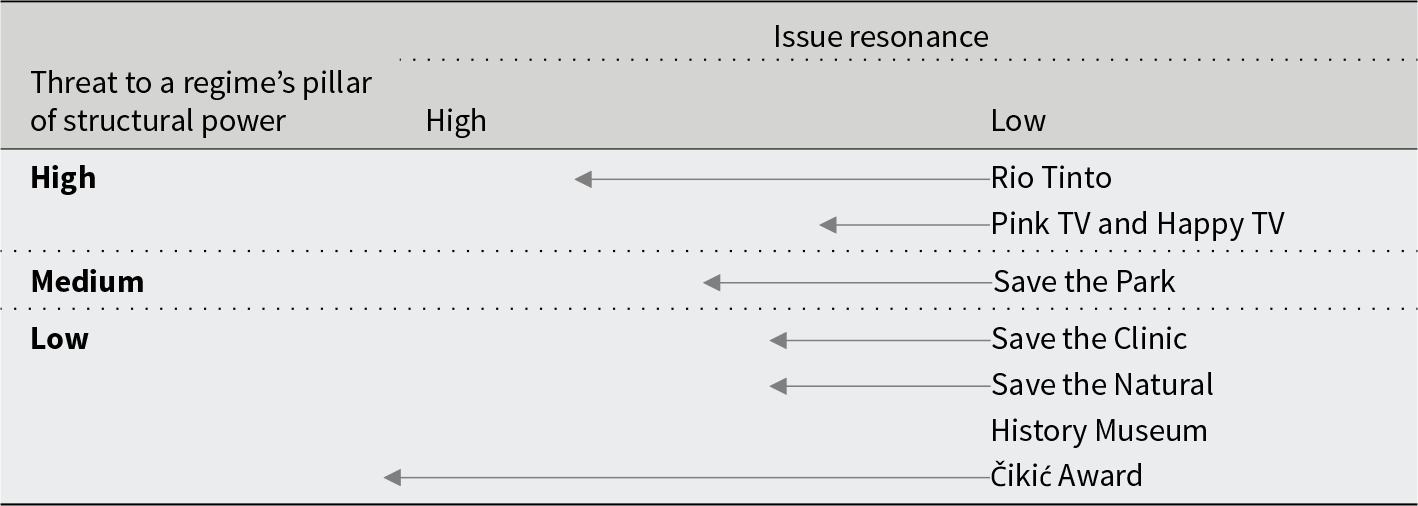
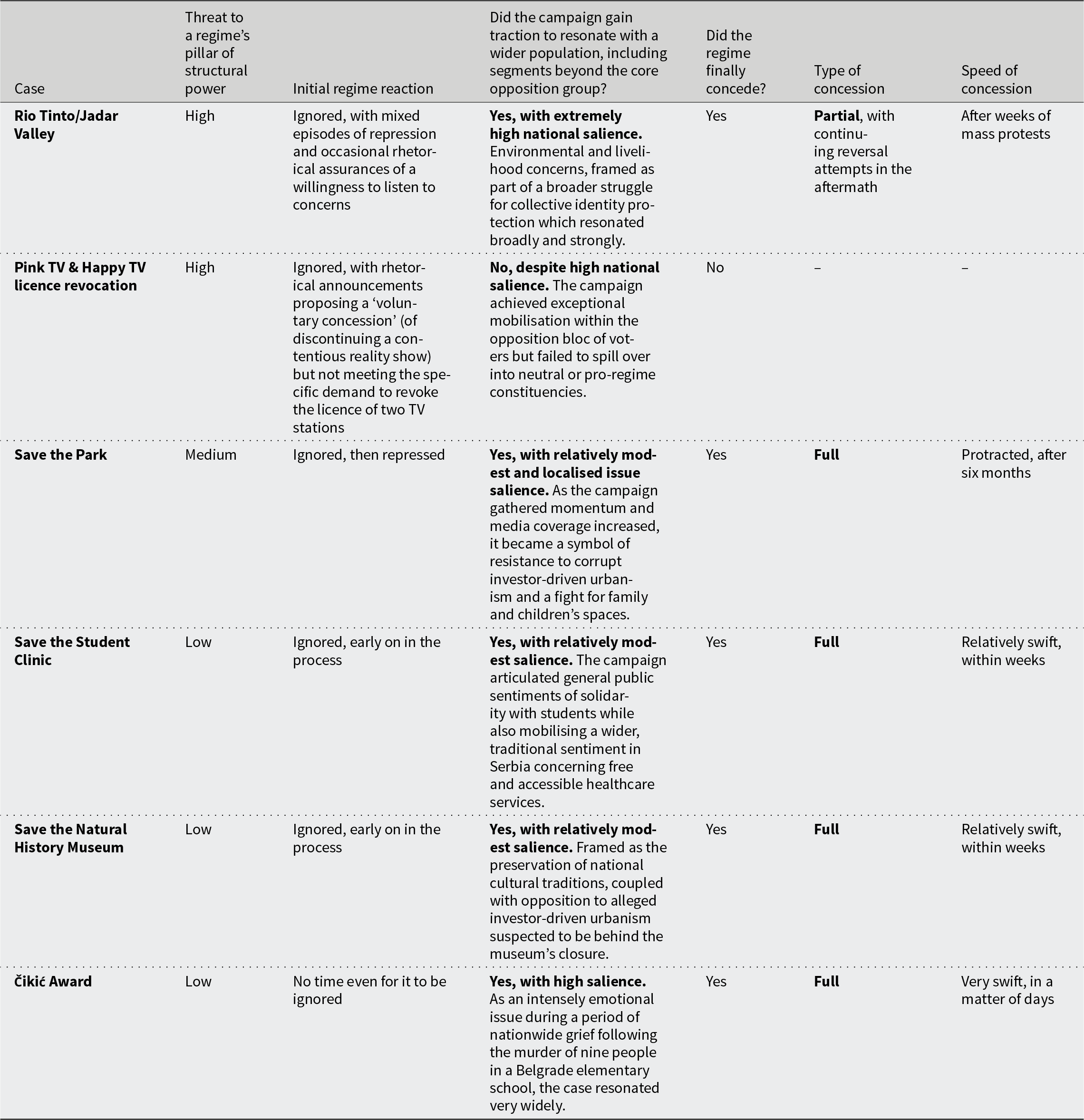
Across all cases, the observed regime behaviour aligned closely with the expected patterns across the threat–resonance matrix, as summarised below and presented in Table 2:
Issue Trajectories during Mobilisation
Note: Arrows indicate changes in symbolic/emotional resonance (shown in binary form: low/high), with horizontal distance reflecting the approximate variation within each cell.
Source: Authors’ elaboration.
Low structural threat, high emotional resonance. The regime showed the least resistance and conceded most readily. In the Čikić Award case, where no core power resources were at stake, the demand was met quickly once societal sympathy became evident.
Moderate structural threat, high emotional resonance. Initial resistance was followed by concessions once the campaigns gained visibility and legitimacy costs rose. Save the Park disrupted clientelistic profit streams but succeeded through emotionally resonant framing, as did the Save the Natural History Museum campaign – protecting children’s spaces or safeguarding national heritage.
High structural threat, with one case achieving and the other not achieving wider resonance. The regime resisted strongly, relying on institutional manipulation, intimidation and selective repression. The Rio Tinto campaign and the case of Pink TV and Happy TV threatened strategic foreign investment and media control – both central levers of regime power – and therefore met with sustained resistance.
Throughout, the regime’s responses followed a consistent pattern marked by initial avoidance of the issue (Conrad Reference Conrad2011; O’Donnell and Schmitter Reference O’Donnell and Schmitter1986), shifting to graduated concessions proportional to the structural threat as the emotional resonance increased. When demands touched the core pillars of power, however, even mass mobilisation produced only temporary or tactical retreats, which were quickly reversed once the pressure ebbed, as in the case of Rio Tinto. The Pink TV case showed the same logic, in that the announcement of a partial concession (pausing the reality show) was later abandoned entirely as the regime’s counterframing and entrenched viewership enabled it to reject both the partial concession and the wider demand to revoke the TV licence. Table 3 sets out the relationship between the regime’s response, structural threat and issue salience in each of the six campaigns.
Observed versus Predicted Regime Responses
Note: The table shows the observed versus predicted regime responses across the six possible constellations of threat to regime power and symbolic resonance.
Source: Authors’ elaboration.
We also observed, however, that as certain issues achieved broader resonance, the regime became more inclined to consider concessions. When structural threat was low, concessions were made quickly and with minimal resistance, as seen in the Čikić case, which carried strong emotional weight but posed no risk to regime power. When the structural threat was moderate – still short of undermining core pillars of power – the regime eventually yielded, typically after initial inaction and attempts at damage control through rhetorical reframing or, in some cases, limited suppression (e.g. the Park case). Sustained mobilisation and expanded resonance ultimately compelled concessions in these instances. In contrast, when a demand threatened a fundamental pillar of regime power, the regime resisted most strongly.
This was evident in the Rio Tinto and Pink TV/Happy TV cases. Halting the Rio Tinto project temporarily appeased public outrage but was soon followed by efforts to revive it, reflecting a broader authoritarian pattern of making apparent concessions under pressure, only to reverse them later. Here, the regime is caught between high legitimacy costs (and potential electoral losses) and the risk of weakening its core power structures. Similarly, in the Pink TV case, the regime initially offered a partial concession – ending a controversial reality show but retaining the channel’s licence – to reduce public pressure without undermining its media control. However, even this was short-lived, as the regime soon reversed its position. Despite large-scale mobilisation, the issue failed to resonate beyond the opposition and did not shift opinion among the broader public, especially regime supporters. The government’s counterframing, which portrayed the incidents as unforeseeable and unrelated to regime or media responsibility, prevailed. The continued popularity of the TV station and its shows illustrates how the imperative to safeguard structural power can outweigh substantial – but insufficiently widespread – public pressure.
The cases show that emotional resonance is not automatic but is often achieved through deliberate strategic framing. Move, Change’s most successful campaigns aligned their messaging with widely shared values, identity markers and emotional appeals, broadening support and raising the legitimacy costs of regime inaction. For instance, the Rio Tinto campaign combined themes of ancestral land, environmental protection and national sovereignty to mobilise across political divides; Save the Park framed the struggle as ordinary citizens defending children’s spaces from corrupt developers; the Čikić Award campaign drew on collective grief; and the Save the Clinic effort tapped into longstanding positive sentiment towards students. In contrast, the Pink TV/Happy TV campaign failed to resonate with the regime’s base despite large-scale protests, as revoking the stations’ licences threatened a core pillar of regime control and the framing did not break through to neutral or pro-regime audiences.
Across all cases, once a campaign began to gain traction, persistent regime refusal became increasingly costly, often prompting signals of a willingness to concede. Where structural power threat was low, concessions were rapid and complete; as threat levels rose, however, concessions became more limited, delayed or absent altogether.
The case studies analysed here underscore the crucial role of issue framing in social mobilisation (Anspach and Draguljić Reference Anspach and Draguljić2019; Benford and Snow Reference Benford and Snow2000). Effective framing, especially when anchored in widely shared values and identity markers, enables campaigns to extend their reach beyond narrow constituencies and unify diverse segments of the public (Drury and Reicher Reference Drury and Reicher1999, Reference Drury and Reicher2000, Reference Drury and Reicher2005; Tajfel Reference Tajfel1978; Tajfel and Turner Reference Tajfel, Turner, Austin and Worchel1979). Successful campaigns often combined liberal-democratic appeals with traditional or symbolic values, showing that resonance can be constructed, not taken for granted.
Two key points emerge from this analysis: first, framing is a powerful tool for broadening support and increasing mobilisation; second, unifying frames that appeal to shared identities are particularly effective. Additionally, incorporating motivational (Smith and Ellsworth Reference Smith and Ellsworth1985; van Zomeren et al. Reference van Zomeren, Postmes and Spears2008) and personalised (Hart and Nisbet Reference Hart and Nisbet2012) narratives further amplifies mobilisation, as seen in cases like that of Rio Tinto, where campaigners humanised the issue and directed moral urgency and anger at the regime and its collaborators. Such strategies not only deepened engagement but also reached new audiences.
These findings depart from much of the dominant literature on mobilisation and authoritarian concessions in two main ways. The cases highlight how legitimacy pressures are actively constructed through strategic issue selection and framing (Benford and Snow Reference Benford and Snow2000; Entman Reference Entman1993), adding nuance to mobilisation accounts that emphasise organisational resources (Ganz et al. Reference Ganz, Nohria, Khurana, Nohria and Khurana2010; Sutton et al. Reference Sutton, Devine, Lamont and Holmes2021) and underscoring the role of value-based framing in shaping outcomes. Although organisational factors (such as communication style, coordination and sustained visibility) were important in Move, Change’s campaigns, it was the interplay of these elements with deliberate, value-based framing that was most decisive in generating the regime’s response (Gamson and Modigliani Reference Gamson and Modigliani1989; Snow and Benford Reference Snow and Benford1988).
The framework also helps to explain the process of partial concessions and subsequent reversals in (semi)authoritarian regimes (Leuschner and Hellmeier Reference Leuschner and Hellmeier2023). In the Rio Tinto case, the regime initially repealed the expropriation law under intense public pressure but later sought to revive the project – employing narrative reframing, continued land clearance, and a favourable Constitutional Court ruling to relegitimise it. This behaviour reflects a broader pattern observed in other hybrid regimes, which may ‘back off’ temporarily when legitimacy costs peak, only to reintroduce contested policies or projects once mobilisation subsides (Acemoglu and Robinson Reference Acemoglu and Robinson2006; Brancati Reference Brancati2014; Leuschner and Hellmeier Reference Leuschner and Hellmeier2023).
By mapping issues according to both structural power threat and issue resonance, the proposed framework offers not only explanatory insight but also practical guidance for civic strategists and activists. First, issues with strong potential for identity- and value-based framing should be prioritised to maximise emotional resonance. Second, mobilisation efforts should be designed to extend resonance beyond the directly affected group, especially in cases where structural stakes for the regime are high. Third, even after concessions are secured, sustained monitoring is essential to guard against backtracking or reversal – an outcome frequently observed in (semi)authoritarian contexts, where regimes often rescind or dilute concessions once mobilisation pressure subsides (Leuschner and Hellmeier Reference Leuschner and Hellmeier2024; Meng et al. Reference Meng, Paine and Powell2023: 159).
Conclusion
The six campaigns allow us to assess how structural power threat and emotional resonance jointly shape a regime’s concession calculus. The empirical analysis supports the central argument that concessions depend on the interplay of two factors: the extent to which a demand threatens the regime’s structural power and the campaign’s ability to generate broad emotional resonance (Benford and Snow Reference Benford and Snow2000; Levitsky and Way Reference Levitsky and Way2002). Where structural threats were minimal, the regime conceded more readily, whereas greater threats led to stronger resistance, and in high-threat cases, concessions tended to be partial, temporary or quickly reversed.
Importantly, regime responses were not static. As campaigns increased their resonance – especially when framed to align with shared values and identities – the regime’s stance shifted from disregard to negotiation or concession. This underscores the importance of both framing and issue selection in shaping outcomes (Gamson and Modigliani Reference Gamson and Modigliani1989; Snow and Benford Reference Snow and Benford1988). By integrating structural perspectives on authoritarian resilience with the agency of civic actors (Cann Reference Cann2021; Ganz et al. Reference Ganz, Nohria, Khurana, Nohria and Khurana2010), the framework clarifies the conditions under which mobilisation can check abuses of power or halt harmful projects in hybrid regimes. It offers activists a practical diagnostic tool for strategic planning, complementing the ‘how-to’ literature that has largely focused on organisational and resource considerations (Ganz et al. Reference Ganz, Nohria, Khurana, Nohria and Khurana2010).
While prior research has acknowledged that authoritarian regimes sometimes concede, few have provided tools for predicting when resistance will succeed. Our approach adds analytical precision by highlighting the interplay of issue nature and framing quality. Furthermore, it addresses how partial and reversible concessions (de Vogel Reference de Vogel2024; Leuschner and Hellmeier Reference Leuschner and Hellmeier2023; Oliver Reference Oliver1991) are often used by regimes as a strategy to manage dissent without undermining core power structures. Future research should test this framework comparatively across different hybrid regimes, using both qualitative and quantitative methods. Although the framework’s variables are presented categorically, finer-grained or continuous measures may be developed for greater analytical depth (Collier and Mahon Reference Collier and Mahon1993; Sartori Reference Sartori1970). Finally, while the framework cannot specify which issues will resonate most in any given context, nor always allow for precise measurement, it provides a foundation for understanding and improving the strategic effectiveness of civic mobilisation against semi-authoritarian regimes (Chenoweth and Stephan Reference Chenoweth and Stephan2011; Tilly and Tarrow Reference Tilly and Tarrow2015).
Supplementary material
The supplementary material for this article can be found at 10.1017/gov.2026.10039
Acknowledgements
We thank all those who participated in the observed anti-authoritarian mobilisation processes in Serbia. Their engagement enabled us to examine and reflect on the analytical framework presented in this paper.
Disclosure statement
The authors report that there are no competing interests to declare.


 Open access

