Theory suggests that introducing a tax on items will reduce the amount purchased. But it seems that the tax on sugar-sweetened beverages (SSBs) introduced in Barbados in 2015, although successful in reducing consumption of SSBs of some kinds, did not reduce consumption of all types of SSBs long term – in particular, it failed to reduce long-term sales of juice drinks. How do we know post hoc that the tax failed in this respect? Why did it fail in this way? What could we have looked for in advance to have made a more accurate (‘ex ante’) prediction about what would ensue when the tax was introduced? This book aims to help you answer questions like these: questions about singular causal processes and about how to warrant claims about them, both for after-the-fact evaluation and before-the-fact prediction.
Here singular matters. We are not talking about what happens in general – ‘Taxing items tends to reduce the purchase of them.’ Rather, we will be talking about what happens in a specific setting at a specific time – in Barbados in 2015, or here and now or there and then. Singular is a term of art in philosophy. It means ‘one’. But that one thing need not be a single person. It can be a single village – this village, or a particular set of villages – these villages, or a single school, school district or country, or a set of schools, districts, countries, a given population or a given set of populations. All these are singular in the intended sense so long as it is clear which districts, which countries, which populations are referred to, where and when. If the claim refers to a set or a population, it can be about each member of the set or about the set as a whole. For instance, as is typical in reports on randomised controlled trials, it can be about an average across the members of the set. Here is a typical example, taken from a report of the average impact of sending employment help brochures between October 2010 and January 2011 to 13,471 randomly assigned job seekers who had registered with the German Federal Employment Agency during the previous three to seven weeks as compared to a group of 40,282 such job seekers not sent brochures:
Impact on employment prospects: One year after the intervention, job seekers who received informational brochures in the at-risk group had accumulated more than four additional days of employment on average compared to their counterparts in the comparison group.Footnote 1
What matters is that this claim is about what happened to a specific thing or set of things at a specific place over a specific period of time.
Understanding singular causal processes is key to predicting what will happen when you act and for assigning responsibility for what has happened post hoc. The book is built around two central tenets:
1. You can’t warrant something if you don’t know what it is you are warranting.
2. Warranting (or disconfirming) a claim involves more than providing evidence. It involves giving reasons why that evidence makes a solid case for (or against) the claim.
Part 1 is dedicated to the first issue. Philosophers and social scientists alike, in an effort to be explicit and precise, try to provide short, sharp definitions of concepts. But such definitions are generally too thin to be useful. They don’t tell you enough about the concept defined to underwrite methods for measuring it or for warranting when it obtains. This is just what we see when we look at what both philosophers and social scientists offer in explanation of what they mean by ‘X caused Y in this case’ or ‘X contributed to Y in this case’. The bulk of the work in supporting warrant for claims like these turns out to done by other assumptions about singular causation that do not follow from the definition given of it. These other assumptions are what we aim to lay out in Part 1, which presents a ‘thick’ theory of singular causal processes, thick enough to provide a basis for warranting them. We do not aim for this to be a deep theory or one that offers startling new ideas. That would be counterproductive. We want rather to provide a theory that can be accepted widely – but that is rich enough to spawn a well-grounded category scheme for evidencing singular causal claims. ‘Thick’ here connotes rich and full of information. Note that this is not the same as what philosophers often mean nowadays when they use the term ‘thick’, especially in the expression ‘thick concepts’, which they use to refer to concepts that have both descriptive and normative content (like ‘sleazy’).
Building from this, Part 2 constructs an account of what kinds of claims can warrant singular causal claims and why. It focuses especially on warrant that a hypothesised causal process will go through as expected from initial cause to final outcome, offering a framework for cataloguing different pieces of warrant in a way that should facilitate judgements about the overall strength of an argument for and against the related singular causal claim. Part 2 closes with some guidance on how to use the information about the roles various pieces of evidence play to come to such overall judgements. But beware: we do not offer any formula or fixed method for how to do this. We do not think that any such thing is in general possible. Much as one might wish to the contrary, judgement – lots of judgement – is always required, and that’s so even where use of a formal method seems to best fit.
In Part 3 we develop in considerable detail an example from a policy area different from the Barbados sugar tax to broaden our illustration of how our recommended approach to assessing singular causal processes can be used. The example looks at the implementation and evaluation of the Signs of Safety practice approach in working with families where abuse or neglect is suspected or established. Signs of Safety is widely mandated now in the UK and elsewhere. But getting child protection practices to change so that Signs of Safety is being used as it is supposed to be has not always been easy; success in implementing it properly has been highly variable. Our detailed case study of its implementation in one UK child protection agency illustrates how a singular causal claim can be warranted by investigating in detail whether a bevy of initiatives undertaken to promote change in practice in that agency contributed significantly to successful implementation of Signs of Safety there.
Our account of causation brings into focus a number of issues subject to lively debate in philosophy right now – and allows us to address them from a new perspective. It also raises some nice technical issues. But we want the body of this work and its practical applications to be readily accessible and we realise that many readers may not be interested in the philosophical or technical niceties at this stage. So we mark these off in the text by labelling them as that with titles in boldface to indicate that they can be skipped over without loss to the overall development of the ideas in a first read-through.
The book is intended as a help both to practitioners who have to evaluate singular causal claims, both ex ante (e.g. predictions about what will happen if a proposed policy is implemented here and now) and post hoc (whether the policy did what was expected), and to philosophers who care about singular causation.
Political scientists Gary Goetz and Stephen Haggard note in their forthcoming book on large-N qualitative analysis:
Most social scientists have faced a blank piece of paper or empty whiteboard or had discussions with colleagues about how to map out a causal argument. If the argument cannot be mapped onto a simple diagrammatic figure, then it is probably not clearly thought out to begin with. Constructing these figures is a nontrivial exercise, however, particularly when the theory is complex. Yet there are few guides to doing causal model-mechanism figures, despite the fact that they are frequently deployed in empirical research in the social sciences.Footnote 2
We aim for this book to help fill this lacuna.
We begin by introducing an example that we will follow throughout the book, a real-life case where a predicted policy outcome did not obtain quite as expected and post-hoc analysis reveals that this was due to a specific unexpected happening in the midst of the process connecting the initial cause with the ultimate hoped-for effect. This is the case of the Barbados tax on SSBs with which we began.
Throughout the book we use Panels to set out information about specific examples used to illustrate our ideas, as well as Technical Notes (demarcated by bold lines) which are asides containing relevant technical (often philosophical) discussion and Boxes in which we provide specific details of the Barbados SSB tax example.
Panel 1 provides an extended description of this case. But in brief, the tax was introduced to raise prices of SSBs and thereby reduce their consumption in aid of diminishing the health risks raised by SSBs. The short story is that prices on sugar-sweetened juice drinks (a subset of SSBs) did not increase in aggregate over the period of the study. The reason: shortly after the price of SSBs rose as expected after the tax, a manufacturer introduced a whole new sugar-sweetened juice drink and sold it at a very much lower price than the other sugar-sweetened juice drinks. This move had not been envisaged in the original predictions of policy success and no evidence had been gathered about the chance of it happening.
Consider another finding from the evaluation report:
In addition to changing prices, the introduction of an SSB tax may convey information about the health risks of SSBs (a signalling effect). If SSB taxation operates in part by producing a health risk signal, there may be important opportunities to amplify this effect. … We found evidence consistent with a risk signalling effect following the introduction of the SSB tax for sodas but not for juice drinks. Consistent with risk signalling theory, the findings suggest that consumers were aware of the tax, believed in a health rationale for the tax, understood that sodas were taxed and perceived that sodas and juice drinks were unhealthy. However consumers appear not to have understood that juice drinks were taxed, potentially reducing tax effectiveness from a health perspective. In addition, the tax may have incentivised companies to increase advertising around juice drinks (undermining any signalling effect) and to introduce low-cost SSB product lines. Policymakers can maximize the impact of risk signals by being clear about the definition of taxed SSBs, emphasizing the health rationale for introducing such a policy, and introducing co-interventions (e.g. marketing restrictions) that reduce opportunities for industry countersignals. These actions may amplify the impact of an SSB tax.Footnote 3
In both cases an important factor was overlooked that was crucial to the policy process proceeding as hoped from beginning to end, a factor that was necessary for one step in the process to lead to another. In both cases these overlooked factors functioned as what are often called ‘moderator variables’ or ‘support factors’. In Chapter 1.2, we label these ‘INUS conditions’ for an outcome – Insufficient but Necessary parts of an Unnecessary but Sufficient condition for a contribution to that outcome. In the first, the factor necessary for the process to go through that was later found to have been missing is that drinks manufacturers offer a stock of SSBs at similar pre-tax prices to those in place before the SSB tax. In the second, it is the fact that consumers recognise that juice drinks are subject to the SSB tax that was passed in part on account of health risks. The post-hoc evaluation suggests that the fact that the tax was widely called a ‘soda tax’ militated against consumers recognising that the health risks applied as well to sugar-sweetened juice drinks.
Panel 1 presents a more detailed account of the Barbados SSB tax and its post-hoc evaluation constructed for this book by Miriam Alvarado, a member of the evaluation team.
Taxes on SSBs have been recommended by the World Health Organization to address the growing burden on non-communicable diseases. A 10 per cent tax was introduced on SSBs in Barbados in 2015 to reduce health risks.
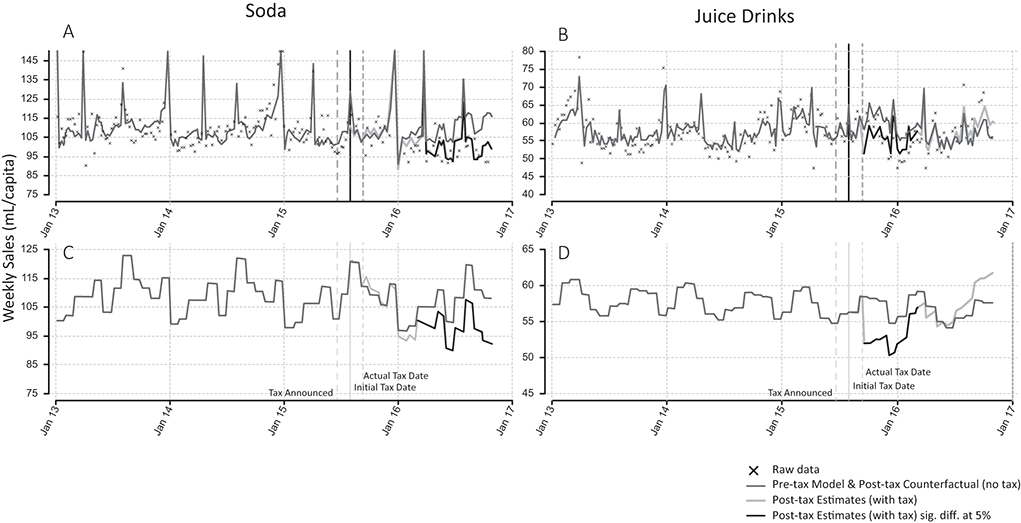
The impact of the tax on sales of SSBs was assessed after one year using an interrupted time-series analysis and electronic point-of-sale data from a major grocery store chain. This analysis suggested that sales of SSBs decreased after the introduction of the tax. However, patterns in the post-tax period varied by type of SSBs in an unexpected way. Sales of sodas decreased increasingly, while sales of juice drinks (taxed, non-100 per cent juices) dropped immediately and then rose back to pre-tax levels within one year (Figure I.1).
Sales change of sodas and (taxed, non-100 per cent) juice drinks following the introduction of the Barbados SSB tax in 2015 (originally figure 3 in Alvarado et al., Reference Alvarado, Penney, Unwin, Murphy and Adams2021).Footnote 5 Comparison of sales trends (mL/capita) for sodas and juice drinks, Barbados 2013–2016 (re-analysis by Alvarado et al.). The two upper panels (A and B) display the unadjusted model results overlaid with the raw data. Soda sales were truncated at 150 mL/capita for ease of display. The lower panels (C and D) display the model results adjusted for seasonality and holidays.
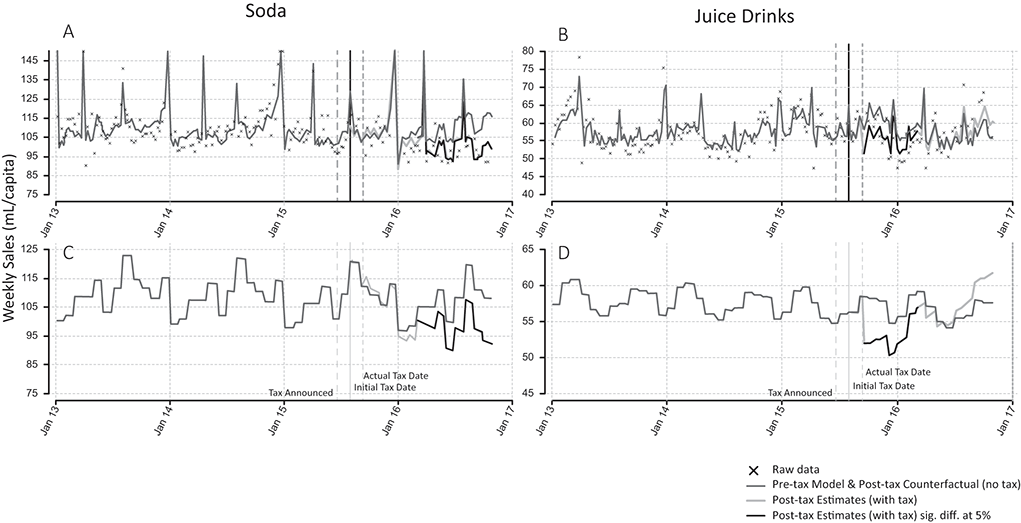
This was surprising, especially since there was evidence of a step-wise price increase for both sodas and juice drinks.
The evaluation team hypothesised that this difference in post-tax trends may be attributable to two potential explanations: (1) a difference in price elasticity for juice drinks versus sodas or (2) a signalling effect, whereby the introduction of the tax signalled information to consumers about sodas but not juice drinks. They developed the signalling hypothesis and attempted to assess the evidence in support of it.Footnote 4
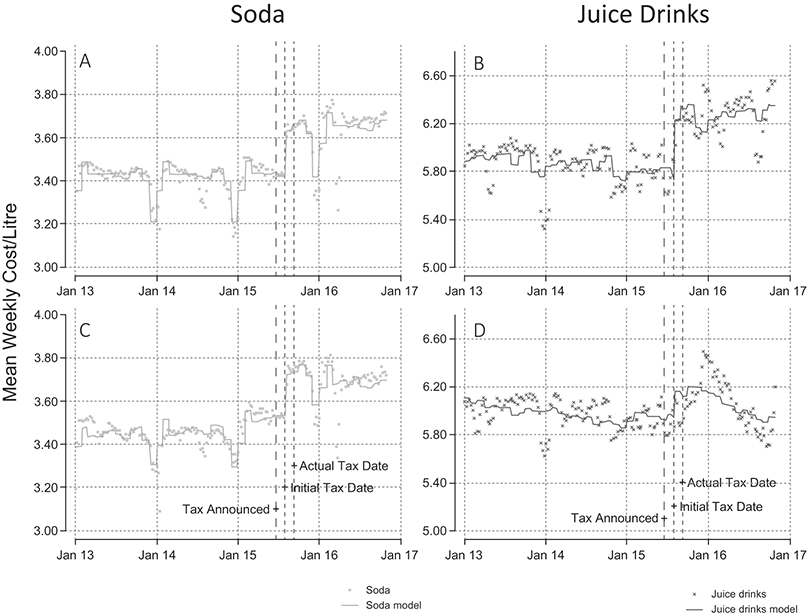
The evaluation team identified something surprising upon re-analysis of the price data. The original assessment of price change had excluded all products which had more than a specified number of missing data points across the time series (a common practice). Re-running the price change analysis with all products produced a very different post-tax trend for the mean weekly cost per litre of juice drinks – prices initially increased but then decreased to below pre-tax levels (Figure I.2, lower panels).
Mean weekly cost per litre, by sodas and juice drinks with all non-missing products (upper panels – A and B) and all products (lower panels – C and D) (originally figure 4 in Alvarado et al., Reference Alvarado, Penney, Unwin, Murphy and Adams2021)Footnote 6
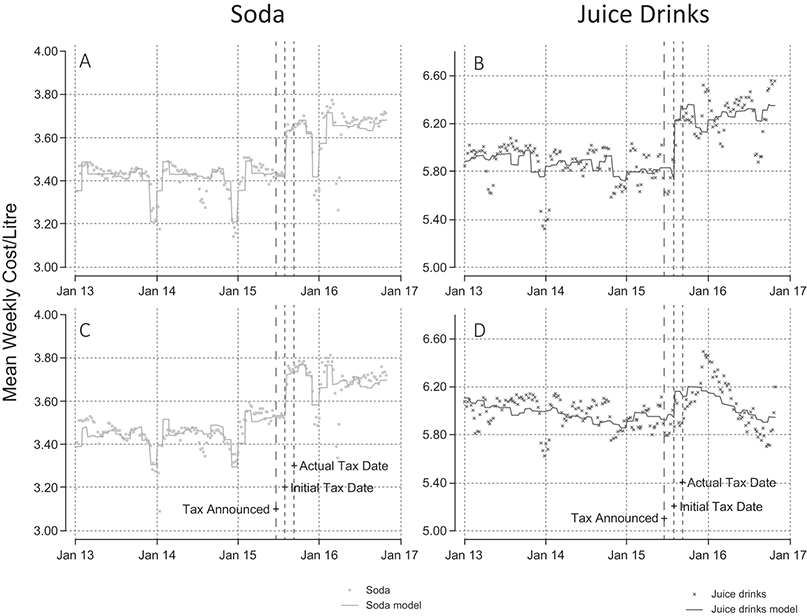
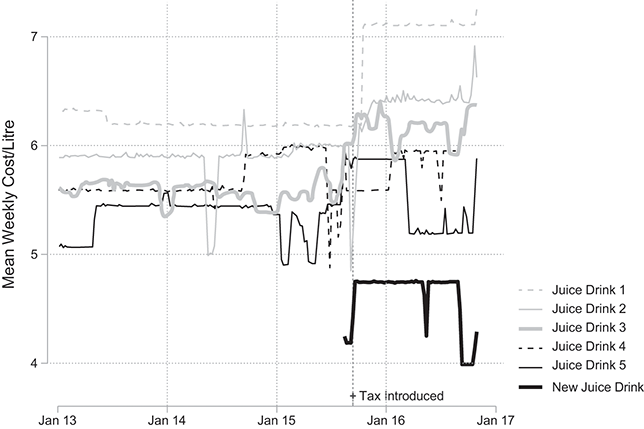
This prompted the evaluation team to revisit the data with a new lens. They found that a new juice drink had been introduced in the post-tax period. Importantly, this juice drink was introduced at a much lower price point than other similar juice drinks (Figure I.3), despite being just as sugary as other alternatives.
The introduction of a low-cost SSB in the post-tax period.Footnote 7
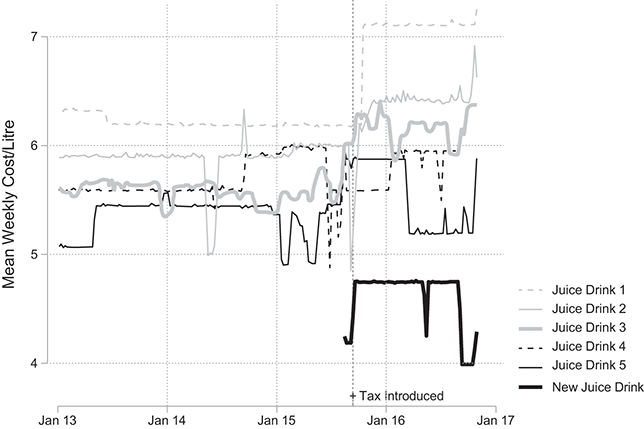
By being prompted to seek explanations for a surprising pattern, the evaluation team identified an unanticipated impact of the tax. They hypothesised that the introduction of the tax led at least one manufacturing company to introduce a low-cost SSB to counteract the tax-induced price changes. This product commanded a substantial market share. This revised hypothesis provides an explanation consistent with the observed trend in post-tax juice drinks sales.
Here is another example from yet another domain. We use this one to underline the importance of a good conceptualisation of the wider system into which a policy is to be introduced – a report led by a development economist on a Cambodian community-driven development (CDD) initiative:
Another way that CDD programs commonly fail to account for local context is by activating processes of citizen engagement, oversight, and feedback before local government has achieved a reasonable baseline level of capacity to respond to citizen demands. CDD programs typically ratchet up citizens’ expectations of local government over time, and as these expectations rise, local government administrators often find it increasingly difficult to satisfy the demands of their constituents. Therefore, in settings where local government is severely capacity constrained, a common design flaw in CDD programs is the prioritization of citizen engagement over local government capacity building, which can inadvertently set in motion a vicious circle of government inaction and citizen disengagement rather than the intended virtuous circle of government responsiveness and citizen engagement.Footnote 8
We might see this case, as an eminent policy evaluator Elliot Stern suggests, as ‘one where the widespread evidence that citizen engagement can be an effective way to support local development was taken on board but was undermined by poor conceptualisation of the wider context – there was a theory of intention/action rather than a theory of change/system model’.Footnote 9 Here again what was missing – and that should naturally have appeared in a detailed ‘change/system’ model – is note of an essential ingredient for the process by which citizen involvement in development is meant to improve outcomes to go through as intended. As Stern colourfully remarks: ‘Lack of local government capacity shot their fox!’Footnote 10
These kinds of cases are not unusual. This should be no surprise. Gathering evidence and understanding its role and the strength of support it provides is hard – very hard. We hope with the lessons from this book to make it a bit easier, at least for one class of claims that are generally taken to be especially hard to warrant – causal process and other singular causal claims, like the prediction that an SSB tax will lower consumption of juice drinks, or that widely advertising that the SSB tax is due to the health risks of SSBs will reduce consumption of both sodas and sugar-sweetened juice drinks, or that mandating Signs of Safety will lead to its being properly adopted, or that citizen involvement in development initiatives will improve outcomes. What we have to say will not be of much help with the actual gathering of evidence but it should be a big help in cataloguing and keeping track of what categories of information need to be evidenced and what kinds of reasons carry probative force. We do this by bringing a bit more well-grounded systematicity into the understanding of warrant for singular causal claims, grounding the understanding of warrant in a general account of what singular causation is like and what the world must be like for it to obtain, or better: what the world must be like for it to obtain and for us to be able to have warrant for it.
In the previous paragraphs we have been using the term ‘singular causation’. This is a term of art in philosophy. It refers to the relation between an event, say ‘X=x at time t’ (i.e. the quantity X taking the value x at t, perhaps by a purposeful addition to the original value then), and an effect Y that it influences by contributing an amount yˆ to the value Y takes at a later time t° in a specific setting on a specific occasion. Singular causal claims are contrasted with general causal claims. General claims assert a connection between kinds of events that is taken to hold always, widely or always/often across some unspecified range. For instance, the singular claim, ‘The SSB tax initiated in Barbados in 2015 produced a reduction in consumption of SSBs by 2016’ contrasts with the general, ‘SSB taxes cause reductions in consumption of SSBs shortly after’. Evidence for general causal claims includes randomised controlled trial results, correlations, deduction from theory, repeated observations of single-case causation that can serve as a basis for induction and so on. Our concern is with the more contested issue of what counts as evidence for singular causal claims – and why.
Our aim is two-fold: to provide practical tools for practitioners to support their work using and warranting causal processes and other singular causal claims. And to do so by articulating a thick theory of singular causation that will be of interest to philosophers. We shall address claims made both ex ante (predictively) – ‘Will X=x produce a contribution yˆ to Y in this setting?’ – and post hoc (after the fact) – ‘Did X=x produce a contribution yˆ to Y in this setting?’
So our concern is with singular causal claims of the form
SCC: X’s taking the value x at t contributed/will contribute yˆ to Y=y’ at t° in setting S.
For brevity, where it will not cause confusion, we may often drop reference to the size of the contribution or to the timings and shorten this to
SCC: X caused/will cause Y in S/C causes O in S.
We realise that the form of SCC may be far more precise than you need. You may care only whether X contributes to Y at all or whether it contributes an amount in some broad range or whether it contributes across some broad period of time. We focus on suggestions for the more precise form because we think it will be transparent how to apply these to looser forms but not so transparent what to do in the reverse direction.
For the most part, we build on and develop theoretical perspectives on causation that are available in fragmented form within the literature. We develop these and fit them together as seven interlocking components of an overarching theory of singular causation. We then set out ways in which this theory affords the justification for different types of information that can be used for warranting singular causal claims. Hence, we construct a catalogue of evidence types that are justified by reference to what we take to be a good general theory and provide a schema for recording the evidence in a way that shows what role each of the various very different pieces of evidence play. We call these ‘evidence-role’ maps. We thus provide a broad-ranging catalogue of evidence types as a tool for practitioners. By locating these evidence types in the context of the theory, we show why and how they are evidence and hence show how to use such evidence. Understanding the role each piece of evidence plays can then be a great help in seeing what is missing and in assessing the overall strength of a case. We believe this catalogue will be a tool that is of genuine help to practitioners in identifying and using evidence for causal processes and other singular causal claims. At the same time, we aim to move the philosophical discussion of causation forward by piecing together a rich general theory of singular causation and types of warrant for it.
We are not aiming for a deep theory, or one with exciting new ideas or neat technical developments. That would run counter to our overall objectives. For we need a theory that almost anyone can subscribe to. That’s why we rely heavily on ideas already well rehearsed in one domain or another. The important point is that it is a theory with a body of interconnected claims and concepts that, together with further facts about a specific case that can be established or taken for granted, are rich enough to license a host of further inferences, especially about what kinds of factual claims can count as warrant for causation in a single case.
Our enterprise here is similar to, but different from, those that aim to license different methods for causal inference in philosophical accounts of causation, like that of methodologist Ingo Rohlfing and political scientist Christina Isabel Zuber.Footnote 11 Here’s how Rohlfing and Zuber describe what they are doing:
This article argues that social scientists should be aware of philosophical theories of causation. These theories have implications for which method of causal inference can establish whether a given causal claim holds true – and which cannot.Footnote 12
In order to improve the dialogue about methods and provide guidelines for researchers aiming at causal inference, this article introduces five prominent philosophical theories of causation that define causation in terms of regularities, probability raisers, counterfactuals, interventions, and physical processes.Footnote 13
We then connect these theories to prominent large- and small-N methods of causal inference in the social sciences: experiments, observational inferential statistics, qualitative comparative analysis (QCA), comparative case studies, process tracing and multimethod research (MMR).Footnote 14
Second, we argue that most methods are in principle compatible with more than one theory of causation, as long as the connection between the so-called type-level theories of causation (relating classes of facts, or events) and large-N methods on one hand, and the so-called token-level theories (relating singular facts, or events) and small-N methods on the other hand is adhered to.Footnote 15
The main insight from this analysis is the diversity of perspectives on which causal claims can be evaluated with which method. Each method is linked to at least two criteria with a share of about 20 percent or more. This shows that researchers as a whole are ambiguous about the exact type of causal claim that each method can substantiate. To pick one example, about 30 percent of all responses state that process tracing substantiates causal claims by assessing whether physical processes obtain. The same share of responses, establishes a link between process tracing and token counterfactuals, thus believing that process tracing substantiates causal claims through difference-making. Just knowing that someone applies process tracing therefore does not allow us to infer what type of causal claim she made and whether she used (and should have used) process evidence or counterfactual or comparative difference-making evidence in her study. The practical consequence is that empirical scholars should become aware of and be transparent about the truth conditions of their causal claims. Only mentioning the method can breed confusion about how inferences were made and about what would count as valid confirming and disconfirming evidence in a follow-up study on the same causal relationship.Footnote 16
Rohlfing and Zuber are here connecting methods for warranting a causal claim with definitions of causation (or necessary and sufficient conditions for a causal claim to be true). We aim instead to connect types of facts that can be adduced as evidence with a theory of causation. But our aims are analogous. They aim to show why using this or that method is justified by showing that that method is indeed a good way to learn about the very thing this or that definition takes singular causation to be. We aim to use our theorical assumptions about singular causation to show why the specific kinds of facts we catalogue can be counted as evidence for a singular causal claim and make clear just what role each type plays in warranting it. Moreover, we do not expect there to be any neat connection between the role that a fact adduced as evidence plays – for example, is it the fact that a support factor obtains or that an intermediate step in the process connecting cause and effect obtains or that an appropriate activity occurred at that intermediate step to produce the next effect in the process? – and the methods that can be used to establish that fact.
The philosopher of social science Rosa Runhardt undertakes a similar project to Rohlfing and Zuber’s and to our project here.Footnote 17 But Runhardt’s conception of causality is far narrower than the one we offer. She takes it that the meaning of singular causal claims is given by a definition of singular causation, in particular by the widely popular counterfactual analysis wherein ‘C causes O’ means that ‘Had C not occurred, O would not have occurred’. We instead see the meaning as given not by a definition of singular causation but by a thick theory about it.Footnote 18 Philosophers distinguish explicit definitions, which give necessary and sufficient conditions for something to be an X – for example, an electron, a causal relation, a democracy – from implicit definitions that tell a lot about X, constraining what ‘X’ refers to. When the aim is to provide the meaning of a term, implicit definitions will try to circumscribe what X is like so tightly that only a single referent in the world can satisfy all that is required of X.
Our aim is not, though, to provide a meaning for ‘singular causation’. Rather, we aim to say enough about what singular causation is like to figure out what are clearly legitimate kinds of facts you can adduce as evidence for it, an aim we share with Runhardt. For instance, she explains:
[C]ircumscribing the causal claim … will help researchers avoid false positives and negatives (i.e., the belief that a relation is causal while it is not, or not causal while it is) by making sure the evidence they look for is relevant to the causal claim of interest.Footnote 19
And she argues on behalf of the steps she recommends in her analysis that
each step … is shown to make the causal analysis more robust, amongst others by disambiguating causal claims and clarifying or strengthening the existing methodological advice on counterfactual analysis.Footnote 20
Relevance is what we are up to too: what kinds of facts – like the presence or absence of necessary support factors (‘moderator variables’) and necessary intermediate factors (‘mediating variables’) – can be shown to be relevant to the truth or falsity of a singular causal claim?
We will discuss Runhardt’s proposal in some detail because we think it will give you a sense of what we are up to right from the start. Also it gives you a look into why we do not adopt the widely popular counterfactual understanding of singular causality.
Runhardt deals with what we call ‘path-relative’ singular causation: ‘Does C contribute to outcome O via a given causal pathway?’ (see discussion of path-relative vs. net contributions later in relation to Figure I.4).Footnote 21 Operating within a broadly counterfactual understanding of singular causation, her central contribution in this paper is to lay out a framework for making precise just what is claimed by ‘C caused O via causal pathway P in setting S’ (supposing both C and O occur in S). She does so by offering an ‘interventionist’ semantics for the loosely stated counterfactual ‘Had C not occurred in S, O would not have occurred (unless via an alternative pathway)’ that is supposed to capture just those cases in which it is appropriate to claim that C caused O via P in S.
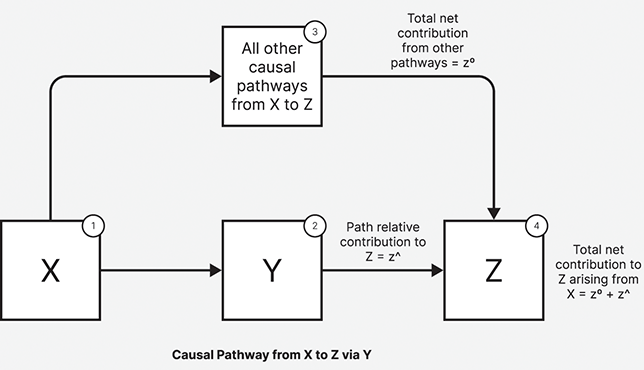
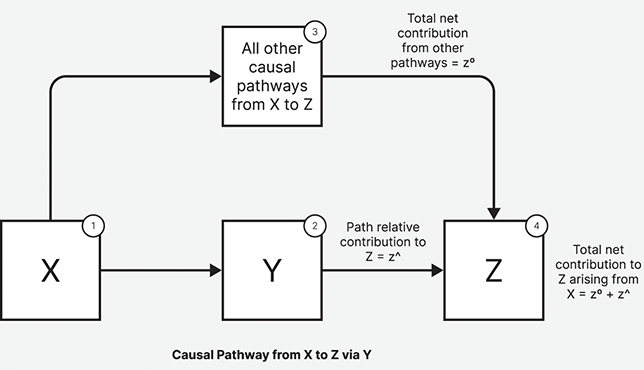
Path-relative contribution and net contribution.
This semantics makes the loose counterfactual more precise in two different ways. First, it requires that you be specific about just what it is about C that is supposed to bring about just what about O. Second, it specifies what else is supposed to be the case in the imagined analogue situation to S in which C does not occur, in particular what else must stay the same and what may vary. Runhardt wants a semantics that does these two things for the very good reason that it’s hard to adduce evidence for a claim, and especially hard to show that what you offer as evidence really is evidence, if you don’t know what it is you’re claiming in the first place.
The first is something that we too stress (see especially Chapter 1.2 and Section 2.1.2): being more precise in specifying the cause and the effect in more concrete language makes the job of telling which facts are evidence and which are not far easier. Consider Runhardt’s own example:
[C]onsider a simple example, the causal claim ‘If the Industrial Revolution had not occurred, the British standard of living would have been lower than it was’.Footnote 22 As it stands here, this claim is quite clearly underspecified. Which aspects of the Industrial Revolution, specifically, are hypothesized as the putative cause of the higher standard of living here? Are we only referring to the technological aspects of the Revolution (such as the invention of the spinning jenny or the steam engine)? Or do we refer to some of the large-scale social changes during the Revolution? Specifying the counterfactual can help one clarify the intended causal claim. The associated counterfactual here could be about preventing the invention of the steam engine; alternatively, it could be about preventing some of the large-scale social changes during the Revolution. Considering associated counterfactuals allows the researcher to carefully circumscribe the causal claim at issue; it disambiguates one’s analysis.Footnote 23
Clearly, evidence that the steam engine contributed to producing a higher standard of living will be different from evidence that the invention of the spinning jenny did so, and that will be different again from evidence that specific large-scale social changes contributed.
What about the second? It is tangential to our project since we do not adopt a counterfactual analysis of causation, or any other. As noted, we do not propose any explicit definition of singular causation but rather lay out a panoply of features that we take to be widely associated with it, in aid of identifying a number of different types of facts that can be adduced in its favour or against it. Our first reason for eschewing explicit definition is that all the explicit definitions we know are controversial and all have counterexamples alleged against them. Our second reason is the more important one. Explicit definitions provide very little basis for deciding what is and what is not evidence since they tell you very little about the thing defined – they only tell you that it satisfies the characterisation in the definiens.
Turn to Runhardt again for illustration. She argues that ‘According to [philosopher James] Woodward [who developed the interventionist semantics she endorses], evidence for [the effects of] an intervention can come from “observation or from a combination of observation and experiment”.’Footnote 24 Runhardt then refers to a variety of studies that describe how to evidence counterfactuals under an interventionist semantics.
We suppose there are two broad categories of such studies. In order to establish what would happen in S if C did not occur, the first strategy is to find a ‘doppelgänger’ for S; that is, a setting S’ which is the same as S in all the required ways in which C does not occur. Adducing a result not-O in a setting S’ as evidence for the counterfactual, though, is a hard job because in order to defend it as evidence, you need to defend that S and S’ are indeed the same in all required respects. This means you have to identify what these required respects are in S, and how do you do that?
We will not go into the fine points of the interventionist semantics that Runhardt recommends here. It suffices to point out that, loosely put, all the causes in S relevant to the production of O along pathway P other than C (that are not also on P) must be the same in S’ as in S (and all the causal principles involving features occurring in S and S’ must be the same) and no other causal pathways must be operative in S’.
The most straightforward method for evidencing this is to itemise the causal factors for O that occur in S (except on the pathway from C to O), provide reasons to believe these are all and only the causal factors and then provide evidence about their values in both S and S’ and show they are the same. (Note that this still falls short because the causal principles at work in different settings may differ because of their underlying social/political/economic/geographic/physical structures, so that these to need to be evidenced to be sufficiently similar. We take up this topic in Chapter 1.7 and Section 2.1.2 – discussion of category 8.) This of course requires a vast amount of background causal knowledge. This illustrates a well-known slogan of Cartwright’s from her book with respect to causal inference: NO CAUSES IN, NO CAUSES OUT.Footnote 25
Of course, finding an S’ that fits the bill is generally very difficult even if you have a reasonable amount of the required background knowledge to tell what a good doppelgänger would be like, as Runhardt herself illustrates.Footnote 26 There she gives the example of a causal claim by political scientist Kirsten Bakke: the radicalisation of insurgent tactics during the Second Chechen War was caused by transnational fighters’ diffusion of those tactics to local insurgents.Footnote 27 While Runhardt spells out this case study using the interventionist semantics, she is rightly sceptical that one can find a doppelgänger for S (the Second Chechen War), as the most likely candidate for S’ discussed by Bakke (the First Chechen War) is dissimilar to S in many relevant respects.
A second standard method for defending the causal similarity of S and S’ is from general knowledge of their sources. This is common in testing products from a specific batch from a production line, like toasters or widgets: draw one at random and suppose that its behaviour is characteristic of all of the products in that batch. This also requires a vast amount of background knowledge – causal knowledge ‘in’, though of a different kind than with the first method. For instance, you need to be able to defend inter alia the claim that all products in the batch are subject to a process of production that is the same in all relevant respects (so you have to have a good idea of what differences matter – e.g. does change of production staff matter, or number of hours the production staff work continuously on the production line?) and that the components in the products are relevantly similar (maybe because each of them in turn was in the same production batch from a process you have reason to believe was relevantly similar during the production process). Biological studies that infer in vivo results about features of an organism from in vitro studies (e.g. some behaviour in a cell of a certain type) also rely on assumptions about the similarity of the sources along with a series of strong assumptions about the preparation of the in vitro sample.
Clearly, proper doppelgängers are hard to come by. So it is common to adopt the second strategy: thought experiments – try to figure out what would happen if C did not occur but all other required factors were the same as they are in S. But how? It is hard to see how you can do this without making assumptions about what causal principles can apply in S or thinking about what C was supposed to be doing in bringing about S.
Consider a real example we return to in Chapter 2.0: Nancy offered her granddaughter Tabi an ice cream to get her finally to leave the zoo. The bribe worked. How could Nancy defend her claim that her offer of ice cream caused Tabi to leave the zoo under a counterfactual analysis of causation? Here’s one standard way. Survey the situation and ask: what other causal factors were available in that situation that could have caused Tabi to leave? You can answer the question about what could have done so because you know a lot about the kinds of causal principles that apply to children like Tabi; ordinary, everyday principles like ‘Children tend to do X rather than other things they like doing if sufficiently bribed to do so’, ‘Children tend to avoid Y if they are frightened of it’ or ‘Children tend to stop doing Y if bored of it’. A survey of the situation that day around Tabi at the zoo and of the kind of person Tabi is makes these look to be the most probable ones that might have operated. Then Nancy could note that there was nothing there to frighten Tabi, she was still fascinated by the birds in the bird house after lingering 10 minutes and she does love ice cream. So the second and third principles were not likely to have been operating. That leaves the first. But take away Nancy’s offer, as the counterfactual scenario requires, and it will not operate either. So in that case Tabi would not leave the zoo, thus under the counterfactual analysis substantiating the claim ‘Nancy’s offer of an ice cream caused Tabi to leave the zoo’.
Notice what is being assumed here. It’s not just a matter of chance whether one factor causes another or not. If one factor C causes another O in a given setting S, there’s a reason for it: a principle under which C cause O in S.Footnote 28 Why, though, are you entitled to that assumption? Under the counterfactual characterisation all that needs to be true when ‘C caused O in S’ is true is that C and O both occurred and had C not occurred, O would not have occurred. There is nothing in this characterisation that implies that in general cases where had C not occurred O would not have are also cases where there is a causal principle connecting C and O operative. This last is an additional empirical assumption being made – and often made without note in research evidencing singular causal claims under a counterfactual characterisation of singular causation. This is just the kind of assumption that we aim to make explicit in laying out a theory of causation as opposed to an explicit definition or set of necessary and sufficient conditions.
Returning to Tabi at the zoo. Nancy has also been known to remark, ‘Poor Tabi. Her love of ice cream did her in’. How on a counterfactual reading could Nancy defend this new claim that it is Tabi’s love of ice cream that caused her to leave the zoo; that is, how could Nancy support that had Tabi not liked ice cream, she would not have left the zoo when she did? By considering the same set of available principles as before and again noting that no set of factors sufficient to call into play either of the other two principles that seemed likely to apply was present. That leaves as the only option that people respond to sufficiently attractive bribes. Nancy’s offer can readily be counted as a bribe. But it is only Tabi’s great love of ice cream that turned it into a sufficiently attractive bribe. Without that, Nancy and Tabi would have stayed a great deal longer in the bird house. Here, besides the assumption that causes act in accord with principles, we also suppose that a cause may not be sufficient by itself for a contribution to an effect but rather may be only a necessary part of a set that together are sufficient. Philosophers call these INUS conditions – Insufficient but Necessary parts of generally Unnecessary but Sufficient conditions. Practitioners may more often label these ‘moderator’ variables. See Chapter 1.3 for discussion.
The point is that, although the assumption that causes are INUS conditions (or equivalently that causes may be moderator variables or may require moderator variables in order to act) is commonly relied on in evidencing singular causal claims and in making causal predictions, it is not in any way implied by the counterfactual characterisation of causation. So when it is used in the context of the counterfactual characterisation, yet another empirical assumption is implied – that the truth of the requisite counterfactual is highly correlated with causes being INUS conditions. This is another of the central claims that we aim to lay out explicitly in the ‘theory’ of singular causation we offer.
In closing our discussion of Runhardt’s approach, we should note that we neither endorse nor reject the claim that a singular causal claim is true if and only if an appropriate counterfactual holds. We rather urge that far more assumptions about the nature of singular causality – of just the kind we lay out here – are needed, and are commonly relied on, if you are to produce evidence for them that you can warrant as evidence.
We should underline from the start that we operate within what has been described as the ‘anti-positivist stockade’. By this we mean that we do not think you can ‘reduce causation away’ – causal notions cannot be defined in non-causal terms. Explaining one causal notion inevitably involves using other causal notions. In particular, the notion of singular causation that we theorise about here presupposes that there is a fact of the matter about what the causal possibilities are in a setting, about what factors can produce contributions to others. The array of causal possibilities is sometimes represented in a causal graph, like Figure 1.2.1, or in equations, often written like this: Y = ∑ aiXi.Footnote 29 In these kinds of equations, more than mere equality of the right- and left-hand sides is supposed to be represented. The factors on the right-hand side are meant to be genuine possible causes in the setting: if aiXi = Φ, then the quantities represented by ai and Xi operating together produce a contribution of size Φ to the quantity represented by Y. You will see some simple examples of such equations that appear in the philosophical literature in Chapter 1.1.
We realise that our starting assumption that there are facts of the matter about the causal possibilities in a setting may seem incredibly strong. We would, though, like to point out that this is just the assumption being made in both practice-orientated and philosophical literature whenever causal equations are used. For instance, standard proofs showing that randomised controlled trial results provide an unbiased estimate of an average treatment effect begin with a potential outcome equation that is supposed to hold for the trial population – an equation of just the form above – Y = ∑aiXi – where Y is the outcome of interest, the treatment is one of the Xis and the other Xis are supposed to be values taken by the other possible causes of the outcome.
A standard alternative to causal possibilities for the interpretation of these kinds of equations is to turn to counterfactuals. And indeed, the equations do imply a raft of counterfactuals. For each allowed arrangement of values for the ‘a’s and the Xs, the equations, supposing they are correct, tell you what value y would take if the ‘a’s and Xs took those values. But their meaning is not exhausted by these counterfactuals because the form of the equations also is meant to tell you that the equality is no mere spurious correlation, like the philosopher’s standard example of the correlation between the drop in the barometer reading and the oncoming of a storm. The equation expressing that correlation also implies counterfactuals: both ‘If the barometer were to drop, there would be a storm’ and ‘If there were to be a storm, the barometer would drop’. But these counterfactuals do not add up to causation. As the saying goes, ‘You can’t bring on the storm by breaking the glass’.
The fix-it strategy for this problem by those who want to maintain that counterfactuals exhaust the meaning of the equations is to introduce a very special kind of counterfactual – a ‘causal’ counterfactual – to do the job, a counterfactual with the kind of semantics that we noted Rosa Runhardt explicates in some detail. We do not embrace this strategy for two reasons. The first is that it seems impossible to characterise the appropriate counterfactual situation to consider without the use of other causal concepts which we think eventually end up having to suppose the very idea of causal possibilities that was to be avoided. Second, it is hard to see what in the actual world can make a causal counterfactual true other than facts about what is causally possible here. Nevertheless, what we do throughout the rest of the book should make equal sense whether you start from causal possibilities as we do or some kind of special counterfactuals.
With this groundwork in place, we return to the issue of just what is being asked with the question, ‘Does C cause O in setting S?’ or for non-dichotomous variables, ‘Does/will X=x at t contribute yˆ to Y at t° in setting S?’. The account in this book addresses two different more specific forms of this question.
The first question is about the sequence of causal possibilities in the setting:
Is there a causal pathway from X to Y in S,
where ‘There is a causal pathway from X to Y in S’ means that there are temporally intervening features Xj, Xk, … such that in S, X is among the possible causes of Xj and Xj is in turn among the possible causes of Xk and so on until there is a penultimate intervening feature that is among the possible causes Y. For example, as we illustrate in Chapter 1.2, the Barbados SSB tax policy supposed that there was a causal pathway available from introducing the tax to a drop in consumption of SSBs by the intervening variables ‘tax is collected’ that could cause manufacturers to increase price that in turn could cause retailers to increase price that could finally cause consumers to buy less.
The second question is about size of the contributions that different values of X make to Y: how big is the contribution that X=x makes to Y=y in S?Footnote 30 This contribution question can be broken down further into a question about path-relative contributions (PRC) and about net contributions (NC), taking into account all causal pathways together.
PRC: How big is the contribution that X=x makes to Y in S along path P?
NC: How big is the net (i.e. overall) contribution that X=x makes to Y=y in S?
In Figure I.4 the path-relative contribution to Z arising from X along the path that goes via Y is zˆ, while the total contribution to Z from X via all other paths is z°. The total net contribution of X to Z is the sum of these amounts, zˆ + z°. If these contributions are of differing signs, then they offset so that on occasion the total net contribution to Z arising from X may be zero even though some of the path-relative contributions are positive.
Consider, for instance, a case investigated by the 2011 UK Munro Review of Child ProtectionFootnote 31 where the intended good effects on child welfare of manualising and auditing child welfare practices were undone by a perhaps even stronger negative feedback loop they set in motion.
Child Protection Feedback Loops. Meeting the twin goals of proceduralising practice and making it auditable was challenging: practice was at the time relationship-based and professionals operated with a high degree of discretion. The reforms focused on prescribing measurable aspects of the child protection process. For example, speed in making decisions was important in reducing the likelihood of leaving a child in danger and leaving the family feeling anxious and stressed. While professionals had treated this as a principle adapted to suit the unique child and circumstances, the new system specified that the initial assessment must be completed within seven days. As a result, there was less attention to the urgency for the child and, since the task was re-defined as completing the forms, the need to inform parents was sometimes forgotten, leaving them in a stressed state. As a result of the reforms, the inspection process became more focused on counting quantitative measures on computers than in assessing the quality of practice.
At the same time, society was becoming more critical of social workers when a child died from abuse and, at least with hindsight, the death looked predictable. Decisions on removing a child from their family are based on weighing the likelihood of harm and benefit if left at home against the likely harm and benefit if placed in alternative care. By responding punitively to decisions to leave the child at home that had adverse outcomes but not to decisions to remove a child where harm ensued, social and media responses encouraged a defensive culture where avoiding blame became a primary goal so there was a lower threshold for deciding to remove children from their parents. In combination, these changes gradually led to the development of a reinforcing loop with practice being increasingly focused on evidencing compliance with procedures both as a defence of ‘due diligence’ (‘I followed the procedures’) if a child died and for obtaining a positive inspection judgement. This initiated a negative feedback loop. The focus on providing evidence of compliance with procedures reduced the time spent in forming a relationship with families and with helping them to solve their problems. This led to social workers feeling less professional satisfaction in their work and many left. Consequently the work was increasingly done by newly appointed inexperienced staff. The overall quality of practice diminished along this pathway.
Both questions about causal pathways and about contributions are important in practice. Even if you are ultimately only interested in how much of a contribution overall, if any, one factor like a proposed policy intervention would/did make to a targeted outcome, a solid, well-warranted prediction or post-hoc evaluation will almost always require a good deal of investigation of what the possible causal pathways by which the policy is supposed to lead to the outcome are and how likely it is that one or another of these will be/was actualised. That’s for the trivial reason that a cause cannot produce an effect unless a causal pathway between is actualised. So if you don’t have good reasons supporting a pathway between, there are good grounds for suspicion about the causal claim. And of course this kind of information is extremely useful in making predictions about what will happen in new settings that are sufficiently similar. In particular, when a factor fails to make any contribution to a targeted outcome, it matters whether this is because no causal pathway is possible in that kind of setting or instead the effects of one pathway cancel those from another. Suppose, for instance, that there is an effect you are keen to obtain and a cheap, easy-to-initiate policy that promises to bring it about but fails to do so because effects of different pathways cancel. In this case, knowledge of just what happens along the negative pathway can provide useful ideas about how the effects of that pathway might be eliminated or diminished so that the desired effects can be achieved.
So in our account we include path-relative contributions as well as net contributions because we think it is often important to know, for instance, that a cause both produces and inhibits an effect of interest. If you have good warrant for predicting that that is true in your setting, you may, as just noted, be able to intervene to encourage one pathway or another.
Questions about causal pathways versus those about net causal contributions should not be confused with a distinction between two different kinds of concepts of singular causation that has become familiar in philosophy and is also recognised in practice; that between production and difference-making, where difference-making is generally thought of in terms of counterfactuals: X makes a difference to Y just in case the value of Y would be different if X occurs than if X does not occur. The concepts of path-relative and net causal contribution that we focus on are both production concepts. Production has to do with the effects of an actual (or envisaged as actual) cause. Counterfactual differences require a comparison of the results of that with the results of other causes.
One might feel tempted to assume that making a counterfactual difference and making a net contribution are co-extensional. But they are not. A factor F can make a difference in a setting S without making a net contribution. That can happen in settings where F occurs and actually makes no contribution but had -F occurred, -F would have made a net contribution. Your not being eaten by a dinosaur a minute ago has made no net contribution to your state now. Nevertheless, the outcome is very different from what it would have counterfactually been had you been eaten by a dinosaur. Conversely, a factor F can make a net contribution in a setting without making a difference there. This can happen if both F and -F would make net contributions to the outcome of just the same size. A standard philosophical example of this is Back-up shooter: a recruit is assigned to shoot a prisoner. The recruit shoots and kills the prisoner, thereby making a significant path-relative and net contribution to the prisoner’s state of aliveness. But if the recruit had failed to fire, their supervisor, a crack shot, would have fired and the prisoner would have been equally dead. The recruit’s firing made a net contribution but in this setting it makes no counterfactual difference.
For those who want more detail on production versus difference-making, philosopher Brendan Kelters has prepared a brief summary of recent thinking on this in the Technical Note: ‘Production and Difference-Making’.
Philosophers have commonly distinguished between concepts of causation which require that causes produce their putative effects (through making path-relative contributions to bringing them about) and concepts of causation which require that causes make differences to their putative effects (through making net contributions to bringing them about) since at least Ned Hall argued for two distinct concepts of causation and defended – in the face of the widely adopted difference-making concept – a distinct concept of production causation.Footnote 32
As is the case for HallFootnote 33 and othersFootnote 34 who highlight the same distinction, talk of production causation often emerges from critiquing a ‘counterfactual dependence’ account of causation, in contrast to which they urge an analysis of the nature of causation which encourages thinking of causes as difference-makers. According to a counterfactual dependence account of causation X causes Y iff for Y to occur X must occur; that is, Y must be counterfactually dependent on X. This view, popularised by David LewisFootnote 35 and employed as a general analysis among both philosophers and practitioners, generates counterintuitive results when applied to certain cases. For instance, in cases of overdetermination, where something intuitively causes something that would otherwise have been caused by something else, it seems we can get causation without counterfactual dependence. If A fatally shoots victim C at time t1, it seems true that A’s shooting of C at t1 caused C to be dead at later time t3 even if, had A not shot C at t1, B would have fatally shot C at intervening time t2 and C would thus still have been dead by t3.
There are three kinds of response to such counterexamples to counterfactual dependence as an analysis of causation (and also to other sorts of counterexample):Footnote 36 abandoning the analysis, rejecting intuitions about apparent counterexamples or complicating the counterfactual analysis such that some part of it is somehow preserved while relevant counterexamples are accommodated. Proposing an additional ‘production’ causal concept, which requires only that causes figure properly in the production of effects irrespective of whether they make a difference to them, can be a way of making the third sort of move. While production causation is thus often contrasted with causation construed as counterfactual dependence, it may equally be contrasted with causation construed as involving only probabilistic dependence (X causes Y iff the probability of Y is higher given X), say; hence the construction in this book of production causation as contrasted with ‘difference-making’ causation.
Production causation itself is generally defined as an ancestral: it requires a chain of step-wise causal connections between production causes and effects. It doesn’t generally require that causes make a difference to their effects (in the terms used in this book, it requires only some path-relative contribution to bringing them about). Authors differ subtly on what properties these chains of step-wise connections must have if there is to be production causation. Hall requires that each step in the causal process be sufficient to yield its effects and fixed across any possible world obeying the same laws.Footnote 37 This makes it difficult to see how Hall’s account can handle indeterminacy (the random decay of a given atom, say, is not fixed in all possible worlds obeying the same laws; for Hall, thus, it seemingly can never production-cause anything); the approach taken in this book avoids this problem by not analysing production causation in terms of such a constraint.
Holger Andreas and Mario Günther, meanwhile, use ‘production causation’ to label the central pillar of their account of ‘actual causation’ – causation that obtains between occurrent events (which will always be ‘singular causation’ in the terminology in this book). In their view, you rightly apply this concept to an event X when you assume that X occurs, and this assumption alongside the rest of your beliefs compels you to infer that Y occurs, and you would not be compelled to infer that Y occurs by only the rest of your beliefs.Footnote 38
Andreas and Günther take this analysis (in terms of modal facts revealed through working out the implications of beliefs) to reveal most of the content of what is intuitively called ‘causation’ as it occurs in the world. On the face of it, theirs appears to be a difference-making account, at least from the point of view of the belief system that licenses the attribution of causation. That’s because you are entitled to call something a cause only if it makes a difference to inferring that the putative effect occurs within your belief system. Nevertheless, they argue with the later HallFootnote 39 that a full account would also include a separable supplementary concept of difference-making causation.Footnote 40 This then looks to sum to a comparable analysis to Hall’s but one less directly dependent upon an understanding of natural laws. This distinguishes their production causation from both the concepts of path-relative and net-contribution causation used in this book insofar as the latter needn’t be difference-making.
In a more recent paper titled ‘Difference-Making Causation’, Andreas and Günther offer an account of explicitly difference-making causation which defines it in terms of counterfactual dependence, itself interpreted as analysable in terms of facts and their worldly and modal relations.Footnote 41 They do not add, however, the requirement that causes occur before effects, which has attracted criticismFootnote 42 and further distinguishes their difference-making concept from the path-relative and net-contribution notions used in this book.
What may amount to difference-making causation, equally, differs in extant literature. Setting aside uses of similar language for fundamentally different purposes (such as by Neil McDonnell, who means by a ‘difference-making cause’ a cause which makes a difference to something we care aboutFootnote 43 rather than a selected output variable), difference-making causation generally requires that causes make some change in their putative effects. Giving meaning to this ‘change’ encourages authors to introduce a ‘deviancy’ property with which to mark changed variables. For Hall, notably, ‘dependence’ (roughly, difference-making) causation permits cases of ‘masked dependence’ whereby B may still be dependent on and thereby be caused by A even if some third factor intervenes to prevent B eventuating and hence A may happen without B happening. Hall argues we should detect such cases – and hence ‘masked’ dependence – by checking whether there’s a possible world in which fewer events ‘deviate from default’ and in which B occurs given A.Footnote 44 J. D. Gallow has more recently adopted this deviancy analysis to distinguish two kinds of causal networks: ‘causal networks’ in which deviant initial causal inputs yield deviant final outputs and ‘productive networks’ which transfer deviancy step-wise through themselves from causal inputs to outputs.Footnote 45 While both these kinds of network describe necessarily difference-making causal processes, Gallow proposes we uncontroversially detect causal relations between inputs and outputs from productive networks but not causal networks, explaining puzzles like overdetermination cases.Footnote 46
Not all authors introduce such a deviancy property in defining difference-making causes. Critiquing Lewis’ counterfactualism,Footnote 47 Carolina Sartorio proposes that difference-making causes – those causes she (unlike the authors of this book) holds are the only sort able to ground attributions of moral responsibility – may be defined as causes which cause their effects and whose absences do not cause their effects. This implies that cases where both a putative cause and its absence are individually sufficient to bring about a putative effect cannot be cases of difference-making causation.Footnote 48 By contrast, the approach taken in this book allows that both the presence and the absence of a factor can be said to make both a net and a path-relative contribution. For instance, suppose Y=aX, Z=b(1-X) and R=cY + dZ. If X=+1, X makes a path-relative contribution to R of ac via Y and no contribution via Z, so it also makes a net contribution of ac to R. If X=0, it makes no path-relative contribution to R via Y and a path-relative contribution of bd via Z, so it also makes a net contribution of size bd.
It should be emphasised, further, that extant discussion of the distinction between difference-making and production understandings of causation is closely integrated with discussions of the metaphysical character of causation. Writing in the 1970s, as realist evaluator Ray Pawson notes in his recent book,Footnote 49 the philosopher Rom Harré distinguished ‘two great metaphysical theories’ of causation: the ‘successionist’ theory, which interprets causation as requiring counterfactual or probabilistic dependence, and the ‘generative’ theory, which interprets causation as requiring some sort of appropriate mechanical connection.Footnote 50 As should be evident from the prior discussion, the former view encourages (perhaps implies) conceiving of causes as difference-makers and in terms of net contributions. The latter view, equally, at least encourages conceiving of causes in production terms and in terms of path-relative contributions, at least because many ways in which one might disambiguate ‘appropriate mechanical connection’ will involve the sort of step-wise causal connections required by production causation.
The distinction between production and difference-making conceptions of causation, further, mirrors two distinct methodologies for warranting causal inferences. For example, with respect to medical science, as one philosopher puts it, ‘we have two classical ways of ascertaining causation: the epidemiological study of frequencies at a population-level and the physiopathological assessments in laboratories at a microstructural level’.Footnote 51 The epidemiological studies investigate whether X makes a difference to Y on average across the population of individuals/individual settings studied. If so, then it must make a difference in at least some of the individual settings (though the study itself does not tell us in which). Physiopathological assessments, on the other hand, seek something closer to the sort of ‘appropriate mechanical connections’ distinguished by Harré and thereby pursue something closer to production causes.
In contemporary social science, along similar lines, practitioners are encouraged to distinguish between statistical analyses which may be used to ground claims about difference-making and the investigation of causal mechanisms, which can tell us what things are involved in the causing of an output independent from their making of differences.Footnote 52 In their recent textbook on process tracing, causal-process methodologists Derek Beach and Rasmus Brun Pedersen argue that the latter approach to drawing causal inferences resists reduction to the former approach, since such reductions (whereby production causes are understood as connected to effects by chains of difference-making dependence relations) fail to focus sufficiently on the causal processes described in investigations of causal mechanisms.Footnote 53 Such distinctions generally separate difference-making from mechanism-focused production causal concepts or epistemologies and may occasionally introduce further distinctions within these categories. See, for example, the sociologist John Goldthorpe, who distinguishes causation as ‘generative process’, a production concept with an associated epistemology, from causation as ‘robust dependence’ or ‘consequential manipulation’. Both are difference-making concepts but the latter requires that manipulation of the cause be possible for attribution and discovery.Footnote 54
Complicating one’s approach to causation by engaging with both difference-making and production-orientated resources may be interpreted in multiple ways (sometimes at once): as discovering ontologically distinct (though perhaps variably fundamental) kinds of causation, as identifying a supplemental concept hidden within the vague term ‘cause’Footnote 55 or as an epistemological insight.
Prominently, some theorists who label themselves ‘evidential pluralists’, like the philosopher Jon Williamson, argue for a unified concept of causation but propose that attributing this unified causation to real-world relations requires evidencing with distinct classes of claims that might otherwise be thought to separately evidence what in this book are called production and difference-making causation.Footnote 56 According to this view, causal claims should be disciplined by the ‘Russo-Williamson Thesis’:Footnote 57 fairly generally, in order to warrant a causal claim, one must show both the probabilistic dependence of the putative effect upon its putative cause and the existence of an appropriate mechanical connection between the two.Footnote 58 The former may be shown by methods such as quantitative association studies or counterfactual analyses which evidence difference-making; the latter may be shown through the construction of accurate narratives which show path-relative causal contributions and evidence of what we would call production causation.Footnote 59 In this way, it is proposed, conflicted intuitions about the sorts of cases that motivate distinguishing production from difference-making causation may be settled by interpreting them as revealing fundamentally epistemic rather than ontological or conceptual complexity.Footnote 60 The Russo–Williamson thesis is discussed briefly below in the main text, explaining why it is not adopted in this book and in the Technical Note: ‘Evidential Pluralism and Singular Causation’.
This book makes no strong commitments with regards to the exact interpretation of the difference (is it ontological, conceptual or epistemic?); however, it does suggest that it is at least possible and sometimes helpful to interpret interlocutors as employing or equivocating between distinct production and difference-making causal concepts, ontology notwithstanding. Inasmuch as this book may be understood as offering an account of how to build accurate causal narratives, with its granular anatomy of relevant evidence types, it may be interpreted as contributing to what ‘evidential pluralists’ would call the identification of appropriate mechanical connections between putative causes and effects.
To repeat: a cause cannot make a difference to an effect unless it makes a non-zero net contribution. But even if X makes no net contribution to an outcome Y, and thus no difference to Y, X can still make path-relative contributions to Y, and it can also make a net contribution without making a counterfactual difference. It will be apparent then that in studying how to warrant both path-relative and net contributions, we do not in this book assume that causes must make a difference to their effects.
This is of some consequence for our thick theory of singular causation. One standard theory for general causal claims is the probabilistic theory of causality, developed in some detail by Patrick Suppes (who held joint appointments in Philosophy, Statistics, Psychology and the School of Education at Stanford University) and with early refinements by Brian Skyrms,Footnote 61 Nancy Cartwright,Footnote 62 John DupréFootnote 63 and others. Under this theory, the correct form for general causal claims is ‘C causes/prevents O in K(C,O)’ where K(C,O) is a ‘maximally homogenous causal setting’, which means that in K all factors that cause O other than C and any factors that might occur on pathways from C to O have constant value. Then C causes/prevents O in K(C,O) just in case C is probabilistically dependent on O in K. As with the counterfactual theory of causation, we take this to be one of those thin definitions that should be seen instead as the basis for various probabilistic methods for warranting general causal claims that can be useful in many cases. But it is neither necessary nor sufficient for a general causal claim to be true.
What we have just said is of course about general causal claims and that is not our topic here. We bring it up because a similar stricture has been urged for singular causal claims, notably by philosopher Jon Williamson, one of the two inventors, along with philosopher Federico Russo, of a doctrine widely known as ‘the Russo–Williamson thesis’ but which the authors dub ‘evidential pluralism’: that normally warrant for the causal claim that C causes O requires warrant for both the fact of a mechanism connecting C and O and for the fact that C and O are correlated in the right way.Footnote 64 This goes along with Williamson’s demand that causes are difference-makers: the ‘right kind’ of correlation guarantees that a cause makes a difference to the probability of the effect and, moreover, thereby that it makes a difference to some individuals in the population where the correlation holds. Williamson claims this both for general causal claims and singular ones. As noted already, we do not assume that singular causal claims imply that the cause makes a counterfactual difference to the effect. A cause can make a path-relative contribution without making a net contribution and it can make a net contribution without making a counterfactual difference. Also there seem to be additional problems when the demand for probabilistic dependence is applied to the single case, which we describe in the Technical Note: ‘Evidential Pluralism and Singular Causation’, where we explain how Williamson and his co-author Yafeng Shan interpret probabilistic dependence in the case of singular causation.
In their recent book Evidential Pluralism in the Social Sciences,Footnote 65 Williamson and fellow philosopher Yafeng Shan argue that even in the single case, warrant for a causal claim generally requires warrant that the putative cause raises the single-case chance of the effect:
Evidence needs to establish that the putative cause and effect are ‘appropriately correlated’. Here ‘appropriately correlated’ just means probabilistically dependent conditional on all potential confounders …. Note that if the causal claim is single case … then the probability function in question needs to be interpreted as single case probability, such as single case chance or rational degree of belief.Footnote 66
In this book we focus primarily on warrant that there is a mechanism – in the causal-process sense of ‘mechanism’ – connecting putative cause and effect and maintain that even for path-relative causation, the singular chance of O with C need not be different from the chance of O without C.
Why do Williamson and Shan insist on establishing both a mechanism and probabilistic dependence? Their reason for insisting on establishing a mechanism is that warrant for correlation on all potential confounders is not available so there is also the chance of spurious correlation. Here’s their reason for insisting on correlation or probabilistic dependence: ‘[T]he existence of a mechanism is also not enough on its own to establish causation. One cannot directly infer from there being a mechanism from A to B that A makes a difference to B.’Footnote 67 In their account, then, difference-making is an essential feature of causation. As noted in the main text, we think it is important to allow for different senses of causation, in particular making a path-relative contribution and making a net contribution.
Beyond that, though, even for path-relative causation we would not like to assume that causes and effects need to be probabilistically dependent or the stronger claim that causes should increase the single-case chance of their effects. That’s for the straightforward reason that, so long as the chance of O with C is not zero, C could cause O. Think about a setting S where the single-case probability of O is the same as or even lower than the single-case probability of O without C, but nevertheless the single-case probability of O with C is non-negligible. We take it that that means that at least as far as the probabilities are concerned, it is not ruled out that C causes O in S and it might actually do so. Moreover, there might be extremely strong warrant after the fact for a successful causal process from C to O, so that it would be entirely reasonable to conclude that C did indeed cause O in S even though in that very setting C was chance-lowering for O. For a nice example of this, see Runhardt (2024).Footnote 68
Although for the bulk of our discussion we focus on questions about whether X has a pathway to Y or whether specific values of X make a contribution to Y, for specific features X and Y, these are definitely very often not all you want to know. For instance, for many purposes you also want to know what are the effects other than Y that X might bear on in S or what in S might bear on Y other than X.
Both of these matter from a policy point of view. For policy deliberation, you generally want to know not only ‘Will X work here?’ – that is, ‘Will X=x at t contribute yˆ to Y at t° as anticipated?’ – but also what other outcomes X=x at t might contribute to, both beneficial and injurious; whether X will initiate pathways that subtract contributions to Y as well as add them; whether causal pathways with other starting causes than X=x will cancel the good effects of X=x, leaving you where you were at the start; and whether other causal pathways will independently of those initiated by X=x produce in combination a big enough contribution to Y that X=x’s contribution would be redundant for your needs. We do come to these questions at last in Chapter 1.6 where we introduce situation-specific causal equation models that allow for the easy representation of a complex of causal facts.
We should also remind you that for our purposes we take ‘singular’ broadly. A singular claim could be a claim about an individual person or thing or about a particular institution like a village, a school, a jurisdiction or (as in the SSB example) a country, or about a set of such institutions – a particular set of schools or perhaps a particular set of technological devices produced in a particular set of factories. What matters is that the claim is indexed to a particular set at particular times and particular places.
Looking forward, what follows comes in three parts.
Part 1 sets out our thick theory of singular causation which consists of seven interlocking components:
1. Formal relations
2. Processes and mediators
3. INUS conditions (Insufficient but Necessary parts of an Unnecessary but Sufficient condition)
4. Activities
5. Tendency principles
6. Situation-specific causal equation models
7. Underlying systems
None of these components is new. Each is theorised already in one approach or another to understanding and evidencing singular causal claims. What we do that is new is to fit them together into one joined-up theory. We develop and expand the established theory in each case so that it meshes with the others and explicate the overall theory that results.
Part 2 takes up the question, ‘What counts as warrant and why?’ The theory from Part 1 establishes what kinds of things must be true of a setting if an envisaged causal process is going to be able to obtain there. Warranting that the process will obtain there involves providing good reasons that what must obtain in the setting for the process to proceed will in fact obtain, and at the places and times required. Part 2 looks at ways to produce warrant that what must obtain will obtain, setting out examples. In it we present a schema for organising facts that are candidates for evidence that makes clear what roles those facts are supposed to play in the overall body of reasons. Filling in a schema like this in a real case shows up the logical structure of the case the collected evidence makes for the claim at stake, which serves as the ground for assessing how strongly all told that the body of evidence supports the claim. It also makes apparent what is missing from the body of evidence and argument, thus suggesting further research that may need to be undertaken. We discuss this in in Chapter 2.2. We believe the rules and guidance we offer, while not comprehensive, will be of genuine practical value.
Part 3 applies our theory and the evidence roles it spawns to the evaluation of the implementation of Signs of Safety as the social work practice approach in a child welfare service in a UK district where it was mandated.