





1 Introduction
Let p be a prime, let F be a finite extension of ${\mathbb Q}_p$
, and let
${\mathbb Q}_p$
, and let $n \geq 1$
. The Drinfeld symmetric space
$n \geq 1$
. The Drinfeld symmetric space $\Omega $
of dimension
$\Omega $
of dimension $(n-1)$
is the rigid analytic space defined by removing from
$(n-1)$
is the rigid analytic space defined by removing from ${\mathbb P}^{n-1}$
all F-rational hyperplanes, which carries a natural action of
${\mathbb P}^{n-1}$
all F-rational hyperplanes, which carries a natural action of  by restricting the natural action of G on ${\mathbb P}^{n-1}$
. One reason to study
${\mathbb P}^{n-1}$
. One reason to study $\Omega $
is that
$\Omega $
is that $\Omega $
is a natural source of interesting representations of G.
$\Omega $
is a natural source of interesting representations of G.
One such source of representations of G is the category ${\mathbf {Vect}}^G(\Omega )$
of G-equivariant vector bundles on
${\mathbf {Vect}}^G(\Omega )$
of G-equivariant vector bundles on $\Omega $
, and to this end different classes of equivariant vector bundles on
$\Omega $
, and to this end different classes of equivariant vector bundles on $\Omega $
have been studied by many different authors [Reference Orlik18, Reference Linden15, Reference Junger12, Reference Kohlhaase13, Reference Ardakov and Wadsley4, Reference Ardakov and Wadsley3, Reference Taylor24, Reference Taylor25].
$\Omega $
have been studied by many different authors [Reference Orlik18, Reference Linden15, Reference Junger12, Reference Kohlhaase13, Reference Ardakov and Wadsley4, Reference Ardakov and Wadsley3, Reference Taylor24, Reference Taylor25].
1.1 Lubin-Tate bundles
Suppose from now on that K is a complete extension of $\breve {F}$
, the completion of the maximal unramified extension of F, and let us consider
$\breve {F}$
, the completion of the maximal unramified extension of F, and let us consider $\Omega $
as a rigid space over K. This paper concerns the full subcategory
$\Omega $
as a rigid space over K. This paper concerns the full subcategory ${\mathbf {Vect}}^G_{\operatorname {\mathrm {LT}}}(\Omega ) \subset {\mathbf {Vect}}^G(\Omega )$
of Lubin-Tate bundles introduced by Kohlhaase [Reference Kohlhaase13]. Concretely, an object
${\mathbf {Vect}}^G_{\operatorname {\mathrm {LT}}}(\Omega ) \subset {\mathbf {Vect}}^G(\Omega )$
of Lubin-Tate bundles introduced by Kohlhaase [Reference Kohlhaase13]. Concretely, an object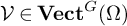 ${\mathcal V} \in {\mathbf {Vect}}^G(\Omega )$
is Lubin-Tate if for some
${\mathcal V} \in {\mathbf {Vect}}^G(\Omega )$
is Lubin-Tate if for some $m \geq 1$
the
$m \geq 1$
the $\mathcal {O}({\mathcal N}_m)$
-module
$\mathcal {O}({\mathcal N}_m)$
-module
 $$\begin{align*}\mathcal{O}({\mathcal N}_m) \otimes_{\mathcal{O}(\Omega)} {\mathcal V}(\Omega) \end{align*}$$
is generated by $G_m$
-invariant elements, where
$G_m$
-invariant elements, where ${\mathcal N}_m$
is the level m Drinfeld covering of
${\mathcal N}_m$
is the level m Drinfeld covering of $\Omega $
of finite degree and
$\Omega $
of finite degree and  is the mth congruence subgroup of G.
From the construction of the category ${\mathbf {Vect}}^G_{\operatorname {\mathrm {LT}}}(\Omega )$
, there is an equivalence
${\mathbf {Vect}}^G_{\operatorname {\mathrm {LT}}}(\Omega )$
, there is an equivalence
 $$\begin{align*}{\mathbb D}_{\operatorname{\mathrm{Dr}}} \colon {\mathbf{Vect}}^H_{\operatorname{\mathrm{Dr}}}({\mathbb P}^{n-1}) \xrightarrow{\sim} {\mathbf{Vect}}^G_{\operatorname{\mathrm{LT}}}(\Omega) \end{align*}$$
where ${\mathbf {Vect}}^H_{\operatorname {\mathrm {Dr}}}({\mathbb P}^{n-1}) \subset {\mathbf {Vect}}^H({\mathbb P}^{n-1})$
is the full subcategory of Drinfeld bundles on
${\mathbf {Vect}}^H_{\operatorname {\mathrm {Dr}}}({\mathbb P}^{n-1}) \subset {\mathbf {Vect}}^H({\mathbb P}^{n-1})$
is the full subcategory of Drinfeld bundles on ${\mathbb P}^{n-1}$
and H is the group of units of the division algebra over F of invariant
${\mathbb P}^{n-1}$
and H is the group of units of the division algebra over F of invariant $1/n$
. This equivalence allows one to translate problems regarding G-equivariant vector bundles on
$1/n$
. This equivalence allows one to translate problems regarding G-equivariant vector bundles on $\Omega $
to problems regarding H-equivariant vector bundles on
$\Omega $
to problems regarding H-equivariant vector bundles on ${\mathbb P}^{n-1}$
. For example, Kohlhaase defined a fully faithful inclusion functor
${\mathbb P}^{n-1}$
. For example, Kohlhaase defined a fully faithful inclusion functor

from the category of finite-dimensional smooth representations of H over K. This was used by Dospinescu and Le Bras to translate problems about $\Psi _H(V)$
into problems about
$\Psi _H(V)$
into problems about $\mathcal {O}_{{\mathbb P}^{n-1}} \otimes _K V$
in their proof [Reference Dospinescu and Le Bras11, §10] that the locally analytic
$\mathcal {O}_{{\mathbb P}^{n-1}} \otimes _K V$
in their proof [Reference Dospinescu and Le Bras11, §10] that the locally analytic $\operatorname {\mathrm {GL}}_2({\mathbb Q}_p)$
-representation
$\operatorname {\mathrm {GL}}_2({\mathbb Q}_p)$
-representation $\Gamma (\Omega , \Psi _H(V))^*$
is coadmissible whenever V is irreducible and
$\Gamma (\Omega , \Psi _H(V))^*$
is coadmissible whenever V is irreducible and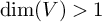 $\dim (V)> 1$
.
$\dim (V)> 1$
.
The functor $\Psi _H$
provides examples of objects of
$\Psi _H$
provides examples of objects of ${\mathbf {Vect}}^G_{\operatorname {\mathrm {LT}}}(\Omega )$
, but a priori
${\mathbf {Vect}}^G_{\operatorname {\mathrm {LT}}}(\Omega )$
, but a priori ${\mathbf {Vect}}^G_{\operatorname {\mathrm {LT}}}(\Omega )$
is much larger. Our main result is that, somewhat surprisingly,
${\mathbf {Vect}}^G_{\operatorname {\mathrm {LT}}}(\Omega )$
is much larger. Our main result is that, somewhat surprisingly, $\Psi _H$
is actually an equivalence.
$\Psi _H$
is actually an equivalence.
Theorem A. The functor
 $$\begin{align*}\Psi_H \colon \operatorname{\mathrm{Rep}}_{K}^{\operatorname{\mathrm{sm}}}(H) \rightarrow {\mathbf{Vect}}^G_{\operatorname{\mathrm{LT}}}(\Omega) \end{align*}$$
is an equivalence of categories.
In particular, any Drinfeld bundle on ${\mathbb P}^{n-1}$
is of the form
${\mathbb P}^{n-1}$
is of the form $\mathcal {O}_{{\mathbb P}^{n-1}} \otimes _K V$
. We also note that there is an asymmetry here: the analogously defined functor
$\mathcal {O}_{{\mathbb P}^{n-1}} \otimes _K V$
. We also note that there is an asymmetry here: the analogously defined functor $\Psi _G$
is not an equivalence when
$\Psi _G$
is not an equivalence when $n \geq 2$
(Remark 6.11).
$n \geq 2$
(Remark 6.11).
The main idea behind the proof of Theorem A is an equivalent characterisation of the notation of a Lubin-Tate bundle (Lemma 6.2), from which the fact that $\Psi _H$
is an equivalence becomes relatively formal (cf. Corollary 6.4 and Theorem 6.10). The main observation is that for any Lubin-Tate bundle
$\Psi _H$
is an equivalence becomes relatively formal (cf. Corollary 6.4 and Theorem 6.10). The main observation is that for any Lubin-Tate bundle ${\mathcal V}$
, the
${\mathcal V}$
, the $G_m$
-invariants and
$G_m$
-invariants and $G^m$
-invariants of the
$G^m$
-invariants of the $\mathcal {O}({\mathcal N}_m)$
-module
$\mathcal {O}({\mathcal N}_m)$
-module $\mathcal {O}({\mathcal N}_m) \otimes _{\mathcal {O}(\Omega )} {\mathcal V}(\Omega )$
considered above actually coincide, where
$\mathcal {O}({\mathcal N}_m) \otimes _{\mathcal {O}(\Omega )} {\mathcal V}(\Omega )$
considered above actually coincide, where $G^m = \det ^{-1}(1 + \pi ^m \mathcal {O}_F)$
, the normal closure of
$G^m = \det ^{-1}(1 + \pi ^m \mathcal {O}_F)$
, the normal closure of $G_m$
in G.
$G_m$
in G.
1.2 $G^0$
-finite bundles
$G^0$
-finite bundles

The functor $\Psi _H$
also lands in the full subcategory
$\Psi _H$
also lands in the full subcategory
 $$\begin{align*}{\mathbf{Vect}}^G(\Omega)_{G^0\text{-}\operatorname{\mathrm{fin}}} \subset {\mathbf{Vect}}^G(\Omega), \end{align*}$$
of $G^0$
-finite bundles, where
$G^0$
-finite bundles, where $G^0 = \ker (\nu \circ \det \colon G \rightarrow {\mathbb Z})$
(see Definition 7.1). In our previous work [Reference Taylor24] we showed that the natural factorisation of
$G^0 = \ker (\nu \circ \det \colon G \rightarrow {\mathbb Z})$
(see Definition 7.1). In our previous work [Reference Taylor24] we showed that the natural factorisation of $\Psi _H$
through the category
$\Psi _H$
through the category ${\mathbf {VectCon}}^G(\Omega )$
of G-equivariant vector bundles with connection on
${\mathbf {VectCon}}^G(\Omega )$
of G-equivariant vector bundles with connection on $\Omega $
induces an equivalence
$\Omega $
induces an equivalence
 $$\begin{align*}\Psi_H^{\nabla} \colon \operatorname{\mathrm{Rep}}_{K}^{\operatorname{\mathrm{sm}}}(H) \xrightarrow{\sim} {\mathbf{VectCon}}^G(\Omega)_{G^0\text{-}\operatorname{\mathrm{fin}}} \end{align*}$$
to the analogously defined full subcategory ${\mathbf {VectCon}}^G(\Omega )_{G^0\text {-}\operatorname {\mathrm {fin}}}$
of
${\mathbf {VectCon}}^G(\Omega )_{G^0\text {-}\operatorname {\mathrm {fin}}}$
of ${\mathbf {VectCon}}^G(\Omega )$
.
${\mathbf {VectCon}}^G(\Omega )$
.
Using some results we establish relating the infinitesimal action of G and the action of the tangent sheaf on the covering spaces ${\mathcal N}_m$
(Lemma 4.1), we adapt the techniques from [Reference Taylor24] to also show that
${\mathcal N}_m$
(Lemma 4.1), we adapt the techniques from [Reference Taylor24] to also show that $\Psi _H$
is also an equivalence onto
$\Psi _H$
is also an equivalence onto ${\mathbf {Vect}}^G(\Omega )_{G^0\text {-}\operatorname {\mathrm {fin}}}$
.
${\mathbf {Vect}}^G(\Omega )_{G^0\text {-}\operatorname {\mathrm {fin}}}$
.
Theorem B. The functor $\Psi _H$
induces an equivalence of categories
$\Psi _H$
induces an equivalence of categories
 $$\begin{align*}\Psi_H \colon \operatorname{\mathrm{Rep}}_{K}^{\operatorname{\mathrm{sm}}}(H) \xrightarrow{\sim} {\mathbf{Vect}}^G(\Omega)_{G^0\text{-}\operatorname{\mathrm{fin}}}. \end{align*}$$
In particular, this shows that there is an equality of full subcategories
 $$\begin{align*}{\mathbf{Vect}}^G_{\operatorname{\mathrm{LT}}}(\Omega) = {\mathbf{Vect}}^G(\Omega)_{G^0\text{-}\operatorname{\mathrm{fin}}} \end{align*}$$
inside ${\mathbf {Vect}}^G(\Omega )$
, and that the restriction functor
${\mathbf {Vect}}^G(\Omega )$
, and that the restriction functor
 $$\begin{align*}{\mathbf{VectCon}}^G(\Omega)_{G^0\text{-}\operatorname{\mathrm{fin}}} \rightarrow {\mathbf{Vect}}^G(\Omega)_{G^0\text{-}\operatorname{\mathrm{fin}}} \end{align*}$$
is an equivalence of categories.
Remark 1.1. We further show that ${\mathbf {Vect}}^G(\Omega )_{G^0\text {-}\operatorname {\mathrm {fin}}}$
is closed under sub-objects (Theorem 7.2), and so in particular that
${\mathbf {Vect}}^G(\Omega )_{G^0\text {-}\operatorname {\mathrm {fin}}}$
is closed under sub-objects (Theorem 7.2), and so in particular that $\Psi _H$
preserves irreducibility. This generalises the results of Dospinescu and Le-Bras [Reference Dospinescu and Le Bras11, §10.1] established during their proof of the coadmissibility of
$\Psi _H$
preserves irreducibility. This generalises the results of Dospinescu and Le-Bras [Reference Dospinescu and Le Bras11, §10.1] established during their proof of the coadmissibility of $\Gamma (\Omega , \Psi _H(V))^*$
described above, from
$\Gamma (\Omega , \Psi _H(V))^*$
described above, from $\operatorname {\mathrm {GL}}_2(F)$
to
$\operatorname {\mathrm {GL}}_2(F)$
to $\operatorname {\mathrm {GL}}_n(F)$
.
$\operatorname {\mathrm {GL}}_n(F)$
.
Remark 1.2. Theorem A and Theorem B show that objects of ${\mathbf {Vect}}^G_{\operatorname {\mathrm {LT}}}(\Omega )$
are functorially equipped with a connection, which for
${\mathbf {Vect}}^G_{\operatorname {\mathrm {LT}}}(\Omega )$
are functorially equipped with a connection, which for $W \in \operatorname {\mathrm {Rep}}_K^{\operatorname {\mathrm {sm}}}(H)$
agrees with the connection on
$W \in \operatorname {\mathrm {Rep}}_K^{\operatorname {\mathrm {sm}}}(H)$
agrees with the connection on $\Psi _H(W)$
considered in [Reference Kohlhaase13, Rem. 4.8] and the connection on
$\Psi _H(W)$
considered in [Reference Kohlhaase13, Rem. 4.8] and the connection on $\Psi _H(W)$
which we consider in Section 6.
$\Psi _H(W)$
which we consider in Section 6.
1.3 Other results
We also give a complete description of the category of $G_0$
-equivariant Lubin-Tate bundles
$G_0$
-equivariant Lubin-Tate bundles ${\mathbf {Vect}}^{G_0}_{\operatorname {\mathrm {LT}}}(\Omega )$
considered by Kohlhaase (Theorem 5.4). Using this, we give a precise description of which of these Lubin-Tate bundles arise from smooth representations of
${\mathbf {Vect}}^{G_0}_{\operatorname {\mathrm {LT}}}(\Omega )$
considered by Kohlhaase (Theorem 5.4). Using this, we give a precise description of which of these Lubin-Tate bundles arise from smooth representations of $G_0 = \operatorname {\mathrm {GL}}_n(\mathcal {O}_F)$
and
$G_0 = \operatorname {\mathrm {GL}}_n(\mathcal {O}_F)$
and $H_0 = \mathcal {O}_D^{\times }$
, and how these subcategories intersect (Theorem 5.13).
$H_0 = \mathcal {O}_D^{\times }$
, and how these subcategories intersect (Theorem 5.13).
The proof of Theorem B used ${\mathcal D}$
-modules in an essential way, even though the statement itself does not involve them. As another application of the use of
${\mathcal D}$
-modules in an essential way, even though the statement itself does not involve them. As another application of the use of ${\mathcal D}$
-modules to the study of
${\mathcal D}$
-modules to the study of $\Psi _H$
, we prove:
$\Psi _H$
, we prove:
Theorem C. For any smooth character $\chi \colon F^\times \rightarrow K^\times $
and
$\chi \colon F^\times \rightarrow K^\times $
and $V \in \operatorname {\mathrm {Rep}}_{K}^{\operatorname {\mathrm {sm}}}(H)$
,
$V \in \operatorname {\mathrm {Rep}}_{K}^{\operatorname {\mathrm {sm}}}(H)$
,
 $$\begin{align*}\Psi_H(V \otimes \chi_H) = \Psi_H(V) \otimes \chi_G. \end{align*}$$
Here $\chi \mapsto \chi _G = \chi \circ \det $
and
$\chi \mapsto \chi _G = \chi \circ \det $
and $\chi \mapsto \chi _H = \chi \circ \operatorname {\mathrm {Nrd}}$
are the canonical identifications of the smooth character groups of
$\chi \mapsto \chi _H = \chi \circ \operatorname {\mathrm {Nrd}}$
are the canonical identifications of the smooth character groups of $G, H$
and
$G, H$
and $F^\times $
. Our proof of Theorem C uses in an essential way the enrichment of
$F^\times $
. Our proof of Theorem C uses in an essential way the enrichment of $\Psi _H$
to
$\Psi _H$
to $\Psi _H^{\nabla }$
, and makes use of a result of Kohlhaase on the trace of the action of elliptic elements of G on certain stalks of
$\Psi _H^{\nabla }$
, and makes use of a result of Kohlhaase on the trace of the action of elliptic elements of G on certain stalks of $\Psi _H(V)$
[Reference Kohlhaase13, Thm. 4.7].
$\Psi _H(V)$
[Reference Kohlhaase13, Thm. 4.7].
Outline of the paper
In Section 2 and Section 3 we prove some general technical results regarding equivariant vector bundles arising from certain semilinear representations, which we use in many places throughout the rest of the paper. We advise the reader to skip these sections and refer back to them when necessary. In Section 4 we relate the infinitesimal action of G on Drinfeld spaces with the action of the tangent sheaf. In Section 5 we describe the category of $G_0$
-equivariant Lubin-Tate bundles (Theorem 5.4), and use this description to establish properties of
$G_0$
-equivariant Lubin-Tate bundles (Theorem 5.4), and use this description to establish properties of ${\mathbf {Vect}}^{G_0}_{\operatorname {\mathrm {LT}}}(\Omega )$
. In Section 6 we prove Theorem A that
${\mathbf {Vect}}^{G_0}_{\operatorname {\mathrm {LT}}}(\Omega )$
. In Section 6 we prove Theorem A that $\Psi _H$
is an equivalence onto the category of G-equivariant Lubin-Tate bundles (Theorem 6.10). In Section 7 we prove Theorem B and show that the essential image of
$\Psi _H$
is an equivalence onto the category of G-equivariant Lubin-Tate bundles (Theorem 6.10). In Section 7 we prove Theorem B and show that the essential image of $\Psi _H$
is also equal to the category of
$\Psi _H$
is also equal to the category of $G^0$
-finite bundles (Theorem 7.3), before establishing some properties of
$G^0$
-finite bundles (Theorem 7.3), before establishing some properties of $\Psi _H$
in Section 8 including Theorem C (Theorem 8.1).
$\Psi _H$
in Section 8 including Theorem C (Theorem 8.1).
Conventions
All group representations considered in this paper are assumed to be finite-dimensional.
2 Smooth semilinear representations
We are interested in various categories of semilinear representations, which we now introduce. Later, we will show how these categories are related to the category of Lubin-Tate bundles.
Definition 2.1. For a group G which acts on a ring R, and a subgroup H of G, we write
 $$\begin{align*}\operatorname{\mathrm{Rep}}^H_R(G) \end{align*}$$
for the full subcategory of modules V over the skew group ring $R \rtimes G$
such that
$R \rtimes G$
such that
-
1. V is free of finite rank over R,
-
2.
$R \cdot V^H = V$
.

When H is trivial, we write this as $\operatorname {\mathrm {Rep}}_R(G)$
. Note that when the action of H on R is trivial, condition (2) is simply that H acts trivially on V. We also have the following topological version.
$\operatorname {\mathrm {Rep}}_R(G)$
. Note that when the action of H on R is trivial, condition (2) is simply that H acts trivially on V. We also have the following topological version.
Definition 2.2. If G is a topological group which acts on a ring R, then we write
 $$\begin{align*}\operatorname{\mathrm{Rep}}^{\operatorname{\mathrm{sm}}}_R(G) \end{align*}$$
for the full subcategory of modules V over the skew group ring $R \rtimes G$
such that
$R \rtimes G$
such that
-
1. V is free of finite rank over R,
-
2. there exists an open subgroup H of G such that
$R \cdot V^H = V$
.

When the action of G on R is smooth (meaning $R = \cup _{H \leq _{o} G} R^H$
, as H varies over the open subgroups of G), then for V free of finite rank over R,
$R = \cup _{H \leq _{o} G} R^H$
, as H varies over the open subgroups of G), then for V free of finite rank over R, $V \in \operatorname {\mathrm {Rep}}^{\operatorname {\mathrm {sm}}}_R(G)$
if and only if
$V \in \operatorname {\mathrm {Rep}}^{\operatorname {\mathrm {sm}}}_R(G)$
if and only if $V = \cup _{H \leq _{o} G} V^H$
. In particular, when the action of G on R is trivial,
$V = \cup _{H \leq _{o} G} V^H$
. In particular, when the action of G on R is trivial, $\operatorname {\mathrm {Rep}}^{\operatorname {\mathrm {sm}}}_R(G)$
is simply the category of smooth representations of G on free R-modules of finite rank.
$\operatorname {\mathrm {Rep}}^{\operatorname {\mathrm {sm}}}_R(G)$
is simply the category of smooth representations of G on free R-modules of finite rank.
2.1 Some useful lemmas
We are principally interested in the case when R is a product of fields, in which case we shall make use of the following two lemmas.
Lemma 2.1. Suppose that $\phi \colon L \rightarrow L$
is a ring automorphism of L, where
$\phi \colon L \rightarrow L$
is a ring automorphism of L, where $L = \prod _i L_i$
is a product of fields. Then
$L = \prod _i L_i$
is a product of fields. Then $\phi $
preserves the set
$\phi $
preserves the set $\{e_i\}_i$
of principal idempotents.
$\{e_i\}_i$
of principal idempotents.
Proof. Idempotents are preserved by automorphisms, and principal idempotents of L can be characterised as those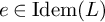 $e \in \text {Idem}(L)$
for which
$e \in \text {Idem}(L)$
for which $ef = e$
or
$ef = e$
or $ef = 0$
for any
$ef = 0$
for any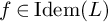 $f \in \text {Idem}(L)$
.
$f \in \text {Idem}(L)$
.
In particular, any group action on $L = \prod _i L_i$
by ring automorphisms will preserve
$L = \prod _i L_i$
by ring automorphisms will preserve $\{e_i\}_i$
.
$\{e_i\}_i$
.
Lemma 2.2. Suppose that $L = \prod _i L_i$
is a product of fields with an action of a group G by ring automorphisms, which acts on the set
$L = \prod _i L_i$
is a product of fields with an action of a group G by ring automorphisms, which acts on the set $\{e_i\}_i$
of principal idempotents of L transitively. Suppose that M is a
$\{e_i\}_i$
of principal idempotents of L transitively. Suppose that M is a $L \rtimes G$
-module for which the natural map
$L \rtimes G$
-module for which the natural map
 $$\begin{align*}M \rightarrow \prod_i e_i \cdot M, \qquad m \mapsto (e_i \cdot m)_i \end{align*}$$
is an isomorphism and $\dim _{L_i} e_i \cdot M < \infty $
for some i. Then M is free of finite rank over L.
$\dim _{L_i} e_i \cdot M < \infty $
for some i. Then M is free of finite rank over L.
Proof. Fix some $e_0 \in \{e_i\}_i$
with
$e_0 \in \{e_i\}_i$
with $\dim _{L_0} e_0 \cdot M < \infty $
, and for each i fix some
$\dim _{L_0} e_0 \cdot M < \infty $
, and for each i fix some $g_i \in G$
with
$g_i \in G$
with $g_i(e_0) = e_i$
. This allows us to define field isomorphisms
$g_i(e_0) = e_i$
. This allows us to define field isomorphisms

where $\pi _i \colon L \rightarrow L_i$
is the projection and
$\pi _i \colon L \rightarrow L_i$
is the projection and $\iota _0 \colon L_0 \rightarrow L$
is defined by setting
$\iota _0 \colon L_0 \rightarrow L$
is defined by setting $\iota _0(\lambda )$
to be the unique element of L with
$\iota _0(\lambda )$
to be the unique element of L with $\pi _0(\iota _0(\lambda )) = \lambda $
and
$\pi _0(\iota _0(\lambda )) = \lambda $
and $\pi _j (\iota _0(\lambda )) = 0$
when
$\pi _j (\iota _0(\lambda )) = 0$
when $j \neq 0$
.
$j \neq 0$
.
The map $g_i \colon M \rightarrow M$
restricts to a bijection
$g_i \colon M \rightarrow M$
restricts to a bijection $e_0 \cdot M \xrightarrow {\sim } e_i \cdot M$
, which is
$e_0 \cdot M \xrightarrow {\sim } e_i \cdot M$
, which is $L_0$
-linear with respect to the natural action of
$L_0$
-linear with respect to the natural action of $L_0$
on
$L_0$
on $e_0 \cdot M$
and the action of
$e_0 \cdot M$
and the action of $L_0$
on
$L_0$
on $e_i \cdot M$
through
$e_i \cdot M$
through $\gamma _i \colon L_0 \xrightarrow {\sim } L_i$
. Then if
$\gamma _i \colon L_0 \xrightarrow {\sim } L_i$
. Then if $\{f_m^0\}_m$
is a basis for
$\{f_m^0\}_m$
is a basis for $e_0 \cdot M$
over
$e_0 \cdot M$
over $L_0$
, the set
$L_0$
, the set $\{f_m\}_m$
defined by
$\{f_m\}_m$
defined by $f_m = (g_i(f_m^0))_i$
is a basis of
$f_m = (g_i(f_m^0))_i$
is a basis of $\prod _i M_i$
over L. Indeed, because each
$\prod _i M_i$
over L. Indeed, because each $\{g_i(f_m^0)\}_m$
is a basis of
$\{g_i(f_m^0)\}_m$
is a basis of $e_i \cdot M$
over
$e_i \cdot M$
over $L_i$
, the set
$L_i$
, the set $\{f_m\}_m$
is linearly independent and (using crucially that
$\{f_m\}_m$
is linearly independent and (using crucially that $\{f_m\}_m$
is finite) the set
$\{f_m\}_m$
is finite) the set $\{f_m\}_m$
also spans M.
$\{f_m\}_m$
also spans M.
Remark 2.3. If the assumption that some $\dim _{L_i} e_i \cdot M < \infty $
is removed, then the same proof shows that M is free (but potentially of infinite rank), provided that
$\dim _{L_i} e_i \cdot M < \infty $
is removed, then the same proof shows that M is free (but potentially of infinite rank), provided that $|I| < \infty $
.
$|I| < \infty $
.
3 Semilinear representations and equivariant vector bundles
Suppose that X is a scheme or rigid space over a field K with an action of a group G, and that H is a subgroup of G. In this context we can consider the category ${\mathbf {Vect}}^G(X)$
of G-equivariant vector bundles on X, and when X is smooth the category
${\mathbf {Vect}}^G(X)$
of G-equivariant vector bundles on X, and when X is smooth the category ${\mathbf {VectCon}}^G(X)$
of G-equivariant vector bundles with connection on X (see, for example, [Reference Taylor24, §2.8]).
${\mathbf {VectCon}}^G(X)$
of G-equivariant vector bundles with connection on X (see, for example, [Reference Taylor24, §2.8]).
We consider the quadruple $({\mathcal A}, {\mathcal B}, {\mathcal C}, L)$
as in one of the following two cases:
$({\mathcal A}, {\mathcal B}, {\mathcal C}, L)$
as in one of the following two cases:
-
(A)
${\mathcal A} = {\mathbf {VectCon}}^G(X)$
,
${\mathcal B} = {\mathbf {VectCon}}^H(X)$
,
${\mathcal C} = {\mathbf {VectCon}}(X)$
,
$L = c(X)^H$
, -
(B)
${\mathcal A} = {\mathbf {Vect}}^G(X)$
,
${\mathcal B} = {\mathbf {Vect}}^H(X)$
,
${\mathcal C} = {\mathbf {Vect}}(X)$
,
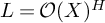
$L = \mathcal {O}(X)^H$
,







where we additionally assume in case (A) that K has characteristic $0$
and X is smooth over K, in order for the quantities
$0$
and X is smooth over K, in order for the quantities $({\mathcal A}, {\mathcal B}, {\mathcal C}, L)$
to be well-defined. Here
$({\mathcal A}, {\mathcal B}, {\mathcal C}, L)$
to be well-defined. Here $c(X)$
is the K-algebra of global sections of the sheaf of constant functions as considered in [Reference Taylor24, §3]. In either case we further assume:
$c(X)$
is the K-algebra of global sections of the sheaf of constant functions as considered in [Reference Taylor24, §3]. In either case we further assume:
-
(1) X is the categorical disjoint union of its connected components,
-
(2) The action of G on
$\mathcal {O}(X)$
preserves L, -
(3) G acts transitively on
$\pi _0(X)$
.


Remark 3.1. We note that the requirement that X is the categorical disjoint union of its connected components is automatic if X is a rigid space [Reference Conrad10, §2.1], or if X is in case (A) as smooth schemes are locally noetherian and thus locally connected [Reference Taylor24, Lem. 3.4(1)]. Furthermore, if H is normal in G or if $L = c(X)$
(in case (A)) then the requirement that G preserves L is automatic. Additionally, the results of this section still have consequences when the assumption that G acts transitively on
$L = c(X)$
(in case (A)) then the requirement that G preserves L is automatic. Additionally, the results of this section still have consequences when the assumption that G acts transitively on $\pi _0(X)$
is dropped, as they can be applied to each orbit of the action of G on X.
$\pi _0(X)$
is dropped, as they can be applied to each orbit of the action of G on X.
Write $\{X_i\}_{i \in \pi _0(X)}$
for the set of connected components of X, and let
$\{X_i\}_{i \in \pi _0(X)}$
for the set of connected components of X, and let $\mathfrak {O}$
be the set of H orbits on
$\mathfrak {O}$
be the set of H orbits on $\pi _0(X)$
. For each
$\pi _0(X)$
. For each ${\mathfrak o} \in {\mathfrak O}$
, set
${\mathfrak o} \in {\mathfrak O}$
, set
 $$\begin{align*}X_{{\mathfrak o}} = \bigsqcup_{i \in {\mathfrak o}} X_i. \end{align*}$$
For ${\mathfrak o} \in {\mathfrak O}$
and
${\mathfrak o} \in {\mathfrak O}$
and $i \in \pi _0(X)$
we write
$i \in \pi _0(X)$
we write
-
(A)
${\mathcal B}_{{\mathfrak o}} = {\mathbf {VectCon}}^H(X_{{\mathfrak o}})$
,
${\mathcal B}_{i} = {\mathbf {VectCon}}^{H_i}(X_{i})$
, -
(B)
${\mathcal B}_{{\mathfrak o}} = {\mathbf {Coh}}^H(X_{{\mathfrak o}})$
,
${\mathcal B}_{i} = {\mathbf {Coh}}^{H_i}(X_{i})$
,




where $H_i = \operatorname {\mathrm {Stab}}_H(X_i)$
and
$H_i = \operatorname {\mathrm {Stab}}_H(X_i)$
and ${\mathbf {Coh}}^H(X_{{\mathfrak o}})$
is the category of H-
${\mathbf {Coh}}^H(X_{{\mathfrak o}})$
is the category of H- $\mathcal {O}_{X_{{\mathfrak o}}}$
-modules for which the underlying
$\mathcal {O}_{X_{{\mathfrak o}}}$
-modules for which the underlying $\mathcal {O}_{X_{{\mathfrak o}}}$
-module is coherent (and similarly for
$\mathcal {O}_{X_{{\mathfrak o}}}$
-module is coherent (and similarly for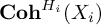 ${\mathbf {Coh}}^{H_i}(X_i)$
). We note that these definitions are uniform, as in case (A) a
${\mathbf {Coh}}^{H_i}(X_i)$
). We note that these definitions are uniform, as in case (A) a ${\mathcal D}$
-module on
${\mathcal D}$
-module on $X_{{\mathfrak o}}$
which is coherent as an
$X_{{\mathfrak o}}$
which is coherent as an $\mathcal {O}_{X_{{\mathfrak o}}}$
-module is automatically locally free [Reference Taylor24, Lem. 2.38]. With this notation, we also make the additional assumption that:
$\mathcal {O}_{X_{{\mathfrak o}}}$
-module is automatically locally free [Reference Taylor24, Lem. 2.38]. With this notation, we also make the additional assumption that:
-
(4) Each
$\mathcal {O}_{X_{{\mathfrak o}}}$
is irreducible as an object of
${\mathcal B}_{{\mathfrak o}}$
.


We note that by [Reference Taylor24, Ex. 2.33], this is equivalent to the assumption that
-
(4’) Each
$\mathcal {O}_{X_{i}}$
is irreducible as an object of
${\mathcal B}_{i}$
.


As X is the disjoint union of the $X_{{\mathfrak o}}$
,
$X_{{\mathfrak o}}$
,
 $$\begin{align*}L = \prod_{{\mathfrak o} \in {\mathfrak O}} L_{{\mathfrak o}} \end{align*}$$
where for ${\mathfrak o} \in {\mathfrak O}$
and
${\mathfrak o} \in {\mathfrak O}$
and $i \in \pi _0(X)$
we write
$i \in \pi _0(X)$
we write
-
(A)
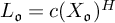
$L_{{\mathfrak o}} = c(X_{{\mathfrak o}})^H$
,
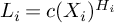
$L_{i} = c(X_{i})^{H_i}$
-
(B)
$L_{{\mathfrak o}} = \mathcal {O}(X_{{\mathfrak o}})^H$
,
$L_{i} = \mathcal {O}(X_{i})^{H_i}$
.


Lemma 3.2. For $i \in {\mathfrak o}$
and
$i \in {\mathfrak o}$
and ${\mathfrak o} \in {\mathfrak O}$
,
${\mathfrak o} \in {\mathfrak O}$
, $L_{{\mathfrak o}}$
and
$L_{{\mathfrak o}}$
and $L_{i}$
are fields and the projection map
$L_{i}$
are fields and the projection map
 $$\begin{align*}\pi \colon L_{{\mathfrak o}} \xrightarrow{\sim} L_i. \end{align*}$$
is an isomorphism.
Proof. The projection $\pi $
forms part of the commutative diagram
$\pi $
forms part of the commutative diagram

with vertical isomorphisms given by taking invariants of the isomorphism of [Reference Taylor24, Lem. 3.3]. Each endomorphism ring is a division ring by assumption (4) and Schur’s Lemma, hence both $L_{{\mathfrak o}}$
and
$L_{{\mathfrak o}}$
and $L_i$
are fields. Furthermore,
$L_i$
are fields. Furthermore, $\pi $
is an isomorphism as the lower map is an isomorphism by [Reference Taylor24, Ex. 2.33].
$\pi $
is an isomorphism as the lower map is an isomorphism by [Reference Taylor24, Ex. 2.33].
The functor
$\mathcal {O}_X \otimes _{L} -$

We consider the functor
 $$\begin{align*}\mathcal{O}_X \otimes_{L} - \colon \operatorname{\mathrm{Rep}}^H_L(G) \rightarrow {\mathcal A} \end{align*}$$
defined by considering $\mathcal {O}_X \otimes _L V$
as a G-equivariant sheaf via the diagonal action of G. In case (A), for
$\mathcal {O}_X \otimes _L V$
as a G-equivariant sheaf via the diagonal action of G. In case (A), for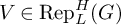 $V \in \operatorname {\mathrm {Rep}}^H_L(G)$
, we additionally view
$V \in \operatorname {\mathrm {Rep}}^H_L(G)$
, we additionally view $\mathcal {O}_X \otimes _L V$
as
$\mathcal {O}_X \otimes _L V$
as ${\mathcal D}_X$
-module via the action of
${\mathcal D}_X$
-module via the action of ${\mathcal D}_X$
on the left factor, which induces a well-defined action on the tensor product as the tangent sheaf
${\mathcal D}_X$
on the left factor, which induces a well-defined action on the tensor product as the tangent sheaf ${\mathcal T}_X$
acts trivially on
${\mathcal T}_X$
acts trivially on $L \subset c(X)$
, and further gives
$L \subset c(X)$
, and further gives $\mathcal {O}_X \otimes _{L} V$
the structure of a G-
$\mathcal {O}_X \otimes _{L} V$
the structure of a G- ${\mathcal D}_X$
-module.
${\mathcal D}_X$
-module.
The functor
$\operatorname {\mathrm {Hom}}_{{\mathcal B}}(\mathcal {O}_X, -)$

In the other direction we have the functor
 $$\begin{align*}\operatorname{\mathrm{Hom}}_{{\mathcal B}}(\mathcal{O}_X, -) \colon {\mathcal A} \rightarrow {\mathbf{Mod}}_L. \end{align*}$$
Here, for ${\mathcal V} \in {\mathcal A}$
,
${\mathcal V} \in {\mathcal A}$
, $\operatorname {\mathrm {Hom}}_{{\mathcal B}}(\mathcal {O}_X, {\mathcal V})$
is naturally a module over L as L is fixed by H. In order to see that this is free of finite rank over L, we use the following lemma.
$\operatorname {\mathrm {Hom}}_{{\mathcal B}}(\mathcal {O}_X, {\mathcal V})$
is naturally a module over L as L is fixed by H. In order to see that this is free of finite rank over L, we use the following lemma.
Lemma 3.3. Suppose that ${\mathcal V} \in {\mathcal A}$
. Then the natural morphism
${\mathcal V} \in {\mathcal A}$
. Then the natural morphism
 $$ \begin{align} \mathcal{O}_X \otimes_L \operatorname{\mathrm{Hom}}_{{\mathcal B}}(\mathcal{O}_X, {\mathcal V}) \rightarrow {\mathcal V} \end{align} $$
in ${\mathcal B}$
is injective, and
${\mathcal B}$
is injective, and $\operatorname {\mathrm {Hom}}_{{\mathcal B}}(\mathcal {O}_X, {\mathcal V})$
is free of finite rank over L.
$\operatorname {\mathrm {Hom}}_{{\mathcal B}}(\mathcal {O}_X, {\mathcal V})$
is free of finite rank over L.
Proof. For injectivity, as X is a H-stable disjoint union of $\{X_{{\mathfrak o}}\}_{{\mathfrak o}}$
, the morphism (3.1) factors as the product of morphisms
$\{X_{{\mathfrak o}}\}_{{\mathfrak o}}$
, the morphism (3.1) factors as the product of morphisms
 $$\begin{align*}\mathcal{O}_{X_{{\mathfrak o}}} \otimes_{L_{{\mathfrak o}}} \operatorname{\mathrm{Hom}}_{{\mathcal B}_{{\mathfrak o}}}(\mathcal{O}_{X_{{\mathfrak o}}}, {\mathcal V}_{{\mathfrak o}}) \rightarrow {\mathcal V}_{{\mathfrak o}}, \end{align*}$$
where  , and we are reduced to showing that each is injective, for which we modify the proof of [Reference Taylor24, Lem. 4.3]. Recall that $L_{{\mathfrak o}}$
is a field by Lemma 3.2, and suppose that
$L_{{\mathfrak o}}$
is a field by Lemma 3.2, and suppose that $f_1, ... ,f_k \in \operatorname {\mathrm {Hom}}_{{\mathcal B}_{{\mathfrak o}}}(\mathcal {O}_{X_{{\mathfrak o}}}, {\mathcal V}_{{\mathfrak o}})$
are
$f_1, ... ,f_k \in \operatorname {\mathrm {Hom}}_{{\mathcal B}_{{\mathfrak o}}}(\mathcal {O}_{X_{{\mathfrak o}}}, {\mathcal V}_{{\mathfrak o}})$
are $L_{{\mathfrak o}}$
-linearly independent. Define
$L_{{\mathfrak o}}$
-linearly independent. Define $e_1, ... , e_k \in {\mathcal V}_{{\mathfrak o}}(X_{{\mathfrak o}})^H$
by
$e_1, ... , e_k \in {\mathcal V}_{{\mathfrak o}}(X_{{\mathfrak o}})^H$
by  which are also $L_{{\mathfrak o}}$
-linearly independent because the natural map
$L_{{\mathfrak o}}$
-linearly independent because the natural map
 $$\begin{align*}\operatorname{\mathrm{Hom}}_{{\mathcal B}_{{\mathfrak o}}}(\mathcal{O}_{X_{{\mathfrak o}}}, {\mathcal V}_{{\mathfrak o}}) \rightarrow {\mathcal V}(X_{{\mathfrak o}})^H, \qquad f \mapsto f(1_{X_{{\mathfrak o}}}) \end{align*}$$
is $L_{{\mathfrak o}}$
-linear and injective. Because
$L_{{\mathfrak o}}$
-linear and injective. Because $\mathcal {O}_{X_{{\mathfrak o}}}$
is irreducible in
$\mathcal {O}_{X_{{\mathfrak o}}}$
is irreducible in ${\mathcal B}_{{\mathfrak o}}$
by assumption (4), it is sufficient for us to show that the sum
${\mathcal B}_{{\mathfrak o}}$
by assumption (4), it is sufficient for us to show that the sum
 $$\begin{align*}\sum_{i = 1}^k \mathcal{O}_{X_{{\mathfrak o}}} \cdot e_i \hookrightarrow {\mathcal V}_{{\mathfrak o}} \end{align*}$$
is direct. We prove this by induction on $k \geq 1$
. When
$k \geq 1$
. When $k = 1$
this is trivially true, so suppose that the statement is true for some fixed
$k = 1$
this is trivially true, so suppose that the statement is true for some fixed $k \geq 1$
, and consider
$k \geq 1$
, and consider
 $$\begin{align*}\sum_{i = 1}^{k+1} \mathcal{O}_{X_{{\mathfrak o}}} \cdot e_i. \end{align*}$$
After rearranging the factors if necessary, it is sufficient to show that
 $$\begin{align*}\left( \bigoplus_{i = 1}^{k} \mathcal{O}_{X_{{\mathfrak o}}} \cdot e_i \right) \bigcap \mathcal{O}_{X_{{\mathfrak o}}} \cdot e_{k+1} = 0. \end{align*}$$
If this intersection were non-zero, then
 $$\begin{align*}\left( \bigoplus_{i = 1}^{k} \mathcal{O}_{X_{{\mathfrak o}}} \cdot e_i \right) \bigcap \mathcal{O}_{X_{{\mathfrak o}}} \cdot e_{k+1} = \mathcal{O}_{X_{{\mathfrak o}}} \cdot e_{k+1}, \end{align*}$$
by the irreducibility of $\mathcal {O}_{X_{{\mathfrak o}}} \cdot e_{k+1}$
. We can therefore write
$\mathcal {O}_{X_{{\mathfrak o}}} \cdot e_{k+1}$
. We can therefore write
 $$\begin{align*}e_{k+1} = \lambda_1 e_1 + \cdots + \lambda_k e_k \end{align*}$$
for unique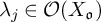 $\lambda _j \in \mathcal {O}(X_{{\mathfrak o}})$
. For any
$\lambda _j \in \mathcal {O}(X_{{\mathfrak o}})$
. For any $h \in H$
,
$h \in H$
,
 $$\begin{align*}0 = h(e_{k+1}) - e_{k+1} = (h(\lambda_1) - \lambda_1) e_1 + \cdots + (h(\lambda_k) - \lambda_k) e_k, \end{align*}$$
and therefore each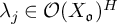 $\lambda _j \in \mathcal {O}(X_{{\mathfrak o}})^H$
by induction. Furthermore, in case (A), for any affinoid (resp. affine) open subset U and
$\lambda _j \in \mathcal {O}(X_{{\mathfrak o}})^H$
by induction. Furthermore, in case (A), for any affinoid (resp. affine) open subset U and $\partial \in {\mathcal T}(U)$
,
$\partial \in {\mathcal T}(U)$
,
 $$ \begin{align*} 0 &= \partial(e_{k+1}) = \partial(\lambda_1 e_1 + \cdots + \lambda_k e_k), \\ &= \partial(\lambda_1)e_1 + \cdots + \partial(\lambda_k) e_k, \end{align*} $$
in ${\mathcal V}(U)$
, and therefore by induction
${\mathcal V}(U)$
, and therefore by induction $\partial (\lambda _i) = 0$
for all
$\partial (\lambda _i) = 0$
for all $i = 1, ... ,n$
. As this holds for each admissible open subset
$i = 1, ... ,n$
. As this holds for each admissible open subset $U \subset X_{{\mathfrak o}}$
, each
$U \subset X_{{\mathfrak o}}$
, each $\lambda _i \in c(X_{{\mathfrak o}})$
by [Reference Taylor24, Lem. 3.2]. Therefore, in either case (A) or (B),
$\lambda _i \in c(X_{{\mathfrak o}})$
by [Reference Taylor24, Lem. 3.2]. Therefore, in either case (A) or (B), $\lambda _i \in L_{{\mathfrak o}}$
, which is a contradiction as we know that
$\lambda _i \in L_{{\mathfrak o}}$
, which is a contradiction as we know that $e_1, ... ,e_k, e_{k+1}$
are linearly independent over
$e_1, ... ,e_k, e_{k+1}$
are linearly independent over $L_{{\mathfrak o}}$
.
$L_{{\mathfrak o}}$
.
Finally, the fact that $\operatorname {\mathrm {Hom}}_{{\mathcal B}}(\mathcal {O}_X, {\mathcal V})$
is free of finite rank over L follows directly from Lemma 2.2, which uses Lemma 3.2, that
$\operatorname {\mathrm {Hom}}_{{\mathcal B}}(\mathcal {O}_X, {\mathcal V})$
is free of finite rank over L follows directly from Lemma 2.2, which uses Lemma 3.2, that
 $$\begin{align*}\operatorname{\mathrm{Hom}}_{{\mathcal B}}(\mathcal{O}_{X}, {\mathcal V}) \xrightarrow{\sim} \prod_{{\mathfrak o}} \operatorname{\mathrm{Hom}}_{{\mathcal B}_{{\mathfrak o}}}(\mathcal{O}_{X_{{\mathfrak o}}}, {\mathcal V}_{{\mathfrak o}}), \end{align*}$$
that each $\dim _{L_{{\mathfrak o}}} \operatorname {\mathrm {Hom}}_{{\mathcal B}_{{\mathfrak o}}}(\mathcal {O}_{X_{{\mathfrak o}}}, {\mathcal V}_{{\mathfrak o}}) \leq \text {rank}_{X_{{\mathfrak o}}}({\mathcal V}_{{\mathfrak o}}) < \infty $
, and that G acts transitively on the orbits
$\dim _{L_{{\mathfrak o}}} \operatorname {\mathrm {Hom}}_{{\mathcal B}_{{\mathfrak o}}}(\mathcal {O}_{X_{{\mathfrak o}}}, {\mathcal V}_{{\mathfrak o}}) \leq \text {rank}_{X_{{\mathfrak o}}}({\mathcal V}_{{\mathfrak o}}) < \infty $
, and that G acts transitively on the orbits ${\mathfrak o}$
.
${\mathfrak o}$
.
When H is normal in G, the natural action of G on $\operatorname {\mathrm {Hom}}_{{\mathcal C}}(\mathcal {O}_X, {\mathcal V})$
[Reference Taylor24, Rem. 2.32] preserves
$\operatorname {\mathrm {Hom}}_{{\mathcal C}}(\mathcal {O}_X, {\mathcal V})$
[Reference Taylor24, Rem. 2.32] preserves $\operatorname {\mathrm {Hom}}_{{\mathcal B}}(\mathcal {O}_X, {\mathcal V})$
because H is normal in G. This gives
$\operatorname {\mathrm {Hom}}_{{\mathcal B}}(\mathcal {O}_X, {\mathcal V})$
because H is normal in G. This gives $\operatorname {\mathrm {Hom}}_{{\mathcal B}}(\mathcal {O}_X, {\mathcal V})$
the structure of a
$\operatorname {\mathrm {Hom}}_{{\mathcal B}}(\mathcal {O}_X, {\mathcal V})$
the structure of a $L \rtimes G$
-module upon which H acts trivially, hence the functor
$L \rtimes G$
-module upon which H acts trivially, hence the functor $\operatorname {\mathrm {Hom}}_{{\mathcal B}}(\mathcal {O}_X, -)$
factors as
$\operatorname {\mathrm {Hom}}_{{\mathcal B}}(\mathcal {O}_X, -)$
factors as
 $$\begin{align*}\operatorname{\mathrm{Hom}}_{{\mathcal B}}(\mathcal{O}_X, -) \colon {\mathcal A} \rightarrow \operatorname{\mathrm{Rep}}_L^H(G), \end{align*}$$
and (3.1) is a morphism in ${\mathcal A}$
.
${\mathcal A}$
.
We can now state the main result of this section.
Proposition 3.4. Suppose that X, G and H are as described at the start of Section 3 and satisfy the assumptions (1), (2), (3) and (4). Then:
-
1. The functor
is exact, monoidal, and fully faithful.
$$\begin{align*}\mathcal{O}_X \otimes_{L} - \colon \operatorname{\mathrm{Rep}}^H_L(G) \rightarrow {\mathcal A} \end{align*}$$
-
2. Suppose that H is normal in G. Then the essential image is the full subcategory of objects
${\mathcal V} \in {\mathcal A}$
for which the injective map (3.1) is an isomorphism, and on this full subcategory is a quasi-inverse to
$$\begin{align*}\operatorname{\mathrm{Hom}}_{{\mathcal B}}(\mathcal{O}_X, -) \colon {\mathcal A} \rightarrow \operatorname{\mathrm{Rep}}^H_L(G) \end{align*}$$
$\mathcal {O}_X \otimes _L -$
.
-
3. If each
$X_i$
is quasi-Stein then the essential image of
$\mathcal {O}_X \otimes _{L} -$
is closed under sub-quotients.


For simplicity, here and in the proof of Proposition 3.4 we use the term quasi-Stein to mean quasi-Stein of finite dimension ( $\sup _{x \in X} \dim (\mathcal {O}_{X,x}) < \infty $
) when X is a rigid space, and to mean affine when X is a scheme.
$\sup _{x \in X} \dim (\mathcal {O}_{X,x}) < \infty $
) when X is a rigid space, and to mean affine when X is a scheme.
Remark 3.5. In case (A), the essential image description (3) is equivalently those ${\mathcal V} \in {\mathcal A}$
for which
${\mathcal V} \in {\mathcal A}$
for which $\text {rank}_{L}(\operatorname {\mathrm {Hom}}_{{\mathcal B}}(\mathcal {O}_X, {\mathcal V})) = \text {rank}({\mathcal V})$
, which can be seen using the same argument as [Reference Taylor24, Thm. 4.4(3)].
$\text {rank}_{L}(\operatorname {\mathrm {Hom}}_{{\mathcal B}}(\mathcal {O}_X, {\mathcal V})) = \text {rank}({\mathcal V})$
, which can be seen using the same argument as [Reference Taylor24, Thm. 4.4(3)].
Remark 3.6. Lemma 3.3 and Proposition 3.4 generalise Lemma 4.3 and Theorem 4.4 of [Reference Taylor24], which can be seen by taking the triple $(X, G, H)$
to be
$(X, G, H)$
to be $(X, G \times H, G)$
(in the notation of loc. cit.).
$(X, G \times H, G)$
(in the notation of loc. cit.).
Proof. For point (1), first note that $\mathcal {O}_X \otimes _L -$
is clearly exact, monoidal and faithful. To show that it is full, suppose that
$\mathcal {O}_X \otimes _L -$
is clearly exact, monoidal and faithful. To show that it is full, suppose that $V,W \in \operatorname {\mathrm {Rep}}_L^H(G)$
, and
$V,W \in \operatorname {\mathrm {Rep}}_L^H(G)$
, and
 $$\begin{align*}f \colon \mathcal{O}_X \otimes_L V \rightarrow \mathcal{O}_X \otimes_L W \end{align*}$$
is a morphism in ${\mathcal A}$
. For any
${\mathcal A}$
. For any $v \in V$
, because H acts trivially on V and W and f is H-equivariant,
$v \in V$
, because H acts trivially on V and W and f is H-equivariant,
 $$\begin{align*}f_X(1_X \otimes v) \in \mathcal{O}(X)^H \otimes_L W. \end{align*}$$
Furthermore, in case (A), for any admissible open subset $U \subset X$
and
$U \subset X$
and $\partial \in {\mathcal T}(U)$
 $$\begin{align*}\partial (f_U(1_U \otimes v)) = f_U(\partial(1_U) \otimes v) = 0, \end{align*}$$
and therefore
 $$\begin{align*}f_X(1_X \otimes v) \in c(X) \otimes_L W \end{align*}$$
by [Reference Taylor24, Lem. 3.2]. In either case (A) or (B),
 $$\begin{align*}f_X(1_X \otimes v) \in L \otimes_L W \equiv W, \end{align*}$$
and this allows us to define a morphism $\lambda \colon V \rightarrow W$
with
$\lambda \colon V \rightarrow W$
with $f_X(1_X \otimes v) = 1 \otimes \lambda (v)$
. It is direct to see, as f is a morphism in
$f_X(1_X \otimes v) = 1 \otimes \lambda (v)$
. It is direct to see, as f is a morphism in ${\mathcal A}$
, that
${\mathcal A}$
, that $f = 1 \otimes \lambda $
and hence
$f = 1 \otimes \lambda $
and hence $\mathcal {O}_X \otimes _L -$
is full.
$\mathcal {O}_X \otimes _L -$
is full.
For point (2), first note that because H is normal in G we may view $\operatorname {\mathrm {Hom}}_{{\mathcal B}}(\mathcal {O}_X, -)$
as a functor from
$\operatorname {\mathrm {Hom}}_{{\mathcal B}}(\mathcal {O}_X, -)$
as a functor from ${\mathcal A}$
to
${\mathcal A}$
to $\operatorname {\mathrm {Rep}}_L^H(G)$
, not just
$\operatorname {\mathrm {Rep}}_L^H(G)$
, not just ${\mathbf {Mod}}_L$
, as described above. If
${\mathbf {Mod}}_L$
, as described above. If ${\mathcal V} \in {\mathcal A}$
and the injective map (3.1) is an isomorphism then
${\mathcal V} \in {\mathcal A}$
and the injective map (3.1) is an isomorphism then ${\mathcal V}$
is in the essential image of the functor
${\mathcal V}$
is in the essential image of the functor $\mathcal {O}_X \otimes _L -$
, and on the full subcategory of such
$\mathcal {O}_X \otimes _L -$
, and on the full subcategory of such ${\mathcal V}$
the functor
${\mathcal V}$
the functor $\operatorname {\mathrm {Hom}}_{{\mathcal B}}(\mathcal {O}_X, -)$
provides a right quasi-inverse to
$\operatorname {\mathrm {Hom}}_{{\mathcal B}}(\mathcal {O}_X, -)$
provides a right quasi-inverse to $\mathcal {O}_X \otimes _L -$
. Conversely, if
$\mathcal {O}_X \otimes _L -$
. Conversely, if ${\mathcal V} = \mathcal {O}_X \otimes _L V$
is in the essential image, then
${\mathcal V} = \mathcal {O}_X \otimes _L V$
is in the essential image, then
 $$\begin{align*}\operatorname{\mathrm{Hom}}_{{\mathcal B}}(\mathcal{O}_X, \mathcal{O}_X \otimes_L V) = \operatorname{\mathrm{Hom}}_{{\mathcal B}}(\mathcal{O}_X \otimes_L L, \mathcal{O}_X \otimes_L V) \xleftarrow{\sim} \operatorname{\mathrm{Hom}}_{L[H]}(L, V) \equiv V, \end{align*}$$
by the fully faithfulness of point (1) in the case when we take $G = H$
. Therefore,
$G = H$
. Therefore,
 $$\begin{align*}\mathcal{O}_X \otimes_L \operatorname{\mathrm{Hom}}_{{\mathcal B}}(\mathcal{O}_X, {\mathcal V}) \rightarrow {\mathcal V} \end{align*}$$
is an isomorphism, being identified with the identity map
 $$\begin{align*}\mathcal{O}_X \otimes_L V \rightarrow {\mathcal V} \end{align*}$$
and we see that $\operatorname {\mathrm {Hom}}_{{\mathcal B}}(\mathcal {O}_X, -)$
provides a left quasi-inverse to
$\operatorname {\mathrm {Hom}}_{{\mathcal B}}(\mathcal {O}_X, -)$
provides a left quasi-inverse to $\mathcal {O}_X \otimes _L -$
.
$\mathcal {O}_X \otimes _L -$
.
For point (3), in case (A) one can use the same argument as [Reference Taylor24, Thm. 4.4(4)], which uses point (2) and the fact that ${\mathbf {VectCon}}^G(X)$
is closed under quotients in
${\mathbf {VectCon}}^G(X)$
is closed under quotients in ${\mathbf {Mod}}(G\text {-}{\mathcal D}_X)$
. However, it is not true in general that
${\mathbf {Mod}}(G\text {-}{\mathcal D}_X)$
. However, it is not true in general that ${\mathbf {Vect}}^G(X)$
is closed under quotients in
${\mathbf {Vect}}^G(X)$
is closed under quotients in ${\mathbf {Mod}}(G \text {-}\mathcal {O}_X)$
, and so we give an alternative proof. First note that because the functor is exact and full, it is sufficient to show that the essential image is closed under sub-objects. Given
${\mathbf {Mod}}(G \text {-}\mathcal {O}_X)$
, and so we give an alternative proof. First note that because the functor is exact and full, it is sufficient to show that the essential image is closed under sub-objects. Given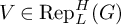 $V \in \operatorname {\mathrm {Rep}}^H_L(G)$
, suppose that
$V \in \operatorname {\mathrm {Rep}}^H_L(G)$
, suppose that ${\mathcal F} \subset \mathcal {O}_X \otimes _L V$
is a sub-object in
${\mathcal F} \subset \mathcal {O}_X \otimes _L V$
is a sub-object in ${\mathcal A}$
, and define
${\mathcal A}$
, and define

This is an L-submodule of V as the tensor product is over L, and further a $L \rtimes G$
- submodule of V, as given
$L \rtimes G$
- submodule of V, as given $g \in G$
and
$g \in G$
and $v \in V$
, then for any open subset
$v \in V$
, then for any open subset $U \subset X$
and
$U \subset X$
and $s \in \mathcal {O}_X(U)$
,
$s \in \mathcal {O}_X(U)$
,
 $$\begin{align*}s \otimes g(v) = g^{\mathcal{O}_X}_{g^{-1}(U)}((g^{-1})^{\mathcal{O}_X}_U(s)) \otimes g(v) = g^{\mathcal{O}_X \otimes V}((g^{-1})^{\mathcal{O}_X}_U(s) \otimes v) \in {\mathcal F}(U). \end{align*}$$
We now claim that the injection $\mathcal {O}_X \otimes _L W \hookrightarrow {\mathcal F}$
is an isomorphism. It is sufficient to show that for all
$\mathcal {O}_X \otimes _L W \hookrightarrow {\mathcal F}$
is an isomorphism. It is sufficient to show that for all $i \in \pi _0(X)$
, the restriction to
$i \in \pi _0(X)$
, the restriction to $X_i$
is surjective, or equivalently that the morphism on sections
$X_i$
is surjective, or equivalently that the morphism on sections
 $$\begin{align*}\mathcal{O}(X_i) \otimes_{L} W \hookrightarrow {\mathcal F}(X_i) \end{align*}$$
is surjective, as each $X_i$
is quasi-Stein. Furthermore, as
$X_i$
is quasi-Stein. Furthermore, as $e_{{\mathfrak o}}$
acts as the identity on
$e_{{\mathfrak o}}$
acts as the identity on $\mathcal {O}(X_i)$
, the inclusion
$\mathcal {O}(X_i)$
, the inclusion $e_{{\mathfrak o}} \cdot W \hookrightarrow W$
induces an isomorphism
$e_{{\mathfrak o}} \cdot W \hookrightarrow W$
induces an isomorphism
 $$\begin{align*}\mathcal{O}(X_i) \otimes_{L_{{\mathfrak o}}} e_{{\mathfrak o}} \cdot W \xrightarrow{\sim} \mathcal{O}(X_i) \otimes_{L} W. \end{align*}$$
The same is true for V, and we have a commutative diagram

where we have defined $M_i$
to be the preimage of
$M_i$
to be the preimage of ${\mathcal F}(X_i)$
in
${\mathcal F}(X_i)$
in $\mathcal {O}(X_i) \otimes _{L_{{\mathfrak o}}} e_{{\mathfrak o}} \cdot V$
. Suppose that
$\mathcal {O}(X_i) \otimes _{L_{{\mathfrak o}}} e_{{\mathfrak o}} \cdot V$
. Suppose that
 $$\begin{align*}z = \sum_{k} s_k \otimes v_k \in M_i \subset \mathcal{O}(X_i) \otimes_{L_{{\mathfrak o}}} e_{{\mathfrak o}} \cdot V, \end{align*}$$
noting that without loss of generality we may assume that the elements $s_k$
are
$s_k$
are $L_{i}$
-linearly independent by choosing a
$L_{i}$
-linearly independent by choosing a $L_{i}$
basis of the
$L_{i}$
basis of the $L_{i}$
-span of
$L_{i}$
-span of $\{s_k\}_k$
and using the isomorphism
$\{s_k\}_k$
and using the isomorphism $L_{{\mathfrak o}} \xrightarrow {\sim } L_i$
.
$L_{{\mathfrak o}} \xrightarrow {\sim } L_i$
.
By assumption (4’) $\mathcal {O}_{X_i}$
is irreducible in
$\mathcal {O}_{X_i}$
is irreducible in ${\mathcal B}_i$
, and thus
${\mathcal B}_i$
, and thus $\mathcal {O}(X_i)$
is irreducible as an R-module (where
$\mathcal {O}(X_i)$
is irreducible as an R-module (where $R = {\mathcal D}(X_i) \rtimes H_i$
in case (A) and
$R = {\mathcal D}(X_i) \rtimes H_i$
in case (A) and $R = \mathcal {O}(X_i) \rtimes H_i$
in case (B)) by [Reference Taylor24, Prop. 2.44] as
$R = \mathcal {O}(X_i) \rtimes H_i$
in case (B)) by [Reference Taylor24, Prop. 2.44] as $X_i$
is quasi-Stein. Furthermore
$X_i$
is quasi-Stein. Furthermore
 $$\begin{align*}\operatorname{\mathrm{End}}_{R}(\mathcal{O}(X_i)) = L_i \end{align*}$$
by the definition of $L_i$
. Therefore, for any index j we may apply the Jacobson Density Theorem to assert the existence of some
$L_i$
. Therefore, for any index j we may apply the Jacobson Density Theorem to assert the existence of some $x_j \in R$
such that
$x_j \in R$
such that $x_j$
acts on the
$x_j$
acts on the $L_i$
-span of
$L_i$
-span of $\{ s_k \}_k$
by the projection to the basis element
$\{ s_k \}_k$
by the projection to the basis element $s_j$
. Because
$s_j$
. Because $H_i$
acts trivially on
$H_i$
acts trivially on $e_{{\mathfrak o}} \cdot V$
, R only acts on the first factor of
$e_{{\mathfrak o}} \cdot V$
, R only acts on the first factor of $\mathcal {O}(X_i) \otimes _{L_{{\mathfrak o}}} e_{{\mathfrak o}} \cdot V$
, and therefore
$\mathcal {O}(X_i) \otimes _{L_{{\mathfrak o}}} e_{{\mathfrak o}} \cdot V$
, and therefore $x_j(z) = s_j \otimes v_j \in {\mathcal F}(X_i)$
, and thus
$x_j(z) = s_j \otimes v_j \in {\mathcal F}(X_i)$
, and thus $1 \otimes v_j \in {\mathcal F}(X_i)$
, using again that
$1 \otimes v_j \in {\mathcal F}(X_i)$
, using again that $\mathcal {O}(X_i)$
is a simple R-module. But then also
$\mathcal {O}(X_i)$
is a simple R-module. But then also $\mathcal {O}_{X_{{\mathfrak o}}} \otimes v_j \subset {\mathcal F}|_{X_{{\mathfrak o}}}$
as
$\mathcal {O}_{X_{{\mathfrak o}}} \otimes v_j \subset {\mathcal F}|_{X_{{\mathfrak o}}}$
as $\mathcal {O}_{X_{{\mathfrak o}}}$
is irreducible in
$\mathcal {O}_{X_{{\mathfrak o}}}$
is irreducible in ${\mathcal B}_{{\mathfrak o}}$
and H acts trivially on V. Therefore, each
${\mathcal B}_{{\mathfrak o}}$
and H acts trivially on V. Therefore, each $v_j \in e_{{\mathfrak o}} \cdot W$
, as we can describe
$v_j \in e_{{\mathfrak o}} \cdot W$
, as we can describe $e_{{\mathfrak o}} \cdot W$
as
$e_{{\mathfrak o}} \cdot W$
as
 $$\begin{align*}e_{{\mathfrak o}} \cdot W = \{v \in V \mid e_{{\mathfrak o}} \cdot v = v \text{ and } s \otimes v \in {\mathcal F}(U) \text{ for any open } U \subset X_{{\mathfrak o}}, s \in \mathcal{O}_{X_{{\mathfrak o}}}(U)\}. \end{align*}$$
In particular, $z \in \mathcal {O}(X_i) \otimes _{L_{{\mathfrak o}}} e_{{\mathfrak o}} \cdot W$
and
$z \in \mathcal {O}(X_i) \otimes _{L_{{\mathfrak o}}} e_{{\mathfrak o}} \cdot W$
and $\mathcal {O}(X_i) \otimes _{L} W \hookrightarrow {\mathcal F}(X_i)$
is surjective.
$\mathcal {O}(X_i) \otimes _{L} W \hookrightarrow {\mathcal F}(X_i)$
is surjective.
Finally, to see that W is free of finite rank over L, as G acts transitively on the orbits ${\mathfrak o}$
, and
${\mathfrak o}$
, and $\dim _{L_{{\mathfrak o}}} e_{{\mathfrak o}} \cdot W \leq \dim _{L_{{\mathfrak o}}} e_{{\mathfrak o}} \cdot V < \infty $
, we may deduce this from Lemma 2.2 once we know that the map
$\dim _{L_{{\mathfrak o}}} e_{{\mathfrak o}} \cdot W \leq \dim _{L_{{\mathfrak o}}} e_{{\mathfrak o}} \cdot V < \infty $
, we may deduce this from Lemma 2.2 once we know that the map
 $$\begin{align*}W \rightarrow \prod_{{\mathfrak o}} e_{{\mathfrak o}} \cdot W \end{align*}$$
is an isomorphism. This is injective, as the corresponding map for V is an isomorphism, V being free over L. For surjectivity, given $(w_{{\mathfrak o}})_{{\mathfrak o}}$
, from the isomorphism for V there is a unique
$(w_{{\mathfrak o}})_{{\mathfrak o}}$
, from the isomorphism for V there is a unique $v \in V$
with
$v \in V$
with $e_{{\mathfrak o}} \cdot v = w_{{\mathfrak o}}$
for all
$e_{{\mathfrak o}} \cdot v = w_{{\mathfrak o}}$
for all ${\mathfrak o} \in I$
. To see that
${\mathfrak o} \in I$
. To see that $v \in W$
, suppose that
$v \in W$
, suppose that $U \subset X$
is an admissible open subset, and
$U \subset X$
is an admissible open subset, and $s = (s_{{\mathfrak o}})_{{\mathfrak o}} \in \prod _{{\mathfrak o}} \mathcal {O}_{X_{\mathfrak o}}(U \cap X_{{\mathfrak o}}) = \mathcal {O}_X(U)$
. Then
$s = (s_{{\mathfrak o}})_{{\mathfrak o}} \in \prod _{{\mathfrak o}} \mathcal {O}_{X_{\mathfrak o}}(U \cap X_{{\mathfrak o}}) = \mathcal {O}_X(U)$
. Then
 $$ \begin{align*} s \otimes v &= (s_{{\mathfrak o}} \otimes v)_{{\mathfrak o}}, \\ &= (e_{{\mathfrak o}} \cdot s_{{\mathfrak o}} \otimes v)_{{\mathfrak o}}, \\ &= (s_{{\mathfrak o}} \otimes e_{{\mathfrak o}} \cdot v)_{{\mathfrak o}}, \\ &= (s_{{\mathfrak o}} \otimes m_{{\mathfrak o}})_{{\mathfrak o}} \end{align*} $$
which lies in $\prod _{{\mathfrak o}} {\mathcal F}(U \cap X_{{\mathfrak o}}) = {\mathcal F}(U)$
and therefore
$\prod _{{\mathfrak o}} {\mathcal F}(U \cap X_{{\mathfrak o}}) = {\mathcal F}(U)$
and therefore $v \in W$
.
$v \in W$
.
Remark 3.7. In case (B), evaluating on the section $1_X \in \mathcal {O}(X)$
induces an isomorphism
$1_X \in \mathcal {O}(X)$
induces an isomorphism
 $$\begin{align*}\operatorname{\mathrm{Hom}}_{{\mathcal B}}(\mathcal{O}_X , {\mathcal V}) \xrightarrow{\sim} {\mathcal V}(X)^H \end{align*}$$
which is natural in ${\mathcal V} \in {\mathcal A}$
. In case (A), this further restricts to a natural isomorphism
${\mathcal V} \in {\mathcal A}$
. In case (A), this further restricts to a natural isomorphism
 $$\begin{align*}\operatorname{\mathrm{Hom}}_{{\mathcal B}}(\mathcal{O}_X , {\mathcal V}) \xrightarrow{\sim} {\mathcal V}(X)^{{\mathcal T}(X) = 0,H} \end{align*}$$
whenever the tangent sheaf ${\mathcal T}$
is generated as an
${\mathcal T}$
is generated as an $\mathcal {O}$
-module by global sections [Reference Ardakov and Wadsley2, Lem. 3.1.4]. Here
$\mathcal {O}$
-module by global sections [Reference Ardakov and Wadsley2, Lem. 3.1.4]. Here ${\mathcal V}(X)^{{\mathcal T}(X) = 0,H}$
denotes the H-invariants of
${\mathcal V}(X)^{{\mathcal T}(X) = 0,H}$
denotes the H-invariants of
 $$\begin{align*}{\mathcal V}(X)^{{\mathcal T}(X) = 0} = \{v \in {\mathcal V}(X) \mid \partial(v) = 0 \text{ for any } \partial \in {\mathcal T}(X)\}. \end{align*}$$
In particular both isomorphisms hold whenever X is a disjoint union of quasi-Stein spaces.
3.1 Properties of
$\operatorname {\mathrm {Rep}}_L^H(G)$

We can translate Lemma 3.3 and Proposition 3.4 of the previous section into properties of the categories $\operatorname {\mathrm {Rep}}_L^H(G)$
.
$\operatorname {\mathrm {Rep}}_L^H(G)$
.
Suppose in this section that $F = \prod _i F_i$
is a product of fields, G is a group which acts on F, and H is a subgroup of G. By Lemma 2.1, G acts on the principal idempotents
$F = \prod _i F_i$
is a product of fields, G is a group which acts on F, and H is a subgroup of G. By Lemma 2.1, G acts on the principal idempotents $\{e_i\}_i$
of F, and we assume that this action is transitive. We additionally assume that G stabilises
$\{e_i\}_i$
of F, and we assume that this action is transitive. We additionally assume that G stabilises  . In particular, this allows us to define a space
 $$\begin{align*}X = \bigsqcup_{i} \operatorname{\mathrm{Spec}}(F_i) \end{align*}$$
with an action of G which satisfies the hypothesis of Section 3 in case (B), and from which we can recover F with its action of G as $F = \mathcal {O}(X)$
.
$F = \mathcal {O}(X)$
.
The category ${\mathbf {Vect}}^G(X)$
is canonically identified with the category of
${\mathbf {Vect}}^G(X)$
is canonically identified with the category of $F \rtimes G$
-modules M for which the natural map
$F \rtimes G$
-modules M for which the natural map
 $$\begin{align*}M \rightarrow \prod_i e_i \cdot M \end{align*}$$
is an isomorphism, and $\dim _{F_i} e_i \cdot M < \infty $
, which by Lemma 2.2 is simply the category
$\dim _{F_i} e_i \cdot M < \infty $
, which by Lemma 2.2 is simply the category $\operatorname {\mathrm {Rep}}_F(G)$
.
$\operatorname {\mathrm {Rep}}_F(G)$
.
Corollary 3.8. Suppose that $V \in \operatorname {\mathrm {Rep}}_F(G)$
. Then the natural map
$V \in \operatorname {\mathrm {Rep}}_F(G)$
. Then the natural map
 $$ \begin{align} F \otimes_L V^H \rightarrow V \end{align} $$
is injective, $V^H$
is free of finite rank over L, and
$V^H$
is free of finite rank over L, and $\text {rank}_L V^H \leq \text {rank}_F V$
.
$\text {rank}_L V^H \leq \text {rank}_F V$
.
Furthermore, the following are equivalent:
-
• The map (3.2) is an isomorphism,
-
•
$F \cdot V^H = V$
, -
•
$\text {rank}_L V^H = \text {rank}_F V$
.


Proof. All that remains to show is that if $\text {rank}_L V^H = \text {rank}_F V$
, then (3.2) is surjective. Writing W for the image of (3.2), it is sufficient to show that the quotient
$\text {rank}_L V^H = \text {rank}_F V$
, then (3.2) is surjective. Writing W for the image of (3.2), it is sufficient to show that the quotient $V / W$
is free, as then
$V / W$
is free, as then $V \cong W \oplus V / W$
and hence
$V \cong W \oplus V / W$
and hence $V / W$
must have rank
$V / W$
must have rank $0$
. For this, by Lemma 2.2 it is sufficient to show that the natural map
$0$
. For this, by Lemma 2.2 it is sufficient to show that the natural map $V/W \xrightarrow {\sim } \prod _i e_i \cdot (V/W)$
is an isomorphism, which follows directly from the isomorphisms
$V/W \xrightarrow {\sim } \prod _i e_i \cdot (V/W)$
is an isomorphism, which follows directly from the isomorphisms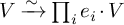 $V \xrightarrow {\sim } \prod _i e_i \cdot V$
and
$V \xrightarrow {\sim } \prod _i e_i \cdot V$
and $W \xrightarrow {\sim } \prod _i e_i \cdot W$
.
$W \xrightarrow {\sim } \prod _i e_i \cdot W$
.
When H is normal in G, $V^H$
is closed under the action of G for any
$V^H$
is closed under the action of G for any $V \in \operatorname {\mathrm {Rep}}_F(G)$
, and therefore the invariants functor from
$V \in \operatorname {\mathrm {Rep}}_F(G)$
, and therefore the invariants functor from $\operatorname {\mathrm {Rep}}_F(G)$
to
$\operatorname {\mathrm {Rep}}_F(G)$
to ${\mathbf {Mod}}_L$
admits a factorisation
${\mathbf {Mod}}_L$
admits a factorisation
 $$\begin{align*}(-)^H \colon \operatorname{\mathrm{Rep}}_F(G) \rightarrow \operatorname{\mathrm{Rep}}^H_L(G). \end{align*}$$
Corollary 3.9. Suppose that F, G and H are as described at the start of this section. Then:
-
1. The functor
is exact, monoidal, and fully faithful.
$$\begin{align*}F \otimes_{L} - \colon \operatorname{\mathrm{Rep}}^H_L(G) \rightarrow \operatorname{\mathrm{Rep}}_F(G) \end{align*}$$
-
2. Suppose that H is normal in G. Then the essential image is the full subcategory of objects
$V \in \operatorname {\mathrm {Rep}}_F(G)$
for which
$F \cdot V^H = V$
, and on this full subcategory is a quasi-inverse to
$$\begin{align*}(-)^H \colon \operatorname{\mathrm{Rep}}_F(G) \rightarrow \operatorname{\mathrm{Rep}}^H_L(G) \end{align*}$$
$F \otimes _{L} -$
.
-
3. The essential image of
$F \otimes _{L} -$
is closed under sub-quotients.





4 Differential operators on Lubin-Tate and Drinfeld spaces
In this section we relate the action of $\operatorname {\mathrm {GL}}_n(F)$
on Drinfeld spaces with the action of the tangent sheaf. We will use this in the following sections to give a description of the categories of Lubin-Tate and Drinfeld bundles in terms of smooth semilinear representations.
$\operatorname {\mathrm {GL}}_n(F)$
on Drinfeld spaces with the action of the tangent sheaf. We will use this in the following sections to give a description of the categories of Lubin-Tate and Drinfeld bundles in terms of smooth semilinear representations.
4.1 Notation
Let F be a finite extension of ${\mathbb Q}_p$
, and let K be a complete non-archimedean field extension of the completion of the maximal unramified extension of F. Let
${\mathbb Q}_p$
, and let K be a complete non-archimedean field extension of the completion of the maximal unramified extension of F. Let $n \geq 1$
, and let D be the division algebra over F of invariant
$n \geq 1$
, and let D be the division algebra over F of invariant $1/n$
, with ring of integers
$1/n$
, with ring of integers $\mathcal {O}_D$
. We write
$\mathcal {O}_D$
. We write $\pi $
for a uniformiser of
$\pi $
for a uniformiser of $\mathcal {O}_F$
and
$\mathcal {O}_F$
and $\Pi $
for a uniformiser of
$\Pi $
for a uniformiser of $\mathcal {O}_D$
. We also consider the extensions
$\mathcal {O}_D$
. We also consider the extensions
 $$\begin{align*}\breve{F} \subset \breve{F}_1 \subset \breve{F}_2 \subset \cdots \end{align*}$$
of the completion of the maximal unramified extension of F, where $\breve {F}_m$
is the compositum of
$\breve {F}_m$
is the compositum of $\breve {F}$
with
$\breve {F}$
with $F_m$
, the mth Lubin-Tate extension of F. Following Kohlhaase [Reference Kohlhaase13], from now on we will denote:
$F_m$
, the mth Lubin-Tate extension of F. Following Kohlhaase [Reference Kohlhaase13], from now on we will denote:

We denote the Drinfeld tower by
 $$\begin{align*}\Omega \leftarrow {\mathcal M} \leftarrow {\mathcal M}_1 \leftarrow {\mathcal M}_2 \cdots \end{align*}$$
which we view via base change as a tower of rigid spaces over K. The space ${\mathcal M}_m$
and
${\mathcal M}_m$
and ${\mathcal M}$
correspond (in the sense of local Shimura varieties [Reference Rapoport and Viehmann20, §5.1]) to the compact open subgroups
${\mathcal M}$
correspond (in the sense of local Shimura varieties [Reference Rapoport and Viehmann20, §5.1]) to the compact open subgroups $H_m$
and
$H_m$
and $H_0$
of H respectively, and correspondingly we have that each map
$H_0$
of H respectively, and correspondingly we have that each map ${\mathcal M}_m \rightarrow {\mathcal M}$
is a finite étale Galois covering with Galois group
${\mathcal M}_m \rightarrow {\mathcal M}$
is a finite étale Galois covering with Galois group $H_0 / H_m$
. Let
$H_0 / H_m$
. Let
 $$\begin{align*}\Omega \xleftarrow{\sim} {\mathcal N} \leftarrow {\mathcal N}_1 \leftarrow {\mathcal N}_2 \cdots \end{align*}$$
denote the subtower induced by choosing a connected component ${\mathcal N}$
of
${\mathcal N}$
of ${\mathcal M}$
and setting
${\mathcal M}$
and setting ${\mathcal N}_m$
to be the preimage of
${\mathcal N}_m$
to be the preimage of ${\mathcal N}$
in
${\mathcal N}$
in ${\mathcal M}_m$
, and write
${\mathcal M}_m$
, and write $f_m \colon {\mathcal N}_m \rightarrow \Omega $
for restriction to
$f_m \colon {\mathcal N}_m \rightarrow \Omega $
for restriction to ${\mathcal N}_m$
of the mth covering map. Note that we are considering a cofinal subtower of that of [Reference Taylor24]: what we denote by
${\mathcal N}_m$
of the mth covering map. Note that we are considering a cofinal subtower of that of [Reference Taylor24]: what we denote by ${\mathcal M}_m$
is called
${\mathcal M}_m$
is called ${\mathcal M}_{nm}$
in [Reference Taylor24] (and similarly for
${\mathcal M}_{nm}$
in [Reference Taylor24] (and similarly for ${\mathcal N}_m$
). Let
${\mathcal N}_m$
). Let
 $$\begin{align*}({\mathbb P}^{n-1} \leftarrow {\mathcal Y}_{U})_{U \leq_{\text{c,o}} G} \end{align*}$$
be the Lubin-Tate tower, indexed by the compact open subgroups U of G. We write ${\mathcal Y} = {\mathcal Y}_0 = {\mathcal Y}_{G_0}$
, and
${\mathcal Y} = {\mathcal Y}_0 = {\mathcal Y}_{G_0}$
, and ${\mathcal Y}_m = {\mathcal Y}_{G_m}$
for
${\mathcal Y}_m = {\mathcal Y}_{G_m}$
for $m \geq 1$
. We note that these are denoted
$m \geq 1$
. We note that these are denoted $\underline {{\mathcal Y}}$
and
$\underline {{\mathcal Y}}$
and $\underline {{\mathcal Y}_m}$
respectively in [Reference Kohlhaase13].
$\underline {{\mathcal Y}_m}$
respectively in [Reference Kohlhaase13].
4.2 The action of
$G_0$
and differential operators

Lemma 4.1. Let $m \geq 1$
, and let U be an admissible affinoid open subset of
$m \geq 1$
, and let U be an admissible affinoid open subset of ${\mathcal N}_m$
.
${\mathcal N}_m$
.
Then there is some $r \geq 1$
such that for any
$r \geq 1$
such that for any $k \geq r$
,
$k \geq r$
,
-
1.
$G_k$
stabilises U, -
2. For any
$g \in G_k$
,
$\log (g^{\mathcal {O}}_U)$
converges to an element of
${\mathcal T}(U)$
, -
3. The image
$\log (G_k)$
generates
${\mathcal T}(U)$
as an
$\mathcal {O}(U)$
-module.


Here, for $g \in G$
,
$g \in G$
, $g^{\mathcal {O}} \colon \mathcal {O}_{{\mathcal N}_m} \rightarrow g^{-1} \mathcal {O}_{{\mathcal N}_m}$
is the structure morphism for the action of G on the G-equivariant sheaf
$g^{\mathcal {O}} \colon \mathcal {O}_{{\mathcal N}_m} \rightarrow g^{-1} \mathcal {O}_{{\mathcal N}_m}$
is the structure morphism for the action of G on the G-equivariant sheaf $\mathcal {O}_{{\mathcal N}_m}$
, and
$\mathcal {O}_{{\mathcal N}_m}$
, and $g^{\mathcal {O}}_U \colon \mathcal {O}(U) \rightarrow \mathcal {O}(g(U))$
are the sections above U, which is a ring automorphism of
$g^{\mathcal {O}}_U \colon \mathcal {O}(U) \rightarrow \mathcal {O}(g(U))$
are the sections above U, which is a ring automorphism of $\mathcal {O}(U)$
whenever
$\mathcal {O}(U)$
whenever $g(U) = U$
(see [Reference Taylor24, §2.6, §2.8]).
$g(U) = U$
(see [Reference Taylor24, §2.6, §2.8]).
Proof. The action of $G^0$
on
$G^0$
on ${\mathcal N}_m$
is continuous in the sense of [Reference Ardakov1, Def. 3.1.8] by [Reference Taylor24, Cor. 7.1], and therefore the stabiliser of U in
${\mathcal N}_m$
is continuous in the sense of [Reference Ardakov1, Def. 3.1.8] by [Reference Taylor24, Cor. 7.1], and therefore the stabiliser of U in $G^0$
is open and thus contains some
$G^0$
is open and thus contains some $G_{s}$
. Set
$G_{s}$
. Set  , and let $\rho \colon G_s \rightarrow \operatorname {\mathrm {Aut}}_K(A)$
denote the action map. Choosing a formal model
$\rho \colon G_s \rightarrow \operatorname {\mathrm {Aut}}_K(A)$
denote the action map. Choosing a formal model ${\mathcal A}$
of A, this defines a topology on
${\mathcal A}$
of A, this defines a topology on $\operatorname {\mathrm {Aut}}_K(A)$
[Reference Ardakov1, Def. 3.1.3] which is independent of the choice of formal model
$\operatorname {\mathrm {Aut}}_K(A)$
[Reference Ardakov1, Def. 3.1.3] which is independent of the choice of formal model ${\mathcal A}$
of A [Reference Ardakov1, Thm. 3.1.5]. The open subgroup
${\mathcal A}$
of A [Reference Ardakov1, Thm. 3.1.5]. The open subgroup ${\mathcal G}_{p^{2}}({\mathcal A}) \subset \operatorname {\mathrm {Aut}}_K(A)$
has the property that for any
${\mathcal G}_{p^{2}}({\mathcal A}) \subset \operatorname {\mathrm {Aut}}_K(A)$
has the property that for any $\varphi \in {\mathcal G}_{p^{2}}({\mathcal A})$
the series
$\varphi \in {\mathcal G}_{p^{2}}({\mathcal A})$
the series $\log (\varphi )$
converges and defines an element of
$\log (\varphi )$
converges and defines an element of $\operatorname {\mathrm {Der}}_{{\mathcal R}}({\mathcal A})$
, where
$\operatorname {\mathrm {Der}}_{{\mathcal R}}({\mathcal A})$
, where ${\mathcal R}$
is the ring of integers of K.
${\mathcal R}$
is the ring of integers of K.
The continuity of the action of $G^0$
on
$G^0$
on ${\mathcal N}_m$
further implies that
${\mathcal N}_m$
further implies that $\rho \colon G_s \rightarrow \operatorname {\mathrm {Aut}}_K(A)$
is continuous, and thus there is some
$\rho \colon G_s \rightarrow \operatorname {\mathrm {Aut}}_K(A)$
is continuous, and thus there is some $G_r \leq G_s$
with
$G_r \leq G_s$
with $\rho (G_r) \subset {\mathcal G}_{p^{2}}({\mathcal A})$
. We therefore have that
$\rho (G_r) \subset {\mathcal G}_{p^{2}}({\mathcal A})$
. We therefore have that $\log (g^{\mathcal {O}}_U)$
converges for any
$\log (g^{\mathcal {O}}_U)$
converges for any $g \in G_r$
to an element of
$g \in G_r$
to an element of $\operatorname {\mathrm {Der}}_{\mathcal R}({\mathcal A})$
, which we consider as a derivation of A via the canonical inclusion
$\operatorname {\mathrm {Der}}_{\mathcal R}({\mathcal A})$
, which we consider as a derivation of A via the canonical inclusion $\operatorname {\mathrm {Der}}_{\mathcal R}({\mathcal A}) \hookrightarrow \operatorname {\mathrm {Der}}_K(A)$
(noting that
$\operatorname {\mathrm {Der}}_{\mathcal R}({\mathcal A}) \hookrightarrow \operatorname {\mathrm {Der}}_K(A)$
(noting that $A = {\mathcal A}[1/p]$
).
$A = {\mathcal A}[1/p]$
).
For the third claim, fix an affine chart ${\mathbb A}_K^{n-1, \text {an}} \subset {\mathbb P}_K^{n-1, \text {an}}$
with
${\mathbb A}_K^{n-1, \text {an}} \subset {\mathbb P}_K^{n-1, \text {an}}$
with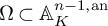 $\Omega \subset {\mathbb A}_K^{n-1, \text {an}}$
, and let
$\Omega \subset {\mathbb A}_K^{n-1, \text {an}}$
, and let $\{\Omega _j\}_{j \geq 1}$
be the quasi-Stein open covering of
$\{\Omega _j\}_{j \geq 1}$
be the quasi-Stein open covering of $\Omega $
defined by setting
$\Omega $
defined by setting $\Omega _j = \Omega \cap {\mathbb D}_j$
, the intersection in
$\Omega _j = \Omega \cap {\mathbb D}_j$
, the intersection in ${\mathbb A}_K^{n-1, \text {an}}$
of
${\mathbb A}_K^{n-1, \text {an}}$
of $\Omega $
with the affinoid
$\Omega $
with the affinoid $(n-1)$
-dimensional ball
$(n-1)$
-dimensional ball ${\mathbb D}_j = \{x \in {\mathbb A}_K^n \mid |x| \leq j\}$
of centre
${\mathbb D}_j = \{x \in {\mathbb A}_K^n \mid |x| \leq j\}$
of centre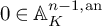 $0 \in {\mathbb A}_K^{n-1, \text {an}}$
and radius j. Let
$0 \in {\mathbb A}_K^{n-1, \text {an}}$
and radius j. Let $\{U_j\}_{j \geq 1}$
be the induced quasi-Stein open covering of
$\{U_j\}_{j \geq 1}$
be the induced quasi-Stein open covering of ${\mathcal N}_m$
, where
${\mathcal N}_m$
, where $U_j$
is the preimage of
$U_j$
is the preimage of $\Omega _j$
in
$\Omega _j$
in ${\mathcal N}_m$
under the
${\mathcal N}_m$
under the $G_0$
-equivariant finite étale map
$G_0$
-equivariant finite étale map ${\mathcal N}_m \rightarrow {\mathcal N} \xrightarrow {\sim } \Omega $
.
${\mathcal N}_m \rightarrow {\mathcal N} \xrightarrow {\sim } \Omega $
.
Because U is quasi-compact, U is contained in some $U_j$
for some
$U_j$
for some $j \geq 1$
, and the composition
$j \geq 1$
, and the composition
 $$\begin{align*}U \hookrightarrow U_j \rightarrow \Omega_j \hookrightarrow {\mathbb D}_j \end{align*}$$
is étale and $G^0$
-equivariant. The tangent sheaf
$G^0$
-equivariant. The tangent sheaf ${\mathcal T}({\mathbb D}_j)$
is generated over
${\mathcal T}({\mathbb D}_j)$
is generated over $\mathcal {O}({\mathbb D}_j)$
by the derivations
$\mathcal {O}({\mathbb D}_j)$
by the derivations

for coordinates $x_1, ... ,x_{n-1}$
of
$x_1, ... ,x_{n-1}$
of ${\mathbb A}^{n-1, \text {an}}$
. By the same argument as above, there is some
${\mathbb A}^{n-1, \text {an}}$
. By the same argument as above, there is some $G_k$
such that
$G_k$
such that $G_k$
stabilises
$G_k$
stabilises ${\mathbb D}_j$
and
${\mathbb D}_j$
and $\log (g^{\mathcal {O}}_{{\mathbb D}_j})$
converges for any
$\log (g^{\mathcal {O}}_{{\mathbb D}_j})$
converges for any $g \in G_k$
which (after potentially going to a smaller congruence subgroup) we may assume is the same
$g \in G_k$
which (after potentially going to a smaller congruence subgroup) we may assume is the same $G_k$
as above. From the formula for the logarithm,
$G_k$
as above. From the formula for the logarithm,
 $$\begin{align*}\pi^k \partial_i = \log(g^{\mathcal{O}}_{i,k, {\mathbb D}_j}) \end{align*}$$
where $g_{i,k} \in G_k$
is the elementary matrix in
$g_{i,k} \in G_k$
is the elementary matrix in $G_k$
which acts by the Möbius transformation which sends
$G_k$
which acts by the Möbius transformation which sends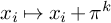 $x_i \mapsto x_i + \pi ^k$
, and fixes each other
$x_i \mapsto x_i + \pi ^k$
, and fixes each other $x_j$
.
$x_j$
.
By [Reference Taylor24, Lem. 2.12], because the morphism $U \rightarrow {\mathbb D}_j$
is étale, for each i there is a unique derivation
$U \rightarrow {\mathbb D}_j$
is étale, for each i there is a unique derivation $\partial ^{\prime }_i$
of
$\partial ^{\prime }_i$
of $\mathcal {O}(U)$
which restricts to
$\mathcal {O}(U)$
which restricts to $\partial _i$
on the image of
$\partial _i$
on the image of $\mathcal {O}({\mathbb D}_j)$
in
$\mathcal {O}({\mathbb D}_j)$
in $\mathcal {O}(U)$
, and these generate
$\mathcal {O}(U)$
, and these generate ${\mathcal T}(U)$
as an
${\mathcal T}(U)$
as an $\mathcal {O}(U)$
-module because the derivations
$\mathcal {O}(U)$
-module because the derivations $\partial _i$
generate
$\partial _i$
generate ${\mathcal T}({\mathbb D}_j)$
as an
${\mathcal T}({\mathbb D}_j)$
as an $\mathcal {O}({\mathbb D}_j)$
-module. Because the morphism
$\mathcal {O}({\mathbb D}_j)$
-module. Because the morphism $\mathcal {O}({\mathbb D}_j) \rightarrow \mathcal {O}(U)$
is continuous (being a morphism of affinoid algebras),
$\mathcal {O}({\mathbb D}_j) \rightarrow \mathcal {O}(U)$
is continuous (being a morphism of affinoid algebras), $\log (g^{\mathcal {O}}_{i,k,U})$
restricts to
$\log (g^{\mathcal {O}}_{i,k,U})$
restricts to $\log (g^{\mathcal {O}}_{i,k,{\mathbb D}_j})$
on the image of
$\log (g^{\mathcal {O}}_{i,k,{\mathbb D}_j})$
on the image of $\mathcal {O}({\mathbb D}_j)$
in
$\mathcal {O}({\mathbb D}_j)$
in $\mathcal {O}(U)$
. In particular, from the uniqueness of
$\mathcal {O}(U)$
. In particular, from the uniqueness of $\partial ^{\prime }_i$
described above,
$\partial ^{\prime }_i$
described above, $\partial ^{\prime }_i$
is explicitly given by
$\partial ^{\prime }_i$
is explicitly given by
 $$\begin{align*}\partial^{\prime}_i = \pi^{-k} \log(g^{\mathcal{O}}_{i,k,U}), \end{align*}$$
and therefore $\log (G_k)$
generates
$\log (G_k)$
generates ${\mathcal T}(U)$
as an
${\mathcal T}(U)$
as an $\mathcal {O}(U)$
-module.
$\mathcal {O}(U)$
-module.
Corollary 4.2. For any connected component X of ${\mathcal N}_m$
,
${\mathcal N}_m$
, $\mathcal {O}_{X}$
is irreducible as a
$\mathcal {O}_{X}$
is irreducible as a $G_m\text {-}\mathcal {O}_{X}$
-module.
$G_m\text {-}\mathcal {O}_{X}$
-module.
Remark 4.3. For the above to make sense, we note that any connected component of ${\mathcal N}_m$
is stabilised by
${\mathcal N}_m$
is stabilised by $G_m$
. Indeed, when K contains
$G_m$
. Indeed, when K contains $\breve {F}_m$
,
$\breve {F}_m$
, $\pi _0({\mathcal N}_m)$
is canonically identified with
$\pi _0({\mathcal N}_m)$
is canonically identified with $\mathcal {O}_F / (1 + \pi ^m \mathcal {O}_F)$
, and the action of
$\mathcal {O}_F / (1 + \pi ^m \mathcal {O}_F)$
, and the action of $G_0$
on
$G_0$
on $\pi _0({\mathcal N}_m)$
corresponds to the action of
$\pi _0({\mathcal N}_m)$
corresponds to the action of $g \in G_0$
on
$g \in G_0$
on $\mathcal {O}_F / (1 + \pi ^m \mathcal {O}_F)$
by left multiplication by
$\mathcal {O}_F / (1 + \pi ^m \mathcal {O}_F)$
by left multiplication by $\det (g)$
[Reference Taylor24, Thm. 7.3]. In particular,
$\det (g)$
[Reference Taylor24, Thm. 7.3]. In particular, $G_m$
acts on
$G_m$
acts on $\pi _0({\mathcal N}_m)$
trivially. For a general K, there is a
$\pi _0({\mathcal N}_m)$
trivially. For a general K, there is a $G_0$
-equivariant surjection
$G_0$
-equivariant surjection $\pi _0({\mathcal N}_{m, K\breve {F}_m}) \twoheadrightarrow \pi _0({\mathcal N}_m)$
, and therefore
$\pi _0({\mathcal N}_{m, K\breve {F}_m}) \twoheadrightarrow \pi _0({\mathcal N}_m)$
, and therefore $G_m$
also acts on
$G_m$
also acts on $\pi _0({\mathcal N}_m)$
trivially.
$\pi _0({\mathcal N}_m)$
trivially.
Proof. To prove statement (1), suppose that ${\mathcal V}$
is a non-trivial
${\mathcal V}$
is a non-trivial $G_m \text {-}\mathcal {O}_{X}$
-submodule of
$G_m \text {-}\mathcal {O}_{X}$
-submodule of $\mathcal {O}_{X}$
. We show that
$\mathcal {O}_{X}$
. We show that ${\mathcal V}$
is in fact a
${\mathcal V}$
is in fact a ${\mathcal D}_{X}$
-submodule of
${\mathcal D}_{X}$
-submodule of $\mathcal {O}_{X}$
, from which it follows that
$\mathcal {O}_{X}$
, from which it follows that ${\mathcal V} = \mathcal {O}_{X}$
as
${\mathcal V} = \mathcal {O}_{X}$
as $\mathcal {O}_{X}$
is irreducible as a
$\mathcal {O}_{X}$
is irreducible as a ${\mathcal D}_{X}$
-module because X is connected [Reference Taylor24, Lem. 2.37].
${\mathcal D}_{X}$
-module because X is connected [Reference Taylor24, Lem. 2.37].
To this end, let $U \subset X$
be a connected admissible open affinoid subset. By Lemma 4.1, we can find some
$U \subset X$
be a connected admissible open affinoid subset. By Lemma 4.1, we can find some $G_k \subset G_m$
such that
$G_k \subset G_m$
such that $G_k$
stabilises U and
$G_k$
stabilises U and $\log (G_k)$
generates
$\log (G_k)$
generates ${\mathcal T}(U)$
as an
${\mathcal T}(U)$
as an $\mathcal {O}(U)$
-module, and thus it is sufficient to show that for any
$\mathcal {O}(U)$
-module, and thus it is sufficient to show that for any $g \in G_k$
and
$g \in G_k$
and $v \in {\mathcal V}(U)$
,
$v \in {\mathcal V}(U)$
, $\log (g_U^{\mathcal {O}})(v) \in {\mathcal V}(U)$
. Because
$\log (g_U^{\mathcal {O}})(v) \in {\mathcal V}(U)$
. Because $\mathcal {O}(U)$
is a noetherian Banach algebra,
$\mathcal {O}(U)$
is a noetherian Banach algebra, ${\mathcal V}(U)$
is closed in the subspace topology [Reference Schneider and Teitelbaum22, Prop. 2.1], and therefore
${\mathcal V}(U)$
is closed in the subspace topology [Reference Schneider and Teitelbaum22, Prop. 2.1], and therefore
 $$\begin{align*}\log(g_U^{\mathcal{O}})(v) = \sum_{k = 1}^{\infty} \frac{(-1)^{k+1}}{k} (g_U^{\mathcal{O}} - 1)^k(v) \in {\mathcal V}(U), \end{align*}$$
as each $(g_U^{\mathcal {O}} - 1)^k(v) \in {\mathcal V}(U)$
by the assumption that
$(g_U^{\mathcal {O}} - 1)^k(v) \in {\mathcal V}(U)$
by the assumption that ${\mathcal V} \subset \mathcal {O}_X$
is a
${\mathcal V} \subset \mathcal {O}_X$
is a $G_m \text {-}\mathcal {O}_{X}$
-submodule.
$G_m \text {-}\mathcal {O}_{X}$
-submodule.
Remark 4.4. For our applications, we will only actually need the consequence that $\mathcal {O}_{{\mathcal N}_m}$
is irreducible in
$\mathcal {O}_{{\mathcal N}_m}$
is irreducible in ${\mathbf {Coh}}^{G_m}({\mathcal N}_m)$
, not in the larger category
${\mathbf {Coh}}^{G_m}({\mathcal N}_m)$
, not in the larger category ${\mathbf {Mod}}(G_m \text {-} \mathcal {O}_{{\mathcal N}_m})$
as we have proven here.
${\mathbf {Mod}}(G_m \text {-} \mathcal {O}_{{\mathcal N}_m})$
as we have proven here.
5
$G_0$
-equivariant Lubin-Tate bundles on
$\Omega $


In this section, we show that the category of $G_0$
-equivariant Lubin-Tate bundles on
$G_0$
-equivariant Lubin-Tate bundles on $\Omega $
introduced by Kohlhaase is equivalent to a certain category of smooth semilinear representations of
$\Omega $
introduced by Kohlhaase is equivalent to a certain category of smooth semilinear representations of $G_0 \times H_0$
.
$G_0 \times H_0$
.
Definition 5.1. For $m \geq 1$
, we set
$m \geq 1$
, we set $K_m = c({\mathcal N}_m)$
.
$K_m = c({\mathcal N}_m)$
.
Here $c(X)$
is the K-algebra of global sections of the sheaf of constant functions [Reference Taylor24, Def. 3.1].
$c(X)$
is the K-algebra of global sections of the sheaf of constant functions [Reference Taylor24, Def. 3.1].
Definition 5.2. An object ${\mathcal V}$
of
${\mathcal V}$
of ${\mathbf {Vect}}^{G_0}(\Omega )$
or
${\mathbf {Vect}}^{G_0}(\Omega )$
or ${\mathbf {VectCon}}^{G_0}(\Omega )$
is Lubin-Tate if the natural map
${\mathbf {VectCon}}^{G_0}(\Omega )$
is Lubin-Tate if the natural map
 $$ \begin{align} \mathcal{O}_{{\mathcal N}_m} \otimes_{K_m} (f_m^*{\mathcal V})({\mathcal N}_m)^{G_m} \rightarrow f_m^*{\mathcal V} \end{align} $$
is an isomorphism for some $m \geq 1$
, in which case we say that
$m \geq 1$
, in which case we say that ${\mathcal V}$
is Lubin-Tate of level m. We let
${\mathcal V}$
is Lubin-Tate of level m. We let
 $$ \begin{align*} {\mathbf{VectCon}}^{G_0}_{\operatorname{\mathrm{LT}}}(\Omega) &= \bigcup_{m \geq 1} {\mathbf{VectCon}}^{G_0}_{\operatorname{\mathrm{LT}},m}(\Omega), \\ {\mathbf{Vect}}^{G_0}_{\operatorname{\mathrm{LT}}}(\Omega) &= \bigcup_{m \geq 1} {\mathbf{Vect}}^{G_0}_{\operatorname{\mathrm{LT}},m}(\Omega), \end{align*} $$
denote the corresponding full subcategories of $G_0$
-equivariant Lubin-Tate bundles on
$G_0$
-equivariant Lubin-Tate bundles on $\Omega $
.
$\Omega $
.
Remark 5.1. In particular, by [Reference Kohlhaase13, Lem. 3.11] and the description of $K_m$
below, the category
$K_m$
below, the category ${\mathbf {Vect}}^{G_0}_{\operatorname {\mathrm {LT}}}(\Omega )$
we have defined agrees with Kohlhaase’s category of
${\mathbf {Vect}}^{G_0}_{\operatorname {\mathrm {LT}}}(\Omega )$
we have defined agrees with Kohlhaase’s category of $G_0$
-equivariant Lubin-Tate bundles.
$G_0$
-equivariant Lubin-Tate bundles.
The product of fields $K_m$
is described by
$K_m$
is described by
 $$\begin{align*}K_m = c({\mathcal N}_m) = c({\mathcal N}_m)^{G_m} = \mathcal{O}({\mathcal N}_m)^{G_m} = K \otimes_{\breve{F}} c({\mathcal N}_{m,\breve{F}}) = K \otimes_{\breve{F}} \breve{F}_m, \end{align*}$$
by a result of Kohlhaase [Reference Kohlhaase13, Thm. 2.8(ii)]. The group $G_0 \times H_0$
acts on
$G_0 \times H_0$
acts on $K_m$
through the right factor, via the composition of the homomorphism
$K_m$
through the right factor, via the composition of the homomorphism
 $$\begin{align*}G_0 \times H_0 \rightarrow \mathcal{O}_F / (1 + \pi^m \mathcal{O}_F), \qquad (g,h) \mapsto \det(g) \operatorname{\mathrm{Nrd}}(h)^{-1}, \end{align*}$$
with the Lubin-Tate isomorphism
 $$\begin{align*}\mathcal{O}_F / (1 + \pi^m \mathcal{O}_F) \xrightarrow{\sim} \operatorname{\mathrm{Gal}}(\breve{F}_m / \breve{F}). \end{align*}$$
With this action, we can consider the semilinear representation category $\operatorname {\mathrm {Rep}}_{K_m}^{Z_m}(G_0 \times H_0)$
.
$\operatorname {\mathrm {Rep}}_{K_m}^{Z_m}(G_0 \times H_0)$
.
We can take the triple $(X, G, H)$
of Section 3 to be
$(X, G, H)$
of Section 3 to be $({\mathcal N}_m, G_0 \times H_0 / H_m, G_m)$
, which in either case (A) or (B) has
$({\mathcal N}_m, G_0 \times H_0 / H_m, G_m)$
, which in either case (A) or (B) has $L = K_m$
by the above discussion. This is preserved by the action of
$L = K_m$
by the above discussion. This is preserved by the action of $G_0 \times H_0$
, and in either case the triple satisfies the assumptions (1), (2), (3) and (4) of Section 3 by Corollary 4.2. In particular, we may compose the functors
$G_0 \times H_0$
, and in either case the triple satisfies the assumptions (1), (2), (3) and (4) of Section 3 by Corollary 4.2. In particular, we may compose the functors $(\mathcal {O}_{{\mathcal N}_m} \otimes _{K_m} -)$
of Section 3 with the equivalence of [Reference Taylor24, Prop. 2.53] (which also holds for vector bundles without connection, using the same proof), to obtain functors
$(\mathcal {O}_{{\mathcal N}_m} \otimes _{K_m} -)$
of Section 3 with the equivalence of [Reference Taylor24, Prop. 2.53] (which also holds for vector bundles without connection, using the same proof), to obtain functors
 $$ \begin{align} \begin{aligned} (\mathcal{O}_{{\mathcal N}_m} \otimes_{K_m} -)^{H_0} &\colon \operatorname{\mathrm{Rep}}^{Z_m}_{K_m}(G_0 \times H_0) \rightarrow {\mathbf{VectCon}}^{H_0 / H_m \times G_0}({\mathcal N}_m) \xrightarrow{\sim} {\mathbf{VectCon}}^{G_0}(\Omega), \\ (\mathcal{O}_{{\mathcal N}_m} \otimes_{K_m} -)^{H_0} &\colon \operatorname{\mathrm{Rep}}^{Z_m}_{K_m}(G_0 \times H_0) \rightarrow {\mathbf{Vect}}^{H_0 / H_m \times G_0}({\mathcal N}_m) \xrightarrow{\sim} {\mathbf{Vect}}^{G_0}(\Omega). \end{aligned} \end{align} $$
Proposition 5.2. For $m \geq 1$
, the map (5.1) is always injective, and the composite functors (5.2) are exact, monoidal, and fully faithful. The essential images are
$m \geq 1$
, the map (5.1) is always injective, and the composite functors (5.2) are exact, monoidal, and fully faithful. The essential images are ${\mathbf {VectCon}}^{G_0}_{\operatorname {\mathrm {LT}},m}(\Omega )$
and
${\mathbf {VectCon}}^{G_0}_{\operatorname {\mathrm {LT}},m}(\Omega )$
and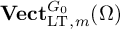 ${\mathbf {Vect}}^{G_0}_{\operatorname {\mathrm {LT}},m}(\Omega )$
respectively, both of which are closed under sub-quotients. In particular, the canonical restriction map
${\mathbf {Vect}}^{G_0}_{\operatorname {\mathrm {LT}},m}(\Omega )$
respectively, both of which are closed under sub-quotients. In particular, the canonical restriction map
 $$\begin{align*}{\mathbf{VectCon}}^{G_0}_{\operatorname{\mathrm{LT}},m}(\Omega) \rightarrow {\mathbf{Vect}}^{G_0}_{\operatorname{\mathrm{LT}},m}(\Omega) \end{align*}$$
is an equivalence of categories.
Proof. The map (5.1) is the canonical injection of Lemma 3.3, using Remark 3.7 and the fact that ${\mathcal N}_m$
is quasi-Stein. Then the result follows directly from Proposition 3.4, using that
${\mathcal N}_m$
is quasi-Stein. Then the result follows directly from Proposition 3.4, using that ${\mathcal N}_m$
is quasi-Stein of finite dimension to give that the image is closed under sub-quotients.
${\mathcal N}_m$
is quasi-Stein of finite dimension to give that the image is closed under sub-quotients.
For $m' \geq m$
, there is a fully faithful inclusion functor
$m' \geq m$
, there is a fully faithful inclusion functor
 $$\begin{align*}K_{m'} \otimes_{K_m} - \colon \operatorname{\mathrm{Rep}}^{Z_m}_{K_m}(G_0 \times H_0) \rightarrow \operatorname{\mathrm{Rep}}^{Z_{m'}}_{K_{m'}}(G_0 \times H_0), \end{align*}$$
and this is compatible with inclusion of Lubin-Tate bundles of levels m and $m'$
in the sense that
$m'$
in the sense that

commutes. In particular, we see that if ${\mathcal V} \in {\mathbf {Vect}}^{G_0}(\Omega )$
is Lubin-Tate of level m, it is Lubin-Tate of level
${\mathcal V} \in {\mathbf {Vect}}^{G_0}(\Omega )$
is Lubin-Tate of level m, it is Lubin-Tate of level $m'$
for all
$m'$
for all $m' \geq m$
(and similarly for
$m' \geq m$
(and similarly for ${\mathbf {VectCon}}^{G_0}(\Omega )$
). We can use this to describe the whole categories
${\mathbf {VectCon}}^{G_0}(\Omega )$
). We can use this to describe the whole categories ${\mathbf {Vect}}^{G_0}_{\operatorname {\mathrm {LT}}}(\Omega )$
and
${\mathbf {Vect}}^{G_0}_{\operatorname {\mathrm {LT}}}(\Omega )$
and ${\mathbf {VectCon}}^{G_0}_{\operatorname {\mathrm {LT}}}(\Omega )$
in terms of smooth semilinear representations of
${\mathbf {VectCon}}^{G_0}_{\operatorname {\mathrm {LT}}}(\Omega )$
in terms of smooth semilinear representations of $G_0 \times H_0$
.
$G_0 \times H_0$
.
Definition 5.3. We write $\breve {F}_{\infty }$
for the union of the fields
$\breve {F}_{\infty }$
for the union of the fields $\breve {F}_m$
, and set
$\breve {F}_m$
, and set
 $$\begin{align*}K_{\infty} = \varinjlim_{m \geq 1} K_m = K \otimes_{\breve{F}} \breve{F}_{\infty}, \end{align*}$$
which we consider with its natural action of $G_0 \times H_0$
through the factor
$G_0 \times H_0$
through the factor $\breve {F}_{\infty }$
as above.
$\breve {F}_{\infty }$
as above.
For each $m \geq 1$
, there is a canonical inclusion functor
$m \geq 1$
, there is a canonical inclusion functor
 $$\begin{align*}K_{\infty} \otimes_{K_m} - \colon \operatorname{\mathrm{Rep}}^{Z_m}_{K_m}(G_0 \times H_0) \rightarrow \operatorname{\mathrm{Rep}}_{K_{\infty}}(G_0 \times H_0), \end{align*}$$
the essential image of which we denote by $\operatorname {\mathrm {Rep}}^m_{K_{\infty }}(G_0 \times H_0)$
.
$\operatorname {\mathrm {Rep}}^m_{K_{\infty }}(G_0 \times H_0)$
.
Lemma 5.3. The category $\operatorname {\mathrm {Rep}}^m_{K_{\infty }}(G_0 \times H_0)$
is intrinsically described as
$\operatorname {\mathrm {Rep}}^m_{K_{\infty }}(G_0 \times H_0)$
is intrinsically described as
 $$\begin{align*}\operatorname{\mathrm{Rep}}^m_{K_{\infty}}(G_0 \times H_0) = \{V \in \operatorname{\mathrm{Rep}}_{K_{\infty}}(G_0 \times H_0) \mid K_{\infty} \cdot V^{Z_m} = V \}, \end{align*}$$
and is closed under sub-quotients. Furthermore, on this full subcategory
 $$\begin{align*}(-)^{Z_m} \colon \operatorname{\mathrm{Rep}}^m_{K_{\infty}}(G_0 \times H_0) \rightarrow \operatorname{\mathrm{Rep}}^{Z_m}_{K_m}(G_0 \times H_0) \end{align*}$$
is a quasi-inverse to the exact, monoidal, fully faithful functor $K_{\infty } \otimes _{K_m} -$
, and in
$K_{\infty } \otimes _{K_m} -$
, and in $\operatorname {\mathrm {Rep}}_{K_{\infty }}(G_0 \times H_0)$
 $$\begin{align*}\operatorname{\mathrm{Rep}}^{\operatorname{\mathrm{sm}}}_{K_{\infty}}(G_0 \times H_0) = \bigcup_{m \geq 1} \operatorname{\mathrm{Rep}}^{m}_{K_{\infty}}(G_0 \times H_0). \end{align*}$$
Proof. This follows directly from Corollary 3.9 as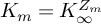 $K_m = K_{\infty }^{Z_m}$
. The final claim follows from the description of
$K_m = K_{\infty }^{Z_m}$
. The final claim follows from the description of $\operatorname {\mathrm {Rep}}^m_{K_{\infty }}(G_0 \times H_0)$
, and the fact that the subgroups
$\operatorname {\mathrm {Rep}}^m_{K_{\infty }}(G_0 \times H_0)$
, and the fact that the subgroups $Z_m$
form a neighbourhood basis of the identity in
$Z_m$
form a neighbourhood basis of the identity in $G_0 \times H_0$
.
$G_0 \times H_0$
.
We therefore have equivalences

which are compatible by the above discussion and we may therefore take the direct limit

Because $\Phi _{\operatorname {\mathrm {LT}},m}^0$
is an equivalence at each level, we have the following.
$\Phi _{\operatorname {\mathrm {LT}},m}^0$
is an equivalence at each level, we have the following.
Theorem 5.4. The functors
 $$\begin{align*}\operatorname{\mathrm{Rep}}^{\operatorname{\mathrm{sm}}}_{K_{\infty}}(G_0 \times H_0) \xrightarrow{\Phi^0_{\operatorname{\mathrm{LT}}}} {\mathbf{VectCon}}^{G_0}_{\operatorname{\mathrm{LT}}}(\Omega) \rightarrow {\mathbf{Vect}}^{G_0}_{\operatorname{\mathrm{LT}}}(\Omega) \end{align*}$$
are equivalences of categories.
5.1
$H_0$
-equivariant Drinfeld bundles on
${\mathcal Y}$


Kohlhaase defined equivalences,

where ${\mathbf {Vect}}^{H_0}_{\operatorname {\mathrm {Dr}}}({\mathcal Y})$
is an analogously defined category of
${\mathbf {Vect}}^{H_0}_{\operatorname {\mathrm {Dr}}}({\mathcal Y})$
is an analogously defined category of $H_0$
-equivariant Drinfeld bundles on
$H_0$
-equivariant Drinfeld bundles on ${\mathcal Y}$
.
${\mathcal Y}$
.
We can similarly define, for each level $m \geq 1$
,
$m \geq 1$
,
 $$\begin{align*}(\mathcal{O}_{{\mathcal Y}_m} \otimes_{K_m} -)^{G_0} \colon \operatorname{\mathrm{Rep}}^{Z_m}_{K_m}(G_0 \times H_0) \rightarrow {\mathbf{Vect}}^{G_0/G_m \times H_0}({\mathcal Y}_m) \xrightarrow{\sim} {\mathbf{Vect}}^{H_0}({\mathcal Y}) \end{align*}$$
with essential image denoted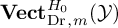 ${\mathbf {Vect}}^{H_0}_{\operatorname {\mathrm {Dr}},m}({\mathcal Y})$
, and have functors
${\mathbf {Vect}}^{H_0}_{\operatorname {\mathrm {Dr}},m}({\mathcal Y})$
, and have functors

for which we can take the direct limit

We can deduce that $\Phi ^0_{\operatorname {\mathrm {Dr}}}$
and each
$\Phi ^0_{\operatorname {\mathrm {Dr}}}$
and each $\Phi _{\operatorname {\mathrm {Dr}},m}^0$
are equivalences from the following compatibility result.
$\Phi _{\operatorname {\mathrm {Dr}},m}^0$
are equivalences from the following compatibility result.
Proposition 5.5. For any $m \geq 1$
, the composition
$m \geq 1$
, the composition
 $$\begin{align*}\operatorname{\mathrm{Rep}}^{Z_m}_{K_m}(G_0 \times H_0) \xrightarrow{\Phi^0_{\operatorname{\mathrm{LT}},m}} {\mathbf{Vect}}^{G_0}_{\operatorname{\mathrm{LT}}}(\Omega) \xrightarrow{{\mathbb D}_{\operatorname{\mathrm{LT}}}} {\mathbf{Vect}}^{H_0}_{\operatorname{\mathrm{Dr}},m}({\mathcal Y}) \end{align*}$$
is naturally isomorphic to $\Phi _{\operatorname {\mathrm {Dr}},m}^0$
and
$\Phi _{\operatorname {\mathrm {Dr}},m}^0$
and $\Phi _{\operatorname {\mathrm {Dr}},m}^0$
is an equivalence. In particular, the composition
$\Phi _{\operatorname {\mathrm {Dr}},m}^0$
is an equivalence. In particular, the composition
 $$\begin{align*}\operatorname{\mathrm{Rep}}_{K_{\infty}}^{\operatorname{\mathrm{sm}}}(G_0 \times H_0) \xrightarrow{\Phi^0_{\operatorname{\mathrm{LT}}}} {\mathbf{Vect}}^{G_0}_{\operatorname{\mathrm{LT}}}(\Omega) \xrightarrow{{\mathbb D}_{\operatorname{\mathrm{LT}}}} {\mathbf{Vect}}^{H_0}_{\operatorname{\mathrm{Dr}}}({\mathcal Y}) \end{align*}$$
is naturally isomorphic to $\Phi ^0_{\operatorname {\mathrm {Dr}}}$
and
$\Phi ^0_{\operatorname {\mathrm {Dr}}}$
and $\Phi ^0_{\operatorname {\mathrm {Dr}}}$
is an equivalence.
$\Phi ^0_{\operatorname {\mathrm {Dr}}}$
is an equivalence.
Proof. For $m \geq 1$
, suppose that
$m \geq 1$
, suppose that ${\mathcal V} \in {\mathbf {Vect}}^{G_0}_{\operatorname {\mathrm {LT}}}(\Omega )$
. As all spaces are quasi-Stein, it is sufficient to give the isomorphism on global sections. Writing
${\mathcal V} \in {\mathbf {Vect}}^{G_0}_{\operatorname {\mathrm {LT}}}(\Omega )$
. As all spaces are quasi-Stein, it is sufficient to give the isomorphism on global sections. Writing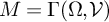 $M = \Gamma (\Omega , {\mathcal V})$
, then in the notation of [Reference Kohlhaase13],
$M = \Gamma (\Omega , {\mathcal V})$
, then in the notation of [Reference Kohlhaase13],
 $$ \begin{align*} \Gamma(\Omega, {\mathbb D}_{\operatorname{\mathrm{LT}}}({\mathcal V})) &= (C_m \otimes_{A_0} M)^{G_0}, \\ &\equiv (B_m \hat{\otimes}_{K_m} A_m \otimes_{A_0} M)^{G_0},\\ &\equiv (B_m \hat{\otimes}_{K_m} (A_m \otimes_{A_0} M)^{G_m})^{G_0 / G_m}, \\ &\equiv (B_m \hat{\otimes}_{K_m} (A_m \otimes_{K_m} V)^{G_m})^{G_0 / G_m}. \end{align*} $$
Here for the third equality we use [Reference Kohlhaase13, Lem. 3.3] and the fact that $G_m$
acts trivially on
$G_m$
acts trivially on $B_m$
. In particular, if
$B_m$
. In particular, if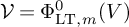 ${\mathcal V} = \Phi ^0_{\operatorname {\mathrm {LT}},m}(V)$
, then
${\mathcal V} = \Phi ^0_{\operatorname {\mathrm {LT}},m}(V)$
, then $A_m \otimes _{A_0} M = A_m \otimes _{K_m} V$
and
$A_m \otimes _{A_0} M = A_m \otimes _{K_m} V$
and
 $$ \begin{align*} B_m \hat{\otimes}_{K_m} (A_m \otimes_{A_0} M)^{G_m} &= B_m \hat{\otimes}_{K_m} (A_m \otimes_{K_m} V)^{G_m}, \\ &= B_m \hat{\otimes}_{K_m} (K_m \otimes_{K_m} V), \\ &\equiv B_m \otimes_{K_m} V, \end{align*} $$
using that $G_m$
acts trivially on V, and thus there is a natural isomorphism
$G_m$
acts trivially on V, and thus there is a natural isomorphism
 $$ \begin{align*} \Gamma(\Omega, {\mathbb D}_{\operatorname{\mathrm{LT}}}(\Phi^0_{\operatorname{\mathrm{LT}},m}(V))) &\equiv (B_m \otimes_{K_m} V)^{G_0 / G_m}, \\ &= \Gamma(\Omega, \Phi^0_{\operatorname{\mathrm{Dr}},m}(V)). \\[-38pt] \end{align*} $$
Remark 5.6. One can define analogous categories ${\mathbf {VectCon}}^{G_0}_{\operatorname {\mathrm {LT}}}(\Omega )$
and
${\mathbf {VectCon}}^{G_0}_{\operatorname {\mathrm {LT}}}(\Omega )$
and ${\mathbf {VectCon}}^{H_0}_{\operatorname {\mathrm {Dr}}}({\mathcal Y})$
, and by defining appropriate
${\mathbf {VectCon}}^{H_0}_{\operatorname {\mathrm {Dr}}}({\mathcal Y})$
, and by defining appropriate ${\mathcal D}$
-module structures extend Kohlhaase’s equivalences to equivalences
${\mathcal D}$
-module structures extend Kohlhaase’s equivalences to equivalences

which are extensions in the sense that there are natural forgetful maps from these categories to those of Kohlhaase for which the diagram

commutes. With these equivalences, one can further check that the natural isomorphisms of Proposition 5.5 respect the ${\mathcal D}$
-module structure, and hence that Proposition 5.5 continues to hold with
${\mathcal D}$
-module structure, and hence that Proposition 5.5 continues to hold with ${\mathbf {Vect}}$
replaced by
${\mathbf {Vect}}$
replaced by ${\mathbf {VectCon}}$
everywhere.
${\mathbf {VectCon}}$
everywhere.
5.2 Applications
From now on we focus on the Drinfeld side, but in light of Section 5.1 all the following results can be translated to the Lubin-Tate side. In this section we apply the results of Section 5 and Section 3.1 to understand the categories ${\mathbf {VectCon}}^{G_0}_{\operatorname {\mathrm {LT}}}(\Omega )$
and
${\mathbf {VectCon}}^{G_0}_{\operatorname {\mathrm {LT}}}(\Omega )$
and ${\mathbf {Vect}}^{G_0}_{\operatorname {\mathrm {LT}}}(\Omega )$
. First, we have the following immediate consequence.
${\mathbf {Vect}}^{G_0}_{\operatorname {\mathrm {LT}}}(\Omega )$
. First, we have the following immediate consequence.
Corollary 5.7. The categories ${\mathbf {VectCon}}^{G_0}_{\operatorname {\mathrm {LT}}}(\Omega )$
and
${\mathbf {VectCon}}^{G_0}_{\operatorname {\mathrm {LT}}}(\Omega )$
and ${\mathbf {Vect}}^{G_0}_{\operatorname {\mathrm {LT}}}(\Omega )$
are semisimple.
${\mathbf {Vect}}^{G_0}_{\operatorname {\mathrm {LT}}}(\Omega )$
are semisimple.
Proof. Each category $\operatorname {\mathrm {Rep}}_{K_m}^{Z_m}(G_0 \times H_0)$
is semisimple, by [Reference Montgomery17, Cor. 0.2]. Each inclusion
$\operatorname {\mathrm {Rep}}_{K_m}^{Z_m}(G_0 \times H_0)$
is semisimple, by [Reference Montgomery17, Cor. 0.2]. Each inclusion
 $$\begin{align*}K_{\infty} \otimes_{K_m} - \colon \operatorname{\mathrm{Rep}}_{K_m}^{Z_m}(G_0 \times H_0) \xrightarrow{\sim} \operatorname{\mathrm{Rep}}_{K_{\infty}}^m(G_0 \times H_0) \hookrightarrow \operatorname{\mathrm{Rep}}^{\operatorname{\mathrm{sm}}}_{K_{\infty}}(G_0 \times H_0) \end{align*}$$
is closed under sub-quotients by Lemma 5.3 and thus $\operatorname {\mathrm {Rep}}^{\operatorname {\mathrm {sm}}}_{K_{\infty }}(G_0 \times H_0)$
is semisimple.
$\operatorname {\mathrm {Rep}}^{\operatorname {\mathrm {sm}}}_{K_{\infty }}(G_0 \times H_0)$
is semisimple.
Remark 5.8. Both ${\mathbf {VectCon}}^{G_0}_{\operatorname {\mathrm {LT}}}(\Omega )$
and
${\mathbf {VectCon}}^{G_0}_{\operatorname {\mathrm {LT}}}(\Omega )$
and ${\mathbf {Vect}}^{G_0}_{\operatorname {\mathrm {LT}}}(\Omega )$
are closed under sub-quotients in the ambient categories
${\mathbf {Vect}}^{G_0}_{\operatorname {\mathrm {LT}}}(\Omega )$
are closed under sub-quotients in the ambient categories ${\mathbf {VectCon}}^{G_0}(\Omega )$
and
${\mathbf {VectCon}}^{G_0}(\Omega )$
and ${\mathbf {Vect}}^{G_0}(\Omega )$
by Proposition 3.4. Therefore any semisimple decomposition is also semisimple in the larger category.
${\mathbf {Vect}}^{G_0}(\Omega )$
by Proposition 3.4. Therefore any semisimple decomposition is also semisimple in the larger category.
In light of Theorem 5.4, to understand ${\mathbf {VectCon}}^{G_0}_{\operatorname {\mathrm {LT}}}(\Omega )$
and
${\mathbf {VectCon}}^{G_0}_{\operatorname {\mathrm {LT}}}(\Omega )$
and ${\mathbf {Vect}}^{G_0}_{\operatorname {\mathrm {LT}}}(\Omega )$
we are reduced to understanding the category
${\mathbf {Vect}}^{G_0}_{\operatorname {\mathrm {LT}}}(\Omega )$
we are reduced to understanding the category $\operatorname {\mathrm {Rep}}^{\operatorname {\mathrm {sm}}}_{K_{\infty }}(G_0 \times H_0)$
. One source of objects is the category
$\operatorname {\mathrm {Rep}}^{\operatorname {\mathrm {sm}}}_{K_{\infty }}(G_0 \times H_0)$
. One source of objects is the category $\operatorname {\mathrm {Rep}}^{\operatorname {\mathrm {sm}}}_K(G_0 \times H_0)$
.
$\operatorname {\mathrm {Rep}}^{\operatorname {\mathrm {sm}}}_K(G_0 \times H_0)$
.
Definition 5.4. We denote by $K_{\infty } \otimes _K -$
the canonical base change functor
$K_{\infty } \otimes _K -$
the canonical base change functor
 $$\begin{align*}K_{\infty} \otimes_K - \colon \operatorname{\mathrm{Rep}}^{\operatorname{\mathrm{sm}}}_K(G_0 \times H_0) \rightarrow \operatorname{\mathrm{Rep}}^{\operatorname{\mathrm{sm}}}_{K_{\infty}}(G_0 \times H_0) \end{align*}$$
from the category of smooth (linear) representations of $G_0 \times H_0$
over K, and set
$G_0 \times H_0$
over K, and set
 $$\begin{align*}\Psi^0_{G \times H}(-) = \Phi^0_{\operatorname{\mathrm{LT}}}(K_{\infty} \otimes_K -) \colon \operatorname{\mathrm{Rep}}_K^{\operatorname{\mathrm{sm}}}(G_0 \times H_0) \rightarrow {\mathbf{VectCon}}^{G_0}_{\operatorname{\mathrm{LT}}}(\Omega) \end{align*}$$
for the composition of $K_{\infty } \otimes _K -$
with the equivalence
$K_{\infty } \otimes _K -$
with the equivalence $\Phi ^0_{\operatorname {\mathrm {LT}}}$
.
$\Phi ^0_{\operatorname {\mathrm {LT}}}$
.
Remark 5.9. By abuse of notation we also write $\Psi ^0_{G \times H}$
for the composition of
$\Psi ^0_{G \times H}$
for the composition of $\Psi ^0_{G \times H}$
with the forgetful map to
$\Psi ^0_{G \times H}$
with the forgetful map to ${\mathbf {Vect}}^{G_0}_{\operatorname {\mathrm {LT}}}(\Omega )$
. Additionally, if
${\mathbf {Vect}}^{G_0}_{\operatorname {\mathrm {LT}}}(\Omega )$
. Additionally, if $V \in \operatorname {\mathrm {Rep}}_{K}^{Z_m}(G_0 \times H_0)$
, then as the diagram
$V \in \operatorname {\mathrm {Rep}}_{K}^{Z_m}(G_0 \times H_0)$
, then as the diagram

commutes, the associated Lubin-Tate bundle is explicitly described by
 $$ \begin{align} \begin{aligned} \Psi^0_{G \times H}(V) &= \Phi^0_{\operatorname{\mathrm{LT}},m}(K_m \otimes_K V), \\ &= (\mathcal{O}_{{\mathcal N}_m} \otimes_{K_m} (K_m \otimes_K V))^{H_0/H_m}, \\ &= (\mathcal{O}_{{\mathcal N}_m} \otimes_K V)^{H_0/H_m}. \end{aligned} \end{align} $$
Definition 5.5. We define
 $$ \begin{align*} \Psi_{G}^0 &\colon \operatorname{\mathrm{Rep}}_K^{\operatorname{\mathrm{sm}}}(G_0) \rightarrow {\mathbf{VectCon}}_{\operatorname{\mathrm{LT}}}^{G_0}(\Omega),\\ \Psi_{H}^0 &\colon \operatorname{\mathrm{Rep}}_K^{\operatorname{\mathrm{sm}}}(H_0) \rightarrow {\mathbf{VectCon}}_{\operatorname{\mathrm{LT}}}^{G_0}(\Omega), \end{align*} $$
to each be the post-composition of $\Psi ^0_{G \times H}$
with the respective inflation functor
$\Psi ^0_{G \times H}$
with the respective inflation functor
 $$ \begin{align*} \operatorname{\mathrm{Rep}}_K^{\operatorname{\mathrm{sm}}}(G_0) \rightarrow \operatorname{\mathrm{Rep}}_K^{\operatorname{\mathrm{sm}}}(G_0 \times H_0),\\ \operatorname{\mathrm{Rep}}_K^{\operatorname{\mathrm{sm}}}(H_0) \rightarrow \operatorname{\mathrm{Rep}}_K^{\operatorname{\mathrm{sm}}}(G_0 \times H_0), \end{align*} $$
induced by the corresponding projection from $G_0 \times H_0$
to
$G_0 \times H_0$
to $G_0$
or
$G_0$
or $H_0$
.
$H_0$
.
Similarly to above, when composed with the forgetful equivalence, these give functors to ${\mathbf {Vect}}_{\operatorname {\mathrm {LT}}}^{G_0}(\Omega )$
which we also denote by
${\mathbf {Vect}}_{\operatorname {\mathrm {LT}}}^{G_0}(\Omega )$
which we also denote by $\Psi _G^0$
and
$\Psi _G^0$
and $\Psi _H^0$
. Kohlhaase also considered functors from
$\Psi _H^0$
. Kohlhaase also considered functors from $\operatorname {\mathrm {Rep}}_K^{\operatorname {\mathrm {sm}}}(G_0)$
and
$\operatorname {\mathrm {Rep}}_K^{\operatorname {\mathrm {sm}}}(G_0)$
and $\operatorname {\mathrm {Rep}}_K^{\operatorname {\mathrm {sm}}}(H_0)$
to
$\operatorname {\mathrm {Rep}}_K^{\operatorname {\mathrm {sm}}}(H_0)$
to ${\mathbf {Vect}}_{\operatorname {\mathrm {LT}}}^{G_0}(\Omega )$
[Reference Kohlhaase13, Thm. 3.8]. The following shows that these coincide with
${\mathbf {Vect}}_{\operatorname {\mathrm {LT}}}^{G_0}(\Omega )$
[Reference Kohlhaase13, Thm. 3.8]. The following shows that these coincide with $\Psi _{G}^0$
and
$\Psi _{G}^0$
and $\Psi _{H}^0$
.
$\Psi _{H}^0$
.
Lemma 5.10. For $V \in \operatorname {\mathrm {Rep}}_K^{\operatorname {\mathrm {sm}}}(G_0)$
and
$V \in \operatorname {\mathrm {Rep}}_K^{\operatorname {\mathrm {sm}}}(G_0)$
and $W \in \operatorname {\mathrm {Rep}}_K^{\operatorname {\mathrm {sm}}}(H_0)$
there are natural isomorphisms,
$W \in \operatorname {\mathrm {Rep}}_K^{\operatorname {\mathrm {sm}}}(H_0)$
there are natural isomorphisms,
 $$ \begin{align*} \Psi_{G}^0(V) &\cong \mathcal{O}_{\Omega} \otimes_K V, \\ \Psi_{H}^0(W) &\cong {\mathbb D}_{\operatorname{\mathrm{LT}}}(\mathcal{O}_{{\mathcal Y}} \otimes_K W) \end{align*} $$
in ${\mathbf {Vect}}_{\operatorname {\mathrm {LT}}}^{G_0}(\Omega )$
.
${\mathbf {Vect}}_{\operatorname {\mathrm {LT}}}^{G_0}(\Omega )$
.
Proof. From the explicit description (5.3) above, if $G_m$
acts trivially on V, then
$G_m$
acts trivially on V, then
 $$ \begin{align*} \Psi_{G}^0(V) &= (\mathcal{O}_{{\mathcal N}_m} \otimes_K V)^{H_0/H_m}, \\ &= \mathcal{O}_{{\mathcal N}_m}^{H_0/H_m} \otimes_K V, \\ &= \mathcal{O}_{\Omega} \otimes_K V \end{align*} $$
because $H_0$
acts trivially on V. The claim for
$H_0$
acts trivially on V. The claim for $\Psi _{H}^0(W)$
follows similarly using Proposition 5.5.
$\Psi _{H}^0(W)$
follows similarly using Proposition 5.5.
Lemma 5.11. The functors $\Psi _{G}^0$
and
$\Psi _{G}^0$
and $\Psi _{H}^0$
are fully faithful and preserve irreducibility.
$\Psi _{H}^0$
are fully faithful and preserve irreducibility.
Proof. This follows directly from Corollary 3.9 with triples $(K_{\infty }, G_0 \times H_0,H_0)$
and
$(K_{\infty }, G_0 \times H_0,H_0)$
and $(K_{\infty }, G_0 \times H_0,G_0)$
respectively, as
$(K_{\infty }, G_0 \times H_0,G_0)$
respectively, as $K_{\infty }^{G_0} = K = K_{\infty }^{H_0}$
.
$K_{\infty }^{G_0} = K = K_{\infty }^{H_0}$
.
Using $\Psi _{G}^0$
and
$\Psi _{G}^0$
and $\Psi _{H}^0$
, we can describe the category of
$\Psi _{H}^0$
, we can describe the category of $G_0$
-equivariant Lubin-Tate bundles more concretely when
$G_0$
-equivariant Lubin-Tate bundles more concretely when $n = 1$
.
$n = 1$
.
Lemma 5.12. When $n=1$
, each functor of the diagram
$n=1$
, each functor of the diagram
 $$\begin{align*}\operatorname{\mathrm{Rep}}_K^{\operatorname{\mathrm{sm}}}(G_0) \xrightarrow{K_{\infty} \otimes_K -} \operatorname{\mathrm{Rep}}_{K_{\infty}}^{\operatorname{\mathrm{sm}}}(G_0 \times H_0) \xrightarrow{\Phi_{\operatorname{\mathrm{LT}}}^0} {\mathbf{VectCon}}^{G_0}_{\operatorname{\mathrm{LT}}}(\Omega) \xrightarrow{\sim} {\mathbf{Vect}}^{G_0}_{\operatorname{\mathrm{LT}}}(\Omega), \end{align*}$$
is an equivalence, and the same holds for $\operatorname {\mathrm {Rep}}_K^{\operatorname {\mathrm {sm}}}(G_0)$
replaced with
$\operatorname {\mathrm {Rep}}_K^{\operatorname {\mathrm {sm}}}(G_0)$
replaced with $\operatorname {\mathrm {Rep}}_K^{\operatorname {\mathrm {sm}}}(H_0)$
.
$\operatorname {\mathrm {Rep}}_K^{\operatorname {\mathrm {sm}}}(H_0)$
.
In particular, when $n = 1$
both
$n = 1$
both $\Psi _G^0$
and
$\Psi _G^0$
and $\Psi _H^0$
are equivalences of categories.
$\Psi _H^0$
are equivalences of categories.
Proof. The functor $K_{\infty } \otimes _K -$
is the direct limit of the functors
$K_{\infty } \otimes _K -$
is the direct limit of the functors
 $$\begin{align*}K_m \otimes_K - \colon \operatorname{\mathrm{Rep}}_K(G_0 / G_m) \rightarrow \operatorname{\mathrm{Rep}}_{K_m}(G_0 / G_m \times H_0/H_m), \end{align*}$$
which are equivalences with inverse $(-)^{H_0 / H_m}$
when
$(-)^{H_0 / H_m}$
when $n = 1$
by Galois descent [Reference Taylor24, Prop. 2.53], as
$n = 1$
by Galois descent [Reference Taylor24, Prop. 2.53], as $H_0 / H_m$
is the Galois group of
$H_0 / H_m$
is the Galois group of $K_m / K$
. The same holds similarly for
$K_m / K$
. The same holds similarly for $G_0$
and
$G_0$
and $H_0$
swapped.
$H_0$
swapped.
However for $n \geq 2$
, the essential images of
$n \geq 2$
, the essential images of $\Psi _G^0$
and
$\Psi _G^0$
and $\Psi _H^0$
will not coincide in general, as was noted by Kohlhaase [Reference Kohlhaase13, Rem. 3.9]. From the work we have done above, we can now give a precise description of the intersection of the essential images of
$\Psi _H^0$
will not coincide in general, as was noted by Kohlhaase [Reference Kohlhaase13, Rem. 3.9]. From the work we have done above, we can now give a precise description of the intersection of the essential images of $\Psi _G^0$
and
$\Psi _G^0$
and $\Psi _H^0$
.
$\Psi _H^0$
.
Theorem 5.13. The intersection of the essential images of $\Psi _G^0$
and
$\Psi _G^0$
and $\Psi _H^0$
is the full subcategory consisting of objects
$\Psi _H^0$
is the full subcategory consisting of objects
 $$\begin{align*}\Psi_G^0(V) = \mathcal{O}_{\Omega} \otimes V \end{align*}$$
for $V \in \operatorname {\mathrm {Rep}}_K^{\operatorname {\mathrm {sm}}}(\mathcal {O}_F^\times )$
, viewed as an object of
$V \in \operatorname {\mathrm {Rep}}_K^{\operatorname {\mathrm {sm}}}(\mathcal {O}_F^\times )$
, viewed as an object of $\operatorname {\mathrm {Rep}}_K^{\operatorname {\mathrm {sm}}}(G_0)$
via inflation along
$\operatorname {\mathrm {Rep}}_K^{\operatorname {\mathrm {sm}}}(G_0)$
via inflation along $\det \colon G_0 \rightarrow \mathcal {O}_F^\times $
.
$\det \colon G_0 \rightarrow \mathcal {O}_F^\times $
.
Remark 5.14. When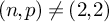 $(n,p) \neq (2,2)$
the determinant
$(n,p) \neq (2,2)$
the determinant $\det \colon G_0 \rightarrow \mathcal {O}_F^{\times }$
is an abelianisation of
$\det \colon G_0 \rightarrow \mathcal {O}_F^{\times }$
is an abelianisation of $G_0$
[Reference Litoff16], and therefore when K is a splitting field for
$G_0$
[Reference Litoff16], and therefore when K is a splitting field for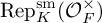 $\operatorname {\mathrm {Rep}}_K^{\operatorname {\mathrm {sm}}}(\mathcal {O}_F^\times )$
(e.g. if K is algebraically closed), then the intersection of Proposition 5.13 is simply the full subcategory of direct sums of
$\operatorname {\mathrm {Rep}}_K^{\operatorname {\mathrm {sm}}}(\mathcal {O}_F^\times )$
(e.g. if K is algebraically closed), then the intersection of Proposition 5.13 is simply the full subcategory of direct sums of $\mathcal {O}_{\Omega } \otimes \chi $
, for
$\mathcal {O}_{\Omega } \otimes \chi $
, for $\chi $
a smooth character of
$\chi $
a smooth character of $G_0$
over K.
$G_0$
over K.
Proof. Fix an object $V \in \operatorname {\mathrm {Rep}}_K^{\operatorname {\mathrm {sm}}}(G_0)$
, and let
$V \in \operatorname {\mathrm {Rep}}_K^{\operatorname {\mathrm {sm}}}(G_0)$
, and let $m \geq 1$
be such that
$m \geq 1$
be such that $V^{G_m} = V$
. We take L to be a finite extension of K which is a splitting field for the group
$V^{G_m} = V$
. We take L to be a finite extension of K which is a splitting field for the group  , and set
  (which has an action of $G_0 \times H_0$
which is trivial on the first component). We first note that by Theorem 5.4 and Lemma 5.3, the following statements are equivalent:
$G_0 \times H_0$
which is trivial on the first component). We first note that by Theorem 5.4 and Lemma 5.3, the following statements are equivalent:
-
•
$\Psi _G^0(V)$
is in the essential image of
$\Psi _H^0 \colon \operatorname {\mathrm {Rep}}_K^{\operatorname {\mathrm {sm}}}(H_0) \rightarrow {\mathbf {Vect}}^{G_0}_{\operatorname {\mathrm {LT}}}(\Omega )$
, -
•
$K_{\infty } \otimes _K V$
is in the essential image of
$K_{\infty } \otimes _K - \colon \operatorname {\mathrm {Rep}}_K^{\operatorname {\mathrm {sm}}}(H_0) \rightarrow \operatorname {\mathrm {Rep}}_{K_{\infty }}^{\operatorname {\mathrm {sm}}}(G_0 \times H_0)$
, -
•
$K_m \otimes _K V$
is in the essential image of
$K_{m} \otimes _K - \colon \operatorname {\mathrm {Rep}}_K^{H_m}(H_0) \rightarrow \operatorname {\mathrm {Rep}}_{K_m}^{Z_m}(G_0 \times H_0)$
.





We are therefore reduced to showing that this final condition is equivalent to V being inflated from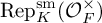 $\operatorname {\mathrm {Rep}}_K^{\operatorname {\mathrm {sm}}}(\mathcal {O}_F^\times )$
. We first consider
$\operatorname {\mathrm {Rep}}_K^{\operatorname {\mathrm {sm}}}(\mathcal {O}_F^\times )$
. We first consider $V_L$
. Taking the triple
$V_L$
. Taking the triple $(F,G,H)$
in Corollary 3.8 and Corollary 3.9 to be
$(F,G,H)$
in Corollary 3.8 and Corollary 3.9 to be $(L_m, G_0 \times H_0, G_0)$
, this essential image of the functor
$(L_m, G_0 \times H_0, G_0)$
, this essential image of the functor
 $$\begin{align*}L_m \otimes_L - \colon \operatorname{\mathrm{Rep}}_L^{H_m}(H_0) \rightarrow \operatorname{\mathrm{Rep}}^{Z_m}_{L_{m}}(G_0 \times H_0), \end{align*}$$
consists of exactly those U for which the inequality
 $$\begin{align*}\dim_L U^{G_0/G_m} \leq \dim_{L_m}(U) \end{align*}$$
is an equality. Taking $U = L_m \otimes _L V_L$
this inequality becomes
$U = L_m \otimes _L V_L$
this inequality becomes
 $$ \begin{align} \dim_L(L_m \otimes_L V_L)^{G_0/ G_m} \leq \dim_K V_L. \end{align} $$
By the normal basis theorem [Reference Chase, Harrison and Rosenberg8, Thm. 4.2(c)] we have that $L_m \cong L[A]$
as
$L_m \cong L[A]$
as $L[A]$
-modules because
$L[A]$
-modules because $L_m/L$
is Galois with Galois group A. Writing
$L_m/L$
is Galois with Galois group A. Writing $V_L$
as the direct sum of irreducible representations
$V_L$
as the direct sum of irreducible representations $V_i$
, the inequality (5.4) is an equality if and only it is for each
$V_i$
, the inequality (5.4) is an equality if and only it is for each $V_i$
, and, by our assumption that L is a splitting field of A, (5.4) is an equality for a fixed
$V_i$
, and, by our assumption that L is a splitting field of A, (5.4) is an equality for a fixed $V_i$
if and only if some twist of
$V_i$
if and only if some twist of $V_i$
by an inflated character of A is trivial, or equivalently that
$V_i$
by an inflated character of A is trivial, or equivalently that $V_i$
is an inflated character of A.
$V_i$
is an inflated character of A.
In summary, $L_m \otimes _L V_L$
is in the essential image of the functor
$L_m \otimes _L V_L$
is in the essential image of the functor $L_m \otimes _L -$
above if and only if
$L_m \otimes _L -$
above if and only if $V_L$
is inflated from a smooth representation of
$V_L$
is inflated from a smooth representation of $\mathcal {O}_F^\times $
. In particular, if
$\mathcal {O}_F^\times $
. In particular, if $K_m \otimes _K V \cong K_m \otimes _K W$
for some
$K_m \otimes _K V \cong K_m \otimes _K W$
for some $W \in \operatorname {\mathrm {Rep}}_K^{H_m}(H_0)$
, then
$W \in \operatorname {\mathrm {Rep}}_K^{H_m}(H_0)$
, then $V_L \cong W_L$
and
$V_L \cong W_L$
and $V_L$
is in the essential image of
$V_L$
is in the essential image of $L_m \otimes _L -$
, so
$L_m \otimes _L -$
, so $V_L$
and hence V is inflated from a smooth representation of
$V_L$
and hence V is inflated from a smooth representation of $\mathcal {O}_F^\times $
. Conversely, suppose that V is inflated from a smooth representation of
$\mathcal {O}_F^\times $
. Conversely, suppose that V is inflated from a smooth representation of $\mathcal {O}_F^\times $
. Then
$\mathcal {O}_F^\times $
. Then $V_L$
is too and hence
$V_L$
is too and hence $L_m \otimes _L V_L$
is in the essential image of
$L_m \otimes _L V_L$
is in the essential image of $L_m \otimes _L -$
. We claim that
$L_m \otimes _L -$
. We claim that $K_m \otimes V \cong K_m \otimes W$
for
$K_m \otimes V \cong K_m \otimes W$
for  . Indeed, the natural map
 $$\begin{align*}K_m \otimes_K W \rightarrow V \end{align*}$$
is an isomorphism, because after applying $L \otimes _K -$
it becomes the map
$L \otimes _K -$
it becomes the map
 $$\begin{align*}L_m \otimes_L (L_m \otimes_L V_L)^{G_0 / G_m} \rightarrow L_m \otimes_L V_L, \end{align*}$$
Remark 5.15. In fact, using the results of [Reference Taylor26] it is possible to show that $\Psi ^0_G(\chi ) \cong \Psi _H^0(\chi )$
for any smooth character
$\Psi ^0_G(\chi ) \cong \Psi _H^0(\chi )$
for any smooth character $\chi $
of
$\chi $
of $\mathcal {O}_F^\times $
viewed as a character of
$\mathcal {O}_F^\times $
viewed as a character of $G_0$
and
$G_0$
and $H_0$
by inflation along
$H_0$
by inflation along $\det $
and
$\det $
and $\operatorname {\mathrm {Nrd}}$
. Later, we will show that the analogous statement for the groups G and H holds (cf. Theorem 8.1). For any such
$\operatorname {\mathrm {Nrd}}$
. Later, we will show that the analogous statement for the groups G and H holds (cf. Theorem 8.1). For any such $\chi $
as above,
$\chi $
as above, $\chi \otimes 1$
and
$\chi \otimes 1$
and $1 \otimes \chi $
are non-isomorphic objects of
$1 \otimes \chi $
are non-isomorphic objects of $\operatorname {\mathrm {Rep}}^{\operatorname {\mathrm {sm}}}_K(G_0 \times H_0)$
which become isomorphic in
$\operatorname {\mathrm {Rep}}^{\operatorname {\mathrm {sm}}}_K(G_0 \times H_0)$
which become isomorphic in $\operatorname {\mathrm {Rep}}^{\operatorname {\mathrm {sm}}}_{K_{\infty }}(G_0 \times H_0)$
. In particular, unlike both
$\operatorname {\mathrm {Rep}}^{\operatorname {\mathrm {sm}}}_{K_{\infty }}(G_0 \times H_0)$
. In particular, unlike both $\Psi ^0_{G}$
and
$\Psi ^0_{G}$
and $\Psi ^0_{H}$
, the functor
$\Psi ^0_{H}$
, the functor $\Psi ^0_{G \times H}$
is not fully faithful.
$\Psi ^0_{G \times H}$
is not fully faithful.
Again, using the results of [Reference Taylor26] it is possible to show that $\Psi ^0_{G \times H}$
is not essentially surjective in general. However, one can at least show that each object of
$\Psi ^0_{G \times H}$
is not essentially surjective in general. However, one can at least show that each object of ${\mathbf {Vect}}^{G_0}_{\operatorname {\mathrm {LT}}}(\Omega )$
is a sub-object of an object in its essential image. On the other hand, we will show that the analogous functor
${\mathbf {Vect}}^{G_0}_{\operatorname {\mathrm {LT}}}(\Omega )$
is a sub-object of an object in its essential image. On the other hand, we will show that the analogous functor $\Psi _{G \times H}$
for the groups G and H is in fact essentially surjective (cf. Theorem 6.10).
$\Psi _{G \times H}$
for the groups G and H is in fact essentially surjective (cf. Theorem 6.10).
6
G-equivariant Lubin-Tate bundles on
$\Omega $

In this section, we show that the category of G-equivariant Lubin-Tate bundles on $\Omega $
defined by Kohlhaase is equivalent to the category of finite-dimensional smooth representations of H over K.
$\Omega $
defined by Kohlhaase is equivalent to the category of finite-dimensional smooth representations of H over K.
Definition 6.1. An object ${\mathcal V}$
of
${\mathcal V}$
of ${\mathbf {Vect}}^{G}(\Omega )$
or
${\mathbf {Vect}}^{G}(\Omega )$
or ${\mathbf {VectCon}}^G(\Omega )$
is Lubin-Tate if the restriction
${\mathbf {VectCon}}^G(\Omega )$
is Lubin-Tate if the restriction
 $$\begin{align*}{\mathcal V} |_{G_0} \in {\mathbf{Vect}}^{G_0}_{\operatorname{\mathrm{LT}}}(\Omega) \subset {\mathbf{Vect}}^{G_0}(\Omega), \end{align*}$$
and further that ${\mathcal V}$
is Lubin-Tate of level m if the same is true of
${\mathcal V}$
is Lubin-Tate of level m if the same is true of ${\mathcal V}|_{G_0}$
. We let
${\mathcal V}|_{G_0}$
. We let
 $$ \begin{align*} {\mathbf{VectCon}}^{G}_{\operatorname{\mathrm{LT}}}(\Omega) &= \bigcup_{m \geq 1} {\mathbf{VectCon}}^{G}_{\operatorname{\mathrm{LT}},m}(\Omega), \\ {\mathbf{Vect}}^{G}_{\operatorname{\mathrm{LT}}}(\Omega) &= \bigcup_{m \geq 1} {\mathbf{Vect}}^{G}_{\operatorname{\mathrm{LT}},m}(\Omega), \end{align*} $$
denote the corresponding full subcategories of G-equivariant Lubin-Tate bundles on $\Omega $
.
$\Omega $
.
Remark 6.1. The category ${\mathbf {Vect}}^G_{\operatorname {\mathrm {LT}}}(\Omega )$
agrees with that defined by Kohlhaase [Reference Kohlhaase13, Def. 4.2].
${\mathbf {Vect}}^G_{\operatorname {\mathrm {LT}}}(\Omega )$
agrees with that defined by Kohlhaase [Reference Kohlhaase13, Def. 4.2].
To construct objects of ${\mathbf {Vect}}^G_{\operatorname {\mathrm {LT}}}(\Omega )$
and
${\mathbf {Vect}}^G_{\operatorname {\mathrm {LT}}}(\Omega )$
and ${\mathbf {VectCon}}^G_{\operatorname {\mathrm {LT}}}(\Omega )$
one can use the functors of Section 3.
${\mathbf {VectCon}}^G_{\operatorname {\mathrm {LT}}}(\Omega )$
one can use the functors of Section 3.
Definition 6.2. For $m \geq 1$
, we set
$m \geq 1$
, we set  .
.
The space ${\mathcal M}_m$
is the disjoint union of spaces
${\mathcal M}_m$
is the disjoint union of spaces
 $$\begin{align*}{\mathcal M}_m = \bigsqcup_{i \in {\mathbb Z}} {\mathcal M}_m^i, \end{align*}$$
where ${\mathcal M}_m^0 = {\mathcal N}_m$
, and the action of the uniformiser
${\mathcal M}_m^0 = {\mathcal N}_m$
, and the action of the uniformiser $\Pi $
of D in H induces
$\Pi $
of D in H induces $G^0$
-equivariant isomorphisms
$G^0$
-equivariant isomorphisms $\Pi ^i \colon {\mathcal M}^i_m \xrightarrow {\sim } {\mathcal M}^0_m = {\mathcal N}_m$
[Reference Taylor24, §7.1]. From this,
$\Pi ^i \colon {\mathcal M}^i_m \xrightarrow {\sim } {\mathcal M}^0_m = {\mathcal N}_m$
[Reference Taylor24, §7.1]. From this,
 $$\begin{align*}c({\mathcal M}_m^i) = \mathcal{O}({\mathcal M}_m^i)^{G_m} \end{align*}$$
because $c({\mathcal N}_m) = \mathcal {O}({\mathcal N}_m)^{G_m}$
(see Section 5), and therefore
$c({\mathcal N}_m) = \mathcal {O}({\mathcal N}_m)^{G_m}$
(see Section 5), and therefore
 $$\begin{align*}L_m = c({\mathcal M}_m) = \prod_{i \in {\mathbb Z}} c({\mathcal M}_m^i) = \prod_{i \in {\mathbb Z}} \mathcal{O}({\mathcal M}_m^i)^{G_m} = \mathcal{O}({\mathcal M}_m)^{G_m}. \end{align*}$$
In particular, the triple $(X,G,H) = ({\mathcal M}_m, G \times H/H_m, G_m)$
fits into the formalism of Section 3 with
$(X,G,H) = ({\mathcal M}_m, G \times H/H_m, G_m)$
fits into the formalism of Section 3 with $L_m$
equal to the K-algebra L of Section 3 in either case (A) or (B).
$L_m$
equal to the K-algebra L of Section 3 in either case (A) or (B).
For example, using this approach one obtains functors
 $$\begin{align*}(\mathcal{O}_{{\mathcal M}_m} \otimes_{L_m} -)^H \colon \operatorname{\mathrm{Rep}}_{L_m}^{H_m \times G_m}(G \times H) \rightarrow {\mathbf{Vect}}^{G}_{\operatorname{\mathrm{LT}}, m}(\Omega). \end{align*}$$
However, unlike with the $G^0$
-equivariant Lubin-Tate bundles considered above, the subgroup
$G^0$
-equivariant Lubin-Tate bundles considered above, the subgroup $G_m \leq G$
is no longer normal, and so the functor (cf. Remark 3.7)
$G_m \leq G$
is no longer normal, and so the functor (cf. Remark 3.7)
 $$\begin{align*}(\mathcal{O}({\mathcal M}_m) \otimes_{\mathcal{O}(\Omega)} (-)(\Omega))^{G_m} \colon {\mathbf{Vect}}^{G}(\Omega) \rightarrow {\mathbf{Mod}}_{L_m} \end{align*}$$
doesn’t obviously factor through the forgetful map $\operatorname {\mathrm {Rep}}_{L_m}^{H_m \times G_m}(G \times H) \rightarrow {\mathbf {Mod}}_{L_m}$
and give us a candidate inverse functor.
$\operatorname {\mathrm {Rep}}_{L_m}^{H_m \times G_m}(G \times H) \rightarrow {\mathbf {Mod}}_{L_m}$
and give us a candidate inverse functor.
The key result of this section is an alternative definition of a G-equivariant Lubin-Tate bundle, which fixes this issue, and gives a semilinear representation theoretic description of this category.
Definition 6.3. For $m \geq 1$
, set
$m \geq 1$
, set $G^m = \det ^{-1}(1 + \pi ^m \mathcal {O}_F)$
.
$G^m = \det ^{-1}(1 + \pi ^m \mathcal {O}_F)$
.
We have that $G^m \leq G^0$
and
$G^m \leq G^0$
and $G^m$
acts on
$G^m$
acts on $K_m$
through the determinant action considered at the start of Section 4, and hence
$K_m$
through the determinant action considered at the start of Section 4, and hence
 $$\begin{align*}\mathcal{O}({\mathcal N}_m)^{G_m} = K_m = \mathcal{O}({\mathcal N}_m)^{G^m}. \end{align*}$$
The action of the uniformiser of H induces $G^0$
-equivariant isomorphisms
$G^0$
-equivariant isomorphisms $K_m \xrightarrow {\sim } c({\mathcal M}_m^i) $
, and thus
$K_m \xrightarrow {\sim } c({\mathcal M}_m^i) $
, and thus
 $$\begin{align*}\mathcal{O}({\mathcal M}_m)^{G_m} = \prod_{i \in {\mathbb Z}} \mathcal{O}({\mathcal M}_m^i)^{G_m} = L_m = \prod_{i \in {\mathbb Z}} \mathcal{O}({\mathcal M}_m^i)^{G^m} = \mathcal{O}({\mathcal M}_m)^{G^m}. \end{align*}$$
We can interpret this as a statement about Lubin-Tate bundles, namely that for any $m \geq 1$
the trivial Lubin-Tate bundle
$m \geq 1$
the trivial Lubin-Tate bundle ${\mathcal V} = \mathcal {O} \in {\mathbf {Vect}}^G(\Omega )$
satisfies
${\mathcal V} = \mathcal {O} \in {\mathbf {Vect}}^G(\Omega )$
satisfies
 $$\begin{align*}(f_m^*{\mathcal V})({\mathcal M}_m)^{G_m} = \mathcal{O}({\mathcal M}_m)^{G_m} = L_m = \mathcal{O}({\mathcal M}_m)^{G^m} = (f_m^*{\mathcal V})({\mathcal M}_m)^{G^m}. \end{align*}$$
The following asserts that this is actually true of any Lubin-Tate bundle of level m.
Lemma 6.2. Suppose that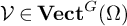 ${\mathcal V} \in {\mathbf {Vect}}^{G}(\Omega )$
,
${\mathcal V} \in {\mathbf {Vect}}^{G}(\Omega )$
, $m \geq 1$
, and set
$m \geq 1$
, and set

Then the following are equivalent:
-
1.
${\mathcal V} \in {\mathbf {Vect}}^{G}_{\operatorname {\mathrm {LT}},m}(\Omega )$
, -
2.
${\mathcal V} \in {\mathbf {Vect}}^{G}_{\operatorname {\mathrm {LT}},m}(\Omega )$
and
${\mathcal W}({\mathcal N}_m)^{G_m} = {\mathcal W}({\mathcal N}_m)^{G^m}$
, -
3. The natural map
is an isomorphism.
$$\begin{align*}\mathcal{O}_{{\mathcal M}_m} \otimes_{L_m} {\mathcal W}({\mathcal M}_m)^{G^m} \rightarrow {\mathcal W} \end{align*}$$




The same holds with ${\mathbf {Vect}}$
replaced with
${\mathbf {Vect}}$
replaced with ${\mathbf {VectCon}}$
throughout.
${\mathbf {VectCon}}$
throughout.
Proof. Note that ${\mathcal V}$
is Lubin-Tate if and only if the natural map
${\mathcal V}$
is Lubin-Tate if and only if the natural map
 $$\begin{align*}\mathcal{O}_{{\mathcal N}_m} \otimes_{K_m} {\mathcal W}({\mathcal N}_m)^{G_m} \rightarrow {\mathcal W}|_{{\mathcal N}_m} \end{align*}$$
is an isomorphism, or equivalently if and only if the natural map
 $$\begin{align*}\mathcal{O}_{{\mathcal M}_m} \otimes_{L_m} {\mathcal W}({\mathcal M}_m)^{G_m} \rightarrow {\mathcal W} \end{align*}$$
is an isomorphism, as the action of a uniformiser of H provides $G^0$
-equivariant isomorphisms
$G^0$
-equivariant isomorphisms
 $$\begin{align*}{\mathcal W}({\mathcal N}_m) = {\mathcal W}({\mathcal M}_m^0) \xrightarrow{\sim} {\mathcal W}({\mathcal M}_m^i) \end{align*}$$
for all $i \in {\mathbb Z}$
, which are compatible with the actions of
$i \in {\mathbb Z}$
, which are compatible with the actions of $\mathcal {O}({\mathcal N}_m)$
and
$\mathcal {O}({\mathcal N}_m)$
and $\mathcal {O}({\mathcal M}_m^i)$
. In particular, it is immediate that
$\mathcal {O}({\mathcal M}_m^i)$
. In particular, it is immediate that $(3)$
implies
$(3)$
implies $(1)$
, as
$(1)$
, as ${\mathcal W}({\mathcal N}_m)^{G^m} \subset {\mathcal W}({\mathcal N}_m)^{G_m}$
, and that
${\mathcal W}({\mathcal N}_m)^{G^m} \subset {\mathcal W}({\mathcal N}_m)^{G_m}$
, and that $(2)$
implies
$(2)$
implies $(3)$
.
$(3)$
.
In order to see that $(1)$
implies
$(1)$
implies $(2)$
, suppose that
$(2)$
, suppose that ${\mathcal V}$
is Lubin-Tate of level m. We want to show that
${\mathcal V}$
is Lubin-Tate of level m. We want to show that ${\mathcal W}({\mathcal N}_m)^{G_m} = {\mathcal W}({\mathcal N}_m)^{G^m}$
. Note that because
${\mathcal W}({\mathcal N}_m)^{G_m} = {\mathcal W}({\mathcal N}_m)^{G^m}$
. Note that because $G^m = \operatorname {\mathrm {SL}}_n(F) G_m$
, we are reduced to showing that if
$G^m = \operatorname {\mathrm {SL}}_n(F) G_m$
, we are reduced to showing that if $z \in {\mathcal W}({\mathcal N}_m)^{G_m}$
, then z is fixed by all
$z \in {\mathcal W}({\mathcal N}_m)^{G_m}$
, then z is fixed by all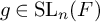 $g \in \operatorname {\mathrm {SL}}_n(F)$
. For any
$g \in \operatorname {\mathrm {SL}}_n(F)$
. For any $t \geq m$
, we have a
$t \geq m$
, we have a $K_t \rtimes G^0$
-module
$K_t \rtimes G^0$
-module

and, because these actions are compatible, a $K_{\infty } \rtimes G^0$
-module
$K_{\infty } \rtimes G^0$
-module

A priori, it is not clear that $\operatorname {\mathrm {SL}}_n(F)$
even preserves
$\operatorname {\mathrm {SL}}_n(F)$
even preserves $V_m^{G_m}$
. However, the inclusion
$V_m^{G_m}$
. However, the inclusion $V_m \hookrightarrow V_\infty $
is
$V_m \hookrightarrow V_\infty $
is $G^0$
-equivariant, and hence
$G^0$
-equivariant, and hence
 $$\begin{align*}V_m^{G_m} \hookrightarrow V_{\infty}^{G_m} \hookrightarrow V_{\infty}^{G^0\text{-}\operatorname{\mathrm{sm}}}. \end{align*}$$
Therefore, if we can show that $\operatorname {\mathrm {SL}}_n(F)$
acts trivially on
$\operatorname {\mathrm {SL}}_n(F)$
acts trivially on $V_{\infty }^{G^0\text {-}\operatorname {\mathrm {sm}}}$
, it must also act trivially on
$V_{\infty }^{G^0\text {-}\operatorname {\mathrm {sm}}}$
, it must also act trivially on $V_m^{G_m}$
.
$V_m^{G_m}$
.
From the definition ${\mathcal V}$
being Lubin-Tate of level m, we have that
${\mathcal V}$
being Lubin-Tate of level m, we have that
 $$\begin{align*}\mathcal{O}({\mathcal N}_m) \otimes_{K_m} V_m^{G_m} \xrightarrow{\sim} V_m \end{align*}$$
and so applying $\mathcal {O}({\mathcal N}_t) \otimes _{\mathcal {O}({\mathcal N}_m)} - $
,
$\mathcal {O}({\mathcal N}_t) \otimes _{\mathcal {O}({\mathcal N}_m)} - $
,
 $$\begin{align*}\mathcal{O}({\mathcal N}_t) \otimes_{K_m} V_m^{G_m} \xrightarrow{\sim} \mathcal{O}({\mathcal N}_t) \otimes_{\mathcal{O}({\mathcal N}_m)} V_m. \end{align*}$$
The right-hand side is nothing but $V_t$
, and when we take the
$V_t$
, and when we take the $G_t$
-invariants this becomes
$G_t$
-invariants this becomes
 $$\begin{align*}K_t \otimes_{K_m} V_m^{G_m} \xrightarrow{\sim} V_t^{G_t} \end{align*}$$
because $\mathcal {O}({\mathcal N}_t)^{G_t} = K_t$
and the action of
$\mathcal {O}({\mathcal N}_t)^{G_t} = K_t$
and the action of $G_t$
on
$G_t$
on $V_m^{G_m}$
is trivial. In particular,
$V_m^{G_m}$
is trivial. In particular,
 $$ \begin{align*} \begin{array}{llclc} V_{\infty}^{G^0\text{-}\operatorname{\mathrm{sm}}} &=& \displaystyle{\bigcup_{r \geq m} V_{\infty}^{G_r}} & = &\displaystyle{\bigcup_{r \geq m} \left( \varinjlim_{t \geq m} V_t \right)^{G_r}} \\ &=& \displaystyle{\varinjlim_{r,t \geq m} V_t^{G_r}} &=& \displaystyle{\varinjlim_{t \geq m} V_t^{G_t}} \\ &\cong& \displaystyle{\varinjlim_{t \geq m} K_t \otimes_{K_m} V_m^{G_m}} &\cong& {K_{\infty} \otimes_{K_m} V_m^{G_m}}, \end{array} \end{align*} $$
where we have used that the diagonal is cofinal in the direct limit. In particular, $V_{\infty }^{G^0\text {-}\operatorname {\mathrm {sm}}}$
is a smooth
$V_{\infty }^{G^0\text {-}\operatorname {\mathrm {sm}}}$
is a smooth $K_{\infty }[\operatorname {\mathrm {SL}}_n(F)]$
-module, which is free of finite rank over
$K_{\infty }[\operatorname {\mathrm {SL}}_n(F)]$
-module, which is free of finite rank over $K_{\infty }$
, because the same is true of
$K_{\infty }$
, because the same is true of $V_m$
over
$V_m$
over $K_m$
, and hence
$K_m$
, and hence $\operatorname {\mathrm {SL}}_n(F)$
has to act trivially by the following lemma.
$\operatorname {\mathrm {SL}}_n(F)$
has to act trivially by the following lemma.
Lemma 6.3. The only open normal subgroup of $\operatorname {\mathrm {SL}}_n(F)$
is
$\operatorname {\mathrm {SL}}_n(F)$
is $\operatorname {\mathrm {SL}}_n(F)$
.
$\operatorname {\mathrm {SL}}_n(F)$
.
Proof. Write Z for the centre of $\operatorname {\mathrm {SL}}_n(F)$
. If N is a normal subgroup of
$\operatorname {\mathrm {SL}}_n(F)$
. If N is a normal subgroup of $\operatorname {\mathrm {SL}}_n(F)$
, then
$\operatorname {\mathrm {SL}}_n(F)$
, then $NZ / Z$
is a normal subgroup of
$NZ / Z$
is a normal subgroup of $\text {PSL}_n(F)$
which is simple [Reference Lang14, Thm. 8.4, Thm. 9.3]. If
$\text {PSL}_n(F)$
which is simple [Reference Lang14, Thm. 8.4, Thm. 9.3]. If $NZ = Z$
, then
$NZ = Z$
, then $N \subset Z$
and N is finite, and thus N cannot be open. If
$N \subset Z$
and N is finite, and thus N cannot be open. If $NZ / Z = \text {PSL}_n(F)$
, then
$NZ / Z = \text {PSL}_n(F)$
, then $NZ = \operatorname {\mathrm {SL}}_n(F)$
and N is a finite index subgroup of
$NZ = \operatorname {\mathrm {SL}}_n(F)$
and N is a finite index subgroup of $\operatorname {\mathrm {SL}}_n(F)$
with abelian quotient
$\operatorname {\mathrm {SL}}_n(F)$
with abelian quotient $\operatorname {\mathrm {SL}}_n(F) / N = NZ / N \cong Z / (Z \cap N)$
. But this quotient must be trivial, as
$\operatorname {\mathrm {SL}}_n(F) / N = NZ / N \cong Z / (Z \cap N)$
. But this quotient must be trivial, as $\operatorname {\mathrm {SL}}_n(F)$
is perfect [Reference Lang14, Thm. 8.3, Thm. 9.2].
$\operatorname {\mathrm {SL}}_n(F)$
is perfect [Reference Lang14, Thm. 8.3, Thm. 9.2].
Definition 6.4. For $m \geq 1$
, we define
$m \geq 1$
, we define $Y_m = G^m \times H_m$
.
$Y_m = G^m \times H_m$
.
Corollary 6.4. For any $m \geq 1$
, the functors
$m \geq 1$
, the functors
 $$\begin{align*}(\mathcal{O}_{{\mathcal M}_m} \otimes_{L_m} -)^H \colon \operatorname{\mathrm{Rep}}_{L_m}^{Y_m}(G \times H) \rightarrow {\mathbf{VectCon}}^{G}_{\operatorname{\mathrm{LT}},m}(\Omega) \rightarrow {\mathbf{Vect}}^{G}_{\operatorname{\mathrm{LT}},m}(\Omega) \end{align*}$$
are equivalences of categories, and ${\mathbf {VectCon}}^{G}_{\operatorname {\mathrm {LT}},m}(\Omega )$
and
${\mathbf {VectCon}}^{G}_{\operatorname {\mathrm {LT}},m}(\Omega )$
and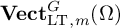 ${\mathbf {Vect}}^{G}_{\operatorname {\mathrm {LT}},m}(\Omega )$
are closed under sub-quotients.
${\mathbf {Vect}}^{G}_{\operatorname {\mathrm {LT}},m}(\Omega )$
are closed under sub-quotients.
Furthermore, these are compatible with respect to the forgetful functor
 $$\begin{align*}\operatorname{\mathrm{Rep}}^{Y_m}_{L_m}(G \times H) \rightarrow \operatorname{\mathrm{Rep}}^{Z_m}_{K_m}(G_0 \times H_0), \qquad V \mapsto e_{0} \cdot V \end{align*}$$
where $e_0$
is the idempotent of
$e_0$
is the idempotent of $L_m$
corresponding to
$L_m$
corresponding to $K_m$
, in the sense that the diagram
$K_m$
, in the sense that the diagram

commutes.
Proof. For ${\mathbf {VectCon}}$
, the functor is the composition of
${\mathbf {VectCon}}$
, the functor is the composition of
 $$\begin{align*}\mathcal{O}_{{\mathcal M}_m} \otimes_{L_m} - \colon \operatorname{\mathrm{Rep}}^{Y_m}_{L_m}(G \times H) \rightarrow {\mathbf{VectCon}}^{G \times H / H_m}({\mathcal M}_m), \end{align*}$$
from Section 3 (with $(X,G,H)$
taken as
$(X,G,H)$
taken as $({\mathcal M}_m, G \times H/H_m, G^m)$
) and the equivalences
$({\mathcal M}_m, G \times H/H_m, G^m)$
) and the equivalences
 $$\begin{align*}(-)^H \colon {\mathbf{VectCon}}^{G \times H / H_m}({\mathcal M}_m) \xrightarrow{\sim} {\mathbf{VectCon}}^{G \times H / H_0}({\mathcal M}) \xrightarrow{\sim} {\mathbf{VectCon}}^{G}(\Omega) \end{align*}$$
of [Reference Taylor24, Prop. 2.53] and [Reference Taylor24, §7.5]. The assumptions of Section 3 are satisfied, as $G \times H / H_m$
acts transitively on the components
$G \times H / H_m$
acts transitively on the components $({\mathcal M}_m^i)_{i \in {\mathbb Z}}$
of
$({\mathcal M}_m^i)_{i \in {\mathbb Z}}$
of ${\mathcal M}_m$
[Reference Taylor24, §7.1], and each connected component X of
${\mathcal M}_m$
[Reference Taylor24, §7.1], and each connected component X of ${\mathcal M}_m$
is irreducible as a
${\mathcal M}_m$
is irreducible as a $G_m\text {-}\mathcal {O}_{X}$
-module by Corollary 4.2 and the isomorphisms
$G_m\text {-}\mathcal {O}_{X}$
-module by Corollary 4.2 and the isomorphisms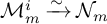 ${\mathcal M}_m^i \xrightarrow {\sim } {\mathcal N}_m$
induced by the action of a uniformiser of H. Therefore the first part of the statement follows from Proposition 3.4 and Lemma 6.2. The commutativity follows from the commutativity of
${\mathcal M}_m^i \xrightarrow {\sim } {\mathcal N}_m$
induced by the action of a uniformiser of H. Therefore the first part of the statement follows from Proposition 3.4 and Lemma 6.2. The commutativity follows from the commutativity of

which commutes by construction, and the commutativity of

which commutes because the left-hand square does by definition and the right-hand square does by [Reference Taylor24, Lem. 7.10]. The same holds with ${\mathbf {VectCon}}$
replaced by
${\mathbf {VectCon}}$
replaced by ${\mathbf {Vect}}$
everywhere.
${\mathbf {Vect}}$
everywhere.
Remark 6.5. For the equivalence of categories part of Corollary 6.4 one doesn’t need the full force of the results of Section 3, it being possible to show directly that $(\mathcal {O}_{{\mathcal M}_m} \otimes _{L_m} -)^H$
has inverse
$(\mathcal {O}_{{\mathcal M}_m} \otimes _{L_m} -)^H$
has inverse $(\mathcal {O}({\mathcal M}_m) \otimes _{\mathcal {O}(\Omega )} (-)(\Omega ))^{G^m}$
, the key property used being the characterisation of Lemma 6.2.
$(\mathcal {O}({\mathcal M}_m) \otimes _{\mathcal {O}(\Omega )} (-)(\Omega ))^{G^m}$
, the key property used being the characterisation of Lemma 6.2.
For $m' \geq m$
, there is a fully faithful inclusion functor
$m' \geq m$
, there is a fully faithful inclusion functor
 $$\begin{align*}L_{m'} \otimes_{L_m} - \colon \operatorname{\mathrm{Rep}}^{Y_m}_{L_m}(G \times H) \rightarrow \operatorname{\mathrm{Rep}}^{Y_{m'}}_{L_{m'}}(G \times H), \end{align*}$$
and this is compatible with inclusion of Lubin-Tate bundles of levels m and $m'$
in the sense that
$m'$
in the sense that

commutes.
Definition 6.5. We define
 $$ \begin{align*} \Psi_{G} &\colon \operatorname{\mathrm{Rep}}_K^{\operatorname{\mathrm{sm}}}(G) \rightarrow {\mathbf{VectCon}}_{\operatorname{\mathrm{LT}}}^{G}(\Omega),\\ \Psi_{H} &\colon \operatorname{\mathrm{Rep}}_K^{\operatorname{\mathrm{sm}}}(H) \rightarrow {\mathbf{VectCon}}_{\operatorname{\mathrm{LT}}}^{G}(\Omega), \end{align*} $$
as the direct limits of the functors
 $$ \begin{align*} \operatorname{\mathrm{Rep}}_K^{G^m}(G) \xrightarrow{L_m \otimes_K -} \operatorname{\mathrm{Rep}}_{L_m}^{Y_m}(G \times H) \rightarrow {\mathbf{VectCon}}^{G}_{\operatorname{\mathrm{LT}},m}(\Omega),\\ \operatorname{\mathrm{Rep}}_K^{H^m}(H) \xrightarrow{L_m \otimes_K -} \operatorname{\mathrm{Rep}}_{L_m}^{Y_m}(G \times H) \rightarrow {\mathbf{VectCon}}^{G}_{\operatorname{\mathrm{LT}},m}(\Omega). \end{align*} $$
Here we have used that the categories $\operatorname {\mathrm {Rep}}_K^{G^m}(G)$
exhaust
$\operatorname {\mathrm {Rep}}_K^{G^m}(G)$
exhaust $\operatorname {\mathrm {Rep}}_K^{\operatorname {\mathrm {sm}}}(G)$
, which is true because
$\operatorname {\mathrm {Rep}}_K^{\operatorname {\mathrm {sm}}}(G)$
, which is true because $\operatorname {\mathrm {Rep}}_K^{G_m}(G) = \operatorname {\mathrm {Rep}}_K^{G^m}(G)$
as a consequence of the following lemma.
$\operatorname {\mathrm {Rep}}_K^{G_m}(G) = \operatorname {\mathrm {Rep}}_K^{G^m}(G)$
as a consequence of the following lemma.
Lemma 6.6. The normal closure of $G_m$
in G is
$G_m$
in G is $G^m$
.
$G^m$
.
Proof. Let N be the normal closure of $G_m$
in G. Then
$G_m$
in G. Then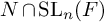 $N \cap \operatorname {\mathrm {SL}}_n(F)$
is an open normal subgroup of
$N \cap \operatorname {\mathrm {SL}}_n(F)$
is an open normal subgroup of $\operatorname {\mathrm {SL}}_n(F)$
, hence
$\operatorname {\mathrm {SL}}_n(F)$
, hence $\operatorname {\mathrm {SL}}_n(F) \subset N$
by Lemma 6.3, and thus
$\operatorname {\mathrm {SL}}_n(F) \subset N$
by Lemma 6.3, and thus $G^m \subset N$
, as
$G^m \subset N$
, as $G^m = \operatorname {\mathrm {SL}}_n(F)G_m$
because the determinant map
$G^m = \operatorname {\mathrm {SL}}_n(F)G_m$
because the determinant map $\det \colon G_m \rightarrow 1 + \pi ^m \mathcal {O}_F$
is surjective.
$\det \colon G_m \rightarrow 1 + \pi ^m \mathcal {O}_F$
is surjective.
Remark 6.7. By abuse of notation we will also view $\Psi _{G}$
and
$\Psi _{G}$
and $\Psi _H$
as functors to
$\Psi _H$
as functors to ${\mathbf {Vect}}^{G}_{\operatorname {\mathrm {LT}}}(\Omega )$
.
${\mathbf {Vect}}^{G}_{\operatorname {\mathrm {LT}}}(\Omega )$
.
Kohlhaase also considered functors from $\operatorname {\mathrm {Rep}}_K^{\operatorname {\mathrm {sm}}}(G)$
and
$\operatorname {\mathrm {Rep}}_K^{\operatorname {\mathrm {sm}}}(G)$
and $\operatorname {\mathrm {Rep}}_K^{\operatorname {\mathrm {sm}}}(H)$
to
$\operatorname {\mathrm {Rep}}_K^{\operatorname {\mathrm {sm}}}(H)$
to ${\mathbf {Vect}}_{\operatorname {\mathrm {LT}}}^{G}(\Omega )$
[Reference Kohlhaase13, Thm. 4.5], using the equivalences,
${\mathbf {Vect}}_{\operatorname {\mathrm {LT}}}^{G}(\Omega )$
[Reference Kohlhaase13, Thm. 4.5], using the equivalences,

where ${\mathbf {Vect}}^{H}_{\operatorname {\mathrm {Dr}}}({\mathbb P}^{n-1})$
is an analogously defined category of H-equivariant Drinfeld bundles on
${\mathbf {Vect}}^{H}_{\operatorname {\mathrm {Dr}}}({\mathbb P}^{n-1})$
is an analogously defined category of H-equivariant Drinfeld bundles on ${\mathbb P}^{n-1}$
. The following shows that these coincide with
${\mathbb P}^{n-1}$
. The following shows that these coincide with $\Psi _{G}$
and
$\Psi _{G}$
and $\Psi _{H}$
.
$\Psi _{H}$
.
Lemma 6.8. For $V \in \operatorname {\mathrm {Rep}}_K^{\operatorname {\mathrm {sm}}}(G)$
and
$V \in \operatorname {\mathrm {Rep}}_K^{\operatorname {\mathrm {sm}}}(G)$
and $W \in \operatorname {\mathrm {Rep}}_K^{\operatorname {\mathrm {sm}}}(H)$
there are natural isomorphisms,
$W \in \operatorname {\mathrm {Rep}}_K^{\operatorname {\mathrm {sm}}}(H)$
there are natural isomorphisms,
 $$ \begin{align*} \Psi_{G}(V) &\cong \mathcal{O}_{\Omega} \otimes_K V, \\ \Psi_{H}(W) &\cong {\mathbb D}_{\operatorname{\mathrm{Dr}}}(\mathcal{O}_{{\mathbb P}^{n-1}} \otimes_K W) \end{align*} $$
in ${\mathbf {Vect}}_{\operatorname {\mathrm {LT}}}^{G}(\Omega )$
.
${\mathbf {Vect}}_{\operatorname {\mathrm {LT}}}^{G}(\Omega )$
.
Proof. If $G^m$
acts trivially on V, then
$G^m$
acts trivially on V, then
 $$ \begin{align*} \Psi_{G}(V) &= (\mathcal{O}_{{\mathcal M}_m} \otimes_K V)^{H/H_m}, \\ &= \mathcal{O}_{{\mathcal M}_m}^{H/H_m} \otimes_K V, \\ &= \mathcal{O}_{\Omega} \otimes_K V \end{align*} $$
because H acts trivially on V. For the description of $\Psi _{H}(W)$
, as all spaces are the disjoint union of quasi-Stein spaces it is sufficient to give the isomorphism on global sections. As W is smooth some
$\Psi _{H}(W)$
, as all spaces are the disjoint union of quasi-Stein spaces it is sufficient to give the isomorphism on global sections. As W is smooth some $H_m$
acts trivially on W, and from [Reference Kohlhaase13, §4 (26)] we have that (in the notation of [Reference Kohlhaase13]),
$H_m$
acts trivially on W, and from [Reference Kohlhaase13, §4 (26)] we have that (in the notation of [Reference Kohlhaase13]),
 $$ \begin{align*} \Gamma(\Omega, {\mathbb D}_{\operatorname{\mathrm{Dr}}}(\mathcal{O}_{{\mathbb P}^{n-1}} \otimes_K W)) &= (\mathbb{C}_{\infty} \otimes_{K} W)^{H}, \\ &\equiv (\mathbb{C}_{\infty}^{H_m} \otimes_{K} W)^{H/H_m}, \\ &\equiv (\mathbb{A}_{m} \otimes_{K} W)^{H/H_m},\\ &= \Gamma(\Omega, \Psi_G(V)) \end{align*} $$
using [Reference Kohlhaase13, Lem. 3.3] for the second equality, and that $\mathbb {C}_{\infty }^{H_m} = \mathbb {A}_m$
[Reference Kohlhaase13, Thm. 4.3] for the third.
$\mathbb {C}_{\infty }^{H_m} = \mathbb {A}_m$
[Reference Kohlhaase13, Thm. 4.3] for the third.
Proposition 6.9. The functors $\Psi _{G}$
and
$\Psi _{G}$
and $\Psi _{H}$
are fully faithful and preserve irreducibility.
$\Psi _{H}$
are fully faithful and preserve irreducibility.
Proof. Each is the composition of fully faithful functors. The functors
 $$ \begin{align*} L_m \otimes_K - \colon \operatorname{\mathrm{Rep}}_K^{G^m}(G) \rightarrow \operatorname{\mathrm{Rep}}_{L_m}^{Y_m}(G \times H),\\ L_m \otimes_K - \colon \operatorname{\mathrm{Rep}}_K^{H^m}(H) \rightarrow \operatorname{\mathrm{Rep}}_{L_m}^{Y_m}(G \times H), \end{align*} $$
both preserve irreducibility, by Corollary 3.9 with $(F,G,H)$
taken as
$(F,G,H)$
taken as $(L_m, G / G^m \times H / H_m, H/H_m)$
and
$(L_m, G / G^m \times H / H_m, H/H_m)$
and $(L_m, G / G^m \times H / H_m, G/G^m)$
respectively, and the functors
$(L_m, G / G^m \times H / H_m, G/G^m)$
respectively, and the functors $\operatorname {\mathrm {Rep}}_{L_m}^{Y_m}(G \times H) \rightarrow {\mathbf {VectCon}}^G_{\operatorname {\mathrm {LT}},m}(\Omega )$
and
$\operatorname {\mathrm {Rep}}_{L_m}^{Y_m}(G \times H) \rightarrow {\mathbf {VectCon}}^G_{\operatorname {\mathrm {LT}},m}(\Omega )$
and $\operatorname {\mathrm {Rep}}_{L_m}^{Y_m}(G \times H) \rightarrow {\mathbf {Vect}}^G_{\operatorname {\mathrm {LT}},m}(\Omega )$
preserve irreducibility by Corollary 6.4.
$\operatorname {\mathrm {Rep}}_{L_m}^{Y_m}(G \times H) \rightarrow {\mathbf {Vect}}^G_{\operatorname {\mathrm {LT}},m}(\Omega )$
preserve irreducibility by Corollary 6.4.
It turns out that $\Psi _H$
is actually an equivalence of categories.
$\Psi _H$
is actually an equivalence of categories.
Theorem 6.10. The functors
 $$\begin{align*}\operatorname{\mathrm{Rep}}_K^{\operatorname{\mathrm{sm}}}(H) \xrightarrow{\Psi_{H}} {\mathbf{VectCon}}^{G}_{\operatorname{\mathrm{LT}}}(\Omega) \rightarrow {\mathbf{Vect}}^{G}_{\operatorname{\mathrm{LT}}}(\Omega) \end{align*}$$
are equivalences of categories.
Proof. This follows from Corollary 6.4, once we show that each
 $$\begin{align*}L_{m} \otimes_K - \colon \operatorname{\mathrm{Rep}}_K^{H_m}(H) \rightarrow \operatorname{\mathrm{Rep}}^{Y_m}_{L_{m}}(G \times H) \end{align*}$$
is an equivalence. To see this, set
 $$ \begin{align*} X_0 = \bigsqcup_{i \in {\mathbb Z}} \operatorname{\mathrm{Spec}}(c({\mathcal M}^i)), \qquad X_m = \bigsqcup_{i \in {\mathbb Z}} \operatorname{\mathrm{Spec}}(c({\mathcal M}^i_m)), \end{align*} $$
and note that there are pullback functors
 $$\begin{align*}{\mathbf{Vect}}^{H/H_m}(\operatorname{\mathrm{Spec}}(K)) \rightarrow {\mathbf{Vect}}^{G / G^0 \times H/H_m}(X_0) \rightarrow {\mathbf{Vect}}^{G / G^{m} \times H/H_m}(X_m), \end{align*}$$
which are equivalences: the second as $G^0 / G^m$
is the Galois group of
$G^0 / G^m$
is the Galois group of $X_m / X_0$
([Reference Taylor24, Prop. 2.53]) and the first by [Reference Taylor24, Ex. 2.33], using the fact that
$X_m / X_0$
([Reference Taylor24, Prop. 2.53]) and the first by [Reference Taylor24, Ex. 2.33], using the fact that $G / G^0$
acts on the connected components of
$G / G^0$
acts on the connected components of $X_0$
simply transitively. Taking global sections, this becomes
$X_0$
simply transitively. Taking global sections, this becomes
 $$\begin{align*}\operatorname{\mathrm{Rep}}_K^{H_m}(H) \xrightarrow{\sim} \operatorname{\mathrm{Rep}}_{c({\mathcal M})}^{G^0 \times H_m}(G \times H) \xrightarrow{\sim} \operatorname{\mathrm{Rep}}_{L_m}^{Y_m}(G \times H) \end{align*}$$
the composition of which coincides with $L_m \otimes _K -$
above.
$L_m \otimes _K -$
above.
Remark 6.11. Similarly, one can show $\Psi _G$
is also an equivalence when
$\Psi _G$
is also an equivalence when $n = 1$
(cf. [Reference Kohlhaase13, Prop. 4.6]).
$n = 1$
(cf. [Reference Kohlhaase13, Prop. 4.6]).
When $n \geq 2$
, however,
$n \geq 2$
, however, $\Psi _G$
is not an equivalence. To construct an object outside the essential image, let
$\Psi _G$
is not an equivalence. To construct an object outside the essential image, let $W \in \operatorname {\mathrm {Rep}}_K^{\operatorname {\mathrm {sm}}}(H)$
be any representation of H which is non-trivial on
$W \in \operatorname {\mathrm {Rep}}_K^{\operatorname {\mathrm {sm}}}(H)$
be any representation of H which is non-trivial on $\operatorname {\mathrm {SL}}_1(D)$
, the kernel of the reduced norm
$\operatorname {\mathrm {SL}}_1(D)$
, the kernel of the reduced norm $\operatorname {\mathrm {Nrd}} \colon H \rightarrow F^{\times }$
. For example one could take W to be any of the representations
$\operatorname {\mathrm {Nrd}} \colon H \rightarrow F^{\times }$
. For example one could take W to be any of the representations $V_m$
of [Reference Taylor24, Ex. 7.17], where the condition that
$V_m$
of [Reference Taylor24, Ex. 7.17], where the condition that $n \geq 2$
is used to ensure that
$n \geq 2$
is used to ensure that $\operatorname {\mathrm {SL}}_1(D) \neq 0$
.
$\operatorname {\mathrm {SL}}_1(D) \neq 0$
.
Let L be an extension of K containing $F^{\operatorname {\mathrm {ab}}}$
. Because
$F^{\operatorname {\mathrm {ab}}}$
. Because $\Psi _H$
commutes with base change (by Remark 7.1 and [Reference Taylor24, Lem. B.2]),
$\Psi _H$
commutes with base change (by Remark 7.1 and [Reference Taylor24, Lem. B.2]), $\Psi _H(W)_L \cong \Psi _{H, L}(W_L)$
, and by [Reference Taylor24, Thm. C]
$\Psi _H(W)_L \cong \Psi _{H, L}(W_L)$
, and by [Reference Taylor24, Thm. C] $\Psi _{H, L}(W_L)$
is non-trivial when restricted to
$\Psi _{H, L}(W_L)$
is non-trivial when restricted to ${\mathbf {VectCon}}(\Omega )$
, in the sense that it is not the direct sum of
${\mathbf {VectCon}}(\Omega )$
, in the sense that it is not the direct sum of $\dim _K(W)$
copies of
$\dim _K(W)$
copies of $\mathcal {O}_{\Omega }$
.
$\mathcal {O}_{\Omega }$
.
On the other hand, by Lemma 6.8 we have that for every $V \in \operatorname {\mathrm {Rep}}_K^{\operatorname {\mathrm {sm}}}(G)$
,
$V \in \operatorname {\mathrm {Rep}}_K^{\operatorname {\mathrm {sm}}}(G)$
, $\Psi _G(V)_L = \mathcal {O}_{\Omega } \otimes _K V = \mathcal {O}_{\Omega , L} \otimes _L V_L$
, and therefore
$\Psi _G(V)_L = \mathcal {O}_{\Omega } \otimes _K V = \mathcal {O}_{\Omega , L} \otimes _L V_L$
, and therefore $\Psi _G(V)_L$
is isomorphic to the direct sum of
$\Psi _G(V)_L$
is isomorphic to the direct sum of $\dim _K(V)$
copies of
$\dim _K(V)$
copies of $\mathcal {O}_{\Omega _L}$
when restricted to
$\mathcal {O}_{\Omega _L}$
when restricted to ${\mathbf {VectCon}}(\Omega )$
.
${\mathbf {VectCon}}(\Omega )$
.
In particular, $\Psi _{H}(W) \not \cong \Psi _G(V)$
for any
$\Psi _{H}(W) \not \cong \Psi _G(V)$
for any $V \in \operatorname {\mathrm {Rep}}_K^{\operatorname {\mathrm {sm}}}(G)$
, and therefore
$V \in \operatorname {\mathrm {Rep}}_K^{\operatorname {\mathrm {sm}}}(G)$
, and therefore $\Psi _{H}(W)$
is not in the essential image of
$\Psi _{H}(W)$
is not in the essential image of $\Psi _G$
.
$\Psi _G$
.
Corollary 6.12. The functor
 $$\begin{align*}\mathcal{O}_{{\mathbb P}^{n-1}} \otimes_K - \colon \operatorname{\mathrm{Rep}}_K^{\operatorname{\mathrm{sm}}}(H) \rightarrow {\mathbf{Vect}}^H_{\operatorname{\mathrm{Dr}}}({\mathbb P}^{n-1}) \end{align*}$$
is an equivalence of categories.
7
$G^0$
-finite vector bundles on
$\Omega $


In this section we consider the functors

which are defined in the same way as [Reference Taylor24, §7.7, §7.8]. We describe how one can use the results of Section 3 and Section 4.2 to show that the main result of [Reference Taylor24] also holds for these functors.
Remark 7.1. For $V \in \operatorname {\mathrm {Rep}}_K^{\operatorname {\mathrm {sm}}}(H)$
and
$V \in \operatorname {\mathrm {Rep}}_K^{\operatorname {\mathrm {sm}}}(H)$
and $W \in \operatorname {\mathrm {Rep}}_K^{\operatorname {\mathrm {sm}}}(H_0)$
, there are natural isomorphisms
$W \in \operatorname {\mathrm {Rep}}_K^{\operatorname {\mathrm {sm}}}(H_0)$
, there are natural isomorphisms
 $$ \begin{align*} \Phi_H(V) &\cong \Psi_H(V^*), \\ \Phi_H^0(W) &\cong \Psi^0_H(W^*) \end{align*} $$
as G-equivariant (resp. $G_0$
-equivariant) vector bundles (with connection). This follows from Remark 6.7 together with [Reference Taylor24, Thm. 6.1(1)] and the construction of
$G_0$
-equivariant) vector bundles (with connection). This follows from Remark 6.7 together with [Reference Taylor24, Thm. 6.1(1)] and the construction of $\Phi _H^0$
and
$\Phi _H^0$
and $\Phi _H$
.
$\Phi _H$
.
Theorem 7.2. The functors $\Phi _H^0$
and
$\Phi _H^0$
and $\Phi _H$
are exact, monoidal, and fully faithful. The diagram
$\Phi _H$
are exact, monoidal, and fully faithful. The diagram

commutes, and the essential image of each is closed under sub-quotients.
Proof. The triples $({\mathcal N}_m, G^0 \times H_0 / H_m, G^0)$
and
$({\mathcal N}_m, G^0 \times H_0 / H_m, G^0)$
and $({\mathcal M}_m, G \times H / H_m, G)$
satisfy the assumptions of Section 3, which can be checked similarly to the start of Section 5 and the start of Section 6. The fact that
$({\mathcal M}_m, G \times H / H_m, G)$
satisfy the assumptions of Section 3, which can be checked similarly to the start of Section 5 and the start of Section 6. The fact that $\Phi _H^0$
and
$\Phi _H^0$
and $\Phi _H$
are exact, monoidal, fully faithful and have essential images closed under sub-quotients then follows exactly as in [Reference Taylor24, §7.10], which only uses [Reference Taylor24, §6], which itself goes through with
$\Phi _H$
are exact, monoidal, fully faithful and have essential images closed under sub-quotients then follows exactly as in [Reference Taylor24, §7.10], which only uses [Reference Taylor24, §6], which itself goes through with ${\mathbf {VectCon}}$
replaced with
${\mathbf {VectCon}}$
replaced with ${\mathbf {Vect}}$
by appealing to the results Section 3 in lieu of the results of [Reference Taylor24, §4]. The compatibility between
${\mathbf {Vect}}$
by appealing to the results Section 3 in lieu of the results of [Reference Taylor24, §4]. The compatibility between $\Phi ^0_H$
with
$\Phi ^0_H$
with $\Phi _H$
follows analogously to the case for
$\Phi _H$
follows analogously to the case for ${\mathbf {VectCon}}$
[Reference Taylor24, §7.8].
${\mathbf {VectCon}}$
[Reference Taylor24, §7.8].
We can also describe the essential images of $\Phi _H^0$
and
$\Phi _H^0$
and $\Phi _H$
, by modifying the methods of [Reference Taylor24] to our setting. The main difference is that unlike
$\Phi _H$
, by modifying the methods of [Reference Taylor24] to our setting. The main difference is that unlike ${\mathbf {VectCon}}^{G^0}(\Omega )$
, the category
${\mathbf {VectCon}}^{G^0}(\Omega )$
, the category ${\mathbf {Vect}}^{G^0}(\Omega )$
is not obviously abelian (it might fail to be closed under quotients), and therefore one needs to also use the larger abelian category
${\mathbf {Vect}}^{G^0}(\Omega )$
is not obviously abelian (it might fail to be closed under quotients), and therefore one needs to also use the larger abelian category ${\mathbf {Coh}}^{G^0}(\Omega )$
.
${\mathbf {Coh}}^{G^0}(\Omega )$
.
We need a couple of notions from [Reference Taylor24, §5]. For a set of objects ${\mathcal S}$
of
${\mathcal S}$
of ${\mathbf {Coh}}^{G^0}(\Omega )$
, we follow [Reference Taylor24, §3] and write
${\mathbf {Coh}}^{G^0}(\Omega )$
, we follow [Reference Taylor24, §3] and write ${\mathcal C}({\mathcal S})$
for the full subcategory of
${\mathcal C}({\mathcal S})$
for the full subcategory of ${\mathbf {Coh}}^{G^0}(\Omega )$
whose objects are those objects isomorphic to a quotient of a sub-object of a direct sum of objects of
${\mathbf {Coh}}^{G^0}(\Omega )$
whose objects are those objects isomorphic to a quotient of a sub-object of a direct sum of objects of ${\mathcal S}$
. For
${\mathcal S}$
. For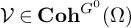 ${\mathcal V} \in {\mathbf {Coh}}^{G^0}(\Omega )$
, we set
${\mathcal V} \in {\mathbf {Coh}}^{G^0}(\Omega )$
, we set  where
where ${\mathcal S}_{{\mathcal V}}$
is the set of objects
${\mathcal S}_{{\mathcal V}}$
is the set of objects $\{({\mathcal V})^{\otimes s} \otimes ({\mathcal V}^*)^{\otimes t}\}_{s,t \in {\mathbb Z}_{\geq 0}}$
. For
$\{({\mathcal V})^{\otimes s} \otimes ({\mathcal V}^*)^{\otimes t}\}_{s,t \in {\mathbb Z}_{\geq 0}}$
. For $f = \sum _{n \geq 0} a_n x^n \in {\mathbb Z}_{\geq 0}[x]$
and
$f = \sum _{n \geq 0} a_n x^n \in {\mathbb Z}_{\geq 0}[x]$
and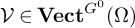 ${\mathcal V} \in {\mathbf {Vect}}^{G^0}(\Omega )$
, we define
${\mathcal V} \in {\mathbf {Vect}}^{G^0}(\Omega )$
, we define

Definition 7.1. An object ${\mathcal V} \in {\mathbf {Vect}}^{G^0}(\Omega )$
is finite if
${\mathcal V} \in {\mathbf {Vect}}^{G^0}(\Omega )$
is finite if
-
1. there are
$f,g \in {\mathbb Z}_{\geq 0}[x]$
with
$f \neq g$
and
$f({\mathcal V}) \cong g({\mathcal V})$
, -
2. for any complete field extension L of K,
${\mathcal C}({\mathcal V}_L) \subset {\mathbf {Vect}}^{G^0}(\Omega _L)$
.
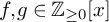

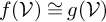

We write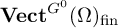 ${\mathbf {Vect}}^{G^0}(\Omega )_{\operatorname {\mathrm {fin}}}$
for the full subcategory of
${\mathbf {Vect}}^{G^0}(\Omega )_{\operatorname {\mathrm {fin}}}$
for the full subcategory of ${\mathbf {Vect}}^{G^0}(\Omega )$
whose objects are the finite objects, and
${\mathbf {Vect}}^{G^0}(\Omega )$
whose objects are the finite objects, and ${\mathbf {Vect}}^{G}(\Omega )_{G^0\text {-}\operatorname {\mathrm {fin}}}$
for the full subcategory of
${\mathbf {Vect}}^{G}(\Omega )_{G^0\text {-}\operatorname {\mathrm {fin}}}$
for the full subcategory of ${\mathbf {Vect}}^{G}(\Omega )$
whose objects are those that restrict to a finite object of
${\mathbf {Vect}}^{G}(\Omega )$
whose objects are those that restrict to a finite object of ${\mathbf {Vect}}^{G^0}(\Omega )$
.
${\mathbf {Vect}}^{G^0}(\Omega )$
.
Theorem 7.3. The functors $\Phi _H^0$
and
$\Phi _H^0$
and $\Phi _H$
induce equivalences
$\Phi _H$
induce equivalences

Proof. Given $V \in \operatorname {\mathrm {Rep}}_K^{\operatorname {\mathrm {sm}}}(H_0)$
,
$V \in \operatorname {\mathrm {Rep}}_K^{\operatorname {\mathrm {sm}}}(H_0)$
, $\Phi ^0_H(V)$
is finite:
$\Phi ^0_H(V)$
is finite: ${\mathcal V}$
satisfies the required polynomial relation by [Reference Taylor24, Thm. 6.1(4)], and for any complete extension
${\mathcal V}$
satisfies the required polynomial relation by [Reference Taylor24, Thm. 6.1(4)], and for any complete extension $L / K$
,
$L / K$
, $\Phi ^0_H$
commutes with base change by [Reference Taylor24, Lem. B.2] and so
$\Phi ^0_H$
commutes with base change by [Reference Taylor24, Lem. B.2] and so
 $$\begin{align*}{\mathcal C}(\Phi^0_H(V)_L) = {\mathcal C}(\Phi^0_{H, L}(V_L)) \subset \Phi^0_{H,L}(\operatorname{\mathrm{Rep}}_L^{\operatorname{\mathrm{sm}}}(H)) \subset {\mathbf{Vect}}^{G^0}(\Omega_L), \end{align*}$$
the essential image of $\Phi ^0_{H,L}$
being closed under direct sums, duals, tensor products and sub-quotients.
$\Phi ^0_{H,L}$
being closed under direct sums, duals, tensor products and sub-quotients.
Conversely given ${\mathcal V} \in {\mathbf {Vect}}^{G^0}(\Omega )$
which is finite, we may reason following [Reference Taylor24, §7.11]. For any complete field extension
${\mathcal V} \in {\mathbf {Vect}}^{G^0}(\Omega )$
which is finite, we may reason following [Reference Taylor24, §7.11]. For any complete field extension $L / K$
the full subcategory
$L / K$
the full subcategory ${\mathcal C}({\mathcal V}_L)$
is abelian by assumption, and being contained in
${\mathcal C}({\mathcal V}_L)$
is abelian by assumption, and being contained in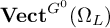 ${\mathbf {Vect}}^{G^0}(\Omega _L)$
can be viewed as a Tannakian category by fixing an L-rational point z of
${\mathbf {Vect}}^{G^0}(\Omega _L)$
can be viewed as a Tannakian category by fixing an L-rational point z of $\Omega _L$
and using the fibre functor
$\Omega _L$
and using the fibre functor

Here we use the condition that ${\mathcal C}({\mathcal V}_L) \subset {\mathbf {Vect}}^{G^0}(\Omega _L)$
to ensure that
${\mathcal C}({\mathcal V}_L) \subset {\mathbf {Vect}}^{G^0}(\Omega _L)$
to ensure that $\omega _z$
is exact. In particular, when
$\omega _z$
is exact. In particular, when $L = C$
is a complete algebraically closed extension of K we can follow exactly the same reasoning as [Reference Taylor24, Prop. 5.8] to see that
$L = C$
is a complete algebraically closed extension of K we can follow exactly the same reasoning as [Reference Taylor24, Prop. 5.8] to see that ${\mathcal C}({\mathcal V}_C)$
is equivalent to the category of C-representations of a constant group scheme, and use this to build a
${\mathcal C}({\mathcal V}_C)$
is equivalent to the category of C-representations of a constant group scheme, and use this to build a $G^0$
-equivariant finite étale Galois covering of
$G^0$
-equivariant finite étale Galois covering of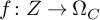 $f \colon Z \rightarrow \Omega _C$
with
$f \colon Z \rightarrow \Omega _C$
with ${\mathcal V}_C$
a direct summand of
${\mathcal V}_C$
a direct summand of $f_* \mathcal {O}_Z$
. One can then reason exactly as in the proof of [Reference Taylor24, Thm. 7.18]: using the Scholze-Weinstein factorisation theorem [Reference Scholze and Weinstein23, Thm. 7.3.1] one can realise
$f_* \mathcal {O}_Z$
. One can then reason exactly as in the proof of [Reference Taylor24, Thm. 7.18]: using the Scholze-Weinstein factorisation theorem [Reference Scholze and Weinstein23, Thm. 7.3.1] one can realise ${\mathcal V}_C$
as an object in the essential image of
${\mathcal V}_C$
as an object in the essential image of $\Phi ^0_{H,C}$
, and from this deduce that
$\Phi ^0_{H,C}$
, and from this deduce that ${\mathcal V}$
is in the essential image of
${\mathcal V}$
is in the essential image of $\Phi ^0_H$
from the compatibility of
$\Phi ^0_H$
from the compatibility of $\Phi ^0_H$
with base change.
$\Phi ^0_H$
with base change.
The description of the essential image of $\Phi _H$
follows from that of
$\Phi _H$
follows from that of $\Phi _H^0$
as in [Reference Taylor24, Cor. 7.19].
$\Phi _H^0$
as in [Reference Taylor24, Cor. 7.19].
From Theorem 7.3 and Theorems A and B of [Reference Taylor24], we immediately have the following.
Corollary 7.4. The forgetful functors
 $$ \begin{align*} {\mathbf{VectCon}}^{G}(\Omega)_{G^0\text{-}\operatorname{\mathrm{fin}}} &\xrightarrow{\sim} {\mathbf{Vect}}^{G}(\Omega)_{G^0\text{-}\operatorname{\mathrm{fin}}}, \\ {\mathbf{VectCon}}^{G^0}(\Omega)_{\operatorname{\mathrm{fin}}} &\xrightarrow{\sim} {\mathbf{Vect}}^{G^0}(\Omega)_{\operatorname{\mathrm{fin}}} \end{align*} $$
are equivalences of categories.
The rank $1$
finite objects of
$1$
finite objects of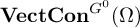 ${\mathbf {VectCon}}^{G^0}(\Omega )$
are the torsion line bundles [Reference Taylor24, Lem. 5.5]. We can show this is also true in
${\mathbf {VectCon}}^{G^0}(\Omega )$
are the torsion line bundles [Reference Taylor24, Lem. 5.5]. We can show this is also true in ${\mathbf {Vect}}^{G^0}(\Omega )$
with our slightly modified definition of finiteness.
${\mathbf {Vect}}^{G^0}(\Omega )$
with our slightly modified definition of finiteness.
Proposition 7.5. Suppose that ${\mathcal L} \in {\mathbf {Vect}}^{G^0}(\Omega )$
has rank
${\mathcal L} \in {\mathbf {Vect}}^{G^0}(\Omega )$
has rank $1$
. Then
$1$
. Then ${\mathcal L}$
is finite if and only if
${\mathcal L}$
is finite if and only if ${\mathcal L}^{\otimes m} \cong \mathcal {O}_{\Omega }$
for some
${\mathcal L}^{\otimes m} \cong \mathcal {O}_{\Omega }$
for some $m \geq 1$
.
$m \geq 1$
.
Proof. If ${\mathcal L}$
is finite, then applying [Reference Taylor24, Lem. 5.5] to the Tannakian category
${\mathcal L}$
is finite, then applying [Reference Taylor24, Lem. 5.5] to the Tannakian category ${\mathcal C}({\mathcal L})$
(after choosing an K-point of
${\mathcal C}({\mathcal L})$
(after choosing an K-point of $\Omega $
) we have that
$\Omega $
) we have that ${\mathcal L}^{\otimes m} \cong \mathcal {O}_{\Omega }$
for some
${\mathcal L}^{\otimes m} \cong \mathcal {O}_{\Omega }$
for some $m \geq 1$
.
$m \geq 1$
.
Conversely, suppose that ${\mathcal L}^{\otimes m} \cong \mathcal {O}_{\Omega }$
for some
${\mathcal L}^{\otimes m} \cong \mathcal {O}_{\Omega }$
for some $m \geq 1$
, so
$m \geq 1$
, so $f({\mathcal L}) = g({\mathcal L})$
for
$f({\mathcal L}) = g({\mathcal L})$
for $f(x) = x^m$
and
$f(x) = x^m$
and $g(x) = 1$
. To verify the second condition, let L be a complete extension of K, and note that as in the first part of the proof of Theorem 7.3, to show that every object of
$g(x) = 1$
. To verify the second condition, let L be a complete extension of K, and note that as in the first part of the proof of Theorem 7.3, to show that every object of ${\mathcal C}({\mathcal L}_L)$
is a vector bundle it is enough to show that
${\mathcal C}({\mathcal L}_L)$
is a vector bundle it is enough to show that ${\mathcal L}_L$
is in the essential image of
${\mathcal L}_L$
is in the essential image of $\Phi ^0_{H,L}$
.
$\Phi ^0_{H,L}$
.
Set  be the finite extension of L defined by adjoining the mth roots of $1$
to L, and fix an isomorphism
$1$
to L, and fix an isomorphism $\alpha \colon {\mathcal L}_{L_m}^{\otimes m} \xrightarrow {\sim } \mathcal {O}_{\Omega _L}$
. To this pair
$\alpha \colon {\mathcal L}_{L_m}^{\otimes m} \xrightarrow {\sim } \mathcal {O}_{\Omega _L}$
. To this pair $({\mathcal L}_{L_m}, \alpha )$
, we may follow the construction of [Reference Taylor25, pg. 11] (appropriately adding
$({\mathcal L}_{L_m}, \alpha )$
, we may follow the construction of [Reference Taylor25, pg. 11] (appropriately adding $G^0$
-equivariant structure) to produce a
$G^0$
-equivariant structure) to produce a $G^0$
-equivariant finite étale Galois covering
$G^0$
-equivariant finite étale Galois covering $f \colon Z \rightarrow \Omega _{L_m}$
with Galois group
$f \colon Z \rightarrow \Omega _{L_m}$
with Galois group $\mu _m(L_m)$
and with
$\mu _m(L_m)$
and with ${\mathcal L}_{L_m}$
a direct summand of
${\mathcal L}_{L_m}$
a direct summand of $f_* \mathcal {O}_Z$
.
$f_* \mathcal {O}_Z$
.
The proof of [Reference Taylor24, Thm. 7.18] starts with exactly such a covering, and thus by the same proof ${\mathcal L}_{L_m}$
is in the essential image of
${\mathcal L}_{L_m}$
is in the essential image of $\Phi ^0_{H,L_m}$
. Then
$\Phi ^0_{H,L_m}$
. Then ${\mathcal L}_L$
itself is in the essential image of
${\mathcal L}_L$
itself is in the essential image of $\Phi ^0_{H,L}$
, using the compatibility of
$\Phi ^0_{H,L}$
, using the compatibility of $\Phi ^0_{H,L}$
with base change as in the final part of the proof of [Reference Taylor24, Thm. 7.18].
$\Phi ^0_{H,L}$
with base change as in the final part of the proof of [Reference Taylor24, Thm. 7.18].
8 Properties of
$\Phi _H$

For any irreducible $V \in \operatorname {\mathrm {Rep}}_{\operatorname {\mathrm {sm}}}(H)$
with
$V \in \operatorname {\mathrm {Rep}}_{\operatorname {\mathrm {sm}}}(H)$
with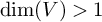 $\dim (V)> 1$
, it is expected that
$\dim (V)> 1$
, it is expected that
 $$\begin{align*}\mathrm{H}_{\operatorname{\mathrm{dR,c}}}^{n-1}(\Omega, \Phi_H(V)) \cong \operatorname{\mathrm{JL}}(V)^{\oplus n} \end{align*}$$
in $\operatorname {\mathrm {Rep}}^{\operatorname {\mathrm {sm}}}_K(G)$
(when K is algebraically closed), where
$\operatorname {\mathrm {Rep}}^{\operatorname {\mathrm {sm}}}_K(G)$
(when K is algebraically closed), where
 $$\begin{align*}\operatorname{\mathrm{JL}} \colon \operatorname{\mathrm{Irr}}^{\operatorname{\mathrm{sm}}}_K(H) \xrightarrow{\sim} \operatorname{\mathrm{Irr}}^{\operatorname{\mathrm{sm}}, \operatorname{\mathrm{ESI}}}_K(G) \end{align*}$$
is the Jacquet-Langlands correspondence from smooth irreducible representations of H to irreducible smooth essentially square-integrable representations of G. For example, this is known in dimension $1$
for
$1$
for $\operatorname {\mathrm {GL}}_2(F)$
[Reference Colmez, Dospinescu and Nizioł9, Thm. 0.4], and in any dimension for certain level
$\operatorname {\mathrm {GL}}_2(F)$
[Reference Colmez, Dospinescu and Nizioł9, Thm. 0.4], and in any dimension for certain level $0$
representations of H corresponding to the first Drinfeld covering
$0$
representations of H corresponding to the first Drinfeld covering ${\mathcal M}_1$
[Reference Junger12, Thm. A].
${\mathcal M}_1$
[Reference Junger12, Thm. A].
It is therefore natural to ask which properties of the Jacquet-Langlands correspondence can already be seen from the properties of the functor $\Phi _H$
. For example, the Jacquet-Langlands correspondence satisfies three natural properties:
$\Phi _H$
. For example, the Jacquet-Langlands correspondence satisfies three natural properties:
-
1.
$\operatorname {\mathrm {JL}}(V^*) = \operatorname {\mathrm {JL}}(V)^*$
, -
2.
$\omega _{V} = \omega _{\operatorname {\mathrm {JL}}(V)}$
, -
3.
$\operatorname {\mathrm {JL}}(\chi _H \otimes V) = \chi _G \otimes \operatorname {\mathrm {JL}}(\rho )$
,



where $\omega _V$
denotes the central character of V,
$\omega _V$
denotes the central character of V, $\chi \colon F^\times \rightarrow K^\times $
is a smooth character of
$\chi \colon F^\times \rightarrow K^\times $
is a smooth character of $F^\times $
, and
$F^\times $
, and
 $$ \begin{align*} (-)_G &\colon \operatorname{\mathrm{Char}}^{\operatorname{\mathrm{sm}}}_K(F^\times) \xrightarrow{\sim} \operatorname{\mathrm{Char}}^{\operatorname{\mathrm{sm}}}_K(G), \qquad \chi_G = \chi \circ \det, \\ (-)_H &\colon \operatorname{\mathrm{Char}}^{\operatorname{\mathrm{sm}}}_K(F^\times) \xrightarrow{\sim} \operatorname{\mathrm{Char}}^{\operatorname{\mathrm{sm}}}_K(H), \qquad \chi_H = \chi \circ \operatorname{\mathrm{Nrd}}, \end{align*} $$
are the associated smooth characters of G and H respectively. These are well-defined bijections because both $\det \colon G \rightarrow F^{\times }$
and
$\det \colon G \rightarrow F^{\times }$
and $\operatorname {\mathrm {Nrd}} \colon H \rightarrow F^{\times }$
are continuous, surjective, and are abelianisations of G and H respectively (by [Reference Lang14, Thm. 8.3, Thm. 9.2] and [Reference Platonov, Rapinchuk and Rapinchuk19, §1.4.3]).
$\operatorname {\mathrm {Nrd}} \colon H \rightarrow F^{\times }$
are continuous, surjective, and are abelianisations of G and H respectively (by [Reference Lang14, Thm. 8.3, Thm. 9.2] and [Reference Platonov, Rapinchuk and Rapinchuk19, §1.4.3]).
This motivates the following Theorem, which establishes that the corresponding properties hold true of the functor $\Phi _H$
(which we consider as a functor to either
$\Phi _H$
(which we consider as a functor to either ${\mathbf {VectCon}}^G(\Omega )$
or
${\mathbf {VectCon}}^G(\Omega )$
or ${\mathbf {Vect}}^G(\Omega )$
).
${\mathbf {Vect}}^G(\Omega )$
).
Theorem 8.1. For any $V \in \operatorname {\mathrm {Rep}}_K^{\operatorname {\mathrm {sm}}}(H)$
,
$V \in \operatorname {\mathrm {Rep}}_K^{\operatorname {\mathrm {sm}}}(H)$
,
-
1.
$\Phi _H(V^*) = \Phi _H(V)^*$
, -
2. If V admits a central character
$\omega _V$
, then
$\omega _{V} = \omega _{\Phi _H(V)}^*$
, -
3. For any smooth character
$\chi \colon F^\times \rightarrow K^\times $
,
$$\begin{align*}\Phi_H(V \otimes \chi_H) = \Phi_H(V) \otimes \chi_G^*. \end{align*}$$




Remark 8.2. Here, for ${\mathcal V} \in {\mathbf {VectCon}}^{\operatorname {\mathrm {GL}}_n(F)}(\Omega )$
with endomorphism ring K,
${\mathcal V} \in {\mathbf {VectCon}}^{\operatorname {\mathrm {GL}}_n(F)}(\Omega )$
with endomorphism ring K, $\omega _{{\mathcal V}}$
is the character
$\omega _{{\mathcal V}}$
is the character

where for $g \in \operatorname {\mathrm {GL}}_n(F)$
,
$g \in \operatorname {\mathrm {GL}}_n(F)$
, $g^{{\mathcal V}} \colon {\mathcal V} \rightarrow g^{-1} {\mathcal V}$
is the equivariant structure morphism, which is an automorphism of
$g^{{\mathcal V}} \colon {\mathcal V} \rightarrow g^{-1} {\mathcal V}$
is the equivariant structure morphism, which is an automorphism of ${\mathcal V}$
whenever g is central, because g is central and acts trivially on
${\mathcal V}$
whenever g is central, because g is central and acts trivially on $\Omega $
.
$\Omega $
.
Remark 8.3. We do not prove it here, but the analogue of Part (3) of Theorem 8.1 for $\Psi _H^0$
is also true: for any smooth character
$\Psi _H^0$
is also true: for any smooth character $\lambda \colon \mathcal {O}_F^{\times } \rightarrow K^\times $
,
$\lambda \colon \mathcal {O}_F^{\times } \rightarrow K^\times $
, $\Psi _H^0(V \otimes \lambda _H) = \Psi _H^0(V) \otimes \lambda _G$
(cf. Remark 5.15).
$\Psi _H^0(V \otimes \lambda _H) = \Psi _H^0(V) \otimes \lambda _G$
(cf. Remark 5.15).
Remark 8.4. In particular, as
 $$\begin{align*}H^{n-1}_{\operatorname{\mathrm{dR,c}}}(\Omega, \mathcal{O}_{\Omega}) = \text{St}_G = \operatorname{\mathrm{JL}}(1) \end{align*}$$
[Reference Schneider and Stuhler21, §3 Thm. 1, §4 Lem. 1], this shows that for any smooth character $\chi \colon F^\times \rightarrow K^{\times }$
,
$\chi \colon F^\times \rightarrow K^{\times }$
,
 $$\begin{align*}H^{n-1}_{\operatorname{\mathrm{dR,c}}}(\Omega, \Phi_H(\chi_H)) = \text{St}_G \otimes \chi_G = \operatorname{\mathrm{JL}}(\chi_H), \end{align*}$$
which complements the expectation outlined above in the case that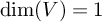 $\dim (V) = 1$
.
$\dim (V) = 1$
.
Proof. The first point follows from the fact that $\Phi _H$
commutes with duals [Reference Taylor24, Rem. 7.14]. For the second point, suppose
$\Phi _H$
commutes with duals [Reference Taylor24, Rem. 7.14]. For the second point, suppose $\lambda \in F^\times $
, write
$\lambda \in F^\times $
, write $\iota \colon F^\times \hookrightarrow H$
,
$\iota \colon F^\times \hookrightarrow H$
, $d \colon F^\times \hookrightarrow G$
for the canonical inclusions, and let
$d \colon F^\times \hookrightarrow G$
for the canonical inclusions, and let $m \geq 1$
be the level of V. We want to show that the image of the action of
$m \geq 1$
be the level of V. We want to show that the image of the action of $\iota (\lambda ) \in H$
on V under
$\iota (\lambda ) \in H$
on V under $\operatorname {\mathrm {Aut}}(V) \xrightarrow {\sim } \operatorname {\mathrm {Aut}}(\Phi _H(V))$
is the inverse of the action of
$\operatorname {\mathrm {Aut}}(V) \xrightarrow {\sim } \operatorname {\mathrm {Aut}}(\Phi _H(V))$
is the inverse of the action of $d(\lambda ) \in G$
on
$d(\lambda ) \in G$
on $\Phi _H(V)$
, so is equal to
$\Phi _H(V)$
, so is equal to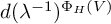 $d(\lambda ^{-1})^{\Phi _H(V)}$
. For a local section
$d(\lambda ^{-1})^{\Phi _H(V)}$
. For a local section $[\phi \colon V \rightarrow \mathcal {O}_{{\mathcal M}_m}(f^{-1}(U))] \in \Phi _H(V)(U)$
, the functorially induced action of
$[\phi \colon V \rightarrow \mathcal {O}_{{\mathcal M}_m}(f^{-1}(U))] \in \Phi _H(V)(U)$
, the functorially induced action of $\iota (\lambda )_V$
on
$\iota (\lambda )_V$
on $\phi $
is
$\phi $
is $\phi \circ \iota (\lambda )_V$
which equals
$\phi \circ \iota (\lambda )_V$
which equals $\iota (\lambda )^{\mathcal {O}_{{\mathcal M}_m}}_{f^{-1}(U)} \circ \phi $
as
$\iota (\lambda )^{\mathcal {O}_{{\mathcal M}_m}}_{f^{-1}(U)} \circ \phi $
as $\phi $
is H-equivariant. On the other hand,
$\phi $
is H-equivariant. On the other hand,
 $$ \begin{align*} d(\lambda^{-1})^{\Phi_H(V)}_{U}(\phi) &= d(\lambda^{-1})^{\mathcal{O}_{{\mathcal M}_m}}_{f^{-1}(U)} \circ \phi, \\ &= \iota(\lambda)^{\mathcal{O}_{{\mathcal M}_m}}_{f^{-1}(U)} \circ \phi, \end{align*} $$
the first equality by definition and the second because the diagonal subgroup $F \hookrightarrow G \times H$
,
$F \hookrightarrow G \times H$
, $\lambda \mapsto (\iota (\lambda ), d(\lambda ))$
acts trivially on
$\lambda \mapsto (\iota (\lambda ), d(\lambda ))$
acts trivially on ${\mathcal M}_m$
. For the third point, as
${\mathcal M}_m$
. For the third point, as $\Phi _H$
is monoidal it is sufficient to show that
$\Phi _H$
is monoidal it is sufficient to show that
 $$\begin{align*}\Phi_H(\chi_H) = \Phi_H(1) \otimes \chi_G^* = \mathcal{O}_{\Omega} \otimes_K \chi_G^*. \end{align*}$$
Writing $m \geq 1$
for the level of
$m \geq 1$
for the level of $\chi $
, set L to be any finite extension of K which contains
$\chi $
, set L to be any finite extension of K which contains $\breve {F}_m$
. Over L the covering
$\breve {F}_m$
. Over L the covering ${\mathcal M}_{m,L}$
breaks up into geometrically connected components, and therefore the diagram of [Reference Taylor24, Thm. C] commutes on representations of level m (which can be seen from the proof, which takes place at each level). In particular, as the restriction of
${\mathcal M}_{m,L}$
breaks up into geometrically connected components, and therefore the diagram of [Reference Taylor24, Thm. C] commutes on representations of level m (which can be seen from the proof, which takes place at each level). In particular, as the restriction of $\chi _H \otimes _K L$
to
$\chi _H \otimes _K L$
to $\operatorname {\mathrm {SL}}_1(D)$
is trivial,
$\operatorname {\mathrm {SL}}_1(D)$
is trivial, $\Phi _H(\chi _H \otimes _K L) \cong \mathcal {O}_{\Omega , L}$
as
$\Phi _H(\chi _H \otimes _K L) \cong \mathcal {O}_{\Omega , L}$
as ${\mathcal D}$
-modules on
${\mathcal D}$
-modules on $\Omega _L$
. We have that
$\Omega _L$
. We have that
 $$\begin{align*}\Phi_H(\chi_H \otimes_K L) = \Phi_H(\chi_H)_L, \end{align*}$$
as $\Phi _H$
commutes with base change [Reference Taylor24, Lem. B.2], and thus by Lemma 8.5 below,
$\Phi _H$
commutes with base change [Reference Taylor24, Lem. B.2], and thus by Lemma 8.5 below, $\Phi _H(\chi _H) \cong \mathcal {O}_{\Omega }$
as
$\Phi _H(\chi _H) \cong \mathcal {O}_{\Omega }$
as ${\mathcal D}$
-modules over K. Consequently,
${\mathcal D}$
-modules over K. Consequently, $\Phi _H(\chi _H) = \mathcal {O}_{\Omega } \otimes _K \psi _G$
for some character
$\Phi _H(\chi _H) = \mathcal {O}_{\Omega } \otimes _K \psi _G$
for some character $\psi $
of
$\psi $
of $F^\times $
by [Reference Ardakov and Wadsley3, Prop. 3.2.14] and the fact that
$F^\times $
by [Reference Ardakov and Wadsley3, Prop. 3.2.14] and the fact that $\operatorname {\mathrm {SL}}_n(F)$
is perfect [Reference Lang14, Thm. 8.3, Thm. 9.2], and we are reduced to showing that
$\operatorname {\mathrm {SL}}_n(F)$
is perfect [Reference Lang14, Thm. 8.3, Thm. 9.2], and we are reduced to showing that $\psi = \chi ^*$
.
$\psi = \chi ^*$
.
Let C be a complete algebraically closed extension of K. If $g \in G_{\operatorname {\mathrm {reg}}}^{\operatorname {\mathrm {ell}}}$
and
$g \in G_{\operatorname {\mathrm {reg}}}^{\operatorname {\mathrm {ell}}}$
and $h \in H_{\operatorname {\mathrm {reg}}}^{\operatorname {\mathrm {ell}}}$
are regular elliptic elements with the same characteristic polynomial, then for any
$h \in H_{\operatorname {\mathrm {reg}}}^{\operatorname {\mathrm {ell}}}$
are regular elliptic elements with the same characteristic polynomial, then for any $x \in \Omega (C)$
which is fixed by g (which exists as g is regular elliptic), there is an equality
$x \in \Omega (C)$
which is fixed by g (which exists as g is regular elliptic), there is an equality
 $$\begin{align*}\text{tr}_{\Psi_H(\chi_H) \otimes \kappa(x)}(g) = \text{tr}_{\chi_H}(h) = \chi(\operatorname{\mathrm{Nrd}}(h)) \end{align*}$$
by [Reference Kohlhaase13, Thm. 4.7] and Lemma 6.8, noting that although [Reference Kohlhaase13] is written in the case that $K = \breve {F}$
, all constructions generalise without issue to the relative setting. We have that
$K = \breve {F}$
, all constructions generalise without issue to the relative setting. We have that $\Psi (\chi _H) = \Phi _H(\chi _H^*)$
by Remark 7.1, and the left-hand side is the trace of the action of g on the
$\Psi (\chi _H) = \Phi _H(\chi _H^*)$
by Remark 7.1, and the left-hand side is the trace of the action of g on the $k(x)$
-vector space
$k(x)$
-vector space
 $$\begin{align*}\Phi_H(\chi_H^*) \otimes \kappa(x) = (\mathcal{O}_{\Omega} \otimes_K \psi_G^* ) \otimes \kappa(x) = \kappa(x) \otimes_K \psi_G^*, \end{align*}$$
or in other words $\psi ^*(\det (g))$
. As g and h have the same characteristic polynomial,
$\psi ^*(\det (g))$
. As g and h have the same characteristic polynomial, $\det (g) = \operatorname {\mathrm {Nrd}}(h)$
, so
$\det (g) = \operatorname {\mathrm {Nrd}}(h)$
, so $\chi (\operatorname {\mathrm {Nrd}}(h)) = \psi ^*(\operatorname {\mathrm {Nrd}}(h))$
, from which the fact that
$\chi (\operatorname {\mathrm {Nrd}}(h)) = \psi ^*(\operatorname {\mathrm {Nrd}}(h))$
, from which the fact that $\chi = \psi ^*$
follows from the Lemma 8.6 below.
$\chi = \psi ^*$
follows from the Lemma 8.6 below.
Lemma 8.5. For any finite extension L of K, the base change homomorphism
 $$\begin{align*}(-)_L \colon \operatorname{\mathrm{PicCon}}(\Omega) \rightarrow \operatorname{\mathrm{PicCon}}(\Omega_L) \end{align*}$$
is injective.
Proof. For any line bundle with connection on $\Omega $
and any finite extension L of K, there is an isomorphism
$\Omega $
and any finite extension L of K, there is an isomorphism
 $$\begin{align*}{\mathcal L}(\Omega)^{{\mathcal T}(\Omega) = 0} \otimes_K L \xrightarrow{\sim} {\mathcal L}_L(\Omega)^{{\mathcal T}(\Omega_L) = 0}. \end{align*}$$
This follows from the same argument given in the proof of [Reference Taylor24, Lem. 3.5] with the sheaf $c_X$
replaced by
$c_X$
replaced by $\operatorname {\mathrm {Hom}}_{{\mathcal D}}(\mathcal {O}, {\mathcal L})$
, the sections of which are described by [Reference Ardakov and Wadsley3, Lem. 3.1.4]. Using this, we see that the base change homomorphism
$\operatorname {\mathrm {Hom}}_{{\mathcal D}}(\mathcal {O}, {\mathcal L})$
, the sections of which are described by [Reference Ardakov and Wadsley3, Lem. 3.1.4]. Using this, we see that the base change homomorphism
 $$\begin{align*}(-)_L \colon \operatorname{\mathrm{PicCon}}(\Omega) \rightarrow \operatorname{\mathrm{PicCon}}(\Omega_L) \end{align*}$$
is injective by [Reference Ardakov and Wadsley3, Cor. 3.1.7], which shows that a line bundle with connection is trivial if and only if it possesses a non-zero global horizontal section.
Lemma 8.6. The reduced normal map induces a surjection
 $$\begin{align*}\operatorname{\mathrm{Nrd}} \colon H_{\operatorname{\mathrm{reg}}}^{\operatorname{\mathrm{ell}}} \rightarrow F^\times. \end{align*}$$
Proof. For $h \in H$
, the reduced characteristic polynomial
$h \in H$
, the reduced characteristic polynomial $f_h$
of h is a power of the minimal polynomial h over F [Reference Berhuy and Oggier5, Lem. IV.2.4]. In particular, if
$f_h$
of h is a power of the minimal polynomial h over F [Reference Berhuy and Oggier5, Lem. IV.2.4]. In particular, if $f_h$
has distinct roots over
$f_h$
has distinct roots over $\overline {F}$
then
$\overline {F}$
then $f_h$
is irreducible, and so any regular element of H is regular elliptic [Reference Bushnell and Henniart7, §1.1]:
$f_h$
is irreducible, and so any regular element of H is regular elliptic [Reference Bushnell and Henniart7, §1.1]: $H_{\operatorname {\mathrm {reg}}}^{\operatorname {\mathrm {ell}}} = H_{\operatorname {\mathrm {reg}}}$
. The set of
$H_{\operatorname {\mathrm {reg}}}^{\operatorname {\mathrm {ell}}} = H_{\operatorname {\mathrm {reg}}}$
. The set of $H_{\operatorname {\mathrm {reg}}}$
is dense in H [Reference Bushnell and Henniart6, Lem. A.3], and therefore the same is true for
$H_{\operatorname {\mathrm {reg}}}$
is dense in H [Reference Bushnell and Henniart6, Lem. A.3], and therefore the same is true for $H_{\operatorname {\mathrm {reg}}}^{\operatorname {\mathrm {ell}}}$
. The nth power subgroup
$H_{\operatorname {\mathrm {reg}}}^{\operatorname {\mathrm {ell}}}$
. The nth power subgroup $F^{\times n}$
of
$F^{\times n}$
of $F^\times $
is open, and hence
$F^\times $
is open, and hence
 $$\begin{align*}H_{\operatorname{\mathrm{reg}}}^{\operatorname{\mathrm{ell}}} \xrightarrow{\operatorname{\mathrm{Nrd}}} F^\times \rightarrow F^{\times} / F^{\times n} \end{align*}$$
is continuous to a discrete space and thus surjective, as $H_{\operatorname {\mathrm {reg}}}^{\operatorname {\mathrm {ell}}}$
is dense in H and
$H_{\operatorname {\mathrm {reg}}}^{\operatorname {\mathrm {ell}}}$
is dense in H and $\operatorname {\mathrm {Nrd}} \colon H \rightarrow F^\times $
is surjective. Therefore, as the set
$\operatorname {\mathrm {Nrd}} \colon H \rightarrow F^\times $
is surjective. Therefore, as the set $H_{\operatorname {\mathrm {reg}}}^{\operatorname {\mathrm {ell}}}$
is closed under multiplication by
$H_{\operatorname {\mathrm {reg}}}^{\operatorname {\mathrm {ell}}}$
is closed under multiplication by $F^\times $
(which follows directly from the definition) and
$F^\times $
(which follows directly from the definition) and $\operatorname {\mathrm {Nrd}}(a) = a^n$
for
$\operatorname {\mathrm {Nrd}}(a) = a^n$
for $a \in F^\times $
,
$a \in F^\times $
, $\operatorname {\mathrm {Nrd}} \colon H_{\operatorname {\mathrm {reg}}}^{\operatorname {\mathrm {ell}}} \rightarrow F^\times $
is also surjective.
$\operatorname {\mathrm {Nrd}} \colon H_{\operatorname {\mathrm {reg}}}^{\operatorname {\mathrm {ell}}} \rightarrow F^\times $
is also surjective.
Remark 8.7. In light of [Reference Bushnell and Henniart7, §1.3], Lemma 8.6 is equivalent to the claim that for any $n \geq 1$
and
$n \geq 1$
and $a \in F^\times $
, there is some monic irreducible polynomial over F of degree n with constant term a.
$a \in F^\times $
, there is some monic irreducible polynomial over F of degree n with constant term a.
Acknowledgements
I would like to thank Jan Kohlhaase, Nicolas Dupré, Tom Adams, Konstantin Ardakov and Alex Horawa for their comments/interest in this work. In particular I am very grateful to Jan Kohlhaase for the invitation to Essen to discuss this work, and his suggestions for how one might prove Theorem A avoiding the use of ${\mathcal D}$
-modules, which greatly simplified the proof of the main result. I would also like to thank the two anonymous referees for their comments, all of which improved the paper.
${\mathcal D}$
-modules, which greatly simplified the proof of the main result. I would also like to thank the two anonymous referees for their comments, all of which improved the paper.
Competing interests
None declared.
Data availability
No data was generated or used as part of this paper.

 -
-


 Open access

