





Introduction
Concern about biodiversity loss worldwide, in combination with an increasing human population, makes it important to find opportunities for conservation in highly modified environments. Most of the world’s population lives in urban areas, and this proportion is set to increase rapidly in the coming decades (United Nations 2019). However, high human population density does not necessarily translate to depauperate ecological communities. Urban green space, such as public parks and gardens, can provide numerous benefits for plant and animal biodiversity (Goddard et al. Reference Goddard, Dougill and Benton2010), as well as improve human well-being (Kondo et al. Reference Kondo, Fluehr, McKeon and Branas2018). Pollinating insects are one focal group that can be supported by urban green space at a low cost relative to the resulting increase in biodiversity (Hall et al. Reference Hall, Camilo, Tonietto, Ollerton, Ahrné and Arduser2017). Pollinators are at risk from a multitude of anthropogenic factors, primarily the conversion of habitat to agricultural and urban areas (Vanbergen and The Insect Pollinators Initiative Reference Vanbergen2013; Fenoglio et al. Reference Fenoglio, Rossetti and Videla2020). Replacing lost habitat in urban areas could help to mitigate pollinator declines. Our study was broadly interested in how urban gardens can be optimised as habitat for syrphid pollinators.
Many studies show that diverse communities of native pollinators persist in urban green spaces around the world, suggesting that this type of habitat could be incorporated into broader pollinator conservation efforts (Hall et al. Reference Hall, Camilo, Tonietto, Ollerton, Ahrné and Arduser2017). Accordingly, several recent studies have investigated which types of city gardens support the greatest pollinator diversity or abundance. Baldock et al. (Reference Baldock, Goddard, Hicks, Kunin, Mitschunas and Morse2019) showed that among nine land use types in four cities, residential gardens and community gardens received the most pollinator visits. These green space types also had higher-than-average floral abundance and richness, driven by numerous nonnative plant taxa. In Matteson and Langellotto (Reference Matteson and Langellotto2010), sunlight and floral availability were correlated with increased bee and butterfly richness in inner-city community gardens, whereas the surrounding habitat matrix had minimal effects. The study suggests that in certain contexts, gardens can support pollinator diversity no matter where plots are placed in the landscape. On the other hand, some studies have found that the effects of landscape-scale factors interact with local factors to determine pollinator diversity (Bates et al. Reference Bates, Sadler, Fairbrass, Falk, Hale and Matthews2011; Janvier et al. Reference Janvier, Ulyshen, Braman, Traylor, Edelkind-Vealey and Braman2022).
Research on urban pollinator species diversity has focused mainly on bees and, to a lesser extent, butterflies, whereas less charismatic groups like fly pollinators have often been inadequately sampled or not identified to the species level (Harrison and Winfree Reference Harrison and Winfree2015; Majewska and Altizer Reference Majewska and Altizer2018). One such group of understudied pollinators is the syrphid flies (Diptera: Syrphidae), also known as hover flies or flower flies. Globally, Diptera is the second-most frequent order of flower-visiting insects after Hymenoptera (Larson et al. Reference Larson, Kevan and Inouye2001), and syrphid flies are considered the most important dipteran pollinators due to their usual adult diet of pollen and nectar (Winfree et al. Reference Winfree, Bartomeus and Cariveau2011). Fly pollinators can increase the resilience of pollination services to environmental disturbance because their resource requirements are distinct from those of bees, particularly in the larval stage (Ssymank et al. Reference Ssymank, Kearns, Pape and Thompson2008). Habitat requirements for syrphid larvae vary across the family, with major functional groups dwelling among herbaceous plants, in soil litter, in trees, or in water, and feeding as decomposers, predators, or herbivores (Schweiger et al. Reference Schweiger, Musche, Bailey, Billeter, Diekötter and Hendrickx2007). Unlike bees, syrphid flies are not central-place foragers, meaning that they have no fixed nest to return to after foraging, and therefore they can move freely about the landscape throughout their adult lives. Like large-bodied bees, syrphid flies can carry viable pollen for long distances (Rader et al. Reference Rader, Edwards, Westcott, Cunningham and Howlett2011), potentially facilitating plant gene flow over fragmented landscapes (Doyle et al. Reference Doyle, Hawkes, Massy, Powney, Menz and Wotton2020).
The distinct traits of Syrphidae described above suggest that this group’s responses to urbanisation may differ from those of bees. For example, if cities are more limited in syrphid larval habitat than in bee nesting sites for the species in the regional species pool, only the hardiest and most generalist syrphids may persist in urban landscapes and be less affected by local habitat characteristics than bees are. Among bees, the urban filter tends to favour species that are generalist, have small bodies, emerge late in the season, and nest in cavities (Ayers and Rehan Reference Ayers and Rehan2021). Similarly, syrphid composition in urban areas is likely to be influenced by species functional traits. Persson et al. (Reference Persson, Ekroos, Olsson and Smith2020) documented that equivalent gardens in urban versus rural areas supported distinct bee assemblages, whereas syrphid assemblages in the urban gardens were a subset of the species in the rural gardens. Meanwhile, Bates et al. (Reference Bates, Sadler, Fairbrass, Falk, Hale and Matthews2011) found that syrphid richness was affected by both a landscape-scale urbanisation gradient and local-scale habitat traits, whereas bee richness was correlated only with the urbanisation gradient.
Given the known importance of syrphid flies as pollinators and the increasing use of urban gardens as a pollinator conservation strategy, in our study, we investigated whether two plant assemblage characteristics – flowering plant richness and prevalence of native plants – correlate with syrphid abundance and diversity in urban gardens. Numerous studies have documented that overall pollinator richness or bee species richness increases with flowering plant richness (Ayers and Rehan Reference Ayers and Rehan2021), and limited research on syrphid flies suggests that syrphid abundance is higher in gardens with more plant diversity. Both Rocha et al. (Reference Rocha, Souza, Bleakley, Burley, Mott, Rue-Glutting and Fellowes2018) and McDougall et al. (Reference McDougall, Kristiansen, Latty, Jones and Rader2022) documented positive correlations between plant richness and syrphid abundance, but neither study tested the relationship between plant richness and syrphid richness. The geographic origins of plant species may also influence the pollinators supported by gardens. For pollinators in general, past studies have yielded mixed findings on whether native plants receive more visits and more diverse visitors than nonnative plants (Chrobock et al. Reference Chrobock, Winiger, Fischer and van Kleunen2013; Garbuzov and Ratnieks Reference Garbuzov and Ratnieks2014; Lowenstein et al. Reference Lowenstein, Matteson and Minor2019). In gardens with mixed native and nonnative plants, total pollinator activity was positively correlated with a relative abundance of native plants (Fukase and Simons Reference Fukase and Simons2016; Staab et al. Reference Staab, Pereira-Peixoto and Klein2020). Considering syrphids specifically, Salisbury et al. (Reference Salisbury, Armitage, Bostock, Perry, Tatchell and Thompson2015) found that more syrphids visited plots of native plants than plots of nonnative plants. Furthermore, Smith et al. (Reference Smith, Gaston, Warren and Thompson2006) found that the species richness of native plants was positively correlated with syrphid abundance in residential gardens. It is unclear from past research whether the abundance or presence of native plants predicts syrphid abundance and diversity in urban gardens, with studies on syrphid diversity particularly lacking. Answering this question will help to explore the utility of planting native plants in gardens for supporting biodiversity.
Syrphid flies are widely recognised as generalist pollinators. Nevertheless, evidence of floral preferences in syrphids suggests that flower visitation may differ between habitat patches that vary in plant diversity and native plant availability, along with plant species identities. Although syrphid species that exclusively pollinate a single plant species are rare (Lucas et al. Reference Lucas, Bodger, Brosi, Ford, Forman and Greig2018), syrphid flies have been shown to selectively feed on certain flowering plant species over others (Gilbert Reference Gilbert1981; Cowgill et al. Reference Cowgill, Sotherton and Wratten1993; Colley and Luna Reference Colley and Luna2000; Klecka et al. Reference Klecka, Hadrava, Biella and Akter2018). Syrphid species displayed varying preferences for plants based on plant height, inflorescence size, and flower colour (Klecka et al. Reference Klecka, Hadrava, Biella and Akter2018), and the length of syrphid species’ mouthparts was associated with the corolla depth of the flowers they visited (Gilbert Reference Gilbert1981). The degree of floral specialisation varies across the family, with members of subfamilies Eristalinae and Pipizinae demonstrating more floral specificity than do members of Syrphinae (Klecka et al. Reference Klecka, Hadrava, Biella and Akter2018). Lucas et al. (Reference Lucas, Bodger, Brosi, Ford, Forman and Greig2018) found that the pollen loads carried by five different syrphid genera comprised distinct and complementary plant species pools, further indicating within-family variation in floral preferences. Increased attractiveness or accessibility of certain flowers over others suggests that differences in garden quality for urban syrphids could depend on the floral assemblages planted.
To better understand the garden traits that best support syrphid abundance and diversity, the present study aimed to characterise the relationships between garden-scale plant characteristics and the syrphid assemblages that visited them. We sampled a selection of small, volunteer-maintained street gardens that spanned varying levels of flowering plant richness and proportion of native flower cover. Based on the existence of floral preferences and the variation in their specificity between syrphid groups, we predicted that gardens with more flowering plant taxa and a higher prevalence of native flowering plants would attract more abundant and diverse syrphid visitors.
Methods
Site selection
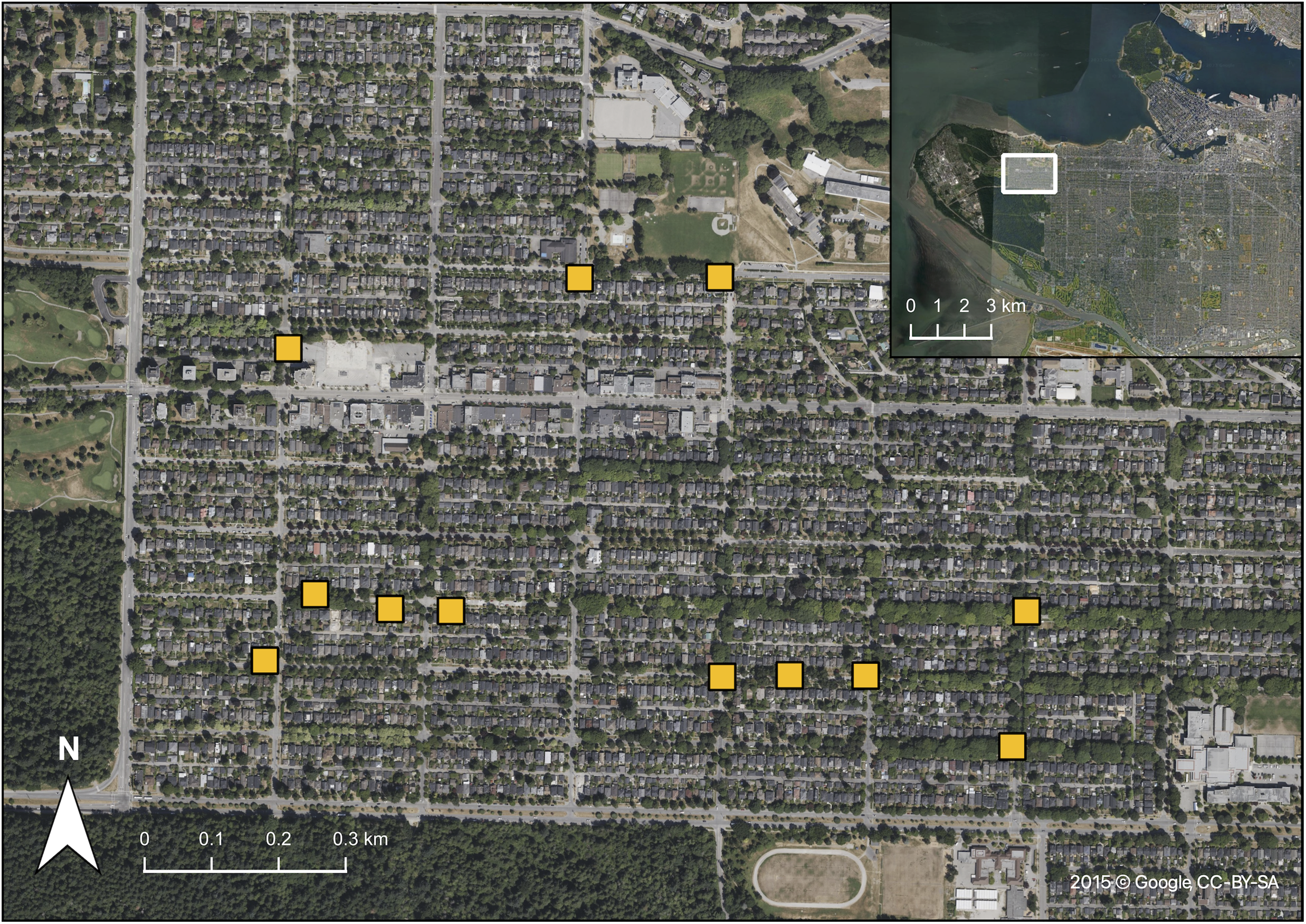
Twelve street gardens were selected in West Point Grey, a low-density residential neighbourhood in Vancouver, British Columbia, Canada (Fig. 1; Supplementary material, Table S1). A single neighbourhood was chosen to keep the habitat matrix more consistent across sites and to minimise landscape-scale effects as a source of variation. All sites were volunteer-maintained gardens on public property, either between the sidewalk and the street, at street corners, or in the centre of a traffic circle. Plot sizes ranged from 2 to 22 m2 (Supplementary material, Table S1). Only gardens that received sunlight during the morning hours were selected because the presence of sunlight influences syrphid activity (Gilbert Reference Gilbert1985). In addition, selected gardens were at least 50 m from the other selected gardens. Selected sites spanned a range of flowering plant richness levels (1–15 genera) and proportion cover values for flowering native plants (0–60%). Sites also had high turnover in the identities of plant genera.
Map of the 12 gardens used as study sites (orange squares). The coarse-scale inset (top right) shows where the study area (white rectangle) was situated in Vancouver, British Columbia, Canada.
Timing of sampling
Gardens were each visited approximately once per week between 19 July and 21 September 2022. Each week, sites were sampled on the three closest possible sunny days to each other with more clear sky than cloud cover, winds less than 10 km/hour, and temperatures between 15 °C and 25 °C. Sites were assigned randomly to each day, with new assignments each week, but it was not possible to randomise the order of sites within a day due to constraints on travel time. Sites were all sampled between 8:00 and 14:00, local time, because this window centres on the peak time for adult syrphid activity in another temperate region (Gilbert Reference Gilbert1985). If on a given visit, a site had less than 1% cover of plants with flowers on them, it was not sampled that week; for this reason, two sites were sampled five times each, whereas the others were sampled eight times each, for a total of 90 samples.
Plant observations
For every sample, a single observer (S.R.) recorded each unique plant morpho-species in flower within the garden, excluding grasses. Plants were identified to the finest possible taxonomic level in the field. Representative plants were photographed for subsequent verification of identifications using Klinkenberg (Reference Klinkenberg2020) and Flora of North America Editorial Committee (1993), and their geographic origins were noted from the same, as well as from Plants of the World Online (2022). If a plant was native to British Columbia, it was always identified to the species level. If a native species identification was ruled out, the plant was identified to the genus level. For each morphologically distinct plant species that was blooming in the garden, the percent cover of flowering individuals over the horizontal area of the garden was visually estimated by the observer (S.R.). If the percent cover value was less than 5%, it was estimated as either 1, 3, or 5%. If the percent cover value was greater than 5%, it was estimated to the nearest 5%. For example, a plant species with approximately 2.5% cover of flowering individuals would be recorded as 3%, whereas 12.5% cover would be recorded as 15%. Individuals lacking flowers were not counted.
Syrphid observations
Syrphids were actively collected using a sweep net. We chose active collection over pan trapping because pan traps have low effectiveness for many syrphid species (Bates et al. Reference Bates, Sadler, Fairbrass, Falk, Hale and Matthews2011), along with concerns about bycatch of nontarget insects and human interference with traps. For every sample, a single observer (S.R.) actively collected syrphid visitors using a sweep net for 20 minutes while slowly walking the perimeter of the patch. A visitor was defined as any syrphid that interacted with the flowering plants in the garden by making physical contact with any part of the plant. The timer was paused for 1–2 minutes while removing the insect from the net and euthanising it with potassium cyanide before resuming sampling.
Specimens were stored in the freezer, pinned, and identified based on morphological characters in published keys (Vockeroth Reference Vockeroth1992; Thompson Reference Thompson1997; Skevington and Thompson Reference Skevington and Thompson2012; Miranda et al. Reference Miranda, Young, Locke, Marshall, Skevington and Thompson2013; Speight et al. Reference Speight, Hauser and Withers2013; Young et al. Reference Young, Marshall and Skevington2016; Skevington et al. Reference Skevington, Locke, Young, Moran, Crins and Marshall2019). Our use of taxon concepts and taxonomic classification was consistent with Skevington et al. (Reference Skevington, Locke, Young, Moran, Crins and Marshall2019). Specimens were identified to the species level, except for the following three taxa of Neocnemodon Goffe, Platycheirus Lepeletier and Serville, and Eupeodes Osten Sacken, which are subsequently treated as species. Two morphologically similar individuals of the genus Neocnemodon were not identified to the species level because the genus requires revision (Skevington et al. Reference Skevington, Locke, Young, Moran, Crins and Marshall2019). In addition, two morphologically similar individuals of the genus Platycheirus were grouped under Platycheirus sp. A because they could not be reliably identified to the species level, but they were distinct from the other species identified in that genus. For Eupeodes sp. A, four males were identified as Eupeodes fumipennis (Thomson), but according to Vockeroth (Reference Vockeroth1992), the 32 females possibly also belonging to Eupeodes fumipennis could not be morphologically distinguished from female Eupeodes americanus (Wiedemann) or Eupeodes pomus (Curran); therefore, we assigned the higher taxonomic grouping to both males and females by calling them Eupeodes sp. A. Representative specimens of each species were vouchered at the University of British Columbia Spencer Museum (Vancouver, British Columbia, Canada). Species were classified as native to British Columbia or nonnative using the same resources as for species identification.
Data analysis
Statistical analyses were performed in R, version 4.2.2 (R Core Team 2022). First, because sites were ostensibly within flight distance of each other for some syrphid species (Schweiger et al. Reference Schweiger, Musche, Bailey, Billeter, Diekötter and Hendrickx2007), we tested syrphid assemblages for spatial autocorrelation. This was achieved by producing a Bray–Curtis similarity matrix of syrphid species present at least once during the sampling season for each pair of sites, producing another matrix of the geographic distance between each site, and running a Mantel test with 1000 permutations on these matrices. The effect of spatial autocorrelation was not statistically significant (P = 0.56). Variables were checked graphically for normality, and variables that were not normally distributed were transformed and checked again for normality; following this, syrphid abundance was transformed to loge(x + 1) for all statistical modelling.
To examine if syrphid abundance or richness differed among sites, for each response variable, we conducted linear models with the fixed effects of garden identity, sampling day, and the interaction between them. To test the effects of time on plant and syrphid assemblages, we generated linear mixed models for the response variables of flowering plant genus richness, syrphid abundance, and syrphid species richness. Each model included sampling day (days since start of sampling period) as a fixed effect and garden identity as a random effect. To examine the effects of plant richness on syrphid abundance or syrphid richness, we used linear mixed-effects models with plant richness as a fixed effect and garden as a random effect. We did not use models that included both sampling day and plant richness (and their interaction) as predictors because these predictors were colinear and exhibited variance inflation factors greater than the recommended threshold of 3 (Zuur et al. Reference Zuur, Ieno and Elphick2010). To investigate the effects of native plants on syrphid abundance or richness, we categorised samples as having either low or high relative presence of native flowering plants rather than using percent native flower cover because nearly half (48.9%) of samples lacked native plants and the remainder of samples had a wide range of percent native flower cover values. Relative presence of native plants was defined as “high” if native plant individuals with flowers covered at least 10% of the site in a garden sample, and “low” samples had native percent cover less than or equal to 2% (0–2%). No samples had a 2–10% cover. Using these categories, we conducted linear mixed-effects models with the relative presence of native flowering plants and the geographic origin of the syrphid species as the fixed effects, plus an interaction term between them. Garden identity was incorporated as a random effect.
All linear modelling used the R package, lmerTest (Kuznetsova et al. Reference Kuznetsova, Brockhoff and Christensen2017), and variance inflation factors were checked with the car package (Fox and Weisberg Reference Fox and Weisberg2019). Spatial autocorrelation was tested using the vegan package (Oksanen et al. Reference Oksanen, Simpson, Blanchet, Kindt, Legendre and Minchin2022). Data visualisation and manipulation used the cowplot (Wilke Reference Wilke2024) and tidyverse (Wickham et al. Reference Wickham, Averick, Bryan, Chang, McGowan and François2019) packages.
Results
General findings
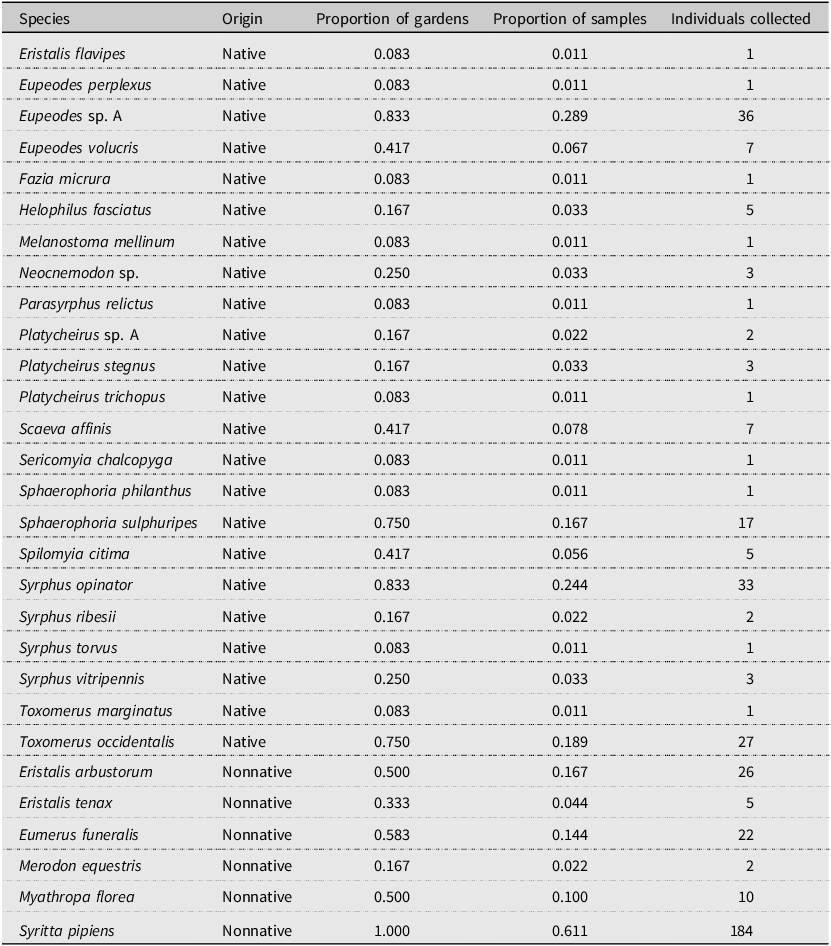
Over the course of the July–September sampling period, we observed a wide range of plants and syrphid visitors at the 12 study gardens in Vancouver. Seventy-three plant genera were recorded in flower (Supplementary material, Table S2). Native plants were represented by 12 species within 10 genera, and nonnative plants were represented by 65 genera. For syrphid flies, we collected 409 individuals of 29 species and 18 genera (Table 1). Most syrphid species were native (79.3%). However, the six nonnative species contributed 249 individuals, or 60.9% of the total. The nonnative compost fly, Syritta pipiens (Linnaeus), was the most common species, represented by 184 individuals, or 45% of the individuals collected. Generally, native plants were less abundant and diverse than nonnative plants, and native syrphids had lower abundance but higher richness than nonnative syrphids. Gardens significantly differed in syrphid abundance and syrphid richness after accounting for sampling through time (Supplementary material, Table S3).
List of syrphid species observed across urban garden sites in Vancouver, British Columbia, Canada between mid-July and mid-September 2022. Species were either native to British Columbia or of nonnative Eurasian origin. For each species, the proportion out of 12 gardens where the species was collected at least once, the proportion out of 90 samples where the species was collected, and the sum of individuals collected across all samples are shown
Effects of time and plant richness on syrphid abundance and richness
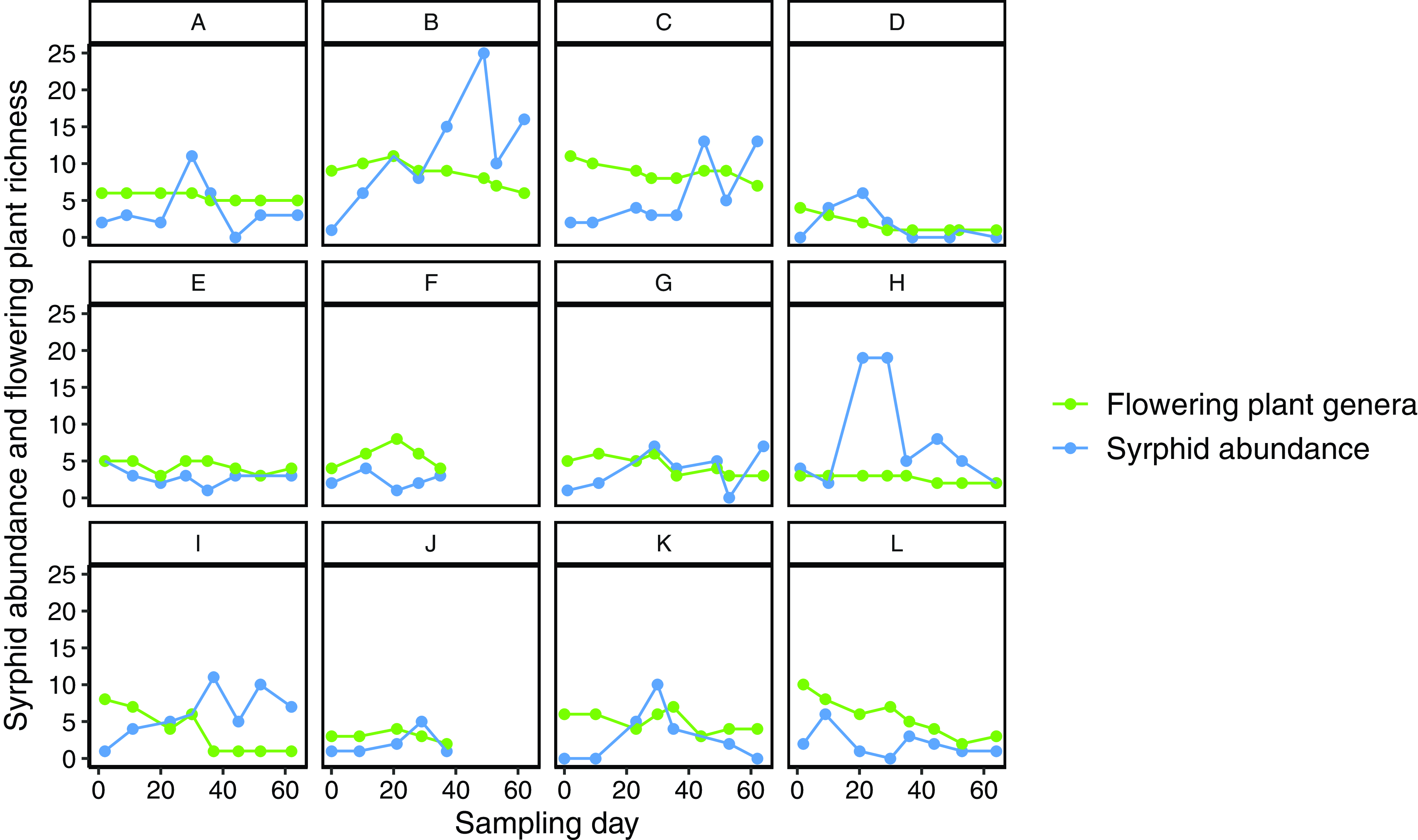
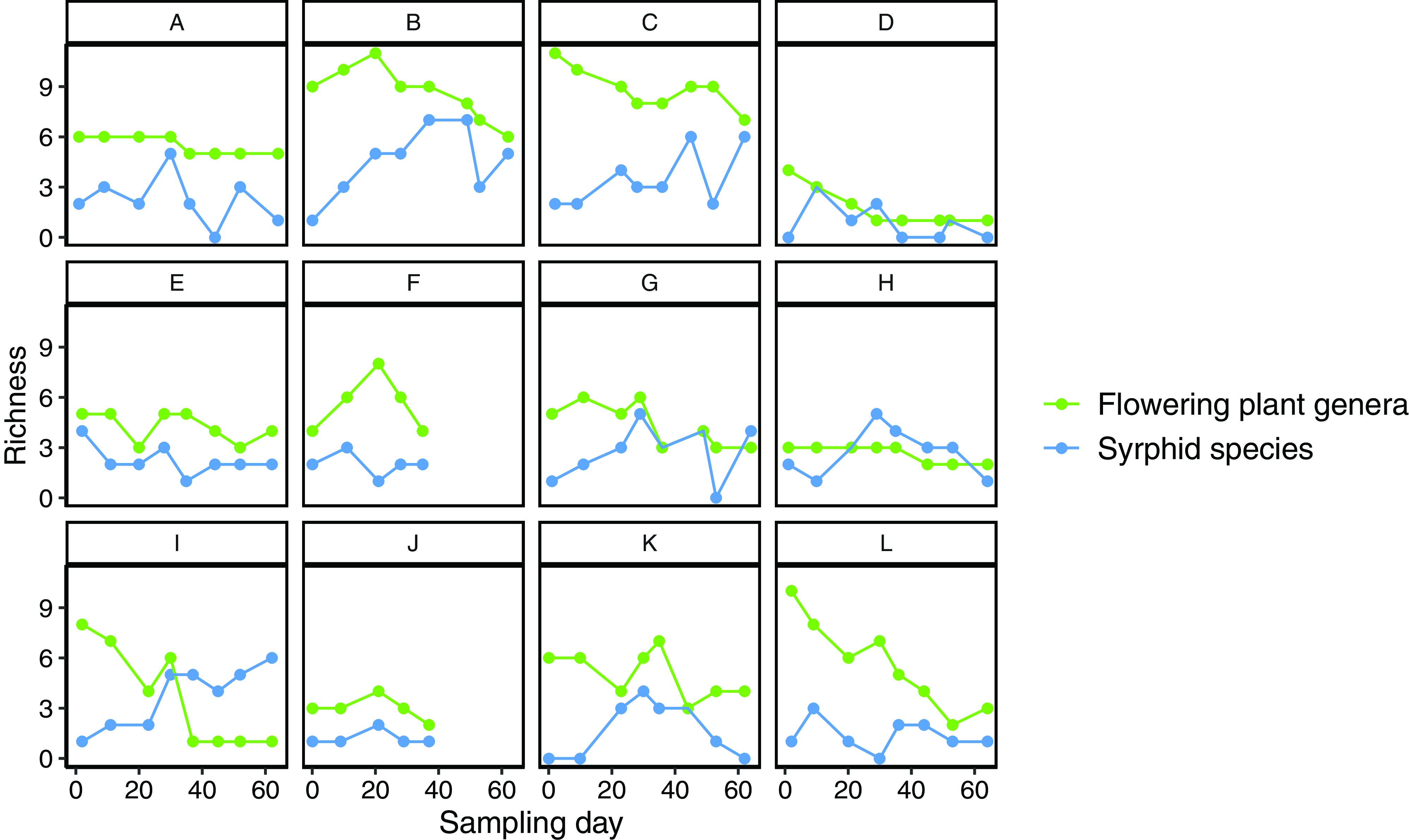
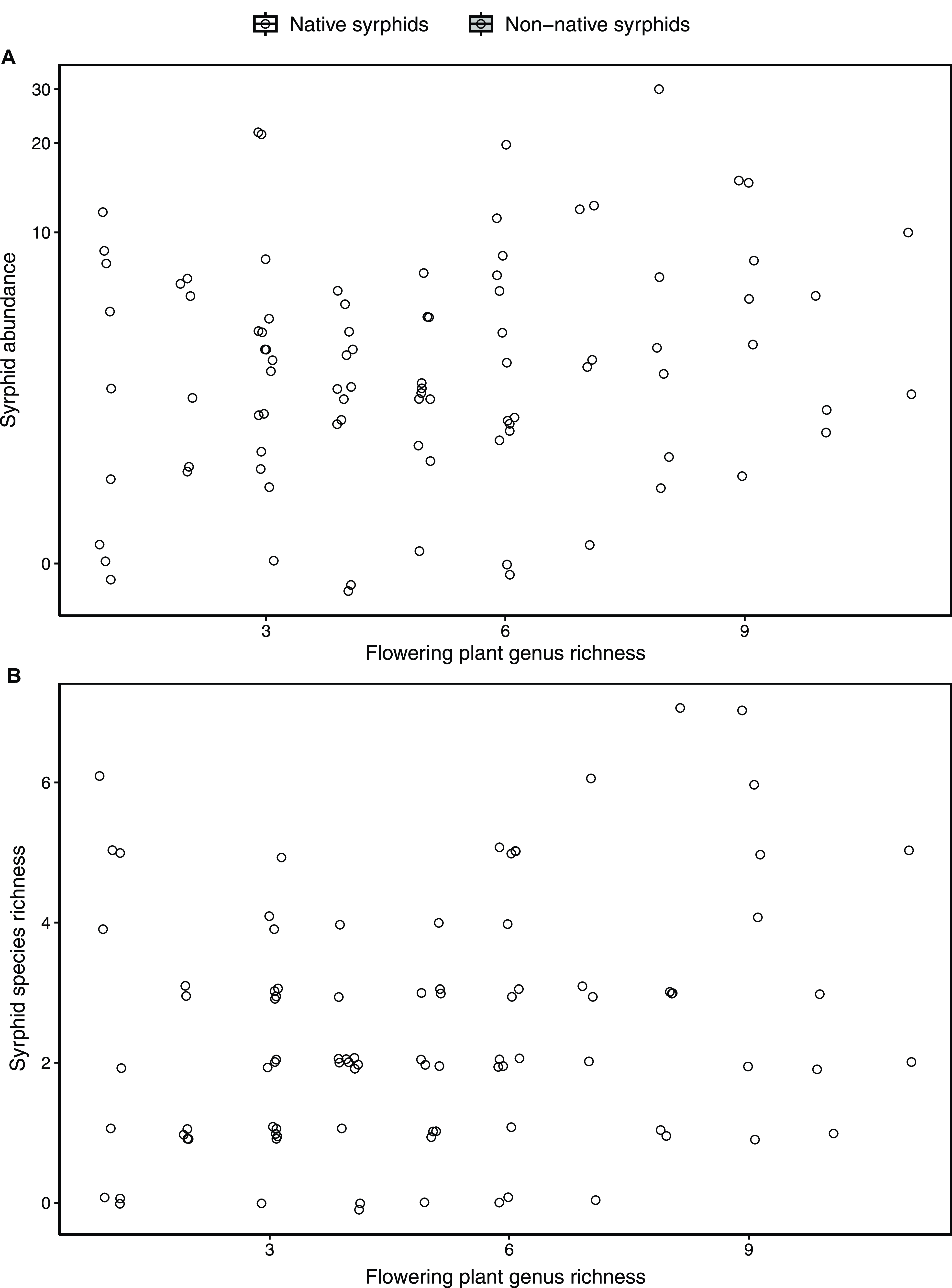
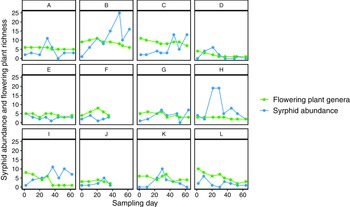
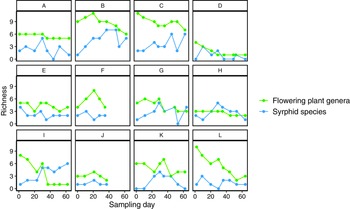
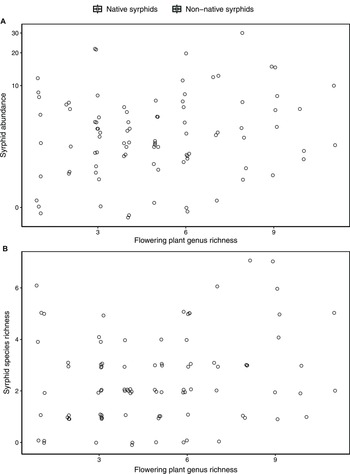
Across the 12 gardens, the number of plant genera in bloom tended to decrease over the sampling period from mid-July to mid-September (Figs. 2 and 3, N = 90, F 1,77.416 = 61.094, P < 0.0001). No general pattern was detected in syrphid abundance or richness over time (abundance: Fig. 2 and Supplementary material, Fig. S1; N = 90, F 1,79.381 = 2.353, P = 0.129; richness: Fig. 3 and Supplementary material Fig. S2; N = 90, F 1,79.144 = 3.096, P = 0.082). No detectable relationship was observed between syrphid abundance and plant genus richness (Fig. 4A; N = 90, F 1,59.008 = 0.007, P = 0.934) or between syrphid richness and plant genus richness (Fig. 4B; N = 90, F 1,61.97 = 0.009, P = 0.927).
Change over time in syrphid abundance and the genus richness of plants in flower for 12 urban gardens (panels correspond to sites A–L). A total of 90 samples were collected between mid-July and mid-September 2022.
Change over time in syrphid species richness and the genus richness of plants in flower for 12 urban gardens (panels correspond to sites A–L). A total of 90 samples were taken between mid-July and mid-September 2022.
A, Abundance and B, species richness of syrphid visitors to 12 urban gardens are plotted against the genus richness of plants in flower per sample for 90 samples. The axis of syrphid abundance, A, is scaled to loge(y + 1).
Effects of plant origin on syrphid abundance and richness
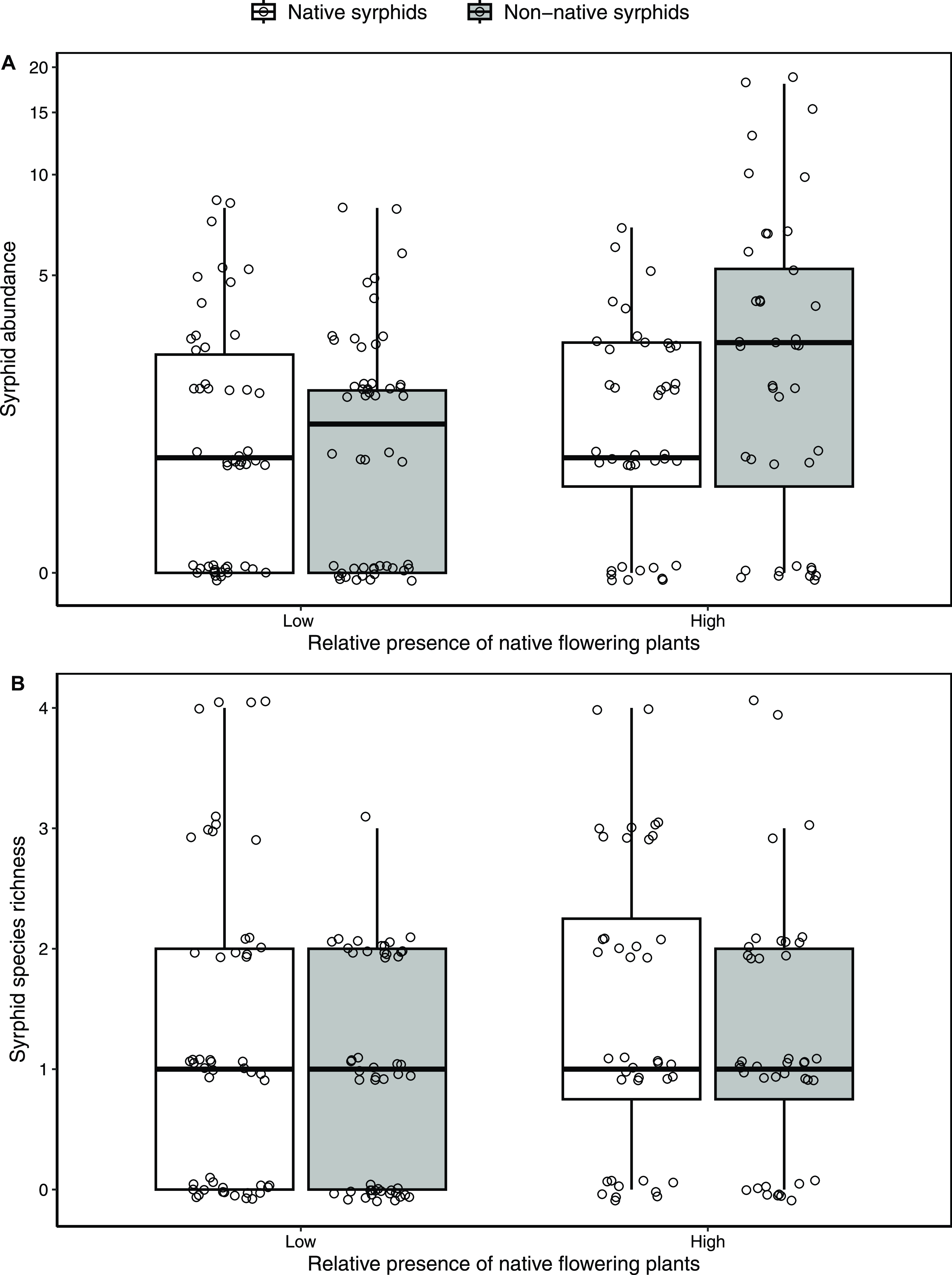
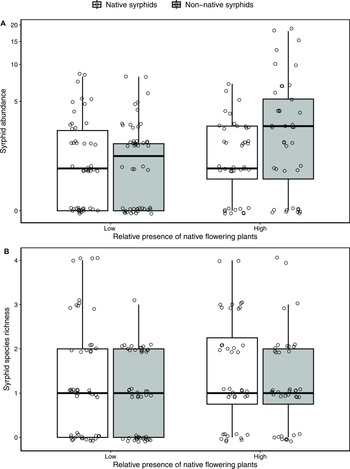
Lastly, we examined whether the presence of native flowers predicted differences in native and nonnative syrphid abundance and richness in garden samples. Forty of 90 samples had appreciable presence of native plants in flower (defined as having at least 10% cover of the garden), and 50 samples were classified as having no or minimal native flowers, with 0% cover of native flowering plants in 44 samples and 1–2% cover in six samples. Interestingly, the median and maximum values of nonnative syrphid abundance appeared higher in samples with native plants than in those with minimal or absent native plants, whereas the equivalent values for native syrphid abundance were the same across sample groups (Fig. 5A). However, this interaction between plant origin and syrphid origin was not statistically significant at the 0.05 level, and neither main effect was statistically significant over the 90 samples per syrphid origin category (presence of native flowers: F 1,62.441 = 0.360, P = 0.551; syrphid species origin: F 1,164.135 = 3.002, P = 0.085; native flowers × syrphid origin interaction: F 1,164.135 = 3.414, P = 0.066). Syrphid richness was similar across native and nonnative syrphid species and levels of native flowering plant cover for the 90 samples each of native and nonnative syrphids (Fig. 5B; presence of native flowers: F 1,69.839 = 0.0003, P = 0.986; syrphid origin: F 1,164.622 = 3.384, P = 0.067; native flowers × syrphid origin interaction: F 1,164.622 = 0.051, P = 0.822).
A, Abundance and B, species richness of native and nonnative syrphid visitors to 12 urban gardens are plotted against relative presence of native flowers per sample, with 90 samples per syrphid origin category. High relative presence represents gardens with at least 10% cover of native plants in flower, and low relative presence represents at most 2% cover. The axis of syrphid abundance, A, is scaled to loge(y + 1).
Discussion
This study aimed to determine the influence of plant richness and the presence of native plants on syrphid abundance and diversity in small urban gardens. Contrary to our hypotheses, neither plant richness nor the presence of native plants affected the abundance or diversity of garden-visiting syrphid flies in a study system with relatively low abundance and diversity of native plants.
Our results do not support the predicted relationship between flowering plant diversity and syrphid abundance and diversity in urban gardens. Although floral diversity decreased over the sampling period, neither the number of syrphid visitors nor the number of species recorded in each syrphid sample changed significantly with time, and floral diversity did not explain the variation among syrphid assemblages. However, other studies have found support for garden plant diversity predicting syrphid abundance. Rocha et al. (Reference Rocha, Souza, Bleakley, Burley, Mott, Rue-Glutting and Fellowes2018) showed that syrphid abundance increased with garden plant richness in private residential gardens that ranged from 29 to 1654 m2. Similarly, McDougall et al. (Reference McDougall, Kristiansen, Latty, Jones and Rader2022) found that urban crop gardens received increased numbers of syrphid visitors to the study’s single target plant species when the surrounding garden had higher plant richness. Our study’s lack of support for a relationship between plant diversity and syrphid assemblages may be due to the smaller size of our study gardens, which ranged from 2 to 22 m2: increases in plant richness may have covered areas too small to have an observable effect on syrphid abundance or diversity, although models with the added explanatory variable of garden size could not be used due to excessive colinearity. Another possibility is that floral characteristics not captured by the metric of plant richness, such as flower colour or shape, or simply plant identities, influenced the findings. Anecdotally, syrphids appeared particularly attracted to certain plant species, such as native Douglas aster, Symphyotrichum subspicatum (Asteraceae), nonnative poppies, Eschscholzia sp. (Papaveraceae), and nonnative goldenrod, Solidago sp. (Asteraceae). As such, the presence of a preferred plant species in flower may have impacted syrphid visitation to the entire garden more than plant richness did. The lack of relationship between syrphid diversity and plant diversity could also be related to landscape-scale filtering of more florally specialised syrphid species from urban areas. In support of this explanation, Persson et al. (Reference Persson, Ekroos, Olsson and Smith2020) showed that syrphid species richness was similar across four types of residential urban gardens, with these species representing a small subset of the significantly richer set of species collected in rural gardens. Although we do not have data from rural gardens to support this claim, our results indicate that syrphid species capable of persisting in the urban landscape are generalist enough as adults for plant diversity not to influence their garden preferences. If more selective species are absent from the landscape due to other limitations, increasing plant richness in urban gardens will not make a difference to diversity of syrphid visitors.
The presence of native plants in street gardens did not significantly explain variation in the abundance or diversity of native and nonnative syrphids in our study. Few other studies have investigated the influence of native plants on syrphids specifically. Salisbury et al. (Reference Salisbury, Armitage, Bostock, Perry, Tatchell and Thompson2015) found that plots of native plants had more syrphid activity than nonnative plots did. Looking at the effects of native plants on pollinating insects more generally, some studies have shown that pollinator abundance benefits from native plants (Chrobock et al. Reference Chrobock, Winiger, Fischer and van Kleunen2013; Salisbury et al. Reference Salisbury, Armitage, Bostock, Perry, Tatchell and Thompson2015; Lowenstein et al. Reference Lowenstein, Matteson and Minor2019), whereas Garbuzov and Ratnieks (Reference Garbuzov and Ratnieks2014) found that abundance was not affected by plant origin. The effects of native plants on pollinator diversity have also been found to be positive (Garbuzov and Ratnieks Reference Garbuzov and Ratnieks2014) or not significant (Staab et al. Reference Staab, Pereira-Peixoto and Klein2020). Our results do not provide support for predicted relationships between native plants and syrphid assemblages. Several factors may have contributed to this result. Firstly, over half of the individuals collected were nonnative, and the native syrphids may have been too few in number (160 individuals total) to detect a general response of this group’s abundance and richness to garden characteristics. Additionally, many gardens that were defined as having a high relative presence of native plants still had low percent cover, ranging from 10 to 60%, with an average native percent cover of 17% across all samples with and without native flowers. The relatively small amount of real-world variation in native plant cover reflects a challenge of correlative investigations in this study system. Other studies of urban gardens have similarly recorded that a minority of plant cover was native (Matteson and Langellotto Reference Matteson and Langellotto2011; Fukase and Simons Reference Fukase and Simons2016). We recorded only 12 native plant species of 10 genera, compared to nonnative species from 65 genera, and this small set of native species may not have included any species that are particularly attractive or important to native syrphids. Tallamy et al. (Reference Tallamy, Narango and Mitchell2021) warned against making comparisons between insects supported by native and nonnative plants in environments that are already lacking in diversity, where shifting baselines can hide the true impacts of plant origin. Given the potential for urban landscapes to filter out more sensitive syrphid species, in addition to the low relative diversity of native plants across our study system, the presence of native plants in a street garden may not meaningfully change its attractiveness to the native syrphids able to live in the area.
Although our predictions were not supported, we cannot generalise that plant richness and native plants do not affect syrphid assemblages in all urban gardens. As discussed above, the studied street gardens were small, and variation between them may have been influenced more by the surrounding habitat matrix than by the characteristics of the individual gardens. Matteson and Langellotto (Reference Matteson and Langellotto2011) highlighted that the addition of 10-m2 native plant patches to community gardens did not increase pollinator richness, leading them to reason that floral additions were too small to make a measurable difference in the much larger community gardens or that nesting requirements were a more limiting factor. Although our study minimised variation in the habitat resource availability surrounding the study sites by selecting street gardens within a 650-m radius of one another in the same residential neighbourhood, we were unable to quantify the variation in floral availability or diversity in the private front yards and backyards near each garden; because these yards were larger than the study sites, their plant composition could have conceivably affected our results. Future research in this system could incorporate surveys of private property or satellite imagery. Additionally, in order to keep the habitat matrix similar, the minimum distance between study gardens was 50 m, even though syrphid dispersal distances vary by species from less than 2 m to hundreds of kilometres (Schweiger et al. Reference Schweiger, Musche, Bailey, Billeter, Diekötter and Hendrickx2007). Although this proximity may suggest that the studied gardens were visited by a homogenous pool of pollinators, our initial analysis showed that gardens significantly differed in the abundance and richness of syrphid visitors, indicating that the gardens were not equivalent patches of habitat. A combination of factors including garden size, garden plant identities, and surrounding habitat could have contributed to the significance of garden identity as a fixed effect, but our study was not able to partition these effects from our focus variables of plant richness and native plant presence due to colinearity between predictors. The sampling period from July to September may also have influenced our findings. Staab et al. (Reference Staab, Pereira-Peixoto and Klein2020) showed that responses of pollinators to the relative availability of native flowers changed with time, with nonnative plants supporting more pollinators late in the season as native plants declined. Colinearity prevented us from accounting for both temporal variability and plant assemblages simultaneously in models of syrphid abundance and richness, but a study with a larger temporal scale may be more sensitive to interactions between predictors. An observational approach introduces more incidental variation into the experiment from differences in garden management, plant identities, size, age, and other factors, but studying pre-existing street gardens is still highly relevant to the objective of optimising gardens in public space as conservation tools. We base our findings on a set of gardens that we already know are realistic for members of the public to maintain, whereas experimental plots may not as closely reflect real-world urban pollinator habitat.
Importantly, our findings characterise the syrphid assemblages that visit small urban gardens in Vancouver, British Columbia, Canada. McCune et al. (Reference McCune, Normandin, Gervais, Mazerolle and Fournier2023) documented 48 syrphid species in Montréal, Quebec, Canada, using pan traps in cemeteries, parks, and community gardens, with less than half of these species detected in the community gardens. To our knowledge, no other studies have documented which syrphid species forage in gardens in North American cities, and little is known about the relative abundance of native versus nonnative syrphids in urban gardens. Across urban and rural farms in western Washington state, United States of America, Olsson et al. (Reference Olsson, Brousil, Clark, Baine and Crowder2021) recorded syrphids spanning 18 species to be the second-most frequent flower visitors and the only pollinators of several crops. In Europe, varying sampling methodologies have identified 15 syrphid species in urban residential gardens (Rocha et al. Reference Rocha, Souza, Bleakley, Burley, Mott, Rue-Glutting and Fellowes2018), 27 species in urban churchyards and cemeteries (Bates et al. Reference Bates, Sadler, Fairbrass, Falk, Hale and Matthews2011), and 17 species in urban meadows managed for insect conservation (Wintergerst et al. Reference Wintergerst, Kästner, Bartel, Schmidt and Nuss2021). Our study shows that even small street gardens can support similarly high levels of syrphid richness, but nonnative species are the most frequent visitors. Comprehensive species inventories of the Vancouver area and the surrounding region are lacking, but such data could clarify whether the syrphid species served by small gardens are a subset of the regional species pool where more sensitive species are filtered out, or whether syrphids tend to be generalist enough to thrive in city gardens. This type of information on local species composition is valuable as a baseline for pollinator conservation efforts under conditions of climate change and continuing habitat transformation.
In conclusion, we found that neither flowering plant diversity nor the presence of native plants explained the variation in syrphid abundance or diversity between street gardens. The factors that can be used to optimise syrphid diversity through urban garden management are not clear from these results. Although the presence of native flowers did not predict native syrphid abundance or diversity in our study, there are many known benefits to planting native flowers. For instance, native plants can support a higher abundance of herbivorous insects (Burghardt and Tallamy Reference Burghardt and Tallamy2013), which in turn may provide more prey for predatory syrphid larvae. Studying a broader range of insect taxa, Mata et al. (Reference Mata, Andersen, Morán-Ordóñez, Hahs, Backstrom and Ives2021) demonstrated that both vegetation heterogeneity and locally native plants are important for maximising insect diversity. Future studies could investigate urban syrphid diversity in larger gardens, over longer time periods, or with experimental approaches, particularly to disentangle the effects of garden size, floral characteristics such as colour and shape, and plant assemblage characteristics such as diversity. McCune et al. (Reference McCune, Normandin, Gervais, Mazerolle and Fournier2023) suggest that the relationship they demonstrated between green space size and syrphid richness could be a result of increased habitat heterogeneity and a greater variety of larval habitat resources available. Our study focused on habitat resources for syrphid flies in the flower-feeding adult stage, but quantifying larval habitat availability of different feeding guilds in urban areas and relating this to functional or species diversity is another avenue open for research. These questions are important given the current situation of global insect declines to which urbanisation contributes (Wagner et al. Reference Wagner, Grames, Forister, Berenbaum and Stopak2021). Urban gardens hold potential for pollinator conservation, but more work is needed to determine how native syrphids can reap the benefits.
Supplementary material
The supplementary material for this article can be found at https://doi.org/10.4039/tce.2025.8.
Data availability
Data are publicly available at https://doi.org/10.5683/SP3/PFGUMJ.
Acknowledgements
The authors acknowledge that this research took place on the traditional, ancestral, and unceded territory of the Musqueam, Squamish, and Tsleil-Waututh peoples. This study was made possible by members of the public who established streetside gardens in West Point Grey, Vancouver. The authors thank Karen Needham for facilitating the use of the Beaty Biodiversity Museum (University of British Columbia, Vancouver) collections for identification assistance and voucher specimen storage. This study was funded by a Natural Sciences and Engineering Research Council of Canada Discovery Grant to Michelle Tseng.
Author contributions
Michelle Tseng and Savitri Raghuraman designed the study. Savitri Raghuraman collected and analysed the data and drafted the manuscript, and Michelle Tseng and Savitri Raghuraman revised the manuscript.
Competing interests
The authors declare that they have no competing interests.




 Open access

